
It’s June 2016.
The football world is just gearing up for a UEFA Euro 2016 championship in France, where Cristiano Ronaldo’s Portugal would eventually defeat the hosts in the final despite their star player’s absence on the pitch through injury.
Real Madrid have just won their 11th UEFA Champions League title and first under the leadership of manager Zinedine Zidane.
Leicester City have remarkably defied the odds to win the Premier League title under Claudio Ranieri and his quick transitions, direct play, creative wingers and legendary strike partnership of Jamie Vardy and Shinji Okazaki.
Despite the unique nature of their story, Leicester City’s league-winning setup was vintage Premier League — the type of tactics and style of play we’ve seen dominate the league for the majority of its history — certainly in the early years through to the beginning of the 2010s.
Over in Serie A, Juventus had just claimed their fifth straight league title — a second under Massimiliano Allegri, who also preferred a direct, transitional style of play reliant on wide creators (wing-backs, in this case, with three centre-backs holding down the fort at the back).
Atalanta BC finished that campaign in 13th place.
This was not an unusual finishing position for the Bergamo-based side; it was pretty much par for the course, with Atalanta having been, at best, a mid-table Serie A side throughout most of their history.
That summer marked a turning point for the club who, up to that point, only had one third-tier title, five Serie B titles and one Coppa Italia to their name, the latter of which they won all the way back in 1963.
That summer, Atalanta appointed Gian Piero Gasperini as their manager, sparking a revolution that culminated in their UEFA Europa League victory of 2023/24.
Gasperini’s near-decade in charge of Atalanta is characterised by the club’s transformation from an unexceptional mid-table dweller/relegation battler to a consistent competitor for European competition.
Atalanta have finished in the top half of the table every season since Gasperini’s arrival.
So far, under his leadership, they’ve finished fourth twice and third three times.
Last season might’ve been Gasperini’s most significant achievement with Atalanta, guiding them to European silverware.
However, at the time of writing, in the midst of the 66-year-old tactician’s ninth season in charge of the club, they sit top of the table in what is a very tight title race in Italy’s top-flight, with the most goals scored (38) and highest xG (34.69) of any side in the league after 15 games.
Gasperini’s transformative impact on Atalanta has been highly impressive, not just due to the club’s achievements during this time but also the style of play with which they’ve become synonymous.
Atalanta are known for a high-octane, fast-paced attacking philosophy, fearlessly committing men forward with the aim of overwhelming the opposition with their offensive might.
In addition to their distinctive, admirable style, Atalanta’s commitment to nurturing talent via the youth system draws some comparisons between Gasperini and past greats of the game, namely Sir Alex Ferguson of Manchester United.
Funnily enough, it was reported that Ferguson had eyed Gasperini as a potential assistant and eventual successor while the Italian was managing Genoa from 2006 to 2010, though needless to say, that move—however much reality the reports are based in—never came to fruition.
Despite Gasperini never linking up with Ferguson at Manchester United, the 66-year-old appears to view the legendary Scot as a reference.
Gasperini is quoted as saying he “can see [himself] staying [at Atalanta] for a long time, like Sir Alex Ferguson at Manchester United” earlier this year in an interview with La Gazzetta dello Sport.
Club President Antonio Percassi also expressed his desire to keep Gasperini at Gewiss Stadium for the long term, citing Ferguson’s legendary tenure at Old Trafford as inspiration.
There are evidently aspects of Ferguson’s style of management both on and off the pitch which Gasperini admires, and there are likely to be aspects of Gasperini’s work which Ferguson currently holds in high regard as well.
This tactical analysis piece will focus solely on Atalanta’s high-octane attacking tactics, aspects of these tactics which resemble some of the iconic football played by Ferguson’s greatest teams and how the Atalanta boss has put his own unique touch on these philosophies to make them his own, too.
Gasperini’s Atalanta Formation & Structure
The club has primarily played with three centre-backs throughout Gasperini’s time as Atalanta boss.
That’s been no different this season, with I Nerazzurri rotating between either a 3-4-2-1 or 3-4-1-2 shape.
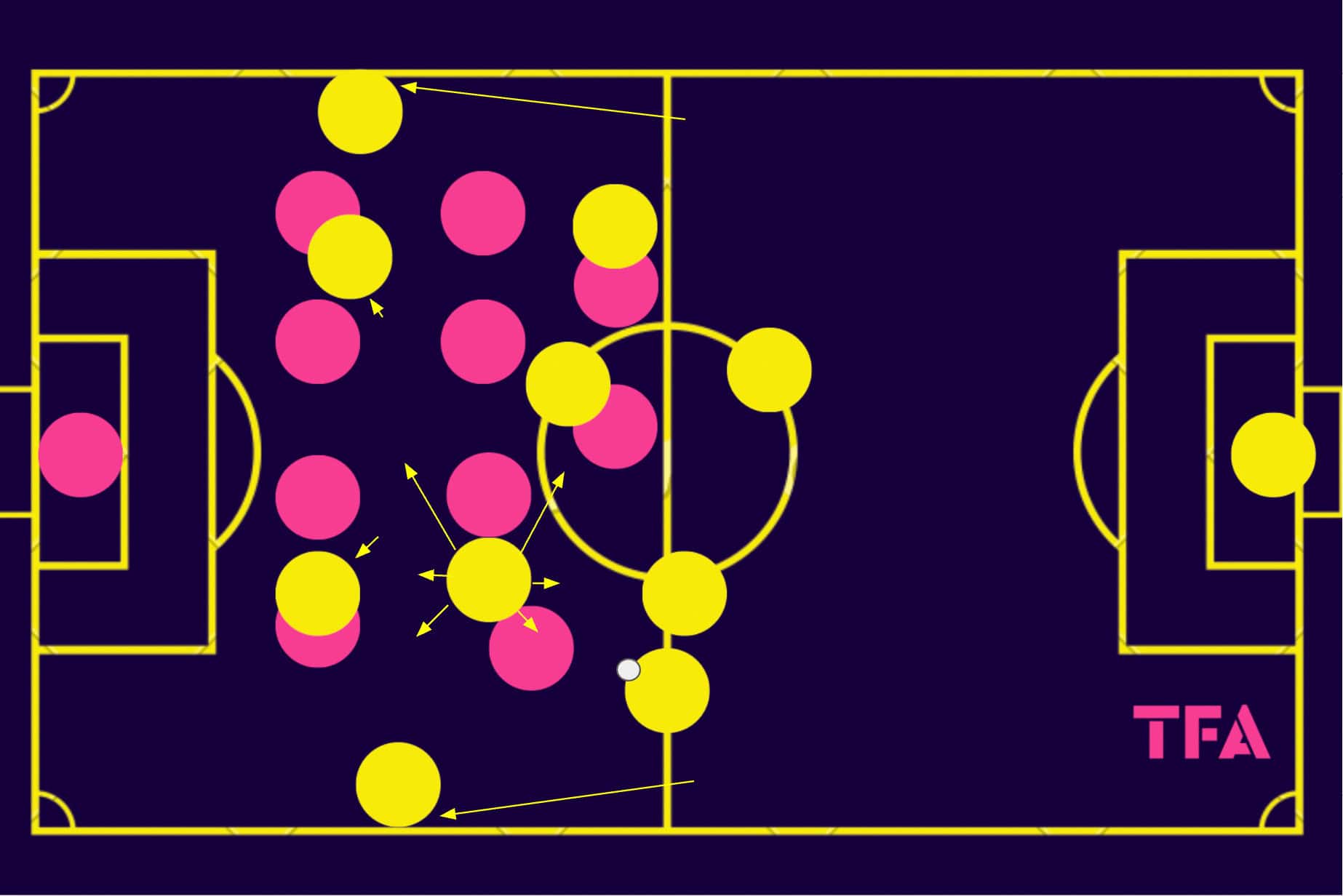
In this particular game, Ademola Lookman partnered Mateo Retegui up front, with Mario Pašalić filling in just behind as the number ‘10’.
In this particular passage of play, we can see the centre-forward pairing split wide, occupying the full-backs, while the ‘10’ drops into some space near the ball carrier to offer a central passing option.
At the same time, the forwards’ positioning gives the opposition defence a dilemma once the wing-backs advance and start occupying free space on the wings.
If the opposition full-backs go out to cover the wing-backs, the centre-backs must shuffle out to pick up the forwards, thus opening space in the centre for the ‘10’ or another central midfielder to potentially run into.
If the opposition full-backs remain tight to the forwards, the wing-backs are obviously free to receive out wide.
Whether they play with a ‘10’ and two forwards or two inside forwards playing just off a centre-forward, once the wing-backs come forward, Atalanta always have a front five capable of overloading an opposing back four.
Atalanta’s High Tempo Attacking Tactics
In addition to their structure, the speed of Atalanta’s attacks is crucial when it comes to breaking down opponents of all shapes, whether they’re up against a back four or a back five.
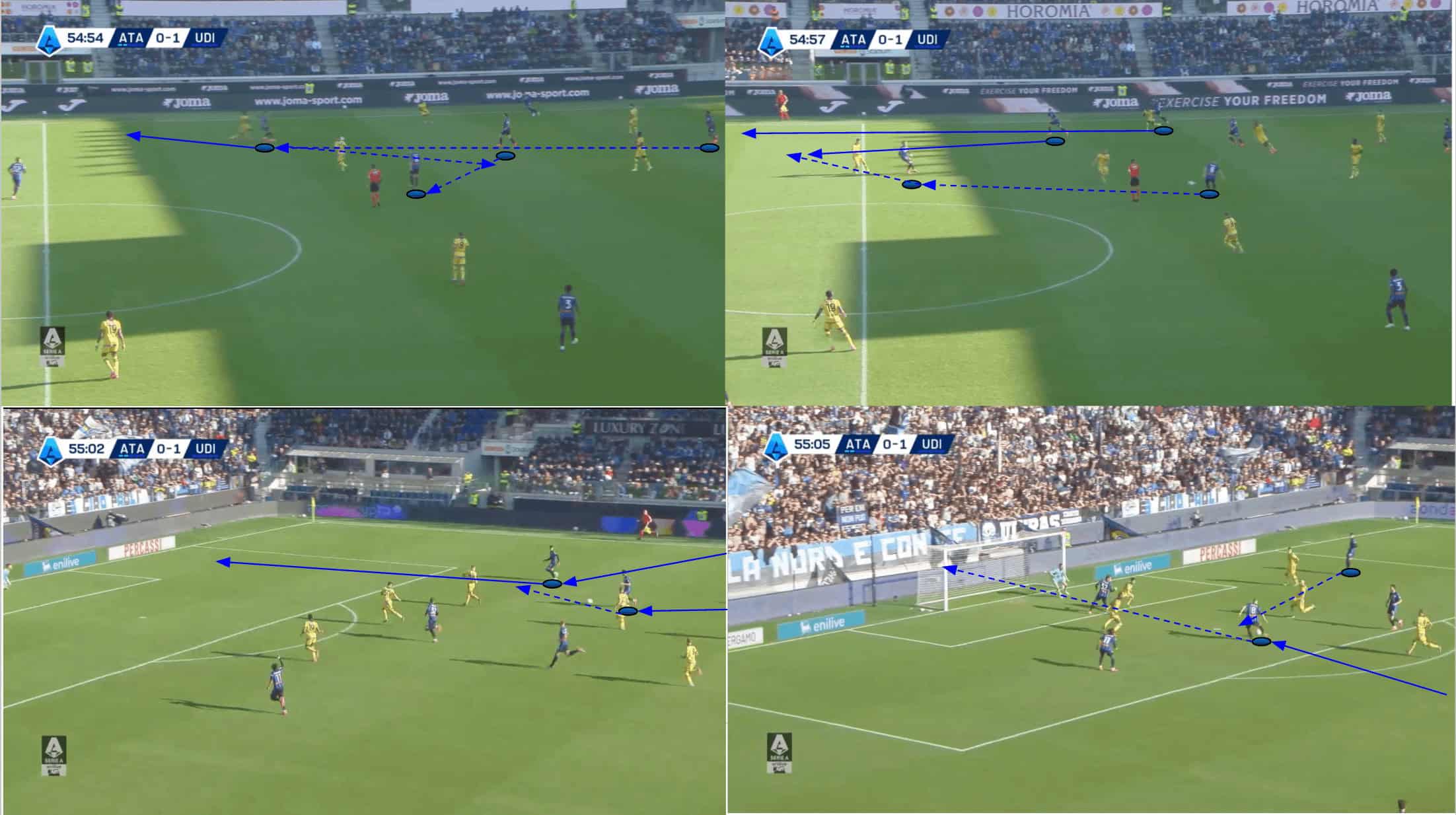
In just 11 seconds, we see an excellent example of Atalanta’s movement from the build-up phase to the finish from almost the penalty spot.
The move begins with some well-timed movement and fast interplay as I Nerazzurri progress into the middle third of the pitch in the top-left of figure 2.
Quick, accurate passing and intelligent movement are critical to Atalanta’s teamwork.
They carve the opposition like a Christmas ham to progress into the final third with the ball at the right inside forward’s feet.
The ball carrier sends it through to the overlapping right wing-back, Raoul Bellanova, who has loads of space to receive and carry into the box on the outside of the opposition’s backline, which is left with just three players — the three centre-backs — due to the speed of Atalanta’s possession play.
The move ends with Bellanova pulling the ball back towards midfielder Mario Pašalić, who enjoys a great shooting opportunity just behind the penalty spot.
Atalanta’s Width
Mateo Ruggeri & Raoul Bellanova Crossing Zones Map 2024/25
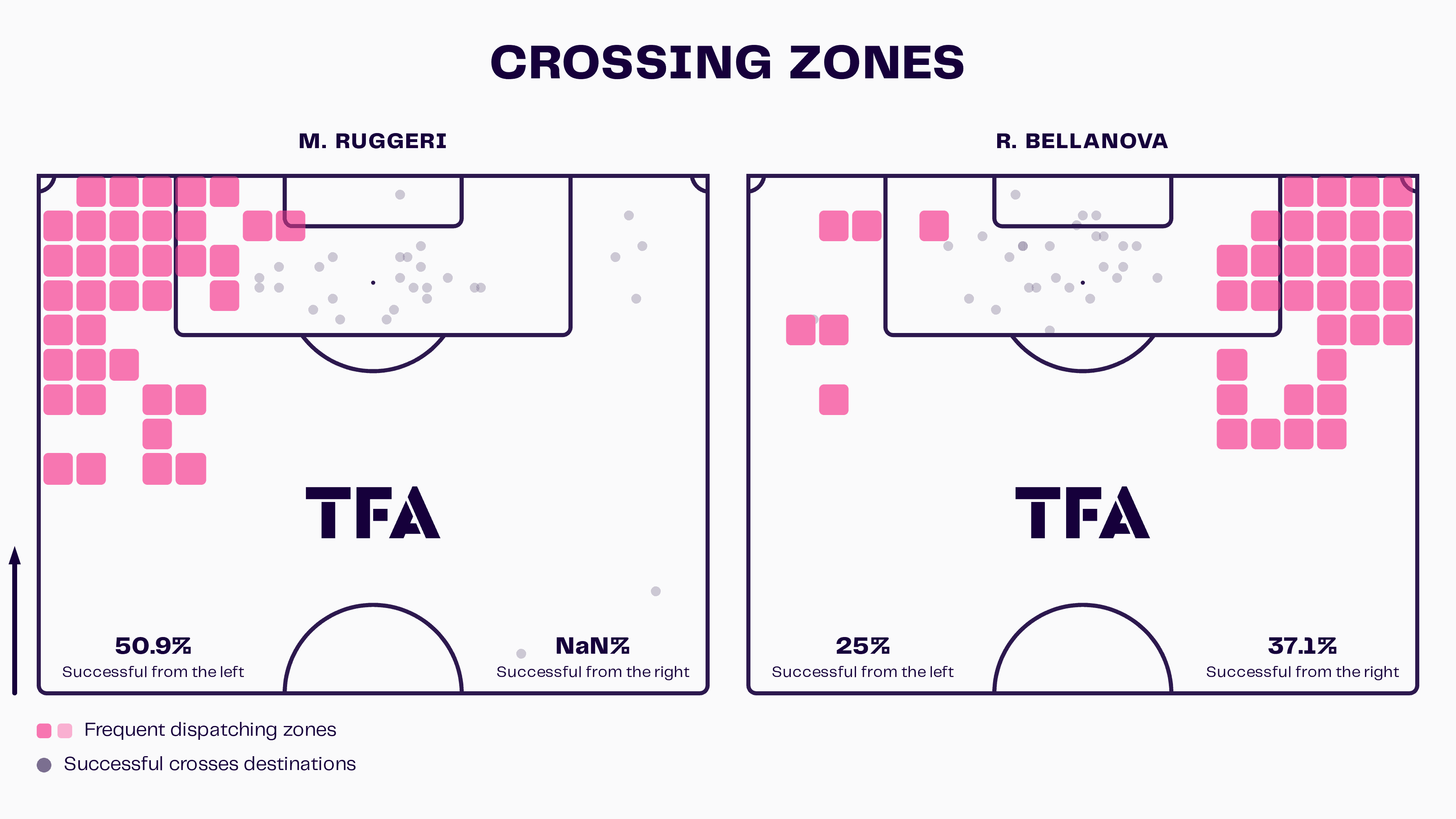
Atalanta have made the third-most crosses (16.19) of any side in Serie A this season.
Their primary crossers are their wing-backs; in Figure 3, we see the zones from and to which they typically deliver their crosses.
Much of Atalanta’s attacking play is designed to create space for their wing-backs to get on the ball inside the final third and send it into the danger zone.
If the wing-backs are marked tightly, chances are someone more centrally has space to receive and cause some havoc of their own.
This is reminiscent of great Manchester United teams under Sir Alex Ferguson and the way in which wingers like Ryan Giggs and David Beckham hugged the touchline and acted as key wide playmakers.
The same is true of the wing-backs in this system.
Mateo Ruggeri & Raoul Bellanova Shot Assists Map 2024/25
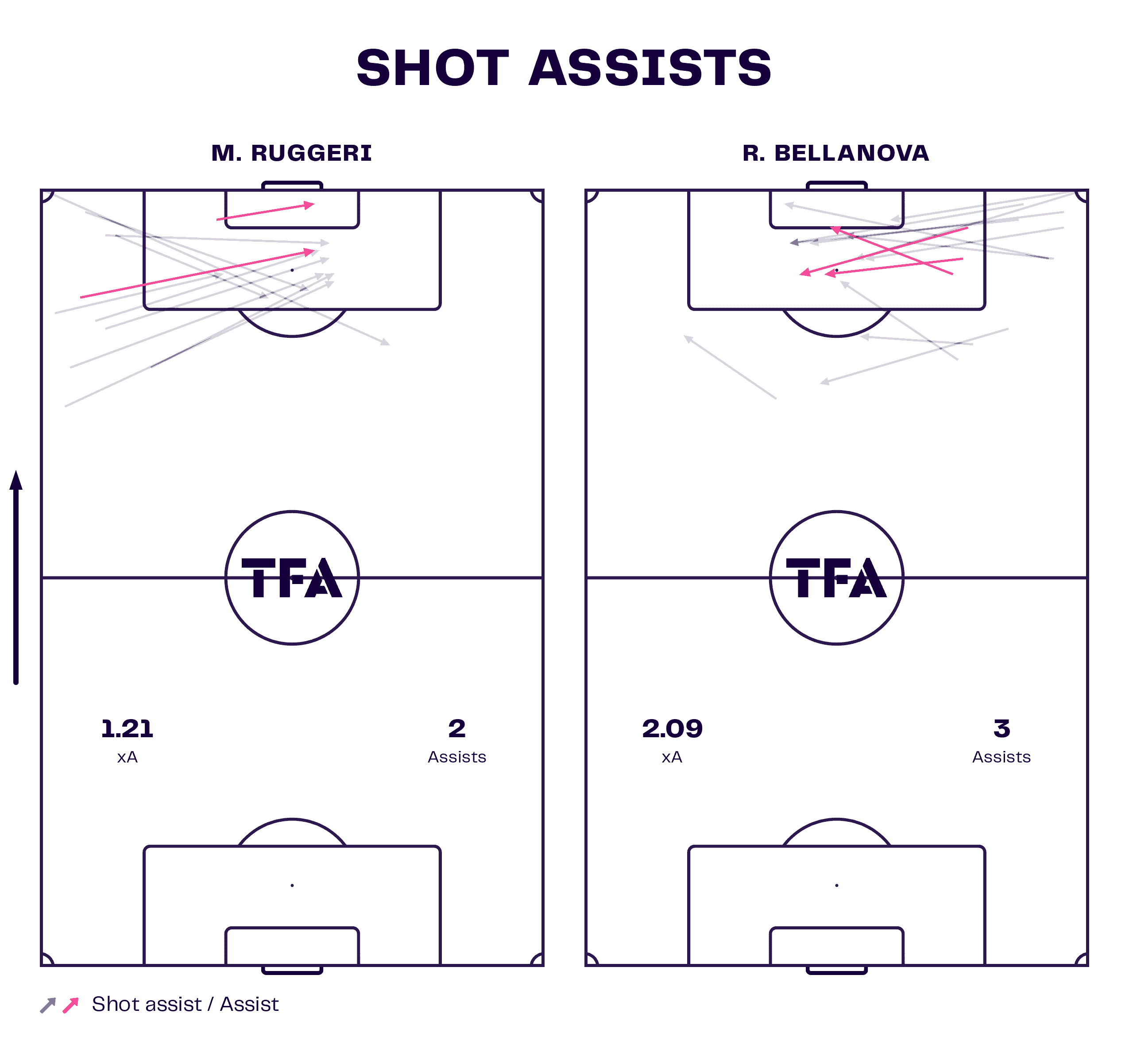
So far this season, Ruggeri has generated 1.21 xA and made two actual assists, while Bellanova has created 2.09 xA and made three assists.
Atalanta’s Chance Creation & Goalscoring
Ademola Lookman & Charles De Ketelaere Shot Assists Map 2024/25
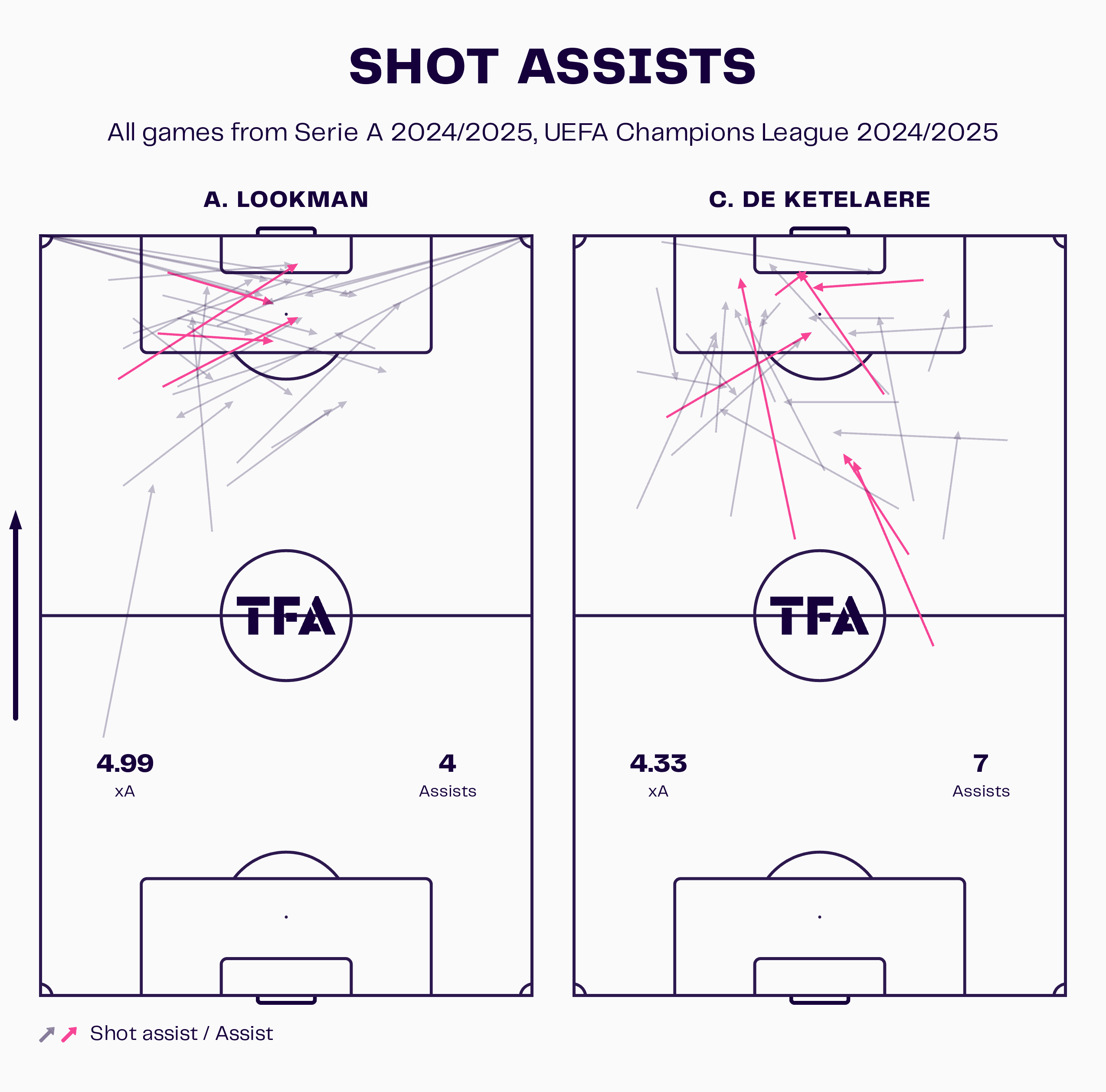
However, the wing-backs are not Atalanta’s primary creators, with Ademola Lookman generating 4.99 xA and making four assists for his club so far this season and Charles De Ketelaere creating 4.33 xA and making seven assists.
From open play, we see the majority of this duo’s shot assists coming from quite central positions.
Both players have played as inside forwards in the 3-4-2-1 this term and have acted as centre-forward partners for Mateo Retegui at times in the 3-4-1-2.
In either role, these two will typically drop into the half-space to receive, dribble at defenders and essentially act as some kind of ‘10’ or second-striker, with Retegui playing the role of a proper ‘9’.
In 2012/13—his final season as Manchester United boss and one in which his side cruised to the Premier League title—Sir Alex Ferguson is quoted as saying that the “flexible movement we now have up front really bothers teams.”
This principle of flexible movement up front is evident in current-day Atalanta as well, and the above quote also rings true for the Bergamo side. The above duo and their constant movement in the final third cause headaches for defences in Serie A and, indeed, the UEFA Champions League.
Ademola Lookman & Mateo Retegui Shot Map 2024/25
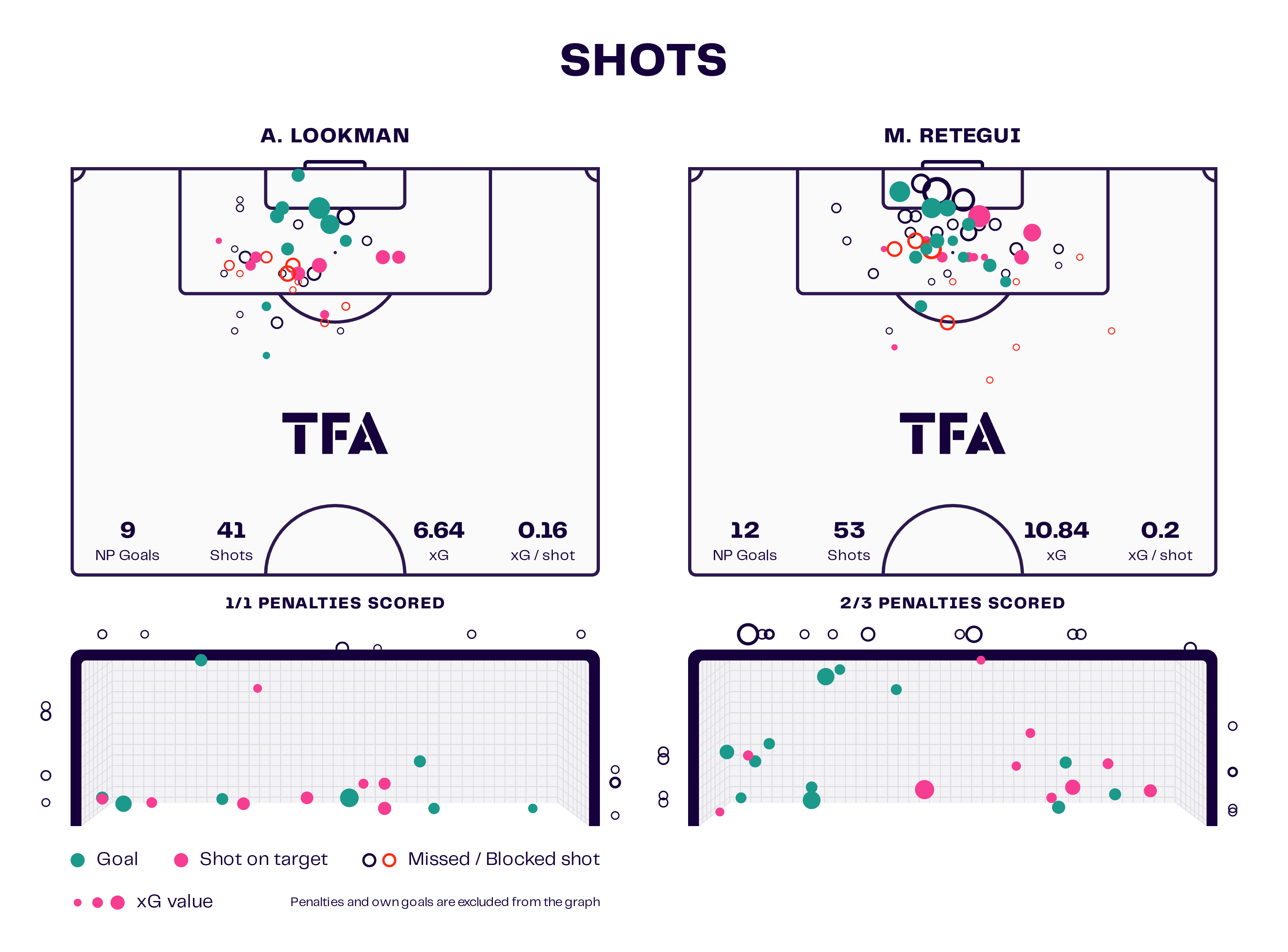
Atalanta have done well to generate lots of high-quality chances for their goalscorers this term, which has been repaid with lots of goals.
Lookman’s nine non-penalty goals this season have come from 41 shots and a total of 6.64 xG, with the Nigeria international averaging 0.16 xG per shot.
Meanwhile, Atalanta’s top scorer at this point in the campaign, Mateo Retegui, has scored his 12 non-penalty goals from 53 shots and 10.84 xG at the time of writing.
At the time of writing, the 25-year-old is averaging an impressive 0.2 xG per shot, highlighting the top-class playmaking servicing the forward as well as the excellent positioning and movement he’s producing for his teammates.
Atalanta Centre-Backs & Transitions
Atalanta’s wide centre-back positions this season have primarily been occupied by Sead Kolašinac (left centre-back) and Berat Djimsiti (right centre-back), both of whom are also very comfortable playing as full-backs.
Defensively, both players are comfortable defending 1v1 in wide areas and have a reasonable level of pace, which are qualities that have their own merits for the team.
However, the pair are also comfortable driving forward with the ball in-possession, which is what we’re going to highlight in this section of analysis.
Sead Kolašinac & Berat Djimsiti Heat Map 2024/25
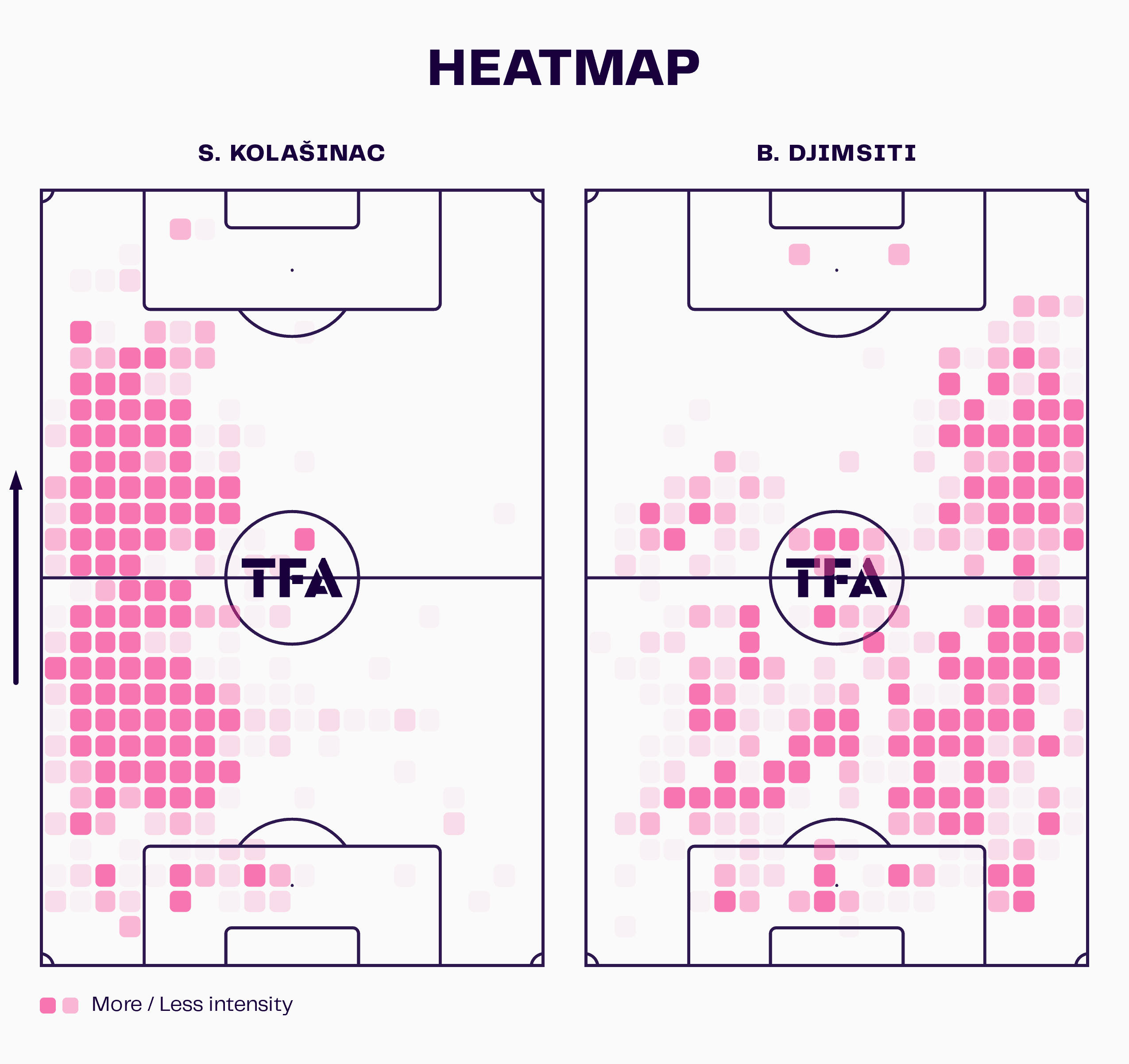
Again, both men have played the vast majority of their minutes at centre-back in 2024/25.
Still, their respective heat maps find both players spending a significant amount of time inside the opposition’s half.
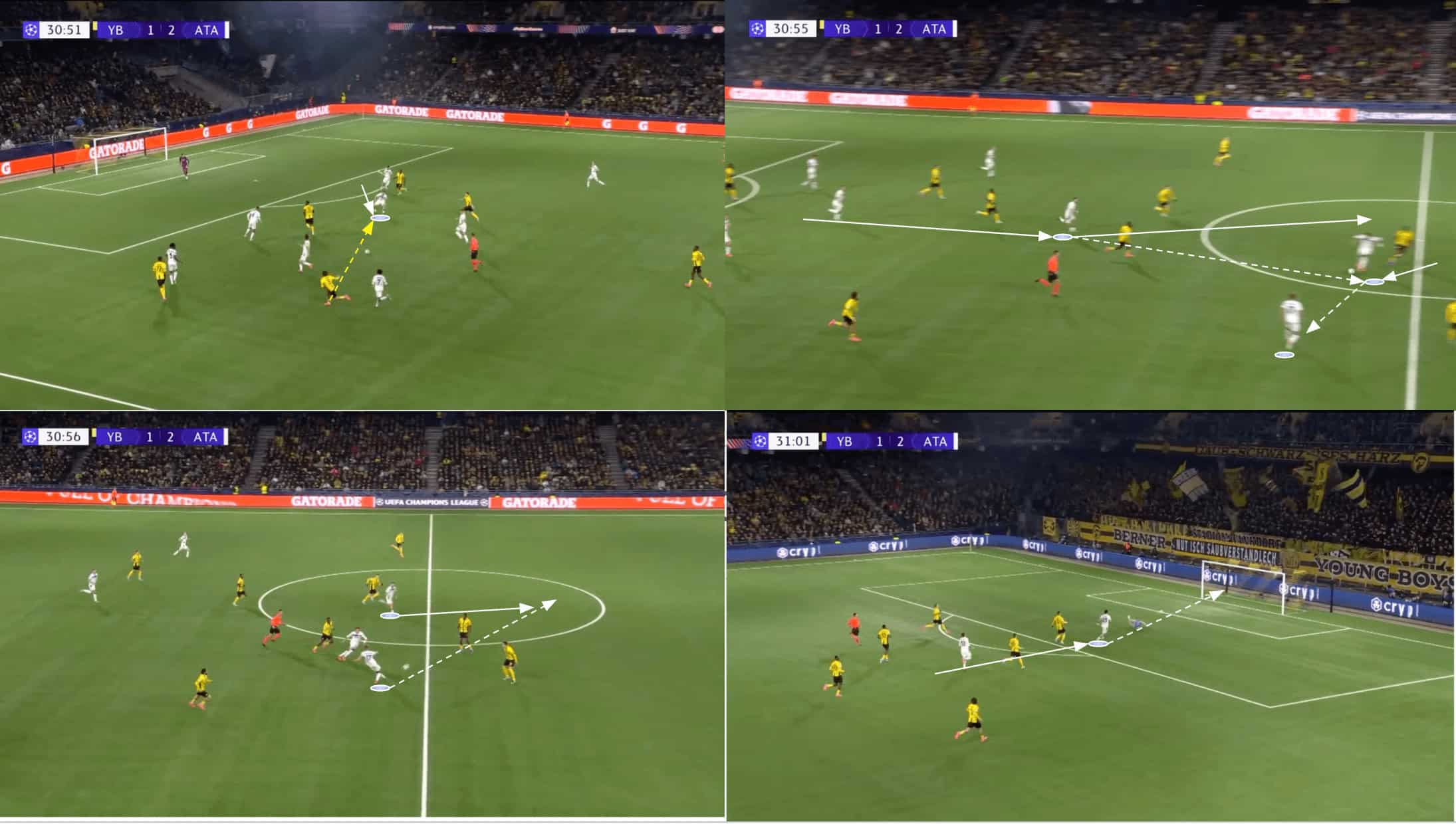
The passage of play above shows a great example of Atalanta counterattacking Young Boys in the Champions League.
The move is started and finished by Sead Kolašinac.
Firstly, the centre-back steps out to intercept the ball just outside of his box.
After sending the ball forward and sparking some quick link-up play between the forwards, Kolašinac continues his run, surprising the opposition defence to get onto the receiving end of a through ball from Charles De Ketelaere.
The centre-back finishes well.
This move provides another stellar example of Atalanta’s fast-attacking play, this time in the transitional phase.
It also demonstrates the freedom of movement afforded to their centre-backs to get forward and attack, embodying the “fast-paced attacking philosophy, fearlessly committing men forward with the aim of overwhelming the opposition with their offensive might” we described in our introduction.
Conclusion
To conclude this tactical analysis of Gian Piero Gasperini’s tactics at Atalanta BC, the 66-year-old head coach has already etched his name firmly into the Bergamo side’s history books by inspiring the greatest period in the club’s history.
He does so with an admirable style of play and tactical setup that embodies everything their leader and tactician is all about.
