
Following a disappointing showing at this past summer’s Copa América as tournament hosts, Gregg Berhalter was relieved of his duties as the United States men’s national team manager.
This ended his second tenure in the position at just shy of the one-year mark.
With the 2026 FIFA World Cup looming, the United States Soccer Federation decided to make a change in the dugout.
Berhalter was not deemed the man to lead them into the showpiece event after poor results in his second stint, culminating in that Copa América group-stage exit.
A two-month search began and ended with USSF finding Mauricio Pochettino, their man to lead them in their most significant hour in two summers’ time.
Following stints at Paris Saint-Germain and Chelsea, Pochettino had been out of work since mutually parting ways with the latter club at the end of last season.
For many USMNT followers, hiring an internationally recognised manager to lead them into the World Cup on home soil and bring new ideas and ways of thinking to the sport stateside, akin to what Jürgen Klinsmann did a decade ago, was a desire.
Pochettino ticks all those boxes on paper and is a far more successful manager on the other side of the pond than the German.
Pochettino’s CV includes a Ligue 1 title, Premier League runners-up, and UEFA Champions League final appearance.
Poch’s resumé, regarding elite European club football pedigree, is only bettered by two-time European Cup winner Dettmar Cramer (who managed the U.S. briefly in 1974).
Four games into his new position, there’s already enough evidence to glimpse what Pochettino’s coaching style will do with the U.S. as the nation begins a new process to lead them to their second-ever World Cup on home soil.
This tactical and data analysis will examine the early days of the Pochettino era, the changes made since Copa América, and what USMNT fans can look forward to under the Argentine manager.
USMNT Formations & Personnel Changes
Wherever he’s managed, be it in England, France, or Spain, Pochettino’s preferred formation has always been a 4-2-3-1, emphasising high-pressing and attacking football.
Coming into the USMNT job, he was expected to try to implement a similar system and philosophy, given that he’s done so everywhere he’s been, across every budget he’s ever worked on, from Espanyol and Southampton to Paris Saint-Germain and Chelsea.
Mauricio Pochettino Formations At Chelsea

Above, we can see some of his most common formations at Chelsea last season, including three-man defensive set-ups, wing-backs, and two forwards, in addition to his main 4-2-3-1 scheme.
This should give U.S. fans some idea of what to expect from Pochettino tactically.
Although the age-old question of whether he’d be able to get his messages across and implement his preferred style of play working on an irregular basis with just a few international windows per year compared to the day-to-day bust at club level was there, there was never any doubt that Pochettino would come in looking to do things his own way and on his terms.
In his debut game, a 2-0 friendly win against Panama in Austin, Pochettino interestingly experimented a new-look 3-4-2-1 shape, but has since returned to his preferred 4-2-3-1 in the recent CONCACAF Nations League quarterfinal clashes with Jamaica.
However, due to injuries to players who played a key part in the Copa América campaign in the summer, such as Tyler Adams, Giovanni Reyna, Chris Richards, and Folarin Balogun, Pochettino hasn’t been able to work with a few of the players expected to get similar opportunities as they did under Berhalter in his four games to date.
In their place, he’s given others chances to showcase themselves, including Mark McKenzie and Miles Robinson in central defence, Gianluca Busio, Tanner Tessmann, Aiden Morris, and Johnny Cardoso in midfield, and Josh Sargent and Ricardo Pepi up front.
With 30 players already called in for his two squad selections to date, Pochettino has wasted no time getting acquainted with the player pool and testing different combinations and individuals as he begins the journey to build his ideal team for the 2026 World Cup.
Mauricio Pochettino Tactics
Pochettino’s 4-2-3-1 shape consists of two defensive midfielders, a ‘roaming’ #10, and two wingers who stay very wide while the full-backs invert underneath to offer support in possession in the half-spaces.
Against Jamaica, he opted to play Christian Pulišić in that central attacking midfield role, having previously played him on the left wing.
Timothy Weah replaced him on the left, and Yunus Musah was stationed on the right.
In this particular game, the U.S. used a lot of movement and rotations to draw Jamaican markers out and create confusion in their defensive structure, which allowed their attacking players to exploit.
But first, let’s look at how Pochettino’s USMNT set up in terms of their base positional structure in possession.

Here’s an example of the U.S.’s base positional structure when in possession during the build-up phase.
All ten outfield players are spotted in Jamaica’s half, with McKenzie and Ream holding a very high line as they build the play between them.
Scally and Robinson take up a more inverted role rather than staying out wide as traditional full-backs do, providing options in the half-spaces to receive the ball and connect the play between the centre-backs and the wingers.
Meanwhile, Musah and Weah, the U.S. wingers in this game, stay very wide and high in their starting positions.
At the same time, Pulišić and McKennie are given the freedom to roam and find spaces to receive the ball in dangerous positions inside Jamaica’s block as the U.S.’s most influential attacking players.
What starts out as a 4-2-3-1 essentially becomes a 2-4-4 in the possession phase, giving the U.S. as many as eight players in positions to attack through.
This positional structure allows them to progress the ball in a well-constructed manner, with options available to the passers from the back and opportunities to create overloads/underloads on either side.

An example of creating overloads/underloads can be seen in the example above.
Musah is on the ball on the right flank.
As is evident, six other U.S. players are making runs towards his side, looking to create an overload and numerical advantage against Jamaica’s defence.
The only players not part of that overload in this graphic are the two central defenders, McKenzie and Rea, and, crucially, Weah.
Weah, circled above, is alone on the opposite left-hand side, which would be considered the underloaded side in this situation.
What this means is that the purpose of creating an overload on one side of the pitch is to drag the opposition’s players towards the area where everyone on that side is located while having an outlet to switch the ball to the opposite side, the underloaded side, to attack the space left behind by a weakened defence as a result of them being outnumbered where the switch of play, thus allowing the attacking team to create a better opportunity to score.
Although the ball was not switched to Weah in this particular play, it still highlights what Pochettino’s team is trying to do offensively.
They want to attack spaces by creating numerical advantages in the attacking half.

As mentioned, Pochettino is a proponent of playing attacking football and getting as many players forward as quickly as possible, both in attacking and transitional phases.
Team USA’s fourth goal against Jamaica captured all of that, and everything talked about earlier, perfectly.
In the top left quadrant, Robinson makes a run from the left-back position into a more central role where there is an empty space to exploit with Pulišić dragging a marker away and McKennie looking for an outlet to switch the play to the other side, this being Robinson.
As the ball comes to Robinson, he can carry it into the empty space and arrive in the final third.
In the top-right graphic, we can see Musah and Weah holding their runs and staying very wide, as instructed.
The ball eventually breaks to Musah, and as it comes to him, Weah runs into the box from the left unopposed and raises his arm, looking for the cross from Musah to the back stick.
Musah spots his run before the ball even arrives at his feet and plays it first time before Weah does the rest with an unstoppable strike into the top right corner.
Quick transitional play, dragging markers out with well-timed movements and/or overloads, and exploiting the underloaded side afterwards are all tenets of Pochettino’s approach to finding space and generating chances to score, which the USMNT accomplished multiple times in this game.
USMNT Progressive Possession
One way to mark any early progress under Pochettino is to look at the data compiled from his first four games and compare it with that from the Copa under Berhalter to see if any noticeable patterns or trends are emerging already under his stewardship.
The biggest immediate difference between Pochettino’s USMNT and Berhalter’s is the progressive nature of their passing and their willingness to get on the ball more to dictate play.
Let’s take a look at the data that supports that.
USMNT Passing Stats Copa América 2024

Here, we see the U.S.’s passing statistics from the Copa games in the summer.
With the U.S. averaging 45% possession and around 300 passes per game, it’s obvious they weren’t a team looking to play on the front foot and dominate games.
This was quite often the case throughout the Berhalter era, particularly later on.
What is also evident is the low accuracy of their different types of passes, with only backwards passes hitting 80% or higher.
Let’s see how that compares to the numbers under Pochettino to date.
USMNT Passing Stats Under Pochettino
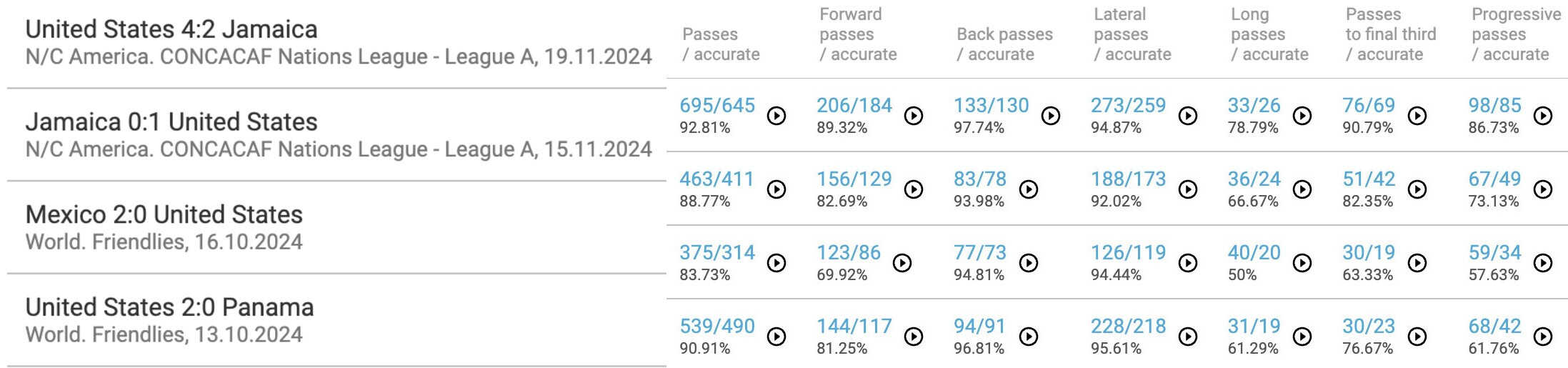
With an average of 58% possession so far, nearly 200 more passes per game, and improved accuracy rates in those passes, it’s fair to say that there’s been an instant improvement in the U.S.’s passing game under Pochettino.
While they did have more problems consistently reaching the final third against Mexico, overall, there’s enough evidence here to suggest that the direction they are taking under Poch is that of a possession-based attacking team, just as the Argentine has tried to make all his teams throughout his coaching career.
While the statistics indicate an improvement in this area of their game, let’s examine the analytics.
USMNT Progressive Passes Maps
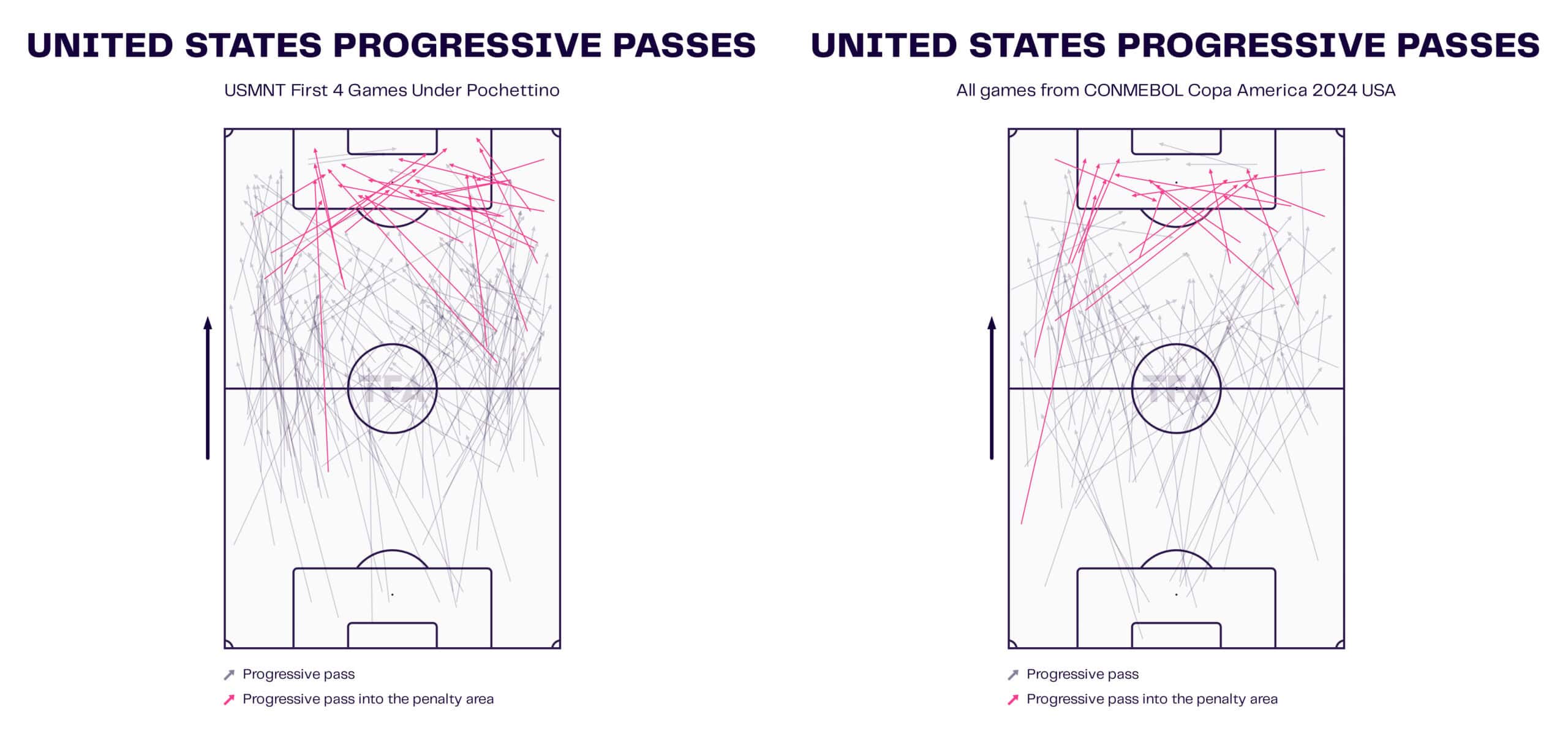
The data viz above highlights how much more activity the USMNT are getting in the attacking half of the field, particularly in the wide areas we can see by the darker lines.
There are also more frequent attempts at getting the ball into the opposition’s penalty area, leading to the team averaging 1.5 goals per game under Pochettino.
While it’s fair to hold off on judgment over whether this progress will be sustained under Pochettino as bigger and more important tests arrive in 2025 and 2026, there are encouraging signs here that this is the new way the U.S. want to play and that it could pay off in the long run.
USMNT Higher Intensity Offense
The other noticeable improvement under Pochettino is in the increased success the U.S. are finding in attacking from wide areas, including from the left and right half-spaces.
USMNT Heatmaps
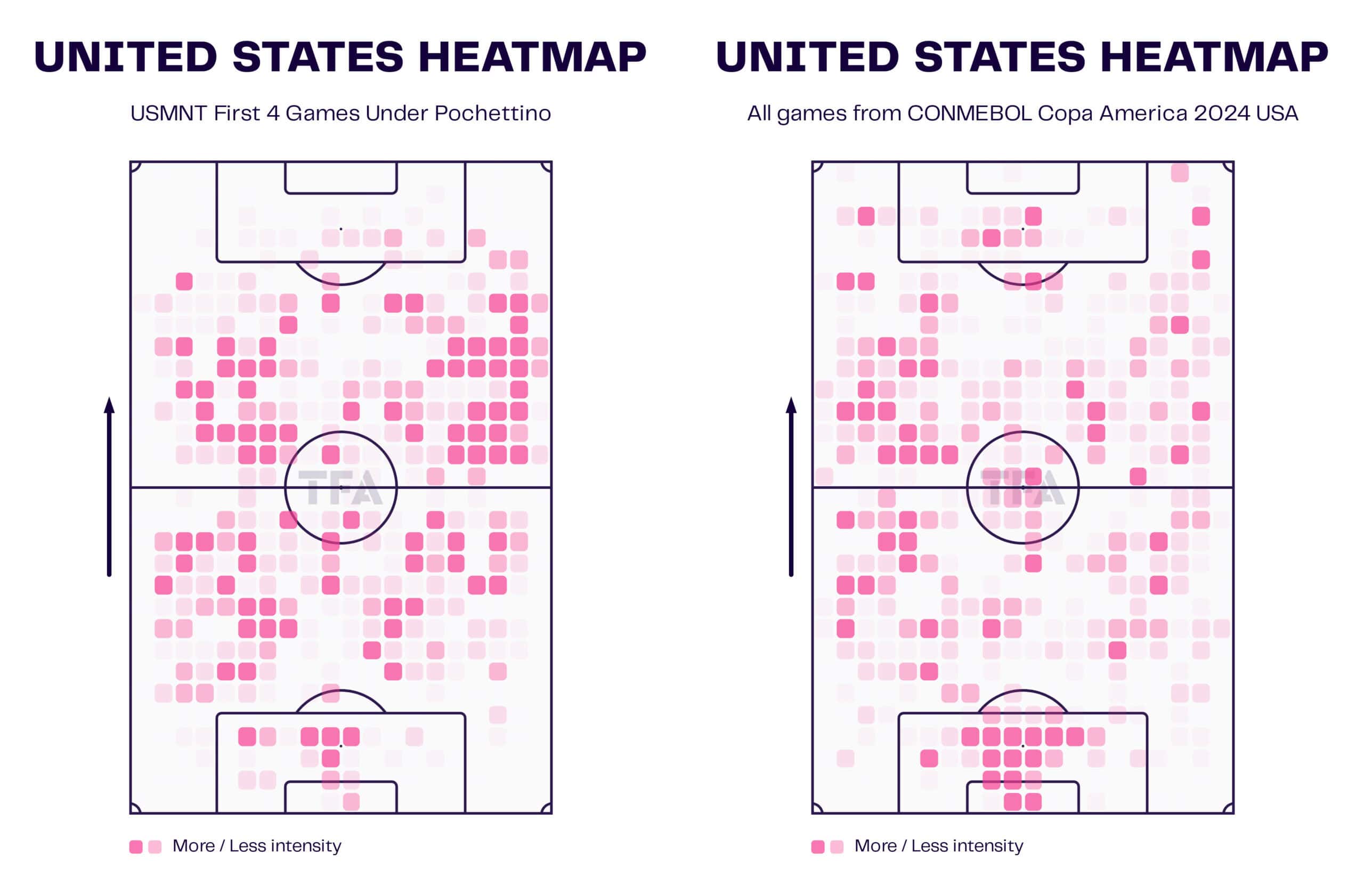
The two heatmaps above highlight the U.S.’s intensity all across the field during Pochettino’s first and Berhalter’s last games as national team manager.
What clearly stands out is how much higher the intensity is now in both central and wider areas, on both sides, under the new manager, creating a more varied, higher-volume U.S. team effort throughout the pitch.
Heatmaps measure the location and movement patterns of players and teams, as well as the intensity of those patterns with and without the ball, and the U.S. has undoubtedly improved in those data points under Pochettino.
Berhalter’s heatmap resembles that of a conservative team that likes to play it safe, as evidenced by the higher intensity in the deeper zones, particularly in their own penalty area.
Pochettino’s heatmap resembles more of an attack-minded team that likes to get forward and on the ball to make things happen.
Again, it may be early days, but the signs are promising.
USMNT Crossing Zones Maps
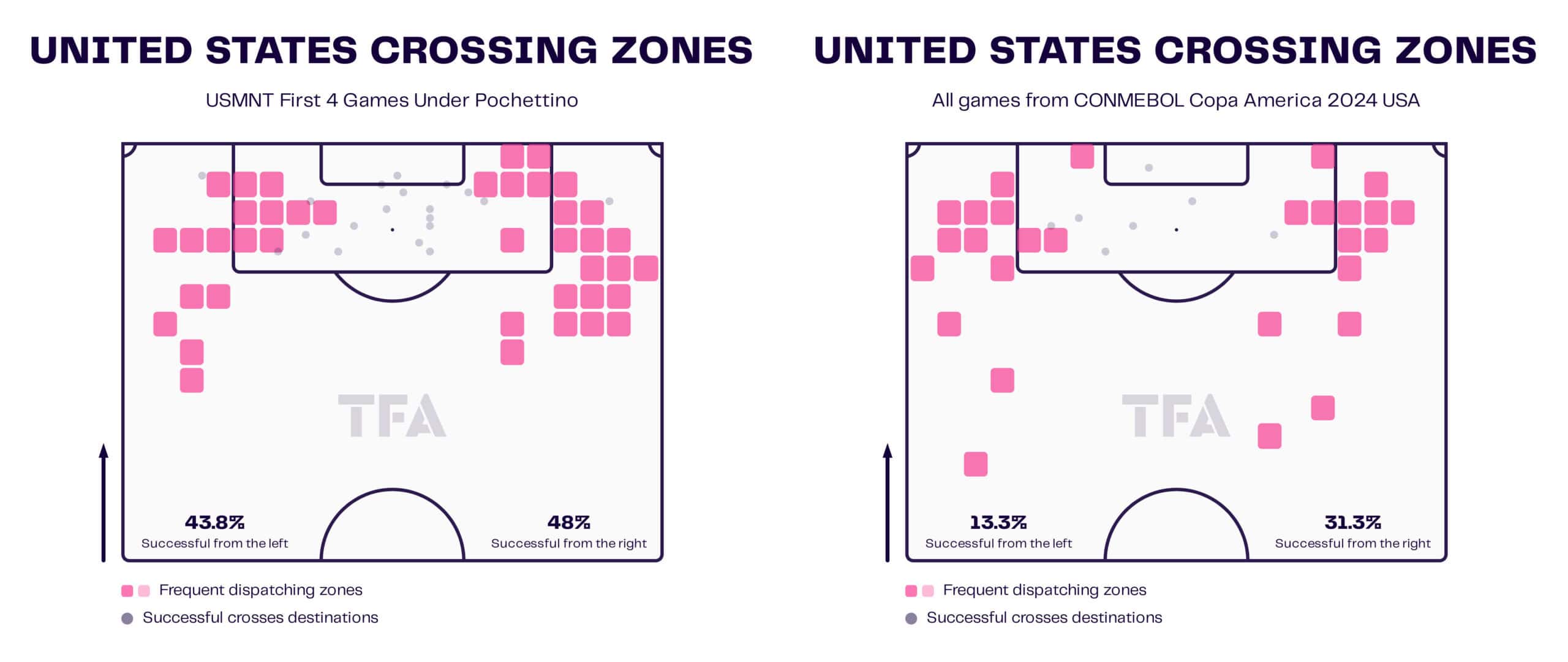
In conjunction with the differences between those heatmaps, we can also see above the crossing zones of both recent versions of the USMNT and the amount of success they achieved through their offensive actions.
The numbers show a staggering difference, with nearly a 30% increase in successful crosses from the left and a 20% increase from the right!
The U.S. are crossing the ball much more frequently and successfully under Pochettino now than they were in the summer, and that’s contributed to by a shift in mindset to attack, with more players joining offensively in the Argentine’s vision of how he likes to play the game.
Pochettino likes his full-backs to get forward on the overlap and join attacks in advanced areas, allowing his team to attack with essentially four players out wide, including the wingers.
USMNT Winger Actions Maps
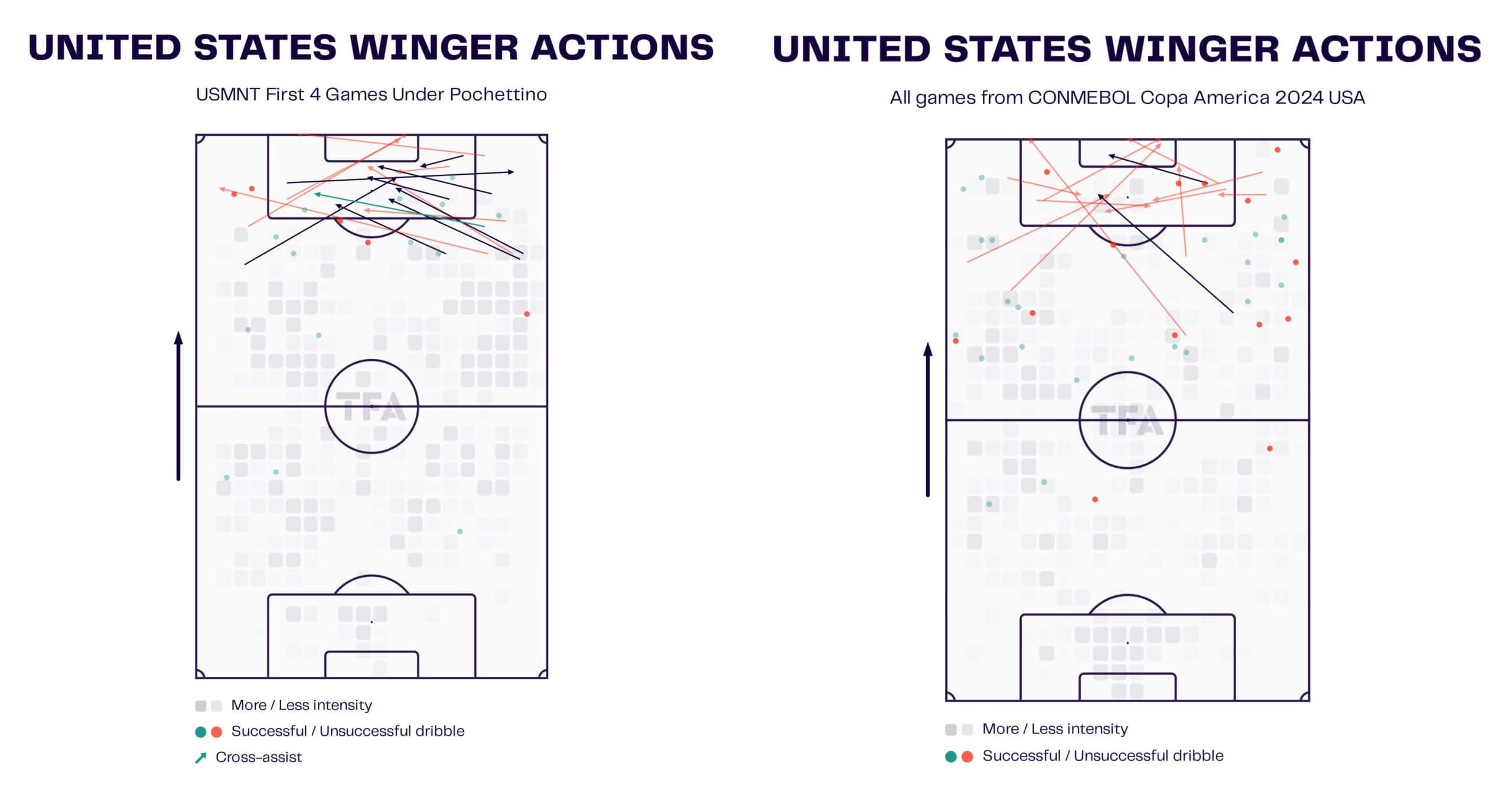
And speaking of the wingers, the last data viz to support their improvements in their vertical offence is through their winger actions and dribbling attempts.
While their dribbles are closer to goal under Poch, looking at both sides, what’s even more evident is the increased intensity in the wide areas of the attacking half of the field, as shown by the darker blocks.
Pochettino’s attacking philosophy allows his players to get involved in the game more and express themselves on the ball, something that only happened in bursts under Berhalter, something many bemoaned throughout his two tenures.
However, under their new manager, the USMNT may have discovered their attacking identity and a brand of football they would like to showcase to the world when the world is watching in just over a year and a half.
Conclusion
Although it’s still very early in Mauricio Pochettino’s era as the United States men’s national team manager, his predecessor has already shown clear signs of encouragement and even improvement.
Even though there have only been a couple of friendlies and Nations League fixtures to date, Poch’s coaching style and ideas with this team are already evident, and the expectation will be that it will only get better and more refined once he has all of his missing pieces at his disposal.
With the Nations League final four and a Gold Cup taking place next year, 2025 will be a crucial year in the development of this side as they take on their final competitive tests before the World Cup begins the following summer.
The U.S. are not among the favourites to claim the Jules Rimet trophy, no doubt, but they will be looking to make a deep run in the tournament and perhaps at least be among the last eight for the first time since Korea/Japan in 2002.
This a challenge that Pochettino will undoubtedly relish as he looks to rebuild his stock after some underwhelming recent club stints, likewise for the perceived Golden Generation of the U.S., whom the spotlight will be on brighter than ever once June 12, 2026, rolls around for their opener.
