
After months of speculation, Arsenal looks on track to finally confirm the signing of Real Sociedad midfielder Martín Zubimendi.
The Gunners have now been Premier League runners-up three years in a row.
The Spanish International could be key in driving Mikel Arteta’s side towards potential glory.
He will share the dressing room with midfielders like Martin Ødegaard, Mikel Merino, Thomas Partey, and Declan Rice.
This move follows Jorginho’s departure for Flamengo.
Zubimendi, who fits the same profile, will serve as a like-for-like replacement.
In this scouting report and player analysis, we will examine the traits of Martín Zubimendi compared to Jorginho and how Zubimendi fits into Mikel Arteta tactics at Arsenal.
Listen to this article free on the Total Football Analysis Podcast via Spotify, Apple Podcast, or RSS.
Martín Zubimendi Vs Jorginho Stats
Jorginho is known for being skilled on the ball, particularly in dictating play from deep positions.

His accuracy with short to mid-range passes has been nothing short of commendable.
Although not very quick or dynamic, the 2020/2021 UEFA Champions League winner has consistently demonstrated calmness over the years.
Zubimendi surpasses the former UEFA Player Of The Year by a fine margin in terms of dribbles and defensive duels.
Meanwhile, the Spaniard also exceeds Jorginho in positioning and progressive passes.
Martín Zubimendi Style Of Play
The soon-to-be Arsenal midfielder plays as a pivot for both club and country.
Zubimendi is comfortable on the ball, in build-up, and in tight spaces.
He sits deep and dictates play if he is deployed alongside dynamic midfielders who like to push up.
He will very often position himself right above his centre-backs.
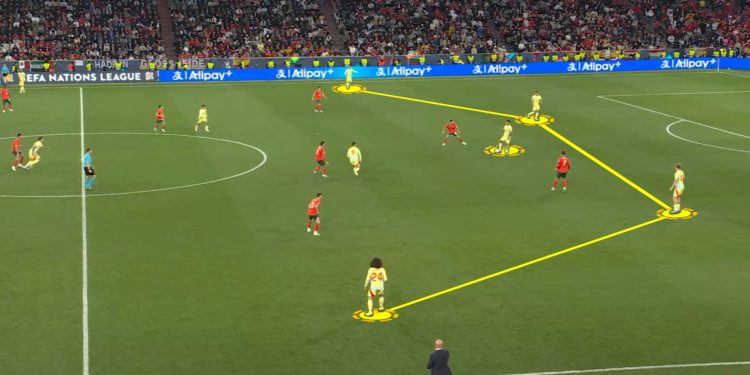
In this image, Zubimendi operates close to his centre-backs.
The back four is visible: the full-backs are slowly starting to push higher and use the space ahead.
While operating in that space, he shifts horizontally to receive from wide areas and to shift play.
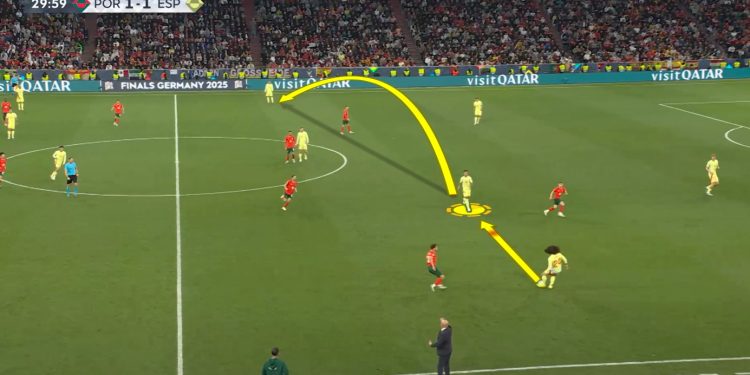
Here is an example of Zubimendi receiving from his Spanish teammate Marc Cucurella (left-back).
He drifts into the half-space to receive and quickly makes a switch to the other full-back.
Building up from their own defensive third and progressing to the midfield third, the Spaniard is often seen operating as the deepest of the midfield three.
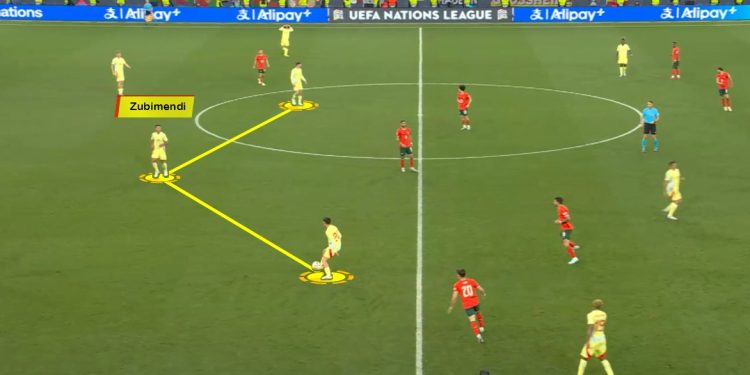
As we can see in this scenario, Zubimendi is deeper than his midfield partners.
The Spaniard, positioning himself at good supporting angles, helps his side keep possession and shift play effectively.
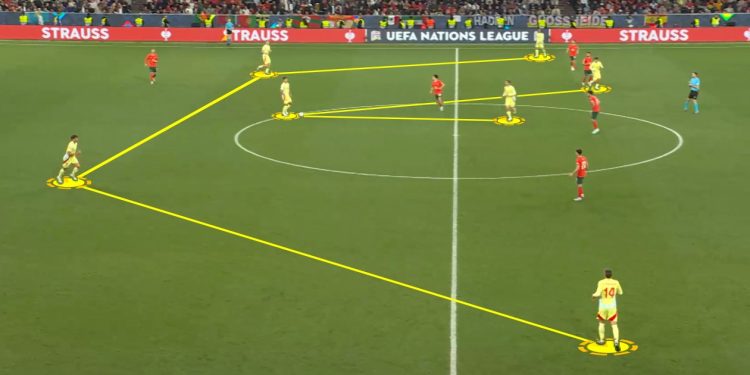
Here, Martín Zubimendi operates as the deepest midfielder in Spain’s UEFA Nations League Final against Portugal.
The 4-3 shape is prominent in this image.
The centre-backs start moving wider, and the full-backs start pushing further up the pitch.
When operating in areas like these, he is often seen connecting passes by being a link player in third-man passes.
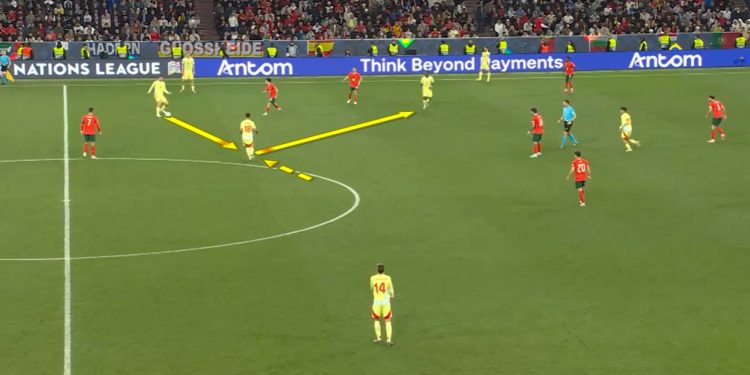
Here, Zubimendi can be seen receiving from the left half-space to find his left-winger (Nico Williams).
Williams drifts infield to receive in the half-space.
It is common to see him dropping between the centre-backs to dictate play for Real Sociedad.
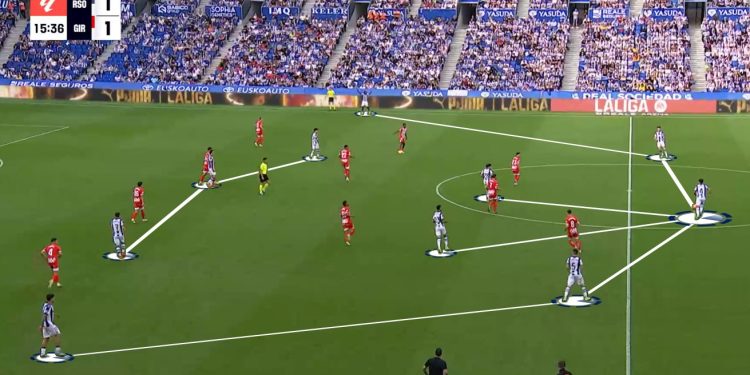
Here is an example of Zubimendi dropping between his centre-backs.
Imanol Alguacil’s side set up in a 4-2-3-1.
However, due to the Spaniard dropping, it becomes a 3-2-5.
The other two midfielders stay inside the opponent’s structure.
In the meantime, the wingers tuck into the half-spaces, and the full-backs push high and wide.
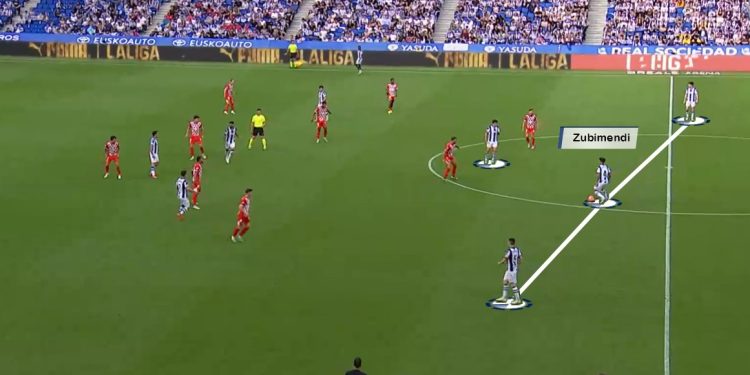
Another example of Zubimendi dropping between the centre-backs.
The other pivot, Pablo Marin, stays inside the opponent’s structure.
As he drops deep, he gets more space and time to collect the ball and pick out progressive options, either vertically or diagonally.
In this example, Zubimendi gets time and space to play a long ball to his wide player.
Operating close to his centre-backs, he positions himself in areas with open angles to break lines with his passing.
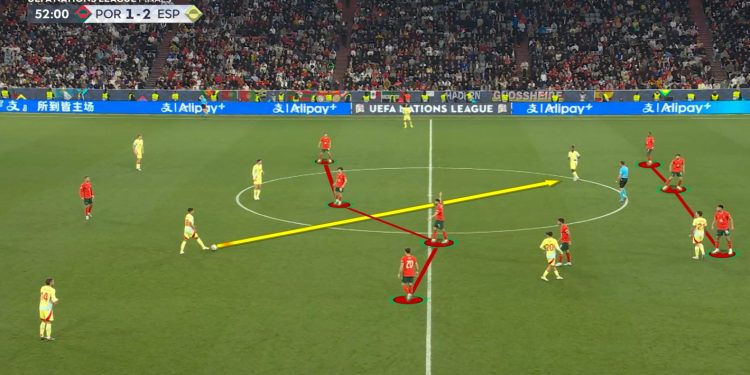
Here, Zubimendi plays a vertical pass through Portugal’s (4-1-4-1) midfield to find Nico Williams (left-winger).
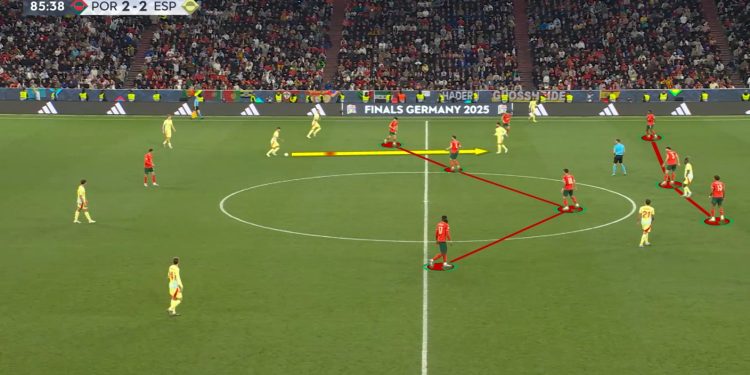
In this situation, we look at a similar outcome from the same match.
Zubimendi receives in front of his left centre-back and plays a vertical pass to an advanced midfielder.
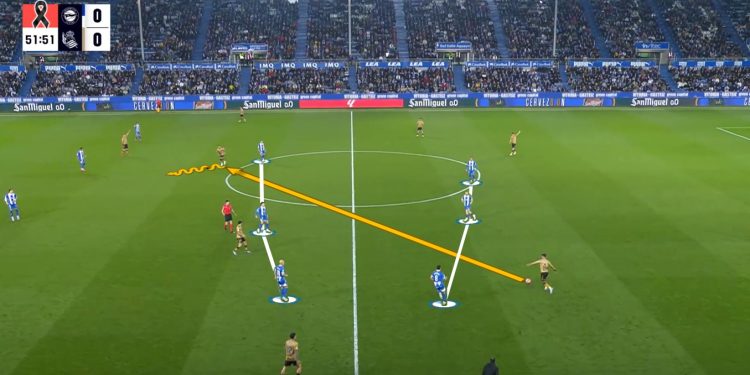
Here is another example where Zubimendi plays forward centrally.
In this case, he is able to break two lines with a single pass for Real Sociedad.
There is one more advantage of the Spaniard dropping between centre-backs.
It enables them to carry the ball if space opens up vertically.
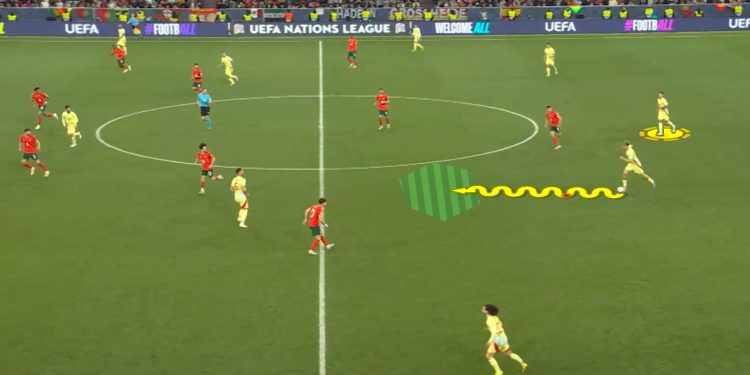
Here, we can see that Martín Zubimendi has dropped centrally.
Since the opponent pressing shape is 4-1-4-1, there is space on either side of the striker.
The left centre-back (Dean Huijsen) exploits the space in front of him by driving into it.
Apart from playing as the deepest midfielder, Martín Zubimendi is a dynamic midfielder who can make forward movements.
In this video, Zubimendi plays a pass to his wide player and makes a forward run.
This opens the space where he was positioned before.
The winger uses that space to come inside and keep possession.
The Spanish midfielder is adept at using space by aggressively carrying the ball into it.
It is a valuable trait for any modern midfielder to initiate attacks.
Here is an example of Zubimendi driving with the ball.
He receives a set pass from his striker (Mikel Oyarzabal) who drops into the half-space.
The midfielder then drives the ball into the attacking third before laying it off to Lamine Yamal (right-winger).
Here is another video where Martín Zubimendi is driving with the ball.
He picks the ball up in the midfield third and proceeds to carry it, breaking Portugal’s midfield line.
Towards the end of the action, he attracts most of the pressure around him.
This gives his teammate (Isco Alarcón) enough space in the zone-14 to get a shot away.
Zubimendi is also comfortable operating inside the opponent’s structure.
It is visible as his Txuri-urdin teammate Pablo Marin dropped between the centre-backs.
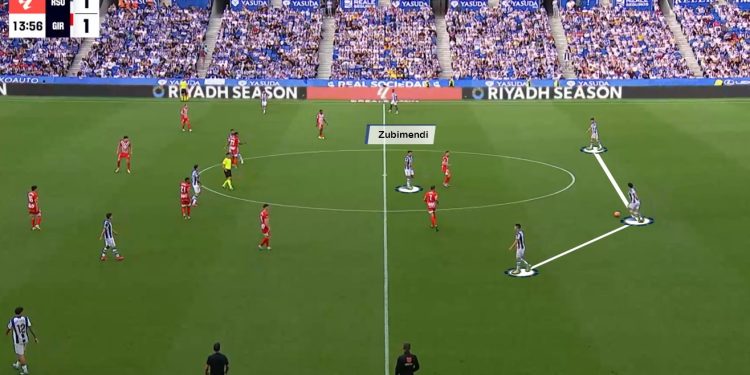
Here, we can see Martín Zubimendi positioned inside the opponent’s structure.
Pablo Marin drops to form a back-three.
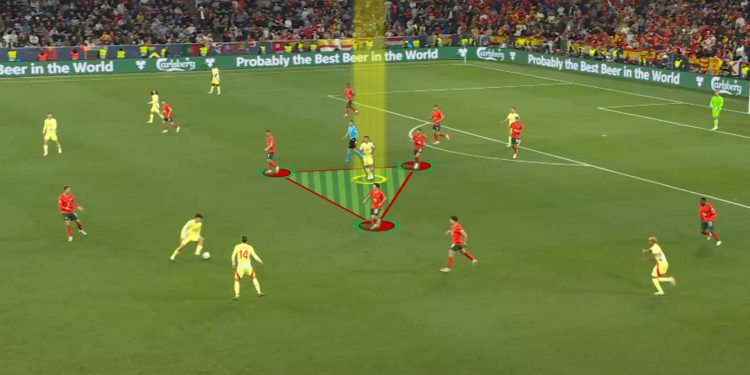
We examine another example of Zubimendi operating within the opponent’s structure.
Spain’s Pedri (centre-midfielder) drops outside the structure to play.
This is a trigger for the holding midfielder to move higher up.
Zubimendi is not a player who possesses a formidable aerial presence and the physicality of a traditional defensive midfielder.
However, the new Arsenal signing has showcased tactical adeptness in terms of pressing and covering spaces.
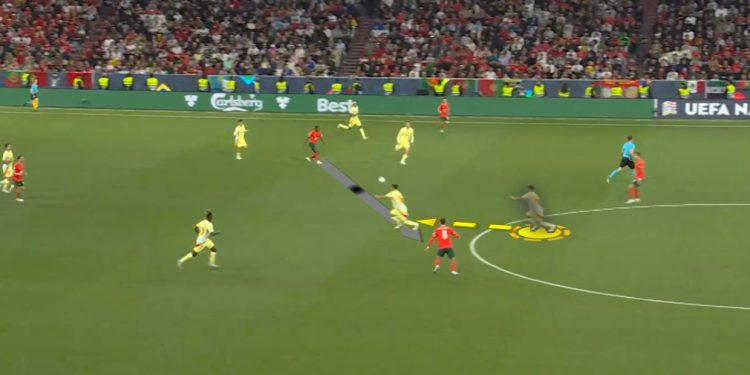
Here, we can see the Spaniard stepping up to make an interception in midfield.
This starts an attack from the midfield third.
When his team presses high, Zubimendi forms the second line of pressure, immediately seizing any balls that pass.
This enables his attackers to press vigorously.
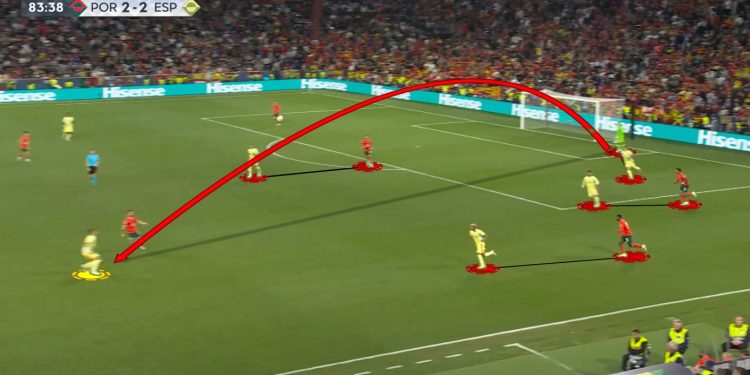
In this situation, La Furia Roja are pressing Portugal high.
As the goalkeeper is under pressure, he plays long.
Zubimendi is present in the right position to make an interception.
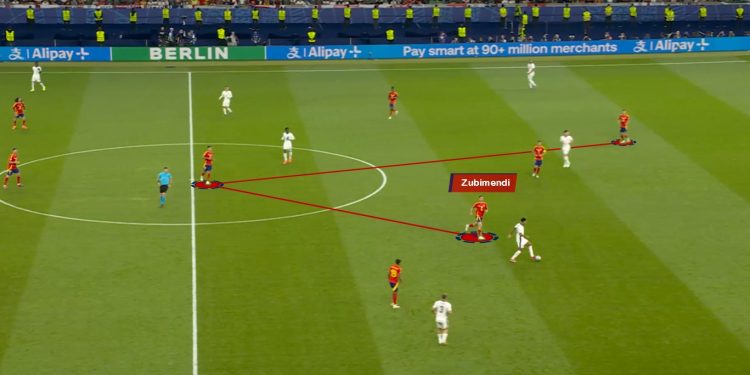
Here is another example of the Spaniard pressing his direct opponent.
In this situation, he is playing as a more advanced midfielder, as Rodri occupies the deeper role.
Martín Zubimendi At Arsenal
At Arsenal, Martín Zubimendi can potentially operate as a pivot or a more advanced midfielder (considering Thomas Partey starts).
We examine how Thomas Partey and Jorginho performed for the Gunners.
During the build-up phase in the defensive third, David Raya often pushes up to position himself between the centre-backs.
This helps create an overload in midfield, as the pivot no longer needs to drop deep.
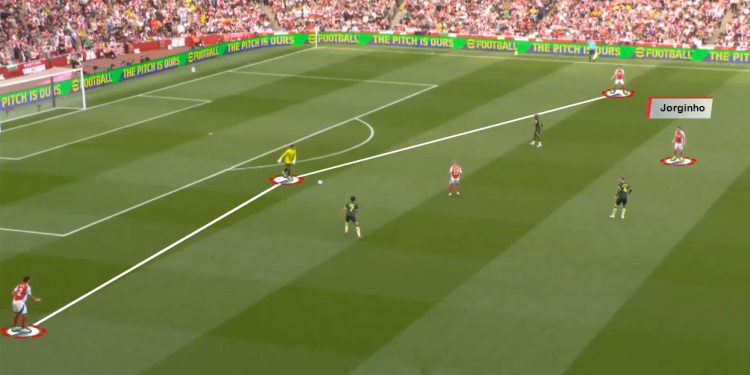
Here, Raya steps up and becomes the third centre-back.
Jorginho no longer needs to drop in that area.
Therefore, the Italian positions himself in the midfield third.
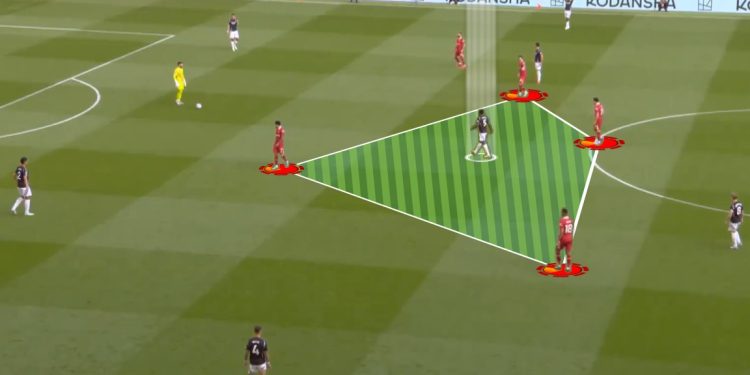
Here, we can see Raya stepping up again.
This time, Thomas Partey is playing as the pivot.
The Ghanaian stays inside the opponent’s structure.
Zubimendi will likely be adaptable to this Arsenal feature, as he is used to operating in a higher position when the other midfielders drop deep.
It is also common for Arsenal’s full-backs to play in staggered positions offensively.
Myles Lewis-Skelly is relatively more offensive than the right-back (Ben White or Jurriën Timber).
Both candidates are natural centre-backs.
This means that the pivot is not required to drop during build-up in the middle third.
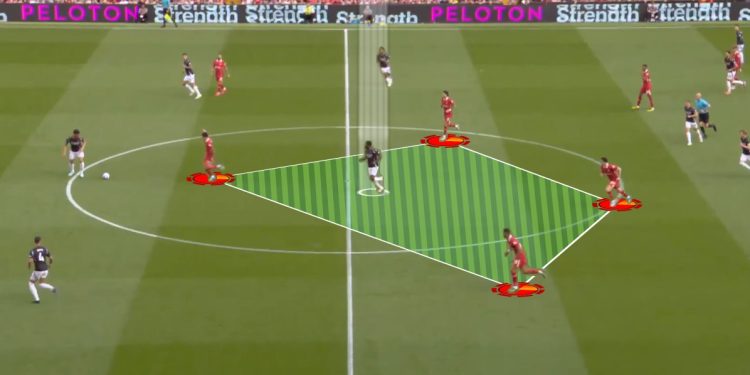
Here is a situation where Thomas Partey operates inside the opponent’s structure.
This is because Ben White stays as a third centre-back.
Meanwhile, Lewis-Skelly can be seen higher up.
As the pivot operates inside the structure, he will likely not receive from his centre-backs directly.
A more advanced midfielder dropping to set the ball will be the way to receive facing forward.
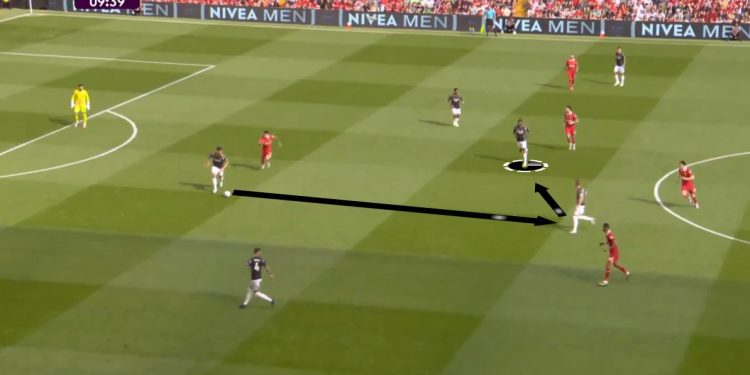
Here is an example of the aforementioned scenario.
Martin Ødegaard drops to set the ball to Thomas Partey.
This is a similar situation to what we saw above with Oyarzabal setting up Zubimendi by dropping deep.
Arsenal are a team that presses high in multiple situations.
This requires their deeper midfielders to push higher and join the second line of press.
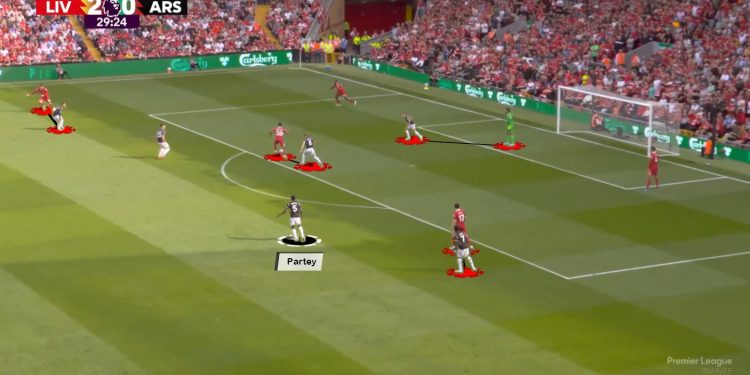
Here, we can see Thomas Partey providing cover as Arsenal are in a high-pressure situation.
One interesting feature of Arsenal in possession is their box midfield.
It is interchangeable in terms of what players form the box.
Myles Lewis-Skelly (left-back) tends to drift inside and form the base of the box alongside the pivot.
On other occasions, the striker can be seen dropping deep to form the box.
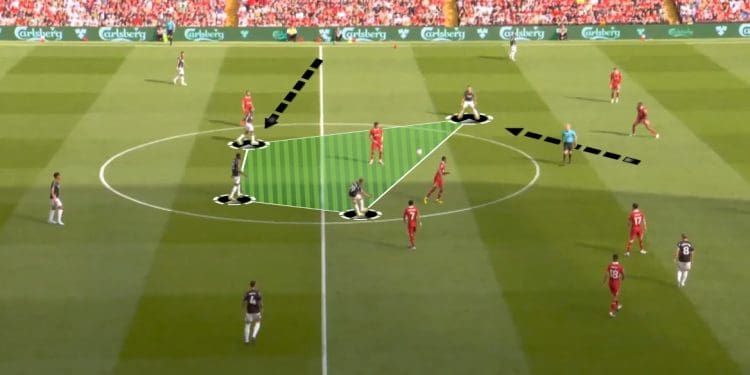
Here is an example of Arsenal’s box midfield.
Lewis-Skelly inverts to position himself alongside Partey.
While Ødegaard is in a higher position, the striker can be seen dropping to complete the box.
Martín Zubimendi can either operate at the base or at the top of this box (if he plays as a centre-midfielder).
Conclusion
Martín Zubimendi is a talented midfielder with the ability to play as a pivot as well as a centre-midfielder.
Being very comfortable on the ball, he offers a range of traits.
He can dictate tempo, drive into space, and link up in tight spaces.
At Arsenal, he is a natural replacement for Jorginho.
However, the Spaniard is more versatile.
He can play as a pivot when Thomas Partey is unavailable.
He can also play alongside Partey and higher in midfield.
This signing opens up several possibilities for Mikel Arteta for the 2025/2026 campaign.
