
Real Madrid faced a considerable challenge in overturning the three-goal deficit against one of Europe’s most disciplined defensive sides.
To stage a remontada against Arsenal, Madrid needed creativity and courage to disrupt Arsenal’s defensive structure.
Yet, this was far from reality.
Arsenal, content to concede possession, managed the game with composure and control.
Their disciplined off-the-ball organisation, more than their work in possession, was key to their win.
Arsenal’s ease of shifting between different blocks rendered Madrid’s attacking efforts (though minimal) ineffective, transforming a miserable first leg into a humbling 5-1 loss on aggregate.
Frustrations mounted at the Bernabéu as Carlo Ancelotti‘s Madrid struggled to find solutions.
This analysis examines how Arsenal’s defensive shape, with its fluid transitions between high, mid, and situational low blocks, became impenetrable.
This approach allowed Mikel Arteta‘s Arsenal to control the tempo, neutralise Real Madrid’s Kylian Mbappé and Vinicius Junior, and dominate the tie with minimal reliance on possession.
Arsenal 4-4-2 Mid-Block – Forcing Real Madrid Into Predictable Zones
From the start, Arsenal’s compact 4-4-2 mid-block, led by Martin Ødegaard and Mikel Merino, inhibited Real Madrid’s build-up phases.
The mid-block was designed to funnel Madrid’s play into predetermined zones, limiting their ability to create central overloads or exploit spaces between the lines.

Martin Ødegaard & Mikel Merino’s Roles
Martin Ødegaard and Merino were the tactical lynchpins of Arsenal’s mid-block.
Their off-the-ball intelligence and body orientation were important in steering Madrid’s build-up into wide areas while denying central progression.
Body Orientation & Lane Blocking
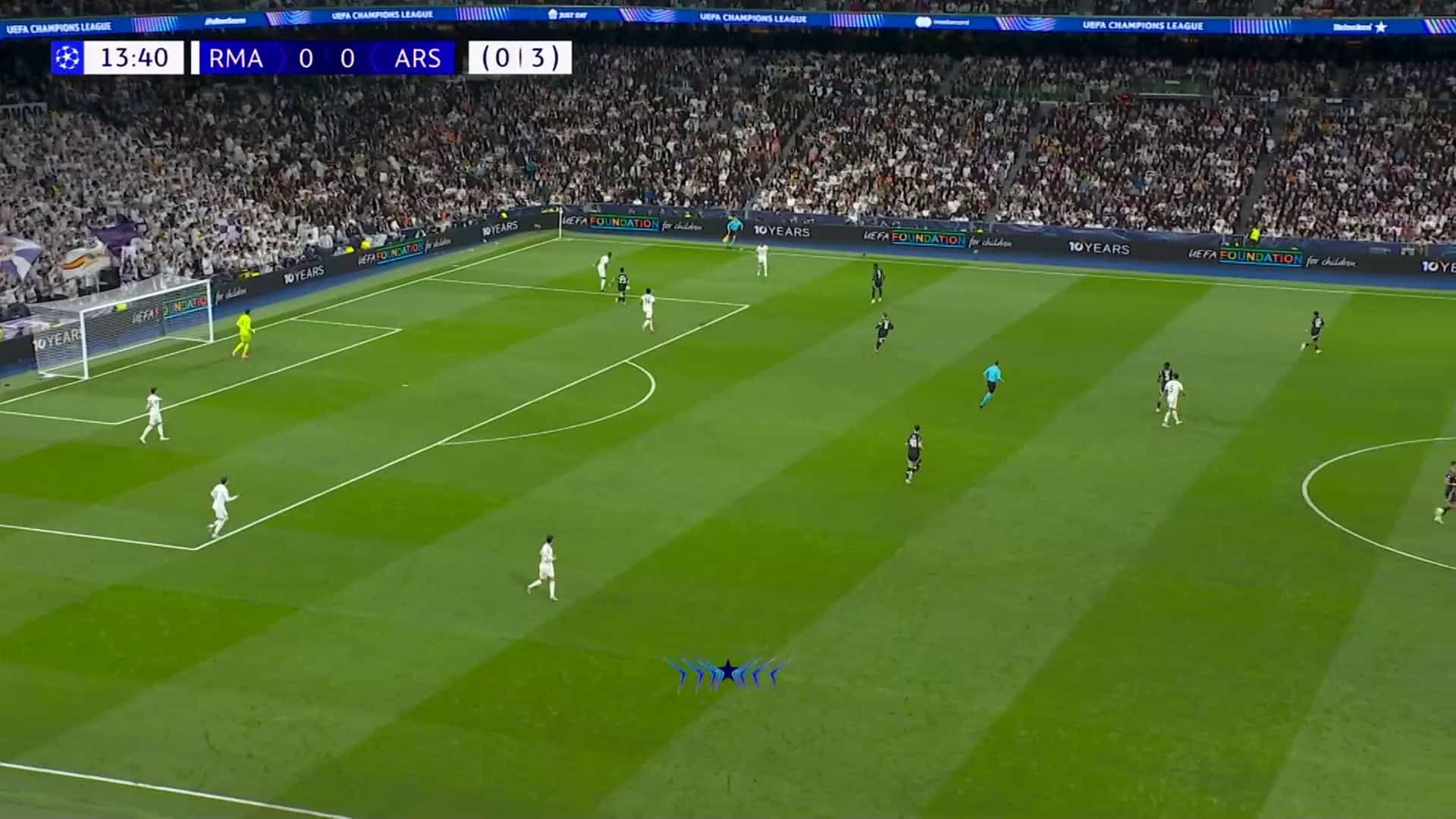
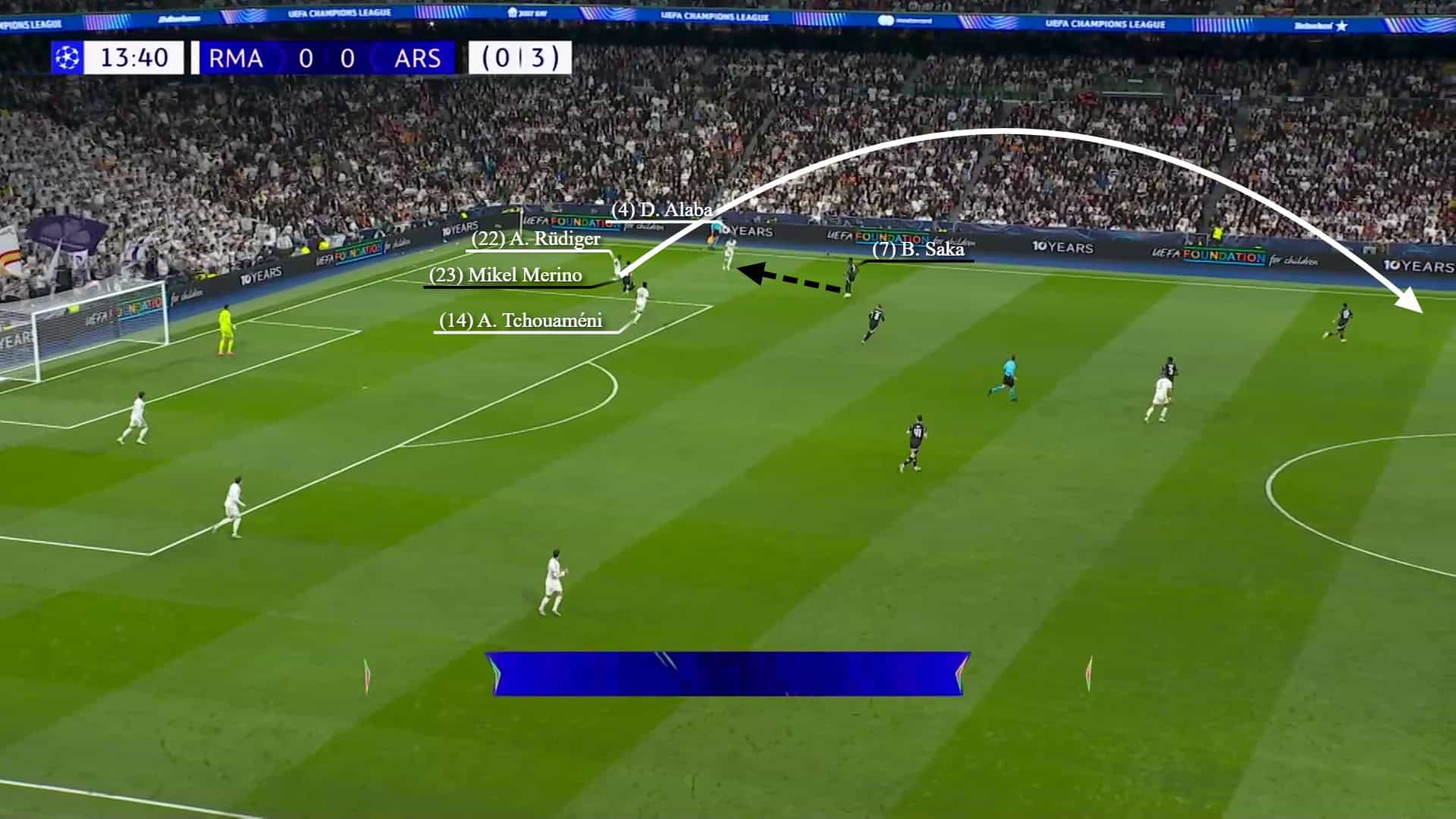
Ødegaard positioned himself to cut off diagonal passing options from Antonio Rüdiger to Aurélien Tchouaméni.
Ødegaard’s body shape was always positioned at an angle that allowed him to monitor both the ball and potential passing lanes, ensuring he could react quickly to any changes in Madrid’s structure.
Pressing Triggers
Merino’s pressing was initiated based on specific triggers, such as a poor first touch by Rüdiger or a heavy touch by David Alaba.
He acknowledged these moments to apply pressure without overcommitting and leaving spaces behind.
Arsenal Compactness In First Line of Press
Arsenal’s first line of press demonstrated elite positional awareness, ensuring that every individual press was supported by cover shadows.
This forced Madrid’s centre-backs into lateral passes or long balls, which would disrupt their rhythm.
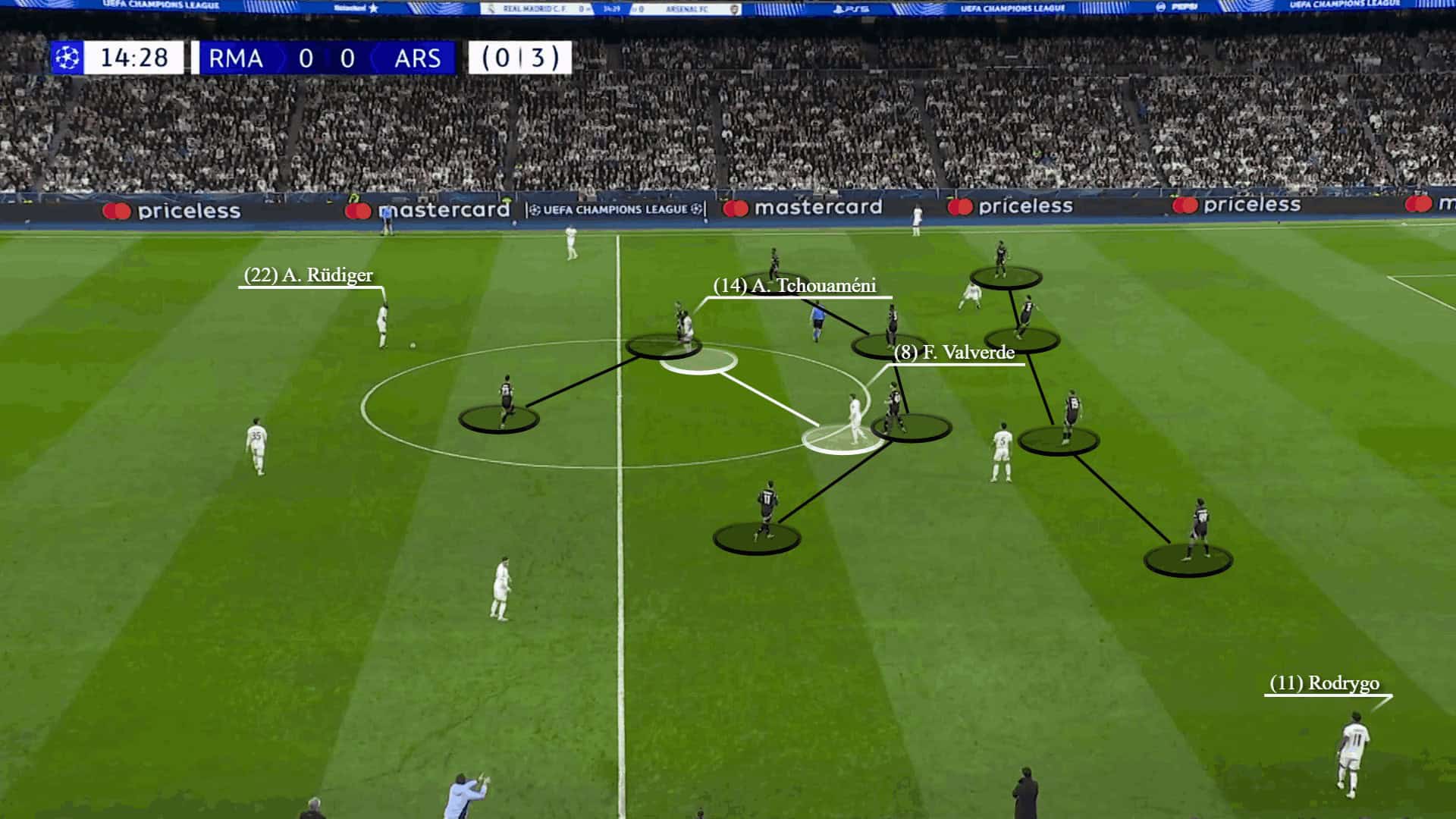
From the image below, we can see that Odegaard and Merino have blocked Federico Valverde and Tchouaméni.
They are also being marked by Declan Rice and Thomas Partey, making it a 4v2 in Arsenal’s favour and making central progression difficult.
The Impact Of Martin Ødegaard And Mikel Merino
Central Denial
By denying Tchouaméni access to the ball, Arsenal restricted Real Madrid’s ability to progress through the middle, forcing them to rely on low-percentage wide play.
Forcing Errors
Rüdiger, under pressure from Ødegaard’s positioning and Merino’s pressing, resorted to long diagonal balls, a lower-percentage strategy that played into Arsenal’s hands.
Maintaining Compactness
The midfield and defensive lines remained synchronised, compressing the vertical spaces between them and making it nearly impossible for Madrid to exploit the spaces between the lines.
In one sequence, Rüdiger attempted a long ball due to Arsenal’s pressing structure.
Partey read the play, intercepted the pass, and drove forward into the space left by Madrid’s stretched structure.
Although he was fouled before initiating a counterattack, this moment showed Arsenal’s ability to turn their block into attacking into opportunities.
Throughout both ties, the Arsenal players were able to read their opponents’ body language and passing intentions, which allowed them to position themselves to break up play and initiate transitions.
Proximity & Congestion In Defensive Zones
A key element of Arsenal’s defensive shape was the spatial proximity between Thomas Partey and Declan Rice in central areas.
Their compact positioning made it difficult for Madrid to thread passes into dangerous zones, particularly to Kylian Mbappe or Jude Bellingham.
Defending The Half-Spaces
The half-spaces, the best zones for creative penetration, were Arsenal’s primary focus defensively.
Arsenal’s defensive coordination repeatedly neutralised Madrid’s attempts to access these areas.
Jakub Kiwior Role
Jakub Kiwior shifted across to block passing lanes into the right half-space, particularly when Bellingham and Rodrygo attempted to operate between the lines.
This is a form of defensive zone activation, where players recognise and cover vulnerable spaces based on the opponent’s positioning.
On a wider team scale, Arsenal created numerical superiority in key zones, suffocating Madrid’s attempts to combine in tight spaces.
It was very zone-oriented, and Arsenal’s defenders continuously adjusted their positioning based on the ball’s location, so that Madrid’s players had no time or space to exploit.
Gabriel Martinelli Dual Role
Gabriel Martinelli played a pivotal role in both defensive and attacking transitions.
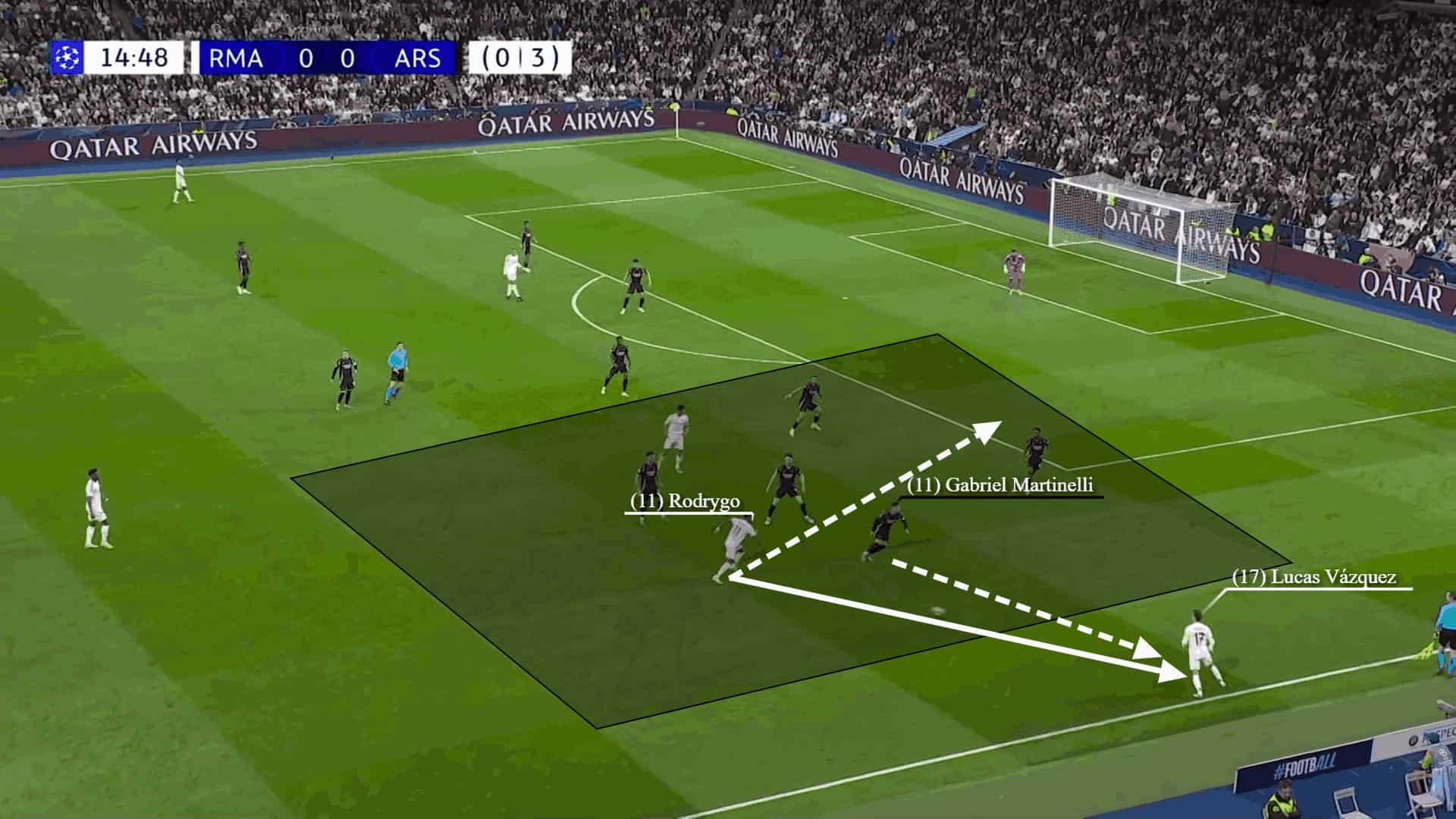
He tracked Lucas Vázquez’s overlaps, which helped Arsenal maintain numerical superiority in wide areas.
When possession was regained, Martinelli’s pace and directness allowed him to exploit the spaces left by Madrid’s advanced full-backs.
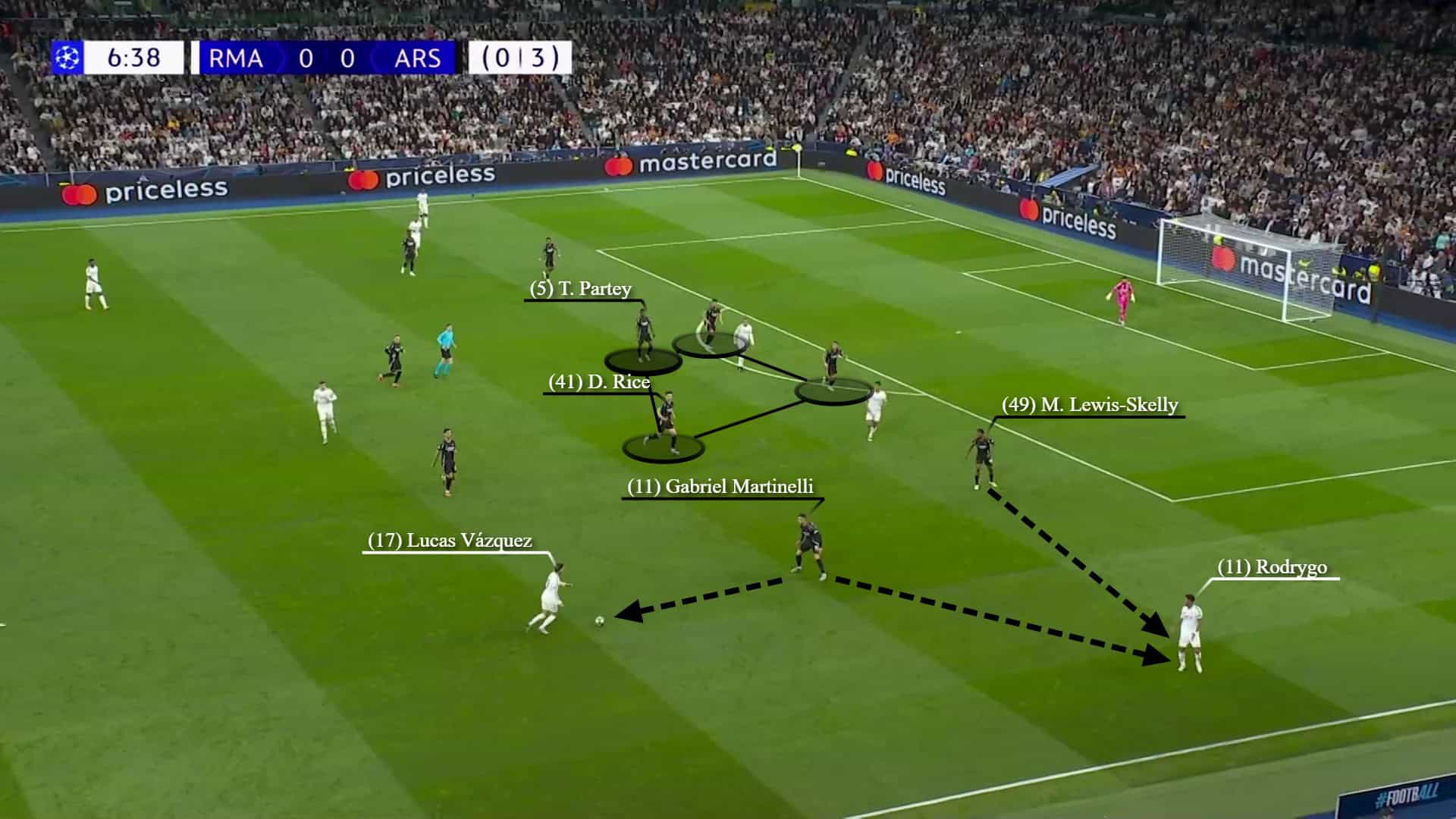
His off-the-ball runs create opportunities to attack the channels. In the image below, we can see how four players (Partey, Rice, Kiwior, and Saliba) have dominated zone 14, the central area just outside the box.
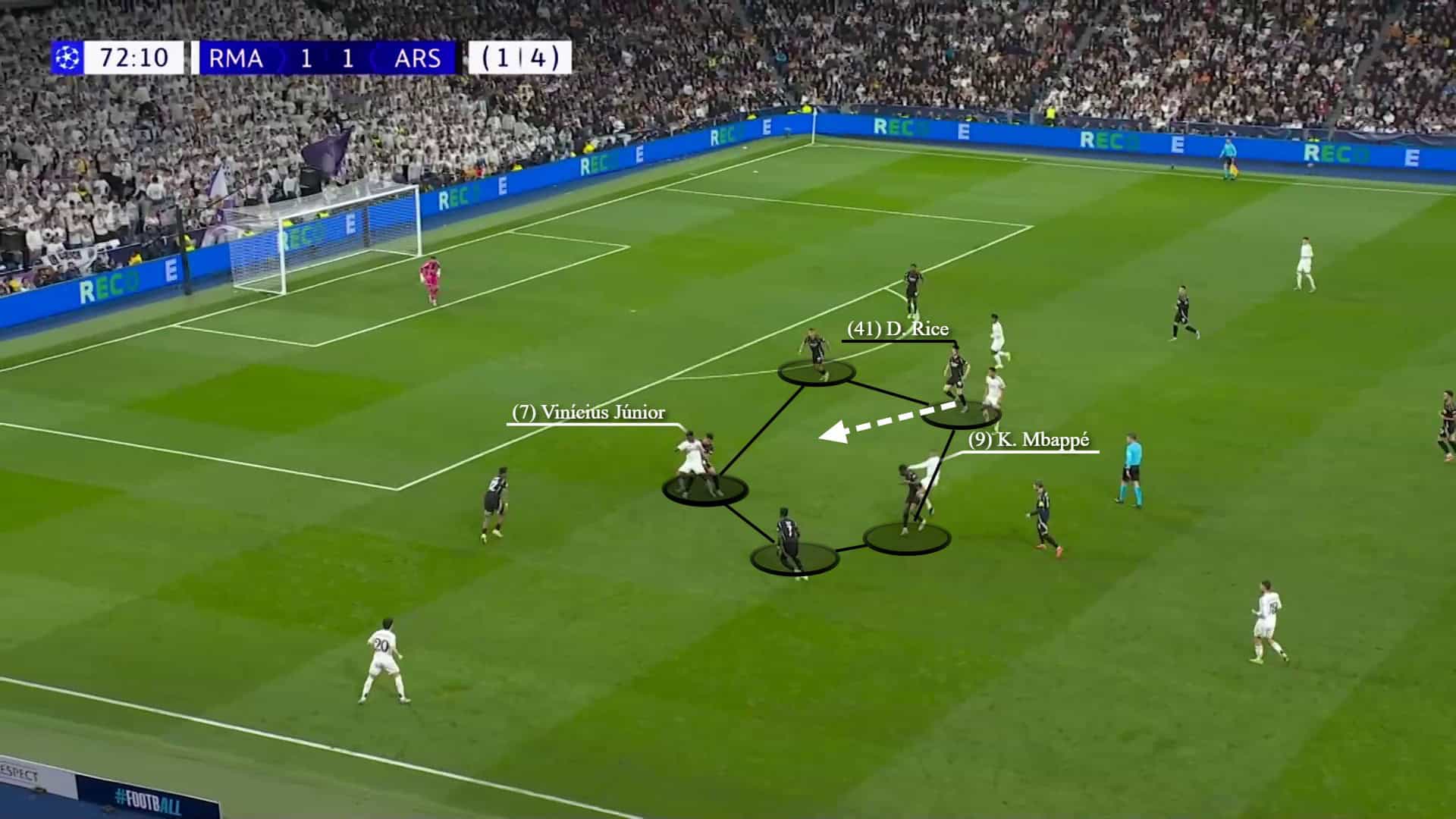
In this image, Arsenal’s defensive structure in this phase is exemplary.
Saliba steps out aggressively to engage Vini Junior, applying immediate pressure as he attempts an inward pass.
The compactness of Arsenal’s shape means close proximity between players, allowing Jurrien Timber to recover quickly if needed.
Simultaneously, Kiwior shifts across to cover the central defensive spaces.
At the same time, Declan Rice, demonstrating excellent positional awareness and athleticism, is positioned to cover ground and intercept any attempted central pass.
This coordinated movement highlights Arsenal’s principles of compactness, cover, and balance.
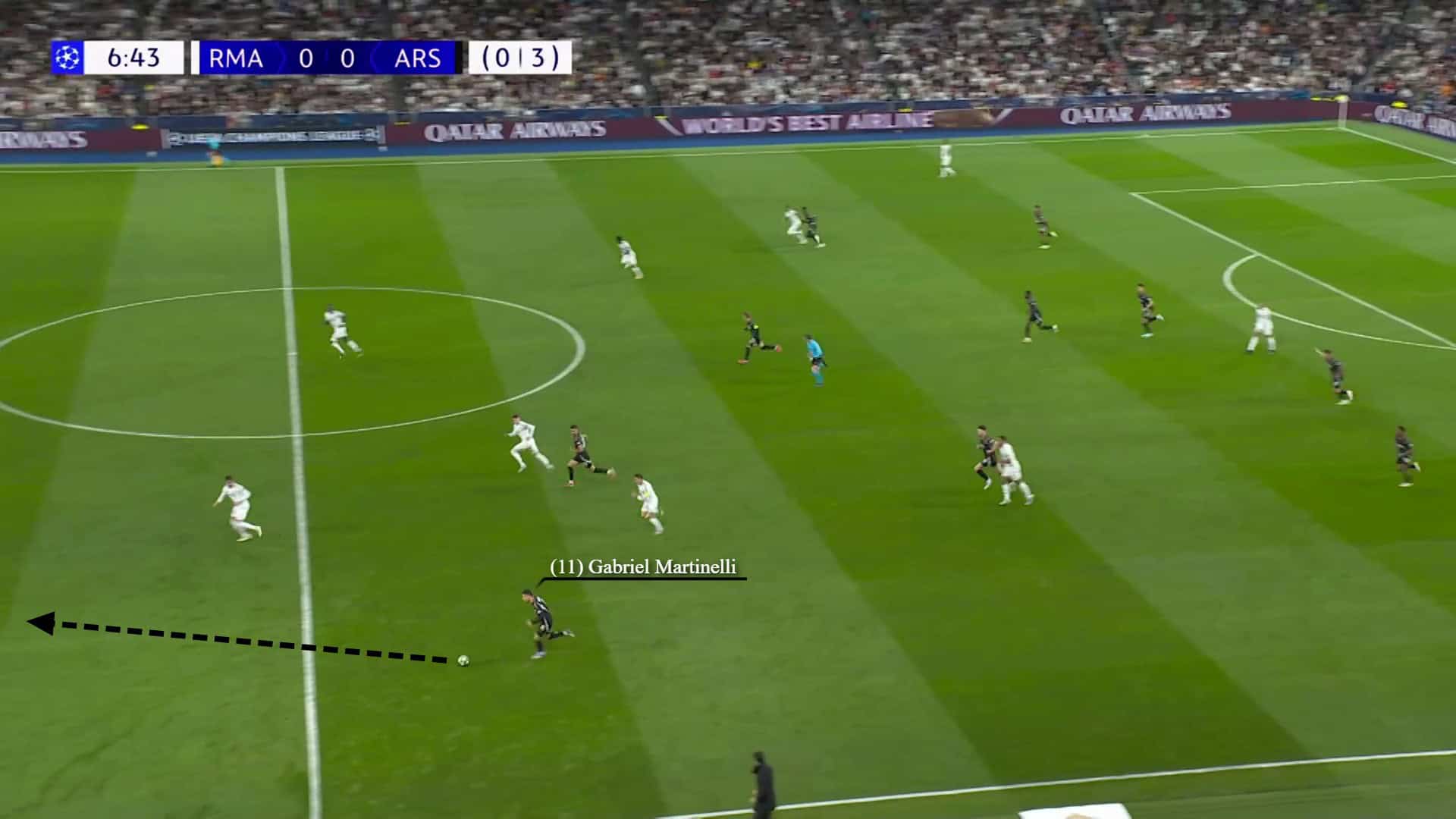
After regaining possession, Arsenal transitions seamlessly into attack.
Real Madrid’s poor rest defence is glaring, with their players clustered and swarmed in central areas near the goal, offering no outlet or balance.
Their lack of defensive width and organisation leaves acres of space on the left wing, which Martinelli exploits.
Valverde’s positioning is wrong-sided, further compounding Madrid’s vulnerability.
This moment highlights the importance of maintaining a defensive structure during transitions—a principle Madrid overlooks.
Arsenal’s ability to capitalise on Madrid’s disorganisation leads directly to the second and decisive goal.
Declan Rice’s Positional Awareness
Rice showed excellent anticipation by stepping forward at the right moments to intercept passes or delay Bellingham’s ability to turn.
His defensive positioning consistently stopped Madrid’s ability to create combinations in tight spaces.
Central Congestion
Arsenal’s defensive line and midfield shifted laterally as a cohesive unit to overload the ball side. This movement created significant numerical superiority in and around Real Madrid’s central players, suffocating their ability to create combinations or penetrate through the middle.
Secondary Layer Of Defence
Partey’s positioning ensured that even if Madrid successfully played into the half-spaces, Arsenal remained prepared to collapse on the ball carrier, forcing backwards or lateral passes.
Sacrificing Width To Protect Central Areas
Arsenal emphasised their commitment to protecting central areas at all costs, even if it meant conceding space in wide zones.
This tactical decision demonstrated Arsenal’s willingness to prioritise compactness and structural integrity over contesting every area of the pitch.
By allowing Rodrygo to operate in relative isolation on the right wing, Arsenal prioritised making the central channels impenetrable, forcing Real Madrid into less threatening areas.
Central Compactness Over Wide Coverage
Arsenal’s 4-4-2 shape was designed to compress the central zones of the field, where Real Madrid’s most dangerous attacking players often looked to operate.
This compactness eliminated passing lanes into the half-spaces and limited Madrid’s ability to combine centrally.
The trade-off was leaving Rodrygo with freedom in wide areas, but Arsenal’s defensive structure meant that he had little support or meaningful options once in possession.
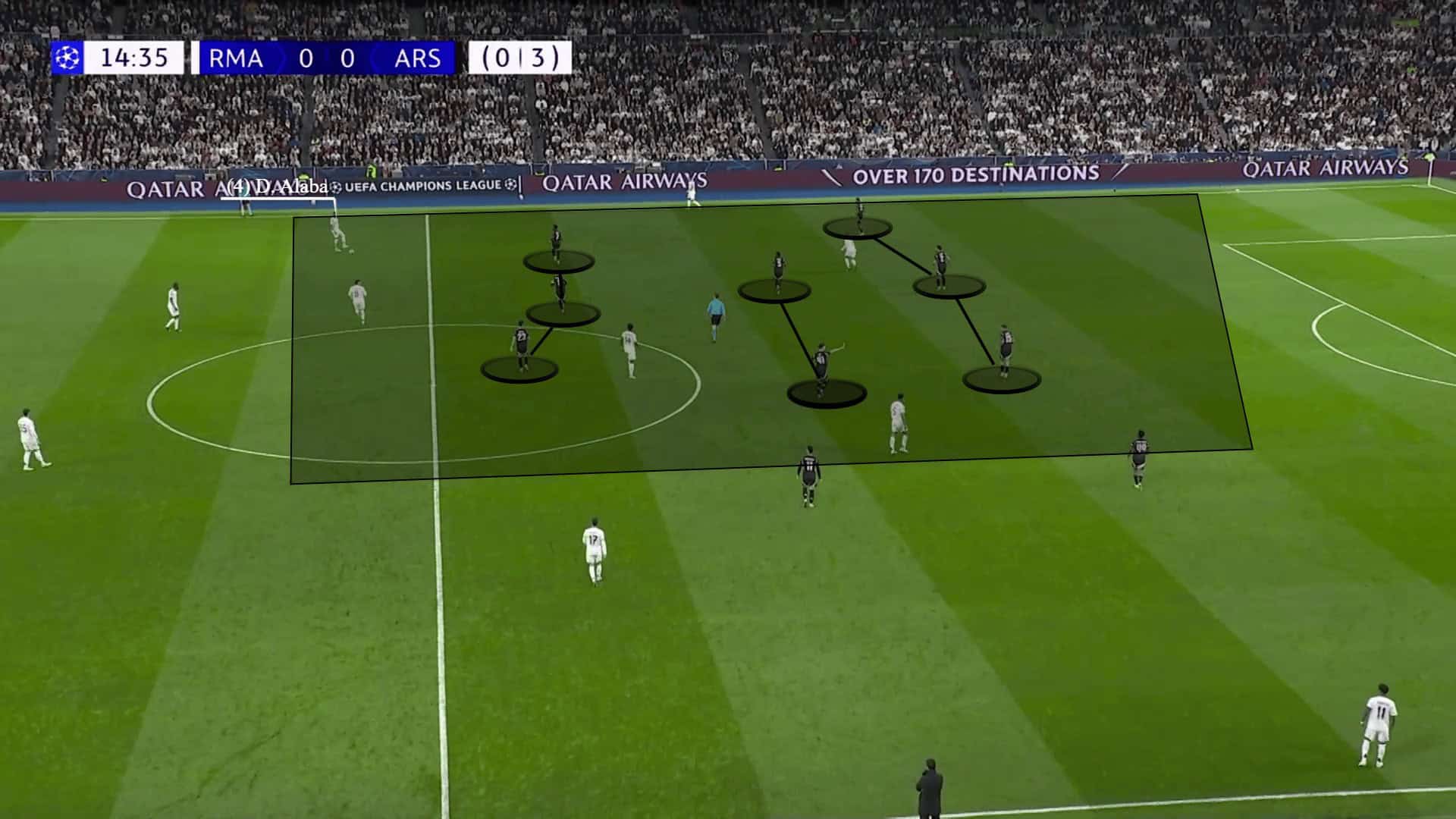
Defensive Overloads & Space Reduction
Arsenal’s ability to overload the ball side while maintaining their defensive compactness was pivotal in limiting Real Madrid’s attacking threats.
By condensing the space in key zones, Arsenal forced Real Madrid into tight, congested areas where turnovers became more likely.
Numerical Superiority
Arsenal’s players consistently outnumbered Madrid’s attackers in central areas, meaning that even if the ball reached Rodrygo, he lacked the support to create meaningful opportunities.
Width As A Decoy
Arsenal’s willingness to concede width gave the illusion of space for Madrid to exploit. However, this was an intentional ploy to funnel play into zones where Arsenal could apply defensive pressure and the touchline as a secondary defender.
Arsenal’s plan to sacrifice width in favour of central compactness was a masterclass in prioritising high-probability defensive zones.
By isolating Rodrygo and refusing to overcommit to wide areas, Arsenal maintained control of the game’s most dangerous spaces.
Arsenal’s 5-3-2 Mid-To-Low Block: Limiting Real Madrid’s Disjointed Attack
Arsenal were able to transition into a situational 5-3-2 off-the-ball shape when needed.
Real Madrid compounded their struggles with ineffective positional play in the final third.
Mbappé’s tendency to vacate his centre-forward role in search of the ball didn’t help Madrid’s attacking structure.
While Mbappé’s desire to influence play is understandable, his movements left Madrid without a focal point in the box.
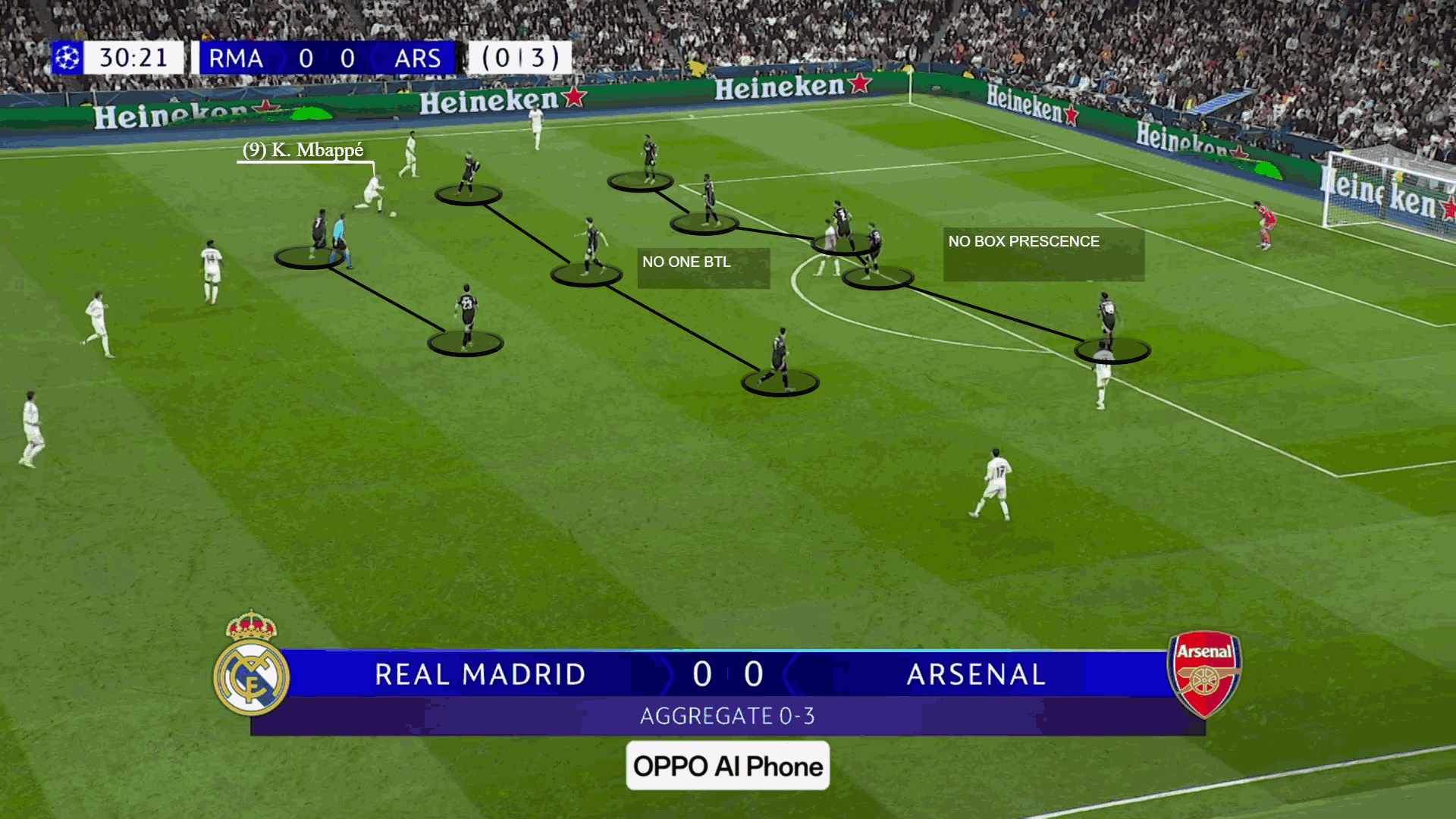
Lack Of Box Presence
With Mbappé drifting into deeper or wider areas, Madrid often found themselves without a striker to attack crosses or occupy Arsenal’s centre-backs.
This gave Arsenal’s defenders greater freedom to focus on blocking passing lanes and controlling the spaces in front of them.
No Confidence Between The Lines
Madrid also struggled to find players willing to receive and play in tight spaces between Arsenal’s midfield and defence.
Without someone to receive on the half-turn and drive forward, Madrid’s attacks lacked penetration and fluidity.
Arda Güler Or Brahim Díaz As Missing Links
In a situation like this, a player with the technical ability and composure of Arda Güler or Brahim Díaz could have been beneficial.
Both possess the confidence to receive the ball under pressure, turn, and create opportunities between the lines.
Arsenal’s 5-3-2 shape was useful because of its flexibility and ability to adapt to Madrid’s movements:
Cover And Balance
The back five provided excellent depth, with the central three defenders covering gaps left by the full-backs when they engaged Madrid’s wide players.
Midfield Discipline
The midfield trio compacted the space in front of the defensive line and denied Madrid access to the central zones.
Thomas Partey and Declan Rice were particularly instrumental in intercepting passes and screening the back line.
By prioritising central areas and maintaining positional discipline, Arsenal nullified Madrid while exposing their lack of box presence and failure to exploit spaces between the lines.
Conclusion
Arsenal’s defensive masterclass against Real Madrid was built on disciplined out-of-possession structures, focusing on central compactness and congestion at the heart of it.
Their 4-4-2 mid-block, led by Ødegaard and Merino, funnelled Madrid’s play into wide areas, denying central progression and forcing errors.
Arsenal’s compactness in central zones, with Partey and Rice dominating Zone 14, suffocated Madrid’s creativity and prevented progression through the half-spaces.
The situational 5-3-2 low block added defensive depth and balance, hindering Madrid’s wide threats while cutting off central passing lanes.
Madrid’s disorganised attack, worsened by Mbappé’s movement away from the box and played into Arsenal’s hands, which secured a historic win.
