
Earlier this week, French football was rocked by the news that Olympique Lyonnais (Lyon) will be relegated to Ligue 2 for 2025/2026.
The relegation was handed to Lyon by the DNCG, French football’s financial watchdog, pending an appeal.
The instability surrounding one of France’s biggest and most historic clubs represents misery for fans of Les Gones.
At the same time, this represents an opportunity for other clubs who will inevitably look to capitalise on Lyon’s current situation.
One player who had been drawing plenty of interest in the weeks leading up to this bombshell news is Malick Fofana (169cm/5’7”, 60kg/132lbs).
The 20-year-old winger has been most heavily linked to Liverpool, though Chelsea, Tottenham Hotspur and Newcastle United have also recently been mentioned as potential destinations for the young Belgium international.
The DNCG’s decision has put those clubs, and undoubtedly others, on alert to Lyon talent, including Fofana, with potential cut-price deals to be secured amid the chaos surrounding the Auvergne-Rhône-Alpes club.
This player analysis and scout report article aims to paint a clear picture of Malick Fofana style of play.
We’ll detail what kind of winger Fofana is, the role he played within Lyon tactics, and where his key strengths and weaknesses lie.
Who Is Malick Fofana?
In January 2024, Lyon spent €19.5m to sign Fofana from KAA Gent, the club where the young winger had developed since 2014.
Transfermarkt valued the player at €8m at the time, though that valuation has grown to €30m during his 18 months at Groupama Stadium.

Last season, Fofana’s first full season at Lyon, the winger played just over half of all available Ligue 1 minutes for Les Gones, scoring five goals and providing four assists.
Looking at the pizza chart graphic in Figure 1, Fofana primarily stands out for his strong attacking contributions.
As well as an above average performance in relation to his positional peers from Europe’s top-five leagues in 2024/2025 for both goal contributions (GC) per 90 and expected goal contributions (xGC) per 90, Fofana put up excellent numbers in dribbles per 90 (76th percentile) and touches inside the opposition’s penalty area per 90 (86th percentile).
These numbers show that Fofana is a reasonably high volume dribbler who’s frequently involved inside the penalty area, as well as being someone who contributed a significant number of goals and assists for Lyon on their road to finishing in the UEFA Europa League qualification places last term.
Fofana was pretty heavily involved in his team’s possession last term but failed to provide a large number of dangerous passes per 90.
Meanwhile, defensively, Fofana offers very little in the air and engages in a below-average number of defensive duels per 90.
However, he ranks above average in the ‘positioning’ metric—a combination of tackles and interceptions.
All in all, Fofana is a decent goal-and-assist threat for Europe’s top leagues, and a keen dribbler who can get involved a lot inside the opposition’s penalty area.
Malick Fofana Dribbling & Off-The-Ball Movement
Fofana is at his best when moving into space on or off the ball.
In Lyon’s system last season, whether the team was set up in a 4-2-3-1 or 4-3-3—their two most common shapes—Fofana typically held the width on the left wing.
Sometimes, he’d invert into the left half-space, but it was most common to find him out wide on that side of the pitch, where he’d look to receive the ball with a lot of space around him.
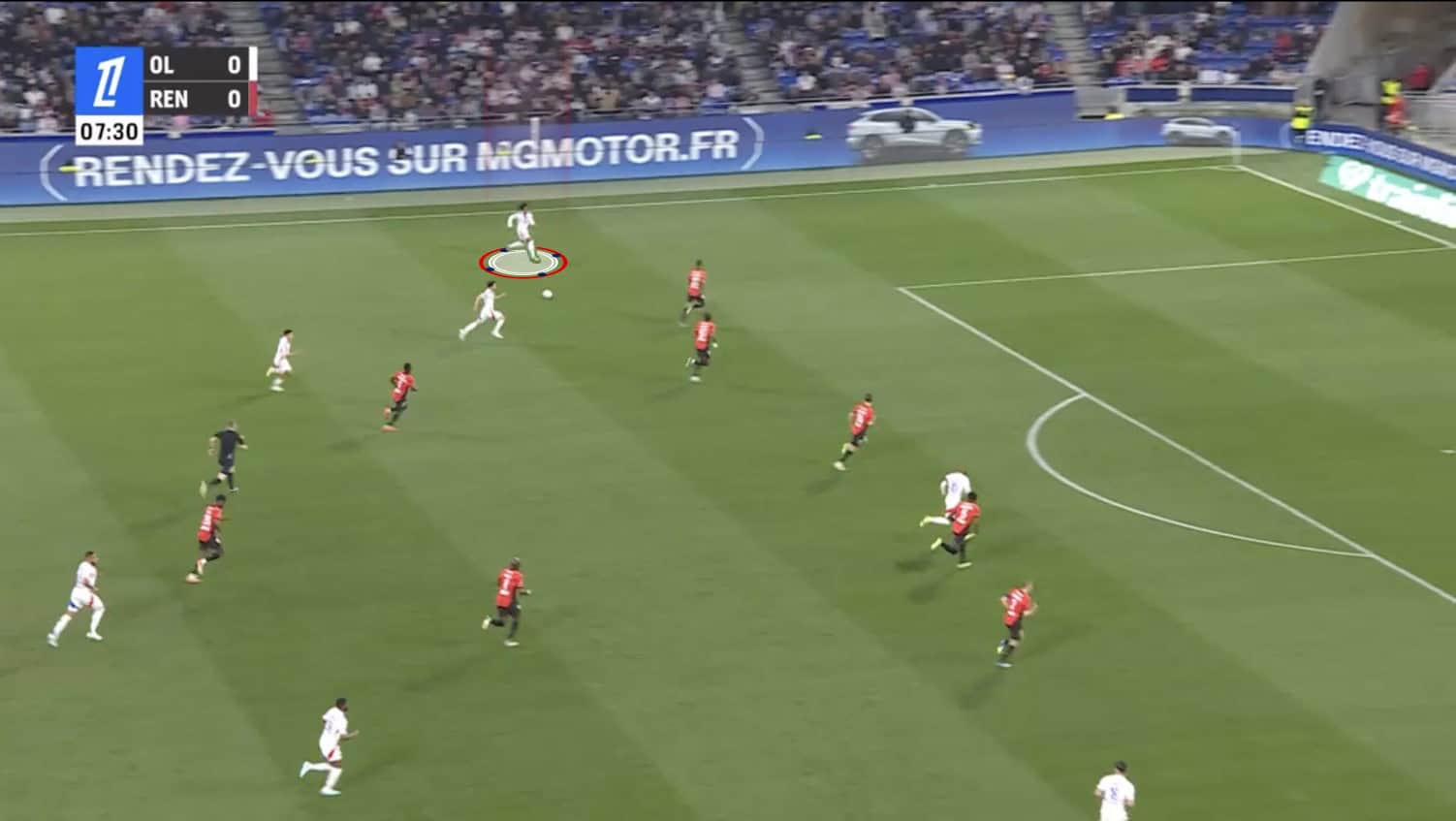
Here, the pass has been played to Fofana, who’s moving inward to meet the ball.
The 20-year-old winger typically receives the ball well while moving at pace, making a situation like this difficult for his direct opponent, who is seen backtracking in this image.
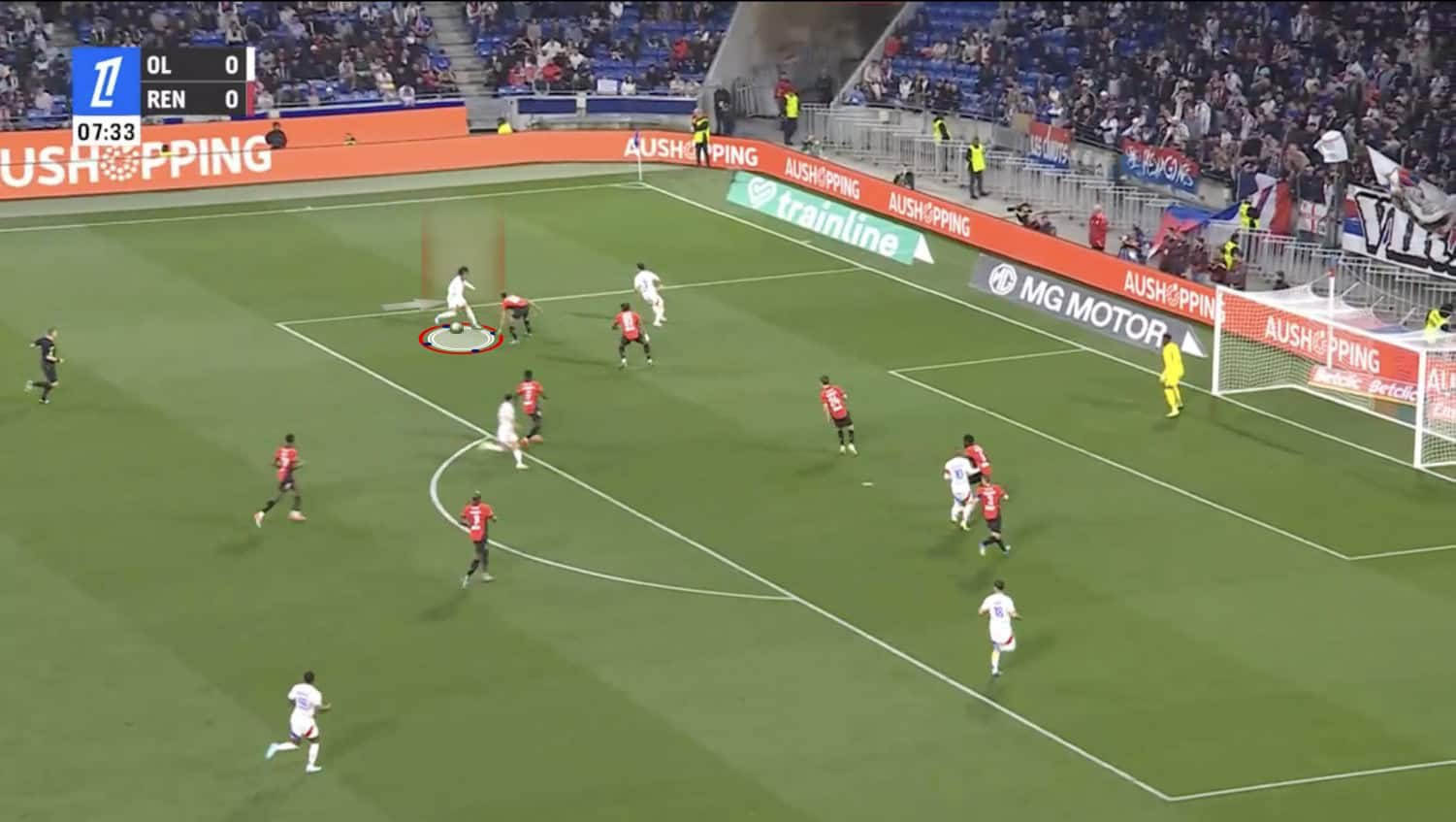
Fofana carries the ball into the box and begins trying to manoeuvre past the opposing right-back.
He gets the opponent square and feints to the left before escaping on the opposite side.
He knocks the ball into some space on his right and opens up a shooting opportunity.
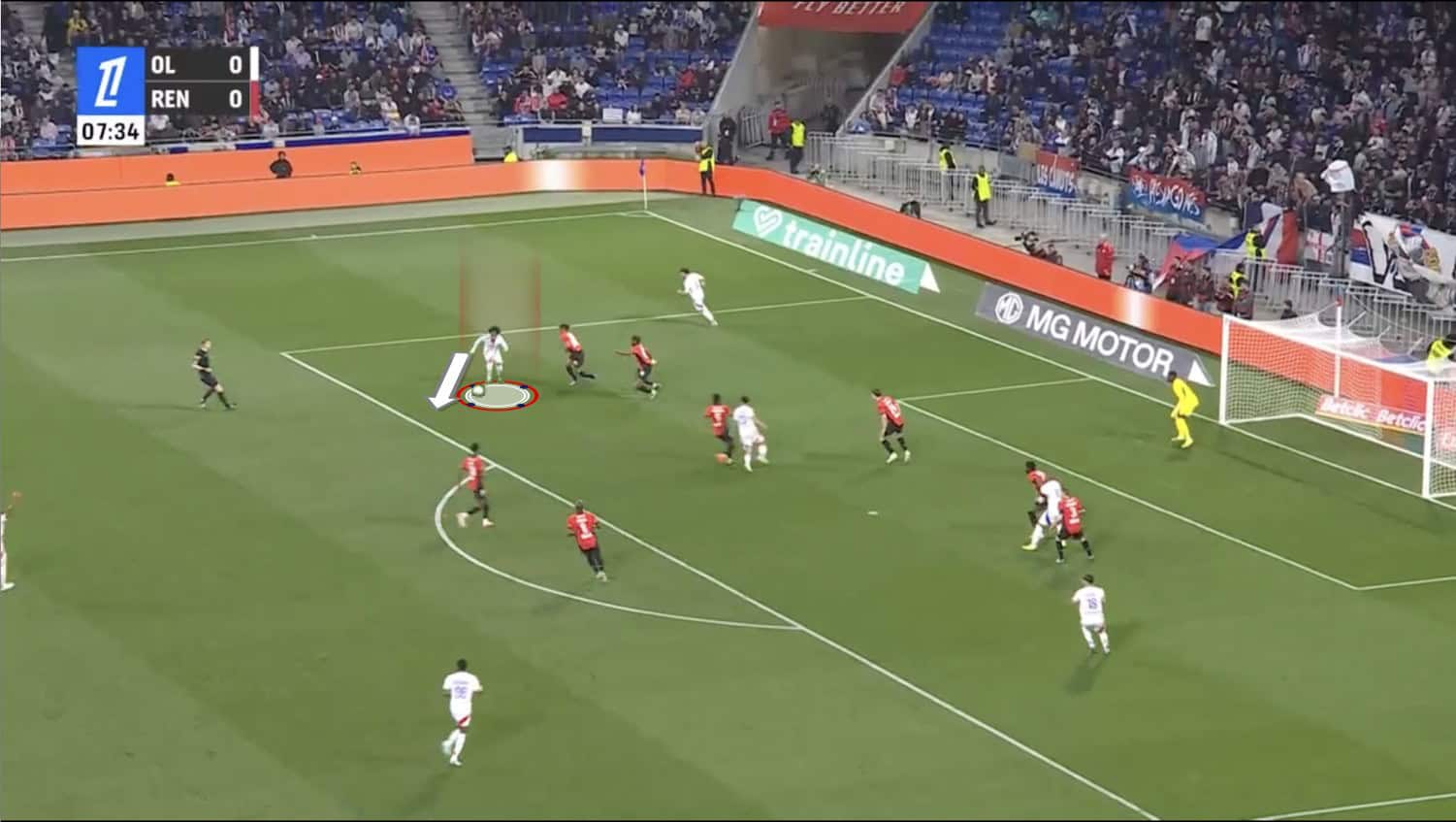
This move ends with a rocket from Fofana into the top corner of the opposition’s net—a near-impossible shot for the goalkeeper to stop.
Fofana is naturally a left-footer.
However, he’s extremely strong off both feet, which adds a layer of unpredictability to his dribbling, playmaking, and goalscoring.
This helps the young winger carve out opportunities for others and himself, as in the passage of play above.
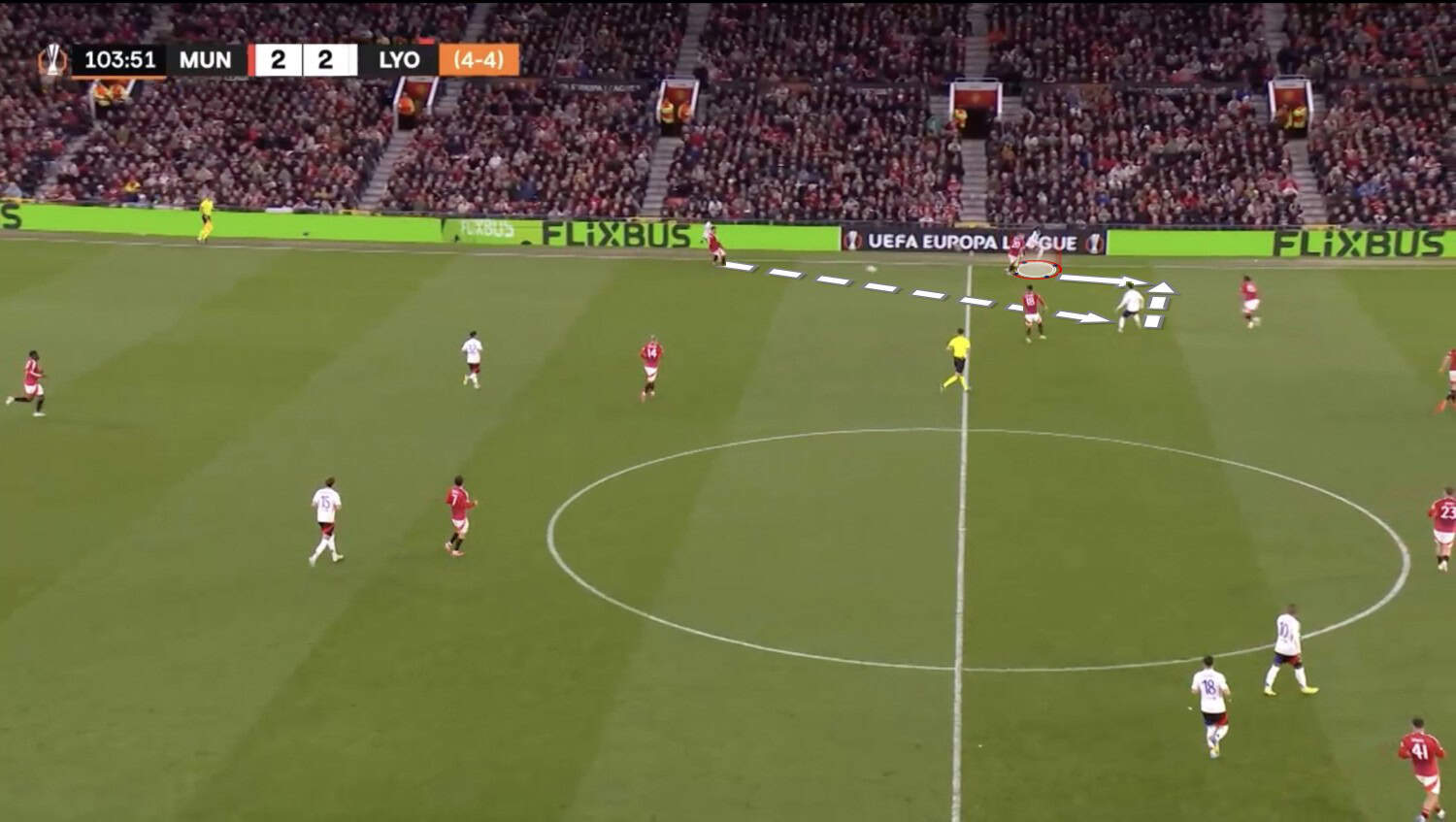
Here, in the UEFA Europa League versus Manchester United, we see Fofana getting away from his marker as his team looks to progress along the left wing.
Lyon form a triangle for ball progression on the left wing here, and Fofana’s direct marker gets drawn high by Lyon’s left-back and his movement past the opposing winger defending on that side.
Fofana begins moving away and starts a run into the space behind the opposition’s backline.
As the marker’s back is turned to him, the ball begins moving from the Lyon left-back into the half-space attacker.
This is a nice move, in which Fofana receives a through pass on the left wing—a direct result of his team’s intelligent structure in the ball progression phase and his intelligent movement, particularly in terms of timing.
Fofana is great at timing his runs to coincide with times when his marker is either preoccupied by something else or just not paying attention to the winger.
Furthermore, Fofana is an incredibly pacey player, so it can be challenging for the defenders to keep tabs on him when he gets going and is released into space.
The Lyon man’s pace and ability to control the ball well while moving at speed make him a perilous counterattacking threat and a lethal player against a high defensive line.
These scenarios in which the winger is offered a large amount of space to move into are when he’s at his most threatening.
The winger can change direction sharply while moving at pace when moving into space.
That said, he’s not the most effective when tasked with carrying the ball past defenders or dribbling in a tighter area.
These situations often get the better of Fofana, making him less effective than a top team might like when playing against a low block.
If the young winger wishes to reach the next level, this is a significant area for improvement.
Malick Fofana Crossing
Fofana is a bit of a mixed bag when it comes to his crossing game.
He’s excellent at carrying the ball into good positions for chance creation out wide.
His pace, intelligent off-the-ball movement, and dribbling ability help him to achieve this.
In addition, Fofana’s two-footedness helps him carve out crossing opportunities by keeping defenders guessing as to which side he will eventually go—a major benefit to his and his team’s playmaking game.
However, cross selection and the technical quality of the delivery can be a bit hit or miss for the winger.
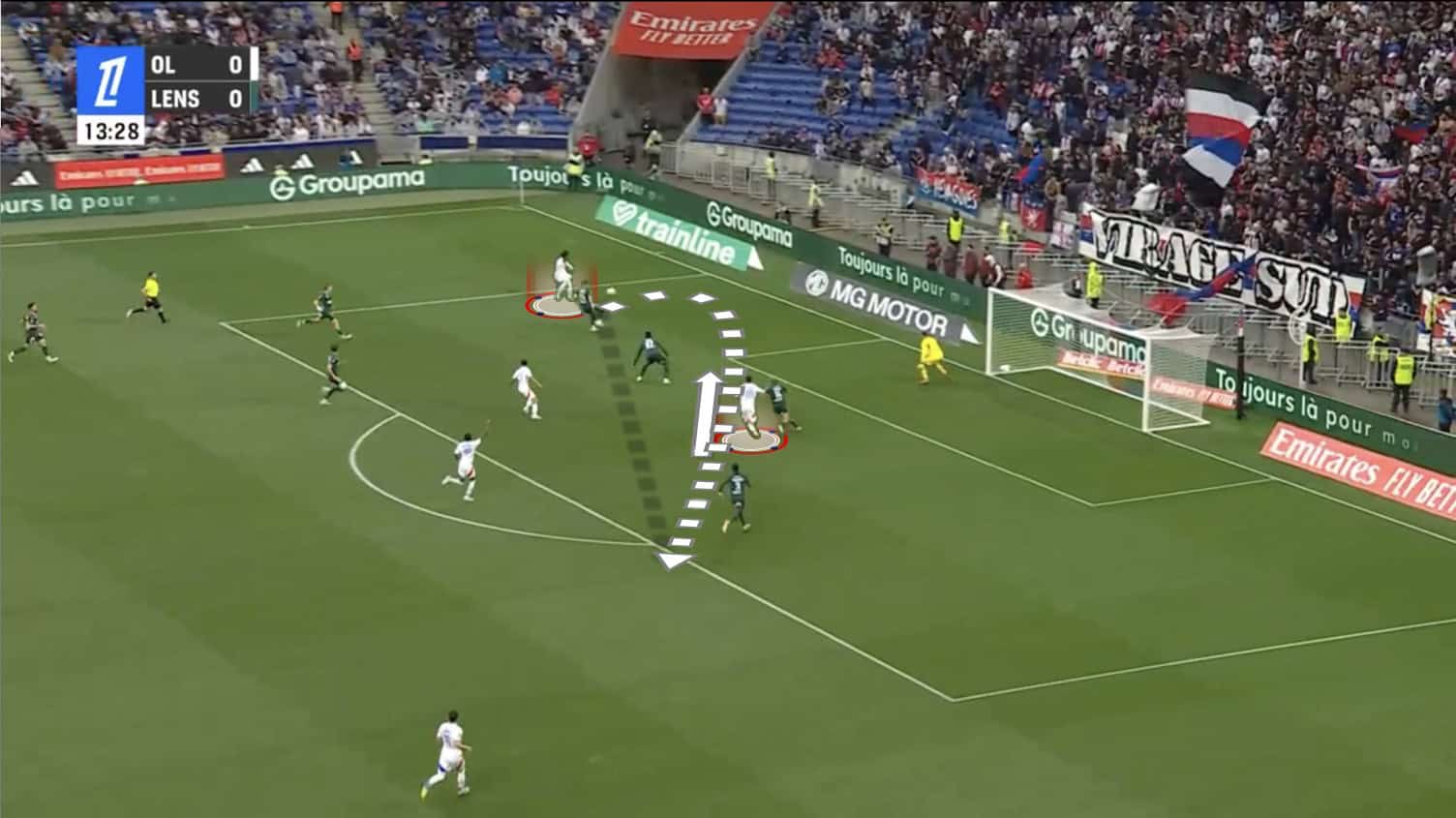
Here, Fofana has carried the ball into a great crossing position.
Additionally, a teammate made a great run through the centre of the box, positioning himself very well to get onto the end of a low-driven cross, which Fofana could perform.
In the end, it seems the two players had their wires crossed, however, as Fofana’s final ball ends up being a chipped cross that floats over the attacker’s head and to the far edge of the box—still falling at a Lyon player’s feet but in a far less threatening position than they could’ve ended up.
Fofana likely failed to spot the player’s movement here, leading to the missed opportunity.
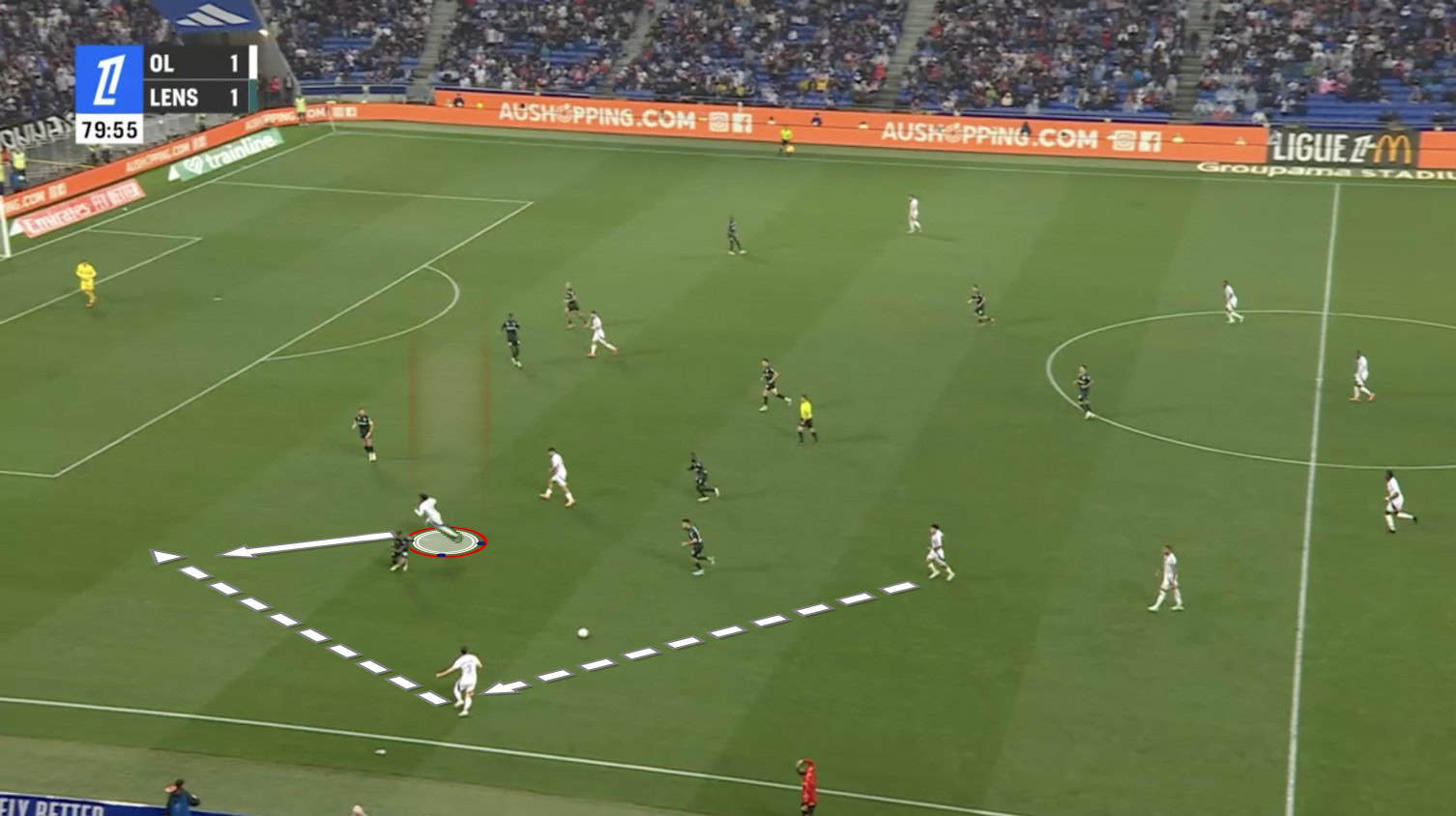
Here, we have another example of Fofana drifting away of the defender’s shoulder into some space out wide.
Again, the run is timed very well, allowing Fofana to capitalise on his marker being preoccupied by a pass out to Lyon’s left-back.
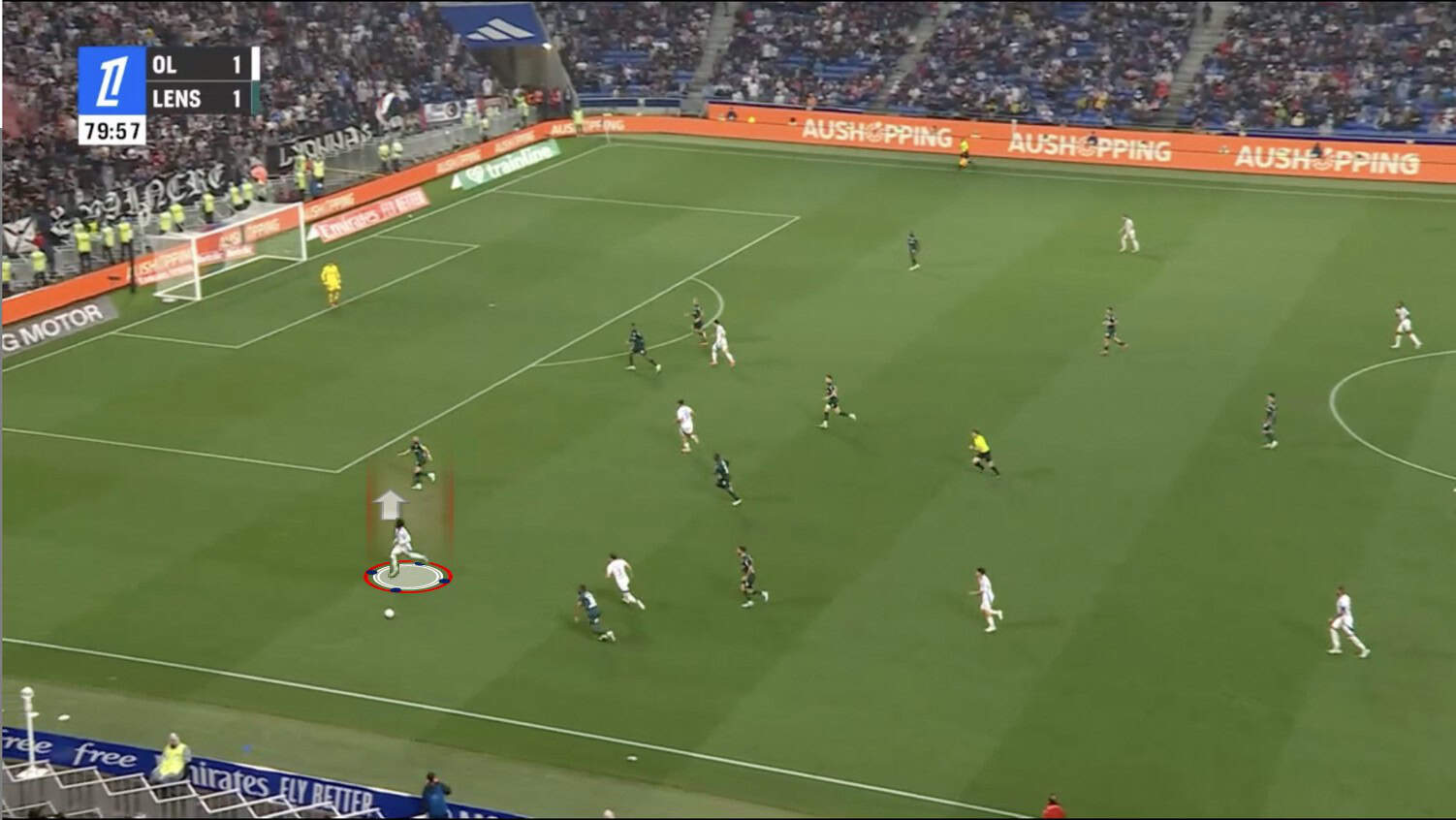
Fofana scans at an intelligent moment, as the ball is in motion, ensuring he’s informed of the developing picture behind his back.
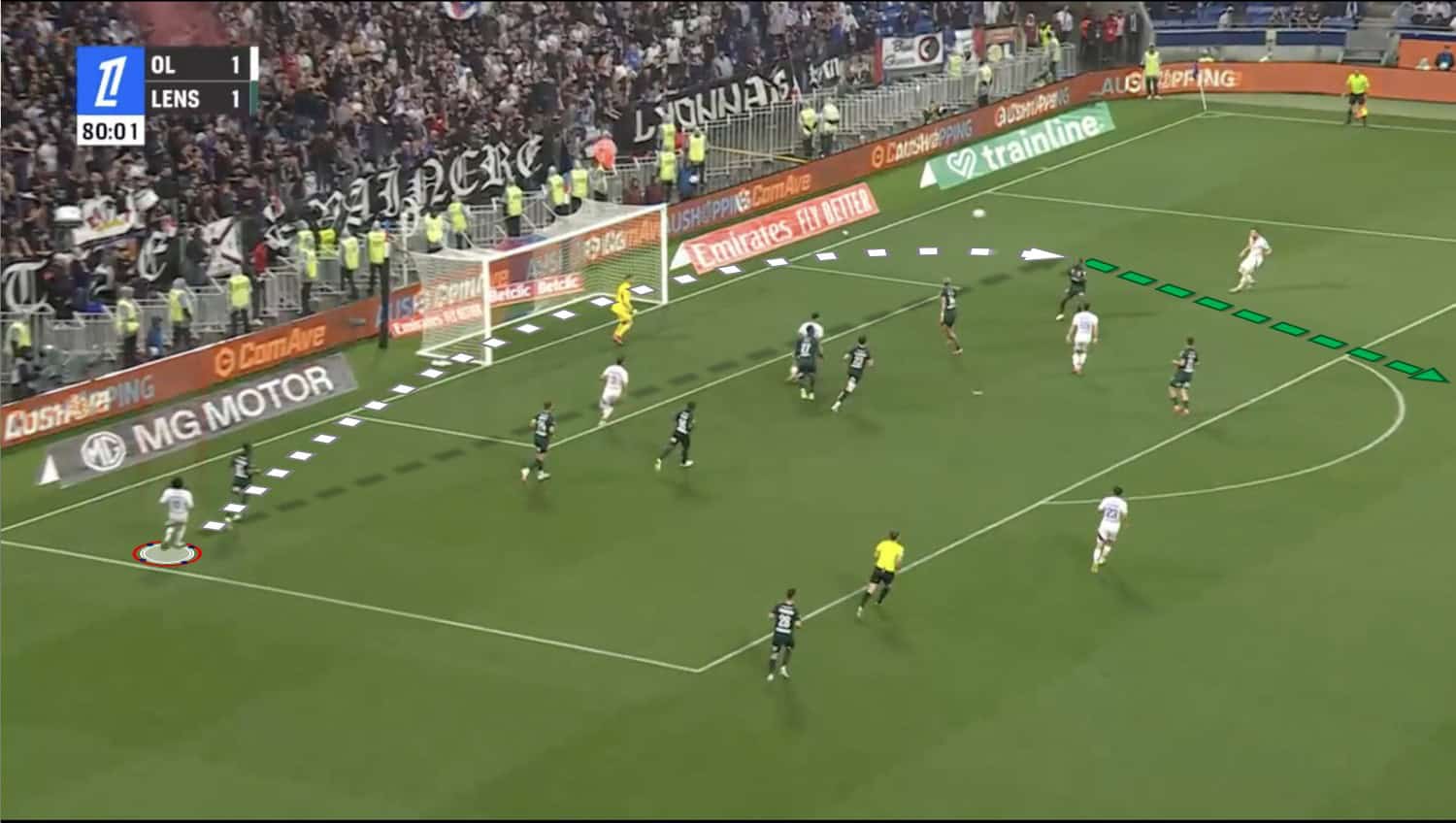
Ultimately, Fofana’s cross is misdirected, turning the goalscoring opportunity into a fairly routine clearance for the opposition defence.
Fofana typically performs a mix of chipped and low-driven crosses into the box off both his left and right foot.
However, accuracy, power and, at times, pass selection need some fine-tuning if the 20-year-old wants to maximise his playmaking ability in the next phase of his career.
Conclusion
If Fofana is to move, he can likely provide his new club a boost in the dribbling department, particularly against a higher line or on the counterattack.
He’ll also provide a decent level of defensive contribution, on top of his solid goalscoring and playmaking abilities.
However, the 20-year-old is undoubtedly still very raw, and it could be a bit early for a move to a team that’d be looking to challenge consistently for league titles and UEFA Champions League.
Fofana’s still quite raw in terms of his playmaking and decision-making.
These areas of his game are in massive need of refinement.
Still, suppose he ends up becoming available on a cut-price deal.
In that case, he’s a young talent with plenty of potential that a patient buyer could benefit from if he’s handled carefully to grow into the top player he could be in the future.
