
Olympique Marseille club president Pablo Longoria has chosen Igor Tudor as the team’s new manager.
The Croatian, who was the head coach of Hellas Verona last season, has signed a two-year contract with Les Olympiens and has taken over from Jorge Sampaoli after the Argentine’s shock exit at the start of the month.
His coaching journey began at Hajduk Split, where he won the Croatian Cup in the 2012/13 season.
He then joined Greek club PAOK and Turkish sides Karabükspor and Galatasaray.
However, he never stayed more than a season before having two stints with Udinese.
Tudor became Andrea Pirlo’s assistant at Juventus in the summer of 2020.
Juventus won the Coppa Italia that season.
Following Pirlo’s departure, Tudor was soon appointed as coach of Hellas Verona.
Given the club’s predicament at the time, Tudor was expected to struggle.
However, Verona only lost one league match in his first ten league fixtures.
With Tudor in charge, Verona finished the campaign in 9th place and gained more points than they achieved under Ivan Juric the season before.
They scored 65 league goals, which was the sixth-highest in Serie A and only 4 fewer than league winners AC Milan.
This tactical analysis will feature data analysis that shows tactical trends instilled by Igor Tudor coaching style at Verona.
We will examine the tactics of Tudor’s attacking approach and the principles of Verona’s defensive phase as they sought to defend on the front foot.
Why Igor Tudor?
Given the number of jobs he has held in his short career, Igor Tudor is still considered to be a journeyman coach.
Someone who hasn’t had time to implement a preferred tactical approach.
That’s why his appointment as Jorge Sampaoli’s replacement has raised a few eyebrows.
Sampaoli is seen as a disciple of Marcelo Bielsa, a manager whose tactical approach is built around intense pressing and quick vertical attacking play.
When you compare how Tudor’s Verona side fared in that department, you can see why Marseille sees Tudor as the coach whose approach is ideal for building on what Sampaoli has started.
The data visual below measures the challenge intensity against the PPDA in Serie A last season.
PPDA is the number of passes per defensive action a team allows their opponents to make on average before they proceed to win the ball.
The challenge intensity measures how many duels, tackles, and interceptions a team makes per minute of their opponent’s possession.

Verona finished the Serie A campaign in first place for both challenge intensity and PPDA last season.
The teams they faced were allowed only an average of 8.28 passes before Verona looked to win the ball.
Once the press was engaged, they made more duels, tackles, and interceptions than any other team, averaging 7.1 challenges per minute against opponents.
By comparison, under Sampaoli tactics, whose philosophy is built upon intense pressing, Marseille’s average challenge intensity was 5.6, and the passes per defensive action averaged 11.88.
When they won the ball, Tudor placed a lot of emphasis on attacking immediately.
Verona would want the play to progress quickly, playing as close to their opponent’s goal as possible.
They attempted more progressive passes per 90 minutes than any other team in Serie A last season, averaging 71.16.
When you compare this to their average possession, which was only 49.71, you can see their intent on playing progressive football.

To summarise Tudor’s tactical approach, Verona pursues the ball aggressively with their press, and when they win it back, they look to play forward and attack immediately.
This leads to quick turnovers during both transition phases, which explains why Verona scored many goals last season but also conceded many under Tudor.
Igor Tudor Defensive Strategy
The defensive system that Igor Tudor implemented at Verona centred on winning the ball as high up the pitch as possible through a man-oriented pressing system.
The team will position themselves as closely as possible, ensuring there is minimal space between each positional line.
Throughout last season, Verona’s formation was 3-4-3.
Sometimes, Tudor would set it up as 3-4-2-1 or 3-4-1-2, depending on the players available and the team they were facing.
Although the formation and principles of his defensive strategy remained the same, Tudor would adapt the press to counter the opposition based on its formation and build-up.
The image below is an example of this.
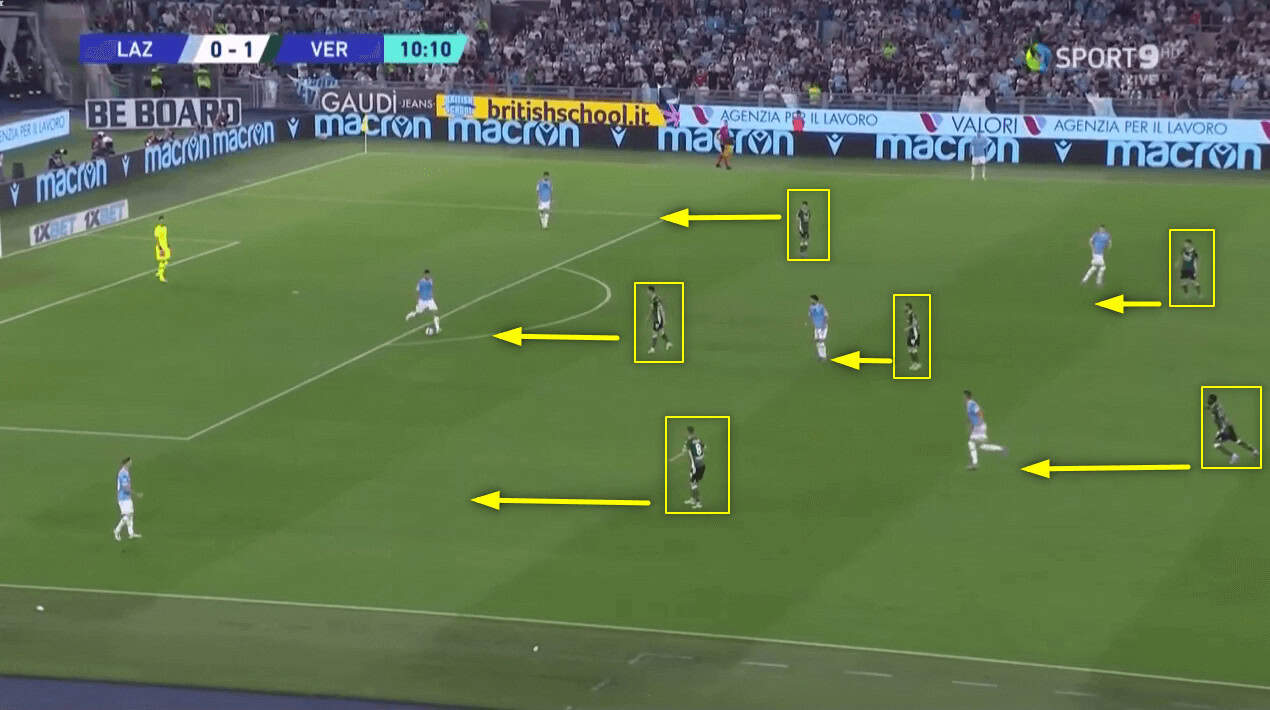
Lazio have dropped their midfield deep to join in with their build-up.
Sarri’s team have seven players in their half of the pitch as they build in a 4-1-2 structure.
Verona, whose formation and usual pressing structure are high in a 2-3 or 3-2 defensive block, has pushed the wing-backs high to block the wide areas.
This creates a 7v7 situation in Lazio’s half of the pitch, with every zone covered and ready to defend.
The risk here is that Verona has left their three centre-backs in a 3v3 situation against Lazio’s forward players at the other end of the pitch.
As soon as Lazio’s centre-backs make that first pass, Verona’s press against the ball is triggered, as each player will look intently at the man in their position.
An example of this is shown below against Sampdoria.
As Sampdoria attempt to progress the play through the centre, the ball is played to Sampdoria’s centre forward, who has dropped deeper to hold up play.
As soon as that pass is made, Verona’s centre-back vacates his defensive line and follows his man as he looks to intercept the play.
You can see how Verona’s players surround the ball, ready for the next phase of play.
They are positioned to pounce on the second ball, or if Sampdoria retains possession, each of Verona’s players is set up man-to-man against each Sampdoria player in the surrounding area.

Igor Tudor implemented a man-to-man marking system all over the pitch, a common tactical trend, at Verona last season.
It creates a high-risk situation as the team won’t maintain a regular defensive shape out of possession, and you rely on the individual to win his 1v1 battle.
The benefits are that the ball is being pressed at every point all over the pitch, which gives you a greater opportunity to win the ball back quickly.
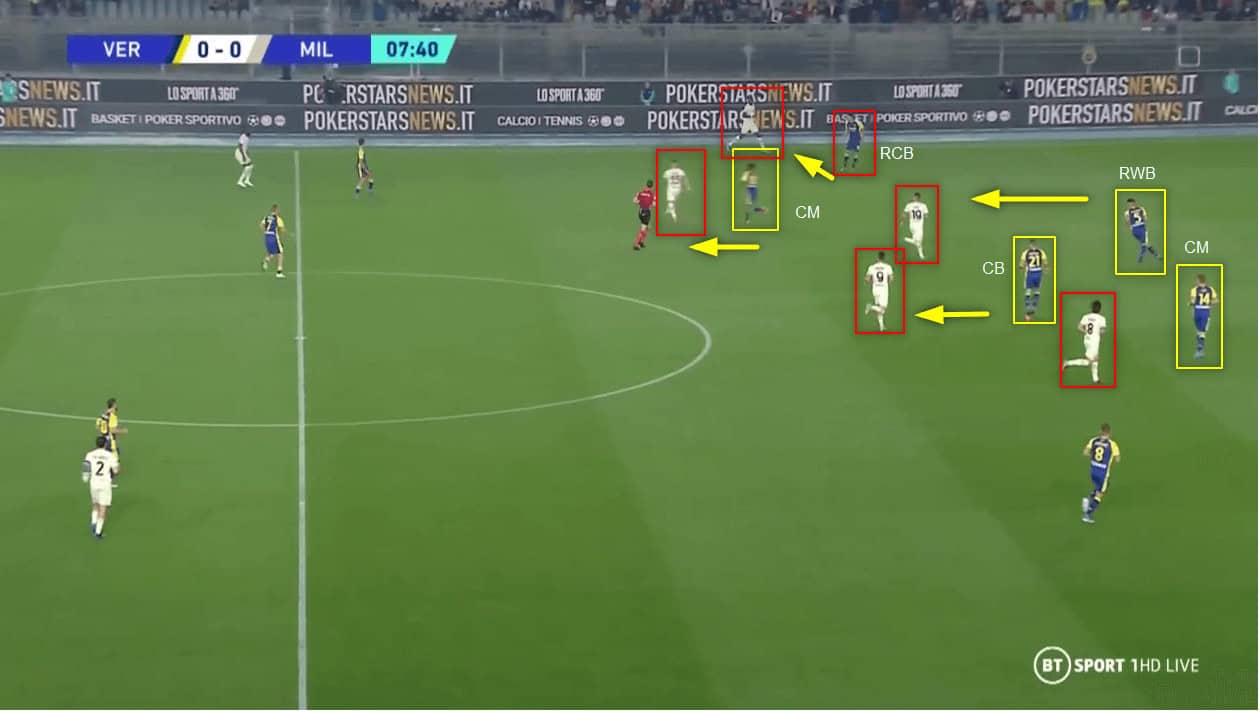
The positions taken by Verona players against AC Milan demonstrate how Tudor employs man-to-man marking.
There is no positional structure within the team’s defensive shape, as each man follows their man.
Attacking Phases
As soon as possession is won, Tudor tactics at Verona were focused on progression and verticality.
Marseille fans will react to this, given their fondness for managers like Sampaoli and Bielsa.
Tudor will want Marseille to get the ball forward quickly.
They will play with full coverage of the pitch as they look to attack through the centre and from out wide.
During the build phase, Verona’s back five switched into a back four, as one wingback moved higher up the pitch while the other remained within the defensive line, as you can see below.
Verona didn’t retain possession for long periods in the defensive third.
The wing-back pushes higher so he can be the outlet that enables the team to progress the play immediately and stretch the opposition.
More so against teams who congest the pitch centrally.
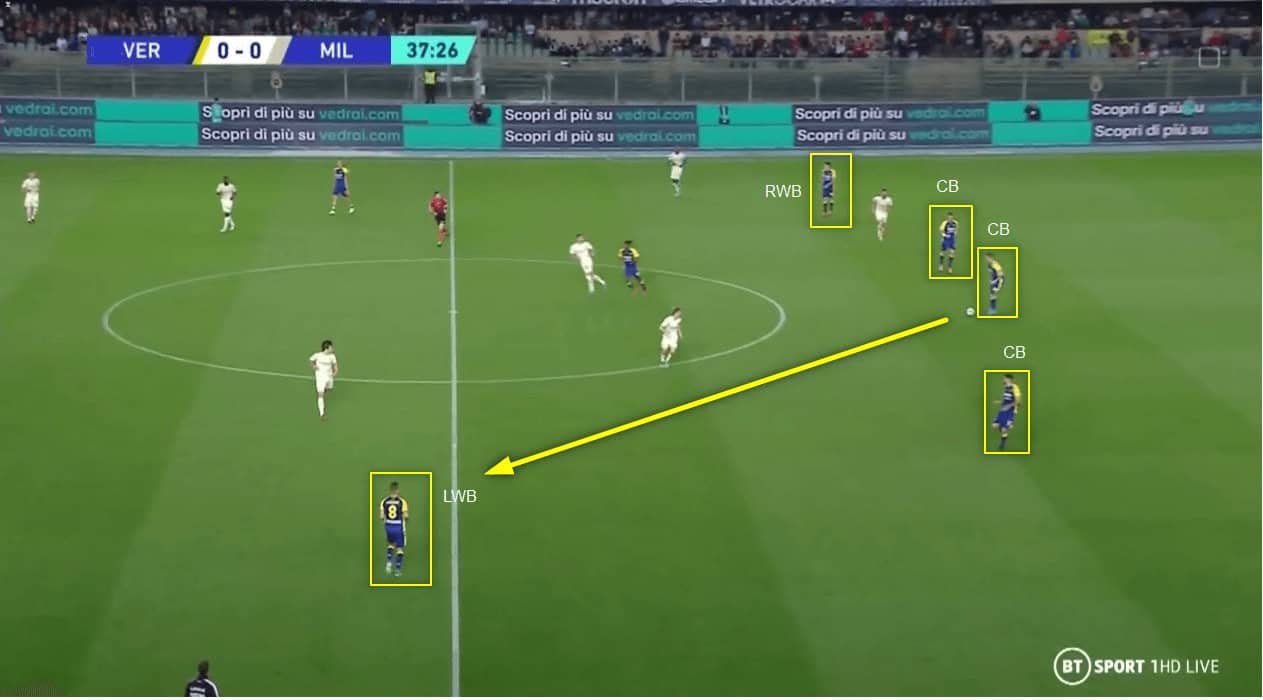
Alternatively, the outside centre-back whose channel they are playing through will make a forward run and join the attack.
Tudor prefers his teams to get as many players as possible in the opponent’s half of the pitch, believing three defenders are enough to deal with any counter-attack that may follow.
However, his preference is for the wing-back on the opposite side to join the attack.
Once the play moves further up the field into the opposition’s half, Tudor’s tactics place a lot of importance on the wing-backs.
They become heavily involved both with and without the ball.
When Verona played a team that wasn’t so attacking-focused, and I Gialloblu were given more possession, the wing-backs are instructed to push forward into the final third and try to overload the opposition’s defensive third.
This allows Verona’s formation to transition from 3-4-3 to 3-2-5.
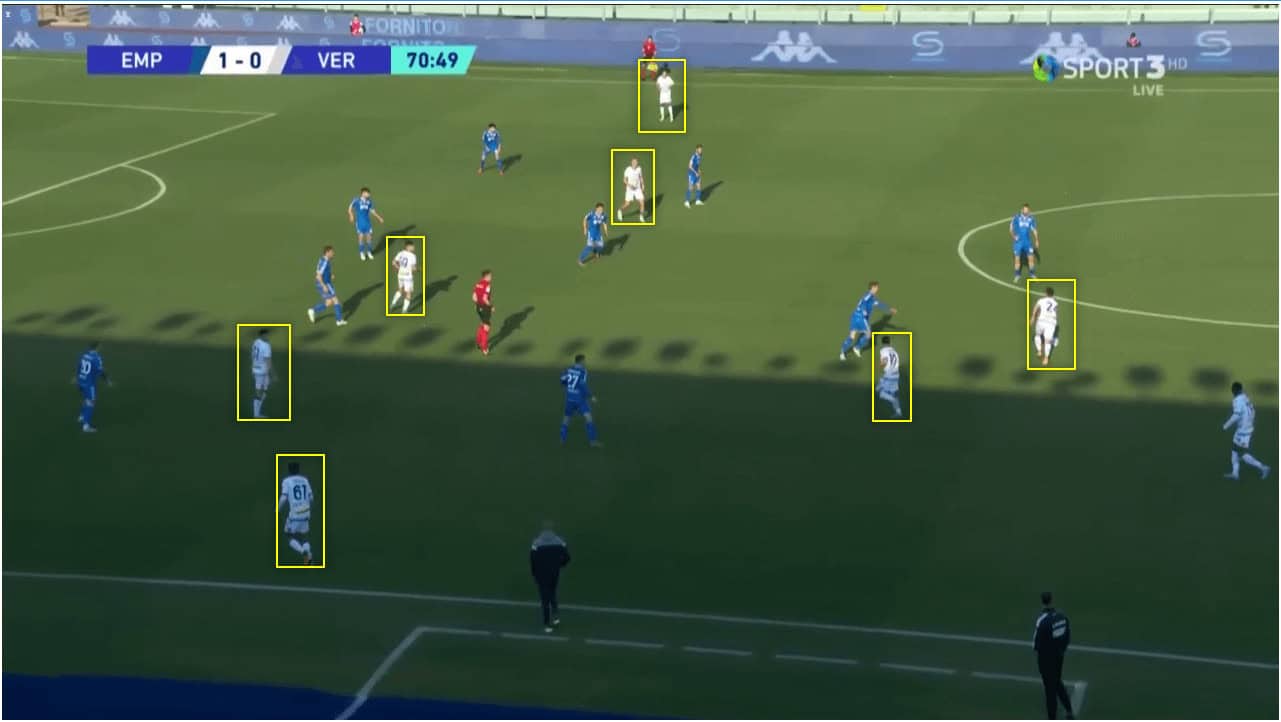
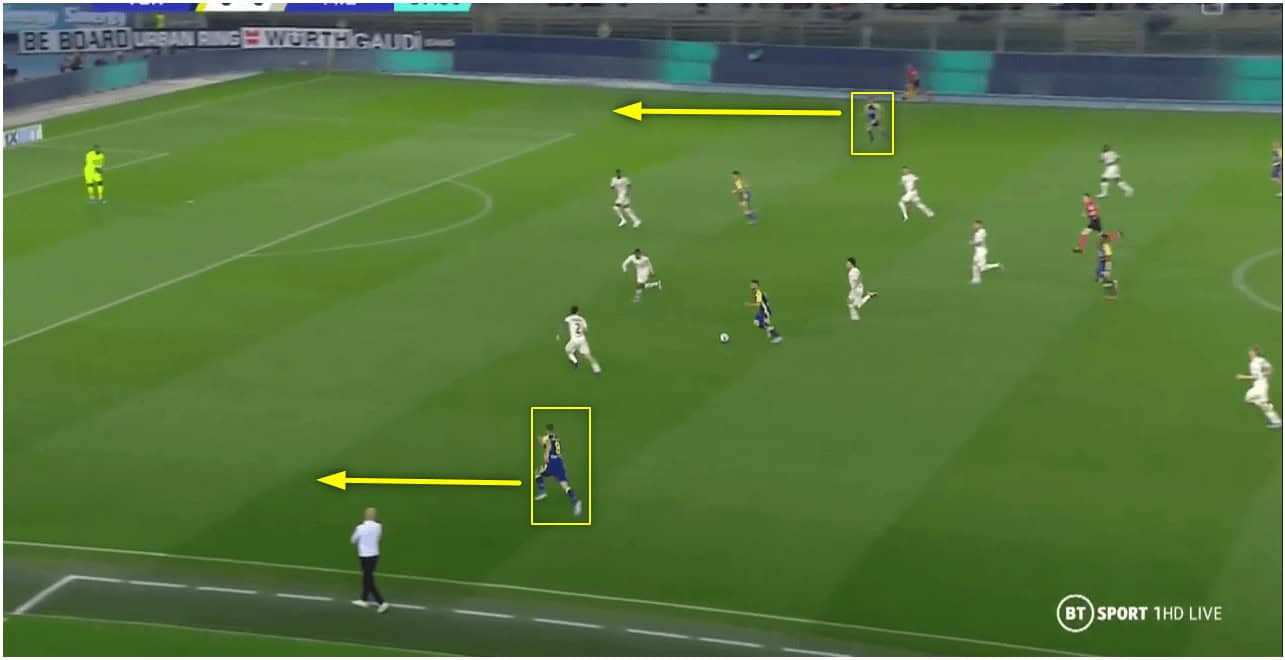
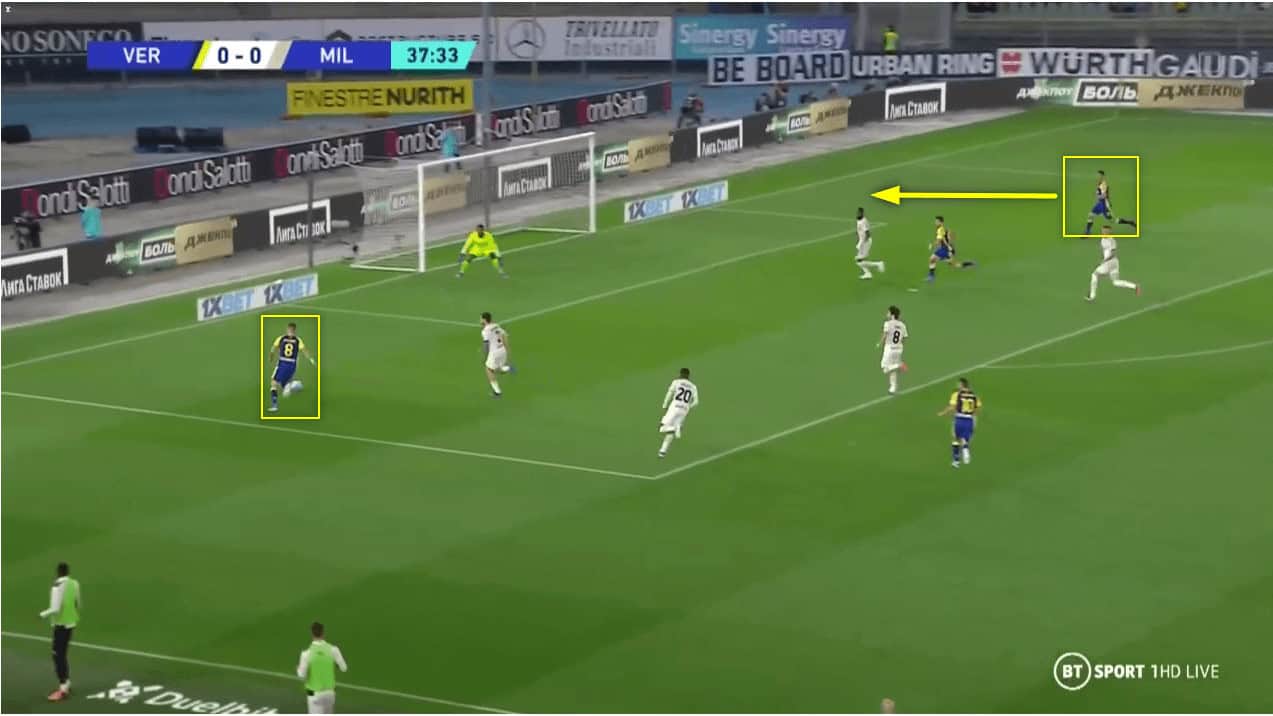
Verona would ideally transition into attack predominantly through the middle of the pitch.
This was to draw teams towards the balls.
Once the other team completed that move this created more space out wide.
The following two images illustrate this trend at two different stages of attack.
The first one occurs as they enter the final third, and the second one occurs as they are deep into the final third and have entered the penalty area.
Milan has six players in the centre of the pitch as Verona exploits the spaces down each channel, creating a 2v1 overload on both sides.
David Faroni and Darko Lazovic were Verona’s main wing-back pairing last season.
Faroni scored four goals, earned five assists, and finished the campaign with a 5.6 npxG+xA.
Lazovic scored one goal, got seven assists, and finished the season with 9.3 npxG+xA.
(non-penalty expected goal and expected assist)
The data shows how involved and how important the wing-backs will be for Marseille under Igor Tudor’s tactical setup.
Conclusion
Taking over Marseille at this time could prove challenging for Igor Tudor.
He is taking over a team that had built significant momentum under Jorge Sampaoli.
The team finished second in Ligue 1, qualified for the Champions League, and got to the semi-finals of the Europa Conference League.
With PSG likely to repeat its dominance domestically, will Tudor be able to build on what Sampaoli started to build, or will this move turn out to be a curse the Croatian coach should have avoided and perhaps wasn’t ready for?
The former Juventus man will continue his courageous attacking and intensive style of football.
Although the Marseille fans will appreciate the entertainment, he will have to adapt to managing a team expected to win rather than one that enjoys winning.
This analysis has shown how Tudor focuses his tactical approach on defending with intensity and attacking with risk.
We have examined the data from his time in charge of Verona and shown the Marseille fans the tactical trends they can expect at the Stade Vélodrome next season.
