
In our previous Pep Guardiola and Pepijn Lijnders analysis, we began exploring Manchester City’s in-possession tactics by focusing on their build-up.
The phase in which Pep Guardiola’s side demonstrated tactical flexibility and diversity in their game plan, adapting based on the starting personnel and showing resilience against the opposition’s high-pressing schemes.
With the addition of assistant coach Pepijn Lijnders and several new signings, Man City’s tactical evolution has taken a fresh turn, especially in how they approach the next phase of play: progression.
In this tactical analysis, we move beyond the defensive third and into the middle third, analysing how Man City advance the ball with their updated positional dynamics, how they manipulate man-oriented systems like Juventus’, and how specific roles enable them to gain territory.
Progression, the phase between build-up and final third penetration, requires cohesion, timing, and flexibility.
It is the phase where Pep Guardiola’s tactical ideas meet the opposition’s pressure in the middle third.
Here, Man City operate with a clear objective, a point worth keeping in mind when analysing their approach.
While creating a goalscoring chance from this phase is certainly a positive outcome, Manchester City’s primary aim is to progress with control into the final third.
The focus is not on forcing opportunities but dictating the game’s rhythm through measured possession.
Manchester City Progression Tactics Vs Wydad

In this match against Wydad AC, Manchester City lined up with Ederson in goal.
Vitor Reis and Nathan Aké operated as the centre-backs, flanked by Rico Lewis on the right and Nico O’Reilly on the left as full-backs.
Tijjani Reijnders started as the six, with Phil Foden and Omar Marmoush playing as the right and left eights respectively—a switch from what we see on the board, which had Rayan Cherki listed in that role.
Instead, Cherki featured as the centre-forward.
Savinho and Jérémy Doku occupied the right and left-wing positions on the flanks.
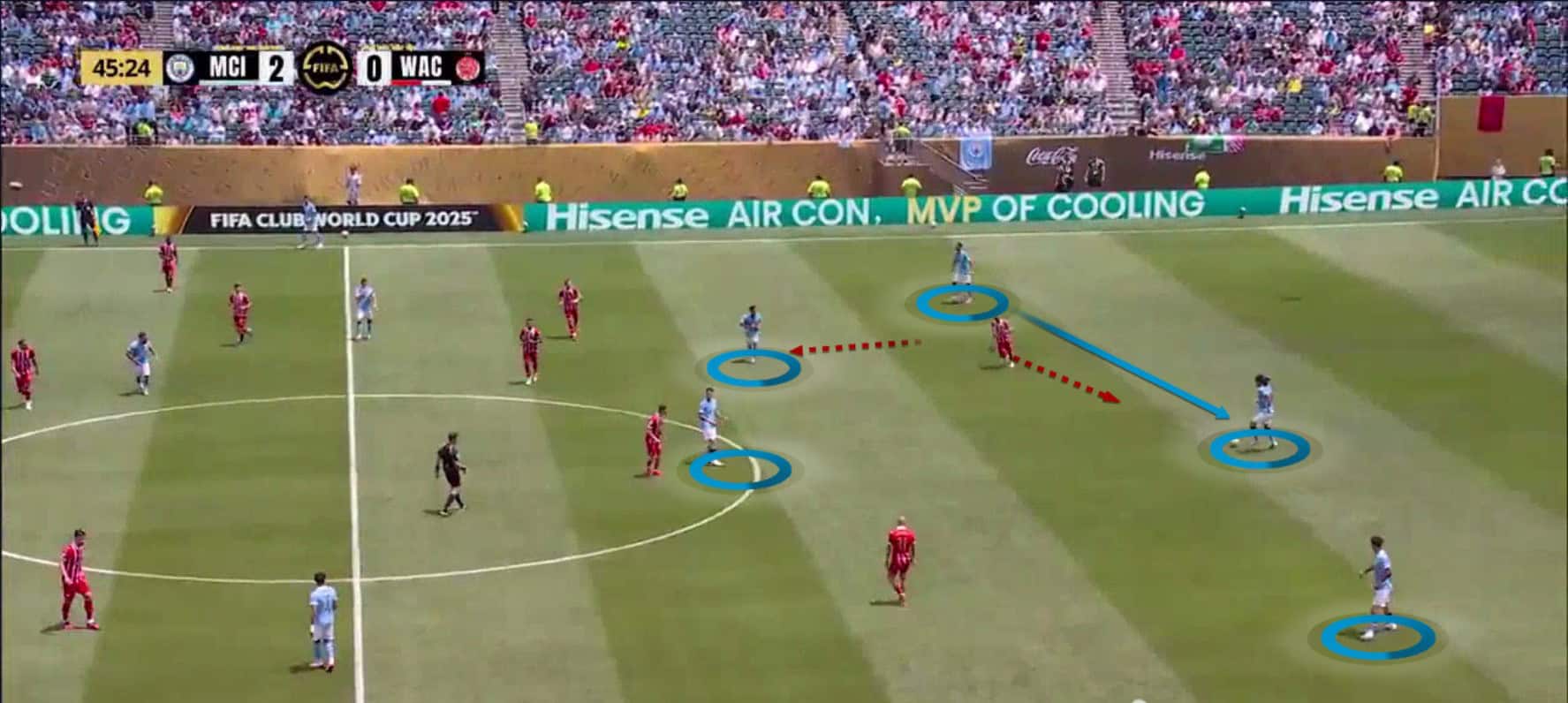
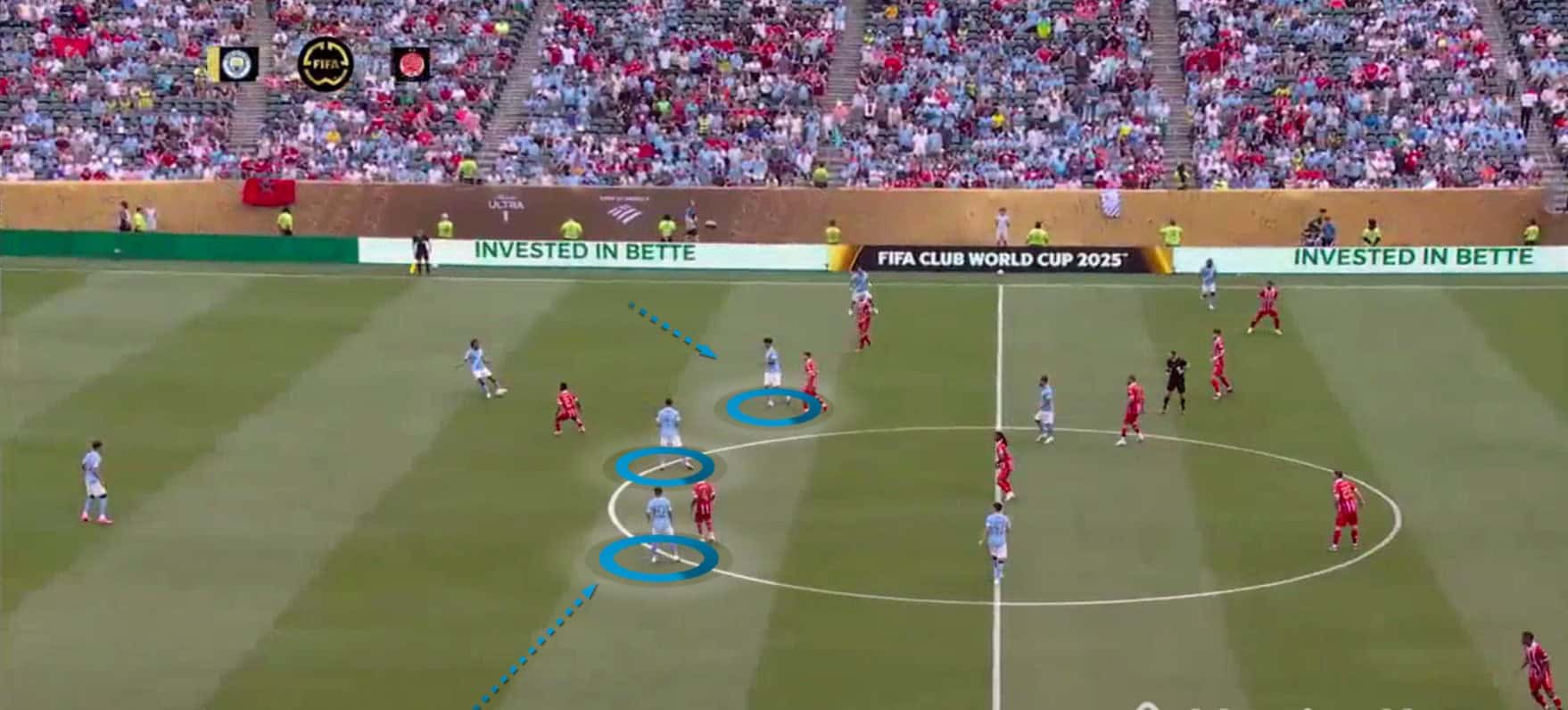 In the figure above, we can see in the mid-third, Man City formed a two-man first line with Reis and Aké.
Ahead, Reijnders sat centrally between Lewis and O’Reilly, who tucked in so narrowly that they nearly aligned vertically with the centre-backs
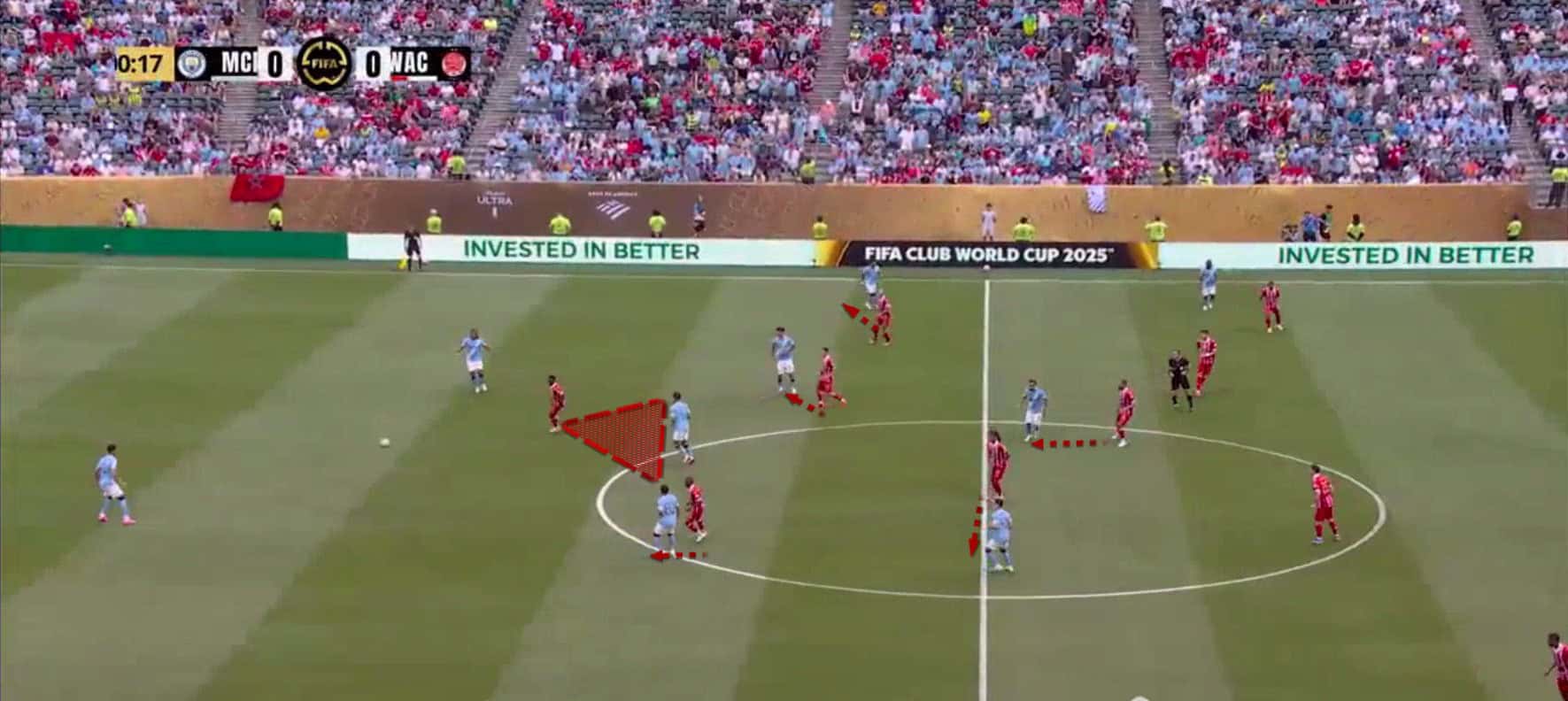 Wydad’s pressing shape sees Cassius Mailula block the lane to Reijnders without pressing the centre-backs directly.
Nordin Amrabat and Thembinkosi Lorch follow the full-backs inside, while Oussama Zemraoui and El Mehdi El Moubarik mark the eights.
If Man City’s eights move wide, Wydad adjust—the winger picks up the wide eight, and the nearest six tracks the full-back.
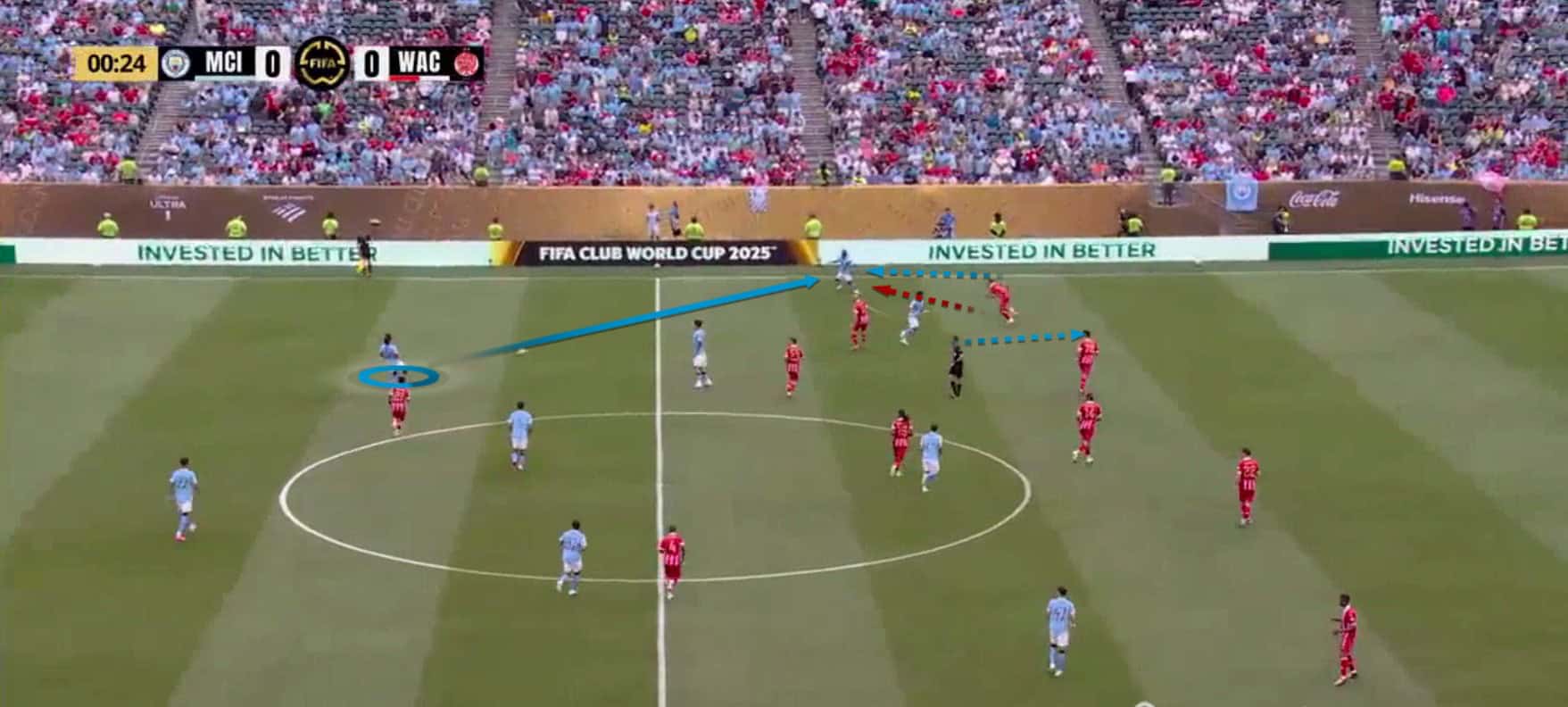 Man City try to open lanes from the centre-backs to the dropping eight or directly to the winger, like Aké to Doku here.
However, a challenge with this pass arises: the winger must drop to receive, often under immediate pressure from Wydad’s wing-back, who is ready to jump while the ball is still in transit.
With the touchline acting as a constraint, the winger receiving the ball has limited space and time, making it difficult to turn and carry forward, or to connect with the eight, in this case Marmoush, who is making a run in behind.
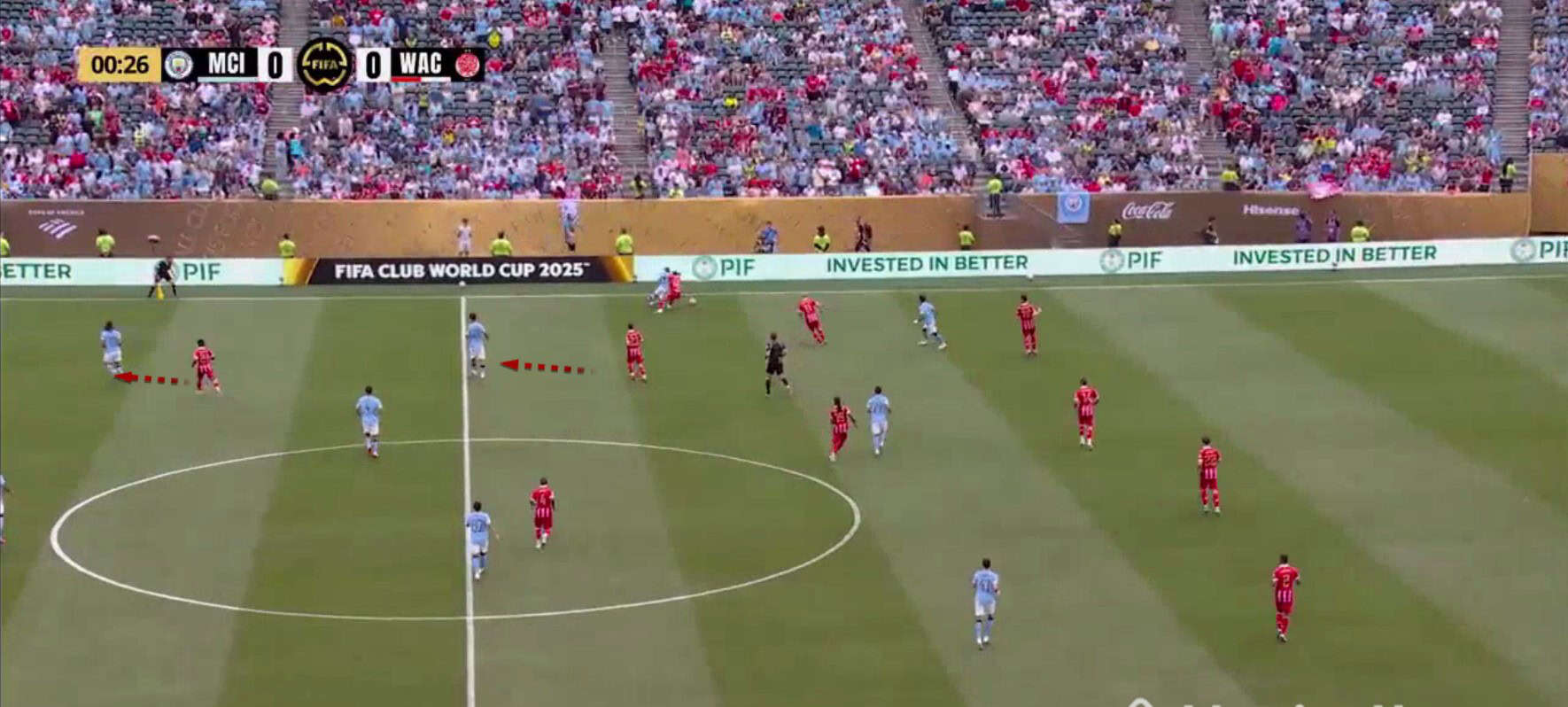 From the first instance, Man City were unable to exploit this situation effectively and quickly found themselves trapped.
Wydad applied intense pressure near the touchline, forcing City into a difficult position without any productive outcome.
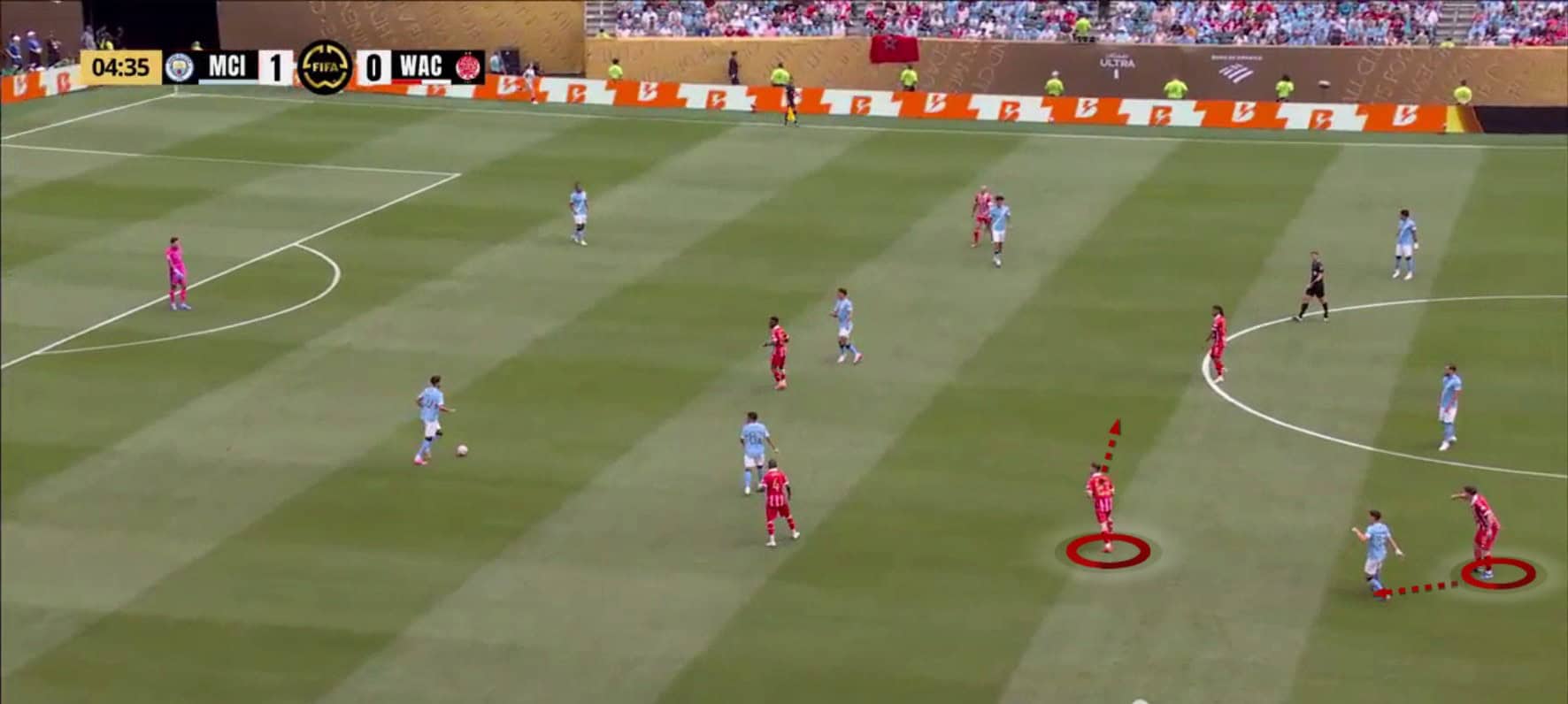 Wydad aim to block central passes by keeping their sixes zonal.
Here, Bart Meijers gestures to Zemraoui to stay central as he handles Foden’s wide movement.
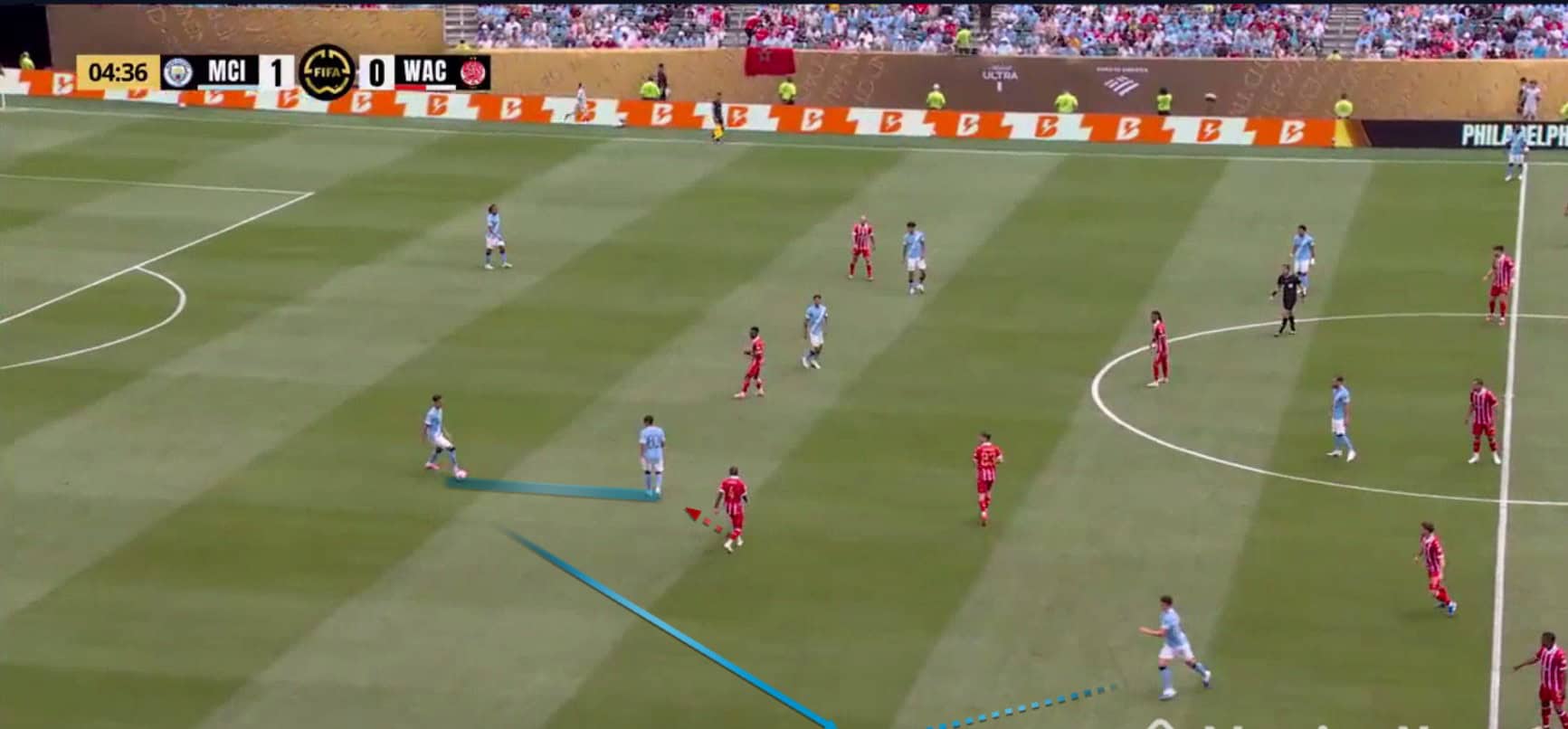 In line with Reis, Lewis drags Lorch with him and creates a passing lane to Foden.
The latter initially positions himself high and central before dropping into a deeper and wider area to receive.
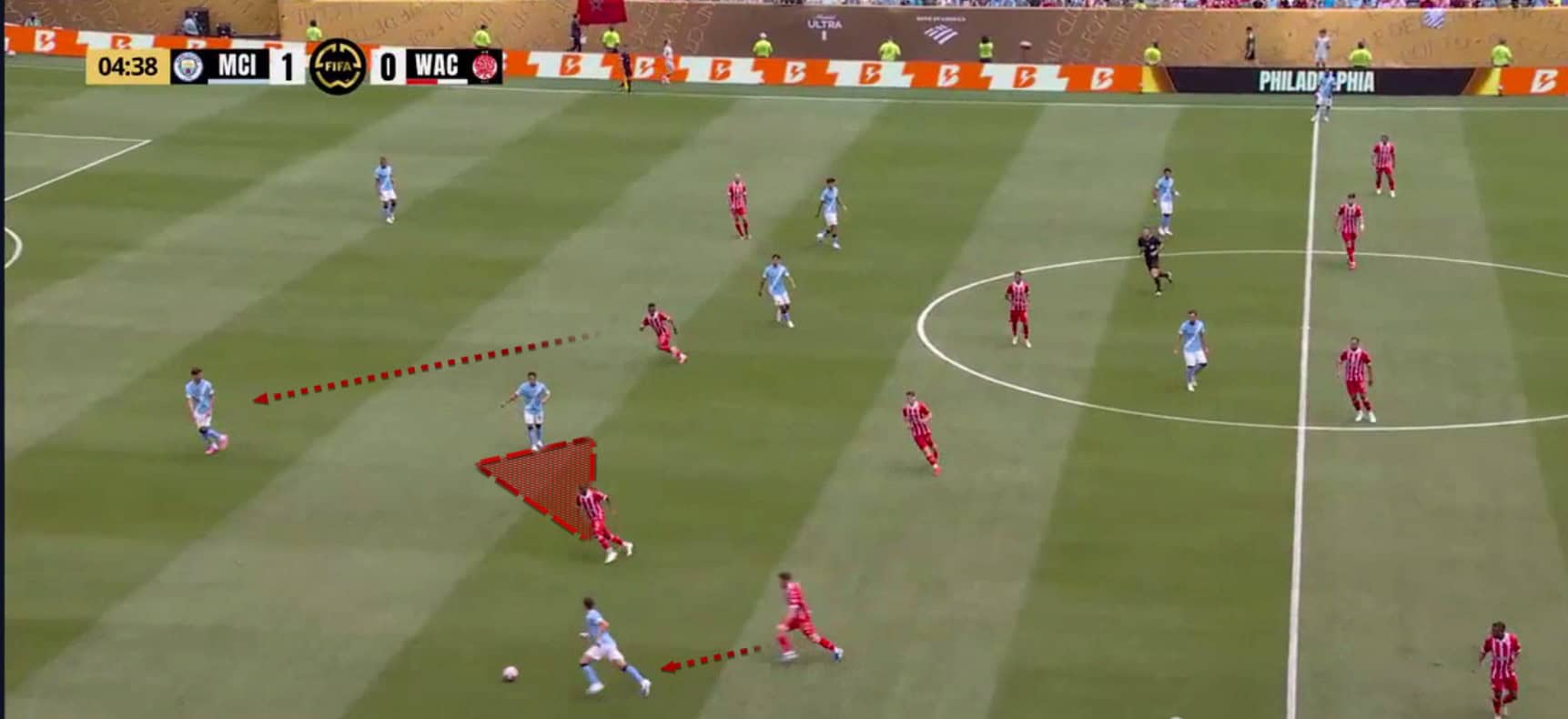 Man City struggle again with Wydad’s high line.
Meijers presses Foden early, stopping him from turning.
Again, out wide, City’s player can’t turn, triggering Wydad’s press—Lorch cuts off Lewis, and Mailula prepares to press Reis.
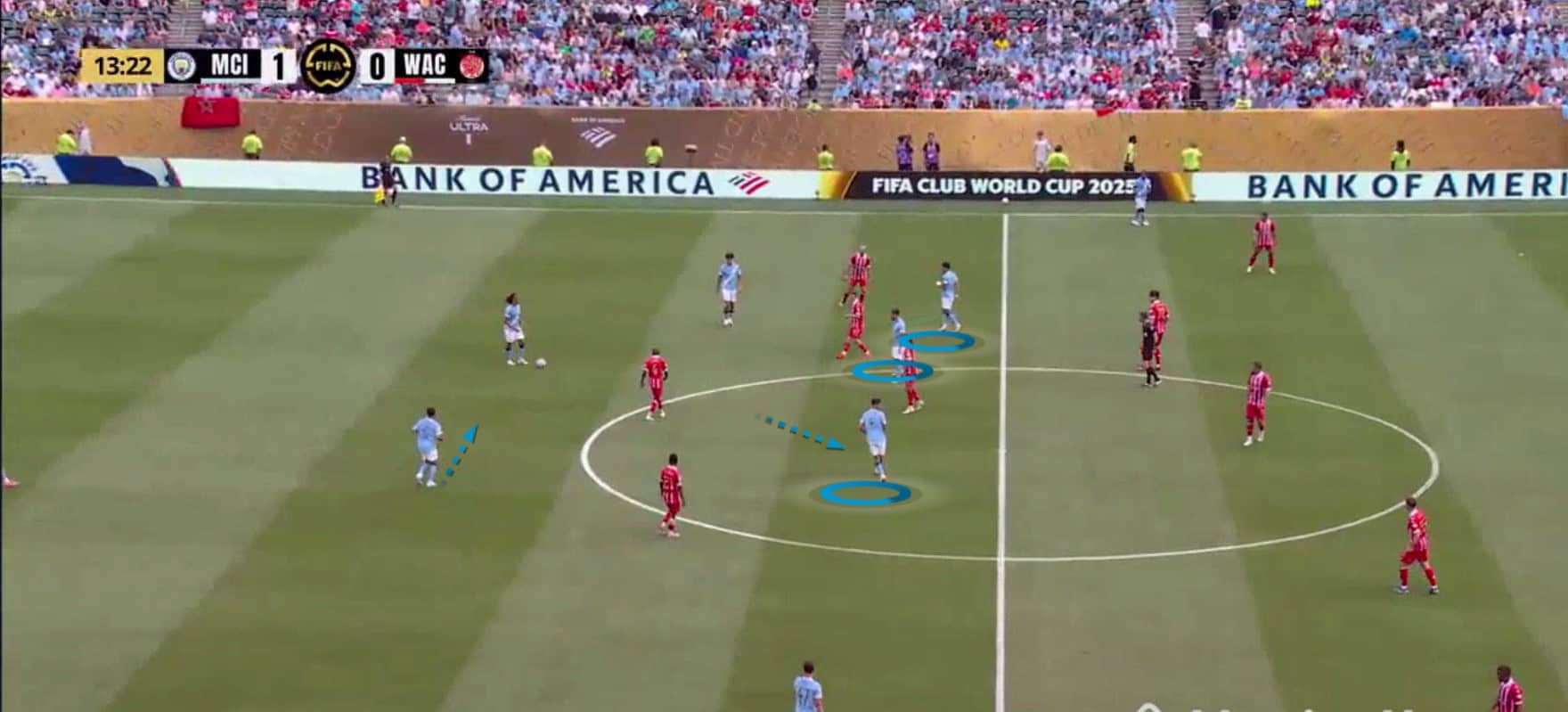 One of Man City’s attempted solutions involved two key adjustments.
First, Reijnders pushed high, positioning himself nearly level with Wydad’s sixes and his own side’s eights, while Lewis moved too centrally.
Second, Rayan Cherki dropped very deep, making it difficult for any of Wydad’s centre-backs to follow him without compromising their structure.
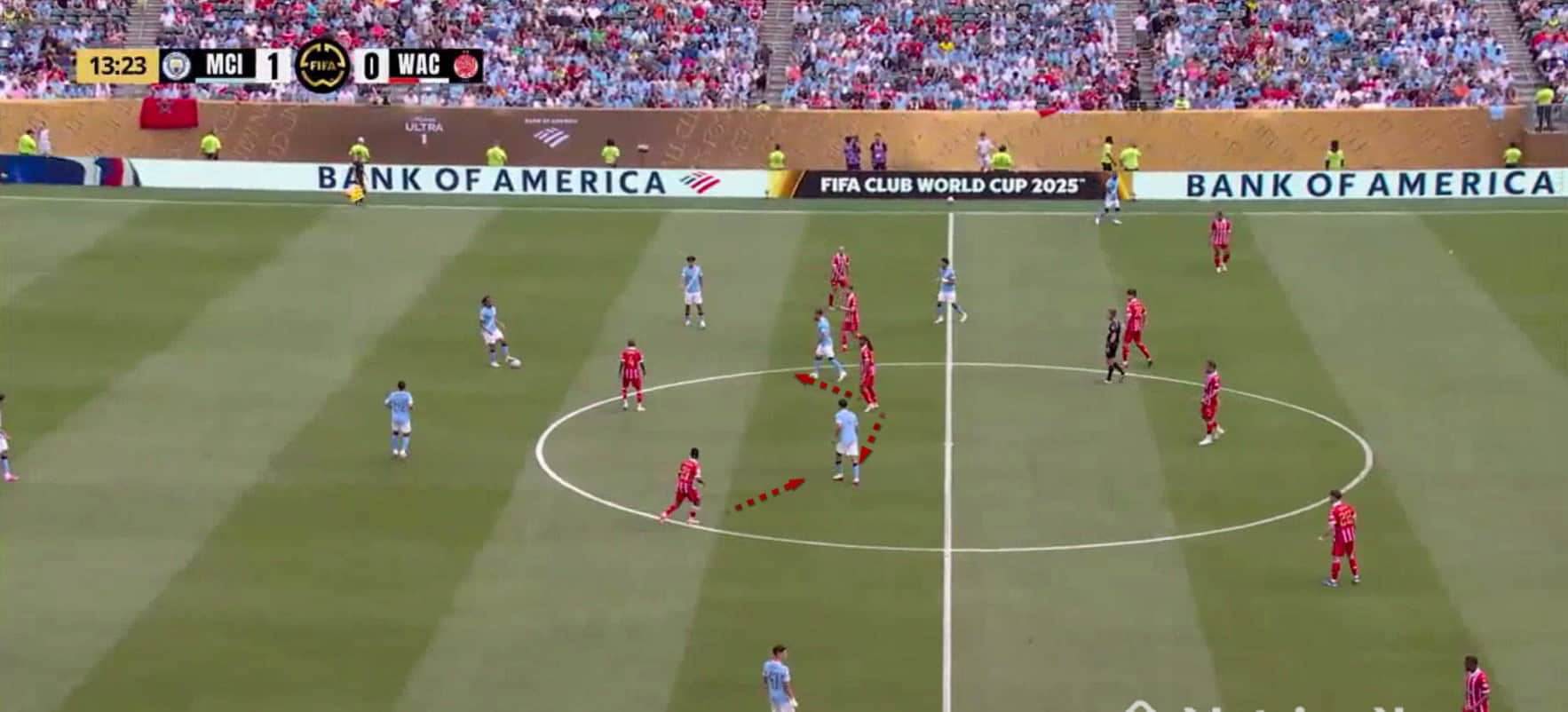 As a result, Wydad’s sixes found themselves in a difficult situation.
Zemraoui followed Marmoush, while El Moubarik was caught between Reijnders and Cherki.
Meanwhile, their left winger ignored Lewis to help tighten midfield gaps.
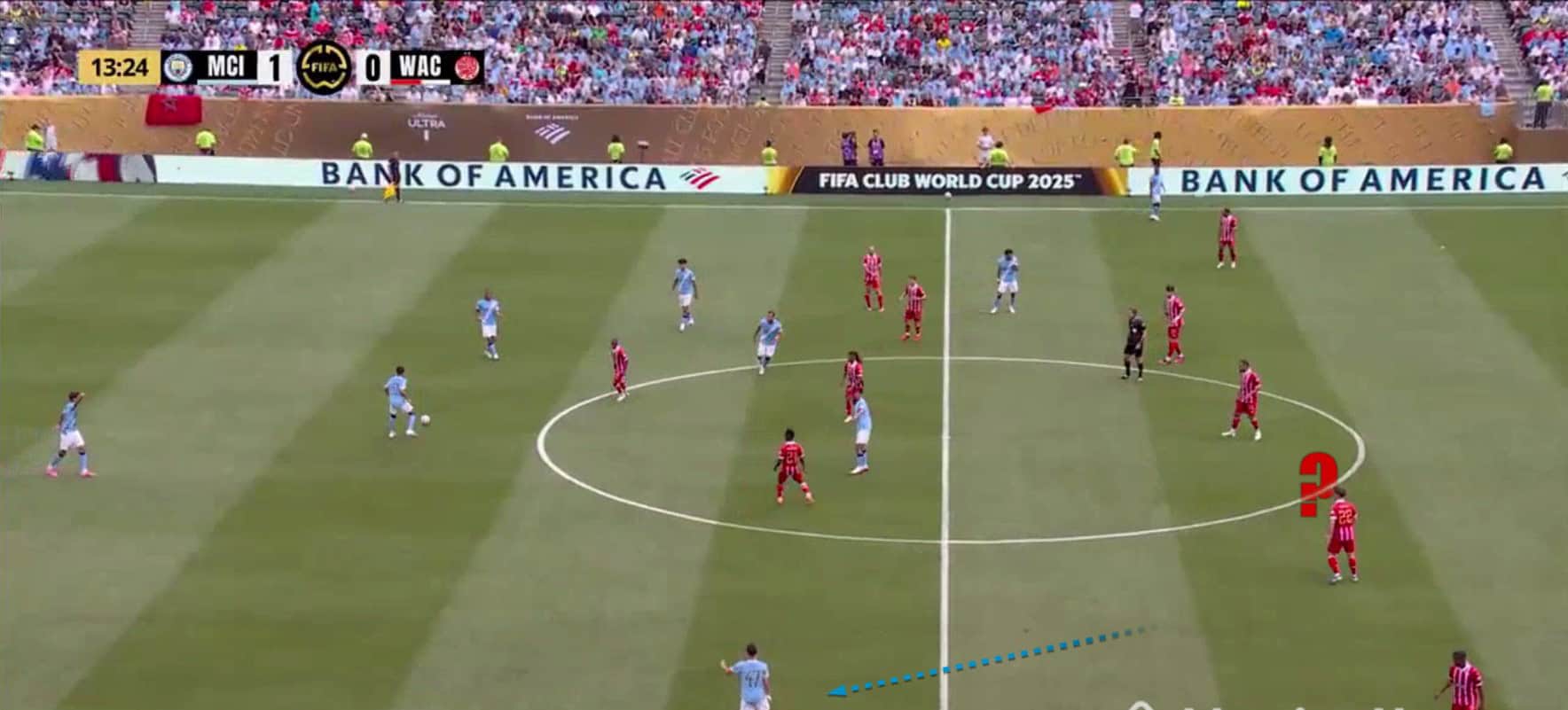 Phil Foden initially positioned himself very deep, making Meijers hesitate in following him, likely to avoid creating an early gap in Wydad’s defensive line.
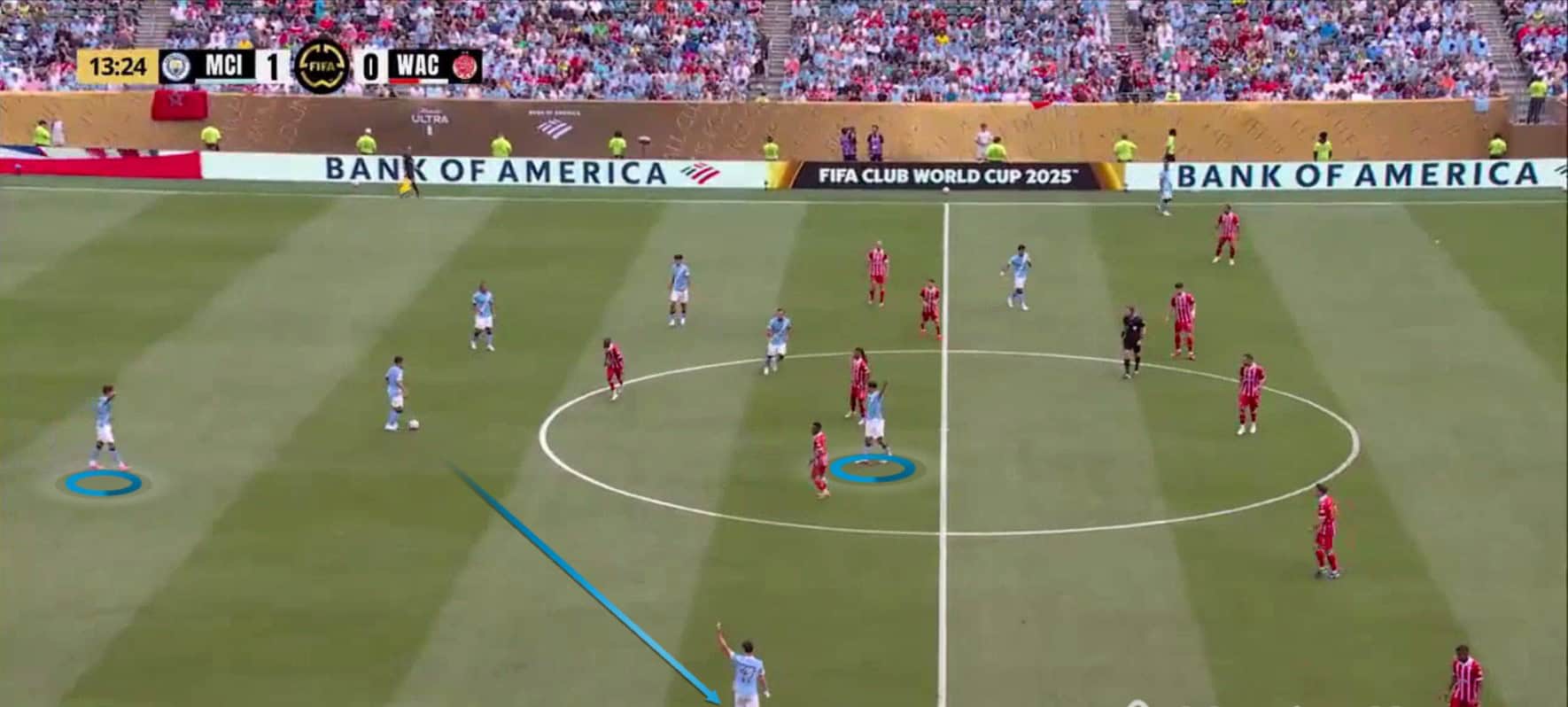 This sequence not only leaves Lewis free to receive the ball and pass it out wide comfortably…
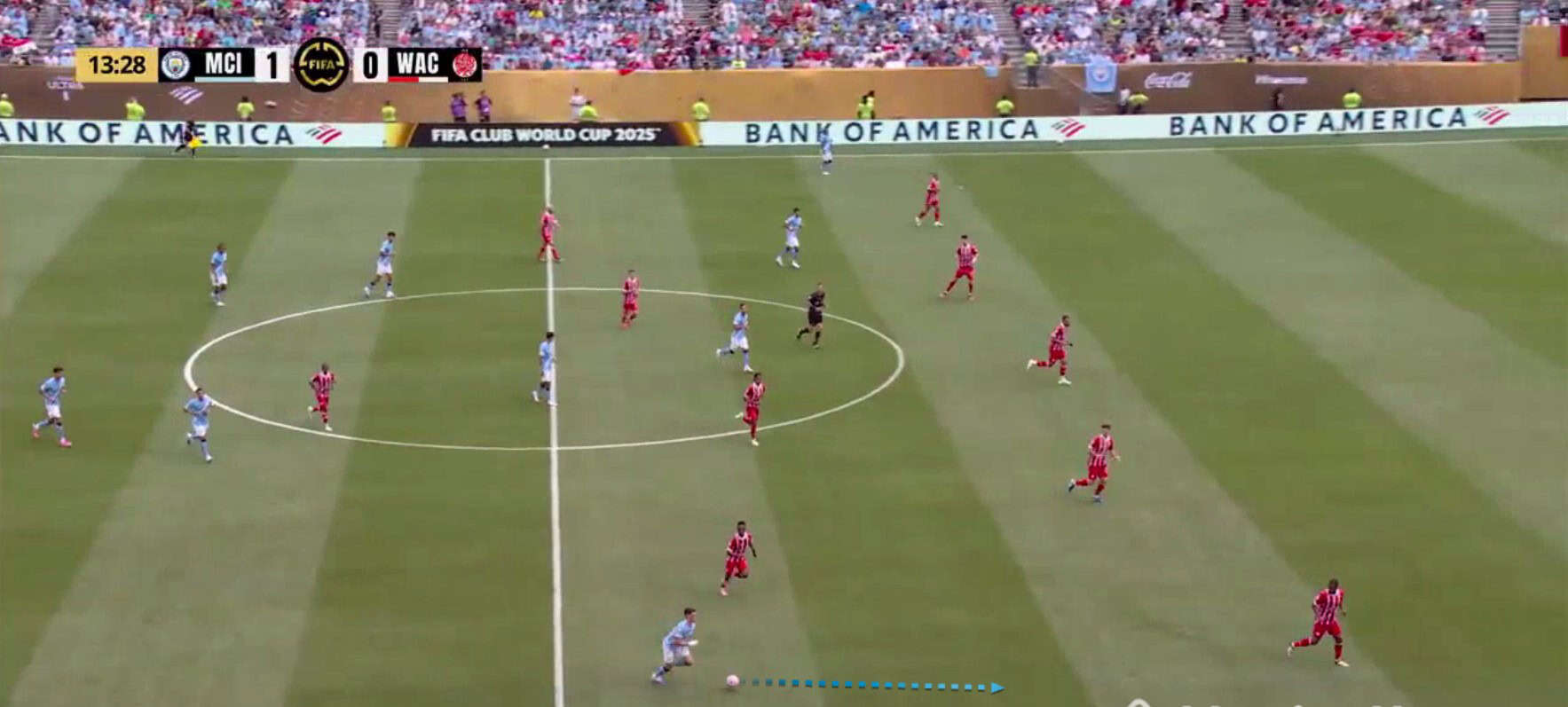 It also frees Foden to receive, turn, and drive the ball forward.
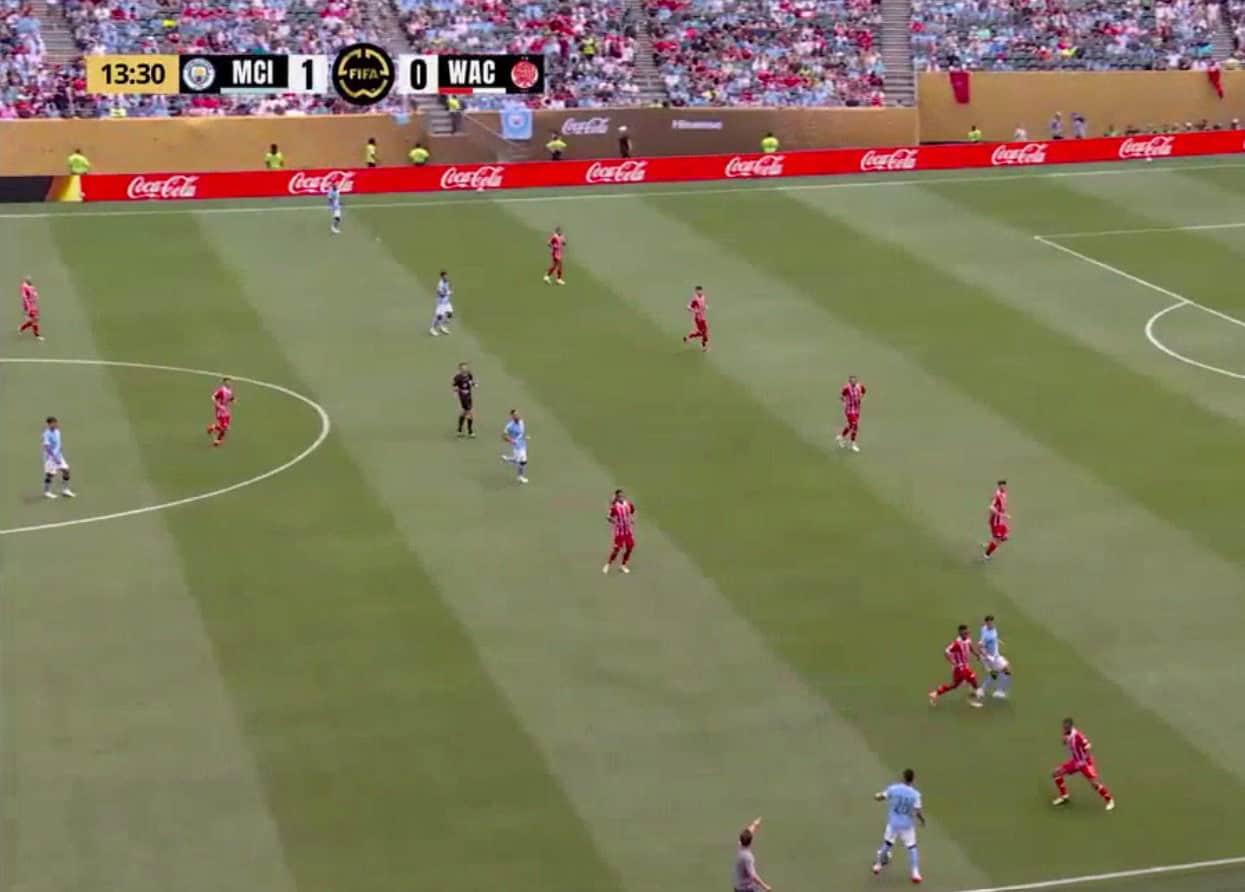 Foden then releases a pass to the winger—in this case, Savinho—who receives in a much better position, facing forward.
Unlike earlier phases, neither the eights nor the winger is under the intense pressure that previously forced them into backwards passes, which acted as Wydad’s pressing trigger.
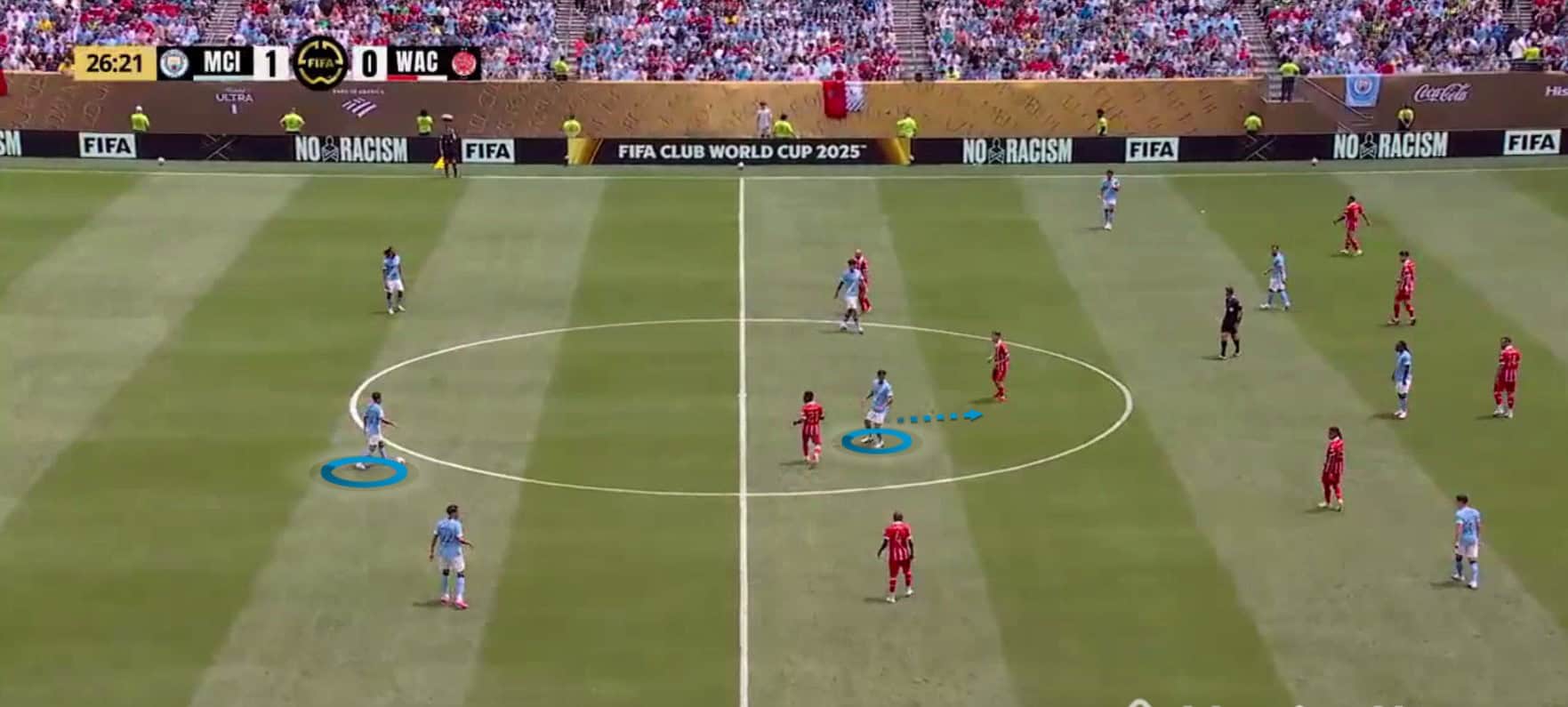 Man City repeat their setup with Lewis central and Reijnders high, but tweak it.
The ball begins with Lewis positioned centrally between Reis and Aké, which forces both of them wider.
O’Reilly also positions himself high, while both eights, Foden and Cherki (here), push up near Wydad’s defensive line.
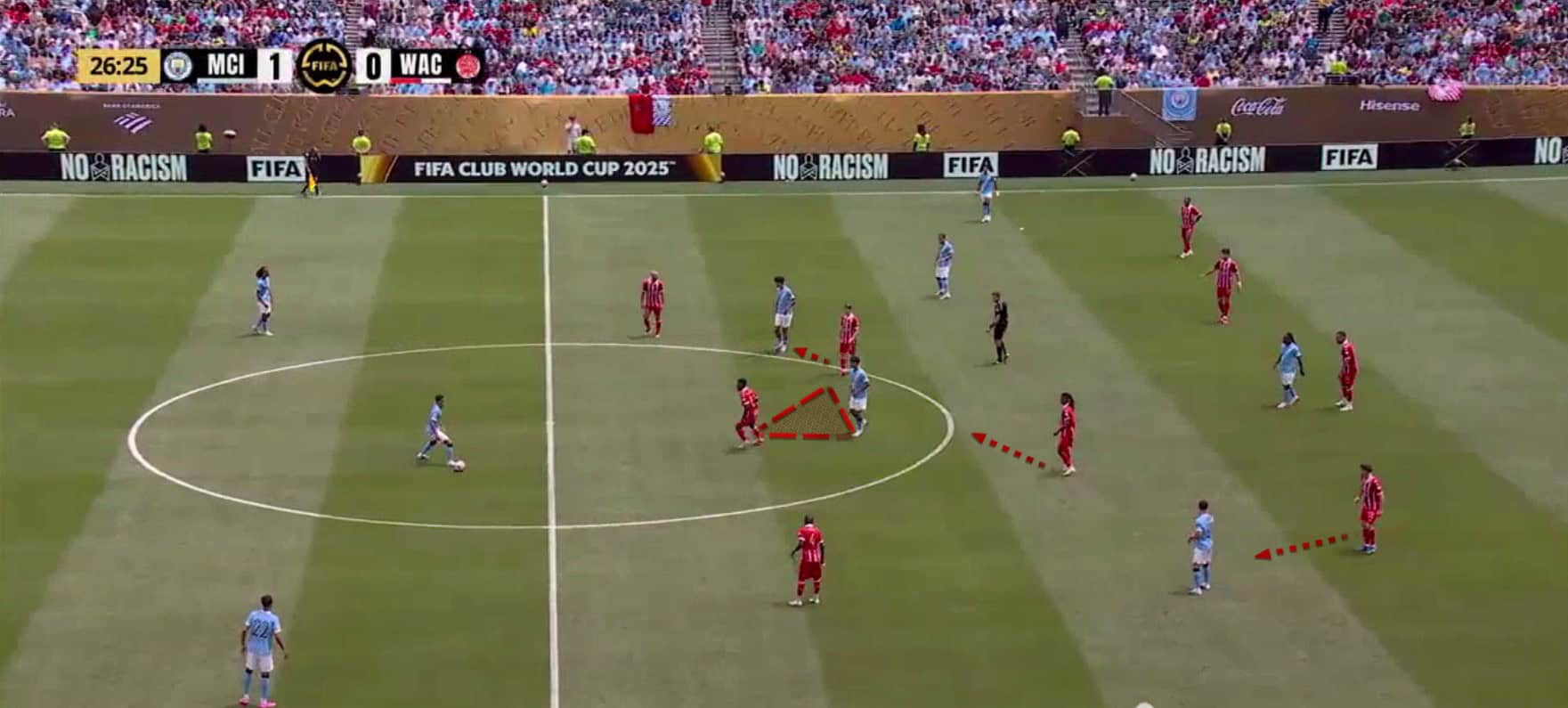 Man City have three in the first line, mirrored by three Wydad defenders.
The two wingers are zonally placed, ready to press whichever centre-back receives the ball.
The centre-forward blocks the passing lane to Reijnders and looks to force Lewis to play wide.
Their sixes are ready for Reijnders and O’Reilly, and the left centre-back may step up on Foden.
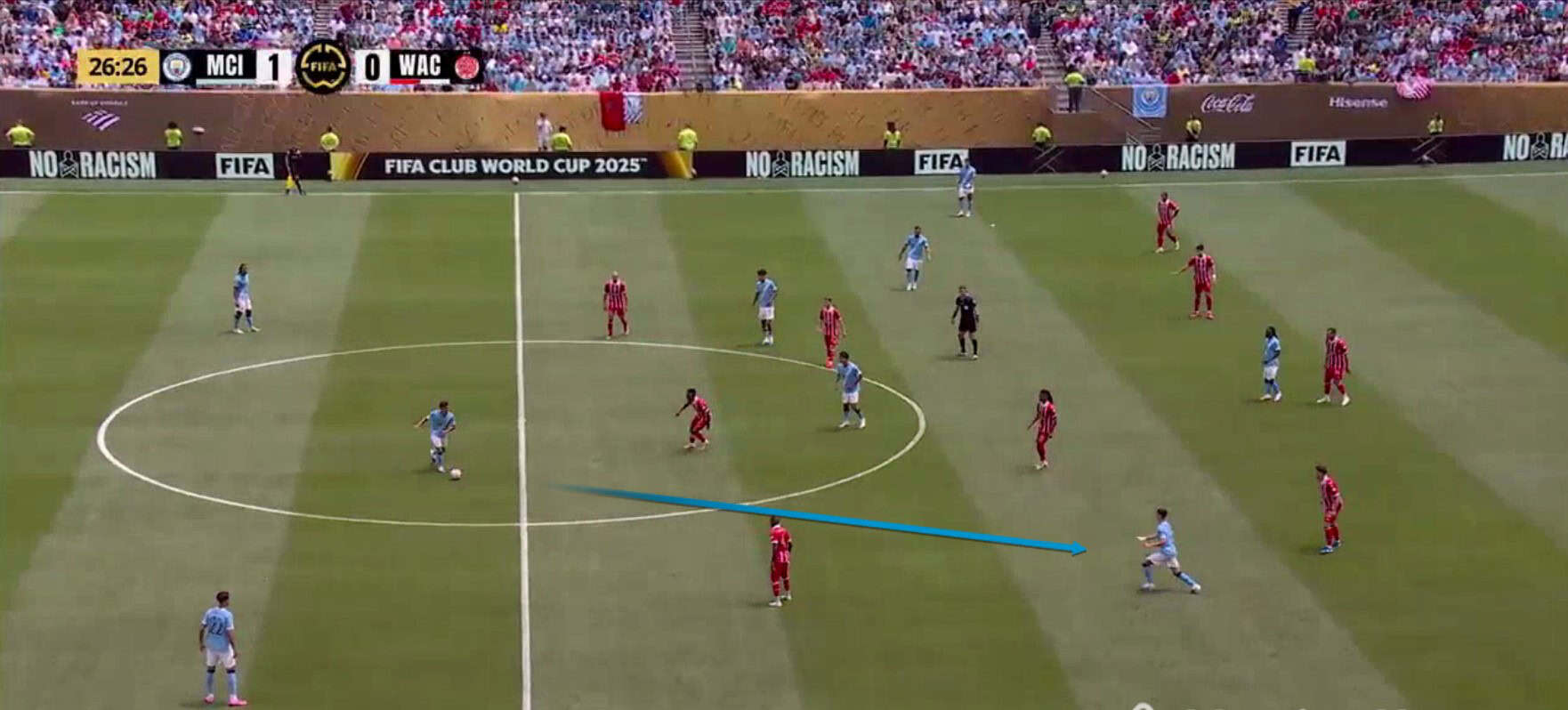 However, Lewis couldn’t identify the right moment to find Foden with a forward pass.
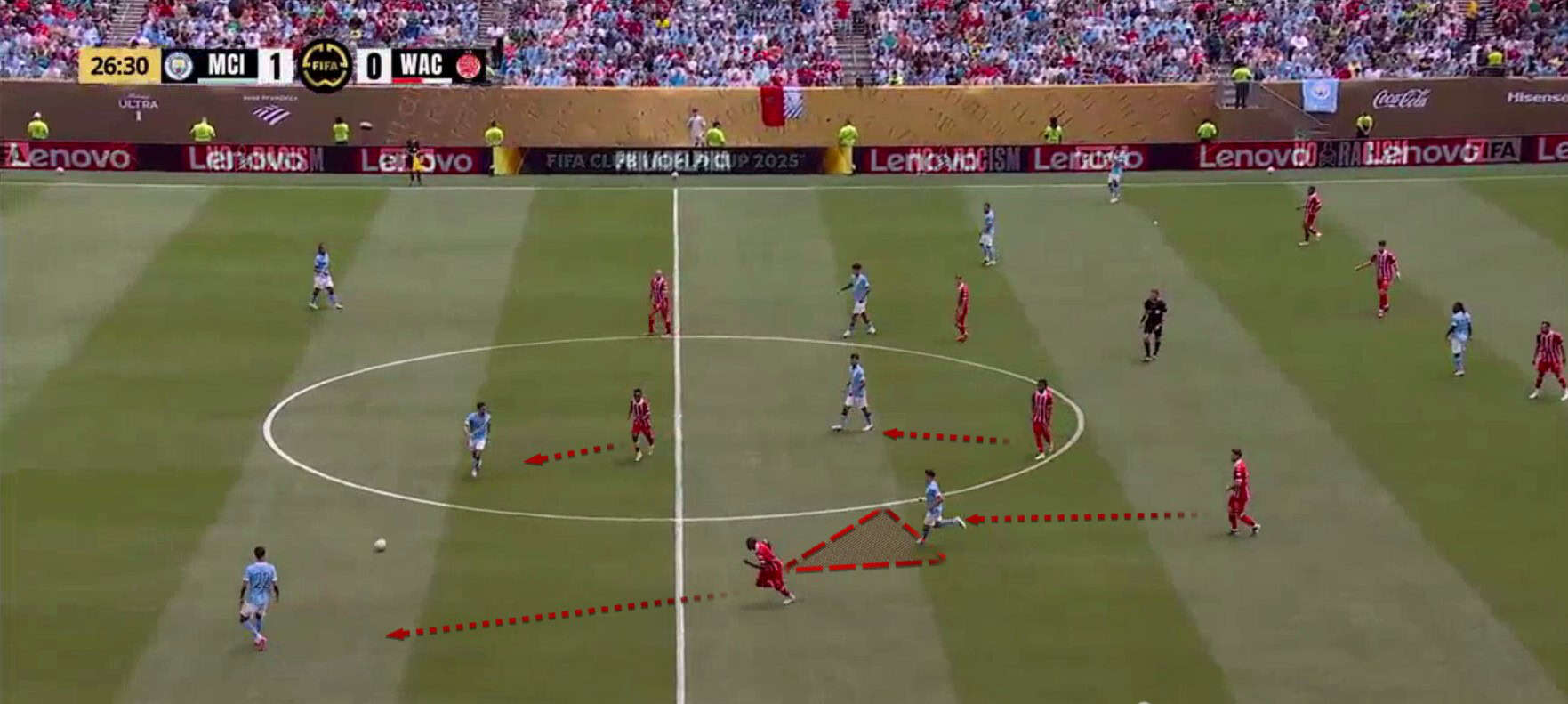 When Lewis misses the opportunity to play forward and instead passes to Reis, it activates one of Wydad’s pressing triggers.
Lorch presses Reis, Mailula blocks Lewis, and El Moubarik steps to Reijnders.
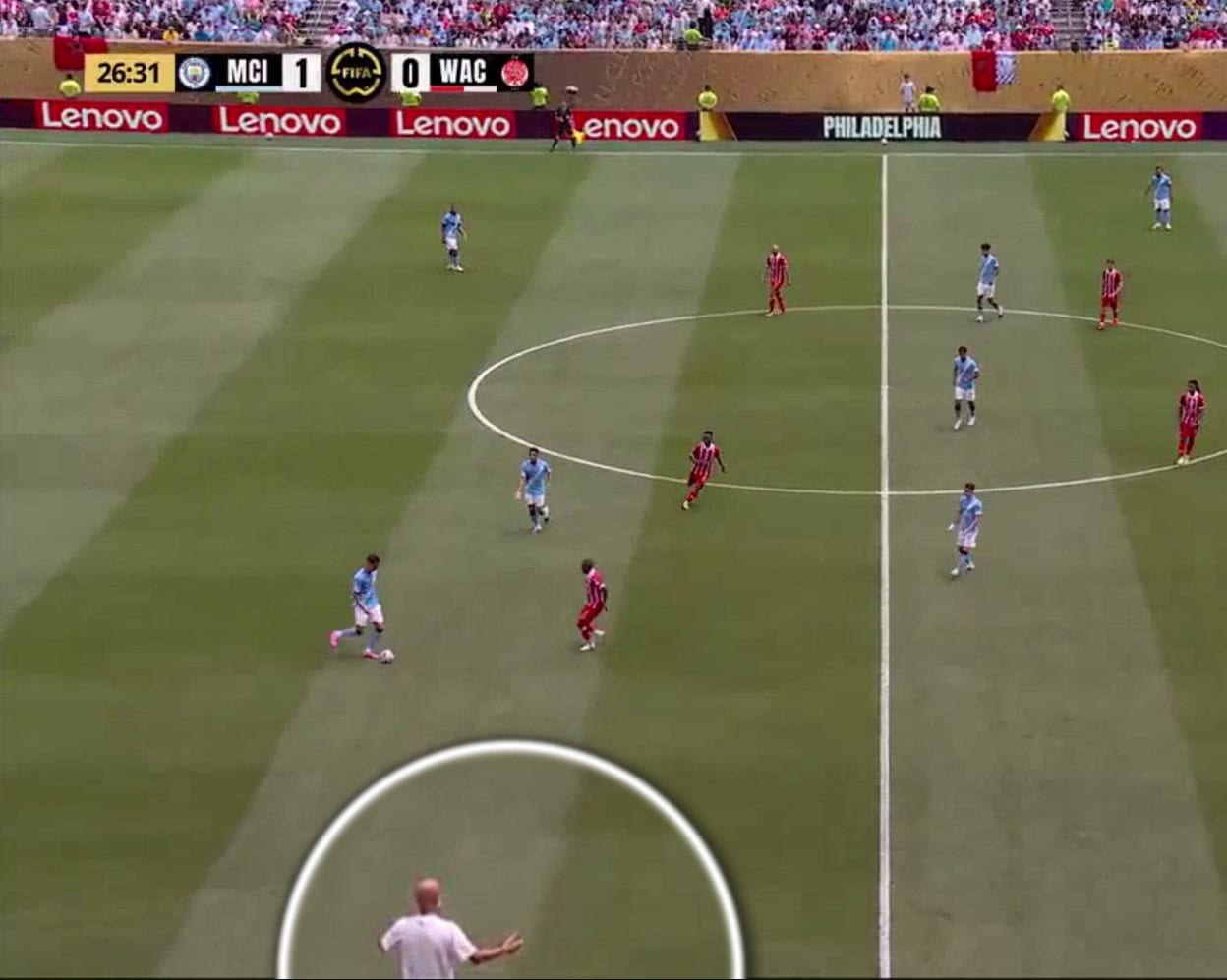 It’s exactly what Pep Guardiola wants to prevent.
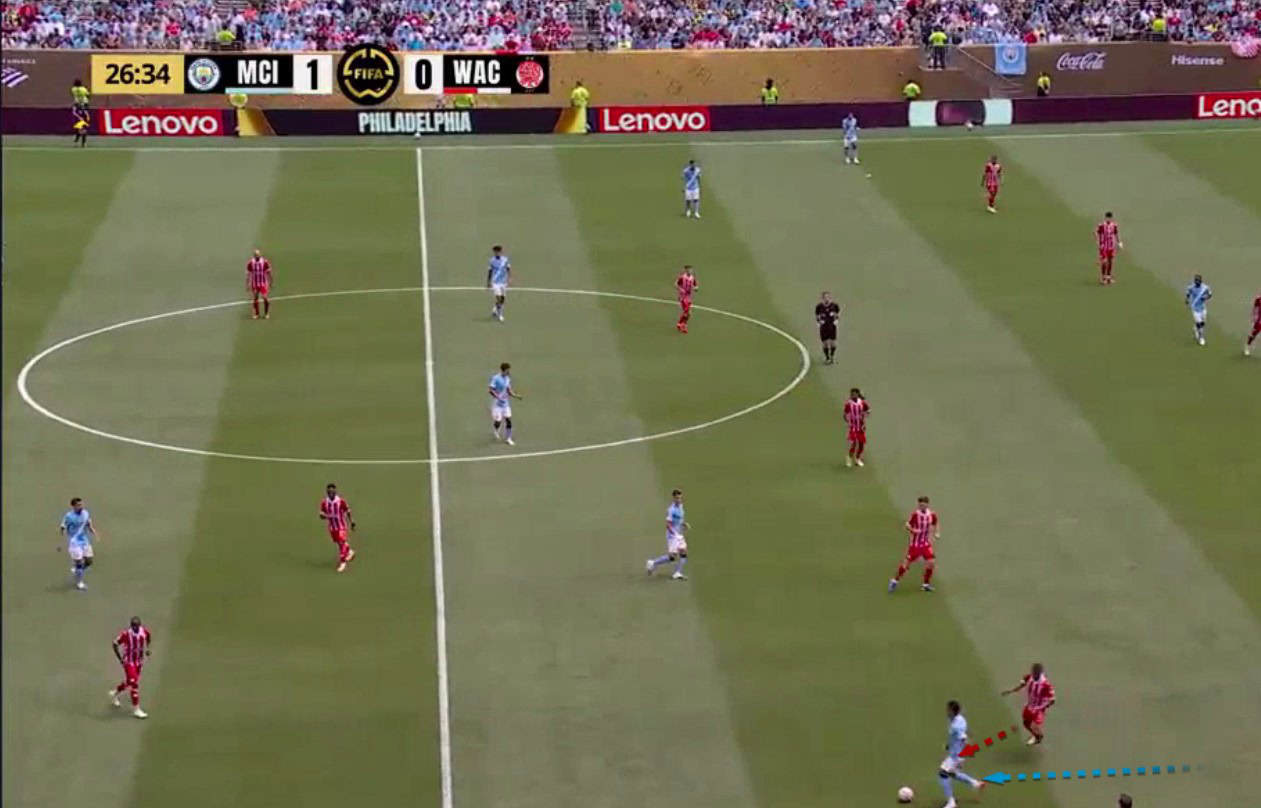 In such scenarios, even if the centre-back escapes the pressure, it often results in a difficult pass to a teammate already under pressure, as seen with Savinho here, who ends up in the exact kind of situation Man City had initially sought to avoid.
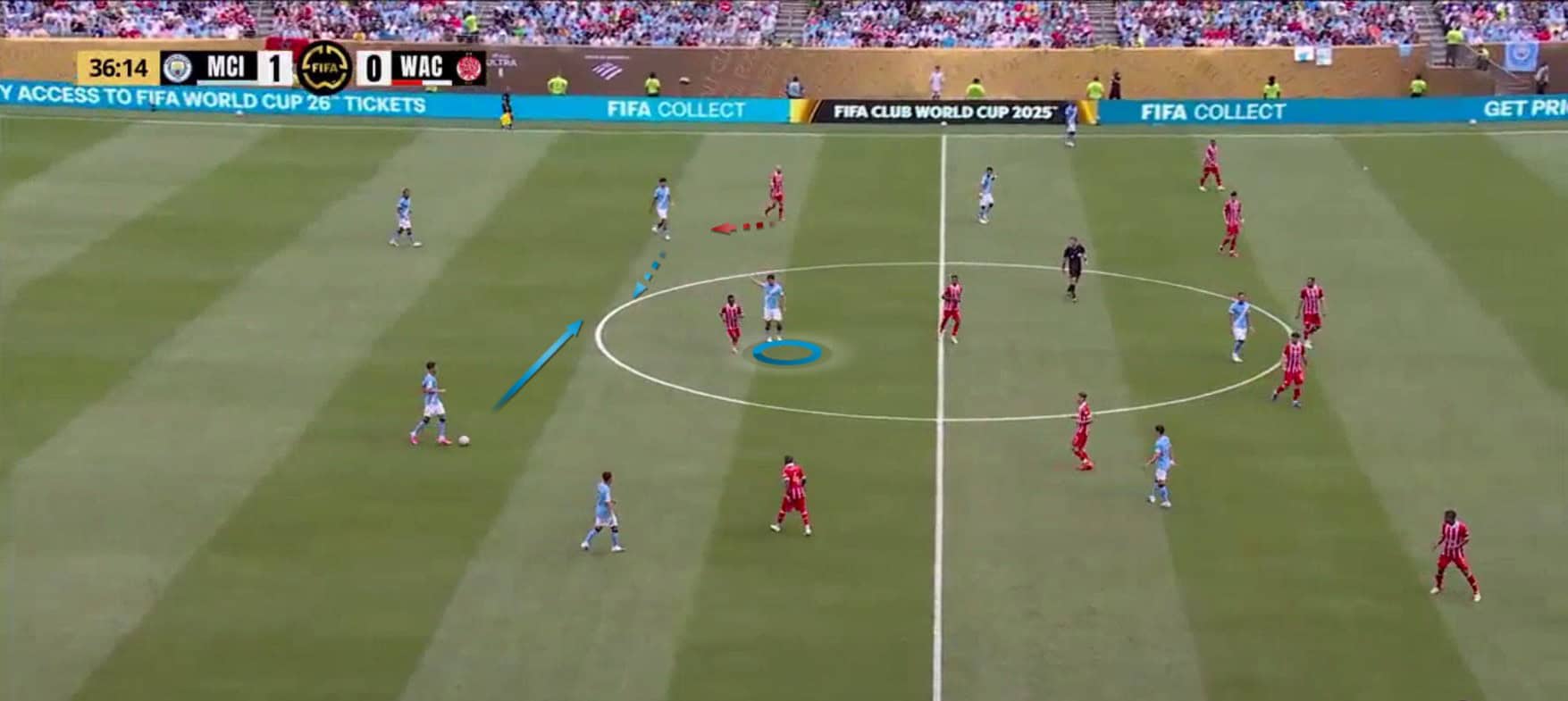 Without Cherki and Foden dropping or Reijnders pushing high, Man City attempt to exploit how Wydad’s wingers ignore full-backs moving centrally.
Out of the shot, Pep Guardiola shouts at O’Reilly to drift inside, while Reijnders signals for Ries to play the pass.
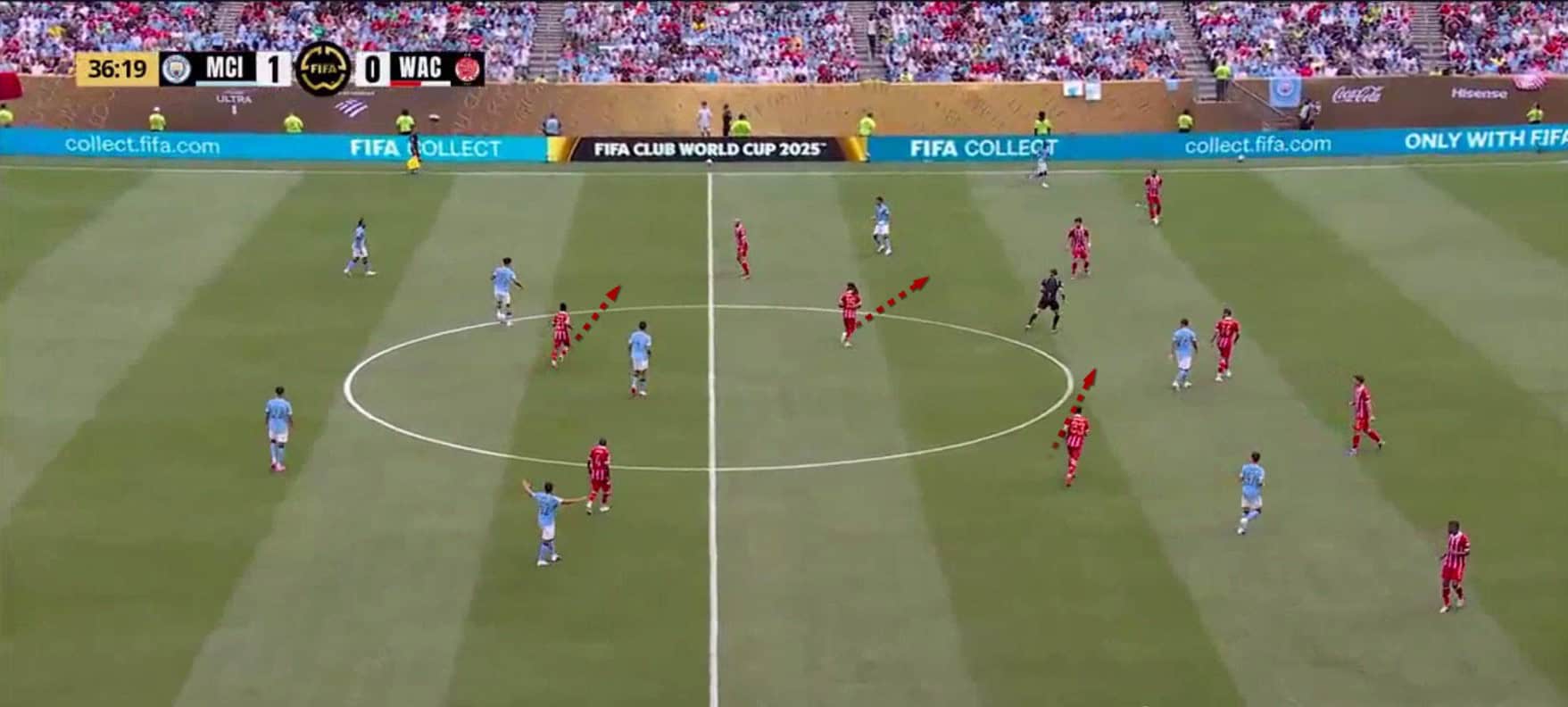 Although O’Reilly is not positioned as centrally as Lewis was earlier, here, unlike Foden, Marmoush is neither deep nor wide enough to receive the pass.
However, as Wydad’s defenders begin to shift, O’Reilly finds Ake, and Mailula steps out to press.
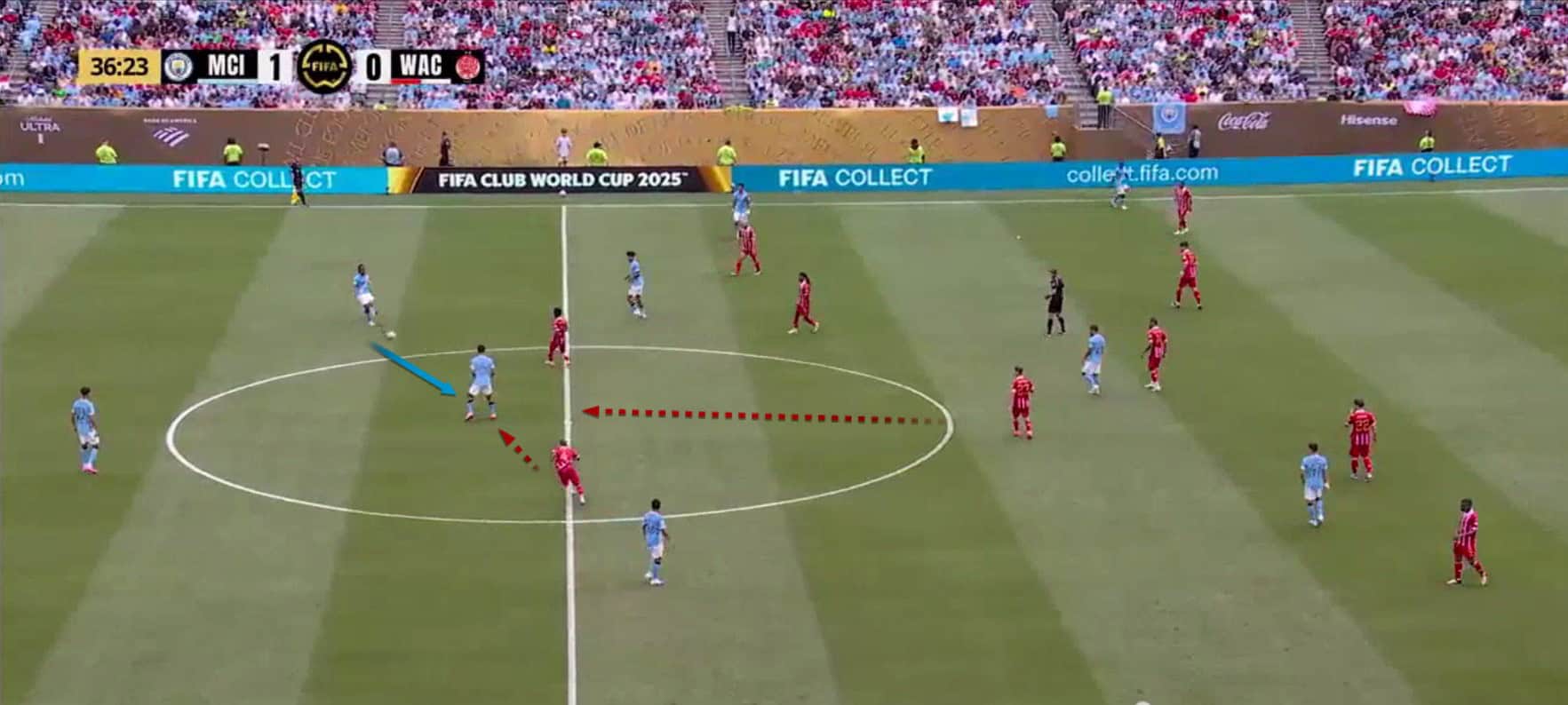 With just a few steps, Reijnders escapes Mailula’s shadow and becomes free to receive.
As the number six, Zemraoui, shifts across, he loses proximity to Reijnders, prompting the left winger to step up and press.
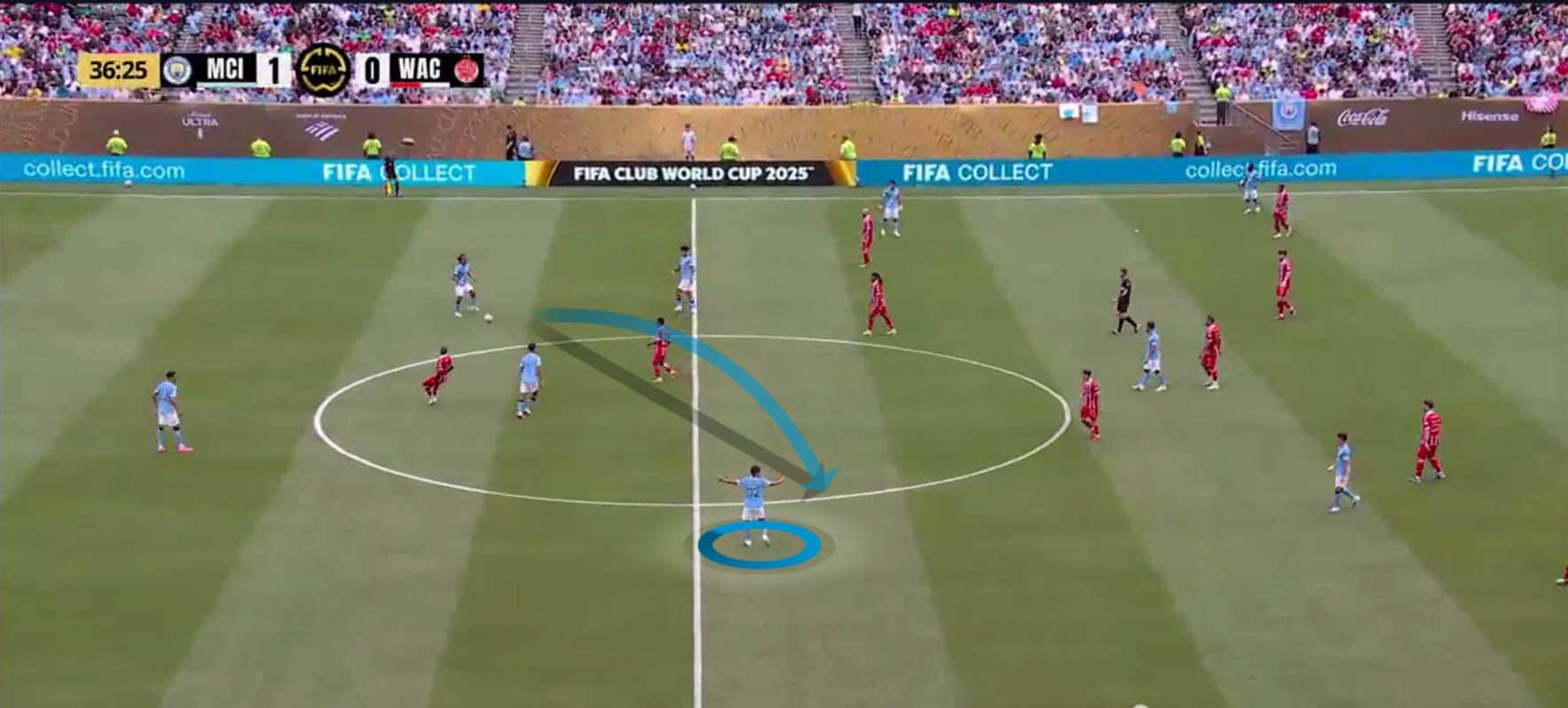 Lewis ends up free and gets the ball from Aké after the return from Reijnders.
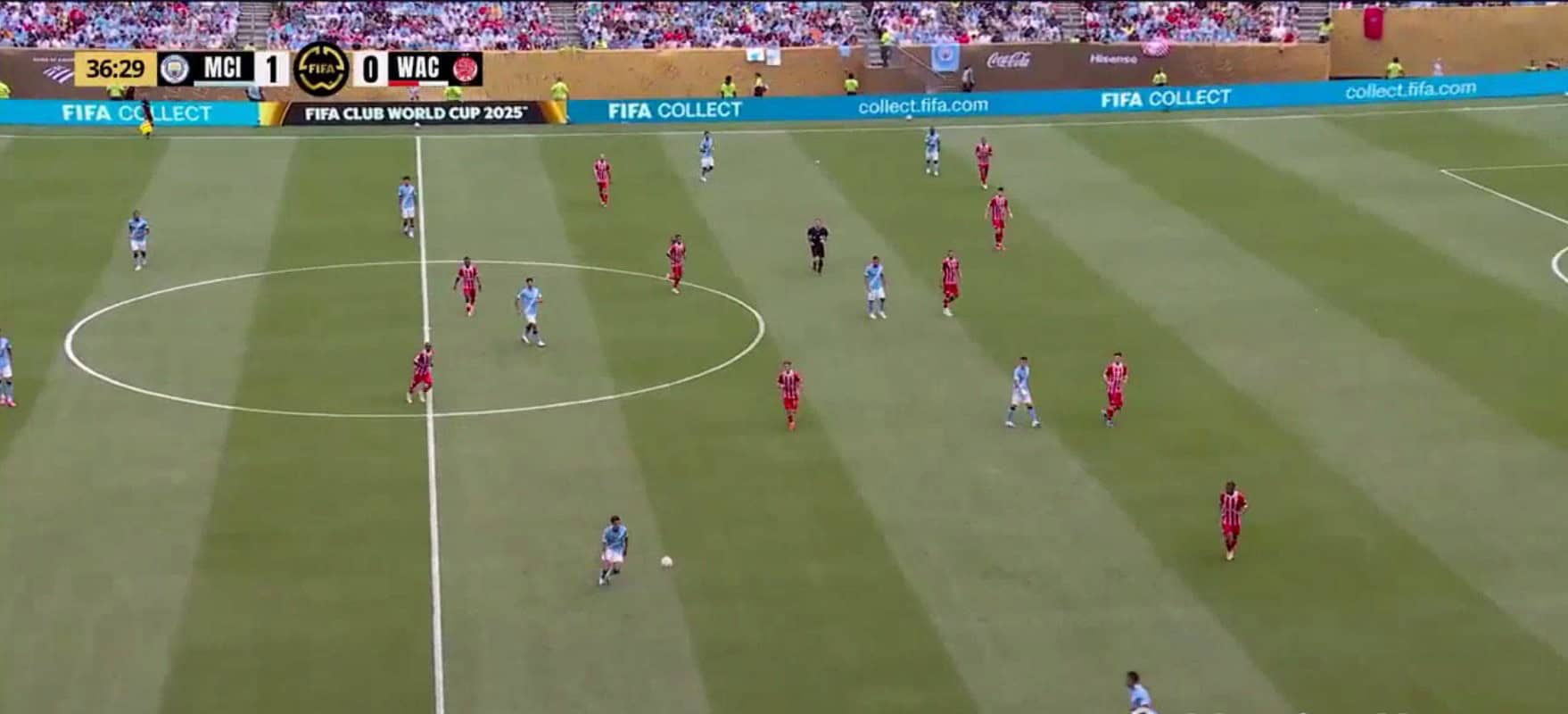 Man City could progress safely here if Aké made the right pass.
 At half-time, Pep Guardiola and his staff sought a more effective solution for this phase of play.
Man City shifted to a 3-2 shape, with O’Reilly dropping in as a third centre-back and Lewis joining Reijnders as a second six.
Meanwhile, Wydad made a change—Mailula was replaced by Mohamed Rayhi, who slotted in on the left wing, while Lorch moved into the centre-forward role.
The new setup made it harder for Lorch to press both centre-backs while shadowing a six.
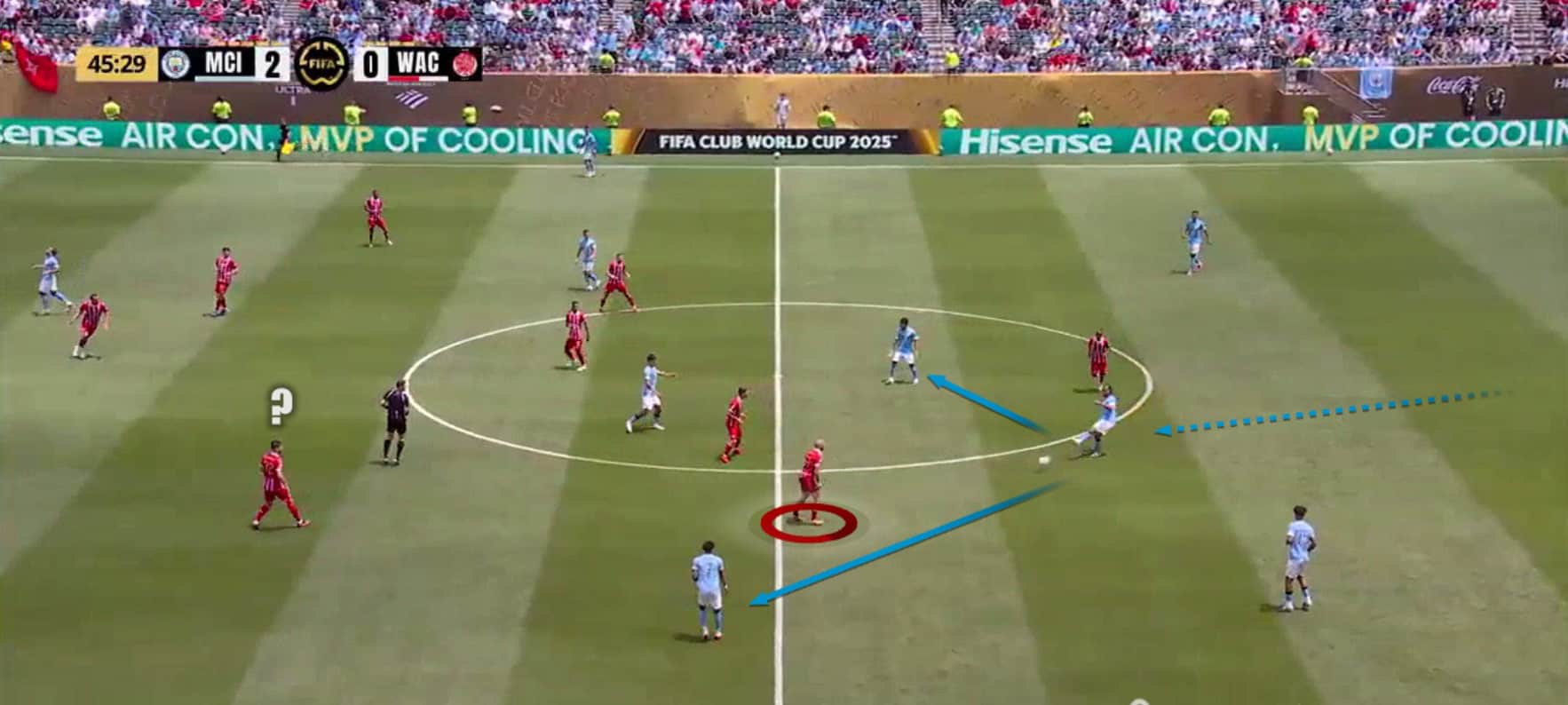 Man City’s new shape brought key advantages: firstly, it created space for Aké to carry the ball forward.
Secondly, Lewis had space to receive with Lorch pulled out.
Thirdly, O’Reilly’s position made Marmoush more accessible.
If Amrabat stepped towards O’Reilly, a lane to Marmoush could emerge between the lines.
Alternatively, if Amrabat stayed central to block interior passes, Marmoush could drop deep and wide, testing Ferreira’s marking decision.
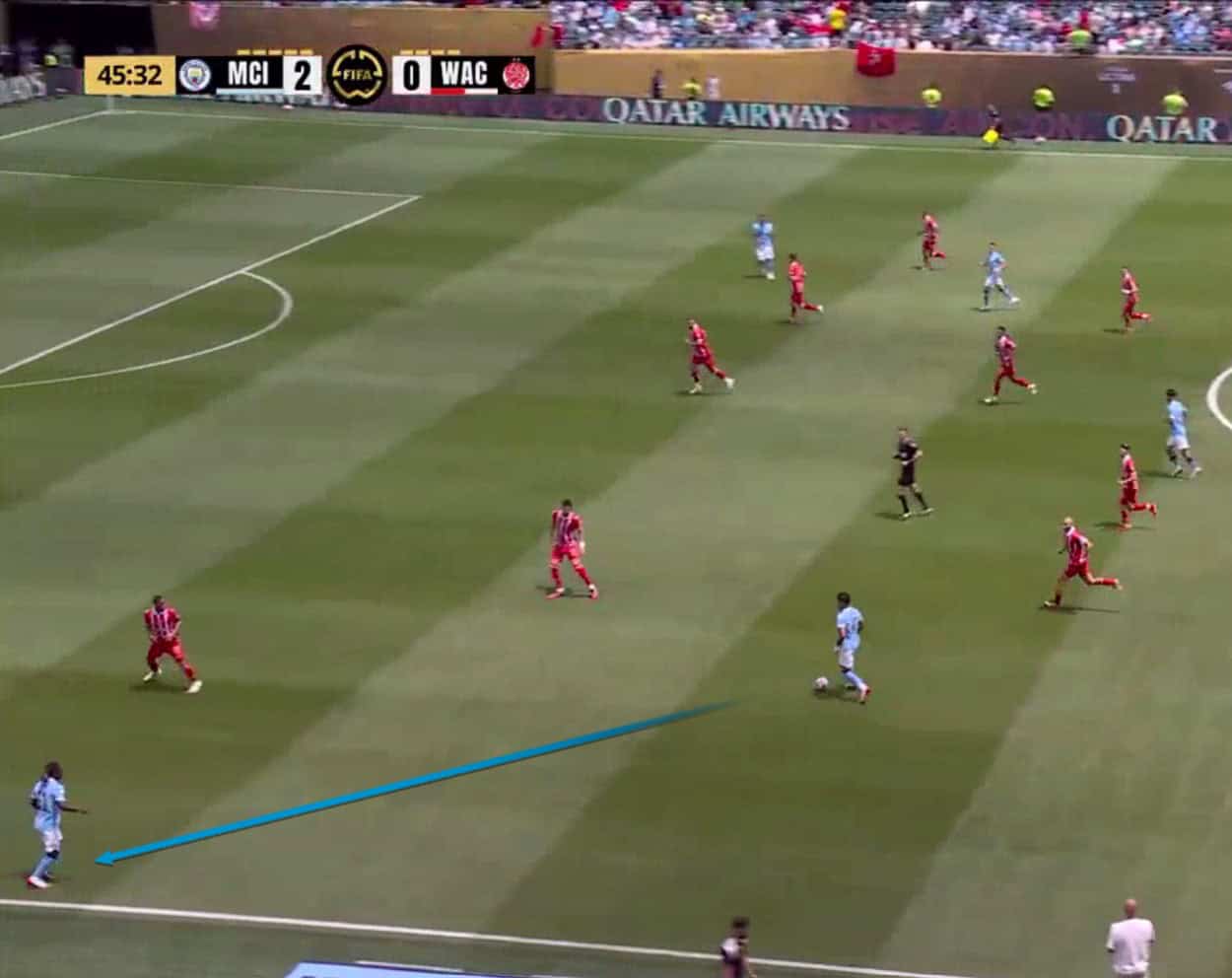 This adjustment helped Marmoush receive the ball in space and contribute to Man City’s forward progression.
It also allowed passes to reach Doku in more favourable conditions—without a defender tight on his back and away from the touchline—the type of scenario Guardiola’s teams deliberately seek to create.
Manchester City Progression Tactics Vs Juventus
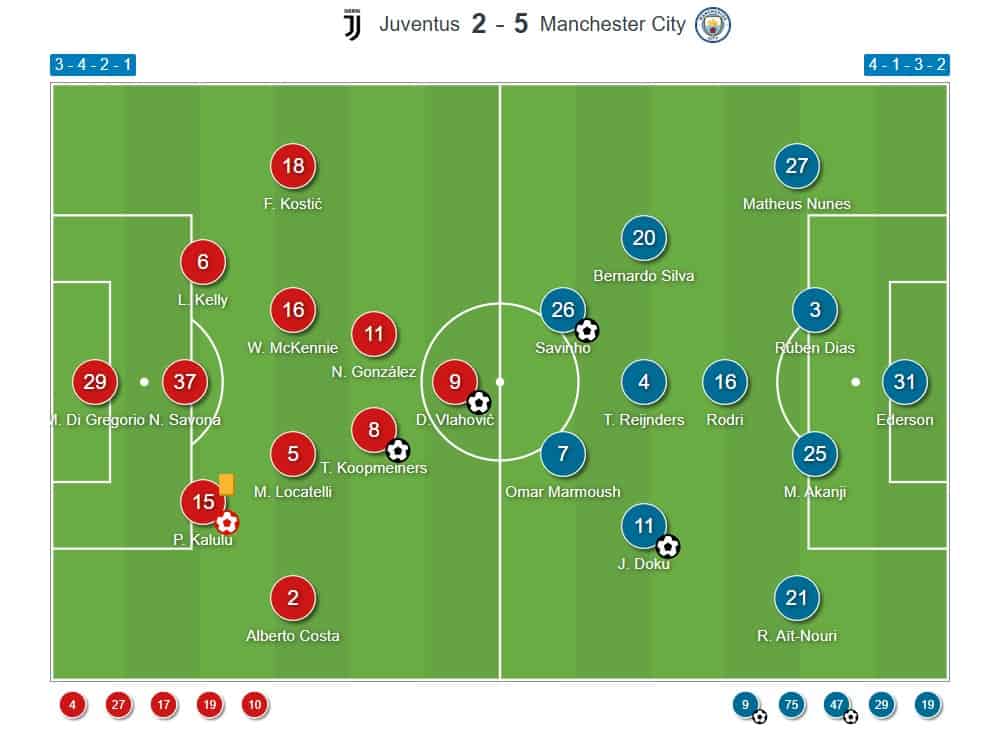
Juventus start this game with Michele Di Gregorio in goal and a defensive line of five defenders: Pierre Kalulu (right centre-back), Nicolò Savona (central centre-back), Lloyd Kelly (left centre-back), Alberto Costa (right wing‑back), and Filip Kostić (left wing‑back).
Manuel Locatelli (right central midfielder) and Weston McKennie (left central midfielder) are in the midfield, with Nicolás González (right winger), Teun Koopmeiners (left winger) on the outside.
Up front, Juventus played Dušan Vlahović (centre-forward).
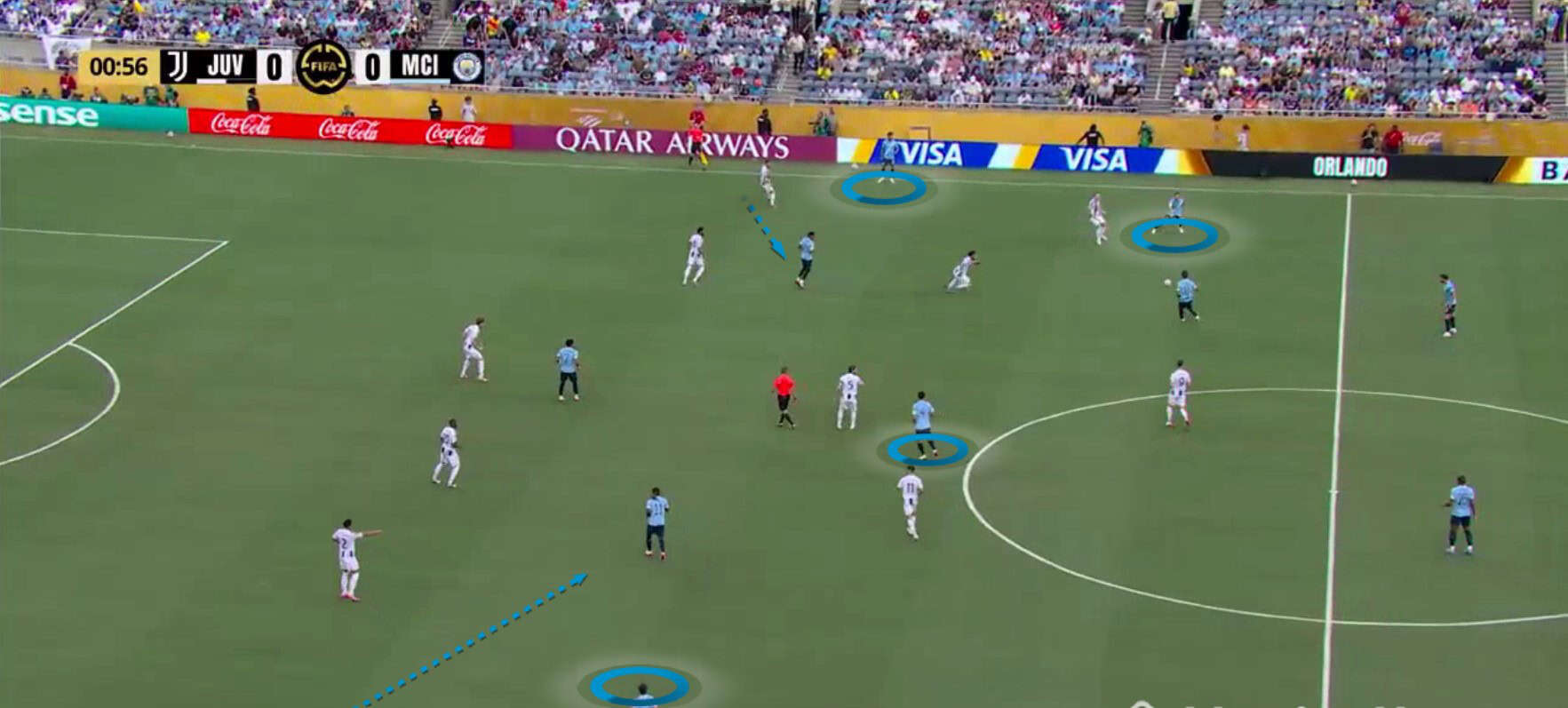 As observed in the build-up, Man City’s structure varies depending on the opposition and the personnel on the pitch.
The same applies to their progression.
In this case, Rúben Dias and Manuel Akanji operate as the right and left centre-backs, while Rayan Aït-Nouri and Matheus Nunes hold the width as full-backs—a contrast to the roles played by Lewis and O’Reilly against Wydad.
Savinho and Doku move inside, taking the eights’ zones, with Marmoush up front.
What stands out here is the midfield configuration: Bernardo Silva drops deep and wide on the right, Rodri (here) positions himself close to the ball side as a six, and with Doku inside as an eight, Rejinders drops as a second six.
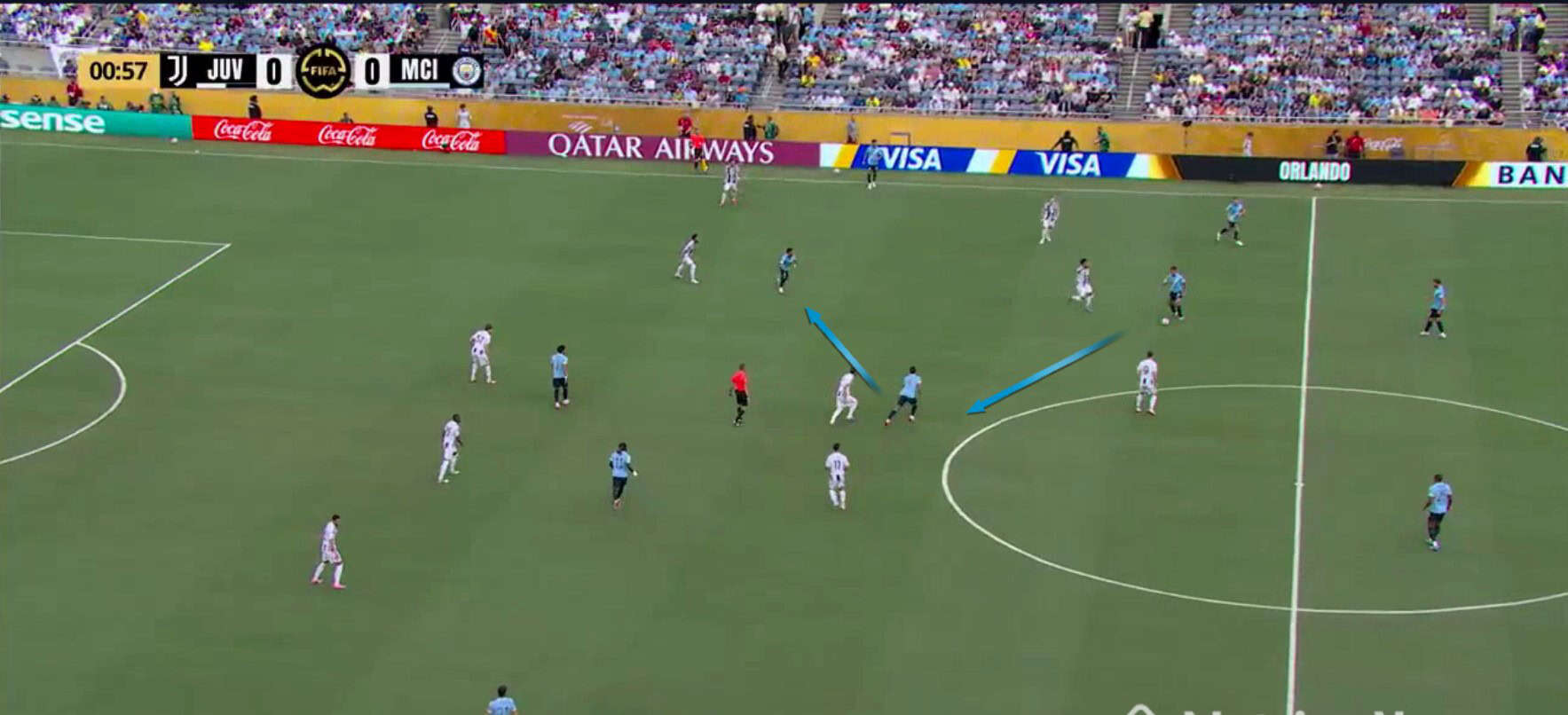 Here, Man City aimed to manipulate the opposition’s midfield.
With Rodri drawing Weston McKennie to open a passing lane from Reijnders to Savinho.
However, the plan stalled as Manuel Locatelli, the right-sided six, stepped in, ready to press Reijnders.
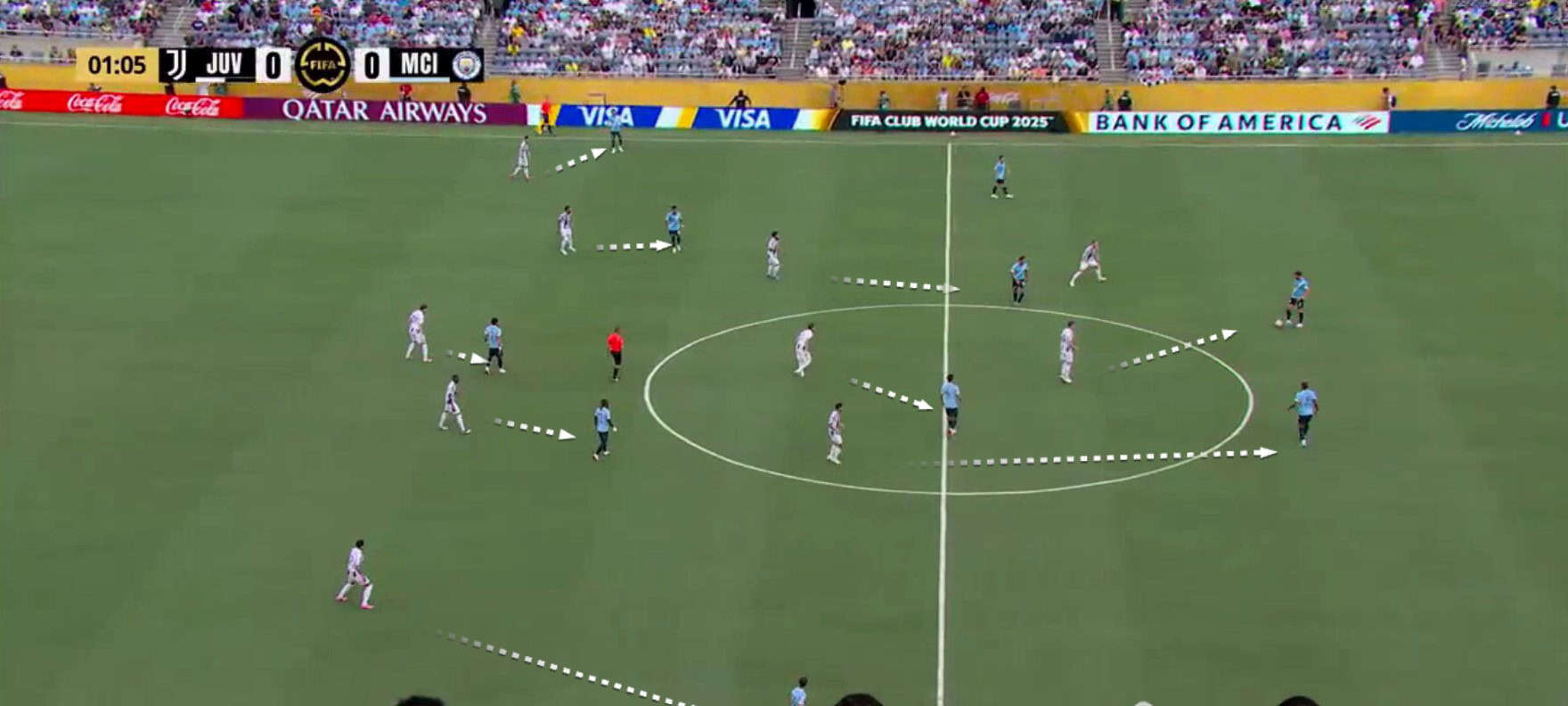 Juventus used a man-marking system.
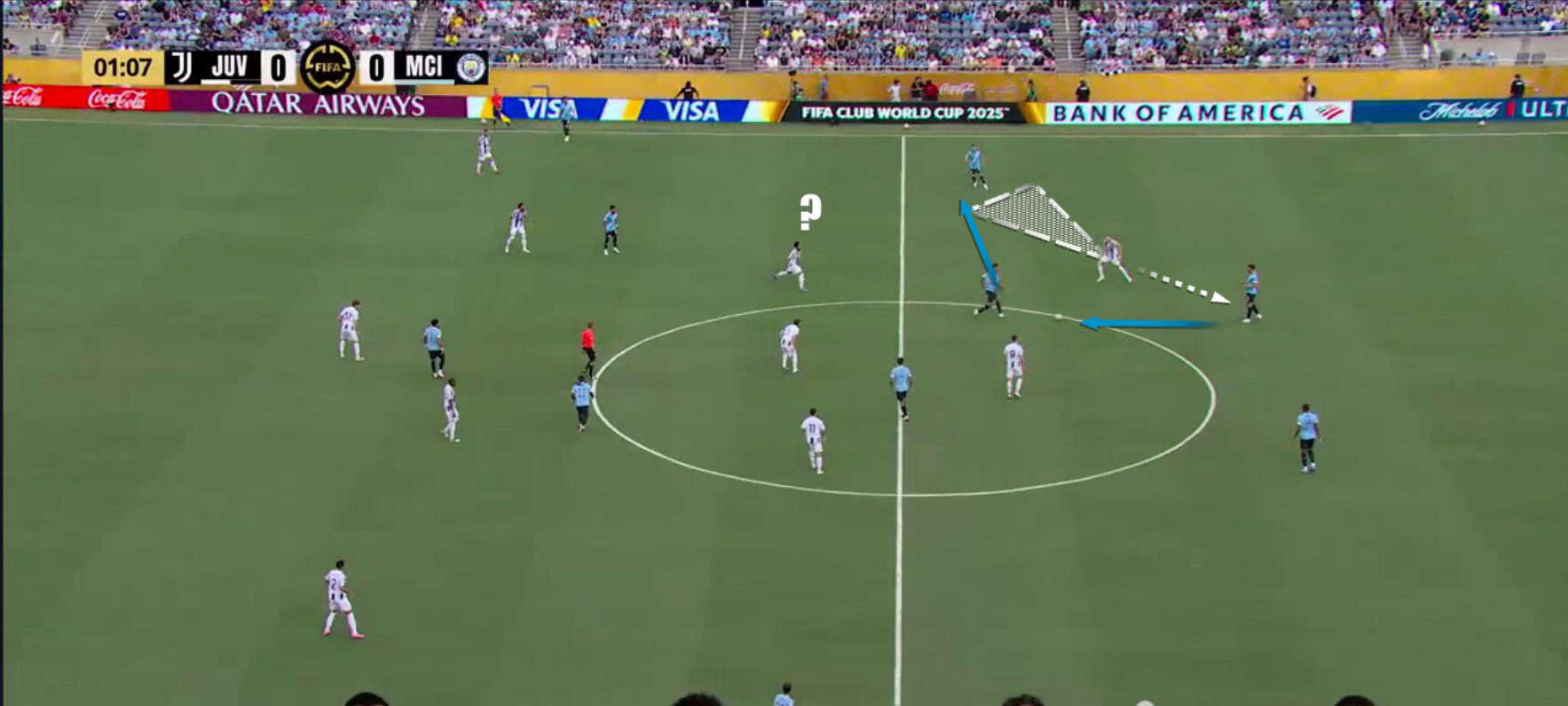 In this sequence, Teun Koopmeiners, playing as the left winger, moves inside to press Dias and shadow Silva, but Dias connects through Rodri.
This movement places McKennie between Rodri and Silva, leaving Silva unmarked and free to receive.
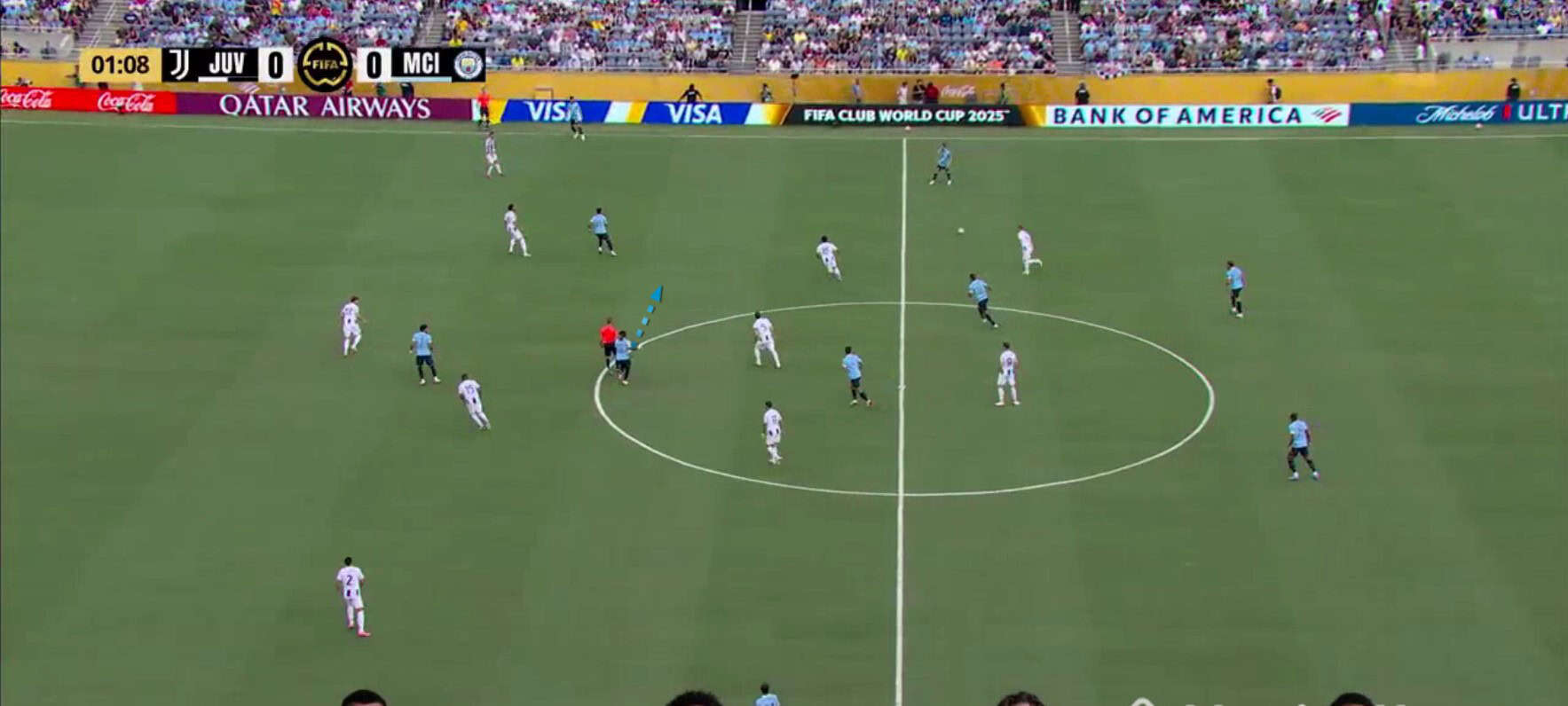 Let’s now focus on Doku’s horizontal run to the far side.
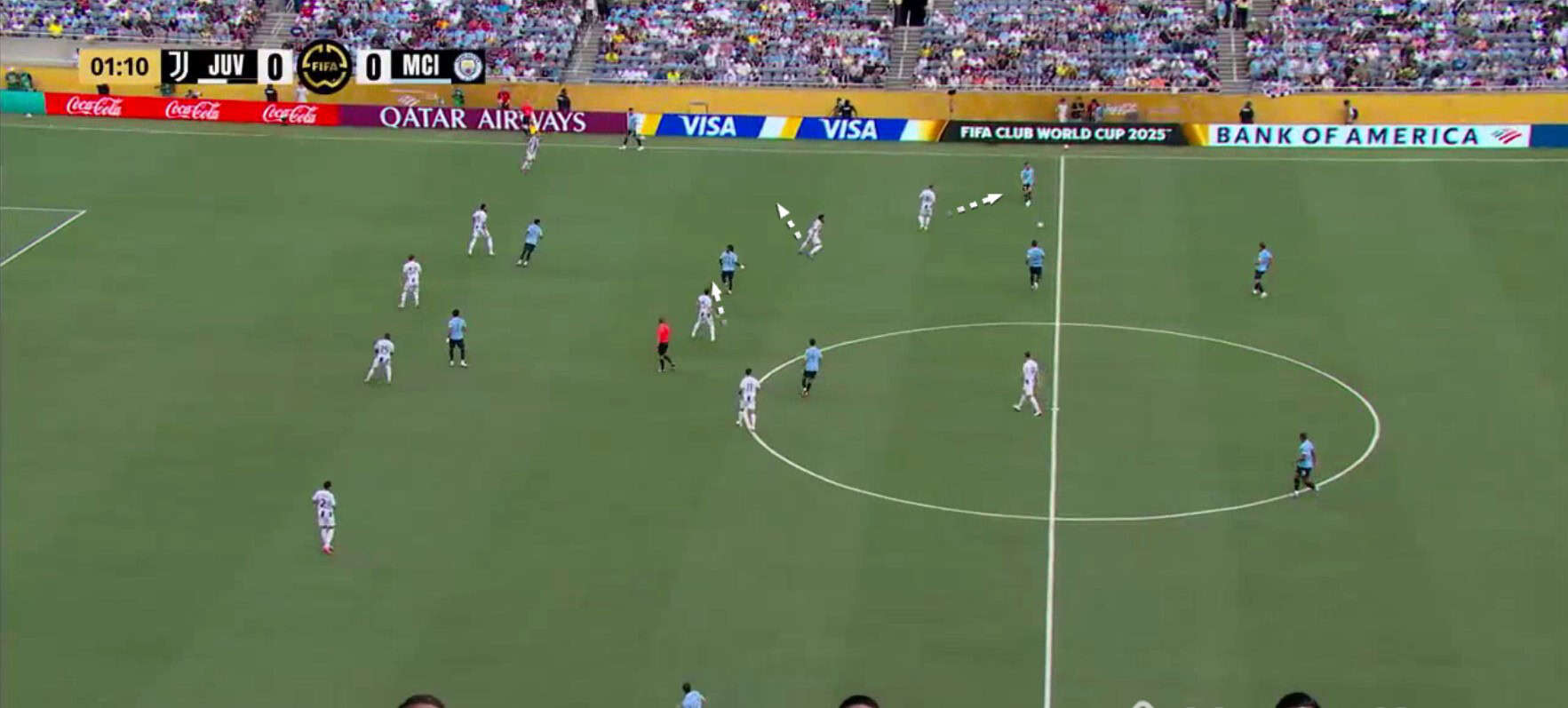 Back to Silva—when he receives the ball, he not only draws his direct marker but also causes a positional shift within Juventus’ midfield—like McKennie here—while Doku’s movement prompts Locatelli to shift across toward him.
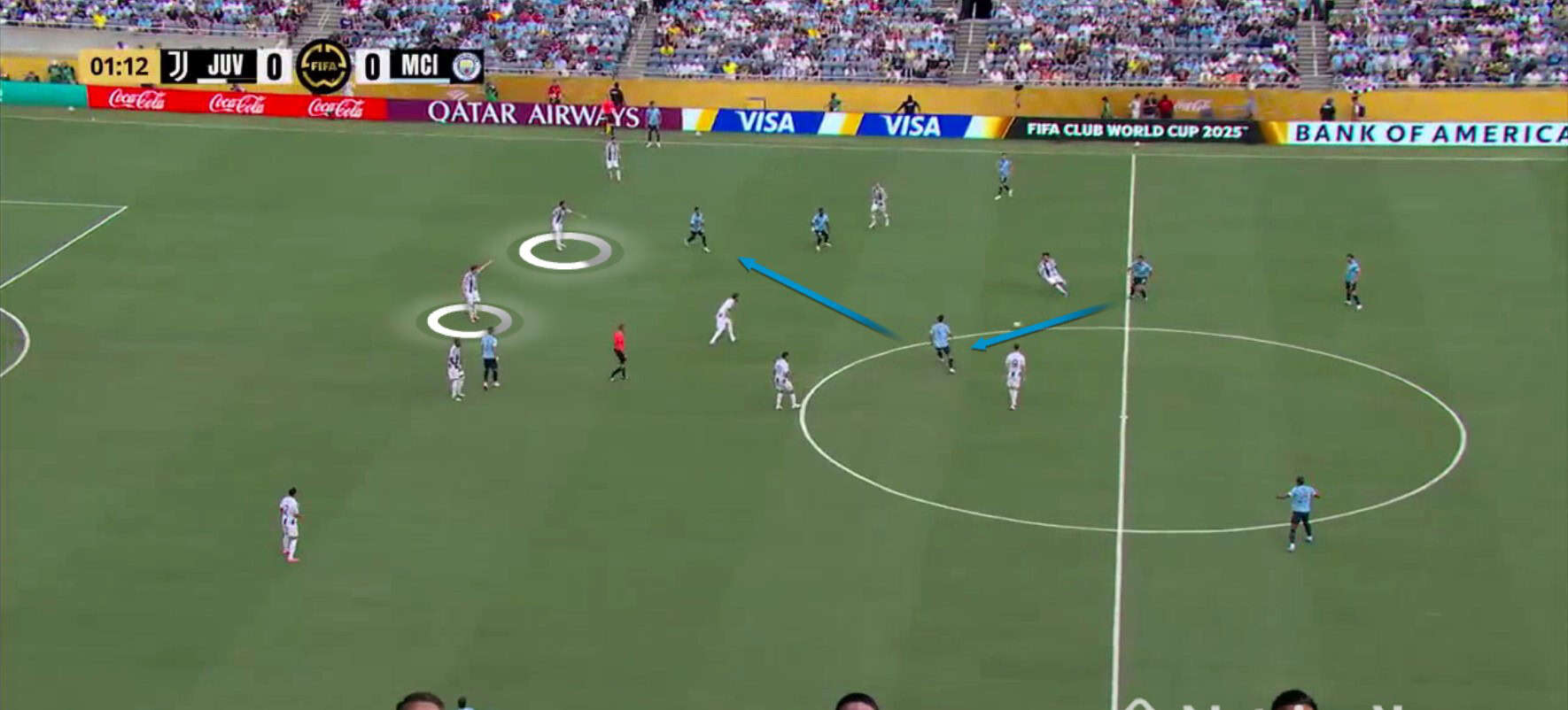 Silva’s pass to Rodri opens up Reijnders, with Locatelli pulled away by Doku.
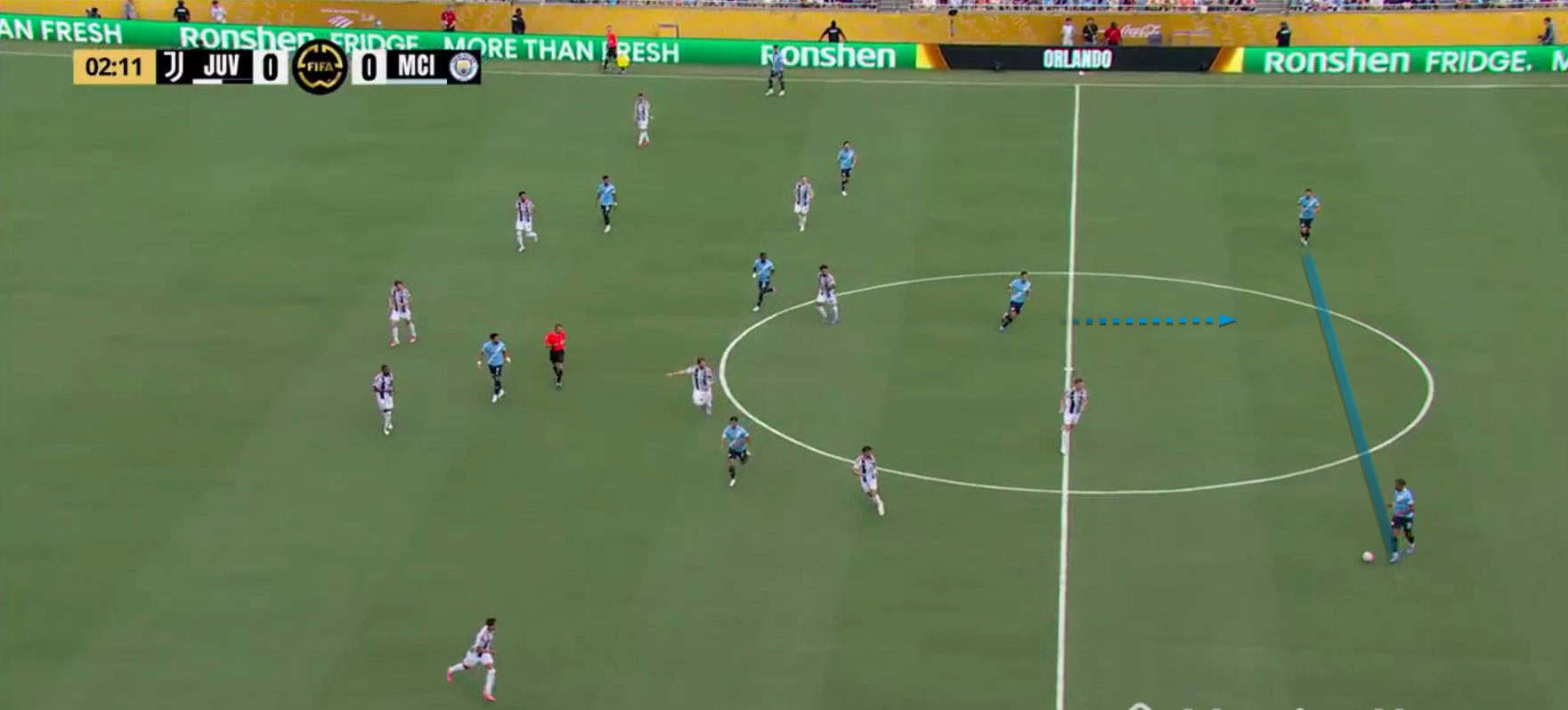 Unlike against Wydad, the centre-backs are more spread out, allowing Rodri, now a six, to drop in as a third option in the first line.
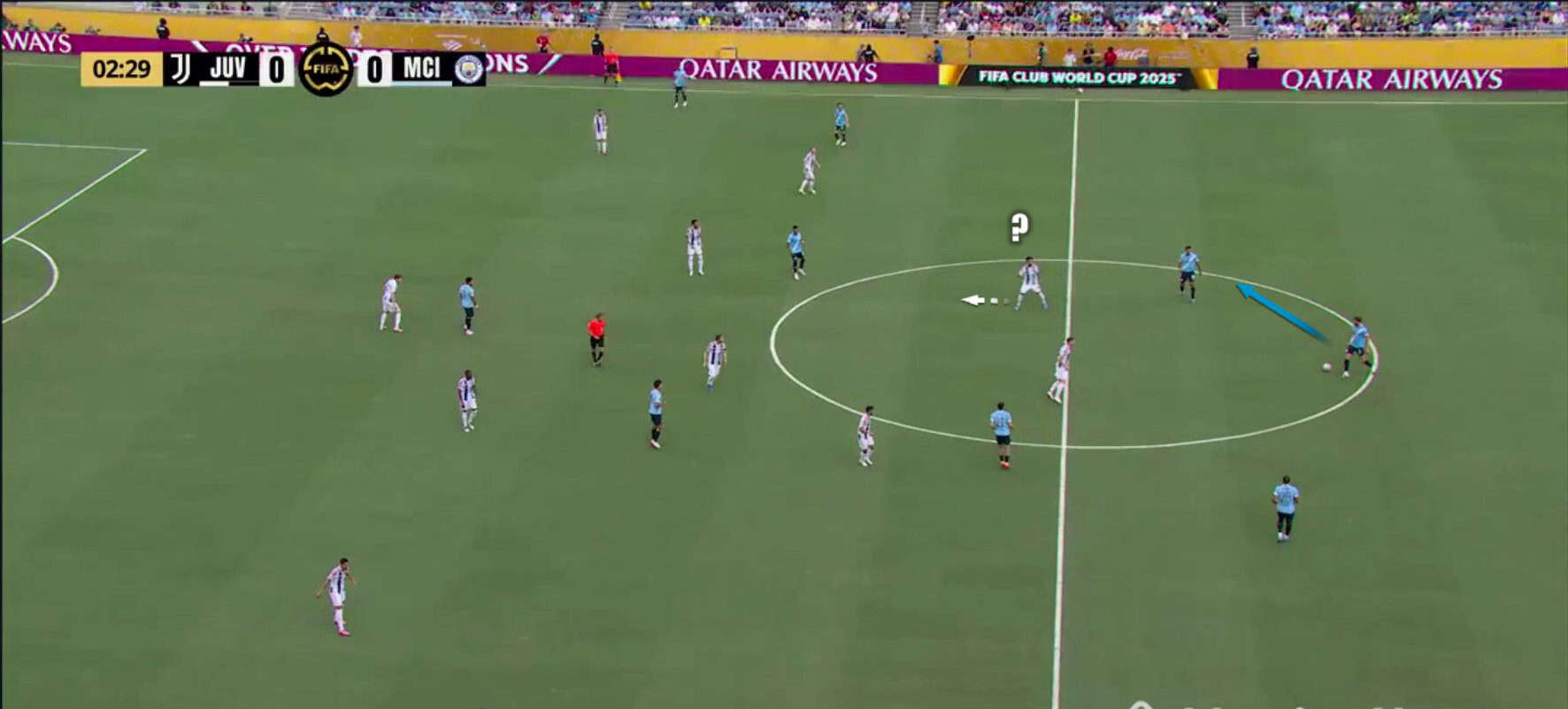 Rodri can drop to the side of the centre-back, gaining time to receive and pass since his marker can’t press without exposing space.
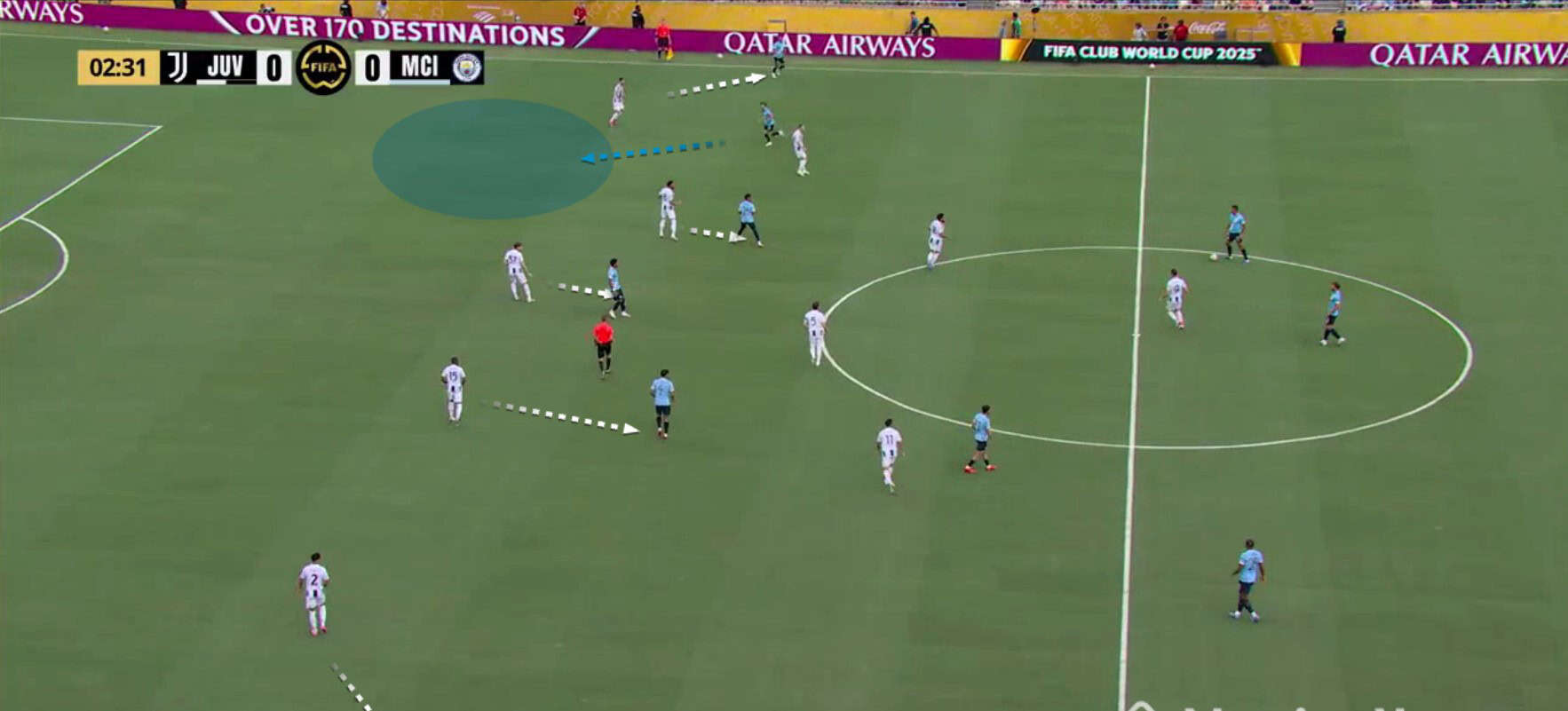 Due to Juventus’ man-marking defensive structure, Lloyd Kelly (left centre-back) follows Savinho, while Filip Kostić (left wing-back) tracks Matheus Nunes.
This movement opens up a pocket of space for Silva to exploit with a forward run.
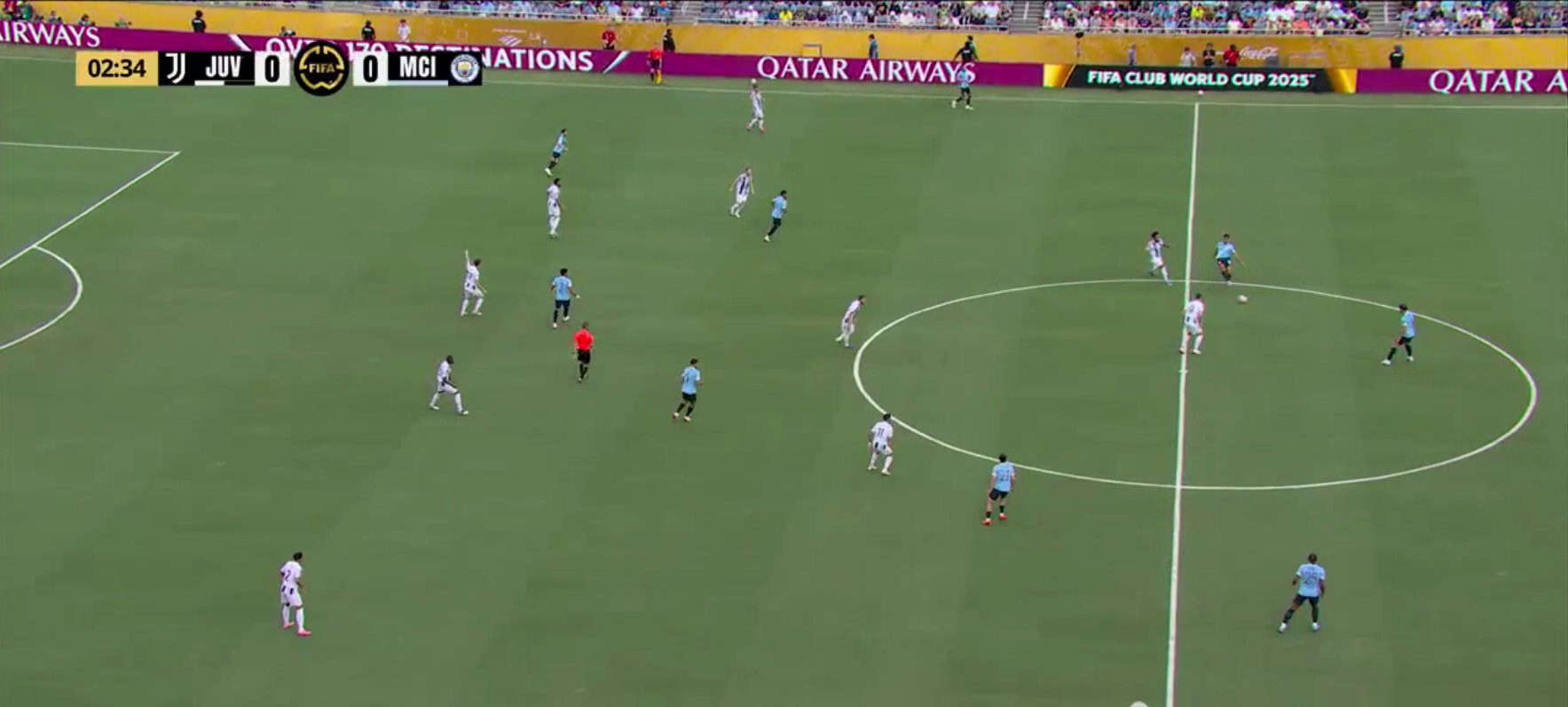 Rodri delays his pass, allowing McKennie to press and forcing him to play backwards.
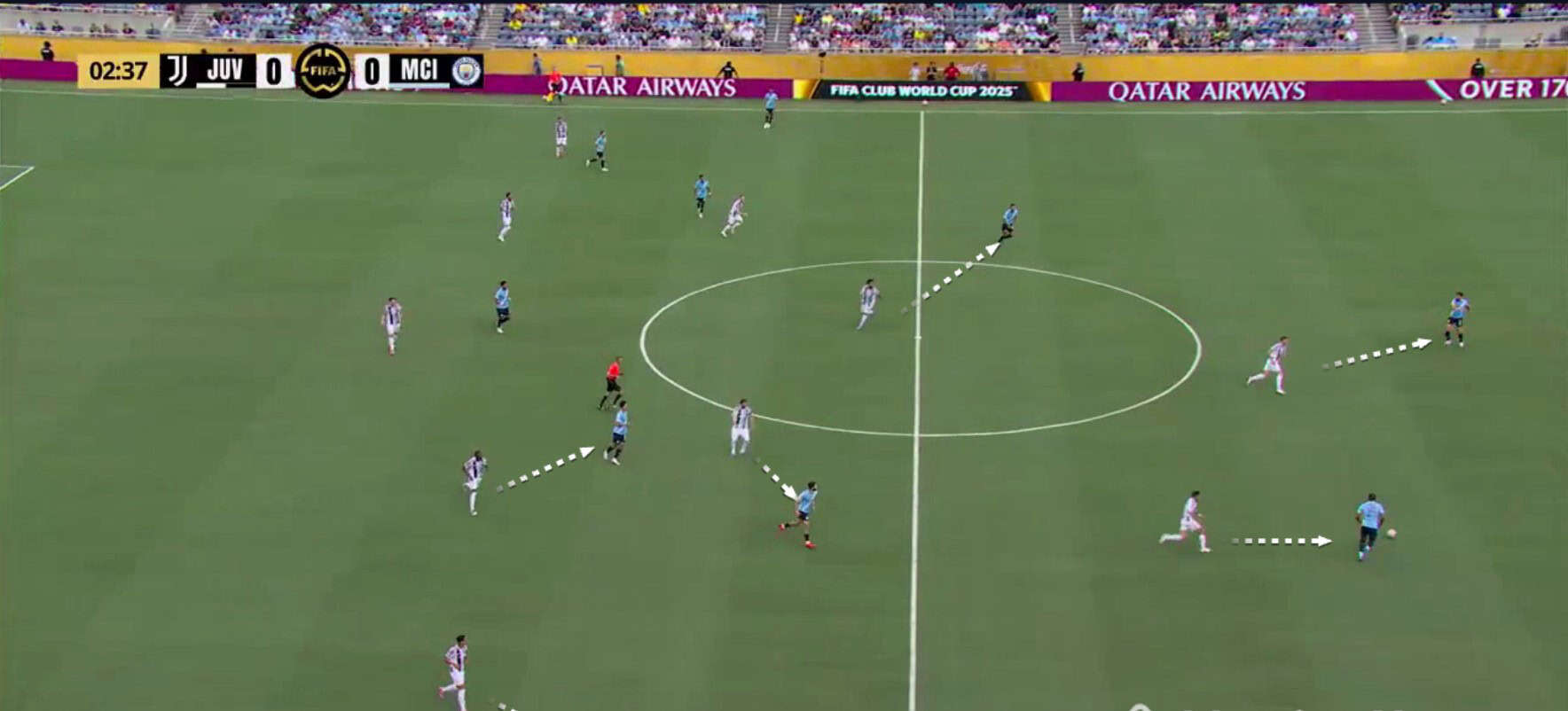 The backwards pass triggers Juventus to press as a unit.
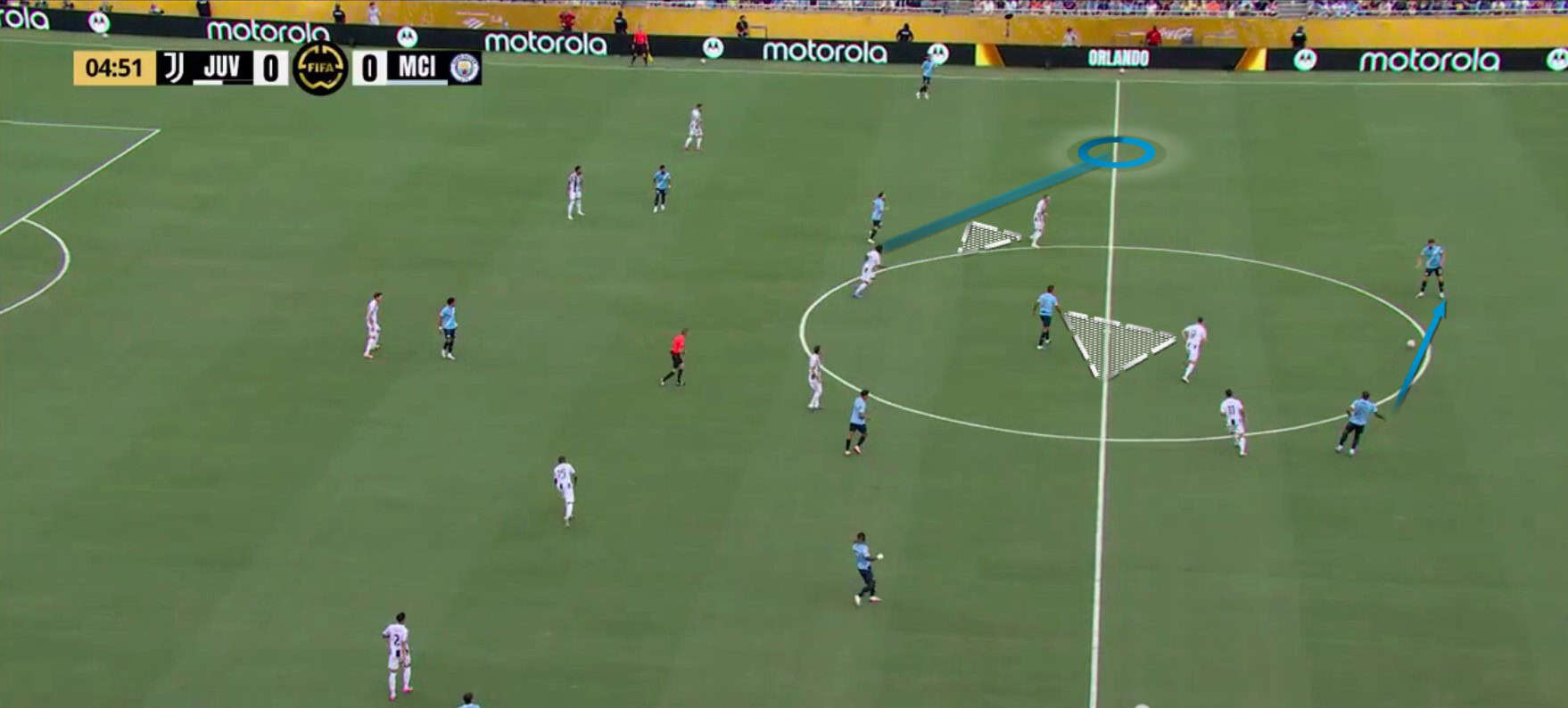 At times when the gap between the centre-backs is narrow and Rodri remains higher, Silva has not yet taken up his usual deep and wide position.
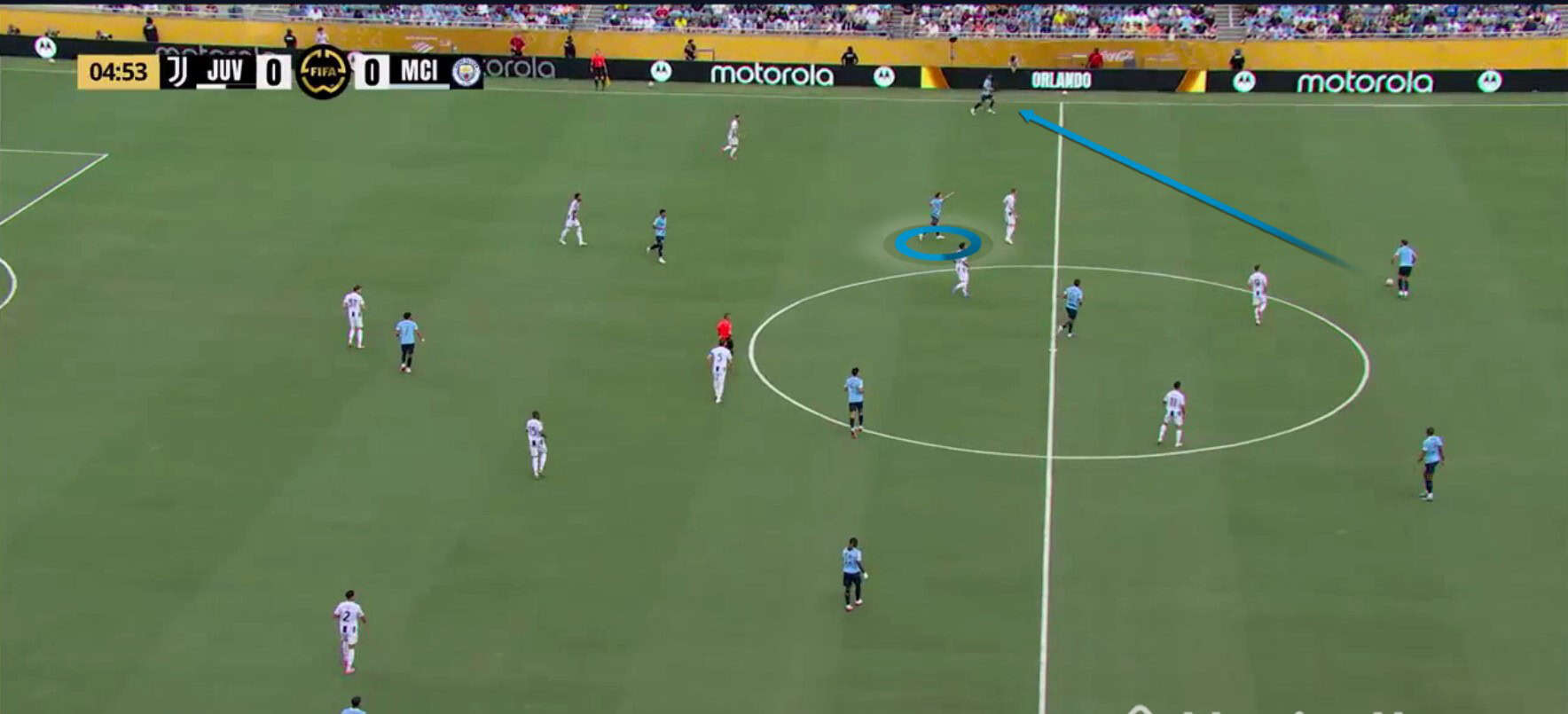 At this point, Man City’s only option is to recycle possession through Ederson and restructure their shape.
Silva signals to Dias to play it back, but instead, Dias chooses to pass to Matheus.
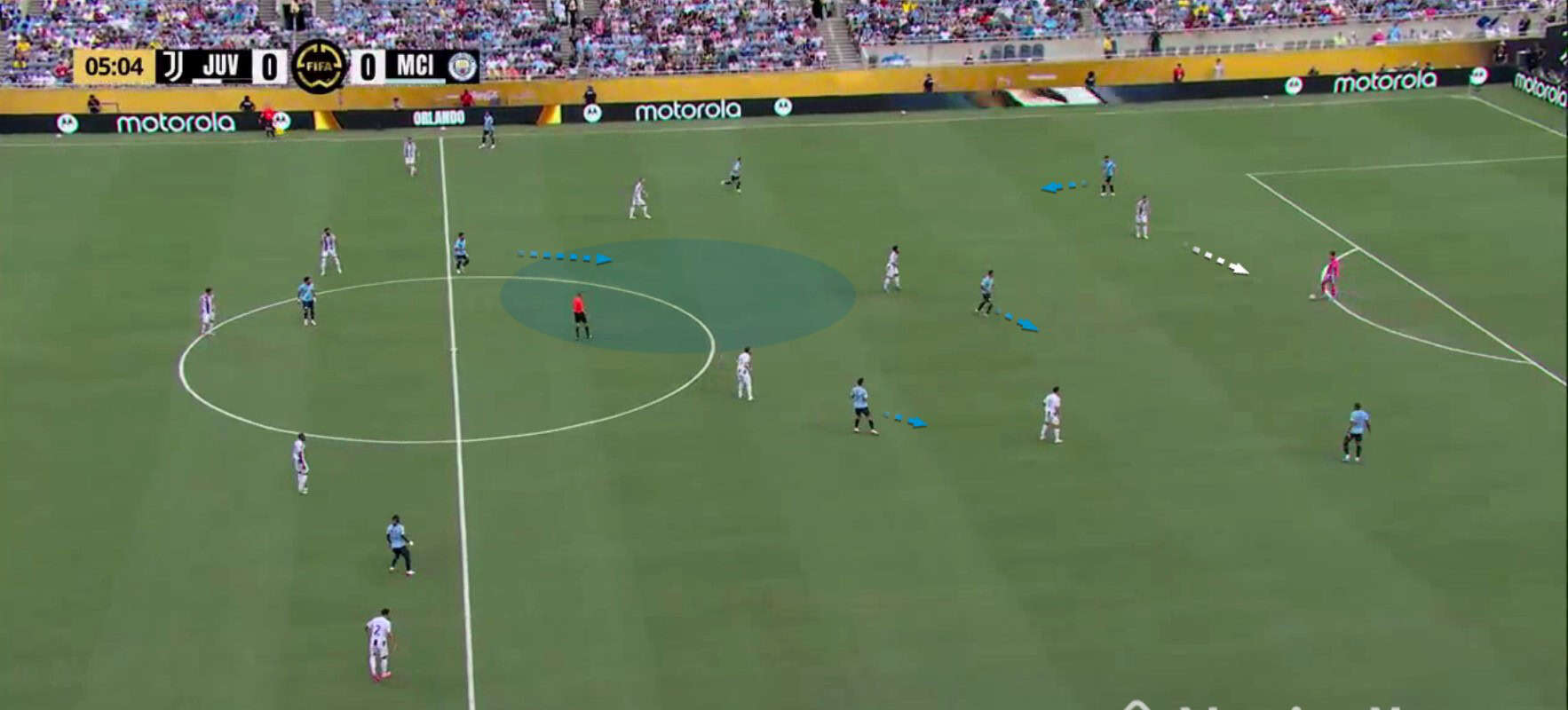 Eventually, the ball goes to Ederson.
In this phase, Guardiola’s side tries to emulate their performance against Juventus in the build-up.
Rodri and Reijnders drift towards the left to pull their markers away from the intended zone, which Savinho moves into.
At the same time, Dias advances as his marker presses Ederson.
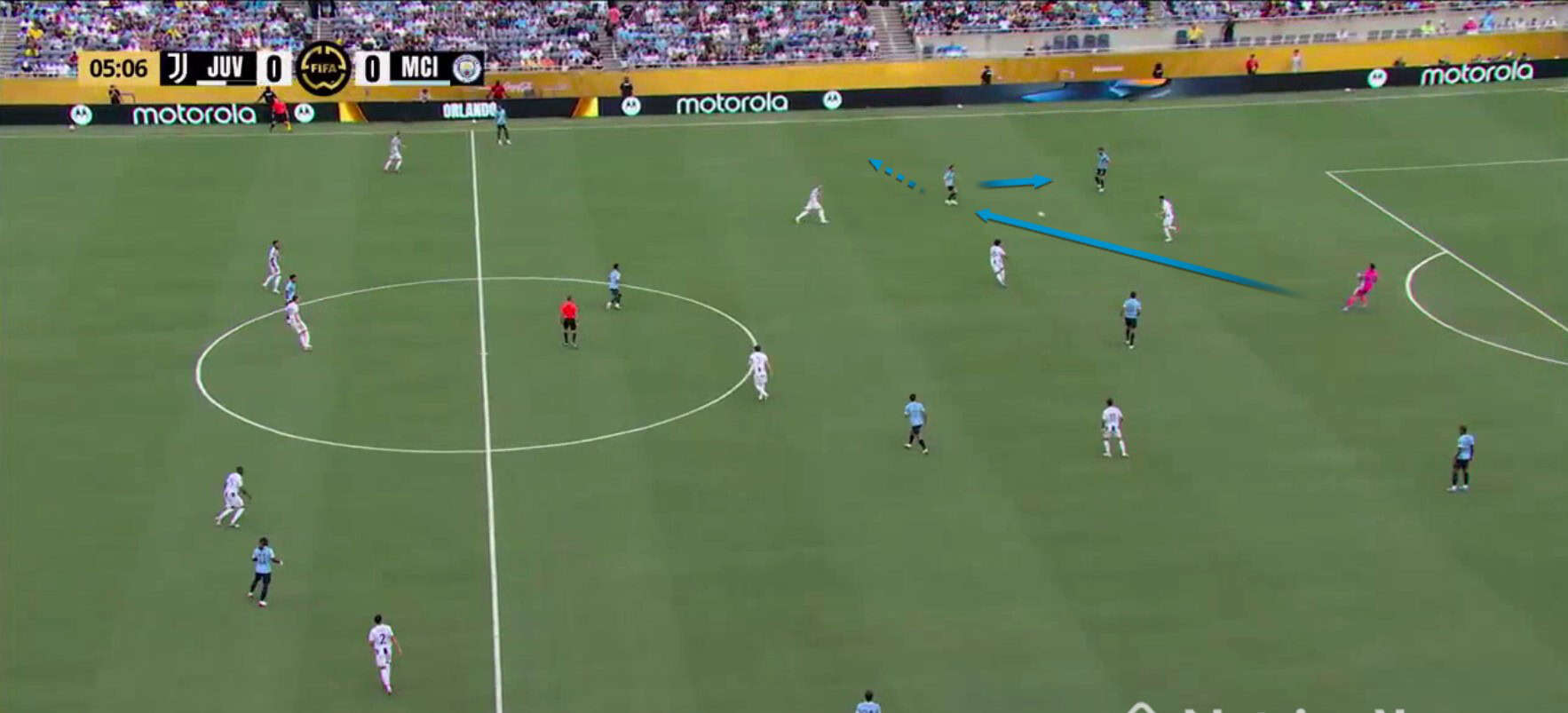 Silva receives from Ederson, lays it off to Dias, then pulls his marker wide to free a passing lane to Savinho.
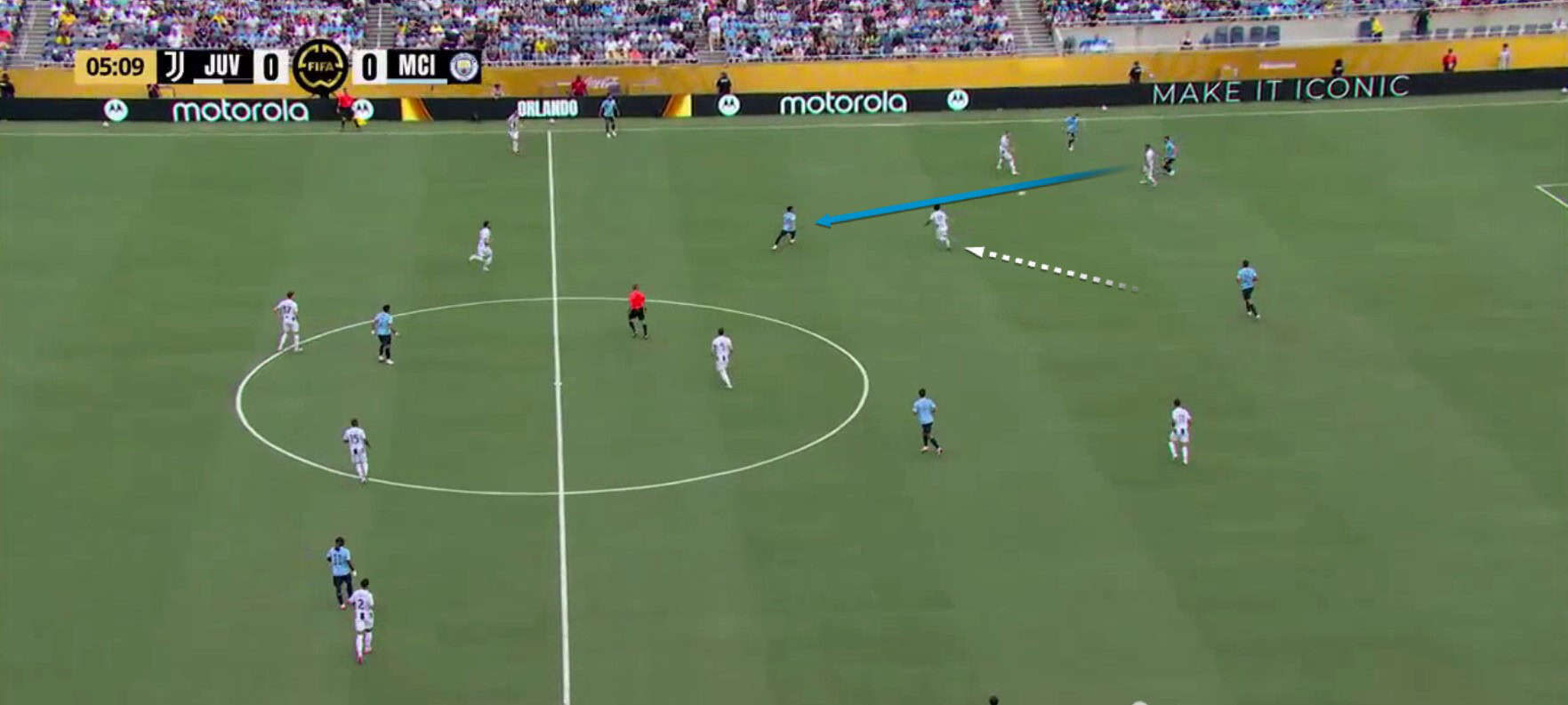 McKennie switches from Rodri to press Savinho after Dias’s pass, stopping him from turning forward, and it ends here.
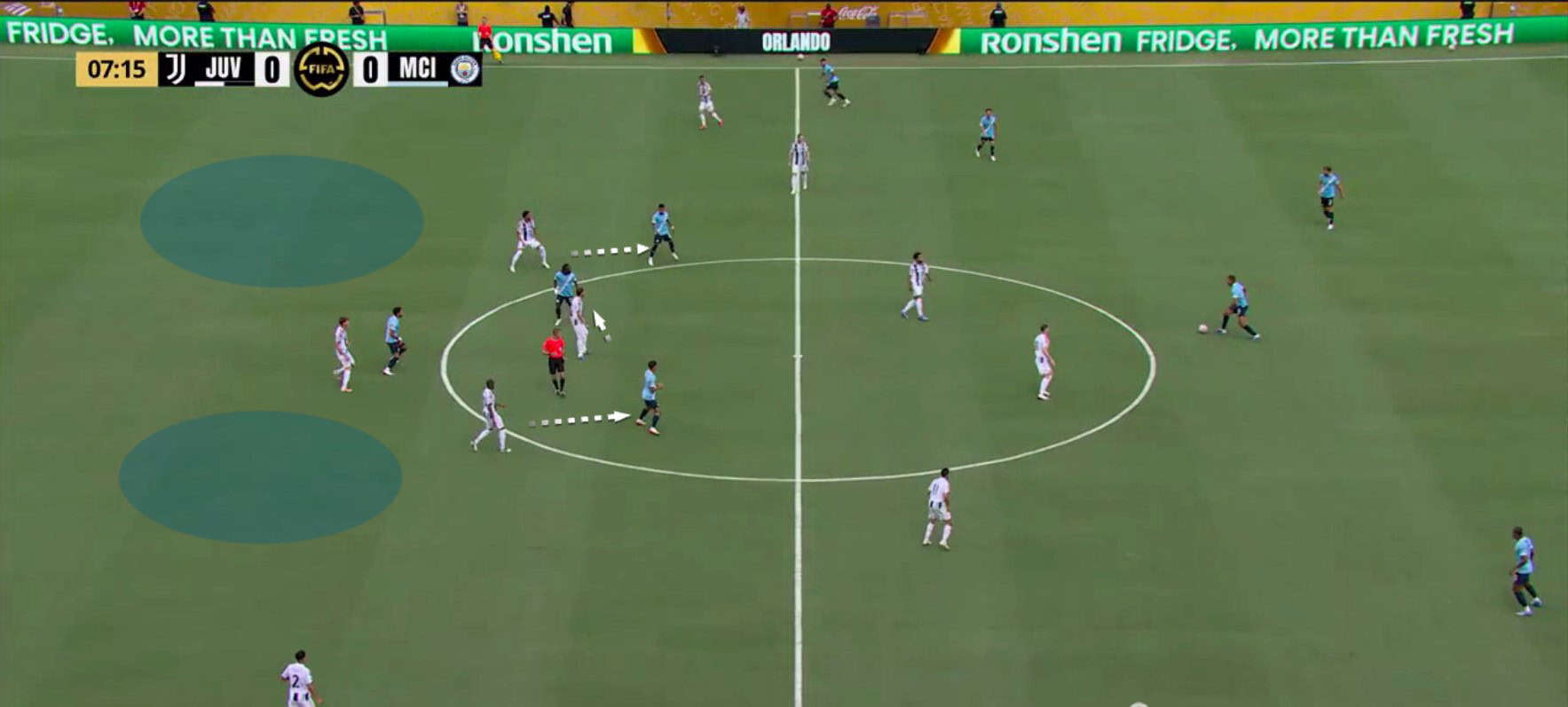 In this one, we can see, once again, Rodri drops between the centre-backs as Savinho, Doku, and Reijnders occupy Juventus’s backline.
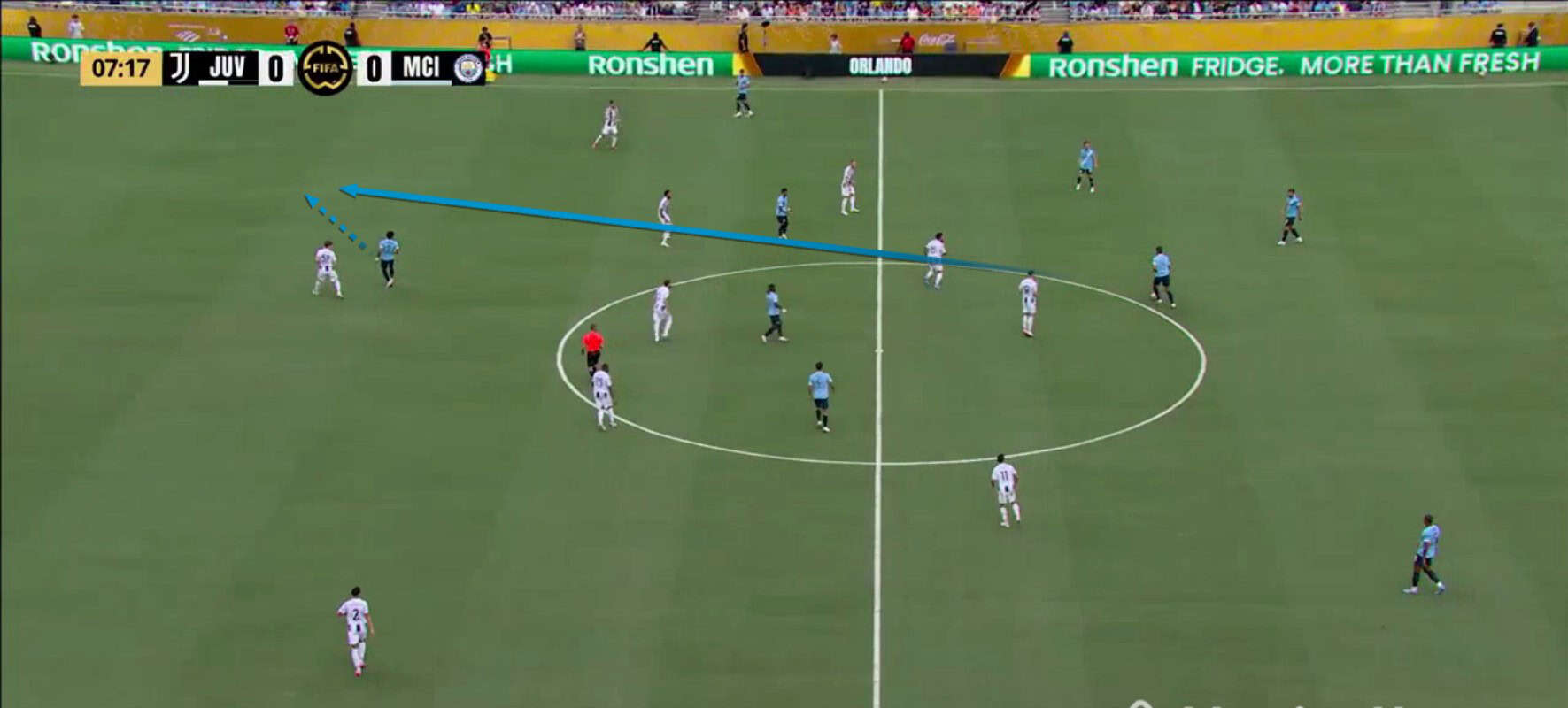 This opens space around Savona for Marmoush to attack.
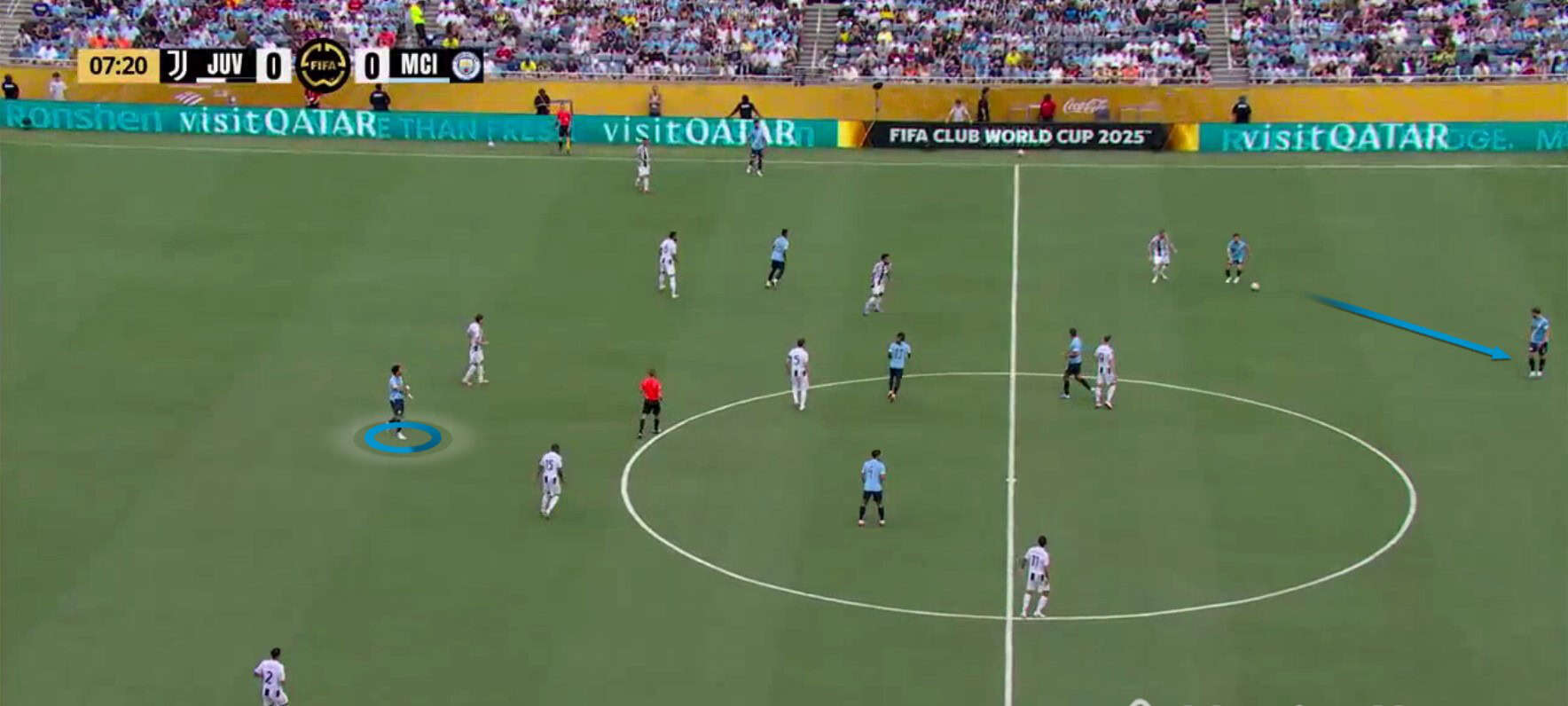 However, just like in Silva’s earlier case, Rodri misses the chance to play into space again, prompting Marmoush to show visible frustration as he passes to Silva, who then plays it back to Dias.
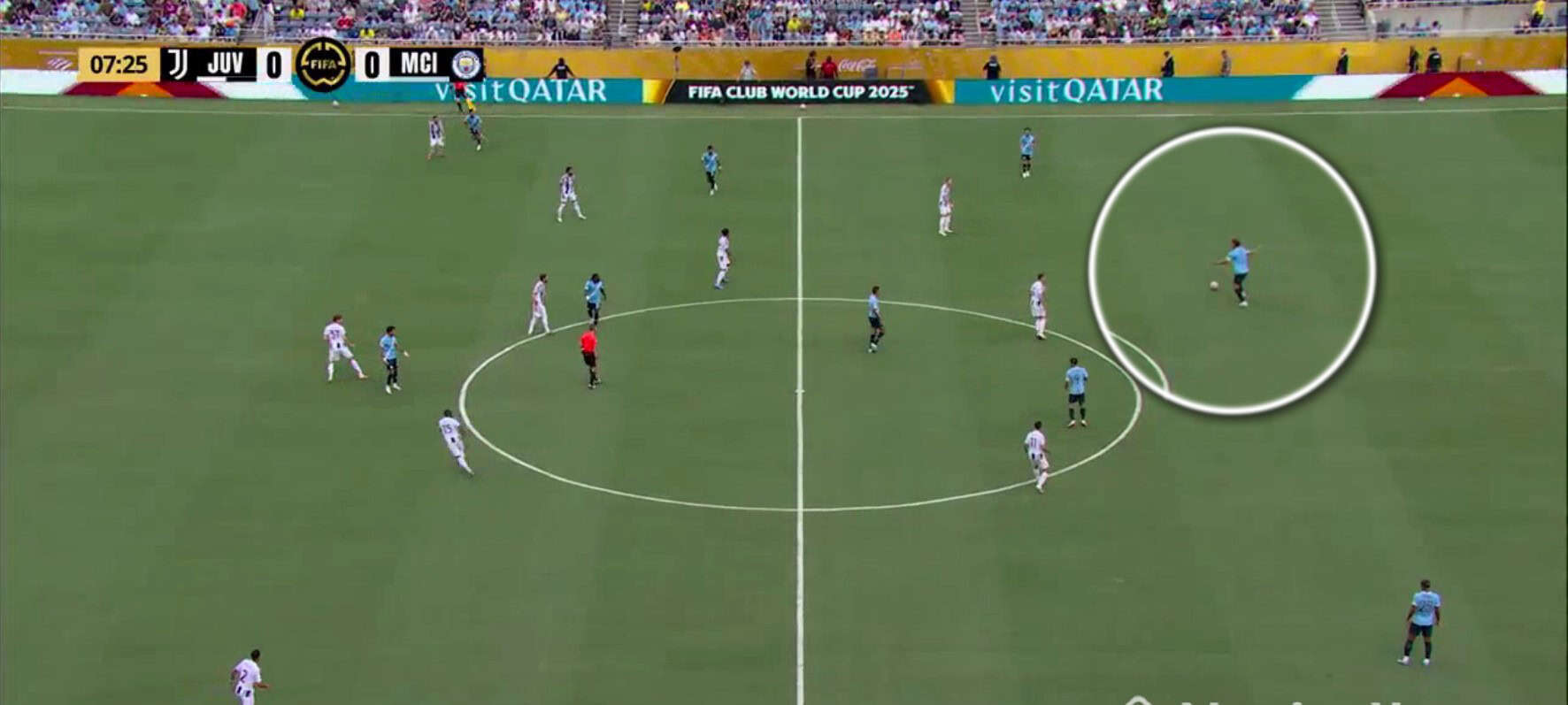 Now, as shown with Dias, Juventus’s man-marking leaves Man City without a clear solution.
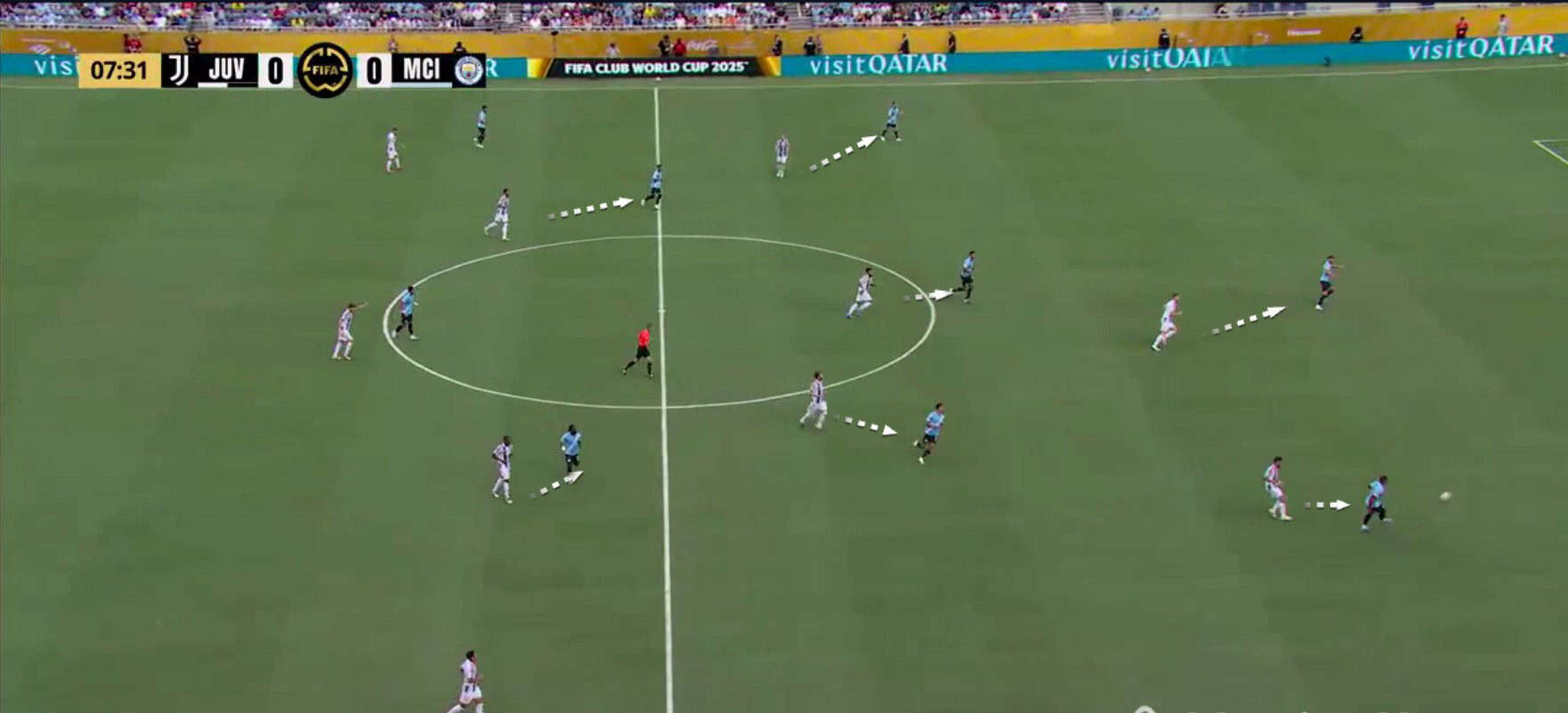 As a result, Man City are once again forced to recycle possession through Ederson.
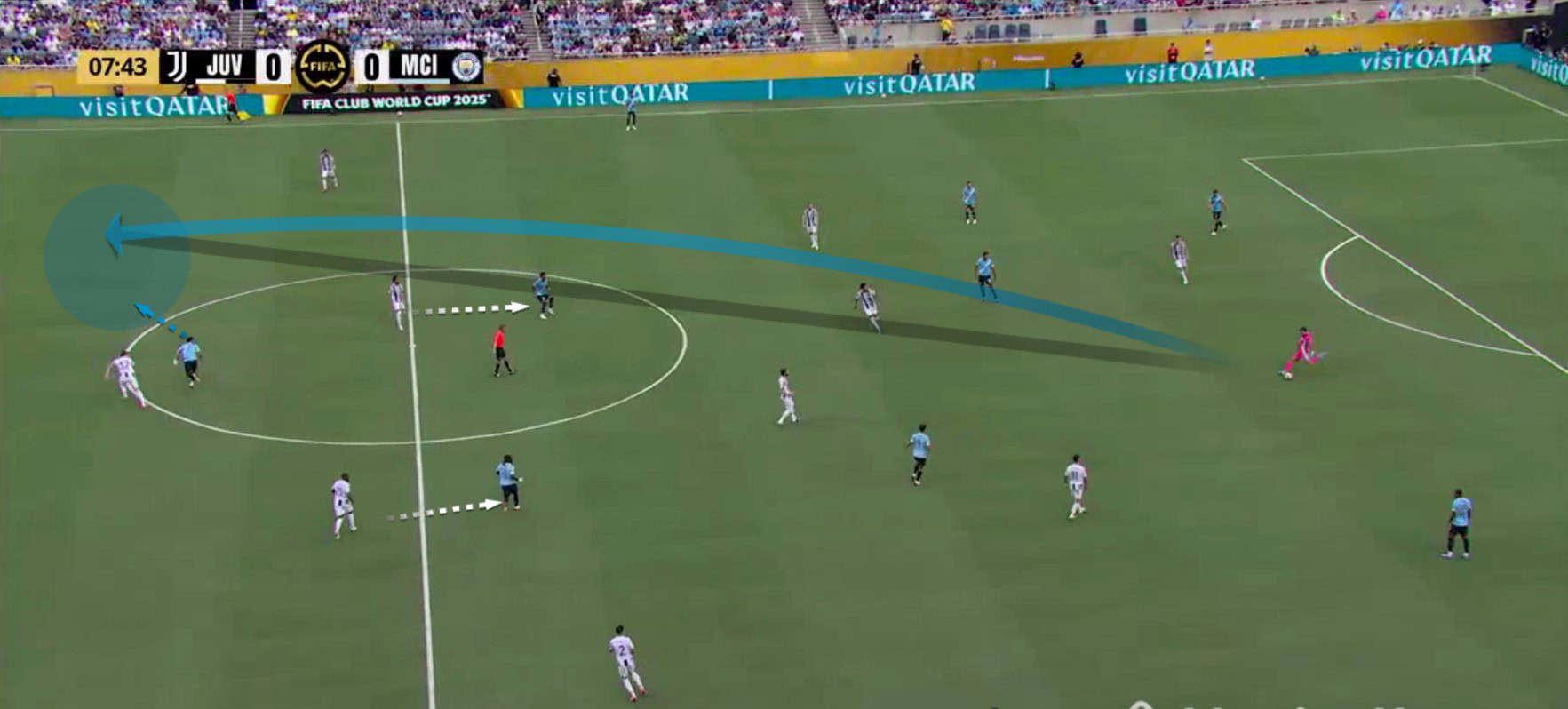 Ederson finds what Rodri missed earlier and plays a long ball to Marmoush, as Juventus’ wide centre-backs follow Savinho and Doku.
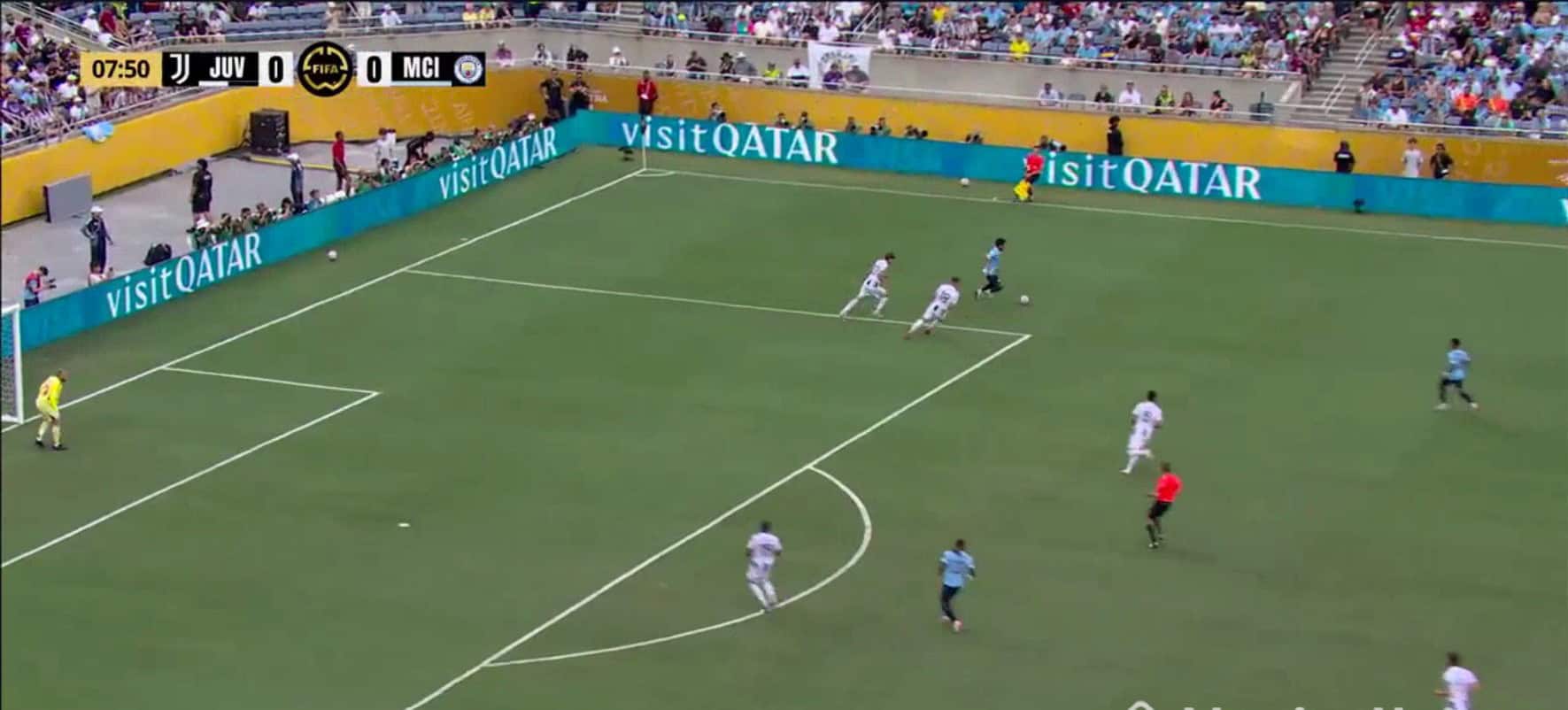 Man City players then use the ball’s new position as a fulcrum to establish themselves in the opposition’s final third.
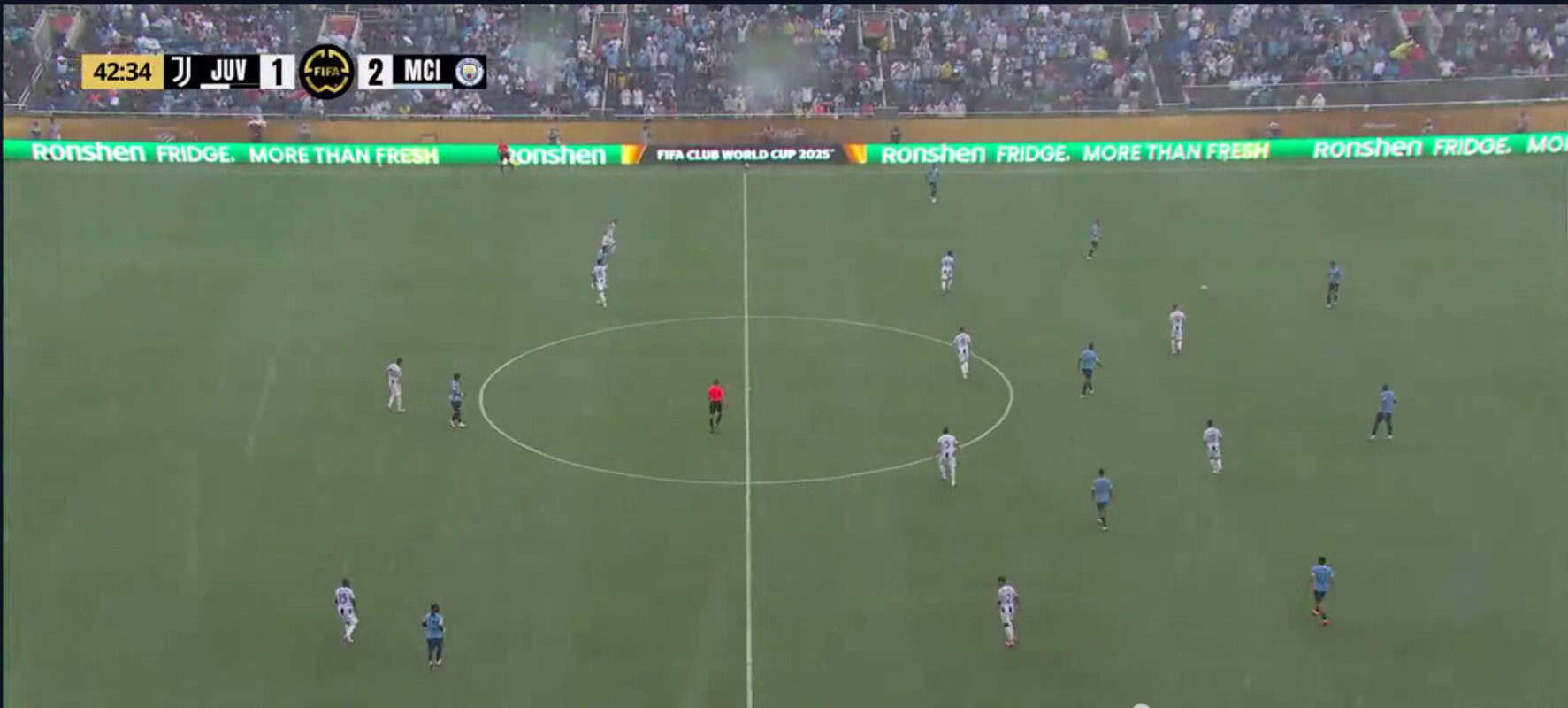 Earlier in the build-up, we highlighted how Man City can rely on individual quality to overcome pressure, with Bernardo Silva as an example.
This time, Silva plays a direct role in helping Guardiola’s side escape Juventus’ press.
Positioned wide and deep, he prepares to receive a pass from Manuel Akanji.
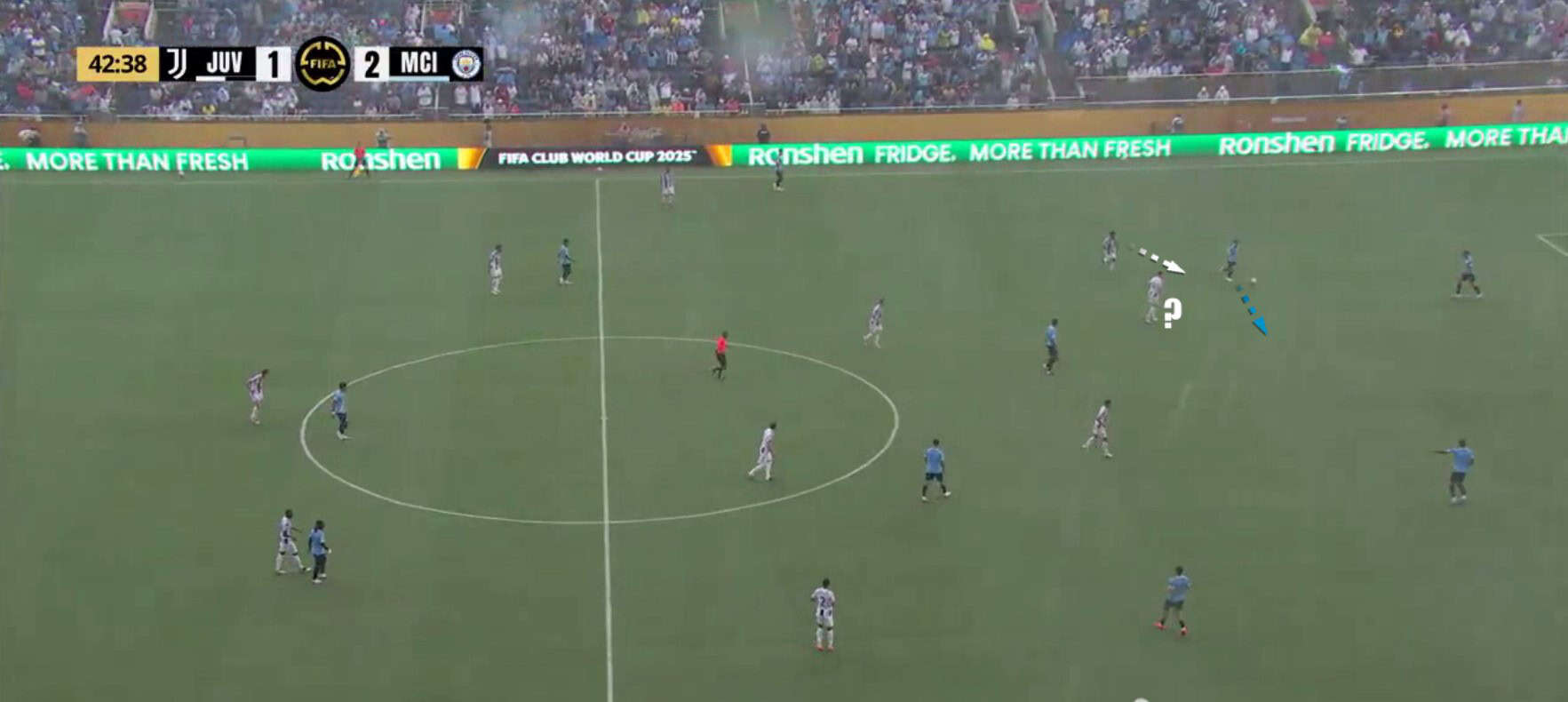 Weston McKennie closely marks Silva, while Dušan Vlahović waits to press Rúben Dias if the ball is played to him.
Aware of the trap, Silva realises that such a pass would leave Dias with no viable options, as every Manchester City player is tightly marked.
Instead, Silva carries the ball horizontally, freezing Dias’ marker in place.
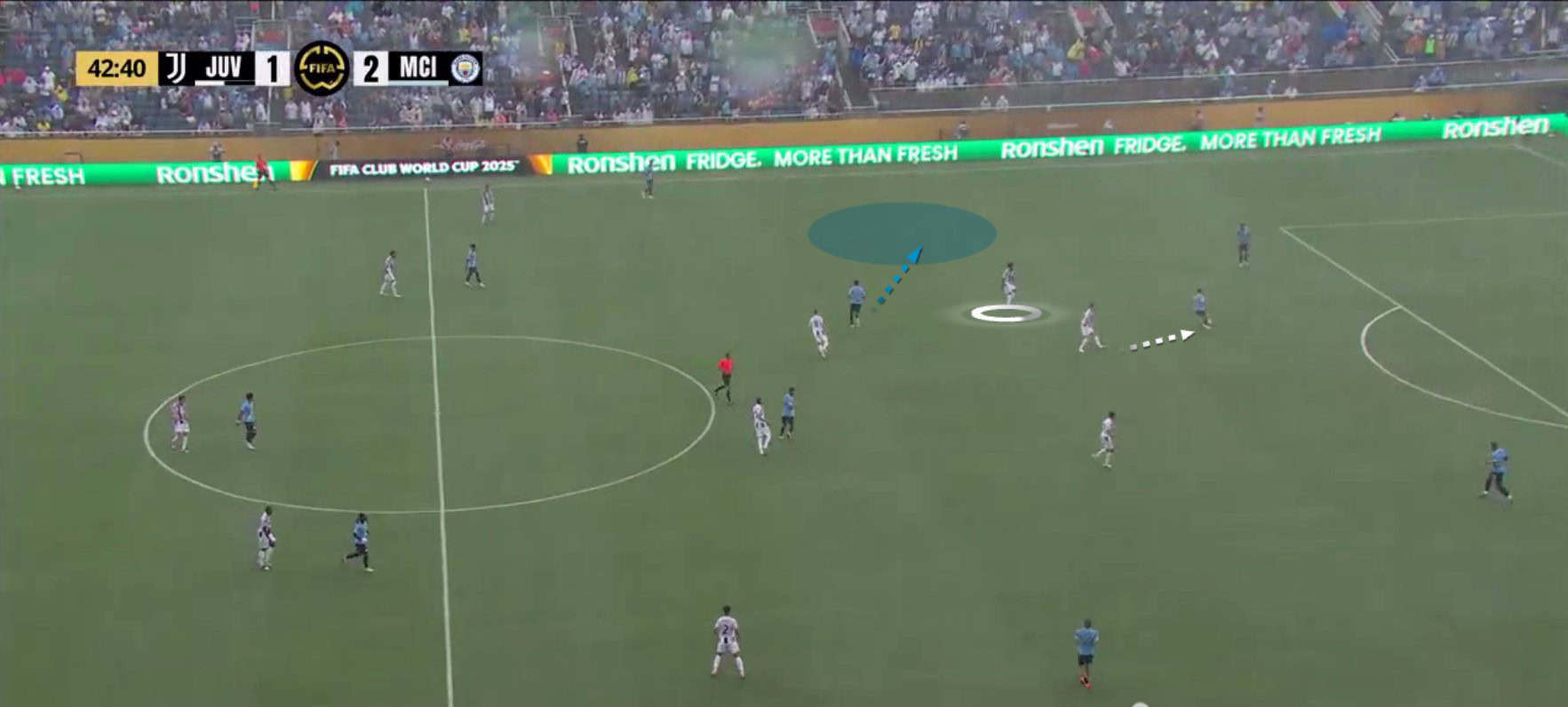 As Silva carries the ball, McKennie halts his tracking, prompting Vlahović to step up and press Silva instead.
Recognising the shift, Rodri reads the situation and moves wide into Silva’s vacated position.
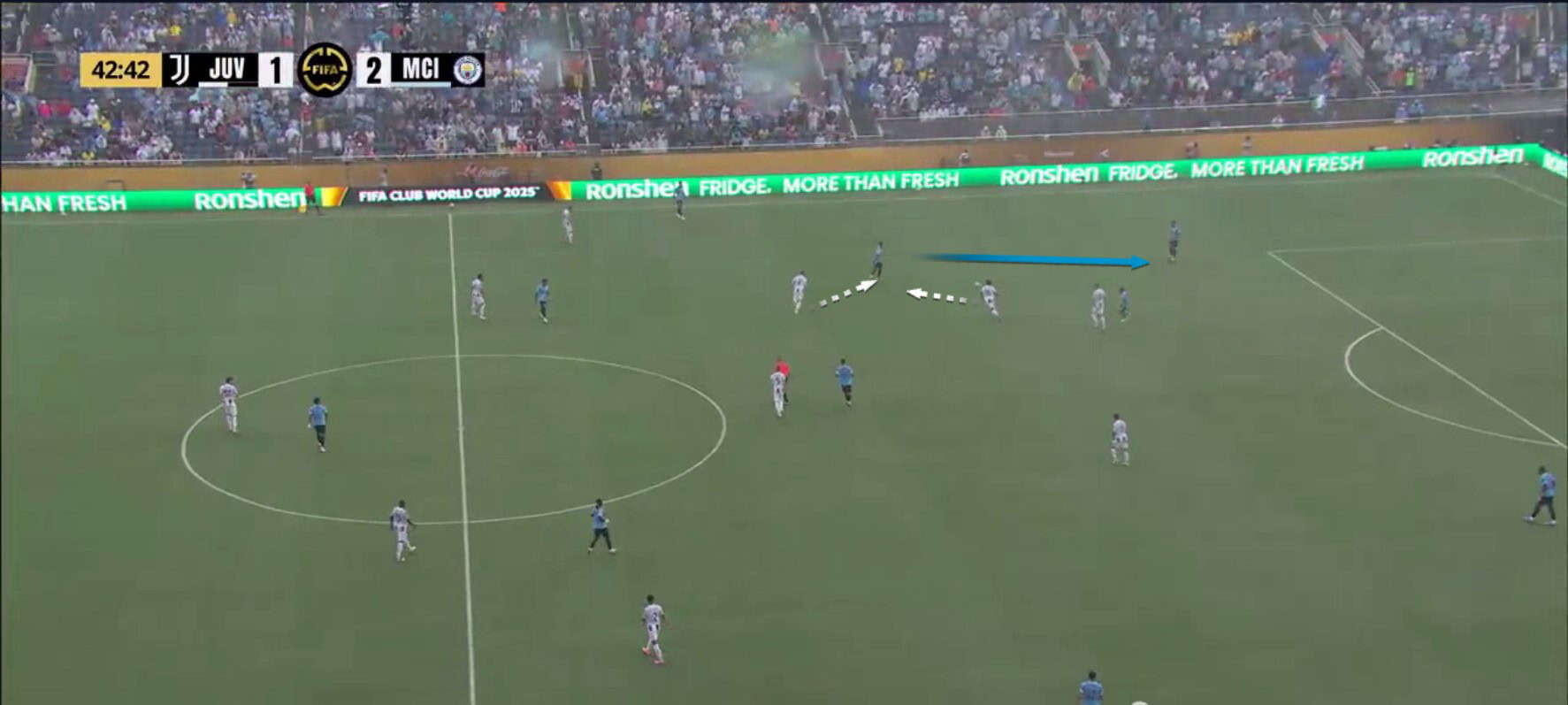 Rodri receives Silva’s pass, with his marker in close pursuit.
Due to a lack of communication within Juventus’ man-oriented pressing, McKennie also shifts towards Rodri, who finds Dias with a pass.
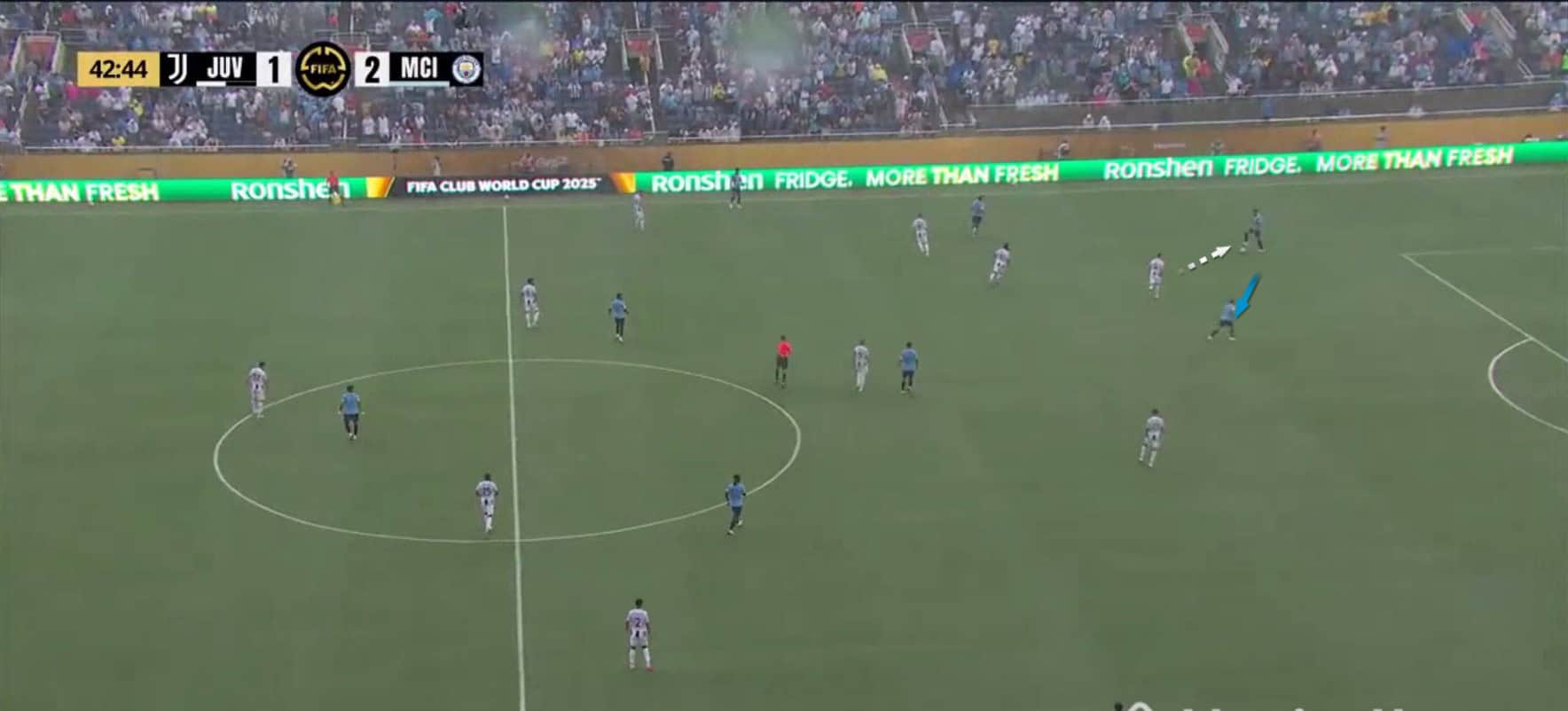 Vlahović now returns to press his original mark, Dias, who quickly plays the ball to Silva.
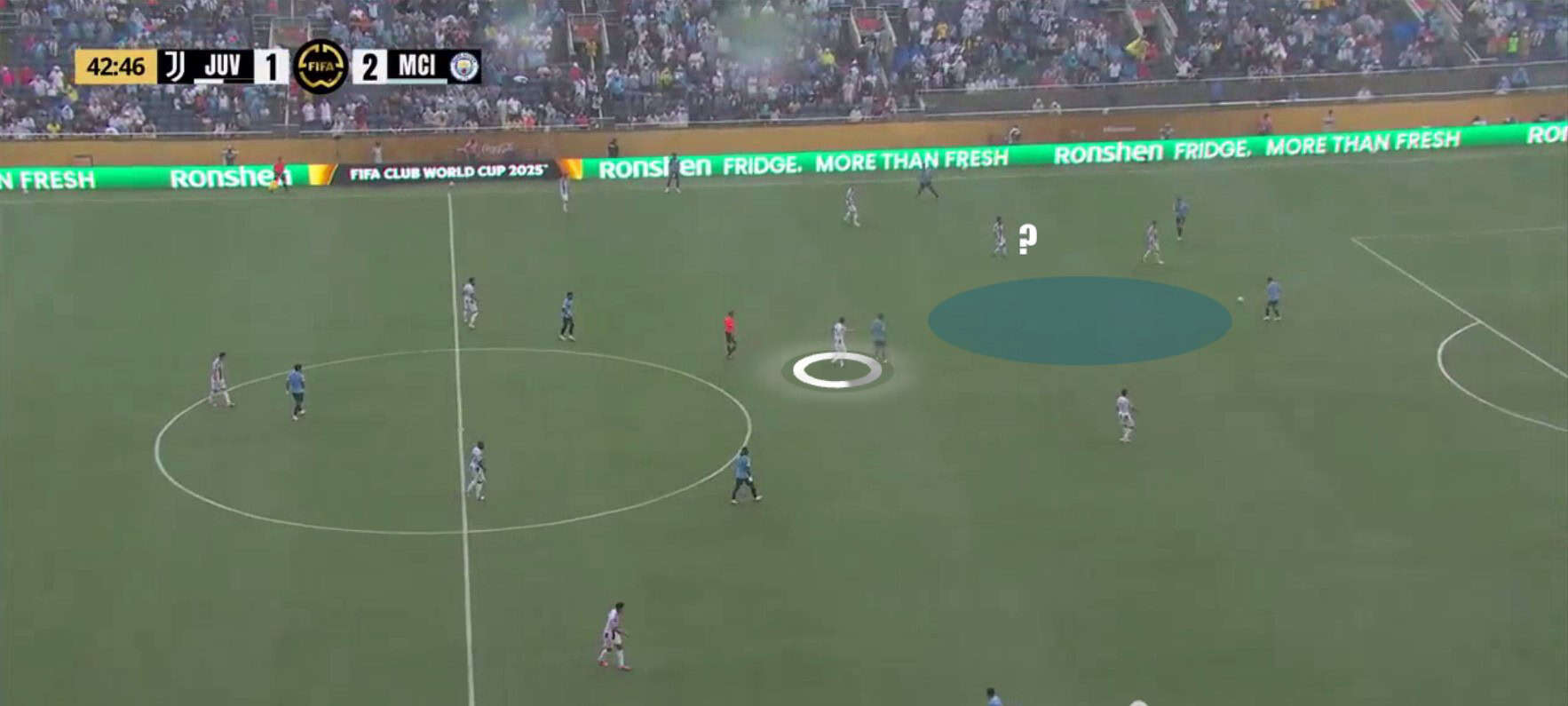 Silva now has time and space to receive and carry the ball forward, as his marker, McKennie, is away from him, and Vlahović is with Dias.
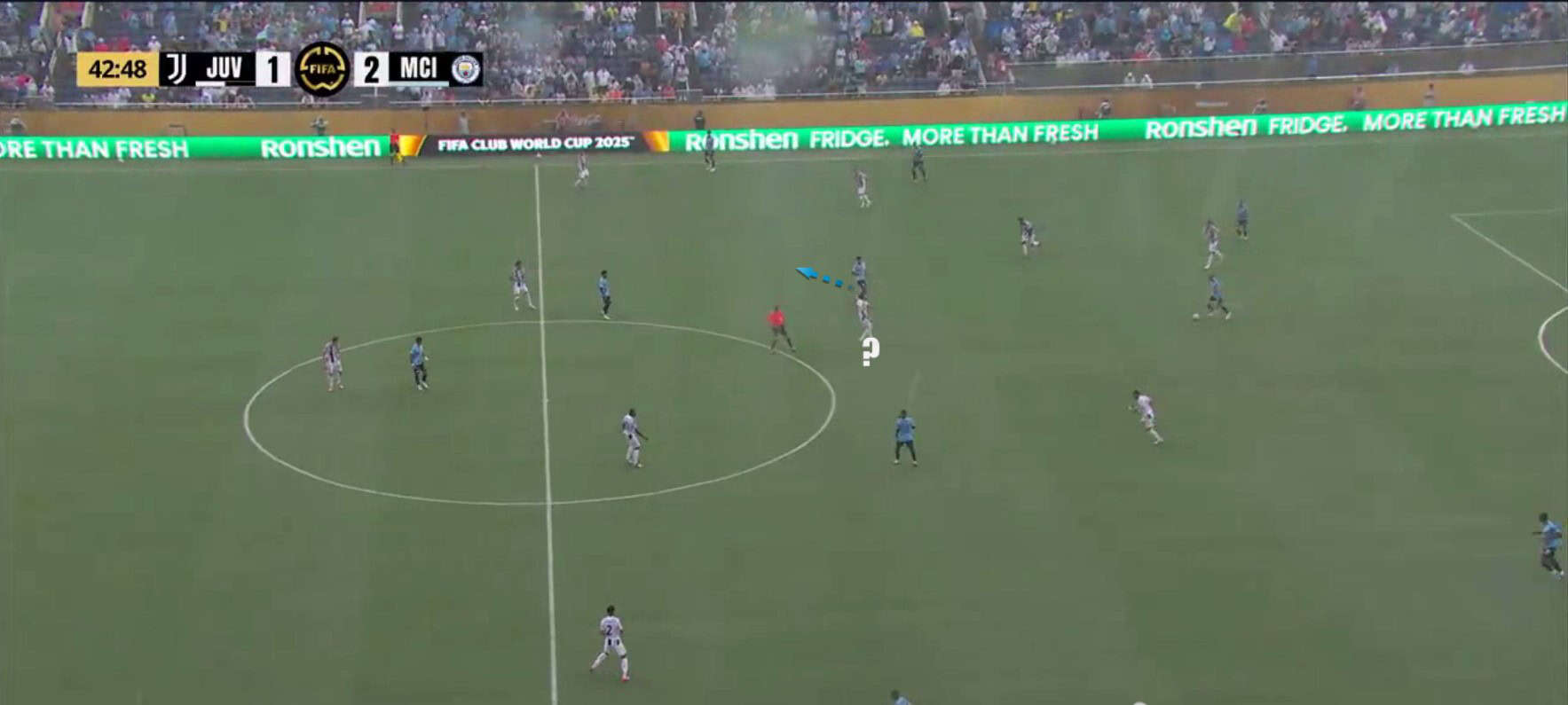 Reijnders shifts slightly wider, making Locatelli’s task of covering space ahead of Silva and marking him more difficult.
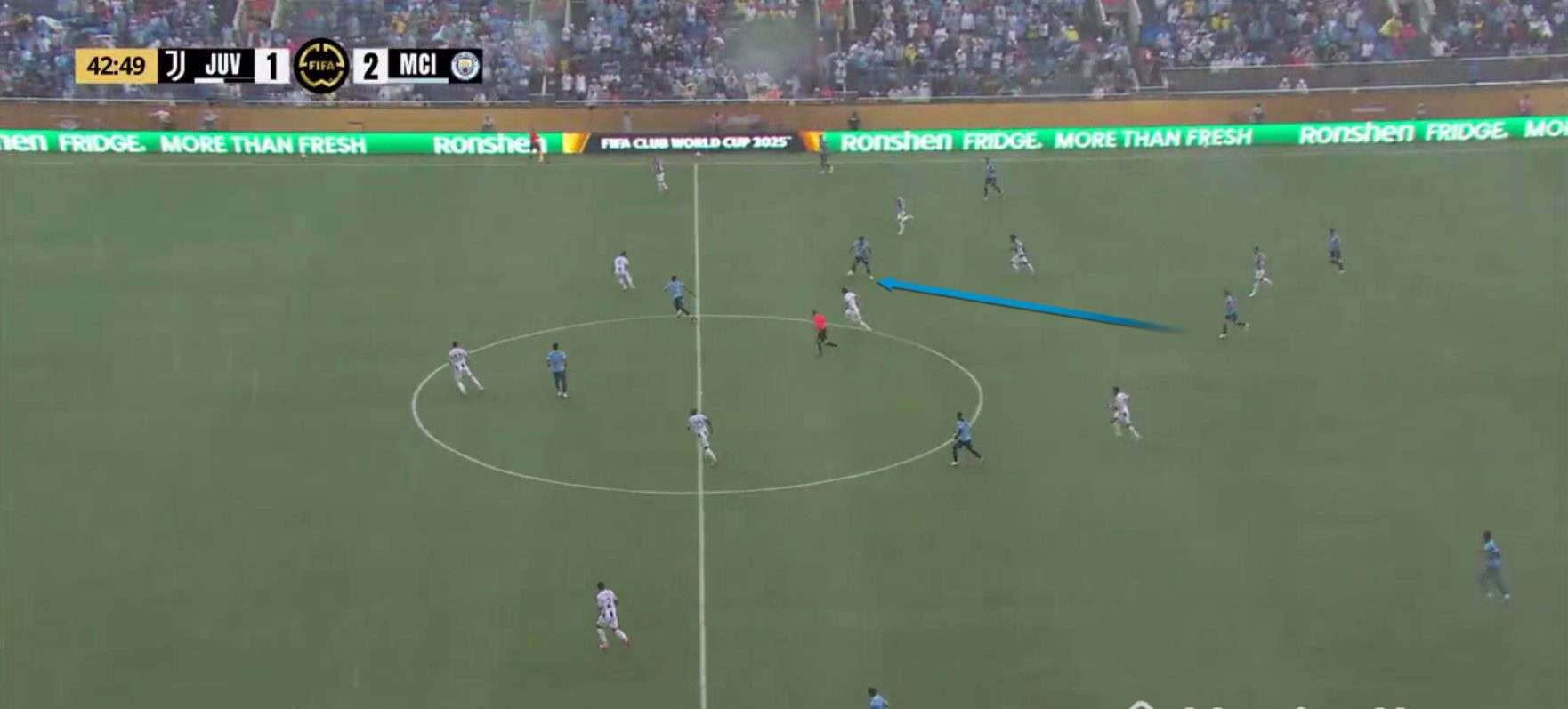 Reijnders is now unmarked and available to receive Silva’s pass.
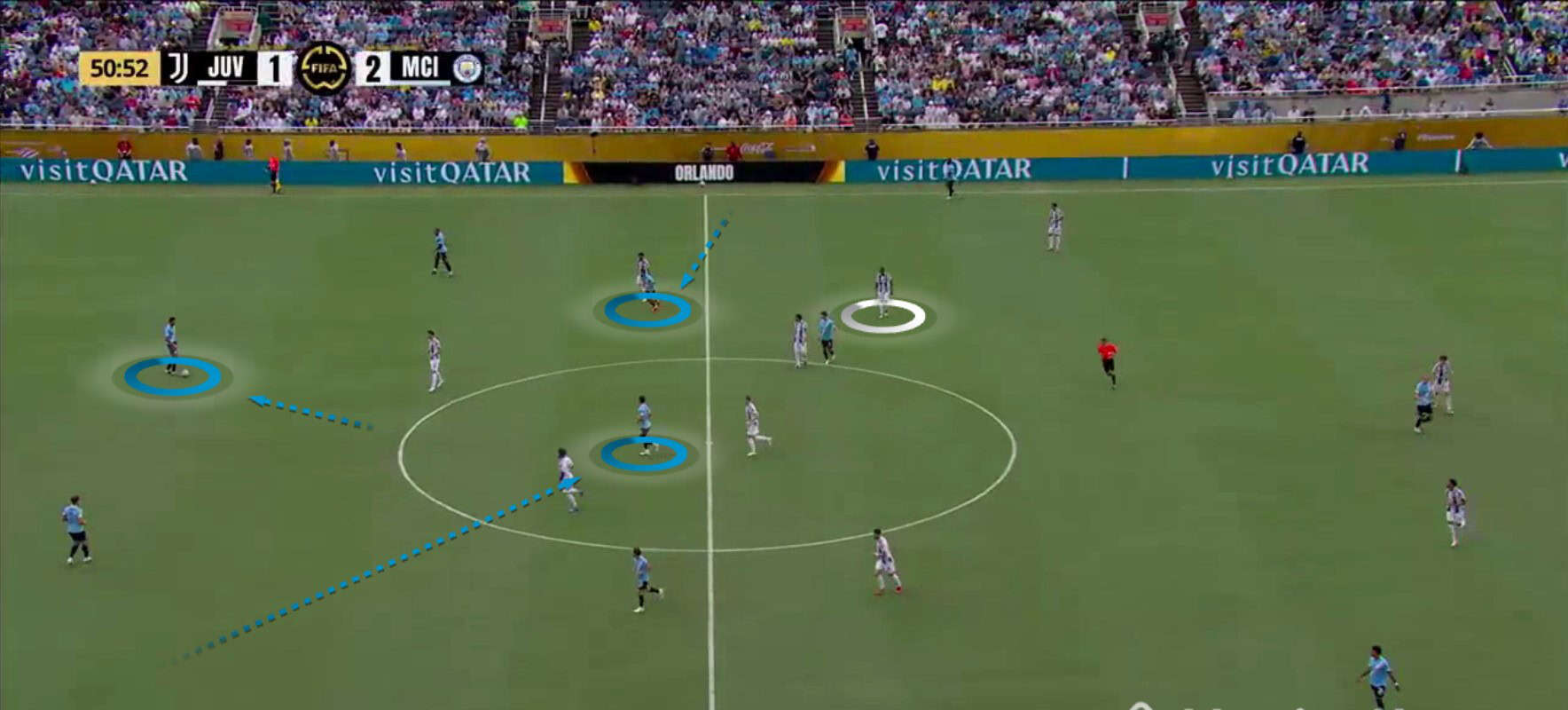 At half-time, Pep Guardiola’s side introduced adjustments to counter Juventus’ man-marking scheme.
Rodri now positions himself between Dias and Akanji.
A key change is the central positioning of full-backs Nunes and Aït-Nouri, with Reijnders positioned deeper behind them.
Meanwhile, Savinho and Doku remain wide.
As a result, Pierre Kalulu steps up to prevent Aït-Nouri from receiving the ball unmarked.
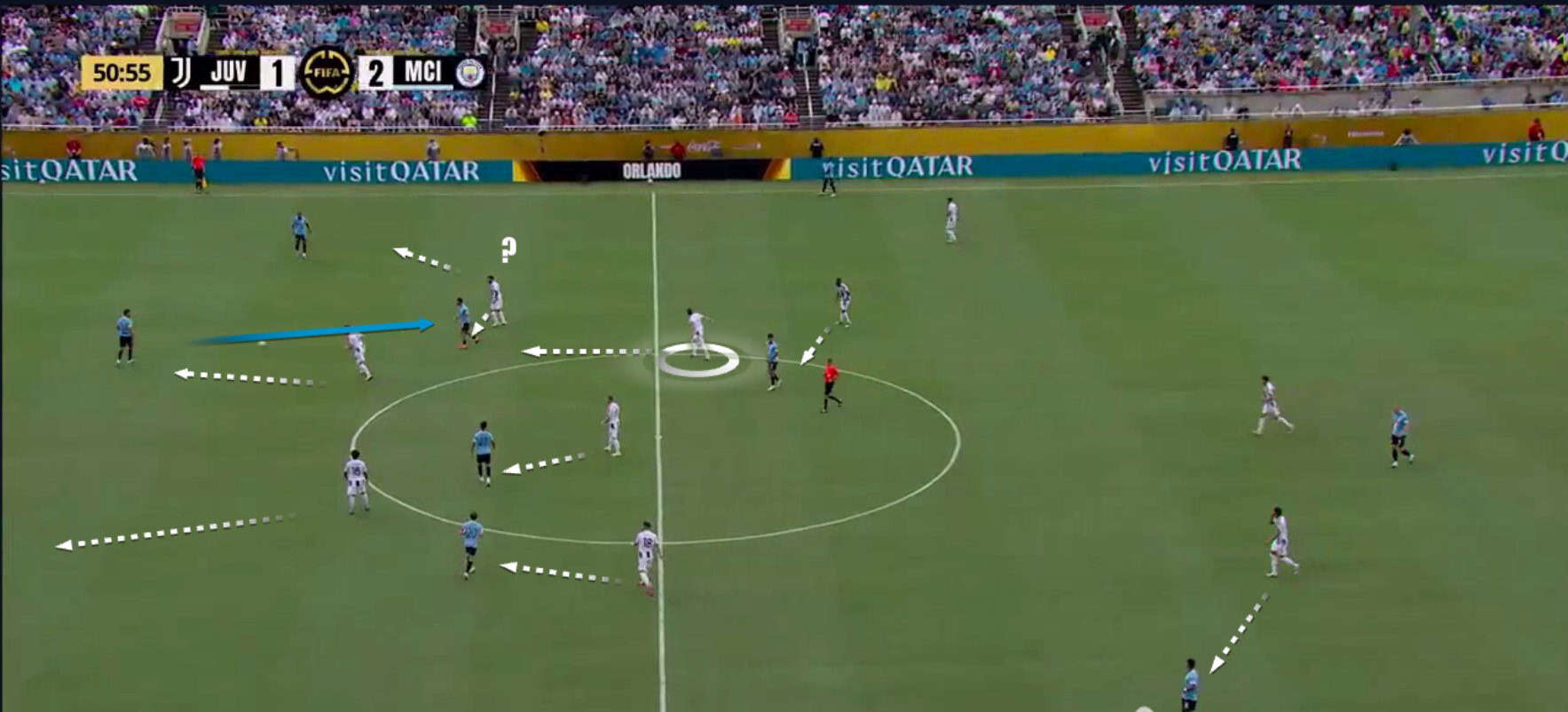 Juventus maintain man-marking: Vlahović on Rodri, McKennie on Dias, Koopmeiners on Nunes, and Kostić shifts to Silva, forcing him too central and leaving Savinho for Lewis Kelly.
The issue for Juventus arises with Kalulu, who cannot follow Aït-Nouri that deep, and if Nicolás González (right-winger) drops to mark Nouri, it frees Akanji.
To solve this, Locatelli signals for Kalulu to take Reijnders, allowing Locatelli to step up and mark Nouri, freeing González to focus solely on Akanji. Is everything now aligned?
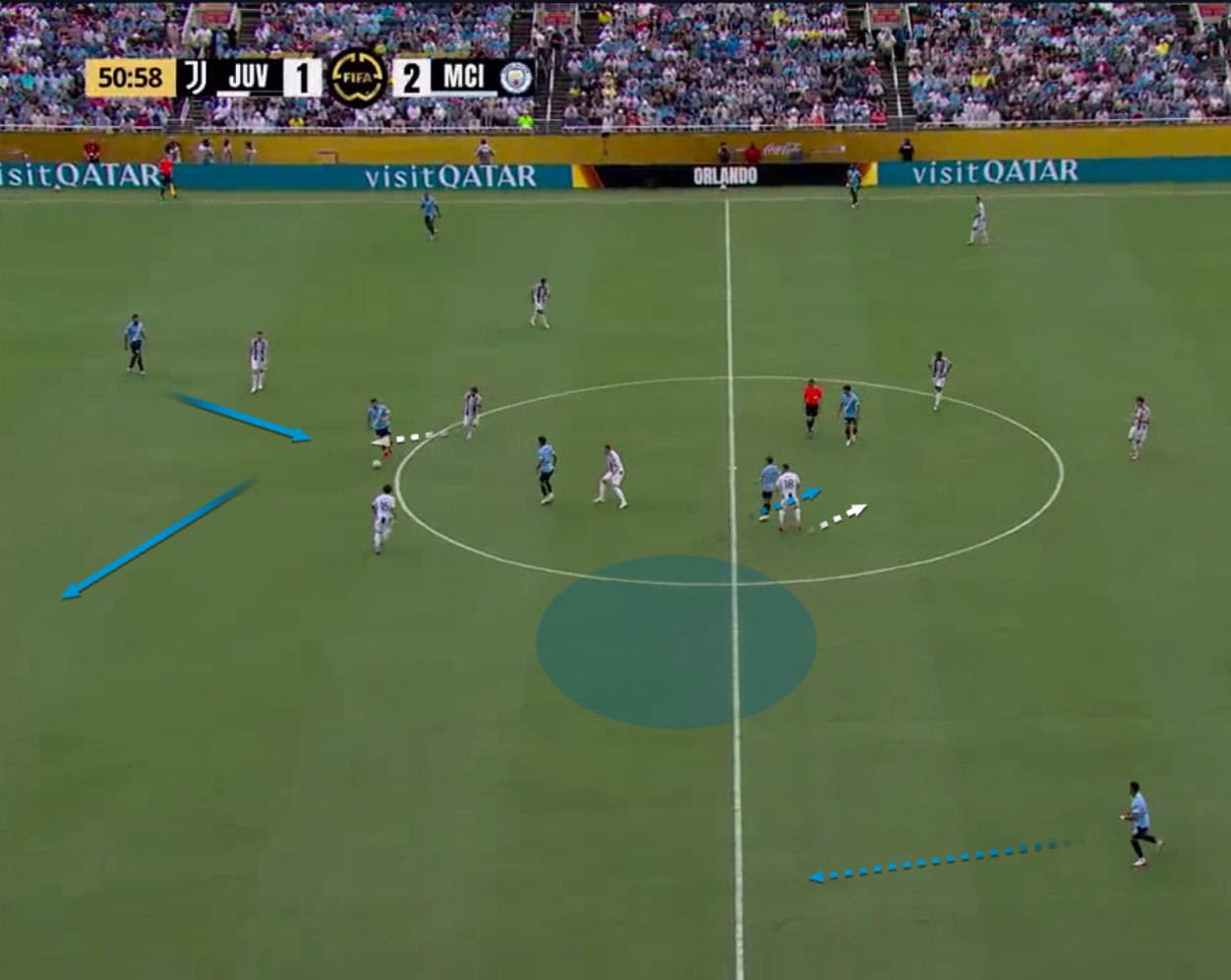 Juventus fall into Pep Guardiola’s trap.
Aït-Nouri carries the ball horizontally, pulling Locatelli with him before passing to Dias.
Simultaneously, Silva drags his marker centrally, vacating the wide area, not only for Savinho to drop into and receive.
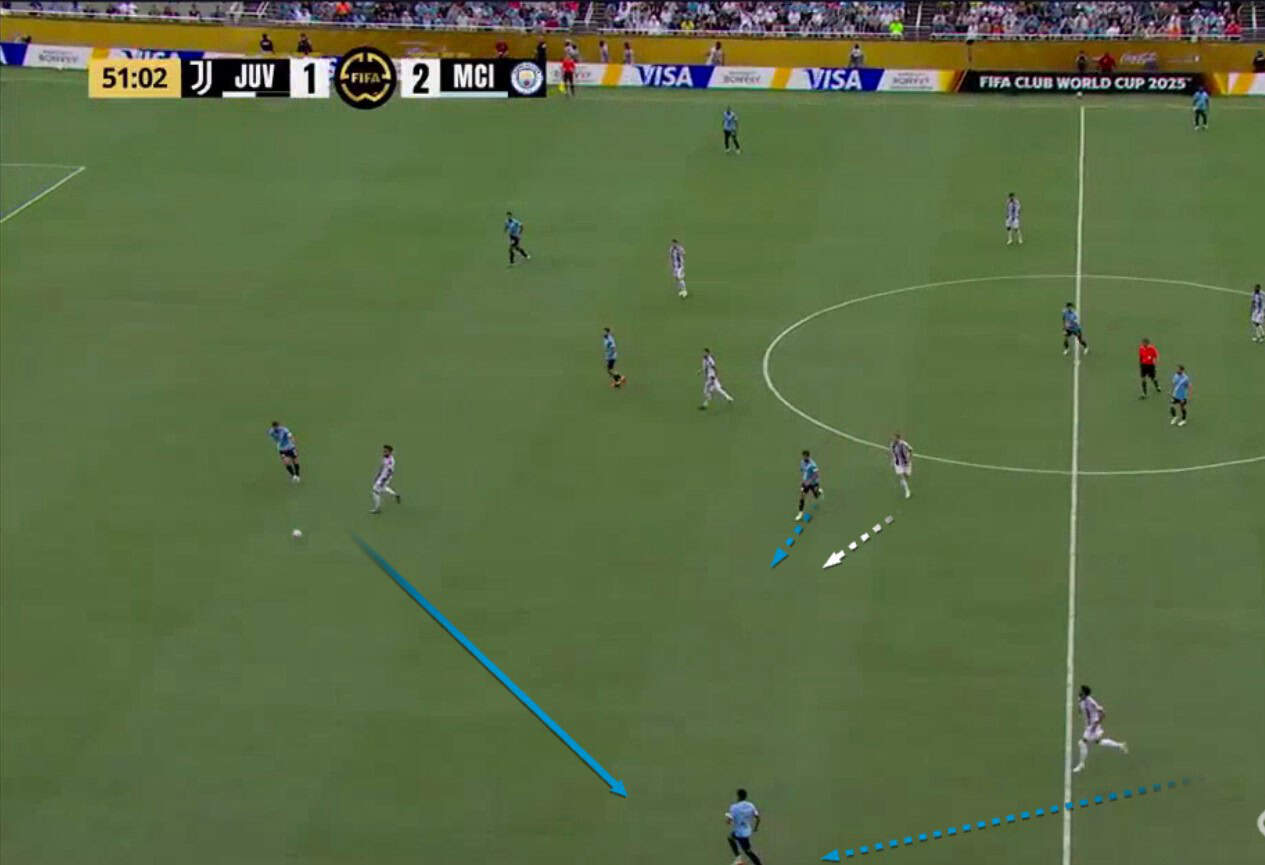 But also for Nunes to run into it, pulling his marker and adding to Juventus’ defensive disruption.
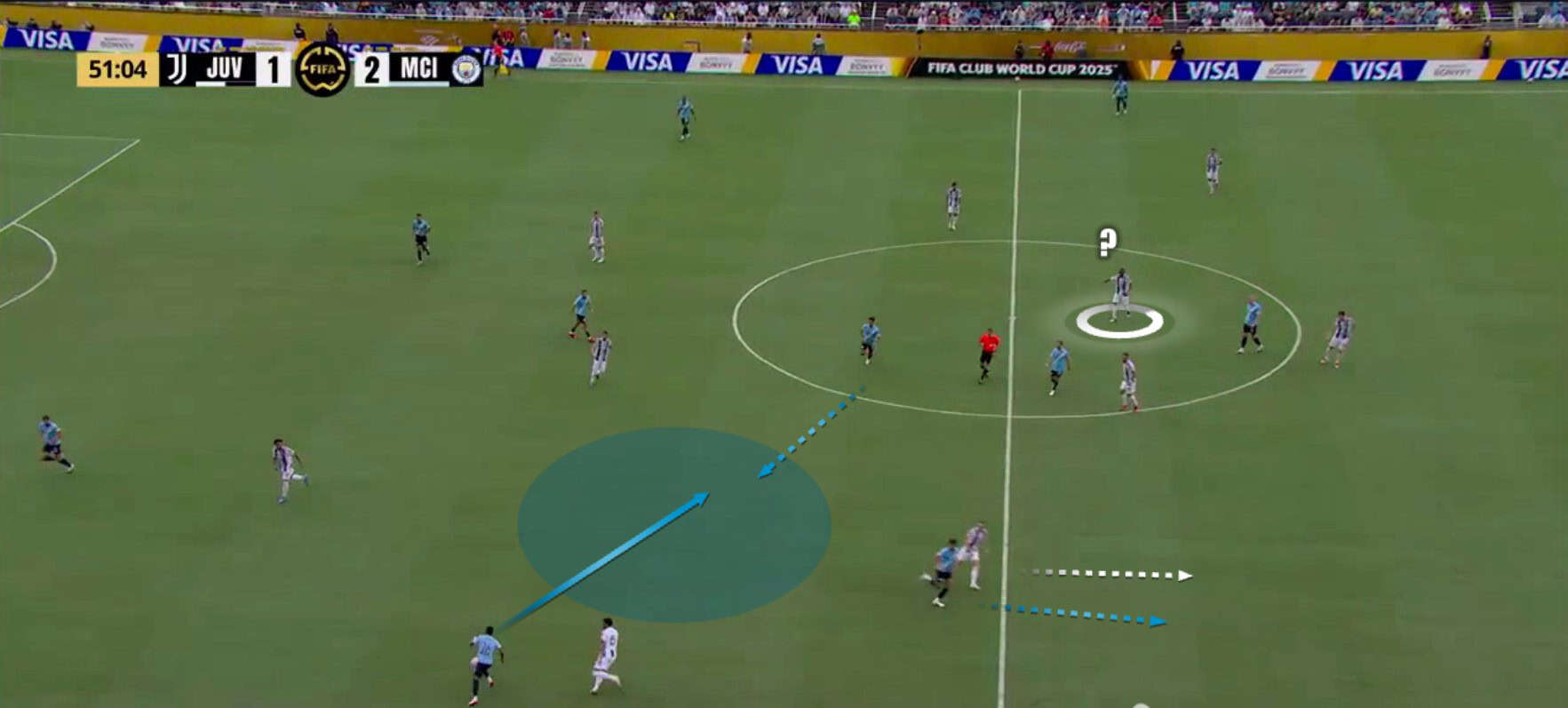 Nunes’ forward run opens up a large pocket of space for Rejinders, who arrives from the far side.
This puts Kalulu in a difficult position—forced to decide whether to follow Rejinders and risk vacating his zone or not.
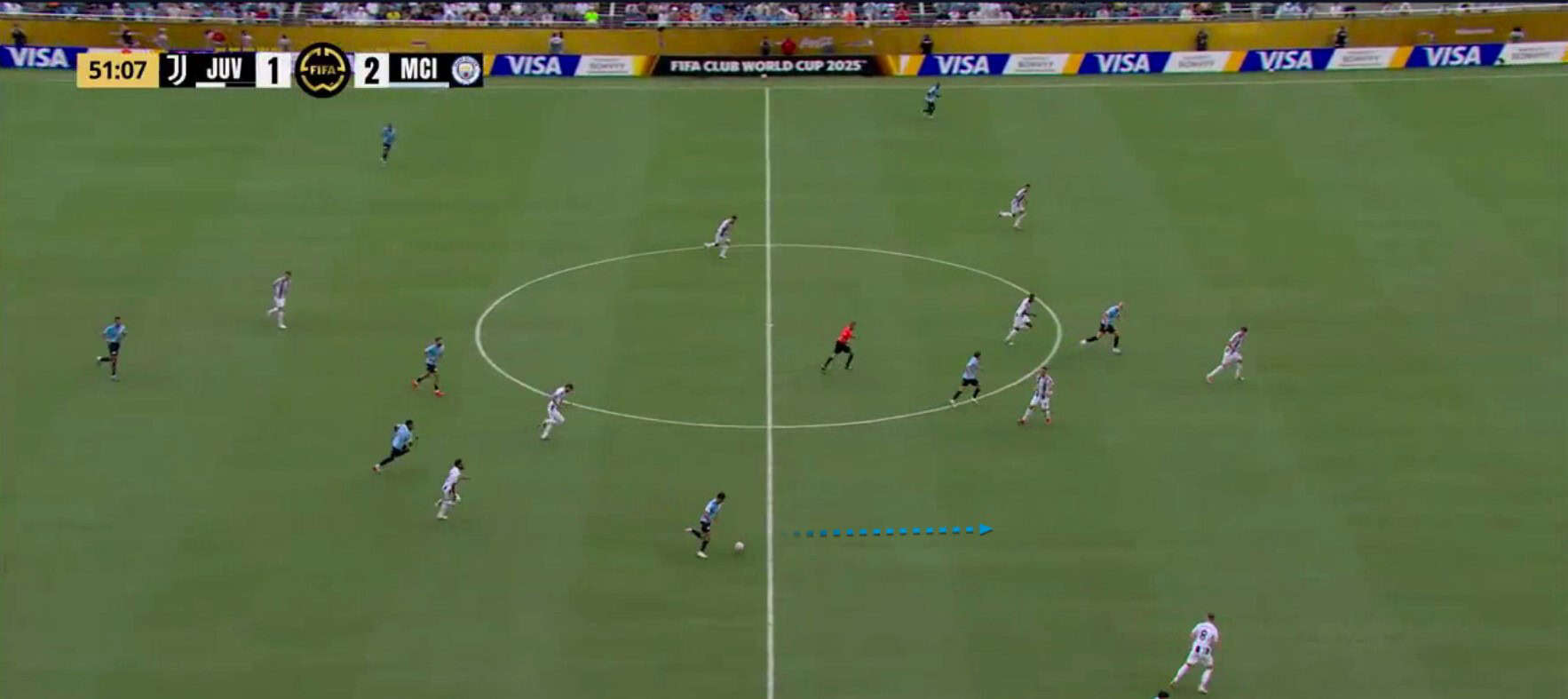 Kalulu holds his position, letting Rejinders drive forward into open space.
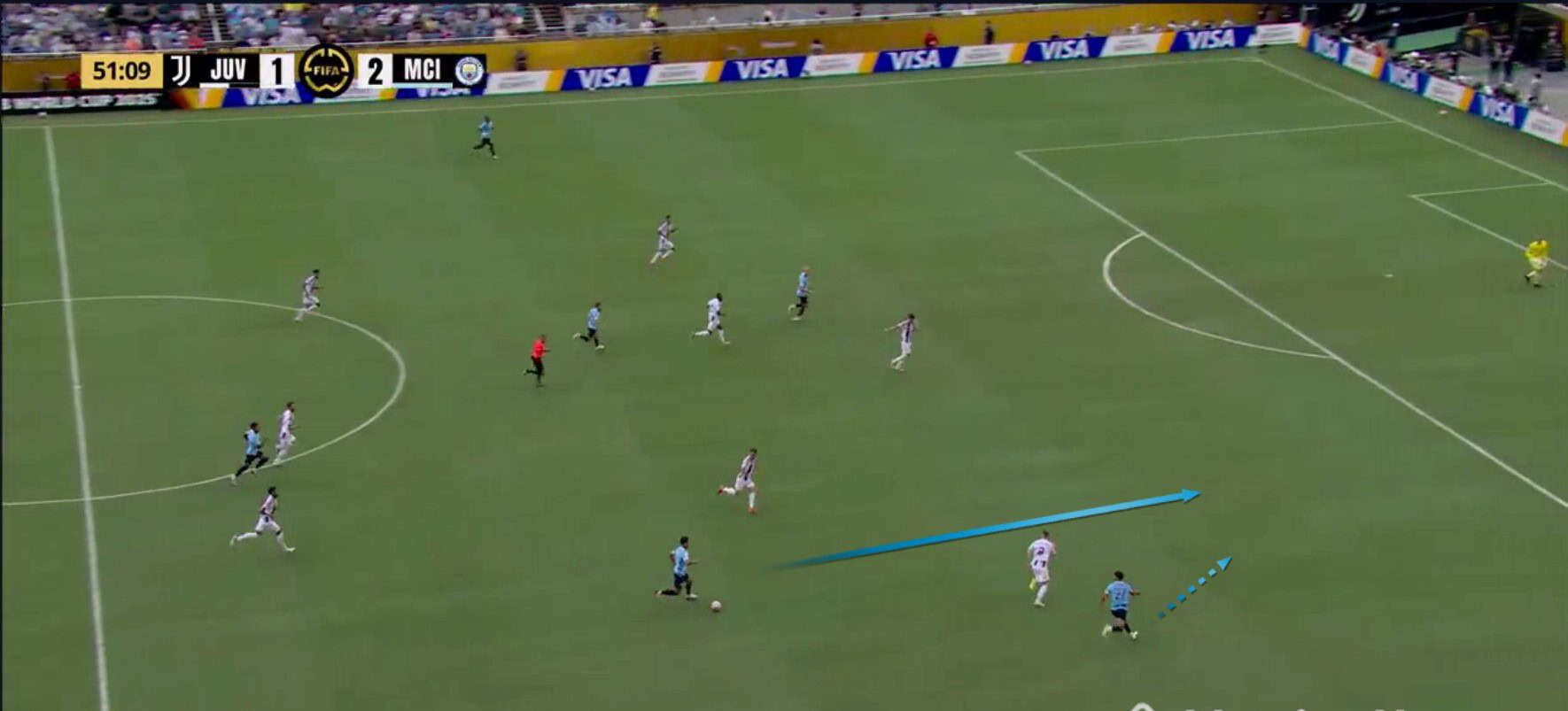 Rejinders then plays a pass in behind the defence to find Nunes’ run.
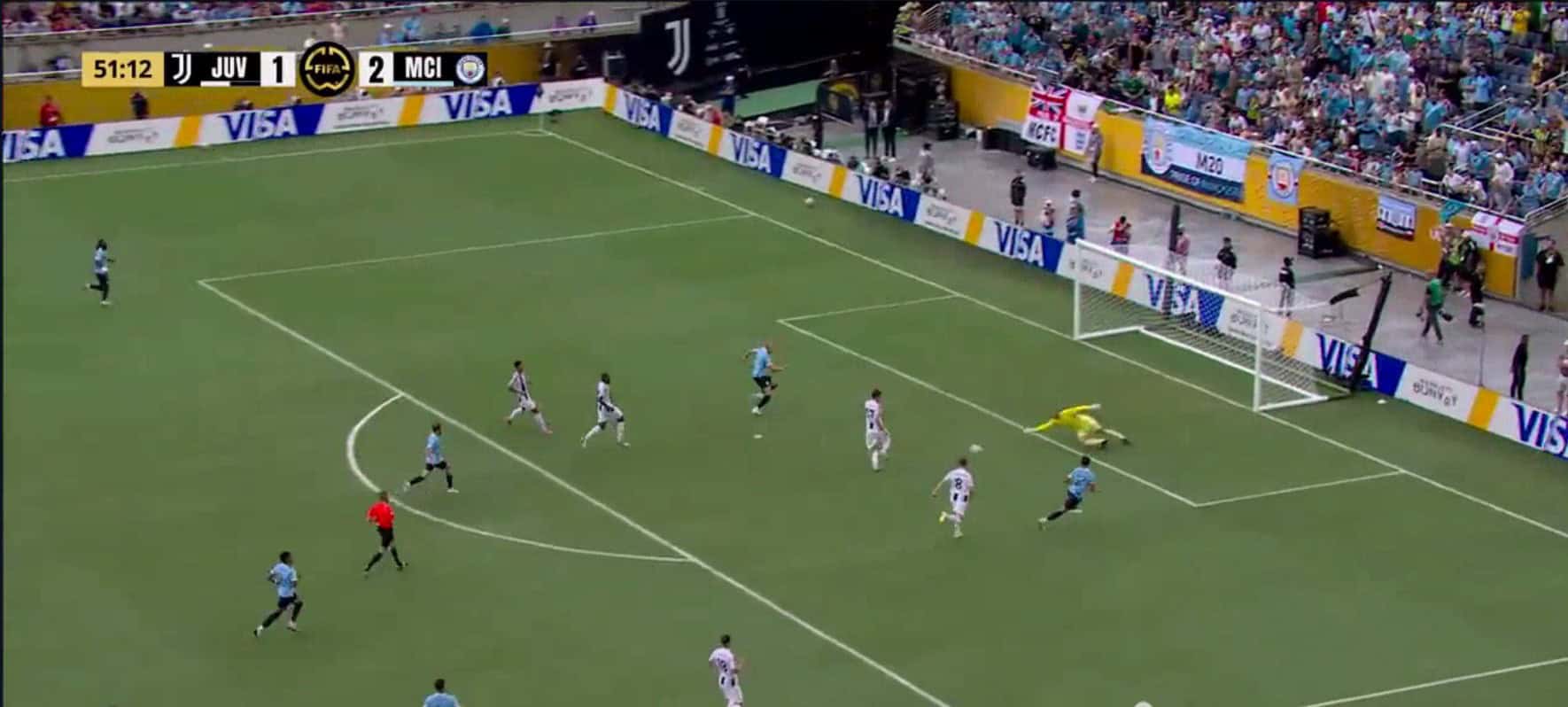 The sequence ends with Man City’s third goal.
Manchester City Progression Tactics Vs Al-Hilal
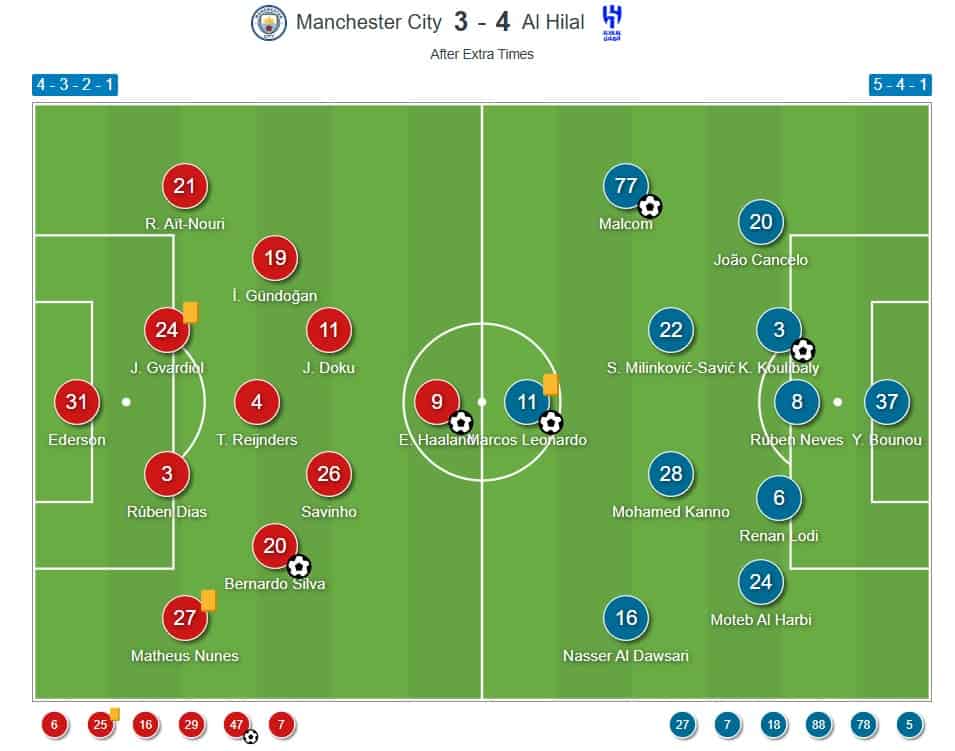
Al Hilal start with goalkeeper Yassine Bounou.
Their defenders are João Cancelo (right wing‑back), Kalidou Koulibaly (right centre-back), Rúben Neves (central centre-back), Renan Lodi (left centre-back), Moteb Al-Harbi (left wing‑back).
In midfield, they lined up Sergej Milinković-Savić (right central midfielder), Mohamed Kanno (left central midfielder), Nasser Al-Dawsari (left winger), and Malcom (right winger).
Marcos Leonardo lined up as the centre-forward.
In this match against Al Hilal, Manchester City made several adjustments to their starting XI.
Joško Gvardiol replaced Manuel Akanji as the left centre-back.
İlkay Gündoğan was introduced as the left eight, with Tijjani Reijnders dropping deeper to operate as the six in place of Rodri.
Additionally, Erling Haaland started as the centre-forward.
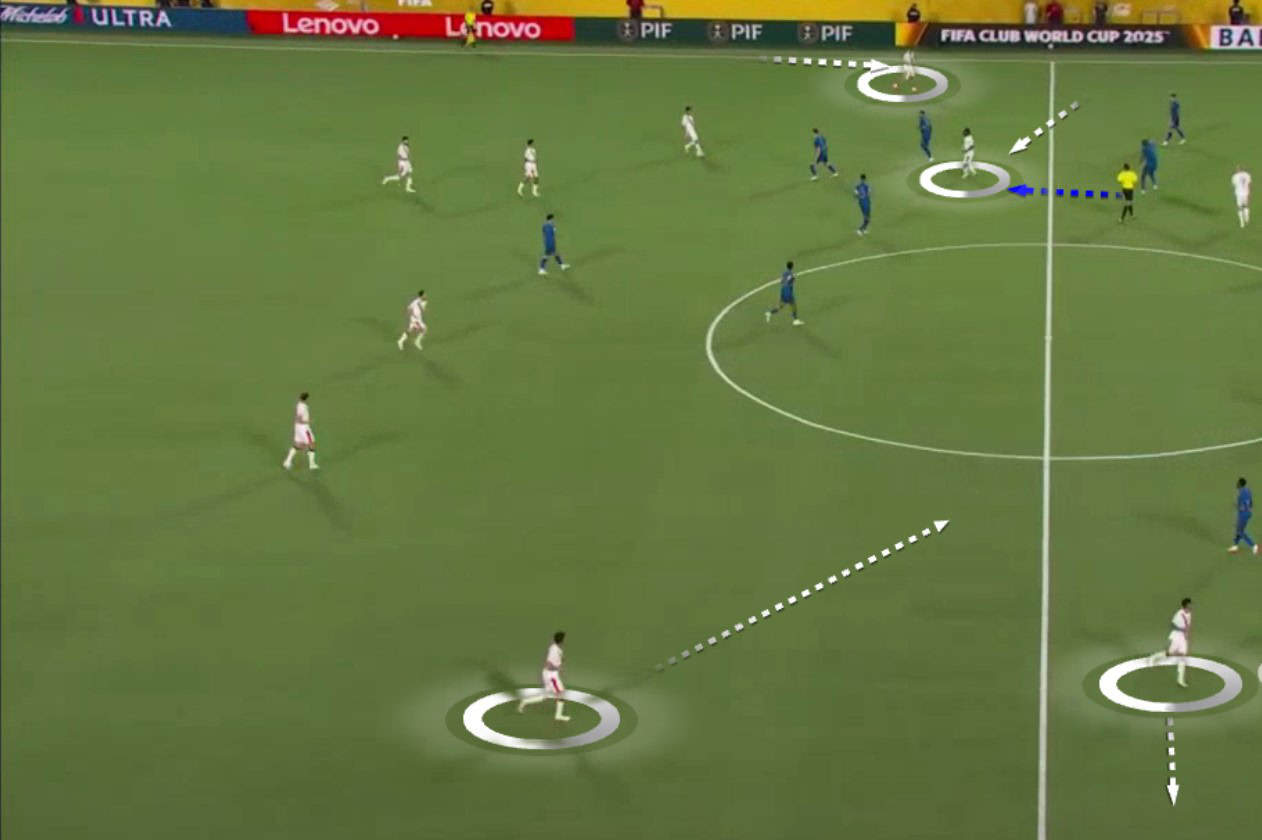 Man City rarely reached this phase in their match against Al Hilal, though they did attempt one clear tactical idea.
Gündoğan dropped deep to receive, on the far side, Savinho held the width while the right full-back, Nunes, moved inside towards the central channel.
Meanwhile, left-back Aït-Nouri hugged the touchline on the near side, and Doku tucked into the half-space before dropping off, forcing Koulibaly to follow him.
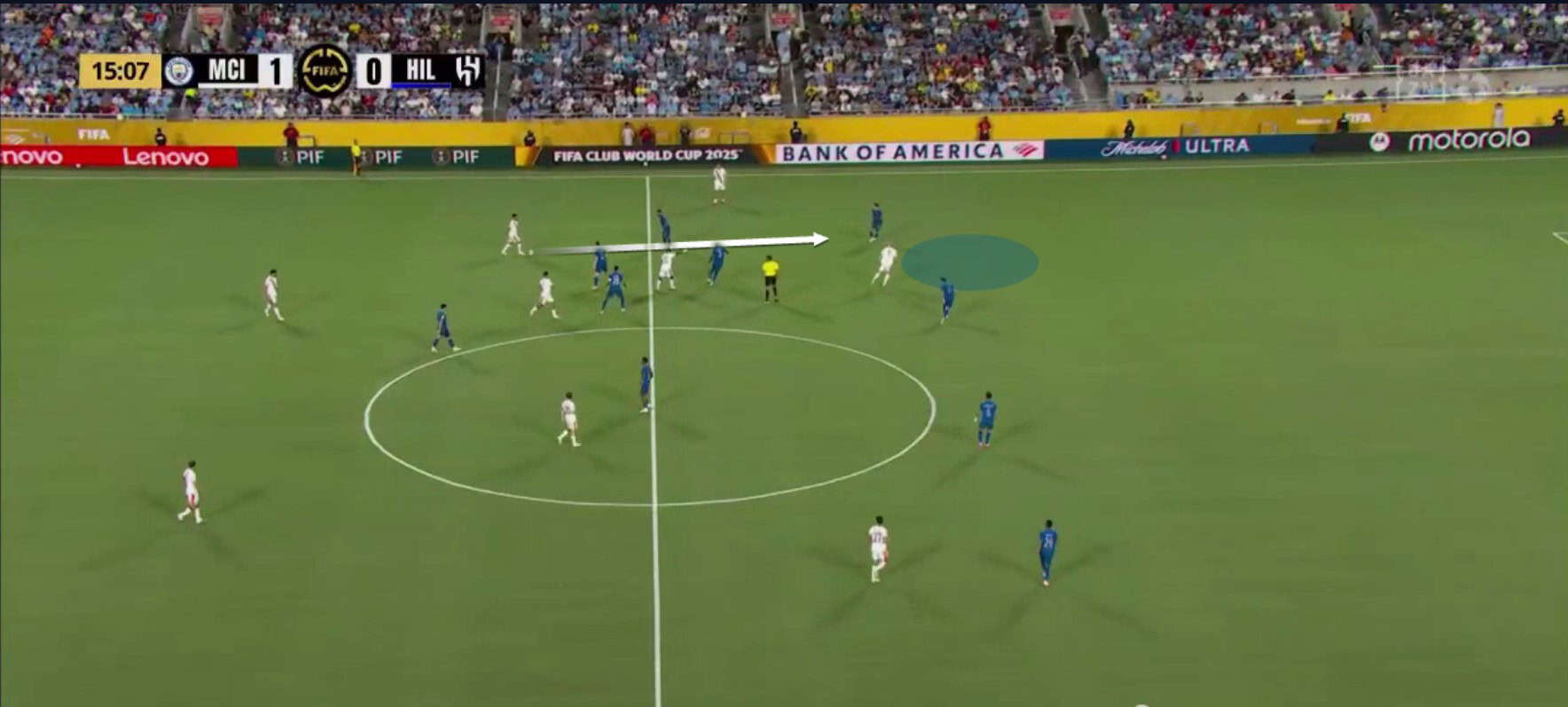 Koulibaly’s movement to track Doku opened up space behind for Haaland.
However, Gündoğan chose not to play the through ball on this occasion.
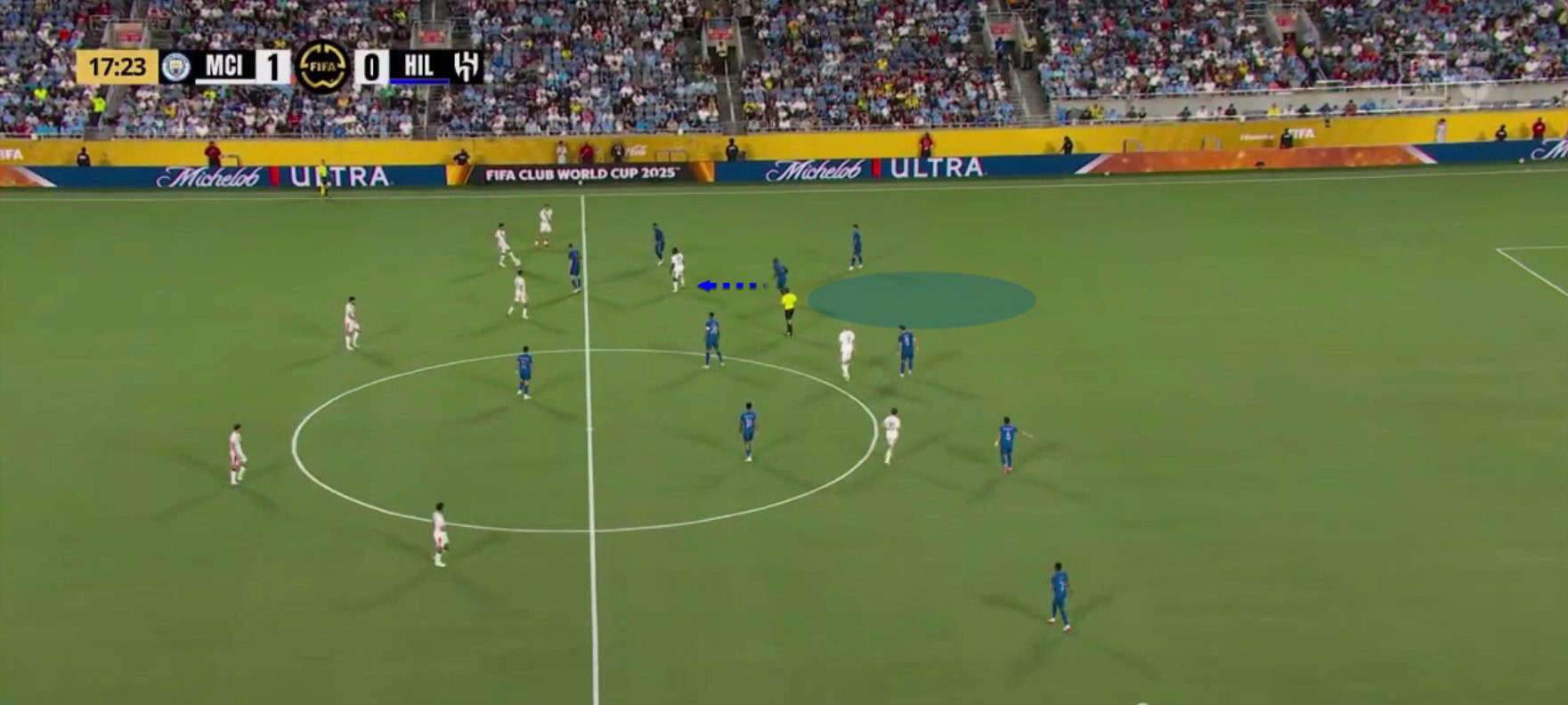 Using the same structure, Doku once again dropped into the half-space to drag Koulibaly out of position, creating space for Haaland to exploit with a forward run.
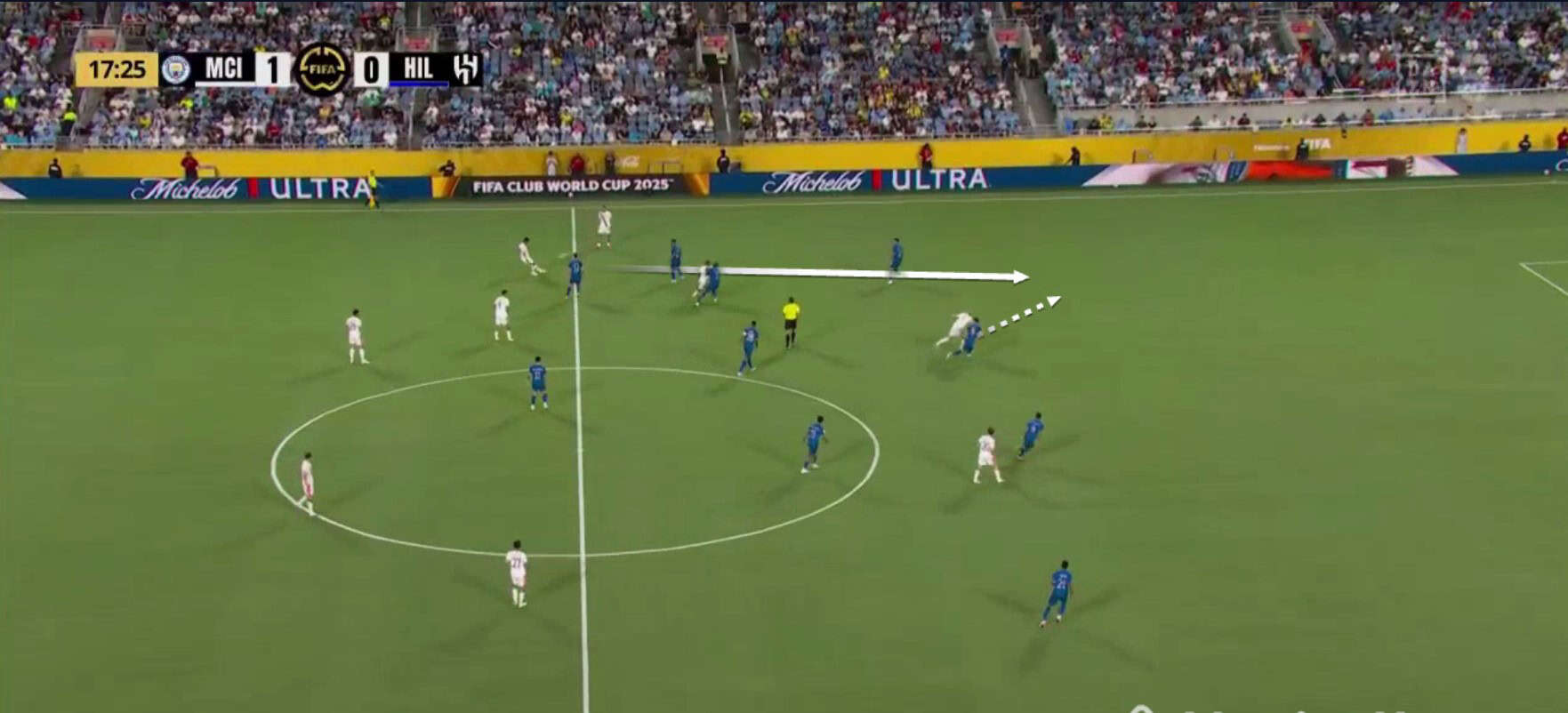
This time, Gündoğan spotted the opportunity and played the pass into Haaland’s run.
Conclusion
A key strength of Pep Guardiola’s side lies in their ability to create space, execute intelligent rotations, and evade pressing lines.
Utilising individuals like Bernardo Silva, Rodri, and Tijjani Reijnders plays a central role in maintaining this dynamic.
In addition, the use of the full-backs contributes significantly to this process.
Yet to arrive in the final third with greater stability—rather than being forced into lateral or backwards passes that invite further pressure—Man City must sharpen their execution and ensure more clinical progressions through the middle third.
