
For Cardiff City, the 2025/2026 campaign will begin not with fanfare but with the sobering reality of EFL League One football.
The Bluebirds, who finished 24th in the EFL Championship and conceded the second most goals in the league (73), face a summer of soul-searching and renewal.
The departures of key figures, such as Aaron Ramsey to Pumas UNAM and Dimitrios Goutas to Gençlerbirliği, further highlighted the scale of the challenge ahead.
Yet, with adversity comes opportunity, a chance to reshape the club’s identity and future.
The Cardiff board’s selection of Brian Barry-Murphy as the new manager is more than a pragmatic appointment; it signals a philosophical shift towards long-term development, tactical modernity, and a renewed commitment to an attractive, progressive brand of football.
This tactical analysis will examine Brian Barry-Murphy style of play and coaching philosophy, along with his journey as a coach and what CCFC supporters can expect from their new manager.
Who Is Brian Barry-Murphy?
Brian Barry-Murphy’s approach to coaching has always been shaped by his experiences as a player and his early managerial years at Rochdale.
Raised in Cork and having grown professionally within the EFL pyramid, he developed a deep appreciation for the demands, nuances, and frequent brutalities of the EFL.
These experiences did not make him a conservative manager.
Instead, Barry-Murphy emerged as a rare proponent of idealistic football in the lower leagues.
He is a manager who, even when faced with adversity, remained committed to an expansive, possession-based game.
His time at Rochdale is a case study in the tension between footballing ideals and resource constraints.
Upon taking over in 2019, Barry-Murphy inherited a side fighting for survival but eventually were relegated in 2021.

Rather than resorting to direct, pragmatic football, Rochdale AFC under his guidance sought to play out from the back, control possession, and build attacks thoughtfully.
In a league game against Blackpool during the 2019/2020 season, Barry-Murphy’s ideals are shown through short passing combinations and ball recycling.
Rochdale dominate possession in the right half-space, patiently moving the ball and showing no hesitation in playing backwards to retain control.
This manipulates the opposition’s defensive shape, dragging players out of key areas.
By exploiting this disorganisation, Brian Barry-Murphy’s side creates a dangerous situation near the goal and wins a free kick.
He typically structured his team in a 4-3-3 or 4-2-3-1 formation, but displayed flexibility, occasionally switching to a 3-5-2 to provide defensive cover or create numerical superiority in midfield.
Youngsters were trusted in key positions, showing his commitment to development and willingness to accept short-term risk for long-term gain.
A big part of his Rochdale team was the insistence on structured build-up.
The goalkeeper and centre-backs were responsible for circulating possession to draw out the opposition and create space further forward.
Central midfielders participated actively in build-up—one usually dropped deep to receive, while others sought to connect vertical lines and offer progressive passing options.
Full-backs were encouraged to advance, providing both width and opportunities to underlap or overlap, depending on the movement of inside forwards.
This approach is progressive but carries risks, such as loose touches, especially under the aggressive pressing of League One opponents.
However, this has not made him change his ideals.
Instead, Barry-Murphy doubled down on his principles, teaching his players to deal with adversity and solve problems on the pitch.
Manchester City EDS
Brian Barry-Murphy’s move to Manchester City’s Elite Development Squad in 2021 has supplemented his managerial education.
If Rochdale was a crucible of adversity and idealism, City’s EDS was a laboratory of great tactical and technical detail.
He operated in an environment designed to mirror the first team under Pep Guardiola, with an abundance of talent and an expectation to produce players capable of transitioning to senior football.
Within this context, Barry-Murphy embraced and refined the principles of positional play, which have come to define the modern Manchester City model.
The pitch was divided into vertical and horizontal zones, with players drilled to maintain optimal spacing, create triangles and diamonds for passing, and avoid occupying the same vertical or horizontal lines.
Rotations among full-backs, midfielders, and wingers became second nature, as did establishing overloads in key areas.
As the ball progressed into midfield and the final third, Brian Barry-Murphy’s teams adopted a five-lane attacking structure.
Wingers retained width, stretching the opposition horizontally.
Advanced midfielders (8s) and the striker occupied central and half-space channels, while full-backs provided either overlapping width or underlapping support, depending on the scenario.
Attacks end with low cutbacks, with late-arriving midfielders exploiting the resulting chaos.
Defensively, Brian Barry-Murphy’s EDS teams pressed high and with purpose.
Pressing triggers included opposition full-backs receiving the ball facing their own goal, backwards passes, or heavy touches under pressure.
The team’s compactness and rest defence (two players, often the pivot and a centre-back, stayed behind the ball during attacks) helped guard against transitions.
When possession is lost, a coordinated counterpress is aimed at recovering the ball as soon as possible by using zonal traps and the touchline as an extra defender.
Player Development
Equally important was Barry-Murphy’s approach to player development.
He understands the demands of youth players and gives them the right amount of tactical responsibilities to digest.
They were trained to be press-resistant, two-footed, and capable of combining quickly in tight spaces.
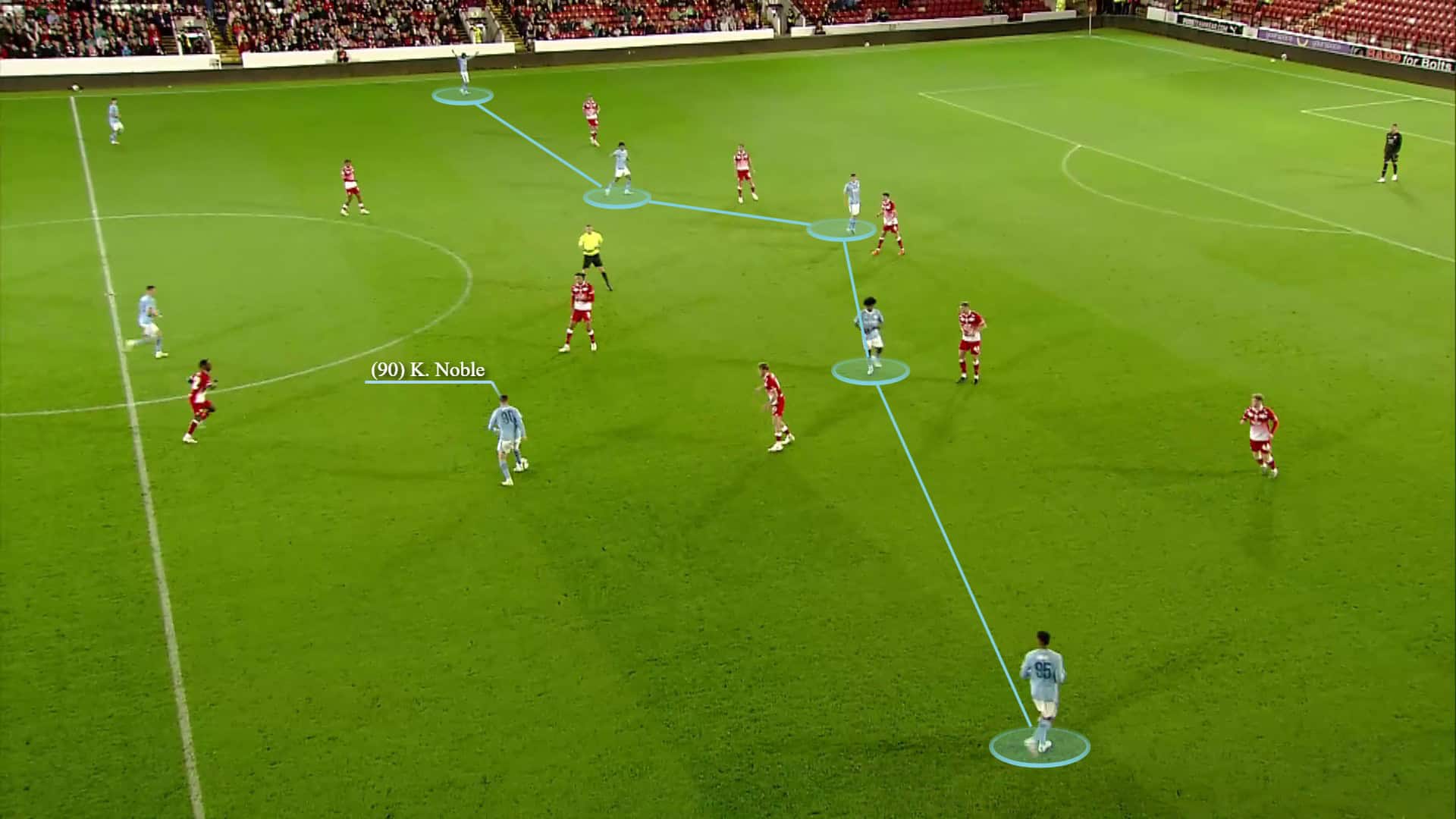
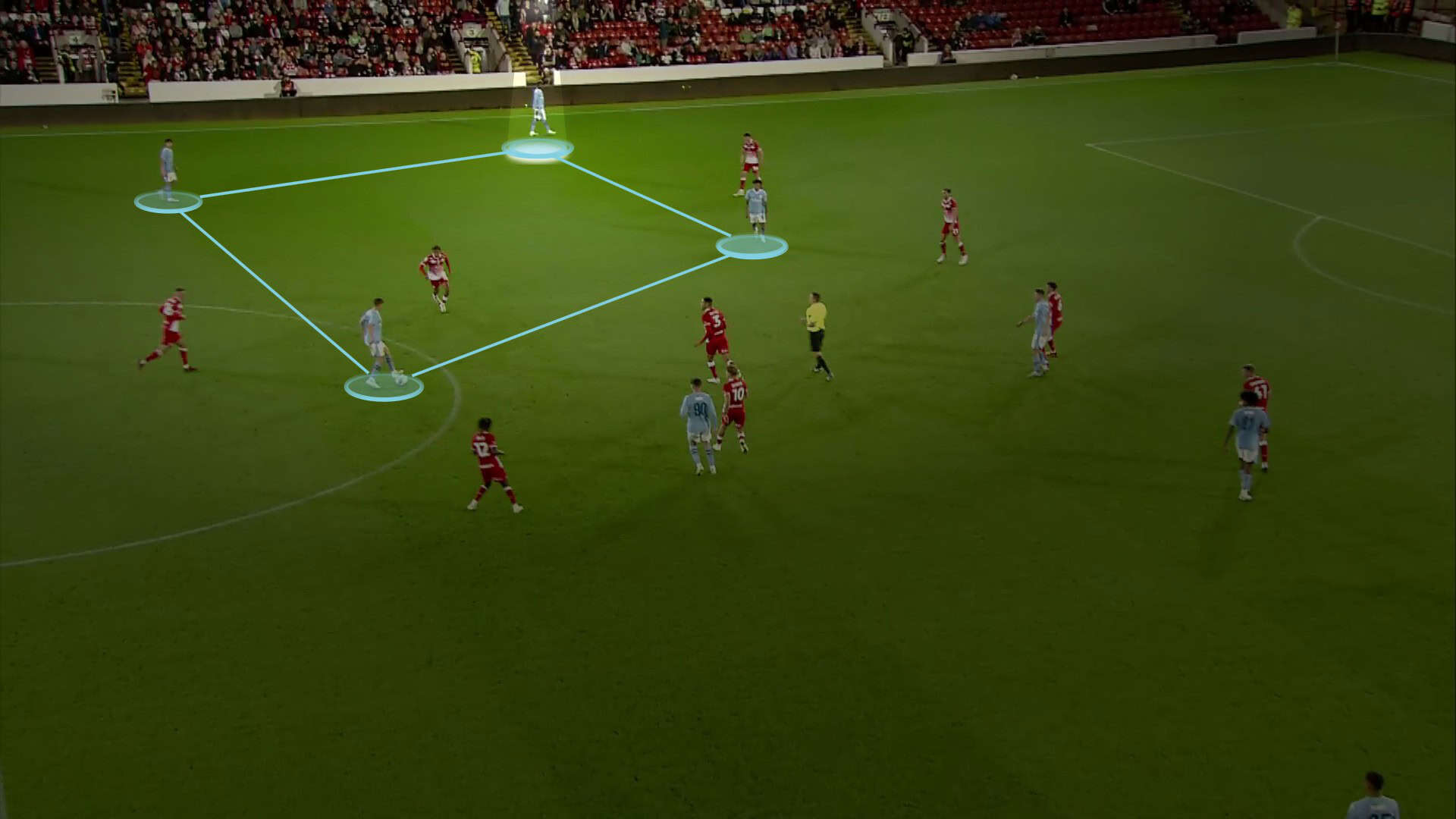



 Players like Oscar Bobb and Rico Lewis flourished, developing tactical versatility and preparing themselves to make appearances in the first team.
Bobb’s progression and change in playing style, in particular, have been excellent.
He arrived as a dribbler and individualist and became a multi-functional attacker capable of acting as a classic winger, inverted playmaker, or as a false nine, all while improving his off-the-ball movement, pressing, and decision-making.
As demonstrated in a pre-season senior fixture against Barcelona in 2024, James McAtee is in possession of the ball.
Oscar Bobb makes a run between the two centre-backs, positioning himself in a dangerous area.
Younger players often prefer receiving the ball to feet, seeking touches to stay involved in play.
However, Bobb showed maturity by recognising the available space and exploiting it, putting himself in a dangerous position to impact the game.
The Next Step: Brian Barry-Murphy At Cardiff City 2025/2026
With this background, what can Cardiff City supporters expect from Brian Barry-Murphy?
The answer is both exciting and daunting: a radical transformation of the club’s playing style and identity.
Brian Barry-Murphy is not a manager who will settle for survival or short-term fixes.
He will seek to implement a system rooted in possession dominance and coordinated aggression, both with and without the ball.
Cardiff’s build-up play is likely to be unrecognisable from previous seasons.
The goalkeeper and defenders will be tasked with playing out from the back.
Centre-backs will split wide, and full-backs may invert into midfield, forming a 2-3 shape in the first phase of possession.
The No. 6 will lead play, as both a deep-lying playmaker and the first line of defence against counters.
Expect wingers to maintain width, but also to drift into half-spaces when the situation demands.
The striker will be required to link play, press aggressively, and make intelligent runs into space.
Depending on the opposition, full-backs may overlap to provide width or underlap to create central overloads.
Defensively, Cardiff will press higher and more coordinated than in recent memory.
The team will use triggers in order to press as a unit, aiming to win the ball back quickly.
Most importantly, this change will not be limited to the starting XI, as Brian Barry-Murphy’s experience with youth means academy players will be given a chance.
Conclusion
Cardiff will become a team that seeks to control games through possession and pressing, rather than reacting to opponents.
The development of young players can lead to on-field success and increased financial value.
The football itself will be modern and attractive.
However, the change will not be without challenges.
EFL League One is a division where direct, physical football is the dominant style, and Brian Barry-Murphy’s ideals will be tested by opponents willing to disrupt build-up and exploit errors on the break.
There will also be an inevitable adjustment period, during which results may fluctuate as players internalise new patterns and responsibilities.
Squad building will be important.
Recruitment must focus on defenders who are comfortable under pressure, midfielders capable of dictating the tempo and pressing, and mobile attackers who can link play and defend from the front.
For Cardiff City, the arrival of Brian Barry-Murphy is both a risk and an opportunity.
Possession-based heavy sides have been increasing in League One in the last few years, and this seems to be an appointment to move with the times.
This will require patience from supporters, trust from the board, and a willingness from players to embrace new responsibilities and ideas.
As the Bluebirds prepare for life in League One, they do so with a manager who sees adversity not as an excuse for compromise, but as a platform for ambition.
