
Total Football Analysis
Once.Sport
  • Football Analysis
    • Data Analysis
    • Formations
      • 2-2-4 Formation
      • 2-3-5 Formation
      • 3-1-4-2 Formation
      • 3-2-2-3 Formation
      • 3-2-4-1 Formation
      • 3-1-6 Formation
      • 3-3-4 Formation
      • 3-4-1-2 Formation
      • 3-4-2-1 Formation
      • 3-4-3 Formation
      • 3-5-1-1 Formation
      • 3-5-2 Formation
      • 4-1-4-1 Formation
      • 4-2-2-2 Formation
      • 4-2-3-1 Formation
      • 4-2-4 Formation
      • 4-3-1-2 Formation
      • 4-3-3 Formation
      • 4-4-2 Formation
      • 4-5-1 Formation
      • 5-3-2 Formation
      • 5-4-1 Formation
      • 6-3-1 Formation
    • Head Coach Analysis
    • Match Analysis
    • Player Analysis
    • Recruitment Analysis
    • Set Piece Analysis
    • Tactical Theory
    • Tactical Preview
    • Team Analysis
    • Training Analysis
    • Tactical Analysis
    • Scouting Report
  • Competition
    • ALL Competitions
    • English Premier League
    • Champions League
    • La Liga
    • Bundesliga
    • Serie A
    • Ligue 1
    • Eredivisie
    • EFL Championship
    • FIFA World Cup 2022
    • WEURO 2022
    • Women’s Super League
    • NWSL
    • Belgian First Division A
    • A-League
    • Liga Profesional de Argentina
    • Austrian Bundesliga
    • Campeonato Brasileiro Série A
    • DFB Pokal
    • 1. HNL
    • Danish Superliga
    • EFL League One
    • EFL League Two
    • FA Cup
    • EFL Cup
    • Indian Super League
    • K-League
    • J1 League
    • Liga MX
    • Copa América 2021
    • Copa del Rey
    • MLS
    • Eliteserien
    • Euro 2020
    • Primeira Liga
    • Scottish Premiership
    • Allsvenskan
    • Europa League
    • UEFA Nations League
    • Liga AUF Uruguaya
  • Coaches
    • All Coaches
    • Alfred Schreuder
    • Ange Postecoglou
    • Antonio Conte
    • Arne Slot
    • Bo Svensson
    • Brendan Rodgers
    • Bruno Lage
    • Carlo Ancelotti
    • Christophe Galtier
    • Claude Puel
    • Claudio Ranieri
    • David Moyes
    • Dean Smith
    • Diego Simeone
    • Domenico Tedesco
    • Frank Lampard
    • Eddie Howe
    • Edin Terzić
    • Emma Hayes
    • Erik ten Hag
    • Ernesto Valverde
    • Gennaro Gattuso
    • Gerardo Seoane
    • Gian Piero Gasperini
    • Giovanni van Bronckhorst
    • Graham Potter
    • Igor Tudor
    • Imanol Alguacil
    • Jesse Marsch
    • Jonas Eidevall
    • Jorge Sampaoli
    • José Bordalás
    • José Mourinho
    • Julen Lopetegui
    • Julian Nagelsmann
    • Julien Stéphan
    • Jürgen Klopp
    • Luciano Spalletti
    • Lucien Favre
    • Manuel Pellegrini
    • Marcelo Bielsa
    • Marco Rose
    • Marco Silva
    • Massimiliano Allegri
    • Mauricio Pochettino
    • Maurizio Sarri
    • Mikel Arteta
    • Niko Kovač
    • Nuno Espírito Santo
    • Oliver Glasner
    • Patrick Vieira
    • Paulo Fonseca
    • Pep Guardiola
    • Peter Bosz
    • Rafa Benítez
    • Ralf Rangnick
    • Ralph Hasenhüttl
    • Roger Schmidt
    • Roy Hodgson
    • Sean Dyche
    • Sérgio Conceição
    • Simone Inzaghi
    • Sonia Bompastor
    • Stefano Pioli
    • Steffen Baumgart
    • Steven Gerrard
    • Thiago Motta
    • Thomas Frank
    • Thomas Tuchel
    • Unai Emery
    • Vincenzo Italiano
    • Xavi
  • Teams
    • ALL Teams
    • AC Milan
    • Ajax Amsterdam
    • Arsenal
    • AS Monaco FC
    • Atalanta
    • Atlético Madrid
    • FC Barcelona
    • FC Bayern Munich
    • Borussia Dortmund
    • Celtic FC
    • Chelsea FC
    • Everton F.C.
    • Inter Milan
    • Juventus F.C.
    • Leeds United F.C.
    • Liverpool FC
    • Manchester City
    • Manchester United FC
    • Paris Saint-Germain
    • Rangers FC
    • RB Leipzig
    • Real Madrid CF
    • Tottenham Hotspur
    • West Ham United
  • Players
    • ALL Players
    • Alisson Becker
    • Bukayo Saka
    • Erling Haaland
    • Harry Kane
    • Jack Grealish
    • John Stones
    • Julián Alvarez
    • Kalvin Phillips
    • Kevin De Bruyne
    • Kyle Walker
    • Kylian Mbappé
    • Lamine Yamal
    • Lionel Messi
    • Luis Díaz
    • Mohamed Salah
    • Phil Foden
    • Virgil Van Dijk
  • Contact
  • Write For TFA
No Result
View All Result
No Result
View All Result
Total Football Analysis
No Result
View All Result
Home Analysis

Cardiff City 2023/24: Why the Bluebirds are soaring as the EFL Championship’s most dangerous team from corners – set-piece analysis

Karim El-Shesheiny by Karim El-Shesheiny
December 19, 2023
in Analysis, EFL Championship, Set Piece Analysis
0
dissecting-cardiff-city's-attacking-corners-set-piece-analysis-tactics

Cardiff City occupy 12th place in the EFL Championship after 22 matches, scoring 28 goals and conceding 27 goals, but showing great excellence in set-pieces, especially the attacking corner kicks.

Cardiff City, at the time of writing, are the top goalscorers from corner kicks in the EFL Championship with 10 goals, far ahead of its rivals, where six teams come in second place with half of this number, only five goals, namely Swansea City, Bristol City, Coventry City, Stoke City, Leicester City, Leeds United and Norwich City.

Not only is it amazing that some of these teams are far ahead of Cardiff City in the standings, but their reliance on corners is even more amazing. Corners represent nearly 36% of Cardiff City’s goals, where they scored 10 from corners out of a total of 28 goals. In contrast, at the top of the table, Leicester City’s percentage is around 12%, where they scored only five goals from corners out of a total of 41 goals. This indicates Cardiff City’s reliance on corners for scoring.

In this tactical analysis, we will discuss the reasons for Cardiff City’s superiority in attacking corners and their different tactics to highlight their players’ abilities in aerial duels for scoring, especially using stacks. We will also explain their use of short corners to surprise the opponent and achieve the principle of variation.

Excellent use of stacks

Using stacks is a characteristic sign for them, so you often see two players, at least, standing behind each other in their corner routines, which gives them many advantages against man markers, as we will explain in detail.

The first advantage we will discuss is that the attackers’ standing vertically close to each other makes it very difficult for the defenders to predict which direction each one will go, especially when the first one in the stack moves in a direction that attracts the attention of the defenders. Then, the attackers behind him go in another direction while he tries to block the defenders from reaching the other side towards his teammates, as in the case below.

In the first photo below, the targeted player is the third man in the stack, so let’s follow the process to free him. In the second photo, you see that the first player moves, at first, to the right side, trying to drag the defenders’ attention and then blocking anyone trying to go back. After that, the second and the third players of the stack move to the left side against only one defender, but the second moves first to drag this defender away to free the targeted player who will attack the area between the two zonal players coming from a good distance to run, then jump with a dynamic mismatch, as in the third and fourth photos.

dissecting-cardiff-city's-attacking-corners-set-piece-analysis-tactics

The result is a goal, as shown below.

dissecting-cardiff-city's-attacking-corners-set-piece-analysis-tactics

In this case below, you can see a stack of four attackers in the middle against a man-marking defending system, which leads to an ample free space on the two sides, so in the second photo, the first and third players move to the right side at first to drag defenders as much as they can and then the rest two attackers move to the left side in a 2-v-1 situation with their teammate’s block to prevent defenders from getting from the other side, so one attacker receives the ball. At the same time, another one stands on the far post, as shown in the third and fourth photos.
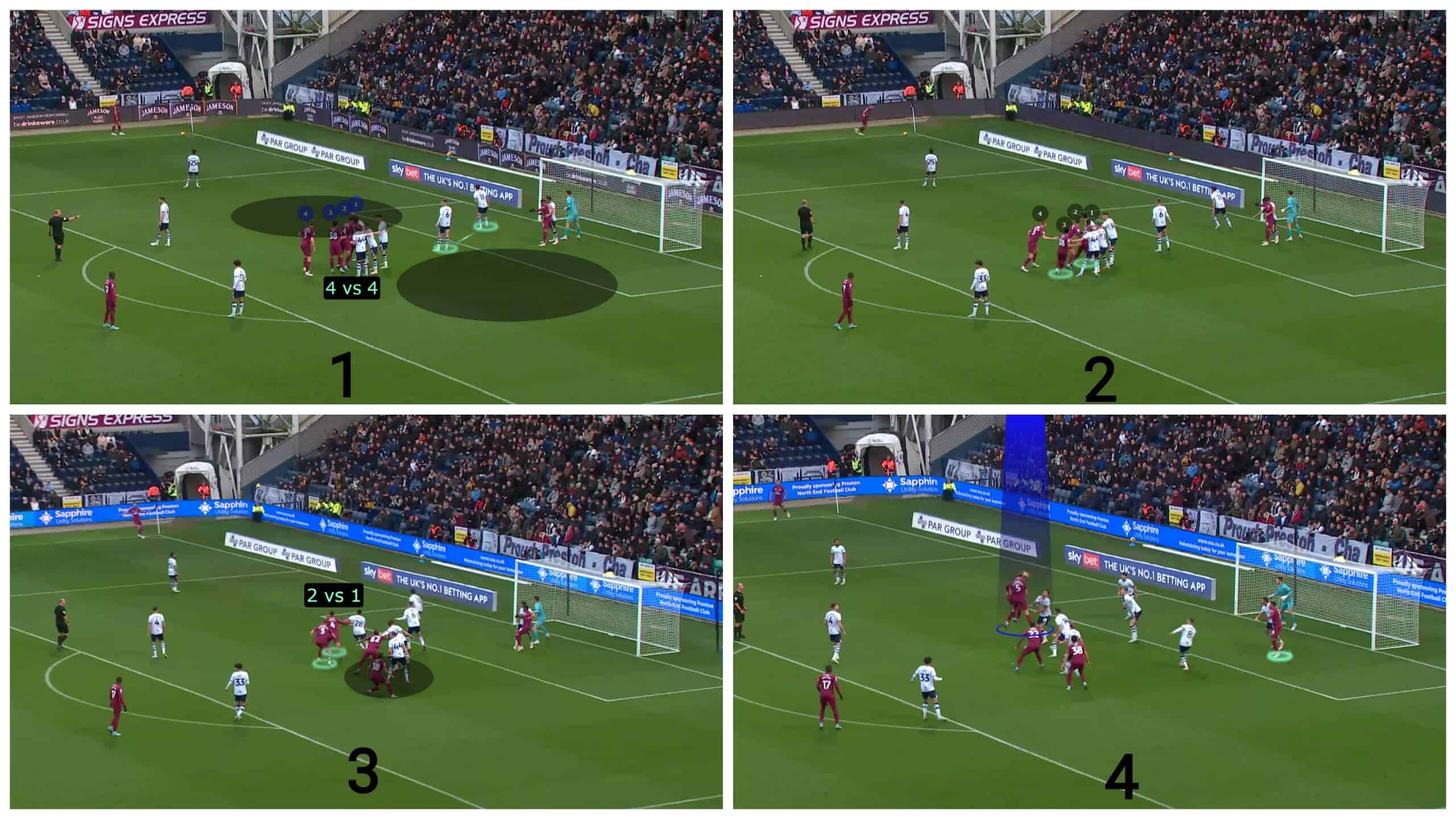
dissecting-cardiff-city's-attacking-corners-set-piece-analysis-tactics

But the ball lands a little earlier, so a defender kicks it away, as shown below.
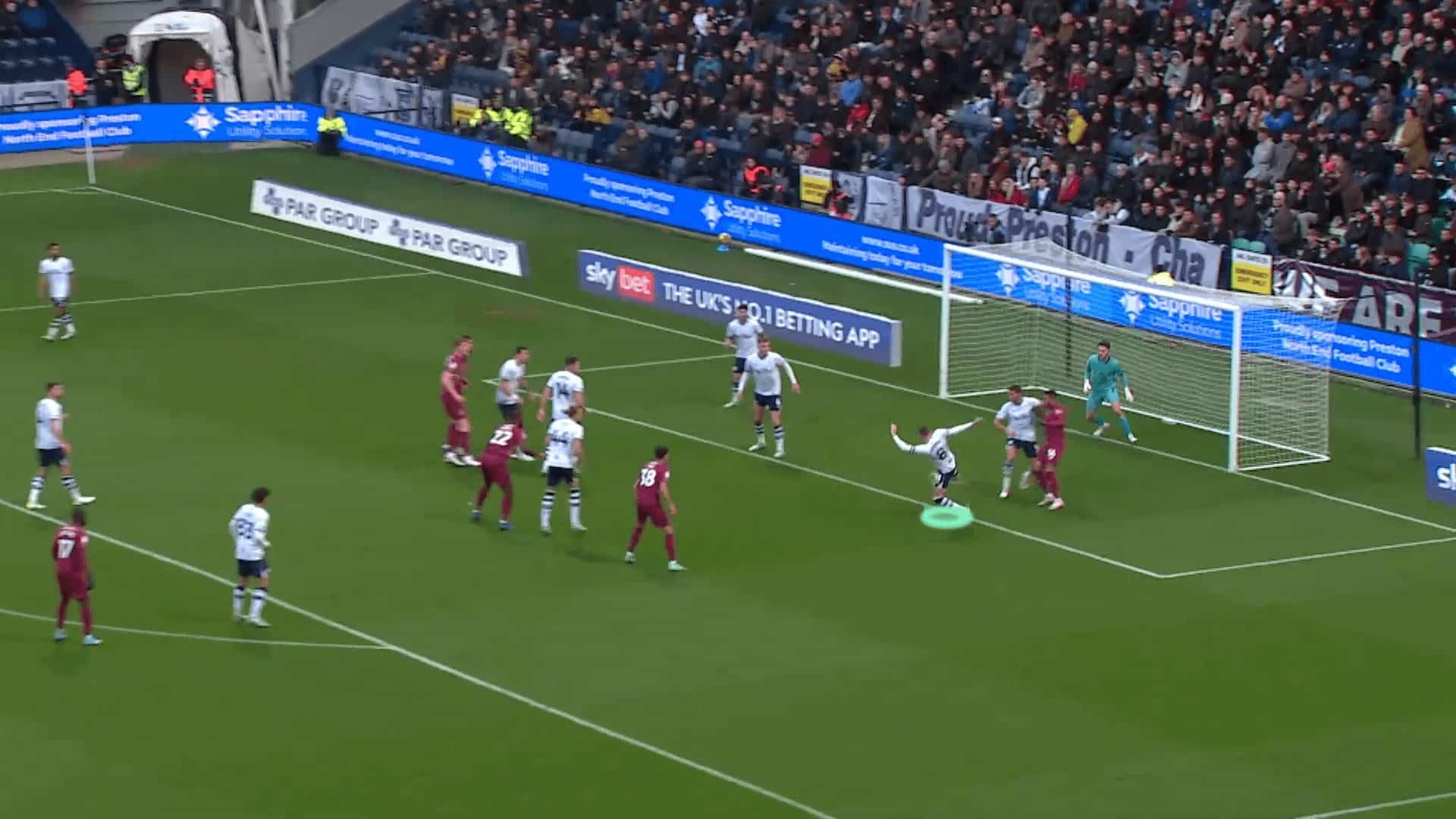
dissecting-cardiff-city's-attacking-corners-set-piece-analysis-tactics

Using stacks doesn’t always lead to freeing a man or achieving numerical superiority. Still, it is also used to give your excellent attacker a chance to show his abilities in aerial duels by giving him only a second before his marker without physical touch, which annoys him to provide him with the time to run and jump, as in the case below.

In the first photo, you can see a two-player stack, while the second one is the targeted man. How will he become free? In the second photo, you can see the first player pushing the defenders to the right side by spreading his arms, so he gets two advantages from this action. The first one is taking their attention for a second, while the second one is to make the markers as far as he can so his teammate behind can take off, gaining a second on his marker, as shown in the third and fourth photos.
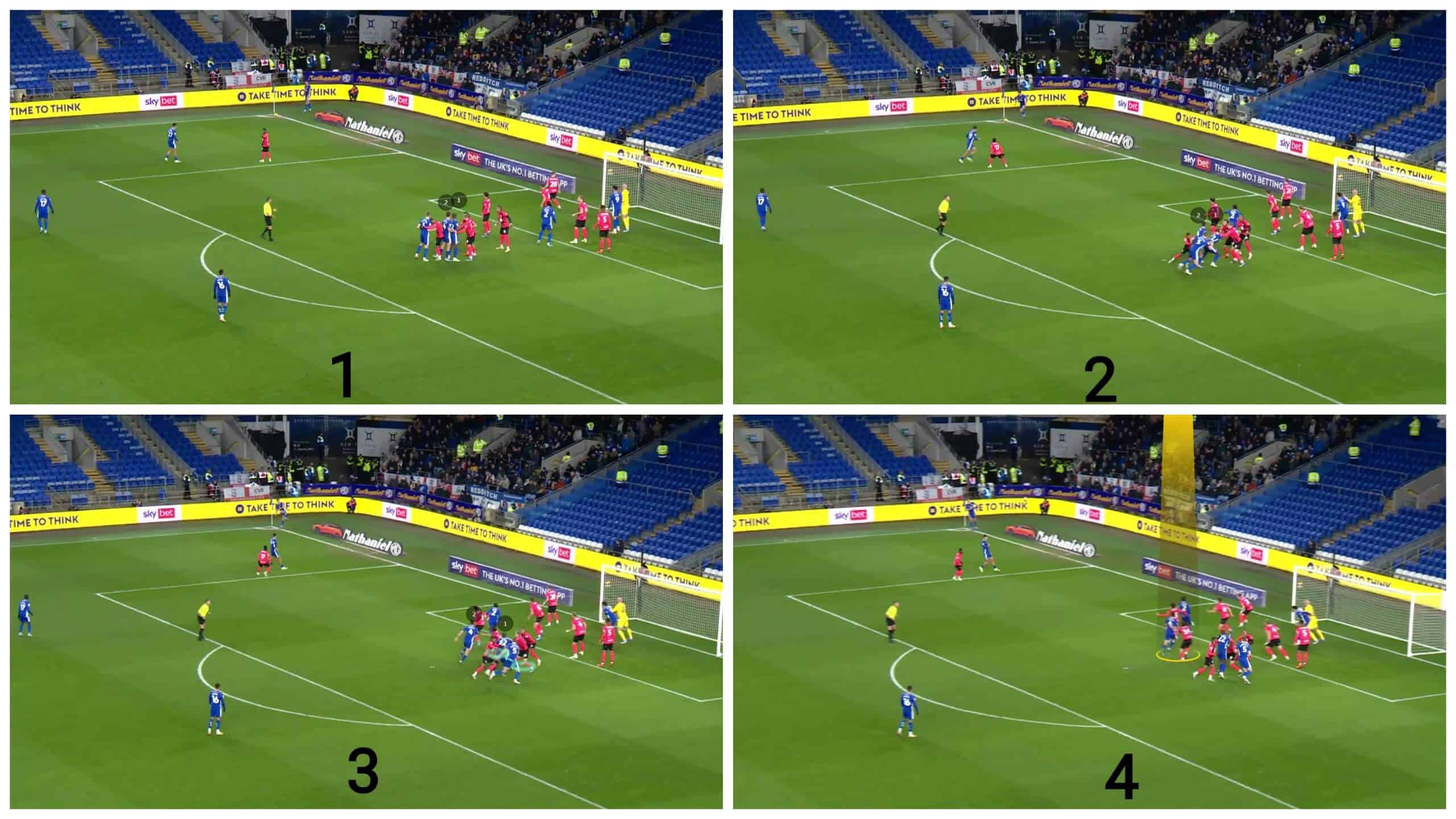
dissecting-cardiff-city's-attacking-corners-set-piece-analysis-tactics

But what after getting rid of the marker against this hybrid system where there are four zone defenders and therefore one of the attackers, in white, launches to drag with him the second zonal defender to target the distance between the second and third zonal defenders by the free attacker, as shown in the first and second photos below.

At the same time, an attacker waits on the far post in the defender’s blind side because they are focusing on the ball, but the ball goes next to the post, as shown in the third and fourth photos below.
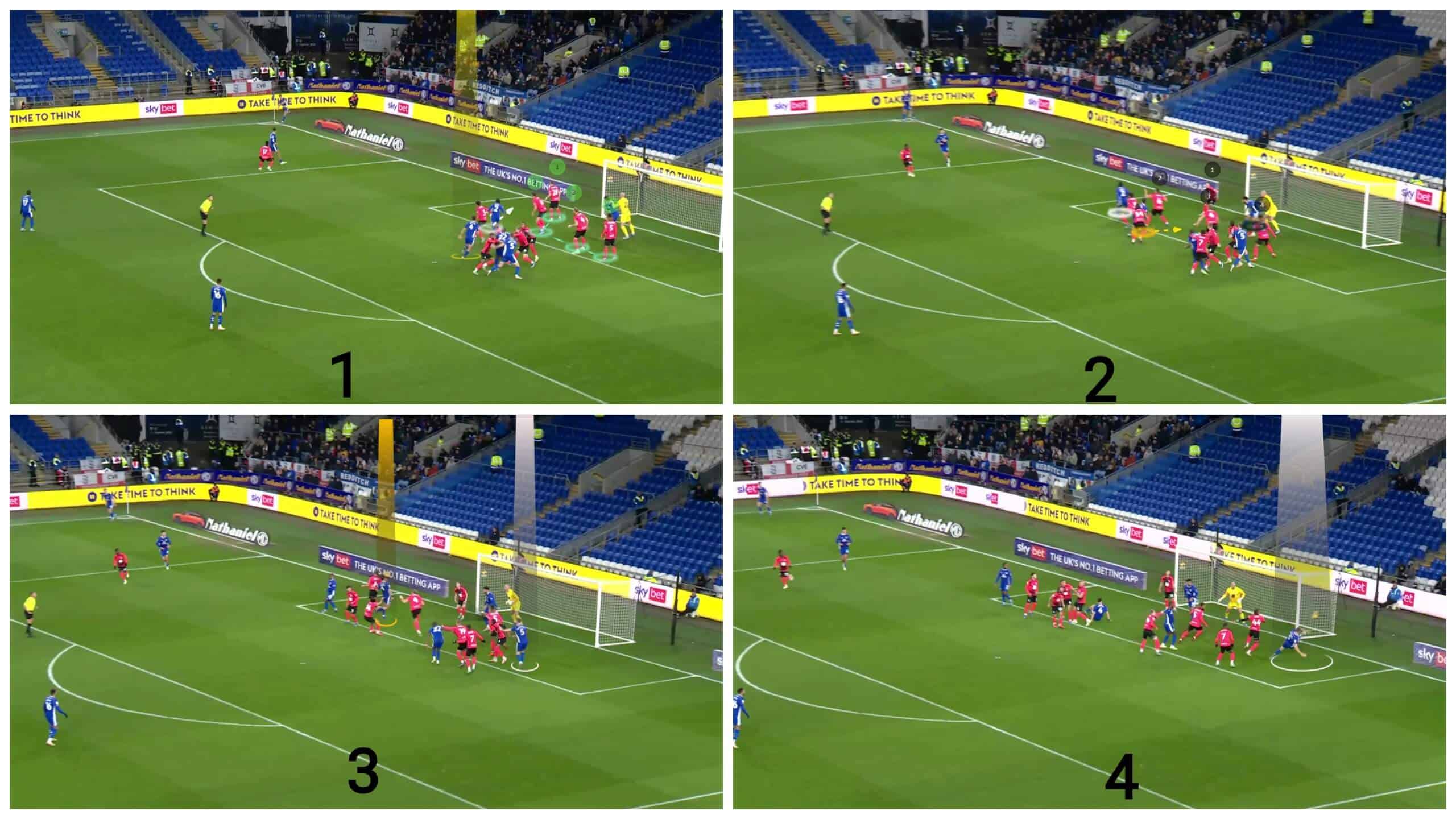
dissecting-cardiff-city's-attacking-corners-set-piece-analysis-tactics

It is not only the numerical superiority and the dynamic mismatch that gives Cardiff City the superiority because of using stacks, but stacks can also cause an orientation problem for the defenders, as in the case below.

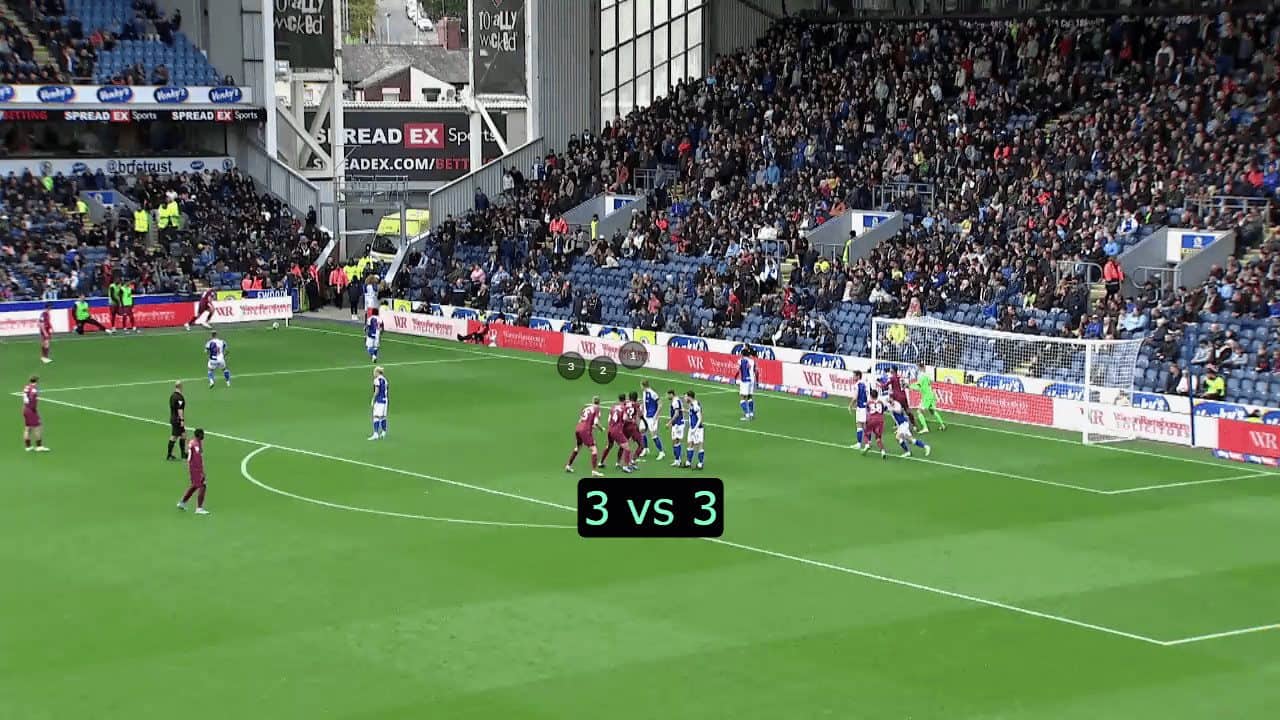
In the photo below, you can see a three-player stack. Let’s follow the process.
dissecting-cardiff-city's-attacking-corners-set-piece-analysis-tactics

The first player goes to the right side, the second player moves to the left, and the third player moves to the middle, but every defender gets an attacker, as in the two photos below, so where is the problem?


dissecting-cardiff-city's-attacking-corners-set-piece-analysis-tactics

dissecting-cardiff-city's-attacking-corners-set-piece-analysis-tactics

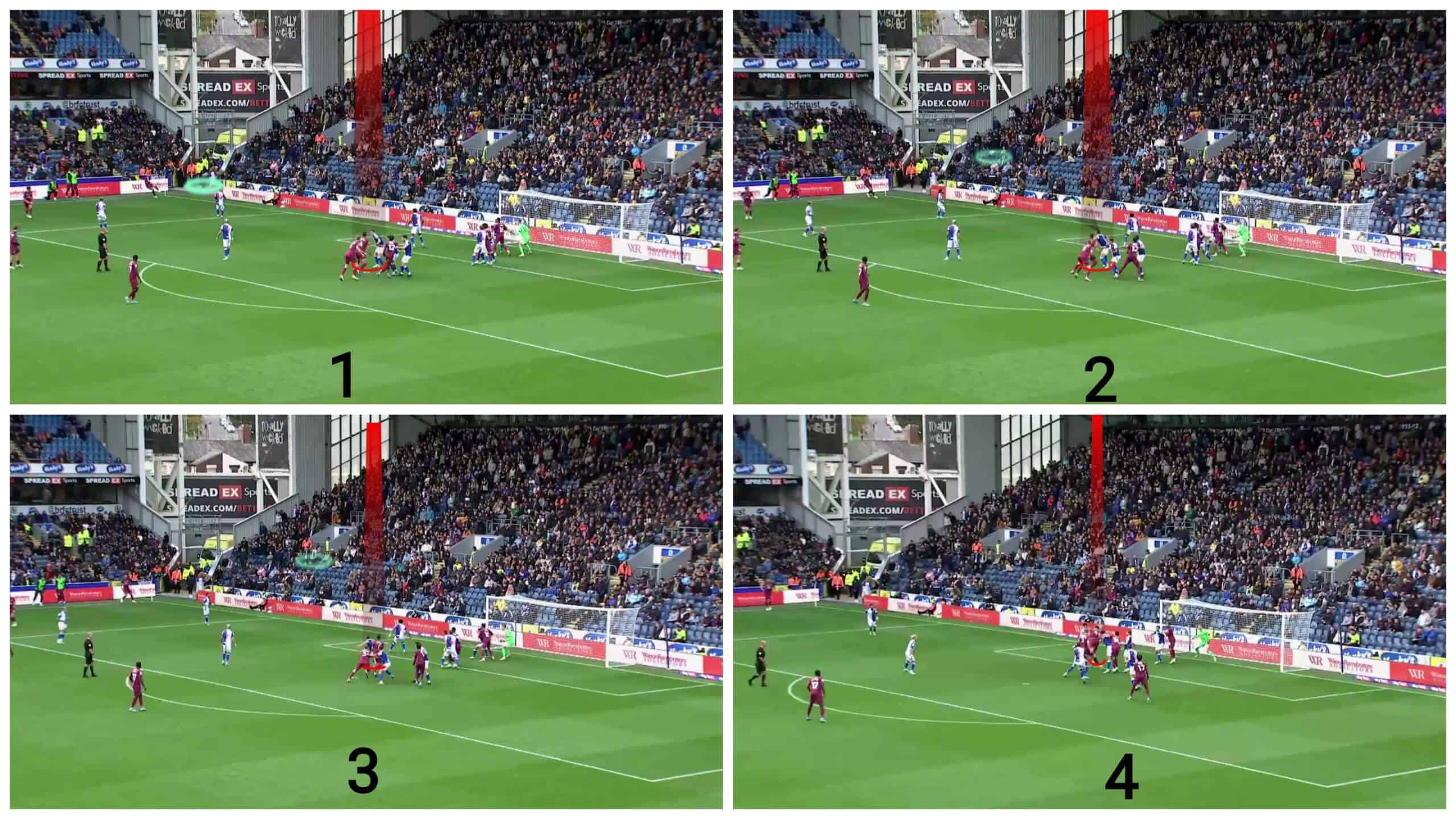
In the first photo below, the taker has just kicked the ball while the defender watches him, but this small distance between them, because of the stack, makes him not stuck with the defender, so when the ball gets nearer, the defender should give a look to the ball, and this is the moment for the attacker to escape through his back because the defender can’t follow the ball and the attacker at the same time which is called a problem in orientation, as in the rest photos.

We should mention an assistant factor: using an outswinging cross so the ball comes from out to in, forcing the defender to have a closed body shape.
dissecting-cardiff-city's-attacking-corners-set-piece-analysis-tactics

The result is a goal, as shown below.

dissecting-cardiff-city's-attacking-corners-set-piece-analysis-tactics

They also have another idea to use stacks: using the first three players to block the defenders as a fence to free the space behind him for the fourth attacker, as in the case below.

In the first photo, you can see a four-player stack, but in the second photo, you can see the last player waiting in his space during the movements of the first three players. The first attacker goes to the near post, trying to attract defenders, while the second and third players block anyone trying to go to the free space behind them, as shown in the third photo.

In the fourth photo, the cross goes a little forward than supposed so that the attacker can get the ball, but with annoyance.

dissecting-cardiff-city's-attacking-corners-set-piece-analysis-tactics

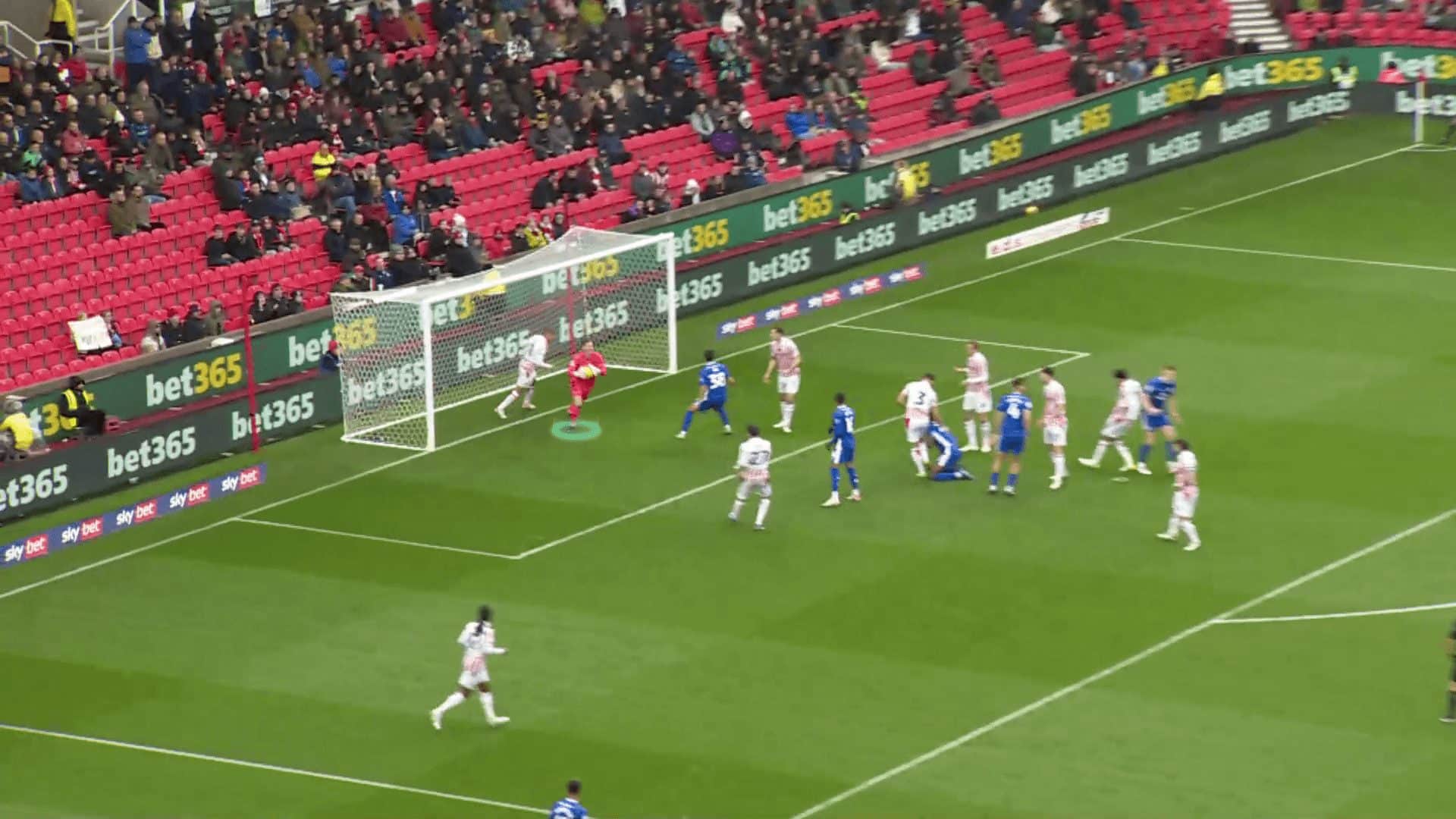
So, the ball goes easily to the goalkeeper, as shown below.
dissecting-cardiff-city's-attacking-corners-set-piece-analysis-tactics

Short corners

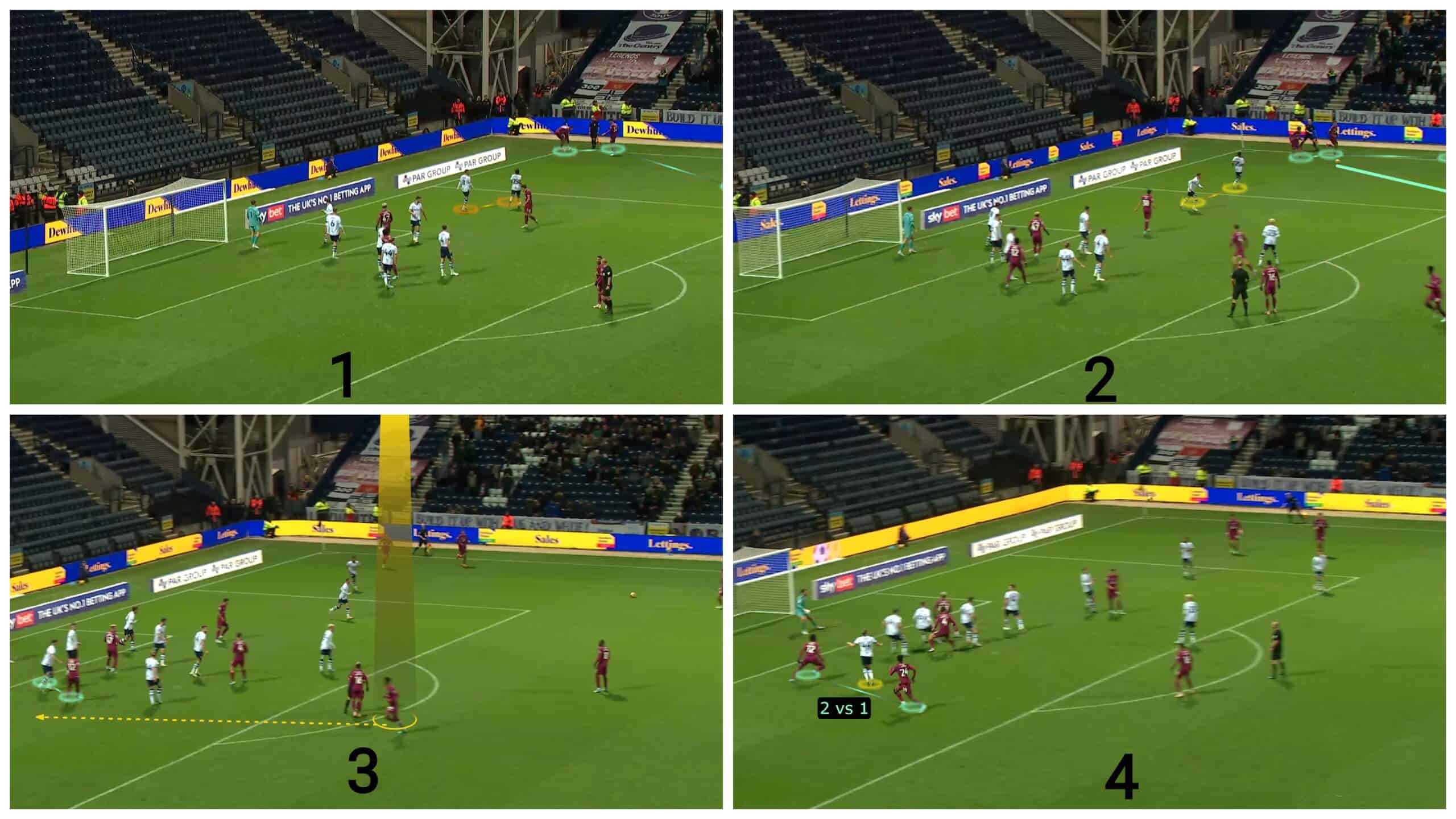
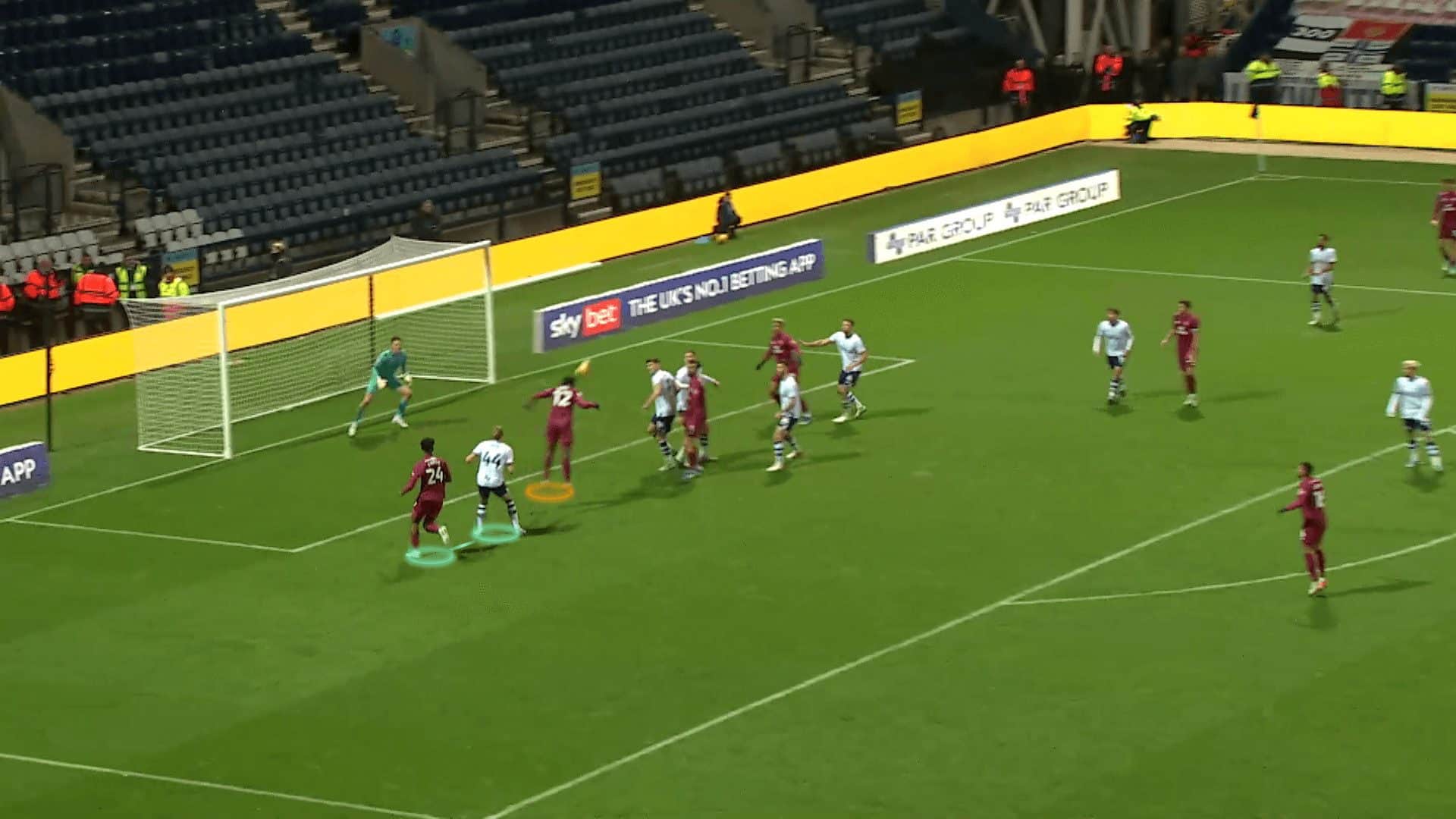
As a variation, they sometimes use quick short corners to achieve numerical superiority at first by 2-v-1 or 3-v-2 situations and then crossing the ball to the far post, as in the case below.

In the first photo below, the short option goes quickly to the taker to receive the ball, then passes it back to him to pass it to the third attacker, who stands a little in the back, as in the first and second photos.

In the third photo, a late attacker comes from the back to the far post behind the last defender while the rest of the defenders focus on the ball and the rest of the attackers who move to the near post, so they have a 2-v-1 situation on the far post, as shown in the fourth photo.
dissecting-cardiff-city's-attacking-corners-set-piece-analysis-tactics

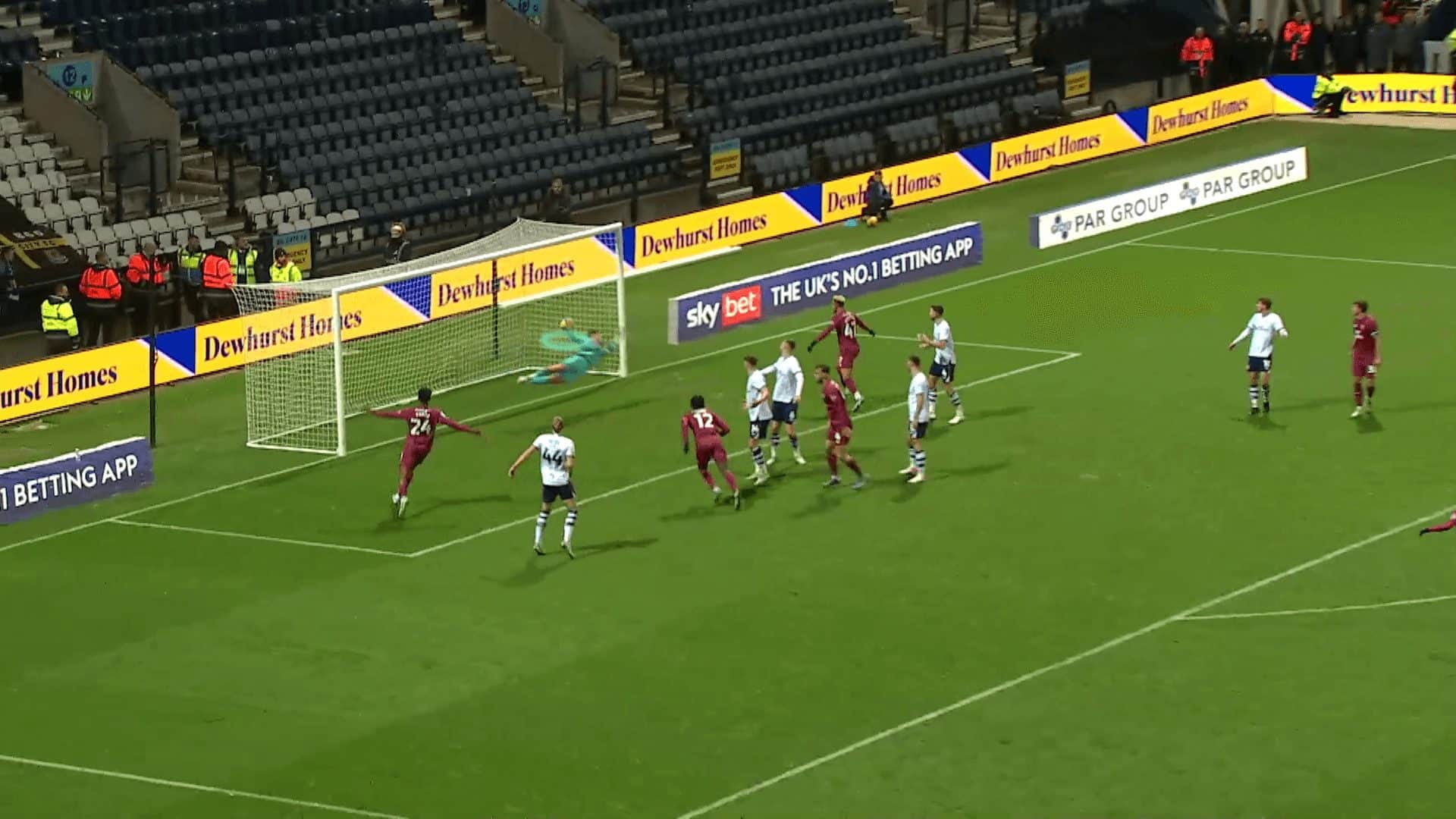
This late attacker drags the last defender’s attention, allowing the last attacker to get the ball freely, as shown below.
dissecting-cardiff-city's-attacking-corners-set-piece-analysis-tactics

The result is a goal, as shown below.
dissecting-cardiff-city's-attacking-corners-set-piece-analysis-tactics

Conclusion

In this analysis, we have explained the reason for the great superiority of Cardiff City over its competitors in executing offensive corner kicks, which led to scoring 10 goals from corners, which is twice the number of goals scored by the teams that follow them, despite their significant advantage over them in the table.

In this set-piece analysis, we have demonstrated their excellence in exploiting stacks to give the attackers a dynamic mismatch against the defenders, escape from man-marking, and disperse the defenders in different ways. We have also explained their use of the principle of variation to surprise their opponent by using the option of short corners through numerical superiority at first and then sending crosses to the blind side of the defenders on the far post.

Previous Post

50% off until NYD: Coaching Luis Suarez’s movement, the best of ASEC Mimosas academy, Koita and Ugalde analysed, pressure at attacking corners + more!

Next Post

Sheffield United 2023/24: What Chris Wilder must consider to keep the Blades in the Premier League – tactical analysis

Next Post
Sheffield United 2023/24: Their tactics under Chris Wilder – tactical analysis

Sheffield United 2023/24: What Chris Wilder must consider to keep the Blades in the Premier League – tactical analysis

  • About Total Football Analysis
  • Contact Total Football Analysis
  • Write For Total Football Analysis
  • Advertise
  • Privacy Policy
  • Cancellation / Refund Policy
  • Resources
  • Terms Of Service

© 2026 Total Football Analysis

No Result
View All Result
  • Football Analysis
    • Data Analysis
    • Formations
      • 2-2-4 Formation
      • 2-3-5 Formation
      • 3-1-4-2 Formation
      • 3-2-2-3 Formation
      • 3-2-4-1 Formation
      • 3-1-6 Formation
      • 3-3-4 Formation
      • 3-4-1-2 Formation
      • 3-4-2-1 Formation
      • 3-4-3 Formation
      • 3-5-1-1 Formation
      • 3-5-2 Formation
      • 4-1-4-1 Formation
      • 4-2-2-2 Formation
      • 4-2-3-1 Formation
      • 4-2-4 Formation
      • 4-3-1-2 Formation
      • 4-3-3 Formation
      • 4-4-2 Formation
      • 4-5-1 Formation
      • 5-3-2 Formation
      • 5-4-1 Formation
      • 6-3-1 Formation
    • Head Coach Analysis
    • Match Analysis
    • Player Analysis
    • Recruitment Analysis
    • Set Piece Analysis
    • Tactical Theory
    • Tactical Preview
    • Team Analysis
    • Training Analysis
    • Tactical Analysis
    • Scouting Report
  • Competition
    • ALL Competitions
    • English Premier League
    • Champions League
    • La Liga
    • Bundesliga
    • Serie A
    • Ligue 1
    • Eredivisie
    • EFL Championship
    • FIFA World Cup 2022
    • WEURO 2022
    • Women’s Super League
    • NWSL
    • Belgian First Division A
    • A-League
    • Liga Profesional de Argentina
    • Austrian Bundesliga
    • Campeonato Brasileiro Série A
    • DFB Pokal
    • 1. HNL
    • Danish Superliga
    • EFL League One
    • EFL League Two
    • FA Cup
    • EFL Cup
    • Indian Super League
    • K-League
    • J1 League
    • Liga MX
    • Copa América 2021
    • Copa del Rey
    • MLS
    • Eliteserien
    • Euro 2020
    • Primeira Liga
    • Scottish Premiership
    • Allsvenskan
    • Europa League
    • UEFA Nations League
    • Liga AUF Uruguaya
  • Coaches
    • All Coaches
    • Alfred Schreuder
    • Ange Postecoglou
    • Antonio Conte
    • Arne Slot
    • Bo Svensson
    • Brendan Rodgers
    • Bruno Lage
    • Carlo Ancelotti
    • Christophe Galtier
    • Claude Puel
    • Claudio Ranieri
    • David Moyes
    • Dean Smith
    • Diego Simeone
    • Domenico Tedesco
    • Frank Lampard
    • Eddie Howe
    • Edin Terzić
    • Emma Hayes
    • Erik ten Hag
    • Ernesto Valverde
    • Gennaro Gattuso
    • Gerardo Seoane
    • Gian Piero Gasperini
    • Giovanni van Bronckhorst
    • Graham Potter
    • Igor Tudor
    • Imanol Alguacil
    • Jesse Marsch
    • Jonas Eidevall
    • Jorge Sampaoli
    • José Bordalás
    • José Mourinho
    • Julen Lopetegui
    • Julian Nagelsmann
    • Julien Stéphan
    • Jürgen Klopp
    • Luciano Spalletti
    • Lucien Favre
    • Manuel Pellegrini
    • Marcelo Bielsa
    • Marco Rose
    • Marco Silva
    • Massimiliano Allegri
    • Mauricio Pochettino
    • Maurizio Sarri
    • Mikel Arteta
    • Niko Kovač
    • Nuno Espírito Santo
    • Oliver Glasner
    • Patrick Vieira
    • Paulo Fonseca
    • Pep Guardiola
    • Peter Bosz
    • Rafa Benítez
    • Ralf Rangnick
    • Ralph Hasenhüttl
    • Roger Schmidt
    • Roy Hodgson
    • Sean Dyche
    • Sérgio Conceição
    • Simone Inzaghi
    • Sonia Bompastor
    • Stefano Pioli
    • Steffen Baumgart
    • Steven Gerrard
    • Thiago Motta
    • Thomas Frank
    • Thomas Tuchel
    • Unai Emery
    • Vincenzo Italiano
    • Xavi
  • Teams
    • ALL Teams
    • AC Milan
    • Ajax Amsterdam
    • Arsenal
    • AS Monaco FC
    • Atalanta
    • Atlético Madrid
    • FC Barcelona
    • FC Bayern Munich
    • Borussia Dortmund
    • Celtic FC
    • Chelsea FC
    • Everton F.C.
    • Inter Milan
    • Juventus F.C.
    • Leeds United F.C.
    • Liverpool FC
    • Manchester City
    • Manchester United FC
    • Paris Saint-Germain
    • Rangers FC
    • RB Leipzig
    • Real Madrid CF
    • Tottenham Hotspur
    • West Ham United
  • Players
    • ALL Players
    • Alisson Becker
    • Bukayo Saka
    • Erling Haaland
    • Harry Kane
    • Jack Grealish
    • John Stones
    • Julián Alvarez
    • Kalvin Phillips
    • Kevin De Bruyne
    • Kyle Walker
    • Kylian Mbappé
    • Lamine Yamal
    • Lionel Messi
    • Luis Díaz
    • Mohamed Salah
    • Phil Foden
    • Virgil Van Dijk
  • Contact
  • Write For TFA
  • Login

© 2026 Total Football Analysis