
Bayern Munich have started their 2025/2026 season in some style as they thrashed Ole Werner’s RB Leipzig by six goals to nil.
This is one of the heaviest defeats in recent Bundesliga opening game history.
Vincent Kompany outdid himself as his side only recorded a 3-2 victory for their opening league game against VfL Wolfsburg last season.
Going into the game, FC Bayern fielded their strongest XI, apart from the injured Jamal Musiala and Alphonso Davies, the same players that started against VfB Stuttgart in the Franz Beckenbauer Supercup.
However, things were not the same for Ole Werner.
With the departures of important players like Benjamin Šeško and André Silva, they were short on attacking power.
The Bundesliga opener was a game to forget for the Leipzig supporters.
Through this tactical analysis, we aim to understand how Bayern Munich outmanoeuvred Leipzig to emerge victorious.
Bayern Munich Vs RB Leipzig Lineups & Formations
Let us have a look at how Vincent Kompany and Ole Werner fielded their squads.

The winners, Bayern, played in a 4-2-3-1 formation.
Skipper Manuel Neuer stood between the sticks behind a back four of Konrad Laimer (right-back), Dayot Upamecano (right centre-back), Jonathan Tah (left centre-back), and Josip Stanišić (left-back).
Tah and Laimer were subbed off for Kim Min-jae (68’) and Sacha Boey (69’), respectively.
Joshua Kimmich played alongside Leon Goretzka in the double pivot, with the former playing slightly deeper.
Aleksandar Pavlović replaced the latter at the 68th minute mark.
Luis Díaz (left-winger) and Michael Olise (right-winger) were the wide players alongside Serge Gnabry (central attacking midfielder), with Harry Kane as the lone striker.
Youngster Lennart Karl came on for Gnabry at the 69th minute.
When this happened, Olise moved into Gnabry’s position with Karl taking the wide zone.
Subsequently, Kane was taken off at the 86th minute for Jonah Kusi-Asare.
The Englishman had completed his hat-trick by this point.
Werner’s side played in a 4-3-3 formation.
For Leipzig, Péter Gulácsi started in goal, behind the back four of Ridle Baku (right-back), Willi Orbán (right centre-back), Castello Lukeba (left centre-back), and the captain David Raum (left-back).
All four defenders stayed on for the entire game.
Nicolas Seiwald played as the defensive midfielder, with Xavi Simons and Xaver Schlager as the advanced midfielders.
Schlager and Seiwald were taken off for Ezechiel Banzuzi (69’) and Assan Ouédraogo (88’).
The front three comprised Yan Diomande (left-winger), Johan Bakayoko (right-winger), and Loïs Openda (striker).
Diomande and Openda were substituted by Antonio Nusa (46’) and Rômulo (46’).
Meanwhile, Bakayoko was taken off a little later for Christoph Baumgartner (69’).
Bayern Munich Attacking Tactics
In this section, we will examine the features of Bayern Munich’s play in the attacking phase.
Bayern Munich Build-Up & Progression
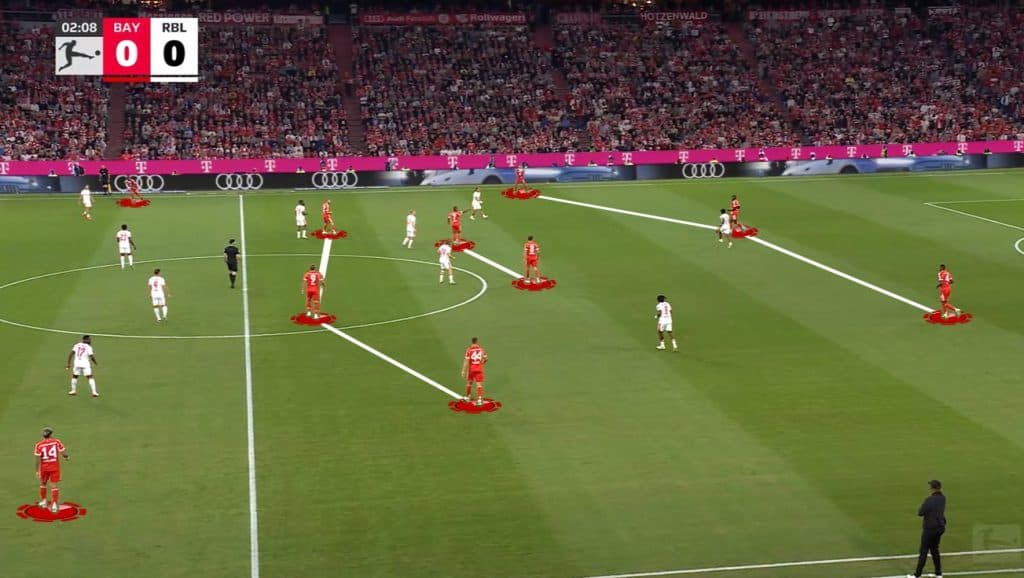
Although their formation was 4-2-3-1, it changed slightly during build-up moments.
Kimmich usually dropped between the centre-backs as the full-backs pushed slightly higher than the pivots.
Gnabry was seen dropping alongside Goretzka to maintain the double pivot.
Kane would sometimes drop into midfield.
This repositioning of players rendered the build-up structure into a 3-2-3-2 and, at other times, a 3-4-3 when Kane stayed higher.
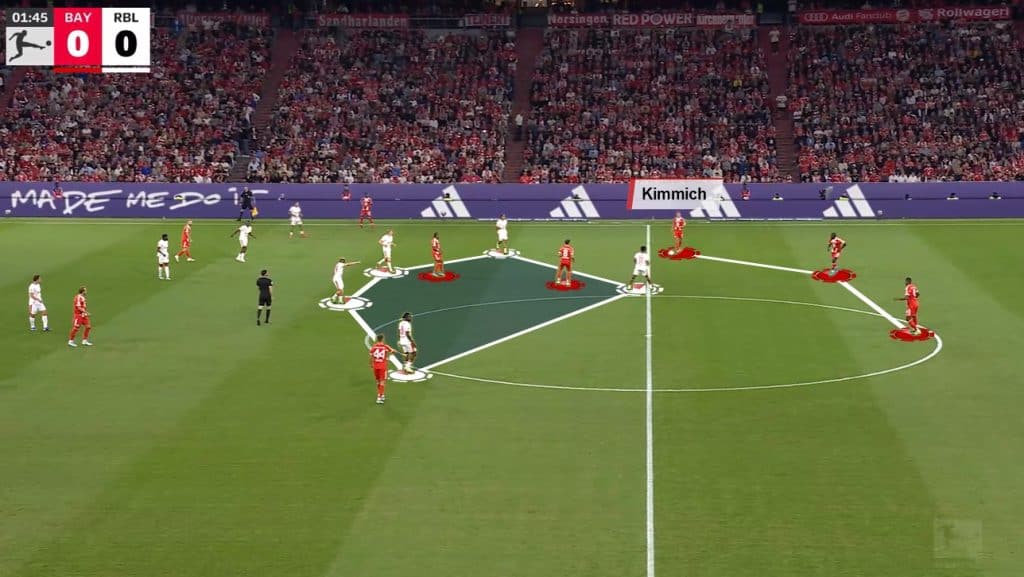
Here, we can see Kimmich dropping outside the opponent structure to join the centre-backs.
He was seen mostly dictating tempo from that position.
Meanwhile, Goretzka and Gnabry operated inside the structure, as shown in the image above.
Although the two consistently showed up in these positions, it was not always the case.
There were occasions when the full-backs inverted and received inside the structure.
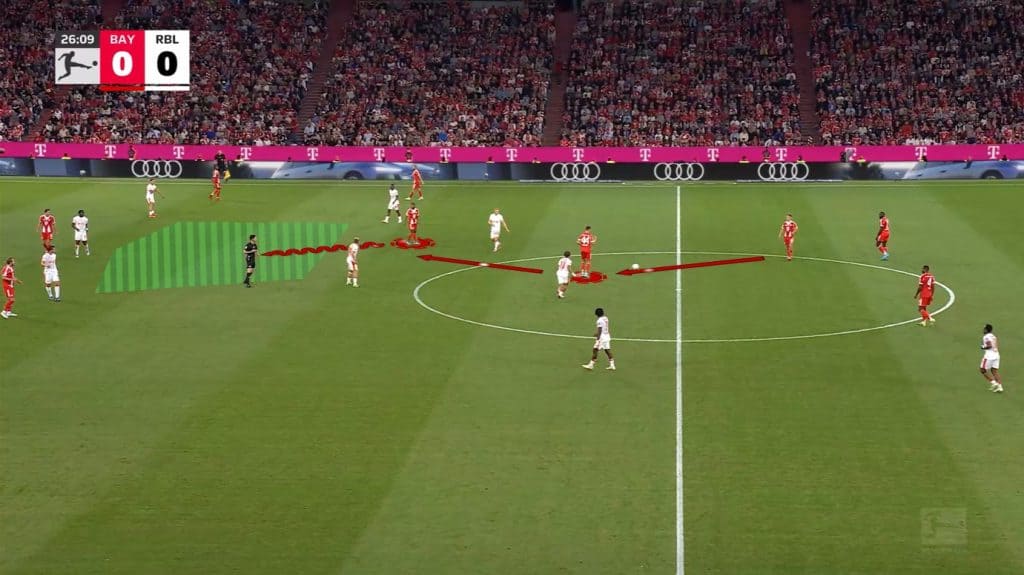
The situation illustrated above is from the first goal Bayern Munich scored.
Stanišić, who was playing as a left-back, can be seen receiving a vertical pass from Kimmich.
He quickly progresses it to Gnabry, who uses the space ahead of him to create the goalscoring opportunity.
This is important about Bayern Munich’s progression.
No single player was receiving the ball in the midfield third at all times.
Different players from different angles entered that space to receive, which made it tricky for Leipzig to track the receiver.
Bayern Munich dominated the game in terms of ball possession.
A key reason for this is their consistent success in short build-up.
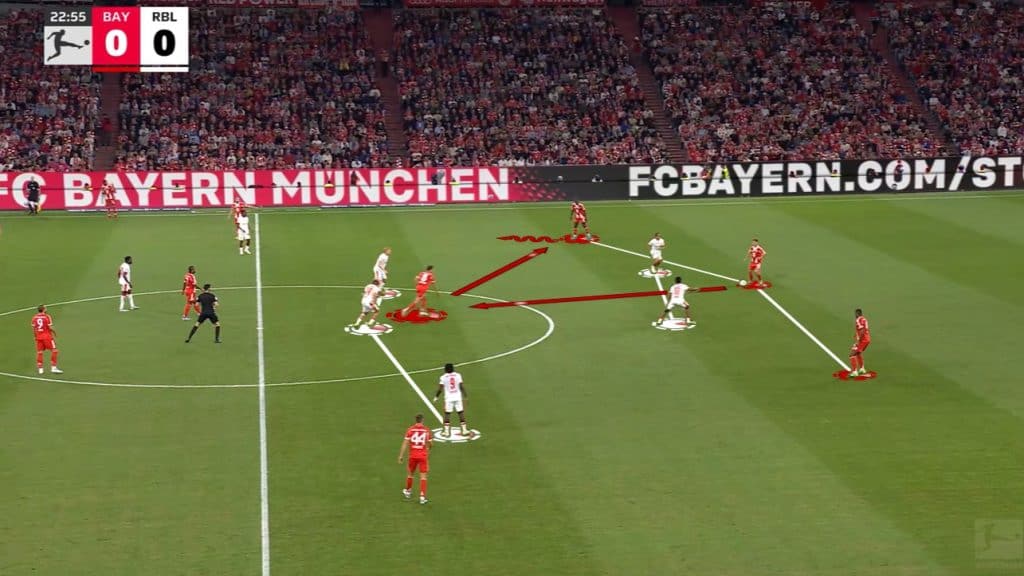
It was common to see Leipzig pressing with a front two, followed by a line of three players.
The Bavarians found it very simple to bypass this.
With Kimmich dropping to form a back three, they had a numerical superiority against Leipzig’s first line of pressure.
Therefore, regardless of what passing angles were cut off, Kimmich was able to find the free player.
In the image above, Xavi Simons is pressing Kimmich while cutting the passing lane to Upamecano.
The German plays a vertical pass to Goretzka, who finds the Frenchman with his first touch.
This was a common event in the Bayern Munich build-up.
They were able to knock it around the corner effortlessly and avoid pressure from Leipzig.
Having spells of possession is not about playing just sideways.
The objective is to move it towards space.
Thus, if the opponent presses high, the team in possession has to use the space behind the pressure.
Bayern Munich were able to carry out these actions with the help of rotating midfield players dropping to receive the passes from their first line of attack.
Here is an example of Bayern Munich winning the ball from a Leipzig clearance to rapidly penetrate and reach the attacking third within a few seconds.
Once Upamecano gets on the ball, he grabs the attention of three opponents.
He exploits Leipzig’s lack of vertical compactness by finding Gnabry in acres of space, who can turn and find Olise at the right moment.
If Leipzig’s line of defenders stepped up and stayed connected, Gnabry would not be able to receive the vertical pass.
Bayern Munich Full-Back & Winger Relationship
It was interesting to see that the wide partnerships in both the wide areas were different.
Luis Díaz, the latest signing, prefers to stay wide and hug the touchline.
This means that Stanišić needed to operate in the half-space for a longer period.
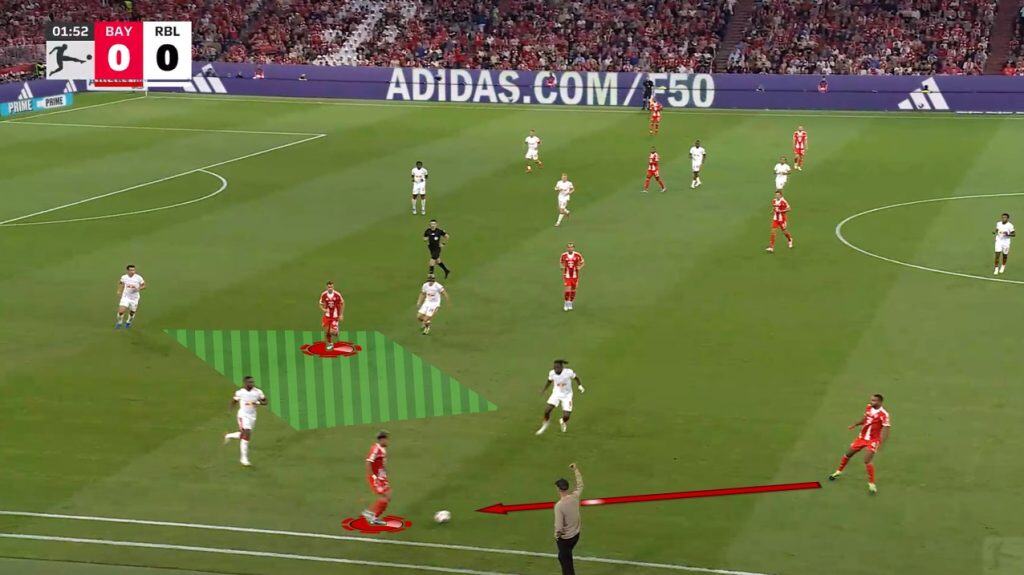
Here, Díaz receives a pass in the wide area.
Meanwhile, his Croatian teammate has positioned himself in the half-space.
The case was slightly different for Olise and Laimer.
The duo worked together for much of the previous season.
Their positional interchanges trouble opponents who are tracking them.
When given the chance, Olise prefers to operate in half-space, which gives Laimer enough space to exploit the wide area.
He was regularly seen operating there, hugging the touchline.
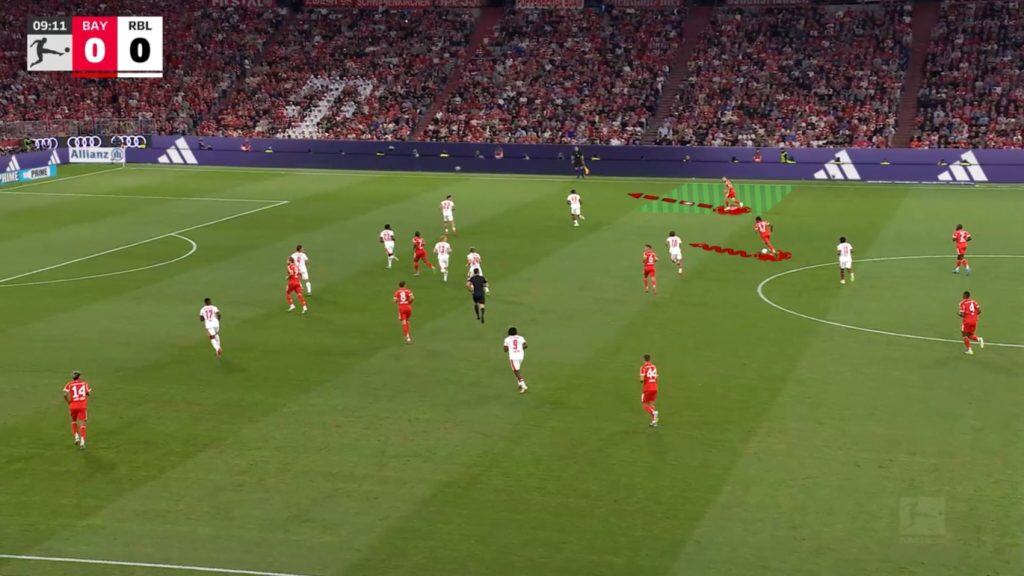
Here is an example.
Olise picks the ball up in the midfield third, in the half-space.
As the Frenchman starts carrying it forward, the Austrian exploits the wide area.
This is important because even if Laimer does not get on the ball, he drags a defender into the wide area.
This opens up more space in the half-space for attacking midfielders and wingers.
Harry Kane & Serge Gnabry: Influence & Relationship
Bayern Munich shaped the game significantly through their front four.
The involvement of Harry Kane and Serge Gnabry was prominent, and will be elaborated on in this section.
The German was extremely dynamic in possession.
He would show up in several areas of the pitch to get involved.
It was common for him to drop in small pockets to receive and either lay it off or drive forward with it.
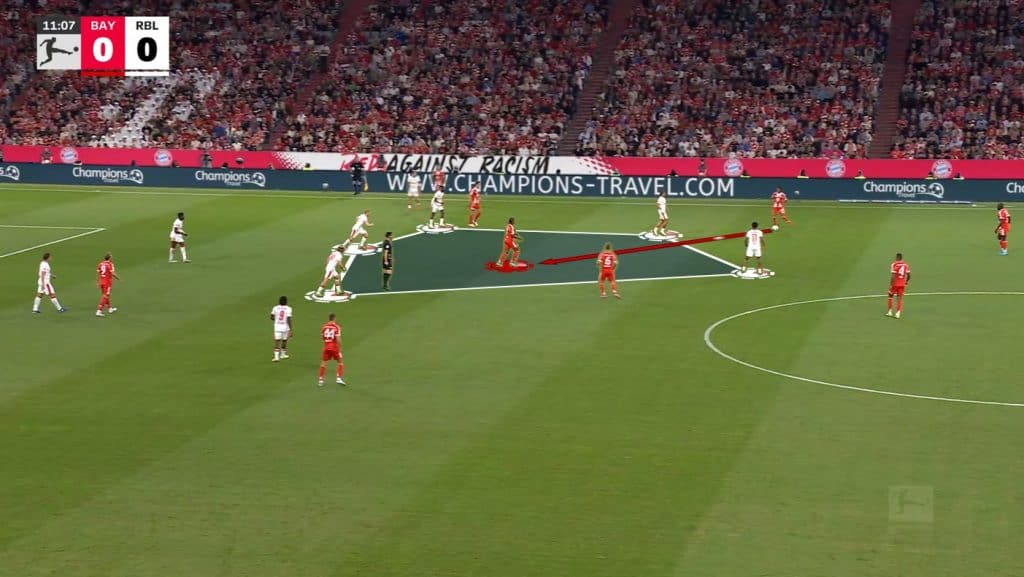
Here is an example of Gnabry receiving in a pocket. It is noteworthy that Kane, meanwhile, occupied his position alongside the Leipzig defenders.
The German was a good source of progression through these actions. He would also frequently carry the ball to attract opponents, which would free up space for his teammates.
This is exactly what happened in the second goal from Olise.
Here, Gnabry drives with the ball.
Four defenders engage with him.
This leaves enough space for Olise to make a run into the penalty area.
In this situation, Kane also stays in his position, which pins some opponents and keeps them from shuffling across to block the shot from Olise.
The Englishman had his moments of involvement in deep areas throughout the game.
In moments where he dropped to link play, Gnabry was seen occupying the striker position to engage the opponent centre-backs.
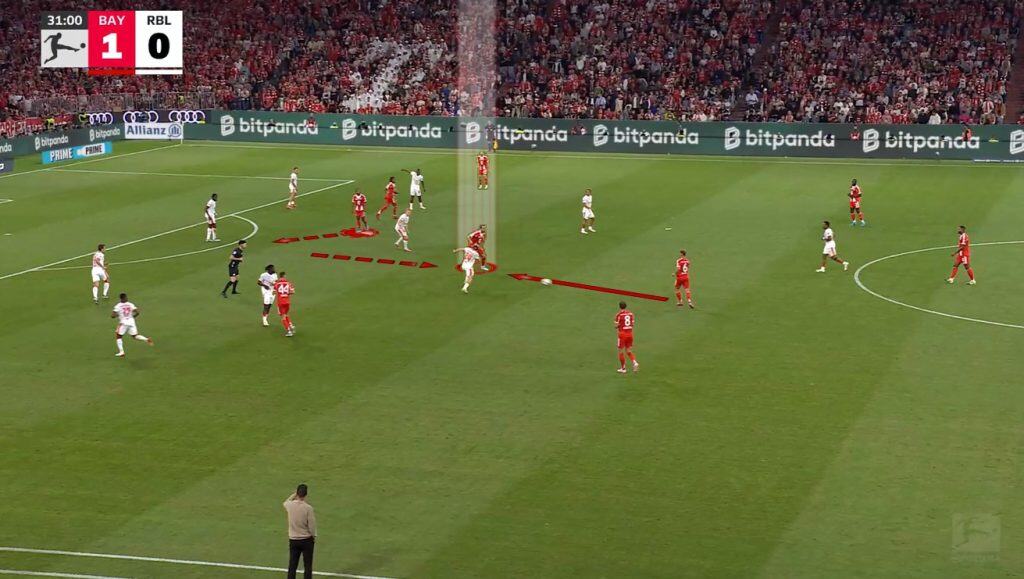
Here is an example of Kane dropping to receive; the space left vacant by this movement is gradually being occupied by Gnabry.
The action of Gnabry positioning himself in the striker position was important as it helped pin the centre-backs.
If not, they would follow Kane into midfield and prevent him from progressing the play.
The opponent midfielders struggled to keep track of the movement on their blindside.
Thus, Kane got on the ball often in these situations.
There were several moments of Luis Díaz being double-teamed by the Leipzig defenders.
Kane assisted him by peeling wide and offering support to either progress the ball down the same flank or quickly shift play.
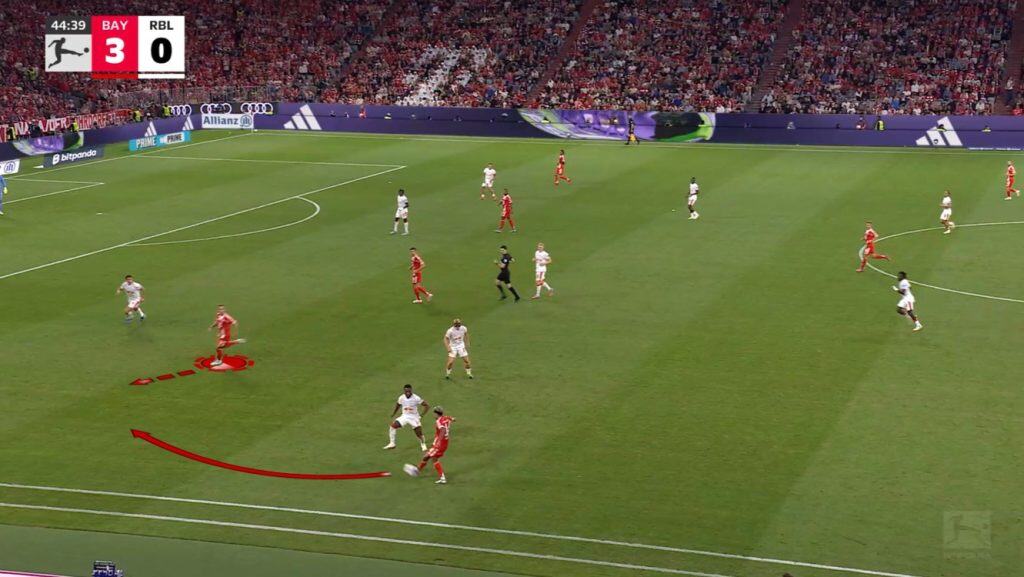
Here, Díaz is engaged by two opponents.
Kane recognises the underload and immediately drifts wide to offer support.
Since it is still a 3-v-2 situation where Bayern Munich are outnumbered, the Colombian plays a one-two with the English striker to shift play.
It is important to notice that Gnabry is occupying Kane’s position in this scenario as well.
Harry Kane and Serge Gnabry were also involved in several third-man combinations in the midfield and the attacking thirds.
These actions helped the hosts with ball possession, penetration, shifting play, and creating shooting chances.
Here, Stanišić gets on the ball and identifies the space down the left flank.
However, the passing lane to Díaz is closed as he is under pressure from his opponent.
The Colombian needs some time to get away from his direct opponent.
In the meantime, Kane drops to offer a vertical option.
It ends up in a third-man combination as the former Liverpool winger receives in his stride.
The build-up to Luis Díaz’s goal also had a third-man pass, which had the Colombian on the end of the move.
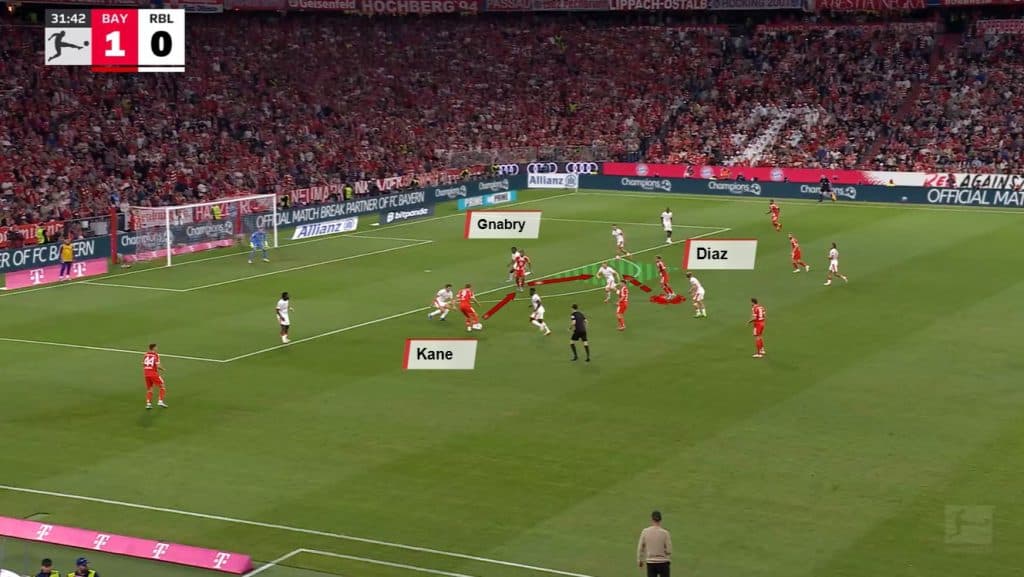
Owing to the fluid movement amongst the Bayern front four, Kane peels out of his position by the time he gets on the ball.
Gnabry, very naturally occupying Kane’s position, receives from the Englishman in zone 14.
It is natural for the defenders to anticipate that Kane would receive it in-behind from the German.
However, Gnabry, identifying the space beforehand, lays it off to Díaz, who utilises the space to bury it inside the goalpost.
The Bayern Munich attackers are adept at these kinds of movements, which was visible on several occasions.
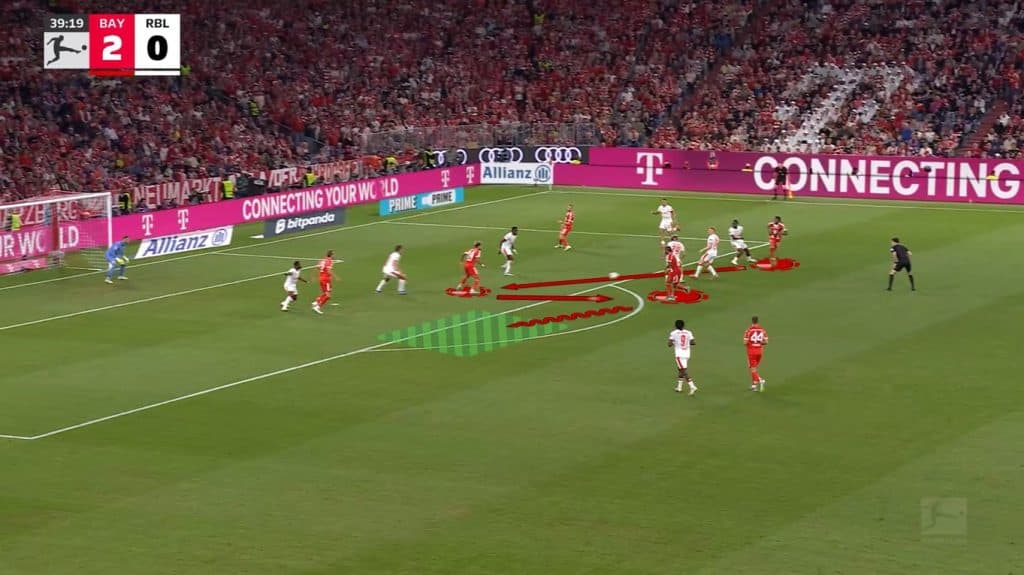
Here is another example where Gnabry is on the end of a third-man pass.
Olise plays it to Díaz, who is pinning the defenders.
His staying there keeps the defenders from stepping aggressively, as it would leave a big hole close to the goal.
He sets it up for the arriving Gnabry, who quickly gets a shot away, this time hitting the crossbar.
Bayern Munich Defending Tactics
In this section, we will examine the features of Bayern’s play in the defensive phase.
Bayern Munich Defending In Opponent Half
As expected, Bayern Munich were pressing high from static restarts of play.
However, in dynamic build-up moments from Leipzig, Bayern Munich pressed with triggers.
Although their pressing depth was high, they engaged at specific moments.
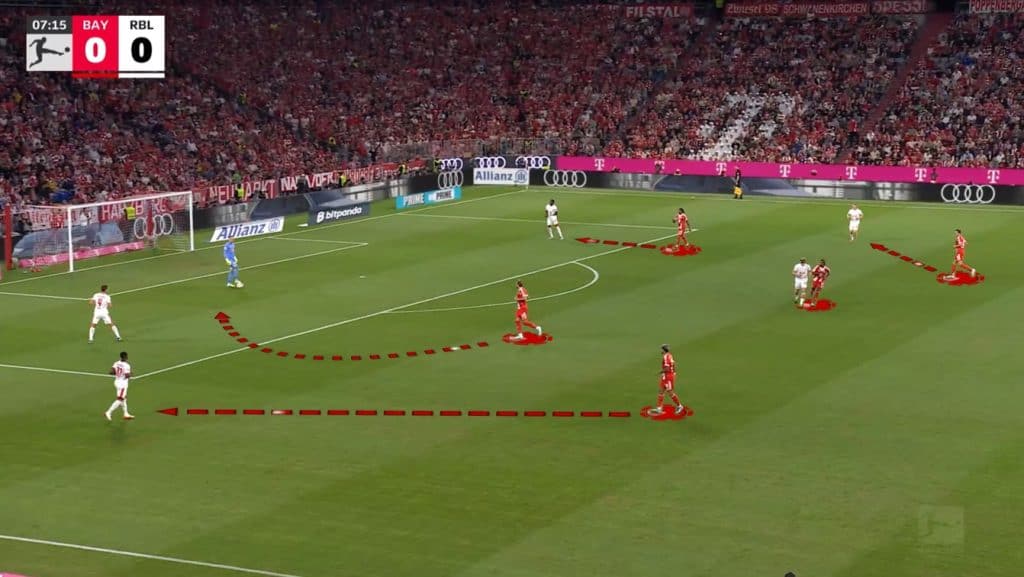
Here is an example of Bayern Munich in a high-pressure situation.
They operate in zonal man-orientations.
Any short options available to the opponent goalkeeper are in the vicinity of Bayern Munich players, who are willing to press.
Péter Gulácsi was frequently forced to play long.
In case they played it wide, the hosts were willing to perform a wide squeeze, cutting out all the short options to shift play.
With the touchline acting as an extra defender, Bayern Munich achieved success multiple times in terms of forcing a mistake in the wide channel.
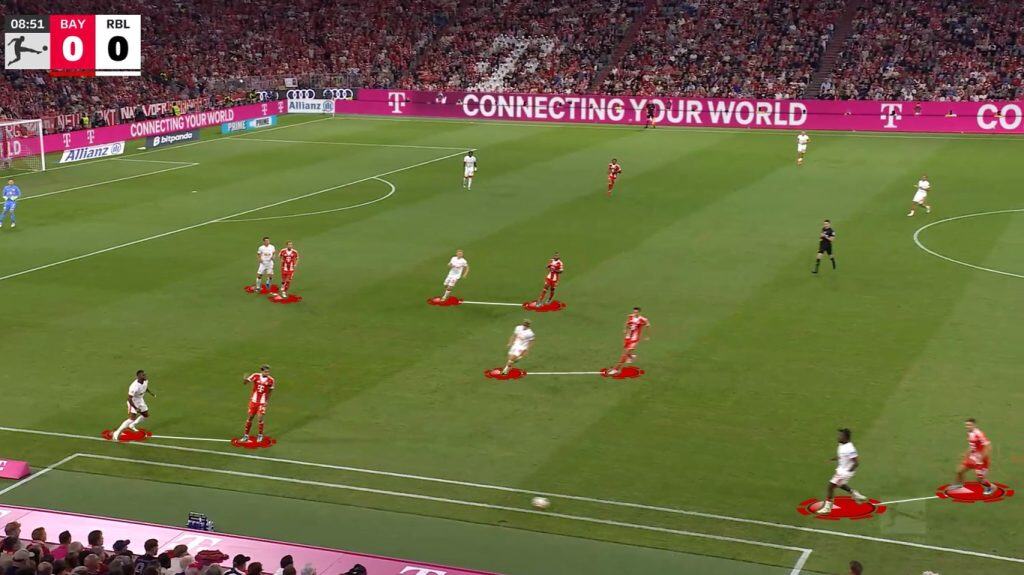
Here is an example of the same.
Leipzig get the ball to Baku (right-back), who attempts to find his winger.
However, Bayern squeezing that area short forced him into making a mistake in playing it off the pitch.
This is an effective pressing trigger that several teams use.
The opponents stay in shape when they have the ball in the central zone.
They switch the intensity up as soon as the ball gets played to the wide zone.
The Bavarians caused the visitors a lot of problems through this.
In situations where Leipzig bypassed the first line of press, Bayern had plans to deal with it.
Their second line of pressure comprised their pivots and, at times, centre-backs.
It was interesting to see how willing Jonathan Tah and Dayot Upamecano were to commit to the press during such events.
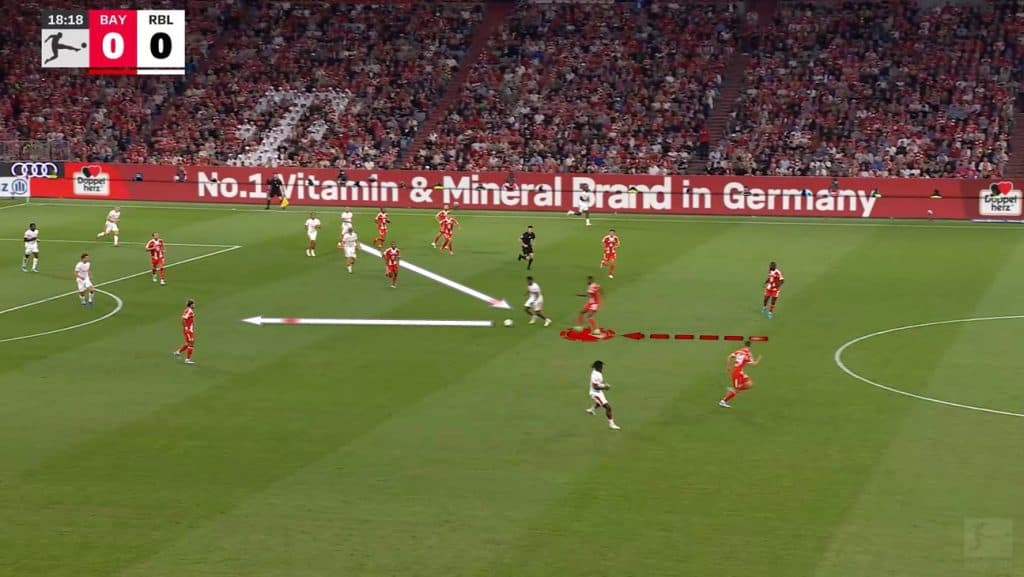
Here is a situation where Tah steps up.
The Leipzig attacker drops into the midfield third to receive a penetrative pass.
However, the German defender makes sure his only option is to go back.
The Leipzig player ends up playing it backwards.
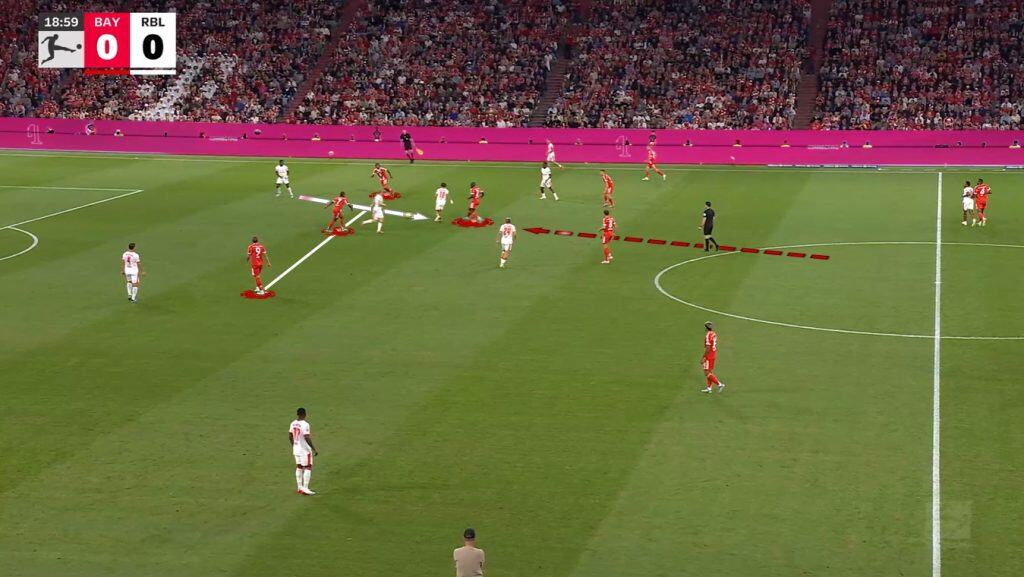
Here is another example, involving Upamecano this time.
Leipzig’s centre-back beats the first line of pressure to find a midfielder.
The Frenchman is prompt in stepping up to force him back.
Actions like these help the players who participated in the first wave of pressure by giving them time to get into a good position to reorganise and maintain their defensive shape.
The next combined defensive action will probably be a mid-block structure, opposed to a high-press.
Beating the first line of press helps the team in possession to move 10 to 15 yards up the pitch.
Therefore, it makes more sense to stay in shape and cut passing lanes.
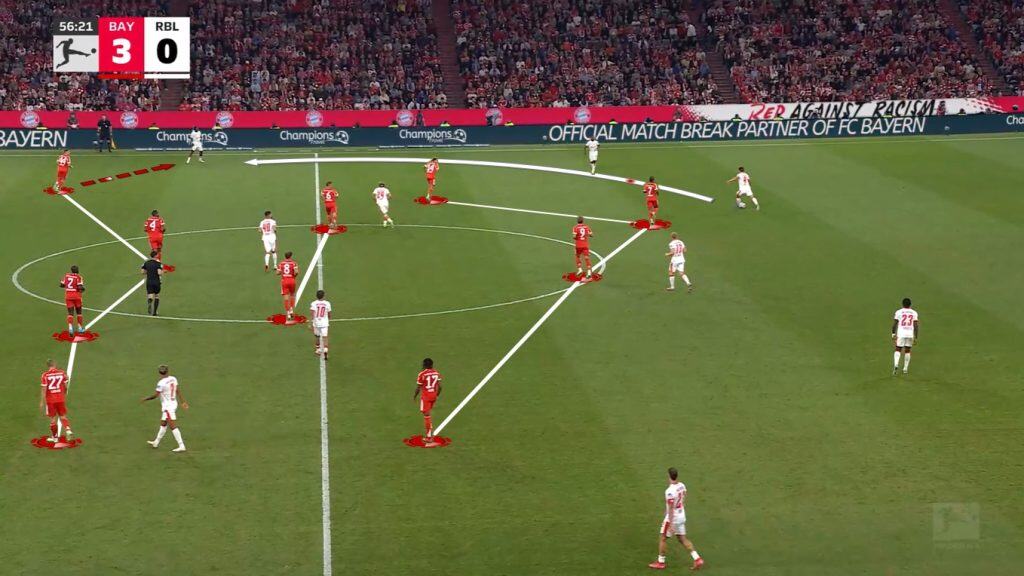
This is how Bayern Munich stayed in a mid-block structure to prevent quicker penetration from their opponents.
Gnabry joined up with Kane, which meant it was a 4-4-2 or a 4-2-4 at times.
In the above image, we can see Bayern Munich in a 4-2-4 mid-block shape.
The players have positioned themselves (in relation to each other) in a way that cuts off passing lanes to any opponents inside their defensive structure.
Eventually, Leipzig have to move it to the wide zone to progress.
Bayern Munich Defending In Own Half
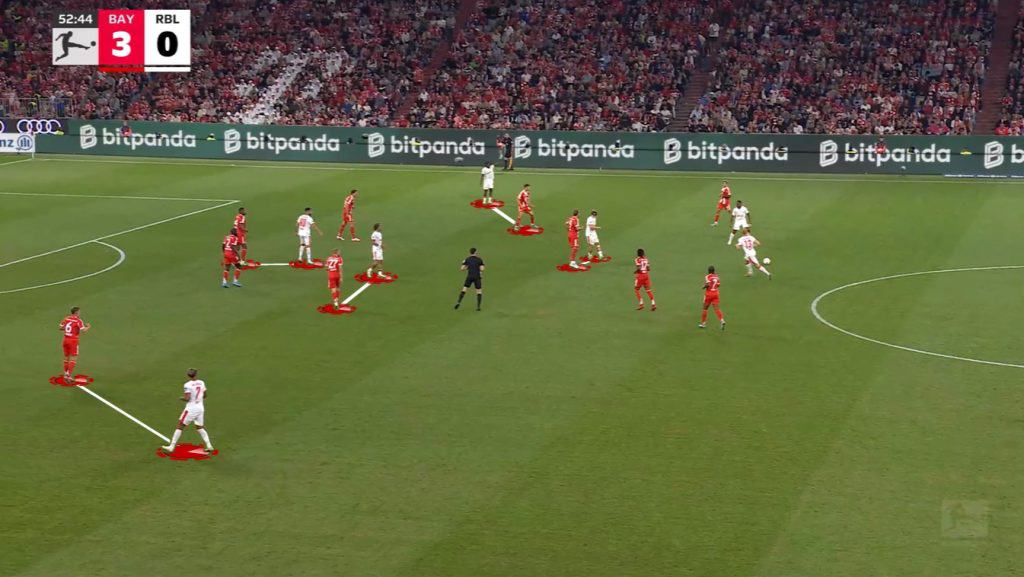
Here is an example of Bayern Munich defending deeper in their own half.
All the players have positioned themselves in a way that helps cut off options, especially the central ones.
In this case, Leipzig force a pass inside the structure, which gets intercepted and puts Bayern Munich in a counterattacking position.
As good as Bayern Munich were in possession and positive transition, they were vigilant in negative transition moments.
Whenever Leipzig were on a counterattack, Bayern Munich made sure to defend in numbers.
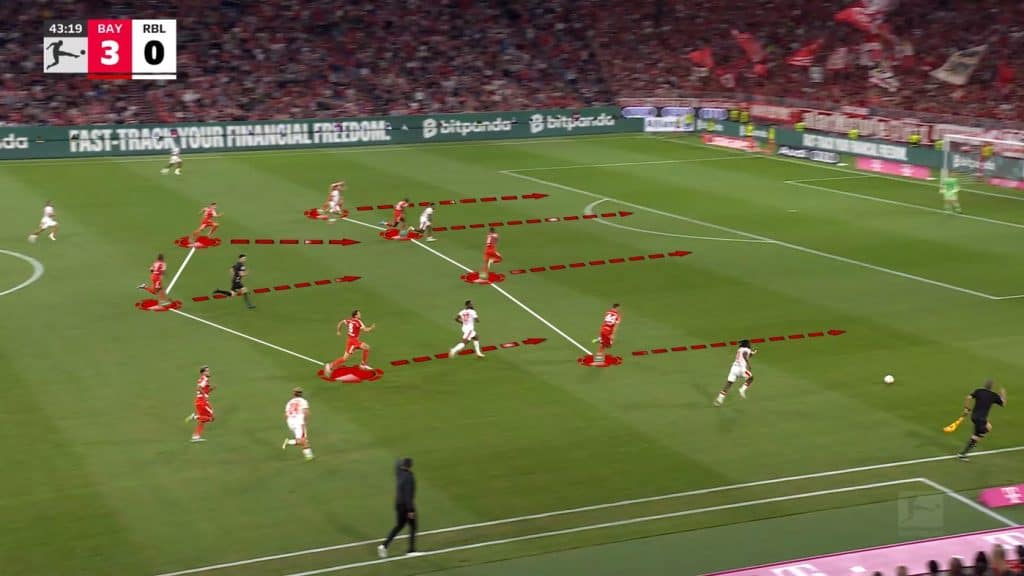
Here is an example of Bayern Munich in a defensive transition moment.
Leipzig’s right-winger gets released.
As Stanišić is quick to engage, the rest of the defenders are running to protect the space between them and Manuel Neuer.
Meanwhile, the midfield three are tracking back to provide cover against cut-backs.
Goretzka, who is the closest midfielder to Stanišić, runs to cover him in case the Croatian loses his 1-v-1 battle.
Conclusion
Bayern Munich were patient and creative in possession, keeping the ball rolling to find the right moment for penetration.
Their perpetual positional rotations in the central zone helped them create more space for the ball carrier.
Whenever they got the chance, they were ruthless in positive transition moments, starting and finishing their attacks rapidly.
They were disciplined in the defensive phase and cut off passing lanes to centrally positioned opponents.
Their hunger to get back in numbers during negative transition situations helped them keep a clean sheet, as they blocked off most chances and shots that came through.
