
Earlier this week, we received confirmation of a transfer that many had been expecting for some time as Leicester City announced the signing of the 22-year-old Zambian forward Patson Daka from Red Bull Salzburg.
The reported fee is approximately £22M, but even then, you might expect Salzburg to be more upset at losing a player who played 3,476 minutes last season and averaged 1.11 goals per 90 minutes.
Instead, the Austrian side accepts that this is all part of the project, as players develop and excel in the Austrian Bundesliga before moving on and generating a more than healthy profit for the club.
Indeed, the sale of Daka opens up first-team minutes for another player to come through their development pipeline.
While Sekou Koita, Mergim Berisha and Karim Adeyemi will all expect to gain more exposure in the 2020/21 season, the sale of Daka may speed up the integration of a young striker who could well eclipse what Daka has achieved in Salzburg.
That player is the 18-year-old Slovenian forward Benjamin Šeško.
Šeško is already firmly established within the Red Bull development network, having moved to Austria from the Slovenian side of NK Domžale in 2019.
He was immediately loaned to the second-tier side FC Liefering.
Liefering have an established partnership with RB Salzburg, providing a regular home for some of the Austrian Bundesliga side’s most promising talent.
While not being eligible for promotion to the Austrian top-flight as a result of this partnership, they do enjoy a steady flow of talented young players.
Likely, we will now see Šeško moved to the RB Salzburg squad for the start of the 2020/21 season but what kind of player is he?
Well, first of all, it is clear to see why there have been so many comparisons made to Erling Haaland.
Benjamin Sesko stands at 194cm | 6’4″ and he has a broad and powerful build.
Like Haaland, however, the Slovenian youngster possesses significant pace with the ability to make timed runs behind the opposition’s defensive line.
His pace allows him to create significant separation when moving on to through balls in these areas.
Benjamin also possesses the ability to score a wide variety of goals, finishing with his left or right foot (he is predominantly right-footed) or with his head.
The 18-year-old has scored tap-ins at the far post and angled drives from outside the area.
In short, the talented FC Liefering striker profiles as a goalscorer.
Benjamin Sesko Data Profile

The raw data behind Benjamin Sesko’s performance this season is impressive.
With 0.85 non-penalty goals per 90 from an xG of 0.64 with 5.57 touches in the opposition area per 90 and 3.37 shots per 90, these numbers show that Šeško is an attacking monster, and there is more than a bit of truth in that.
More than just a battering ram striker, however, Šeško is a player who could fit into a variety of attacking systems.
The Slovenian can lead the line and play with his back to goal, where he receives and then brings others into play.
He can also receive the ball deep and drive his team forward, as evidenced by his 3.77 dribbles per 90 minutes last season.
Benjamin Sesko Heat Map

Benjamin Šeško’s heatmap for last season shows us that the 19-year-old has a tendency to shade over to the left-side of the field when he receives the ball and completes the most actions.
He also tends to enter the penalty area from that side of the pitch.
With RB Salzburg likely to continue with their 4-2-2-2 structure, featuring verticality in possession and aggression out of possession as the cornerstones of their tactics, it is safe to say that Šeško will fit their system perfectly.
Ability To Stretch Defences
As mentioned above, one of the biggest strengths of Benjamin Šeško’s style of play is his ability to stretch the length of the pitch with runs in behind the defensive line.
There was some talk that during the 2020/21 season, whilst playing for Liefering, Šeško was measured running at 36.1 KM/hr in a match against FC Dornbirn.
To provide some context, that is extremely close to the top speed at which Kylian Mbappé has been measured.
What is key, however, is that Šeško has displayed a feel for the flow of the game.
By this, I mean that the Slovenian understands when to make his run and when to maintain his position off the shoulder of opposition defenders in order to stay online.
When the opposition do play with a higher defensive line, however, the FC Liefering forward is a constant threat to make a run that stretches the pitch.
Given that RB Salzburg’s vertical attacking tactics are known for it, this pace and ability to time a run will likely result in a significant number of goal-scoring opportunities for Benjamin Šeško.

Here, we see an example of Šeško’s willingness to run in behind the opposition defensive line from the aforementioned match against FC Dornbirn.
With the ball breaking in midfield and finally coming to a FC Liefering player, we see that Benjamin has isolated himself 1v1 against the defender nearest to this side of the pitch
It’s important to remember that the 19-year-old prefers to shade to the left where he can cut inside on his favoured right foot, as he waits for the right time to make his run.
As the player receiving the ball in midfield gets his head up, we then see Šeško starting his run across the first defender and into the gap between two of the three central defenders.
His pace means that, as he is already moving with momentum, he gains immediate separation from the opposing defenders.

Another example is Liefering in an attacking transition, with the ball being driven through the midfield.
Once again, Šeško has isolated himself against the opposition player on this side of the field and makes a timed run that breaks the line of the opposition’s defence.
This allowed him to move through on goal to collect the through ball.
Benjamin Sesko In The Final Third
In addition to having a physical profile that enables him to run behind the defensive line and create separation from opposing defenders, the Slovenian also displays the ability to identify and occupy pockets of space in and around the final third.
This allows him to receive the ball in dangerous areas before either combining with teammates moving from deeper positions or turning and accessing the penalty area in dangerous positions.
Indeed, it is difficult to categorise Šeško as either a reference striker or as a dynamic player who attacks space.
Instead, he is a mix of both.

Here, we see Liefering attacking in an established attacking phase, with the opposition’s defensive structure already poorly organised.
The ball carrier is moving across the face of the goal, and this drags the highlighted defender across the goal as well.
This further strengthens the connection between the two highlighted defensive players and increases the space that Šeško accesses by positioning himself between them.
When Šeško receives the ball in this position he can immediately turn and access the penalty area with a clear angle to get off a shot at goal.

This time, we see Šeško taking possession of the ball in the wide spaces before finding access to the penalty area and working a shooting chance.
As we discussed above, we see the Slovenian youngster displaying a clear preference for working from the left side of the pitch and attacking into the centre of the pitch.
When Benjamin Šeško receives the ball wide in these circumstances, he can carry the ball powerfully and quickly towards goal.
The 19-year-old can also overpower fullbacks fairly easily when isolated against them.
We see that in this example, as he receives the ball and then casually brushes past the opposition fullback before cutting back inside towards the edge of the area.
From this position and on his favoured right foot, we then see Šeško scoring with a powerful drive into the far corner.
Benjamin Šeško Link-up Play
While Šeško profiles very much as a multi-functional finisher who can play extensively in all phases of the game, he is also a player who can help his team to progress the ball through the thirds thanks to his ability to position himself intelligently and to receive under pressure.
Indeed, the Slovenian is extremely press-resistant, as he displays the ability to accept possession of the ball and then hold off pressure from the opposing defenders.
This ability to receive the ball allows the players in position on the first line to find a progressive passing option through the thirds.
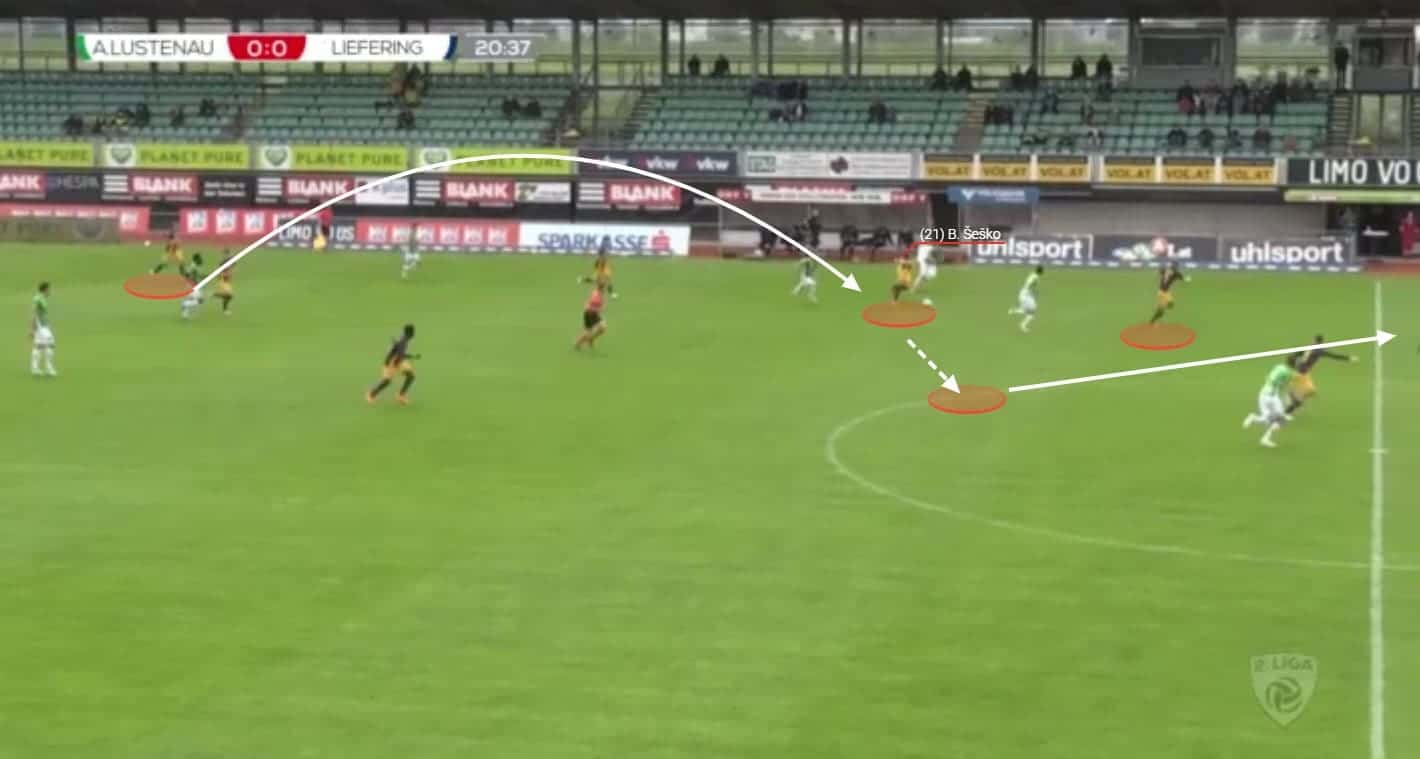
Here, we see an example of this as Šeško has dropped back towards the ball to receive and accept possession before turning and progressing the ball through the next line himself.
The 18-year-old collects possession deep and with his back to goal, while a defensive player is right behind him.
His frame and balance enable him to secure possession of the ball in these areas before manipulating it past opposing defenders.
Here, as he turned forward, he took a positive touch into space and then looked for a line-breaking pass to move the ball into the opposition half and to release a teammate into an attacking position.

This time, we see Šeško in a more advanced position as he receives the ball and then combines quickly with a teammate.
This time, he has identified a gap in the opposition’s defensive structure and moves to occupy this pocket of space.
As the ball is played forward and into his feet, a defender has tracked this movement.
Instead of receiving and taking contact as so many strikers would in this situation, he lays the ball laterally to where a teammate is positioned.
Šeško then makes a second run to break the defensive line of the opposition.
Conclusion
There is a very good reason why the Red Bull group is considered one of the premium networks in world football when it comes to youth development.
For every player who makes an impact in Austria and then moves on to more competitive leagues, others behind them are waiting for their opportunity to gain regular first-team minutes.
Patson Daka’s performances over the last two seasons have been nothing short of remarkable, and I believe that he will thrive at Leicester City.
I also believe, however, that Benjamin Šeško possesses the skillset to be every bit as successful as Daka, if not more so.
