
There have been rumours in football recently that Matthias Jaissle could be set to leave Red Bull Salzburg at the end of the season, regardless of whether they retain the Austrian Bundesliga title.
If that is the case, the question then becomes who will replace the 35-year-old German in Wals-Siezenheim?
The answer to this could come from within, with Salzburg likely to consider 31-year-old Austrian Fabio Ingolitsch, who is currently the head coach of Salzburg’s feeder club FC Liefering in the Austrian second division.
Jaissle followed a similar path from Liefering to Salzburg, so it would not be a surprise to see it happen again.
This Fabio Ingolitsch tactical analysis will examine his tactics at Liefering and assess whether he could be the next in line to lead the powerhouse Austrian club.
Fabio Ingolitsch Formation & Style Of Play

When it comes to formations used this season for FC Liefering, Ingolitsch has preferred to set his side up in some form of a back four, usually a 4-3-1-2. This diamond shape in midfield is similar to what Jaissle uses with Salzburg, with the fullbacks getting forward and often joining the attacks due to the formation’s narrow shape. The shape also becomes a 4-1-3-2 during pressing phases of play, which will be covered in more detail later in this analysis.
When looking at how Ingolitsch’s Liefering side play, they have very much been a side this season that will score multiple goals a match, but also concede multiple as well. In fact, Liefering are averaging 1.78 goals per 90 minutes this season, while averaging 1.83 goals against. They have not had the greatest season, with the club sitting 10th in the Austrian second division. Still, you have to consider that they are by far the youngest side in the division, with an average age of 18.8, along with a young manager in only his first season at the club and his first head coaching job in football.
One thing this Liefering side does really well under Ingolistch is press, with their PPDA of 5.72 ranking second-highest in the division. It is no surprise Ingolitsch wants his side to play like this, as the Austrian was previously an assistant under both Gerhard Struber and Bo Svensson, two coaches known for their high-tempo pressing philosophy and front-foot attacking principles.
Along with the pressing, the Austrian’s use of third-man runs to create overloads and open up passing lanes has allowed the second-tier side success going forward this season, with Liefering the third-highest scorers in the Austrian second division.
Use Of Third-Man Runs
When watching Liefering this season under Fabio Ingolitsch, one thing that stands out from their attacking style of play is their tendency to play the ball into the wide channels during the attacking phases. Because of the narrowness of the 4-3-1-2 that Ingolitsch uses, the fullbacks become key contributors to the attack. They will often make overlapping runs beyond the outside central midfielders, looking to create overloads in the wide channels.
These third-man runs allow Liefering to drag opposition defences out of position, with the ball then able to be played either wide for the fullback to cross into the box or centrally, as the defenders are pulled out of position.
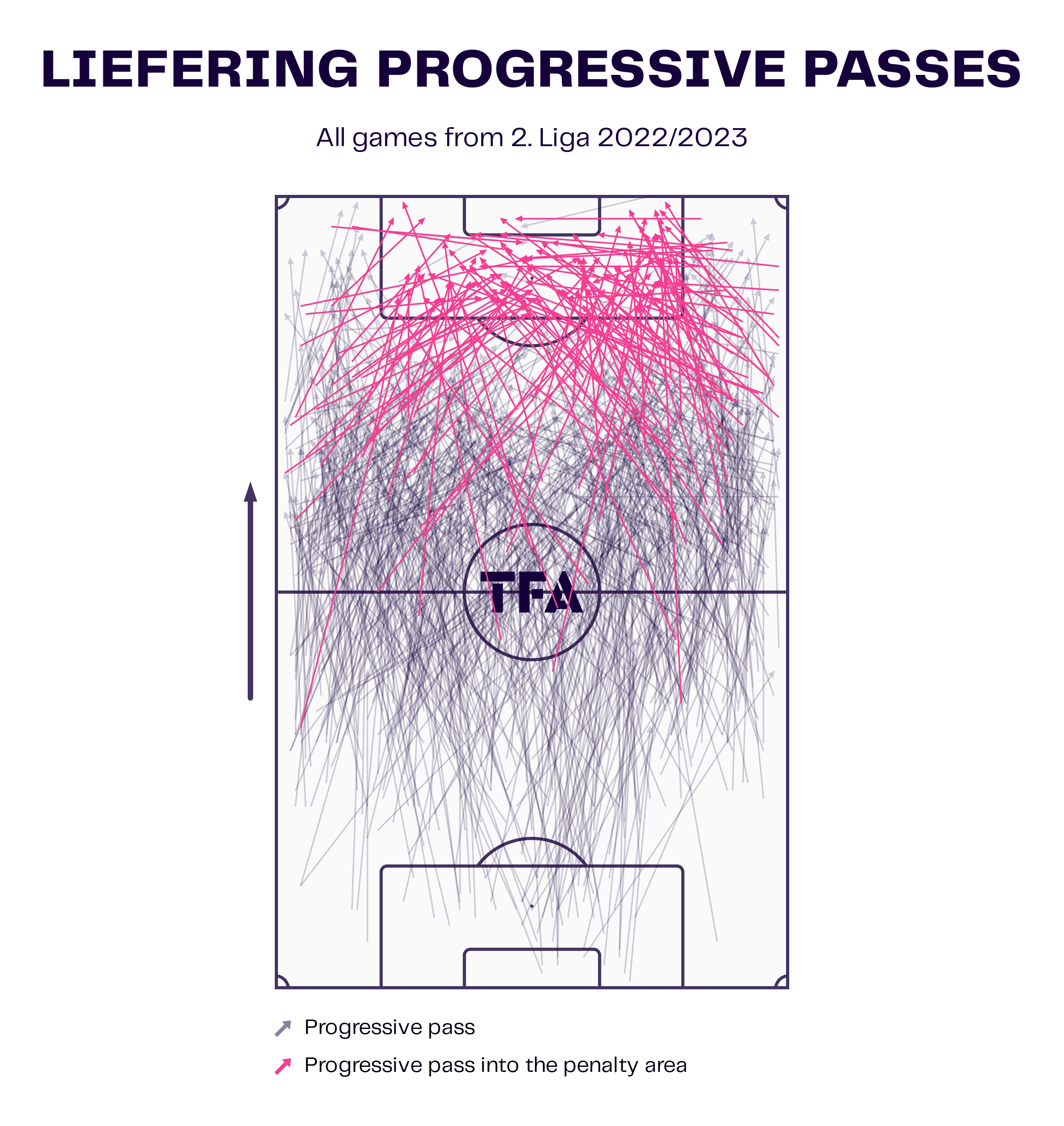
The data viz graphic above shows Liefering’s progressive passes this season, and, more specifically, in pink, the progressive passes into the penalty area. As mentioned, these attacking moves and third-man runs aim to create overloads out wide and open up passing lanes centrally.

The image above shows an example of these attacking principles from Ingolitsch. In this recent match against Dornbirn, Liefering were in possession with one of the outside central midfielders on the ball. The fullback makes an overlapping run beyond the midfielder, with one of the strikers also drifting wide into this channel to temporarily attempt to create an overload against the Dornbirn defence. As a result of the potential danger, this forces the opposition defenders to react, dragging over an opposition midfielder and one of the centre-backs to neutralise this overload from Ingolitsch’s side.
This off-the-ball positional movement from the Liefering attackers opens up space centrally, with the Liefering attacking midfielder able to move into the pocket of space that has formed between the Dornbirn centre-backs. As a result, once the fullback receives possession, he plays the pass centrally to the feet of the #10. Unfortunately, he miscontrols the pass and loses possession. However, it still illustrates how Ingolitsch looks to utilise the fullbacks and outside central midfielders in attack to create space for the ball to be progressed into.
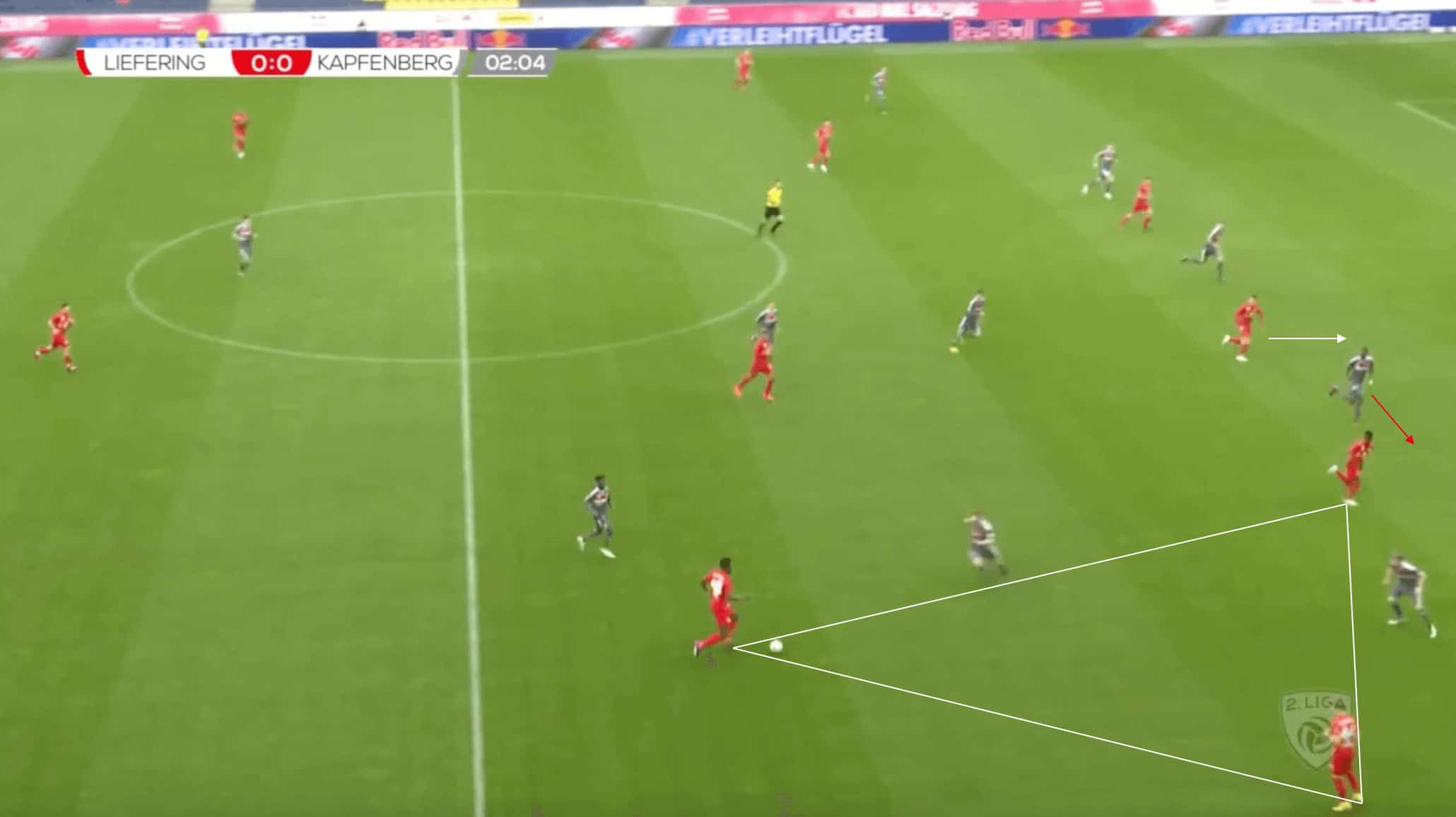
The image above again shows an example where the fullback and outside central midfielder both play a part in forming an overload in the wide channel that forces the opposition defenders to react. In this phase of play above against Kapfenberg, Liefering again created a 3v2 overload in the wide channel. The centre-back dribbles into midfield, with the fullback keeping the width on the near touchline, and the right-sided central midfielder making a run from deep beyond the Kapfenberg fullback. Currently, Ingolitsch’s side holds a numerical advantage against the defence, creating an overload.
This forces the opposition central defender to react, vacating the space to drift wide and track the run of the Liefering midfielder, allowing him to run past the fullback’s blind shoulder. As in the previous example, this again opens up the central passing lane for the Liefering forward to run into. The centre-back’s pass to the forward in the central position is unfortunately dispossessed. However, it once again illustrates the same attacking principle from Fabio Ingolitsch, which created space for the ball to be played vertically into the central area.
Aggressive Use Of Pressing
Another tactic that stands out when watching FC Liefering under Fabio Ingolitsch style of play is his aggressive use of pressing and front-foot defending. This does not come as a surprise, as the 31-year-old Austrian has been an assistant under both Gerhard Struber and Bo Svensson, two coaches well known for this philosophy.
It is also interesting to look at the pressing statistics of Liefering next to Matthias Jaissle’s Salzburg, with the stats looking very similar.
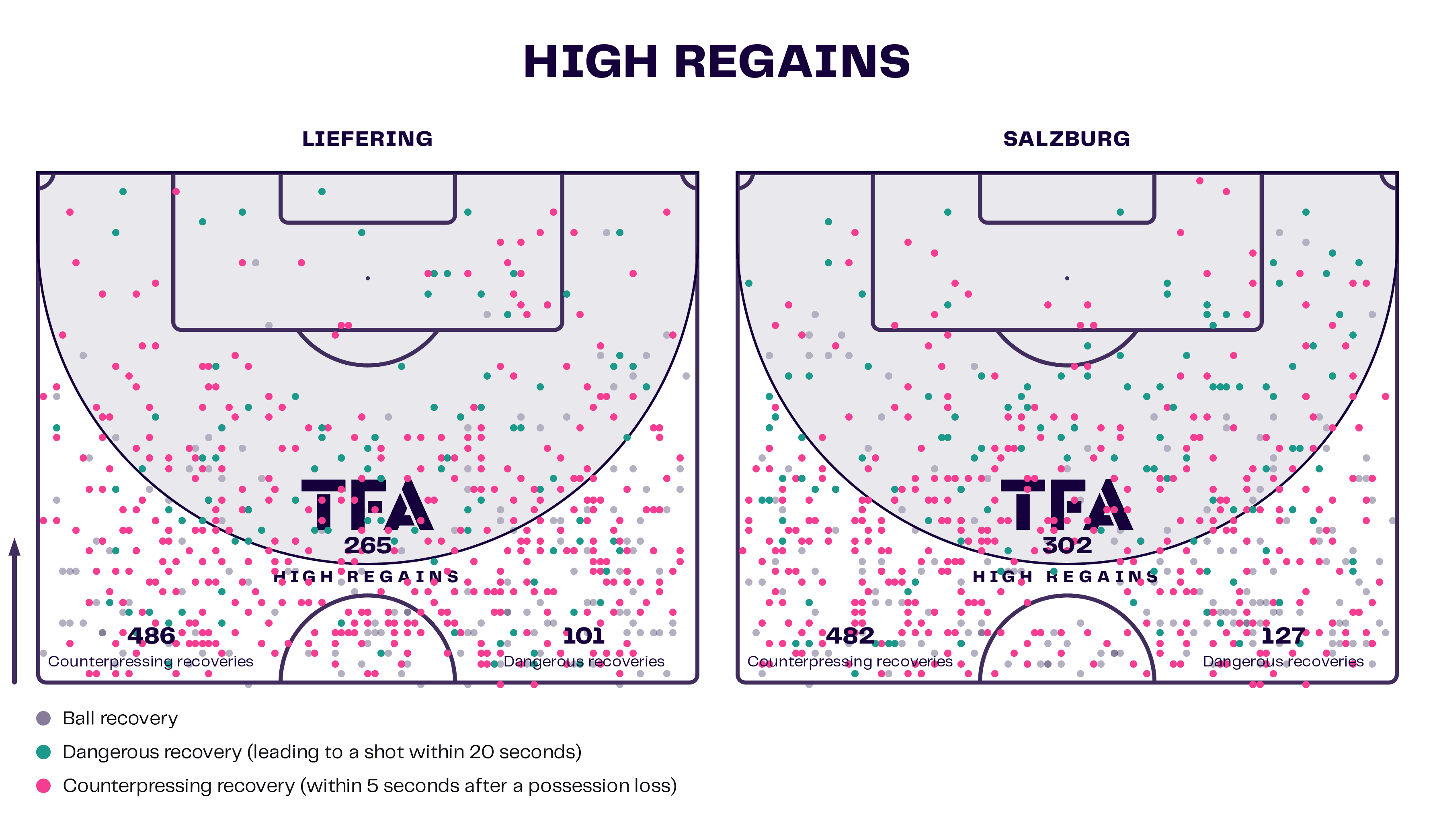
The data viz graphic above shows the high regains, counter-pressing recoveries, and dangerous recoveries of both Liefering and Salzburg this season. As the data shows, both coaches share a very similar philosophy: pressing aggressively and defending from the front. When taking a deeper dive into the numbers, Liefering are statistically one of the most aggressive sides in the Austrian second division, if not the most. Their challenge intensity, a statistic that looks at team defensive actions per minute of opponent possession, of 8.8 is the highest in the league, and their PPDA of 5.72 is the second-highest pressing rate in the league, only behind Blau-Weiß Linz’s 5.49.
When looking at Salzburg in these same metrics this season under Matthias Jaissle, there is not much difference in the numbers. The Austrian champions are top in both categories in the Austrian Bundesliga, with a challenge intensity of 7.8 and a PPDA of 6.6. Both sides look to defend with intensity and tempo, looking to win the ball back quickly in advanced areas and transition quickly into the attacking phase.
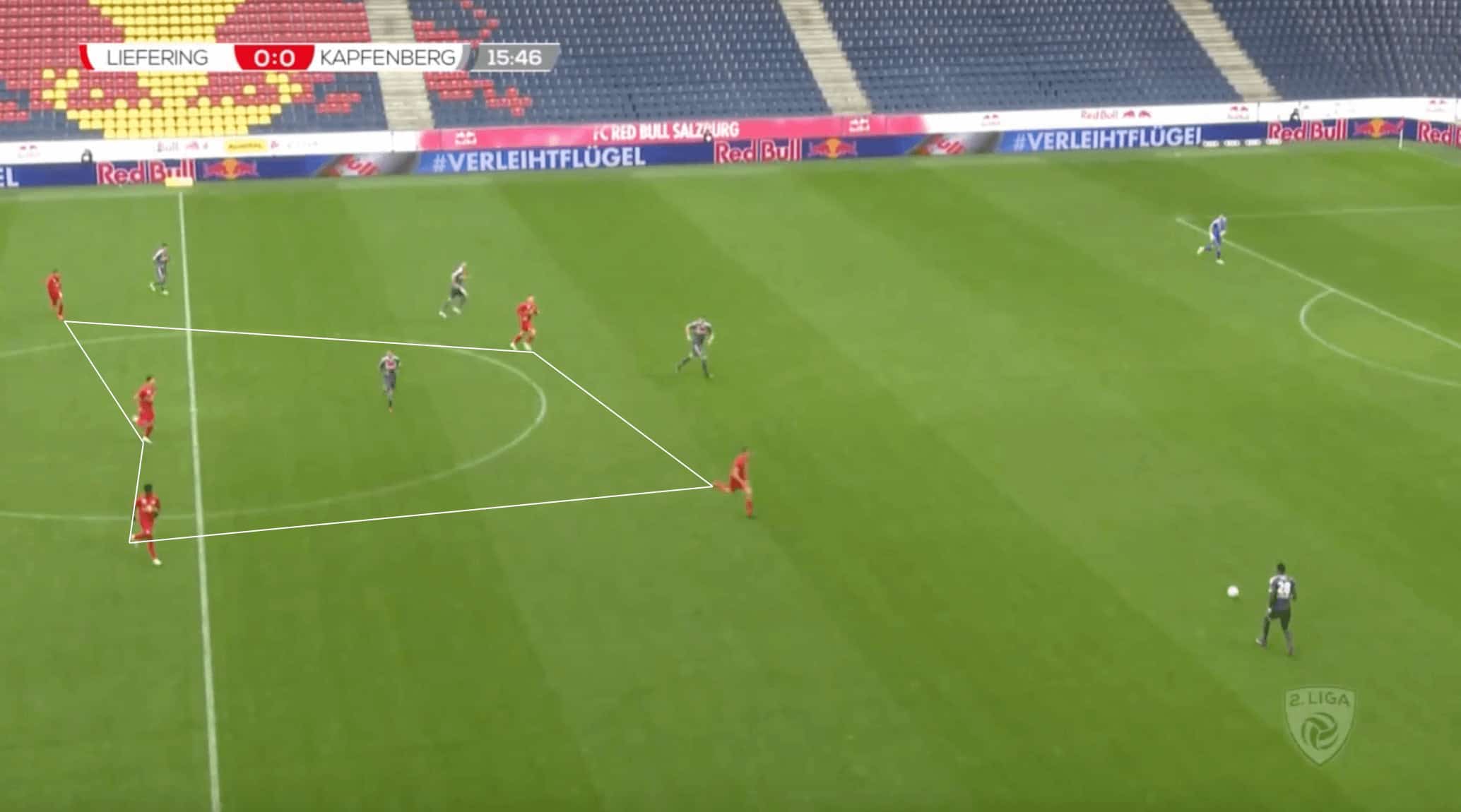
The image above shows the type of pressing shape Fabio Ingolitsch has utilised this season with Leifering. The 4-3-1-2 shape pushes up into a 4-1-3-2, with the outside central midfielders joining the press looking to overload the central areas in these defensive phases. An example of this is shown above from one of their recent matches against Kapfenberg.
As we can see, Liefering have a 5v4 numerical advantage in the central area, eliminating any potential opportunity for the opposition to play through the Liefering press centrally. Ingolitsch looks for his side to force the ball wide, where they can then quickly move wide to engage and keep the ball locked in to one side of the field.
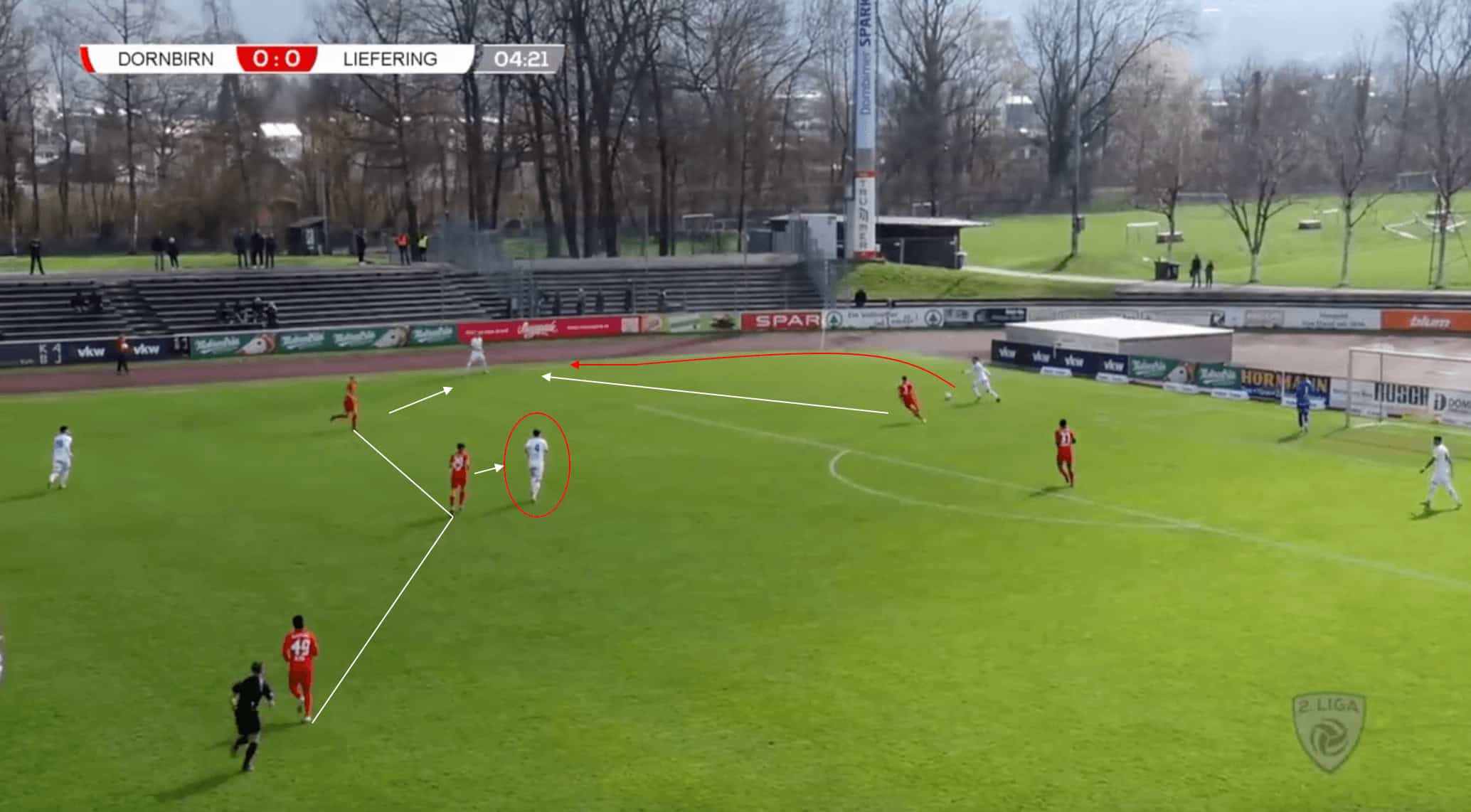
The pressing shape for Liefering is shown again in the image above. The forward five for Liefering again look to have numerical superiority in the central areas, forcing the opposition to play wide when they build out from the back. In this specific phase of play, the angling of the striker’s movement to close down the centre-back does not allow the pass to be played forward centrally to the #6. He is also closely marked by the Lierfering #10, meaning any pass would likely be risky anyway, considering the number of players centrally that would swarm the Dornbirn defensive midfielder.
This press from Ingolitsch’s side means the centre-back ends up playing his fullback into a trap, with the outside central midfielder already moving to engage the defender when he receives possession, anticipating the pass. While the opposition side drop to support the defender in possession, the Liefering press becomes too much, with Ingolitsch’s side able to retain possession and start a dangerous transitional attacking moment.
Conclusion
When former Leeds United head coach Jesse Marsch left Salzburg for Leipzig, the Austrian side promoted Jaissle to the role after only six months in charge at Leifering. Now, about two years later, the same thing could happen with Fabio Ingolitsch, with the 35-year-old Jaissle being linked with Eintracht Frankfurt in case Oliver Glasner leaves the club, with himself having been linked with the vacant jobs at Tottenham and Chelsea.
As this tactical analysis has shown, while Ingolitsch has not had as good a start to life at Liefering as Jaissle did, he is a promising coach. Salzburg has demonstrated in the past that it is not afraid to give a young manager a chance, as it did with the 35-year-old German. Even if Ingolitsch is not the next head coach at Salzburg, he is a bright tactical mind who will definitely make the jump to a top-flight side in the near future.
