Total Football Analysis
  • Football Analysis
    • Data Analysis
    • Formations
      • 2-2-4 Formation
      • 2-3-5 Formation
      • 3-1-4-2 Formation
      • 3-2-2-3 Formation
      • 3-2-4-1 Formation
      • 3-1-6 Formation
      • 3-3-4 Formation
      • 3-4-1-2 Formation
      • 3-4-2-1 Formation
      • 3-4-3 Formation
      • 3-5-1-1 Formation
      • 3-5-2 Formation
      • 4-1-4-1 Formation
      • 4-2-2-2 Formation
      • 4-2-3-1 Formation
      • 4-2-4 Formation
      • 4-3-1-2 Formation
      • 4-3-3 Formation
      • 4-4-2 Formation
      • 4-5-1 Formation
      • 5-3-2 Formation
      • 5-4-1 Formation
      • 6-3-1 Formation
    • Head Coach Analysis
    • Match Analysis
    • Player Analysis
    • Recruitment Analysis
    • Set Piece Analysis
    • Tactical Theory
    • Tactical Preview
    • Team Analysis
    • Training Analysis
    • Tactical Analysis
    • Scouting Report
  • Competition
    • ALL Competitions
    • English Premier League
    • Champions League
    • La Liga
    • Bundesliga
    • Serie A
    • Ligue 1
    • Eredivisie
    • EFL Championship
    • FIFA World Cup 2022
    • WEURO 2022
    • Women’s Super League
    • NWSL
    • Belgian First Division A
    • A-League
    • Liga Profesional de Argentina
    • Austrian Bundesliga
    • Campeonato Brasileiro Série A
    • DFB Pokal
    • 1. HNL
    • Danish Superliga
    • EFL League One
    • EFL League Two
    • FA Cup
    • EFL Cup
    • Indian Super League
    • K-League
    • J1 League
    • Liga MX
    • Copa América 2021
    • Copa del Rey
    • MLS
    • Eliteserien
    • Euro 2020
    • Primeira Liga
    • Scottish Premiership
    • Allsvenskan
    • Europa League
    • UEFA Nations League
    • Liga AUF Uruguaya
  • Coaches
    • All Coaches
    • Alfred Schreuder
    • Ange Postecoglou
    • Antonio Conte
    • Arne Slot
    • Bo Svensson
    • Brendan Rodgers
    • Bruno Lage
    • Carlo Ancelotti
    • Christophe Galtier
    • Claude Puel
    • Claudio Ranieri
    • David Moyes
    • Dean Smith
    • Diego Simeone
    • Domenico Tedesco
    • Frank Lampard
    • Eddie Howe
    • Edin Terzić
    • Emma Hayes
    • Erik ten Hag
    • Ernesto Valverde
    • Gennaro Gattuso
    • Gerardo Seoane
    • Gian Piero Gasperini
    • Giovanni van Bronckhorst
    • Graham Potter
    • Igor Tudor
    • Imanol Alguacil
    • Jesse Marsch
    • Jonas Eidevall
    • Jorge Sampaoli
    • José Bordalás
    • José Mourinho
    • Julen Lopetegui
    • Julian Nagelsmann
    • Julien Stéphan
    • Jürgen Klopp
    • Luciano Spalletti
    • Lucien Favre
    • Manuel Pellegrini
    • Marcelo Bielsa
    • Marco Rose
    • Marco Silva
    • Massimiliano Allegri
    • Mauricio Pochettino
    • Maurizio Sarri
    • Mikel Arteta
    • Niko Kovač
    • Nuno Espírito Santo
    • Oliver Glasner
    • Patrick Vieira
    • Paulo Fonseca
    • Pep Guardiola
    • Peter Bosz
    • Rafa Benítez
    • Ralf Rangnick
    • Ralph Hasenhüttl
    • Roger Schmidt
    • Roy Hodgson
    • Sean Dyche
    • Sérgio Conceição
    • Simone Inzaghi
    • Sonia Bompastor
    • Stefano Pioli
    • Steffen Baumgart
    • Steven Gerrard
    • Thiago Motta
    • Thomas Frank
    • Thomas Tuchel
    • Unai Emery
    • Vincenzo Italiano
    • Xavi
  • Teams
    • ALL Teams
    • AC Milan
    • Ajax Amsterdam
    • Arsenal
    • AS Monaco FC
    • Atalanta
    • Atlético Madrid
    • FC Barcelona
    • FC Bayern Munich
    • Borussia Dortmund
    • Celtic FC
    • Chelsea FC
    • Everton F.C.
    • Inter Milan
    • Juventus F.C.
    • Leeds United F.C.
    • Liverpool FC
    • Manchester City
    • Manchester United FC
    • Paris Saint-Germain
    • Rangers FC
    • RB Leipzig
    • Real Madrid CF
    • Tottenham Hotspur
    • West Ham United
  • Players
    • ALL Players
    • Alisson Becker
    • Bukayo Saka
    • Erling Haaland
    • Harry Kane
    • Jack Grealish
    • John Stones
    • Julián Alvarez
    • Kalvin Phillips
    • Kevin De Bruyne
    • Kyle Walker
    • Kylian Mbappé
    • Lamine Yamal
    • Lionel Messi
    • Luis Díaz
    • Mohamed Salah
    • Phil Foden
    • Virgil Van Dijk
  • Guides
    • Best Betting Sites
      • World Cup Betting Sites
      • World Cup Betting Promotions
      • Footbal Betting Sites
      • New Betting Sites
    • Online Casinos
      • Non GamStop Casinos
      • Offshore Casinos
      • Real Money Slots
  • Contact
No Result
View All Result
No Result
View All Result
Total Football Analysis
No Result
View All Result
Home Analysis Formations 4-2-4 Formation

Nuno Espírito Santo Tactics At West Ham 2025/2026: Applying His Nottingham Forest Blueprint To The Irons – Tactical Analysis

Aaron O'Shea by Aaron O'Shea
October 5, 2025
in 4-2-4 Formation, 4-4-2 Formation, 4-5-1 Formation, Analysis, Anthony Elanga, Chris Wood, Elliot Anderson, Head Coach Analysis, Jarrod Bowen, Kyle Walker-Peters, Lucas Paquetá, Mateus Fernandes, Morgan Gibbs-White, Murillo, Nikola Milenković, Nottingham Forest F.C., Nuno Espírito Santo, Premier League, Tactical Analysis, West Ham United
0
Nuno Tactics At West Ham 2025/2026

In a past interview, Nuno Espírito Santo explained his defensive philosophy:

“I think, but maybe I am the only one, that the defensive process can take care of the game.

Why is that?

Because teams wait to defend.

If you create something where you go to defend, to steal the ball where you want, it’s different.”

This quote provides real insight into Nuno’s mindset.

He believes in controlling the game through defensive organisation rather than by keeping the ball.

His teams aim to push opponents into areas where they are comfortable defending, then win the ball back in zones that allow them to transition quickly.

In this Nuno Espírito Santo tactical analysis, we will assess Nuno’s out-of-possession and in-possession principles, examine how sustainable his style of play is, and consider how well this West Ham United team profiles for his coaching methods.

Nuno Espírito Santo Defensive Principles

At Nottingham Forest, Nuno implemented a narrow 4-2-4 pressing structure.

Nuno's narrow 4-2-4 Press
Nuno Espírito Santo’s narrow 4-2-4 Press, preventing central progression.

In this system, Morgan Gibbs-White and Chris Wood were tasked with blocking passing lanes into the opposition’s ‘sixes’, while the wingers tucked in alongside the front two to prevent access into the ’10s’.

The two central midfielders then matched up directly with the opposition’s advanced midfielders.

The intention is clear: force opponents wide, stop central progression, and defend within a compact mid-block.

From here, Forest looked to win second balls when teams attempt to play through the press.

When opponents are forced wide, Forest’s full-backs engaged aggressively with the opposition wingers, pressing with maximum intensity.

Nuno Espírito Santo Statistical Profile

The statistical profile of Forest last season illustrates just how much Nuno prioritises defensive solidity over possession.

They ranked 18th in the league for average possession (40.8%), highlighting that they are not concerned with dominating the ball.

Yet this has not prevented them from competing.

Forest were sixth for goals conceded per game (1.20) and were joint-second with 13 clean sheets.

Their defensive style is also reflected in their league-leading numbers for clearances (31.1 per game), underlining how often they set up to defend their box and win the ball back.
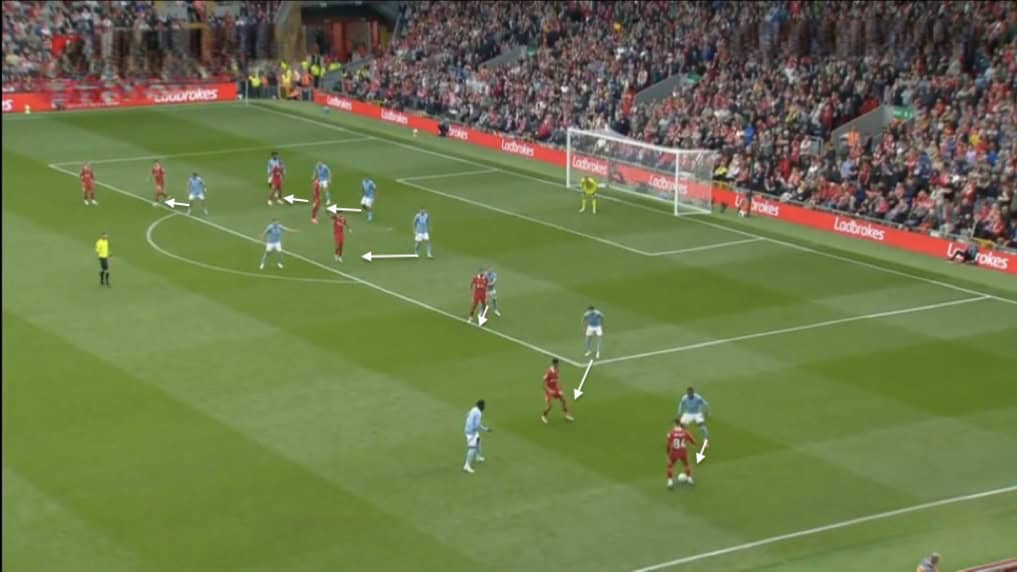
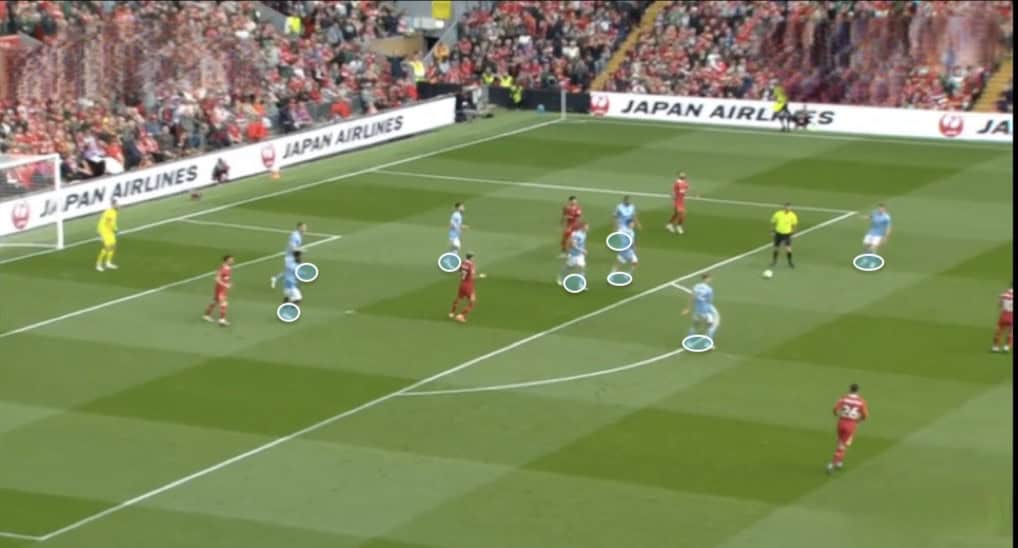
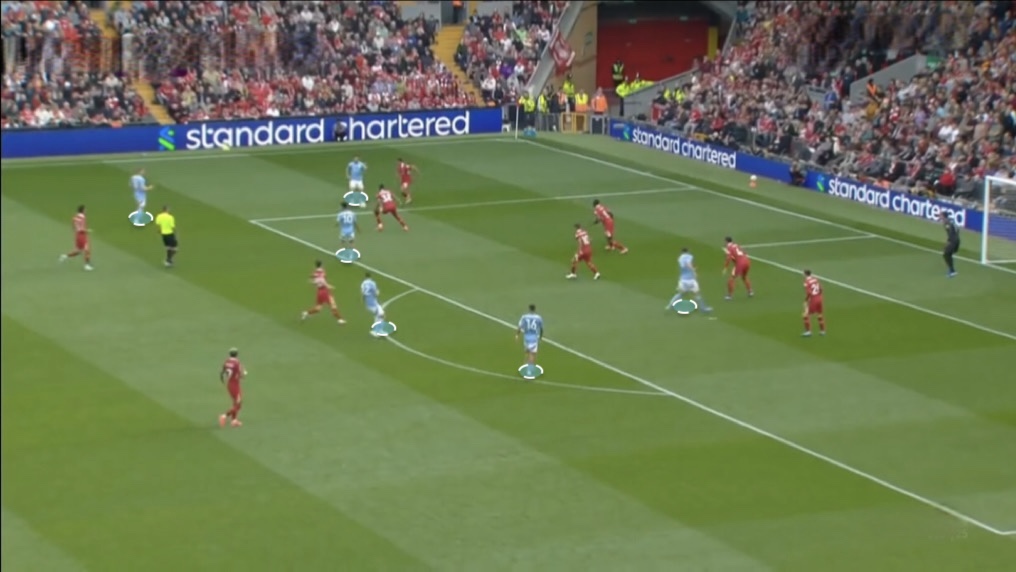
Defending in a low block vs Liverpool. Allowing no free players in the box.

Offensively, they average 1.50 goals per match, which placed them in the top half of the league despite their low possession share.

The numbers confirm what the eye test suggests: Nuno is a defensive coach who builds from the back and looks to win games through organisation, intensity and direct attacking play rather than long spells of ball retention.

Nuno Espírito Santo Examples Vs Liverpool

Liverpool provided a good case study of how this structure operates.

Nuno's narrow 4-2-4 Press
Nuno Espírito Santo’s narrow 4-2-4 Press, Wood + Gibbs-White preventing passes into Liverpool’s number sixes

On multiple occasions, Wood and Gibbs-White picked up Liverpool’s ‘sixes’, while Forest’s wingers matched up against Liverpool’s narrow full-backs.

The two Forest ‘eights’ tracked runners dropping from forward positions, while Forest full back Àlex Moreno was ready to jump to press the winger.
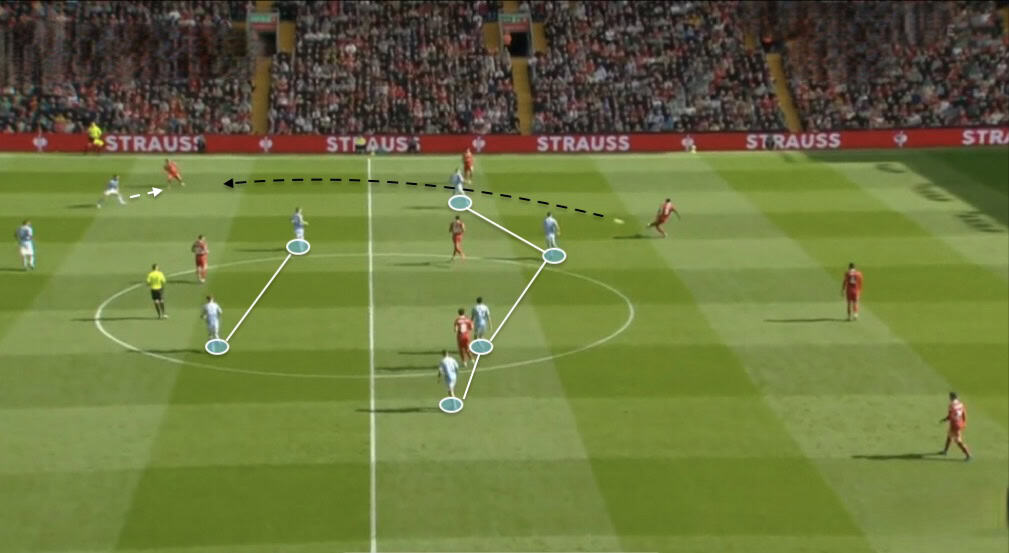
Ola Aina jumping aggressively to Liverpool winger once press is bypassed
Forest full back jumping aggressively to Liverpool winger once the press is bypassed

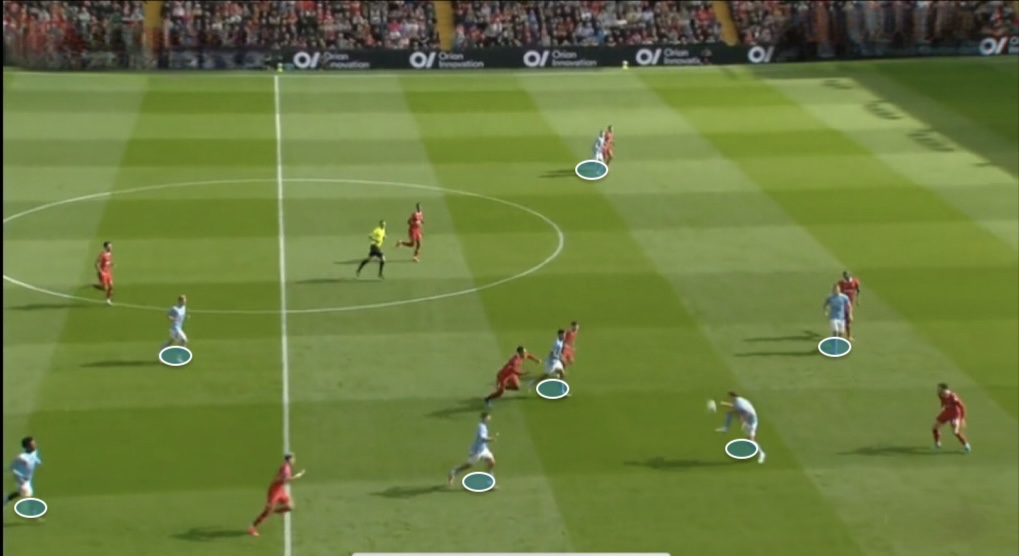
One of Forest’s greatest strengths last season was the intensity with which they execute these actions.

Against Liverpool, one of the Premier League’s most devastating transitional sides, Forest showed their commitment to recovery runs.
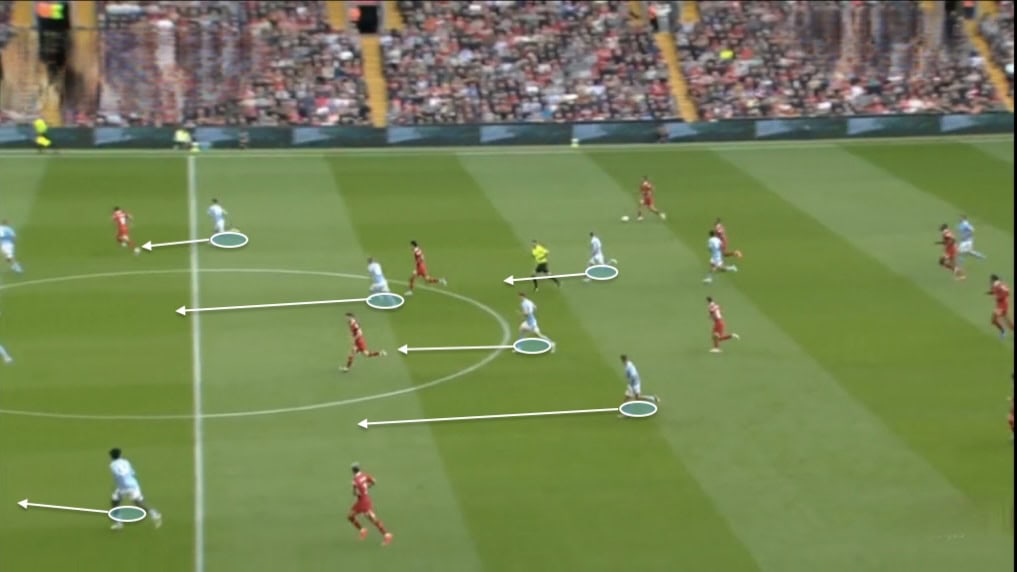
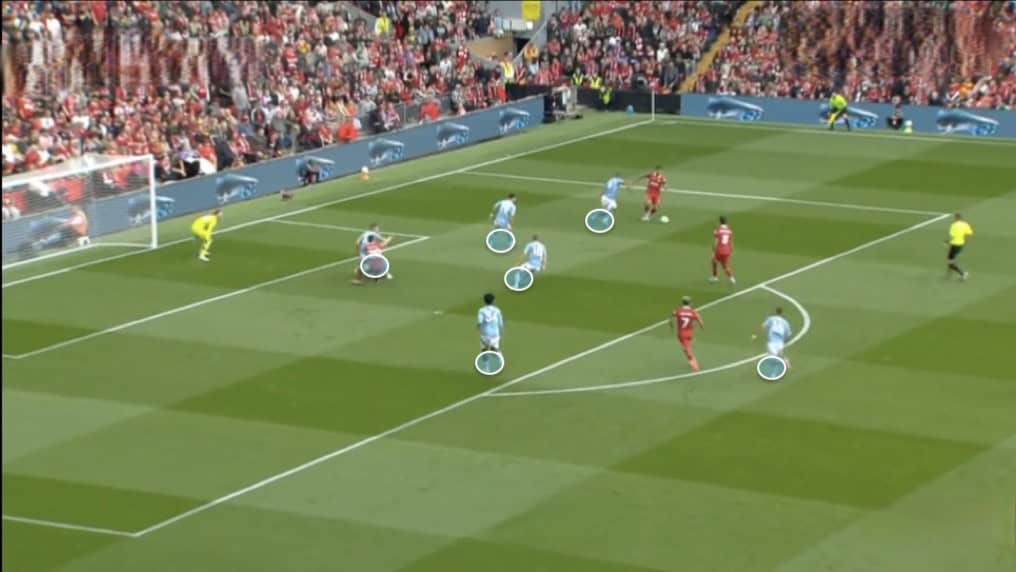
Liverpool transitioning quickly and the amount of Forest players pushing themselves with maximum intensity to get back
Liverpool transitioning quickly, and the number of Forest players pushing themselves with maximum intensity to get back
Salah facing up Forest defenders in the box
Salah is facing up Forest defenders in the box
Forest get 8 players back to recover the situation. Top class recovery defending
Forest get eight players back to recover the situation. Top-class recovery defending

Even when caught in difficult transition moments, players sprinted back into shape.

Within seconds of Mohamed Salah carrying the ball into Forest’s penalty area, they had eight outfield players back to snuff out the attack.

Strengths Of The Nuno Espírito Santo Mid-Block

The positives of pressing in this narrow 4-2-4 mid-block are twofold.

Firstly, if the ball is turned over, the front four players are already in advanced positions to launch a counterattack.

Secondly, this approach saves energy, as it does not require the team to press high for long periods but instead condenses the pitch into specific areas.

This system also suited the profiles of Forest’s players.

Gibbs-White is among the best number tens in the league, Wood provides a reliable target man and clinical finisher, Anthony Elanga offered explosive pace and power, while Callum Hudson-Odoi is one of the best one-v-one wingers in the league.
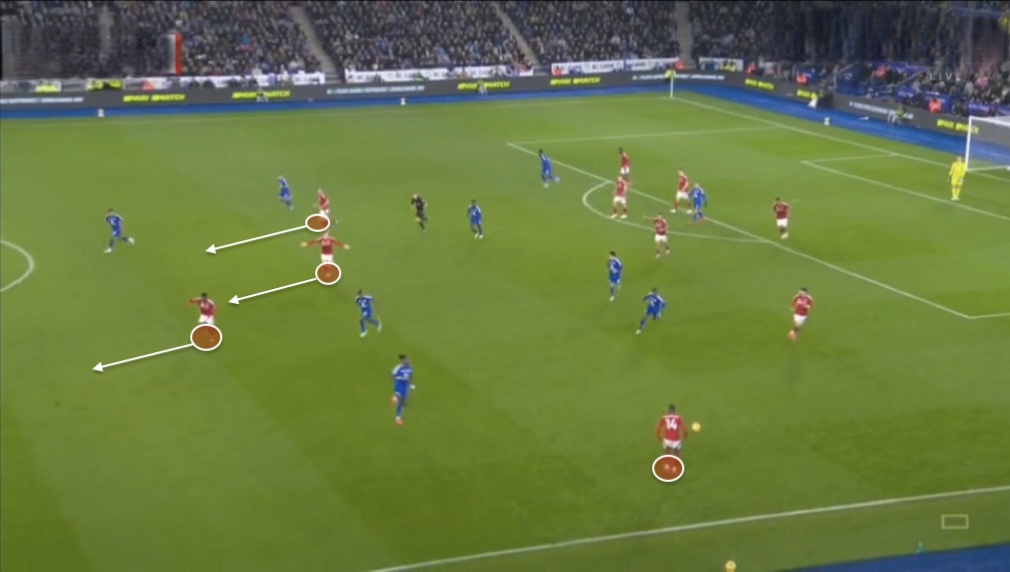
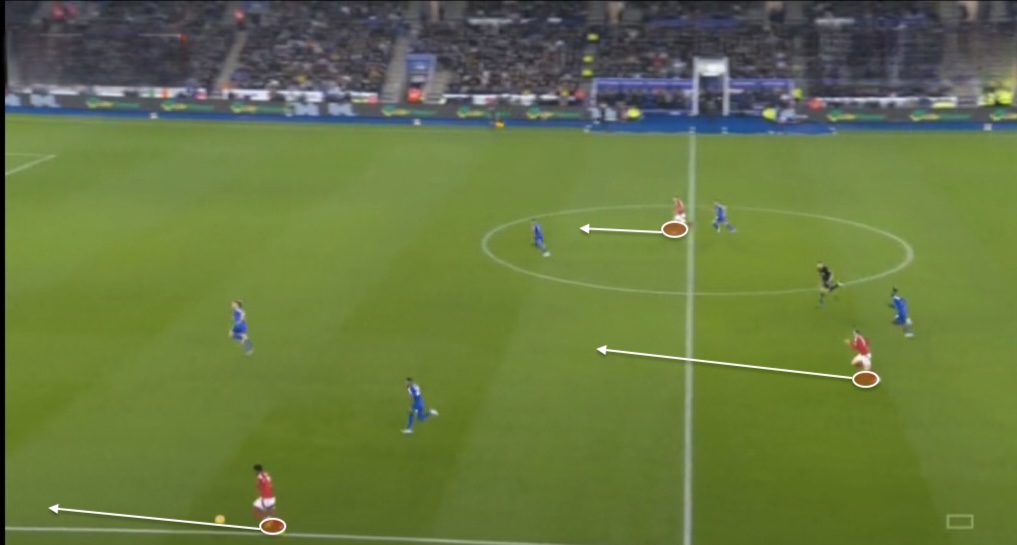
As soon as Forest regain possession - they look to attack directly at speed. 4 Players break immediately at speed
As soon as Forest regain possession – they look to attack directly at speed. 4 Players break immediately at speed
Elanga transitions at speed with support runners with him
Elanga crosses into Chris Wood

Credit must go to Nuno for constructing a balanced system that plays to their strengths.

In-Possession Links

Nuno’s out-of-possession approach is closely linked to his in-possession strategy.

Forest were top of the Premier League table at one point last season despite their extremely low possession figures.

This is because Nuno wanted his side to play forward and direct as soon as they regain the ball.

Most of Forest’s dangerous attacks began from opposition turnovers.

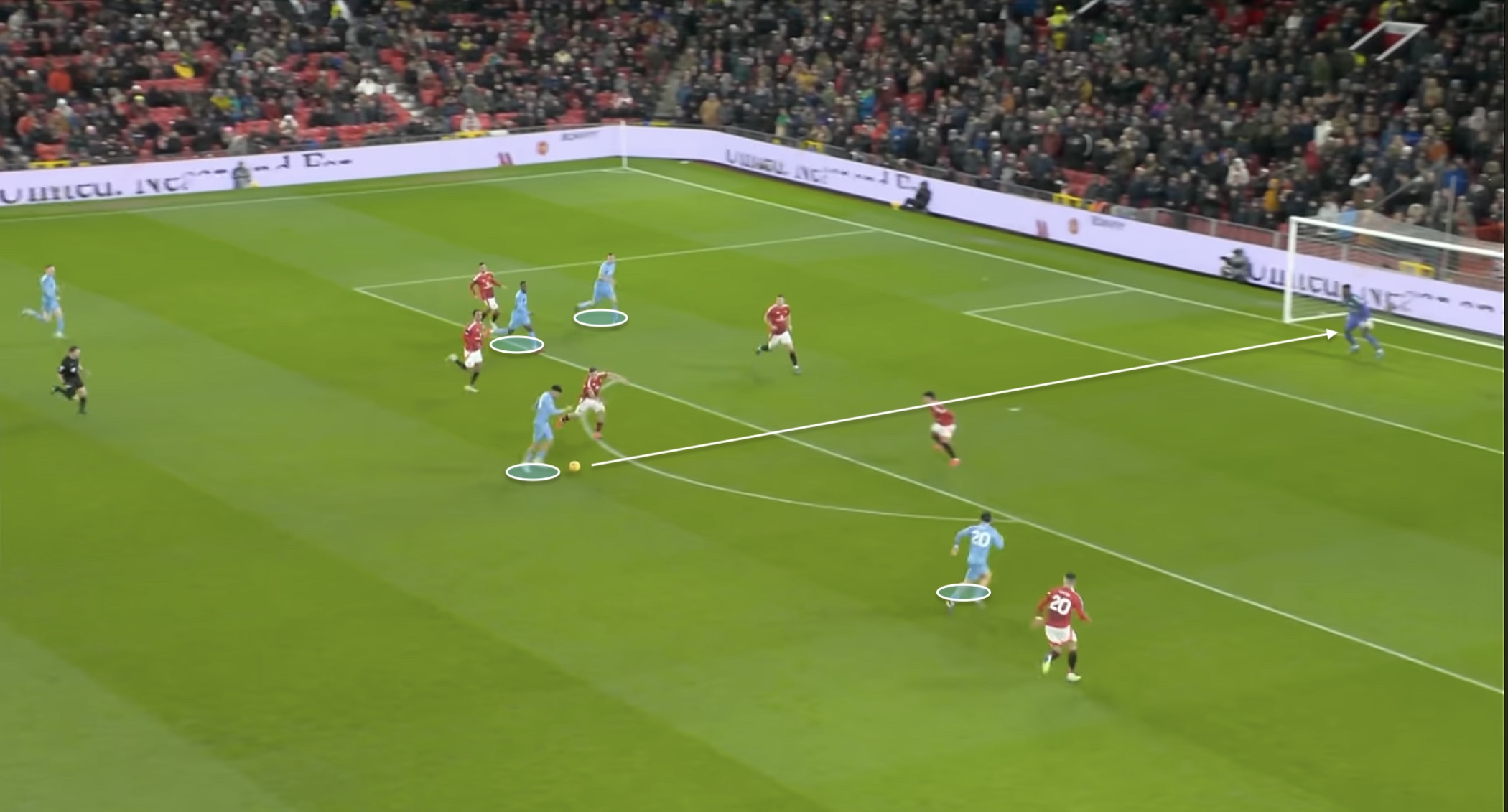
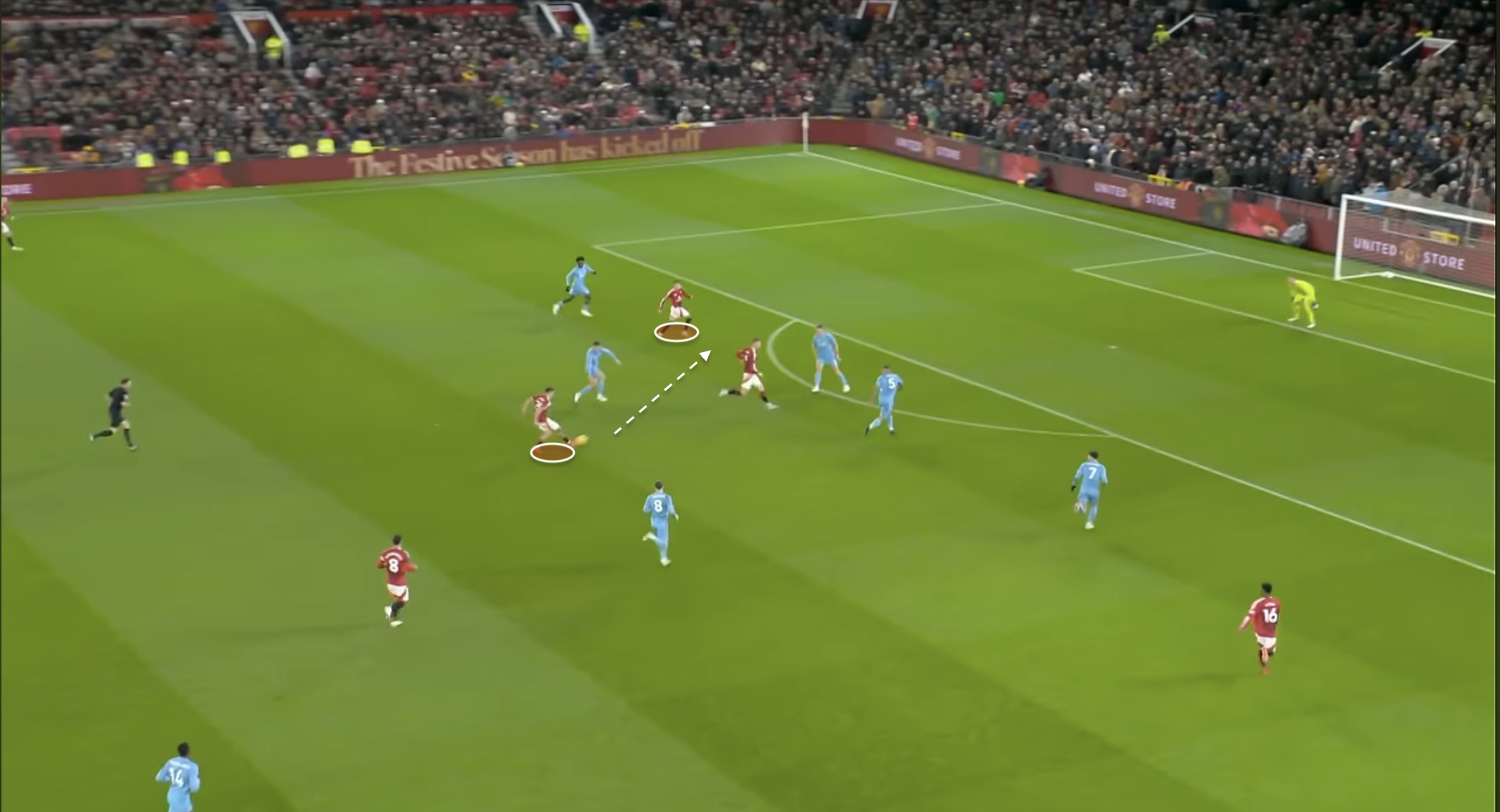
For example, against Manchester United, a poor giveaway led to a rapid transition, with Forest committing numbers forward.

The move ended with Gibbs-White scoring, demonstrating their ability to punish mistakes at speed.
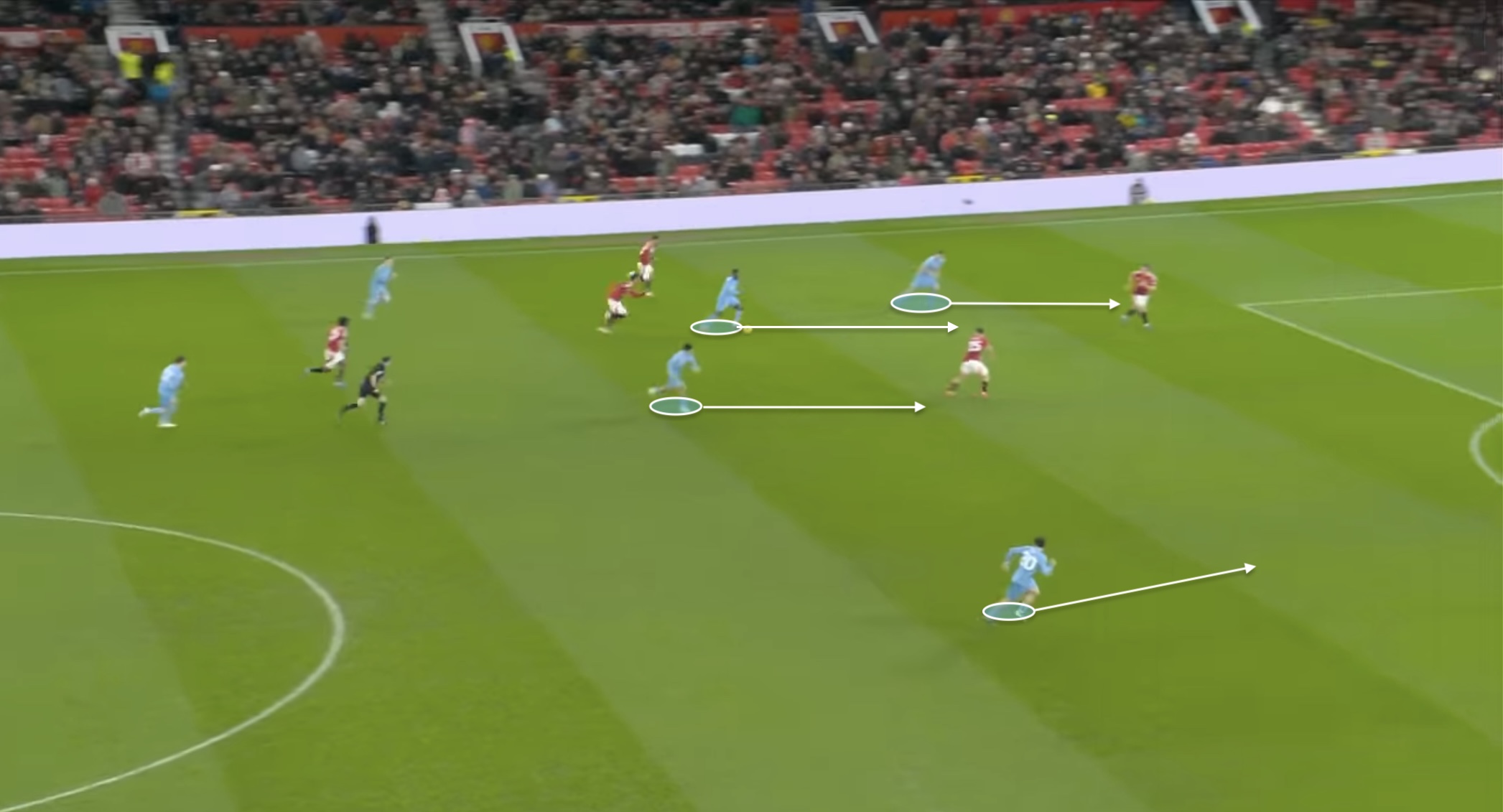
Man United misplace a pass which leaves the exposed due to Forest having 4 players advanced in the press
Man United misplace a pass, which leaves themselves exposed due to Forest having four players advanced in the press
Hudson-Odoi, Gibbs-White, Wood and Jota Silva are now transitioning at speed
Morgan Gibbs-White shoots and scores from distance

Nuno Espírito Santo Direct Play & Second Balls

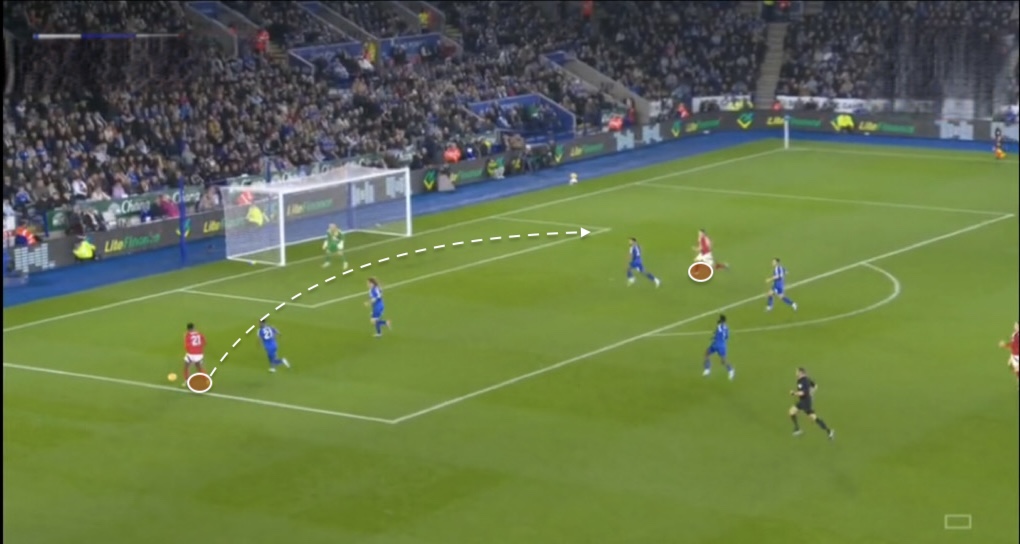
Another feature of Nuno’s approach is his preference for long balls from goal-kicks.

Although centre-backs dropped short, the goalkeeper often goes long to zones where Forest have numbers to compete for second balls.
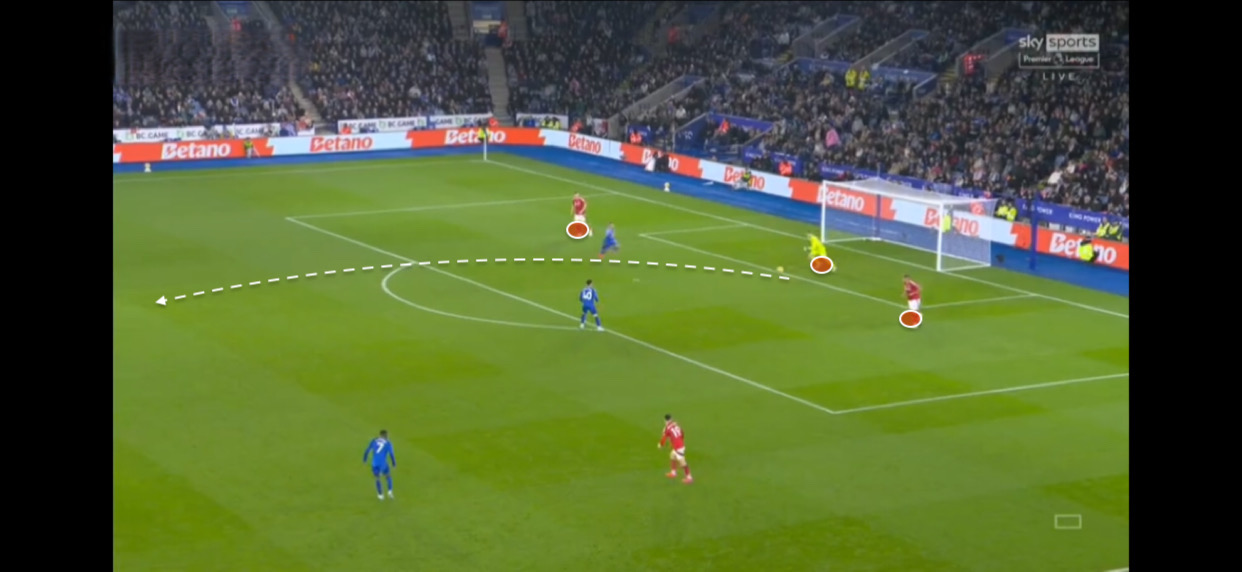
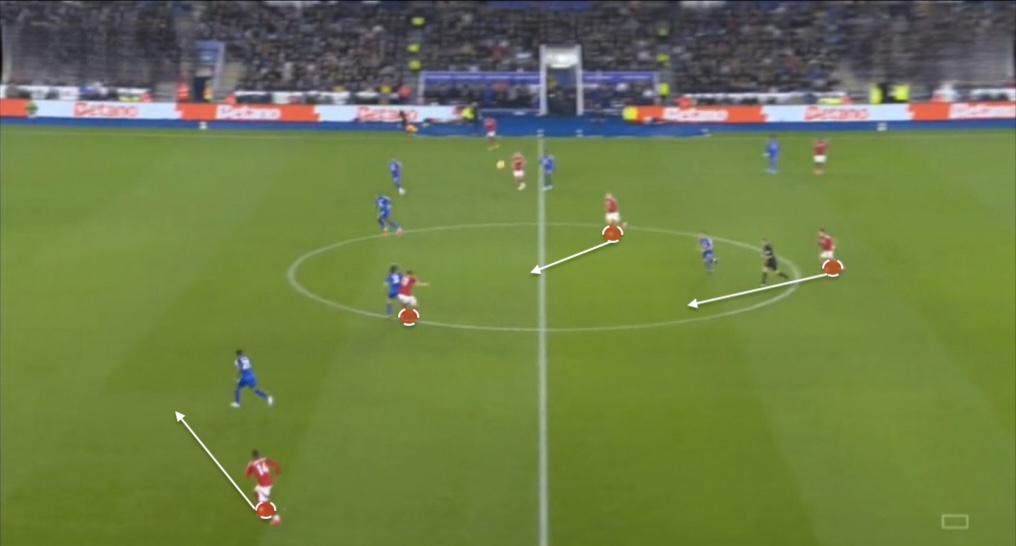
Forest CB's drop giving the impression of playing out of the back but Nuno wants to go direct
Forest CBs drop, giving the impression of playing out of the back, but Nuno wants to go direct
Forest go direct to Chris Wood and get bodies around for the second balls

Against Liverpool, Gibbs-White won the initial header and Ryan Yates collected the second ball, allowing Forest to sustain possession in advanced areas.
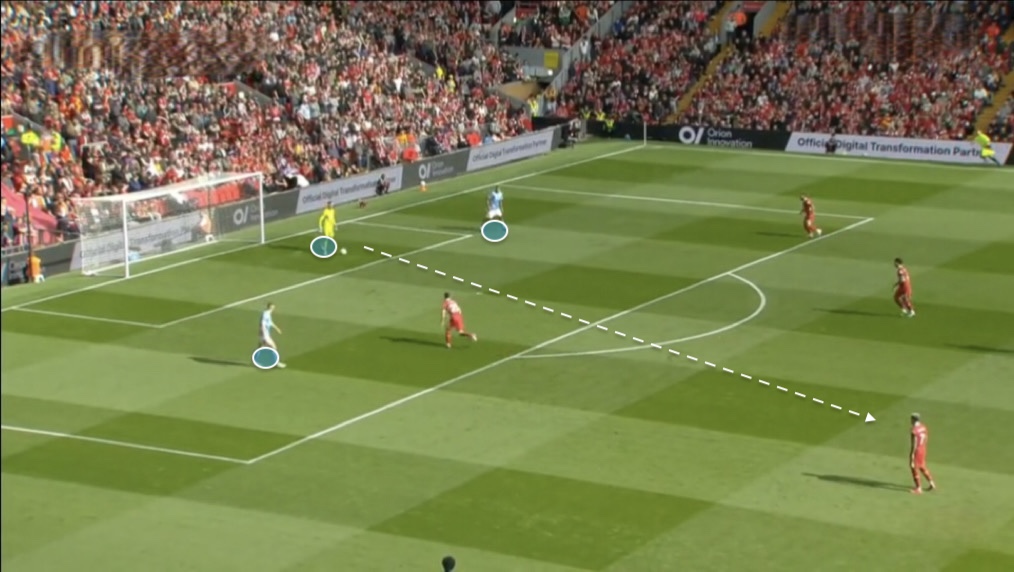
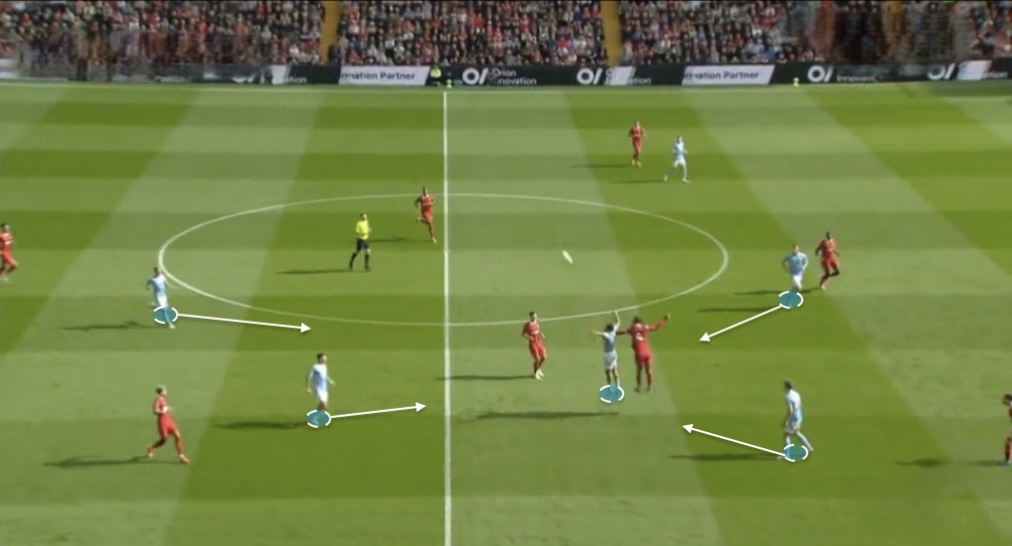
Same process - CB's drop to attract opposition bodies to the press
Same process – CB’s drop to attract opposition bodies to the press
Gibbs-White wins header vs Van Dijk and number of Forest bodies to pick up the second balls
Gibbs-White wins the header vs Van Dijk and a number of Forest bodies to pick up the second balls
Forest now have the ball in an advanced area of the pitch and are able to transition at speed
Forest now have the ball in an advanced area of the pitch and can transition at speed

This strategy has both benefits and drawbacks.

The benefits include winning the ball higher up the pitch, creating space to attack if the second ball is secured, and eliminating the risk of dangerous turnovers near their box.

However, the drawbacks are significant: the game becomes reliant on winning physical duels, meaning that if Forest failed to secure second balls against dominant teams, they can be pinned into a deep block.

It also made their play predictable, as opponents know they will rarely build from the back.

Wide Attacks And Box Occupation

When Forest did progress the ball, there was a clear emphasis on wide play and crossing.

Nuno wants his team to deliver dangerous balls into the box with high occupation.

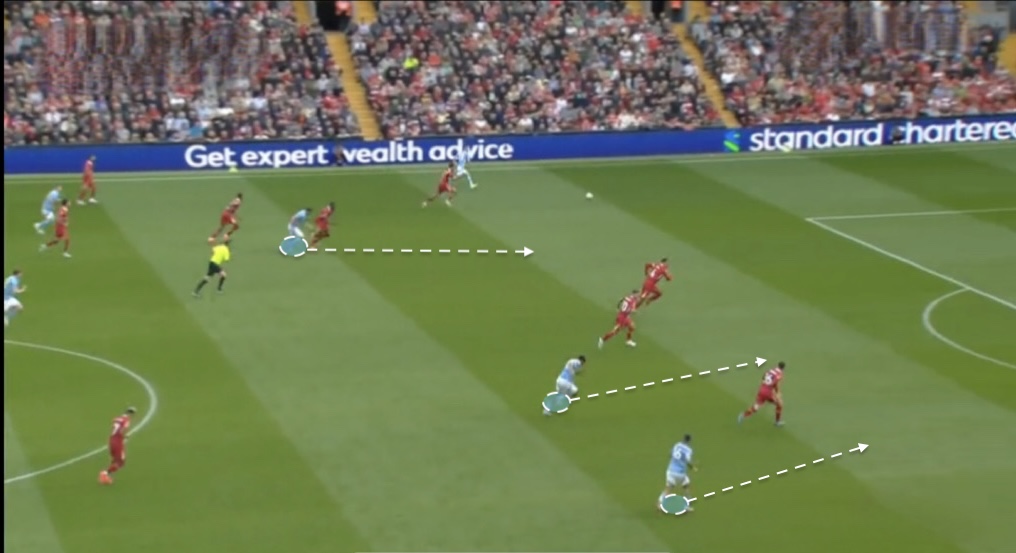
Against Liverpool, a simple combination down the flank led to three players immediately attacking the penalty area.
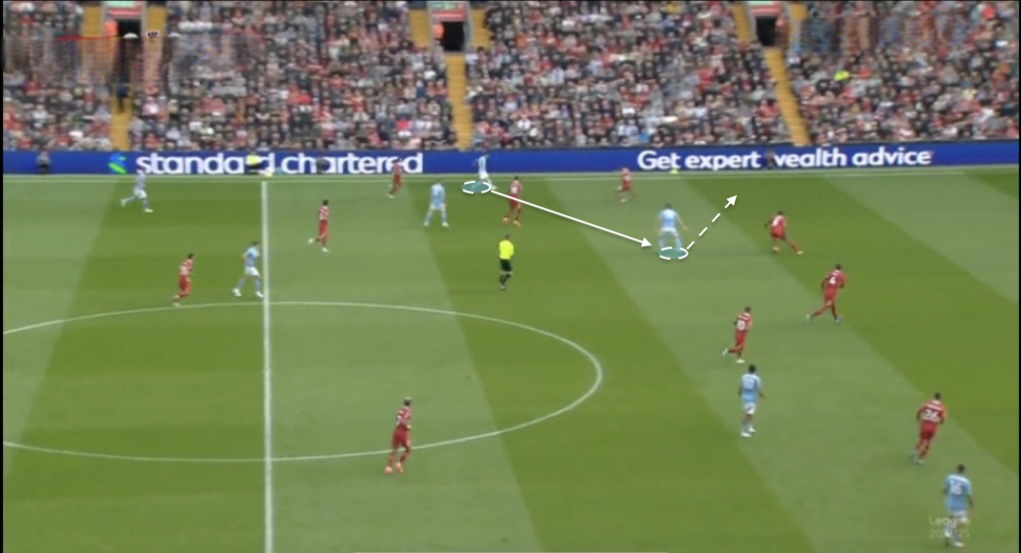
Forest look to progress the ball wide. Against Liverpool - Mereno plays simple 1-2 with Wood
Forest look to progress the ball wide. Against Liverpool – Mereno plays simple 1-2 with Wood
Three Forest players sprinting with intensity to get into the box
Six Forest players are now in and around the box which leads to higher possibility of chance creation
Six Forest players are now in and around the box, which leads to a higher possibility of chance creation

The same pattern was evident against Aston Villa, where Hudson-Odoi received the ball wide with multiple runners attacking the box, including Jota Silva, Elliot Anderson, Elanga, and Wood.
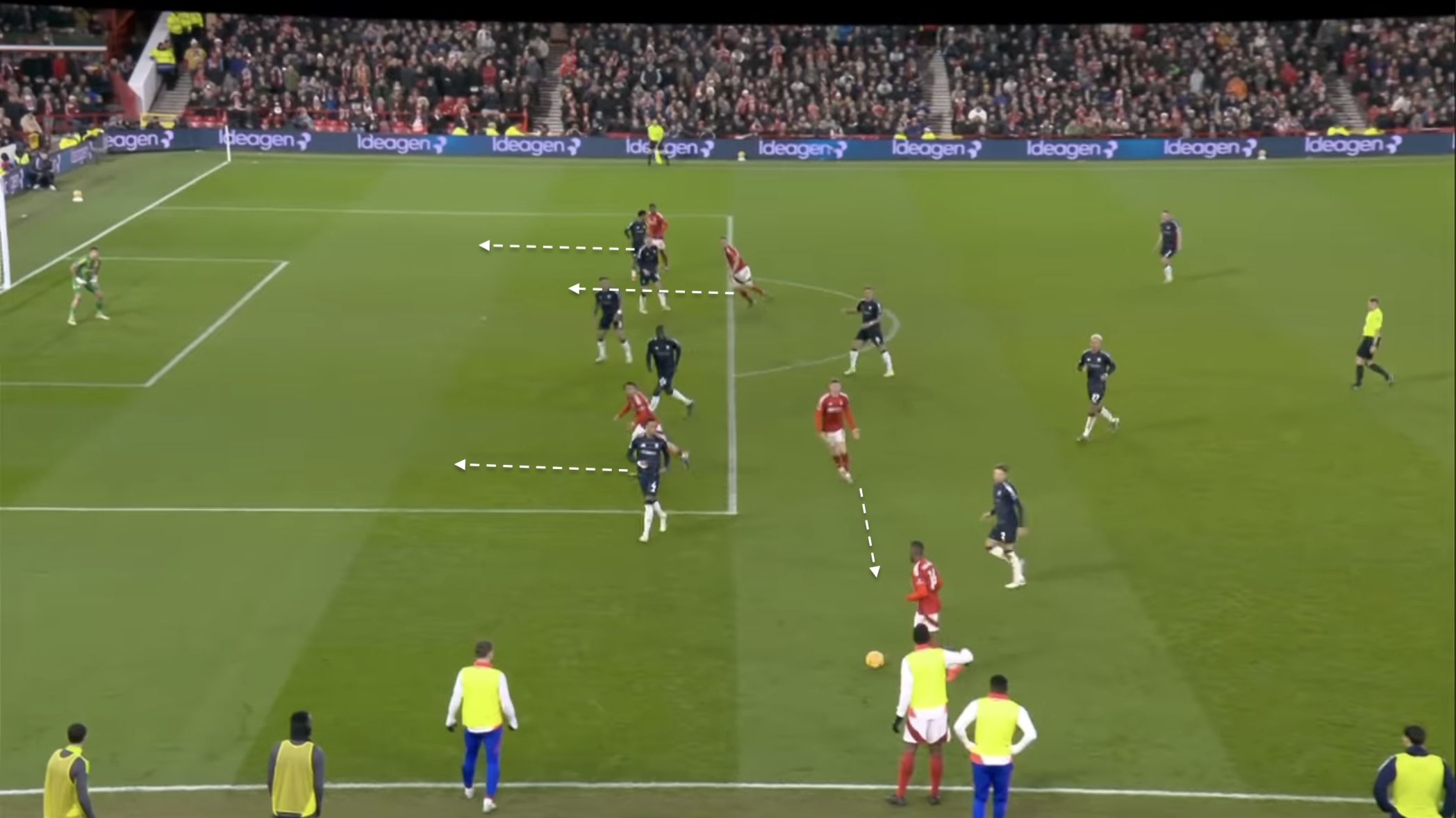
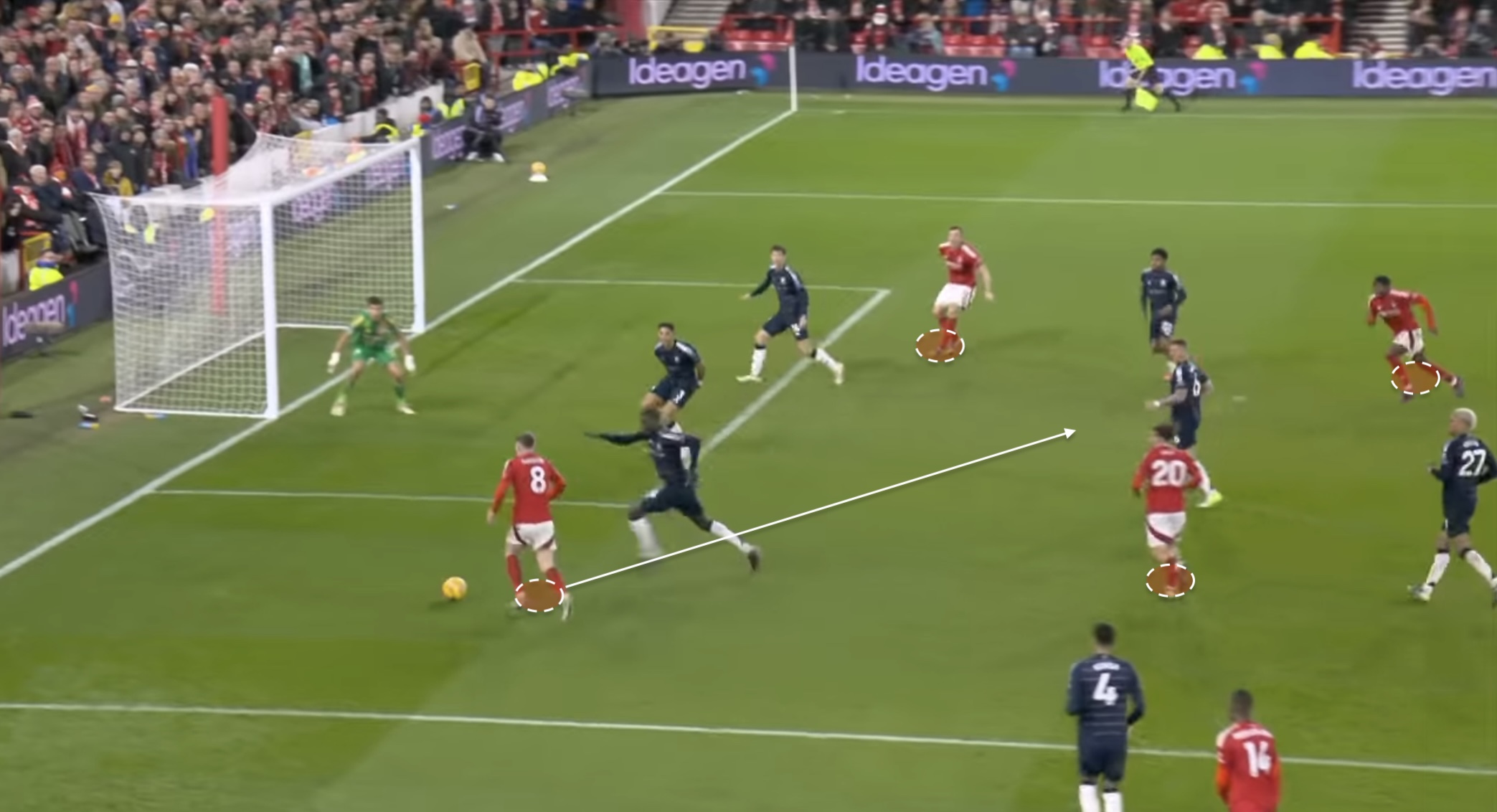
Another example of wide progression - opposite movements with Wood, Silva and Elanga running in behind allowing space for Anderson to receive centrally
Another example of wide progression – opposite movements with Wood, Silva and Elanga running in behind, allowing space for Anderson to receive centrally
Anderson moves the ball into a dangerous position and cuts the ball back with Forest players ready to attack

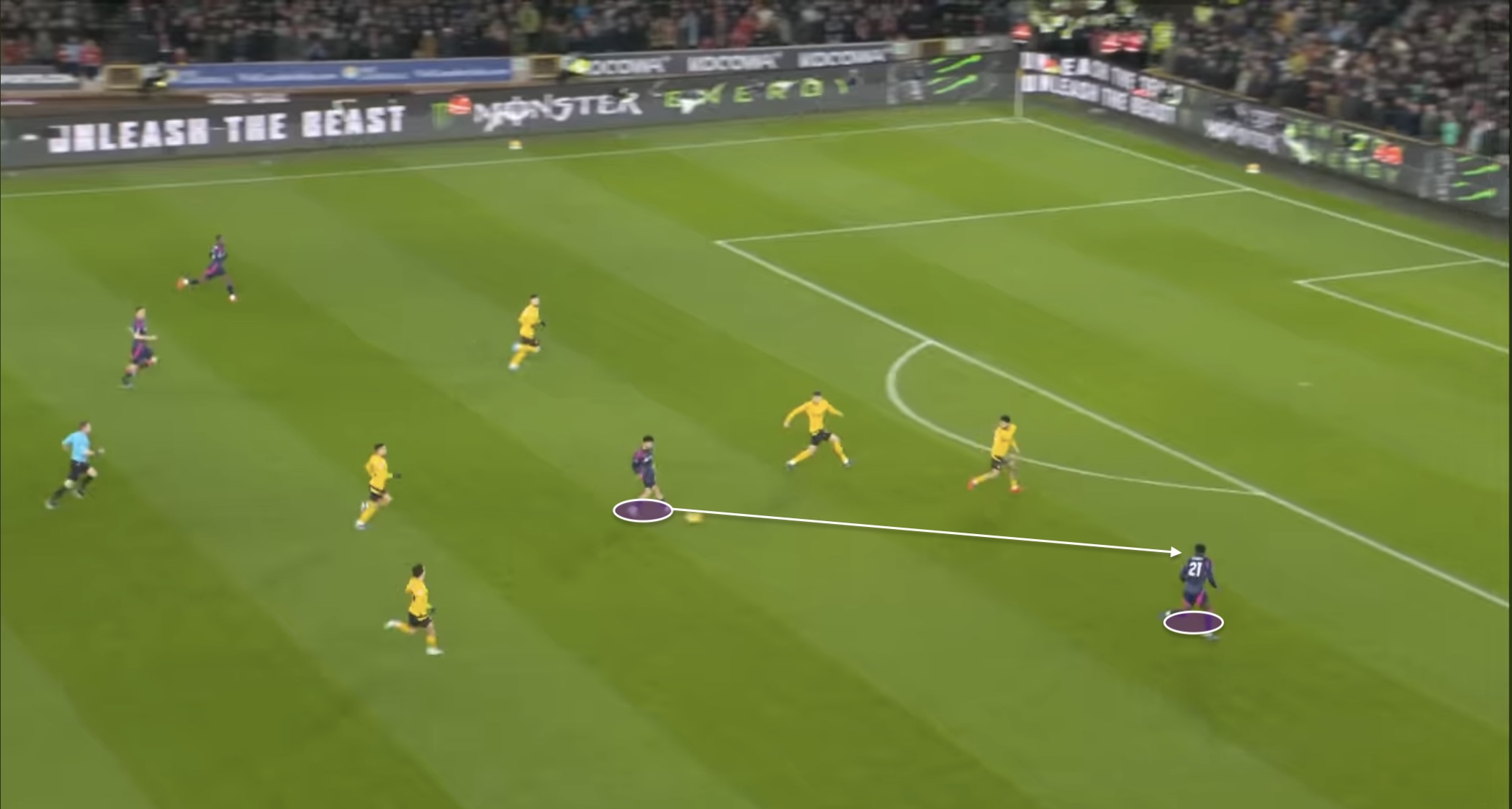
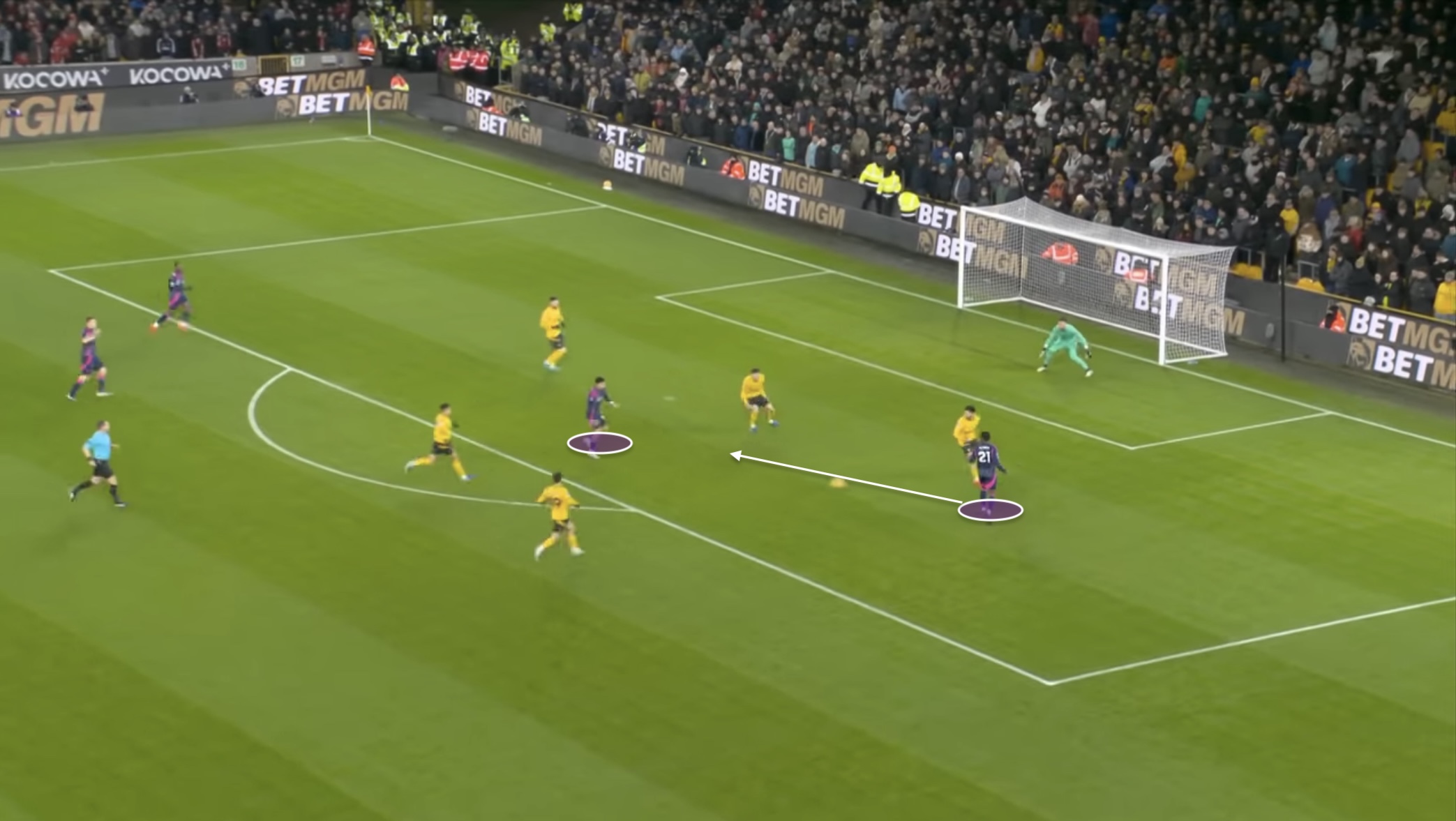
A goal against Wolves further encapsulated this approach.

After regaining possession in their own box, Forest transitioned with pace.

A quick pass to Gibbs-White set him free, and four players immediately joined the attack, culminating in a brilliantly worked goal.
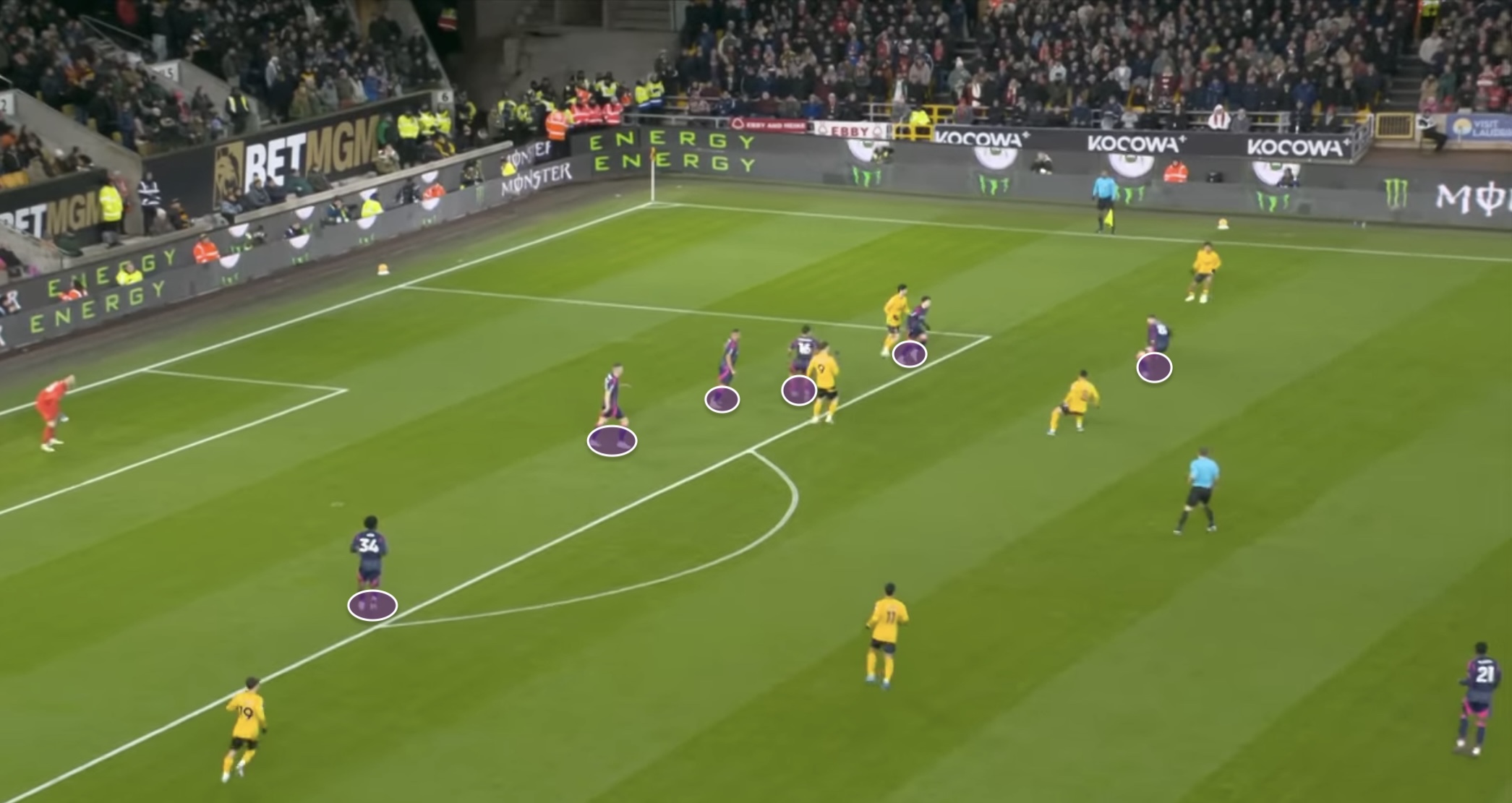
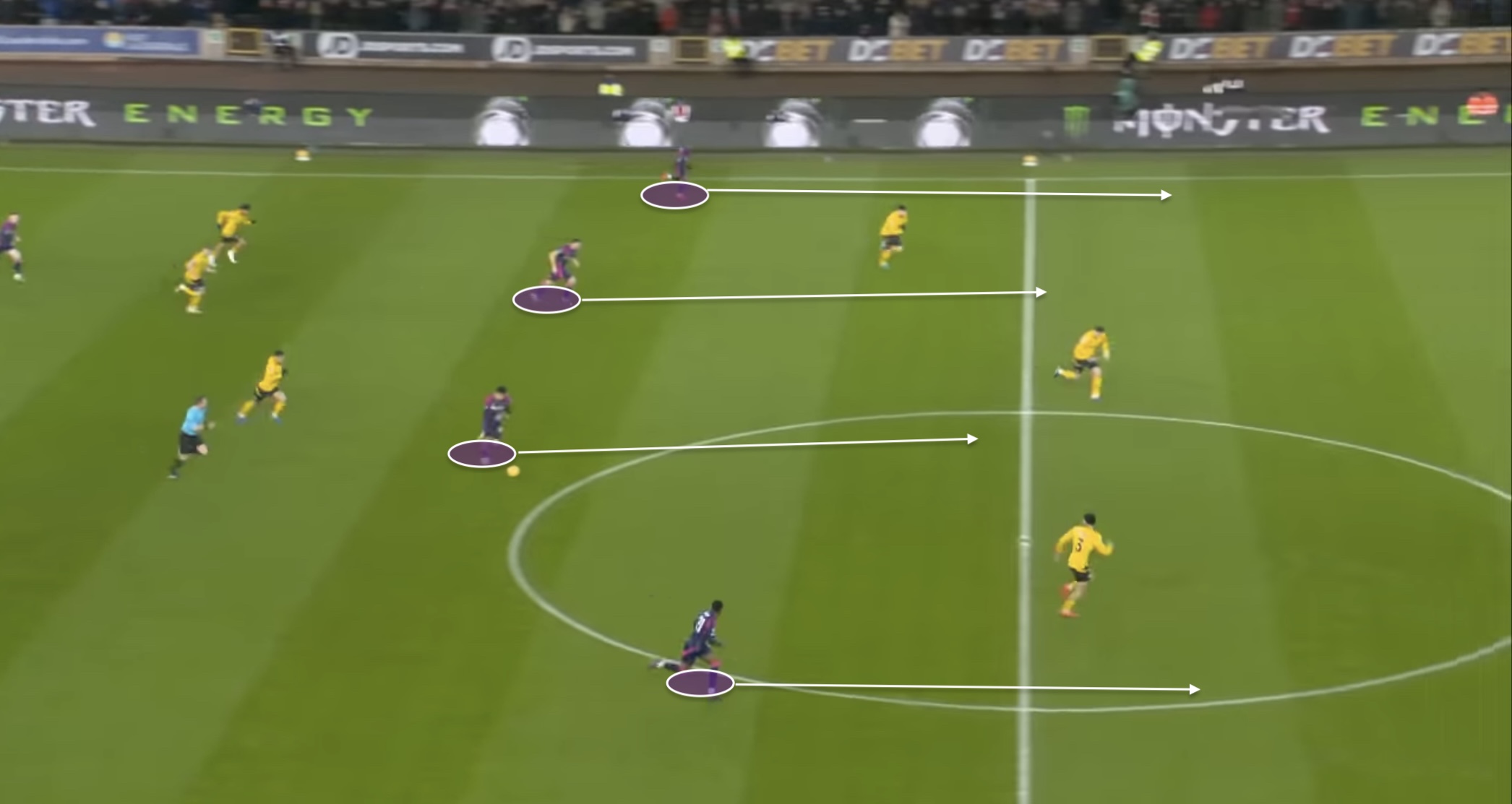
Forest turn over the ball deep
Forest spring forward in transition, with their devastating front four outnumbering Wolves’ back three.
Gibbs-White draws pressure then plays the pass to Elanga
Gibbs-White draws pressure, then plays the pass to Elanga
Gibbs-White receives the return pass and finishes a beautifully executed counter attack
Gibbs-White receives the return pass and finishes a beautifully executed counterattack

Flaws & Sustainability

Despite their defensive record, Forest’s system was not flawless.

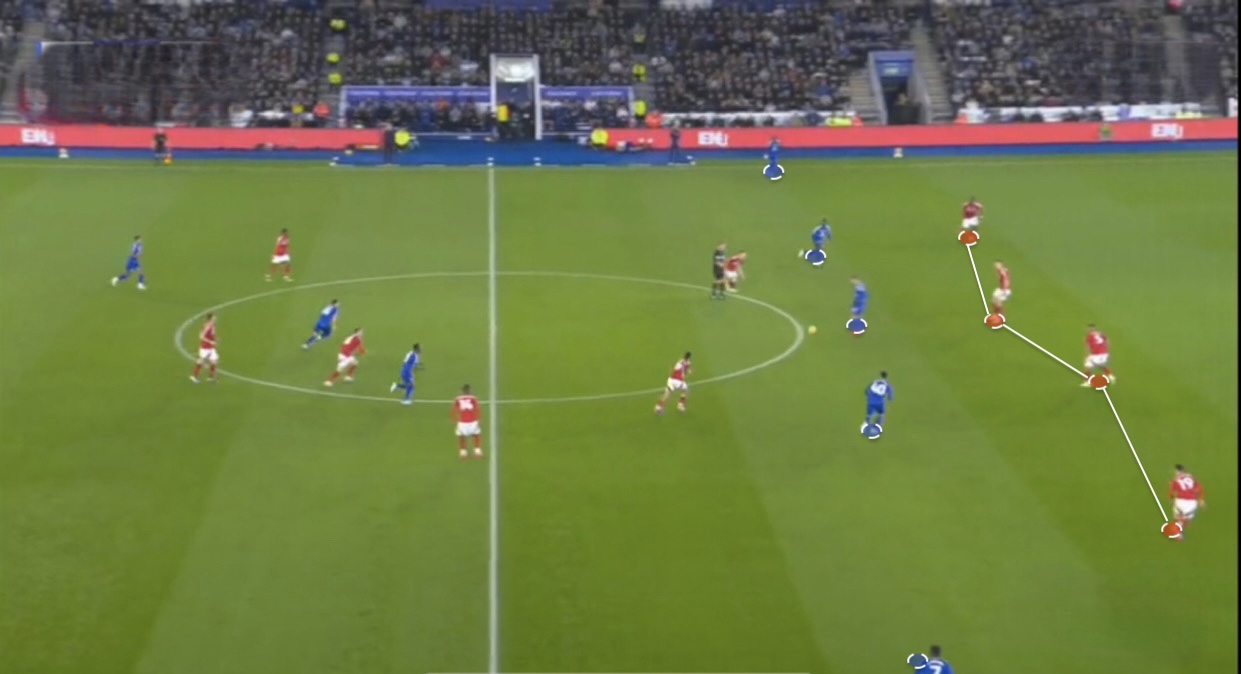
Leicester City, for instance, exposed issues by building in a 3-2 shape.

One vertical pass through midfield took out the entire press, leaving Forest’s backline exposed.
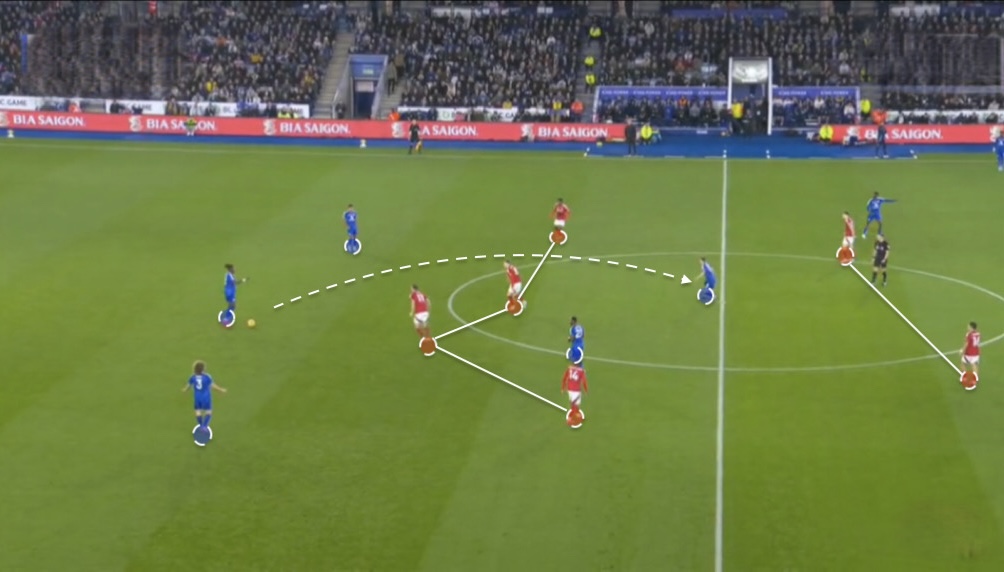
Leicester 3-2 Build Up - One pass into Harry Winks takes the front four of Forest out of the match instantly
Leicester 3-2 Build Up – One pass into Harry Winks takes the front four of Forest out of the match instantly
Leicester front five attacking the Forest back four as they are exposed
Leicester’s front five are attacking the Forest back four as they are exposed

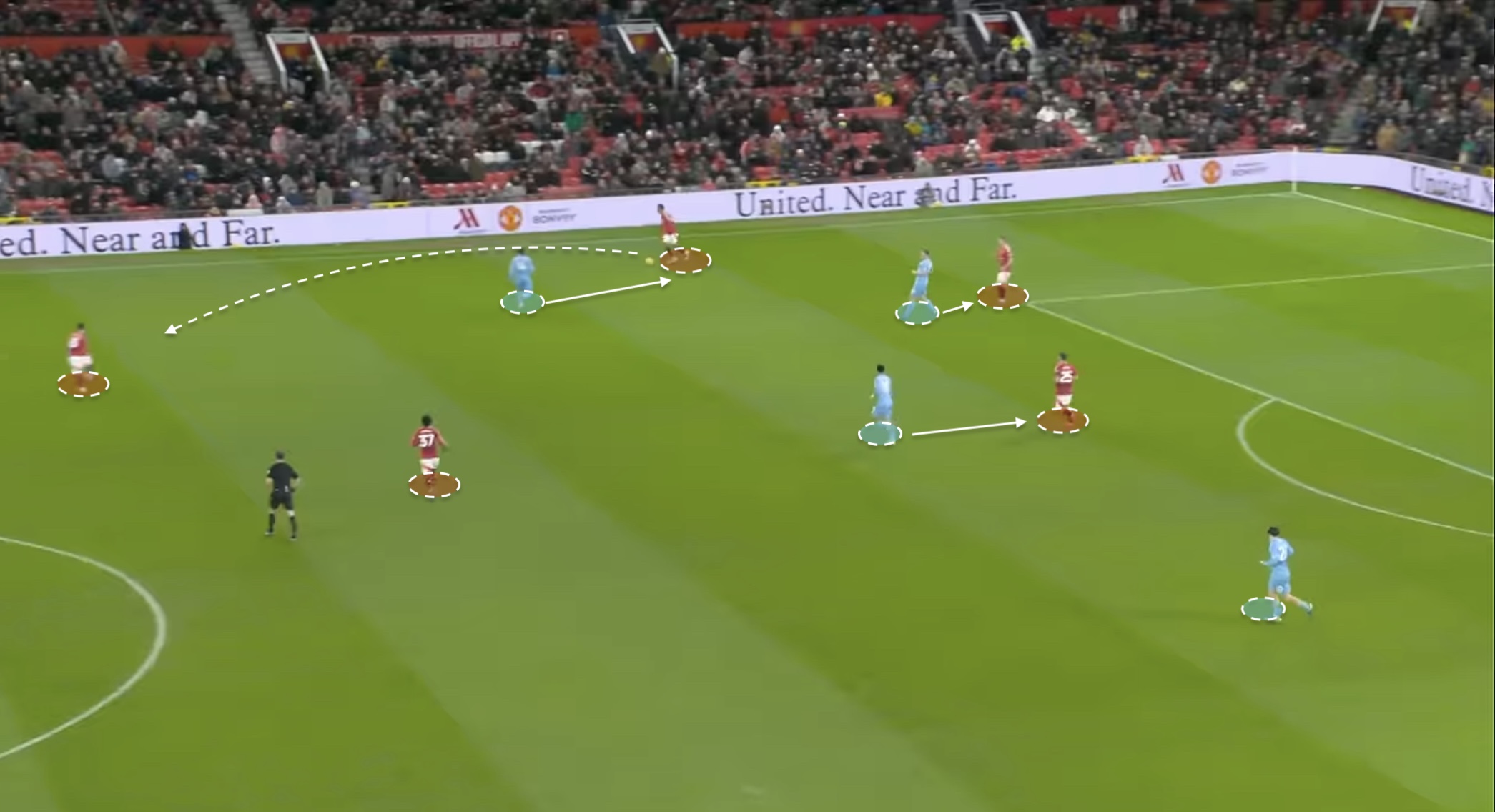
Manchester United achieved similar success at Old Trafford by exploiting third-man runs after Bruno Fernandes dropped deep.
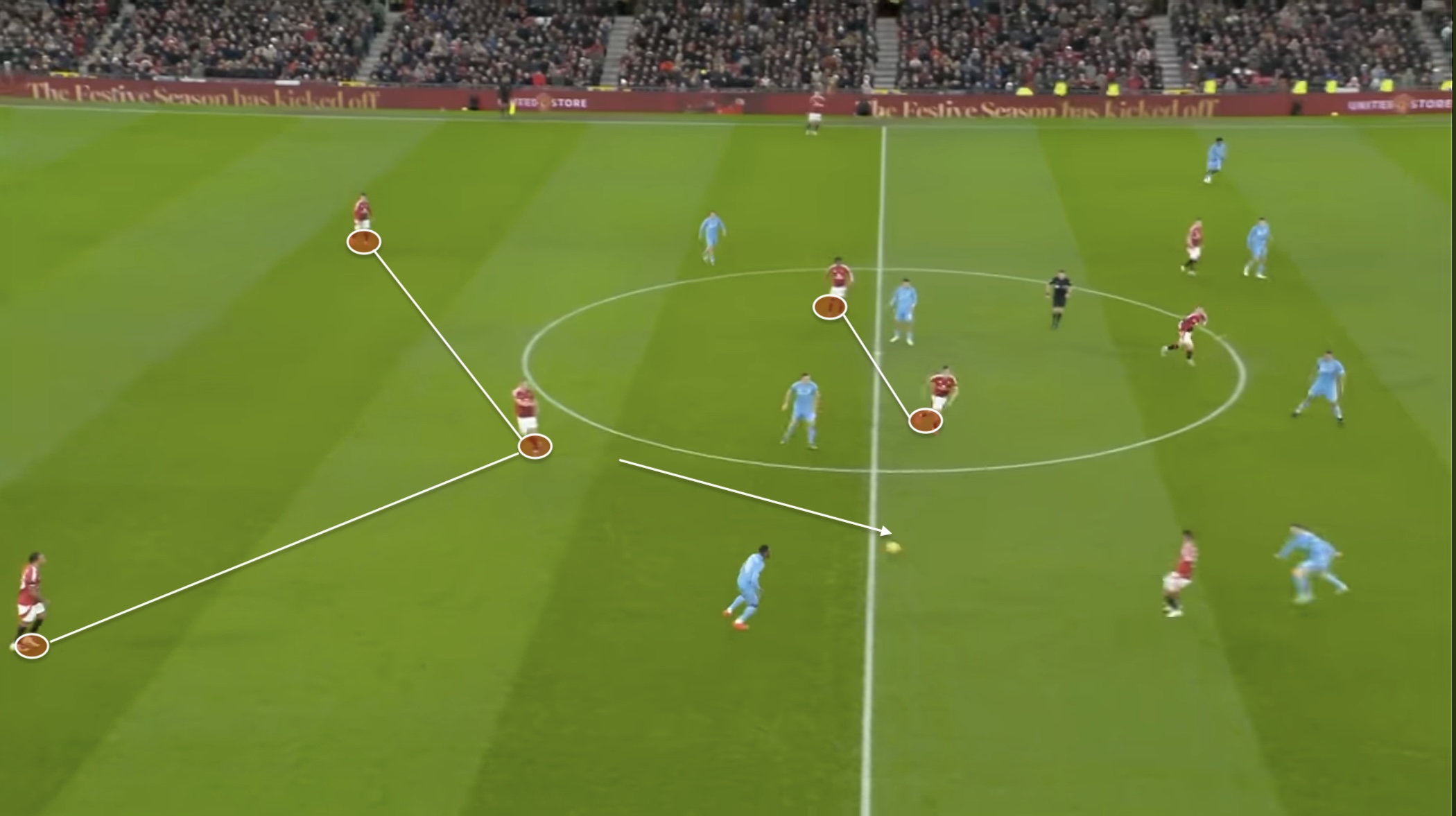
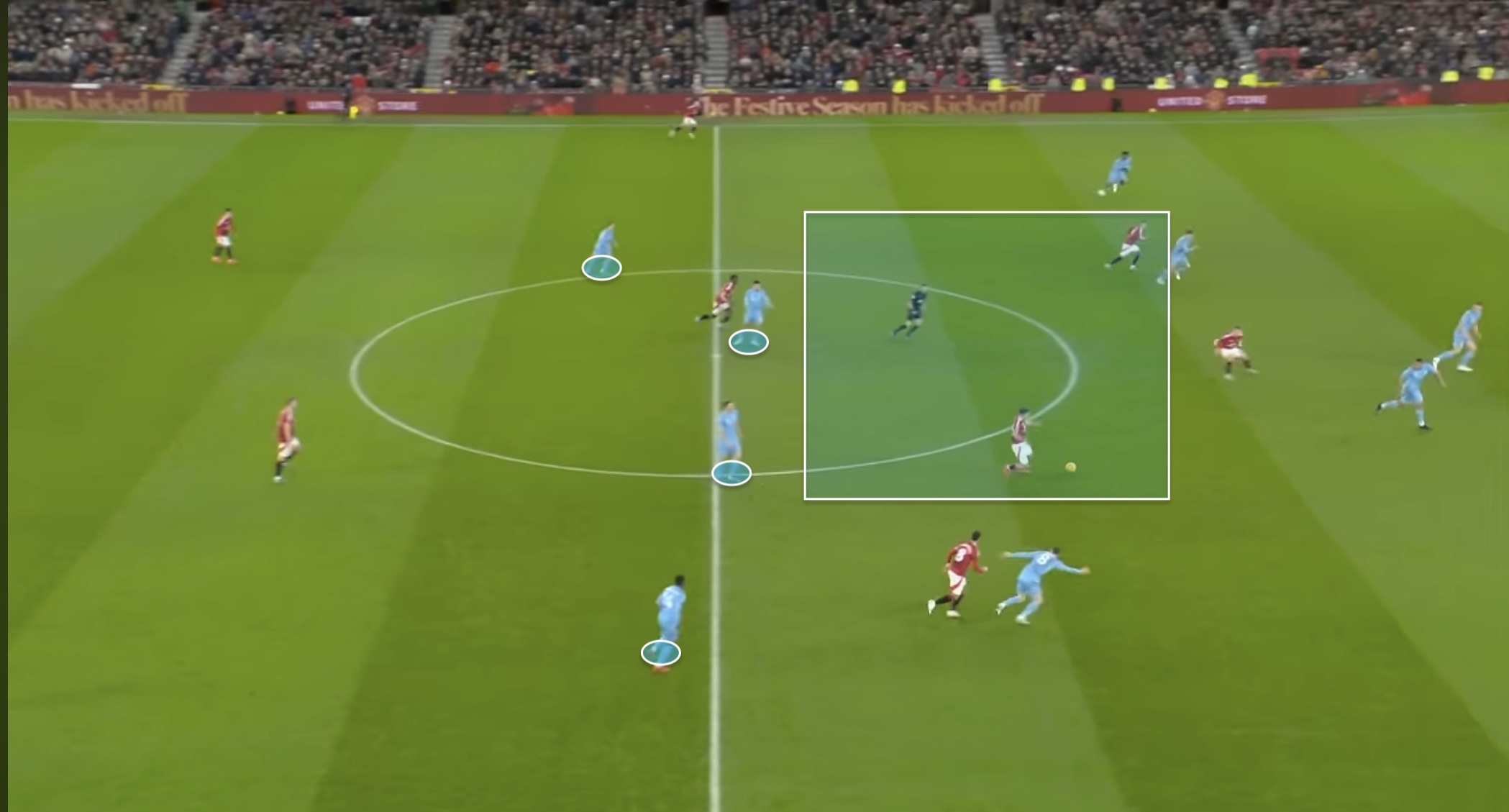
A simple three man pattern of De Ligt, Bruno and Ugarte rip apart Forest's mid block
A simple three-man pattern of De Ligt, Bruno and Ugarte rip apart Forest’s mid block
Ugarte now receives the ball in the middle of the pitch with space to attack and runners in behind
Ugarte finds Garnacho which leads to Højlund's goal
Ugarte finds Garnacho, which leads to Højlund’s goal

The lack of consistent pressure on the ball in the mid-block was a recurring issue.

Forest rarely pressed opposition goal kicks, meaning teams could construct their shape without resistance until the middle third.

Even when Forest attempted to press high, as seen against United, the distances are often too large, leaving opponents with time and space.
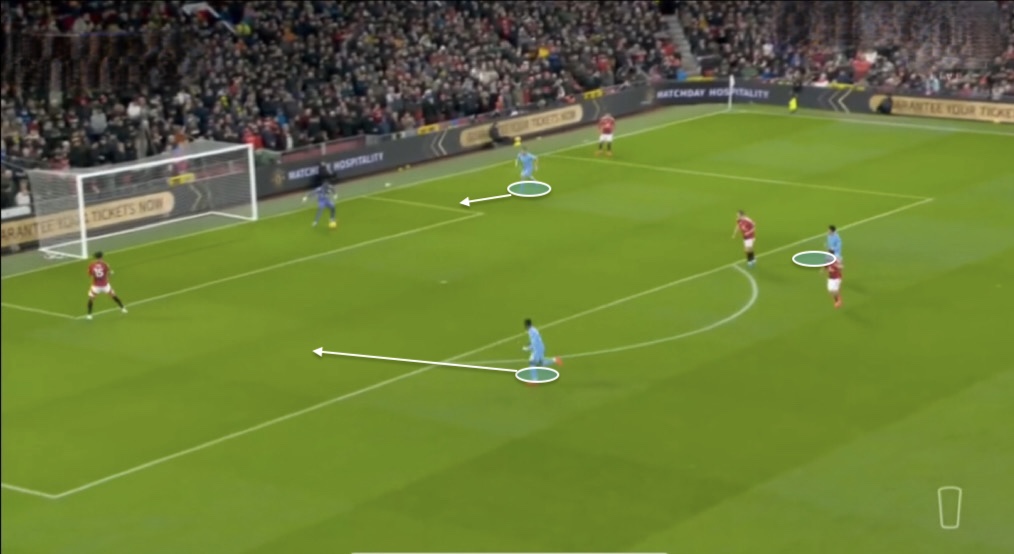
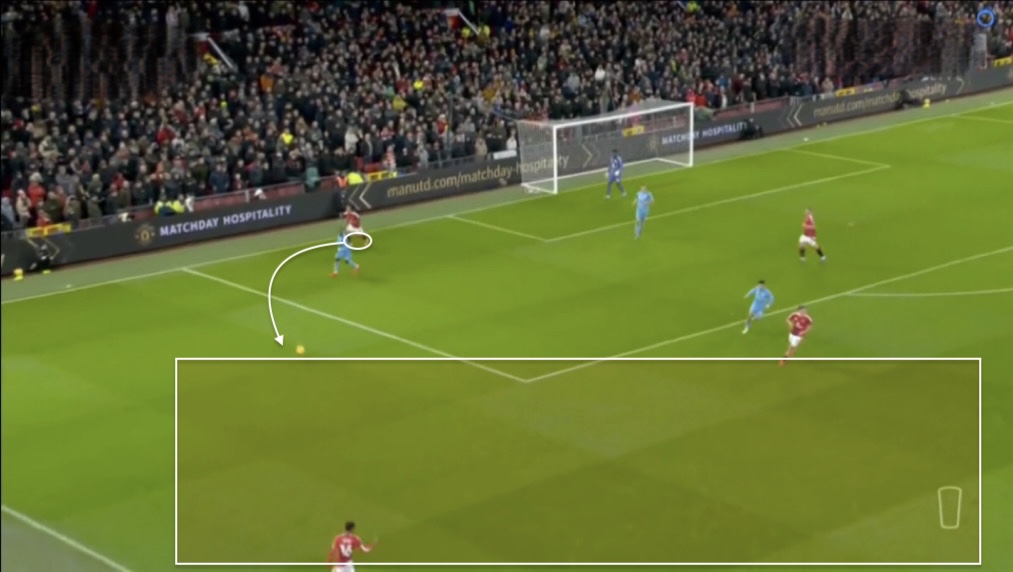
Attempting to press Man United high but outnumbered 5 v 3
Amad receives the ball in huge amount of space and United are out making the press futile
Amad receives the ball in a huge amount of space, and United are out, making the press futile

The flaws in this structure are clear.

Allowing strong opposition to build from the back gives them too much control.

If Forest failed to win second balls, they would become trapped in a deep block.

The 4-2-4 pressing shape is also fragile, as one accurate pass can take out the entire front four.

Nottingham Forest & West Ham United: Similar Profiles

Now that we have outlined Nuno’s principles, it is worth considering whether his Nottingham Forest side resembles the type of team he is now trying to build at West Ham.

Upon examining the profiles, striking similarities are evident.

The centre-back pairing is the most obvious.

Konstantinos Mavropanos shares many of the same traits as Nikola Milenković, offering physical presence and aerial dominance, while Max Kilman is comfortable progressing the ball in a similar manner to Murillo.

In the full-back areas, El Hadji Malick Diouf has been one of the standout full/wing-backs in the league this season.

He mirrors Ola Aina’s ability to defend aggressively in 1-v-1 duels, but offers greater pace to hurt teams on the overlap.

On the other hand, Kyle Walker-Peters represents an upgrade on Neco Williams, providing Nuno with more quality in the attacking phase.

In midfield, there is once again a strong physical base.

Maghnes Akliouche provides the same combative presence as Ibrahim Sangaré or Ryan Yates, while Mateus Fernandes offers energy, pressing ability, and a willingness to carry attacks forward.

He profiles closely to Elliot Anderson in terms of dynamism and technical balance, even if Anderson brings more physicality.

Together, these players demonstrate Nuno’s preference for athletic midfielders who can cover ground and contribute both defensively and offensively.

Nuno’s attacking blueprint has always revolved around a devastating front four, and Forest provided him with that platform.

At West Ham, he is assembling something comparable.

Regarding the direct dribbling threat, Crysencio Summerville bears resemblance to Callum Hudson-Odoi, although Hudson-Odoi offers a more reliable end product.

On the other flank, Jarrod Bowen is one of the league’s most consistent finishers.

His profile differs from Anthony Elanga’s, who is among the fastest players in the league.

However, Bowen shares traits with Jota Silva, whom Nuno used regularly at Forest.

However, Bowen is much faster in execution than Silva.

The key difference between Jarrod Bowen and Jota Silva lies in consistency and efficiency inside the box.

Bowen can reliably create separation to get shots off and has a lightning-quick trigger, which explains many of his unorthodox yet clinical finishes.

Jota Silva, on the other hand, can find space at times but lacks that reliability and composure, making Bowen a clear upgrade; he’s more Mo Salah-esque in the way he cuts inside and finishes with precision, as seen against Everton last Monday

Centrally, Lucas Paquetá performs a creative role similar to that of Morgan Gibbs-White.

Gibbs-White thrives in transitional moments and has more pace, while Paquetá is one of the best creators in the league and finds and threads passes behind the last line of defence.

He could also seamlessly fit into a top-six side.

Finally, at the tip of the attack, there is perhaps the clearest overlap.

Niclas Füllkrug and Chris Wood are almost identical in profile.

They are both physical, back-to-goal strikers who can occupy centre-backs, link play, and give Nuno the target man he values so highly.

Glimpses Vs Everton

Nuno only had a few days to work with his new players ahead of West Ham’s game against Everton, but we could already see glimpses of what he will bring to this team.

It is important not to read too much into that match just yet, as the finer details of his pressing structure and defensive organisation are difficult to implement in such a short period of time.

However, the outline of his philosophy was already visible.

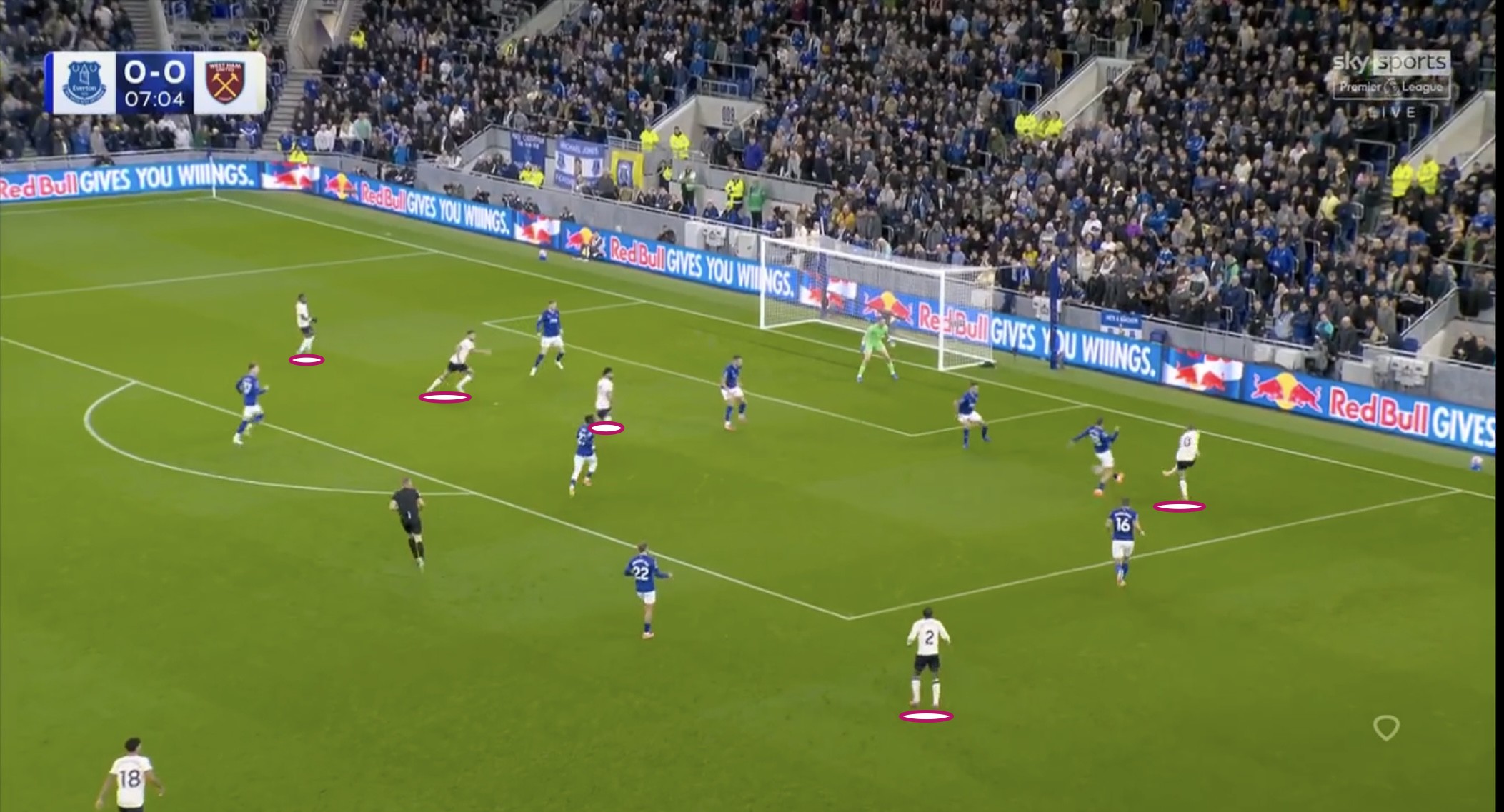
West Ham operated in a 4-5-1 mid-block, showing aggression and discipline, with the full-backs ready to press opposition wingers while blocking central progression.
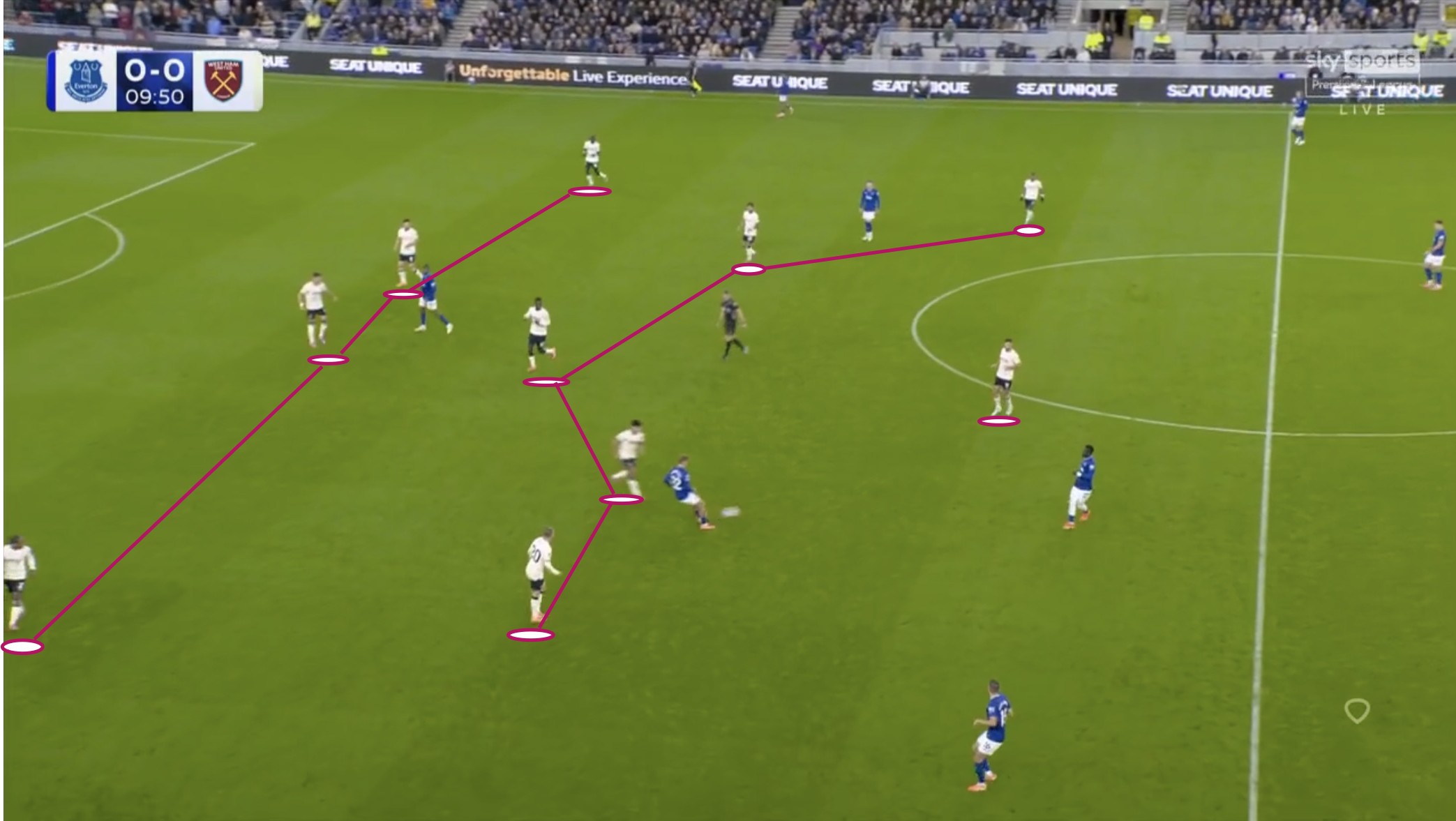
4-5-1 Mid Block
4-5-1 Mid Block

Out of possession, they also dropped into a 4-5-1 deep block, keeping the distances between the lines compact and difficult to play through.
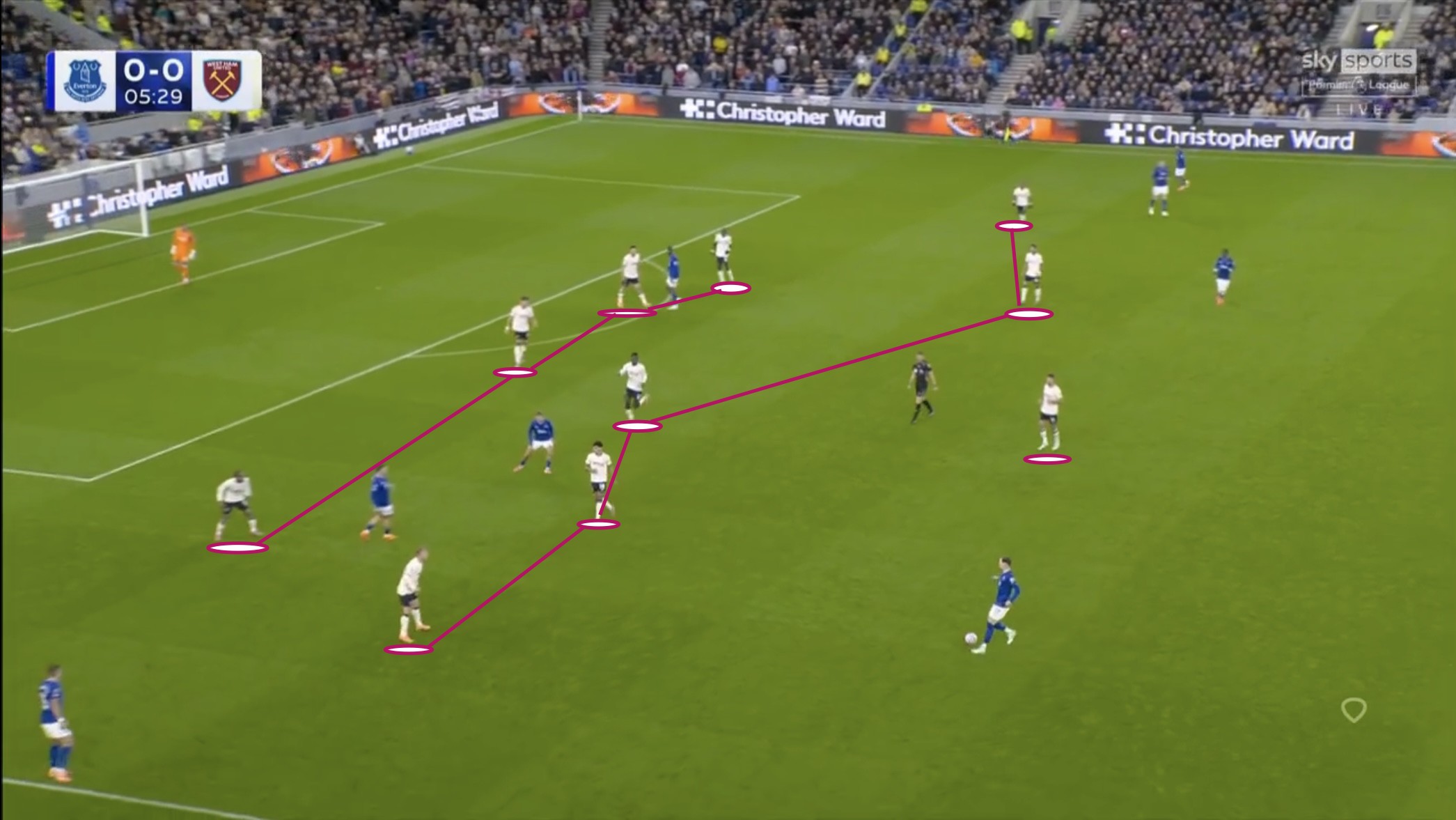
4-5-1 Deep Block
4-5-1 Deep Block

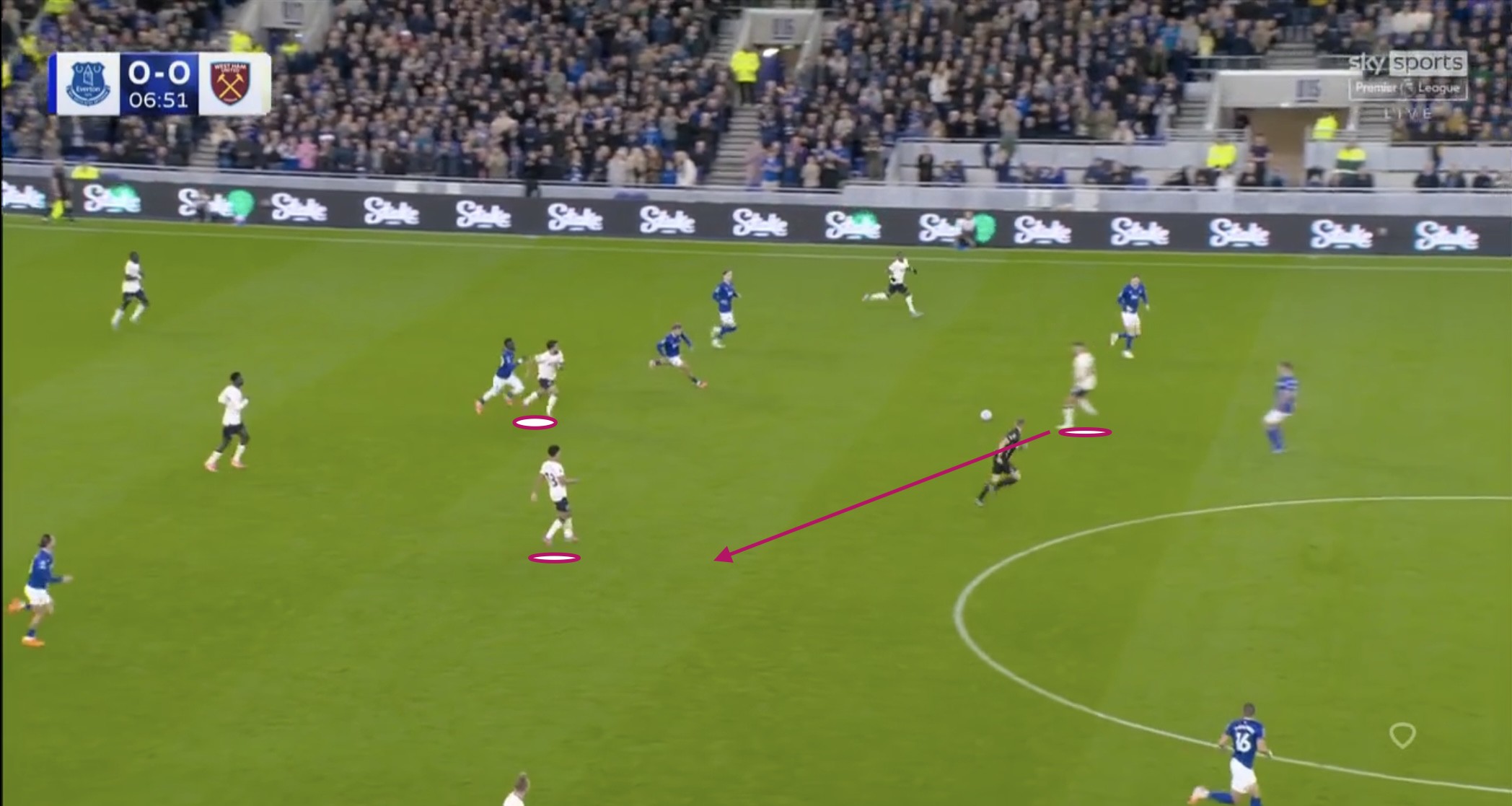
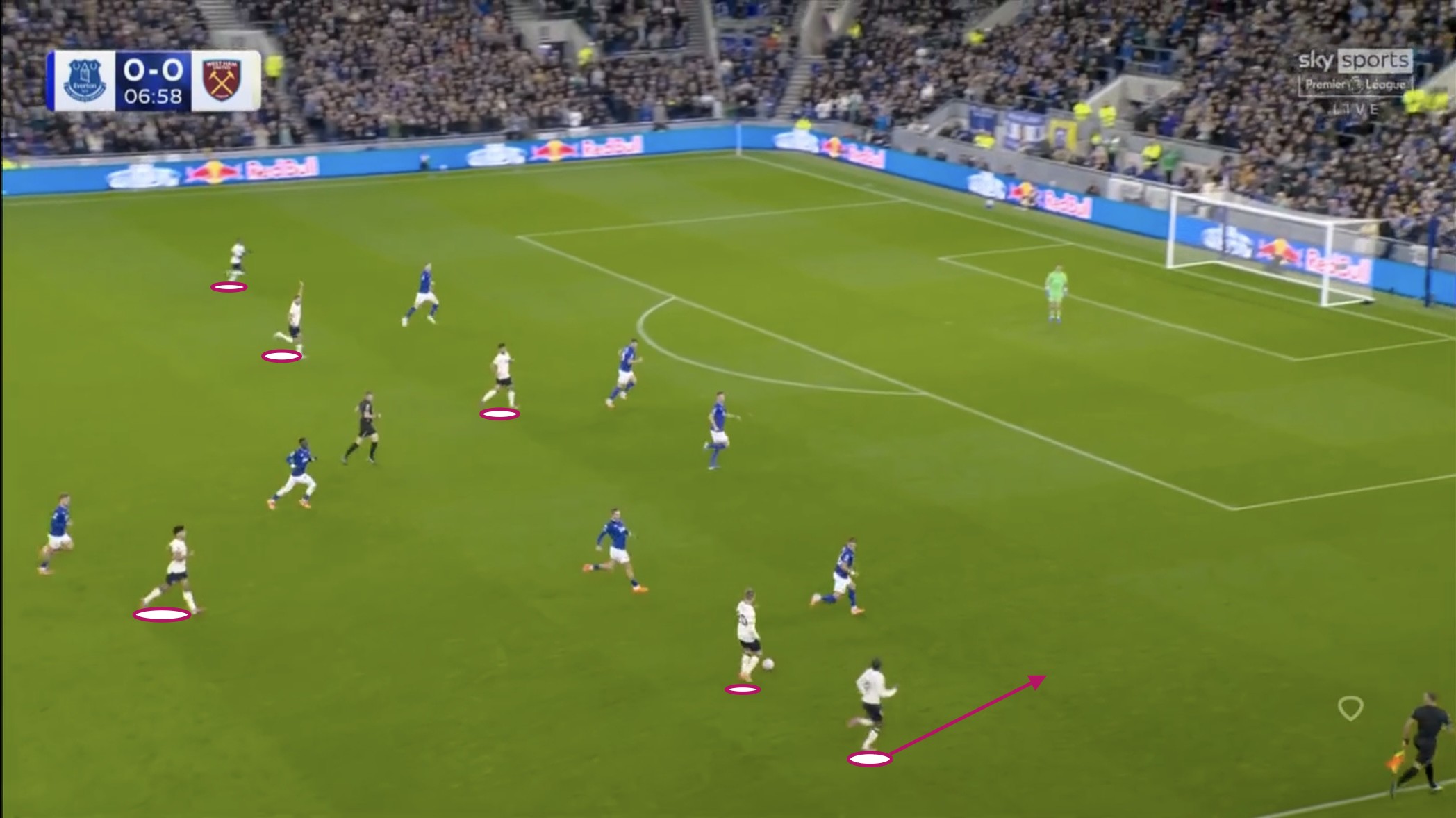
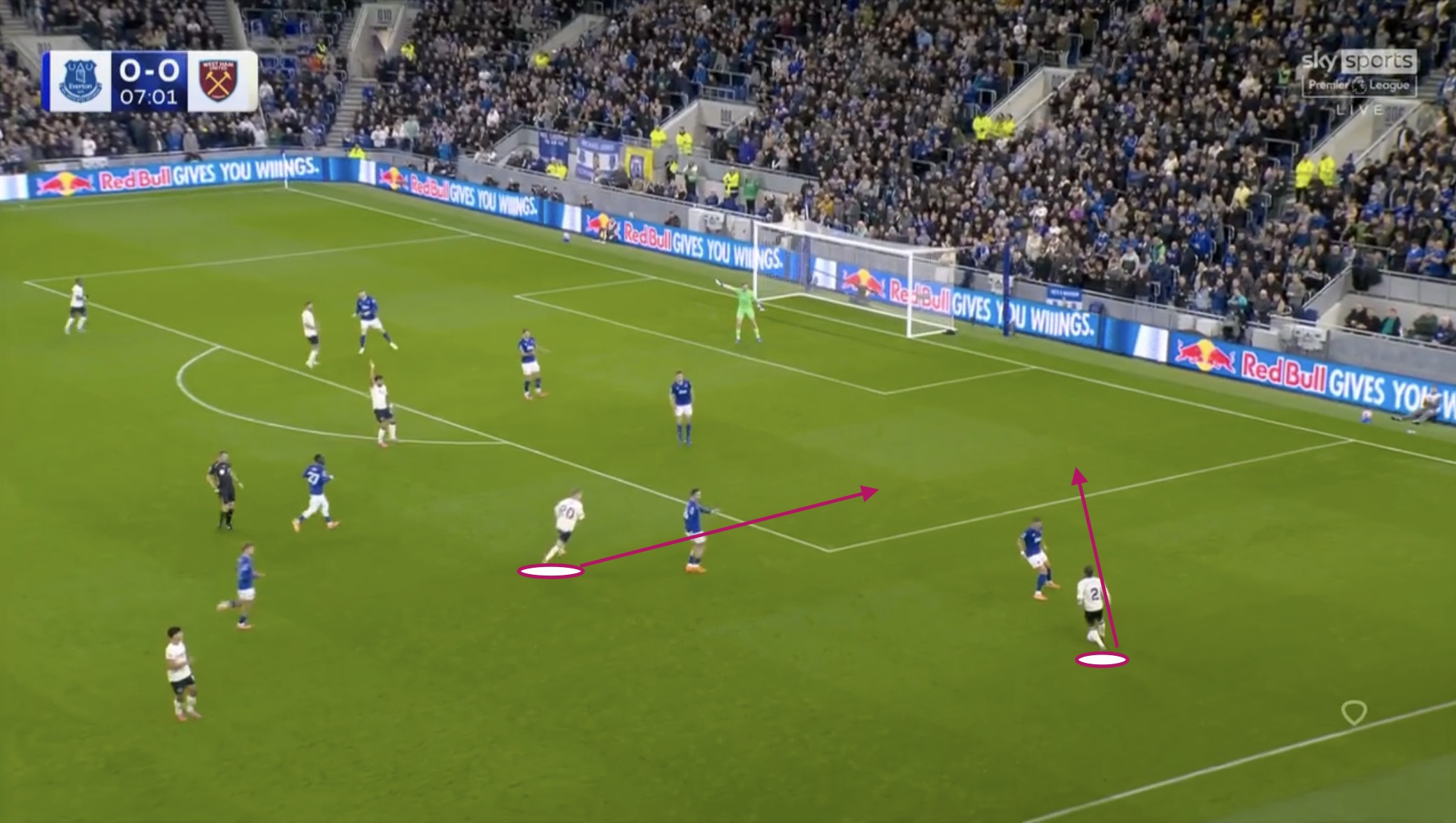
One of the clearest indicators of Nuno’s influence was evident in the transition.

When Everton crossed into the box, West Ham’s ability to regain possession and break at speed was immediately evident.

The move that led to Jarrod Bowen’s chance was a perfect example, with multiple players flooding forward to support the attack.
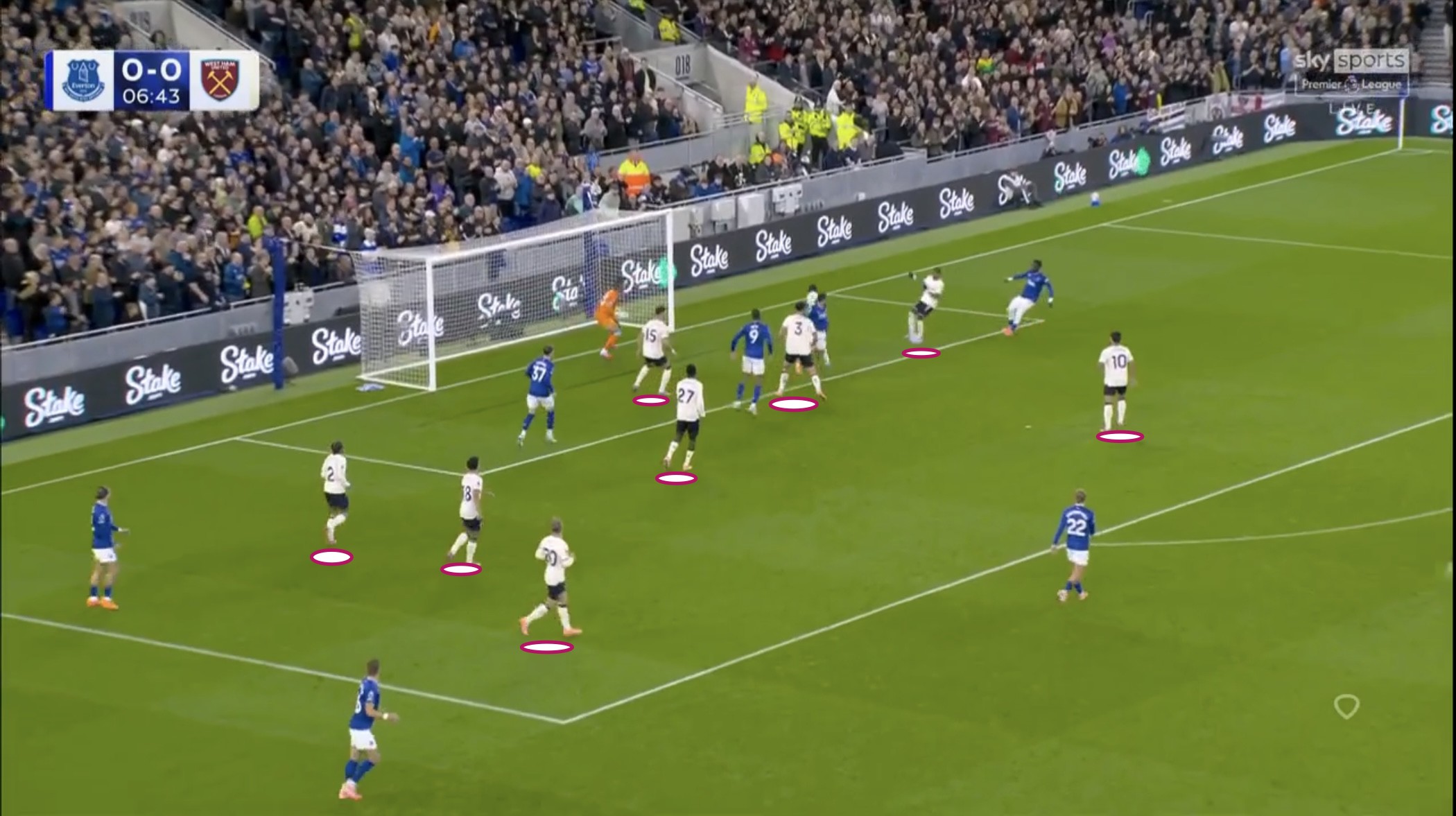
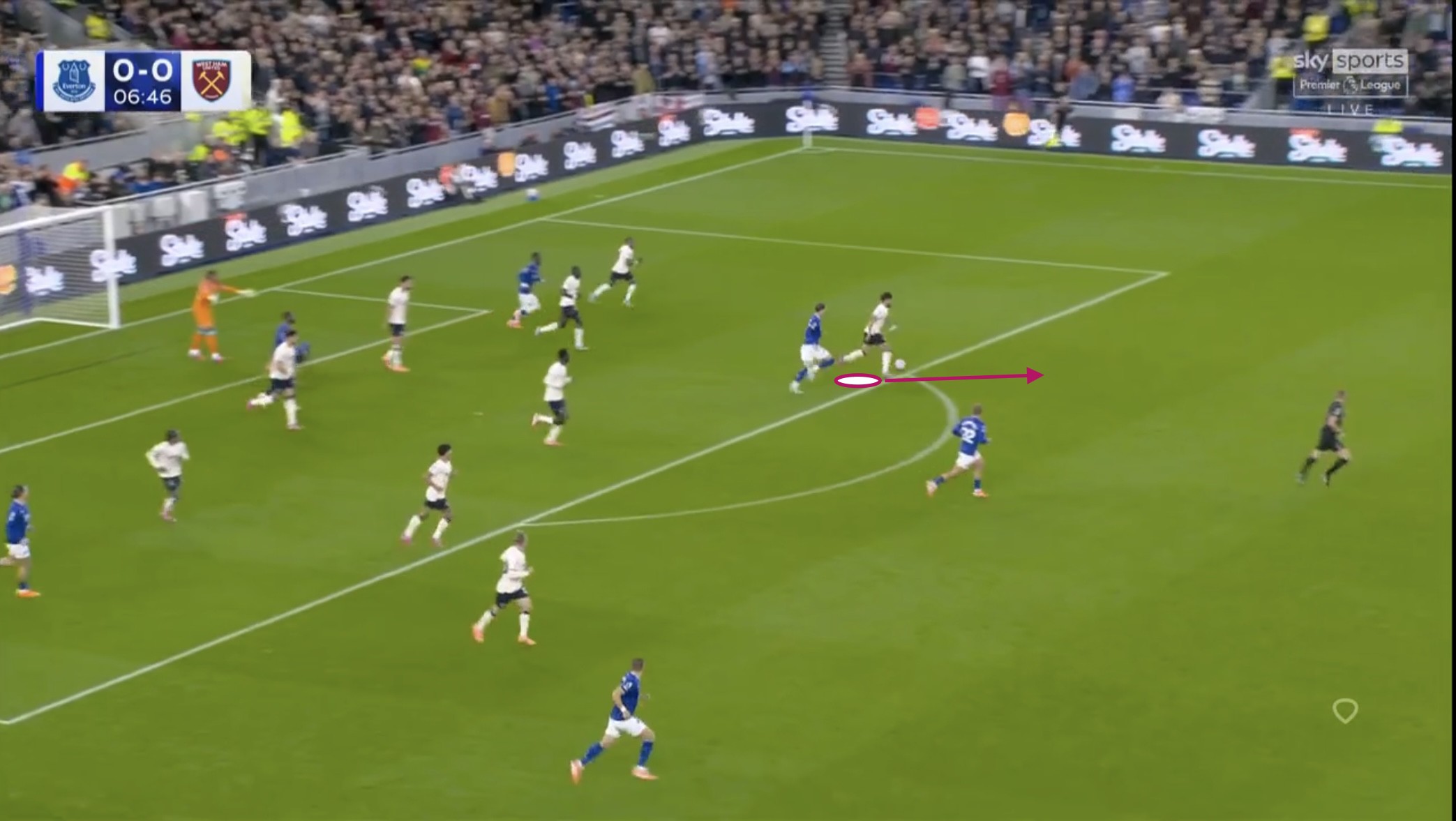
West Ham defending with high volume of numbers in the box
Paqueta starting counter attack
Paqueta to Fullkrug to Fernandes who gets it out wide to Bowen
Overlap Walkers-Peters and bodies in the box
Kyle Walkers Peters pass to Bowen
Bowen attempted cross

With more time on the training ground, these principles will only become more refined and structured.

The key difference Nuno will bring to West Ham compared to previous managers is his selective pressing approach.

Like David Moyes, he prefers his teams to sit in a compact mid-to-deep block, conserving energy and pressing only in targeted zones, typically the middle or defensive third, before breaking forward at pace.

This approach will prevent West Ham from being exposed in transition.

It will also eliminate large gaps between the lines, help conserve energy across matches, and play directly into the strengths of key players such as Bowen, Summerville, Füllkrug, and Paquetá.

It allows them to exploit space on the counterattack, much like they did during their UEFA Conference League-winning run under Moyes.

The early signs are promising.

Nuno’s blueprint is already visible, and with time, West Ham could once again become one of the Premier League’s most dangerous counterattacking sides.

Conclusion

Therefore, it is no surprise that Nuno accepted the West Ham job: the squad profiles allow him to replicate many of the structures and ideas that proved successful at Forest.

But how sustainable is Nuno’s style of football?

His time at Forest showed that it is capable of pushing a team into European contention, but sustaining that success over many years is less certain.

Even Forest floundered at the end of last season.

As highlighted above, his pragmatism often allows opponents to dictate games through possession.

Against high-quality Premier League sides, that can be a dangerous trade-off, as it leaves your team at the opposition’s mercy.

It can catch teams off guard for a season or two, but as the saying goes, “ Fool me once, shame on you; fool me twice, shame on me.”

This is not to say that Nuno is not a good coach.

He is, and he is excellent in specific aspects of the game, which may be precisely what West Ham are looking for.

But there is a ceiling with a coach of his profile.

And the bigger question remains: is this not simply David Moyes 2.0?

West Ham had spoken of wanting to play “the West Ham way,” a phrase associated with more expansive and entertaining football.

They tried managers like Julen Lopetegui and Graham Potter, yet ultimately returned to a Moyes-style appointment in Nuno.

It serves as a reminder to fans across the Premier League: in football, as the old saying goes, “be careful what you wish for.”

Tags: How Good Is Nuno Espírito SantoNottingham ForestNuno Espírito SantoNuno Espírito Santo AnalysisNuno Espírito Santo Coaching StyleNuno Espírito Santo Nottingham ForestNuno Espírito Santo Tactics At Nottingham ForestNuno Espírito Santo West Ham UnitedPremier LeaguePremier League AnalysisWest Ham AnalysisWest Ham Tactical AnalysisWest Ham UnitedWest Ham United AnalysisWest Ham United Style Of PlayWest Ham United TacticsWho Is Nuno Espírito Santo
Previous Post

Merlin Polzin Tactics At HSV 2025/2026: Defensive Discipline For Bundesliga Survival – Tactical Analysis

Next Post

Kamaldeen Sulemana Scout Report At Atalanta 2025/2026: Ademola Lookman Rival Or Partner? – Player Analysis

Next Post
Kamaldeen Sulemana Scout Report At Atalanta 2025/2026 Can He Become The Next Ademola Lookman – Player Analysis

Kamaldeen Sulemana Scout Report At Atalanta 2025/2026: Ademola Lookman Rival Or Partner? - Player Analysis

Premier League tactical clusters data visualization showing three team archetypes

Premier League Tactical Archetypes: What Clustering Reveals

June 4, 2026
PSG’s Control Of Arsenal In The Champions League Final – Tactical Analysis

PSG’s Control Of Arsenal In The Champions League Final – Tactical Analysis

June 3, 2026
Femi Azeez

Femi Azeez Scout Report At Millwall 2025/2026: A High-Output Transition Winger – Player Analysis

April 17, 2026
  • About Total Football Analysis
  • Contact Total Football Analysis
  • Advertise
  • Privacy Policy
  • Cancellation / Refund Policy
  • Resources
  • Terms Of Service

© 2026 Total Football Analysis

No Result
View All Result
  • Football Analysis
    • Data Analysis
    • Formations
      • 2-2-4 Formation
      • 2-3-5 Formation
      • 3-1-4-2 Formation
      • 3-2-2-3 Formation
      • 3-2-4-1 Formation
      • 3-1-6 Formation
      • 3-3-4 Formation
      • 3-4-1-2 Formation
      • 3-4-2-1 Formation
      • 3-4-3 Formation
      • 3-5-1-1 Formation
      • 3-5-2 Formation
      • 4-1-4-1 Formation
      • 4-2-2-2 Formation
      • 4-2-3-1 Formation
      • 4-2-4 Formation
      • 4-3-1-2 Formation
      • 4-3-3 Formation
      • 4-4-2 Formation
      • 4-5-1 Formation
      • 5-3-2 Formation
      • 5-4-1 Formation
      • 6-3-1 Formation
    • Head Coach Analysis
    • Match Analysis
    • Player Analysis
    • Recruitment Analysis
    • Set Piece Analysis
    • Tactical Theory
    • Tactical Preview
    • Team Analysis
    • Training Analysis
    • Tactical Analysis
    • Scouting Report
  • Competition
    • ALL Competitions
    • English Premier League
    • Champions League
    • La Liga
    • Bundesliga
    • Serie A
    • Ligue 1
    • Eredivisie
    • EFL Championship
    • FIFA World Cup 2022
    • WEURO 2022
    • Women’s Super League
    • NWSL
    • Belgian First Division A
    • A-League
    • Liga Profesional de Argentina
    • Austrian Bundesliga
    • Campeonato Brasileiro Série A
    • DFB Pokal
    • 1. HNL
    • Danish Superliga
    • EFL League One
    • EFL League Two
    • FA Cup
    • EFL Cup
    • Indian Super League
    • K-League
    • J1 League
    • Liga MX
    • Copa América 2021
    • Copa del Rey
    • MLS
    • Eliteserien
    • Euro 2020
    • Primeira Liga
    • Scottish Premiership
    • Allsvenskan
    • Europa League
    • UEFA Nations League
    • Liga AUF Uruguaya
  • Coaches
    • All Coaches
    • Alfred Schreuder
    • Ange Postecoglou
    • Antonio Conte
    • Arne Slot
    • Bo Svensson
    • Brendan Rodgers
    • Bruno Lage
    • Carlo Ancelotti
    • Christophe Galtier
    • Claude Puel
    • Claudio Ranieri
    • David Moyes
    • Dean Smith
    • Diego Simeone
    • Domenico Tedesco
    • Frank Lampard
    • Eddie Howe
    • Edin Terzić
    • Emma Hayes
    • Erik ten Hag
    • Ernesto Valverde
    • Gennaro Gattuso
    • Gerardo Seoane
    • Gian Piero Gasperini
    • Giovanni van Bronckhorst
    • Graham Potter
    • Igor Tudor
    • Imanol Alguacil
    • Jesse Marsch
    • Jonas Eidevall
    • Jorge Sampaoli
    • José Bordalás
    • José Mourinho
    • Julen Lopetegui
    • Julian Nagelsmann
    • Julien Stéphan
    • Jürgen Klopp
    • Luciano Spalletti
    • Lucien Favre
    • Manuel Pellegrini
    • Marcelo Bielsa
    • Marco Rose
    • Marco Silva
    • Massimiliano Allegri
    • Mauricio Pochettino
    • Maurizio Sarri
    • Mikel Arteta
    • Niko Kovač
    • Nuno Espírito Santo
    • Oliver Glasner
    • Patrick Vieira
    • Paulo Fonseca
    • Pep Guardiola
    • Peter Bosz
    • Rafa Benítez
    • Ralf Rangnick
    • Ralph Hasenhüttl
    • Roger Schmidt
    • Roy Hodgson
    • Sean Dyche
    • Sérgio Conceição
    • Simone Inzaghi
    • Sonia Bompastor
    • Stefano Pioli
    • Steffen Baumgart
    • Steven Gerrard
    • Thiago Motta
    • Thomas Frank
    • Thomas Tuchel
    • Unai Emery
    • Vincenzo Italiano
    • Xavi
  • Teams
    • ALL Teams
    • AC Milan
    • Ajax Amsterdam
    • Arsenal
    • AS Monaco FC
    • Atalanta
    • Atlético Madrid
    • FC Barcelona
    • FC Bayern Munich
    • Borussia Dortmund
    • Celtic FC
    • Chelsea FC
    • Everton F.C.
    • Inter Milan
    • Juventus F.C.
    • Leeds United F.C.
    • Liverpool FC
    • Manchester City
    • Manchester United FC
    • Paris Saint-Germain
    • Rangers FC
    • RB Leipzig
    • Real Madrid CF
    • Tottenham Hotspur
    • West Ham United
  • Players
    • ALL Players
    • Alisson Becker
    • Bukayo Saka
    • Erling Haaland
    • Harry Kane
    • Jack Grealish
    • John Stones
    • Julián Alvarez
    • Kalvin Phillips
    • Kevin De Bruyne
    • Kyle Walker
    • Kylian Mbappé
    • Lamine Yamal
    • Lionel Messi
    • Luis Díaz
    • Mohamed Salah
    • Phil Foden
    • Virgil Van Dijk
  • Guides
    • Best Betting Sites
      • World Cup Betting Sites
      • World Cup Betting Promotions
      • Footbal Betting Sites
      • New Betting Sites
    • Online Casinos
      • Non GamStop Casinos
      • Offshore Casinos
      • Real Money Slots
  • Contact
  • Login

© 2026 Total Football Analysis