
Since the arrival of Unai Emery, Aston Villa has undergone a complete transformation.
When Emery was appointed, the club was in 16th place under Steven Gerrard, while Dean Smith’s tenure before that had also ended in decline.
Emery immediately altered the direction of travel, leading Villa to seventh, fourth, and sixth finishes across his first three seasons.
Unai Emery holds the best record among recent Aston Villa managers.
He has the highest Points Per Match (1.77), ahead of Dean Smith (1.41) and Steven Gerrard (1.18).
However, the opening weeks of the 2025/2026 EPL campaign have brought a stark contrast.
At the time of writing, Aston Villa have just won a single game from their first six in the Premier League.
This regression has surprised supporters and raised questions about Emery’s methods, the commitment of key players, and the squad’s overall morale.
This Aston Villa tactical analysis explores both the tactical issues and the broader concerns surrounding squad building under Unai Emery management.
Aston Villa Off The Pitch Issues
The sense of deflation at Villa Park was seen in the closing days of last season.
A 2–0 loss to Manchester United in the final match denied the club a place in the UEFA Champions League, and that disappointment appeared to colour what followed in the summer window.
Financial restrictions linked to Profitability and Sustainability Regulations further limited their options.
Aston Villa remained inactive for long stretches of the market, and when a big move finally arrived, it provoked consternation.
The sale of Jacob Ramsey to Newcastle United was unpopular with both fans and within the dressing room, while Emiliano Martínez made it clear his desire to depart.
As the transfer deadline drew near, the club’s moves grew hurried.
The arrivals of Evann Guessand and loan deals for Harvey Elliott and Jadon Sancho appeared to be a scramble rather than a coherent plan.
The impression was of a squad assembled more by circumstance than by design.
Players who might once have been attainable targets and past loanees, such as Marcus Rashford or Marco Asensio, were no longer realistic in the absence of Champions League football.
Instead, Aston Villa entered the new season, both reshaped and unsettled, leaning on a collection of loanees at a time when stability was required.
Aston Villa Striker Issues & Chance Creation
The raw numbers already expose Aston Villa’s struggles with the end product.
They have scored just once in the league, and their expected goals are 3.85, both of which are the lowest in the league.
These points are poor individual form and a lack of creating and finishing high-quality chances.
Without a goal in 10 matches before this past weekend, Ollie Watkins has become both symbol and victim of these limitations.
Watkins’ game is based on attacking space rather than dealing with defenders with his back to goal.
When Aston Villa play against a mid-block or low block, he is trapped between two centre-backs and forced to duel physically rather than exploit the depth.
He remains the lone focal point in crowded zones because his teammates rarely provide coordinated supporting runs into the penalty area.
Opposition teams can commit resources to blocking his channels, which forces him to take suboptimal shots from poor angles or receive minimal service.
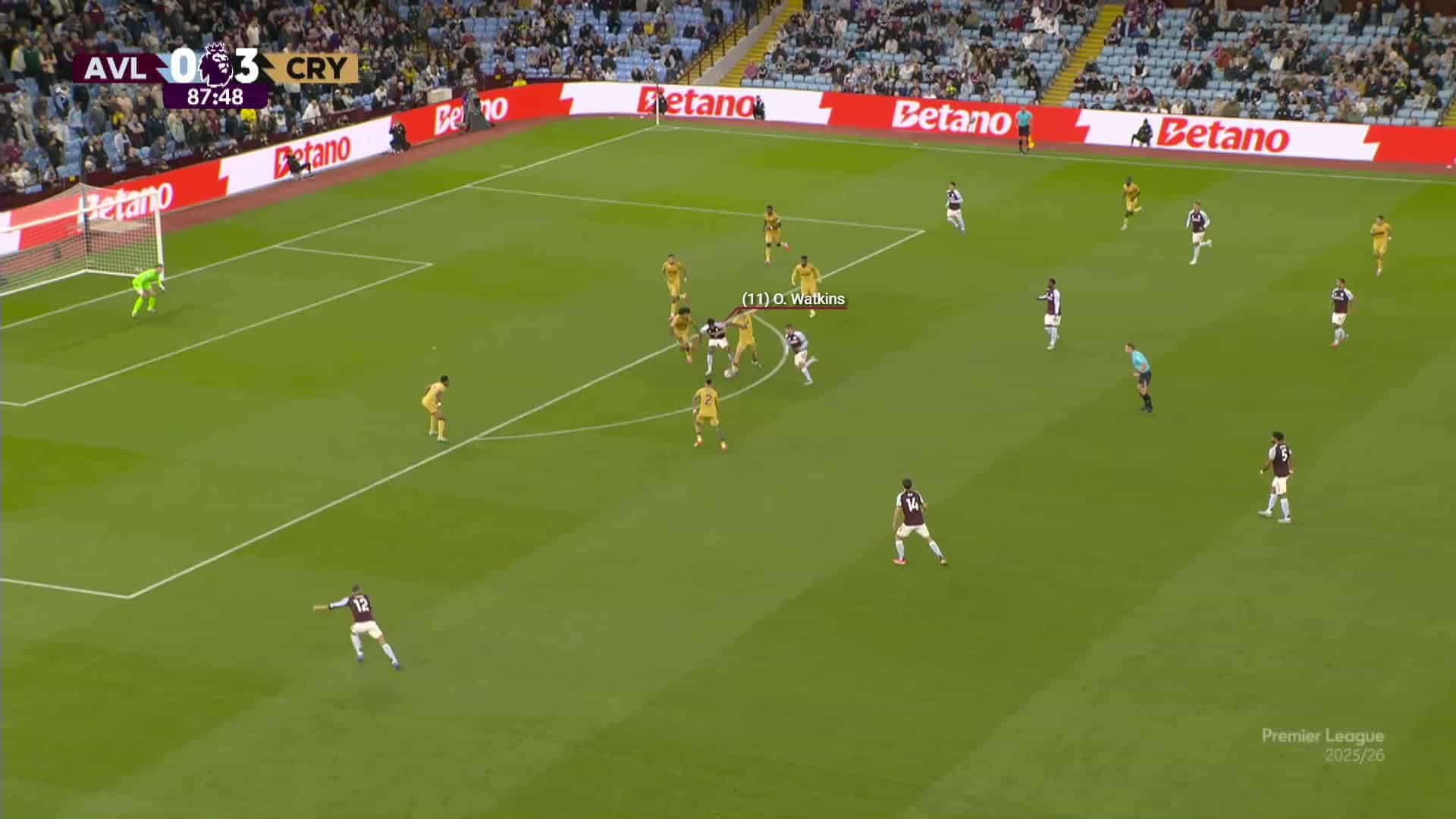
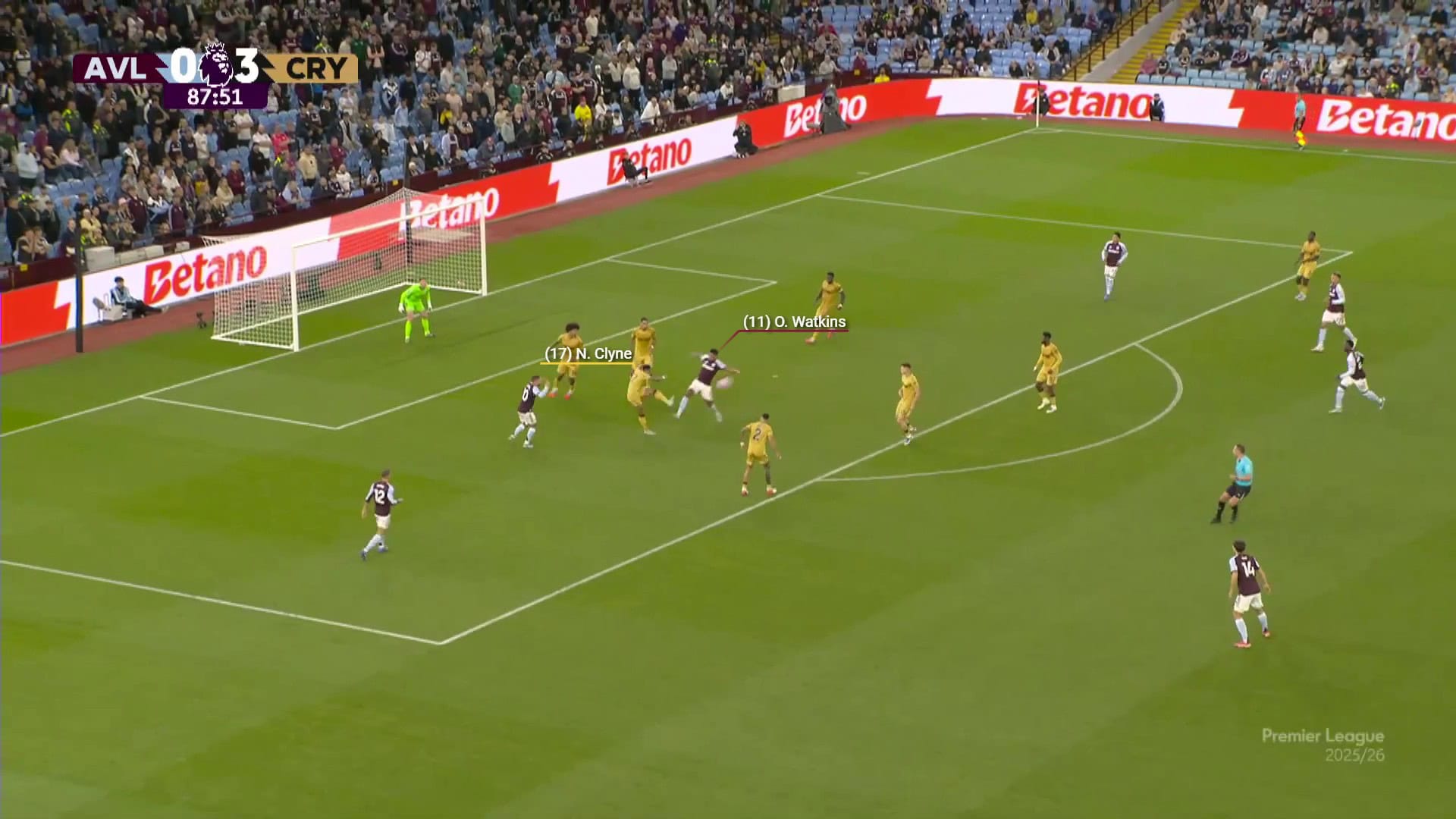
During this season’s 3–0 defeat to Crystal Palace, Emiliano Buendía received possession, but Watkins was left isolated inside the box.
Buendía controls the ball poorly, but it eventually finds its way to Watkins.
There is no close support to combine or create a bounce pass for Watkins, so he cannot spin into space.
When the ball eventually reaches him, he has his back to goal and no nearby runners, so the move breaks down.
Adding to his difficulty, Palace defend with strong cover, with players such as Chris Richards and Nathaniel Clyne quickly closing the space.


A side with European ambitions in the Premier League needs a striker who can deliver a minimum double-figure return.
The absence of any alternative proven option leaves Aston Villa overly dependent on Watkins to meet that output.
Evann Guessand offers a possible complementary profile.
His cameos show promise with intelligent diagonal runs and the ability to cause trouble.
But he has primarily been used on the right wing, which minimises his impact.
He is more naturally equipped to threaten between the centre-backs than to be out wide.
Emery could look to use him in partnership with Watkins or as a central option from the bench; he could provide additional bodies in the area and prevent opponents from marking out the lone striker.
The wider problem is the scarcity of box threats beyond Watkins.
Several of Aston Villa’s advanced players like to play in the middle and final thirds without consistently arriving in finishing zones.
Harvey Elliott and Emiliano Buendía fit this tendency.
Both can be imaginative in their passing and do well in constructing attacks from between the lines, but neither is naturally inclined to attack the penalty spot or provide late arrivals.
They are often the architects rather than the finishers, meaning that promising sequences stall without a decisive body in the right area.
Morgan Rogers has the potential to fill that gap if used in his optimal role.
He is a powerful carrier who can break lines and enter into the box with momentum, and he has shown glimpses of being able to add goals from deeper runs.
His influence is diminished when stationed centrally as a ’10’ since that space overlaps with Buendía and leaves Rogers facing static possession.
He looks far more dangerous when starting from the left side of a midfield three, carrying the ball from middle zones and angling his runs inside.
From that platform, he can time his entries into the box and occupy spaces defenders vacate while tracking Watkins.
Ultimately, Aston Villa’s striker problem is not reducible to Watkins’ confidence.
It reflects the absence of complementary threats around him and the lack of automatisms that deliver arrivals into the area.
Lack Of Quality Width Provided By Lucas Digne & Matty Cash
Aston Villa’s second issue is their lack of threatening width.
The responsibility for providing width has fallen on the full-backs.
Lucas Digne on the left and Matty Cash on the right are expected to cover the length of their wide areas, initiating buildup and delivering the final crosses.
The difficulty is that this reliance exposes the team in transition and reduces the variation of their attacking play.
Neither full-back can repeatedly provide both defensive stability and high positioning without the collective structure suffering elsewhere, and their attacking output does not justify this compromise.
The result is a pattern that makes Aston Villa predictable, as opponents know the wide threat is limited and can be managed without overcommitting.
In possession, Aston Villa lean towards central progression.
The logic makes sense, as the most valuable spaces are located in the half-spaces and around the penalty spot.
But completely neglecting natural wide players invites problems.
Few opponents feel stretched when preparing to defend against Aston Villa.
Without a dribbling winger to fix defenders on the outside, opposition backlines can hold compact, narrow shapes and shuffle laterally short distances.
As seen against Newcastle United, Tyrone Mings plays the ball out wide to Lucas Digne.
Digne isn’t really the type of player to beat a man 1-v-1 (maybe if a ball is clipped over the top, but he’s not as quick as he used to be).
He receives it and whips in a driven cross.
Not necessarily critiquing that individual cross, but this is a recurring theme.
When Aston Villa can’t break through centrally, the ball goes out wide to Digne, and he crosses the ball.
It’s predictable and easy to defend.
His crossing quality can be hit or miss, but the main point is that their wide play doesn’t carry much threat.
The same thing happens, but with Matty Cash.
Leon Bailey previously gave Aston Villa the profile they now lack.
His capacity to receive wide, travel with the ball at speed, and commit a defender one-on-one forced teams to respect Aston Villa in wide areas.
Without him, they are left with wing‑fielders who prefer to drift inside or combine in pockets but who do little to trouble defenders out wide.
The absence of this type of winger also removes the psychological stress defenders feel when isolated in wide channels.
Most Premier League teams possess some form of transitional or physical wide outlet.
At one end of the spectrum are specialists like Jérémy Doku, who can break defensive lines on the ball with a constant dribbling threat.
On the other hand, players such as Anthony Gordon or Anthony Elanga may not be elite technicians, but they are direct runners, aggressive in transition, and force defenses backwards.
Both categories add a layer of unpredictability and create access points into the box through either cutbacks or dragged markers.
Aston Villa currently have no equivalent, which leaves their attack stale.
For Aston Villa, pursuing a profile that can stretch opponents vertically and horizontally would improve things.
It would also increase the value of central creators who could pick passes into more open channels rather than threading through the most congested areas of the pitch.
Individual Mistakes
The final weakness causing Aston Villa’s current performance lies in the defensive phase.
They have conceded five goals, but their expected goals against figure is 8.41, which would rank them 19th in the league.
The issues are not necessarily about being overwhelmed but about individual mistakes and the reduced coordination of their backline.
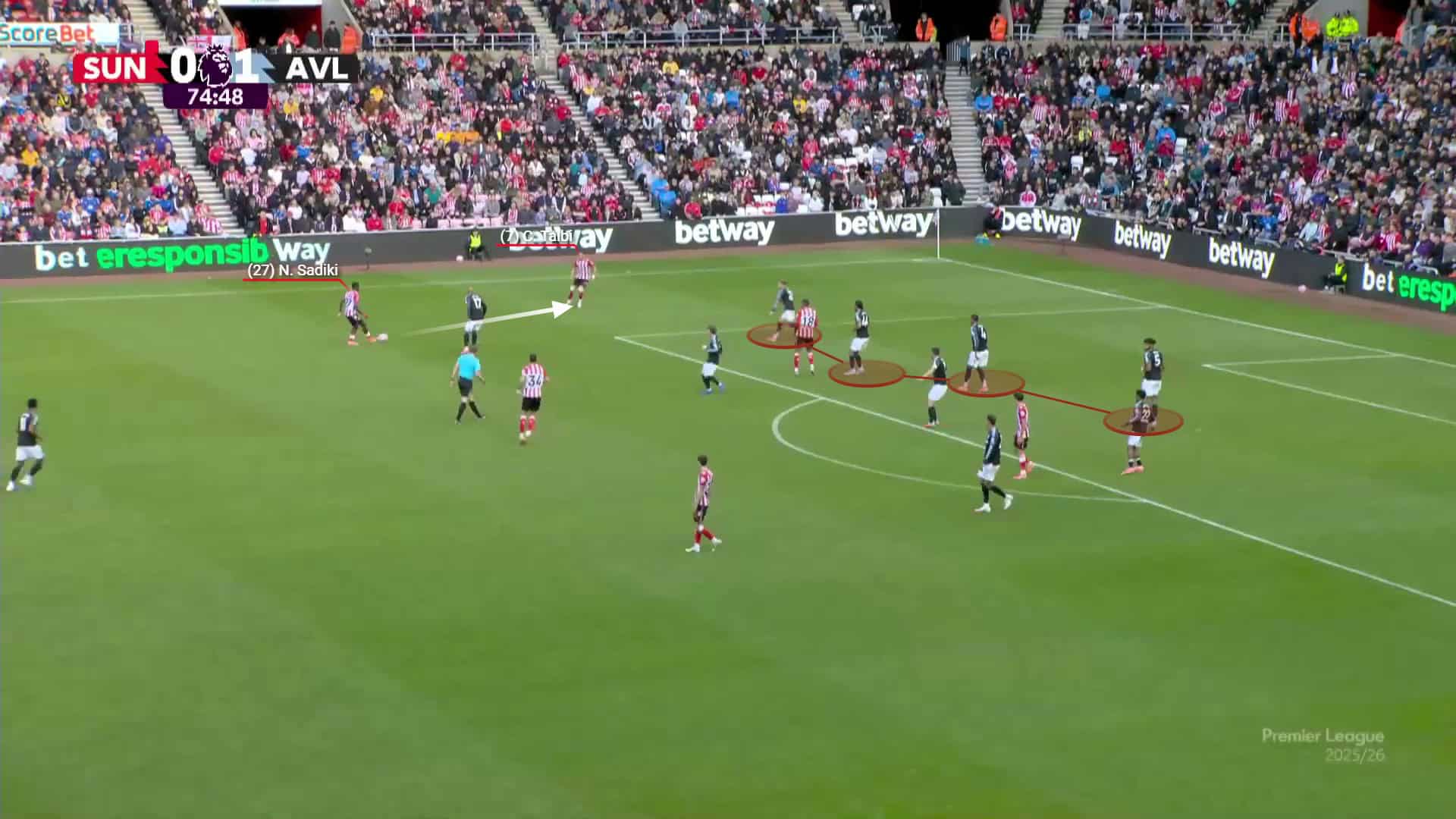
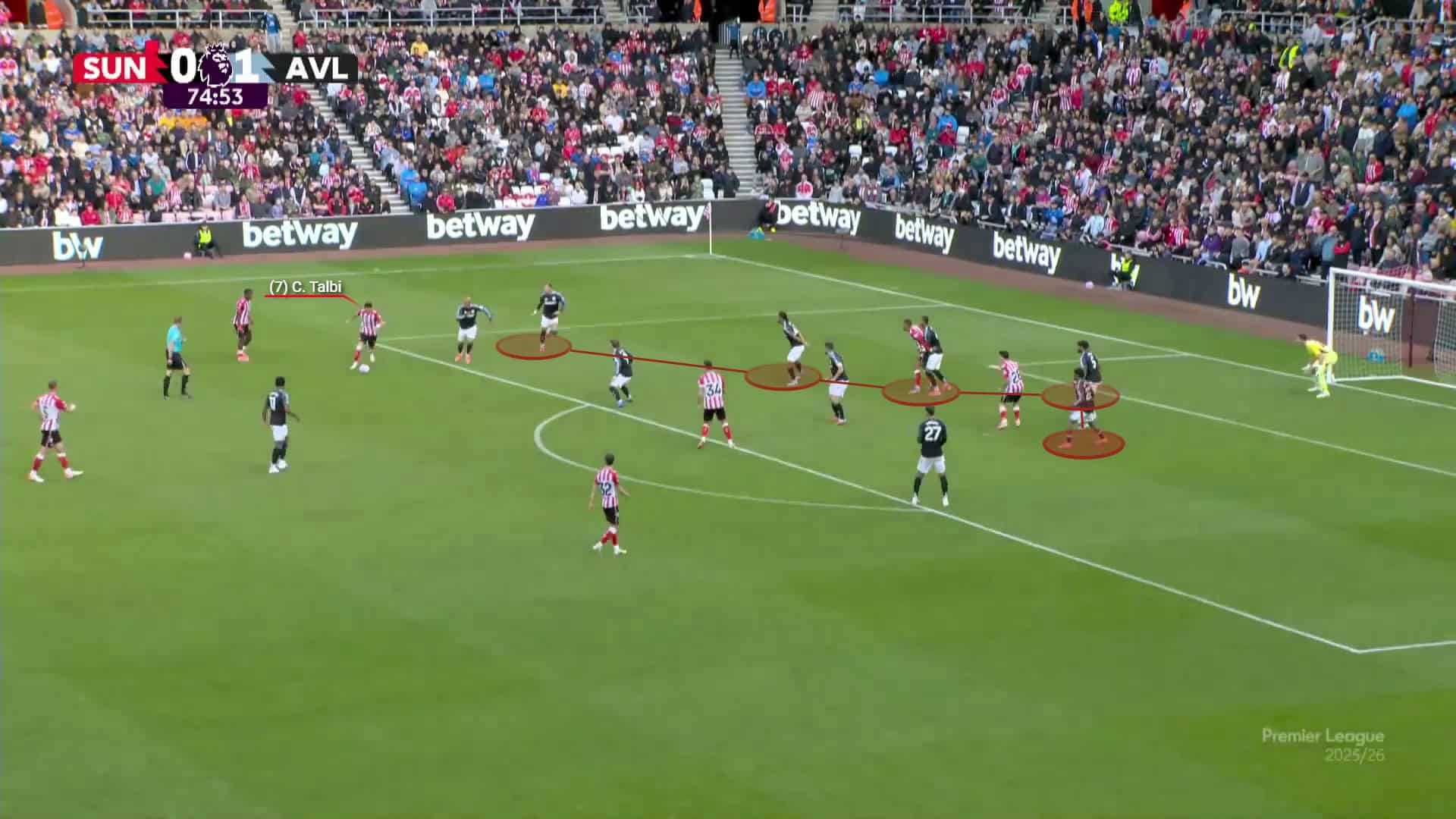
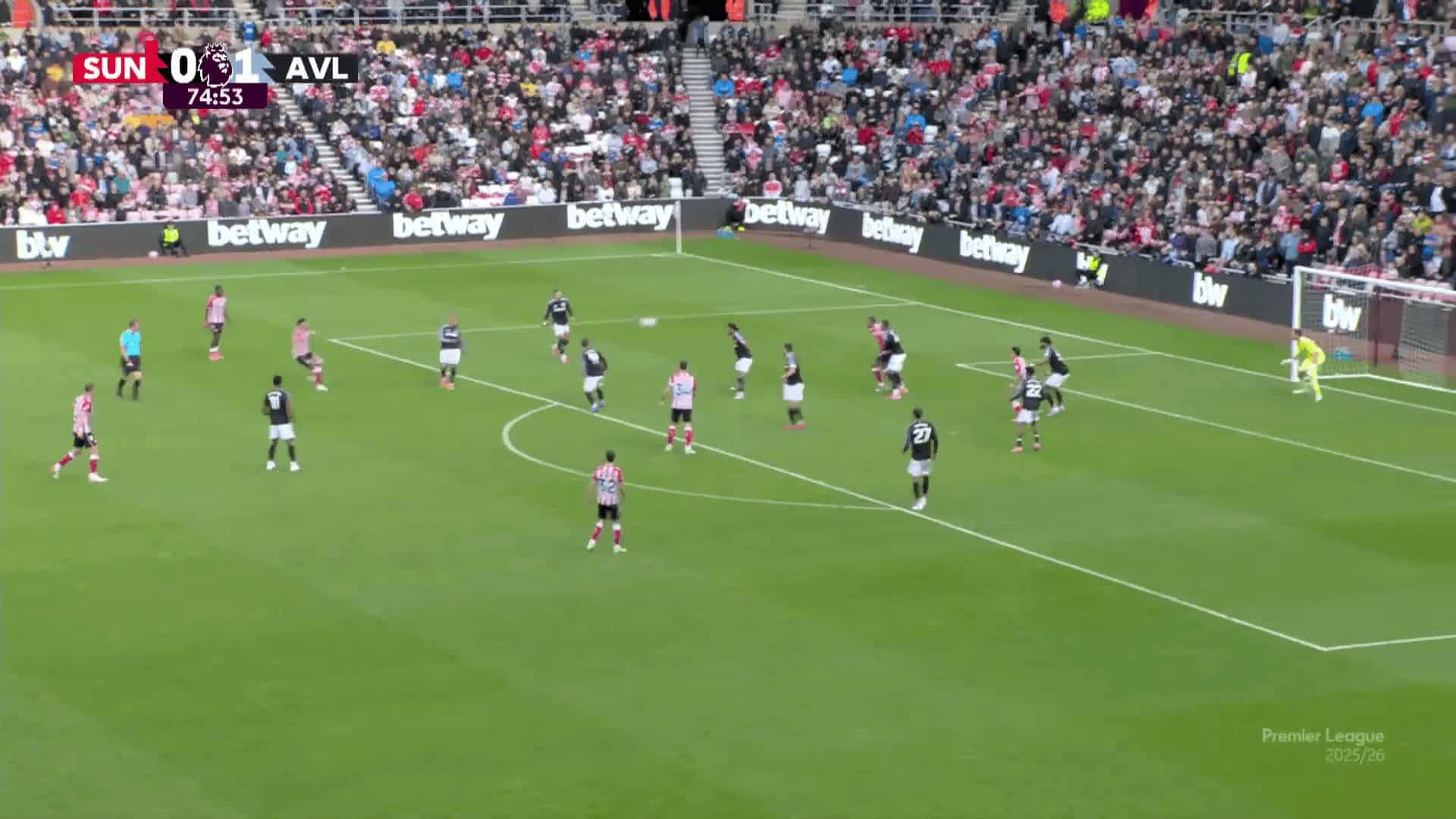
In the images below against Sunderland, Aston Villa’s defensive line initially looks organised.
However, when Chemsdine Talbi tries to force the issue with a shot that gets blocked, the ball loops into the air.
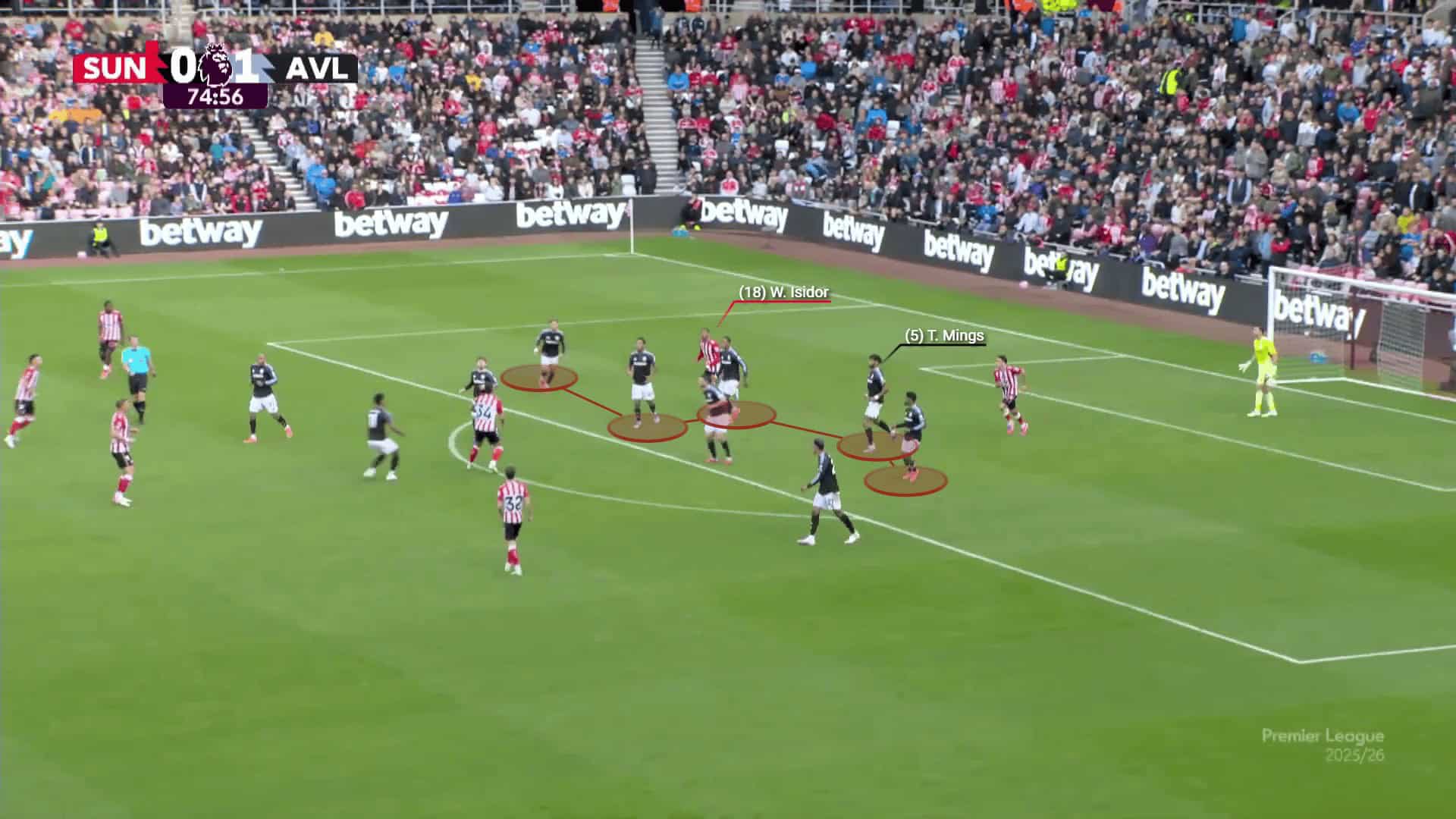
This presents a chance for the backline to push up, as Wilson Isidor positions himself as deep as possible while still aiming to stay onside.
The problem is that Aston Villa’s defensive line is not fully coordinated.
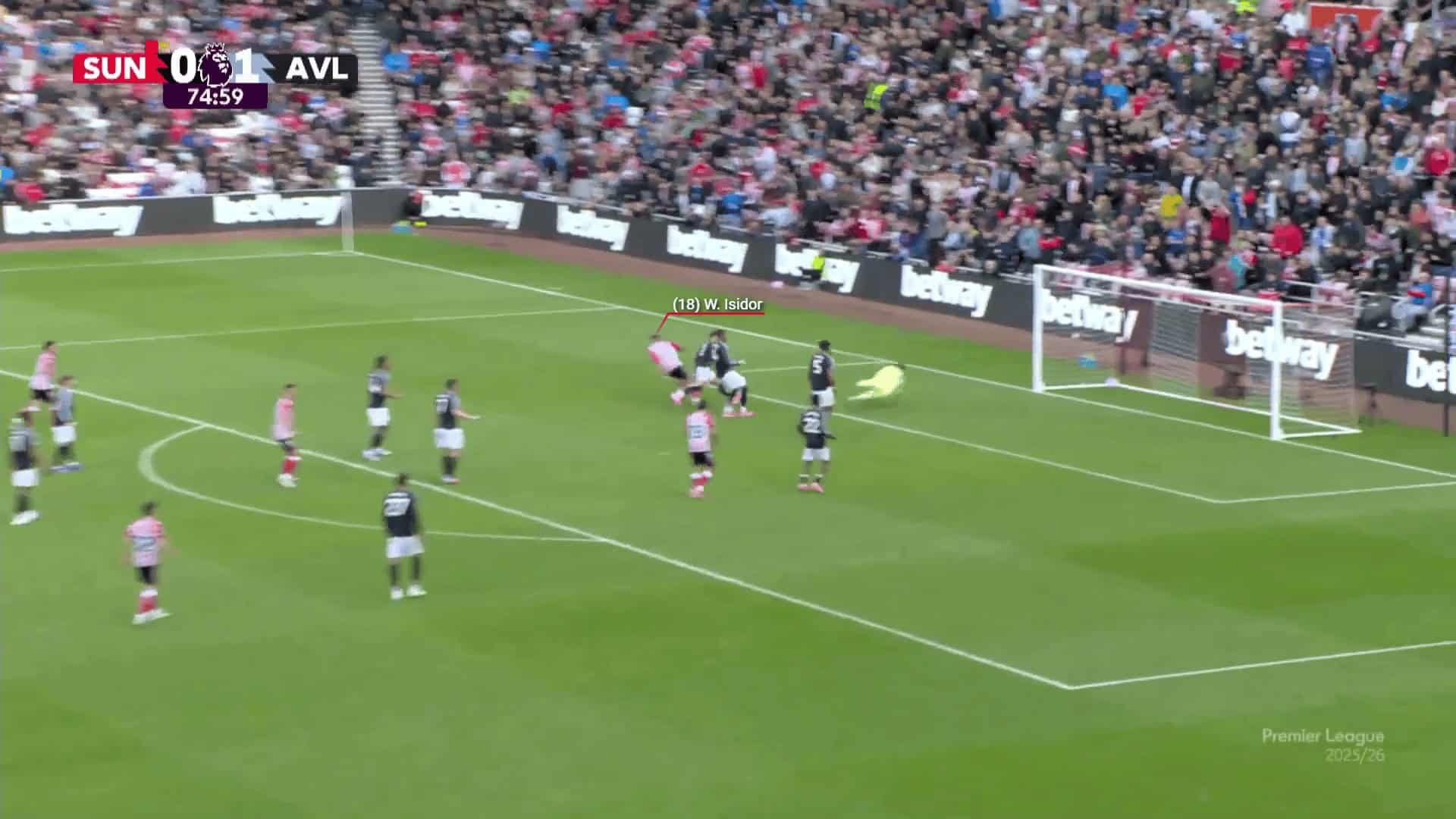
Some defenders step up, but Tyrone Mings remains level with Isidor.
As a result, Isidor is onside, wins the second ball, and goes on to score.
Aston Villa remain known for a mid-block that compresses central areas while still operating with a high line.
At its peak two seasons ago, this structure was among the best out-of-possession shapes in the league.
The team timed its step‑ups and was able to funnel opposition away from the middle.
They also used the offside trap to an exceptional level.
Throughout this time, the classic threat of balls being played over the top was almost entirely nullified.
The compact shape denied short central progression, and the disciplined high line strangled direct runs in behind.
The current picture of the league is different at present.
Opposition now target them with long balls and set-pieces, which turn the game into duels and second‑ball contests.
In that environment, clarity of responsibility becomes very important.
Who steps up, who covers, who picks up loose runners from knockdowns?
These are smaller details that, when poorly coordinated, create moments of chaos.
As seen against Crystal Palace, Aston Villa were punished from a long throw after failing to win both the first and second ball.
Ismaïla Sarr ghosted in at the back post, with no defenders tracking his run and finishing the chance.
These marginal breakdowns have caught out Aston Villa this season.
The mid-block compressed high line model still works when the ball is forced centrally, yet the frequency of aerial and transitional actions has exaggerated the risks.
Personnel absences deepen the problem.
Amadou Onana’s hamstring injury has removed a key figure who covered ground extensively and formed a strong double pivot with Boubacar Kamara.
Onana’s mix of athleticism and defensive reading allowed him to close spaces when the back four stepped out.
In his absence, John McGinn has shouldered many of those duties.
McGinn remains tireless and aggressive, but he is naturally a box‑to‑box midfielder rather than a screener.
The difference is subtle in placement but significant in effect, since Onana can anticipate longer duels and provide shielding at a higher level.
The domino effect of this absence is visible across the midfield.
McGinn’s redeployment towards the right wing at times further reduces the double pivot’s stability.
Lamare Bogarde has featured alongside Youri Tielemans, and although both are technically good, they lack the physical range and defensive security offered by Kamara or Onana.
The drop in quality is shown in how easily opponents reach dangerous zones when first‑line pressing is bypassed.
At present, injuries and role shifts have weakened their out-of-possession structure.
Conclusion
Until key players return and coordination is refined through coaching, individual errors may still occur from time to time.
It is still early in the season, and the issues outlined above should be framed within that context.
Unai Emery has already proven himself as a top-level coach capable of correcting structural weaknesses and extracting better balance from his squads.
None of these flaws are fatal, but they have made the side more predictable and more vulnerable than in previous campaigns.
A single league win could act as the catalyst to restore rhythm and confidence, giving Emery a platform to re‑establish Aston Villa’s identity and push them back up the table.
