
Olympique de Marseille will return to play in the UEFA Champions League after two seasons without doing so.
A second-place finish in last season’s Ligue 1, which Les Phocéens had not achieved since 2022, brought them back to Europe’s top competition.
After a turbulent path within the locker room, Roberto De Zerbi once again demonstrated his value as one of the leading figures in the generational change of coaches.
With his firm hand and the flexibility of his positional and attraction-based game, the Italian brought fresh ideas to a tournament that stands out for its physical rigour and the large number of duels that usually dominate on the pitch.
Before arriving at Marseille, De Zerbi tactics had already drawn attention in Europe with his time at Brighton & Hove Albion, Sassuolo, and Shakhtar Donetsk, where he had combined organised pressing with quick transitions and flexible positional play.
That experience allowed him to experiment with complex possession structures and off-the-ball movement, which he now seeks to implement and refine at Olympique de Marseille.
After a strong pre-season, Marseille have not had the expected start to the league: two defeats against Stade Rennes and Olympique Lyonnais have overshadowed their only victory against Paris FC.
However, the team does not seem to have lost its identity: there is a high volume of movement, while attraction runs and overlaps both inside and outside seem to flow on the pitch.
Although some pieces still need adjusting on the board, De Zerbi’s team still seems to operate effectively.
They have already faced teams with five-defender lines in the first three matchdays, such as Rennes and Paris FC.
Through positional structures and rational occupation of space, they play with patterns that favour flexibility and organic runs.
In this tactical analysis, we analyse some of the behaviours and dynamics that De Zerbi’s Olympique de Marseille show on the pitch, even if they are not fully polished.
Olympique De Marseille Offensive Structures
In possession, Roberto De Zerbi formation at Marseille alternates between 3-2-5 and 3-1-6 structures, designed to maximise rational occupation of space and generate numerical advantages against the opposition’s defence.
In the 3-2-5, two central midfielders secure the base of the team, providing passing options and facilitating ball circulation.
At the same time, the five attackers occupy the last line and open interior lanes for runs and combinations.
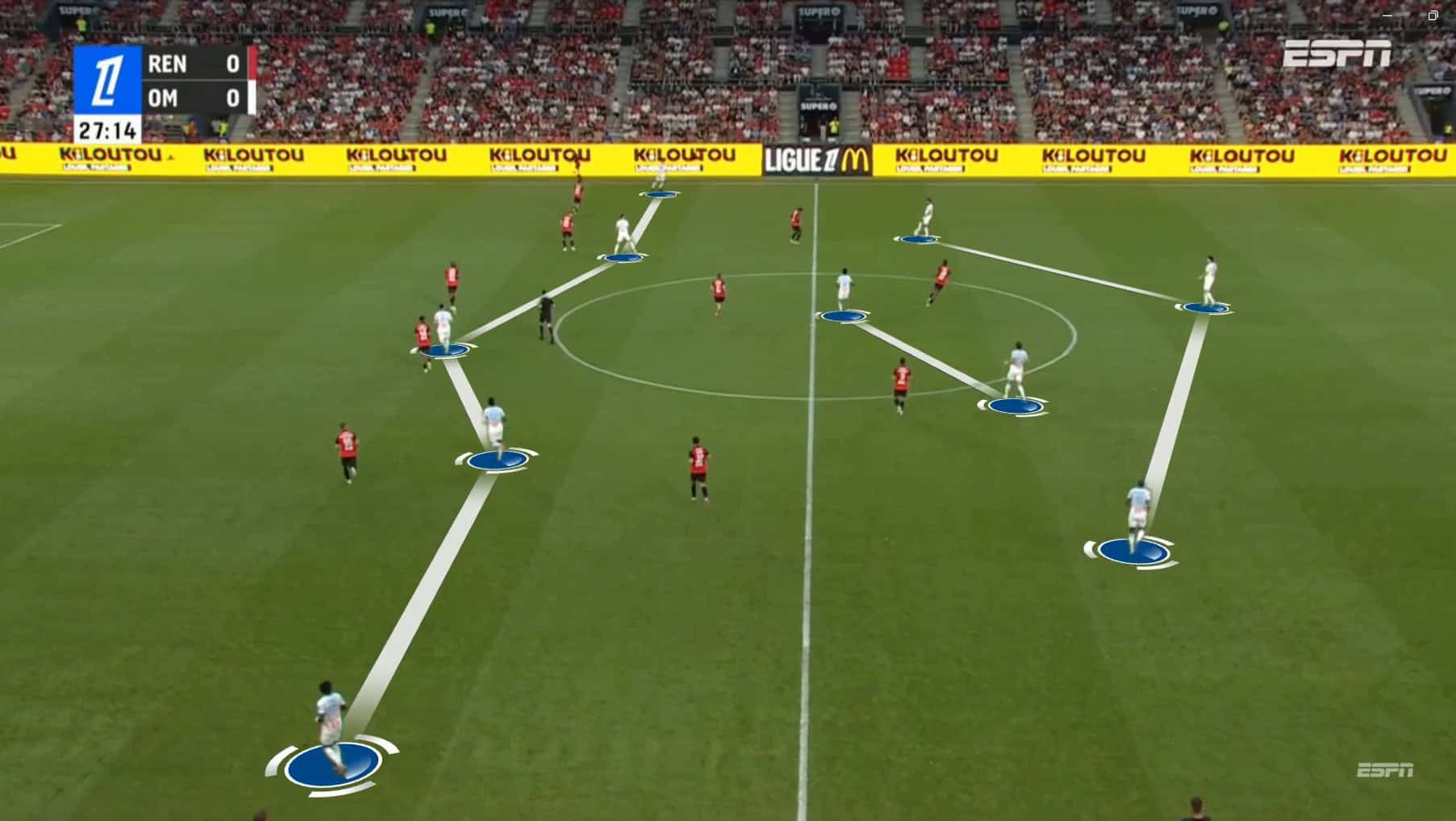
When the team seeks offensive density in the final third, they shift to a 3-1-6, with a single midfielder at the base and up to six players projected forward.

This high volume of attackers allows for numerical superiority in width and interior intervals, forcing the opposition to match up and leaving spaces for coordinated runs and breaks.
Beyond creating numerical advantages, both the 3-2-5 and 3-1-6 structures enable a rational occupation of the field: certain players occupy central positions to draw defenders inside, while others project outward, freeing up wide lanes.
This balance ensures that the opponent is pulled inward, thereby liberating space for full-backs or wingers to receive the ball with time and room to operate, thereby enhancing progression and the offensive threat.
The combination of these structures allows Marseille to maintain a constant offensive presence, projecting players over the last line and creating advantages both in wide areas and central sectors.
Olympique De Marseille Interior Penetrations
One of the main problems Marseille faced against five-defender lines was making interior penetrations effective.
With so little space in intermediate areas, the key was to chain two consecutive runs in the same sector.
The first run attracts defensive attention, while the second, immediately along the same lane, seeks to exploit the space generated.
In the build-up phase from a 3+1 structure, the right-back could be seen making an inside run, reaching the second and third heights.
This type of interior overlap is especially valuable because it opens the lateral lane for the winger to receive wide and, over time, maintain attacking width while also creating a vertical threat through the half-space.
Another relevant pattern appears when the wide player receives oriented forward.
In response, the full-back interprets the passer’s intention and overlaps inside, attacking the interval that expands due to the rival full-back stepping toward the ball.
This generates a double threat: continuity on the outside for the winger or interior penetration by the full-back.
Finally, De Zerbi constantly encourages numerical superiority in central-wing sectors.
By accumulating several players in these zones, he reduces the possibility of individual marking nullifying interior penetrations and facilitates progression with positional and numerical advantage.
Olympique De Marseille Far Man Runs
Penetrating runs from the far side—whether from the centre forward or winger—represent one of Marseille’s most recognisable mechanisms under De Zerbi.
For example, the centre-forward usually anticipates the passer’s intention and responds with an “L-shaped” run.
They start slowly, giving the passer time, and then accelerate in depth, avoiding offside and receiving in stride over long spaces.
In other scenarios, lateralizing the central midfielder in the first line plays a key role.
If the opponent pursues, an interval is created that the centre-forward can exploit by dropping between the lines.
This descent attracts the direct defender and opens a space behind, which the winger can attack by cutting inside.
Conversely, if there is no immediate pressure on the lateralized midfielder, they gain time and space to carry, fix, and choose.
Their diagonal position relative to the wide player provides an ideal angle to connect, while the attacking midfielder fixes centrally and occupies references in the opponent’s defensive square.
Olympique De Marseille Runs To Attract & Free
One of Marseille’s most interesting resources appears in runs that are not meant to be direct receivers but to attract opponents and free another area of the pitch.
In the build-up phase, a simple backward pass can act as a trigger: it forces the rival block to press forward, creates disorder in its lines, and opens gaps.
From there, a first run against the last line drags defenders, and immediately a second run from first or second height appears unexpectedly in the space just created.
In the final third, the principle continues with variations.
It is common to see the winger leave their lateral lane and move inside to attack the box.
This move attracts the opposing full-back toward the interior, intentionally freeing their own full-back, who now has width and advantage to receive and progress.
Subsequent play returns the ball to the wing, with defenders turned the wrong way and struggling to reorganise.
It is also frequent to combine short support and runs in a chain over the last line.
One player offers themselves short to fix, while another runs in depth to break the defence.
This coordination allows spaces to be occupied rationally, destabilises dense blocks on the last line, and facilitates rotations toward interior lanes where a free winger can receive with time and space to drive forward.
Olympique De Marseille 2-v-1 Overlaps On The Wing
When the opponent sets up in a low block, one of Marseille’s most effective ways to attack is through 2-v-1 overlaps on the wing.
For this, a defender steps up and shifts lanes toward the full-back, combining with the winger.
This movement is enhanced by the interior fixation created by De Zerbi’s offensive structures of five or six attackers.
These structures force the opponent to prioritise central protection and leave the flank vulnerable.
Executing these overlaps relies heavily on socio-affective coordination between teammates.
The winger, as the initial possessor, must sensibly time their partner’s run, either prolonging their dribble to attract the rival full-back or choosing the right moment and space to release the pass outside.
This resource exploits a limitation of defenders in low blocks: the lateral rarely positions themselves to cover the outside.
Their main reference is the area and interior intervals, so they always prioritise closing inside.
This creates a window that Marseille seeks to exploit, giving the overlapping full-back or defender free space and a favourable angle to cross or attack the byline.
Conclusions
Roberto De Zerbi’s Olympique de Marseille exhibits a clearly defined offensive style, despite the season’s irregular start.
The combination of structures like 3-2-5 and 3-1-6, along with mechanisms such as penetrating runs and interior and exterior overlaps, enables the team to generate positional advantages, open channels, and create opportunities both in width and in central areas.
Coordinated movements of wingers, full-backs, and forwards, along with spatial awareness and the use of numerical superiority, demonstrate a model that seeks not only to progress with the ball but also to disorganise the opposing defence, even against low blocks or five-defender lines.
Together, these patterns show a team that, although still adjusting pieces and improving synchrony, maintains a clear and versatile offensive identity based on rational space occupation and organic mobility of its attackers.
