
Fenerbahçe hosted Benfica at the Şükrü Saracoğlu Stadium in the first leg of the UEFA Champions League playoff round, which determines which team will advance to the League Phase.
The match ended with a disappointing 0-0 draw from the perspective of Fenerbahçe, the home side.
Sarı Kanaryalar were not able to impose their game on Benfica.
It is also important to note that Fener’s performance progressed as time went by, becoming more dangerous in the second half and getting very close to scoring during the final minutes.
However, Benfica’s solid defending and Fenerbahçe’s attacking errors and tactical choices made it difficult for them to gain their desired advantage before the second leg.
In this tactical analysis, the focus will be centred on Fenerbahçe’s performance, highlighting their attacking errors and the positive aspects that need to be further consolidated and improved ahead of the second leg.
The analysis will also examine the tactical errors and what the team can fix in terms of formation and lineup ahead of the second leg to succeed in the qualification mission.
Fenerbahçe Vs Benfica Formations & Lineups
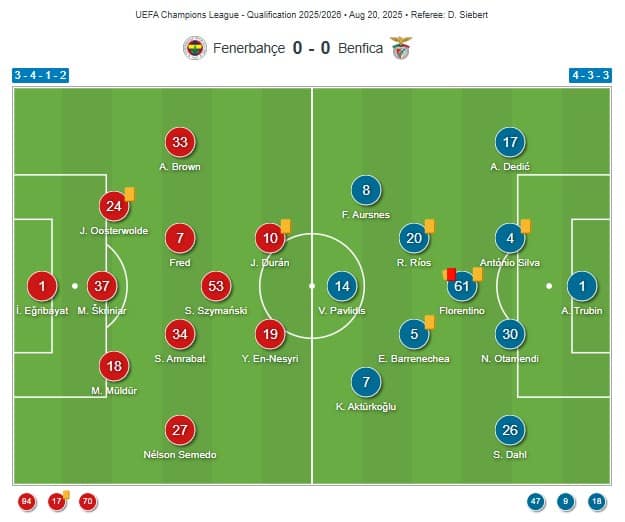
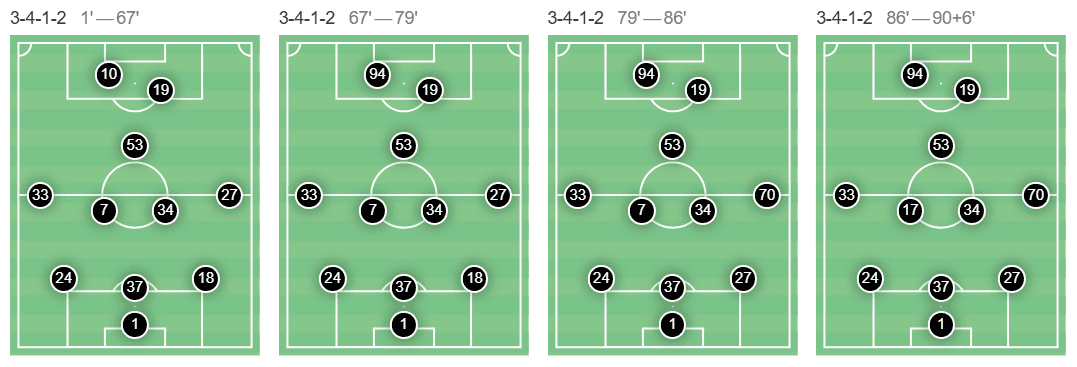
José Mourinho started this match according to the 3-4-1-2 formation with İrfan Can Eğribayat as a goalkeeper, Mert Müldür, Milan Škriniar and Jayden Oosterwolde as centre-backs, Sofyan Amrabat as the defensive midfielder playing in front of the defensive line, with Fred playing alongside him, and both Archie Brown and Nélson Semedo playing as wing-backs.
In front of them, Mourinho used Sebastian Szymański as an attacking midfielder, with both Youssef En-Nesyri and Jhon Durán as the attacking duo.
Mourinho has been using this formation frequently in recent times.
He used almost the exact lineup against Göztepe in the Süper Lig.
But beforehand, Fener had alternated between the 4-2-3-1 formation, the 3-5-2 formation, the 3-4-3 formation and the 3-4-1-2 formation.
The choice of playing according to the 3-4-1-2 formation could have secured the team’s defence more, but the result suggests that it was not very helpful attacking-wise.
Furthermore, in-game changes like the substitution of Talisca instead of Durán at the 67th minute confirm that the initial lineup was not really the best possible one, especially in terms of attacking possibilities.
In addition, we can argue that Mourinho feared making more courageous attacking changes during the game.
Despite changing some of the players, he did not make any changes in terms of positions, even though Fenerbahçe arguably needed to score more urgently than Benfica.
But despite that, Mourinho avoided taking risks and made a single attacking substitution.
On the other hand, Bruno Lage opted for their usual 4-3-3 formation with Anatoliy Trubin as a goalkeeper, Amar Dedić as a right-back, Antonio Silva and Nicolás Otamendi as centre-backs, and Samuel Dahl as a left-back.
In midfield, Florentino was used as a defensive midfielder before getting sent off during the second half, with Enzo Barrenechea and Richard Ríos playing as central midfielders.
Both Kerem Aktürkoğlu and Fredrik Aursnes were used as wingers with Vangelis Pavlidis as the team’s main striker.
Fenerbahçe Vs Benfica Lineups
Fenerbahçe Attacking Tactics
Fener started the match with high pressing in an attempt to win the ball back quickly and disturb Benfica’s build-up from the back, but they were unsuccessful in doing so due to Benfica’s solid organisation, their ability to resist pressure, and their success in reaching the opposing box so often.
This made things difficult for Fenerbahçe because they did not get the chance to attack continuously.
Benfica did not use a low defensive block and did not decide to stay in their own half.
This obliged Fener to defend more and rely heavily on attacking transitions for their attacks.
Fenerbahçe Positioning In Attacking Transitions
In this regard, we should say that Fenerbahçe’s main issues regarding their attacking transitions and counterattacks were that the team was sometimes slow in terms of passing and failed to be in the right place at the right time.
In other words, some of the players failed to position themselves well without the ball, which was crucial during the team’s counterattacks.
This made defending easier for Benfica, who had the time needed to reorganise their defensive lines and secure their goal.
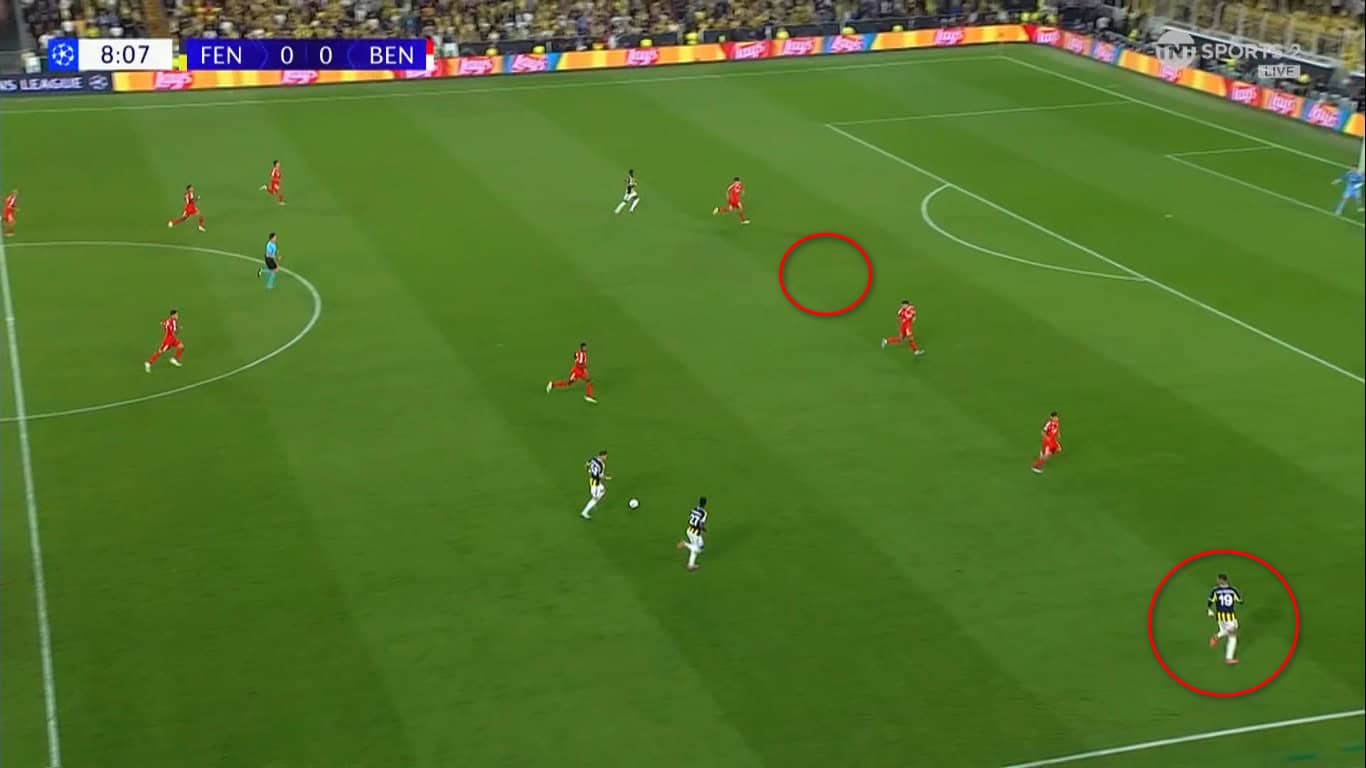
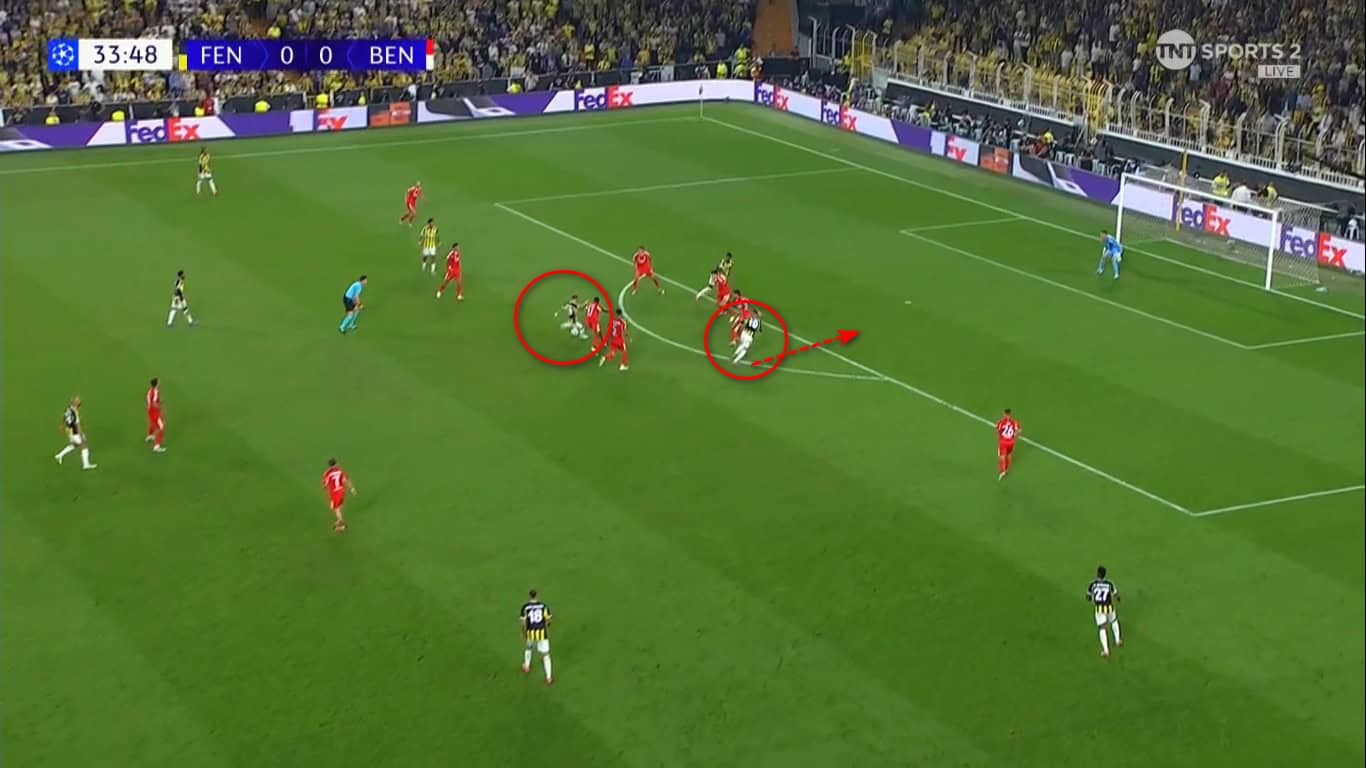
In this example, given his excellent aerial abilities, En-Nesyri preferred to move to the centre of the box and ask for the ball instead of leaning towards the right wing and receiving the ball in that spot.
En-Nesyri could have left that space for Semedo, who was making the overlap.
He would have been much more useful if he had joined Durán inside the box, proposing a different passing option that could have led to a dangerous opportunity.
Furthermore, Fener’s slow build-up made it complicated for them to surprise Benfica, especially during the first half.
Fenerbahçe Slow Build-up
Benfica were aware of this inability to find passing solutions quickly and applied high pressing to further complicate their opponent’s playmaking process.
They were relatively successful in doing so, as high pressing and disciplined individual marking limited the ball carrier’s passing choices and obliged Fener to lose the ball so often.
This example highlights Benfica’s intended high pressing that disturbed Fenerbahçe’s plans a lot in this game.
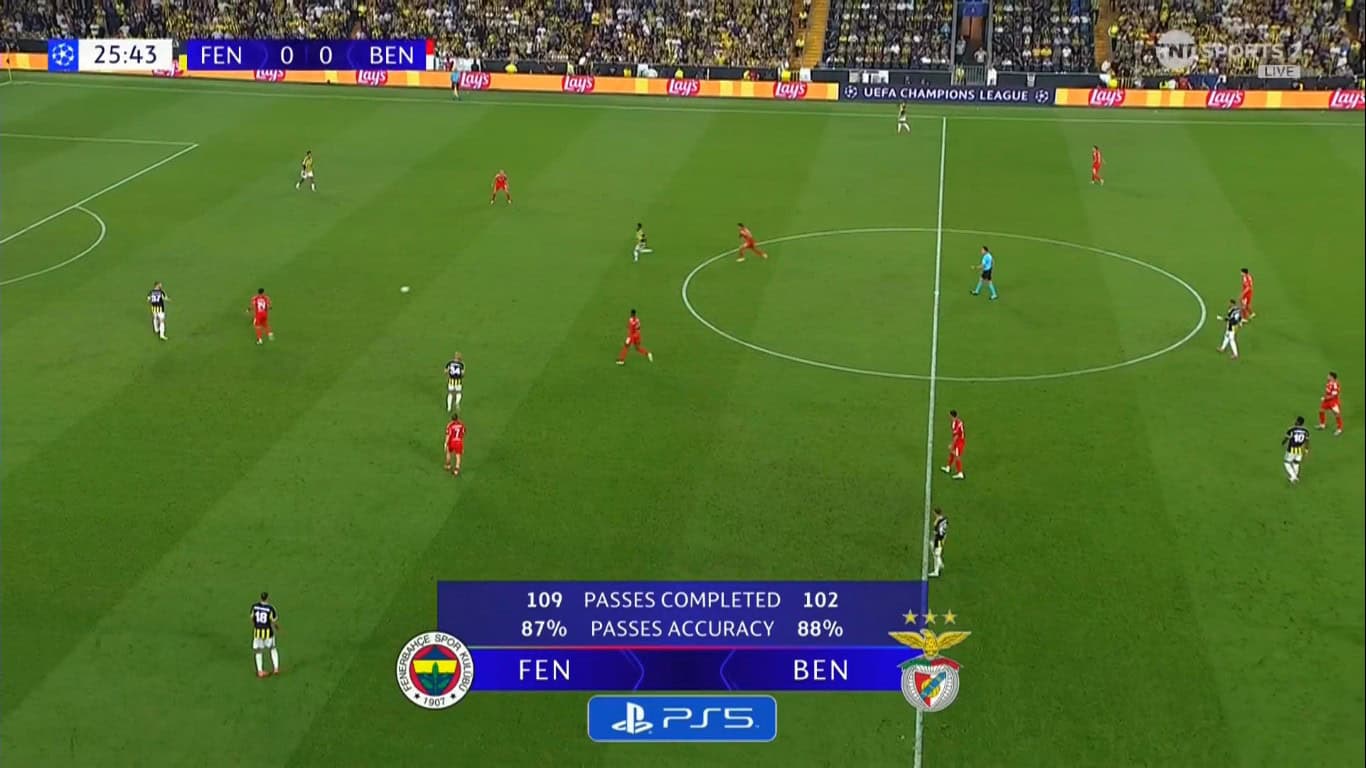
Even when Fener had possession and played with a high defensive block, they failed to find passing options quickly due to Benfica’s tight marking.
Fenerbahçe Passing Inaccuracy In Counterattacks
Moreover, failing to exploit the opportunities that come to you and committing crucial passing mistakes when the team gets dangerous counterattacking opportunities should not be repeated in the second leg, as that prevented Fener from having a suitable goalscoring situation.
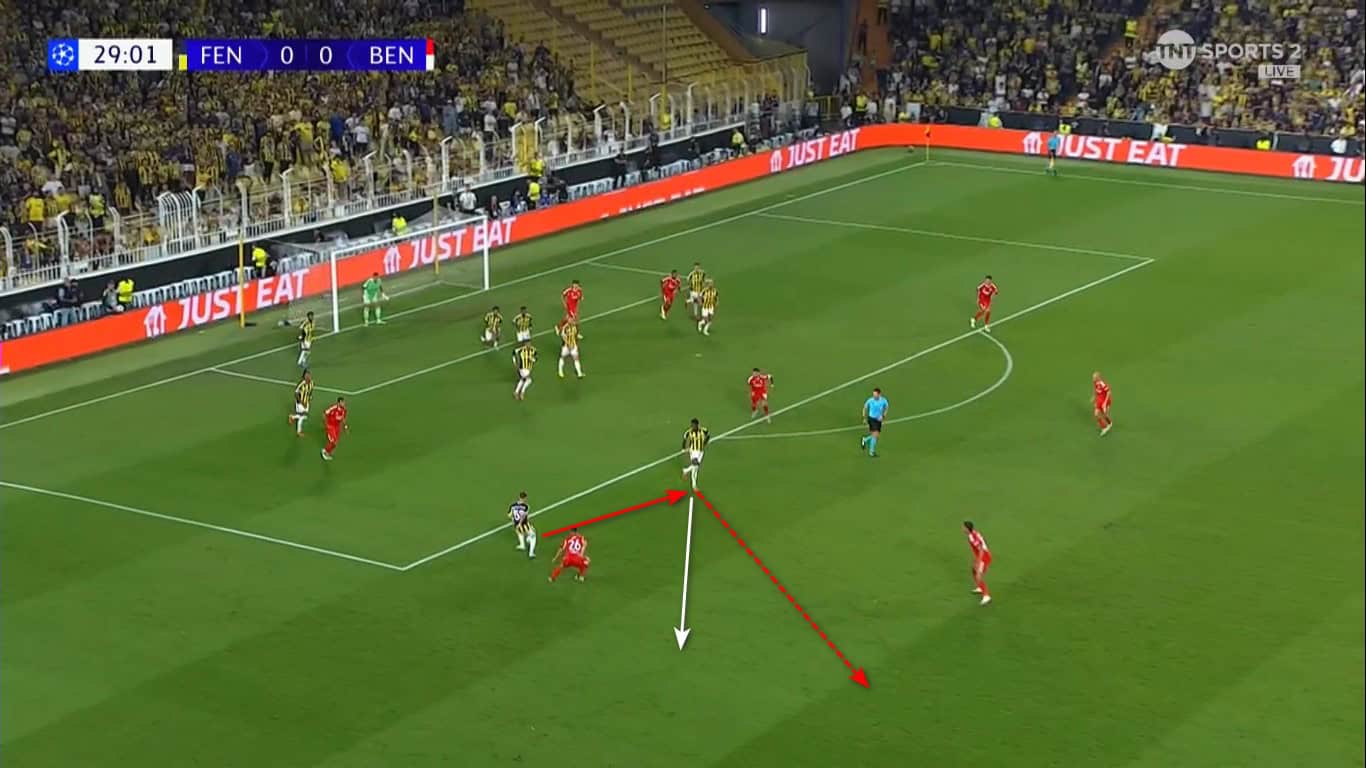
The picture shows a Benfica corner that was intercepted by Fenerbahçe’s players.
Szymański tried playing a one-two combination with Durán to eliminate an opponent and advance on the right wing.
Durán’s inaccurate passing in this crucial situation highlights the lack of concentration and the inability to be useful and decisive in key moments that could have made things better for the team in this first leg.
Even when Fener did well in the playmaking phase and were able to provide the key pass between the lines thanks to Amrabat’s key pass to Szymański, the latter was not as crucial as needed, and his shot was central; neither well-oriented nor powerful.
Fenerbahçe Finishing & Final Touches
In this situation, finishing could have been much better, and Szymański was also capable of taking a fake shot and providing a key pass or a chip to En-Nesyri, who was making the move at the back of the defensive line.
This means that Fener also suffered from a lack of quality in the final third, given that their players did not finish well and did not make the right choices regarding their final passes.
Despite the high-pressing attempts, Fener did not succeed in imposing their game and continued committing mistakes during their attacking transitions.
Failing to provide crosses with the needed frequency to exploit the aerial abilities of En-Nesyri and Durán was due to Semedo and Brown’s inability to beat their direct opponents on most occasions.
Even when Semedo was able to do so at times, his crosses were not as dangerous as needed.
Tactical Adjustments Ahead Of The Second Leg
The fact that Semedo and Brown were not as dangerous as needed attacking-wise makes us wonder why the coaching staff did not consider using an inverted winger like Cengiz Ünder, even during the second half.
Subbing on an experienced inverted winger on the right wing could have added a new dynamic to Fenerbahçe’s attacks.
A player like Ünder has the dribbling abilities needed to surpass players in 1-v-1 situations with more ease and mastery than Semedo.
Thanks to his potential cuts inside, Ünder could also create shooting opportunities for himself.
Fenerbahçe In-Game Changes
In this regard, what happened in the first half suggests that Mourinho could have switched to the 4-2-3-1 formation, relying on two powerful wingers and exploiting the opponent’s red card by adding attacking players rather than defending with more than five players using the 3-4-1-2 formation.
In addition to the possible change of formation, Fener made a single attacking change despite needing to score goals and despite having a numerical superiority.
The substitution of Talisca for Durán could have been done much earlier, as Talisca proved that he can be much more dangerous and decisive inside the final third despite leaning to the right wing most of the time.
Fenerbahçe Use Of Talisca
In fact, the events of the second half confirmed that Talisca should have started the match instead of Durán, as Talisca was much more accurate with his passes, dribbles, and even shooting attempts.
Talisca’s impact was immediately obvious.
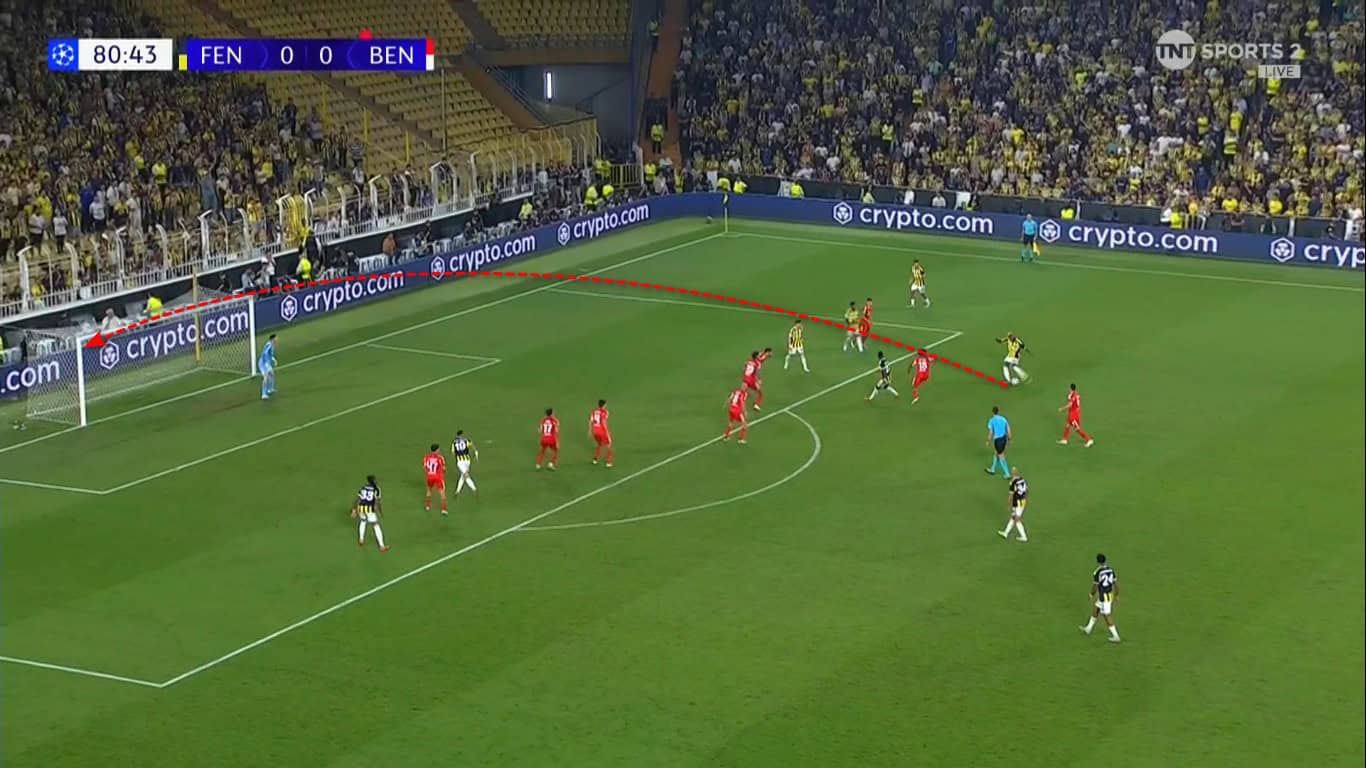
He created chances for his teammates and was even capable of scoring the disallowed goal for his team, thanks to a very powerful curved shot from outside the box.
This confirms that Talisca deserved more playing time in this match, as his inclusion in the starting lineup would have made things less complicated for Fenerbahçe.
Conclusion
A 0-0 draw does not hurt Fener much at the end of the day since there is still a second leg to play.
However, Fenerbahçe could have done better, especially in exploiting their attacking transitions and being more crucial in the final third.
Moreover, fixing the tactical errors made in this first leg is necessary to be more dangerous in Portugal, especially when it comes to using Talisca’s services more and a dangerous winger like Ünder to try scoring in that away game.
