
For the longest time in Bundesliga history, there was only one club that played every single possible matchday in the German top flight, Hamburger Sportverein (HSV).
The club has managed to win numerous titles throughout its history, particularly in the 1980s.
Overall, HSV can look back at six Bundesliga titles, three DFB-Pokal victories, and even winning the European Cup, the predecessor to the UEFA Champions League, once in 1983.
After those successful times, the club remained one of the best in German football, but failed to win major trophies going forward.
Still, as the only side never relegated from the Bundesliga, HSV became a legendary club and is regarded as one of the giants of German football to this day.
For their longevity in the league, they are often called „Die Unabsteigbaren“ or „Der Dino“ (the dinosaur).
Things started to spiral in the late 2000s, and it hit them like a truck in the 2010s.
Since 2010, the club has had 24 different managers, had to play in the relegation play-off twice, and barely escaped relegation until 2018, when they were relegated to the 2. Bundesliga.
Ever since, the club has tried to earn their way back to the top flight, but came short for the longest time, finishing fourth (the first place out of chance of promotion) four times in six years and losing the promotion play-off the other two years.
In 2025, following a decisive home win against SSV Ulm, they finally secured promotion back to the Bundesliga after a seven-year absence.
Following another coaching change, 34-year-old Merlin Polzin took over the team in November 2024 and immediately guided them back to success with his tactical approach.
After five matches in the Bundesliga, their comeback has been somewhat rocky.
They have only won one game and scored two goals.
In this HSV tactical analysis, we will examine Merlin Polzin tactics in Hamburg, how they are approaching their first season back in the Bundesliga, and where they need to improve if they want to survive the relegation battle this season.
Adapting Their Plan In Possession
Looking at HSV over the last couple of seasons, they had a very clearly defined role in the 2. Bundesliga.
They were the team to beat; they needed to excel in possession, and they played against a low block most of the time; therefore, they have adopted a very possession-based style of football over the last couple of years.
Merlin Polzin was not different in that regard.
After taking over last season, he maintained the club’s 4-3-3 formation for multiple years and focused on a dominant playing style.
Things have changed for HSV and Polzin.
They are now underdogs in the Bundesliga, fighting to find a place in a very strong league.
Therefore, the young manager decided to change his men’s possession strategy, and now the team takes a more defensive-minded and straightforward approach to the game.

Upon examining their approach, Polzin altered his backline from a back-four to a back-three after being promoted, opting for one more centre-back instead of an additional midfielder, which resulted in a 3-4-2-1 formation.
This allows his team to have a better presence in the backline and the box, because, unlike last year, they will no longer have the majority of possession.
In fact, HSV currently sit at only 46% of possession in the Bundesliga after having nearly 60% of possession last season in the 2. Bundesliga.
They like to keep their three centre-backs relatively narrow and have one midfielder drop back diametrically, creating a bit of width for them.
A new player, Luka Vušković, also plays a key role in their new approach to building up.
Vušković was brought in on loan from Tottenham Hotspur.
His older brother Mario is also under contract at HSV but is currently serving a suspension because of doping.
The 18-year-old Croatian centre-back might be the youngest player in the HSV squad, but he also might just be the best.
His quality on the ball is exceptional.
He is one of the most talented centre-backs in the world right now, and it shows.
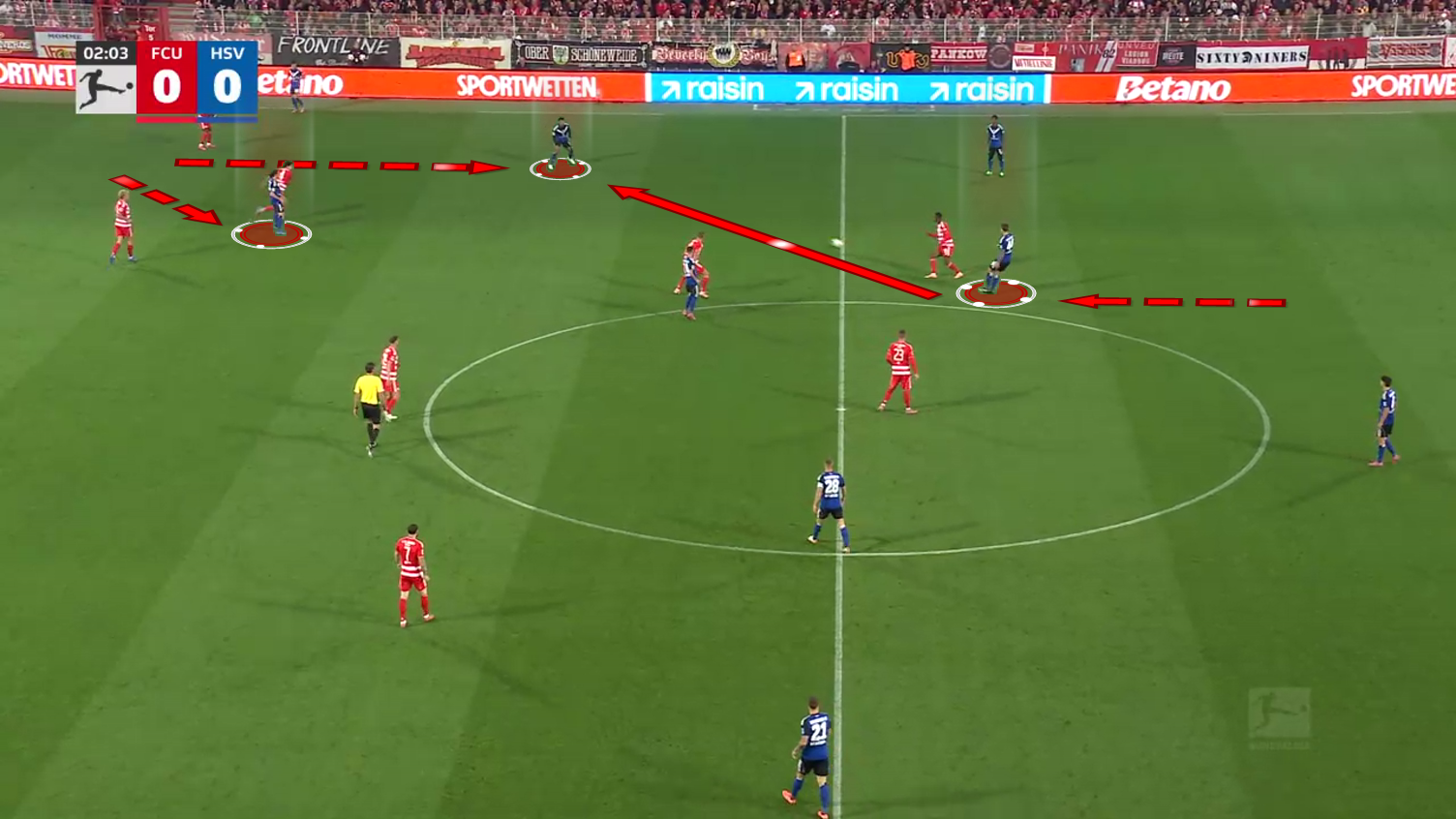
Vušković shows exactly that in the situation pictured above.
Most of the time, he triggers the play in possession for Hamburg, and this time, he does it with a nice carry between the two Union Berlin strikers.
This attracts the press, but Vušković stays calm and does what his coach wants him to do: find one of the three attackers between the lines.
Polzin keeps his two central midfielders close to the backline and the three attackers high up the pitch, allowing them to make runs into the space between the lines, hoping to create dynamism that way instead of through passing the ball faster.
In this case, Ransford Königsdörffer dropped back out of the attacking line towards the wing and was able to receive the pass, while Rayan Philippe also dropped back but stayed higher up the pitch.
While it works here, the way the strikers move is not ideal.
Königsdörffer is too wide.
Philippe should not retreat here at all, and it just shows that the team has not yet fully adapted to its new identity.
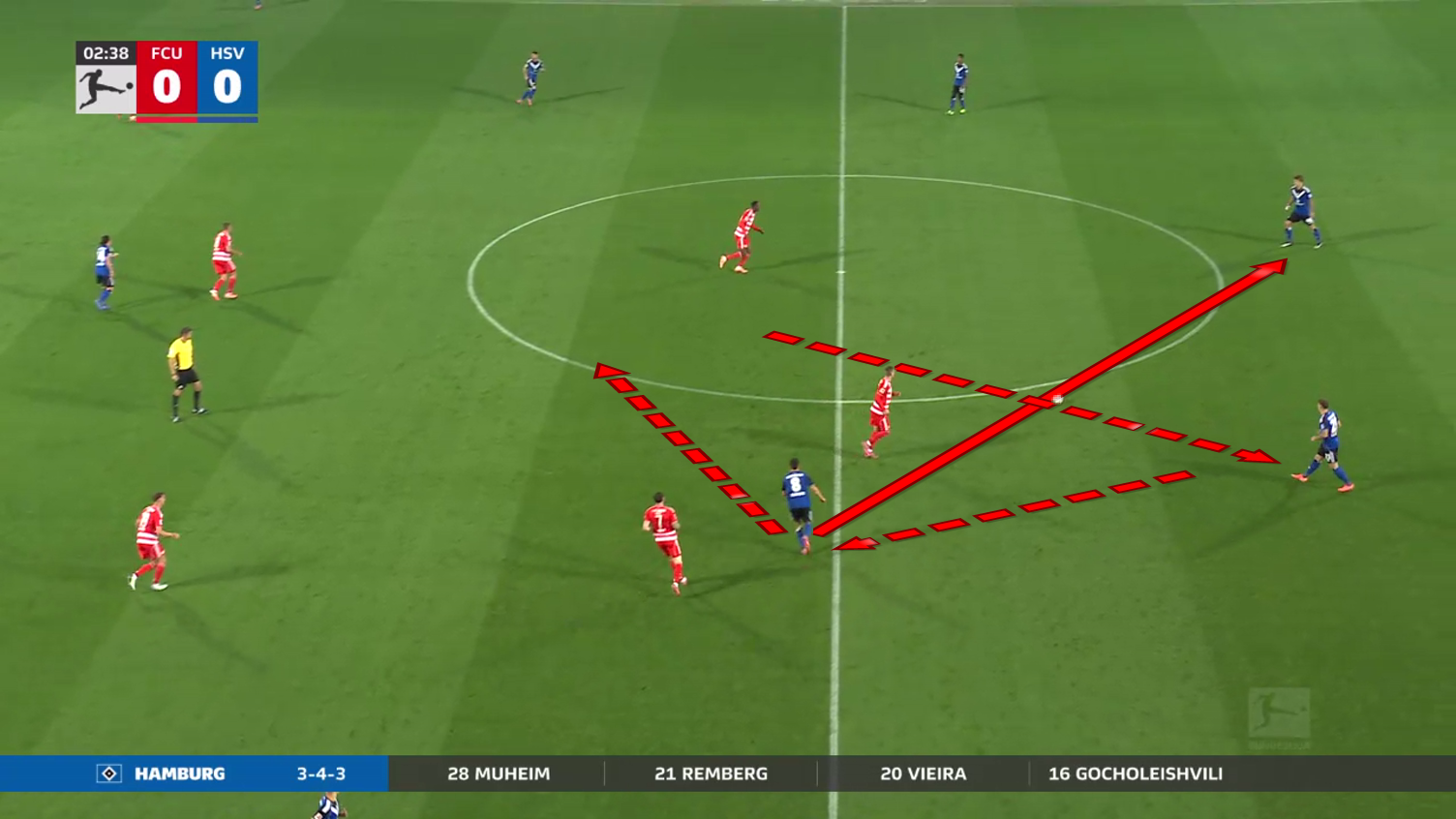
This leads to them having to play backwards once again, something Polzin’s men had to do a lot during their games in the Bundesliga this season.
They have a really interesting pattern in build-up that they use occasionally.
Left centre-back Daniel Elfadli plays a square pass and moves forward into midfield, something they did a lot under Tim Walter in the 2. Bundesliga.
Midfielder Nicolai Remberg drops back into the backline, allowing them to find Elfadli again while he runs behind the first line of press.
While the idea is very good, they struggle with execution a lot.
Elfadli plays the pass to Vušković instead of Remberg, and it takes too much time for the one-two, ending in another backwards pass.
So, while the team tries to be more vertical in its approach to building up, it has struggled significantly so far this season, resulting in it barely finding valuable solutions most of the time.
Struggling With The Basics Of Build Up
Looking at the season for HSV so far, it really doesn’t look too good for Merlin Polzin and his team.
They have only scored two goals in five games, both in a match against Heidenheim, their only win, while failing to score in the other four matches they have had so far this season.
While many people in Germany currently blame the individual class of their attackers and the departure of their top goalscorer, Davie Selke, that’s just too simple a thought.
Not only have they only scored two goals so far this season, their 4.4 non-penalty expected goals are dead last in the Bundesliga as well, so it’s also about even creating opportunities.
Creating opportunities starts at the back, and they struggle to get into good attacking positions; if we are being honest, their attackers don’t even get opportunities to shine.
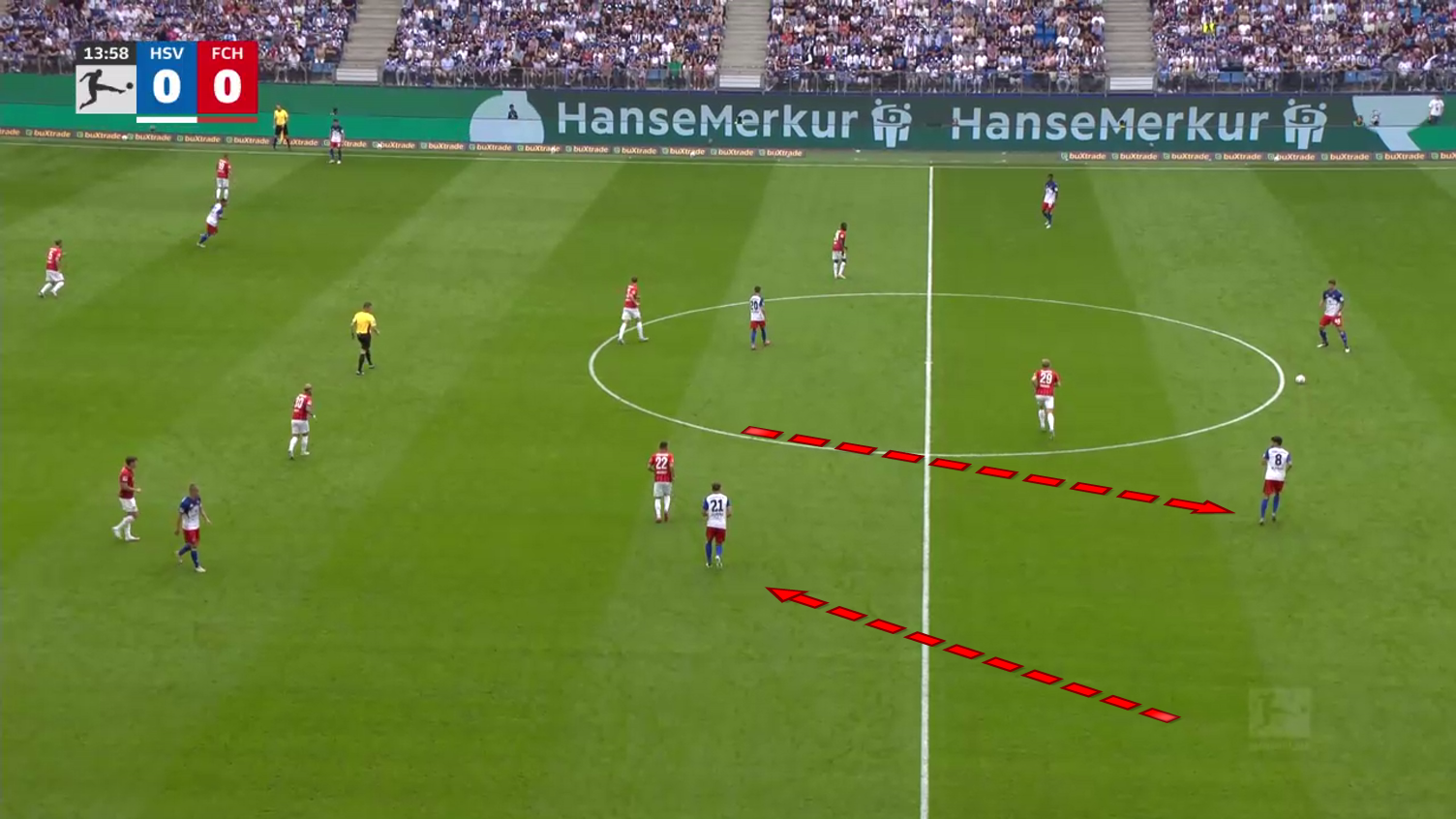 Looking at the game against Heidenheim, which HSV managed to win, but did not deserve to do so, we can see where they struggle.
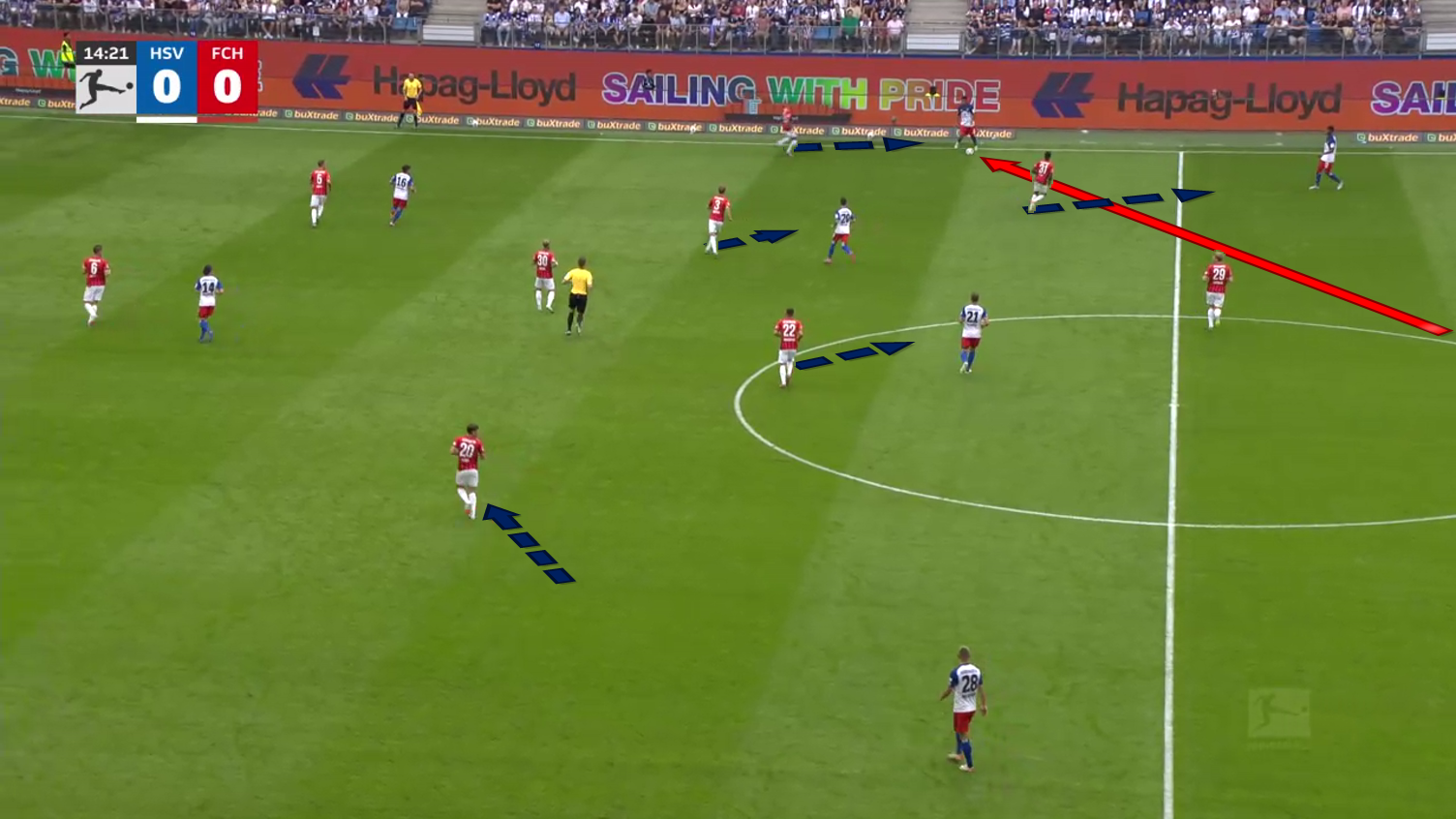
Once again, HSV starts building up with Elfadli playing to Vušković, and Arsenal loanee Fabio Vieira moves into the backline.
Once again, the timing and pass are off, so the movement happens, but it doesn’t do anything for them besides putting their best midfielder into the backline, where he can not have as much impact as he could in midfield.
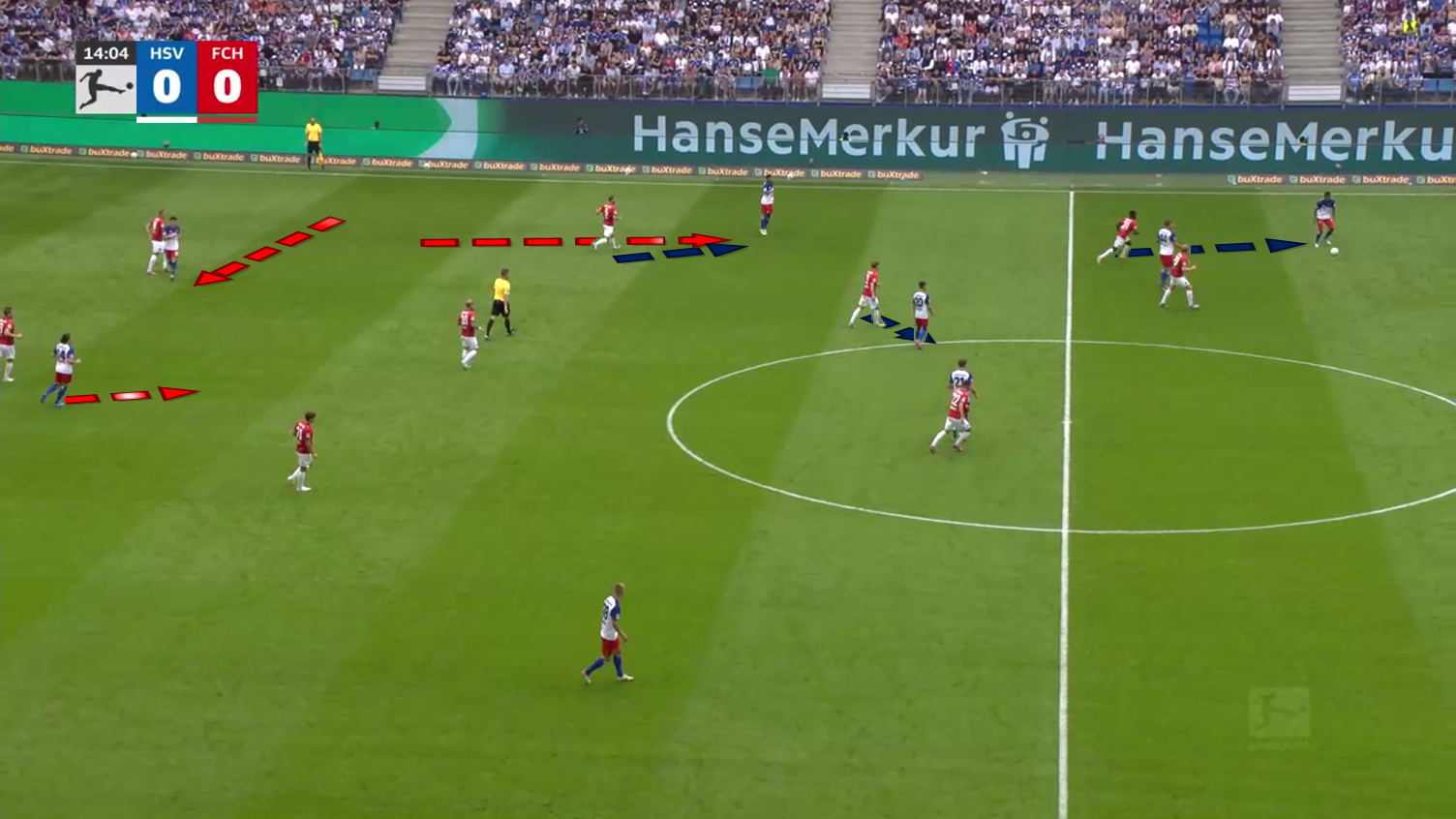
They even just leave the side of their best footballer and play to the right, but Heidenheim were ready for that.
They man-mark the two central midfielders, removing all short passing options for HSV with just two players while still allowing one of their attackers to attack the ball.
The timing of the runs in the attacking line is off as well.
Königsdörffer tries to play around that by moving to the wing again, but Heidenheim has enough open defenders to just man-mark him there as well.
Once again, Polzin’s men are forced into a backwards pass.
From there on, Vušković makes a really bad decision and it seems like the team really lacks a clear plan after having to abort the first attempt of getting forward.
Instead of resetting in their positional play and showing some patience with their runs into open space against the deep block, they double down for no reason at all.
Heidenheim isn’t even really pressing the HSV backline here, but Vušković still plays a first-time pass to Königsdörffer, who dropped even further back.
Königsdörffer plays right into Heidenheim’s press, and they were incredibly lucky not to lose the ball in the resulting duel.
Instead, again, they are forced to play around the back one more time.
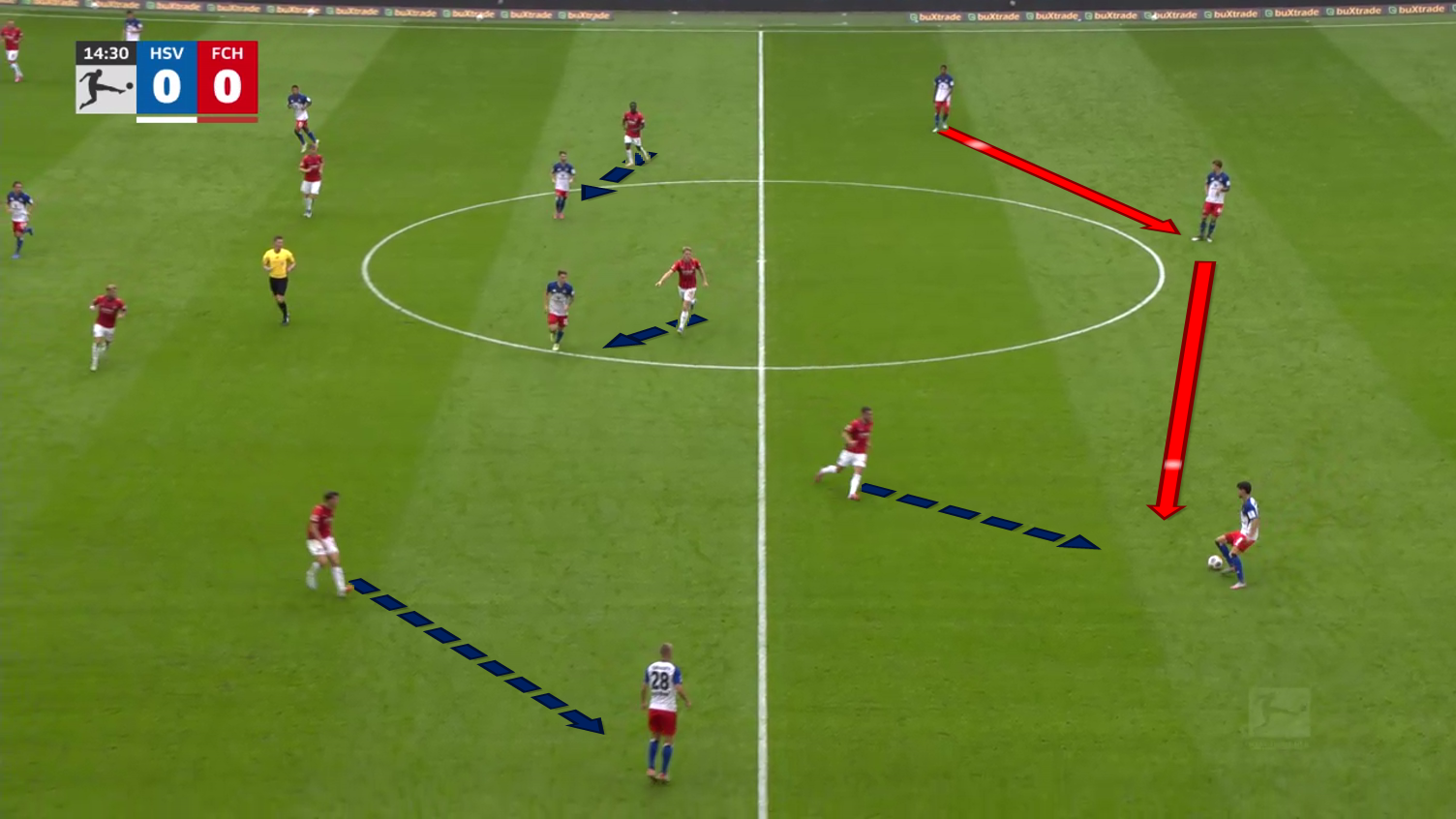
Technically, that isn’t even a bad thing to happen; they have a back-three, so they should be able to switch play quickly and get into position to break into the block when Heidenheim has to collectively shift to the other side.
Instead, Polzin’s men all took multiple touches on the ball, orienting themselves way too late to actually make an impactful pass.
In the end, Heidenheim was able to shift quicker than HSV was able to switch play.
The entire tempo of their passing game is way too slow for the Bundesliga, and it shows in every game.
They can barely beat the first line of press without punting it down the field and praying for second balls; therefore, their attackers never even get the opportunity to do anything in the final third.
Their attacking struggles are not surprising when you watch their build-up, and they have killed their games so far.
Defending Well In The Block
While Merlin Polzin has not found a solution for their attacking struggles, funnily enough, HSV’s biggest strength currently is their play in the deep block.
While conceding eight in five games does not look great, they got completely schooled by Bayern Munich, just like pretty much all the Bundesliga teams so far this season, and got beaten 5-0 away in Munich.
But that means that HSV only conceded three goals in the other four games, which is surprisingly good.
They also managed to steal points away with two 0-0 draws in addition to their win against Heidenheim.
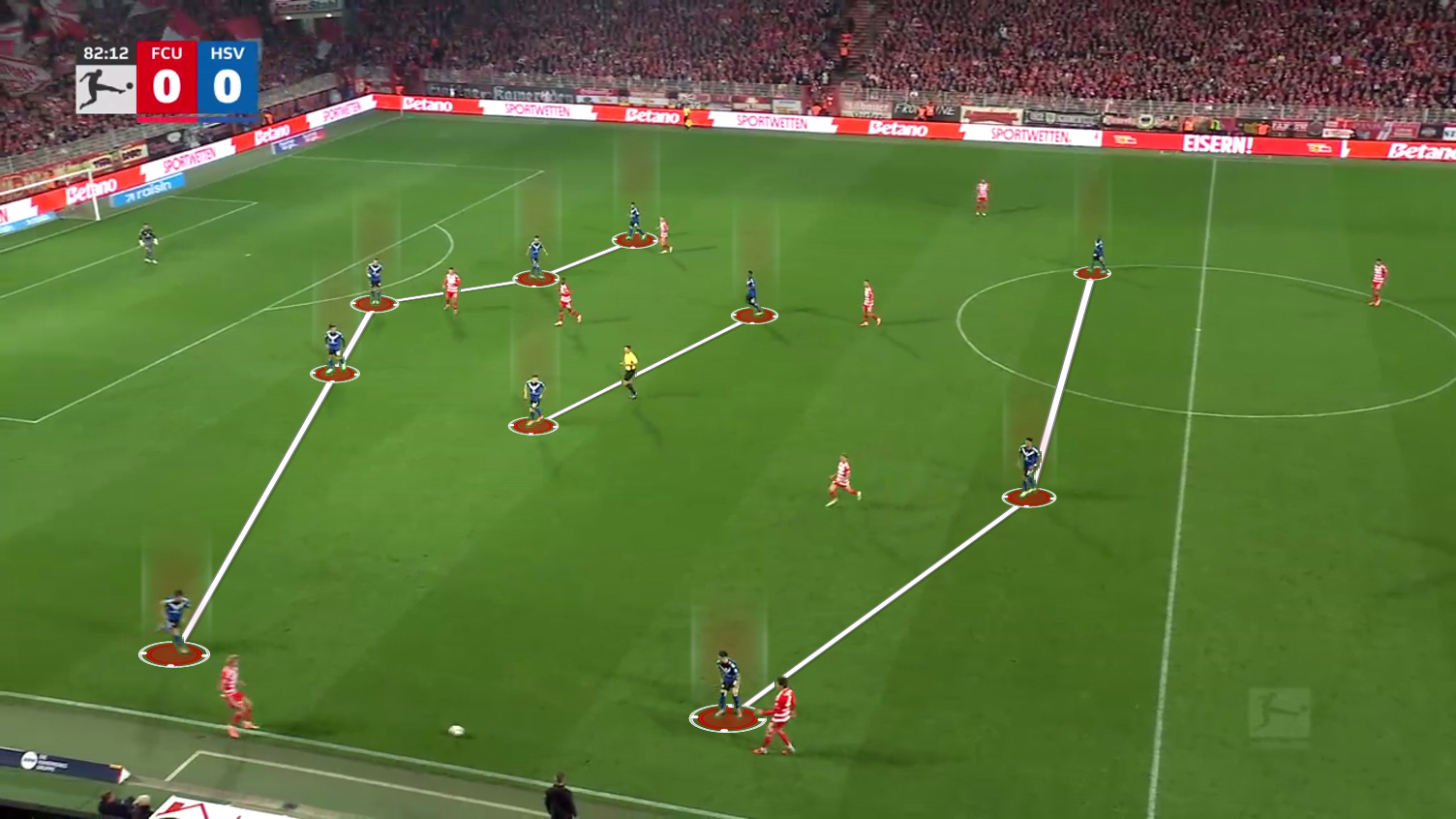
Polzin does not change the formation against the ball; they stay in their 3-4-3 formation, but they shape up a bit differently, as you would expect.
Instead of just falling back into a 5-4-1 shape, like most 3-4-3 formations do, HSV only drops the wing-backs back one line, creating a 5-2-3 shape.
They follow basic principles, keeping the centre closed off with three centre-backs and two central midfielders in a narrow shape.
They even push the far-sided full-back inwards.
This way, they manage to win many duels after long balls and crosses and secure many second balls.
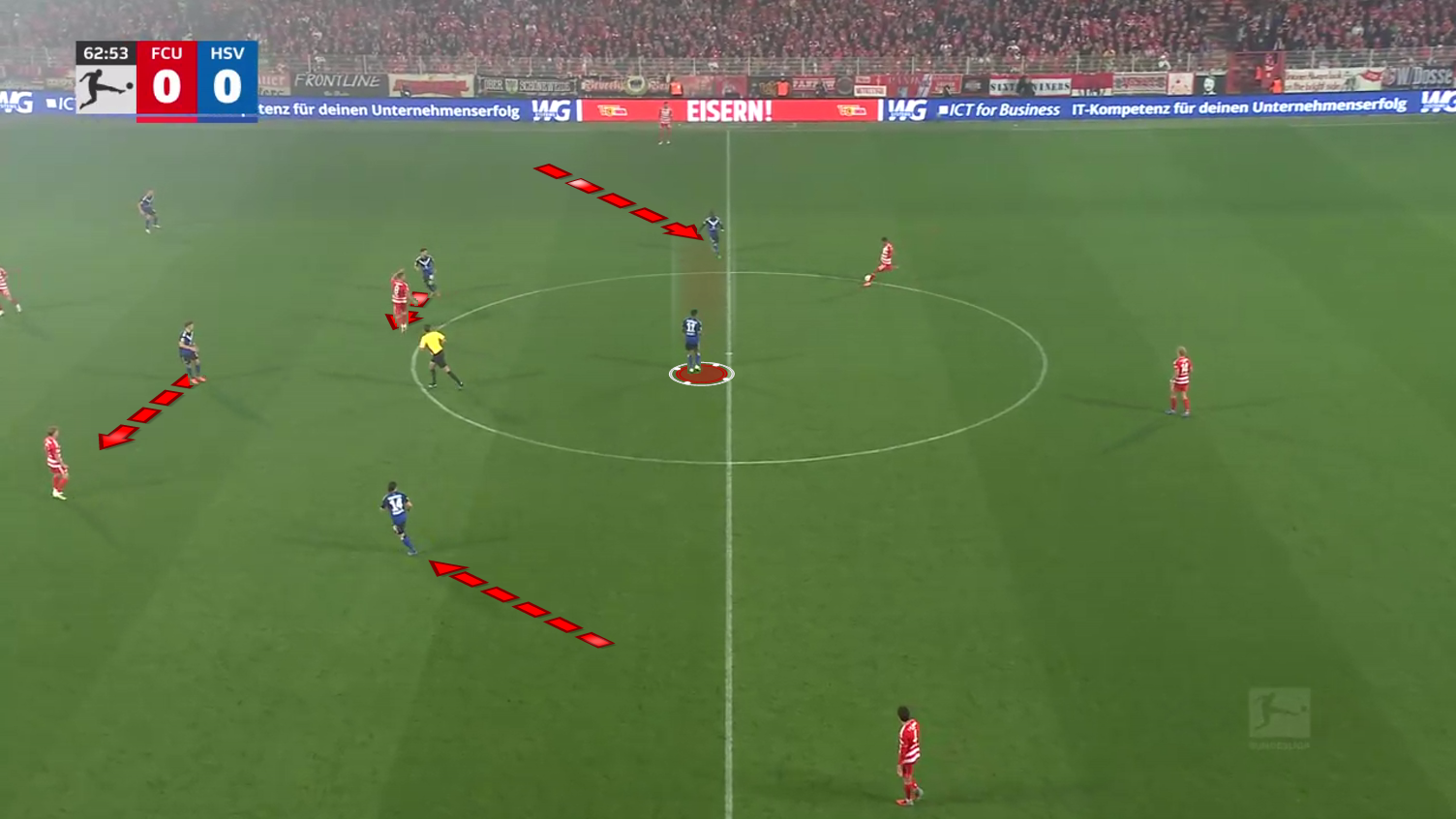
They also have a clear plan for pressing with their attackers; they often keep them in the half-spaces and prevent short passes outwards just by positioning.
If they decide to press, one of the two wingers triggers the press by moving inwards in a curve, cutting off the pass to the full-back.
The far-sided winger then moves backwards into midfield, ready to help get to the second balls and prevent passes to the far-sided midfielders.
The lone striker stays put in the centre, constantly cutting off passes towards the midfielders.
If a holding midfielder wants to have the ball against HSV, they need to drop into the backline most of the time.
This worked well in their game against Union.
They forced a lot of long balls and won the resulting duels and second balls, securing them a point away from home.
Conclusion
In the end, HSV don’t really look good so far this season, but considering their lack of individual class outside of Luka Vušković, the five points they managed to collect so far are rather decent.
Their defensive play is more than alright.
They know they will have to fight to survive in the Bundesliga, and therefore, they defend with a clear plan, a deep field position, and a good amount of intensity, which is evident in their results.
On the other hand, they will need to win more games at some point this season and to win, you need to score goals.
Merlin Polzin attempted to adapt the possession play to make it a better fit for the Bundesliga, but his team has significant problems beating their opponents’ first line of defense and, therefore, is unable to create sufficient opportunities to score goals.
Even their lone win was rather lucky. Heidenheim had multiple great opportunities but managed to finish them, while HSV was at least efficient in front of the goal in this particular game.
But what’s most important: The team shows a good attitude, even when things don’t go their way.
They know their role in the Bundesliga, and they fight for every inch on the pitch.
While their football team needs some work, Merlin Polzin has his team prepared for what’s ahead this season.
If they continue to work hard, they will have the opportunity to stay in the Bundesliga for another year.
