
Arsenal are always an intriguing team.
Can they reach the next level?
Can they make up the fine margins needed to win a major honour they probably already should’ve won?
These are questions typically asked when the Gunners are mentioned, but I personally believe they are one of the world’s best, most adaptive teams, and it’s a matter of time before a major honour arrives.
You can feel the team improving year on year in the same way Jürgen Klopp revived Liverpool; it’s just that Mikel Arteta opts for more variety in his methods.
This adaptiveness was on show vs Newcastle United.
It must be said that, representative of what the Premier League currently is, it was often a game of long balls, with both teams looking to get the ball to their big strikers.
Ultimately, though, the game hinged on Arsenal’s ability to find gaps in the half-spaces of Newcastle’s block, and the Magpies retreated deeper as they lost their out-ball to Nick Woltemade.
In this Premier League tactical analysis, we will analyse the key components of how Arsenal found central space to overcome a difficult challenge at St. James’ Park.
Nick Woltemade Style Of Play Vs Arsenal
A big question mark around some of Eddie Howe’s tactics is that they rely on going too risk-averse, too quickly, when building up a head of steam.
Here against Arsenal, in the first half, the direct tactics of playing a long ball up to Nick Woltemade were something that Arsenal and Cristhian Mosquera failed to deal with.


Newcastle United’s plan was straightforward: target Woltemade so the big German could use his body to push Mosquera or Gabriel out of position.
As he trapped the ball or flicked it on, it meant other runners could come into play.
In the opening 45 minutes, a frequent sight was seeing Woltemade tussle with a centre-back, forcing him out of position.
It meant that, through one long ball, Newcastle bypassed Arsenal’s press, but it also meant Woltemade was creating dangerous situations through simple sequences of play, such as a long throw-in.
His size is particularly challenging to deal with because he uses his body to shield the ball and draw a defender in, pushing them out of the back four.
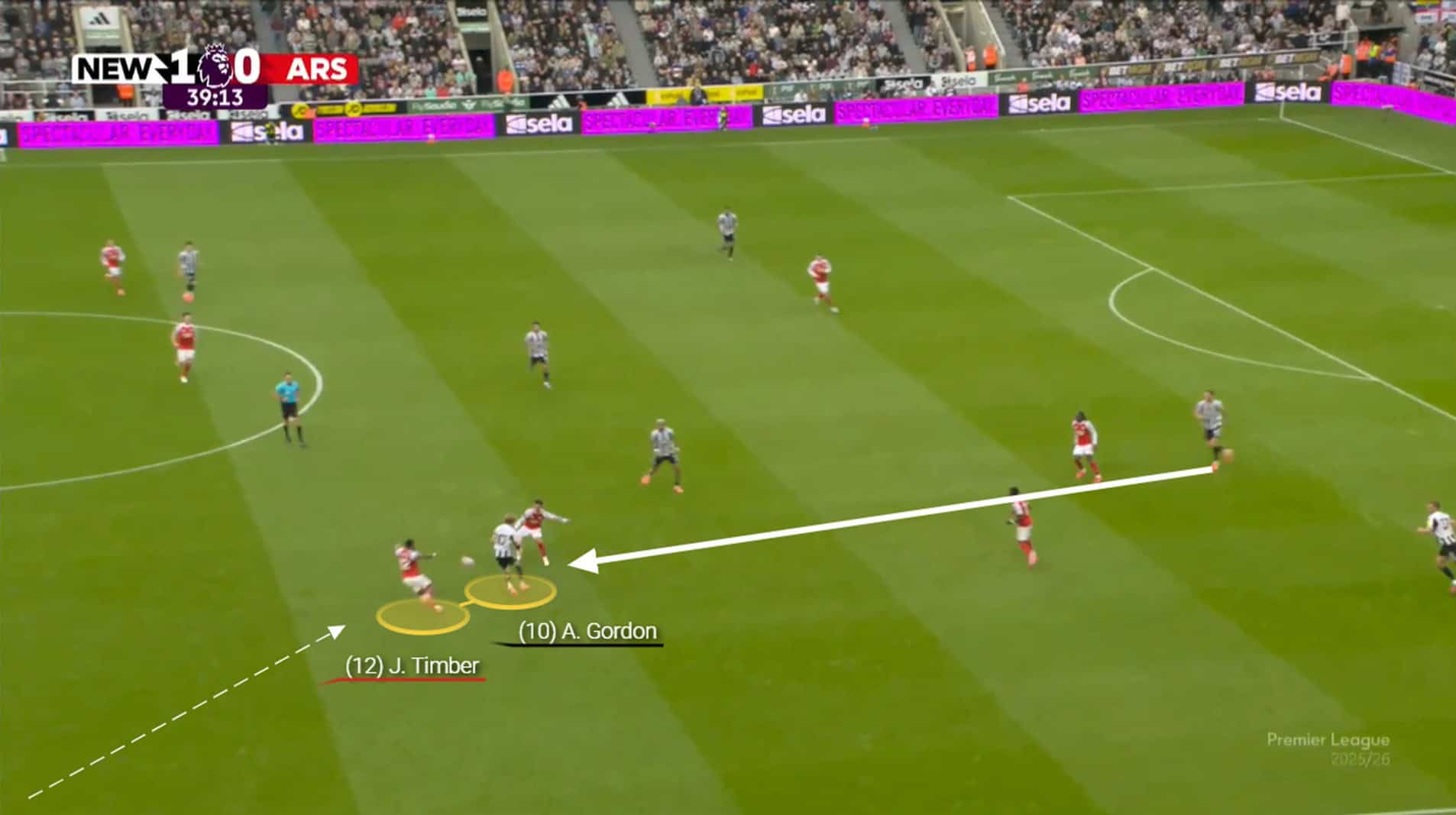
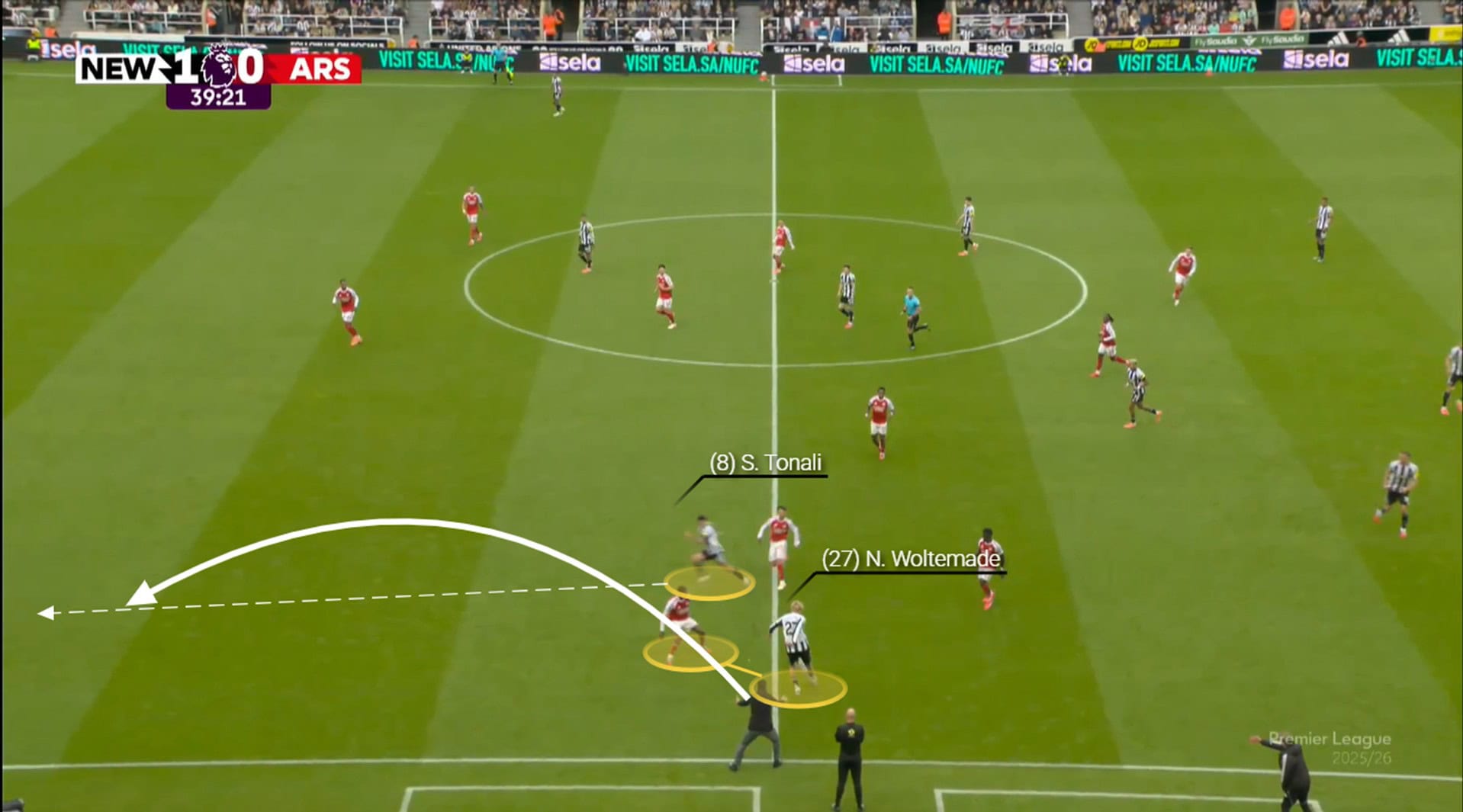
It was clear that Newcastle used either Woltemade or Anthony Gordon as dropping attackers to drag a player with them so they could receive the ball and advance into Arsenal’s half.
Both were doing a good job of it up until Newcastle’s goal.
After that, and particularly in the second half, Newcastle United invited far too much pressure onto themselves, and this is where the aforementioned criticism of Howe’s approach may have merit.
Understandably, they wanted to defend what they had, but the first half felt like a game of long balls and who could utilize their striker more effectively.
The second half was one-way Arsenal traffic as Newcastle tried to defend deep.
There were a few counterattacks that could’ve been damaging to Arsenal, but Newcastle would’ve been better off playing the second half in a similar vein to how they did in the first.
It seems that Howe knows Newcastle United can challenge elite teams, but he isn’t sure whether they can sustainably match them in games without dropping back to defend for large parts of the match.
Arsenal Accessing The Half-Spaces
The problem Arsenal faced last season was a lack of chance creation and an excessive number of draws.
Liverpool waltzed to the Premier League title in 2024/2025, but it was mainly because the team closest to them couldn’t muster up a challenge.
Despite dealing with absences and injuries, the issue was that even with a full-strength team, Arsenal dropped points against Fulham, Brighton, Everton, etc, in matches where Arsenal had more than enough to clinch three points.
With the signings of Eberechi Eze, Viktor Gyökeres, and Martín Zubimendi, it feels as though Arsenal have a variety of ways to create chances this season, as opposed to last.
As Newcastle dropped off in a 4-5-1, it was salient that Eze and Leandro Trossard, playing behind Gyökeres in attack, were positioned centrally between Newcastle’s defence and midfield.
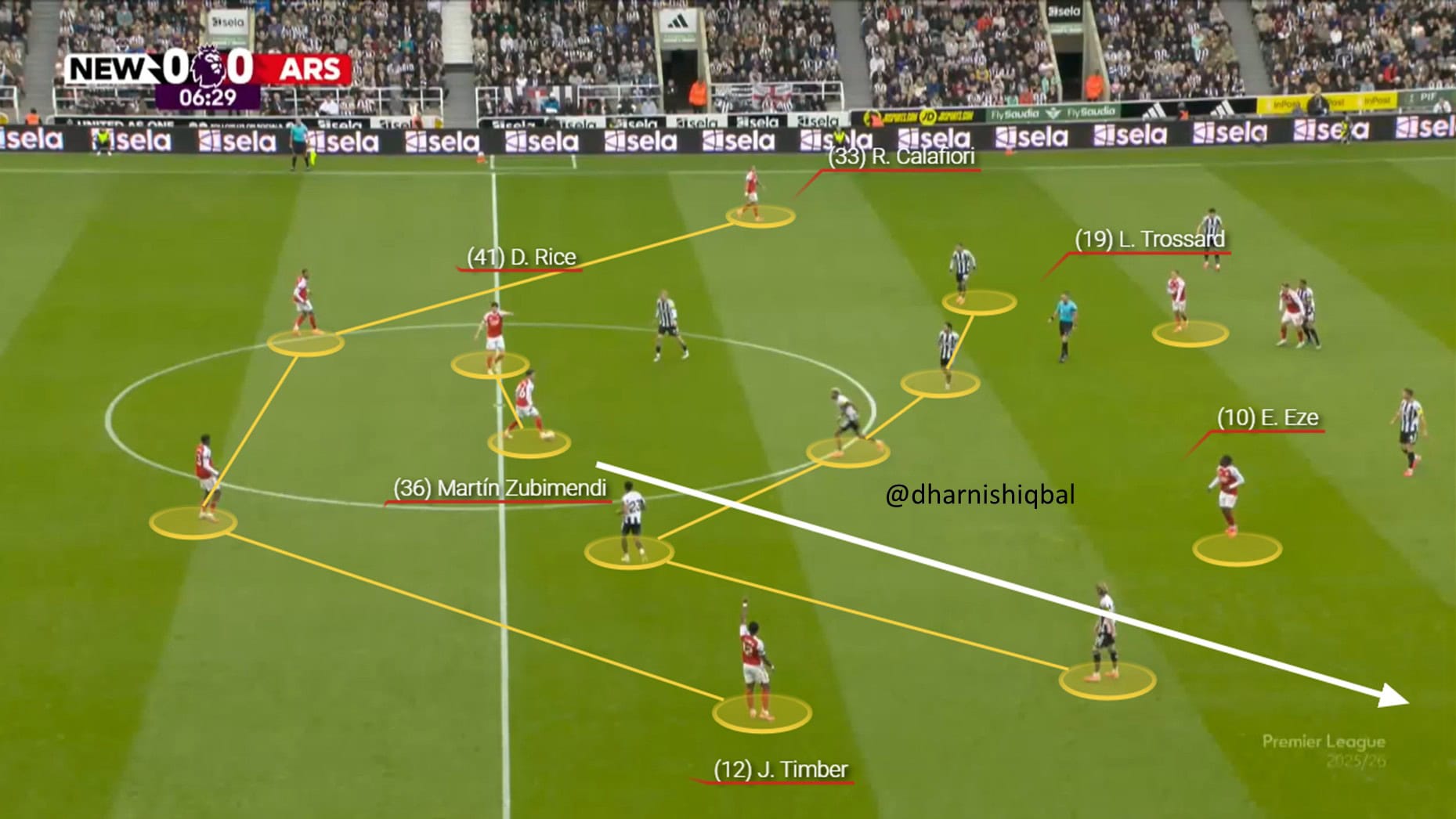
Pushing up Jurrien Timber and Riccardo Calafiori meant Arsenal were constantly in control of the ball but could, importantly, find gaps in the half-spaces between Newcastle’s midfield to punch the ball through centrally.
Newcastle’s midfield couldn’t afford to sit off and let Declan Rice and Zubimendi have the ball for the whole game, so when they jumped to press, that’s when gaps appeared.
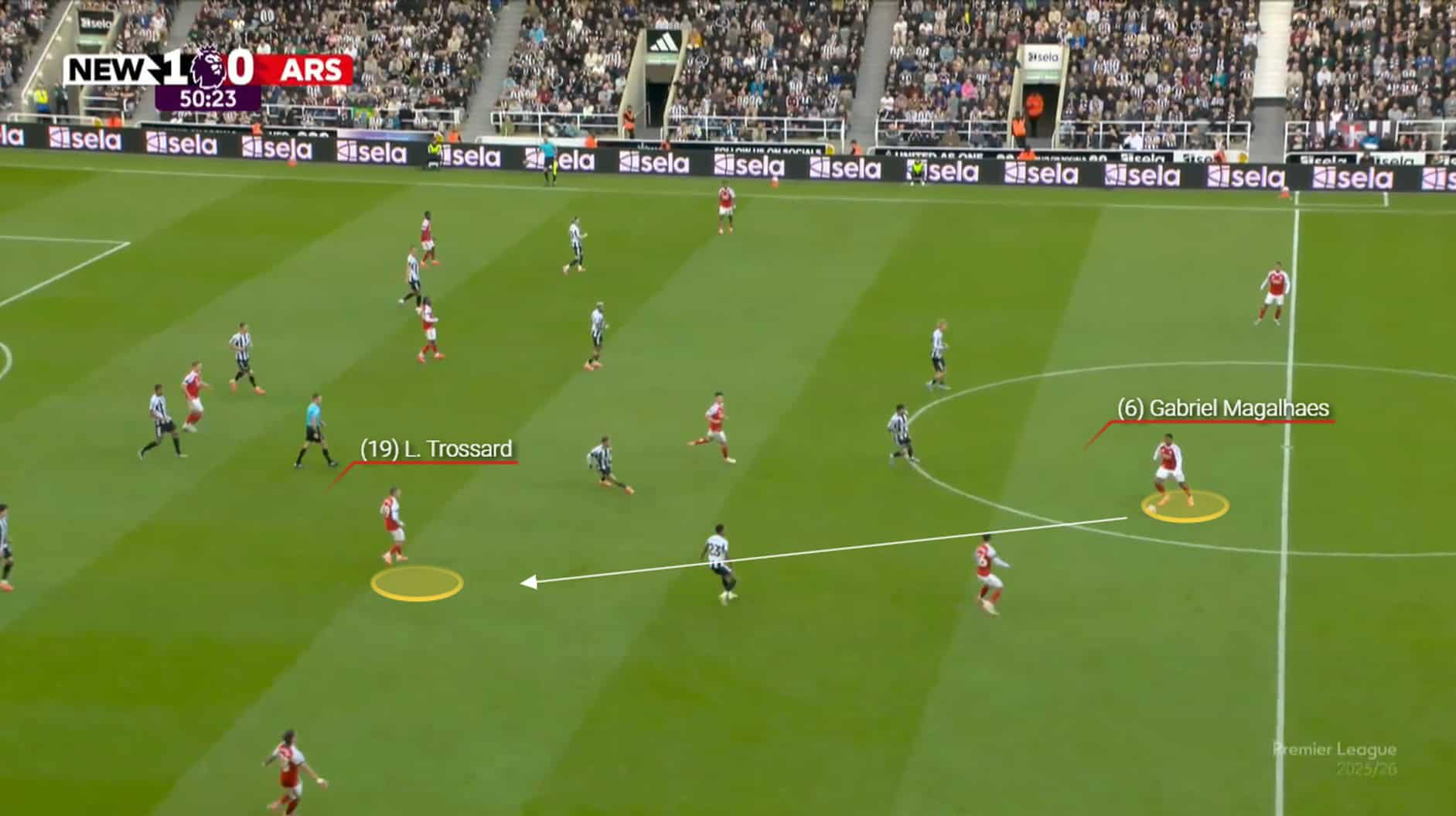
Last season, when teams sat off in a deep low/mid-block, Arsenal struggled to create chances.
In contrast, as Arsenal shifted the ball from one side to the other, they were able to utilize the movements of their central midfield pairing to pick out a winger centrally.
In the example above, Gabriel has the option to go wide to Callafiori or pick out Trossard; it’s not laboured or slow football.
As the changes occurred, the Gunners started using differing variations of this tactic as they got closer and closer to Newcastle’s goal.
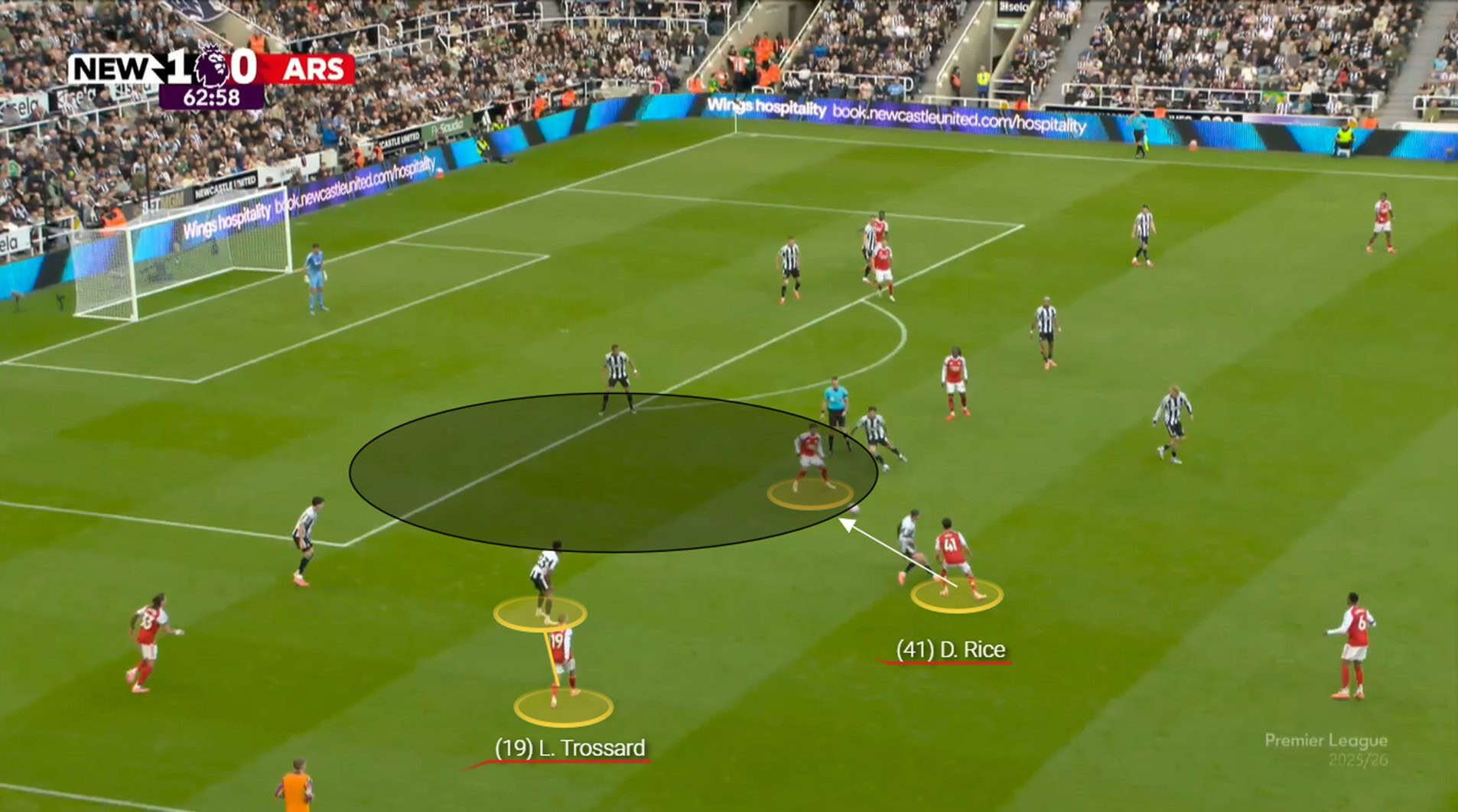
Players started to rotate, so instead of Trossard being the central option to pass to, he would pull Malick Thiaw extremely wide to create a space in the position he was in before, as this time it’s Mikel Merino latching onto a neat pass in the half-space.
Because Trossard has moved Thiaw out, he can attack that space.
It’s also an advantage that they now have Eze to partner with Bukayo Saka, as both can confidently dribble past a player.
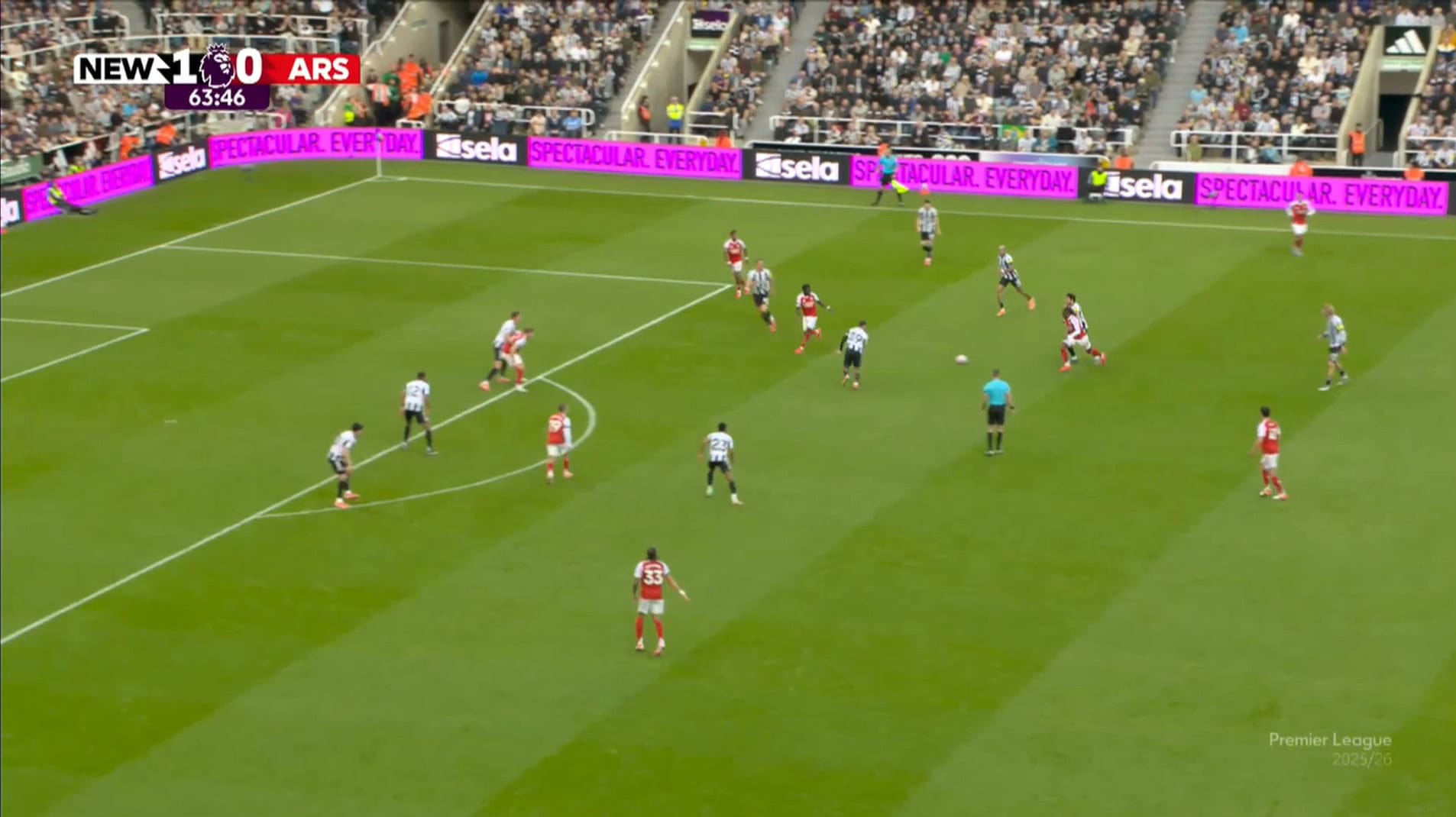
As Eze receives in the half-space, he could turn past a player and play to Saka.
This situation is miles better than lumping the ball wide and hoping Saka can take his man on and cross the ball.
It also reduces the workload on Saka’s shoulders.
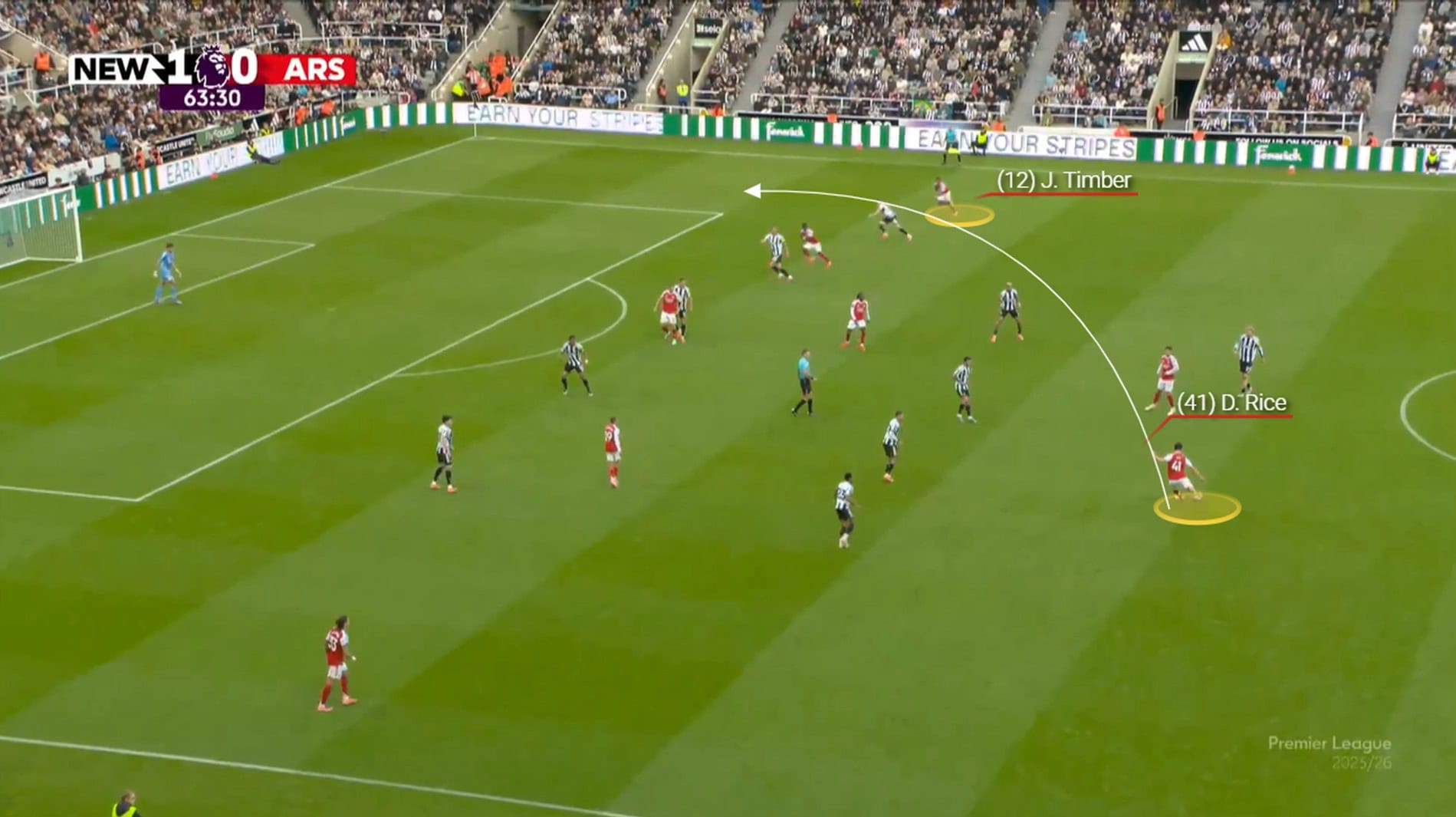
Newcastle United’s midfielders have to stay where they are to prevent the pass into Trossard or Eze.
If they are passed to, they can turn and shoot as they aren’t wide; they are central.
But at other points, Rice opted to use Newcastle’s midfield four against them, playing it over the top and wide for Timber.
A corridor of uncertainty is created through Eze and Trossard’s positioning.
If you look closely, Newcastle’s back five just behind them don’t know whether to stay or go with them.
Tino Livramento at full-back is definitely tracking Trossard’s positioning, so when Rice lobs the ball into one specific area, Arsenal have three players looking to run in behind and three players pinning Newcastle’s defence.
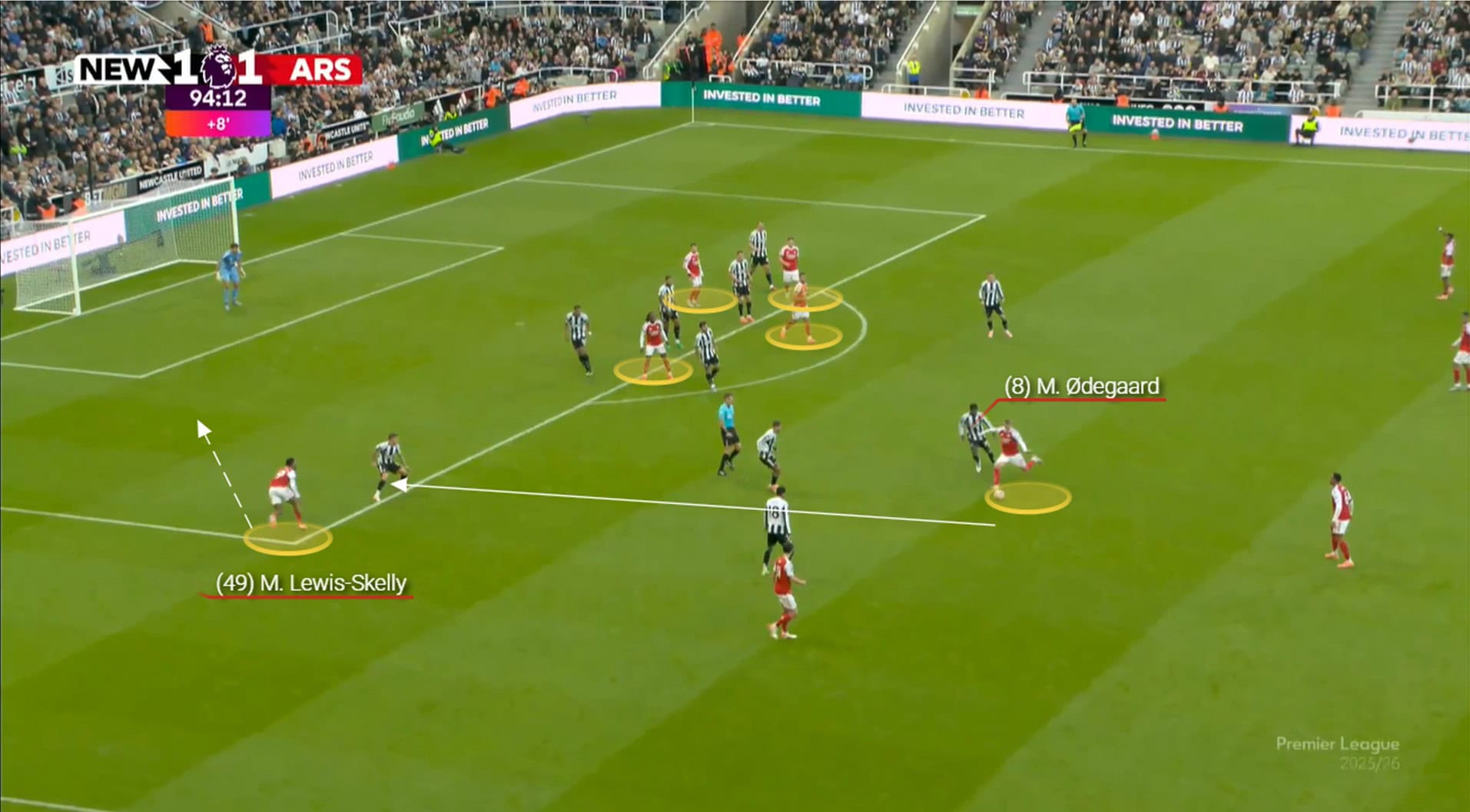
The substitutions represented Arsenal’s threat from the bench as well as their starting XI.
Bringing on Martin Ødegaard with Newcastle pinned close to their own box meant Mikel Merino and Declan Rice could push up.
Merino, with his underrated goalscoring ability, and Rice, with his driving runs forward, could offer a threat.
Still, they didn’t need to receive the ball from the defence because Ødegaard was playing as a ‘quarterback’.
Arsenal then began to create one-on-one situations wide, due to the chaos caused in the middle of Newcastle United’s box, with all the players bunched into a single zone.
Instead of spreading the attack across Newcastle United’s box, there were four Arsenal bodies in or around the penalty area.
Once again, it’s that same line-breaking pass through the half-spaces to Myles Lewis-Skelly cutting through Newcastle’s midfield block.
Eventually, Arsenal got a corner as a result of this attack and scored, but it felt like the goal was coming.
The wide space they were able to create meant that the corners were piling up, and it’s well known how ridiculously good Arsenal’s ability is from set-pieces.
Conclusion
On the same weekend that Liverpool deservedly lost to Crystal Palace, Arsenal clinched what felt like a huge win and validated Gabriel Martinelli’s last-gasp equaliser versus Manchester City the week before.
The encouraging factor from Mikel Arteta’s point of view would be that, for the second game week running, they were tasked with breaking down a low, deep block for most of the game and were able to find a way to score twice in two weeks when the pressure was on.
The biggest takeaway may be that Arsenal has a variety of ways to create space and chances against teams compared to last season.
Be it from the bench, corners, or substitutions, Arsenal have more than one way to create chances at the moment.
Newcastle United’s approach didn’t help them, as they certainly invited pressure in their low block.
Still, you can’t really blame them because this same tactic of defending deep was effective against Arsenal last season.
The Gunners may have learned from their mistakes and now possess a better, multi-faceted attack.