
Total Football Analysis
Once.Sport
  • Football Analysis
    • Data Analysis
    • Formations
      • 2-2-4 Formation
      • 2-3-5 Formation
      • 3-1-4-2 Formation
      • 3-2-2-3 Formation
      • 3-2-4-1 Formation
      • 3-1-6 Formation
      • 3-3-4 Formation
      • 3-4-1-2 Formation
      • 3-4-2-1 Formation
      • 3-4-3 Formation
      • 3-5-1-1 Formation
      • 3-5-2 Formation
      • 4-1-4-1 Formation
      • 4-2-2-2 Formation
      • 4-2-3-1 Formation
      • 4-2-4 Formation
      • 4-3-1-2 Formation
      • 4-3-3 Formation
      • 4-4-2 Formation
      • 4-5-1 Formation
      • 5-3-2 Formation
      • 5-4-1 Formation
      • 6-3-1 Formation
    • Head Coach Analysis
    • Match Analysis
    • Player Analysis
    • Recruitment Analysis
    • Set Piece Analysis
    • Tactical Theory
    • Tactical Preview
    • Team Analysis
    • Training Analysis
    • Tactical Analysis
    • Scouting Report
  • Competition
    • ALL Competitions
    • English Premier League
    • Champions League
    • La Liga
    • Bundesliga
    • Serie A
    • Ligue 1
    • Eredivisie
    • EFL Championship
    • FIFA World Cup 2022
    • WEURO 2022
    • Women’s Super League
    • NWSL
    • Belgian First Division A
    • A-League
    • Liga Profesional de Argentina
    • Austrian Bundesliga
    • Campeonato Brasileiro Série A
    • DFB Pokal
    • 1. HNL
    • Danish Superliga
    • EFL League One
    • EFL League Two
    • FA Cup
    • EFL Cup
    • Indian Super League
    • K-League
    • J1 League
    • Liga MX
    • Copa América 2021
    • Copa del Rey
    • MLS
    • Eliteserien
    • Euro 2020
    • Primeira Liga
    • Scottish Premiership
    • Allsvenskan
    • Europa League
    • UEFA Nations League
    • Liga AUF Uruguaya
  • Coaches
    • All Coaches
    • Alfred Schreuder
    • Ange Postecoglou
    • Antonio Conte
    • Arne Slot
    • Bo Svensson
    • Brendan Rodgers
    • Bruno Lage
    • Carlo Ancelotti
    • Christophe Galtier
    • Claude Puel
    • Claudio Ranieri
    • David Moyes
    • Dean Smith
    • Diego Simeone
    • Domenico Tedesco
    • Frank Lampard
    • Eddie Howe
    • Edin Terzić
    • Emma Hayes
    • Erik ten Hag
    • Ernesto Valverde
    • Gennaro Gattuso
    • Gerardo Seoane
    • Gian Piero Gasperini
    • Giovanni van Bronckhorst
    • Graham Potter
    • Igor Tudor
    • Imanol Alguacil
    • Jesse Marsch
    • Jonas Eidevall
    • Jorge Sampaoli
    • José Bordalás
    • José Mourinho
    • Julen Lopetegui
    • Julian Nagelsmann
    • Julien Stéphan
    • Jürgen Klopp
    • Luciano Spalletti
    • Lucien Favre
    • Manuel Pellegrini
    • Marcelo Bielsa
    • Marco Rose
    • Marco Silva
    • Massimiliano Allegri
    • Mauricio Pochettino
    • Maurizio Sarri
    • Mikel Arteta
    • Niko Kovač
    • Nuno Espírito Santo
    • Oliver Glasner
    • Patrick Vieira
    • Paulo Fonseca
    • Pep Guardiola
    • Peter Bosz
    • Rafa Benítez
    • Ralf Rangnick
    • Ralph Hasenhüttl
    • Roger Schmidt
    • Roy Hodgson
    • Sean Dyche
    • Sérgio Conceição
    • Simone Inzaghi
    • Sonia Bompastor
    • Stefano Pioli
    • Steffen Baumgart
    • Steven Gerrard
    • Thiago Motta
    • Thomas Frank
    • Thomas Tuchel
    • Unai Emery
    • Vincenzo Italiano
    • Xavi
  • Teams
    • ALL Teams
    • AC Milan
    • Ajax Amsterdam
    • Arsenal
    • AS Monaco FC
    • Atalanta
    • Atlético Madrid
    • FC Barcelona
    • FC Bayern Munich
    • Borussia Dortmund
    • Celtic FC
    • Chelsea FC
    • Everton F.C.
    • Inter Milan
    • Juventus F.C.
    • Leeds United F.C.
    • Liverpool FC
    • Manchester City
    • Manchester United FC
    • Paris Saint-Germain
    • Rangers FC
    • RB Leipzig
    • Real Madrid CF
    • Tottenham Hotspur
    • West Ham United
  • Players
    • ALL Players
    • Alisson Becker
    • Bukayo Saka
    • Erling Haaland
    • Harry Kane
    • Jack Grealish
    • John Stones
    • Julián Alvarez
    • Kalvin Phillips
    • Kevin De Bruyne
    • Kyle Walker
    • Kylian Mbappé
    • Lamine Yamal
    • Lionel Messi
    • Luis Díaz
    • Mohamed Salah
    • Phil Foden
    • Virgil Van Dijk
  • Contact
  • Write For TFA
No Result
View All Result
No Result
View All Result
Total Football Analysis
No Result
View All Result
Home Match Analysis

Arsenal Vs Leeds United [5-0] Premier League 2025/2026: Mikel Arteta’s Tactical Evolution – Tactical Analysis

Juan Lauz by Juan Lauz
August 26, 2025
in Match Analysis, Analysis, Arsenal, Daniel Farke, Leeds United F.C., Mikel Arteta, Premier League, Tactical Analysis
0
Arsenal Vs Leeds United [5-0] Premier League 2025/2026: Mikel Arteta’s Tactical Evolution – Tactical Analysis

Arsenal are presenting a serious candidacy to finally lift the Premier League for the first time since 2004.

Mikel Arteta’s boys have got off to a convincing start by winning at Old Trafford against Manchester United and, in a totally different context, thrashing Daniel Farke’s Leeds United at home.

Maintaining their tendency to defend in a mid-block and favour transition contexts, Arsenal had to present a different game plan than the one used in Manchester.

Leeds, who had also beaten Everton on the opening matchday, seemed likely to sit deep in a low block and prevent quick offensive play, presenting a challenge for the Gunners in possession.

Far from shying away from the challenge, there are signs that Mikel Arteta’s style of play have added a new twist to his game mode.

For many stretches last season, it felt insufficient and incomplete, falling short in terms of creativity and management against low blocks.

Even if still lacking that differential touch in a sense (I’m looking at you, Eberechi Eze), Arsenal showed that they remain ultra-competitive, with some of the identity traits they have retained, especially since the 2023/2024 season, when Arteta rethought his team.

In this tactical analysis of Mikel Arteta’s tactics, we analyse some of Arsenal’s tendencies and behaviours, as well as Mikel Arteta’s structures with the ball.

Arsenal Attacking Tactics

Another of the mechanisms that have been consolidated at the start of this season and is already a trademark of Arteta’s team is the 3-2 structure with which Arsenal organise their build-up play.

3 2 Structure Arsenal x Leeds Tactical Analysis

The movement is twofold: on the one hand, Jurriën Timber tucks inside from right-back to form a back three alongside the centre-backs; on the other, Ricardo Calafiori abandons width and positions himself alongside Declan Rice to create a double pivot at the base.

The result is a box in midfield that gives the team numerical superiority in the interior lanes, more passing angles, and the possibility to progress patiently or break lines with vertical passes.
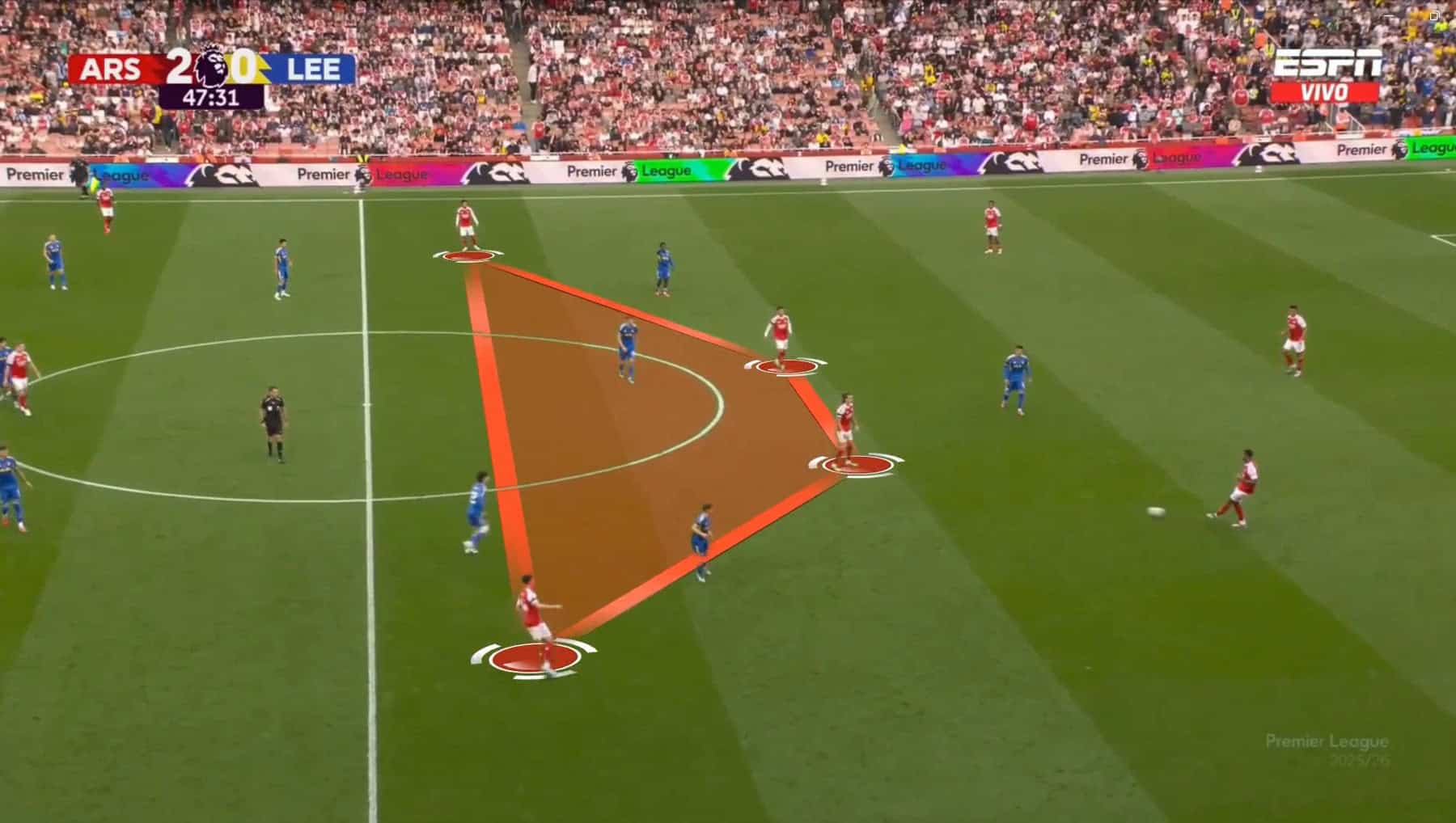
Box Arsenal x Leeds Tactical Analysis

The third goal against Leeds was born precisely from this setup.

Rice, acting as a high interior, drew his marker with a forward movement, thus freeing Calafiori at the base of the play.

https://totalfootballanalysis.com/wp-content/uploads/2025/08/Third-Goal-Arsenal-x-Leeds-Tactical-Analysis.mp4

With the field in front of him, the Italian connected directly with Viktor Gyökeres behind, maximising the Swede’s aggressiveness in runs.

The coordination between positional structure and individual intention was a clear example of how Arsenal finds advantages through its collective mechanisms.

Arsenal Anchors & Floaters

One of the most interesting features of this Arsenal under Arteta is the coexistence of anchors and floaters within their structures.

Anchors act as fixed positional references, staying below or around the ball and sustaining the structural framework of the team.

They ensure the pre-established occupation of space, whether in width, central lanes or half-spaces, and allow the team to maintain a base order from which to project their play.

In contrast, floaters appear as freer figures who give up and abandon positional references depending on the movement of the ball.

Their logic is not to ensure prior occupation, but to self-organise in relation to the immediate context, enabling conditions of proximity, dynamic interactions, and spontaneous associations.

https://totalfootballanalysis.com/wp-content/uploads/2025/08/Second-Goal-Arsenal-x-Leeds-Tactical-Analysis-1.mp4

This double layer, anchors that structure and floaters that unstructure, is constantly seen in Arsenal: while some fix and sustain the platform, others drift to activate connections, attract rivals, and generate fluency around the ball.

Arsenal Overlaps

One of the most interesting mechanisms Arsenal showed against Leeds was the use of overlaps as a resource to attract and free key zones.

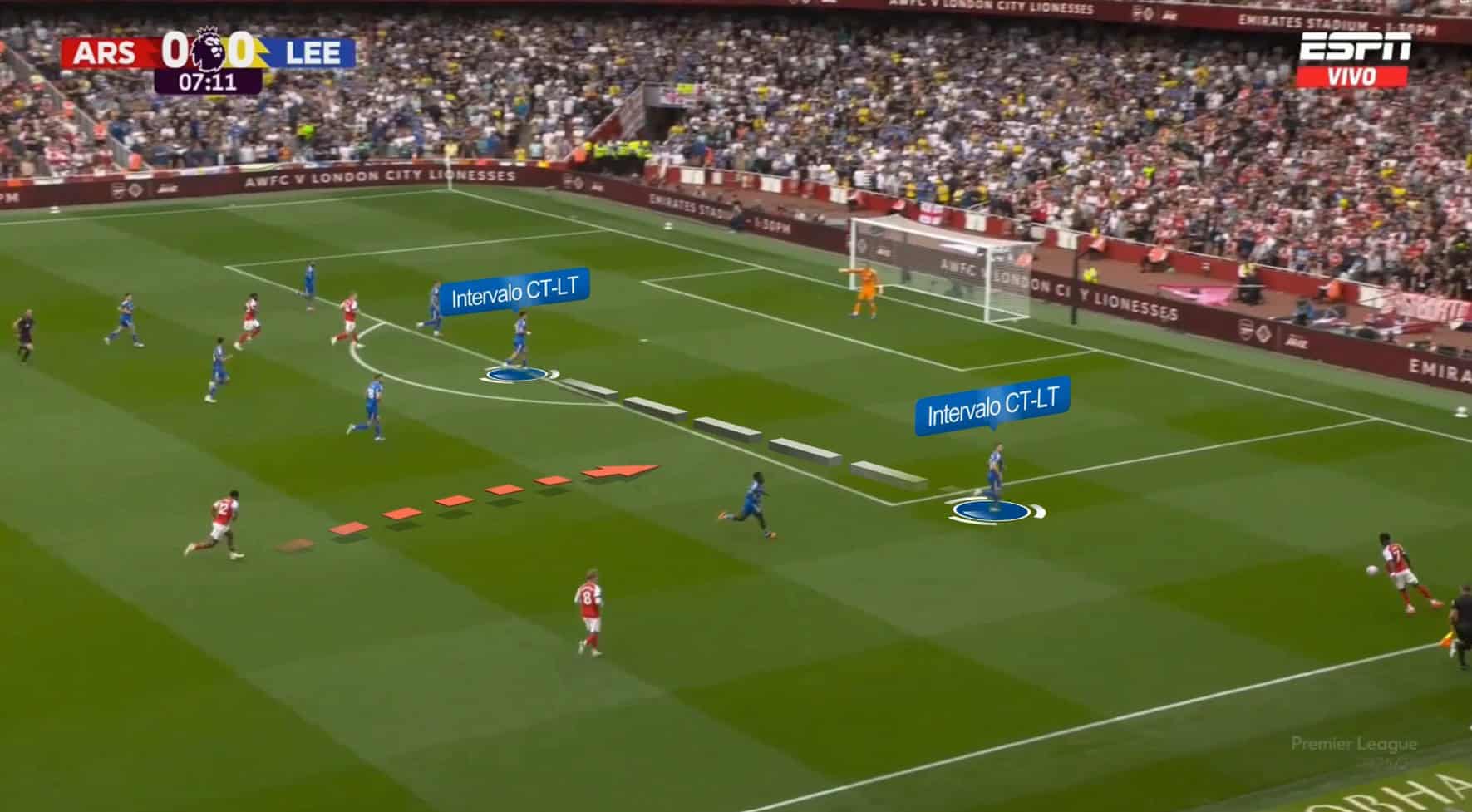
In a representative play, Jurrien Timber made a run in the central-wide interval, moving outward and dragging the attention of the opposing midfielder with him.
Overlap Arsenal x Leeds Tactical Analysis

This action, seemingly secondary, fulfilled a double function: it immediately distracted his marker and, at the same time, opened up an interior corridor.

With Bukayo Saka fixed wide and forcing the full-back to stay stretched, Timber’s movement unlocked the top of the box for Martin Ødegaard to receive with advantage, on the half-turn and in shooting conditions.

Thus, the overlap is not understood as an isolated gesture, but as part of a coordinated sequence that combines width, attraction, and release.

https://totalfootballanalysis.com/wp-content/uploads/2025/08/Overlaps-Arsenal-x-Leeds-Tactical-Analysis-1.mp4

In this interaction, Arsenal shows a growing maturity in their positional play: the value of the runner without the ball is not measured by his own reception but by the advantage he generates for his teammate.

Arsenal & Viktor Gyökeres Aggressiveness

Viktor Gyökeres & His Tendency Towards The Near Post

Another of the differential nuances Arsenal are beginning to show has to do with the aggressiveness and synchrony of their runs inside the box.

The arrival of Viktor Gyökeres, a striker with a much more traditional “9” profile than the false midfielders previously used (such as Kai Havertz or even Mikel Merino), gives the team an extra edge in occupying and attacking space.

https://totalfootballanalysis.com/wp-content/uploads/2025/08/Gyokeres-Box-Arsenal-x-Leeds-Tactical-Analysis-1.mp4

His diagonal runs towards the near post not only threaten the opponent’s goal, but also condition defensive marking, creating drags that open secondary lanes.

In the analysed sequence, while Saka received wide on the right, Gyökeres attacked the near post diagonally and, in parallel, Madueke made a straight run into the same area.

https://totalfootballanalysis.com/wp-content/uploads/2025/08/Gyokeres-Box-2-Arsenal-x-Leeds-Tactical-Analysis-1.mp4

This double threat concentrated the attention of the centre-backs and the nearest full-back, thus freeing the far post.

There, Ødegaard adjusted his diagonal run to appear free at the far post, while Calafiori arrived from deep after surging from left-back.

The result was a coordinated box occupation: each run may not end in the shot, but it is part of a choreography that multiplies options and keeps the opponent in constant imbalance.

Viktor Gyökeres Sinking The Centre-Backs

Gyökeres’s presence also introduces a different nuance in the way the team structures with the ball.

Unlike more associative forward profiles, the Swede does not usually offer continuous midfield support, but instead orients his play towards fixing and pushing back the centre-backs.

That constant vertical movement forces the defensive line to retreat several meters, stretching the field and making the opponent’s team longer.

This effect has a double benefit: on the one hand, it creates an intermediate space that Arsenal’s midfielders can occupy freely, receiving between the lines with time and angle to turn; on the other, if the opponents choose to drop and remain compact, the entire block is forced to sink closer to its box, pushing Arsenal’s circulation into finishing zones.

https://totalfootballanalysis.com/wp-content/uploads/2025/08/Gyokeres-movements-Arsenal-x-Leeds-Tactical-Analysis.mp4

In either case, the simple act of fixing and dragging his marker with power makes Gyökeres a tactical weapon that alters the opposition’s height and disposition.

Arsenal Under High Pressure

Already, with the match 4-0 in their favour, it should be noted that this sequence was not repeated throughout the 90 minutes, but it did make clear Arsenal’s ability to perform in high-pressure contexts.

The reset towards the defenders invited Leeds to press aggressively, and far from rushing, Arteta’s men took advantage of the situation to fix and attract.

Both Myles Lewis-Skelly and Rice acted as intermediate support points, engaging the first line of pressure and opening spaces between the lines.

Within that dynamic, Leo Trossard played a key role by receiving with his back to goal, forcing the central defender to step out and shifting attention to his zone.

That action indirectly freed the interior right lane, where Ethan Nwaneri attacked the space on the run and with the field open in front of him.

https://totalfootballanalysis.com/wp-content/uploads/2025/08/ARSENAL-02-1-1.mp4

Although it was a one-off situation, it showed how Arsenal can turn a high-pressure context into an opportunity to progress with positional advantage, dismantling the opponent’s defensive block even in scenarios that, at first glance, might seem unfavourable.

With the score still 0-0, Arsenal also offered an example of their ability to neutralise high presses through organised buildup structures.

In this case, the initial setup was a 4-3-3 with the full-backs staying wide, forcing Leeds to match up in individual references against Martín Zubimendi, Rice and Martin Ødegaard.

That reading of the opposition block triggered a series of synchronised movements.

Arsenal’s midfielders constantly supported the ball carrier through third-man dynamics or executed runs that forced the opponent’s block to drop deeper.

The outcome of this pattern was twofold: on the one hand, it neutralised the aggressiveness of the opponent’s initial press, and on the other, it forced Leeds to retreat, defending closer to their own box.

https://totalfootballanalysis.com/wp-content/uploads/2025/08/1-1.mp4

In that scenario, Arsenal’s midfielders enjoyed greater freedom to turn and feed passes towards the wingers, with more time and space to accelerate possessions in the attacking third.

Conclusion

In short, Arsenal left clear signs of evolution in their game model.

What previously seemed like a team dependent on certain contexts (mid-block, transitions, verticality) now begins to show richer and more varied solutions for different scenarios.

Overlaps and coordinated runs in the final third allow them to create advantages against closed defenses; the presence of a more traditional ‘9’ like Gyökeres expands the range of options in the box; flexible structures like the 3-2 or the midfield square continue to provide progression routes; and the mechanisms to manipulate high opposition presses demonstrate a more mature team in the buildup phase.

Moreover, all of this is sustained within a conceptual framework of anchors and floaters, where positional stability and relational fluidity coexist.

The result is an Arsenal that, without losing its fierce competitiveness or block identity, seems to have incorporated nuances it previously lacked to solve matches against deep defences or in adverse contexts.

There is still room for improvement, especially in creativity in tight spaces, but what has been shown at the start of this season points to a team that no longer just dreams of competing for the Premier League, but is really being built to win it.

Previous Post

Como Vs Lazio [2-0] Serie A 2025/2026: Cesc Fàbregas Tactics Stun Maurizio Sarri – Tactical Analysis

Next Post

FPL Gameweek 3 Analysis – FPL GW3 Tips For Fantasy Premier League Managers

Next Post
FPL tips gameweek 3 news GW3 advice

FPL Gameweek 3 Analysis – FPL GW3 Tips For Fantasy Premier League Managers

  • About Total Football Analysis
  • Contact Total Football Analysis
  • Write For Total Football Analysis
  • Advertise
  • Privacy Policy
  • Cancellation / Refund Policy
  • Resources
  • Terms Of Service

© 2026 Total Football Analysis

No Result
View All Result
  • Football Analysis
    • Data Analysis
    • Formations
      • 2-2-4 Formation
      • 2-3-5 Formation
      • 3-1-4-2 Formation
      • 3-2-2-3 Formation
      • 3-2-4-1 Formation
      • 3-1-6 Formation
      • 3-3-4 Formation
      • 3-4-1-2 Formation
      • 3-4-2-1 Formation
      • 3-4-3 Formation
      • 3-5-1-1 Formation
      • 3-5-2 Formation
      • 4-1-4-1 Formation
      • 4-2-2-2 Formation
      • 4-2-3-1 Formation
      • 4-2-4 Formation
      • 4-3-1-2 Formation
      • 4-3-3 Formation
      • 4-4-2 Formation
      • 4-5-1 Formation
      • 5-3-2 Formation
      • 5-4-1 Formation
      • 6-3-1 Formation
    • Head Coach Analysis
    • Match Analysis
    • Player Analysis
    • Recruitment Analysis
    • Set Piece Analysis
    • Tactical Theory
    • Tactical Preview
    • Team Analysis
    • Training Analysis
    • Tactical Analysis
    • Scouting Report
  • Competition
    • ALL Competitions
    • English Premier League
    • Champions League
    • La Liga
    • Bundesliga
    • Serie A
    • Ligue 1
    • Eredivisie
    • EFL Championship
    • FIFA World Cup 2022
    • WEURO 2022
    • Women’s Super League
    • NWSL
    • Belgian First Division A
    • A-League
    • Liga Profesional de Argentina
    • Austrian Bundesliga
    • Campeonato Brasileiro Série A
    • DFB Pokal
    • 1. HNL
    • Danish Superliga
    • EFL League One
    • EFL League Two
    • FA Cup
    • EFL Cup
    • Indian Super League
    • K-League
    • J1 League
    • Liga MX
    • Copa América 2021
    • Copa del Rey
    • MLS
    • Eliteserien
    • Euro 2020
    • Primeira Liga
    • Scottish Premiership
    • Allsvenskan
    • Europa League
    • UEFA Nations League
    • Liga AUF Uruguaya
  • Coaches
    • All Coaches
    • Alfred Schreuder
    • Ange Postecoglou
    • Antonio Conte
    • Arne Slot
    • Bo Svensson
    • Brendan Rodgers
    • Bruno Lage
    • Carlo Ancelotti
    • Christophe Galtier
    • Claude Puel
    • Claudio Ranieri
    • David Moyes
    • Dean Smith
    • Diego Simeone
    • Domenico Tedesco
    • Frank Lampard
    • Eddie Howe
    • Edin Terzić
    • Emma Hayes
    • Erik ten Hag
    • Ernesto Valverde
    • Gennaro Gattuso
    • Gerardo Seoane
    • Gian Piero Gasperini
    • Giovanni van Bronckhorst
    • Graham Potter
    • Igor Tudor
    • Imanol Alguacil
    • Jesse Marsch
    • Jonas Eidevall
    • Jorge Sampaoli
    • José Bordalás
    • José Mourinho
    • Julen Lopetegui
    • Julian Nagelsmann
    • Julien Stéphan
    • Jürgen Klopp
    • Luciano Spalletti
    • Lucien Favre
    • Manuel Pellegrini
    • Marcelo Bielsa
    • Marco Rose
    • Marco Silva
    • Massimiliano Allegri
    • Mauricio Pochettino
    • Maurizio Sarri
    • Mikel Arteta
    • Niko Kovač
    • Nuno Espírito Santo
    • Oliver Glasner
    • Patrick Vieira
    • Paulo Fonseca
    • Pep Guardiola
    • Peter Bosz
    • Rafa Benítez
    • Ralf Rangnick
    • Ralph Hasenhüttl
    • Roger Schmidt
    • Roy Hodgson
    • Sean Dyche
    • Sérgio Conceição
    • Simone Inzaghi
    • Sonia Bompastor
    • Stefano Pioli
    • Steffen Baumgart
    • Steven Gerrard
    • Thiago Motta
    • Thomas Frank
    • Thomas Tuchel
    • Unai Emery
    • Vincenzo Italiano
    • Xavi
  • Teams
    • ALL Teams
    • AC Milan
    • Ajax Amsterdam
    • Arsenal
    • AS Monaco FC
    • Atalanta
    • Atlético Madrid
    • FC Barcelona
    • FC Bayern Munich
    • Borussia Dortmund
    • Celtic FC
    • Chelsea FC
    • Everton F.C.
    • Inter Milan
    • Juventus F.C.
    • Leeds United F.C.
    • Liverpool FC
    • Manchester City
    • Manchester United FC
    • Paris Saint-Germain
    • Rangers FC
    • RB Leipzig
    • Real Madrid CF
    • Tottenham Hotspur
    • West Ham United
  • Players
    • ALL Players
    • Alisson Becker
    • Bukayo Saka
    • Erling Haaland
    • Harry Kane
    • Jack Grealish
    • John Stones
    • Julián Alvarez
    • Kalvin Phillips
    • Kevin De Bruyne
    • Kyle Walker
    • Kylian Mbappé
    • Lamine Yamal
    • Lionel Messi
    • Luis Díaz
    • Mohamed Salah
    • Phil Foden
    • Virgil Van Dijk
  • Contact
  • Write For TFA
  • Login

© 2026 Total Football Analysis