
The 2024/2025 season was a historic one for Newcastle United.
Their campaign was marked by their first trophy in 70 years in the EFL Cup Final against Liverpool.
In addition, a fifth-place finish meant a return to the UEFA Champions League.
A successful season such as this led to widespread anticipation of an ambitious transfer window.
Many expected the Toon to decisively strengthen their squad and increase their competitiveness for the new season.
However, as the window enters its last month, the reality has fallen short of those expectations.
Despite expressing interest in players such as João Pedro, James Trafford, Bryan Mbuemo, and, most recently, Benjamin Šeško, Newcastle United have repeatedly found themselves overlooked.
Targets chose to join members of the Premier League’s traditional top six.
To make matters worse, Alexander Isak has reportedly agitated for a move to Anfield and has been absent from training in an apparent effort to force the issue.
Now, with the league starting in a week’s time and the transfer deadline around the corner, the club faces the challenge of scrambling for option B or even C targets across multiple positions.
These alternatives may not fully match the quality of their initial shortlist.
This situation has introduced uncertainty at an important moment when the club is looking to establish its identity on a larger stage.
Nevertheless, viable opportunities remain for Newcastle to address gaps in their squad.
There is a need for a forward who can be the focal point of the attack and play with his back to goal, as well as a midfielder who can inject creativity and knit together the midfield with the attack.
This Newcastle United recruitment analysis will examine the reasons for the club’s recent transfer struggles and propose two players who could provide the reinforcement needed to sustain its upward trajectory in the coming season.
Shifting Fortunes In Newcastle United Recruitment
Newcastle United’s transfer struggles stem from a mix of structural and strategic disruptions that have unsettled what was once an exemplary recruitment model.
Previously, the club excelled in identifying undervalued or high-potential talents whose profiles fit Newcastle’s aspirations.
Signings like Bruno Guimarães, Lewis Hall, and Tino Livramento highlighted this philosophy, allowing Newcastle United to build a competitive squad without overspending.
This is key, given the restrictions of the Premier League’s Profit and Sustainability Rules (PSR).
From Alignment To Instability
The tenure of Dan Ashworth as sporting director from 2022 to 2024 was a success because his recruitment leaned heavily into Eddie Howe’s tactical ideals.
Players such as Anthony Gordon and Sandro Tonali exemplified the blend of athleticism and transitional quality that Howe prefers.
However, Ashworth’s departure introduced instability.
The subsequent arrival of Paul Mitchell, known for successful stints at AS Monaco and Tottenham Hotspur, was meant to elevate modern and international recruitment to a new level.
However, his time at Newcastle United was brief.
He left by mutual consent in June 2025, amid reports that transfer decisions were increasingly made by Howe and his coaching circle rather than by Mitchell.
Eddie Howe Growing Influence
Eddie Howe’s growing influence over recruitment has further complicated matters.
It appears that due to recent on-field success and support from the club’s leadership, he now oversees transfer operations with his close associates, including his nephew, Andy Howe.
This concentration of control risks overburdening Howe, who must juggle coaching responsibilities with the demands of recruitment.
The result has been slower negotiations and missed opportunities in a rapidly shifting market.
The Challenge Of Club Prestige
External factors also play a role.
Despite their domestic achievements, Newcastle United still lack the established prestige and consistency of the Premier League’s traditional powerhouses.
Top European prospects are drawn to these clubs for their history, regular UEFA Champions League participation, and global reputations.
Newcastle’s attempts to sign players like Bryan Mbuemo and Benjamin Šeško were unsuccessful in part because these targets favoured more established destinations.
The Road Forward
Recent signings such as Anthony Elanga and Aaron Ramsdale offer incremental progress, but Newcastle must reestablish a collaborative recruitment structure.
They need a specialist in talent ID to find gems or market opportunities.
Only then can Newcastle United attract top talent, present a unified vision, and continue their evolution into a genuine elite team.
Player Suggestion 1: Lucas Paquetá
Lucas Paquetá, now 27 and well into his peak years, remains among the most technically gifted midfielders in the Premier League.
Despite a turbulent campaign at West Ham United, including a disappointing 14th-place finish and off-the-field investigations, Paquetá’s class and potential for impact haven’t diminished.
He is a full Brazilian international with experience in both top domestic and continental competitions.
His current stage of development means he is more than capable of high-level contribution, particularly within a side hoping to mix amongst the Champions League’s best.
Tactical Fit: Unlocking Newcastle United Attack
Paquetá’s tactical value can best be understood by considering how he prioritises the occupation of optimal spaces between the lines and fluid movement to lure opposition out of position.

In Newcastle United’s context, his ideal areas of occupation would be in the right half-space and the right side of a three-man midfield.
He can be the player between lines and become the conduit for progression and chance creation.
Knitting The Lines: The Link Between Midfield & Attack
Newcastle’s current chance creation and attacking instinct relies heavily on transitions and wide overloads.
It has lacked a central figure capable of knitting play through congested areas.
Paquetá’s ability to receive progressive passes under pressure, as shown by his 3.21 progressive passes received per 90, places him in the 82nd percentile among his European peers.
He is able to find spaces between opposition midfield and defence, receiving on the half-turn, and using his full technical repertoire to evade pressure.
As seen against Bournemouth, Paquetá consistently used his close control and agility to navigate tight spaces.
He attracted multiple defenders, manipulated the ball in his favour, and found teammates to help Newcastle United retain possession.
His 3.10 shot-creating actions per 90 (77th percentile) confirm his value as both a connector and a reliable source of chance creation.
Progression & Penetration
With 5.86 progressive passes per ninety (76th percentile), Paquetá is forward-thinking.
His passing variety and disguise are useful in breaking down blocks, whether threading balls for runners like Anthony Gordon and Elanga or switching play to exploit weak points.
This ability supports Newcastle’s wingers, whose game relies on aggressive movement into space.
Paquetá would help Newcastle United develop a game by regularly providing these threaded passes.
They can have more control (from a possession point of view) and supplement their already dangerous transition play.
Attacking Fluidity & Ball Retention
Paquetá’s movement is best described as gliding and reflects his ability to operate in dense central zones.
His technical security allows him to shield, roll, and escape markers to buy time for teammates to advance.
During last season’s 2-1 defeat to Liverpool, Paquetá demonstrated his composure and technical skill under pressure.
He manipulated the ball to create space for himself, then threaded a through ball for Jarrod Bowen to run onto, resulting in a clear goal-scoring opportunity.
Drawing 2.34 fouls per 90 (96th percentile), he provides consistent opportunities to retain possession high up the pitch and create dangerous set-piece situations.
Defensive Contribution & Positional Freedoms
In accordance with the principles of tactical periodisation, Newcastle United can structure their midfield so that Paquetá’s defensive contribution is balanced by the presence of Tonali, Joelinton, and Bruno Guimarães.
This allows Paquetá to focus primarily on orchestrating play in advanced areas without overextending his defensive responsibilities.
Elevating Newcastle United Ceiling
The integration of Paquetá would not only provide a technical upgrade but would also suit Newcastle’s attacking principles.
A creator in the right half-space enables more positional rotations and provides solutions.
This addition would help Newcastle transition from a side reliant on moments to one capable of sustained, multi-phase attacking pressure.
Weaknesses & Mitigation
While Paquetá is excellent in possession, his defensive intensity and off-the-ball work are not always at the level required for an Eddie Howe team.
Opponents may target his space in transition, attempting to exploit moments when he is caught high up the pitch.
To mitigate this, Newcastle United could utilise a box midfield or staggered rest defence, ensuring one of Tonali or Bruno is always positioned to cover central spaces when Paquetá advances.
Clear communication between the midfield trio is essential, and training routines focused on rest defence and counterpressing principles can help reduce vulnerability in transitions.
Player Suggestion 2: Nick Woltemade
Nick Woltemade is both a present and future solution for Newcastle’s attacking line.
As a German U21 international, the 23-year-old ended the Bundesliga campaign with 12 goals and two assists in 28 appearances.
His statistical profile suggests a player on the cusp of elite production, but with developmental headroom.
This would be an ideal environment given Eddie Howe’s ability to develop strikers, as demonstrated with Alexander Isak and Callum Wilson.
More Than Just A Goalscorer
Woltemade fits the archetype of the modern centre-forward.
He embodies the principles of the “facilitator nine,” a striker who not only finishes but also initiates and sustains attacking sequences by linking play.
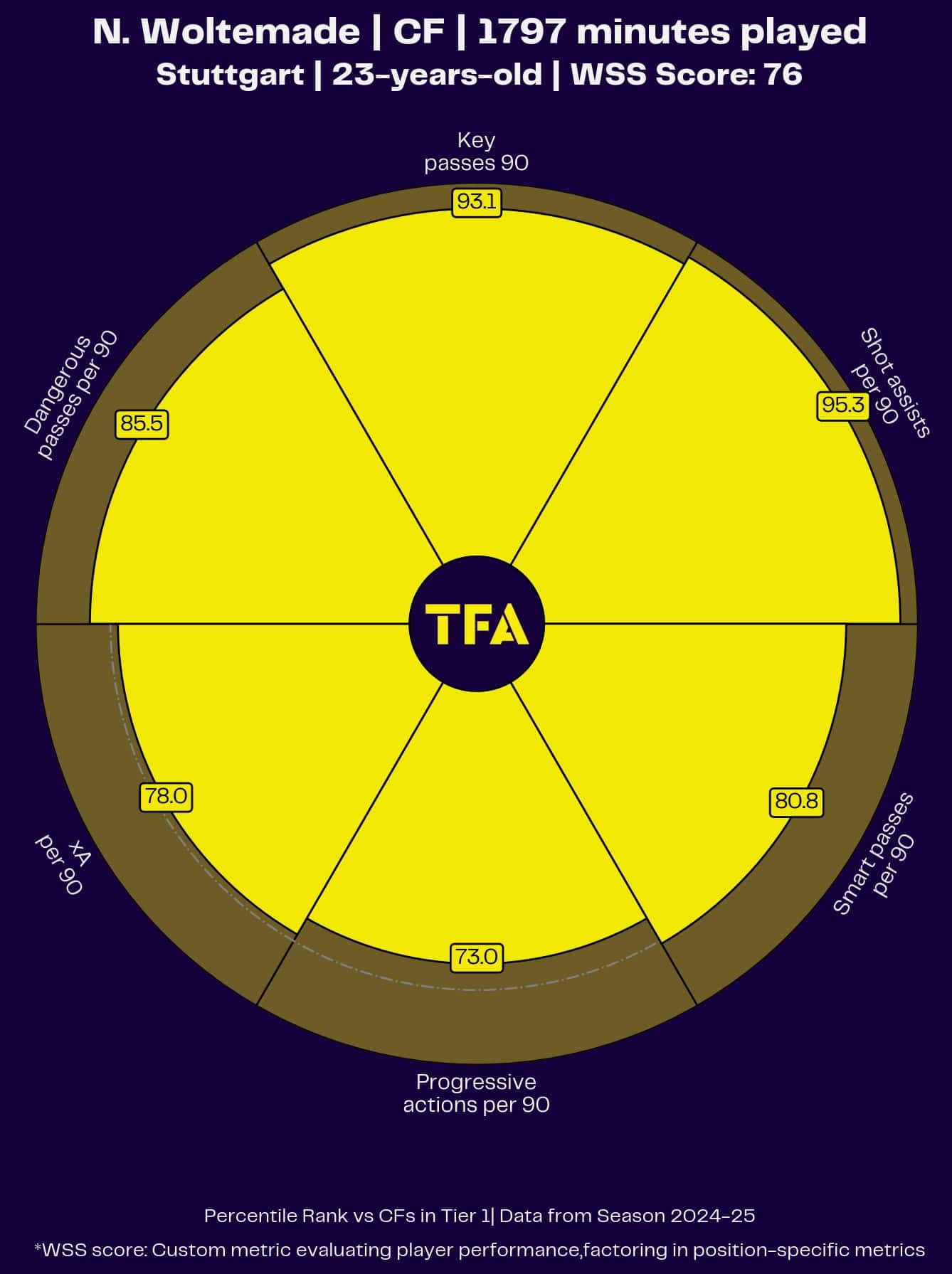
This is shown in the pizza chart below, which focuses on creative metrics and compares him to his positional peers.
The average score is 50.
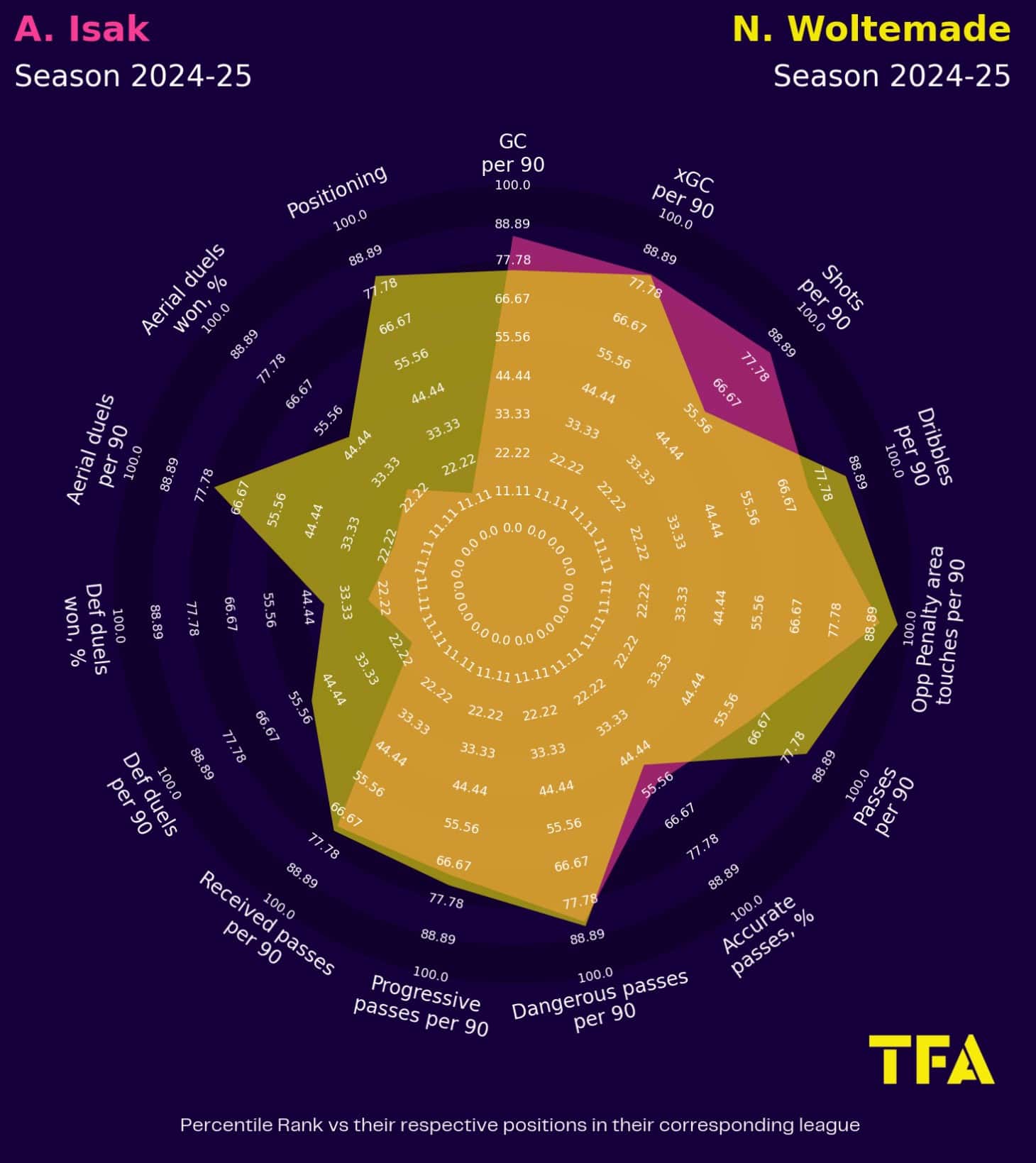
This image below shows that both Isak and Woltemade excel in attacking metrics such as shots per 90 and penalty area touches.
However, Woltemade stands out with higher percentile ranks in progressive passes, dangerous passes, and received passes per 90, indicating a greater involvement in build-up and chance creation.
Their dribbling and finishing profiles are similar, but Woltemade’s superior contribution to link-up play and ball progression gives him an edge in overall forward involvement.
Final Third & Movement
His non-penalty goal rate of 0.55 per 90 (85th percentile), combined with 4.37 shot-creating actions per 90 (97th percentile) and 8.82 touches in the attacking penalty area per 90 (99th percentile), shows a player involved in the most dangerous zones.
Woltemade is not a penalty-box poacher but likes to search for space, drag defenders out of line and offer variety in his movement patterns.
Focal Point
Woltemade’s hold-up play and ability to execute subtle flicks and layoffs would be beneficial for Newcastle United’s attacking fluidity.
He can draw defenders towards him, create overloads, and then release the ball into space for wide players or advancing midfielders.
His mirrors the “third-man” concept, as he acts as a reference point around whom others can rotate and combine.
His 2.05 key passes per 90 (97th percentile) highlight his creative potential.
His hold-up play is due to his large frame, which also benefits him when holding off defenders to go through on goal.
As shown in a league fixture versus Arminia Bielefeld, we can see how the defender is having a difficult time with Woltemade.
When the ball is played into Woltemade’s path, he uses his body to protect it and lets it run past him.
He is then able to control the situation, as the defender is on the wrong side.
This leads to a goal (great finish) to break the deadlock.
Between The Lines & Box-Crashing Potential
Regularly operating between the lines, Woltemade draws centre backs into uncomfortable position and create gaps for midfield runners.
His 2.89 progressive passes per 90 (87th percentile) indicate a willingness and ability to initiate attacks as well as finish them.
This creates opportunities for midfielders such as Bruno Guimarães, Joelinton, or a player like Paquetá to make late, untracked runs into the area.
His game suits game models with a focus on verticality and can also allow Newcastle to lean into the use of central channels.
Elegance & Technical Security
A key differentiator for Woltemade is his technical security and composure under pressure.
He is comfortable dribbling at defenders and rarely loses possession, which allows Newcastle United to sustain attacks and play through pressure rather than relying on direct or aerial solutions.
As shown during the fixture against Wolfsburg, Woltemade receives the ball under pressure with his back to goal and evades defenders.
This is impressive agility for his height.
He then drives at the defence before playing a well-timed slip pass to a teammate in a better position to score.
He is not an aerial specialist (despite being 6’6), but strengths on the ground compensate and fit well with Newcastle’s current squad.
