
In the last few years, Arsenal have been considered one of the best teams in the world from set pieces, if not the best.
In the last three Premier League seasons, Nicolas Jover‘s side were the top scorers from corner kicks, netting 12, 12 and 11 times, respectively, in order from 2022/2023-2024/2025.
They have common principles that are always applied, which makes it easier for their players, especially when they get numerous corners in the same match.
Despite applying almost the same principles, the Gunners make small adjustments, if needed, depending on the opponent.
This makes it difficult for opponents while remaining easy for them because the adjustments are always small and simple.
However, having your own variations is one of the most important principles in set pieces.
It is important to remain somewhat unpredictable, especially since many teams have been thinking about how to stop them, especially in attacking corners.
That’s what happened in their pre-season games against AC Milan, Newcastle United, Tottenham Hotspur, and Villarreal.
This tactical analysis is a set-piece analysis of Arsenal’s new tactics, which have been merged with the old ones in attacking corners from their pre-season matches ahead of the 2025/2026 campaign.
This has provided a new dimension to the Arsenal set-piece tactics.
Arsenal New Use Of Edge-Of-The-Box Players Under Nicolas Jover Tactics
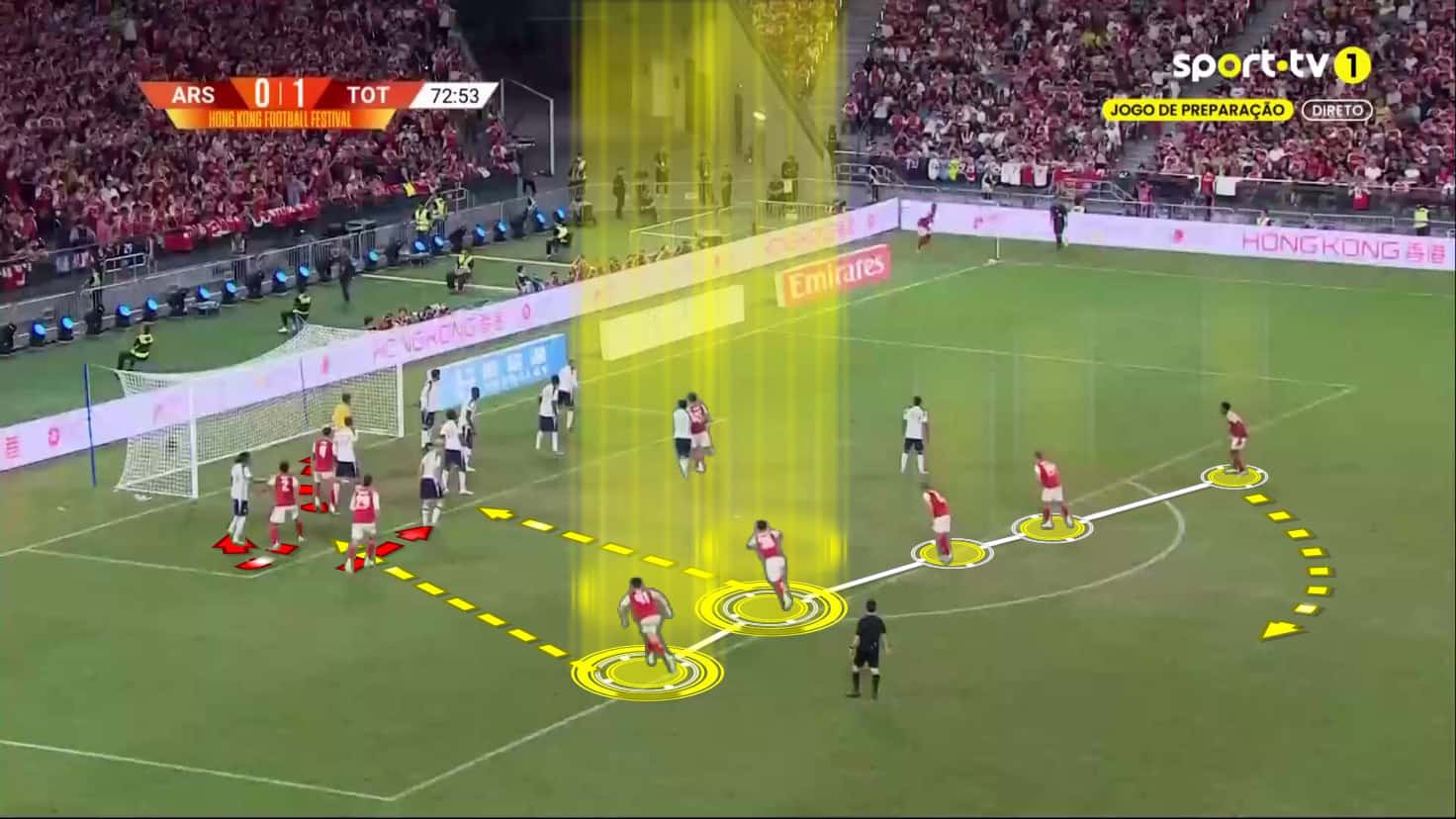
Arsenal’s new tactic includes five players standing on the edge of the box, as shown below (yellow).
All five players are pretending that they will run into the box while four players are inside the box.
On the other hand, Tottenham defend with a zonal system with just a man marker with Jakub Kiwior (green).

Once the routine begins, the three players on the far post (red) do the block job, as shown below.
A player blocks the goalkeeper, while two players block the last zonal player of the first and second lines.
In this case, they target the far post, so the first edge-of-the-box player on the near post runs back to be a security player while the two players on the far post run to the targeted area.
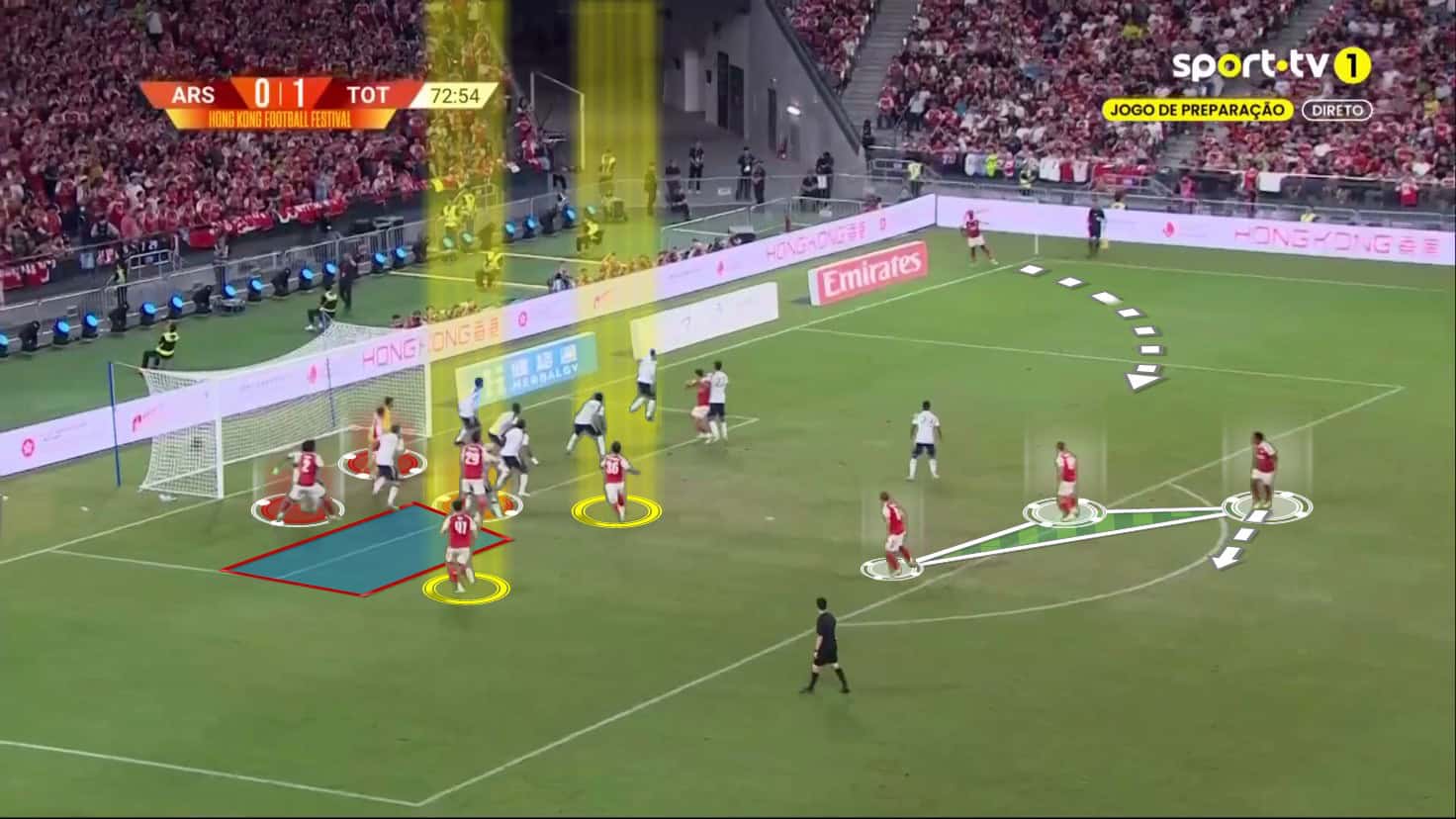
As shown below, the targeted area is now ready to be exploited because of the usual blocking job from the blind side of the zonal defenders and the goalkeeper.
The two running players (yellow) will target the ball’s path while keeping the same triangle on the edge of the box.
They will also give responsibility to the taker to run, as shown, for the rebound ball towards him.
The result is similar to what they used to do, but using the edge-of-the-box players in this way has many advantages.
First of all, the opponent can’t predict which two players will run, and also can’t send many markers there for two reasons:
- They can’t risk leaving the best targets inside the more dangerous area in the box free (like Kiwior, Kai Havertz, William Saliba, and Ben White) to mark Declan Rice or Martín Zubimendi, who are less important players (this happens more against teams that depend on a zonal system with a few man markers).
- Arsenal can manipulate them by asking the free edge-of-the-box players to run into the box, even if they are weaker in aerial duels.
You may wonder how players who aren’t the best in aerial duels can be a problem and threaten the goal.
First of all, they have a dynamic advantage over the stationary zonal defenders because they run a long distance free before jumping, which helps them more against zonal defenders who jump from a stationary state.
Secondly, Arsenal have a lot of good (moderate) players in aerial duels who can’t be considered as the most dangerous players by the opponent, so if the opponent marks Gabriel Magalhães, Mikel Merino, Havertz, William Saliba and Ben White, they most likely will leave Declan Rice and Christian Nørgaard free.
Hence, Arsenal are expected to have two players (at least) in the edge-of-the-box group who are good at aerial duels.
Thirdly, these runners from the edge of the box can be exploited in several ways (not just targets), like asking them to perform decoy runs to drag the zonal defender in the targeted area, frame the ball’s path, or participate in overloading the targeted area, as we will explain in the next example.
As shown below, two of Arsenal’s players block the goalkeeper and the last zonal defender (red) while Havertz (white) is the main targeted player.
Kiwior (green) will take his marker away from the targeted area.
Two of the edge-of-the-box players (yellow) run toward the targeted area (Bukayo Saka and Christian Nørgaard).
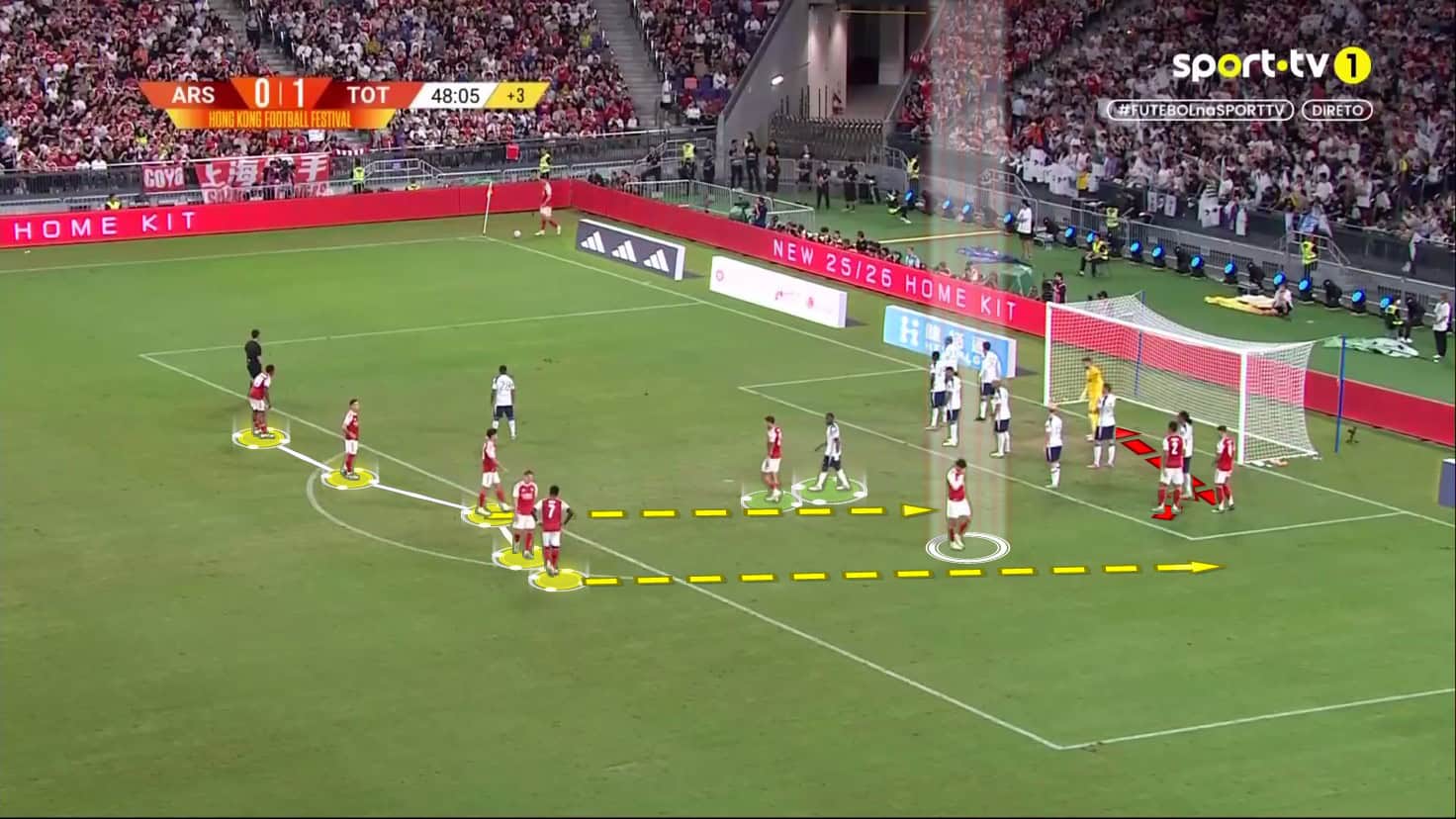
As shown below, they now have three players overloading the targeted area from different starting positions (one in white from inside the box and two in yellow from the edge of the box).
At the same time, the far edge-of-the-box-player goes back to be a security player.
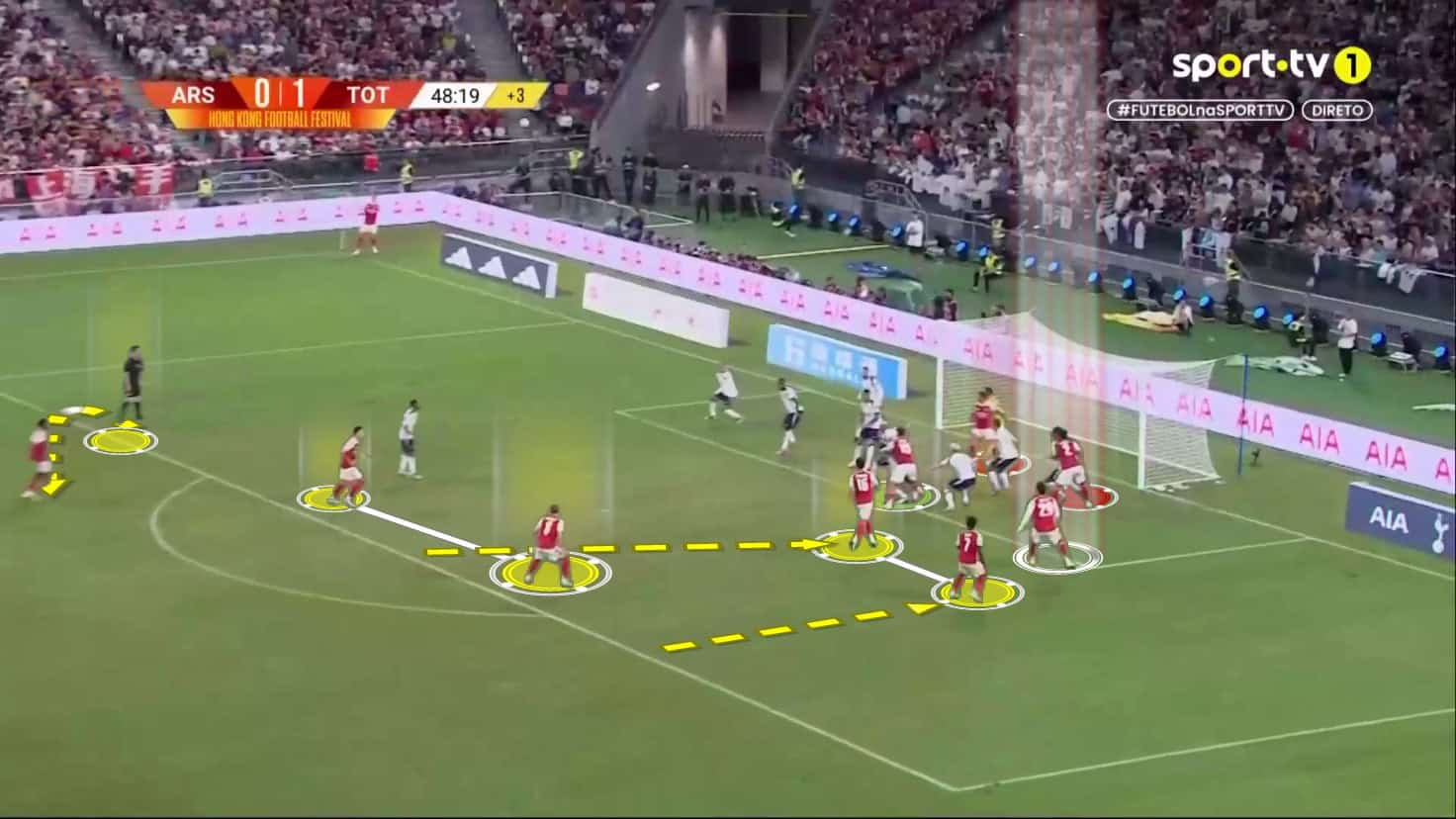
As shown below, Saka (who isn’t strong in aerial duels) will run behind Havertz to frame the ball’s path in case it passes him, while Nørgaard can evaluate the situation to attack the ball or help Havertz.
He decides to block the zonal defender facing him to help the ball reach Havertz easily.
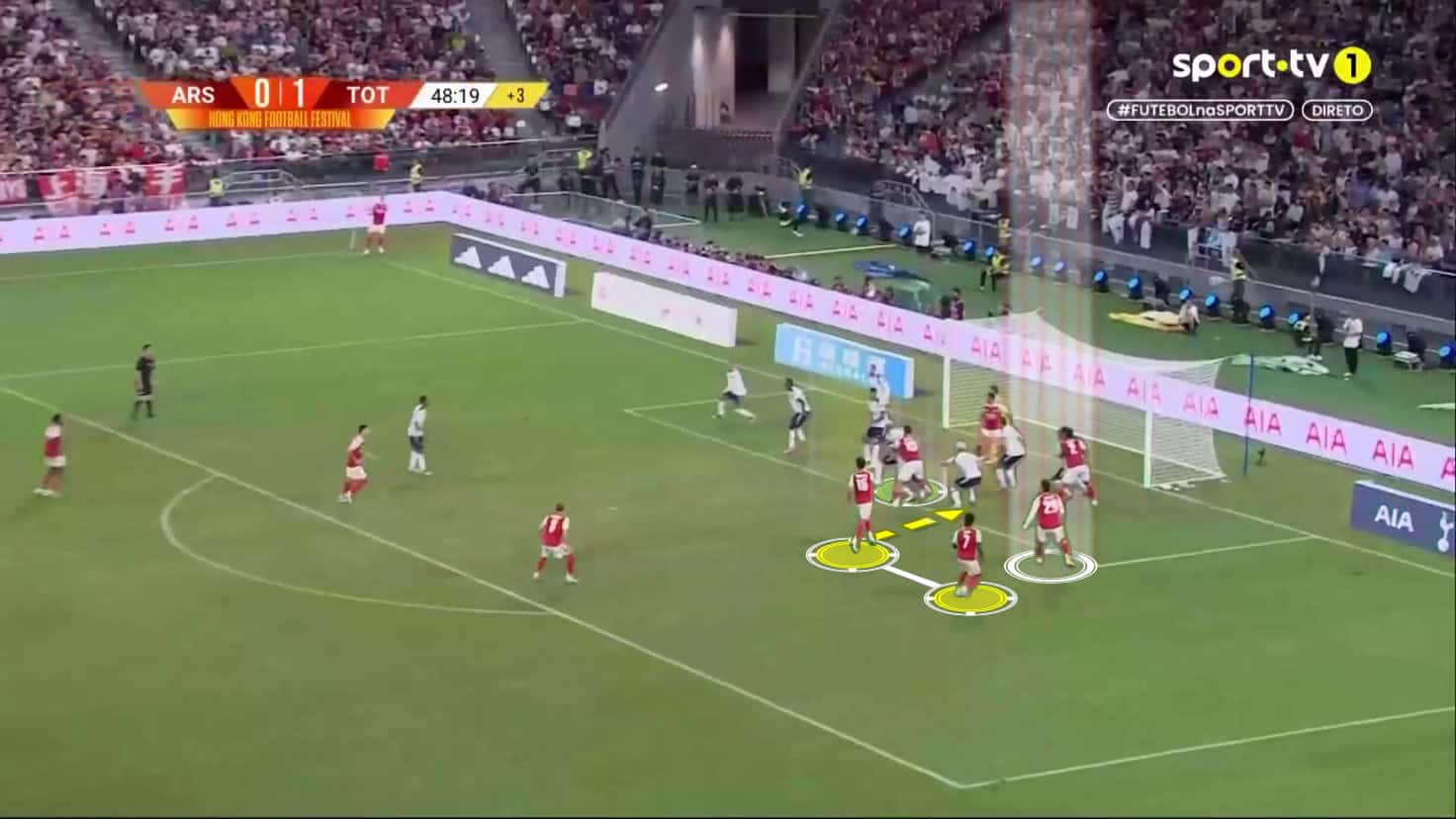
In the last minutes of their game against Tottenham, they could increase the number of players inside the box to five while making the edge-of-the-box players four.
Two will run, leaving two on the edge of the box without security players, as shown below.
Three players (red) will do the blocking job on the near post, while there are now two targeted players inside the box (white) and two runners from the edge of the box (yellow).
Another advantage is that the rebound player from the opponent is usually a player who doesn’t have the commitment to stand back with the runner all of this distance, or may have instructions not to leave the rebound area empty.
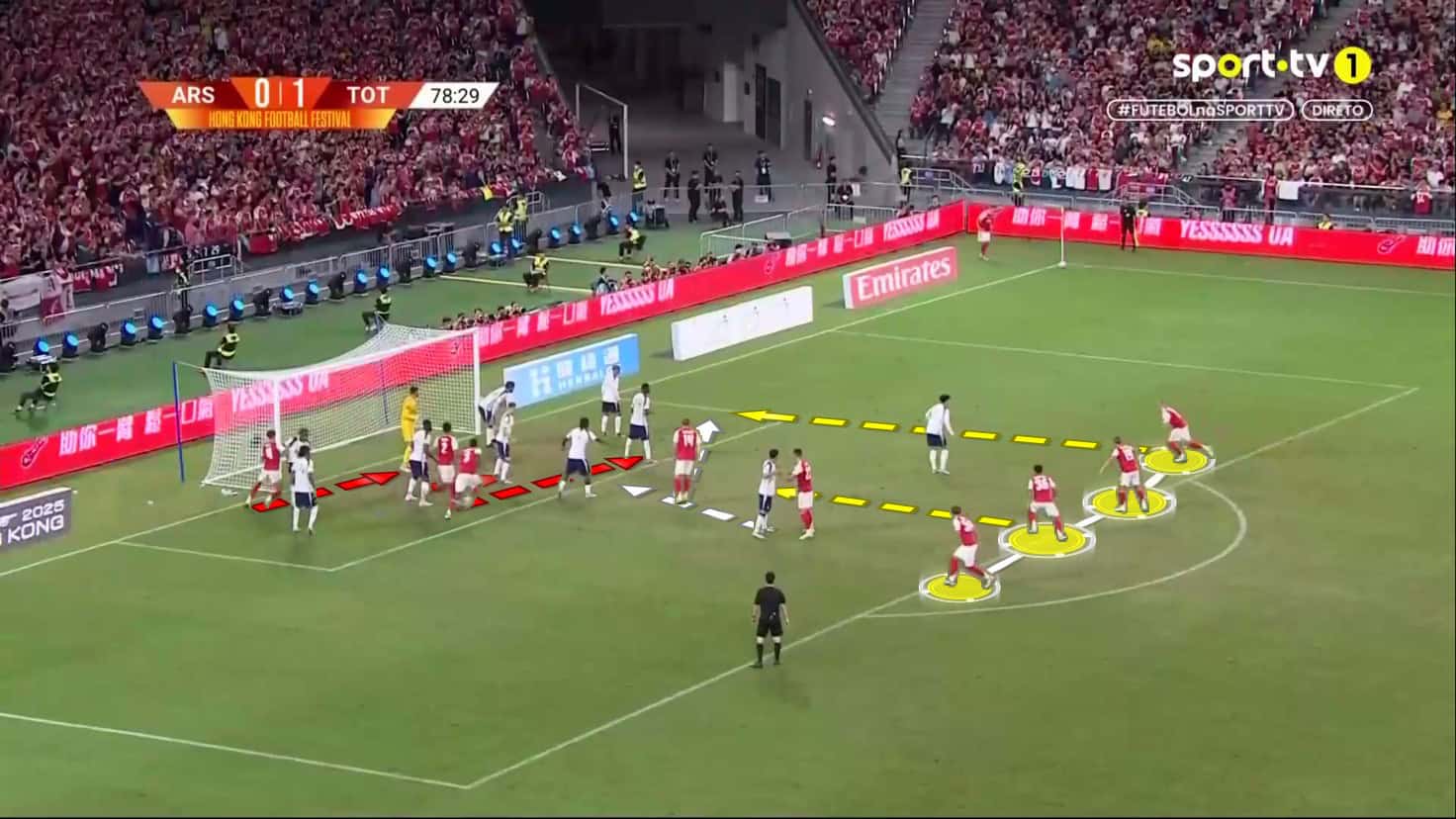
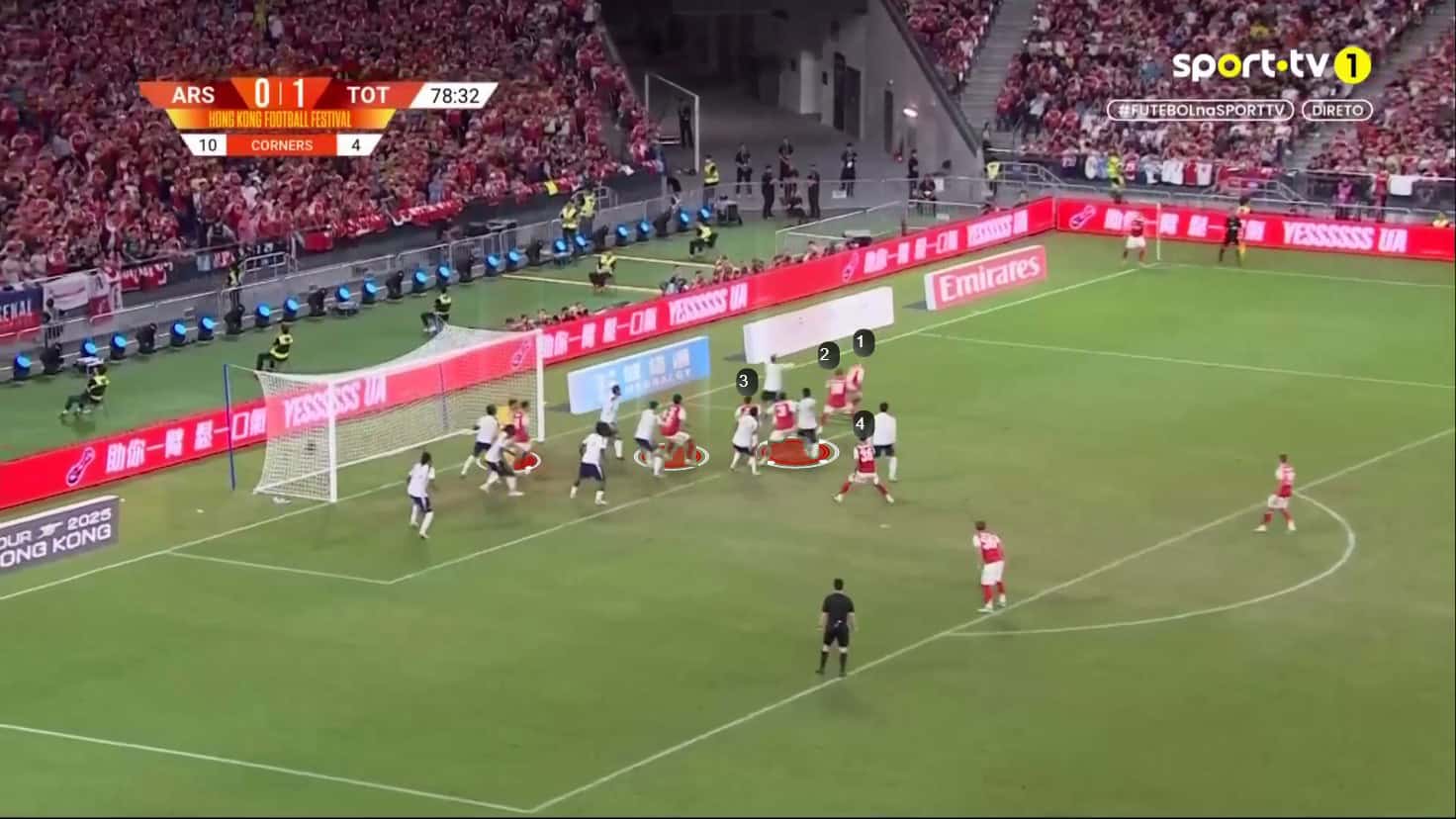
In the photo below, it is all done.
Three blockers to the goalkeeper and two zonal defenders are in red, while four targeted players (numbered) are present.
Two targeted players came from inside the box, and two runners came from the edge of the box.
For example, number one is Oleksandr Zinchenko, coming from the edge of the box.
He drags the first zonal defender a little bit forward, helping the ball reach one of his teammates behind him.
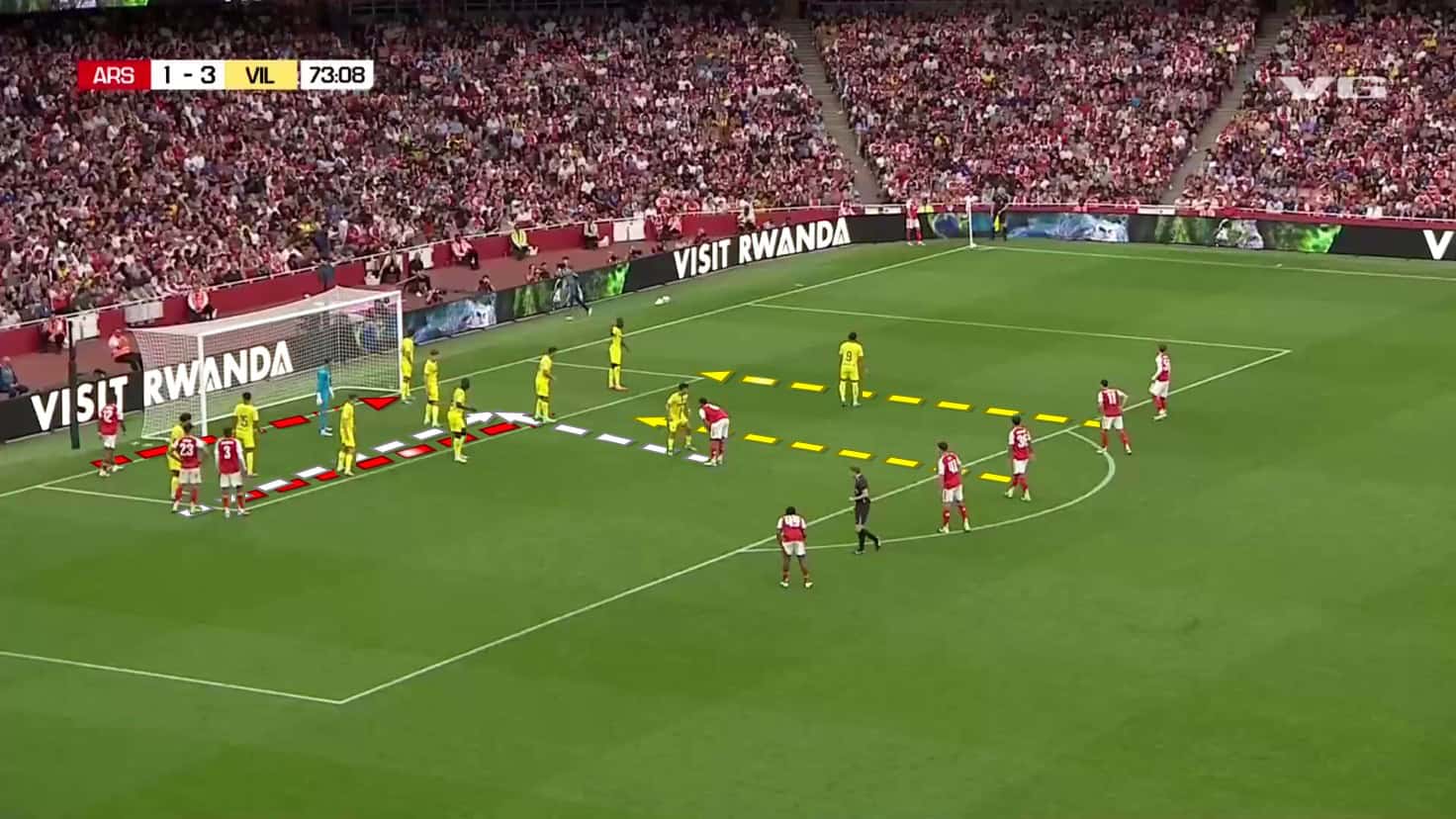
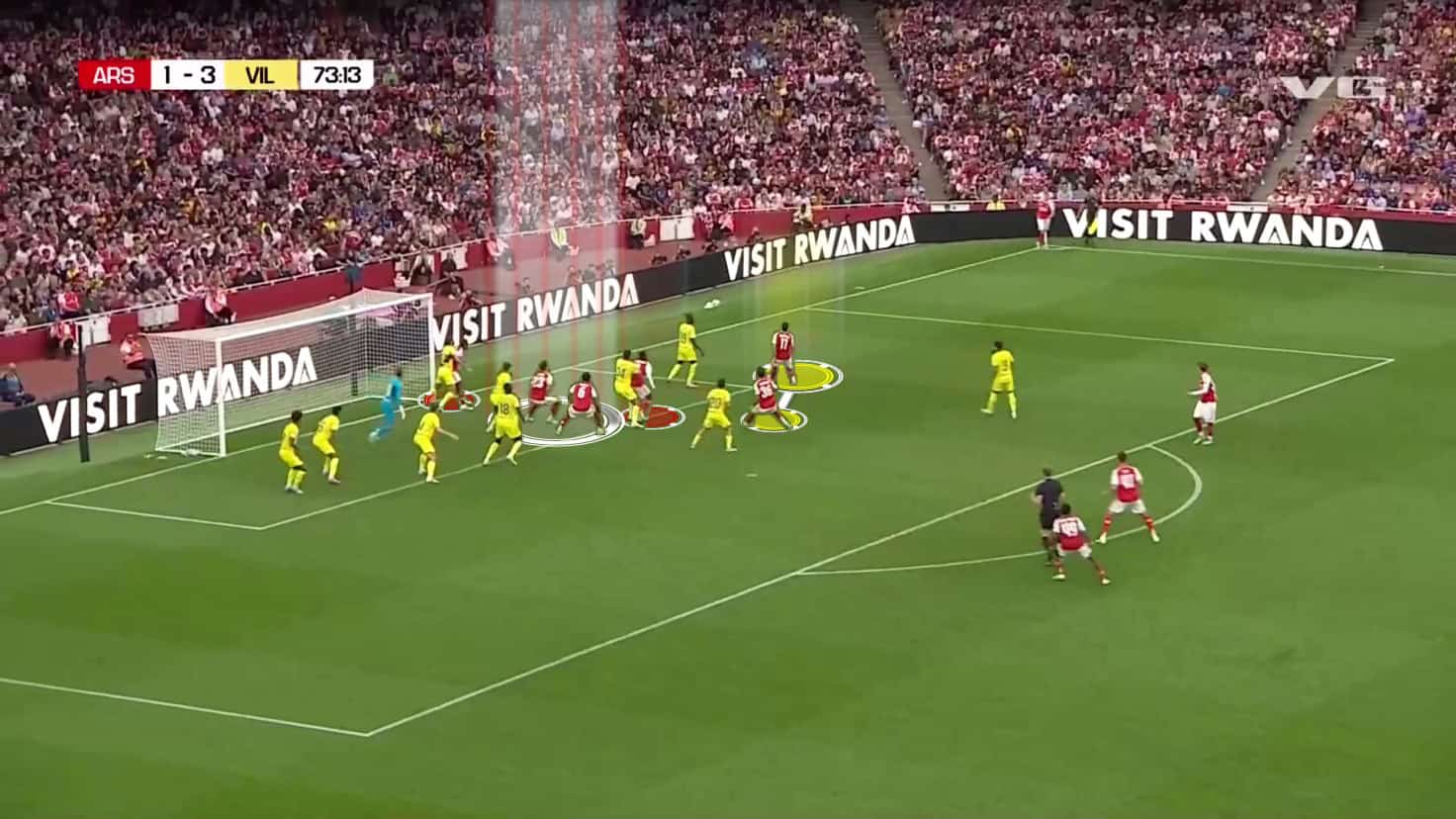
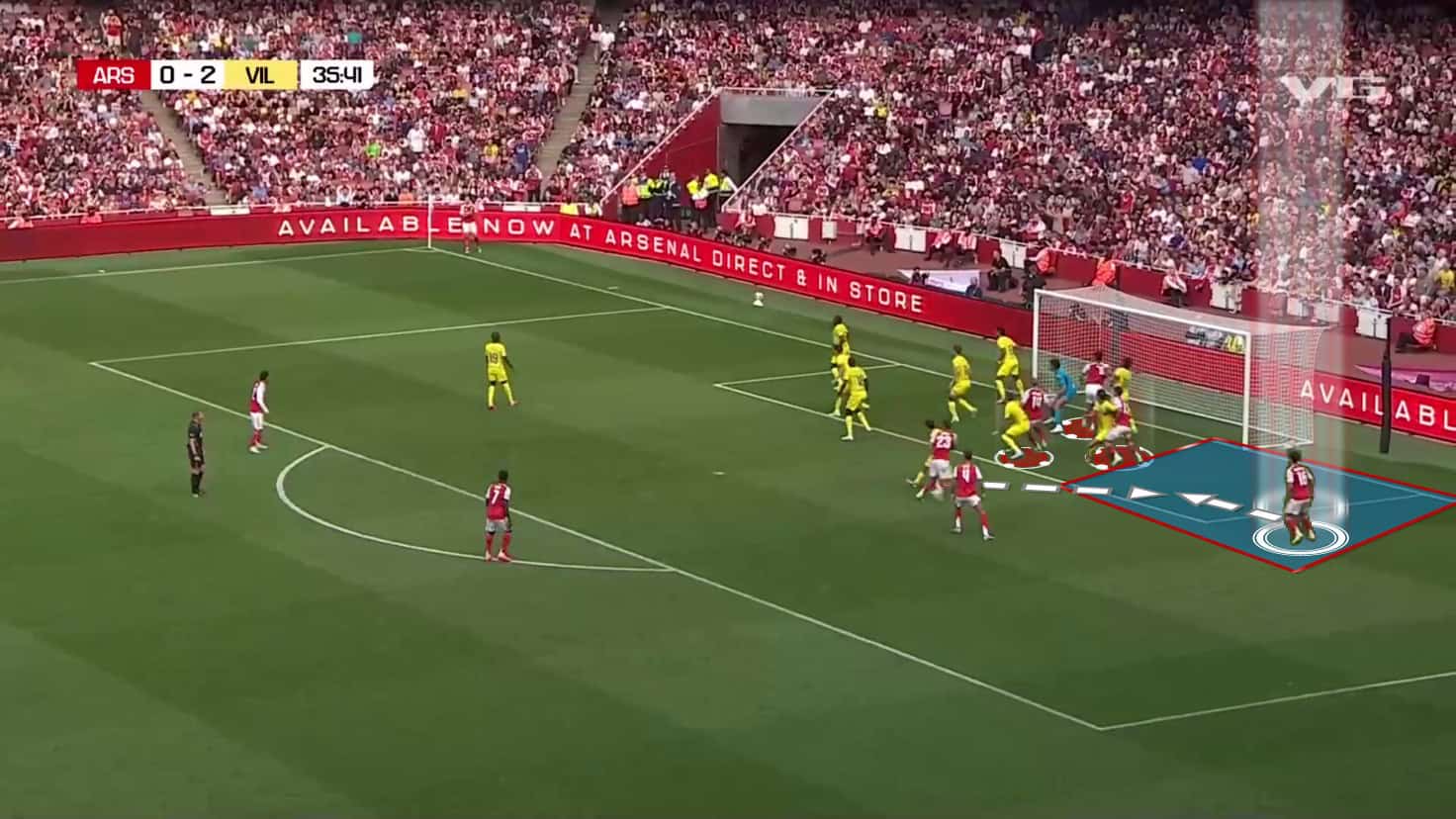
It wasn’t a coincidence because they also implemented the same idea against Villarreal.
As in the photo below, two blockers (red) start from the blind side to block the zonal defender on the near post and the zonal one in front of him.
Two targeted players (white) come from different angles in the box, while two runners (yellow) come from the edge of the box.
As shown below, the usual scene of having four targeted players is clear: two from inside the box (white) and two from the edge of the box (yellow).
Arsenal Short Corners Against Teams With Counterattack Players
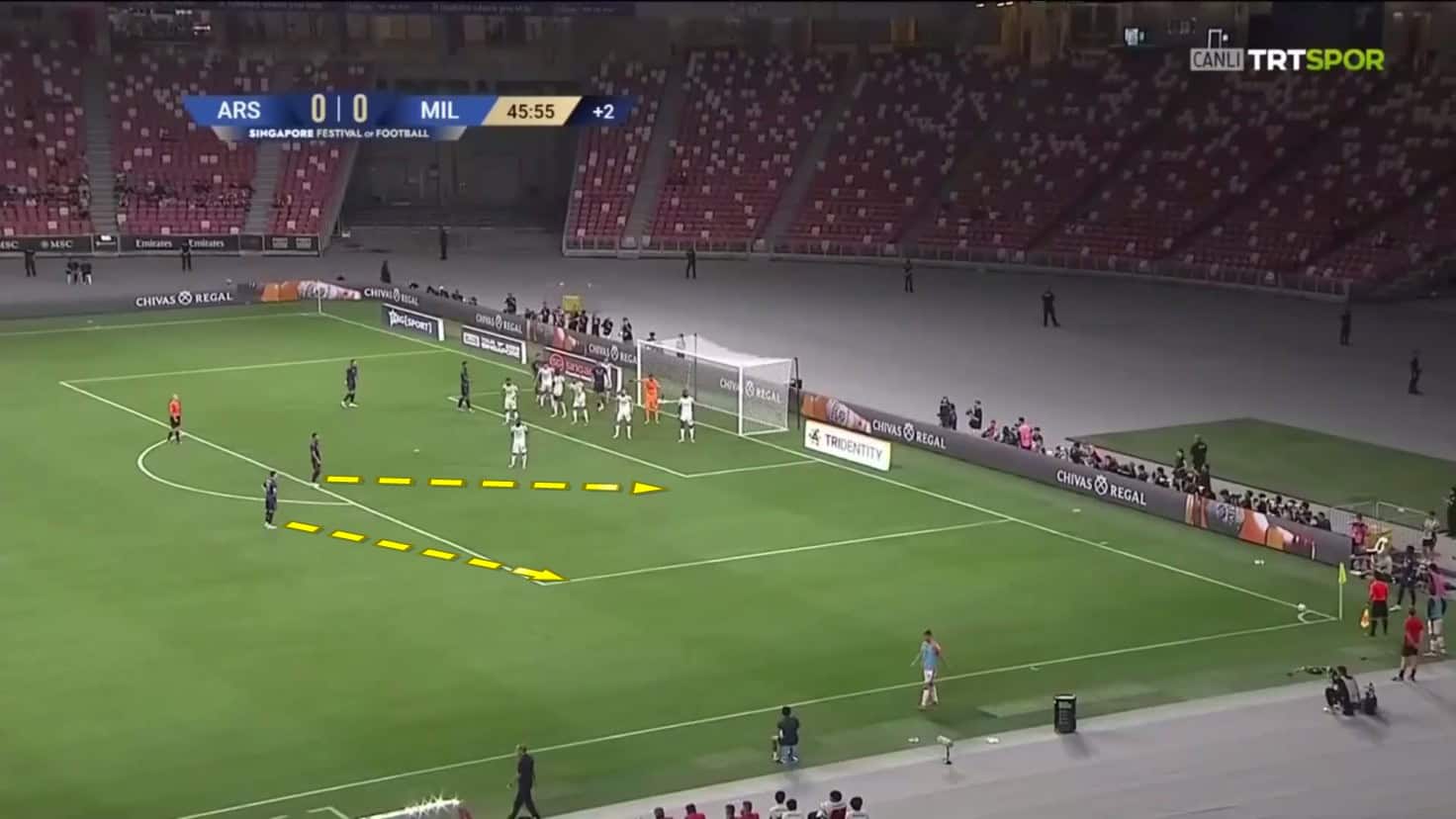
One of the other interesting ideas Arsenal have shown is how they deal with teams that leave two counterattack players while defending the corner against them.
As shown below, AC Milan defend zonally with eight players while leaving two counterattack players, which fixes three of Arsenal’s players at the back.
Hence, three of the usual five edge-of-the-box players are at the back, so the remaining two will manipulate the opposing rebound player.
One runs to fix him while the other receives a pass from the taker.
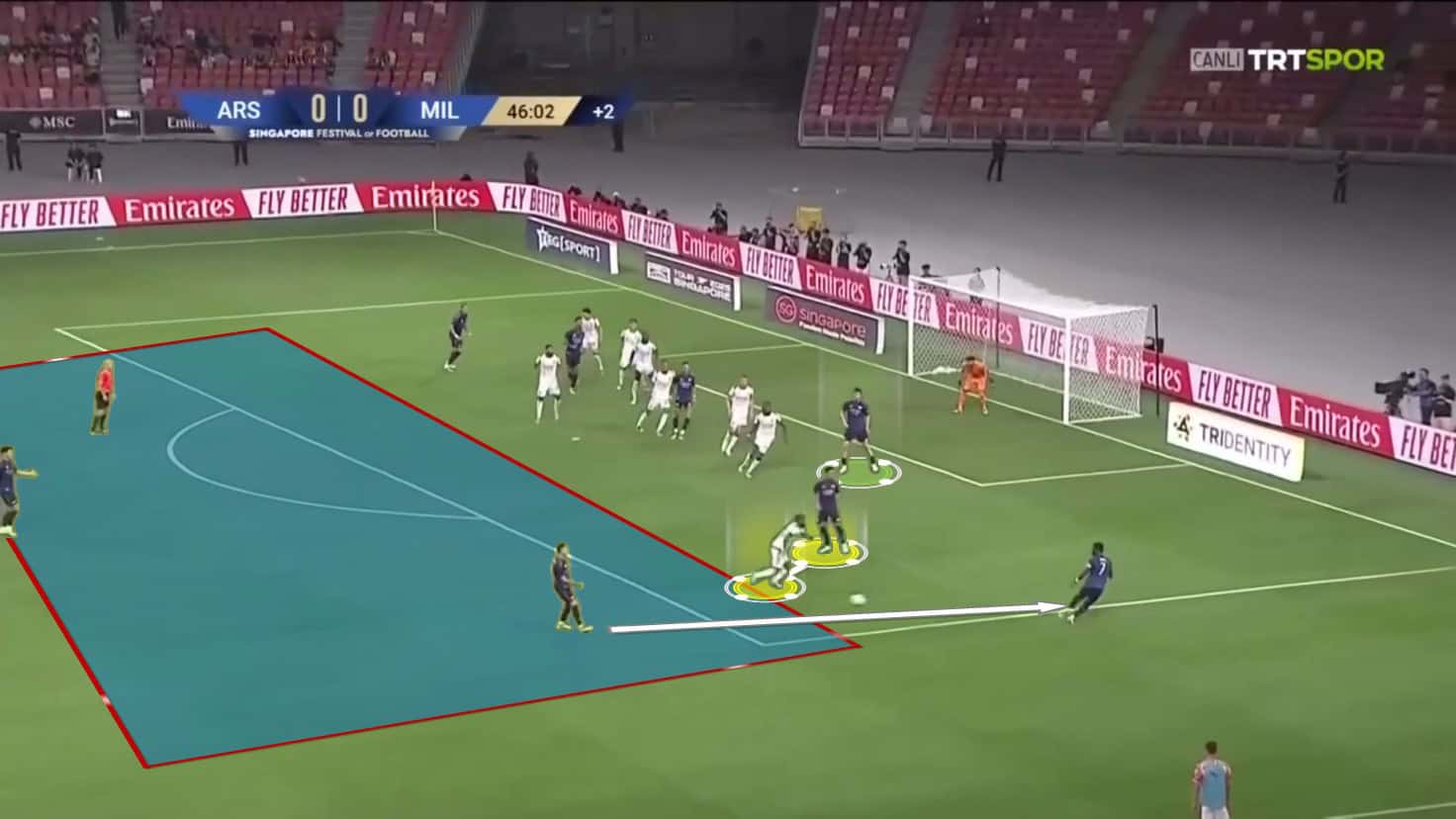
The disadvantage of using this defensive strategy is shown below.
The opponent mostly leaves one player to defend the rebound and short corners, so the short-option player can easily play it back to the taker to cross or to the coming player in the middle to shoot.
Arsenal Previous Tactics
We also shouldn’t neglect that they still use their traditional method, which is still effective, and that they can even merge the two ideas.
They scored a goal against Villarreal via Christian Nørgaard with their traditional tactic.
As shown below, they start in a pack on the far post.
Three players (red) block the goalkeeper and the last two zonal defenders, two players (white) are the targeted players, and a player moves to receive any headed pass (blue).
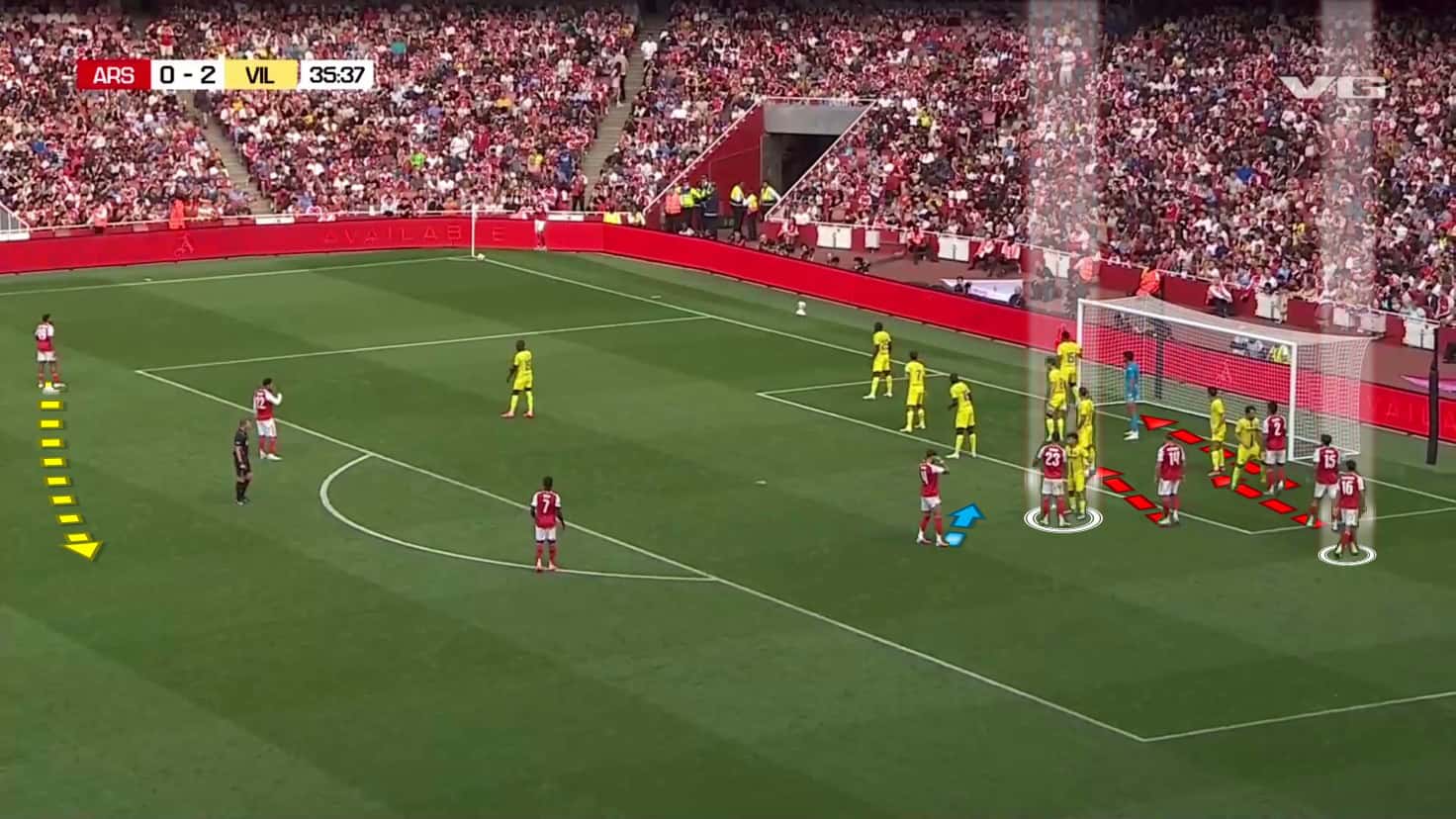
As shown below, the three blocks are perfectly done, so the targeted area is now ready to be exploited by the two targeted players, who come from different angles as usual: the last one of the pack beyond the far post and a player coming from the middle.
Conclusion
In this analysis, we have presented Arsenal’s new tactics of targeting some of the edge-of-the-box players that Nicolas Jover mixed with the previous ideas.
Despite being the team that has scored the most goals from corners in the Premier League over the last three seasons, Nicolas Jover evidently thinks that having many variations is important to ensure the team remains as unpredictable as possible.
Arsenal are also still effective using their previous tactics, scoring a goal from an old corner routine against Villarreal.
Jover has simply added to their set-piece toolbox ahead of the 2025/2026 campaign.
