
Manchester City‘s staff have witnessed numerous changes aimed at reviving the Citizens.
The most notable new additions are former Liverpool coaches Pepijn Lijnders and James French.
Lijnders has been appointed as assistant coach, while James French joins as set-piece coach.
In the 2025 FIFA Club World Cup, Manchester City was one of the best teams in terms of attacking corners, and they employed some effective tactics under the leadership of their new set-piece coach.
We know that French didn’t have time before the tournament, and it is difficult to teach the players new things during the tournament.
However, we can see some repeatedly implemented tricks, routines, or principles that may help us identify some features of his set-piece tactics and anticipate what he will prefer to do in the future.
In this tactical analysis, we will examine Man City’s attacking corner tactics, as implemented in the FIFA Club World Cup, highlighting common issues against zonal marking and man-marking defending systems in this set-piece analysis.
Man City Tactics Against Man Marking
To begin this football analysis, we will examine the common features of Manchester City’s attacking tactics against man-marking defending systems (systems that rely on man-markers having just three or fewer zonal defenders) at corners in the 2025 FIFA Club World Cup.
The most important principles that they implemented against this defending system are screens (blocking the targeted player’s marker to free him, as in basketball), causing orientation problems for the opponent, and framing the goal.
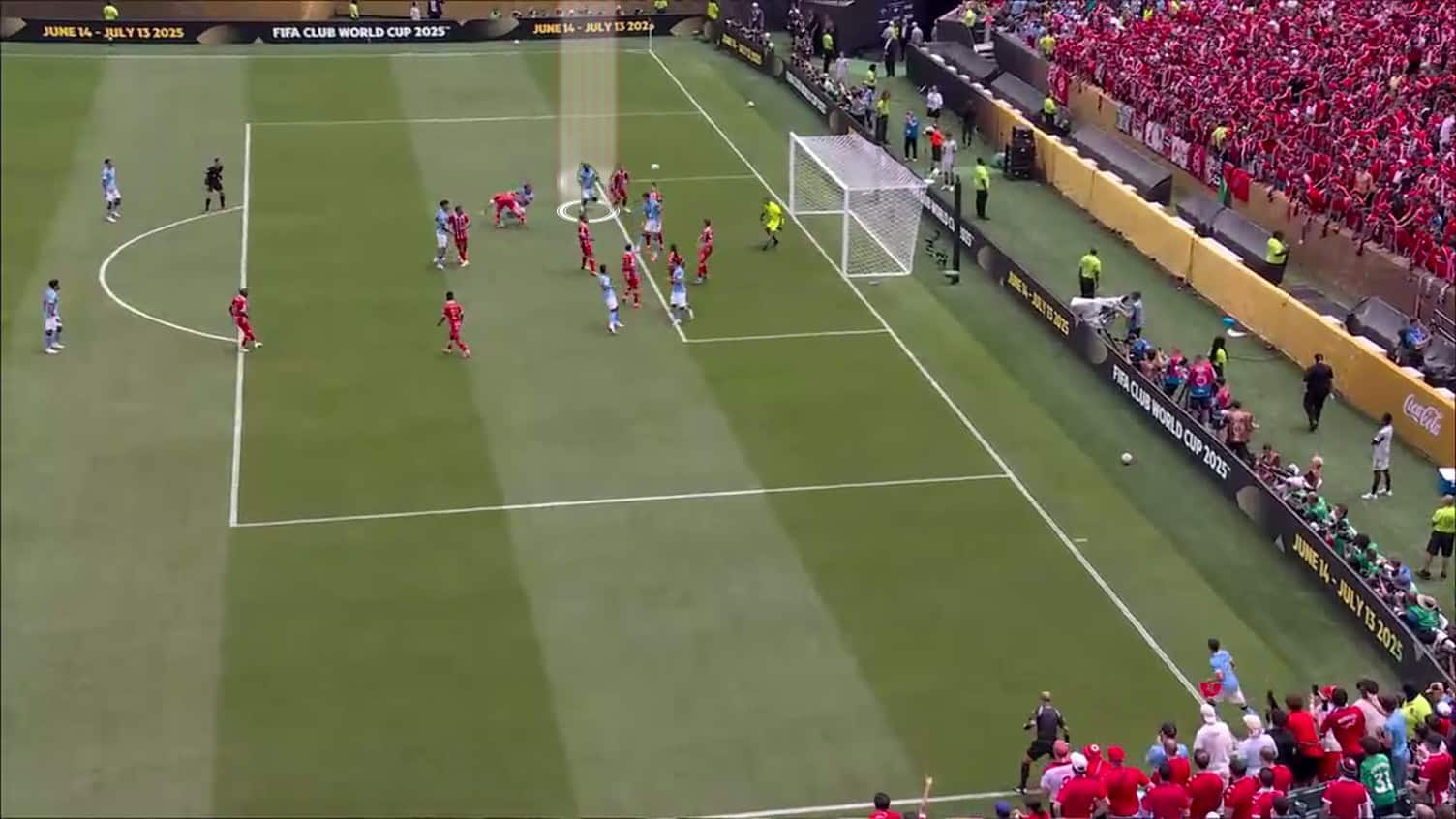
As shown below, Al-Ain defend with two zonal defenders on the near post (green) and one in front of them to defend flicks and is ready to defend short corners.
They have six man markers and a player near the edge of the box ready to get the rebound.
On the other hand, Man City have six players in the box, two players on the edge of the box, and a player in the back for security.
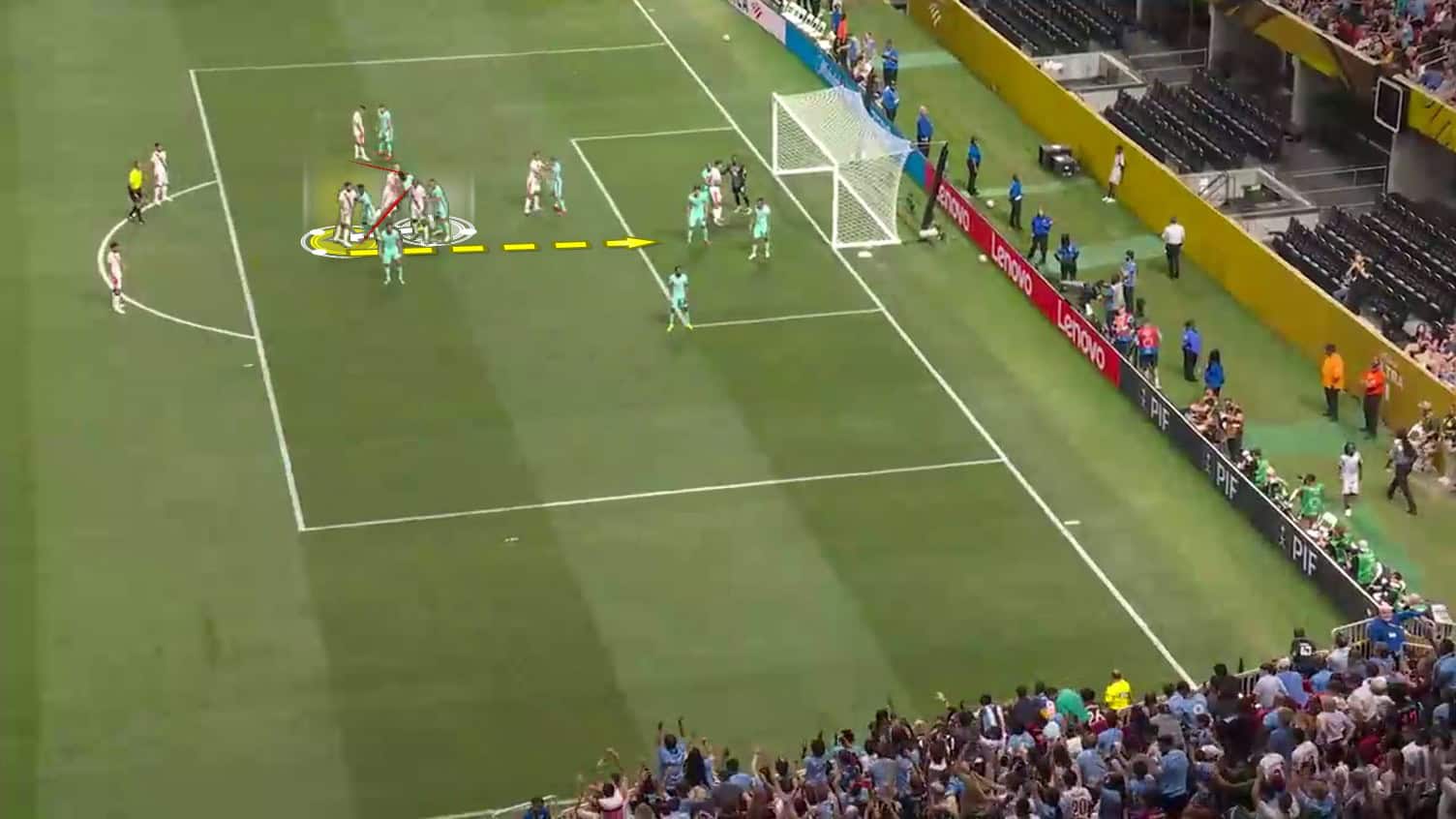
The first targeted player (yellow) starts on the blind side of the zonal defenders to ensure that the second zonal defender can’t see him while tracking the ball in the air, allowing him to surprise the defender.
He causes an orientation problem for the zonal defender in the targeted area because he can’t track the ball and note the targeted player’s movement simultaneously.
As an additional note, the targeted player will push his man marker to separate from him for a moment and do this curved run to the targeted area.
By this starting position, his man marker will run sideways behind him.

Suppose the second zonal defender realises the run of the first targeted player and takes some steps toward the near post.
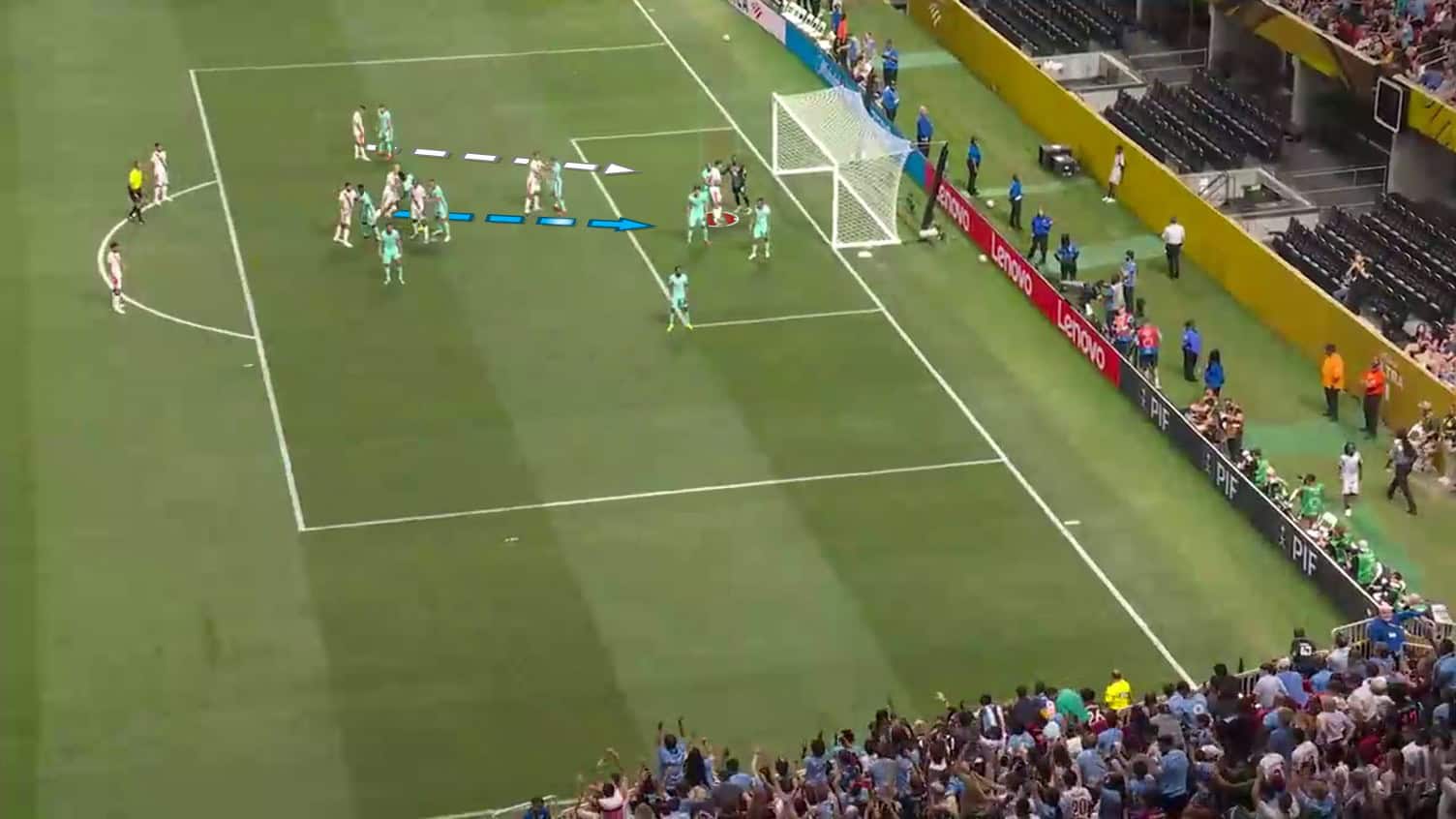
In that case, the role of the second targeted player comes to target the area that the second zonal defender leaves, as shown below.
Hence, we can say that they target two different players for two possibilities, which naturally overloads the targeted area.
The second targeted player (yellow) will exploit the help of his mate (white) to be free from his man-marker.
You can note that his mate doesn’t care about the ball.
He gives his back to the goal and waits for his mate’s run, and he blocks his marker once he tries to follow him.
Naturally, we think that they may need to drag the zonal defender by the run of the previous targeted player and target this player, but coaches consider both possibilities because the cross isn’t always optimal.
The blue-and-white players are framing the goal, with one positioned in the middle and the other at the far post.
The position of the last attacker is repeated, and they intend to place their weakest header in this position, far from the goal mouth, because he will move later than his teammates following any ball that passes the targeted area and follow any rebound ball from the goalkeeper, while no one is aware of him.
You can see the screen (block) clearly below, which completely frees the targeted player.
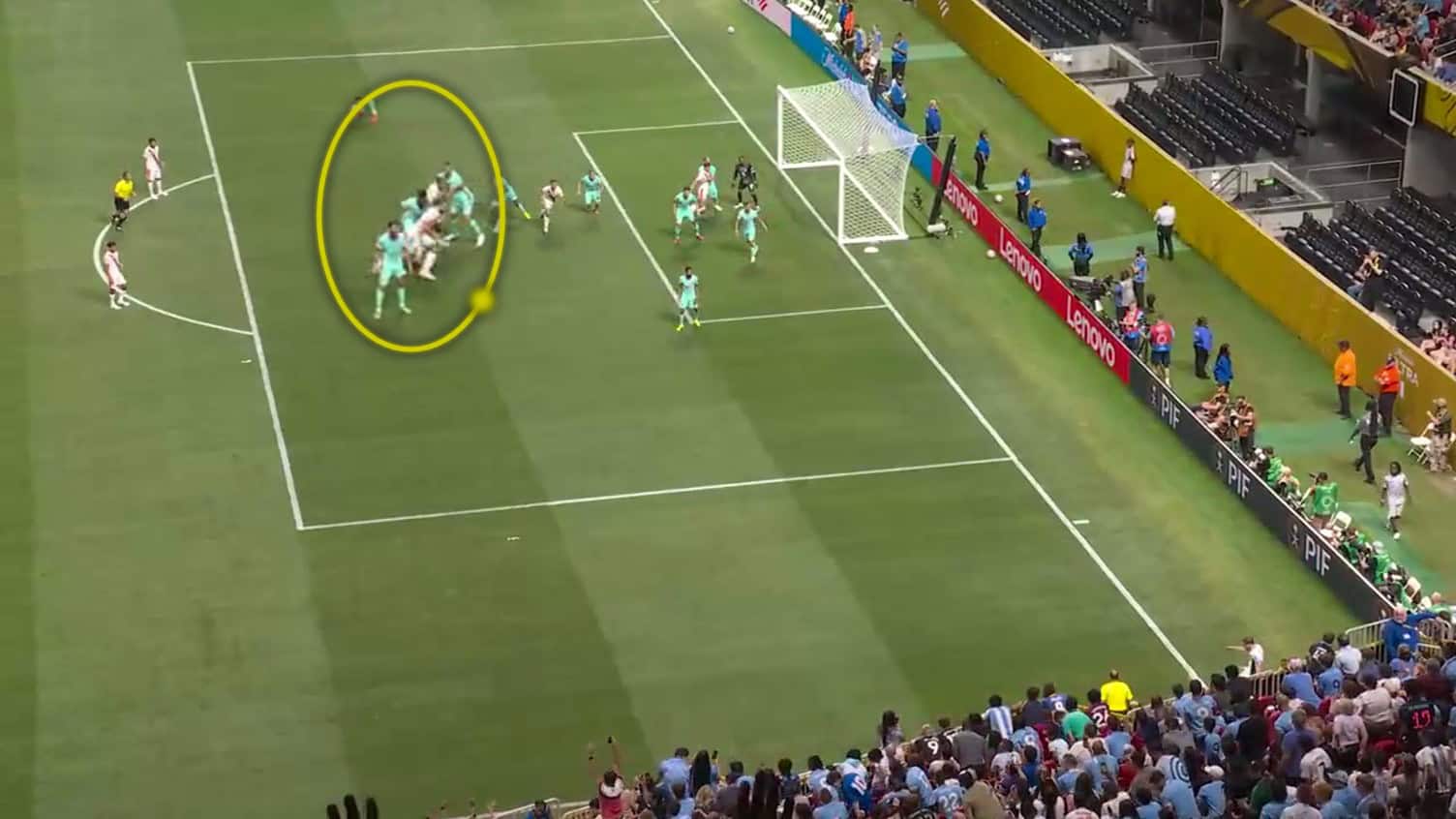
As shown below, the plan works.
The targeted player receives the ball, which hits the post, while the last runner attempts to follow up on the rebound.
They scored from this routine in that match.
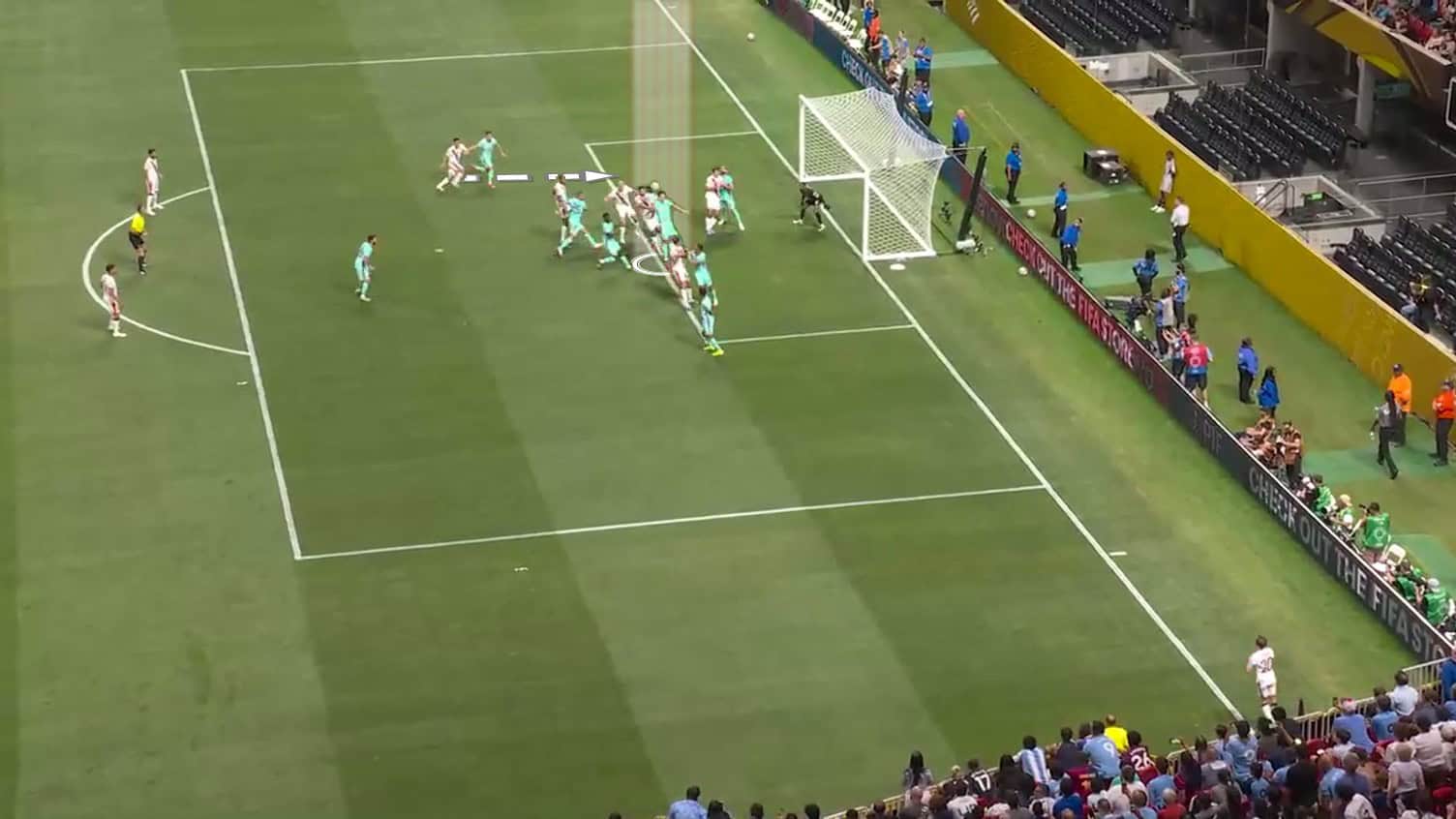
As shown below, Wydad AC defend with three zonal defenders (green), six man markers and a player on the edge of the box for the rebound.
They asked their targeted player (white) to start far on the edge of the box behind his mate to separate him from his man marker, while Wydad’s man marker chose this time to wait for him a little bit further.
We can also note the same far player outside the goal mouth who will frame the ball going to the far post (red).
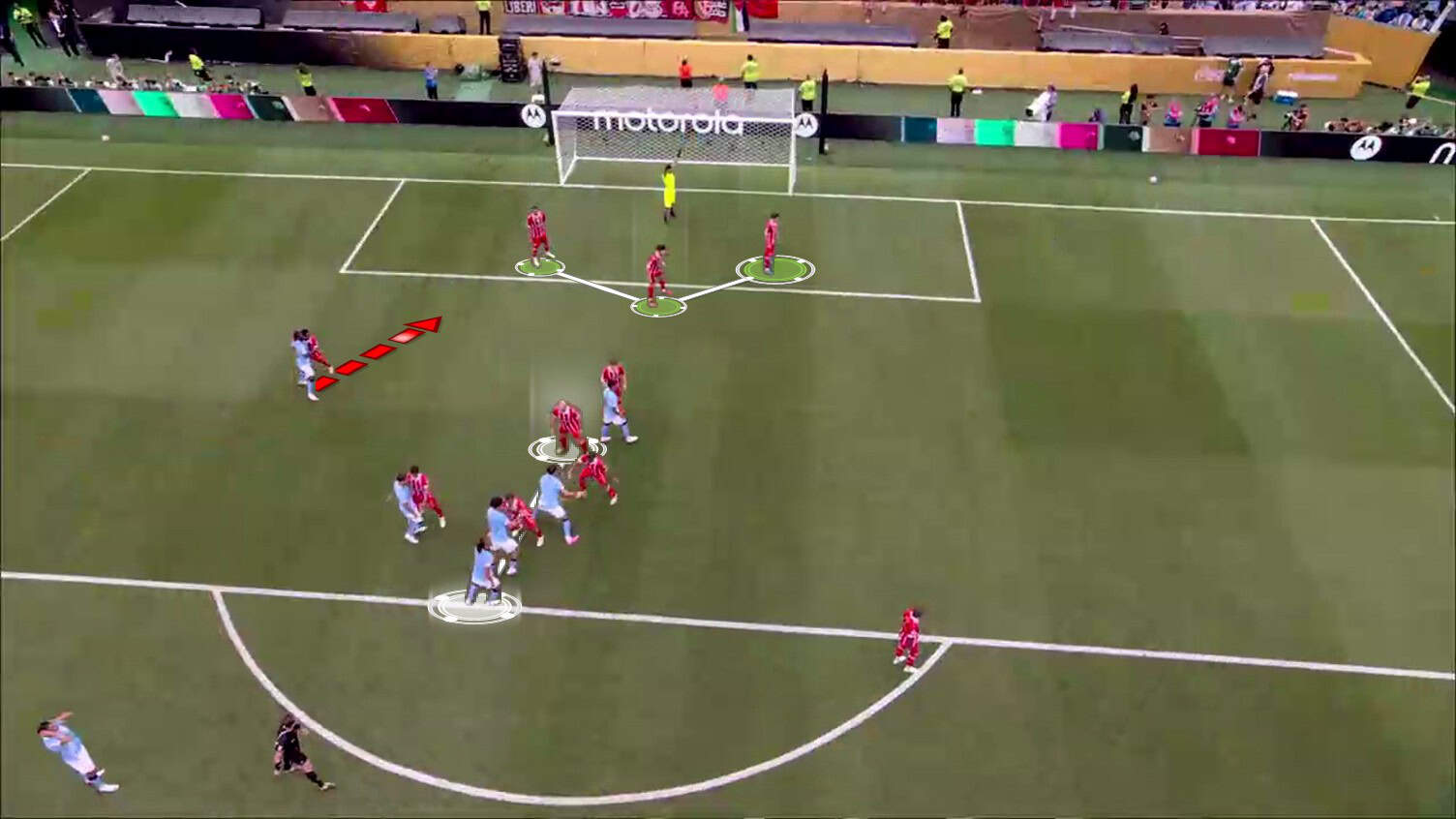
As shown below, this marking method helps the marker avoid blocks and separation.
However, the targeted player starts to run.
At the same time, the ball is played, so the man marker has difficulty tracking the ball in the air while tracking the targeted player along this path (orientation problem).
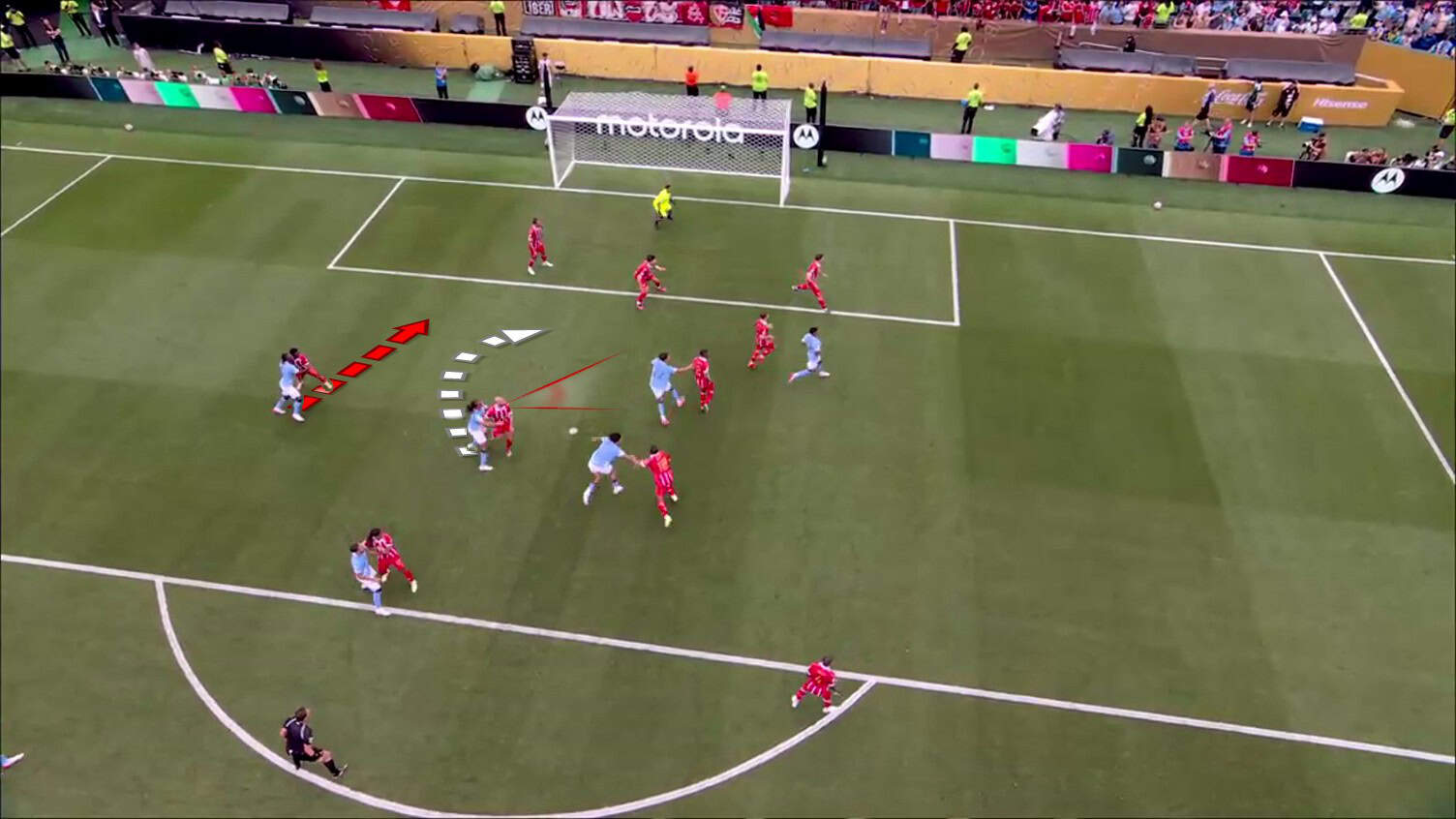
As shown below, the targeted player escapes from his marker, while the zonal defender fails to note his run from such a distant point while tracking the ball in the air.
The result was a dangerous chance.
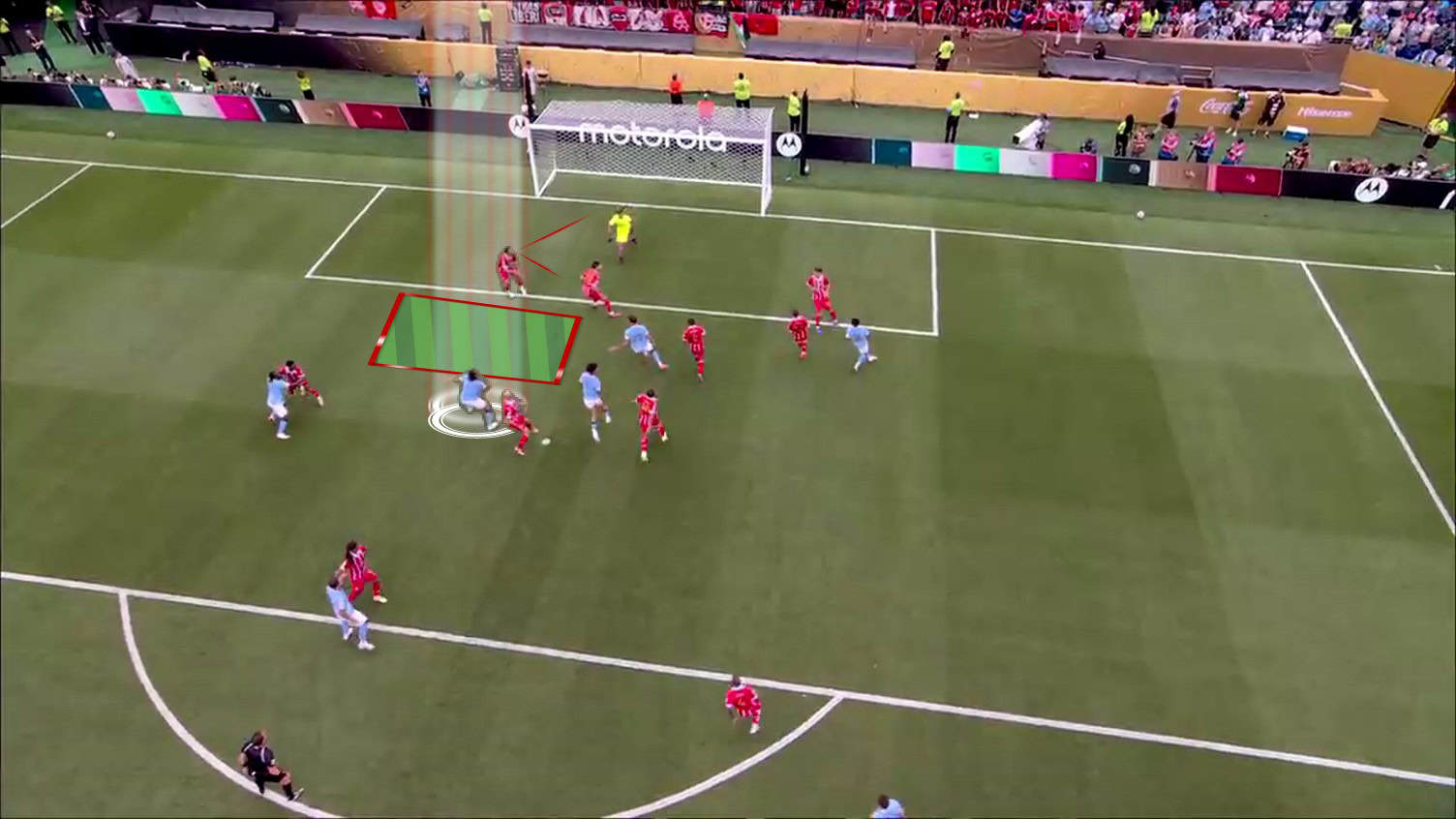
Coming to the goal they scored after that, they had a short-opinion player in the beginning who dragged one of the man markers to help the edge-of-the-box player to be in a 2-v-2 situation, as shown below.
However, they didn’t play it short, and this player went back to his position on the edge of the box.
However, they had the benefit of freeing one player, who was the framer (white).
This player, as usual, starts on the blind side of the last zonal defender.
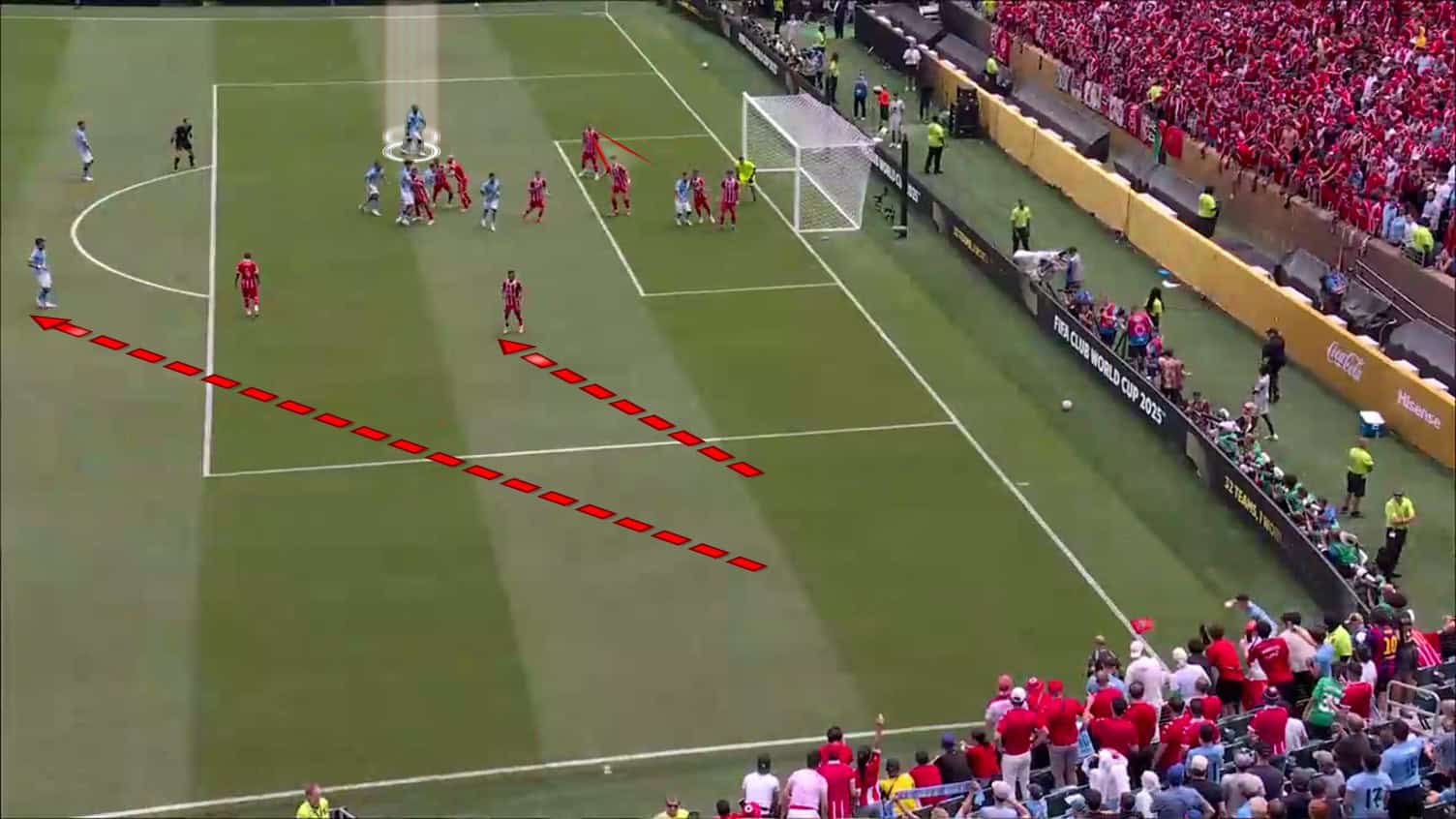
As shown below, the framer receives the passing cross, surprising the last zonal defender and scoring a goal.
Man City Tactics Against Zonal Marking
As we did with man-marking defending systems, we will explore the common principles and ideas they implemented against systems that depend more on zonal defenders.
As shown below, Al Hilal defend with six zonal defenders (red), three players in the second line (yellow) who wait in their zones and act as man markers to the closest runners from these zones and a player ready to defend short corners (blue).
This means that Man City always have the far runner free, and you can see Erling Haaland is free (white) while the same framer (Jérémy Doku) is free in the same position.
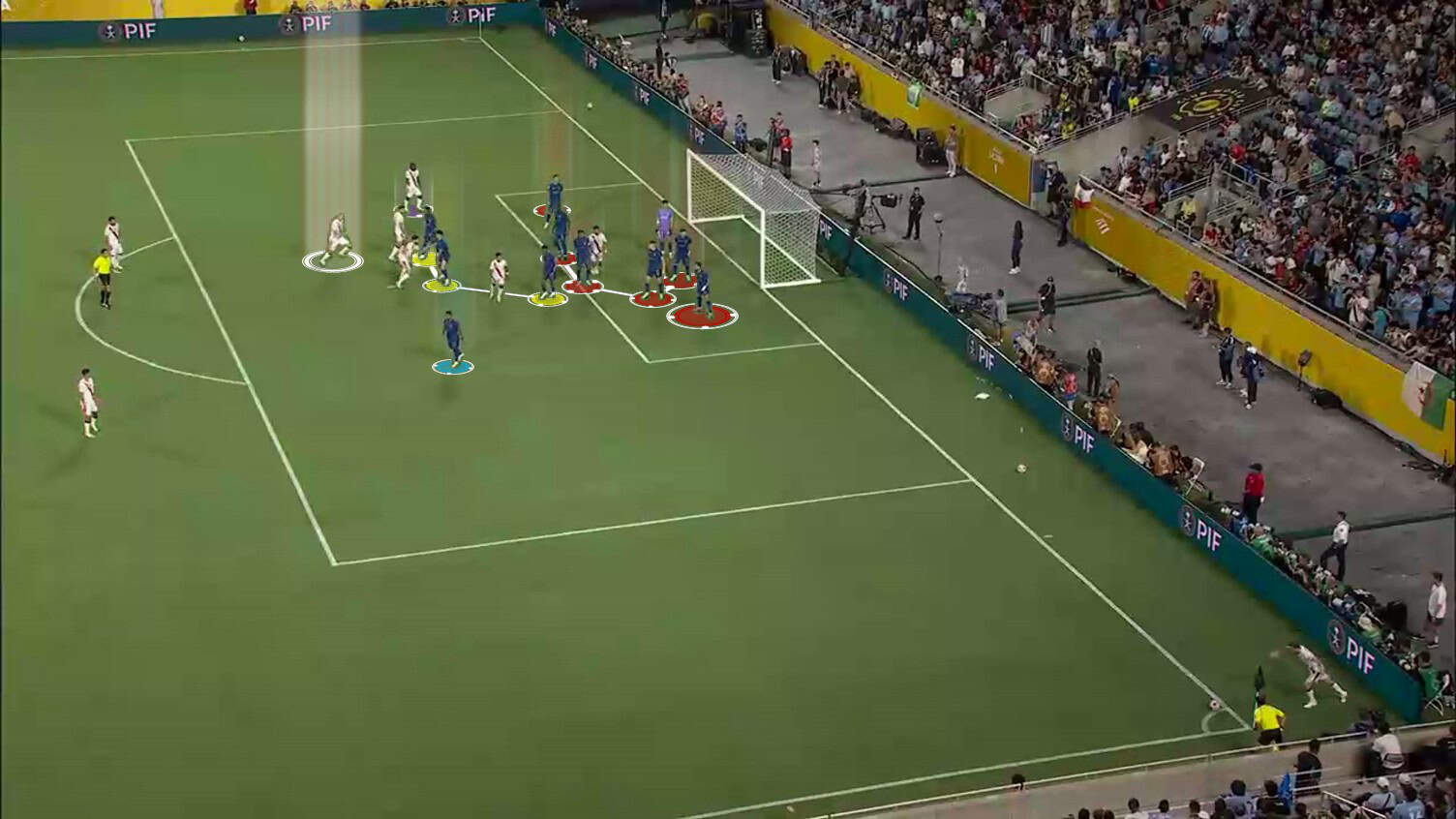
As shown below, Haaland (white) runs freely into the middle from this far position, which means he will exploit movement against the stationary zonal defender, creating a dynamic mismatch.
The other advantage Man City had came from Al Hilal’s decision to use the rebound defender as a man marker in the beginning (yellow).
His role is to block the runner there to reduce his dynamic advantage, but he will then leave him free to move to the edge of the box.
This means that two attackers are now free in the middle.
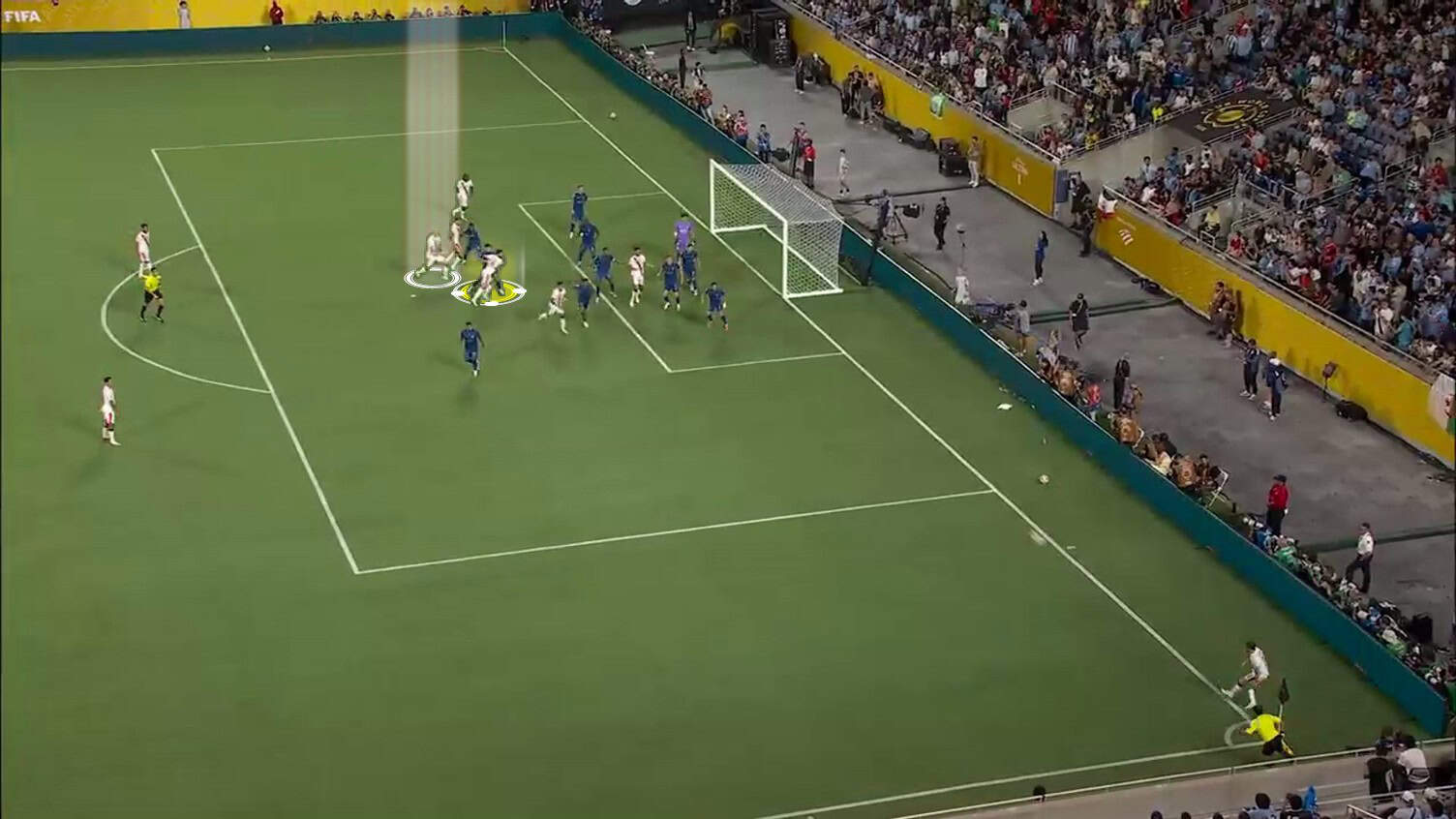
As shown below, the yellow markers leave their marker in the middle and start to move toward the edge of the box.
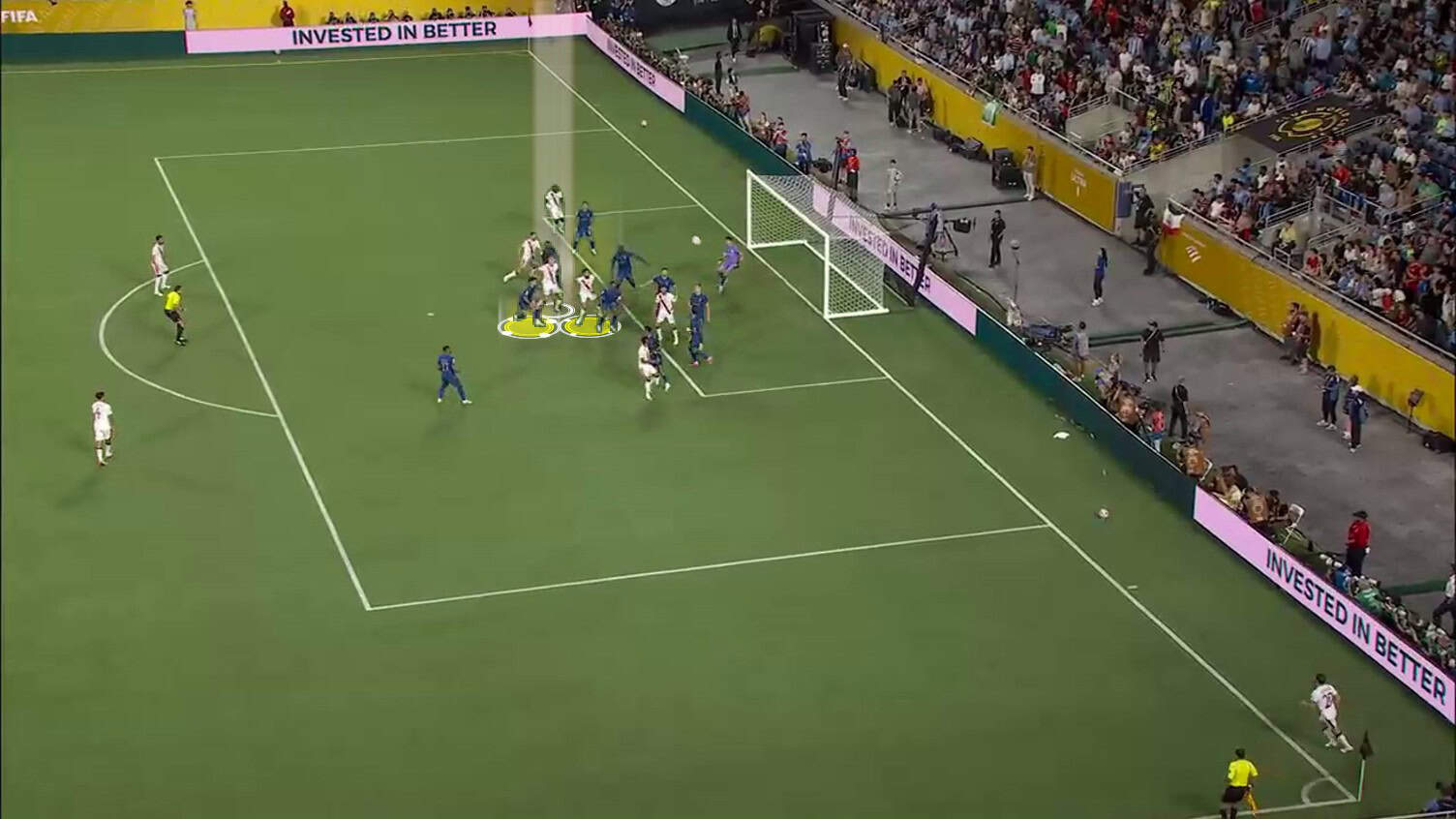
The result is clear below, which leads to a two-versus-one situation against the stationary zonal defender, resulting in a dangerous chance that is cleared by the goalkeeper (Yassine Bounou) to another corner in the end.
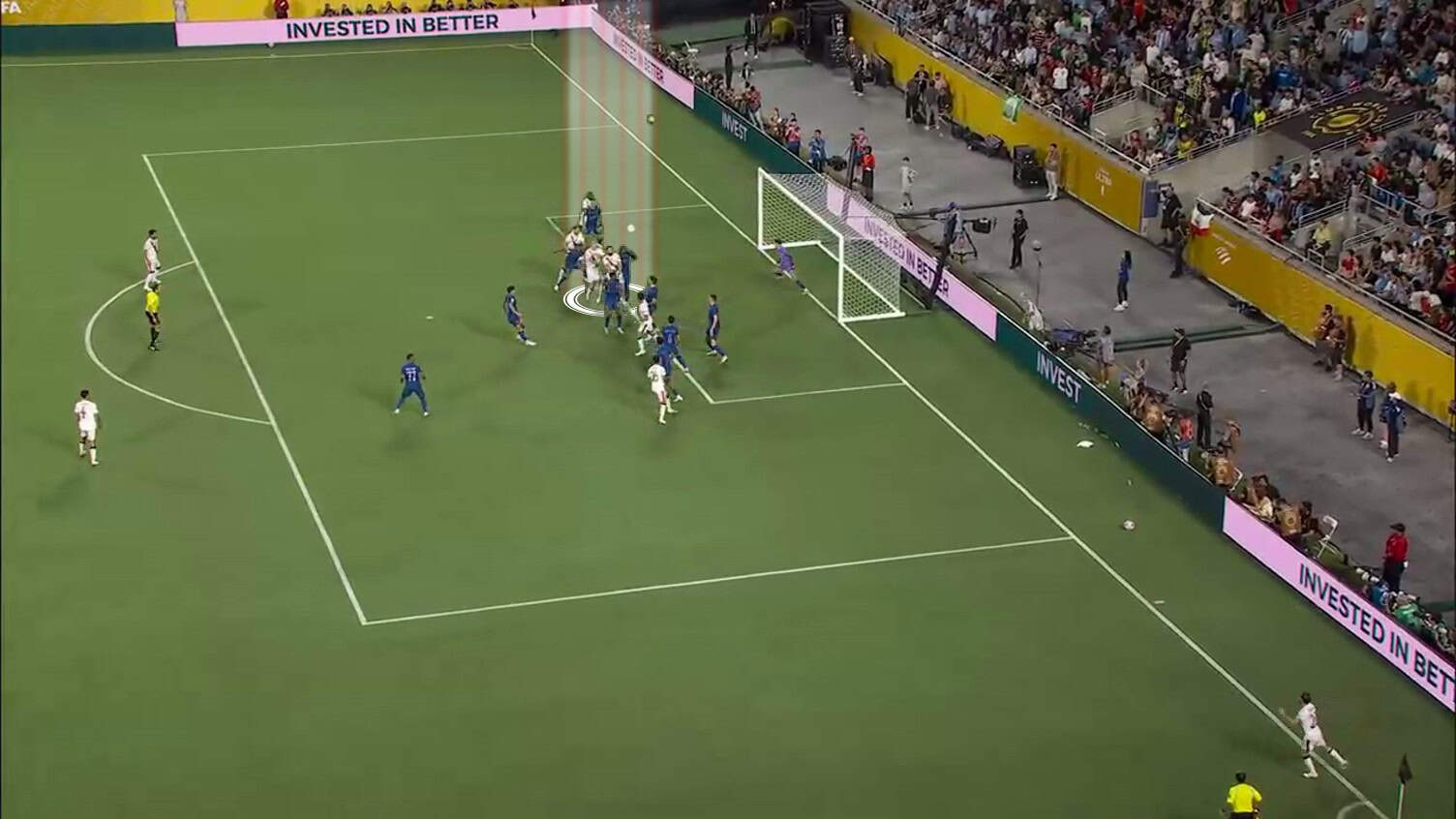
As shown below, Man City want to make it more difficult for these defenders on the second line, so they make three runners further, which means that the last defender has three runners now (numerical superiority)
This makes the targeted player easily move to the middle as well.
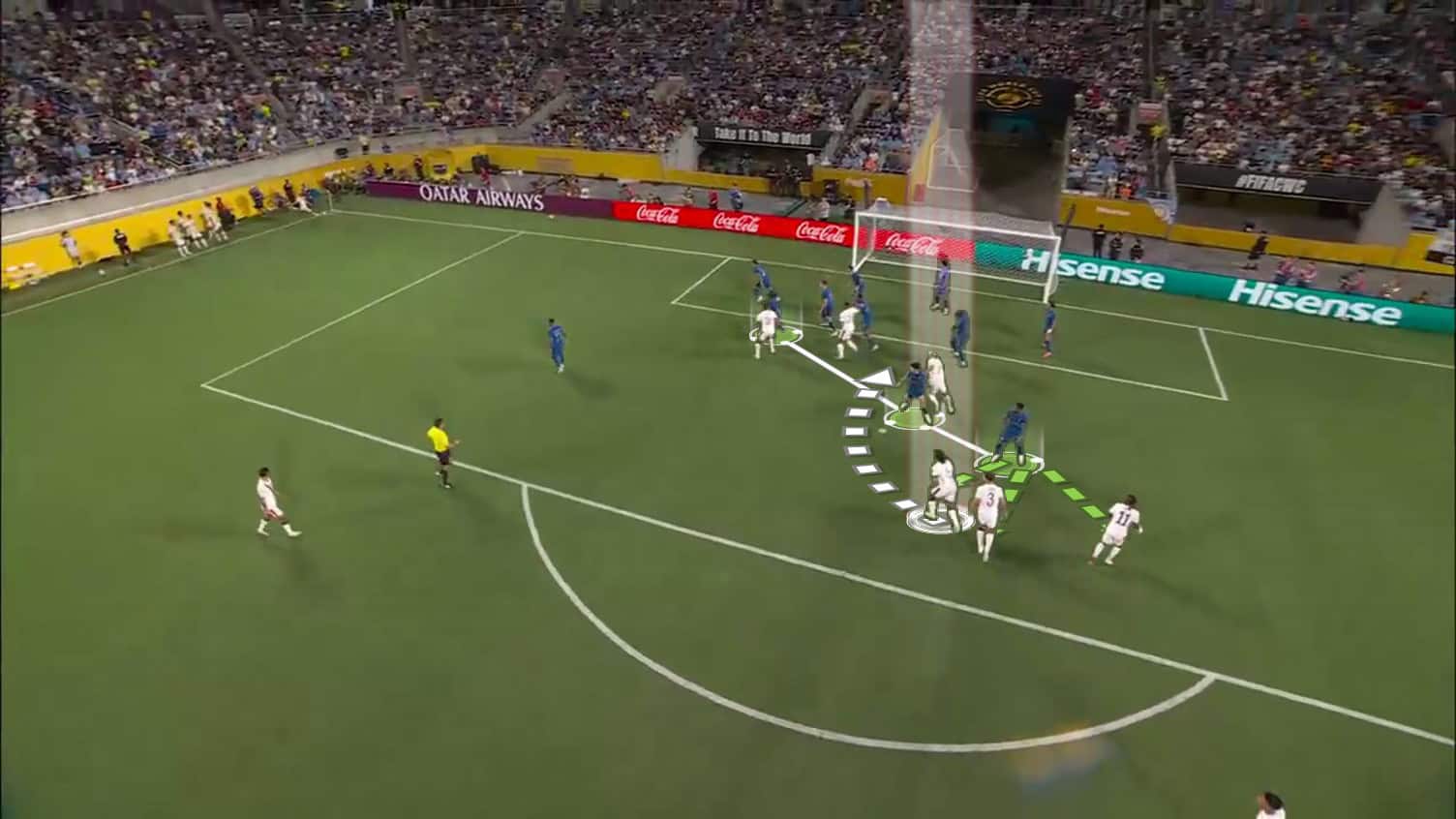
They didn’t have to ask the targeted player to start far and run, achieving dynamic superiority over the zonal line.
They could underload the middle area near the penalty spot, far away from the zonal line.
As shown below, two runners approach the near post, while a player stands on the far post, leaving the second line empty in the middle near the penalty spot for a free player.
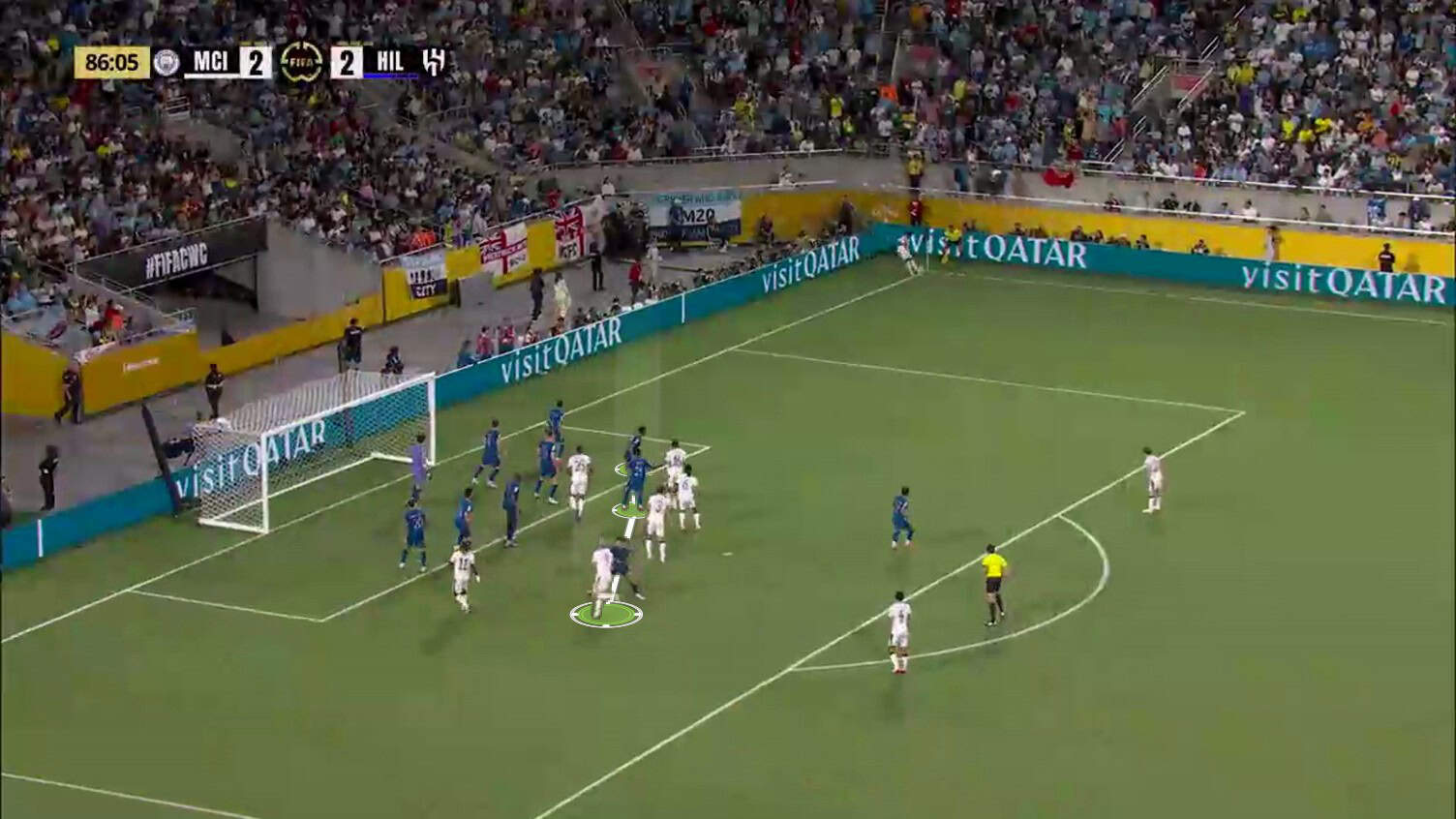
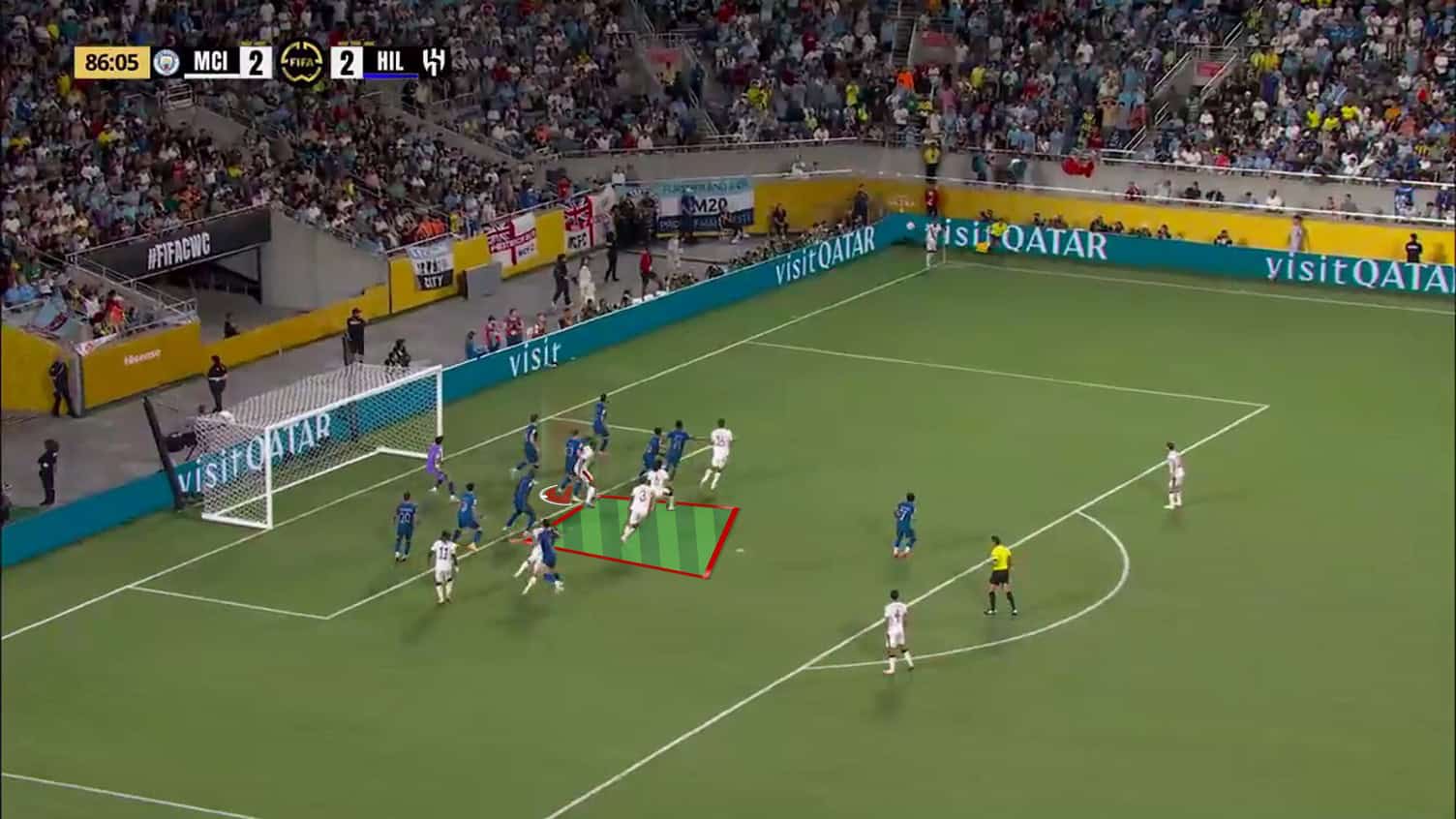
As shown below, they also want to ensure that the closest zonal defender won’t move out of his position to chase the ball, so they use a player (Manuel Akanji in red) starting near the six-yard line to block the closest zonal defender to the targeted area.
Conclusion
In this analysis, we aimed to highlight the most significant features that emerged in Man City’s attacking corners during the previous FIFA Club World Cup tournament and how they may provide insight into the future tactics of the new set-piece coach, James French.
Although the coach hasn’t had enough time yet—and will undoubtedly work on new ideas and further develop his philosophy—we can still deduce some of his fundamental principles against different defensive systems, whether man-to-man or zonal marking.
