
Ulm is a relatively small city located in southern Germany.
It’s not really famous, but its cathedral, the Ulmer Münster, is the highest church in the entire world, and that’s pretty much the only thing interesting about Ulm to most people.
However, in the football world, Ulm is famous for something else.
In the late 90s, after struggling to get promoted to the 2. Bundesliga, the club hired a young, local manager whose ideas were very different from the rest of the coaches in Germany at that point in time.
Playing with a back-four? Zone coverage? Pressing?
People didn’t really understand what SSV Ulm 1846 did, but it got them promoted, and they even led the 2. Bundesliga at the halfway point of their first season there.
The young manager was invited to appear on public television to explain his ideas to the entire football nation, with a broad audience watching.
The name of this young manager: Ralf Rangnick.
This was the birthplace of modern German football, and to this day, these ideas continue to inspire coaches like Jürgen Klopp, Thomas Tuchel, and Julian Nagelsmann.
After Rangnick left Ulm, the club began to struggle significantly and faced multiple relegations and even bankruptcy on several occasions.
However, in the late 2010s, SSV Ulm 1846 underwent a management change and was reborn, being promoted from the fifth division back to the fourth level of play, the Regionalliga.
Then, in 2021, they made a genius move and hired Thomas Wörle as their new head coach.
Wörle was the coach of Bayern Munich women’s team for nine years and was incredibly successful there.
He managed to take over the club and got them promoted to 3. Liga in convincing fashion in his second season, going on to win the league in their first year after promotion and getting back to the 2. Bundesliga after 23 years.
In this Thomas Wörle tactical analysis, we will provide an analysis of the struggles SSV Ulm 1846 face at their new level of play and how head coach Thomas Wörle is trying to keep the team set up for success via his tactics as he did in these last three years at the helm.
Thomas Wörle Formation / Players Used
Thomas Wörle has used multiple formations at the beginning of his tenure in Ulm and found out that for his style of play, a 3-4-3 formation works the best.
In the last two seasons, SSV Ulm has primarily played in their 3-4-3 formation, and the team has not undergone drastic changes over the past two years.
Christian Ortag plays in goal for Ulm after only managing 70 clean sheets in 148 appearances for the club.
The back three consists of the three players who were promoted to those positions with Ulm last season: Tom Gaal plays as the right centre-back, captain Jo Reichert plays as the central defender, and Philipp Strompf plays as the left centre-back.
In midfield, Max Brandt and experienced Philipp Maier are the starters in the double-pivot formation Thomas Wörle prefers, with Maier playing a more defensive role as a holding midfielder and Brandt operating in a box-to-box position.
The left wing-back is Romario Rösch, named after the famous Brazilian attacker. The former winger is complemented on the right side by Bastian Allgeier, a more defensive player who played for Karlsruher SC at the youth level.
The three-man attack features a big target man, Felix Higl, up front, flanked by Dennis Chessa and the young Bayern Munich loanee Maurice Krattenmacher, as part of a double-attacking midfield behind the lone striker.
While the players may not seem that interesting, there is something standing out about the lineup Wörle uses with SSV Ulm: Out of the 11 players in his starting XI, six are taller than 1.90m, and not a single one is smaller than 1.80m — the club pretty obviously prioritises size and physicality in his signings.
Replacing Léo Scienza
While there were not many changes in Ulm’s starting lineup in the first games after promotion, there has been one major change compared to last season: Léo Scienza is no longer at the club.
The Brazilian was signed by SSV Ulm on a free transfer after getting promoted to 3. Liga from Magdeburg was instantly the best player on the team.
Scienza had a slow start to his season but came into his own after scoring his first goal on matchday five at home against Lübeck.
This goal opened the floodgates for 12 goals and 15 assists in the following 28 games.
Léo Scienza Stats
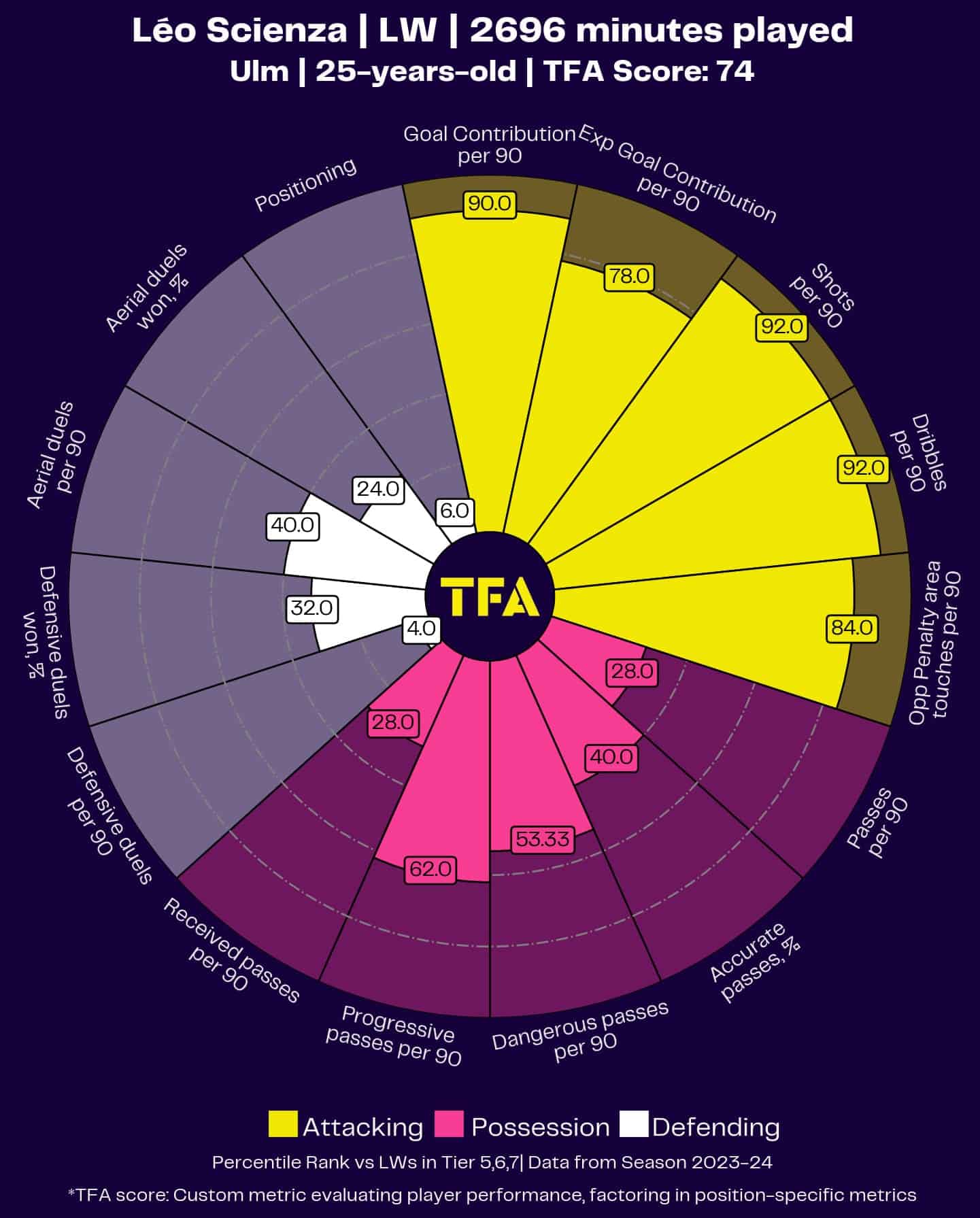
As seen in the chart above, Scienza ranked in the top 10% of goal contributions against comparable players.
His creativity, particularly in his set pieces, created numerous scoring chances for SSV Ulm last season.
His dribbling ability was an X-factor for Wörles men as well, ranking in the 92nd percentile of dribbles per 90 minutes, creating holes in the defence and opportunities for himself and his teammates.
After a great season in 3. Liga, Bundesliga side 1. FC Heidenheim acted swiftly and triggered the release clause in Scienza’s contract, allowing them to sign the attacking midfielder for the upcoming Bundesliga season.
While the money coming in was nice for Ulm, with Scienza being their second-largest sale of all time, the loss in quality, to be expected after the loss of their star player, was immense.
Ulm decided to take a very unusual approach to replacing Scienza, signing 19-year-old starlet Maurice Krattenmacher on loan after his move to FC Bayern.
The German U19 international played for Unterhaching in 3. Liga last season, scoring one goal and providing seven assists at just 18 years of age.
Krattenmacher has demonstrated a great deal of talent during his career so far and will now take the next step to prove himself in professional football in a very tough league with Ulm.
Maurice Krattenmacher Stats
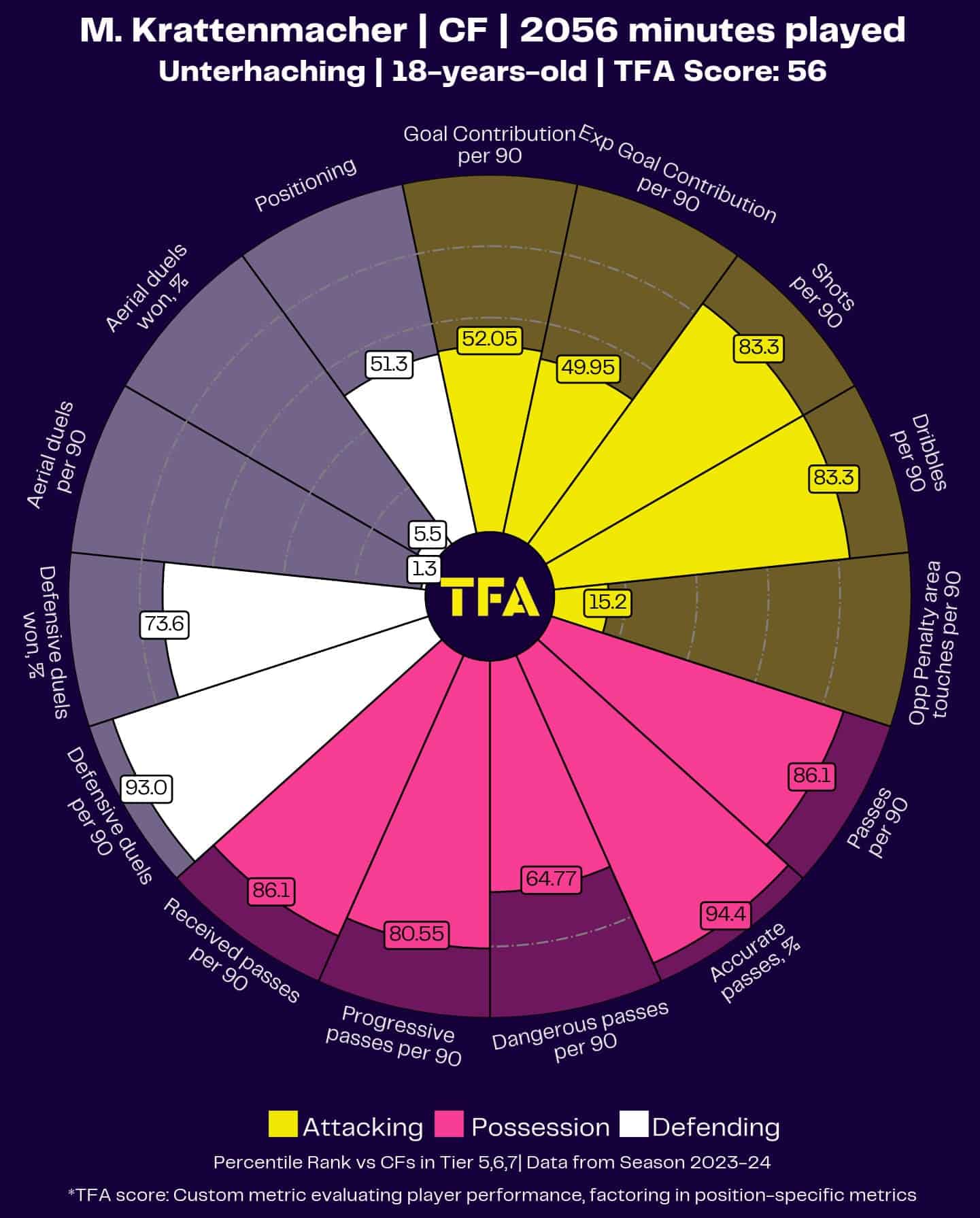
Krattenmacher is more of a typical number 10 compared to Scienza, with a higher focus on his passing game as a playmaker.
While his dribbling is lacking compared to Scienza, he is way more proficient in finding solutions with quick passes.
Another big positive that Ulm gets from the young attacker is his two-footedness.
Krattenmacher has no weaker foot and is constantly able to create opportunities from either side and out of every single situation imaginable.
However, he is obviously just 19 years of age. Scienza was the most essential part of Thomas Wörle’s success last season, creating by far the most goal-scoring opportunities for the team during the season.
Krattenmacher has big shoes to fill at a young age, coming into a league he has never played in before.
It will be interesting to see how the talented attacking midfielder handles the pressure and develops throughout the season.
Ulm will definitely need him to become a reliable option rather quickly.
Ulm’s Risky Defence
Looking back at Ulm’s last couple of successful seasons, one thing stands out the most: Their defence.
Ulm has been one of the best teams in the country when it comes to defending.
As a newcomer to the league, they conceded only 38 goals in 38 games last season, the fewest of all 20 teams.
Ulm’s defensive stability and proficiency do not stem from parking the bus, as some teams tend to do after being promoted.
Thomas Wörle did an exceptional job of making his team one of the most aggressive and defensively forward-thinking teams in the league last season.
This trend continues this season; Ulm try to attack upfront and force their opponents into very intense duels all over the field.
This also shows up on the stat sheet; after the first two games, their challenge intensity of 7.6 led all teams in the 2. Bundesliga.
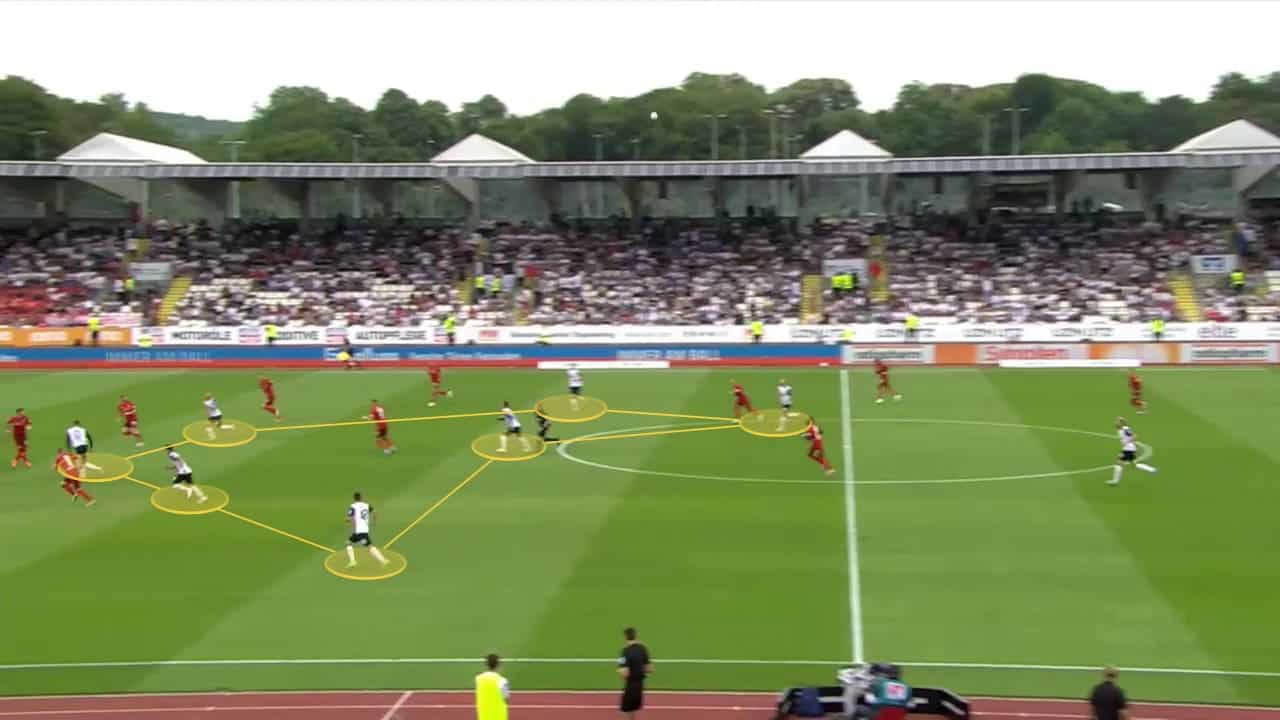
Here, we can see Ulm moving forward in their 3-4-3 shape after a long ball, trying to apply pressure quickly.
In this situation, however, they struggle with tracking the ball, and Kaiserslautern is able to pass it to their holding midfielder, who plays a long ball towards goal.
Here, we can see that Ulm’s approach led to a big problem: Their three centre-backs are now in a 3v3 with the Kaiserslautern attackers able to move towards goal.
Wörle doesn’t want his defenders to stand back in these situations; he wants them to attack the ball aggressively.
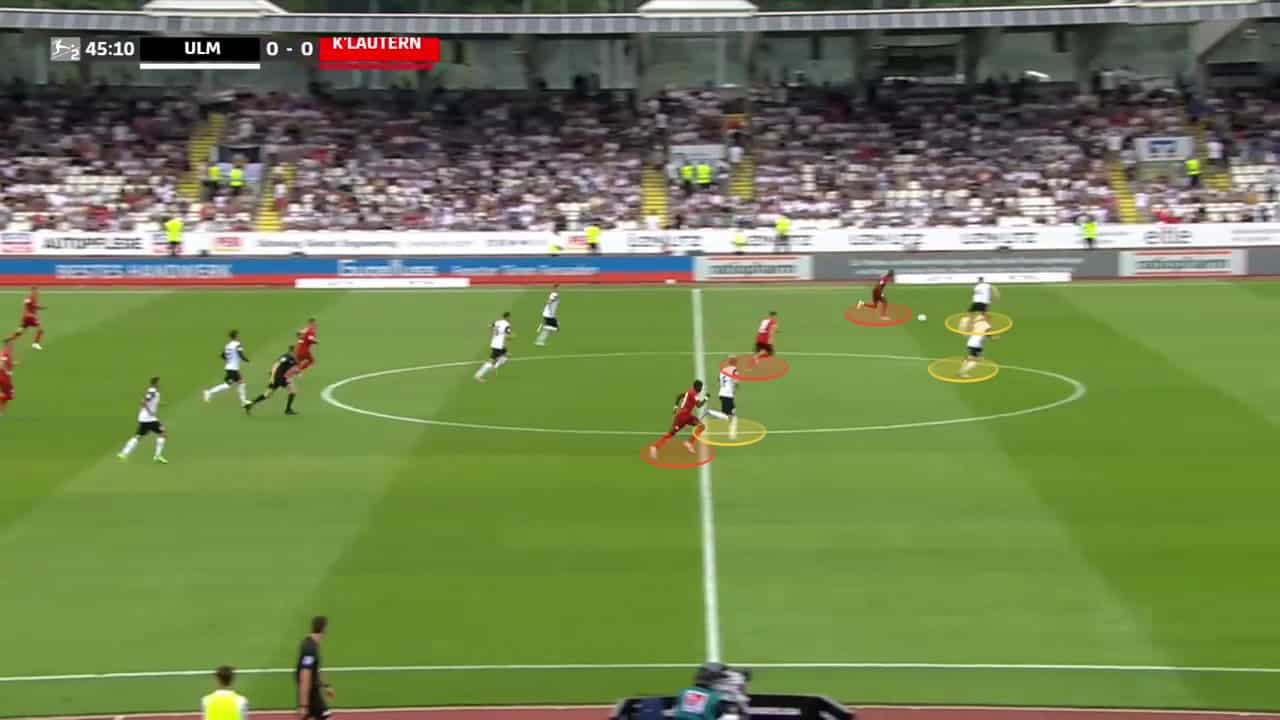
Here, Gaal tries to attack Opoku but is forced into a sprint duel against the rapid winger, standing no chance to recover the ball and resulting in an excellent opportunity for Kaiserslauter.
Overall, Ulm’s three centre-halves are rather slow, and if they are caught on the counter, as in this case, Ulm has struggled to get back behind the ball this season.
These problems are caused by their positional play with the ball, focusing on counterpressing.
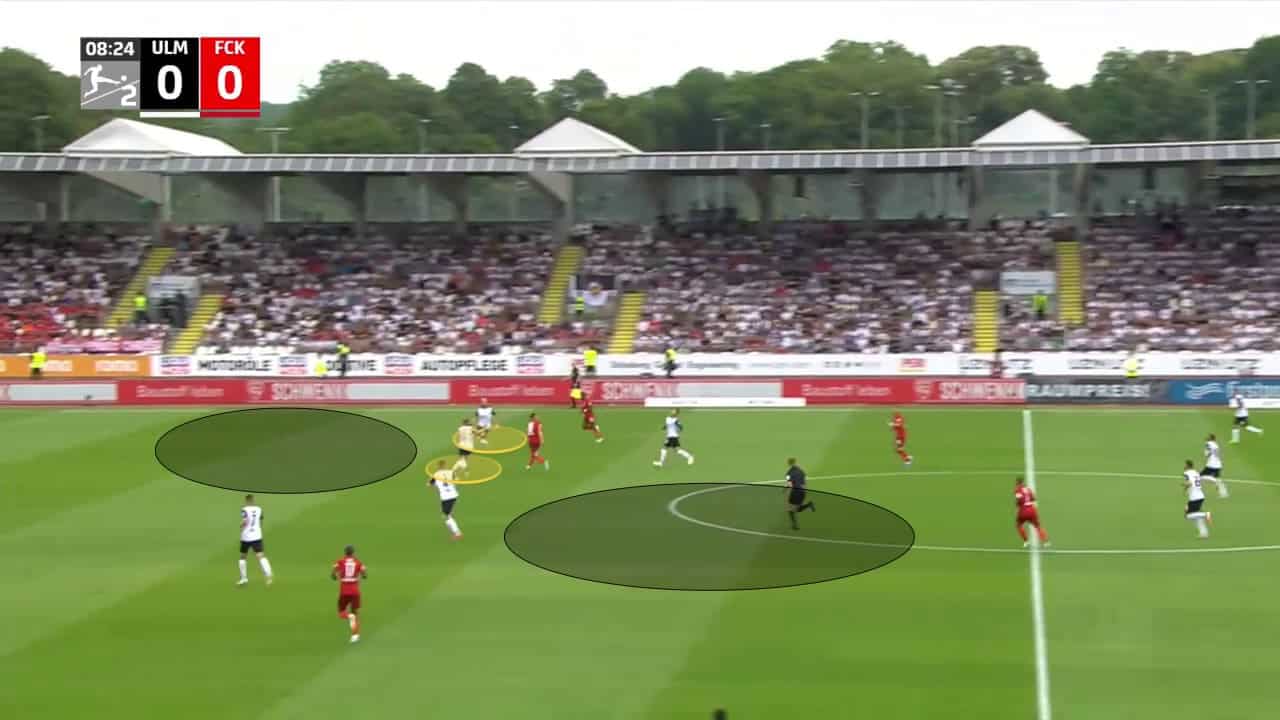
Here, we can see that only the right-back, Allgeier, and one midfielder are still tracking back, with the other part of the double pivot and the left-back, Romario Rösch, pushing up the field.
This forces the defenders to step up into that space to prevent the opposing team from controlling the ball there, leading to quick snapshot decisions.
Here, there is a huge miscommunication between the captain Reichert and Strompf, with both moving forward into the ball and no centre-back-dropping back, vacating even more space behind the left side of the last line of defence.
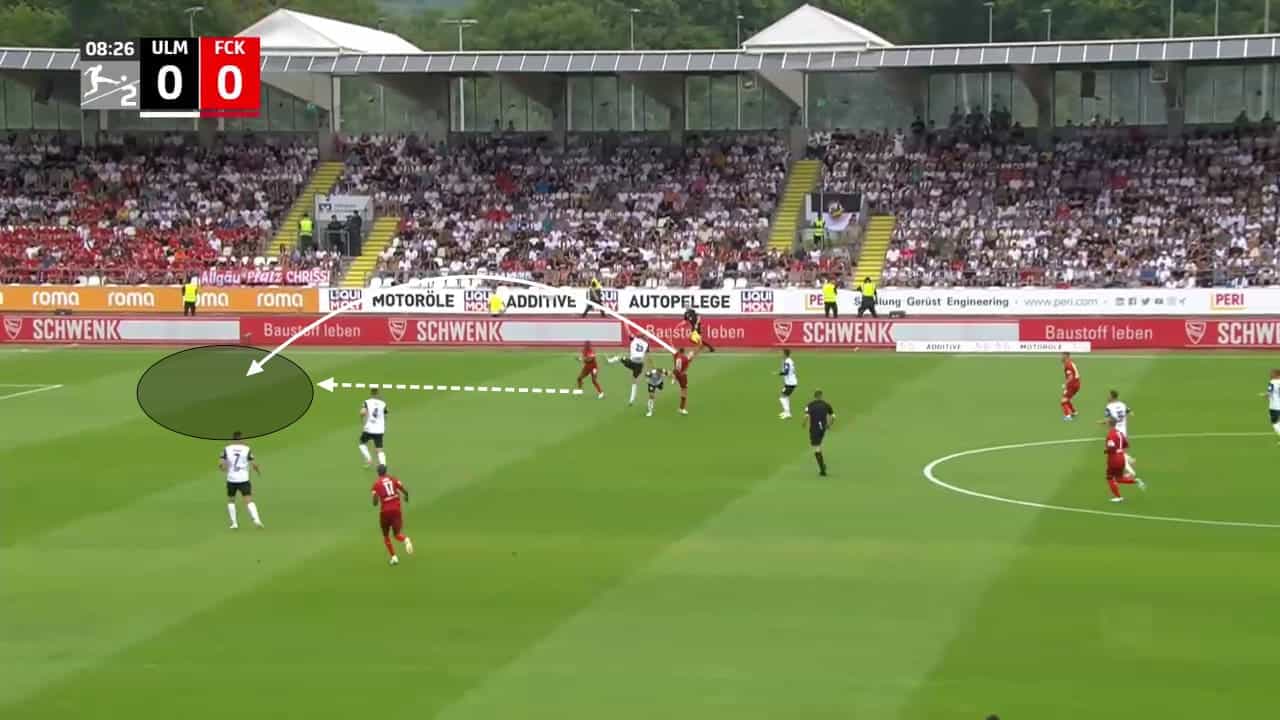
Even though they try to win the header with two people, Kaiserslautern win the aerial duel and heads the ball on right into the vacated space, leading to an easy cross and a good scoring opportunity.
Ulm need to do better in these situations, not forcing their centre-backs into bad situations for them.
Wörle needs to find a solution so his defenders are not always isolated and forced to move forward into the space the midfielders should be able to cover.
Intriguing Build-Up
If we are looking at what Ulm are doing with the ball, the start to the season looks kind of weird for Thomas Wörle’s men.
Firstly, as a freshly promoted team, Ulm currently sit at 53.6% of ball possession, the fourth-highest value in the entire league.
Secondly, even though they have a lot of possession, Ulm have played the second fewest passes during those two games and have not been exceptionally accurate, with a success rate of 79.6%.
Still, Wörle has given his team a lot of solutions at hand to progress the ball in their build-up play, and it’s showing on the pitch.
Ulm are one of the teams refusing to build up through long balls in the 2. Bundesliga, playing the fewest of those passes during the first two games.
Here we can see Ulm’s structure in build-up.
The back three is trying to receive the ball from the keeper Ortag, while one midfielder, the wing-backs, and one midfielder are pushing up the field, and one midfielder is dropping back to give another passing option as well.
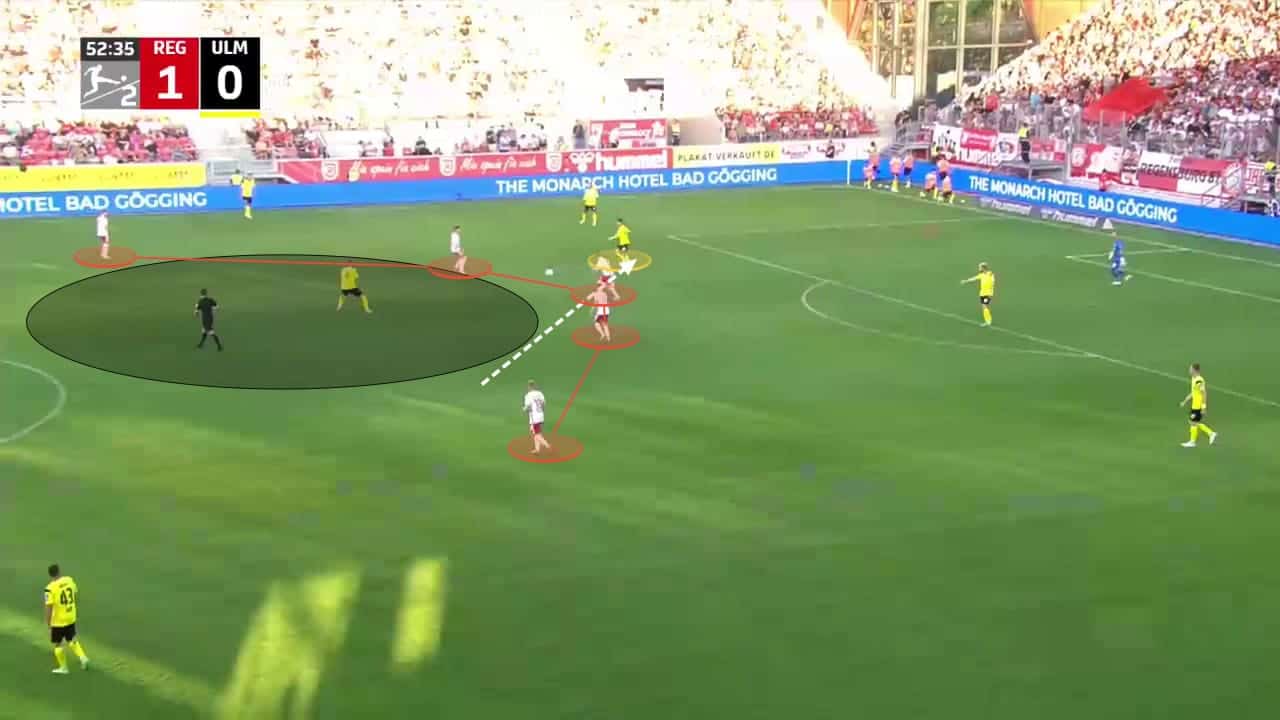
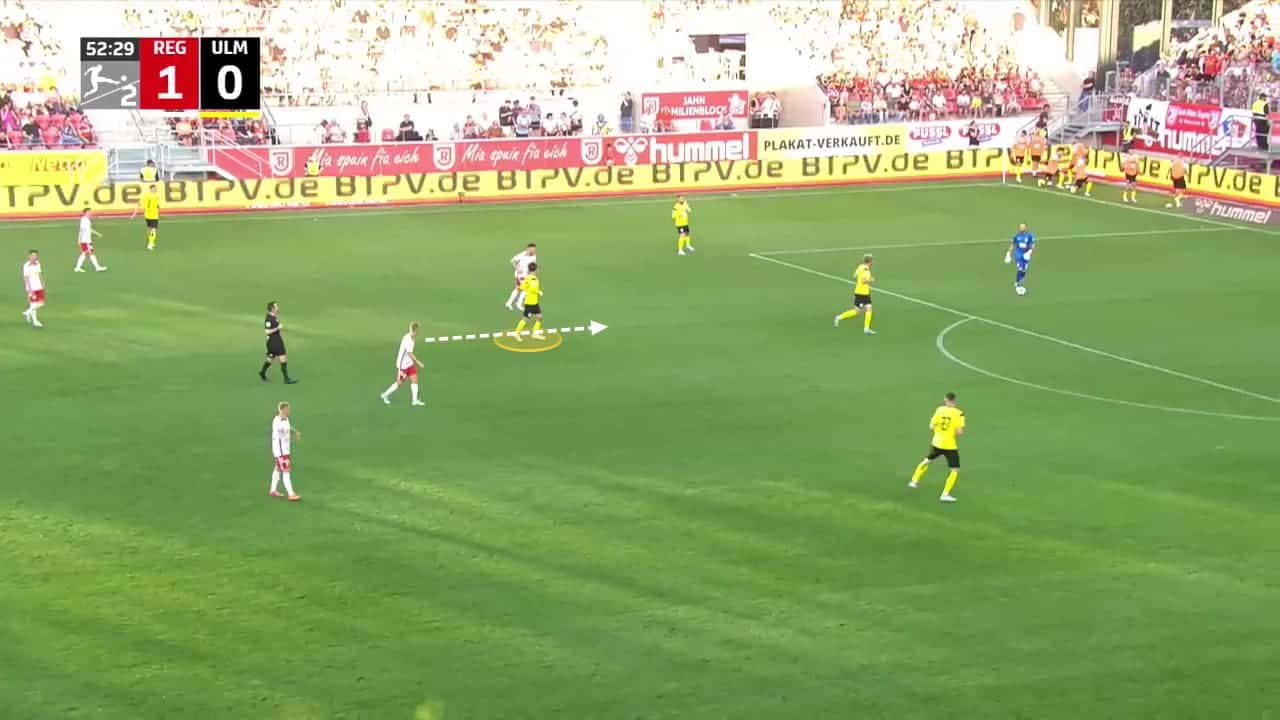
Here, Max Brand is coming to receive a short pass.
He makes a run back into the last line, dragging the first pressing line of Jahn Regensburg with him.
From there on, Ulm has multiple options.
They can simply play short passes between themselves because they are in a very broad formation and have the numerical advantage in their line.
However, Brandt turns with the ball, and because he dragged the Regensburg players with him, there is a lot of space right behind the first line of pressing, where Maier is able to receive the ball and turn towards goal quickly without any interference.
This type of situation occurs quite frequently; Ulm is very good at luring teams out of their defensive formations and drawing the press right where they want to be pressured, allowing them to progress the ball through the middle of the field.
Thomas Wörle’s game plan is not one-dimensional; however, if Ulm can not progress the ball through the centre of the field, they are also great at building up out of the half spaces with their wide centre-backs.
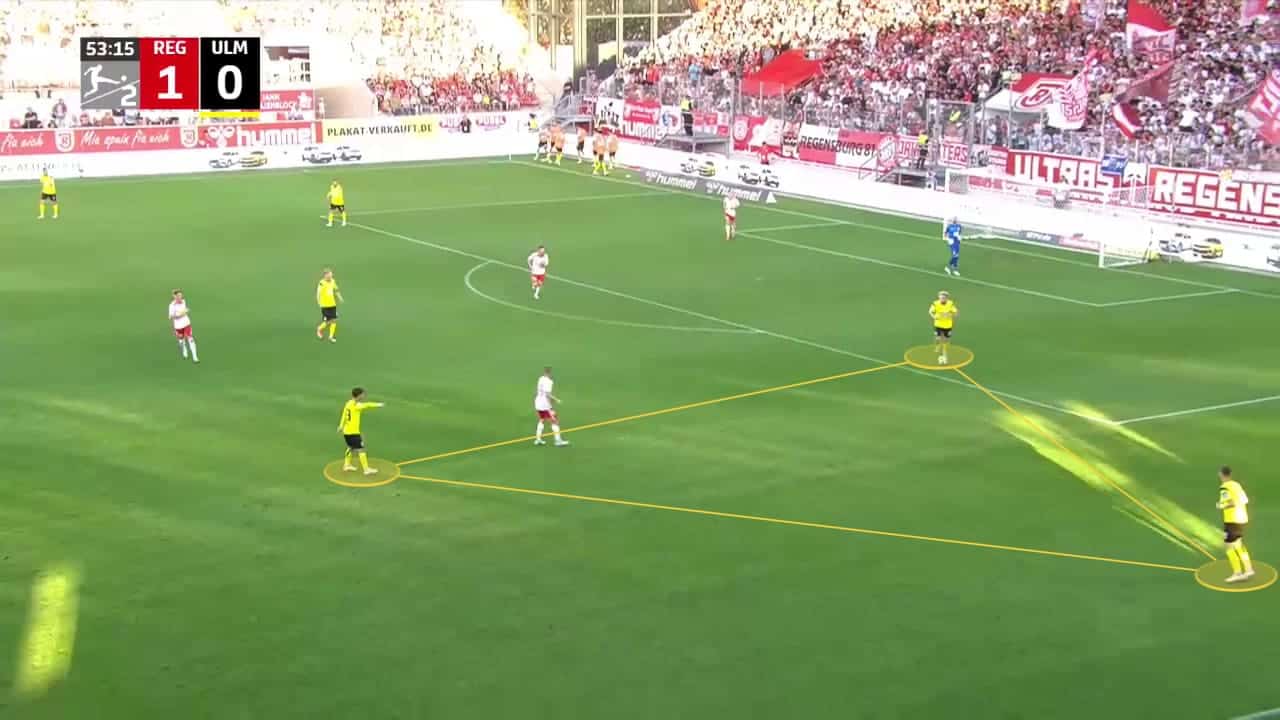
Here, Ortag switched play out to Strompf, who was playing in the middle of the back three.
From there on, Ulm forms a triangle on the left side of the field with Max Brandt and left-centre-half Niklas Kolbe.
Regensburg is not able to trigger their press there, which means that Kolbe is able to carry the ball towards the opposing half in this situation.
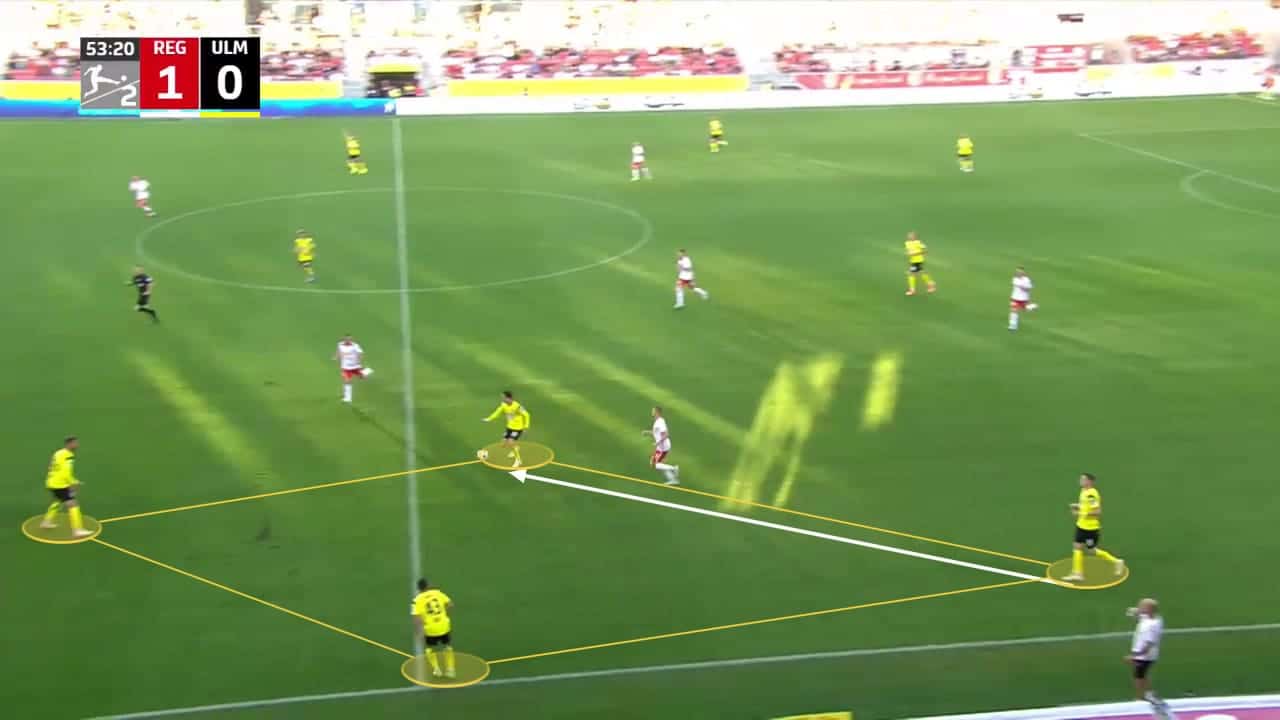
From there on, Ulm form a diamond tactic on the wing to give Kolbe multiple passing options again.
Kolbe decides to play the ball to Max Brandt, who turns towards the goal with his first touch and, from there on, has two more options in the diamond to pass to.
If we look at the other side of the field, there is one Ulm player wide open in the middle of the pitch, as well as on the far right-hand side. This means the team even has the option to switch play after their overload of the left side.
Conclusion
The start to the season hasn’t been kind to SSV Ulm and Thomas Wörle.
After three years of only being on an upward trajectory, they are now facing a different level of play and are struggling to adapt, having lost both of their games so far this season.
Wörle is in a tough spot right now because the two main reasons for his latest success have been Léo Scienza and Ulm’s great defence.
However, both of these things are now part of the problem Ulm is facing.
There is no realistic way to replace a player like Scienza for a team like SSV Ulm, but Maurice Krattenmacher has shown flashes of great potential, and it will be one of Wörles most important tasks to help the development of the 19-year-old starlet to find success in the 2. Bundesliga.
There are also many positive aspects for Ulm.
Their build-up play looks very interesting, and overall, they have not looked like an incompetent team; they just have struggled defensively with their aggressive approach.
SSV Ulm and Thomas Wörle have punched way above their weight for the last couple of seasons, and now they are facing a harsh challenge.
However, they are not backing down and are keeping their line and style of play, which made them one of the most enjoyable teams during these seasons.
From now on, Ulm needs to focus on making that approach work for them, with their first opportunity being the game against FC Bayern in the DFB-Pokal.
