
Arsenal’s possession-dominant 4-3-3 generates chances at an elite rate while occasionally lacking the one profile capable of converting them without fuss. Erling Haaland is that profile, and reports over the weekend claimed Arsenal and Real Madrid had made contact with his camp over a possible 2027 move, a story that surfaced in the immediate aftermath of Manchester City’s guilty verdict on 114 of the 115 Premier League financial charges against them. Arsenal and Haaland’s representatives have since denied any contact took place, no formal offer exists, and the striker remains under contract at City until 2034. What follows treats the reported approach as a conditional premise rather than confirmed business, and asks a narrower question: if Mikel Arteta ever did have Haaland at his disposal, how would the Norwegian’s off-ball profile actually reshape Arsenal’s attacking structure?
Arsenal’s 4-3-3 and the Structural Fit
Arteta’s system is built on control rather than chaos: a possession-dominant 4-3-3 that emphasises rest-defence shape and control. In the final third, the structure is deliberately asymmetric. Bukayo Saka holds width on the right and repeatedly isolates opposition full-backs in one-versus-one situations, while the left winger tucks into the half-space to create local overloads, and the two No.8s time late runs into the box to arrive as the ball does.
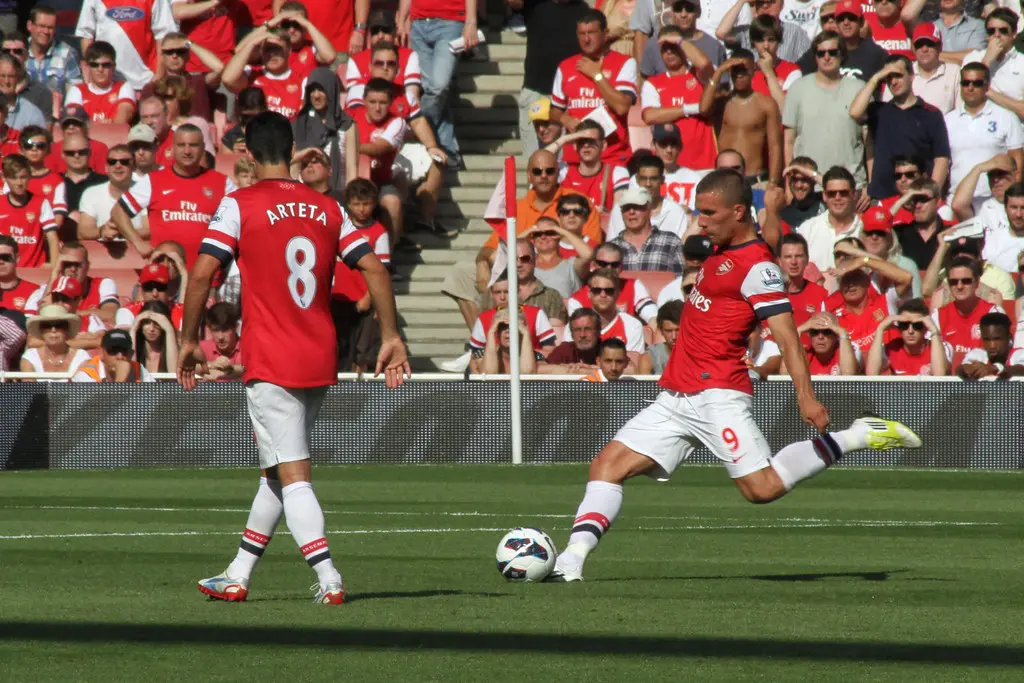
It is a shape engineered to manufacture half-chances in volume, and the underlying numbers it produces have long been among the best in the league. What it has occasionally lacked, even as reigning champions sitting three points behind City after five games this season with 33 fixtures still to play, is a fixed central presence sharp enough to turn that volume into inevitability rather than merely very good conversion.
The Central Upgrade: From Fluid Front Three to Fixed Reference
Haaland’s game is built on economy of touch rather than volume of involvement. He lives on the last shoulder of the last defender, takes a handful of touches per fixture, and turns a disproportionate share of them into goals – seven in his first seven games of the current season, on the back of 169 goals in 205 City appearances. Dropped into Arteta’s system, that profile does not compete with the existing rotation so much as complete it.
A fixed Haaland reference point pins both opposition centre-backs to the width of the six-yard box, which does two things Arsenal’s current fluid front three cannot reliably do on its own. It opens the cutback lane for Saka arriving from the right, and it clears the central channel for the late No.8 runs that Arsenal’s structure already generates but sometimes finds crowded out. The tactical point is broader than any one player. For related reading, see Martin Ødegaard’s advanced positioning. A striker who occupies both centre-backs rather than dropping short leaves central space for arriving midfielders.
The knock-on effects extend beyond the penalty box. Title races are typically decided by the eight or nine matches where a single moment separates two sides chasing the same points, and Haaland has built a career on supplying exactly that moment – the near-post dart, the aerial duel won through sheer physical menace, the penalty earned rather than requested. He would also hand Arsenal a legitimate long out-ball: when a press is broken or an opponent’s block sits too high, the diagonal in behind stops being a hopeful punt and becomes a weapon, because there is a target at the end of it capable of winning the first contact and keeping the rest-defence shape intact behind him.
The Pressing Trade-Off
None of this arrives free of cost, and the cost is structural rather than cosmetic. Haaland does not press with the intensity Arsenal currently demand from their front line; his energy is conserved almost entirely for actions inside or around the penalty box. At City, both Pep Guardiola and Enzo Maresca built an entire counter-pressing framework designed to protect that trade-off, funnelling opponents away from Haaland’s zone and into traps set by the players around him.
Arsenal’s press, by contrast, is more collective and more aggressive from the front, with the front three expected to initiate rather than simply screen passing lanes. Fitting Haaland into that structure would require Arteta to accept the same compromise City long ago made: the other ten outfield players absorb a greater share of the pressing workload, while the No.9 conserves his output for the moment it actually matters. Given the scale of what City received in return – 169 goals in 205 appearances – it is a trade most coaches would take without much deliberation, but it is not a trade Arsenal’s current pressing identity is built to make automatically. It would need deliberate recalibration, not an assumption that Haaland simply slots into the existing front-foot scheme.
The Transfer’s Practical Limits
Set against that tactical logic is a set of practical obstacles that remain, for now, close to insurmountable. Haaland is contracted to City until 2034 with no relegation clause reported in the deal, meaning even a severe sanction would not create an automatic escape route. Any fee would likely need to clear £200m by a wide margin, against reported wages of roughly £500,000 per week that sit well outside Arsenal’s current wage structure. Real Madrid have already made contact according to the same reporting, Barcelona’s interest reportedly predates the verdict entirely, and City’s own appeal against the commission’s finding could yet soften the punishment enough to make the entire scenario redundant.
Analytical Verdict: A Transformative Fit, an Improbable Transfer
Tactically, the case is cleaner than the scepticism around the story suggests. Arteta’s 4-3-3 is a chance-creation mechanism that has spent two seasons searching for a finisher ruthless enough to match its underlying output, and Haaland is precisely that profile. The pressing compromise is real, but it is the same compromise City successfully absorbed, and Arsenal’s collective pressing structure is arguably well-equipped to redistribute the workload if Arteta chose to build around it.
The more likely outcome remains that this stays speculation: Fabrizio Romano’s own reporting indicates Arsenal are content with their current strikers while continuing to monitor the market for 2027, and Haaland staying at City while the appeal process runs its course is the far more probable path. But the tactical thought experiment stands on its own terms – a possession-based 4-3-3 built on structure and control, finally paired with the purest penalty-box finisher of his generation, is not a stretch of the imagination. It is simply, for now, not a transfer.
