
The 2025/2026 campaign has brought with it a distinctly recalibrated version of Manchester City under Pep Guardiola.
After a disappointing 2024/2025 season, in which City failed to win a single trophy and only just managed to secure a place in the UEFA Champions League, Guardiola was forced into a period of tactical reflection.
His hallmark positional play, once unrivalled, appeared to lose its cutting edge, and with it came serious questions about his ability to reinvent a team that had so often set the benchmark for English and European football.
In response, Guardiola has subtly shifted his recruitment and tactical outlook.
The addition of players such as Tijjani Reijnders reflects a move away from the perpetual recycling of possession and towards individuals more comfortable carrying the ball directly through pressure.
This rebalancing act, prioritising transitional threat alongside positional stability, has already altered the rhythm of City’s game.
A prime example came in the 1-1 draw with Arsenal, where Guardiola’s side uncharacteristically conceded long spells of possession to Mikel Arteta’s men.
Instead of dictating every phase, City tailored their approach to the quality of the opposition, signalling a more pragmatic edge.
This Manchester City data analysis will delve into these adjustments in depth, examining how Guardiola’s recalibrated blueprint may shape Man City’s new era.
Pep Guardiola Tactical Evolution: Balancing Positional Play With Sharper Counterattacking Threat
Manchester City’s recalibration in 2025/2026 is most clearly reflected in their attacking profile, which highlights a delicate equilibrium between positional patience and explosive transitional play.
Manchester City Attacking Profile Under Pep Guardiola 2025/2026

Averaging 1.8 goals per game from an xG of 1.55, City are proving more clinical than the data suggests, an efficiency that underscores Guardiola’s willingness to rely less on sheer volume of chances and more on the quality of movement into dangerous areas.
With 10.2 shots per match but only 39.2% on target, the output appears modest by City’s usual standards, indicating a deliberate reorientation.
The team no longer seeks to suffocate opponents through ceaseless positional attacks but instead embraces more varied routes to goal.
City still generate 23.6 positional attacks per game, though only a quarter lead to shots, which marks a decline from the Guardiola archetype of recycling possession until defensive lines crack.
The counterattacking data is more revealing.
At 1.2 counters per match with a remarkable 100% conversion into shots, City’s transitions are now sharper, faster, and more ruthless.
This is precisely where the inclusion of ball carriers such as Tijjani Reijnders is beginning to redefine the side, offering verticality that complements the patient build-up.
The balance is further evident in crossing efficiency (28.9% accuracy from nine attempts) and offensive duels, where City contest 72 per game but succeed in only 38.3%.
This figure demonstrates their willingness to engage in riskier 1-v-1 scenarios to destabilise compact blocks.
Possession remains at 51.3%, a number that once would have been considered unthinkably low for Guardiola’s City.
It reflects a shift towards pragmatism, tailoring approaches to the opponent’s strength, as seen in the 1-1 draw with Arsenal.
This evolution suggests a City side willing to blend positional order with incisive chaos, a recalculated blueprint designed to withstand the tactical arms race of the Premier League.
Carriers As Catalysts: Tijjani Reijnders Leading Manchester City’s Progressive Edge
One of the most notable aspects of Manchester City’s recalibration in 2025/2026 has been the emphasis on ball carriers, players capable of breaking through opposition lines with direct forward running rather than relying on endless circulation.
Tijjani Reijnders has quickly established himself as the standout presence among the group.
In just five appearances, he has recorded 69 total carries covering 800.1 metres, with an average of 11.6 metres per carry, and crucially, 33 progressive carries accounting for 363.2 metres.
These numbers are not only high in volume but also tactically significant: they illustrate Guardiola’s intent to inject vertical momentum into City’s possession structure, creating faster connections between the middle third and the final third.
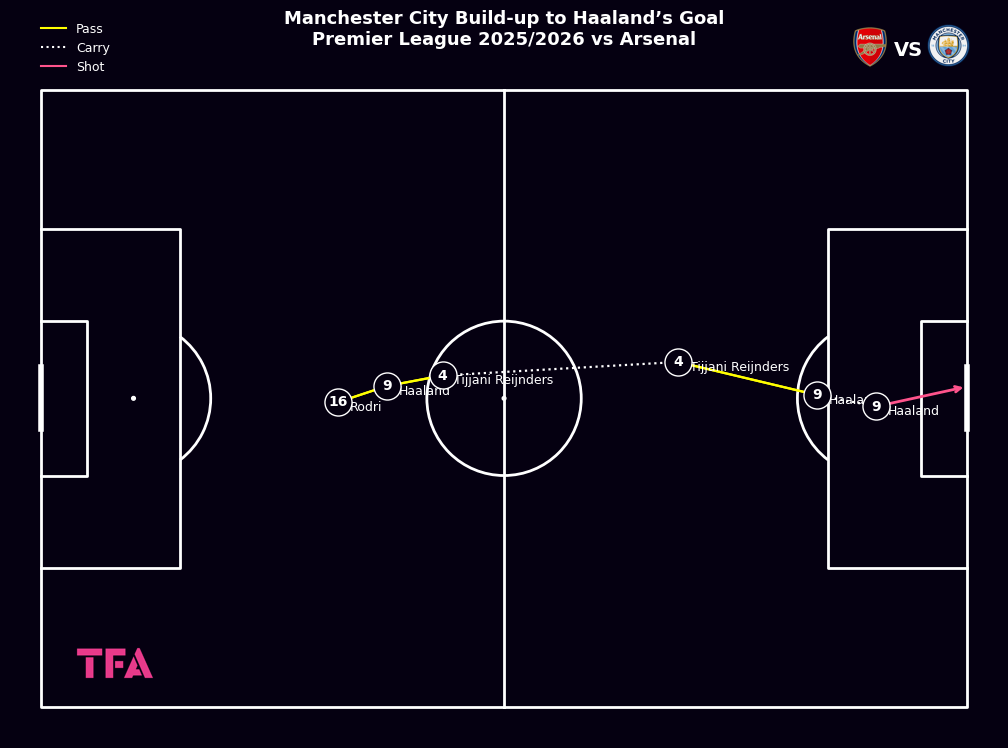
An embedded example is provided in the build-up to Erling Haaland’s goal against Arsenal.
Reijnders received a simple pass in his own half before surging forward into space, carrying the ball into the attacking third, and threading the decisive pass for Haaland to score.
Manchester City Build-Up To Haaland Goal Vs Arsenal
Alongside Reijnders, John Stones, in just five appearances, has also emerged as a valuable carrier from deeper zones, registering 58 total carries across 657.5 metres, with 24 progressive actions contributing 240.8 metres.
While his role is less advanced, his ability to step into midfield and progress possession highlights how Guardiola is diversifying sources of forward thrust.
Together, their contrasting profiles embody the tactical shift: Reijnders offers verticality through midfield drives, and Stones provides controlled advances from the back.
This dual dynamic signals a City side less rigidly wedded to sterile domination and more willing to use carriers as catalysts for transitional threat.
Ruthless Efficiency: Haaland & Manchester City Clinical Edge
If Guardiola’s Manchester City of 2025/2026 have recalibrated their tactical blueprint, then ruthless efficiency has become their sharpest weapon.
The numbers frame a striking picture: City average 1.8 goals per game from an expected goals tally of just 1.55, a clear sign of a side outperforming its underlying data.
Rather than overwhelming opponents with sheer shot volume, Guardiola has instilled a focus on quality.
Across the league, City take just over 10.2 shots per match, and only 39.2% are on target.
By conventional standards, this appears modest; by Guardiola’s standards, it is revolutionary.
What matters is not how many attempts are created but where and when they are taken, a recalibrated emphasis on precision over volume.
The defining factor behind this new ruthlessness is the imperious form of Erling Haaland.
His capacity to convert high-value chances has become the cornerstone of City’s attacking threat, perfectly aligned with Guardiola’s desire to exploit fewer but clearer openings.
Manchester City Shot Locations Vs Manchester United 2025/2026
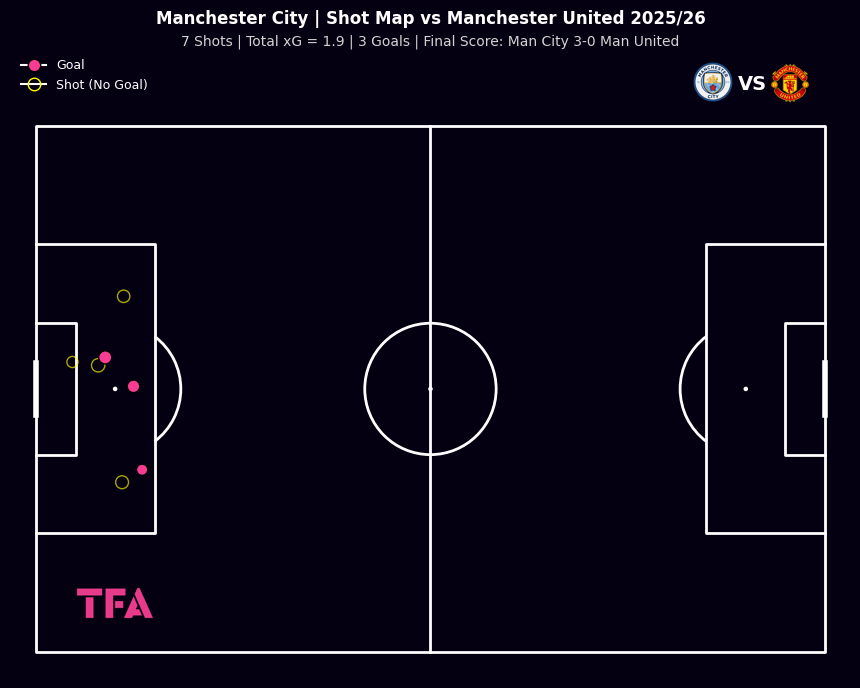
As shown above, the visual data reinforces this point. In the Manchester derby (2025/2026), City managed just seven shots, all from inside the penalty area, scoring three goals from a total xG of 1.9.
The image of Manchester City’s shot locations vs Manchester United encapsulates this efficiency: fewer shots, higher value, greater impact.
This streamlined approach is no accident; Guardiola is tailoring his system to Haaland’s devastating strengths, ensuring that City’s attacking play remains both measured and lethal even as the broader tactical identity evolves.
A Diverse Structure Of Passes Reflecting Guardiola’s Recalibrated Approach
Perhaps the most striking indicator of Manchester City’s tactical recalibration in 2025/2026 is their passing profile, which demonstrates a shift from sterile domination towards a more balanced, multidirectional network.
Manchester City Passing Profile Under Pep Guardiola 2025/2026
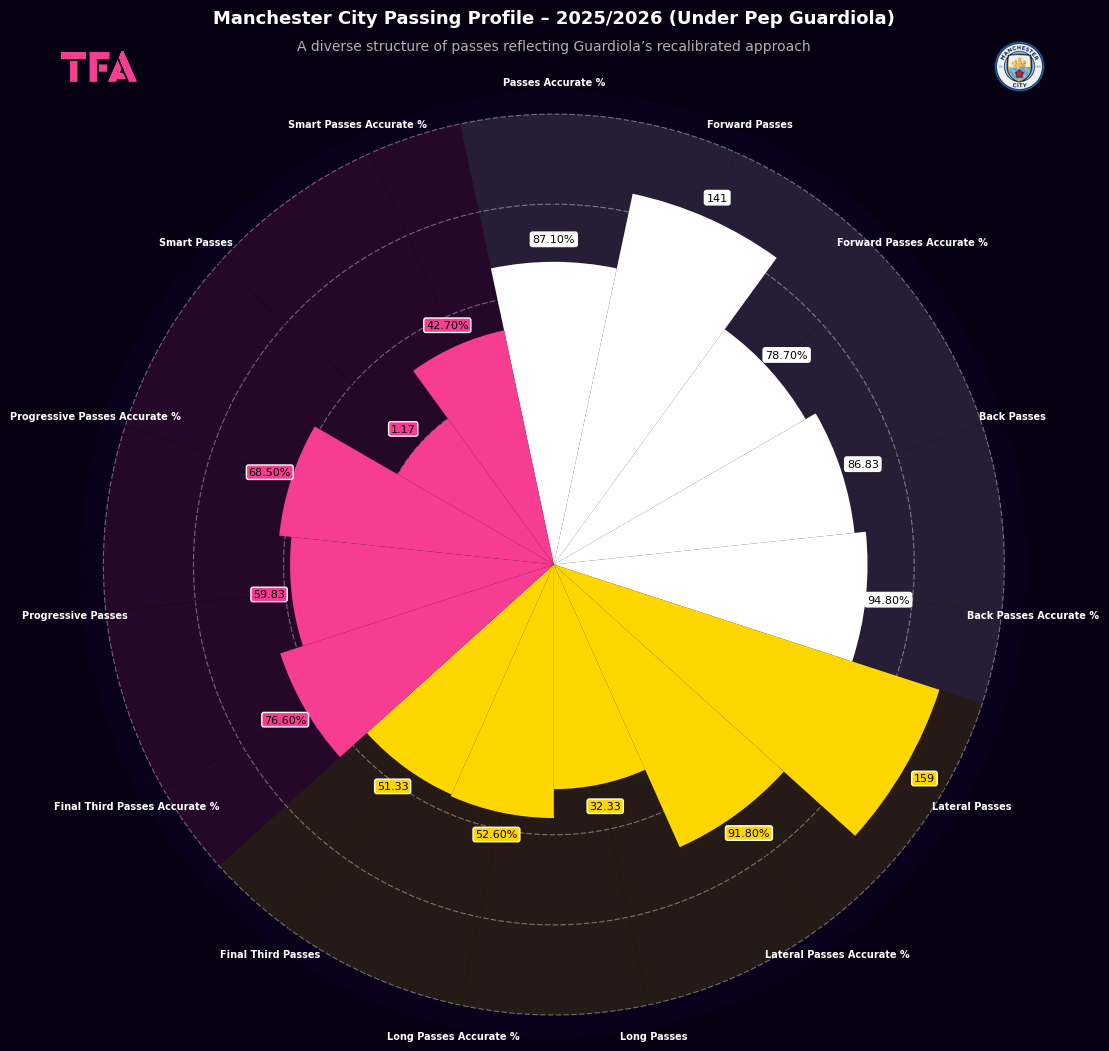
The numbers reveal an average of 482.8 passes per game at 87.1% accuracy, a figure that remains emblematic of Guardiola’s possession-first identity, marked by notable nuance.
Forward passing accounts for 140.7 actions at 78.7% accuracy, while backward (86.8 at 94.8%) and lateral circulation (159.1 at 91.8%) remain strong.
This indicates that the City continues to recycle the ball when necessary, but with a sharper focus on progress.
This intent is further reflected in 59.8 progressive passes per game, completed at a respectable 68.5%, illustrating Guardiola’s recalibrated emphasis on vertical progression.
The distribution towards the final third (51.3 passes at 76.6% accuracy) highlights how City is prioritising direct access into dangerous areas.
The use of long passes (32.3 at 52.6% accuracy) underscores a willingness to bypass pressure when needed, a stark departure from Guardiola’s once dogmatic avoidance of risk.
The presence of 1.17 smart passes per match with 42.7% accuracy is even more telling, signalling a deliberate acceptance of higher-risk, higher-reward patterns designed to unpick compact defences.
From a broader tactical lens, the data shows a team operating at a match tempo of 17.3, with an average of 5.1 passes per possession.
This balance suggests a side that is neither locked into sterile circulation nor overly direct but rather capable of flexing between speeds depending on context.
The 12.3 PPDA figure further illustrates how City are comfortable conceding short spells of possession, a pragmatic evolution.
This diverse passing structure epitomizes Guardiola’s recalculated blueprint: positional control remains intact, now enriched by a pragmatic variety that sustains fluidity while enhancing threat.
Gianluigi Donnarumma Role in A New, Pragmatic Manchester City Under Pep Guardiola
One of the more intriguing aspects of Guardiola’s tactical recalibration has been his willingness to utilise Gianluigi Donnarumma despite the Italian’s limitations with the ball at his feet.
Traditionally, Guardiola has favoured goalkeepers whose distribution and comfort under pressure formed a cornerstone of City’s possession play.
Gianluigi Donnarumma Pass Map: Manchester City Vs Arsenal
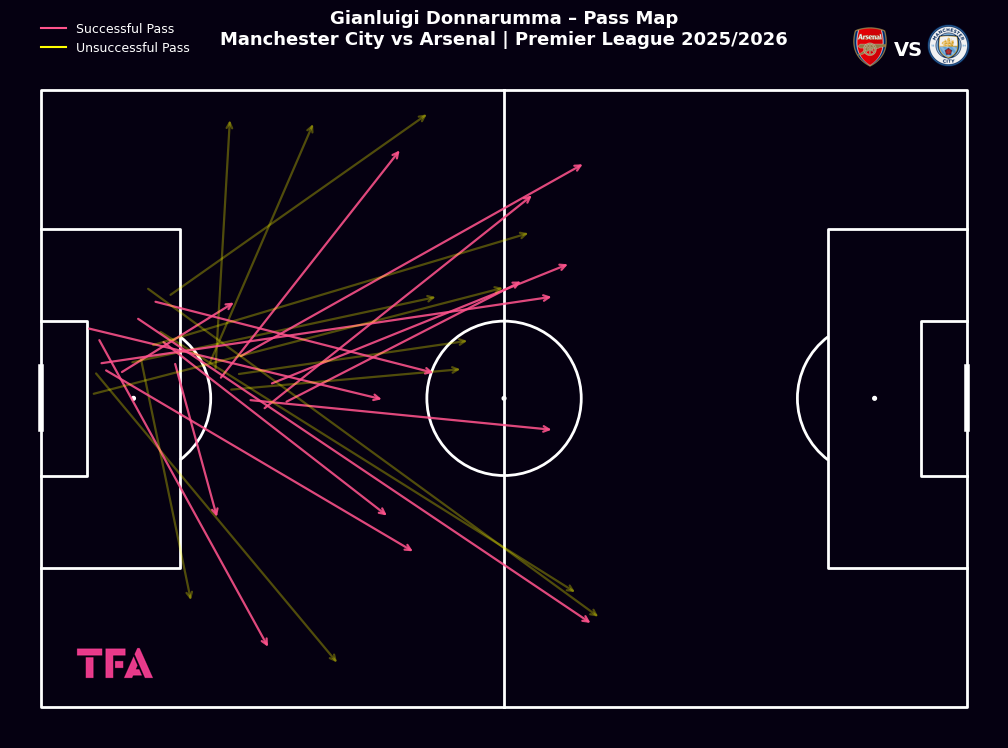
In the 1-1 draw with Arsenal, Donnarumma’s inclusion illustrated a deliberate shift in priorities.
Rather than demanding constant ball progression from deep, Guardiola leaned on Donnarumma’s commanding presence, particularly in aerial situations and defensive stability.
His handling of crosses and long deliveries added security to a City side increasingly open to absorbing pressure rather than smothering it through possession.
While his passing accuracy and range may not rival those of the archetypal Guardiola goalkeeper, Donnarumma’s suitability for this recalibrated, more pragmatic version of City reflects a coach willing to sacrifice technical build-up quality for defensive assurance and a more balanced structure.
Manchester City Adapting Defensively With A Renewed Balance
While much of the focus on Manchester City’s recalibration in 2025/2026 has centred on their attacking efficiency and passing variety, an equally important shift is visible in their defensive structure.
The data presents a picture of a side no longer reliant solely on high pressing or possession dominance to protect themselves, but instead one that manages defensive phases with a more pragmatic balance.
Manchester City Defensive Profile 2025/2026
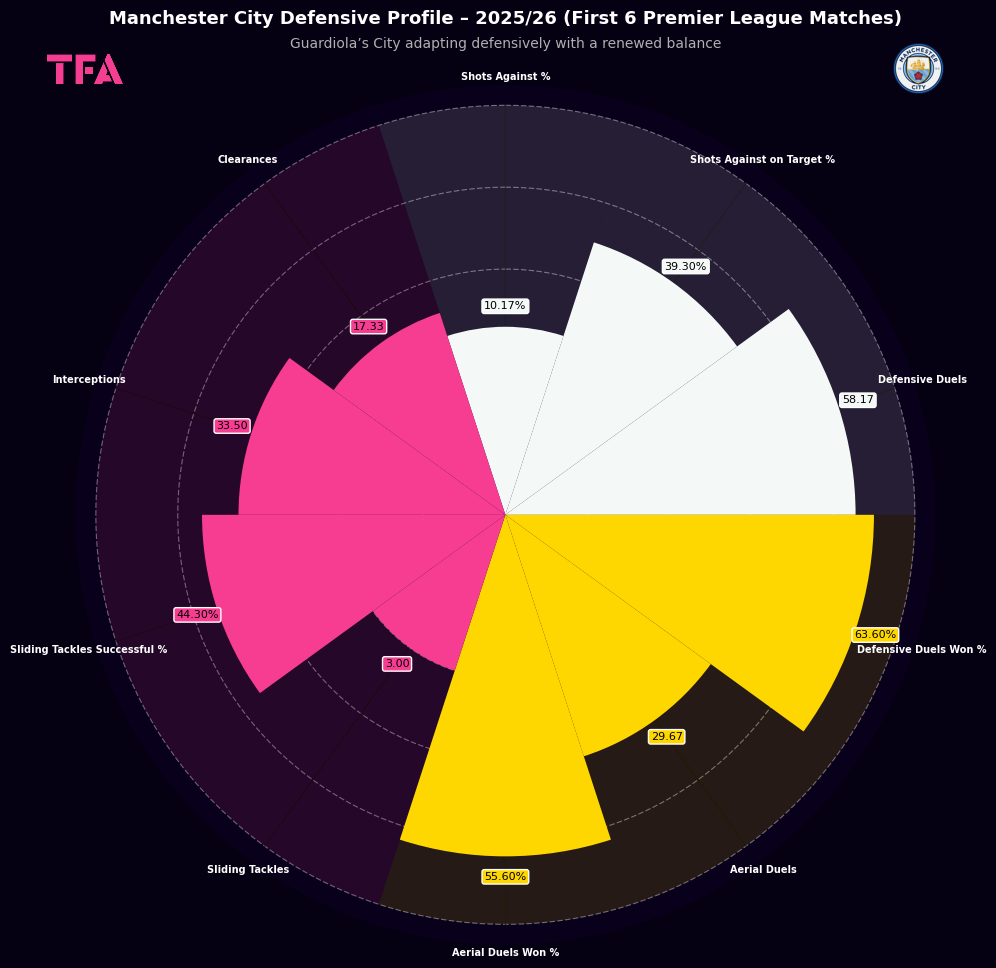
Opponents are registering shots on target at just 39.3%, a figure that reflects City’s ability to limit the quality rather than the quantity of chances conceded.
Manchester City engage in 58.2 defensive duels per game in direct contests, winning 63.6%, a success rate that suggests a greater emphasis on controlled individual defending rather than collective pressing overloads.
Aerially, they average 29.7 duels with a 55.6% win rate, highlighting both a vulnerability in the air compared with ground duels and a recognition that Guardiola’s side are prepared to contest longer, more direct approaches without relying exclusively on possession control.
The relatively low figure of just three sliding tackles per match, with only 44.3% successful, reinforces the notion that City’s defensive adjustments are less about desperate interventions and more about maintaining structure and discipline.
Interceptions (33.5 per game) and clearances (17.3) further underscore a team that is increasingly comfortable absorbing pressure and clearing danger when required.
This reflects Guardiola’s renewed pragmatism: instead of suffocating opponents at source, City now blend compact positional defending with selective pressing, striking a balance that ensures stability without sacrificing their attacking recalibration.
Inconsistent Manchester City Pressing Intensity Reflects Opponent-Driven Pragmatism
Manchester City’s pressing dynamics in 2025/2026 reflect a team no longer committed to a uniform high block, but instead one that calibrates its intensity based on the opponent’s strength and style.
Manchester City PPDA, Premier League 2025/2026
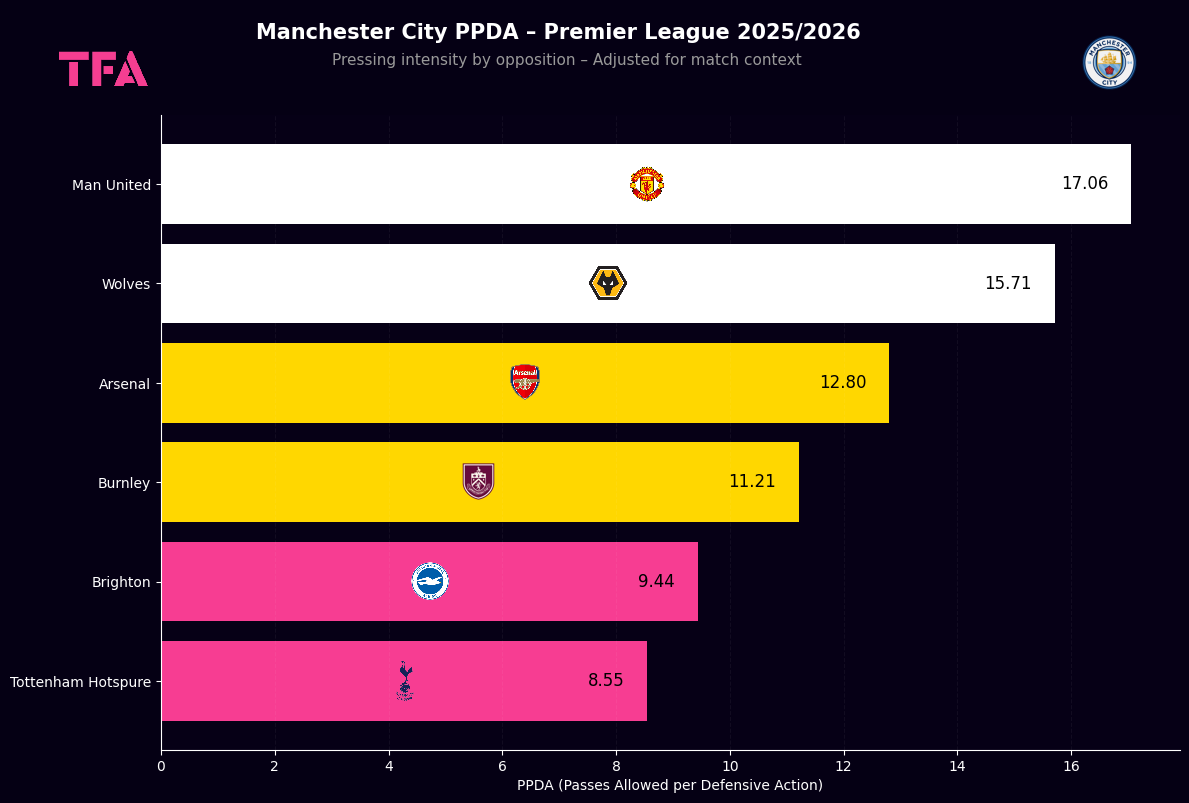
The PPDA figures tell the story: against Tottenham Hotspur (8.55) and Brighton (9.44), City pressed with greater aggression, seeking to disrupt the structured build-up of their opponents.
While against Manchester United (17.06) and Wolves (15.71), Guardiola’s men adopted a more conservative stance, allowing play to develop before engaging.
Arsenal (12.8) and Burnley (11.21) sit in the middle ground, signalling a tactical balance between selective pressure and positional control.
Certain players stand out within this framework.
Rodri remains the fulcrum, winning possession 20 times in just four appearances.
He complements his six tackles and two interceptions with a calm ability to screen transitions.
His presence illustrates how Guardiola relies on controlled interventions rather than reckless pressing waves at the base.
Alongside him, Bernardo Silva exemplifies a flexible approach to aggression.
Across five games, he has registered seven tackles, three interceptions, and 19 possession recoveries, often initiating pressure higher up the pitch.
They embody City’s adaptive pressing, Rodri anchoring stability, and Bernardo providing situational intensity.
This blend underlines Guardiola’s recalculated approach, which is pragmatic, opponent-specific, and far less dogmatic than in previous eras.
Conclusion
Manchester City’s recalibration in the 2025/2026 season paints a picture of a side no longer bound by the rigid principles that once defined Guardiola’s philosophy, but one that embraces flexibility without losing its identity.
The data illustrate a team capable of marrying precision with pragmatism, ruthless in attack through Haaland’s clinical edge, progressive in transition via carriers like Reijnders, and measured in possession with a more varied and less dogmatic passing network.
Even defensively, City demonstrate balance, absorbing pressure when needed and pressing selectively, tailoring their approach to the opponent rather than enforcing a singular blueprint.
What emerges is a Guardiola side that has evolved from suffocating control into adaptable orchestration.
This willingness to sacrifice sterile domination for balance reflects both the lessons of last season’s failures and the demands of a Premier League environment that grows more tactically sophisticated by the year.
City’s reduced possession numbers, their comfort with directness, and their readiness to trust Donnarumma for stability symbolise a broader pragmatism.
The recalibrated blueprint does not abandon Guardiola’s ideals but reinvents them, fusing positional discipline with situational dynamism.
In doing so, City may have found the formula to remain competitive at the highest level while entering a new era of tactical maturity.
