
Derby County versus West Bromwich Albion saw two teams trying to inject momentum into the second halves of their seasons, where avoiding a loss was a key focus for both dugouts.
Derby County, off the back of two hard-fought away wins, have been left with a renewed sense of optimism and are looking at an outside chance of the EFL Championship playoffs in the second half of the season.
To reach that objective, though, they will be looking to amend their home form with only one win in seven across all competitions.
West Brom, however, had been looking to turn the tide.
Four consecutive league losses, including a heavy 5-0 defeat at the hands of Norwich City, have left the Baggies wary of a potential relegation scrap.
Both goals, a scramble to score from Patrick Agyemang and a Chris Mepham header awarded by the goal decision system, came from chaotic set-pieces.
They were conceded by the team that looked most likely to score at the time, at the end of each half, but the key focus is on the principles that both John Eustace and Eric Ramsey will need to implement to move their respective sides up the table in the second half of the season.
Lineups & Formations
John Eustace set Derby County up in a 4-2-3-1 shape.
Jacob Widell Zetterström started in goal behind a back-four of Joe Ward, Sondre Langås, Danny Batth, and Callum Elder, from right to left.
Lewis Travis and David Ozoh played in midfield behind right-winger Ben Brereton Díaz, left-winger Rhian Brewster and attacking midfielder Bobby Clark.
Patrick Agyemang led the line up front.
Eric Ramsay’s side played in a 5-4-1 with Max O’Leary in goal behind Krystian Bielik, Nat Phillips, and George Campbell as centre-backs.
Isaac Price and Callum Styles played right and left wing-back, respectively, with Michael Johnston and Karlan Grant at right and left wing, respectively.
Ousmane Diakité and Jayson Molumby played in central midfield, while Aune Heggebø was up front.

Derby County In Possession Vs The Compact 5-4-1
One of the key themes throughout the game, and an area that Derby County will need to focus on if they are to become more consistent at Pride Park, was the lack of connection and fluid rotation when in settled possession.
This often led to a lack of vertical passing options and, more importantly, a situation that West Brom were able to manage and exploit throughout the first half.
West Brom used a rigid 5-4-1, often with the five flat and sitting very compact in midfield, thereby forfeiting possession.
The 4-2-3-1 of Derby struggled to break through, with Clark often deployed in the creative midfield role.
Often, he took a higher position when Derby were on the ball, resembling a 4-2-4, and even at times allowing Agyemang to be closest to receiving the ball.
This allowed the central pair in Molumby and Diakite of West Brom to focus on the corresponding pair in Ozoh and Travis and force the ball into wide positions.
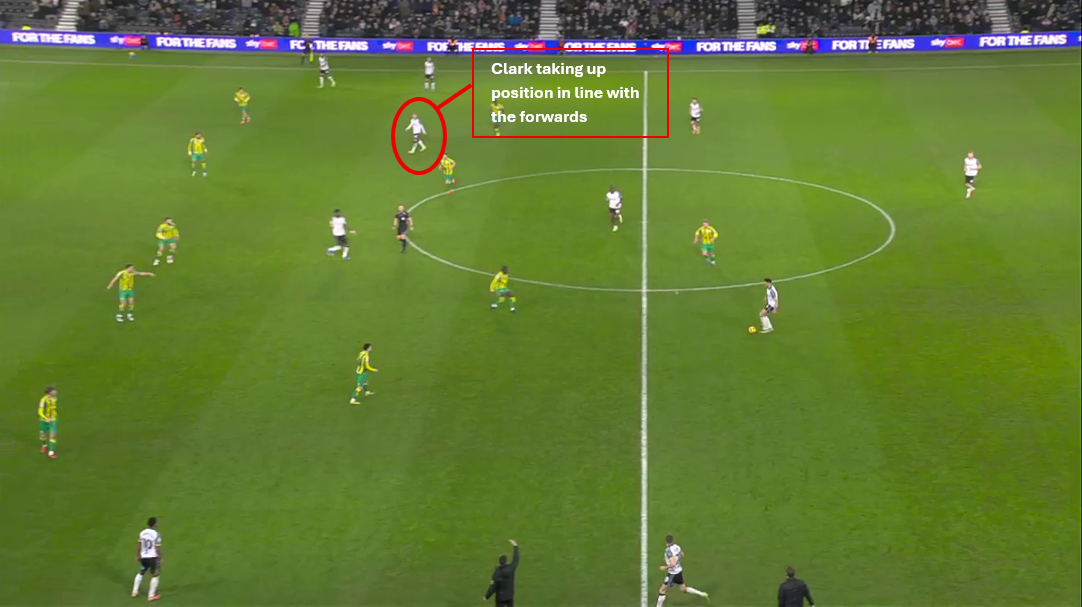 Midway through the first half, after a bounce pass from Agyemang, the space was initially wide on the right for Derby; however, it was an easy situation to defend for West Brom and remained so for most of the game.
Their shape allows them to commit one of the three centre-backs, pushing the winger and full-back onto the focus, going man-to-man ball side.
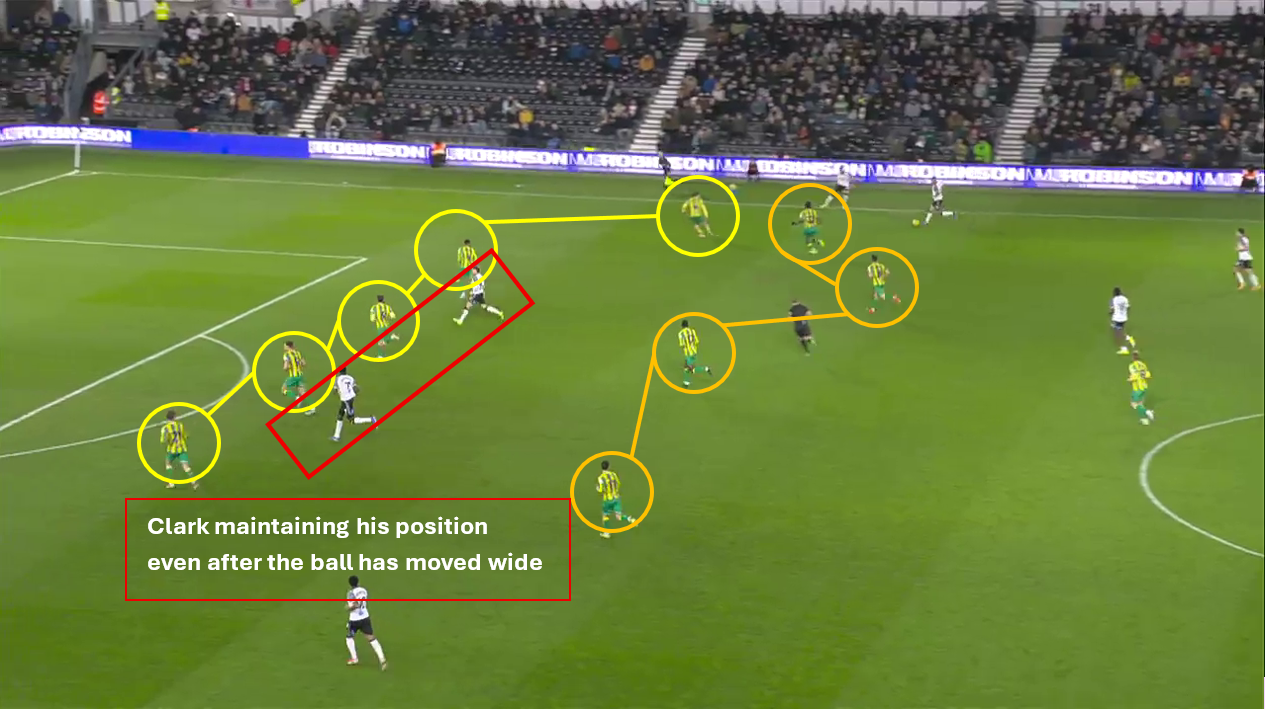
This pattern continued into the second half, even after Derby had taken the lead.
Because Clark often operated away from the ball, there would be space between the West Brom defence and midfield that they didn’t have to commit a defender to defend.
This impacted Derby in two ways.
Firstly, the ball typically had only one point at which it could be recycled back to the adjacent holding player.
Secondly, as Clark did not occupy the space, the near-side centre-back of the three did not have to step out of his defensive line to engage the play.
This limited the opportunity for a more direct route to goal with the space created for Agyemang to run into.
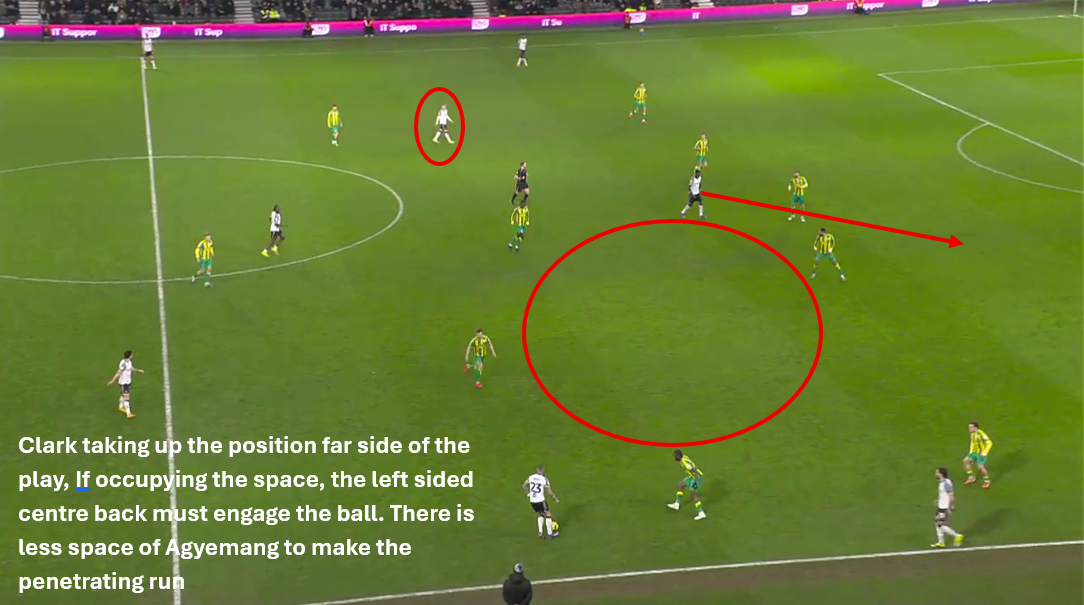
This shape not only gave West Brom defensive solidity but also allowed for some opportunities to win the ball in attacking spaces.
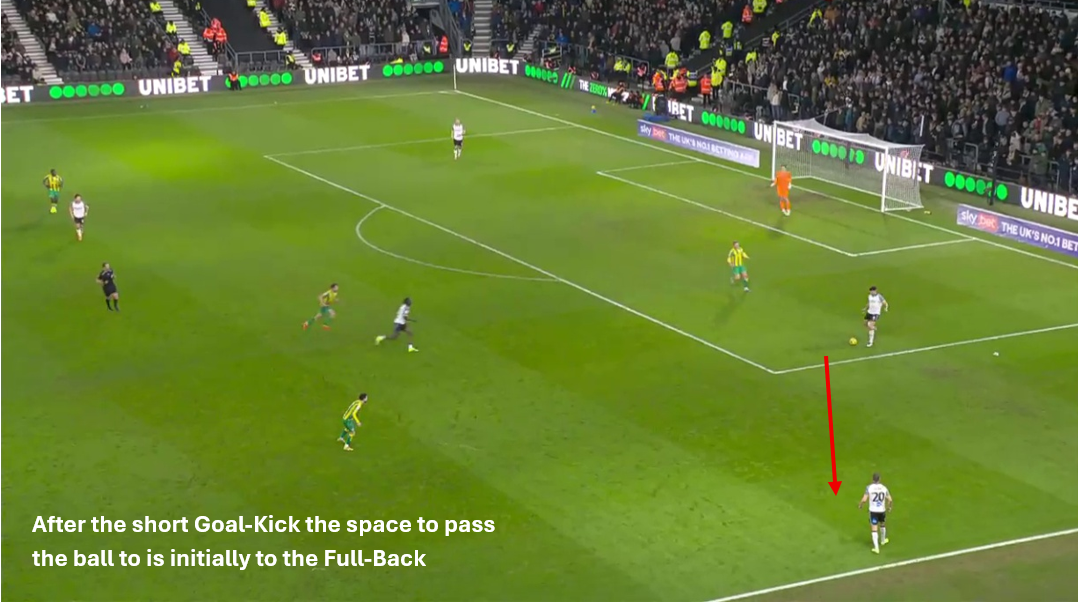
An example of this is in the first half: after a short goal-kick from Derby, the space immediately presented itself in the first phase out wide, as was the case even when Derby were able to control the ball further up the pitch.
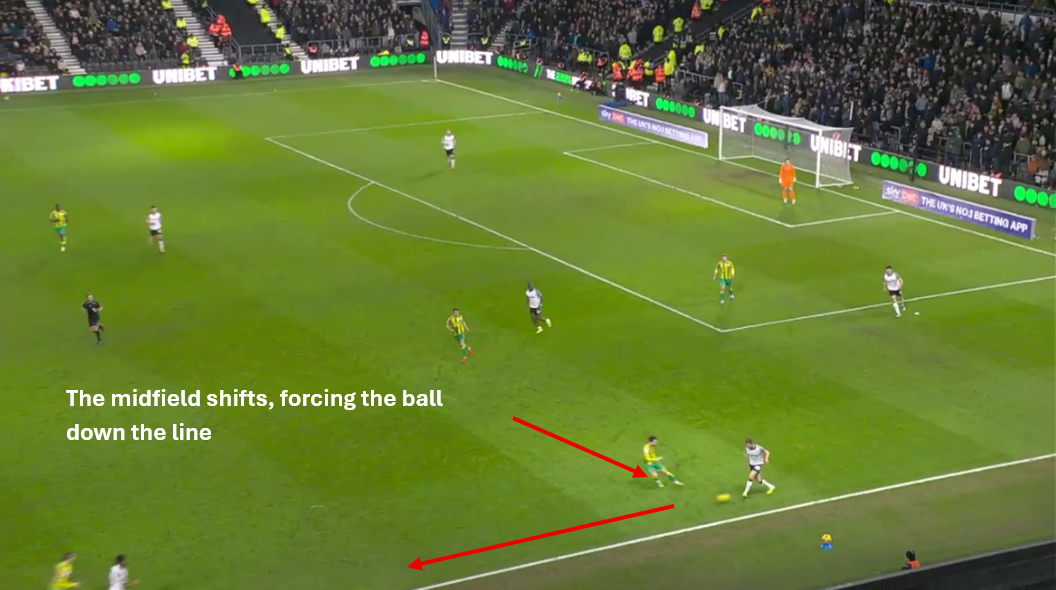
Within two passes, this wide coverage has led to a 2v2 situation, with Derby in a less than favourable position for where the ball can be played.
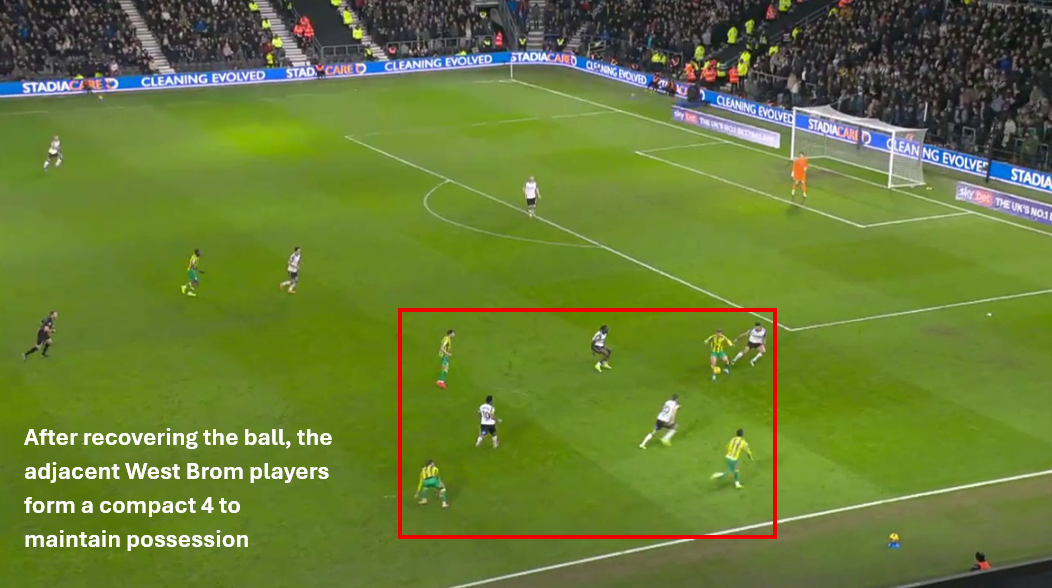
An interception from West Brom then leads to a ball recovery just outside the box.
In this situation, Derby were able to regroup, but there were multiple occasions when this shape successfully applied pressure.
Two Triple Substitutions Opened the Game
Around the 60-minute mark, both teams made personnel changes, which shifted the momentum.
West Brom, having conceded at the end of the first half, although maintaining control, could not find a breakthrough.
Derby, even being ahead, had the sense that they needed another goal to be sure of the result.
West Brom changed shape to a 5-3-2, but there was no imbalance: Jed Wallace occupied the right wing-back spot, and even though there was a more significant attacking threat, Derby couldn’t break down that side and exploit the space vacated.
Derby went like-for-like in their shape, but the introduction of Oscar Fraulo was key, helping them start to work the ball into space and create openings themselves.
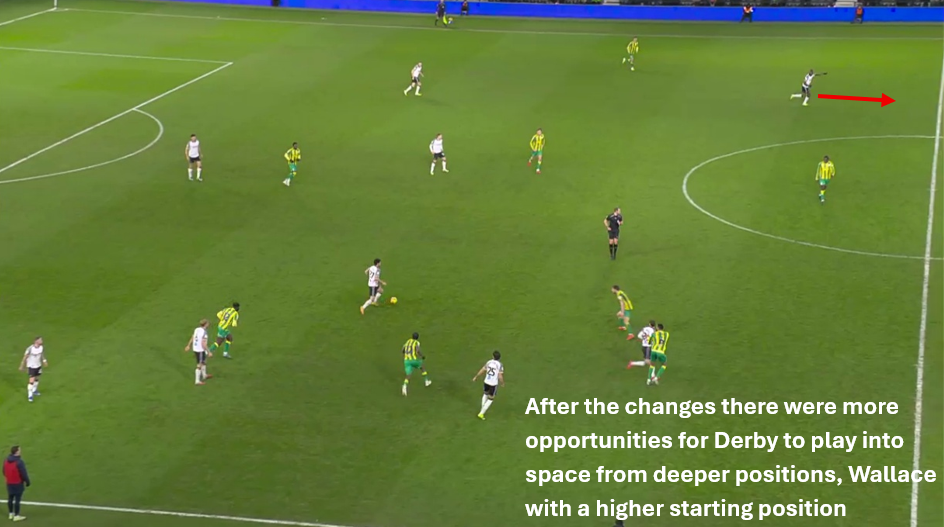
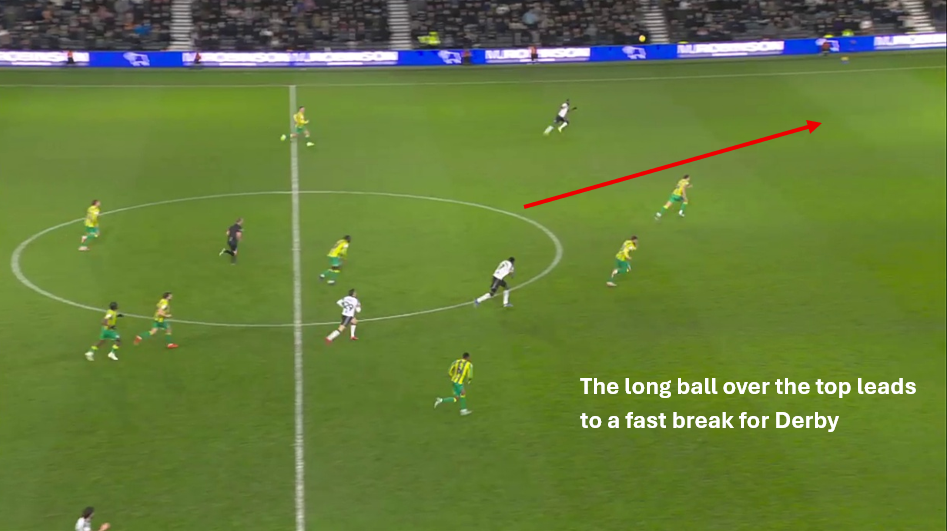
Wallace’s advanced position led to a quick break into Derby in the second half.
Although the space opened up for Derby to exploit, they were not able to produce the goal that would have secured the result.
The Set Pieces That Created The Result
Late in the first half, Agyemang’s work down the left flank won a foul for Derby after a period of consistent pressure from West Brom.
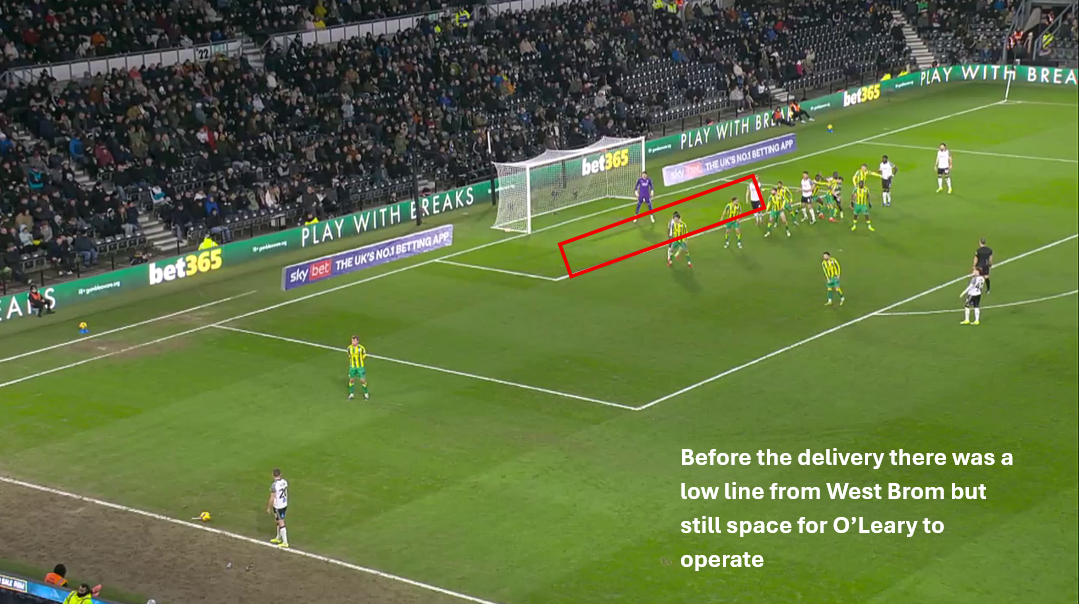
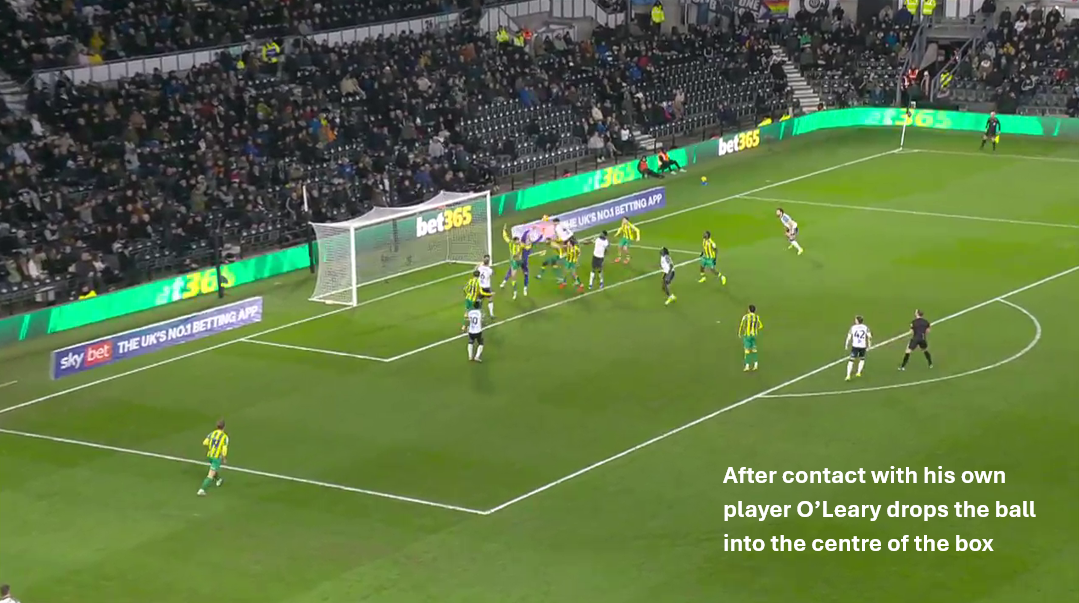
The initial set had the box dominated by West Brom players, but Max O’Leary, making his debut in goal, showed his nerves when attempting to collect the cross, dropping the ball to the feet of Agyemang, who took the opportunity.
Although much of the blame for the goal can be put down to thegoalkeeper’s mistake, when collecting the ball, he is slightly impeded by his own player, without interference from the Derby forward line.
As West Brom had committed so many players back to overload their own box, there is potential that this has caused more issues for the goalkeeper to come and collect.
The opposite of this approach is becoming more visible in top-tier games, where defensive teams will deliberately have additional players in more positive positions to draw out attackers and therefore more space for the goalkeeper to operate in.
For West Brom, their breakthrough came late on after a sustained period of pressure.
The goal came after a move in which Josh Maja had just come close to poking in the equaliser, with some dispute as to whether Zetterström in the Derby goal had the final touch.
The aim of the corner was to get the first contact at the front post and flick the ball into a dangerous area.
One of the benefits of this approach is to take the opportunity away from Zetterström to collect the cross as he had been proactive in this throughout the game.
The movement to create space for the flick-on was clever, with Molumby positioning himself on the goalkeeper before running to the front post.
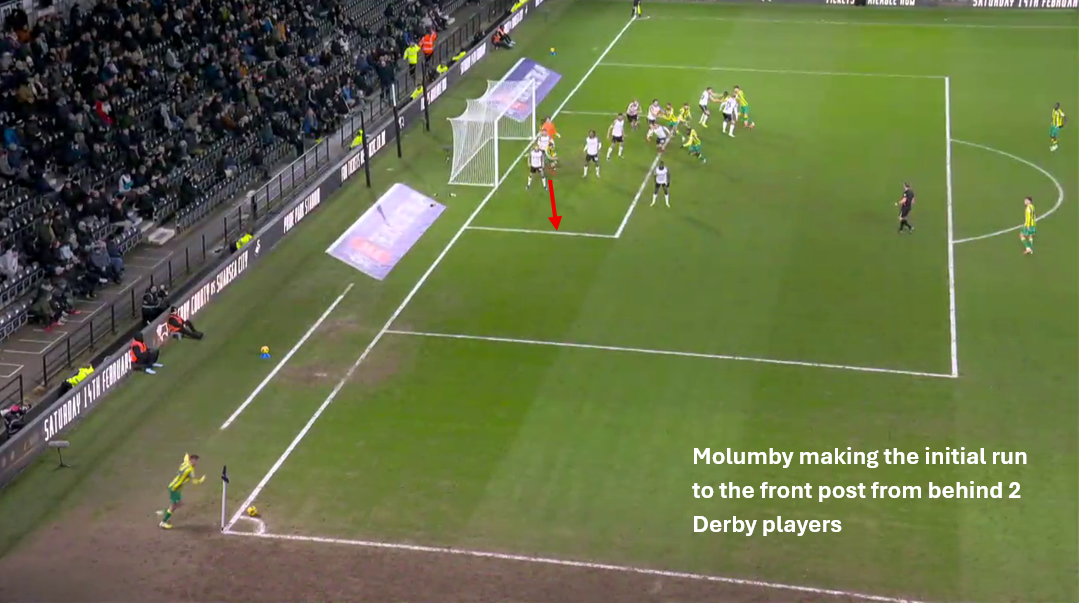
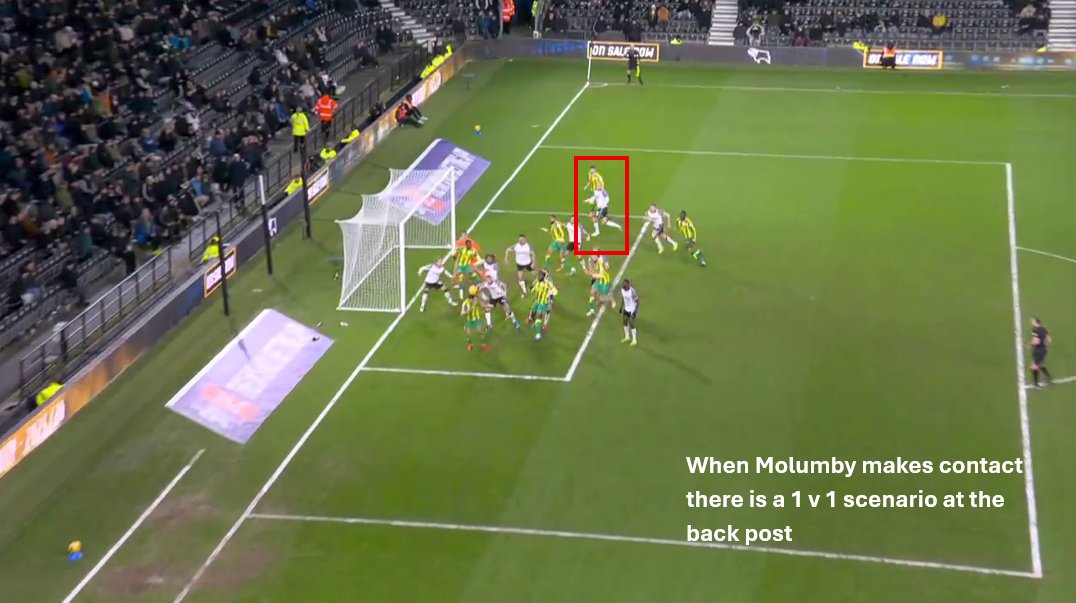
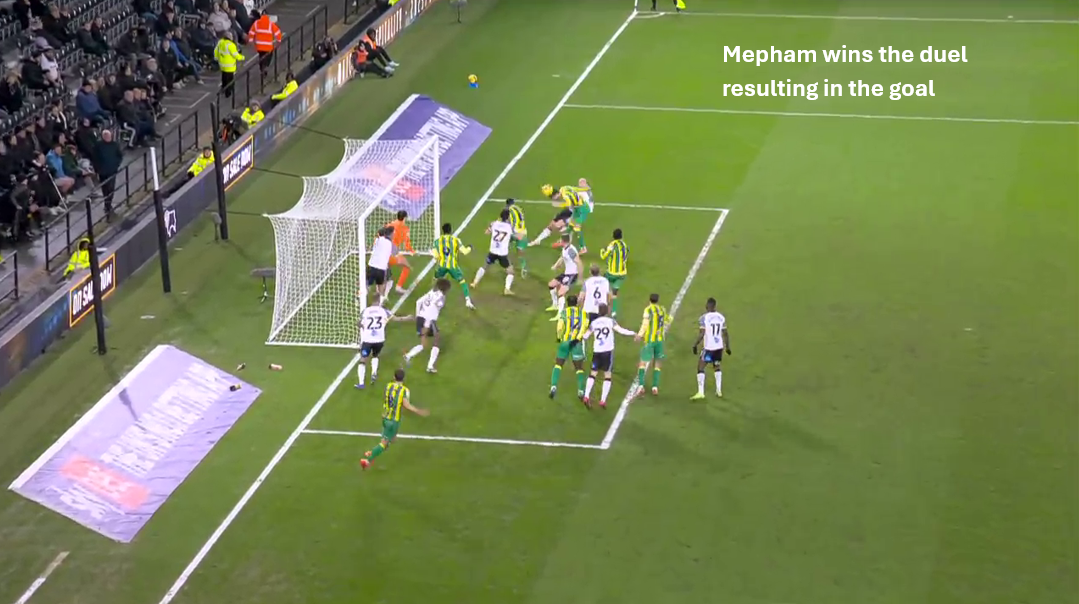
Chris Mepham manages to outmuscle Lars Salveson at the back post, and even though Zetterström manages to get a hand to the ball, the goal decision system ruled that the ball had crossed the line and should be awarded.
Although there will be few complaints from Derby about the setup to defend the goal, they will be disappointed to have been drawn to the ball at the front post, leaving Mepham with such a good chance at goal.
Conclusion
Going forward, if West Brom can replicate their defensive solidity for the rest of the season, then consistency in their results will follow.
The key factor for both sides being able to push up the table will be whether they can develop their offensive games.
For Derby, they will have to better adapt to playing against defensively rigid sides at home, and West Brom will need to convert the chances they create in transition into clearer opportunities, enabling them to become more clinical in front of goal.
