
SV Elversberg‘s story has been one of the best in German football over the last couple of seasons.
Starting in the fourth division, the Regionalliga, CSO Nils-Ole Book took the club to multiple promotions with head coach Horst Steffen.
During these seasons, the team consisted of a strong core that was well complemented by many loan players, like Nick Woltemade, Paul Wanner or Fisnik Asllani.
The story nearly had a perfect ending last season.
After a fantastic season, Elversberg finished third in the league and qualified for the Bundesliga play-off, but fell short to 1. FC Heidenheim and Léo Scienza, despite being the better team over the two games.
When it rains, it pours.
Manager Horst Steffen and his assistant coach, Rafael Duarte, left the club for Bundesliga club Werder Bremen.
Both full-backs left the team, with Elias Baum having to return to Eintracht Frankfurt and Maurice Neubauer moving to Hannover 96.
Their starting double-pivot also left, with Semih Sahin joining Kaiserslautern and Robin Fellhauer joining FC Augsburg in the Bundesliga.
Additionally, their attacking duo, Fisnik Asllani and Mohammed Damar, had to return to their parent club, 1899 Hoffenheim.
With these departures, everyone expected Elversberg to end up in the relegation battle, but after eight matchdays, Elversberg head into the international break as the league leader in 2. Bundesliga under new coach Vincent Wagner.
In this Elversberg tactical analysis, we will examine how Elversberg play this season and how Wagner’s tactics are helping them achieve success.
In the first part of the article, we will examine their approach in possession and how they create progressiveness and goal-scoring opportunities.
Then, we will quickly examine their work against the ball.
Elversberg Key Principles In Possession
Nils-Ole Book has made many excellent decisions over the last couple of years, and Vincent Wagner appears to be the next one.
Instead of trying to brace themselves for a relegation battle, Book decided to stay true to what made them successful over the last couple of years.
Wagner was the manager of the 1899 Hoffenheim B-team and was very successful there, getting promoted to 3. Liga with them last season.
Not only did he prove that he can work with young players and still be successful, something that has been very important in Elversberg for the last three years, but he also wants his team to play a similar style of play as Horst Steffen, meaning he could be building on what remained of the existing structures.
Just like Steffen, Wagner prefers his team to be lined up in a 4-2-3-1 formation and play it out from the back, but he has introduced a couple of tweaks to Elversberg.
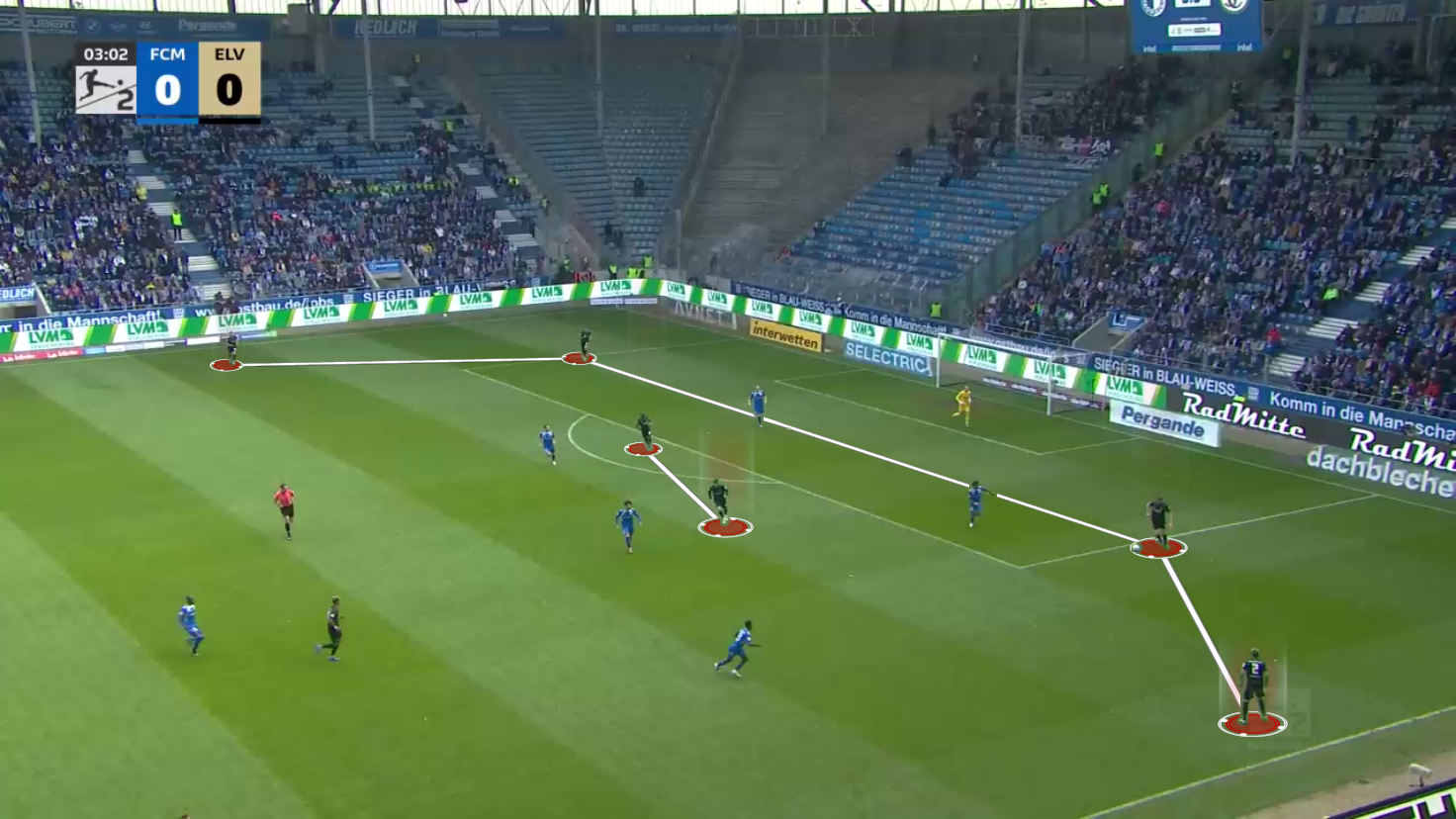
As we can see, Wagner has his back four in a wide shape, with the full-backs positioned near the sideline and the two centre-backs on the edge of the box.
Like Steffen, he involves his goalkeeper heavily in the passing game and uses him as a distributor to the centre-backs, who often dribble forward.
It’s a bit of a change compared to last season, when the full-backs often were pushed higher up the pitch and the centre-backs always triggered play by dribbling forward onto the pressing attackers.
This year, they are trying to get past the first line of press with their first touch.
Another minor change is that Elversberg involves their full-backs more in the build-up, rather than having them provide width higher up the field.
However, several aspects are clearly similar to what the team did last season.
Wagner did not come in to tear everything down, but to continue building.
The double-pivot is incredibly narrow and very close to the centre-backs.
This does two things for Elversberg.
First and foremost, with the wide full-backs and the narrow double-pivot, Wagner opens up the half-spaces for his attackers, creating the opportunity for dynamic movement into those areas.
Secondly, with six players plus the goalkeeper in their own third, Elversberg often has the numerical advantage while building up.
We can see Bambasé Conté in the picture making a run into the half space already.
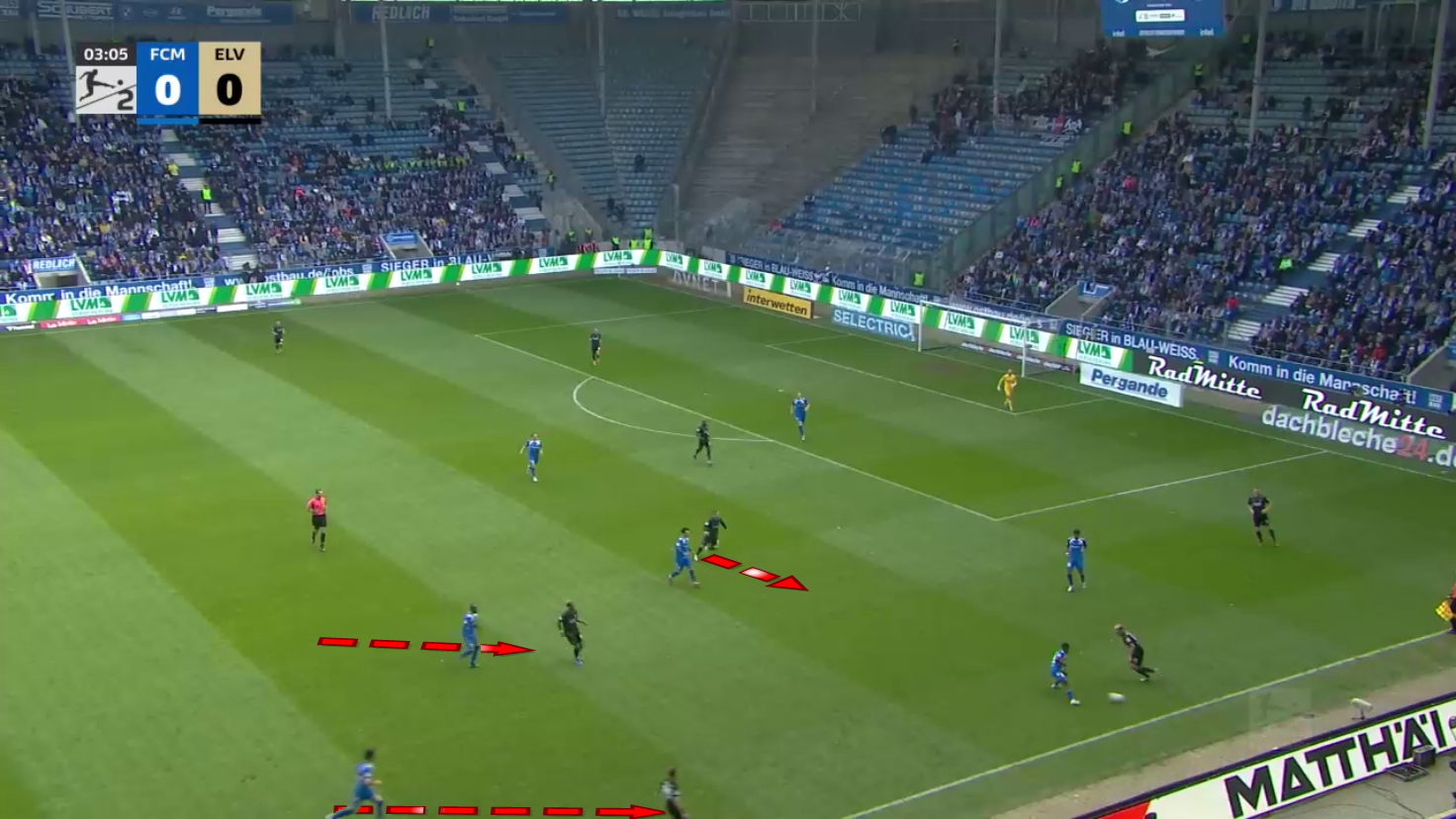
Under Steffen, Elversberg’s centre-backs played the passes down the channel in the half-space more often than under Wagner; the team now plays more with its full-backs.
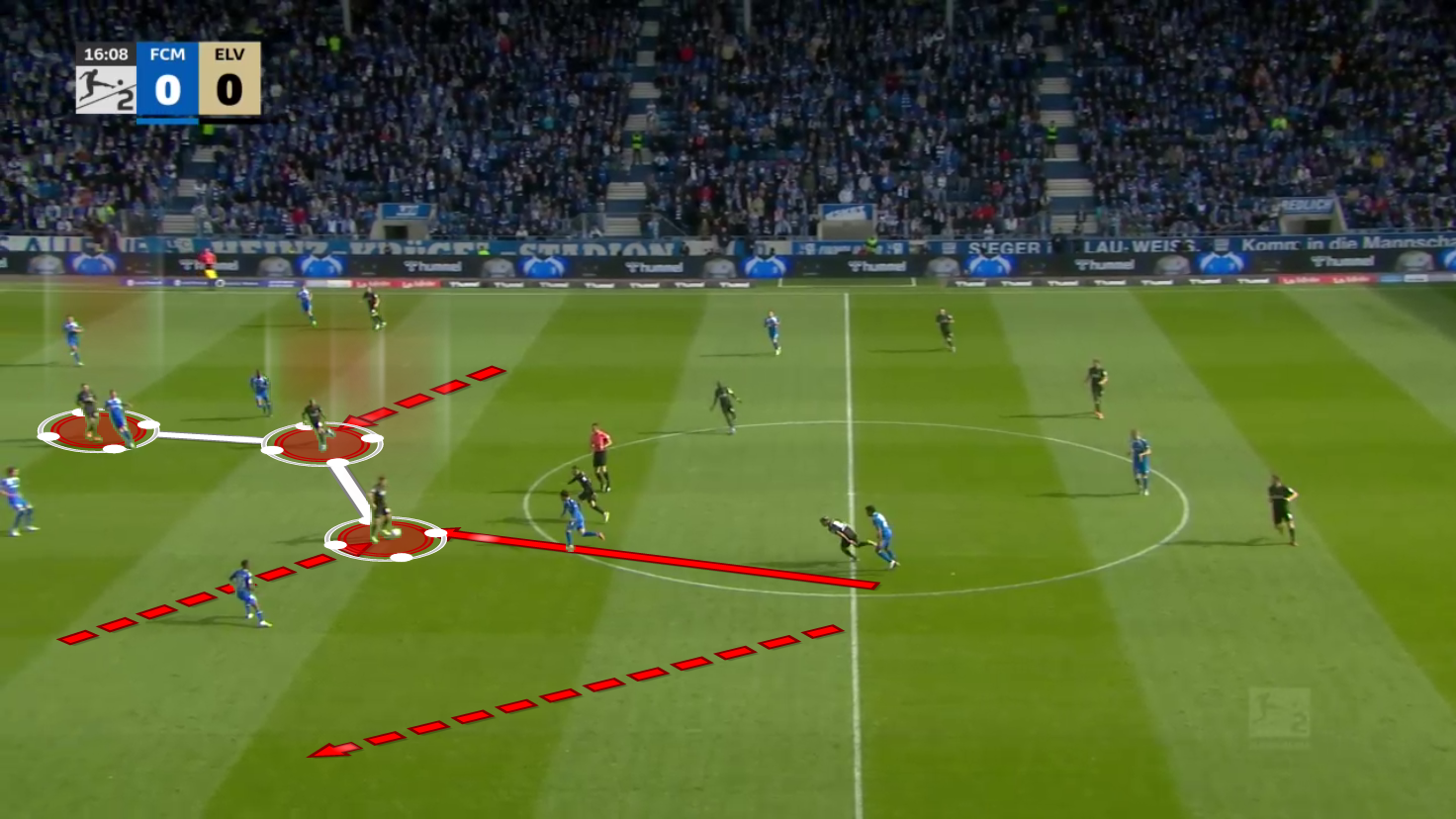
Looking at the picture, the left-back now has the ball, and Elversberg instantly tries to close the passing distance, so three players move towards the full-back.
He plays a simple pass down the line to his winger and keeps moving inwards, with Conté now offering a vertical run behind the winger.
This is a rather simple principle of advancing the ball by overloading the wings, something that is new in Elversberg under Wagner.
They manage to play lay-offs out of these situations more often than not and find their striker or Conté with the next vertical pass.
In these situations, Elversberg easily transition from their build-up into the attacking game when they are forced to build up on line 1 themselves, and they have been very successful with this so far this season.
Elversberg Diagonality, Ladders, Stars & More
The heart of Elversberg’s attacking game is something else, however.
Horst Steffen has implemented it over the last couple of seasons, and now Wagner uses it as well.
The three keywords we will examine here are diagonal ladders, deep-deep combinations, and stars; we will get to each one throughout this paragraph.
Wagner is a coach who loves attacking football and wants his team to create opportunities through passing, but is not overly concerned with possession.
He sees attacks as a chain of patterns and evaluates them very fluidly.
He wants to attack from the first pass up until the shot that ends the situation.
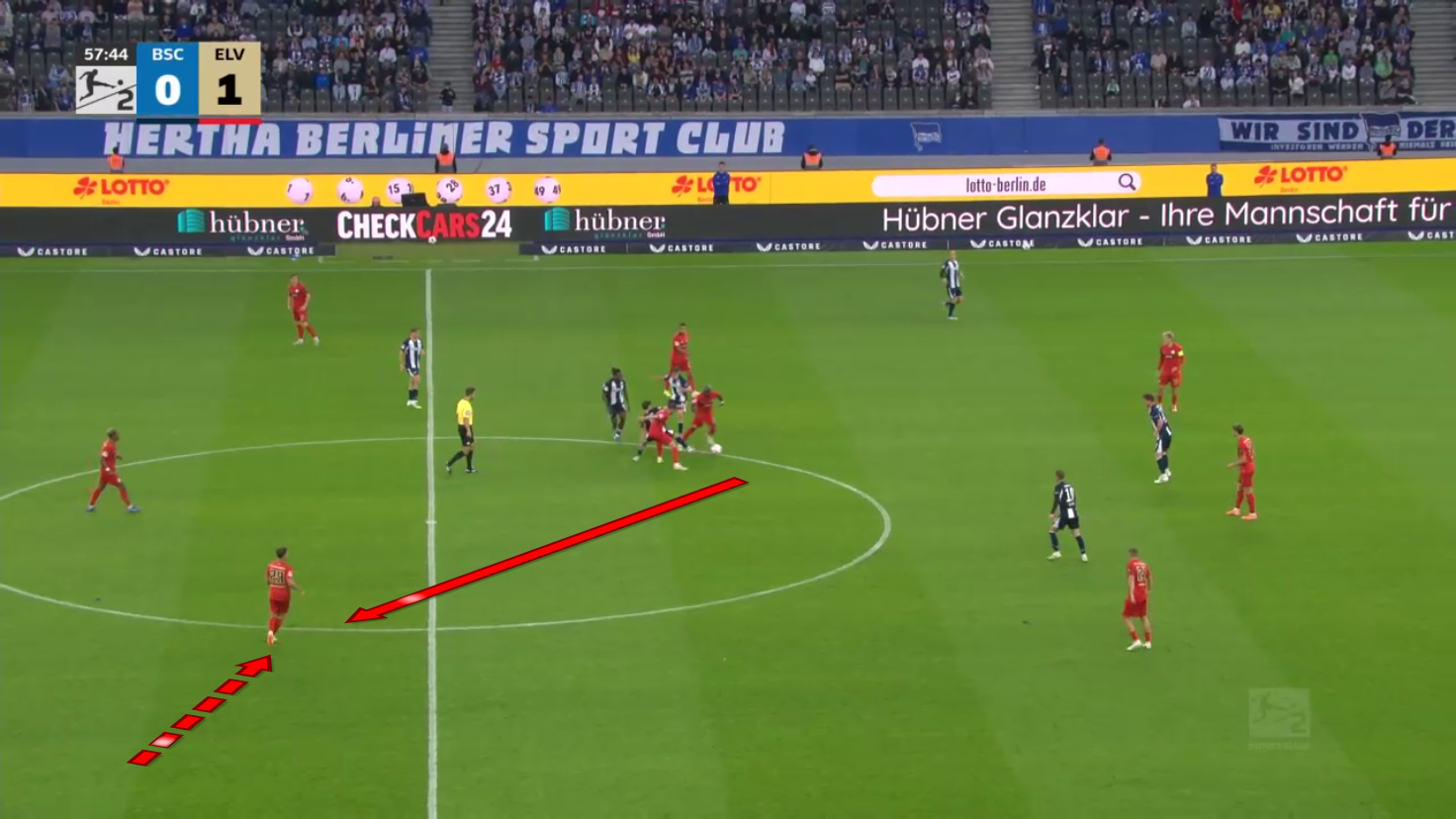
The one thing that is omnipresent in the play in possession of Elversberg, not just under Wagner this season, but over the course of the last couple of years, is diagonal passes.
Diagonal passes are the best form of pass, way superior to square and vertical passes, because they are not only progressive but also force the opponent to shift to the other side once again.
As we can see in the picture above, Wagner has his players overload the centre of the pitch.
The two central midfielders stay incredibly narrow, and even the full-backs don’t stay out wide anymore.
Now, when the midfielders get the ball or even when the centre-backs get the opportunity, they are looking for a pass into the far-sided half-space.
We already established that these spaces open up naturally with the narrow double-pivot.
Now, the wingers play very inversely, dropping into the half-spaces in a half-opened stance and receiving the ball in these areas.
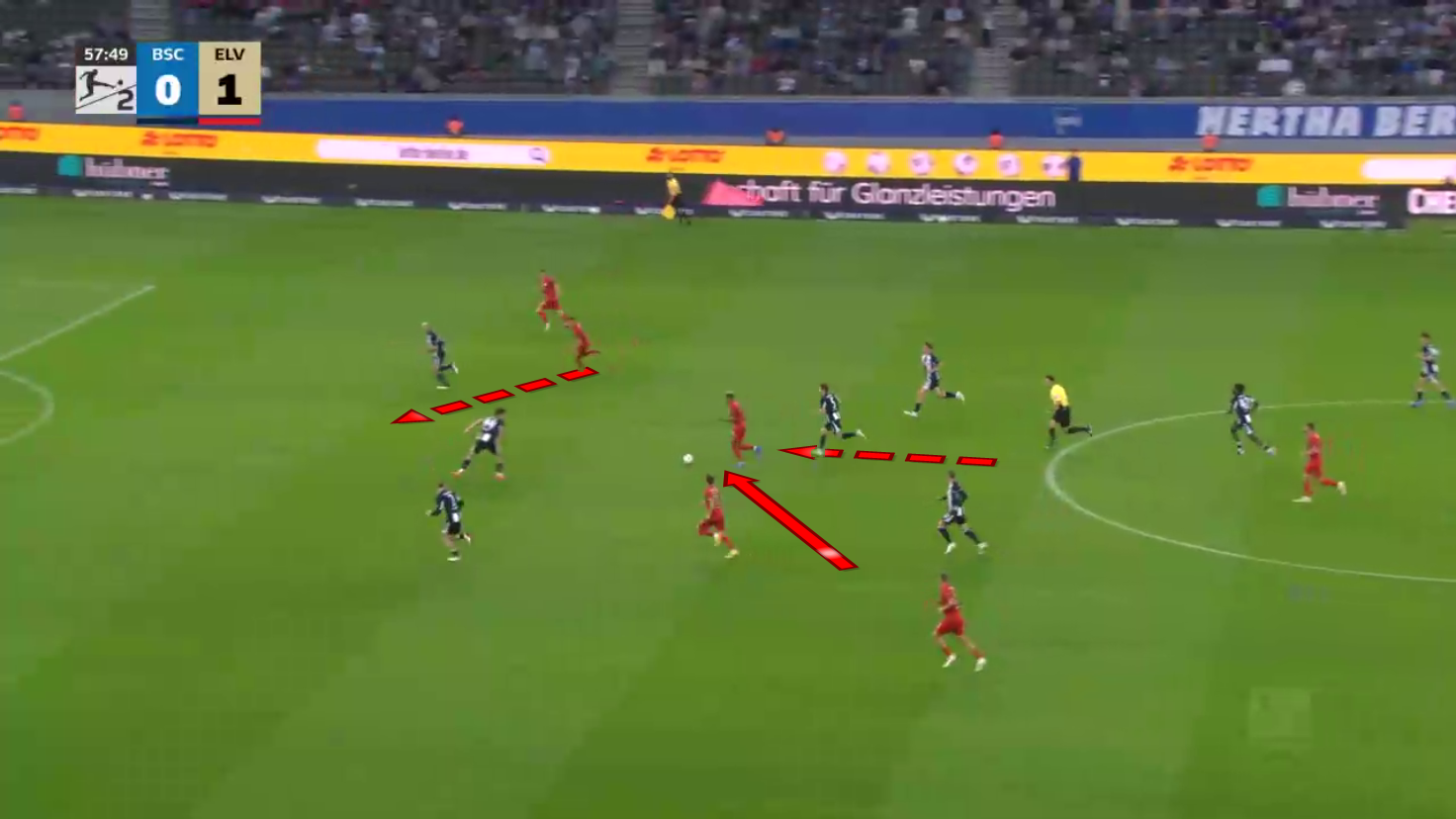
Now, we get to the deep-deep-combinations.
After a forward pass, most teams decide to play lay-offs to secure the ball in a position closer to the goal, but Elversberg don’t do that.
Instead, they instantly play another forward pass after receiving the ball in the half-spaces most of the time.
As we can see in the picture above, the left winger now plays a first-time pass to Conté, who positioned himself higher up the pitch, and Wagner’s men create a huge amount of dynamic that way.
Now, the striker makes a run to free up the right winger, and they can play a third consecutive forward pass and find themselves behind the backline.
These combinations are still somewhat risky, so if possible, they build themselves a safety net in the form of a star.
With their positional play, Wagner and his men always look to position themselves in a triangle around the player receiving the ball, with the player who played the pass moving forward as well, creating a star shape.
The player receiving the ball now has multiple options for lay-offs, deep combinations, and even the opportunity to dribble inward with their first touch.
Wagner trusts his players, especially his two wingers, to make the right decisions in these situations, and so far, it has worked out really well for the team.
Wagner even enables his team to play as many diagonal passes as they do, which suggests that they are using the principle of diagonal ladders in their positional play.
Like a ladder, the players’ positions are in a straight line, with multiple steps (the players) and gaps (the distance between them).
So when a centre-back or a midfielder has the ball, Conté or striker Younes Ebnoutalib leave their positions and try to move themselves to form a rather straight line towards the far-sided half-space, to where the winger is moving into.
Wagner creates two—or three-step ladders that way.
Based on this alignment, Elversberg can utilize multiple straightforward patterns to execute a diagonal pass.
They can simply pass to the first step of the ladder, or the first player can feint or drag their marker out of position; there are numerous possibilities, and Elversberg utilizes them very effectively, with good variance, to always maintain the element of surprise on their side.
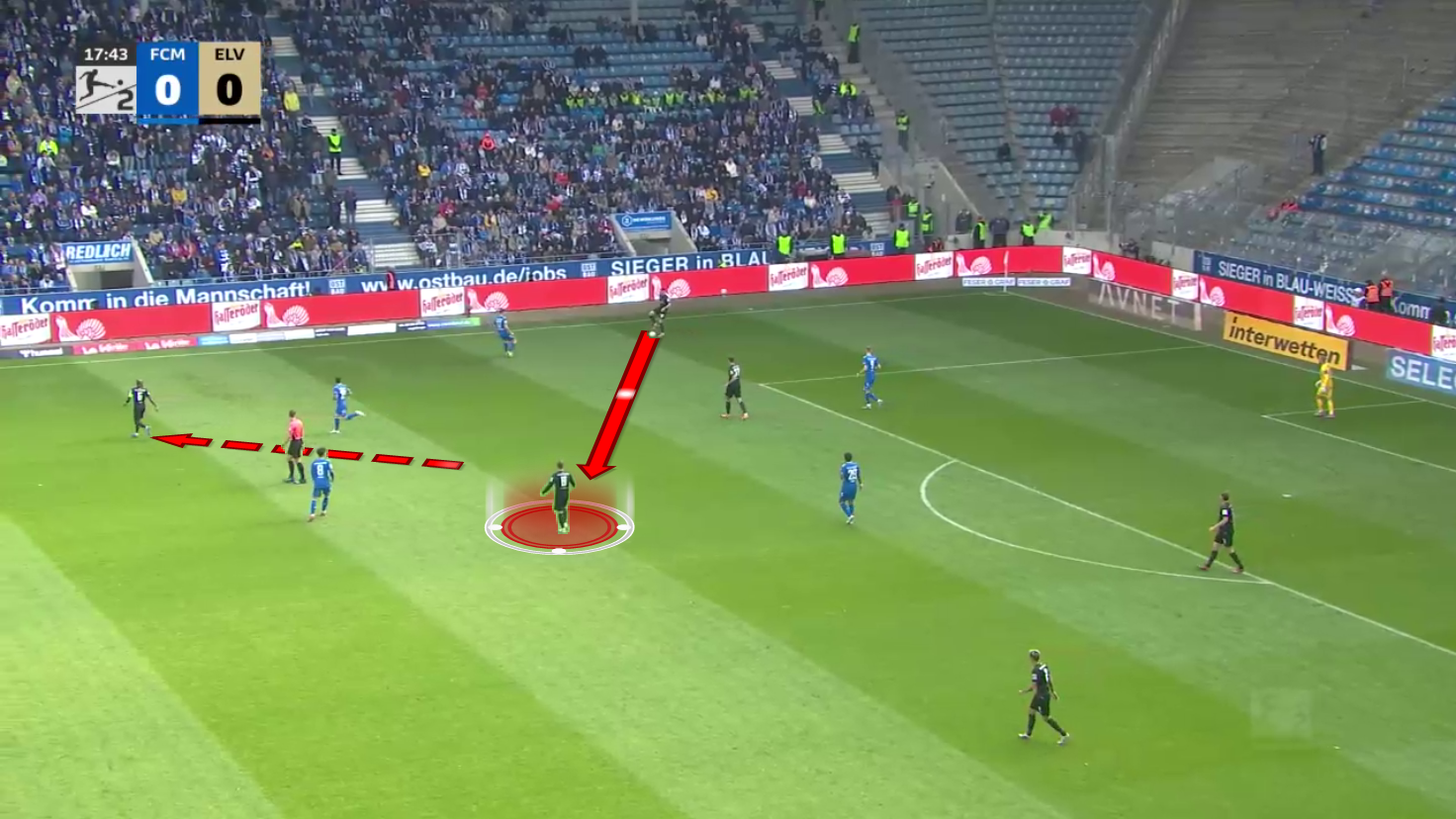
They even use two-step ladders to switch play when building up, so the principle is omnipresent.
As we established in the first paragraph, when one of the players has the ball near the sideline, which they often do, both midfielders move towards that side, with the far-sided midfielder moving in the shadow of his partner.
When they can’t find a solution with this overload, the near-sided midfielder explodes forward, opening up the diagonal passing lane to the far-sided midfielder, who now simply can switch play to the other side with another diagonal pass.
Wagner has taken a lot from what Horst Steffen did over the last couple of years, and with a few tweaks, managed to put his team in a very good position with the ball, even with many new players starting under the new manager.
Elversverg High Risk, High Reward Tactics
In terms of what they do against the ball, Vincent Wagner adapts a lot to what their opponent does.
While this sounds pretty lame, it has been working well for him so far this season, even though they got a bit lucky in the first couple of games with their approach.
In the end, Wagner takes a lot of risks against the ball; Elversberg are not a passive team.
Their defensive identity is shaped around winning the ball high up the field and defending as a unit, not around being incredibly stable.
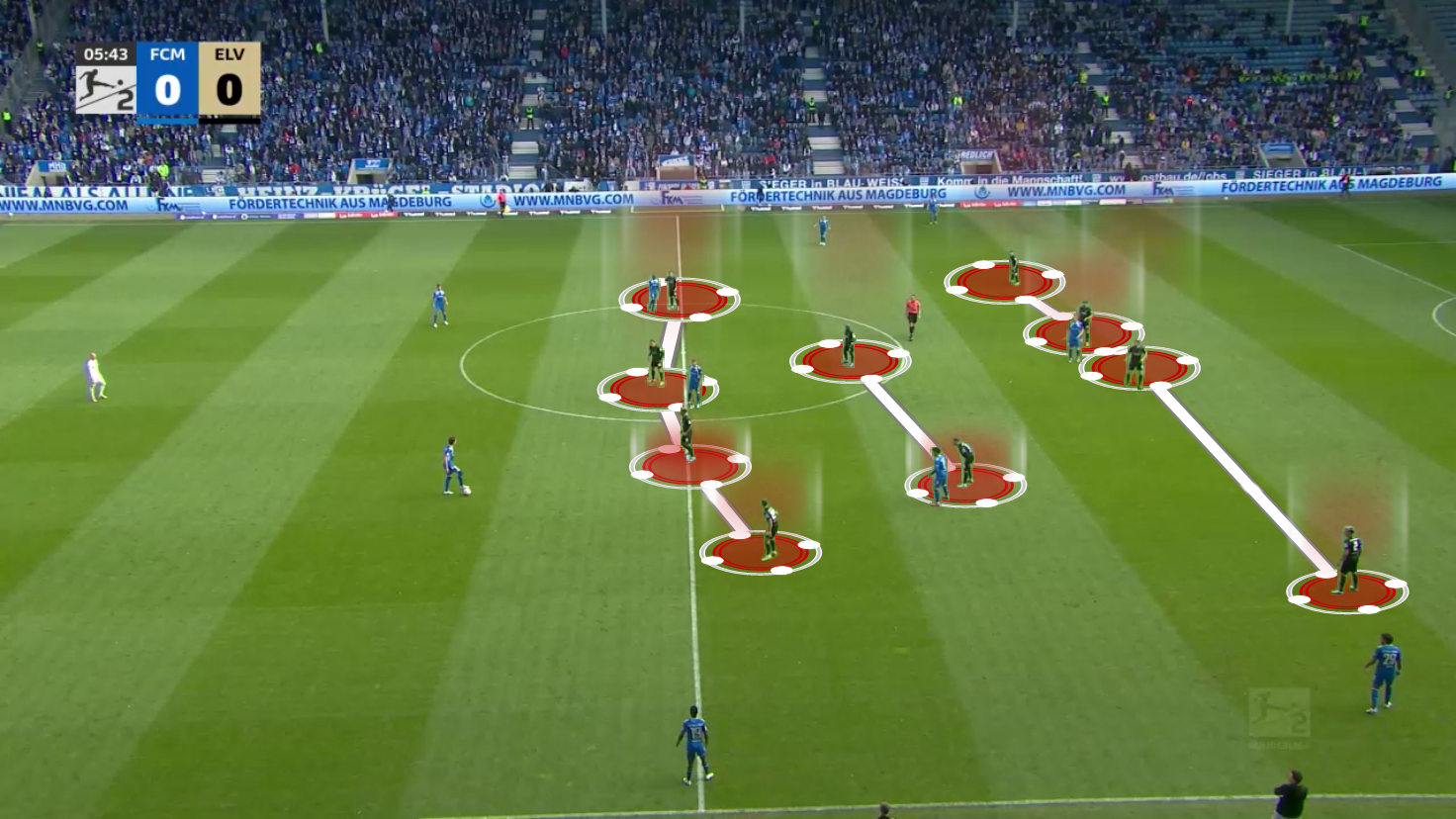
Often, Wagner has his men play out of a 4-2-4 shape against the ball, with the attacking midfielder moving forward to become a second striker and the wingers in advanced positions.
He does that to ensure he can control the opposing team’s build-up instead of just waiting in a deep block.
Overall, Elversberg attacks the ball with a very high pace and intensity, which often results in hectic games and numerous mistakes from their opponents.
They manage to suffocate teams like that.
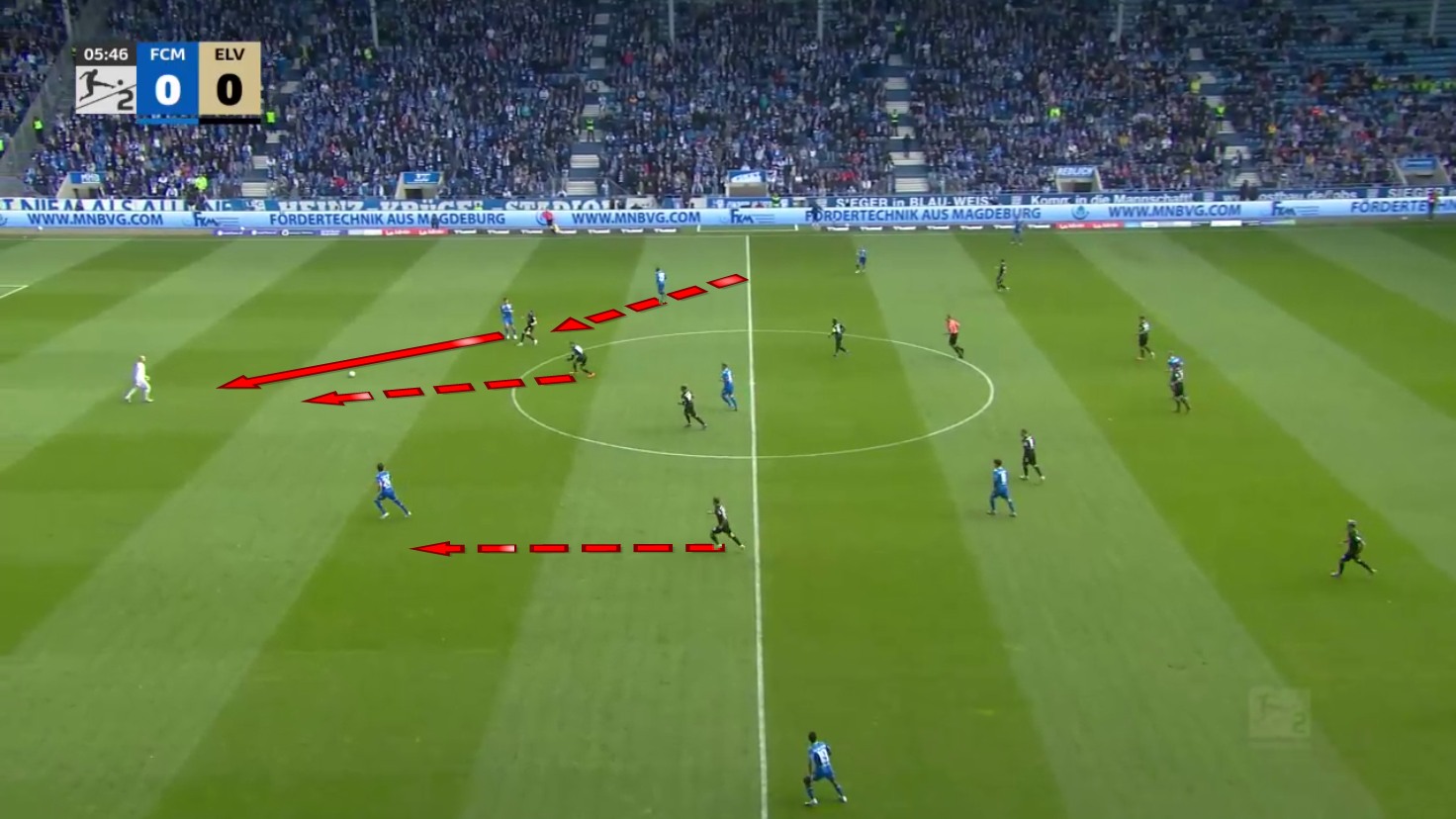
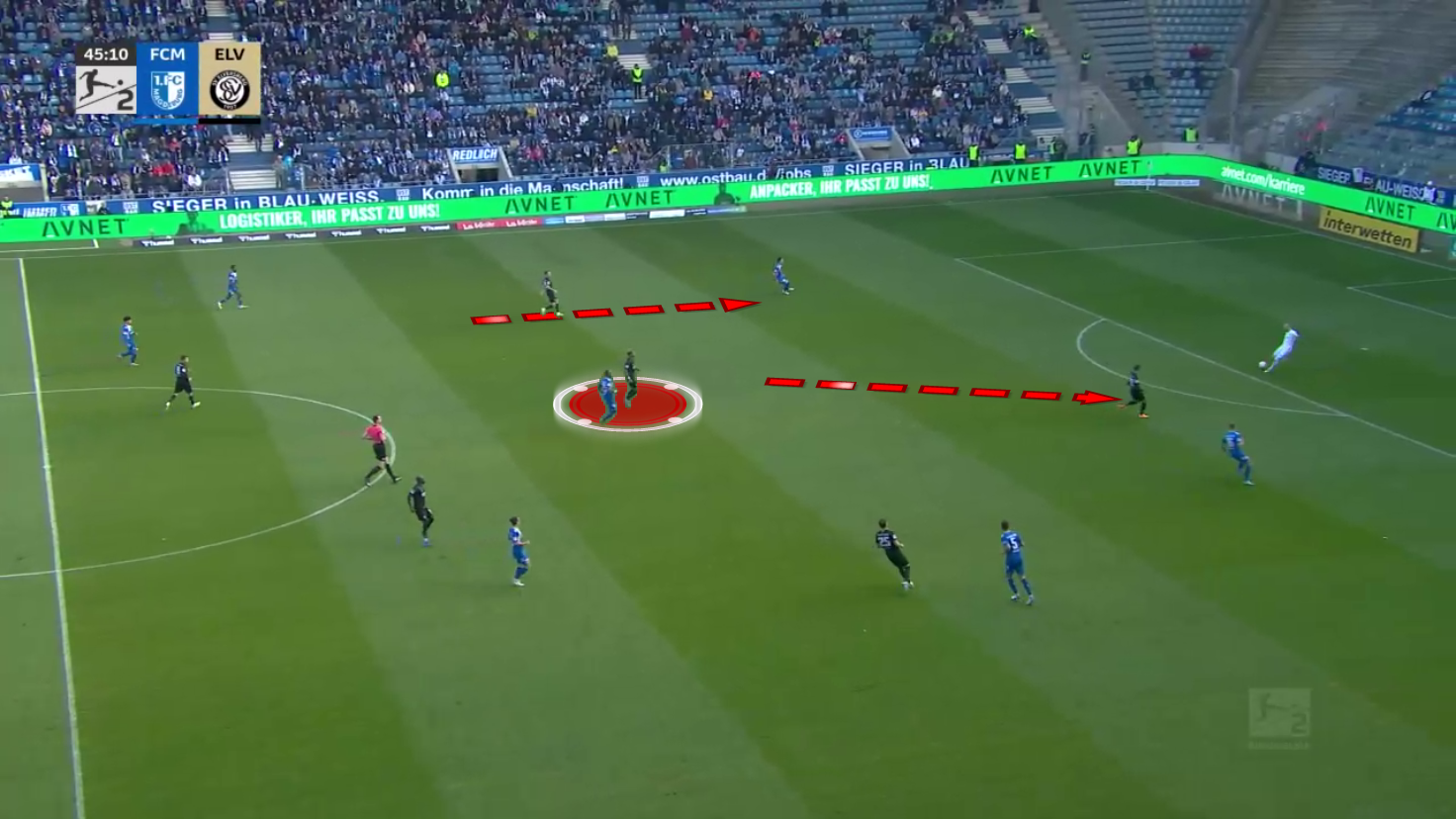
Against Magdeburg, Elversberg was the heavy favourite, so Wagner decided to be incredibly aggressive in their press.
Elversberg likes to drop back into a midfield press when their press in line 1 is not working, but they trigger their press on nearly every backwards pass.
In the situation pictured above, they do precisely that and press a backwards pass to the goalkeeper.
The right winger moves forward onto the centre-back, leaving the full-back wide open, but it doesn’t matter, because Ebnoutalib is already pouncing on the pass towards the goalkeeper.
The left winger also moves forward on the centre-back, leaving the full-back open, but it doesn’t matter at all; they force a long ball.
Just after the second half started, they did the same.
Magdeburg was playing the first passes backwards, and Elversberg did not hesitate one second to press forward.
The striker once again presses the keeper, and the wingers mark the remaining players, forcing a long ball.
Wagner has all players do that, except for one, Conté, in the centre.
While they take a lot of risks, Wagner always has Conté as a second striker behind Ebnoutalib, covering off the passing lanes towards the holding midfield.
So when their press doesn’t get a drip, it has to be beaten through the outside, and they can comfortably fall back into their midfield press again.
It’s been very interesting to see them work as a unit against the ball, but it will be interesting to see if they can maintain that risky playstyle against the league’s tougher opponents.
Conclusion
Ultimately, the footballing world needs to give Nils-Ole Book his flowers.
Not only did the CSO guide SV Elversberg from amateur football to the 2. Bundesliga, but he also guided them through this rebuild they had to take on this summer, and they look as sharp as ever.
Book made a very good decision in hiring Vincent Wagner.
Wagner tweaked many of the preexisting structures slightly to preserve the club’s identity while also improving the team.
Their play in possession is especially impressive.
Their diagonal play is incredibly fun to watch and nearly impossible to defend, resulting in many good attacking actions for Elversberg and allowing them to score many goals.
The question that remains is the same as last year: Will the young team be able to consistently play at this level over the course of 34 games?
I think they have the potential to do so, but they lack the individual class that Damar and Asslani provided for them last year; however, the league is also weaker compared to the previous season.
It will be interesting to see if Elversberg can hold on to their position.
Maybe the end of an era with Horst Steffen really opened up the possibility of a new fairytale under Vincent Wagner.
