
Aston Villa defeated Manchester City by a slender margin of 1-0 in round 9 of the 2025/2026 Premier League.
The result saw Unai Emery’s Villa close the points gap to just one, leaving City in fifth place.
Meanwhile, the hosts are now in eighth, just behind Liverpool on goal difference.
Villa put in a commendable defensive display, allowing Man City just two shots in the first half and a total of just two big chances in the entire game.
Additionally, both sides had similar numbers for total passes, opposition box touches, and final third entries, suggesting the hosts demonstrated formidable attacking intent.
Through this tactical analysis, we will examine how the Villans kept Pep Guardiola’s Manchester City out, created their chances, and scored the winner.
Watch Unai Emery Tactical Analysis On YouTube
Aston Villa Vs Manchester City Lineups & Formations
Let us look at how Unai Emery and Pep Guardiola fielded their squads.

Aston Villa Lineup
Villa played in a 4-2-3-1 formation.
Emiliano Martínez was in goal, behind a back four of Matty Cash (right-back), Ezri Konsa (right centre-back), Pau Torres (left centre-back), and Lucas Digne (left-back).
Digne came off for Ian Maatsen after 86 minutes.
Boubacar Kamara and Amadou Onana were the pivots.
The front four comprised skipper John McGinn (right-winger), Morgan Rogers (centre attacking midfielder), Emiliano Buendía (left-winger), and Ollie Watkins (striker).
Ross Barkley subbed McGinn off in the 74th minute, and Jadon Sancho, who replaced Buendía after just 29 minutes, was also taken off for Evann Guessand in the 74th minute.
Meanwhile, Watkins made way for Donyell Malen at the 86th minute mark.
Manchester City Lineup
Man City played in a 4-1-4-1 formation.
Gianluigi Donnarumma started between the sticks.
The back four had Matheus Nunes (right-back), John Stones (right centre-back), Rúben Dias (left centre-back), and Joško Gvardiol (left-back).
Stones was taken off for Nico O’Reilly after 61 minutes.
Tijjani Reijnders played as the single pivot and was subbed off for Rayan Cherki after 76 minutes.
Oscar Bobb (right) and Savinho (left) were the wingers; meanwhile, Phil Foden and captain Bernardo Silva were the starting attacking midfielders.
Bobb made way for Jérémy Doku and Silva for Nico González at the 61st minute, and Omar Marmoush came on for Savinho after 84 minutes.
Erling Haaland started as the lone striker and played on for 90 minutes.
Aston Villa Attacking Tactics
In this section, we will look at the attacking features of Aston Villa’s play.
Aston Villa Build-Up & Progression
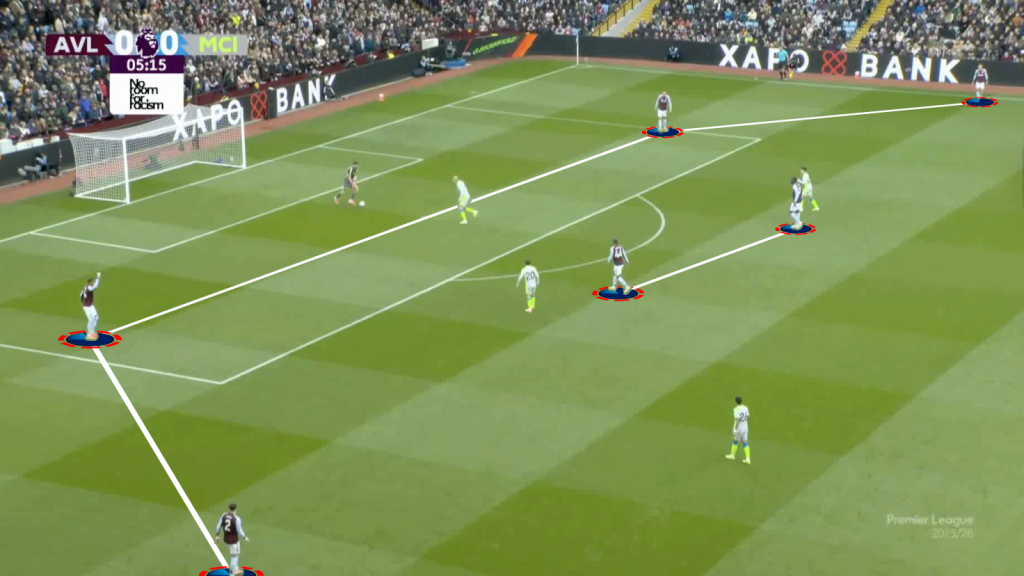
Villa lined up in a 4-2-3-1 formation.
While the centre-backs and full-backs were seen spreading out to use width, the pivots stayed close to each other in the defensive third.
Whenever the goalkeeper moved the ball to one side, both of them started shifting across to get into useful supporting angles.
In the first phase of build-up, the pivots formed passing triangles with the respective full-backs and centre-backs.
These triangles were effective in breaking the first line of Man City’s press.
The first pass from the centre-back went inside or outside, depending on the direction of the first press.
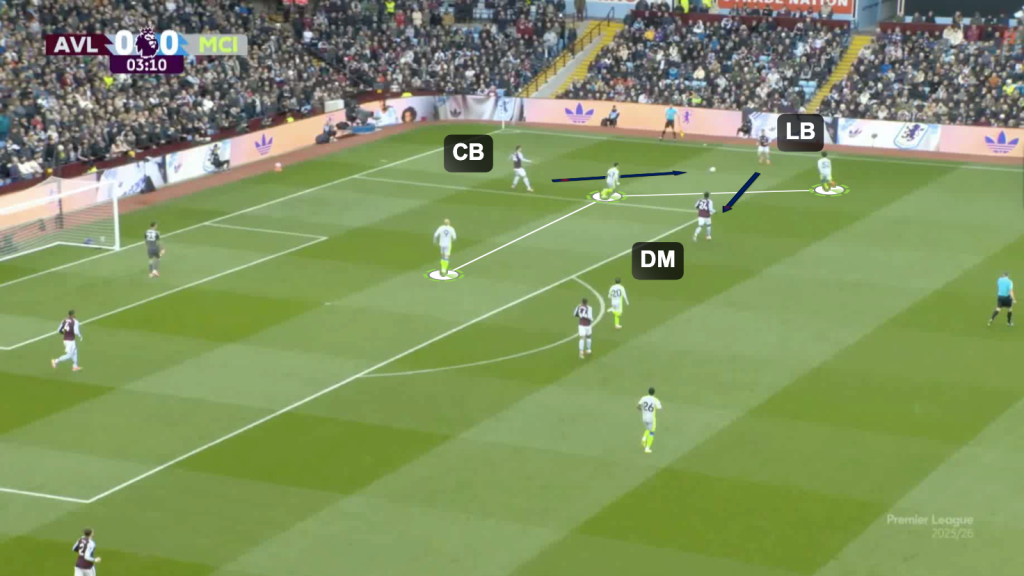
In this situation, the ball is moved out to in, since the first press is from inside, cutting the passing lane to the pivot.
The centre-back passes it to the full-back, who passes it to the pivot, breaking the first line of the opponent’s press.
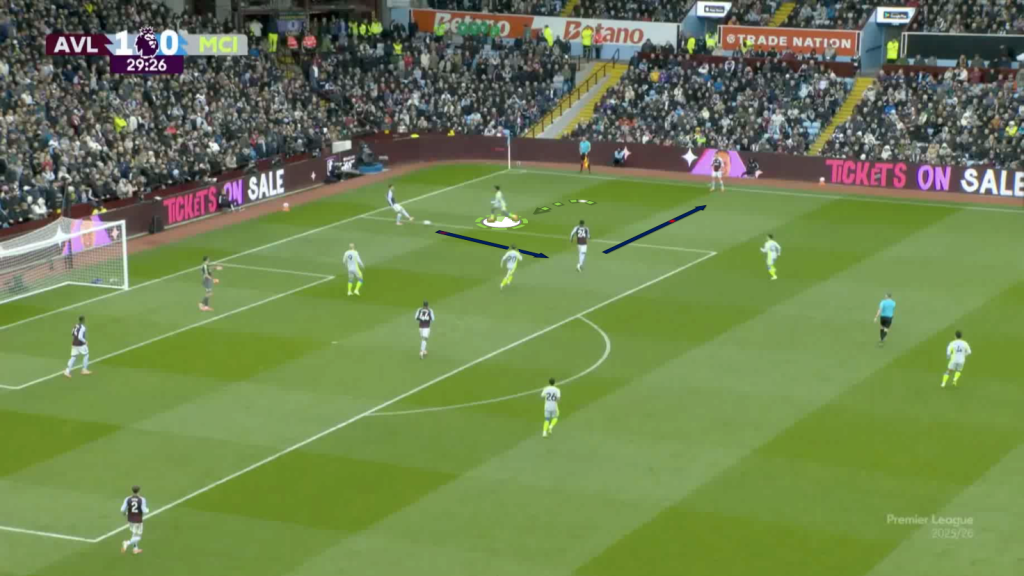
Here is an example of in to out: the first press is from outside, cutting the pass to the full-back.
The centre-back moves it to the pivot, who plays it to the full-back.
The idea of playing these third-man passes to move the ball into space helped Villa progress all the way to the opponent’s half and, at times, the attacking third.
During slightly higher build-up scenarios, once the ball was moved to either half-space, the near-side pivot and the winger moved across to form a diamond.
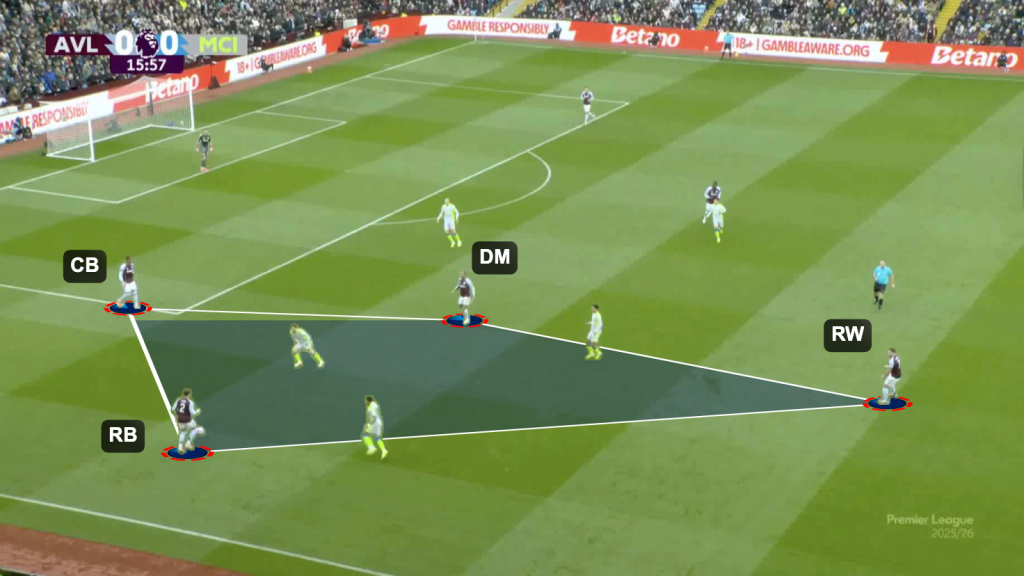
Here is an example: The centre-back stays at the base with the winger at the top (both in the half-space); meanwhile, the full-back goes out wide, with the pivot staying as the central-most of the four.
Making a diamond shape in the build-up enabled Villa to create more passing angles.
If City matched the numbers in the wide zone, Villa went backwards and shifted the play through the goalkeeper.
In the scenario above, Aston Villa progress through a diamond pass combination.
The left centre-back plays to the left-back, who sets it to the near-side pivot.
As the pivot plays it to the left-winger, the left-back’s movement drags an opponent.
This opens space for the left-winger to carry the ball through the midfield third.
Through a simple diamond structure, Villa end up in a 5-v-4 numerical advantage in the attacking half.
Here is an example of a smooth entry into the attacking half from a static build-up.
The Villa players exploit the space between Man City’s lines, and almost find a pass in-behind.
There were situations when playing on the ground was infeasible for Aston Villa.
Emiliano Martínez used these situations to showcase his distribution.
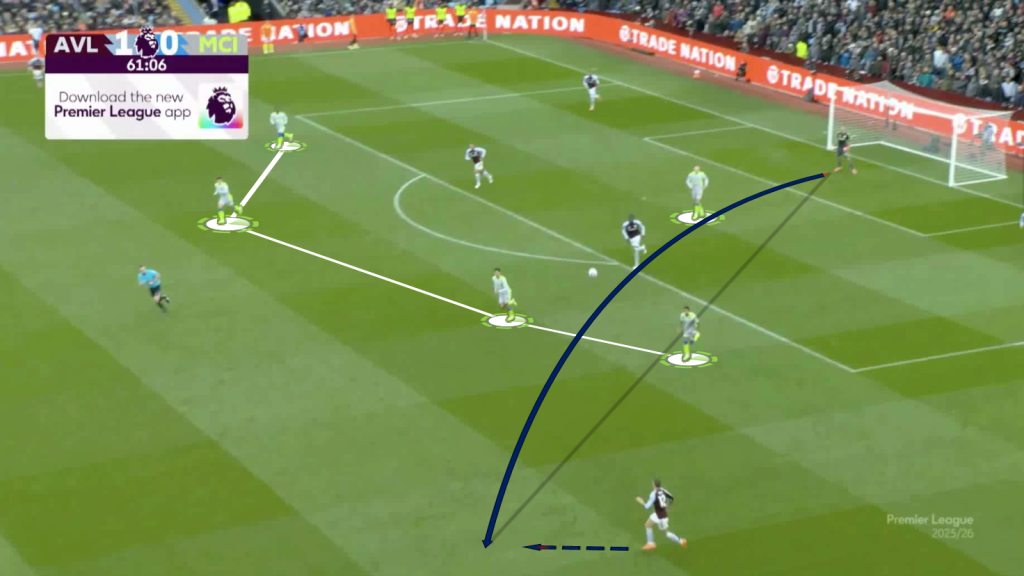
There were instances in which a single pass from Martínez removed up to five Man City players from the game.
In the image above, four City players and Erling Haaland are pressing, while both Villa pivots (Kamara and Onana) are positioned deep.
A simple pinged ball to Digne does the trick for Unai Emery’s side.
Boubacar Kamara & Amadou Onana: Involvement In Progression
Boubacar Kamara and Amadou Onana played important roles in Aston Villa’s attacking phase actions.
The midfield duo positioned themselves interchangeably in possession, especially in the midfield third.
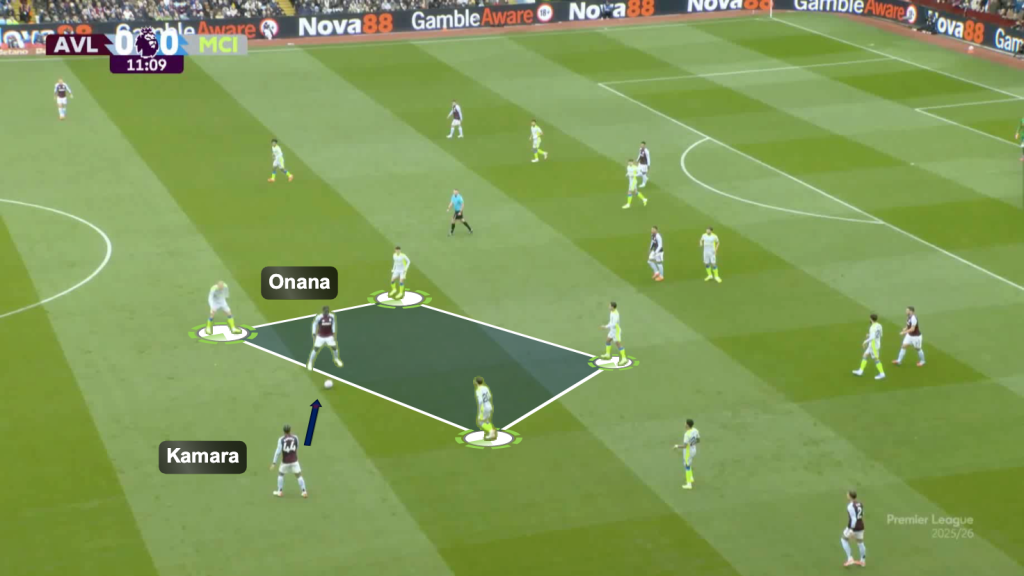
Here, Kamara is outside the opponent structure, while Onana receives inside the structure.
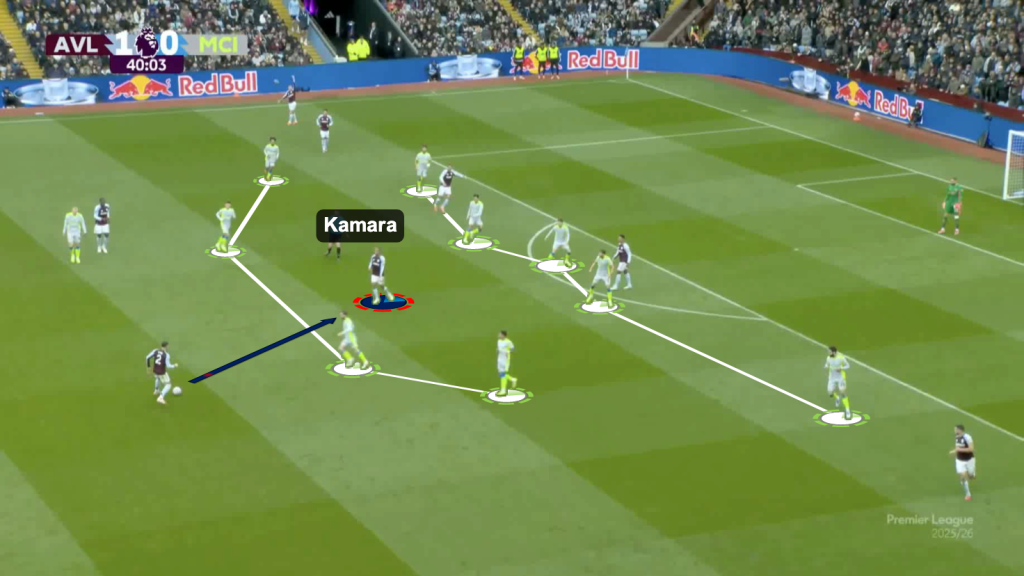
Here, Kamara receives close to the zone 14, between the opponent’s midfield and defence lines.
Being physically imposing, both used this to shield the ball when driving up the pitch.
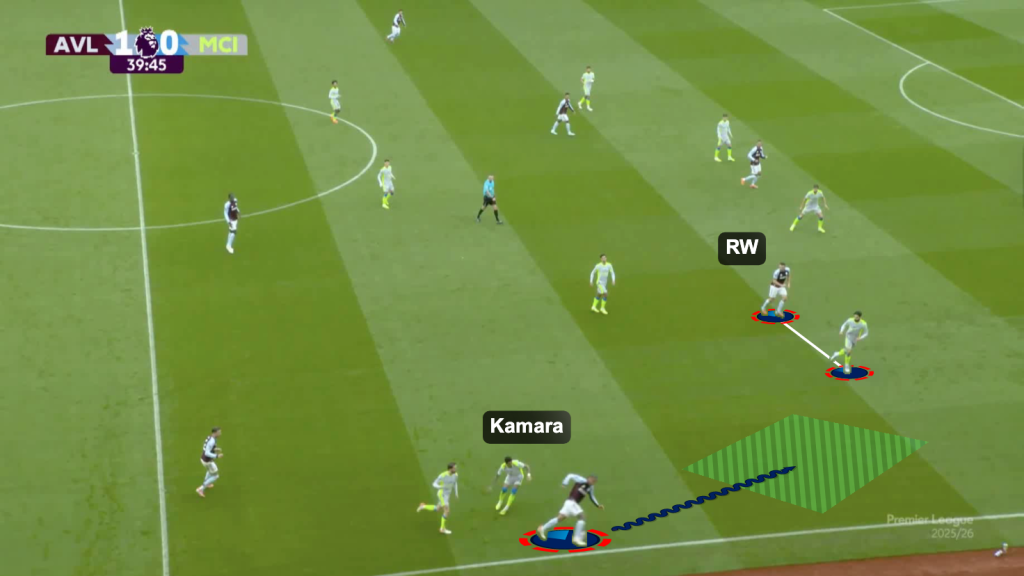
Here is an example: Kamara carries the ball into the wide area, leaving two opponents behind.
In the meantime, the winger stays in the half-space, dragging the opponent full-back, giving Kamara more space to work with.
In this situation, Onana stays in the central channel, active in rest defence.
Entering The Final Third
Unai Emery’s side displayed a direct approach when attempting to enter the attacking third.
They used either deep runs or players running in-behind the shoulder of opponents.
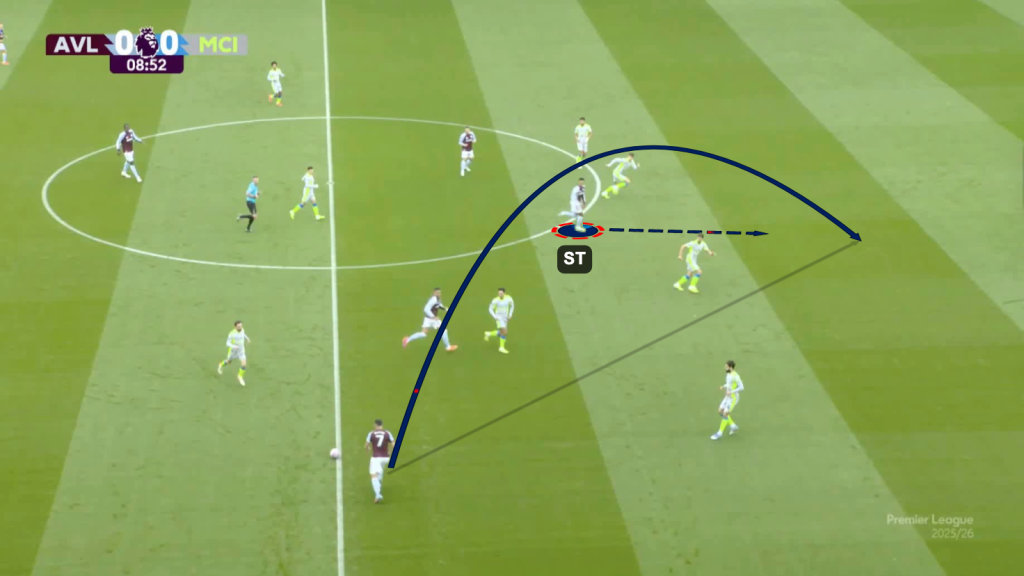
Here is a run from deep: Ollie Watkins starts the move; by the time the ball reaches John McGinn in the wide area, the striker is running on a defender’s blindside.
These moves are possible against opponents who press high, since their backline stays close to the halfway line.
This opens an ample amount of space in-behind.
Here is an example of a run from a higher starting position.
Villa shifts play in the midfield third.
As the ball reaches the right back, the right winger attracts his direct opponent.
He makes a double movement, initially dropping a couple of steps towards the ball, which attracts the opponent, and then accelerating in-behind.
The double movement gives him a few extra yards of space when playing the final pass.
Cutbacks from the wide areas helped Villa a huge deal, especially for the goal scored by Matty Cash.
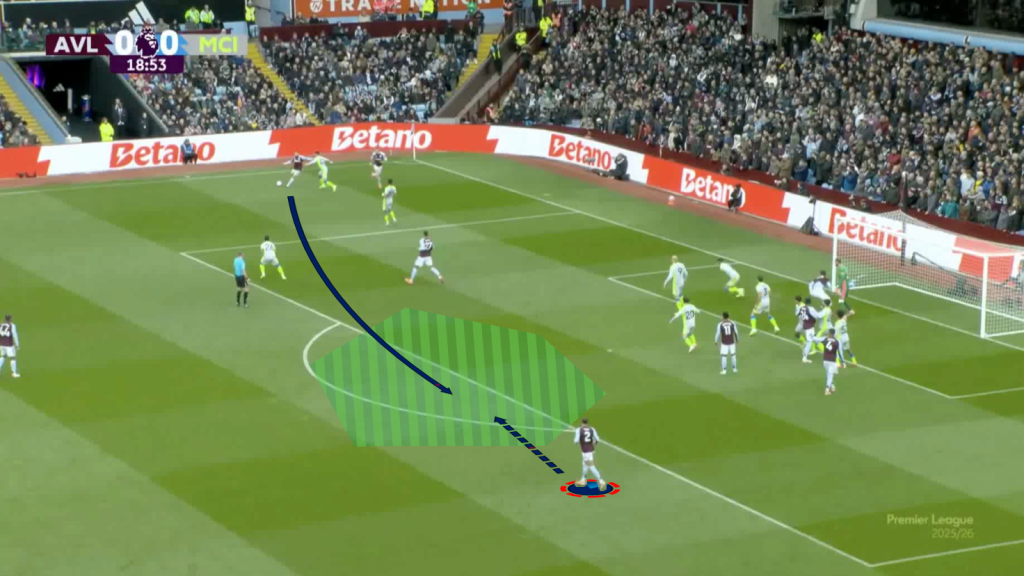
Villa play a short corner; Man City anticipate a cross and leave Matty Cash unmarked in zone 14.
Upon receiving the cutback, he has enough space to take touch and finish with his weak foot.
Aston Villa Defending Tactics
In this section, we will look at the defensive features of Aston Villa’s play.
Aston Villa Defending In Opponent Half
Aston Villa’s high pressing actions were more frequent during the first half.
Their objective was to squeeze the opponents in the wide area to force a long ball.
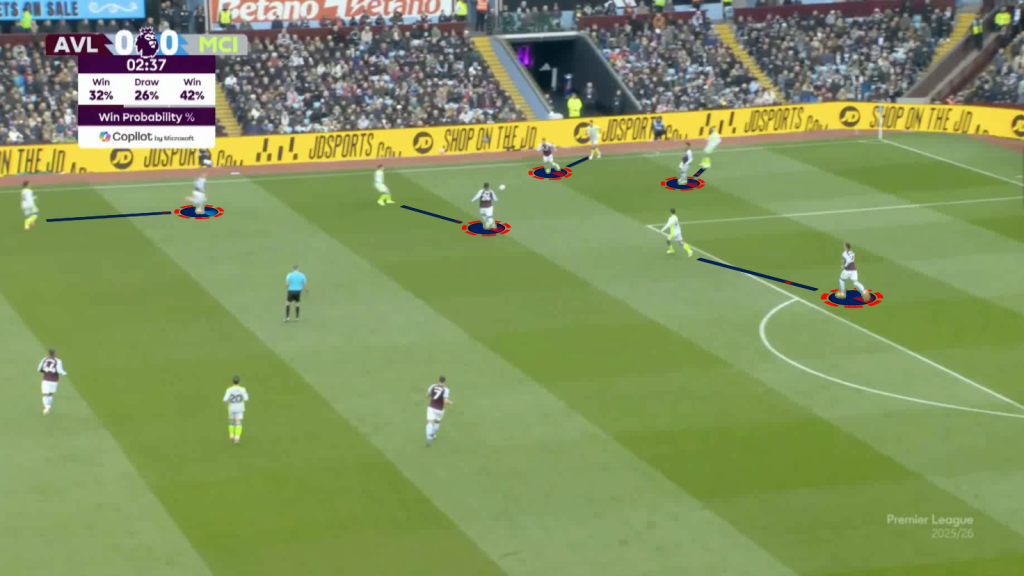
Here is an example of Villa catching Man City in a wide squeeze high up the pitch.
They are pressing with numbers.
However, City were successful in playing long and winning the second ball more often than not.
Emery gradually changed his approach throughout the game.
Aston Villa Defending In Midfield Third
Villa adopted a mid-block as the game progressed, going to a low-block when required.
In negative transition moments, the hosts kept their backline compact and delayed as long as possible.
Their idea was to force the opponent into making a decision.
Here is an example: Villa get dispossessed in the opponent half; as the opponent carries the ball, the hosts make sure to keep their back four intact.
The defenders delay and wait for the midfielders to track back.
As shown in the video, while dropping as a unit, the defenders are zonally defending individual opponents.
By not lunging in, they cut out the passing options for the ball-carrier.
Eventually, their midfielders track back and engage with the ball carrier, forcing him to take a shot from an unfavourable angle.
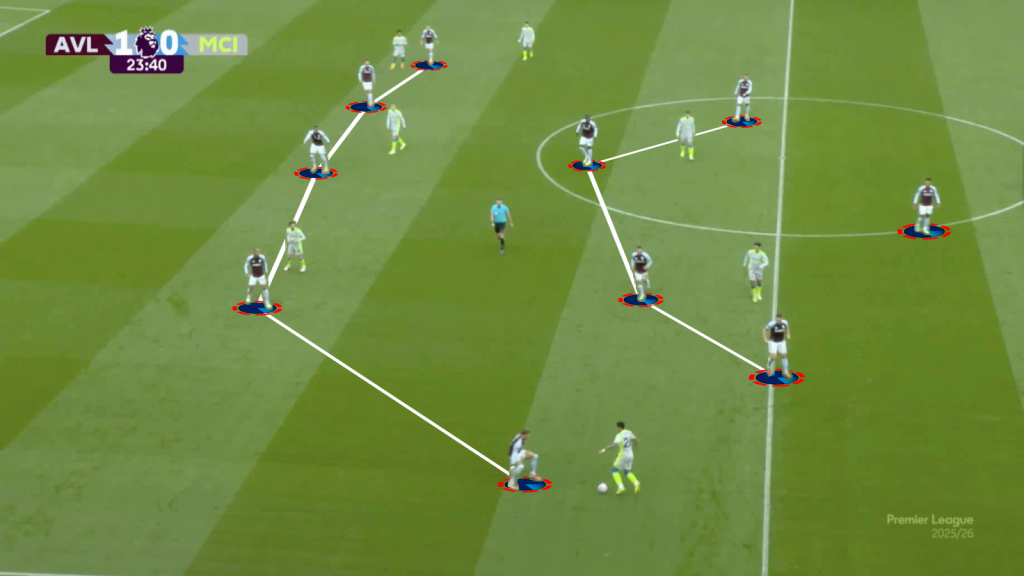
Villa’s defensive shape in a mid-block was 5-4-1.
Kamara was seen dropping into the backline to provide extra solidarity.
This also helped the full-backs in engaging their direct opponent in the wide channel.
In the image shown, Cash steps up to close down his opponent.
However, Kamara dropping in the backline helps keep the shape intact.
Man City attacked in numbers, especially in midfield.
With increased opponents, Villa needed to match the numbers to keep their structure from being penetrated.
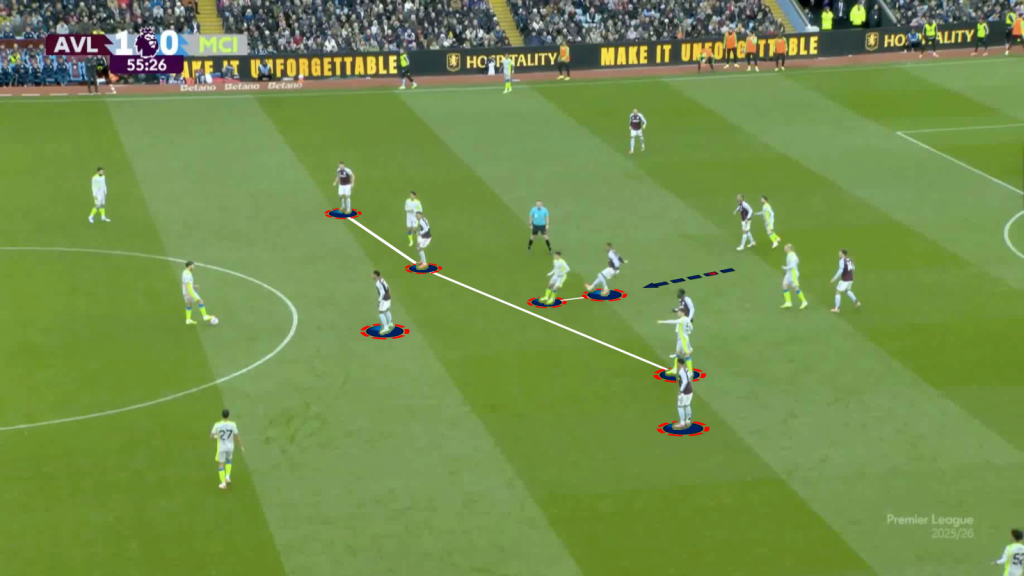
In situations like these, members from the backline jumped to limit vertical passes through their structure.
In the image shown here, Kamara steps up to prevent Man City from finding the free player.
In situations where City players moved in opposite directions (one player dropping and the other running in-behind), Villa had to make adjustments.
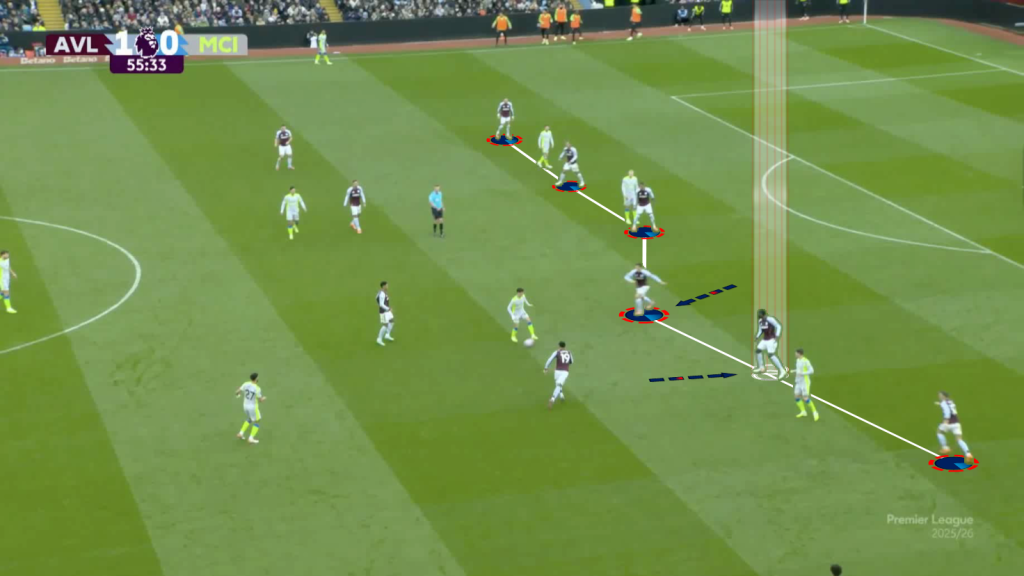
Here, a City player receives between the lines.
The closest defender from the backline steps to prevent him from going forward.
However, this leaves an opponent in the half-space.
To shut this option down, Onana drops into the backline at the same time.
These pressing and covering movements keep the structure intact.
Aston Villa also defended in a 4-3-3 mid-block shape in the latter stages of the game.
When Evann Guessand came on, he joined in as the third member in a physically dominant midfield.
This solidified Emery’s side even further.
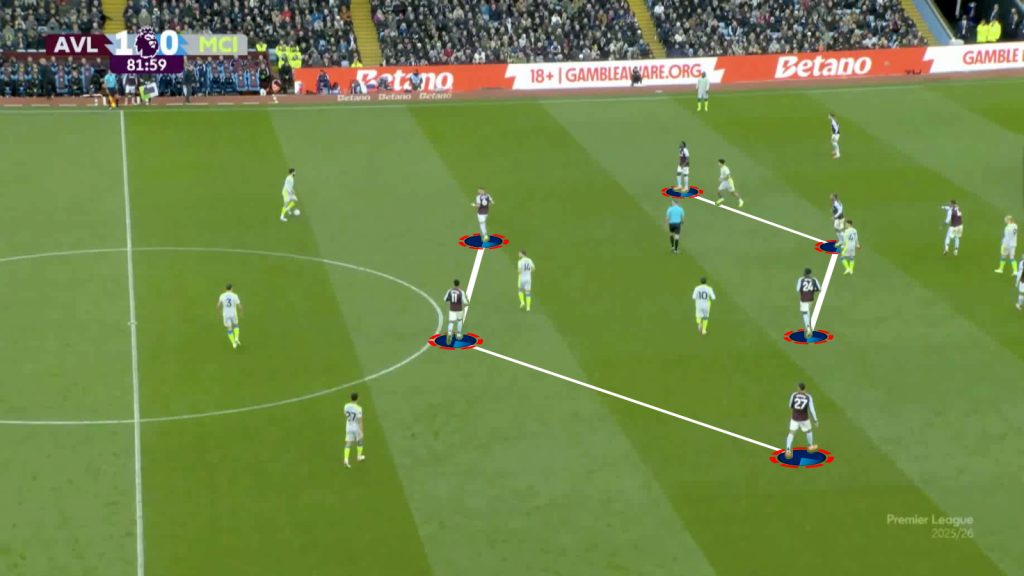
Here, we can see Aston Villa in a 4-3-3 mid-block shape.
This shape also helped them achieve more vertical compactness, dropping into the defensive third.
Aston Villa Defending In Defensive Third
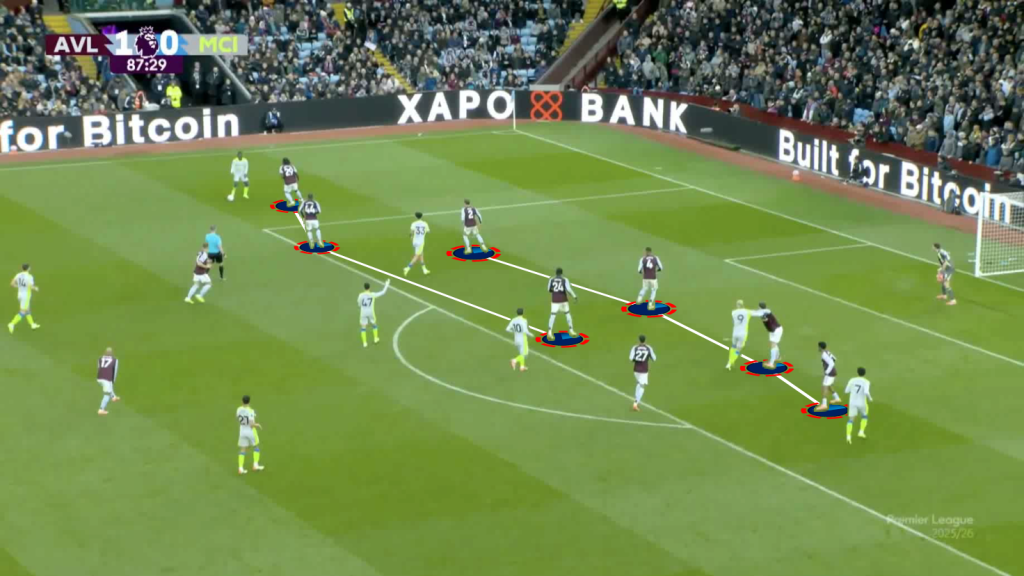
Here, Villa are defending inside their defensive third.
The midfield three drops right on top of the back four.
Villa’s vertical compactness proved to be a tedious challenge for Pep Guardiola’s side, one that they failed to penetrate.
Throughout the game, the hosts made it extremely difficult for Man City to get time and space on the ball in and around the penalty area.
In any instance where a City player received inside the box, he was either forced back or had his shot blocked.
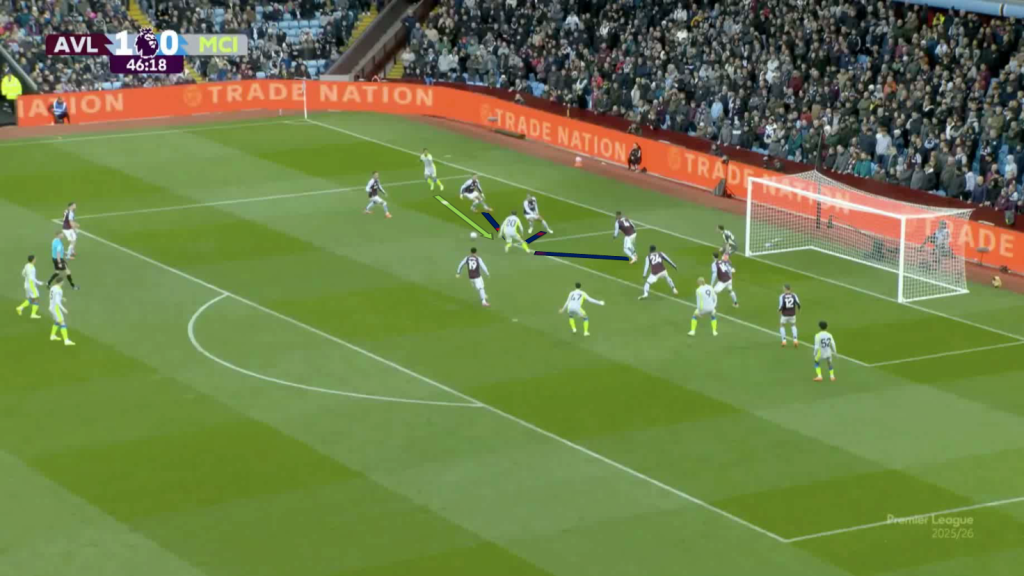
Here, a City player receives a cutback on the edge of the six-yard box.
Multiple Aston Villa players immediately close down the player.
With no space to take a shot, he is forced to go backwards.
When opponents attempted to overload the wide area, Villa responded by matching the numbers and squeezing them.
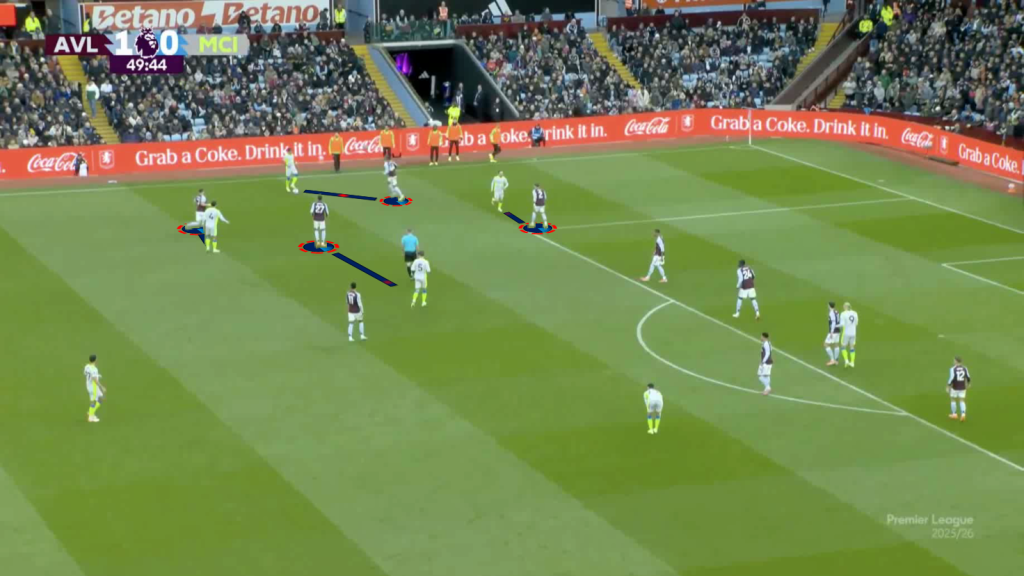
This forced them to either play it back or lose possession.
In the example above, Aston Villa have outnumbered the City ball-carrier in the wide channel, cutting the passing lanes to teammates in the vicinity.
City are forced to play backwards.
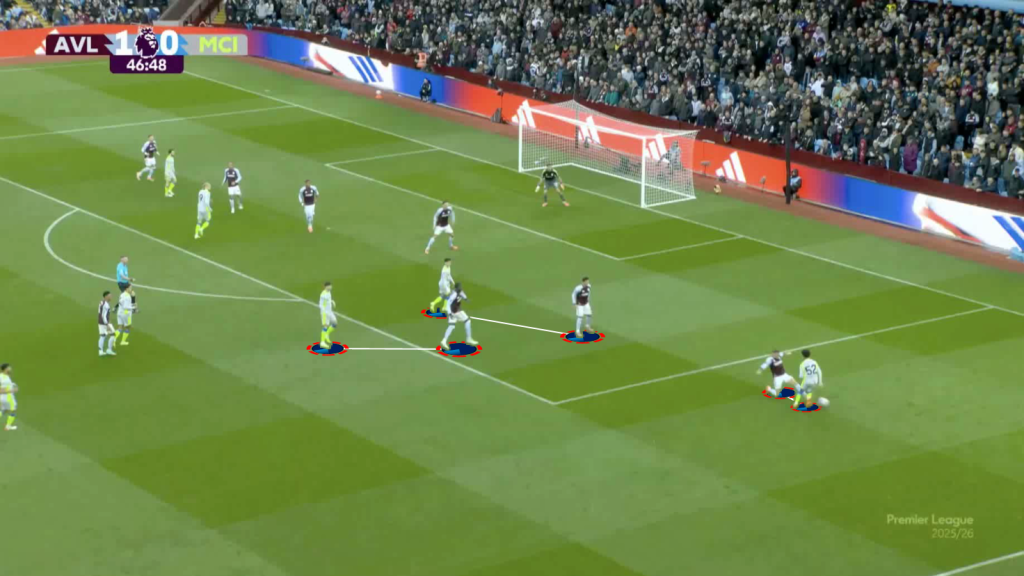
Villa also managed to win multiple defensive 1-v-1s in the wide area.
This is because of the covering defenders, who tracked the opponents who were willing to make underlaps and overlaps.
By implementing man-orientations in these situations, they prevented the opponents from combining in these areas.
Blocking crossing lanes was also a significant contribution to Villa’s defensive performance.
Guardiola realised that creating overloads would not help.
Thus, he chose to introduce Jérémy Doku.
The Belgian is adept at take-ons.
The idea was to knock it past Cash to supply crosses.
However, the Polish international stepped up to the task, blocking dangerous crosses.
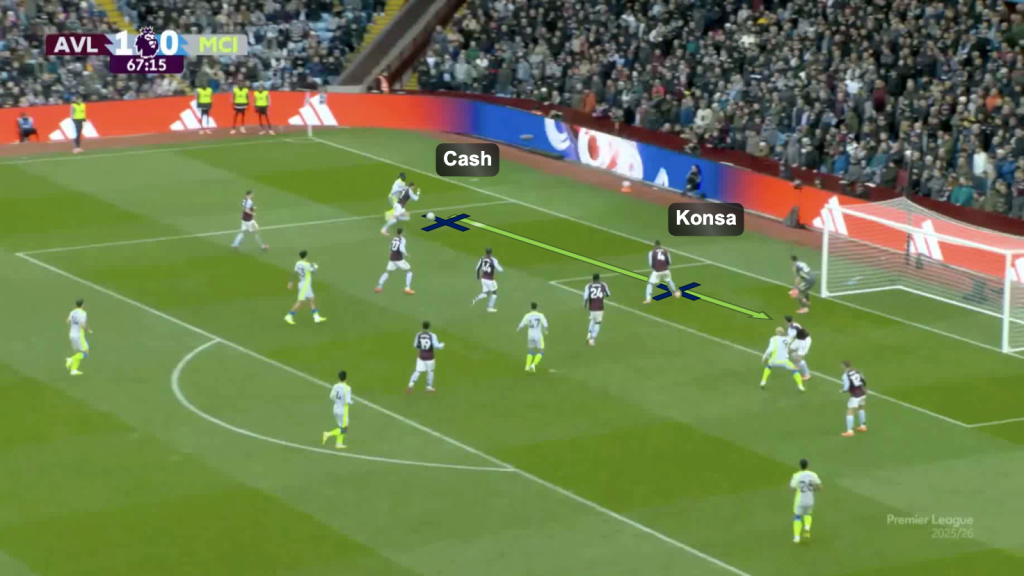
Here, Doku knocks the ball past Cash to attempt a low cross.
However, the Villa defenders’ positioning was adequate to cut out most crosses.
In this particular situation, even if Cash fails to get a block in, Konsa has positioned himself in the right area to cut it out before it causes any danger.
Conclusion
Aston Villa were brave in the build-up and progression phases, and pragmatic in the attacking third, utilising the limited opportunities they had to hurt their opponents.
Defensively, they were quick to realise that high-press would not yield much success.
Their execution of mid-block and low-block structures earned them the valuable three points.
They switched between 5-4-1 and 4-3-3 to maintain horizontal and vertical compactness throughout, filling in for each other to make sure no gaps were exploited.
Their collective effort, discipline, and resilience, along with some individual moments of brilliance in both defending and attacking phases, helped them see this game through.
