
Luton Town, under Rob Edwards, are 21st in the EFL Championship at the time of writing.
Despite playing in the Premier League just one season ago, the competitiveness in the English second division is moving them down the pecking order.
Rob Edwards’ team is one of the most aggressive at counter-pressing, but they are not materialising this skill into results.
Style aside, the quality of their players appears capable of being at the top of the qualification, with a similar playing model to that of one year ago.
Nevertheless, football is not only that.
The reality is that the Hatters’ struggles stem less from the quality of their elite players and more from a fundamental shift in identity compared to last season.
They are finding it challenging to adapt to the new ideas and tactics.
In this tactical analysis, we will examine in depth Luton Town’s main troubles during the first part of the Championship season.
Luton Town 2024/2025: Same Structure, Different Ideas
The Hatters’ tactical shape remains almost the same as it was a year ago.
Starting from a two up front, Luton Town usually plays with a 5-3-2/5-2-1-2 structure, with two holding midfielders alongside a connector between the midfield and the strikers.
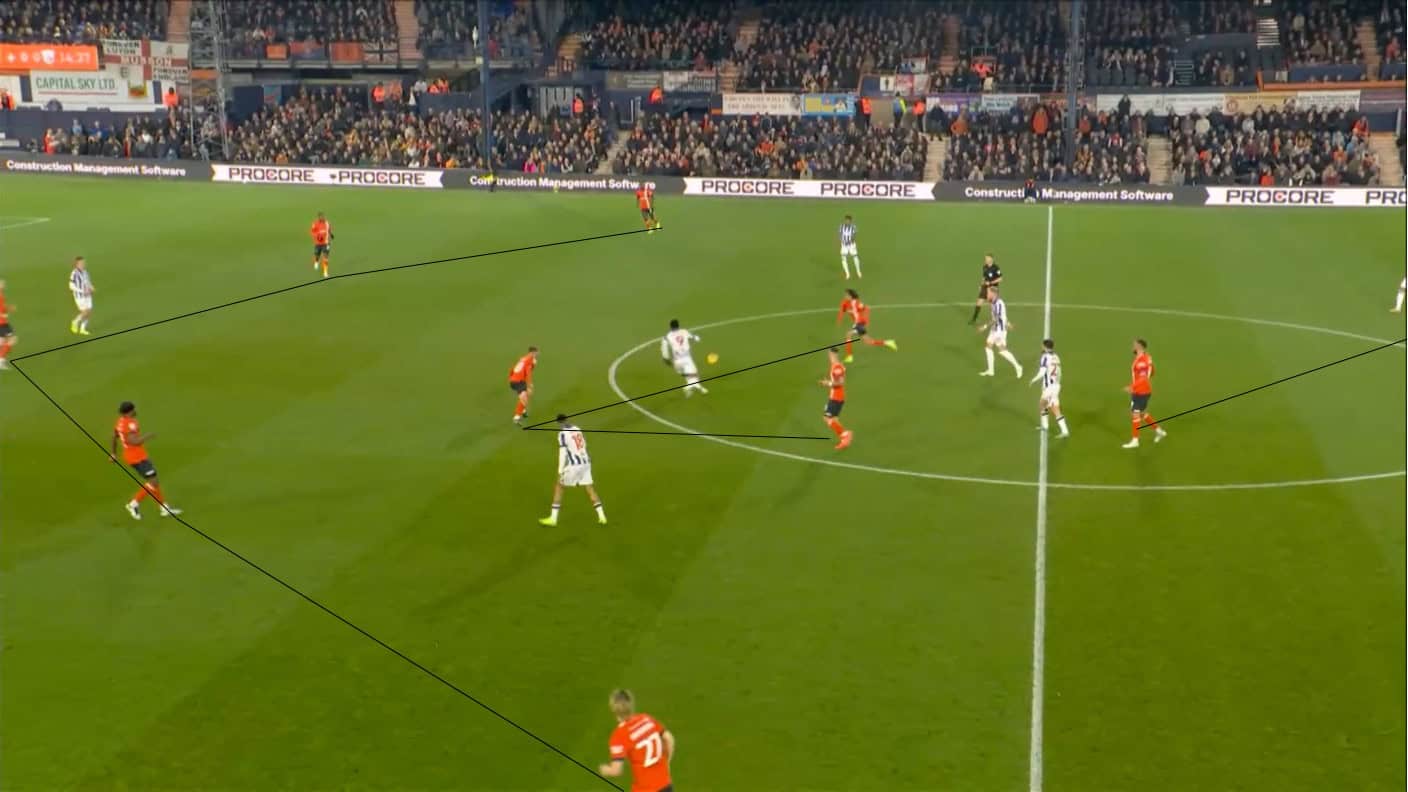
Tahith Chong is crucial here, both defensively and offensively.
The 24-year-old is an advanced midfielder with the freedom to move to the left between the lines and can also be part of the first line of pressure.
He has a strong physique to impose himself on the opposition’s build-up.
Rob Edwards Aggressive Pressing
After losing the ball, as they did last season, Luton tends to jump aggressively to recover as quickly as possible.
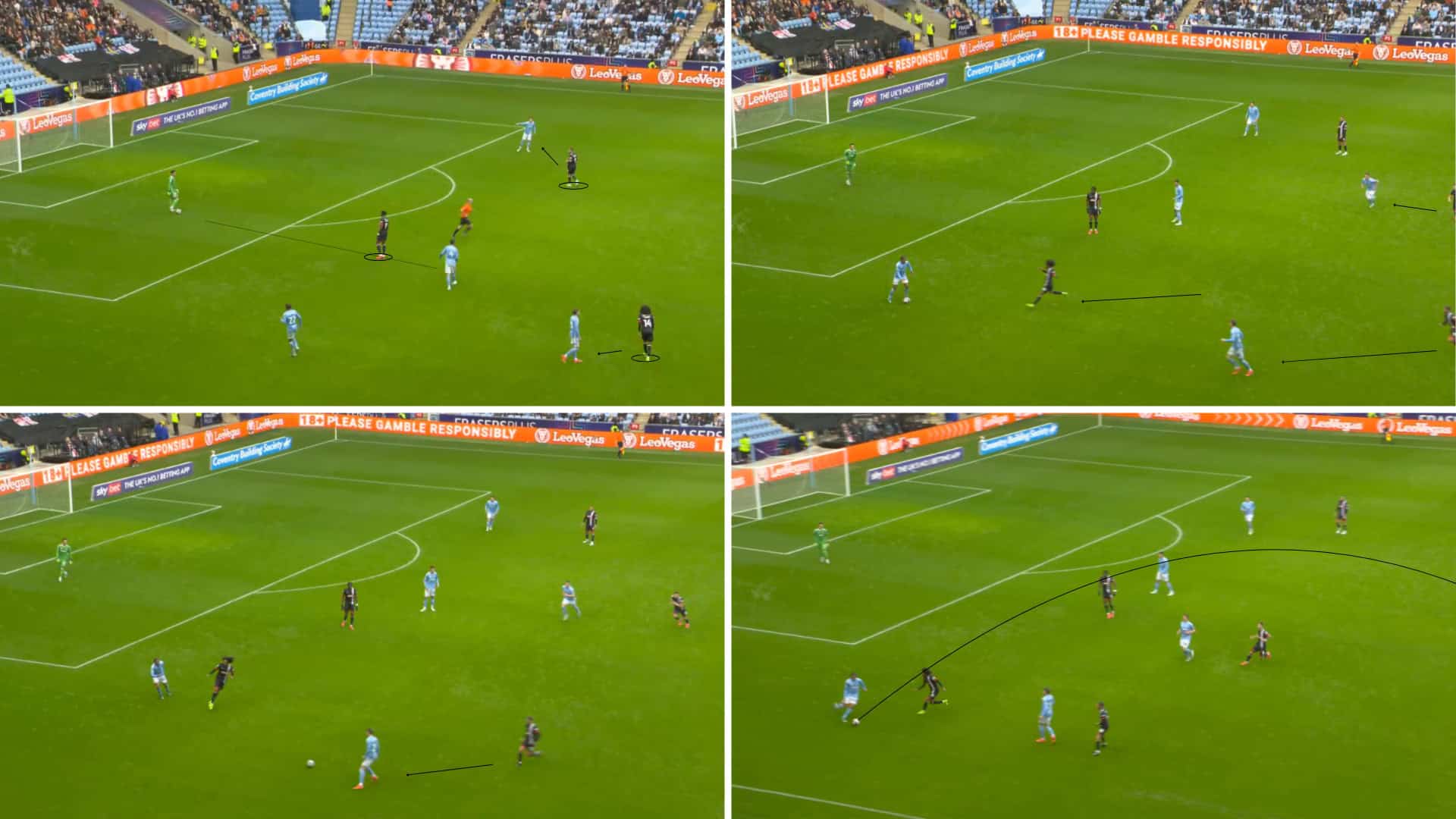
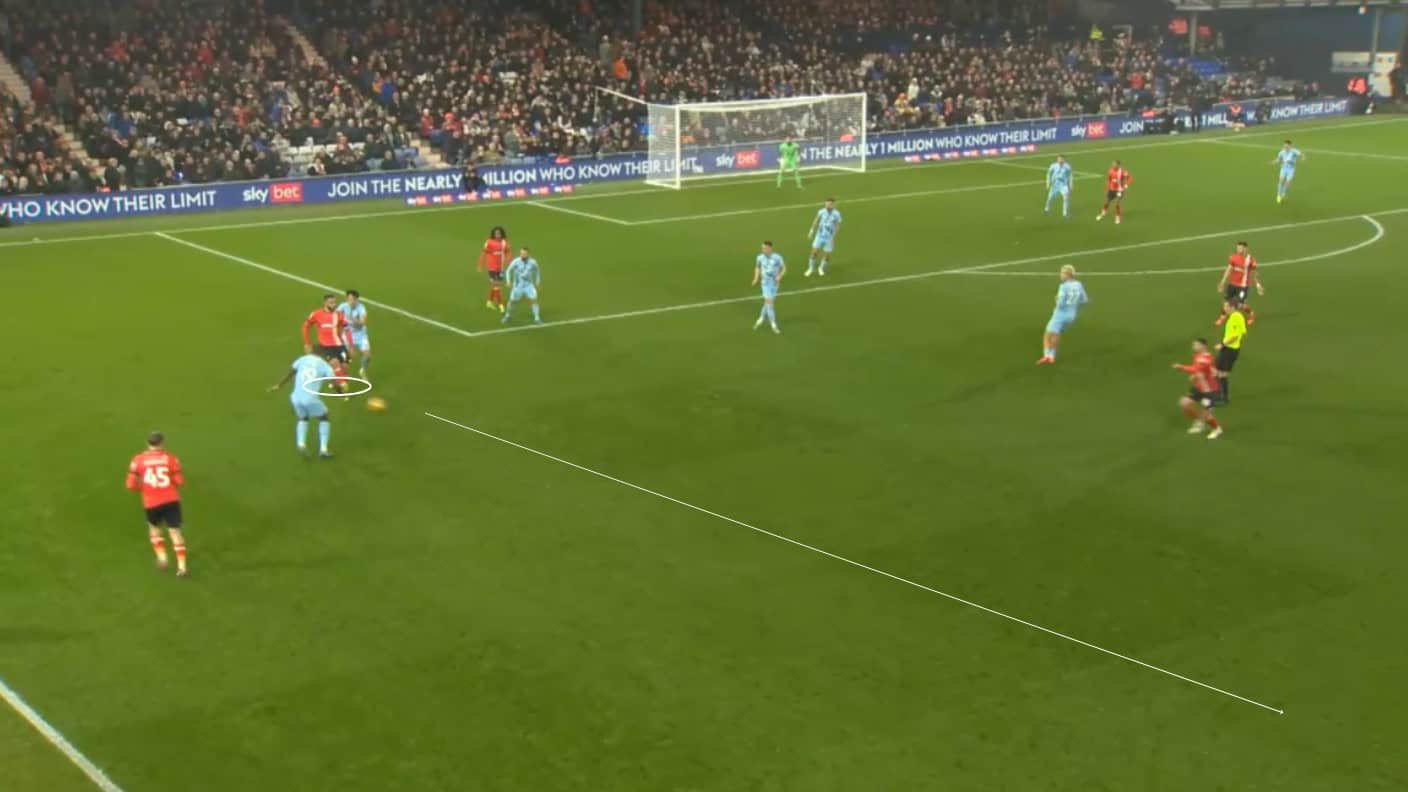
As Figure 2 shows, when the rivals restart play, Luton use an initial man-to-man marking configuration, allowing a free man in the opposition’s backline.
Even the wing-backs frequently jump higher to suffocate the rival with as many players as possible.
Once the free man receives, Luton make exchanges while marking.
The closest player (Chong in Figure 2) jumps to the free man while another covers him; they try to recover with a defensive action.
In Figure 2, Coventry were forced to continue the possession with a long ball.
In that sense, the players from Luton’s attack dominate various defensive metrics in the tournament.
Elijah Adebayo, for example, is a specialist in jumping and completing defensive actions—he is in the 82nd percentile rank in interceptions, 97th in blocks, and 91st in clearances.
Elijah Adebayo High Regains Map
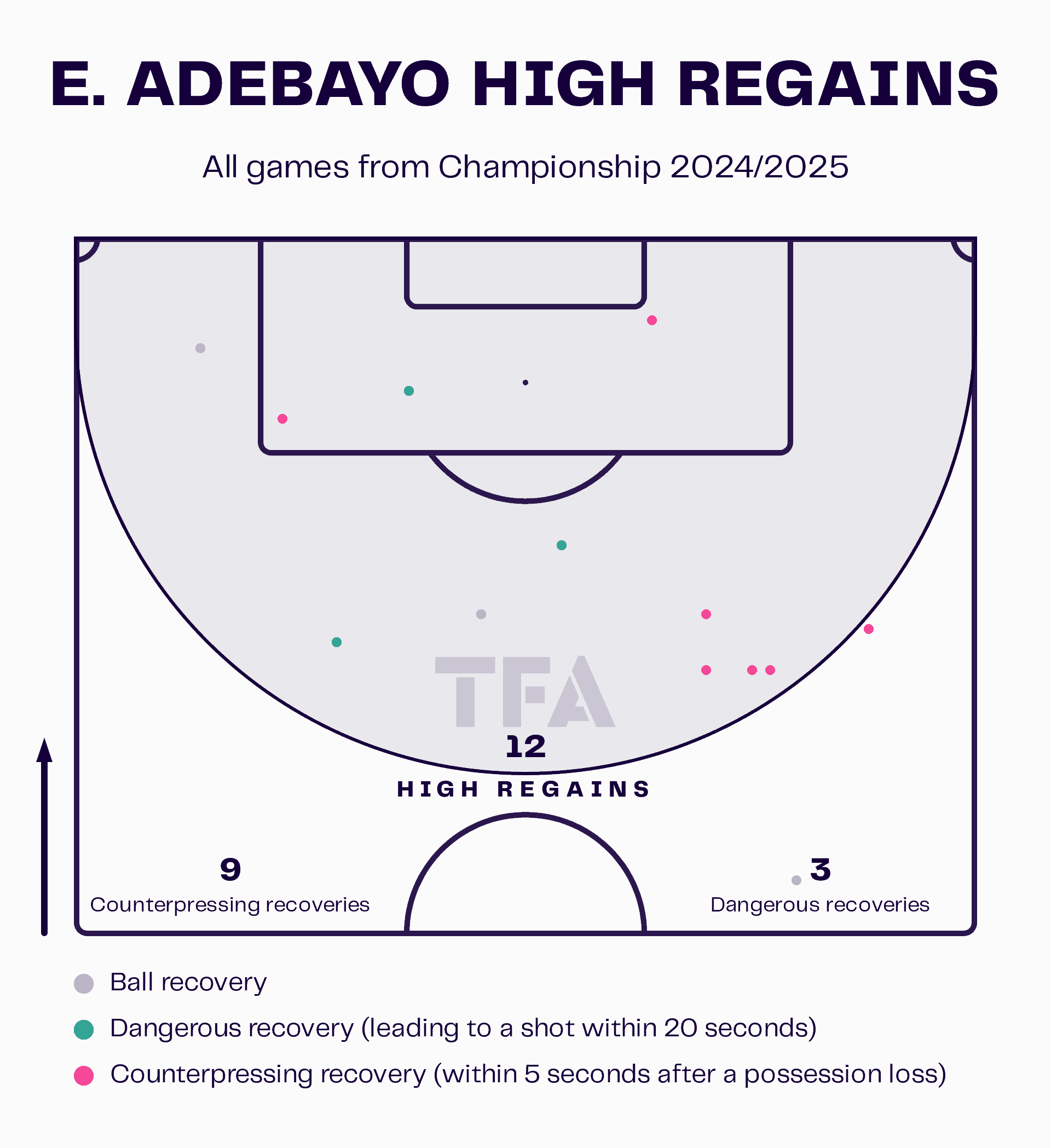
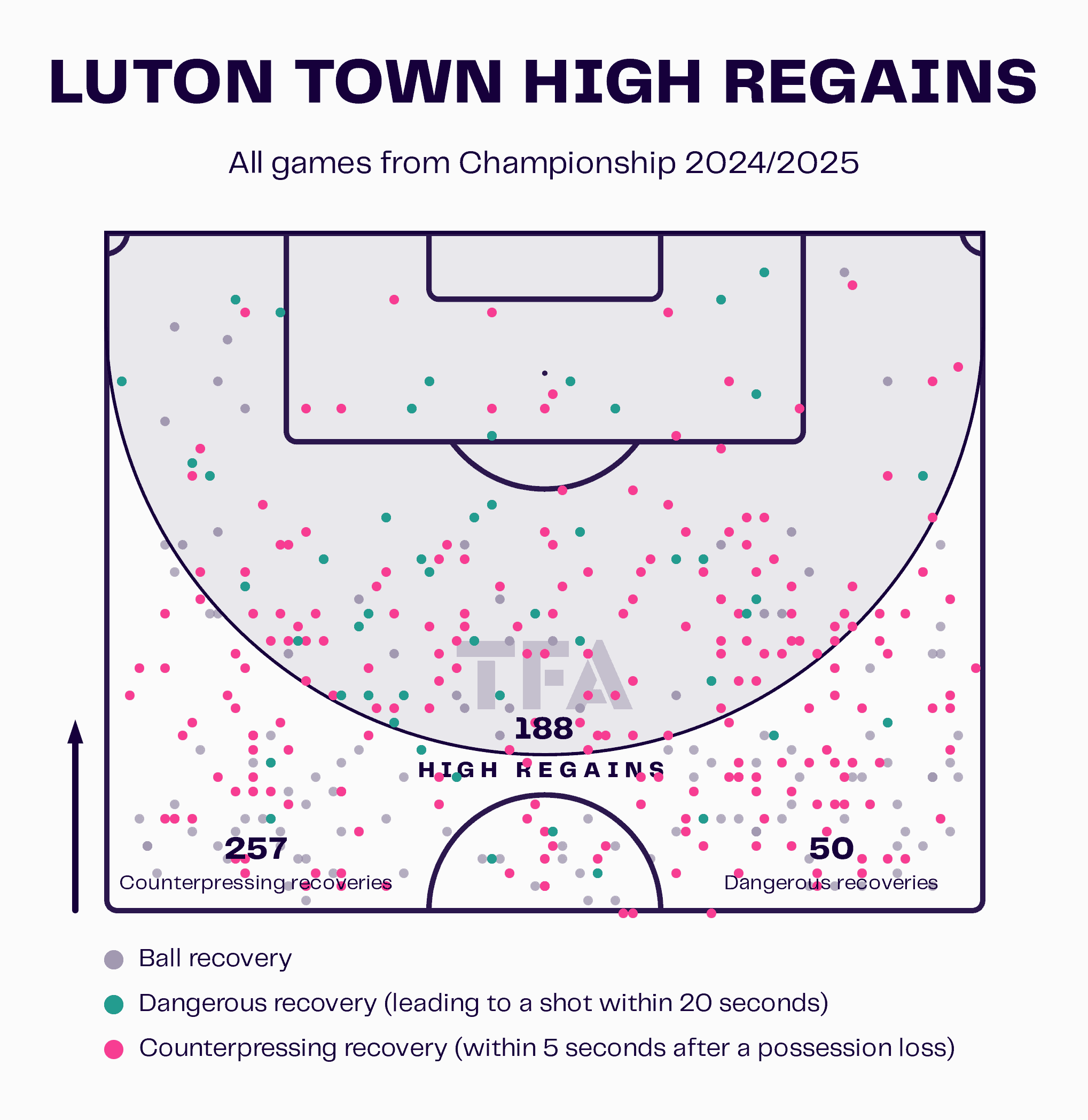
With these types of players and structures, while the opposition builds up, Luton Town leads the EFL Championship in high regains and counter-pressing numbers.
Luton Town High Regains Map
Rob Edwards Defence
Nevertheless, these long balls, as in Figure 2, are one of the main weaknesses of Luton’s defensive system.
Rob Edwards’s Luton try to defend as far as possible from their goal, but they have problems when running back.
During the defensive phase, the five-back frequently makes mistakes when covering depth.
When somebody runs in behind, his marker breaks the defensive line, opening space for the other potential runners and breaking the offside.
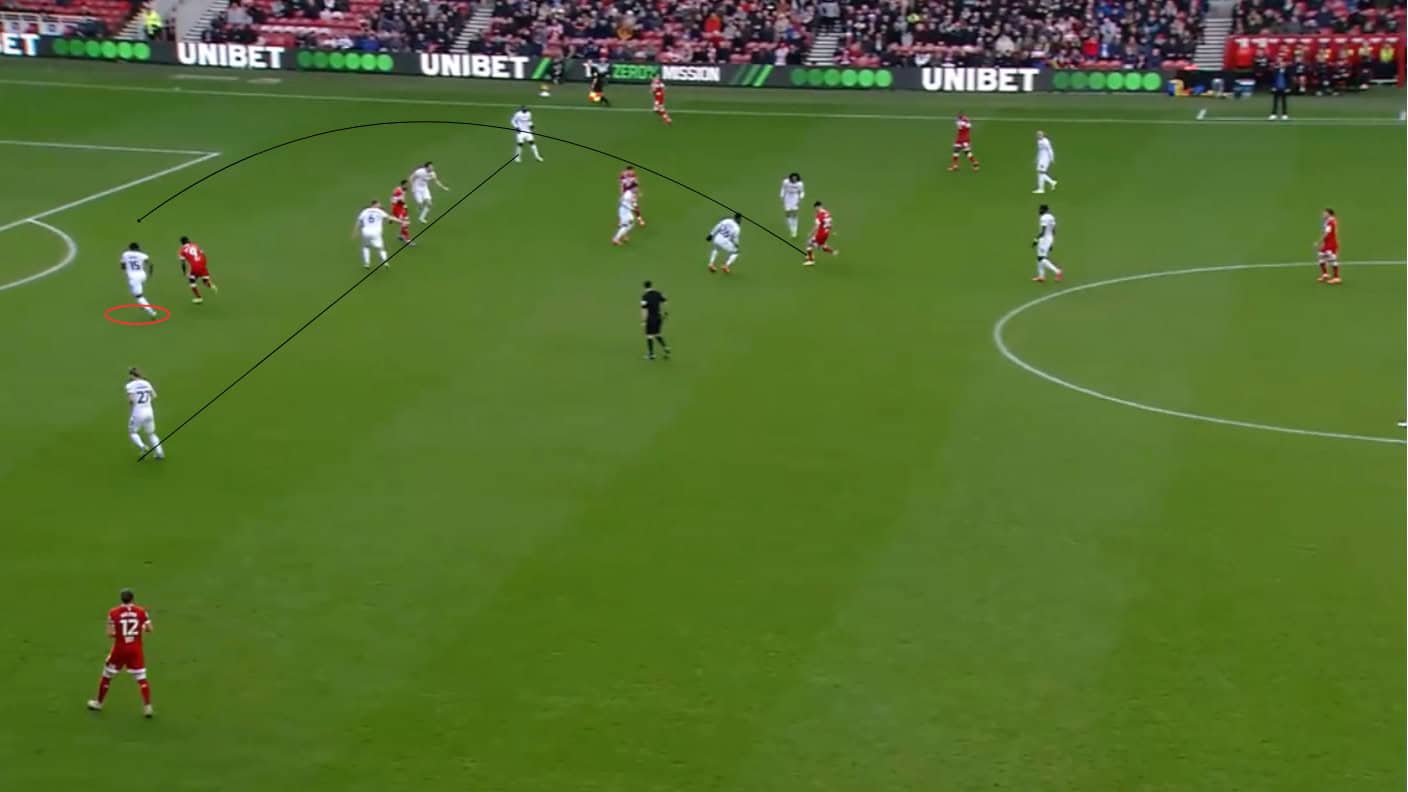
As Figure 5 shows, this happens often when Luton are defending in a mid-block.
Last season, Luton were more comfortable defending in a low block.
Now, the players are not accustomed to accurately deciding whether to wait and threaten with the offside or chase their marks, as shown in Figure 5.
However, detecting the potential solutions here is difficult because Luton will recover less in dangerous zones if they defend as in the Premier League.
Luton Town Defensive Territory Maps: 2024/25 Vs 2023/24
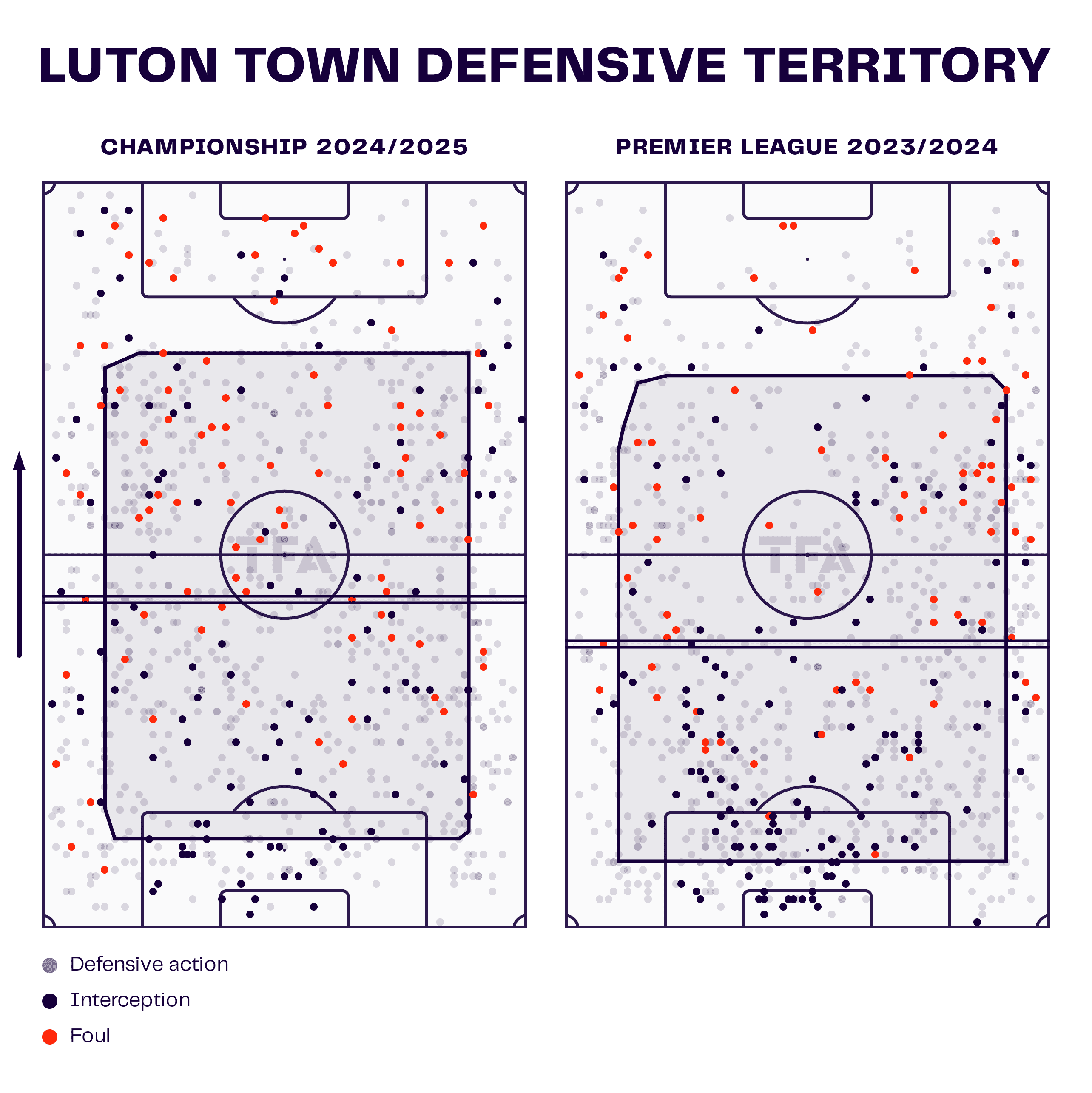
As Figure 6 illustrates, Rob Edwards has increased the volume of defensive actions in the inner channels and raised the height of Luton’s defensive line.
These adjustments should enhance their ability to defend against open-pitch actions, but they also expose vulnerabilities to direct play from opponents, a trend in the Championship.
Rob Edwards Rest Defence
In the Premier League, the Hatters did not counter-press as aggressively as they do now; they tended to retreat faster and defend their box, as Figure 6 shows.
In that sense, the rest defence is one of the main potential improvements that Rob Edwards could make.
Let’s illustrate this in a sequence.
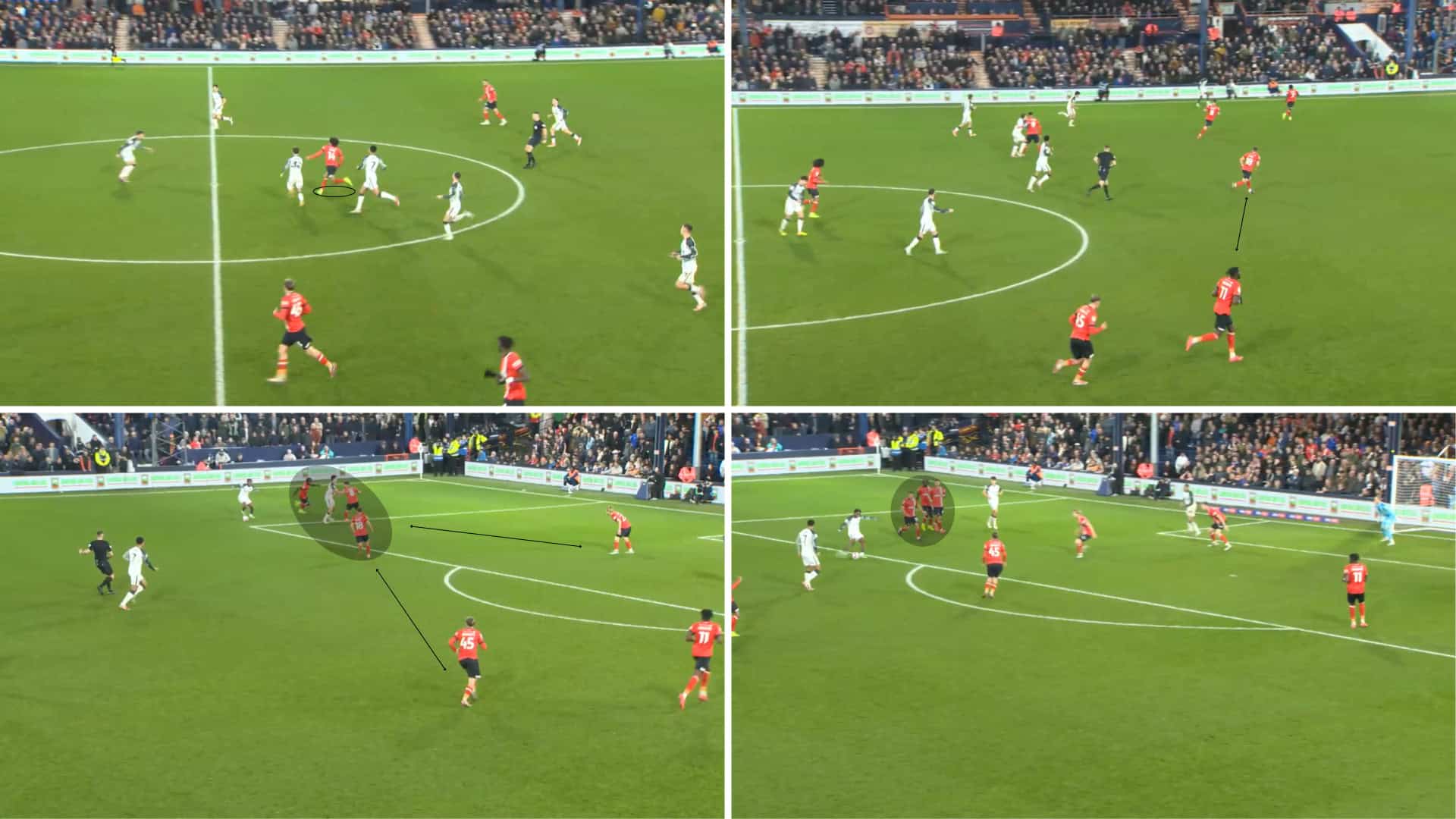
In Figure 7, the distances between the players and their height are extremely risky, considering that Chong is not in a threatening position.
So, once the rival recovers and moves forward via the wide player, Luton’s reorganisation is not good.
Many mismatches pick up players to mark (overloading a zone and being dragged by another player), and the block loses reference at the top of the box.
Rob Edwards Defensive Set-piece Actions
After a few matches, other teams have identified a way to create danger against Luton at set pieces: the near post.
Usually, Luton neglect the near post in defensive set-piece actions.
Other teams exploit this weakness by overloading the far post and the goal area, allowing a player to appear in the near post, or by utilising the space in front of the goal, enabling a player to arrive.
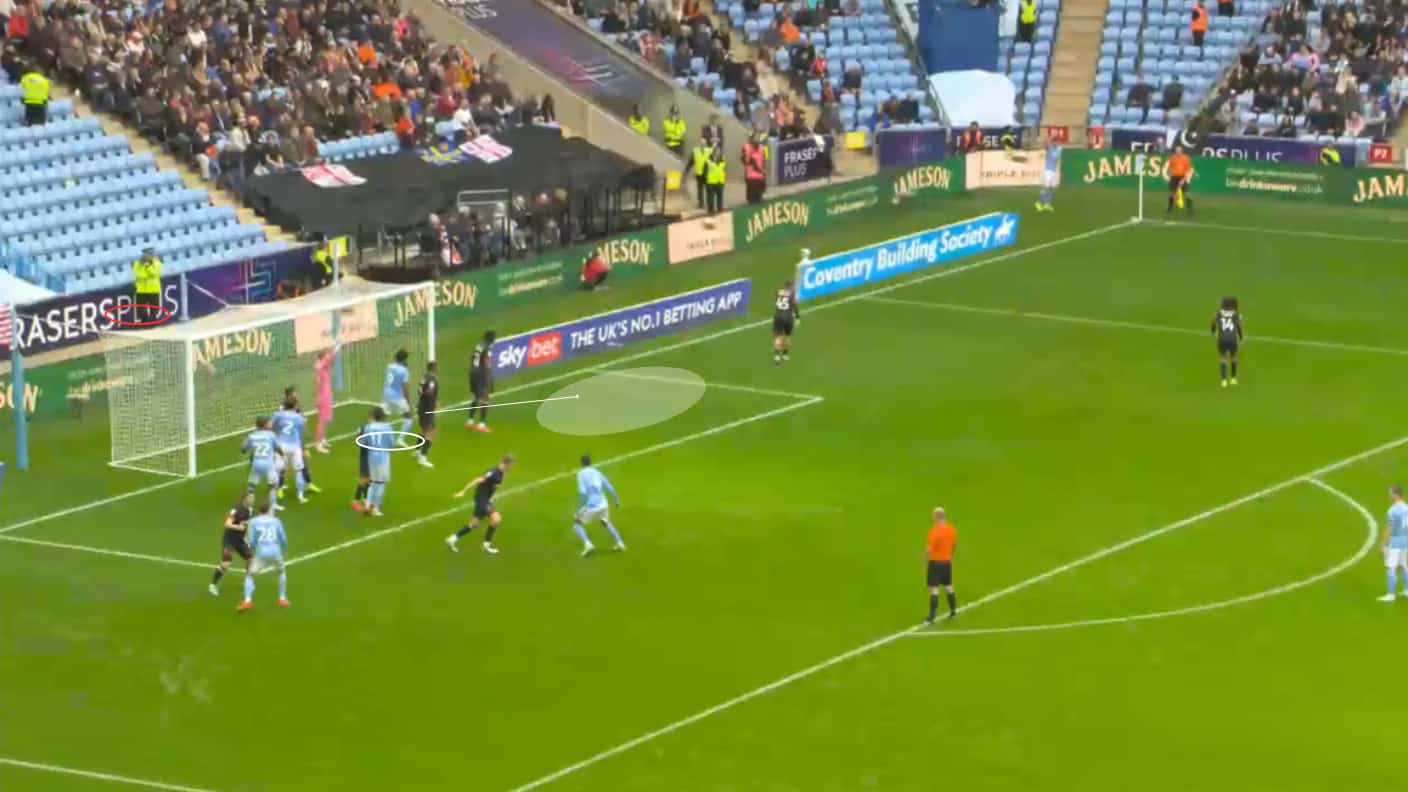
They have conceded two direct goals by this type of sequence, and Thomas Kaminski, as the goalkeeper, struggles to defend headers from his first post.
It may seem that this tactic has only led to a few goals conceded, but the frequency with which other teams exploit it is alarming.
Opponents understand how to hurt Luton by set-piece actions, particularly during corners.
Even other teams have taken advantage of this type of action in a corner, restarting the play and attacking quickly again.
Rob Edwards In Possession Style Of Play
We’ve already mentioned that Luton Town is one of the teams that recover quickly in the Championship.
But once they recover, what do they want to do?
Well, last season, they wanted to move forward as soon as possible.
And they were a machine in transition, although they did not stay in the Premier League.
Now, the intention is not entirely the same, and it has confused their identity.
Sporadically, Luton restart the play even in potential qualitative superiorities after being forward in a good position.
They try to be vertical and fast, but their push in direct play is not the same as it was a season ago.
Rob Edwards’s style of play wants his team to get more pause and tempo, but they are losing their ‘destroyer’ nature in counterattacks.
However, Luton’s best resource is crossing in direct play and positional attacking.
Carlton Morris‘ heading ability and Alfie Doughty’s crossing are a unique tandem.
The left wing-back gathers every skill needed from his position: a powerful lower body in a short stature to complete intense accelerations after recovery, and a fantastic striking technique to make crosses.
That is why Doughty is the set-piece taker in the team.
His great skill in placing the ball wherever he wants, even when it is rolling, creates numerous goal-scoring opportunities for Luton.
Alfie Doughty Shot Assists Map
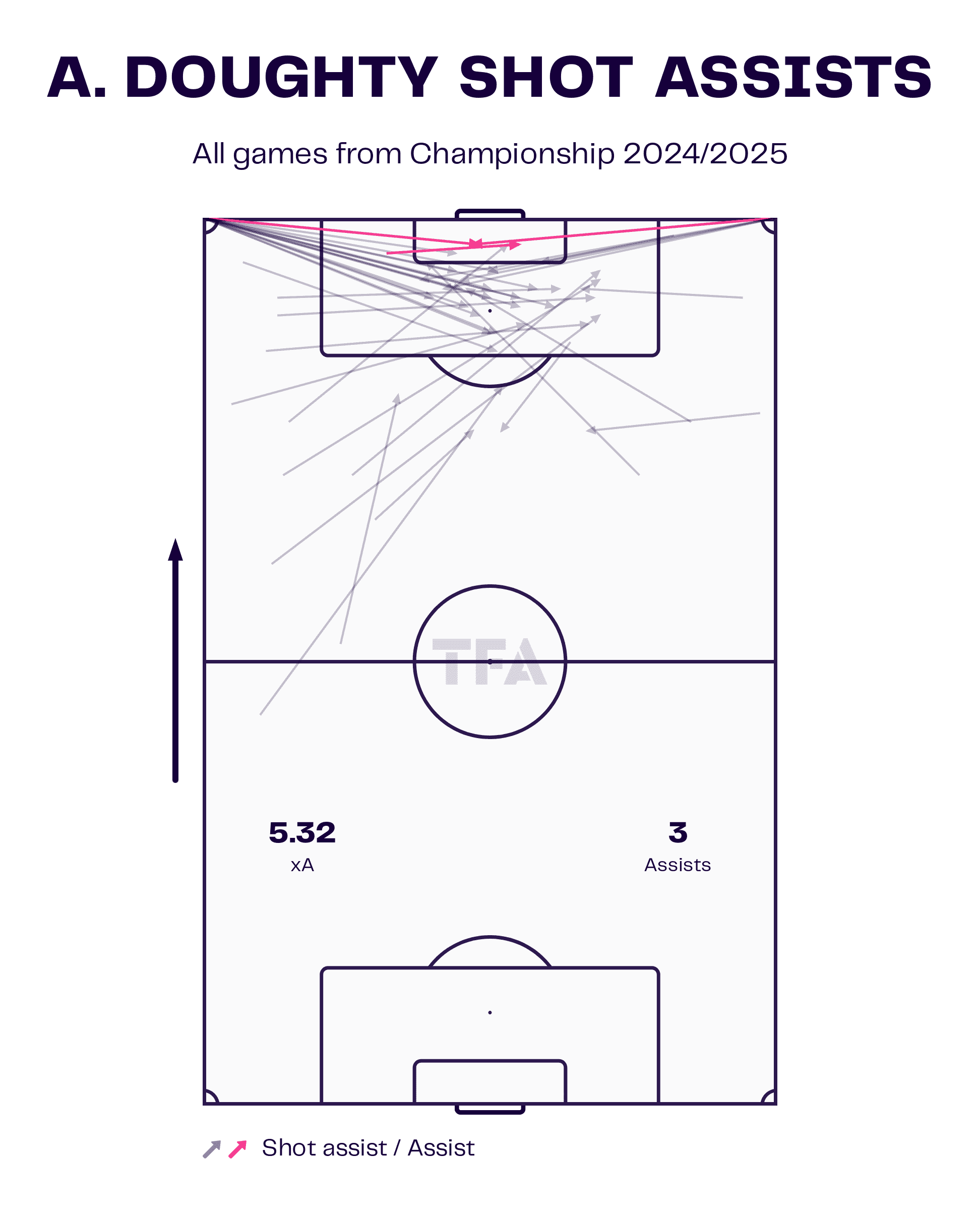
From their 15 non-penalty goals during the current Championship season, Luton have scored three times generated by set-piece actions with Doughty as the taker.
Elijah Adebayo Goalscoring Underperformance
According to Wyscout’s numbers, almost every Luton player who has scored at least once at the Championship 2024/25 is overperforming in terms of expected goals.
The only one who is not is Elijah Adebayo.
The 26-year-old, who offers good tools outside the box, has had bad form in front of goal this season.
He accumulates 27 shots and 5.44 xG but has scored only twice, and a team near the relegation zone cannot allow this week by week.
Elijah Adebayo Shots Map
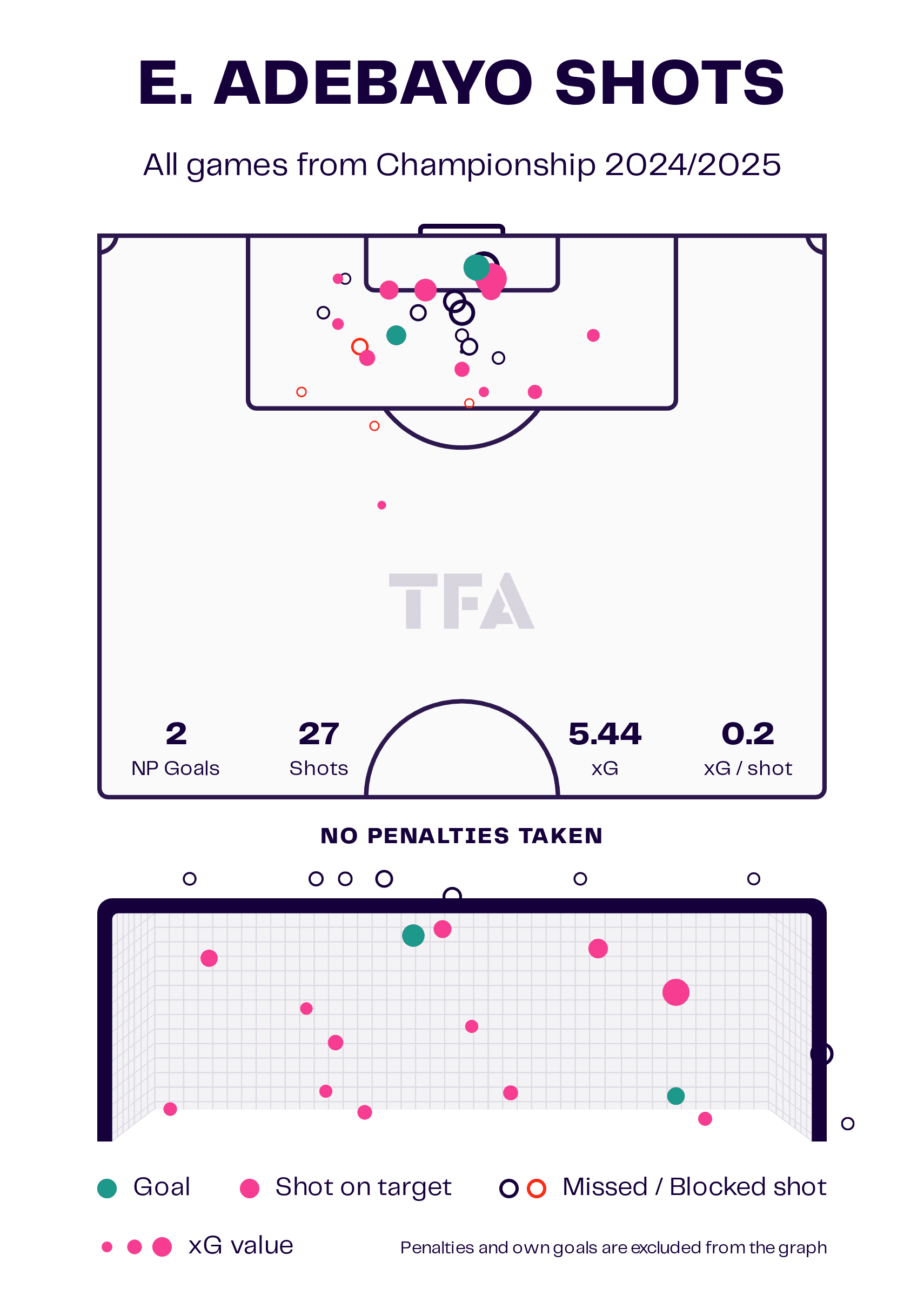
His touches before shooting are loose, and his finishing is even worse.
Adebayo loses the opportunity to shoot faster than he does, allowing the goalkeeper or defender to block more easily.
Conclusion
Luton Town’s problems and identity changes occur during a season that previously seemed to have the potential to see a restructuring of the playing model, enhancing and consolidating ideas.
The Hatters’ relegation is now a possibility, but as we are still in November, anything can happen this year.
Rob Edwards should be on alert and try to improve his team’s play as soon as possible.
The Welsh coach should consider his best players the basis of everything and ensure he has a system that maximizes their potential.
