
On Sunday, the Euros come to an end as the eagerly anticipated clash between two titans, Spain and England, takes place at the Olympiastadion in Berlin. This preview will solely focus on both teams from a set-play perspective to discover how they might be able to score the decisive goal to win the European Championship.
So far, Spain’s success has primarily come from open play, but they have managed to create multiple key chances from set plays, including a goal against Croatia following a short corner kick. From 34 corner kicks, it is fair to say they have been inefficient, but with an average of nearly six corners per game, Spain will have plenty more opportunities to create chances from dead balls in the final.
England, on the other hand, have failed to score from each of their 22 corner kick attempts. Averaging just under four corners per game, alongside the fact they failed to win a single corner kick in the semi-final, England will likely obtain minimal opportunities to create from corners. However, England have achieved success in other ways, including goals from a free kick and a throw-in during the round of 16 victory over Slovakia.
Last week’s article detailed the weaknesses of each of the last eight, including the two finalists, highlighting the most vulnerable parts of each team’s defensive structure. This week, we will discuss how each side attempts to create chances from dead balls and whether the match-up of the offensive and defensive structures could possibly lead to a goal.
This tactical analysis will provide a detailed examination of the significant set-piece tactics to anticipate from both teams ahead of the fixture. This analysis will draw on crucial set-piece strategies exhibited in their respective semi-final appearances while considering the approaches observed in earlier rounds.
Spain’s Set Piece Threat
Before we look at how Spain could create from dead balls, we must look back at how England have prepared to defend corner kicks in each of their previous games during the tournament. England use two zonal defenders, protecting the central space at the six-yard line with other defenders man-marking any free attacker. The ways in which England’s structure could be exposed had already been discussed in the prior article, but put most simply, the deep and underloaded number of zonal markers means that the Spanish players have plenty of space to attack outside of England’s zonal presence, with the only necessity being for a Spaniard to gain separation from his marker.

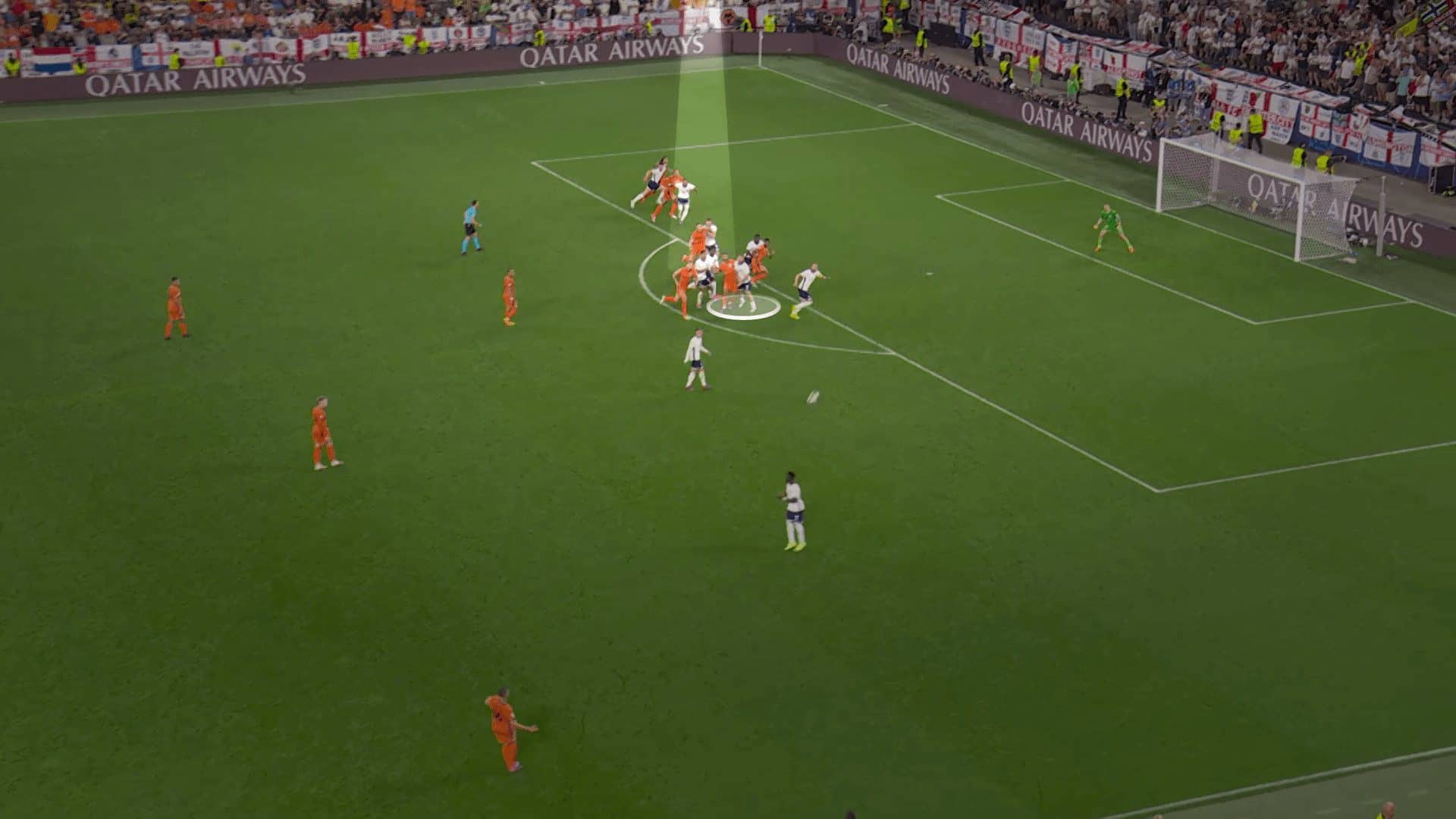
In the previous game against the Netherlands, 2 out of the three corner kicks won; the Dutch were able to make the first contact in the areas shown below, where the deep zonal presence meant no one was already in a position to attack the ball. As a result, the space just outside the near edge of the six-yard box is one that can be accessed by an attacker arriving from deep, whose only job is to lose his marker. This can be achieved in several ways, whether that is by gaining separation through sharp movement, arriving from the blindside, or gaining the dynamic advantage by using runs from deep.

The fact that England are vulnerable to conceding the first contact increases the likelihood of them conceding goals from set plays massively. If Spain can be optimistic about winning the first contact, they can prepare runs and movements to dominate England during the attempts to win the second contact.
As we see in the example below, Inter Milan‘s Dumfries is able to dominate the initial aerial duel, which gives the attacking side the potential to attempt something different during the second contact. During the first contact, we can see that the defensive man markers turn their attention to the ball, allowing other attackers to move into space without being tracked. England’s lack of zonal cover at the back side of the six-yard box means that they are potentially vulnerable to conceding these chances.
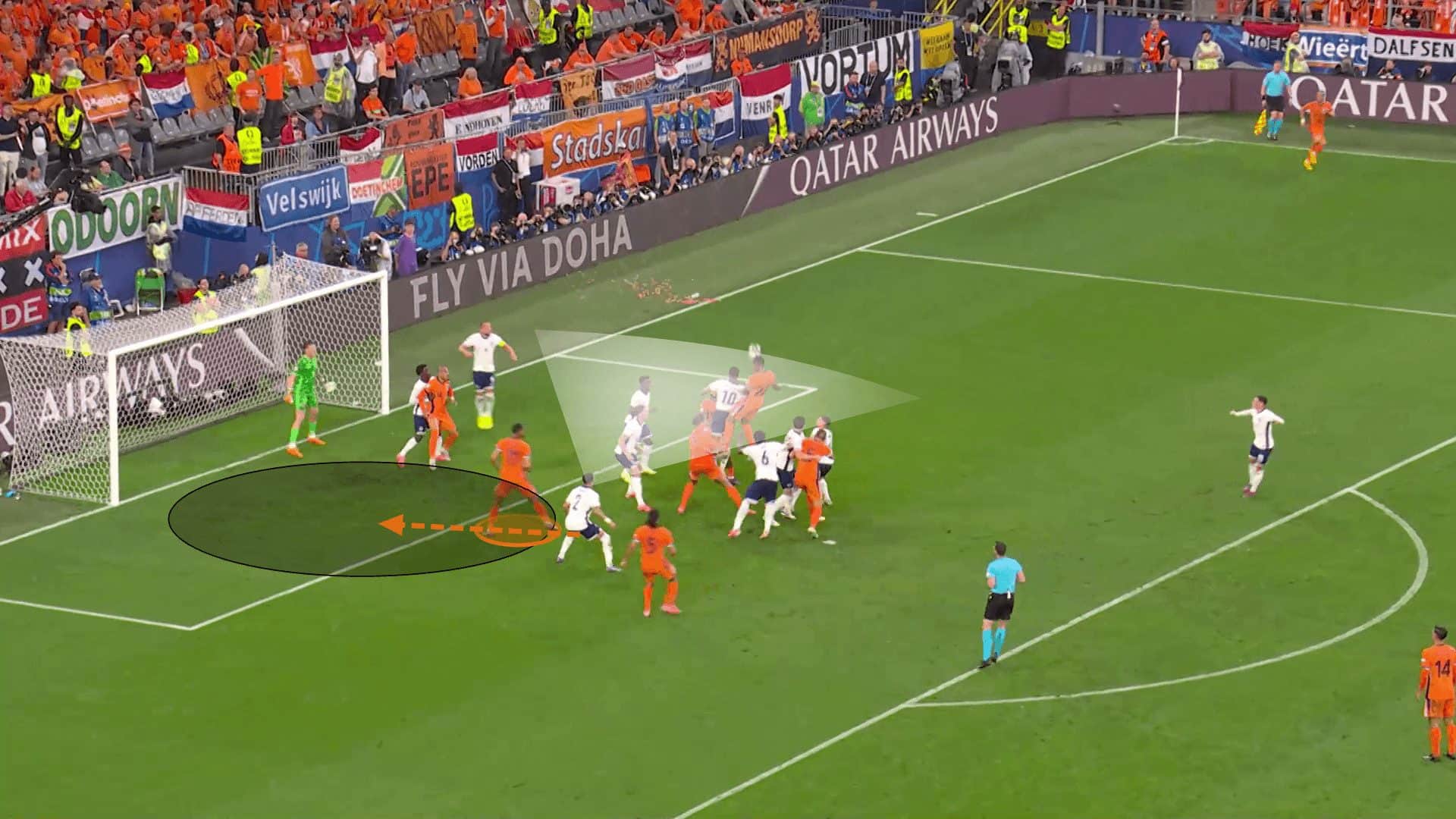
As the aerial duel takes place, Harry Kane drops deeper to protect the near post, ensuring that anyone who moves to the back post area will be kept onside. Kane’s instinct to protect the near post also gives opponents greater reason to focus on directing the ball to the back post rather than attempting to score at the near post, where the goalkeeper and defender are positioned to block attempts.
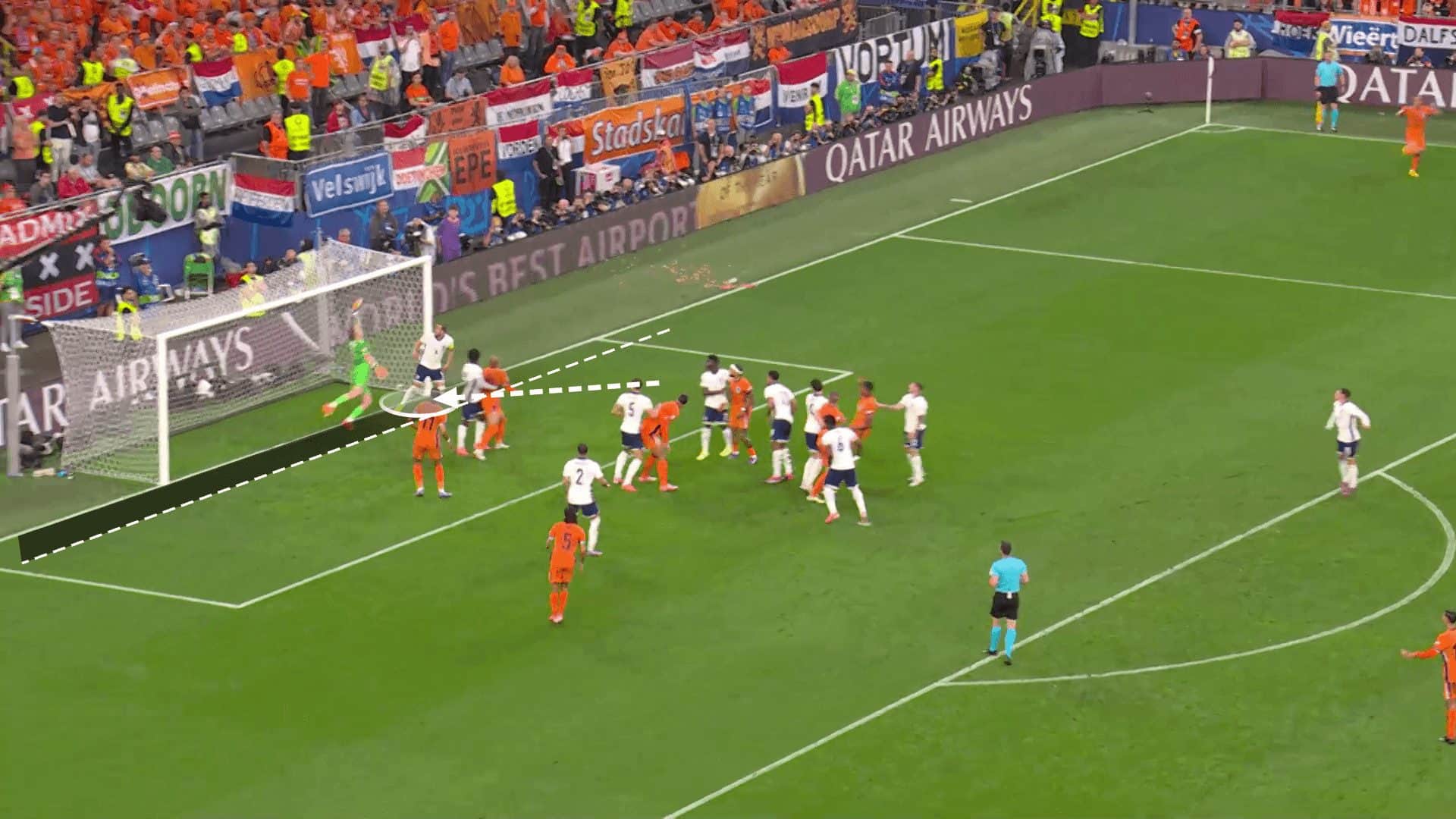
So far, this has been quite hypothetical, but there is substance behind the movements Morata makes towards the back post areas. If Spain can identify the space and encourage the initial headers to be made across the goal towards back post areas, Alvaro Morata will benefit against old foes.
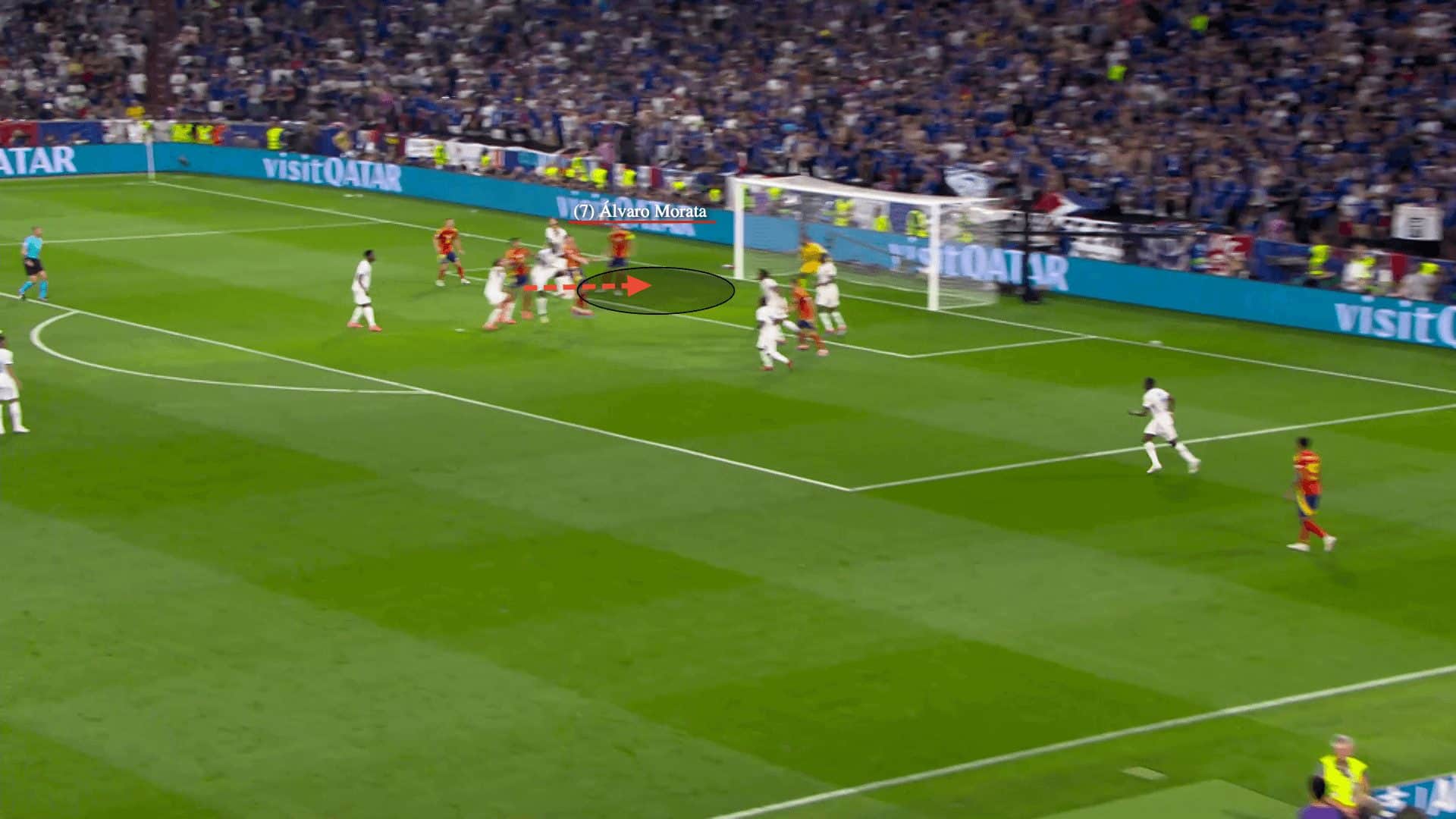
Now, turning the attention to how Spain will attack these corner kicks, it is clear that they target the space highlighted below, at the near corner of the six-yard box. Different strategies are employed by Spain depending on how opponents set up, and with England likely leaving this space open, we can expect Carvajal to have plenty of joy, as he did in the same space during the UEFA Champions League Final last month.
Carvajal’s vast experience means he has a trusted and reliable method of ensuring he gains the separation needed to arrive in space unopposed, as well as having the right timing to arrive in space as the ball does. Simply put, Carvajal’s starting position is by the goalkeeper, which puts him in the blindside of any potential zonal defender ahead of him who could attempt to track his run. Making that darting movement from behind the defender’s back guarantees Carvajal the time and space needed to win the first contact despite his lack of height.

If England do react and plant an extra zonal defender on the near side of the six-yard box, Carvajal will be selfless and make the same run, but this time with the intention to drag that defender out of position, rather than attacking the ball. In this case, Morata is ready to attack the target space, which can be occupied after the defender is dragged away.
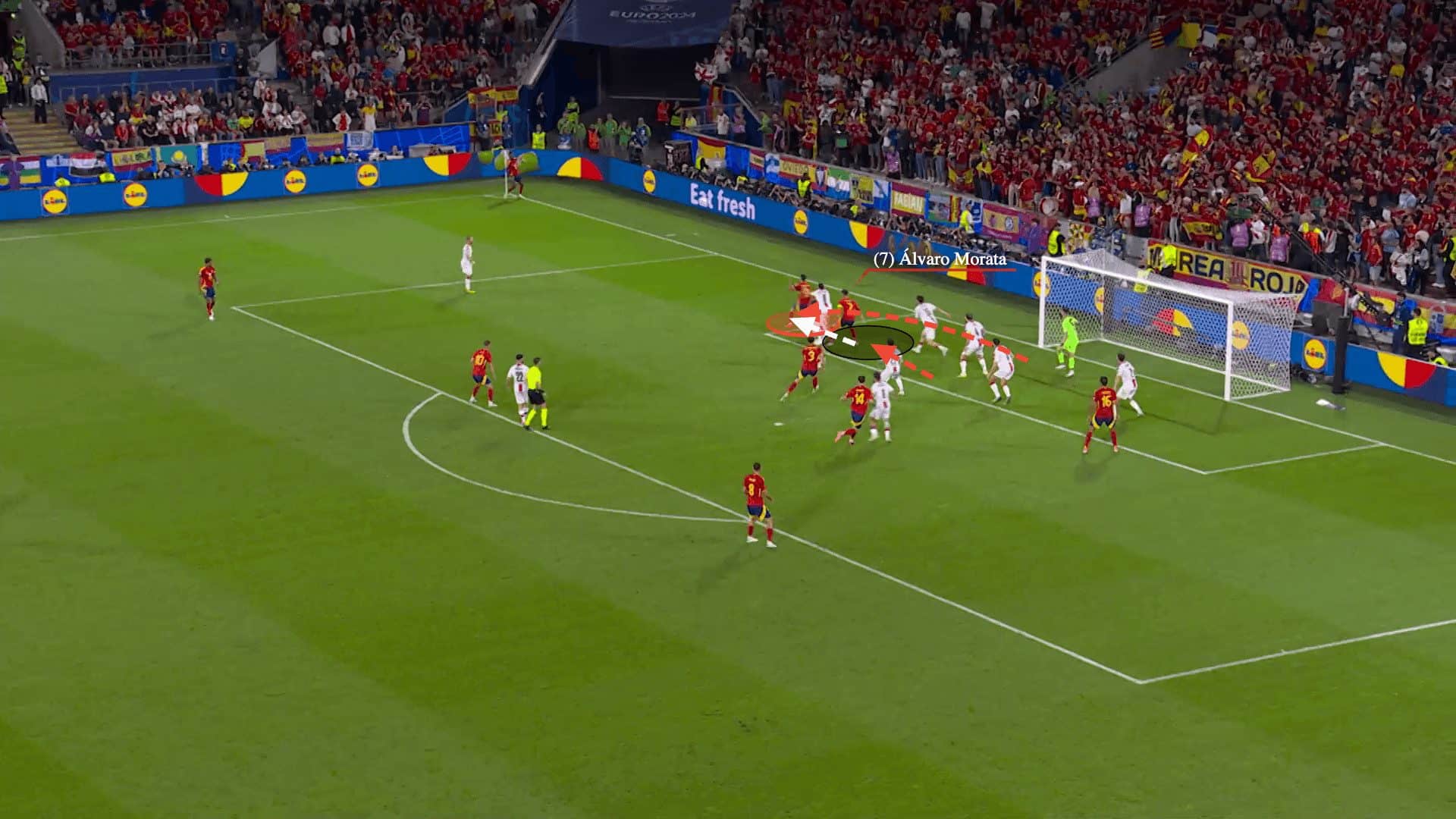
Moving on to free kicks, Spain have so far had limited chances from those situations, but England’s defensive instructions do give them hope for success. In the recent game against the Netherlands, England used a man-marking system, which involved defenders attempting to prevent their assigned player from entering the penalty area. As we can see in the image below, two of the players are fully focused on the battle with their opponent, rather than attempting to cover the space in behind.
This means that at the far side of the penalty area, there is a 2v2 scenario. The attackers have the option to attack the space in behind, at the outside of the block, in the wide left area, and the near side of the defenders, in the central part of the penalty area where the defenders who would usually run back to cover space, have left unmarked. Having so much space to attack makes the marking job of the defenders incredibly difficult.
England’s Set Piece Threat
England’s offensive threat is tougher to predict, partly due to their limited number of opportunities, varied routines from game to game, and Spain not having to defend as many set plays. As analysed last week, Spain’s zonal defensive cover is vulnerable due to how much space is available between the three zonal defenders. Suppose the spaces highlighted below can be overloaded by runners, dragging zonal defenders all over the place. In that case, England will likely achieve success as long as the goalkeeper is prevented from intercepting the cross. However, based on England’s recent corner strategies, there is no evidence this method will be attempted.

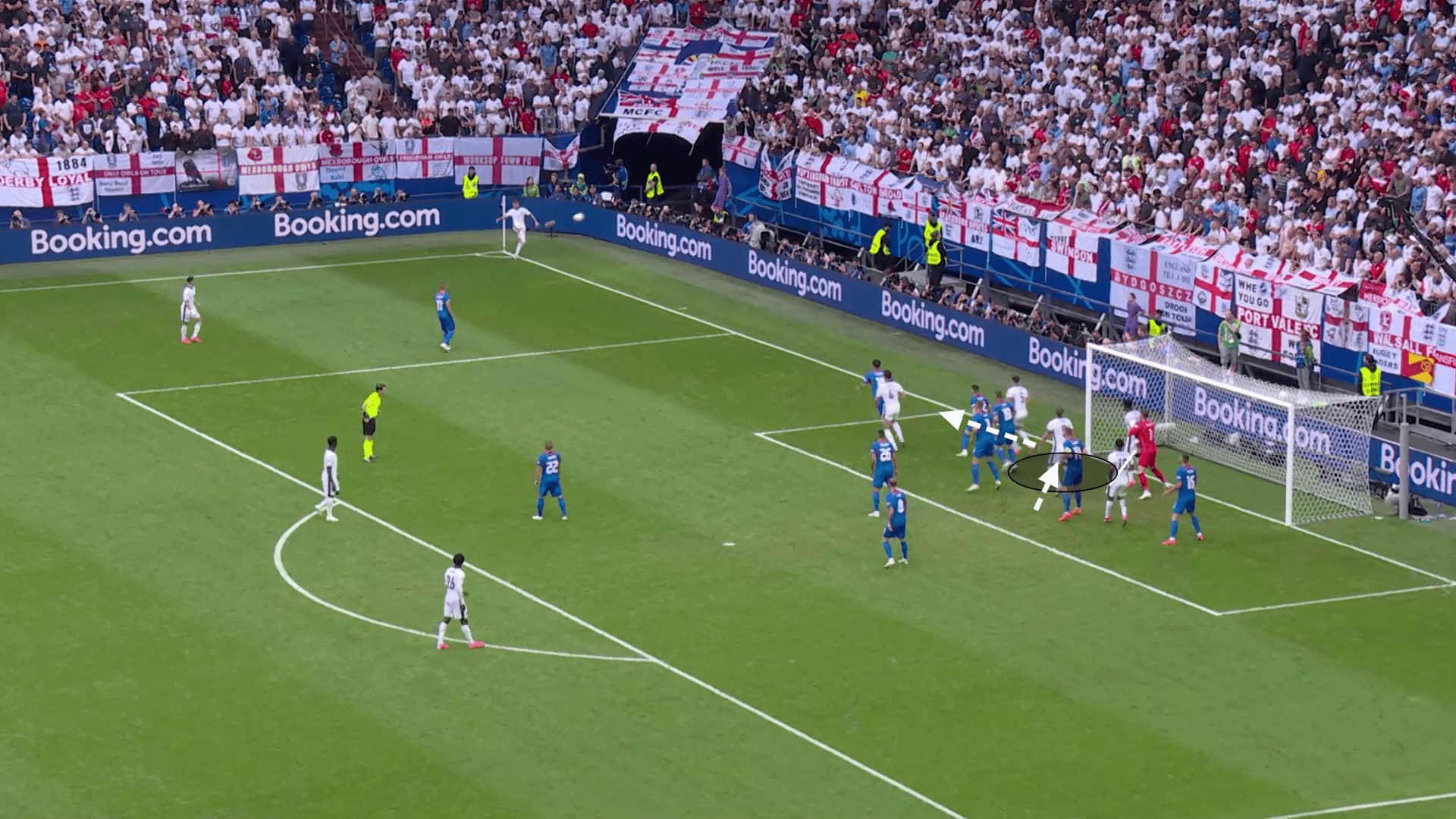
Instead, there are two main possibilities for England’s offensive corner kick strategies. This routine highlighted below was exclusively used against Slovakia, so it is unlikely that we see it return during the final. However, it gave England some of the most dangerous opportunities they managed to create all summer. Marc Guehi plants himself in front of the goalkeeper to root him to the goal line, while Man City‘s John Stones runs away from the near post, dragging zonal defenders away from goal.
This is designed to maximise the amount of space Harry Kane has to redirect the ball into from a yard out. The amount of space the cross has to arrive in is extremely limited, so there has been no success as of yet, but all that is needed is one accurate delivery to turn this into a goal. However, given that England will have minimal corner kicks, it is unlikely that this high-risk, high-reward strategy will be used.
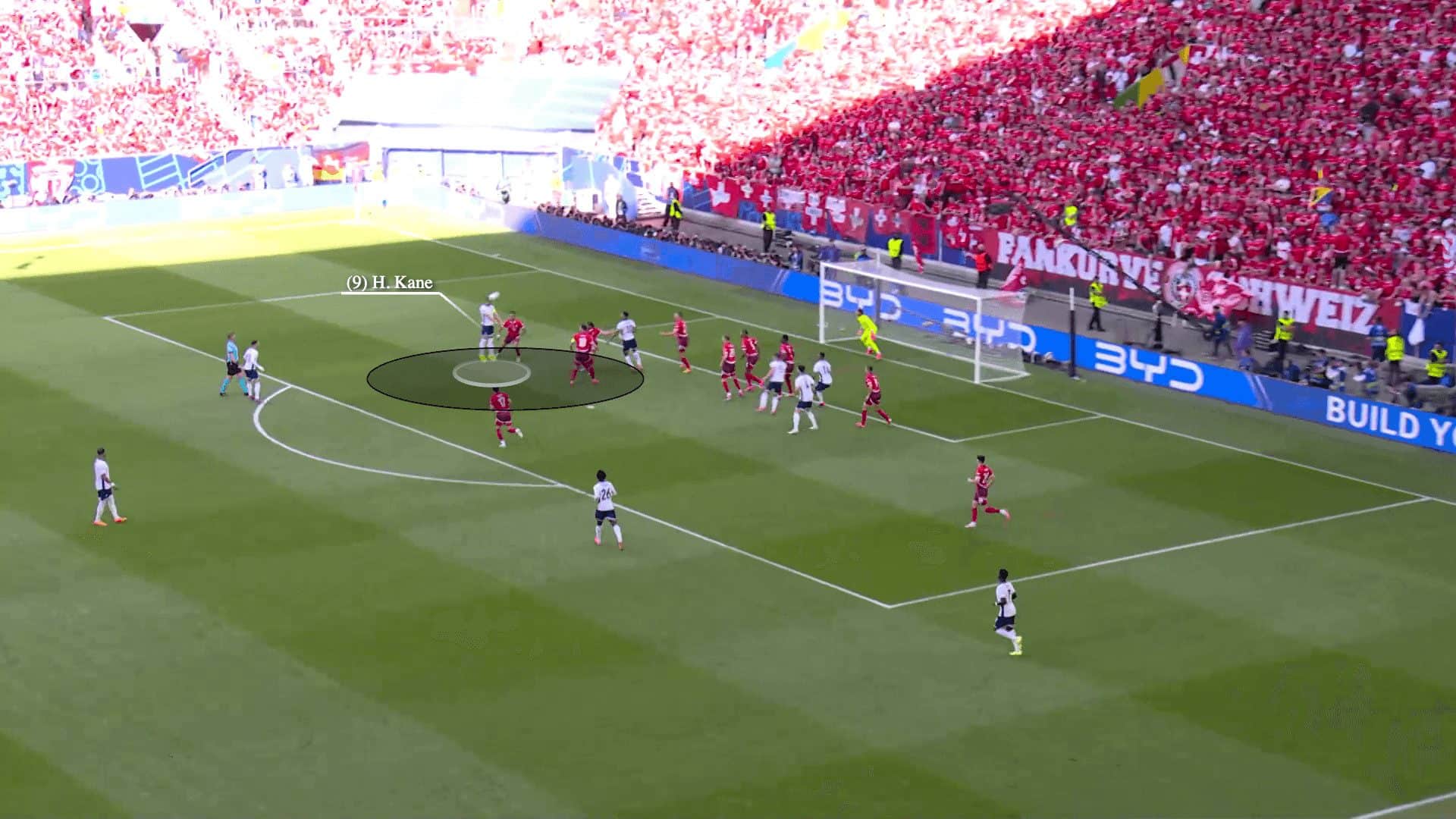
One alternative that England have used fairly frequently is to cross the ball to the deeper area, by the penalty spot, where Harry Kane is isolated in a 1v1 duel against his marker. Kane’s aerial prowess and strong heading ability means that they are able to manufacture shooting opportunities from the penalty spot fairly reliably. However, the distance from the goal gives goalkeepers the chance to save even the stronger headed attempts. This is something that we can expect to see on Sunday night, as Spain’s man-marking unit is usually made up of ‘smaller’ players, where England will be able to use the height mismatch to guarantee Kane makes the first contact.
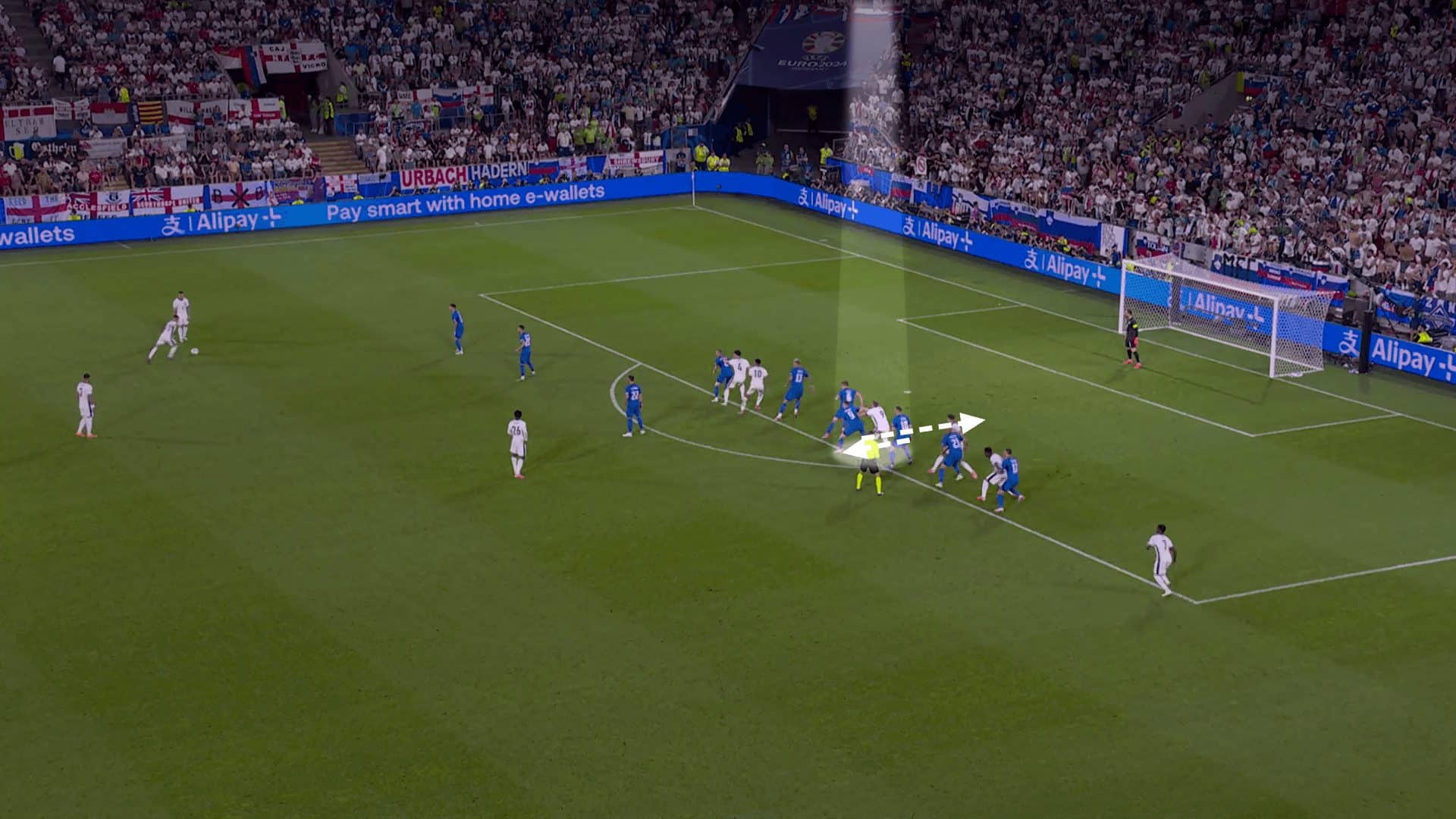
When attacking free kicks, England have used one main move to create space to attack. This involves the attacker starting in an offside position, goalside of his marker, as Kane does in the example below. As the dead ball is about to be delivered, Kane simply inserts himself back onside by forcing his marker to shift away from the goal before darting into the space he has in front of him as the defender is taken out of the equation.
The issue with this is that multiple members of the attack must be successful when engaging in a physical tussle with their marker, as the other defenders retreating back to their goal will be able to cover the space that only one defender vacates.
The two players that attempt this must also start close to each other so that when this does come off, they create one larger space rather than two little ones. If England can coordinate this, they will gain success with the plethora of quality deliveries available in England’s set-piece department, ensuring consistent deliveries into the space behind the defensive line.
Summary
Overall, based on this tactical analysis, a goal from a set play is unlikely, more so because neither team will have set-pieces and due to the lack of quality and coordination either team has. However, each side has vulnerabilities in its defensive structures, so the attacking side does not require a thoroughly detailed routine to deliver the killer blow from a set piece.
If Spain’s corner kick delivery can be consistently accurate, don’t be surprised to see Carvajal arriving at the near side of the six-yard box to flick the ball goalwards, where Alvaro Morata will be lurking to pick up any loose balls or rebounds, with England’s lack of zonal presence.
On the other hand, England have the simple option to direct a delivery to a deep area where Kane will be lying in wait, before using his killer instinct and aerial dominance to potentially header the ball goalwards from the penalty spot.
While this game is expected to be played out in open play for the majority, if either team spends a little time focusing on the other’s frailties during set plays, they can maximise their chances of scoring in the highly anticipated final showdown.
