
As Barcelona approach the first Clásico of the 2025/2026 season under Hansi Flick tactics, the atmosphere feels markedly different from the dominance of the previous campaign.
Flick, who led the team to a historic domestic treble, winning La Liga, the Copa del Rey, and the Spanish Super Cup, while defeating Xabi Alonso‘s Real Madrid in all four encounters last season, now faces a new challenge: sustaining excellence amid growing expectations.
The early stages of this campaign have exposed inconsistency and a lack of rhythm.
The opening 12 matches, nine in La Liga, reveal difficulties for FC Barcelona in maintaining a balance between tactical solidity and attacking fluidity.
This data analysis will examine the underlying causes behind Barcelona’s fluctuating start despite managerial continuity.
This Barca analysis will focus on both collective and individual aspects shaping Barca’s form, particularly the tactical and statistical reasons behind Lamine Yamal’s dip in performance following his injury return, as well as an in-depth look at the Pedri & Frenkie de Jong partnership, a duo widely regarded as the team’s structural core and the main source of optimism heading into El Clásico.
Lamine Yamal’s Post-Injury Struggles: When Individual Brilliance Disrupts Collective Balance
Since returning from injury, Lamine Yamal’s performances have painted a worrying picture for Barcelona.
Once seen as the team’s most dynamic and unpredictable outlet, the young winger’s form during the 2025/2026 season has been defined by inconsistency, poor decision-making, and a growing tactical imbalance that now affects the team’s collective structure.
From a data perspective, his attacking output has declined dramatically; 26 shots have produced a total xG of just 1.81, averaging 0.07 per attempt, with only two goals, one of which came from the penalty spot (xG 0.79).
This leaves him with a non-penalty xG of 1.02, a remarkably low figure for the volume of shots attempted. Even more telling is his efficiency; only 6 of his 26 shots were on target, and over 50% of his dribble attempts have been unsuccessful.
Lamine Yamal Shot Map & xG Distributions 2025/2026

Yamal’s decline isn’t purely technical; it’s deeply tactical.
Flick’s positional system relies on intense pressing from the front three, but Yamal’s lack of aggression and delayed reactions when closing down opponents have weakened Barcelona’s first line of pressure, a key principle of their defensive structure.
The UEFA Champions League group stage match against Paris Saint-Germain exemplified Yamal’s flawed decision-making.
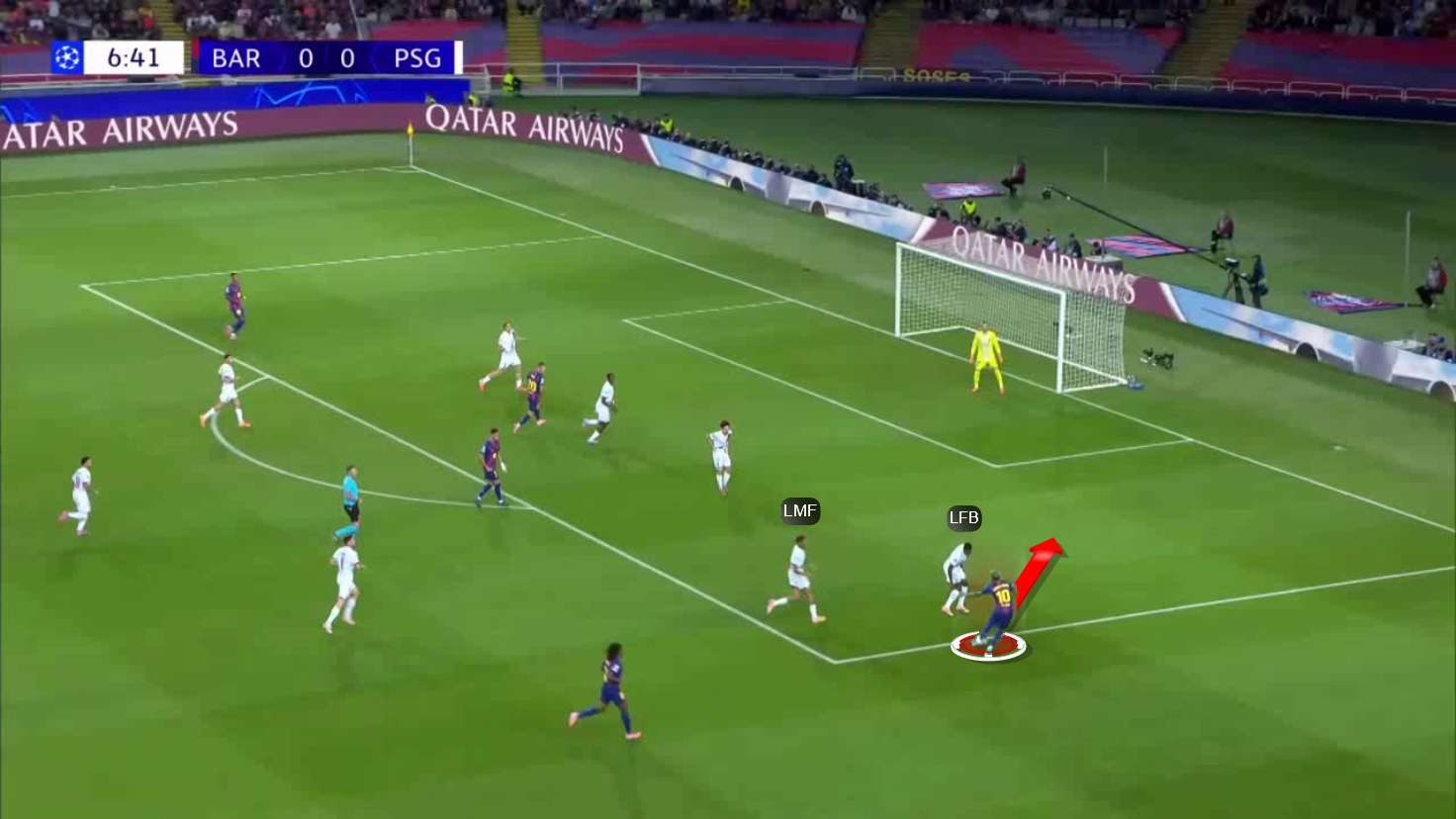
In a promising attacking sequence during the second half, the teenager found himself in the final third, facing Nuno Mendes with two simple options: slip an inside pass to Ferran Torres, making a diagonal run, or wait for Jules Koundé’s overlapping movement on the right.
At that moment, the decision depended entirely on Mendes’ reaction.
If the full-back had followed Lamine Yamal inside, the pass to Koundé would have opened a clear crossing lane.
If he had tracked Koundé wide, Yamal would have had space for a high-xG shot.
Lamine Yamal Hesitating Between Two Passing Options
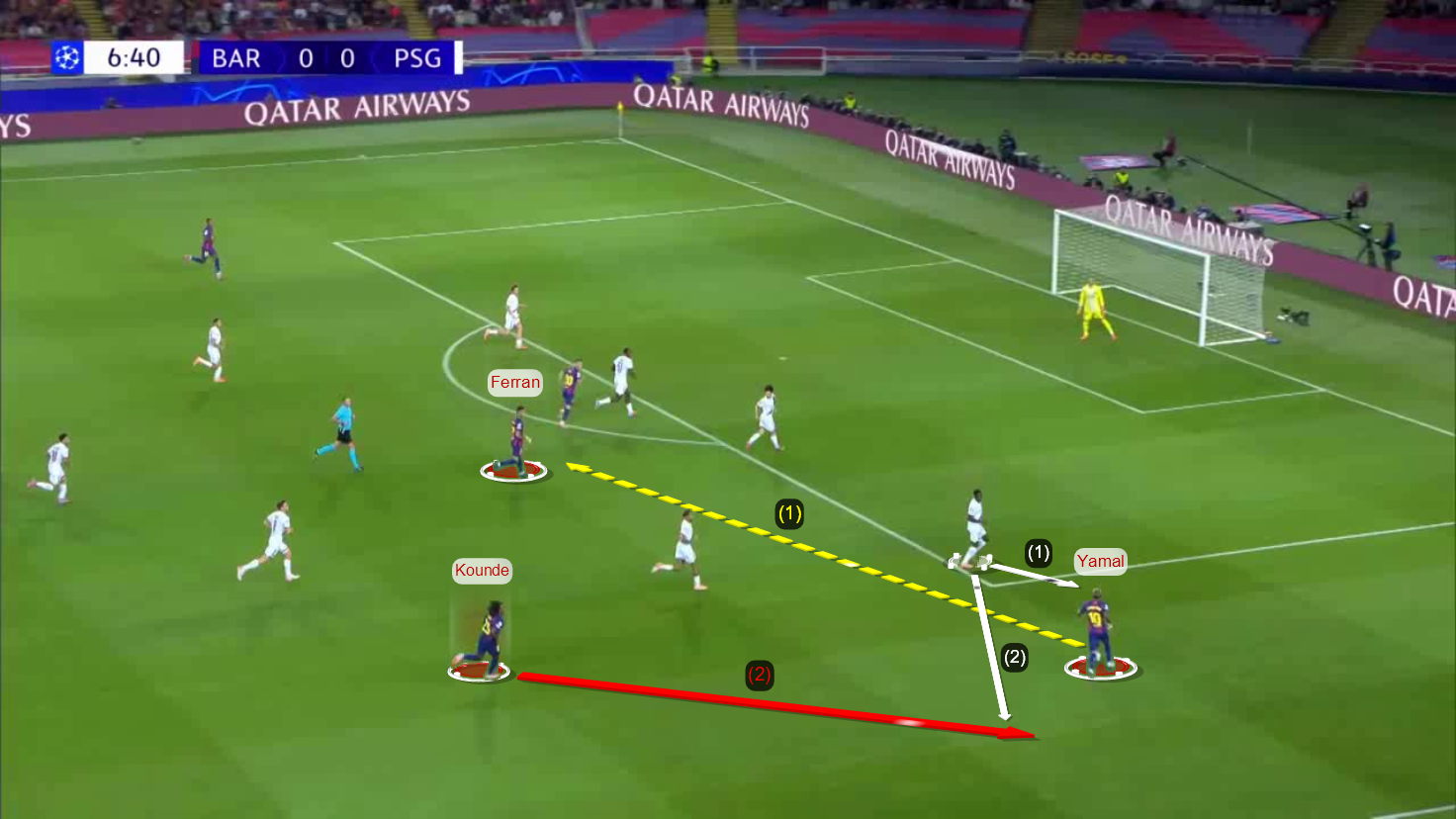
Instead, as seen in the image below, Yamal ignored both reads and opted for an unnecessary dribble into the congested box.
The chance broke down almost instantly, with Mendes winning the ball cleanly and launching a counterattack for PSG.
It was a small yet telling moment that summed up Yamal’s current tactical immaturity.
Lamine Yamal Ignoring Passing Options Before Losing Possession
Another example of Lamine Yamal’s recurring tactical flaw appeared during Barcelona’s league fixture against Girona.
Positioned on the right flank, Yamal successfully attracted the attention of three Girona defenders, creating a clear passing lane to Fermín López, who was completely unmarked in the central channel.
Lamine Yamal Drawing Three Defenders & Ignoring López Option
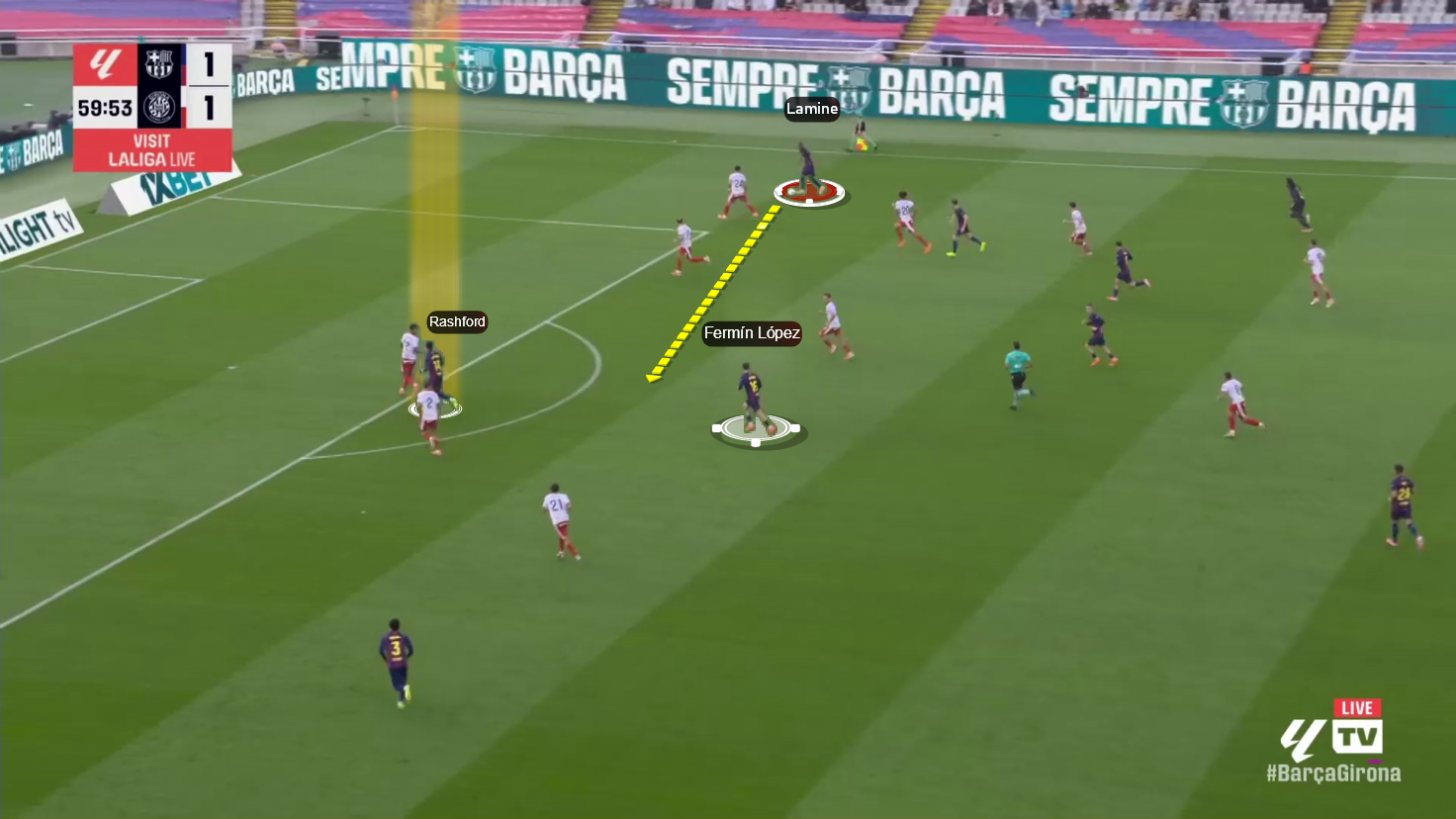
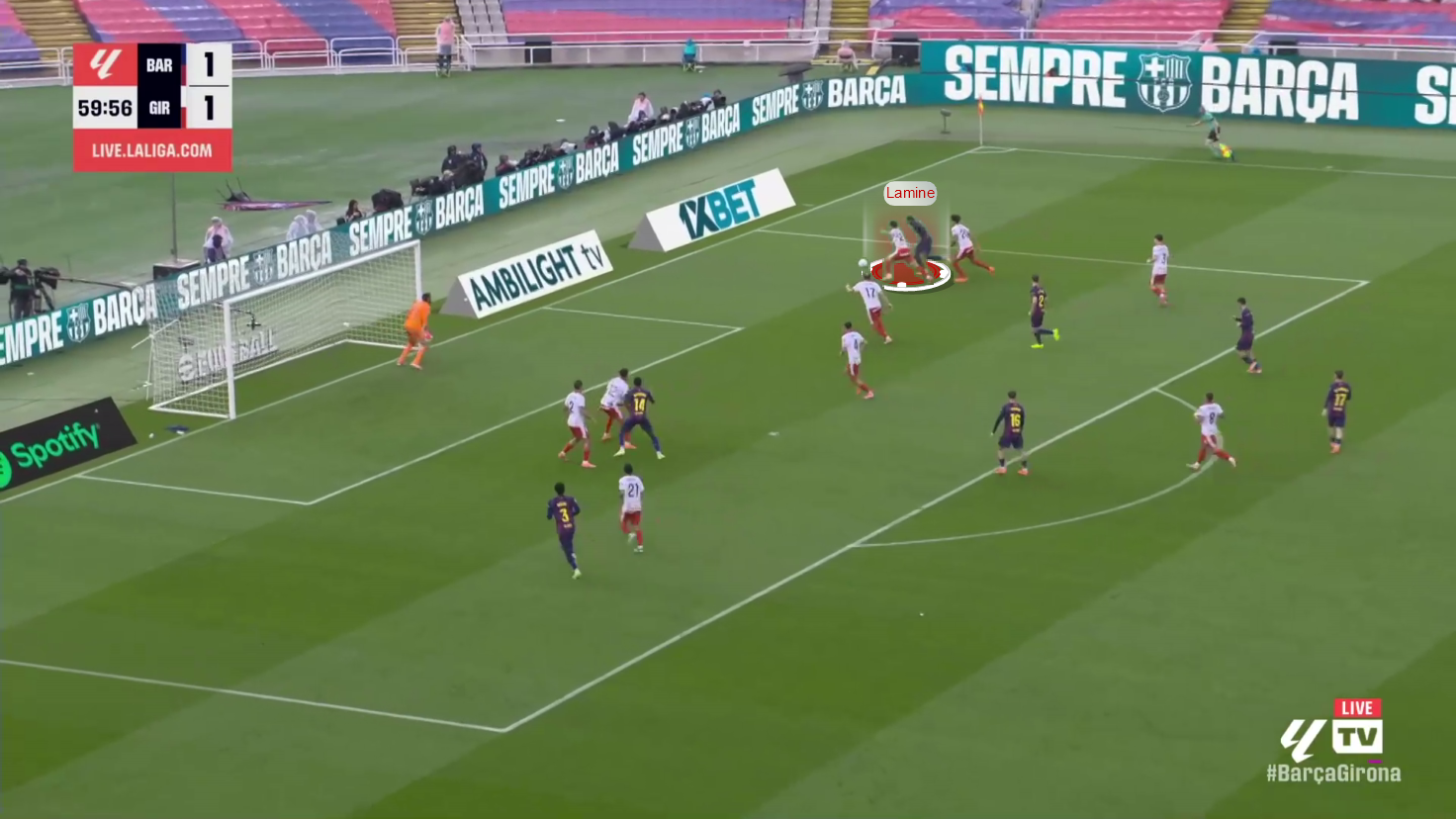
Rather than recognising the opportunity to release the ball into a high-value zone, Yamal hesitated, choosing instead to drive into traffic and attempt an individual dribble.
The outcome was predictable; he lost possession, killing a promising attacking sequence.
Girona Regaining Possession After Lamine Yamal Poor Decision
A similar issue re-emerged in the clash with Rayo Vallecano.
In this instance, Yamal once again found himself in a promising attacking position but facing two defenders with little support.
Dani Olmo stood completely free on the edge of the penalty area, perfectly positioned for a cut-back that would have led to a high-probability shot.
Lamine Yamal Overlooking Dani Olmo Free Position In Central Space
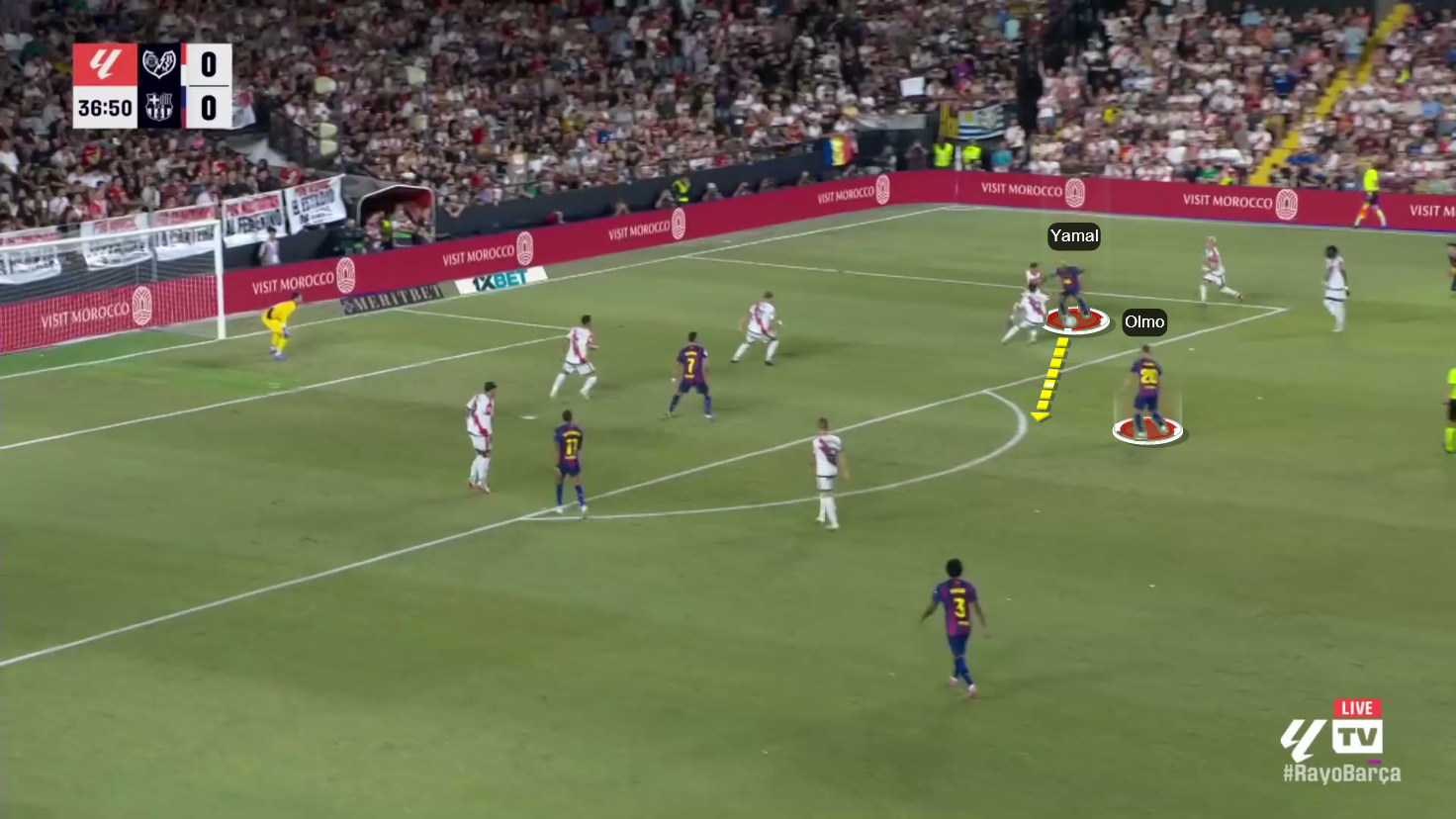
Yamal ignored the option, opting instead for another low-percentage dribble that resulted in losing the ball and allowing Rayo to launch a counter.
Rayo Exploiting Lamine Yamal Lost Dribble To Deny A Clear Barcelona Goal
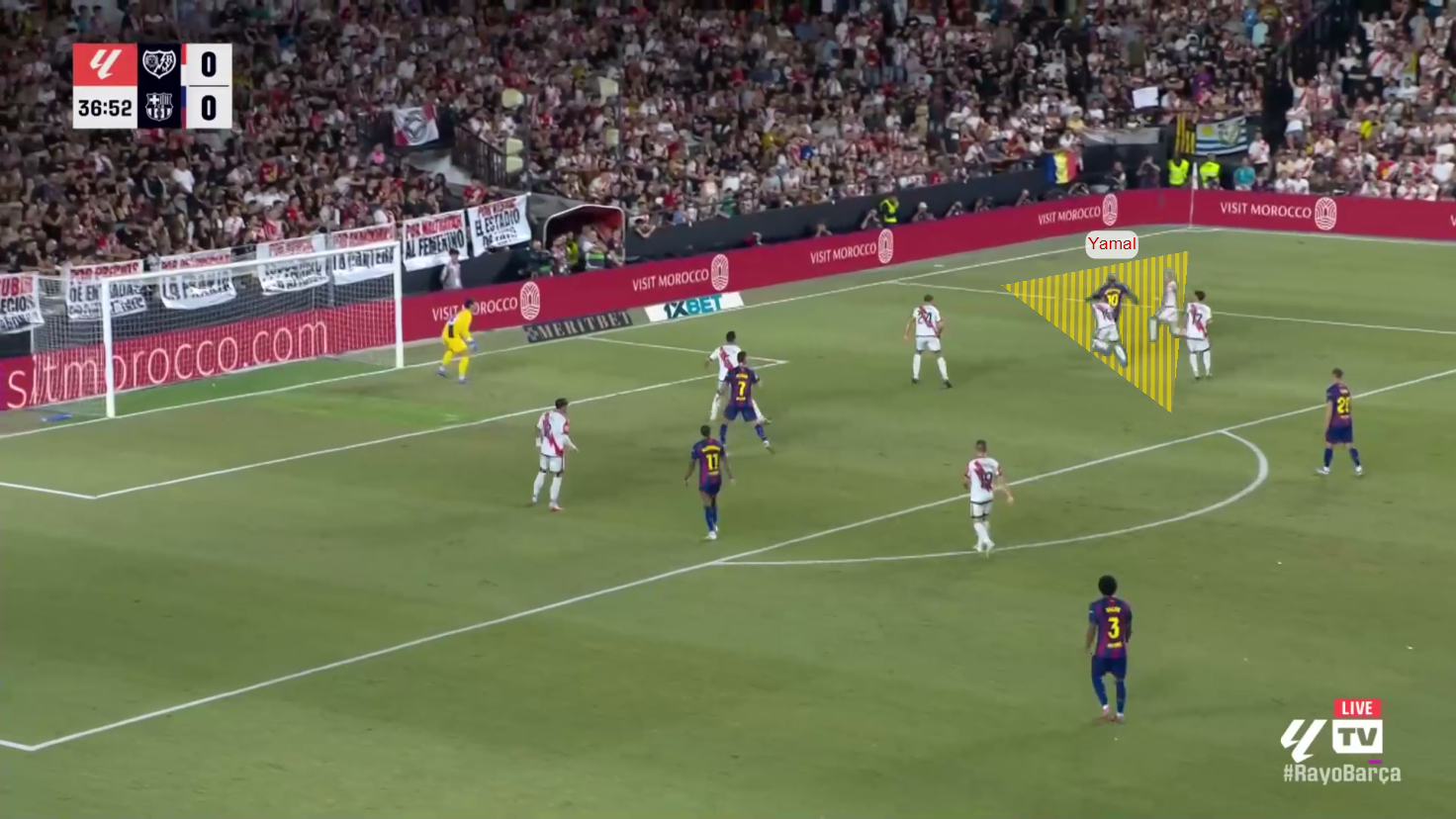
These moments highlight a clear tactical immaturity, not a lack of overall ability, but still an inability to read collective dynamics and prioritise team advantage over individual flair.
Off the ball, his passive pressing and poor body orientation allow opposition full-backs to progress easily, often forcing Pedri or De Jong to step out of shape to cover him.
On the ball, his decision-making remains problematic.
He frequently opts for low-percentage shots from difficult angles or attempts unnecessary dribbles instead of exploiting overlaps or waiting for better shooting lanes.
These patterns have killed attacking momentum and disrupted Barcelona’s rhythm.
Interestingly, Barcelona’s two most fluid performances, the 3-0 win over Getafe and Valencia’s 6-0 demolition, came in Yamal’s absence.
The team looked cohesive, balanced, and tactically disciplined.
While Yamal’s talent remains unquestionable, his current inefficiency and tactical indiscipline have turned him from a creative spark into a potential liability in Flick’s finely tuned system.
Pedri & Frenkie de Jong: The Midfield Axis Restoring Barcelona Tactical Identity
Among all the fluctuations that have defined Barcelona’s early 2025/2026 campaign, the partnership between Pedri and Frenkie de Jong has emerged as the team’s most reliable source of control and stability.
What makes this duo so effective isn’t just their technical excellence but also their contrasting, perfectly complementary profiles.
De Jong’s game is characterized by physical strength, intelligent movement, and a relentless pursuit of space.
His ability to attack spaces, not just identify them, makes him more than a passer; he becomes a dynamic outlet for progression.
Frenkie de Jong Big Chances Created Barcelona 2025/2026
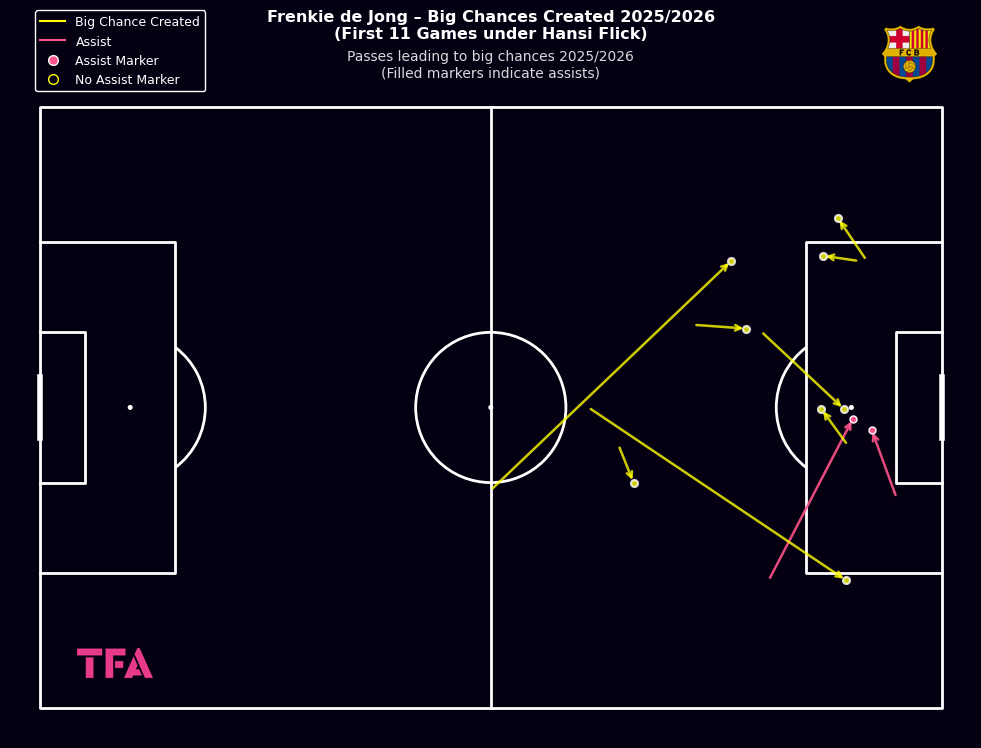
Across the first twelve matches, the Dutchman’s data reflects this mobility and purpose, against Real Sociedad, he completed 102 passes (99 accurate) and 15 to the final third, while versus Girona he made 45 forward passes, demonstrating how he repeatedly pushes play vertically.
Even in high-pressure games such as against PSG, his consistency in recovering and progressing possession stood out, while his 10 created chances, including one assist, highlight his growing impact in advanced areas.
Pedri, on the other hand, operates as the team’s organiser and creative architect.
His command over tempo and positioning enables Barcelona to maintain rhythm even under pressure.
His passing metrics are remarkable.
His 114 passes (103 accurate) against Real Sociedad and 124 (115 accurate) against Levante showcase his unrivalled control.
Moreover, his 21 chances created, including 10 inside the penalty area with high xG potential, underline how he connects progression with penetration, transforming sterile possession into structured threat.
Pedri Big Chances Created Barcelona 2025/2026
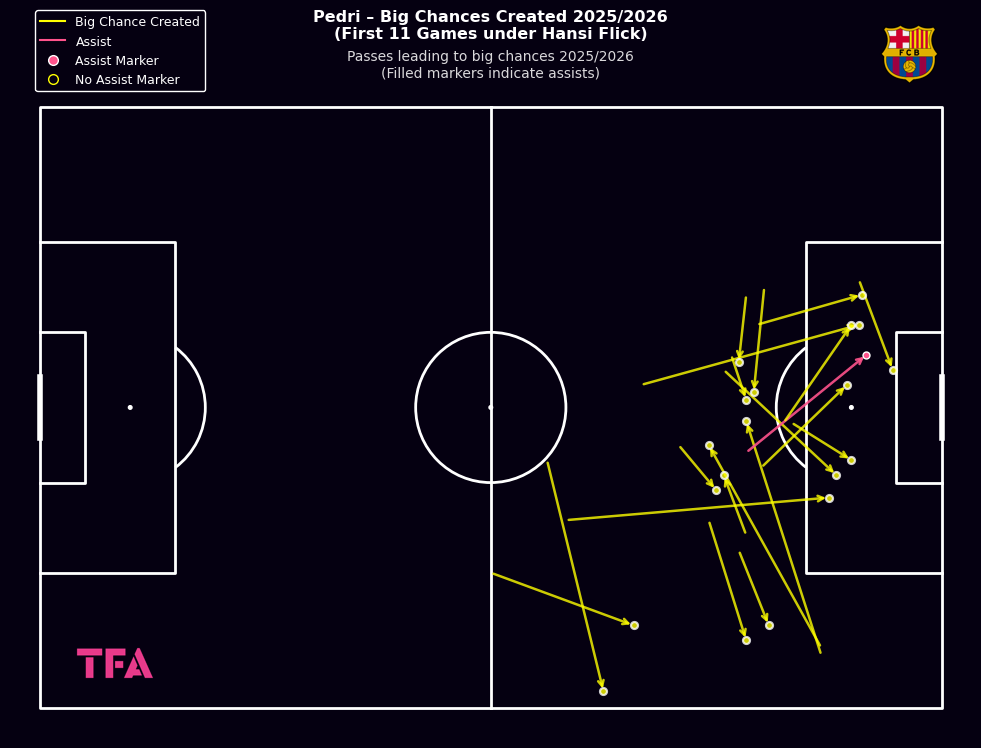
Together, they represent the perfect balance between fluidity and structure.
De Jong drives Barcelona forward through intelligent movement and physical dominance, while Pedri orchestrates the play with precision and vision.
Their synergy, one carrying the ball into danger, the other shaping the geometry around him, has become the tactical heartbeat of Hansi Flick’s Barcelona ahead of El Clásico.
Barcelona Progression Superiority: Pedri & De Jong At The Core Of A Passing Machine
Barcelona’s dominance in progressive passing this season has been nothing short of remarkable.
It leads La Liga with 699 total progressive passes, well above the league average of 603 and comfortably ahead of Atlético Madrid (680) and Real Madrid (653).
La Liga Progressive Passing Map 2025/2026 First Nine Matchweeks
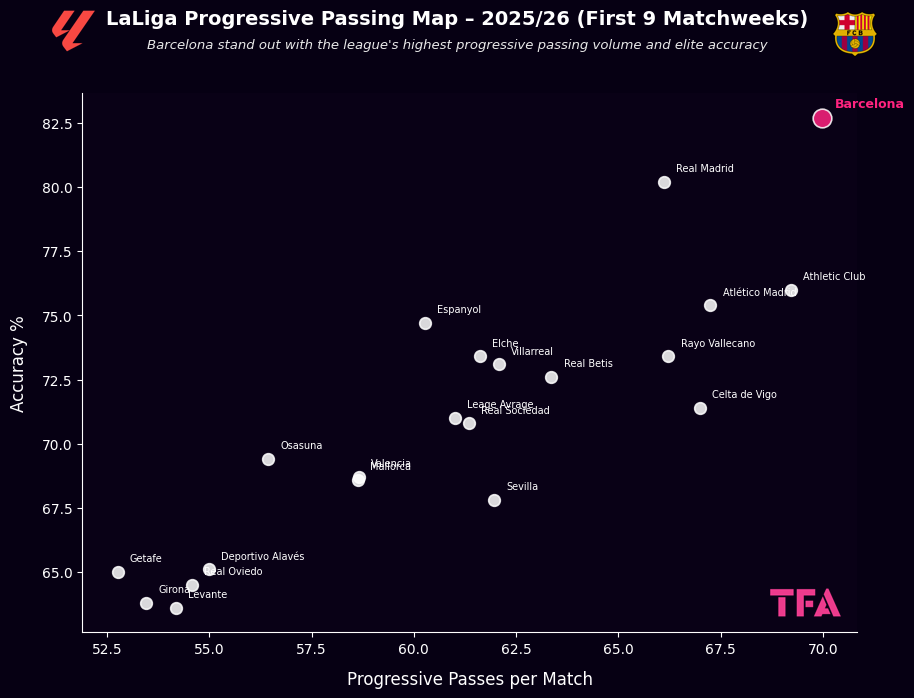
Their 82.7% accuracy, the highest in Spain, encapsulates the precision that defines Hansi Flick’s positional play.
Much of this stems from the control exerted by Pedri and De Jong in midfield.
Matches such as Barcelona’s 3-0 win over Getafe (87 progressive passes, 77% accuracy) and the 2-1 triumph against Real Sociedad (67 progressive passes, 84% accuracy) showed how Barcelona consistently advanced the ball through vertical passing sequences.
However, their efficiency dipped slightly against high-pressing sides like PSG, evidence that their rhythm can be disrupted under sustained pressure.
This variation could prove crucial in El Clásico, where maintaining composure under Real Madrid’s intense counterpress will define whether Barça’s passing dominance translates into territorial control.
Barça Defensive Frailties Exposed: Hansi Flick High-Line Gamble
Barcelona’s defensive data from the 2025/2026 season reveals a series of structural weaknesses that threaten to derail their title challenge.
The team currently concedes 1.08 goals per match, while allowing 8.54 shots against and 3.92 on target, a profile that points to an overly aggressive defensive shape.
Despite maintaining decent averages in defensive duels (45.95%) and aerials (50.31%), these numbers remain below elite standards, highlighting the inherent risk in Flick’s high-line system, which relies heavily on synchronized pressing and precise timing between centre-backs and full-backs.
Barcelona Defensive Profile Under Hansi Flick 2025/2026
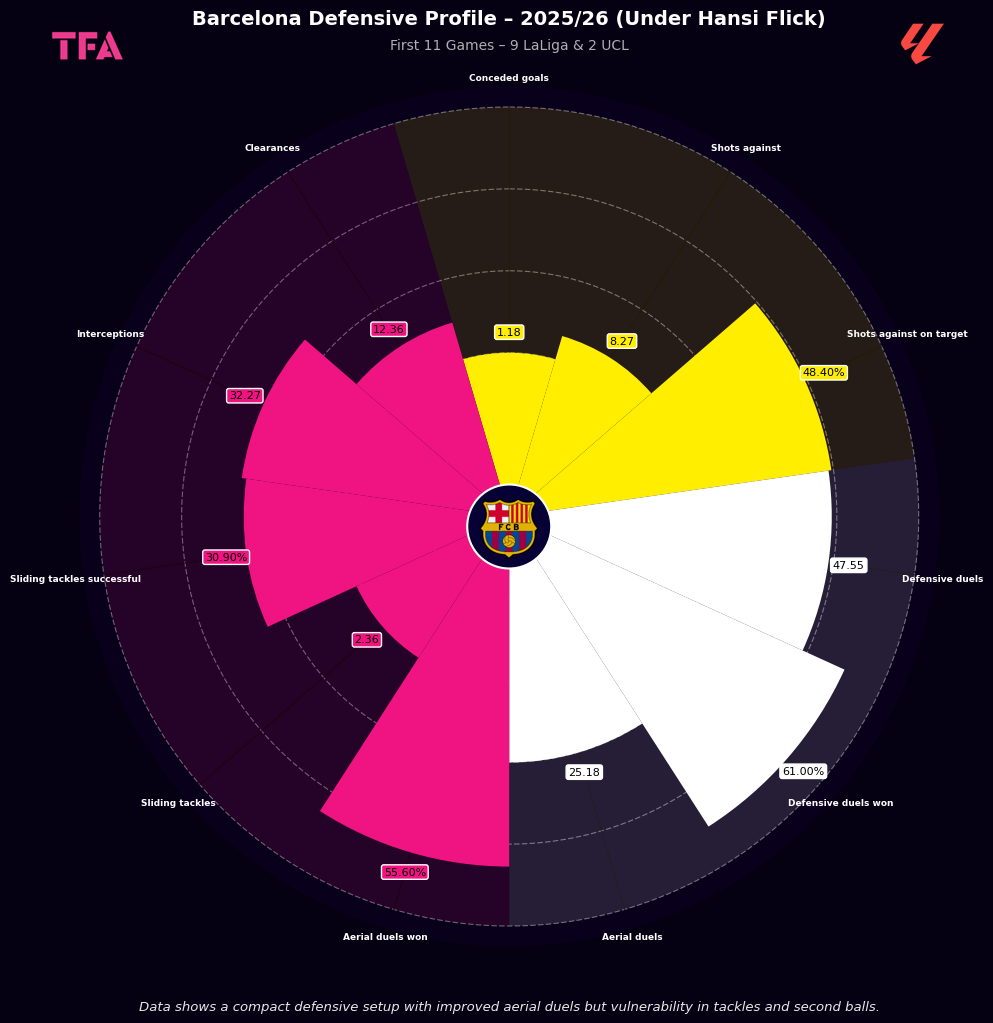
The recurring issue lies in the vertical distance between Barça’s defensive and midfield lines.
When the press is broken, there are vast spaces behind the midfield pivot, allowing opponents to exploit transitions through direct vertical passes or diagonal switches.
Flick’s insistence on compressing play in the opposition half often leaves his backline isolated against pacey forwards, particularly when the counterpress fails to recover possession immediately.
Moreover, the coordination in the offside trap and defensive recovery runs has shown signs of inconsistency, leading to repeated exposure against quick transitional sides, such as Girona and Villarreal.
Barcelona’s high-line gamble magnifies both their strengths and weaknesses.
While it allows dominance in possession and territory, the structural gaps behind make every turnover a potential defensive crisis.
Conclusion
As Barcelona prepare for El Clásico against Xabi Alonso Real Madrid, the sense of assured dominance that surrounded Hansi Flick’s side last season has been replaced by uncertainty and tactical fragility.
The data and performances across the opening months of the 2025/2026 campaign suggest a team still searching for balance, a side capable of brilliance in controlled phases but increasingly vulnerable when exposed to chaos.
While Pedri and Frenkie de Jong continue to serve as the heartbeat of Barcelona’s structure, maintaining progression and rhythm under pressure, the inconsistency of players such as Lamine Yamal and the recurring defensive lapses have disrupted the team’s collective identity.
Flick’s positional principles remain clear, but their execution has faltered: pressing lacks intensity, distances between lines are stretched, and the high defensive line now feels more like a risk than a weapon.
Heading into El Clásico, expectations are therefore far more restrained than a year ago.
What was once seen as a statement fixture confirming Barcelona’s superiority now represents a test of resilience and tactical clarity.
The 2025 treble winners are no longer untouchable; their data tells a story of imbalance, fatigue, and tactical vulnerability.
For Flick, the challenge is no longer about innovation, but restoration: rediscovering control, cohesion, and conviction before the cracks widen further on Spanish football’s biggest stage.
