
As Xabi Alonso embarks on his first full season in charge of Real Madrid, one question stands out above all others: How is he trying to get the best out of this immensely talented squad?
For years, Los Blancos‘ success has relied heavily on individual brilliance rather than on a clear tactical framework.
Moments of magic from world-class players often masked a lack of collective coherence.
But Alonso, true to his reputation as one of the most meticulous midfielders of his generation, is trying to change that.
His approach revolves around control, structure, and maximising the tactical potential of every player at his disposal.
Through this Real Madrid data analysis, we will explore how Alonso’s methods are reshaping Madrid’s identity, from a side that often thrives in chaos to one that dictates the tempo precisely.
We will examine which players have already adapted to his evolving system and which are still figuring out their place.
Early indicators suggest a team becoming more organised, both with and without the ball, pressing more effectively, and managing transitions with greater intent.
Alonso’s project is still “under construction”, but the data suggests a clear direction: a Real Madrid that no longer leaves anything to chance.
How Xabi Alonso Tactics Shape Real Madrid Attacking Dynamics
Across the early stages of the 2025/2026 campaign, Real Madrid’s attacking profile under Xabi Alonso has revealed a compelling tactical pattern.
This pattern highlights how effectively they can dismantle weaker or less compact teams and how their fluidity diminishes against well-structured opponents.
On average, Real Madrid have registered 2.86 expected goals (xG) and nearly 19 shots per match, but those figures fluctuate dramatically depending on the opponent’s defensive organisation and pressing strategy.
Real Madrid Offensive Profile Under Xabi Alonso 2025/2026

When facing mid- or lower-tier sides, such as Kairat (5-0 in the UEFA Champions League) or Levante (4-1 in La Liga), Madrid’s attacking rhythm appears seamless.
Their structured build-up in a 4-2-3-1 shape and aggressive full-back positioning allowed them to dominate transitions and sustain pressure high up the pitch.
In these games, they exceeded 20 shots, produced xG values above 4.0, and created over 14 positional attacks that ended in efforts on goal.
The wide rotations between Vinícius Júnior and Rodrygo, supported by overlapping runs from Dani Carvajal and Álvaro Carreras, consistently stretched defensive lines and opened interior passing lanes.
However, Alonso’s system struggled to impose the same rhythm when confronted by tactically disciplined teams such as Atlético Madrid (2-5) or Mallorca (2-1).
Against Atlético, Real Madrid’s xG dropped sharply to 0.45, with only five total shots and a meagre 6.67% success rate in positional attacks.
These disparities underscore a tactical reality: while Alonso’s Madrid excel in matches where they can dictate tempo and space, they continue to struggle when opponents disrupt their build-up and force them into reactive phases.
The Core Architects Of Real Madrid Attacking Structure Under Xabi Alonso
Through the opening ten matches of the 2025/2026 season, Real Madrid’s attacking system under Xabi Alonso has revealed a clear hierarchy shaped around intelligent movement, creative balance, and positional discipline.
At the heart of this evolution stands a dynamic trio: Vinícius Júnior, Kylian Mbappé, Franco Mastantuono, Rodrygo, and Arda Güler.
Each fulfils a distinct tactical function that collectively defines Madrid’s attacking identity.
One of the most striking transformations has been Vinícius Júnior’s role in transitions.
Once regarded primarily as Madrid’s direct outlet on the counter, Vinícius has been redefined by Alonso into a more multi-dimensional attacking asset.
Vinícius Júnior Chance Creation & Assist Map Under Xabi Alonso
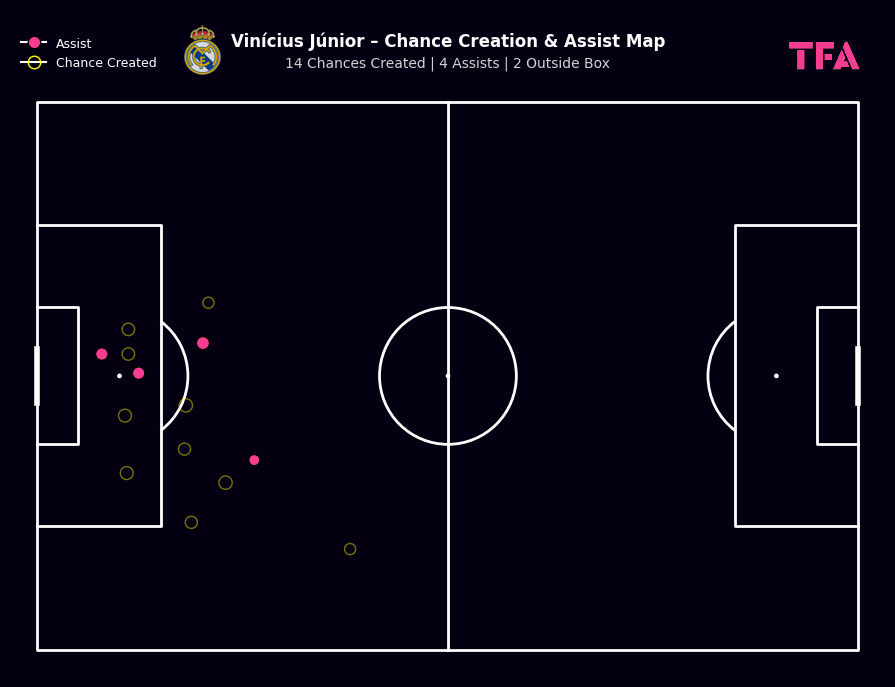
Data from the early LaLiga fixtures show him producing 14 shot-creating actions, with four directly leading to goals in just five matches.
What marks his evolution most is his off-ball intelligence.
Rather than merely attacking space, he manipulates it, making diagonal runs that distort defensive lines and open gaps for others.
In the 1-0 win over Real Oviedo, his movement inside drew multiple defenders away from Kylian Mbappé, allowing the Frenchman to attack the vacated channel.
Similarly, his delayed shift to the left against PSG in the Club World Cup lured both centre-backs, enabling Aurélien Tchouaméni to advance into a dangerous pocket.
Under Alonso, Vinícius is no longer just a finisher of counters; he’s a positional catalyst, destabilising opposition structures through timing, disguise, and pace.
In contrast, Arda Güler’s contribution has centred on precision and creativity in the final third.
The Turkish playmaker has already created 21 chances, with three assists and three goals from 11 shots, backed by an xG of 2.19.
Arda Güler Shot Map 2025/2026 In All Competitions
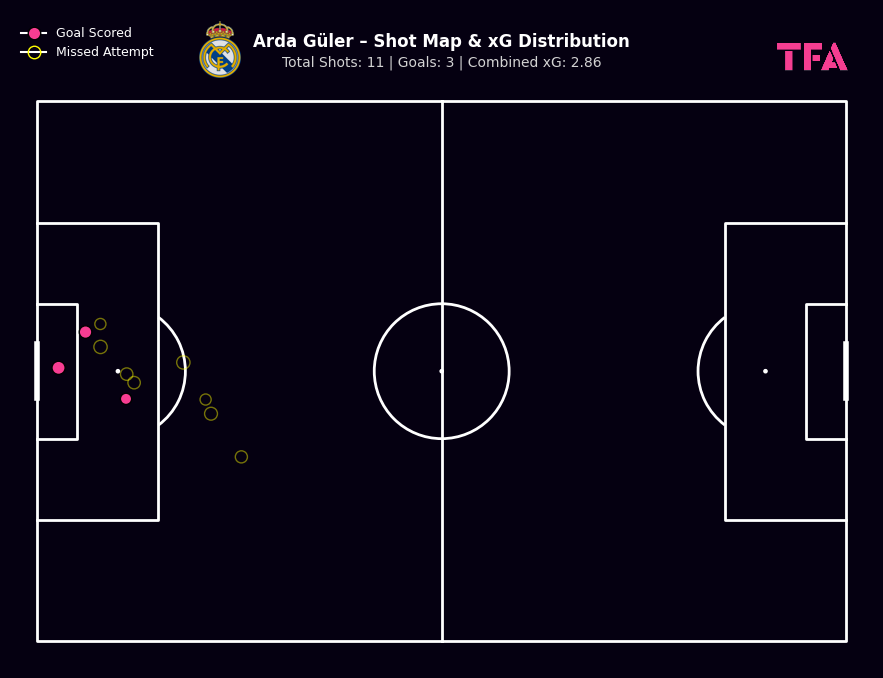
His spatial awareness enables him to find half-spaces between defensive lines, linking midfield and attack with incisive vertical passing.
Güler’s decision-making complements Vinícius’ dynamism, ensuring that Real’s attacks are not solely dependent on transitions but can also thrive in structured possession.
Meanwhile, Kylian Mbappé continues to provide the cutting edge that Alonso’s tactical system demands.
Kylian Mbappé Shot Map & xG Distribution Under Xabi Alonso
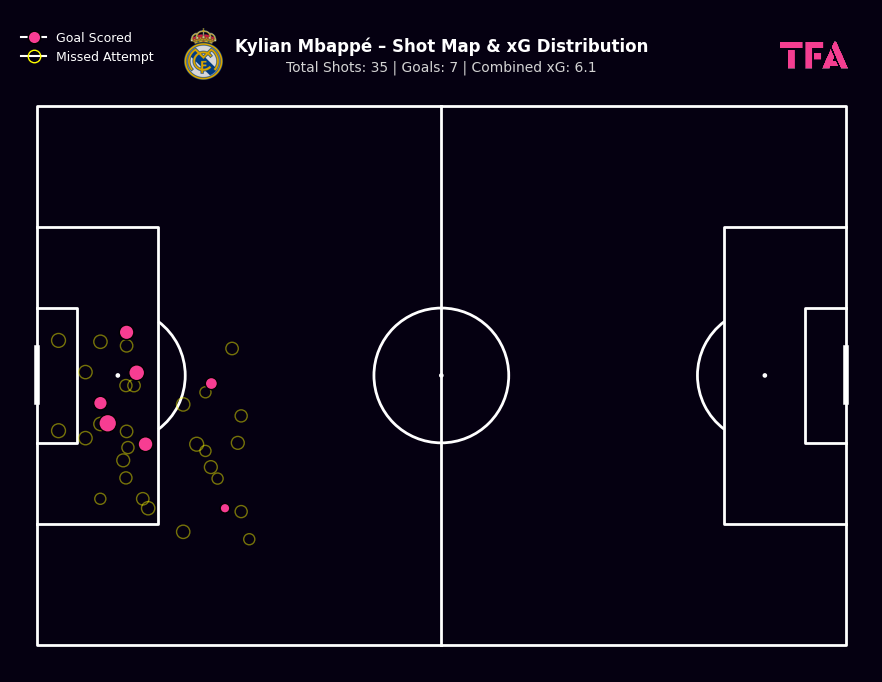
In 572 minutes, he has registered seven goals from 36 shots with an xG of 6.1, a striking xG per shot of 0.17, illustrating his elite chance selection.
His ability to stretch backlines through intelligent off-ball movement creates both space for teammates and high-quality scoring opportunities for himself.
However, Alonso faces a growing positional dilemma.
Youngster Mastantuono has impressed from the left flank when deputising, showing sharp movement and direct dribbling that mirrors Vinícius’ earlier style.
Meanwhile, Rodrygo, often deployed as a substitute, continues to seek rhythm and consistency.
He frequently replaces Vinícius but struggles to impose himself fully in limited minutes.
This rotation highlights a tactical tension Alonso must resolve: balancing the explosive output of his established stars with the form of emerging contributors.
The data and performances suggest that Alonso’s Real Madrid are evolving towards a fluid, multi-layered attack, built not just on individual brilliance but on synchronised movement and intelligent occupation of space.
From Vinícius’ deceptive transitions to Güler’s precision and Mbappé’s efficiency, each player forms a vital piece of an increasingly complex attacking puzzle.
Passing Structure & Distribution Patterns In Real Madrid Tactical Framework
Under Xabi Alonso, Real Madrid’s passing identity in the 2025/2026 campaign embodies a growing emphasis on control, precision, and spatial manipulation, all hallmarks of the Basque coach’s positional philosophy.
The numbers paint a clear picture of a team intent on dictating matches through structured possession rather than chaotic transitions.
Real Madrid Passing Profile Under Xabi Alonso 2025/2026
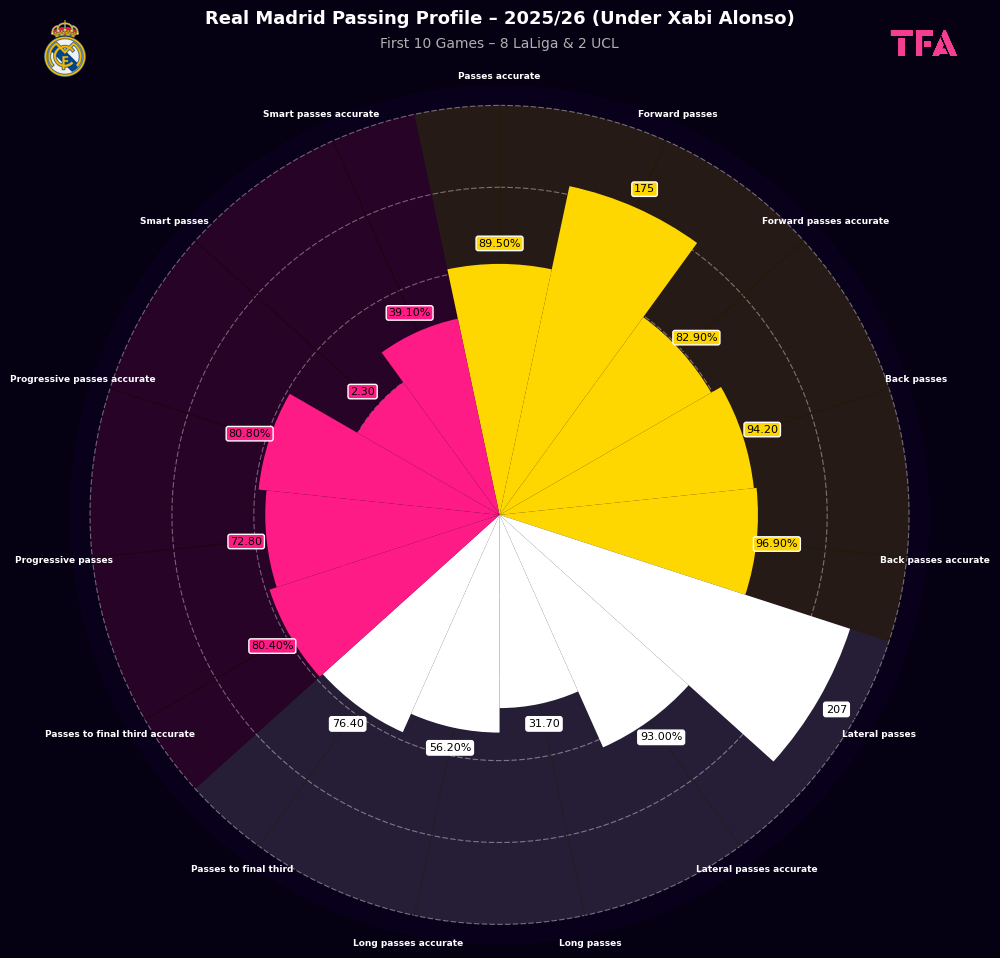
Across both LaLiga and Champions League fixtures, Los Blancos have averaged 585.6 total passes per match, with a 89.46% success rate, nearly 220 more than their opponents’ average of 364.6.
This margin highlights Madrid’s shift towards ball-dominant control, where tempo and structure serve as the foundation for territorial superiority.
Alonso’s side displayed a controlled yet vertical passing rhythm against less aggressive sides such as Kairat (5-0) and Levante (4-1).
In both games, they registered over 600 total passes with accuracy above 89%, combining volume with penetration, producing 80+ progressive passes and 60+ final-third entries.
These figures point to a team capable of sustaining possession while advancing play efficiently through coordinated movement and central overloads.
By contrast, against tactically compact or high-pressing opponents like Atlético Madrid (5-2) and Real Sociedad (2-1), Real’s rhythm was noticeably restricted.
Their total passes dropped to around 520–530, forward pass accuracy declined to around 76%, and the efficiency of smart passes, those breaking defensive lines, fell below 70%.
Real Madrid Passing Comparison Vs Atlético Madrid & Levante
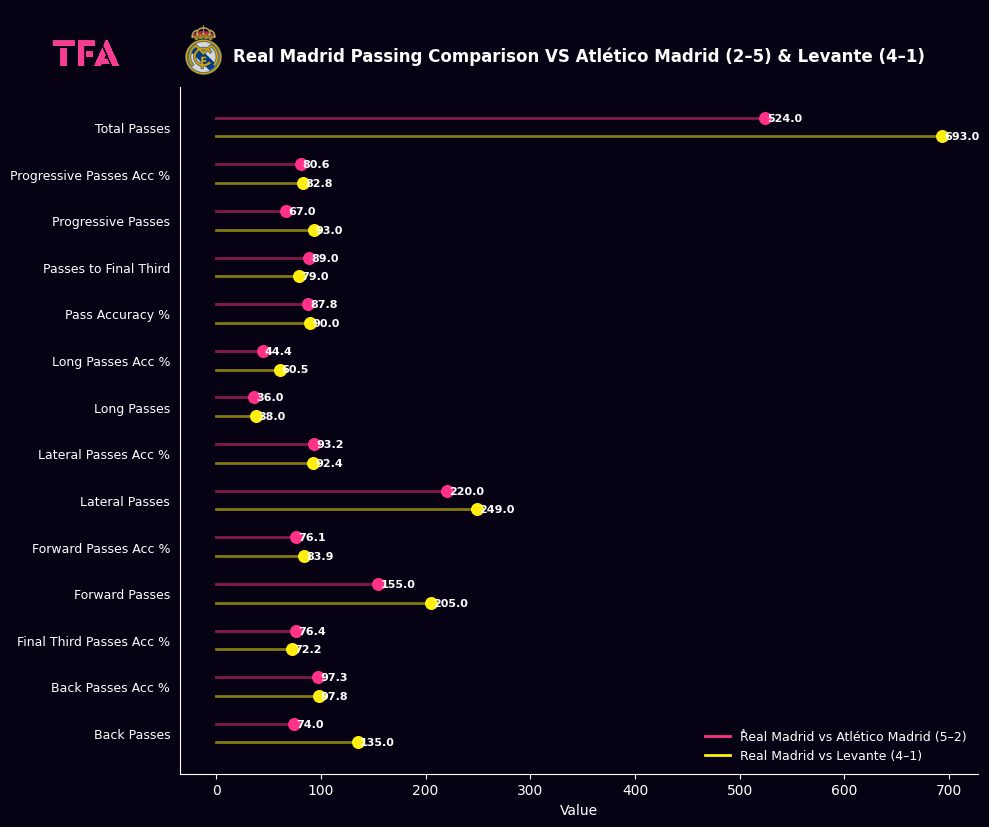
This statistical contrast highlights how, while progressive, Alonso’s system still relies heavily on space management and opposition behavior.
Tactically, Alonso’s Madrid rely on short, triangular combinations to progress through the thirds.
On the left, the interplay between Carreras, Vinícius Júnior, and Fede Valverde provides a blend of direct running and underlapping support, stretching defensive lines horizontally and vertically.
Carreras’s width pins the opposition full-back, Vinícius’s diagonal movements create central overloads, and Valverde’s late half-space arrivals maintain vertical presence.
A more possession-oriented dynamic emerges on the right with Arda Güler, Mastantuono, and Dani Carvajal.
Güler drops deeper to orchestrate tempo, Mastantuono drifts between wide and interior zones, and Carvajal pushes high to provide delivery from advanced spaces.
The result is a dual-structured system, direct and aggressive on one flank, controlled and circulatory on the other, giving Madrid balance and adaptability across phases.
Real Madrid Defensive Identity Under Xabi Alonso: Structure, Pressing & Resilience
Across the opening ten matches of the 2025/2026 campaign, Real Madrid’s defensive evolution under Xabi Alonso has been a calculated adaptation rather than a radical overhaul.
The data reveals a side in transition, more compact and aggressive in controlled phases but still susceptible when the rhythm breaks, especially against sides capable of exploiting vertical spaces.
Real Madrid Defensive Profile Under Xabi Alonso 2025/2026
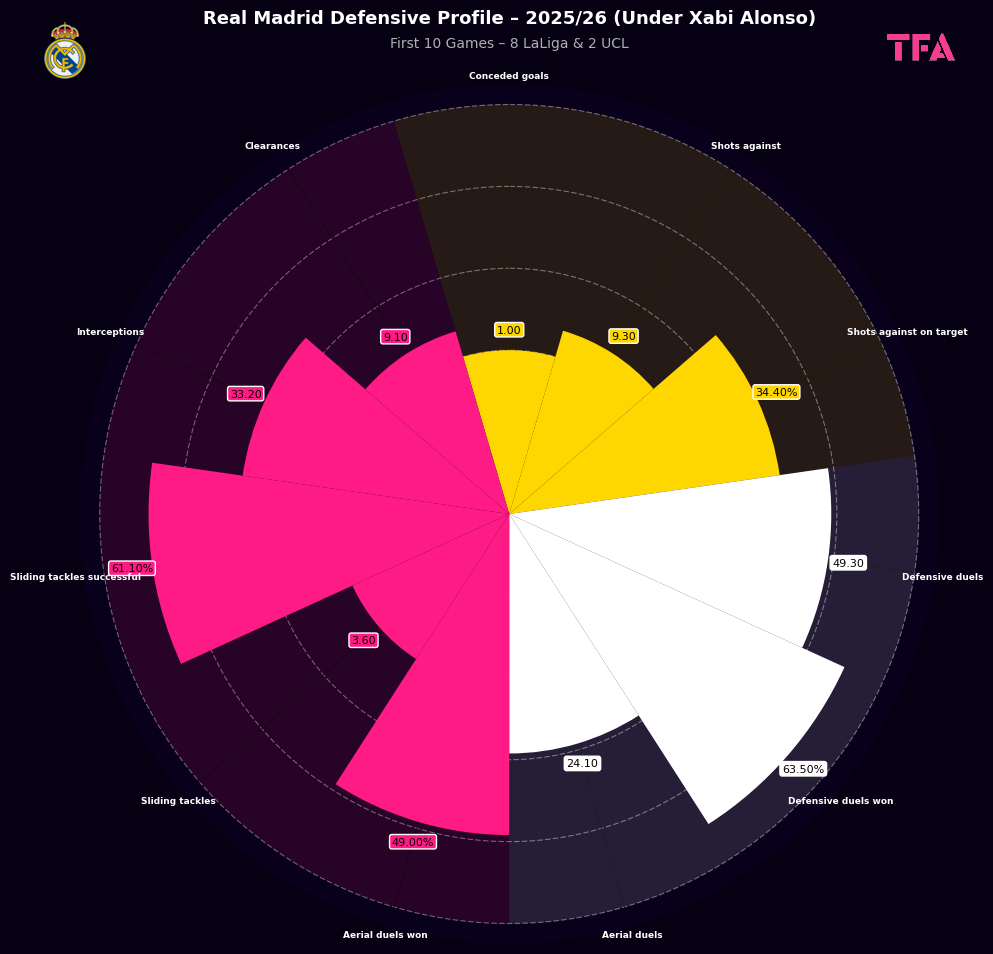
On average, Madrid have conceded 1.0 goal per match, facing 9.3 shots with only 3.2 on target, compared to opponents who face almost double that volume (18.9 shots and 7.9 on target).
This numerical balance reflects improved defensive management in possession-heavy matches, though cracks emerge under sustained pressure.
Against Atlético Madrid (2-5), Alonso’s defensive structure was stretched repeatedly.
Real’s defensive duels success dropped to 54.8%, and their PPDA rose to 11.22, indicating reduced pressing efficiency and greater space for Atlético’s transitions.
In contrast, fixtures against Kairat (5-0) and Espanyol (2-0) demonstrated the ideal version of Alonso’s press: compact mid-blocks that triggered high recoveries, limiting the opposition to 10 and four total shots. Madrid’s PPDA fell below 8.5, and aerial duels won exceeded 70%.
Alonso’s tactical flexibility underpins this defensive balance.
The 4-2-3-1 shape has provided a stable base in most matches, offering both structural width and central protection.
When switching to a 3-4-2-1, as seen versus Levante (4-1), Madrid improved their defensive coverage between lines, recording 65.9% success in duels and over 30 clearances, a clear sign of controlled aggression.
However, inconsistencies persist when opponents manipulate tempo or press effectively.
Against Olympique de Marseille (2-1) and Real Sociedad (2-1), the team’s interception rate (below 60%) and rising PPDA (12-13) indicated a decline in collective intensity.
The overall trend suggests a tactical defence still under construction, built around proactive pressing, spatial control, and structured recovery.
It is capable of suffocating weaker sides but still adjusting to the demands of elite-level transitions.
Real Madrid Tactical Rebirth Under Xabi Alonso
Alonso’s Madrid have developed a clearer sense of identity, one that seeks to dominate possession and dictate rhythm through precision rather than chaos.
Their average of nearly 586 passes per match at 89.5% accuracy underlines a shift towards calculated, methodical control, a far cry from the transition-heavy football of recent years.
The data also highlight where the evolution remains incomplete.
Against compact or high-pressing opponents, Madrid’s passing tempo falters, and their pressing efficiency (PPDA above 11 in some games) still wavers under sustained pressure.
Offensively, Alonso’s approach has brought structural harmony to a line-up bursting with attacking talent.
Vinícius Júnior’s transformation into a spatial manipulator, Arda Güler’s orchestration between lines, and Kylian Mbappé’s ruthless efficiency form the tactical spine of an evolving system that thrives when space is created rather than found.
The team’s dual-wing dynamic, characterized by direct and vertical play on the left and measured, possession-based play on the right, embodies Alonso’s balance between aggression and patience.
Defensively, signs of improvement are tangible.
A lower average of 9.3 shots conceded per match and increased aerial duel success (70%+), indicating better structural cohesion.
One of the clearest markers of Alonso’s influence this season lies in Real Madrid’s pressing and turnover control.
In the first 10 matches of the 2025/2026 campaign, Madrid have already recorded 53 high turnovers, with 15 leading to shots and four resulting in goals.
Real Madrid High Turnovers & End Product Map 2025/2026
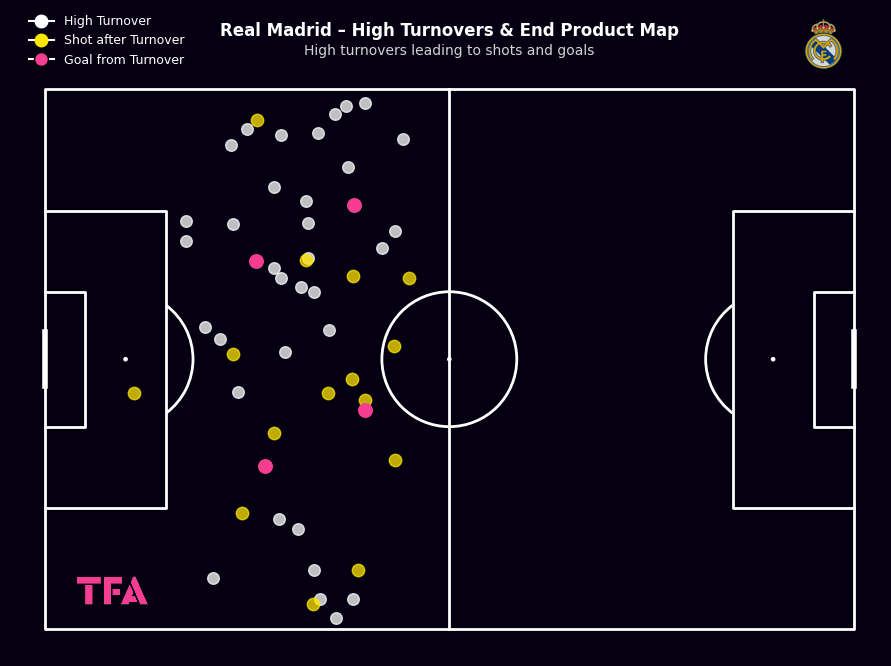
This reflects a side no longer content with merely regaining possession but determined to weaponise those moments, turning defensive pressure into instant attacking intent.
Such sequences illustrate how Alonso’s philosophy of defending through the ball is redefining Madrid’s identity into one that blends control, compactness, and calculated aggression.
Conclusion
As Real Madrid navigate their first full season under Xabi Alonso, the data and tactical evidence suggest a team undergoing a significant transformation.
This iteration of Madrid is no longer reliant on spontaneous brilliance but increasingly defined by structure, cohesion, and control.
Alonso’s influence has instilled a sense of collective discipline, with the side displaying improved spatial intelligence and a clearer strategic intent in and out of possession.
Vulnerabilities persist when transitions accelerate or opponents narrow the central corridors, revealing a tactical framework that is still in development.
Even so, the progress is undeniable.
Real Madrid have evolved from a team thriving on instinct to one operating through calculation and coordinated design.
The project remains unfinished, but Alonso has redrawn the blueprint, shaping a modern, tactically literate Madrid capable of asserting its identity across any competition.
