
Lucas Cepeda, a 22-year-old left winger from Chile, has been one of the most remarkable breakthroughs in the Primera División this season.
His impact at Colo-Colo, along with his appearances for youth national teams, positions him as a player ready to take a competitive leap in the short term.
But beyond measurable performance, Cepeda’s unique style of play distinguishes him: he doesn’t fit the classic dribbling winger model but instead acts as an external organiser throughout multiple phases of play.
This player analysis and scouting report breaks down his most representative patterns on and off the ball across various stages of the offensive and defensive cycle.
Who Is Lucas Cepeda?
Lucas Antonio Cepeda Barturen, born October 31, 2002, in Viña del Mar, Chile, stands at 1.77 meters.
He is known for his versatility on the left flank, including roles as a left forward, left midfielder, and occasionally left-back in his early career.
Cepeda began his career in the youth ranks of Santiago Wanderers, with brief stints at Colo-Colo and Everton de Viña del Mar academies.
He debuted professionally with Wanderers in 2021 but saw limited action after their relegation to Primera B in 2022.
His breakout came in 2023, earning him a move to Colo-Colo in February 2024.
That year, he shone in the Copa Libertadores, scoring key goals against Cerro Porteño and Junior de Barranquilla, and contributed to Colo-Colo’s Chilean Primera División title and Supercopa victory.
He was named the best young player in the Chilean league in 2024.
Internationally, Cepeda debuted for Chile’s senior team in October 2024 during the 2026 FIFA World Cup qualifiers, scoring his first two goals against Venezuela on November 19, 2024.
Lucas Cepeda Stats
Compared to other wingers in leagues of a similar level, Cepeda ranks above average in key metrics, such as all attacking and possession metrics on our pizza chart below.
This statistical profile reinforces what video analysis suggests: he’s a high-volume, multi-phase player involved in progression from several angles.

Lucas Cepeda In-Possession
Lucas Cepeda During Build-Up & Possession Patterns
During the build-up phase (middle third), Cepeda typically positions himself wide on the left, receiving on his natural side.

His intention is not to start from intermediate zones or make deep runs from behind, but to offer a lateral support point that sustains circulation.
At times, he may drop into the interior channel to help advance the ball between lines, but without changing his primary role.
His behaviours in this zone emphasise a combination: he clearly shows interest in the ball, avoids unnecessary carries, and prioritises short-passing connections over individual actions.
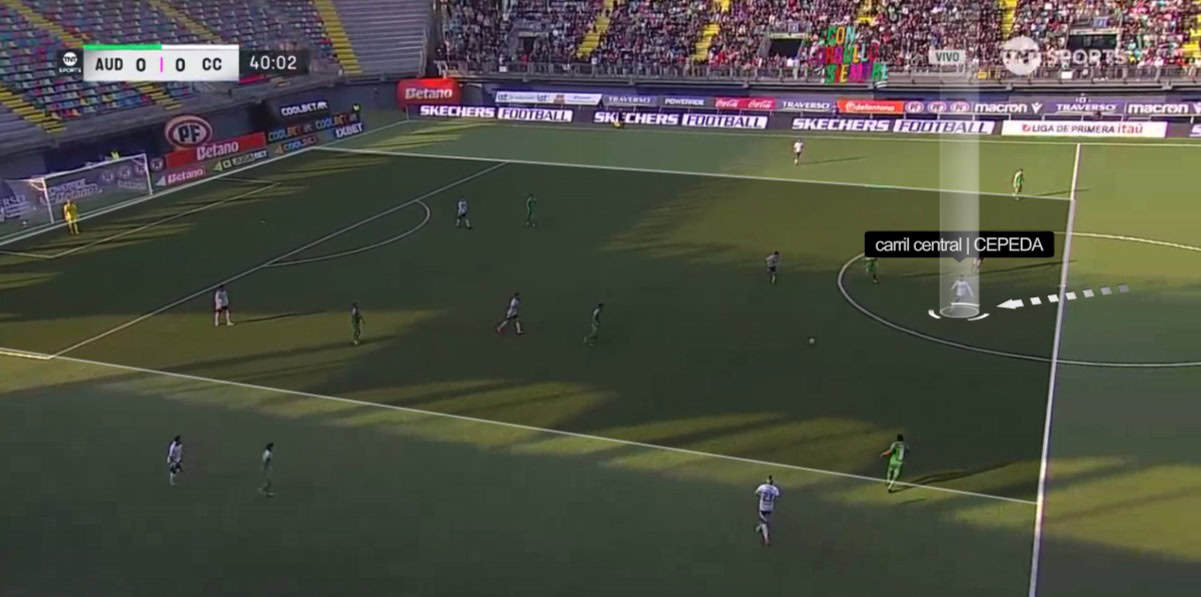
He tends to appear as a receiver in functional triangles, facilitating clean exits oriented toward central progression or overlaps by the full-back.
He doesn’t attack space from deep or run into large open areas.
Instead, he acts as an intermediary: receiving, releasing, and re-engaging.
His influence zone is defined by repeated supports, particularly in the centre-left quadrant, where he combines with full-backs, interiors, or midfield pivots.
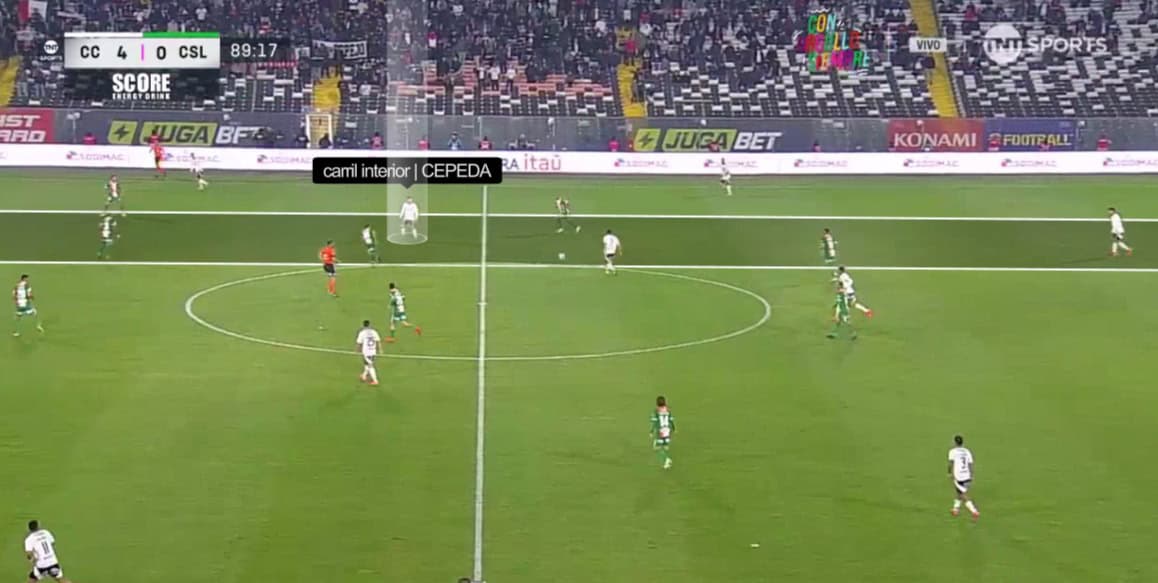
Lucas Cepeda On The Strong Side
Cepeda takes on a more structured role, and that sector becomes the strong side.
He executes short lateral movements, receives, releases, and shows again.
This rhythmic repetition generates continuity, supports circulation across the field, and maintains any positional advantage gained in that zone.
After each pass, he remains active: either making a diagonal or vertical run to offer a new option, or repositioning inside to attract defenders and generate intervals.
He does this without needing to occupy central areas or crash the box.
His influence is indirect: opening channels, occupying in-between spaces, and provoking defensive shifts.
These movements are not improvised but consistent.
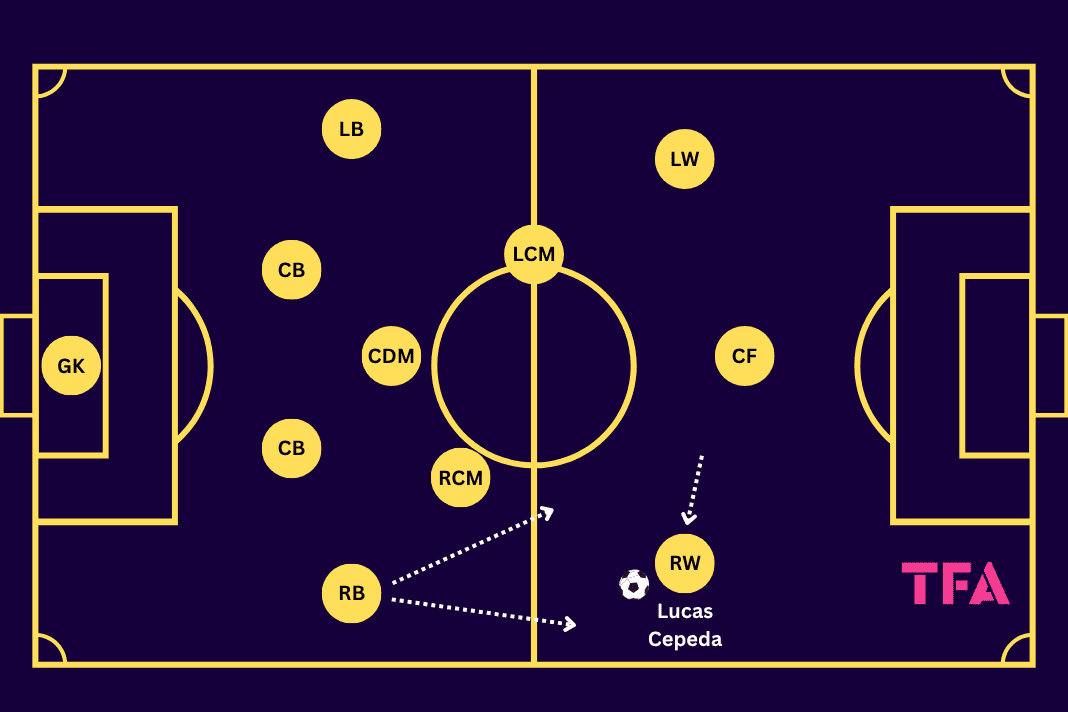
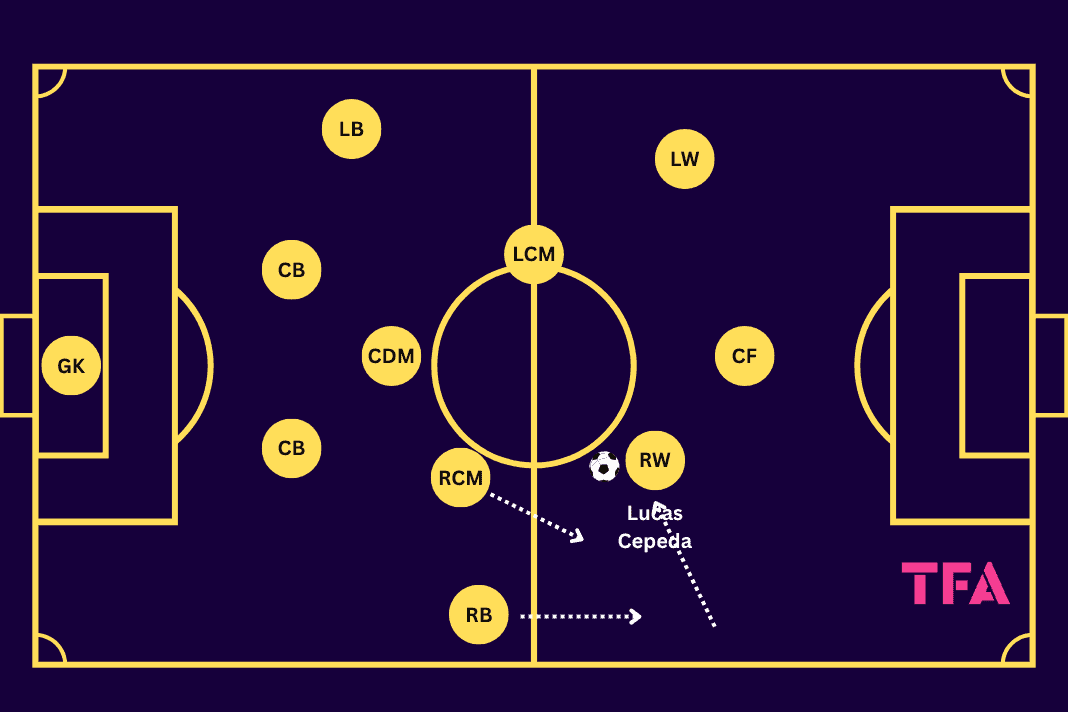
Cepeda understands the space freed up by overlapping full-backs and decides whether to stay wide to facilitate that run or move inside to combine.
Often, his reading of teammates’ off-the-ball movement allows him to play well-timed passes into the interval between the opposing full-back and centre-back (CT-FB zone), particularly when the defensive line drops.
Lucas Cepeda Receptions & Dominant Foot Profile
Technically, his receptions are clean and well-oriented: he controls with the foot furthest from the nearest defender, ensuring protection and optimal passing angle.
Though left-footed, he is competent with his right, allowing him to exit in either direction depending on pressure.
He does not rely on long dribbles or extended sequences of 1-v-1 moves.
He rarely forces direct duels.
His advantage comes through short-distance bursts, especially in tight areas.
This compact explosiveness lets him gain just enough space to wall-pass or thread a ball forward.
In wide zones, his 1v1 management is pragmatic: if he detects a positional mismatch, he may attack the outside shoulder; if not, he simply recycles possession and repositions.
His decision-making in these situations, combined with his rhythm awareness, makes him a reliable option even under aggressive pressing.
Lucas Cepeda In The Final Third: Timing, Decision-Making & Structure
Cepeda maintains his preference for receiving the ball at his feet in organised attacks within the opponent’s half.
He is not a target for weak-side switches in search of 1v1 isolation.
In fact, he’s rarely used as a qualitative superiority receiver.
Instead, his contributions occur in congested areas where his supporting actions help reorganise or stabilise possession.
In wide areas, he demonstrates sound decision-making.
He does not send aimless crosses.
He doesn’t force entries into the box.
Instead, he identifies when spaces open at the edge or top of the area for trailing midfielders and acts accordingly.
He knows when to pause and when to accelerate.
He interprets overlapping runs intelligently: if the full-back overlaps outside, Cepeda stays wide to pin defenders; if the full-back underlaps inside, he adjusts to either stretch horizontally or drop to connect.
His vision allows him to anticipate gaps opening as others move.
Lucas Cepeda Impact In Offensive Transitions
In immediate recovery situations, Cepeda acts as a stabiliser.
If he’s not the one recovering possession, he positions himself close to the ball carrier to offer a safe passing lane.
He doesn’t look to rush transitions or drive forward blindly.
Instead, he focuses on retaining control, reorganising the team, and rebuilding the possession structure.
This makes him valuable in organised transitions.
He links with nearby teammates, initiates short combinations, and helps reestablish offensive shape.
His calmness in these scenarios lowers the risk of immediate turnovers and increases the odds of productive transitions.
Lucas Cepeda Off-The-Ball Work In The Defensive Phase
Off the ball, Cepeda demonstrates a strong commitment.
He tracks back with intensity, covers his flank, and prevents overloads.
His most notable defensive trait is his immediate reaction after a loss: he engages quickly, regardless of whether the loss was his.
This positive aggression enables him to press, disrupt, or recover effectively within the first few seconds of transition.
He shows awareness of when to press and how to guide the opponent’s play in medium or high pressing phases.
He isn’t a natural ball-winner or physically dominant, but he compensates with positioning and work rate.
He doesn’t break structure through poor pressure and generally recovers well if bypassed.
Lucas Cepeda Projected Role & Ideal Structures
Cepeda is best suited for teams that offer close support and emphasise combination play.
His profile flourishes in systems that value short passing, wide pinning, and progression through interaction.
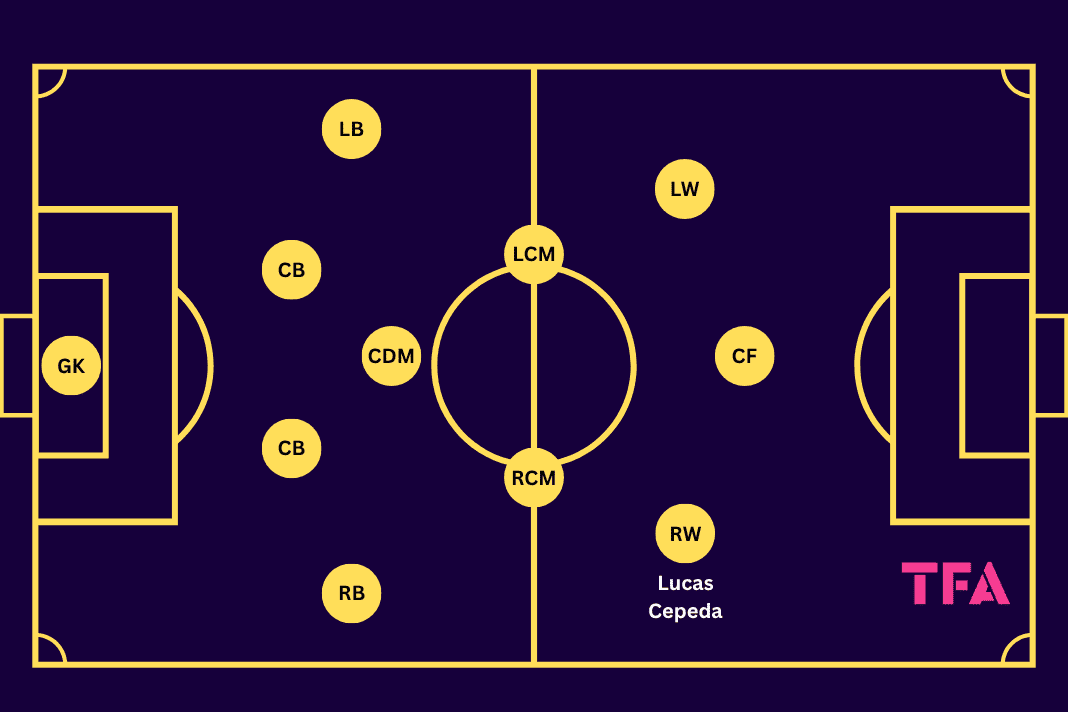
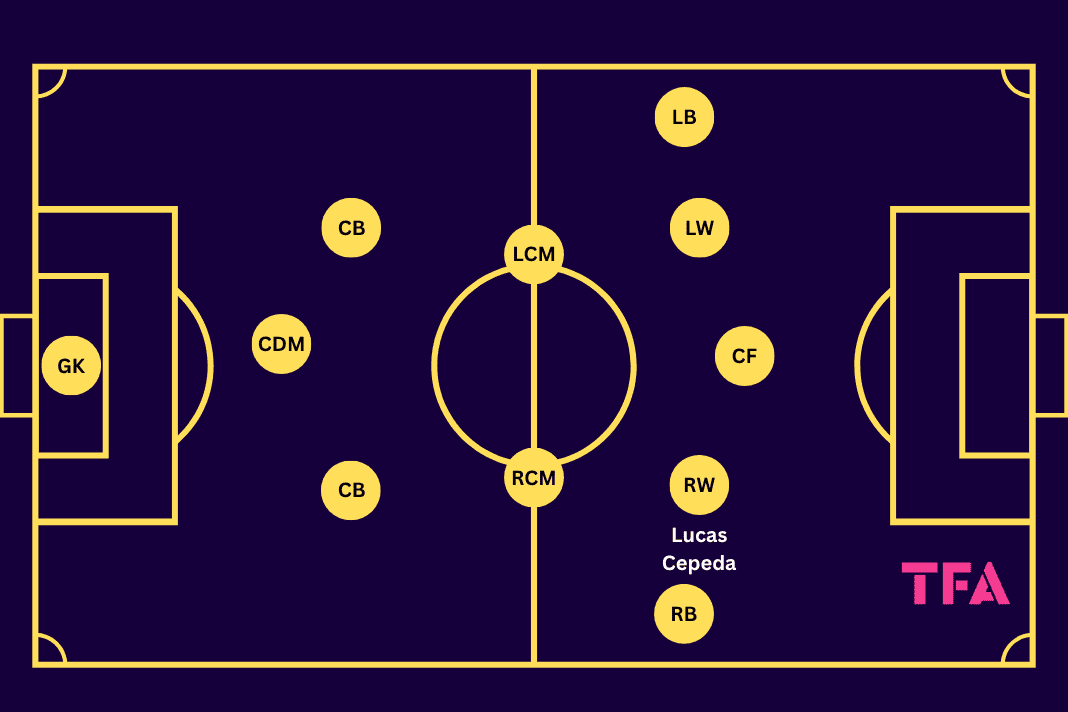
In contrast, isolating him or requiring frequent 1v1 duels without support would reduce his effectiveness.
His ideal role includes starting wide with the option to move inside depending on the full-back’s behaviour.
He fits into 4-3-3 with deep full-backs, box-crashing interiors, or asymmetrical setups with mixed winger roles.
In all cases, he must stay close to the ball to influence.
Additionally, he could evolve into a hybrid role — part winger, part interior — in systems that rotate between outside and inside lanes, depending on the manager’s approach and the full-back’s tendencies.
Cepeda needs a context where his game intelligence is genuinely valued, not treated as a secondary trait, to continue progressing.
Teams prioritising rational spatial occupation, short-passing sequences, and support in wide zones represent optimal environments for his style.
He doesn’t necessarily need to play for a dominant team, but rather one with structured attacking phases — where he can receive to feet, turn when appropriate, and release efficiently.
His game thrives on positional proximity, not unrestricted freedom.
Conclusion
Lucas Cepeda is not a vertical winger or a statistical standout.
His influence isn’t captured in highlight reels or heatmaps.
However, his structural value is significant: he organises, connects, interprets, and aligns his decisions with the game’s collective rhythm.
He is a player who brings order, not chaos, who facilitates from pauses, not dribbles.
His understanding of collective tempo, combined with his technical reliability, makes him a valuable player in structured systems.
In a footballing landscape that often overvalues acceleration, Cepeda offers something different: control, clarity, and synchronisation.
It’s a profile that thrives in tactical ecosystems where intelligent positioning and deliberate sequences take precedence.
He doesn’t need to shine to influence — his value lies in what he enables.
