
Centre-forwards have dominated the 2025 summer transfer window at the top of the Premier League.
Two of the names that have been at the centre of transfer speculation all summer are Newcastle United striker Alexander Isak, who’s been heavily linked with a move to big-spending Liverpool this summer, and Viktor Gyökeres, who’s moved to Arsenal from Sporting CP (Sporting Lisbon) for a reported €65.8m.
Both players are Swedish forwards with a history in Swedish club football—Isak with AIK, the club with which he climbed the youth ranks and went on to make 29 first-team appearances, scoring 13 goals, Gyökeres with IF Brommapojkarna, where he made 67 first-team appearances, scoring 25 goals.
The Swedish top-flight, Allsvenskan, has produced several elite forwards over the years.
Legends of the game like Zlatan Ibrahimović and Henrik Larsson join Isak and Gyökeres in getting their start with Swedish clubs.
Given the demand two Swedish strikers have commanded this summer, we at Total Football Analysis took it upon ourselves to conduct a data analysis of the current forwards scene in Sweden’s top-flight, looking for the best young attackers the league has to offer.
Using Wyscout’s raw data and custom-built metrics, we searched for different types of forwards: poachers, target men, link-up forwards, creative forwards and inside forwards.
Our search was limited to players 23 years of age or younger who have played a minimum of 400 minutes this season so far.
In the end, our player analysis led us to two main standouts: the poacher (Max Fenger of IFK Göteborg, eighth of 16 teams in Allsvenskan this term) and the inside forward (Montader Madjed of Hammarby IF, currently second in Allsvenskan).
This analysis will run through our process of identifying these players and provide an in-depth analysis of both, highlighting the pair’s key traits, strengths, and weaknesses.
Finding The Best Poacher In Allsvenskan 2025
To start, let’s analyse Allsvenskan for goal poacher centre-forwards.
This section includes two scatter plots designed to highlight the best goal poachers in the top-right quadrant.
Our first visualisation combines the raw metrics of xG per 90 and shot conversion %.
This search is designed to highlight players who move intelligently and finish chances well.

When analysed through the lens of these metrics, four main standouts emerged: Max Fenger, Frederik Ihler, Sebastian Clemmensen, and Omar Faraj, in order, decreasing in conversion rate and rising in xG per 90.
We then also compared two custom-built metrics: Finishing Efficiency, which is a combination of goal conversion percentage and shot accuracy rate, and Attacking Impact Score, a weighted combination of non-penalty goals, xG and xA.
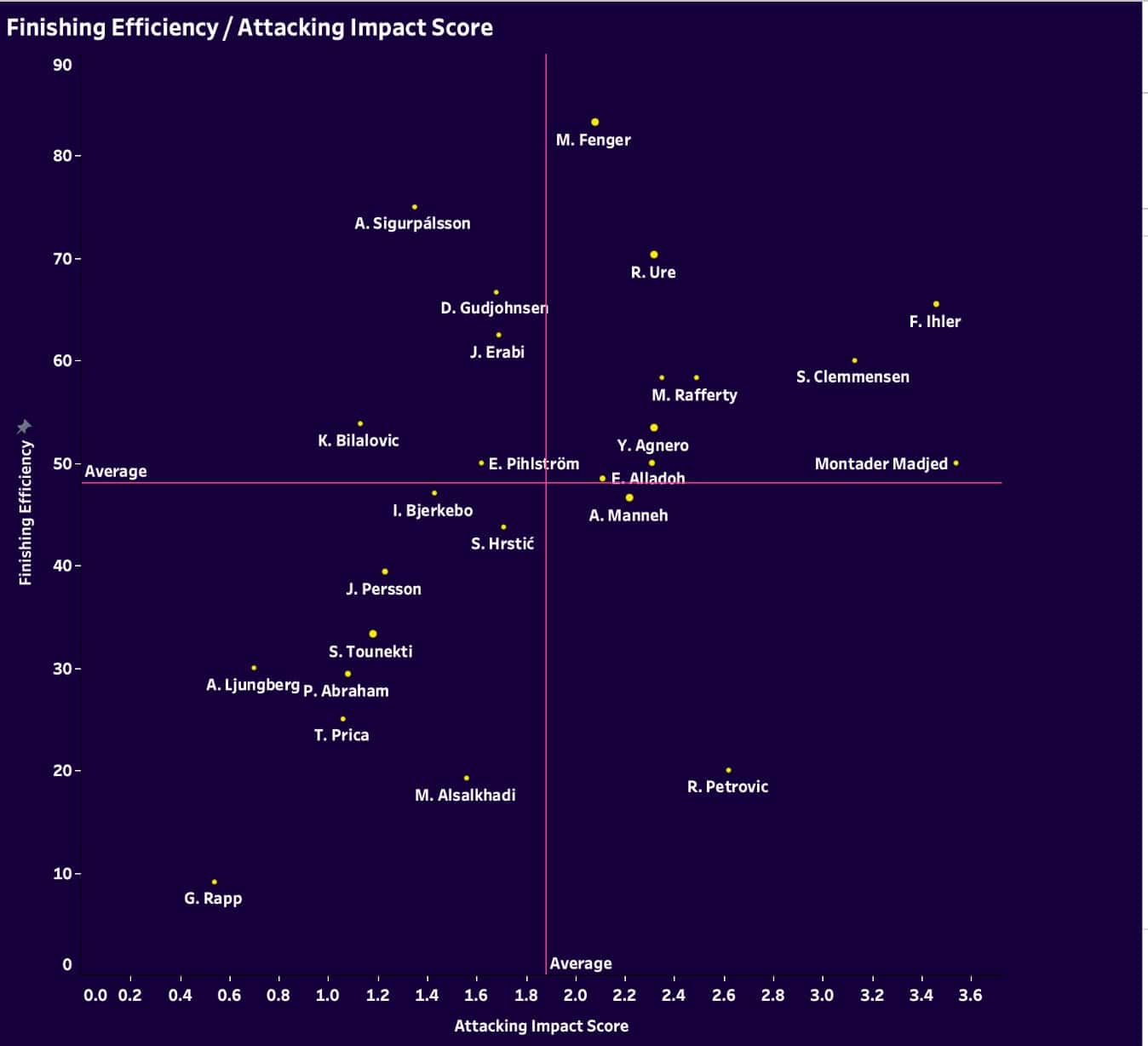
Fenger’s Finishing Efficiency score is outstanding, while he also performs above average in Attacking Impact Score.
Of the three aforementioned forwards, Ihler and Clemmensen also perform well on this graph alongside Fenger.
However, I’d favour Fenger due to my preference for the clinical nature of the 23-year-old Göteborg man when looking for a poacher and the fact that Fenger has played over 1600 minutes this season.
He has been almost an ever-present for his side and accumulated nearly as many minutes as both Ihler and Clemmensen combined in 2025.
Max Fenger Scout Report At IFK Göteborg 2025
Max Fenger (182cm/6’0″, 75kg/165 lbs) is currently the joint-third-highest goalscorer in Allsvenskan for 2025.
At the time of writing, the 23-year-old has scored nine goals in his 1607 minutes played, which is roughly one goal every two games.
Fenger’s movement and positioning are his main positives as a striker.
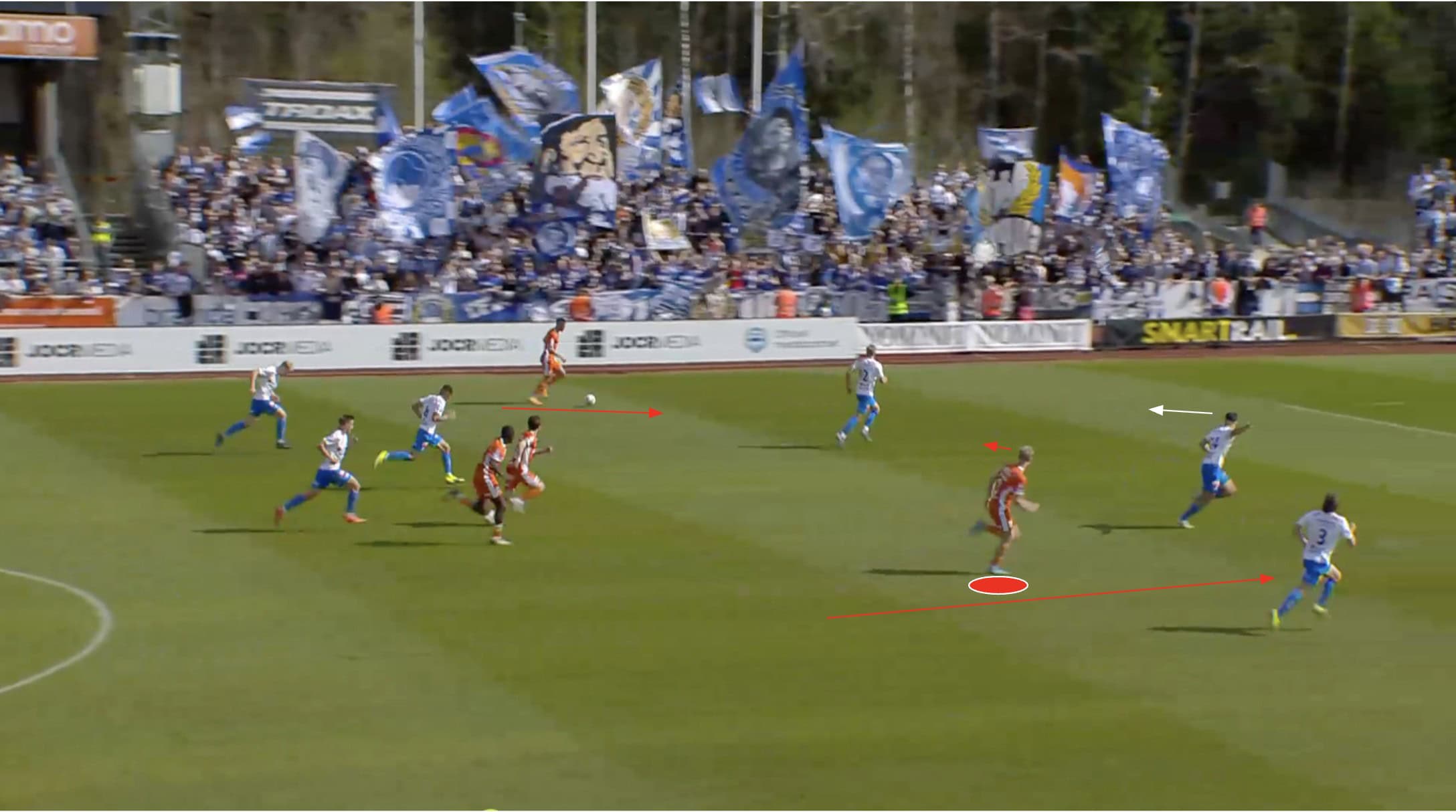
Here, Max Fenger targets some space behind the nearest centre-back to him while making his run towards goal.
He targets the centre-back’s blind side to ensure the defender has to split his focus between Fenger and the ball carrier.
Unable to keep both in his field of vision at the same time, he gives the attacking side an advantage.
This is typical of Fenger and his off-the-ball movement.
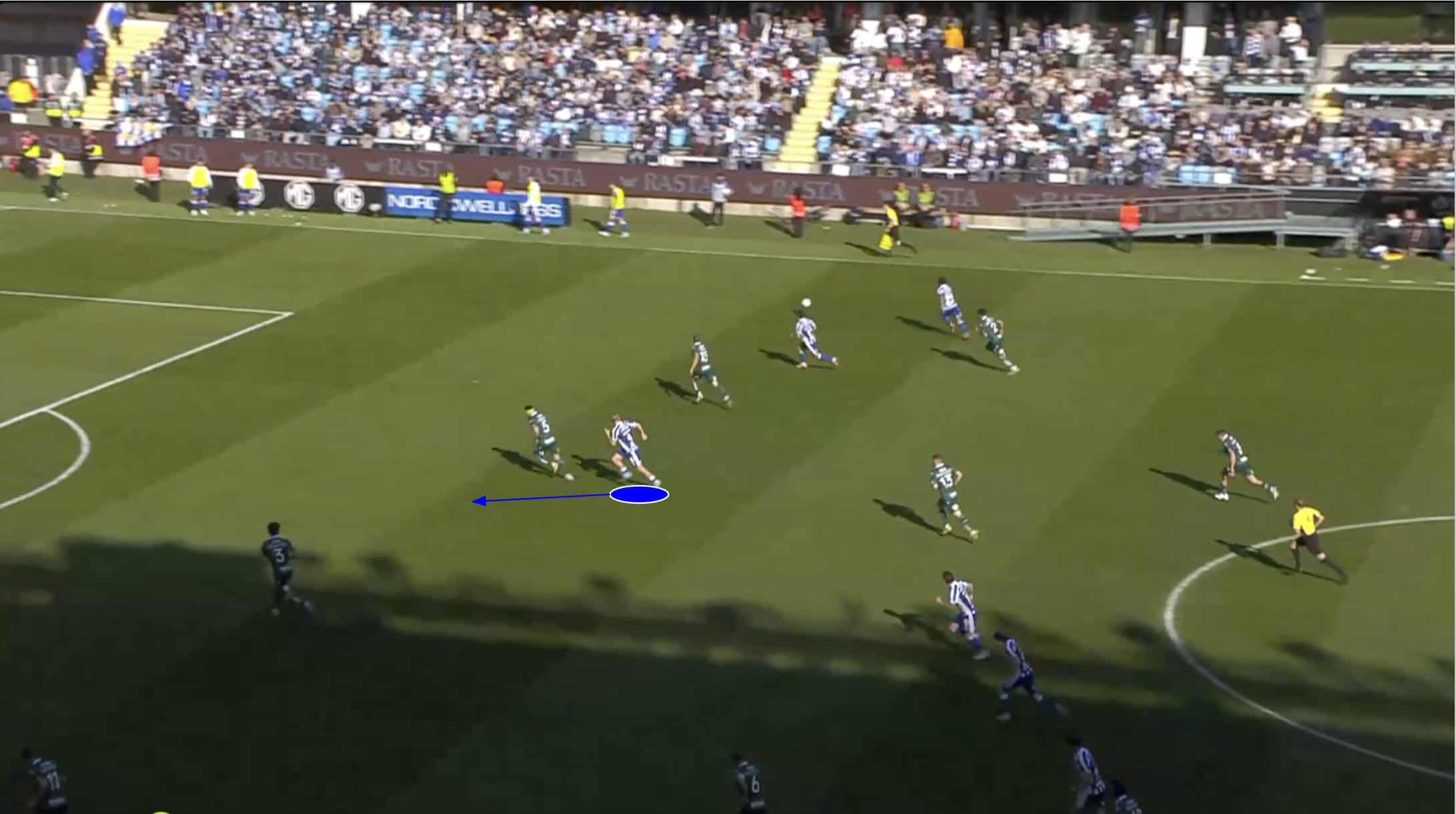
In this passage of play, with Göteborg progressing via the right wing, Max Fenger again aims to get on the nearest centre-back’s blind side while progressing towards goal.
As we’ll see when we follow up on the passage of play in Figure 3, the result is that Fenger ends up in a good goalscoring position while the defender struggles to keep him under control.
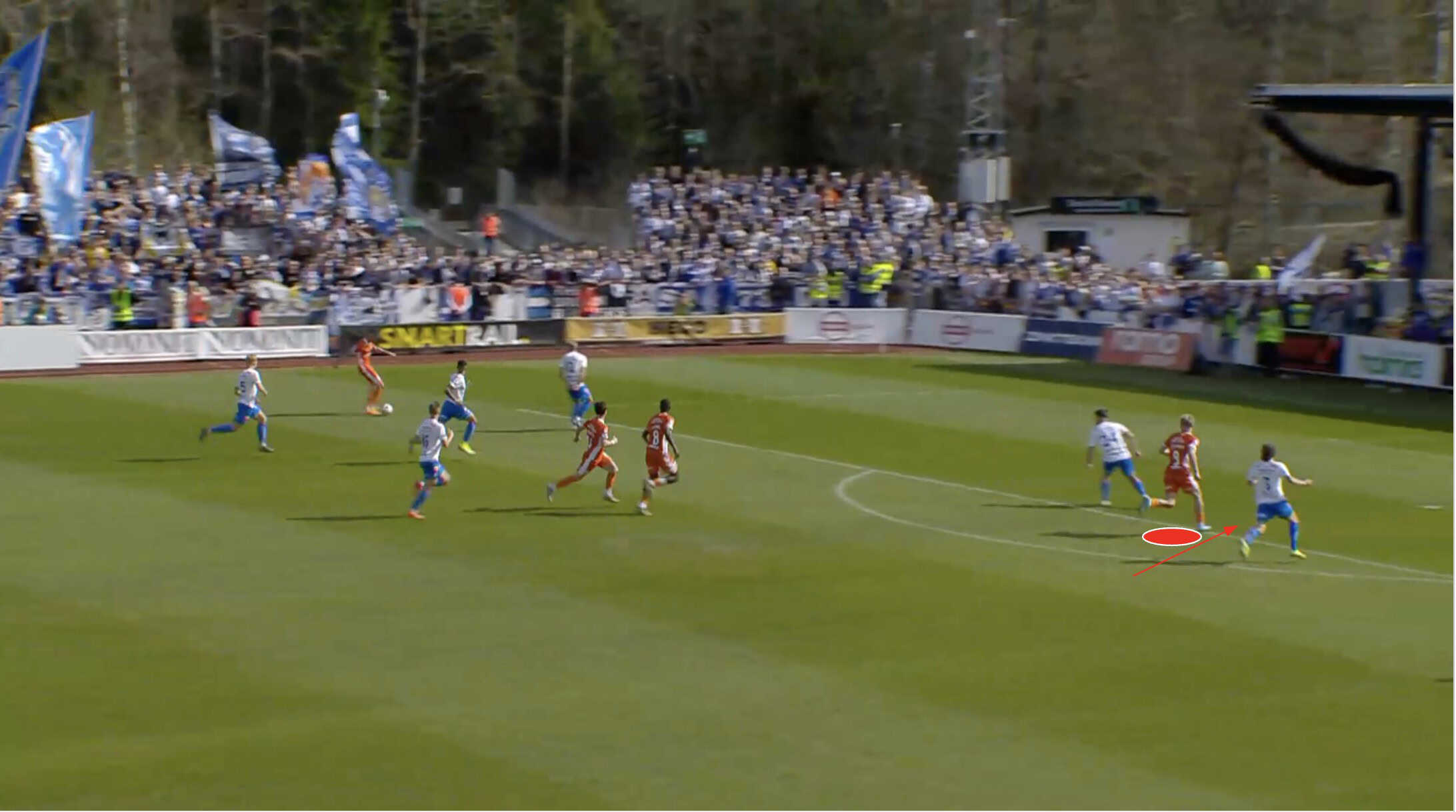
As Fenger continued towards goal after Figure 3, he ended up in the position we see here in Figure 5.
He’s bearing down on goal, positioned in between defenders, on the nearest centre-back’s blind side, while positioned quite centrally in relation to the goal.
Meanwhile, the ball carrier has progressed to the edge of the penalty area on the left wing, seemingly ready to cross.
Fenger’s inviting run and positioning give the playmaker a great target inside the box.
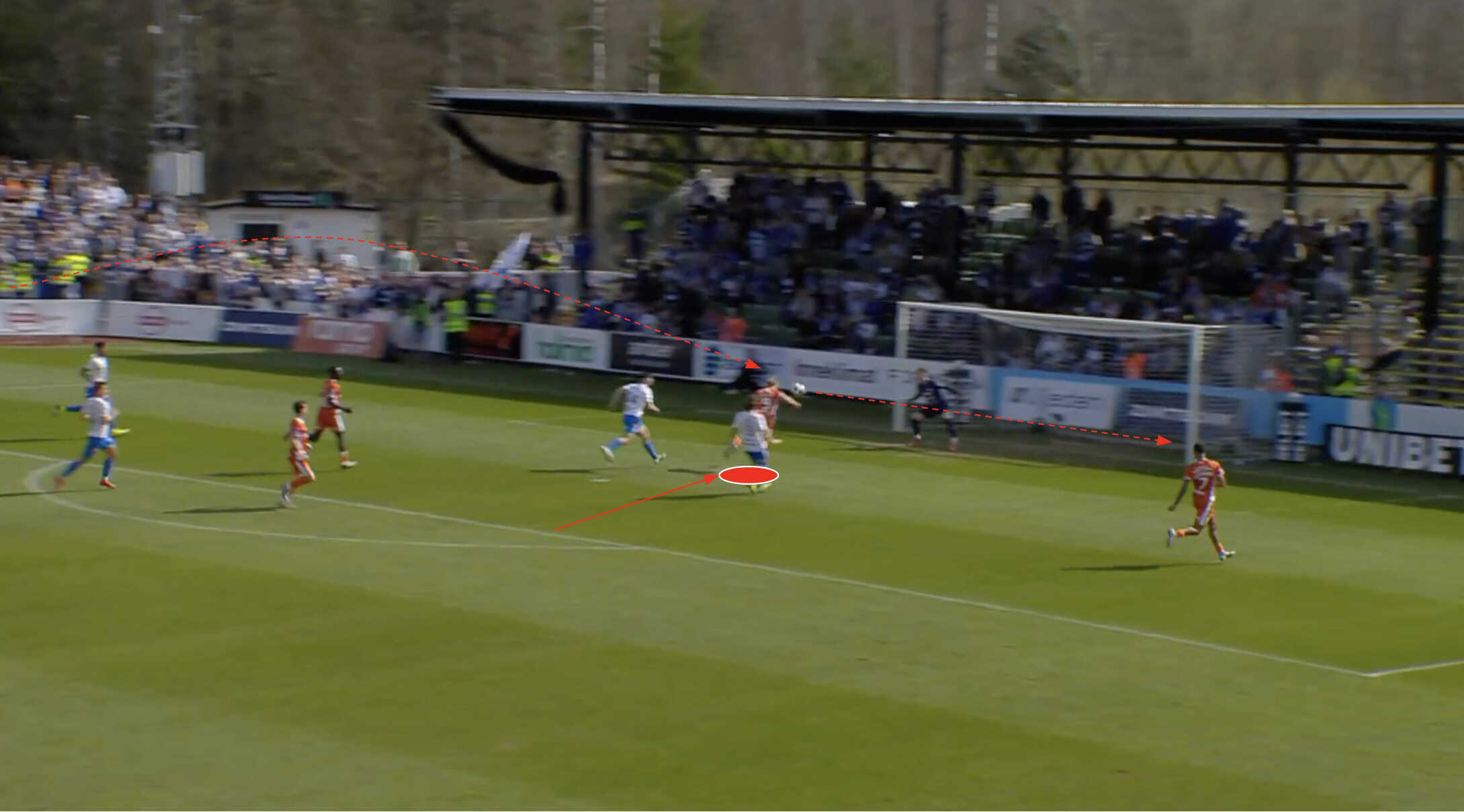
As the ball is crossed into the box, Max Fenger has positioned himself with space around him in front of goal.
He’s able to get up and dive towards the ball to head it home powerfully into the bottom corner of the net, showcasing his aerial ability, which has been a strength in his game this term when it comes to goalscoring.
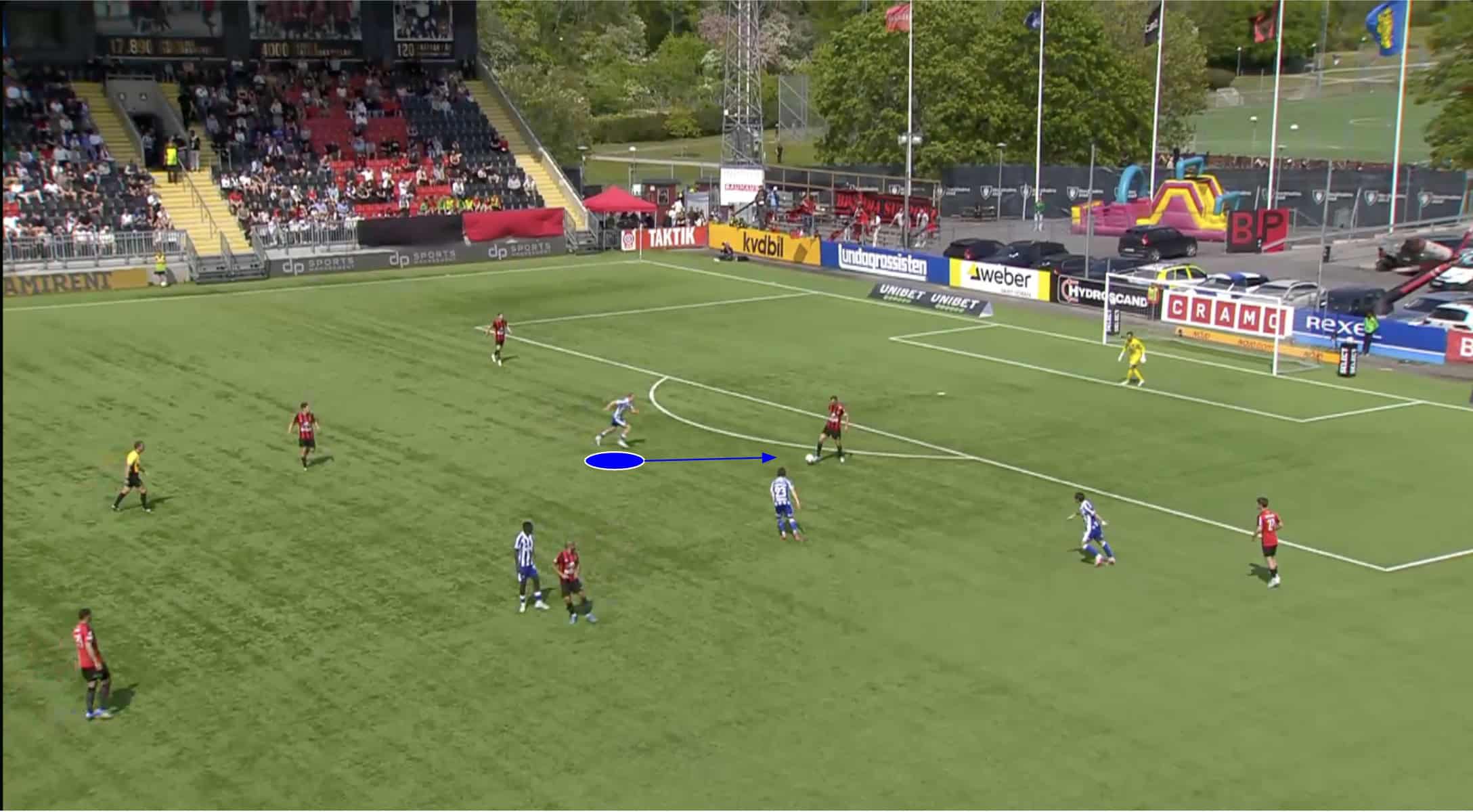
Max Fenger is not an incredibly physical player.
He’s not a target man who you want to be relying on for his aerial ability outside the box or for his hold-up play.
He actually doesn’t get significantly involved in his team’s possession play outside of his off-the-ball movement and finishing inside the box at all!
However, he is not afraid to get involved in physical battles with opponents and contribute to his team’s out-of-possession play, including the high press, as shown above.
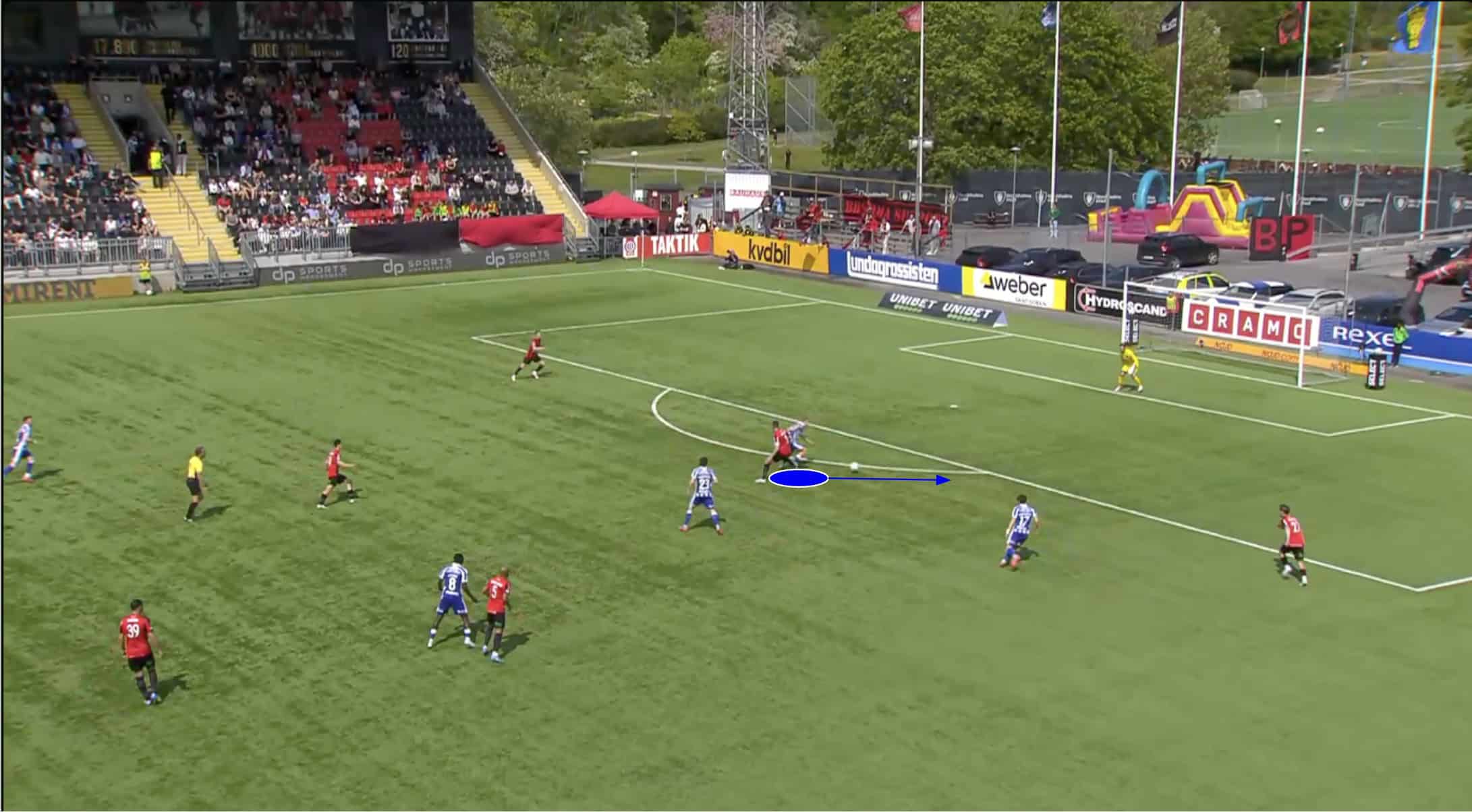
Here, as play moves on, Fenger regains possession for his side through his tenacious pressing.
By winning the ball on the edge of the box here, Fenger creates an excellent opportunity for himself to get a shot off from a solid goalscoring position.
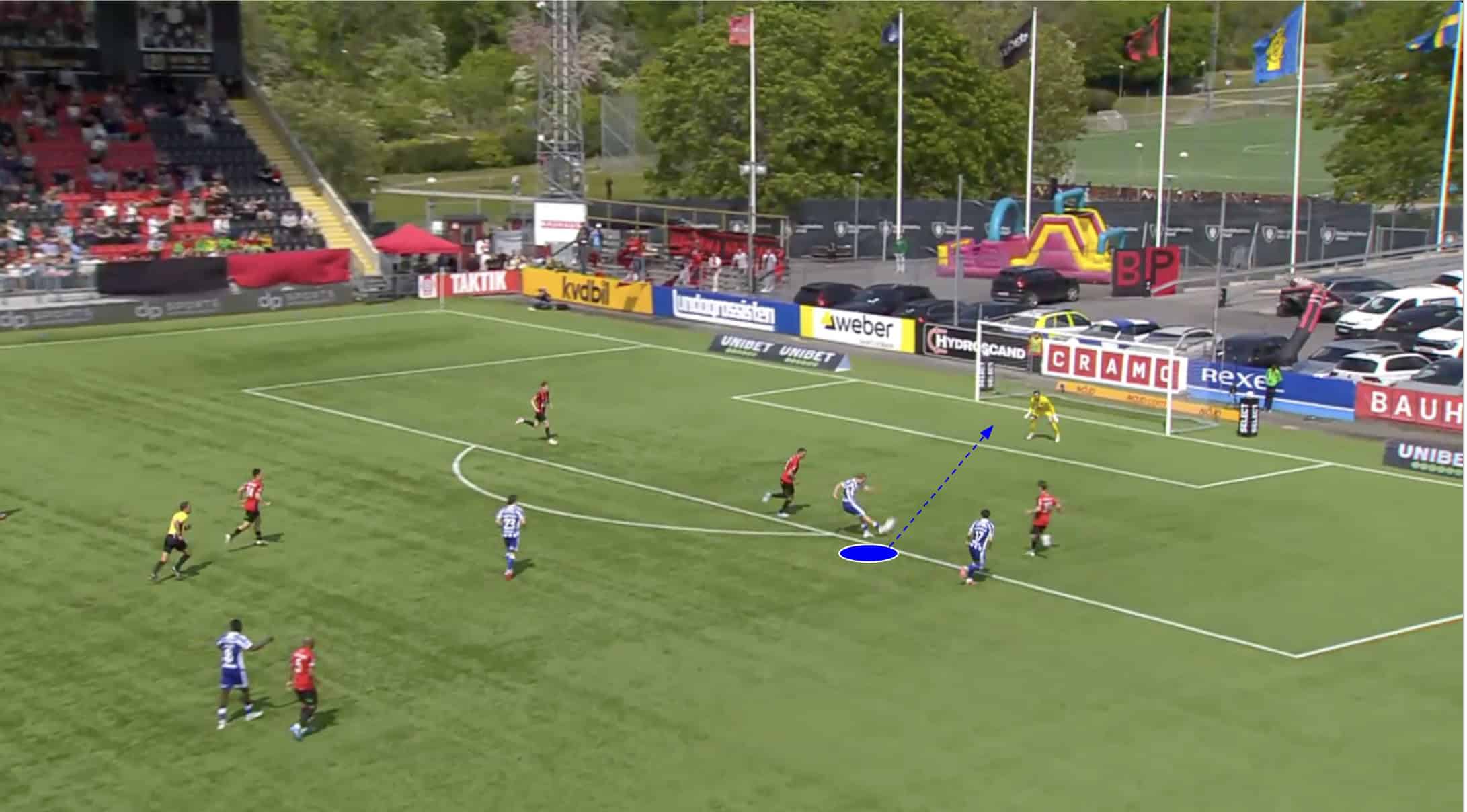
In the end, Fenger’s shot is on target, low and powerful, forcing an excellent save from the goalkeeper.
The 23-year-old fired the shot with his stronger right foot and shot across his body—a typical shooting movement from the young striker, which he loves to perform, and generally does so with strong accuracy.
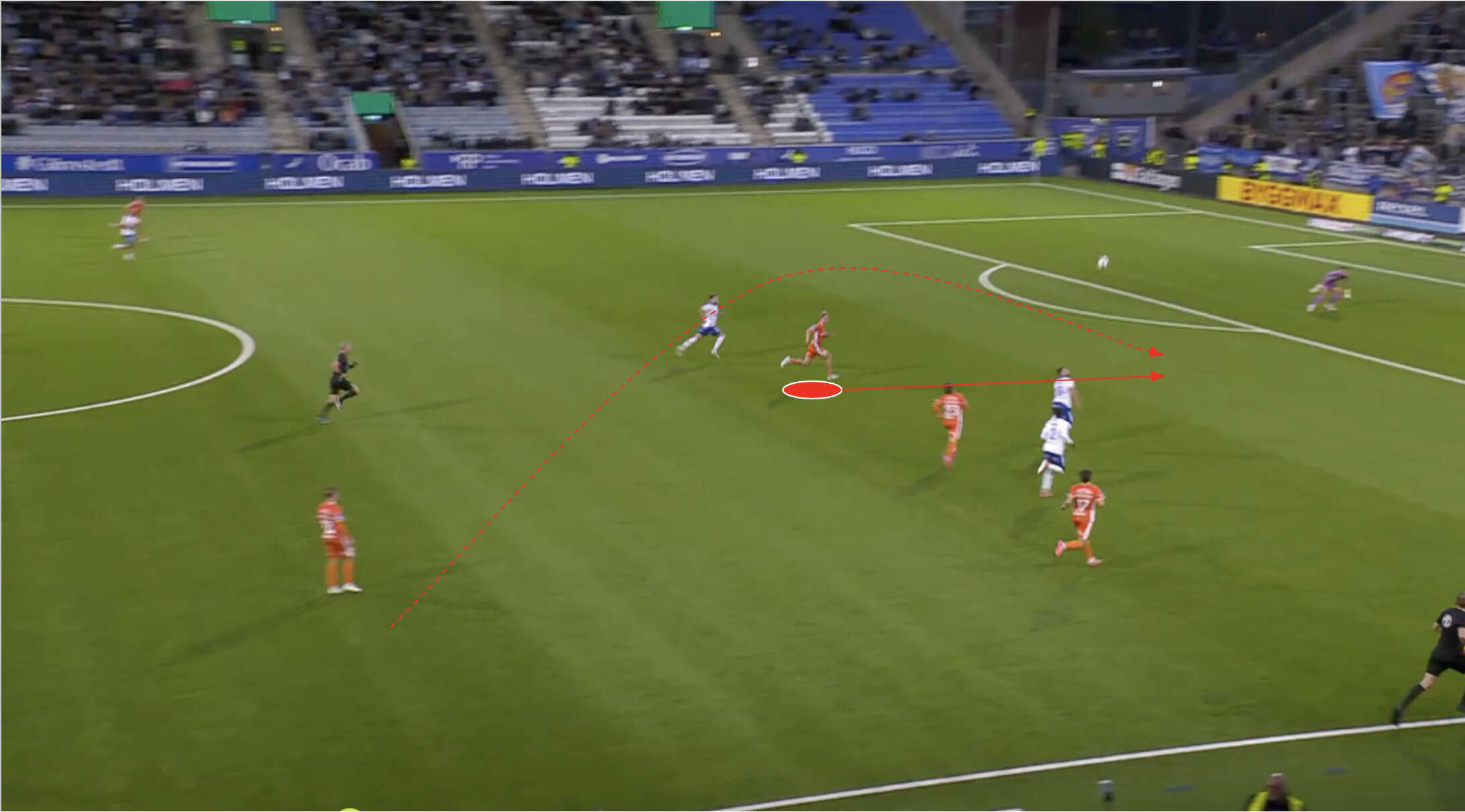
Max Fenger is a threat in behind thanks to his intelligent movement and ability to time his runs well.
Here, the striker has been played in behind by a deeper teammate who’s played a lofted through ball for him to chase down.
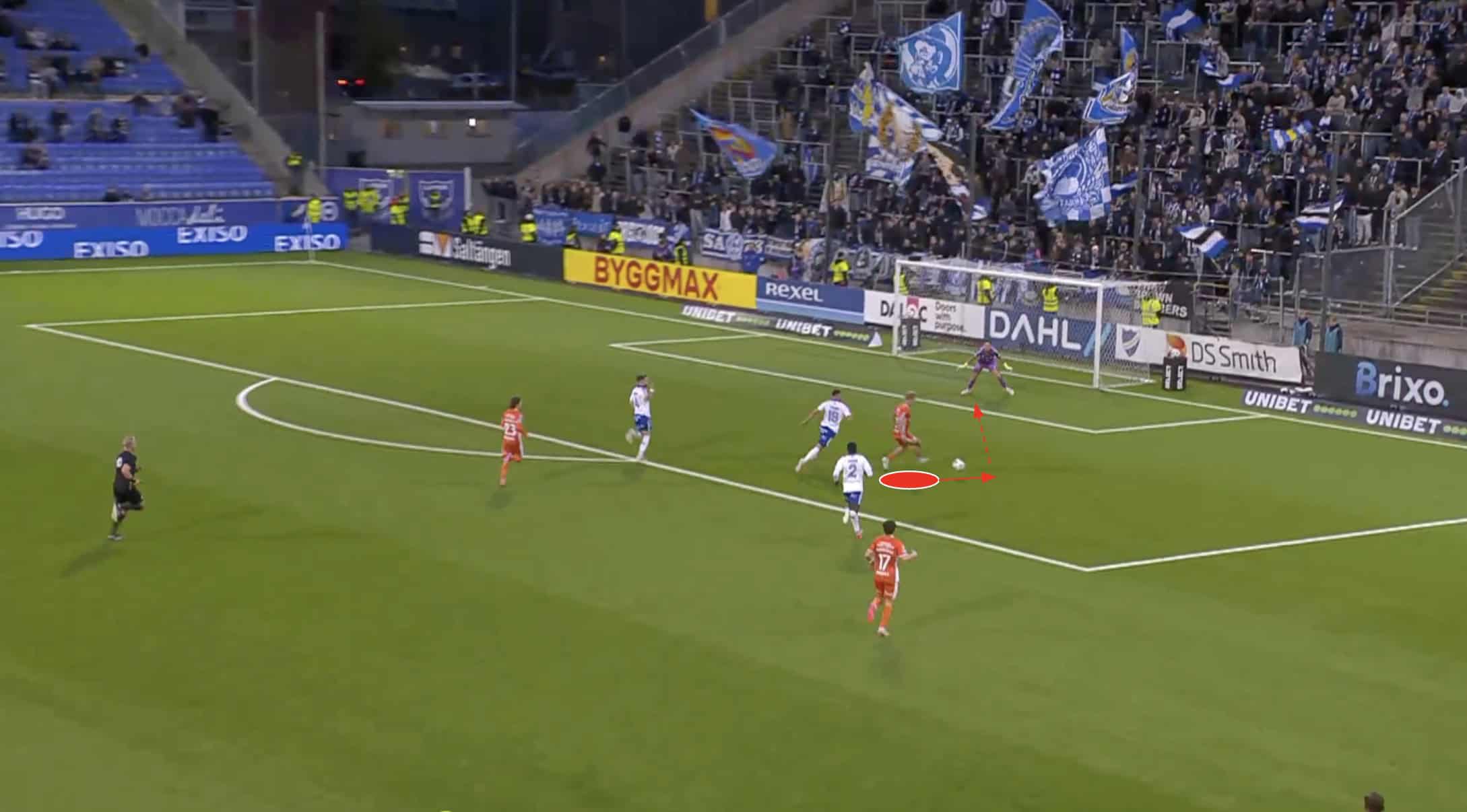
Ultimately, Fenger positions himself to take another shot across his body with his stronger right foot.
However, he’s taken the ball slightly wide, narrowing the angle and simply making the shot less likely to result in a goal.
So, while the shot is on target, low and hard, the narrow angle Fenger’s taken on helps the opponents keep the ball out of their net.
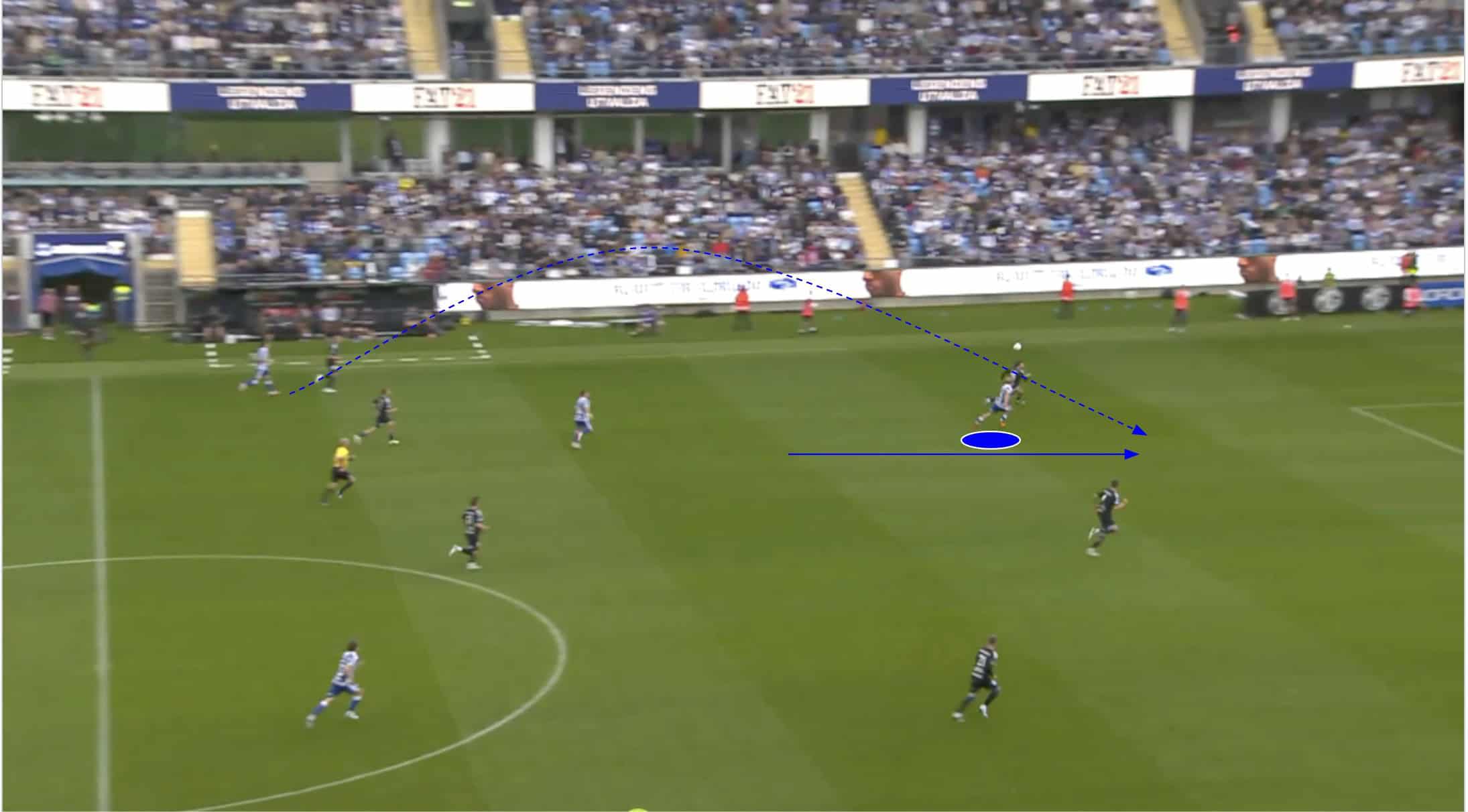
Here in Figure 12, again we find Fenger running in behind after a lofted through pass.
The run is timed well again, but as we’ll see when we get to Figure 13, the striker’s decision-making is questionable once more as he pushes the ball too far wide, narrowing the shooting angle and ultimately hurting his team’s goalscoring chances more than if he were to progress into a more central goalscoring position.
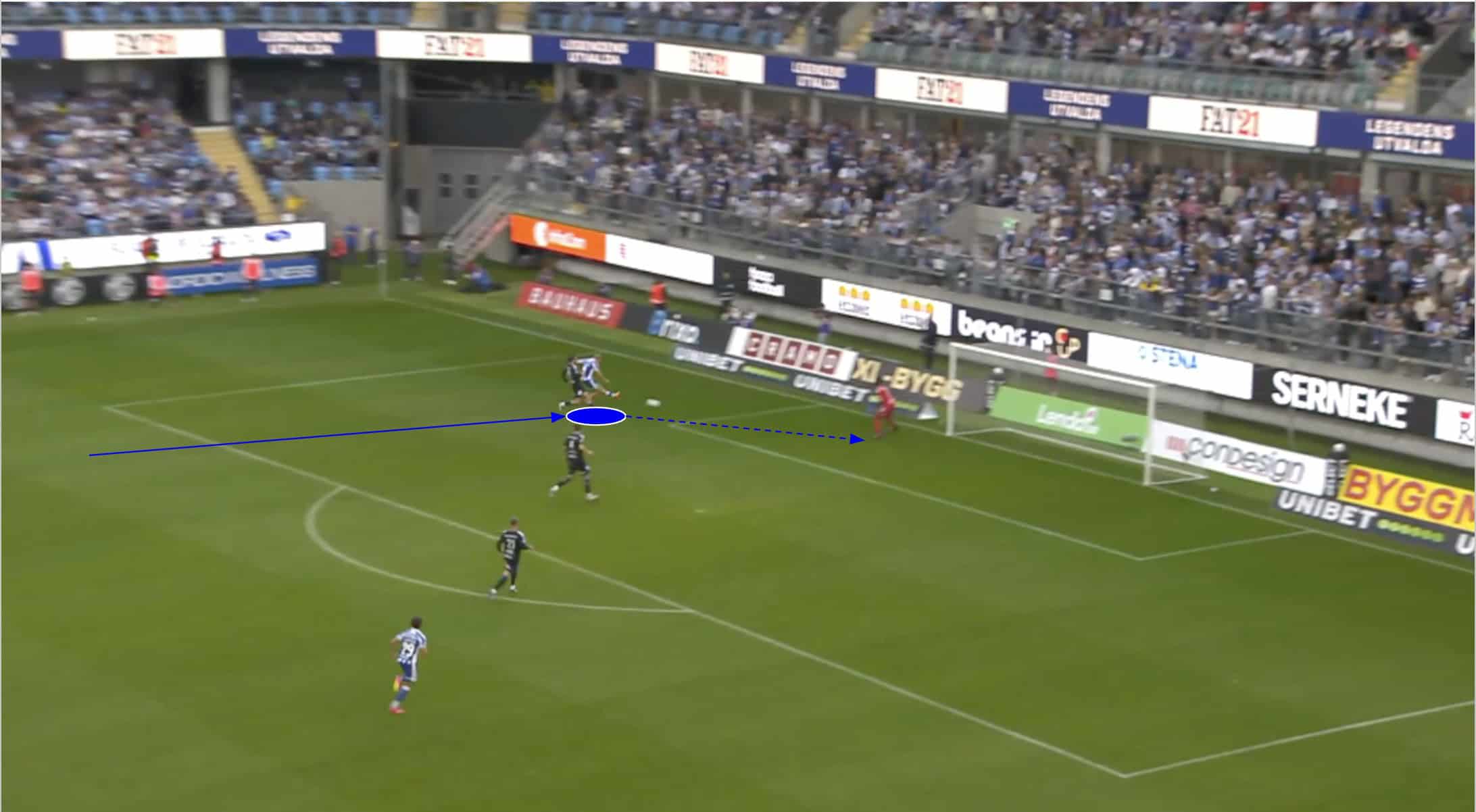
Fenger hits the target with this shot off his weaker foot, but fails to score in part due to the narrow angle from which he’s approached the shot.
Finding The Best Inside Forward In Allsvenskan 2025
Now, let’s curate our search for the best inside forwards in Allsvenskan this season.
We’ll start by combining the raw metric of ‘touches inside the opposition’s penalty box per 90’ this term with our ‘Dribble Threat’ metric, which uses dribbles per 90 and dribble success %.
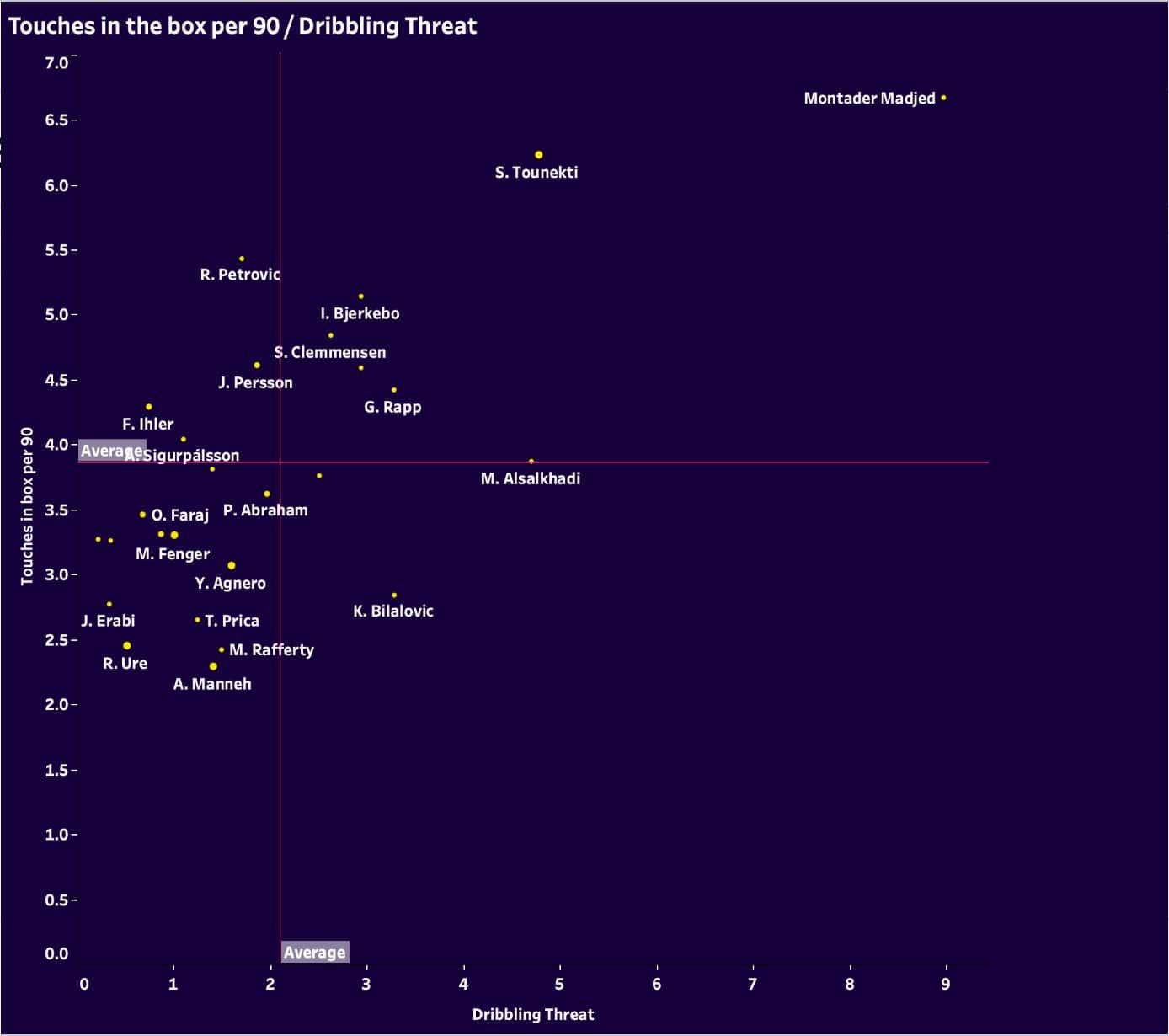
The clear standout, immediately, is 20-year-old Montader Madjed of title contenders Hammarby, who’s firmly planted in the top-right corner of the graph, in first place for both criteria, dominating our Dribble Threat metric.
Madjed is highly effective at beating defenders and getting into the box; he does so a lot in a given game, showcasing confidence in his abilities with the ball.
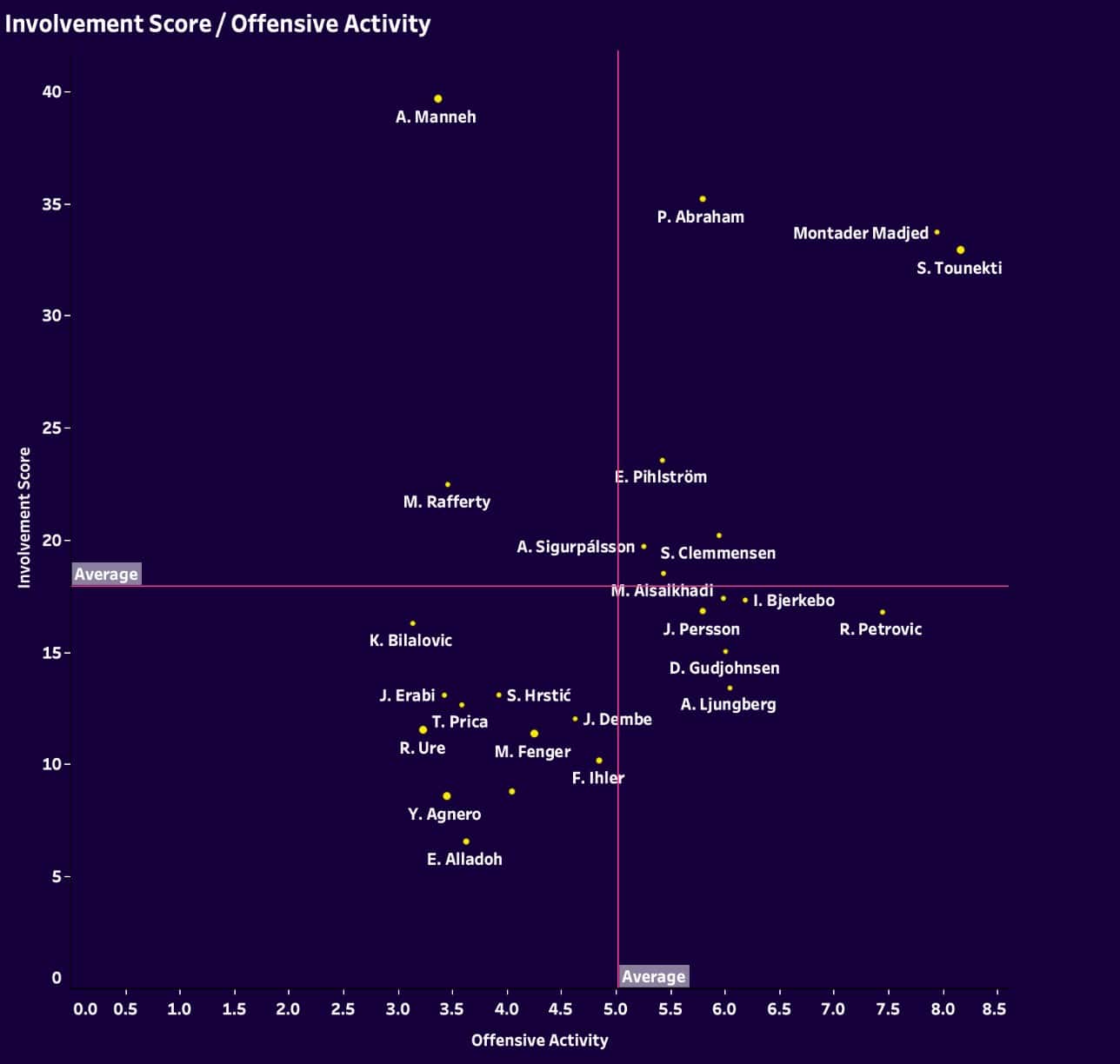
Our following graph uses two custom metrics: ’Involvement Score’, which is a weighted combination of deep completions per 90 and received passes per 90, and ‘Offensive Activity’, which is a simple combination of touches inside the box, key passes, and deep completions.
Again, we find Madjed in the top-right, alongside his Hammarby teammate Sebastian Tounekti.
Paulos Abraham, also of Hammarby, is found in the top-right quadrant as well—an indication of Hammarby’s effective use of inside forwards in their Allsvenskan title chase this season.
This graph gives us an indication of which Allsvenskan forwards this term have been constantly involved in and creating at a high volume.
Madjed’s combination of dribbling efficiency and creativity makes him our pick for top inside forward to watch from Allsvenskan this term.
Montader Madjed Scout Report At Hammarby IF 2025
Montader Madjed (182cm/6’0, 74kg/163lbs) provides his team with a constant pacey, dynamic threat from the right wing.
He’s trigger-happy, but despite that, he doesn’t have a bad conversion rate at all.
The Hammarby winger is a high-volume dribbler with an excellent success rate to boot.
He’s capable of moving extremely quickly with the ball at his feet, demonstrating brilliant balance and agility with swift changes of direction.
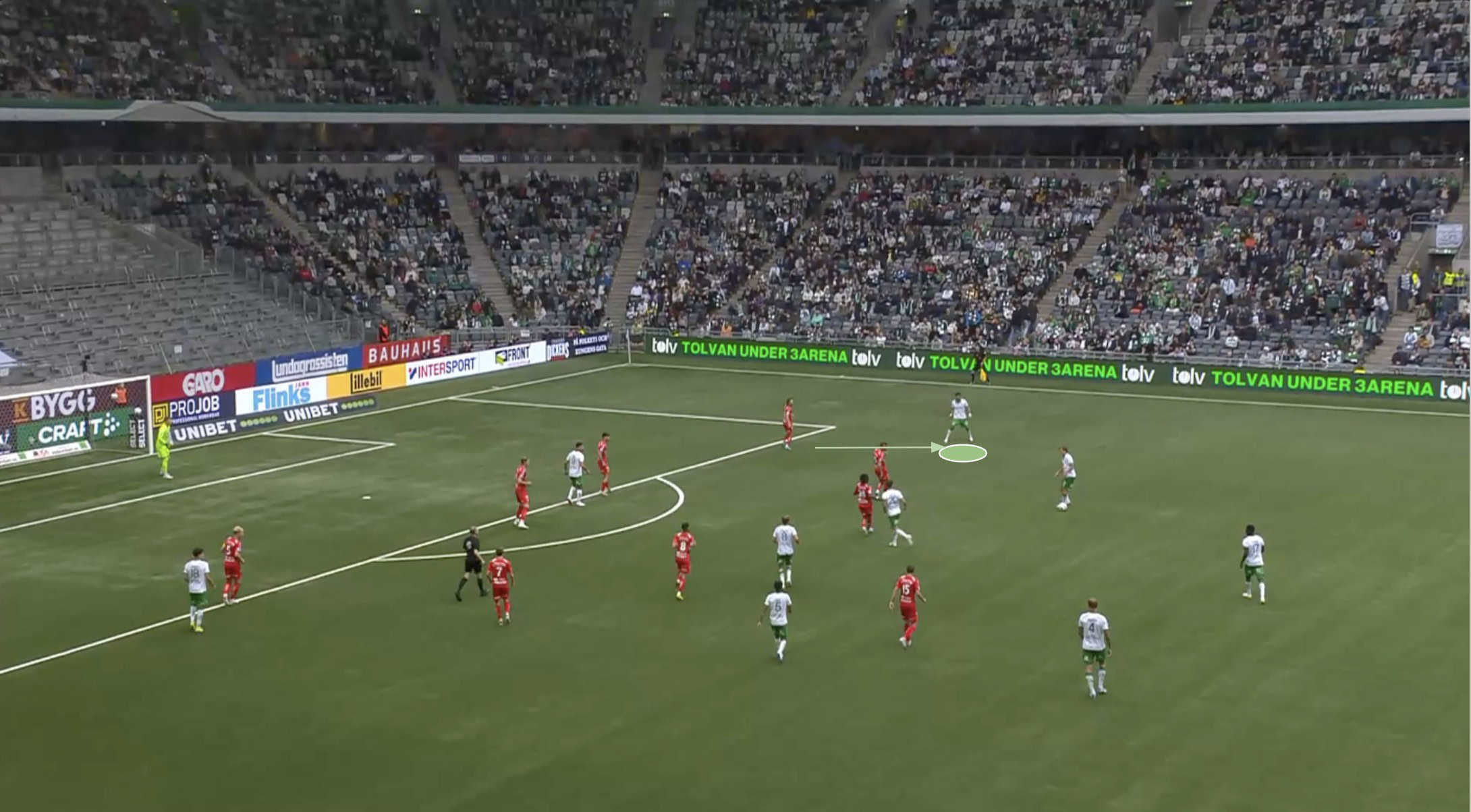
Figures 16-19 display a typical example of Madjed’s influence in the final third.
Firstly, we see the winger creating some separation between himself and the opposing full-back.
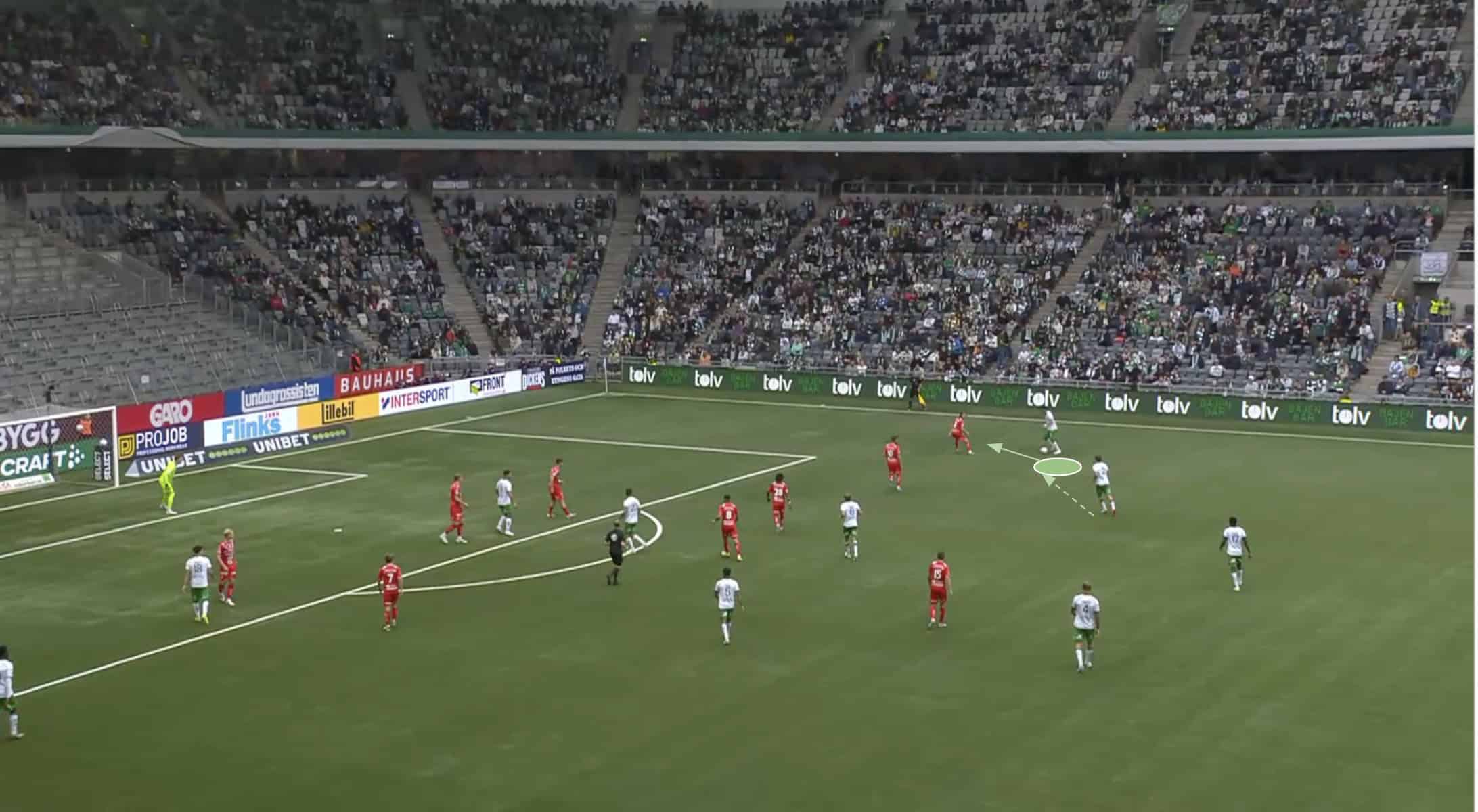
This precedes a pass from the middle of the park out to Madjed on the right wing.
After receiving, Madjed begins leading the opposing full-back out wide towards the right by slowly shifting the ball sideways out to the right.
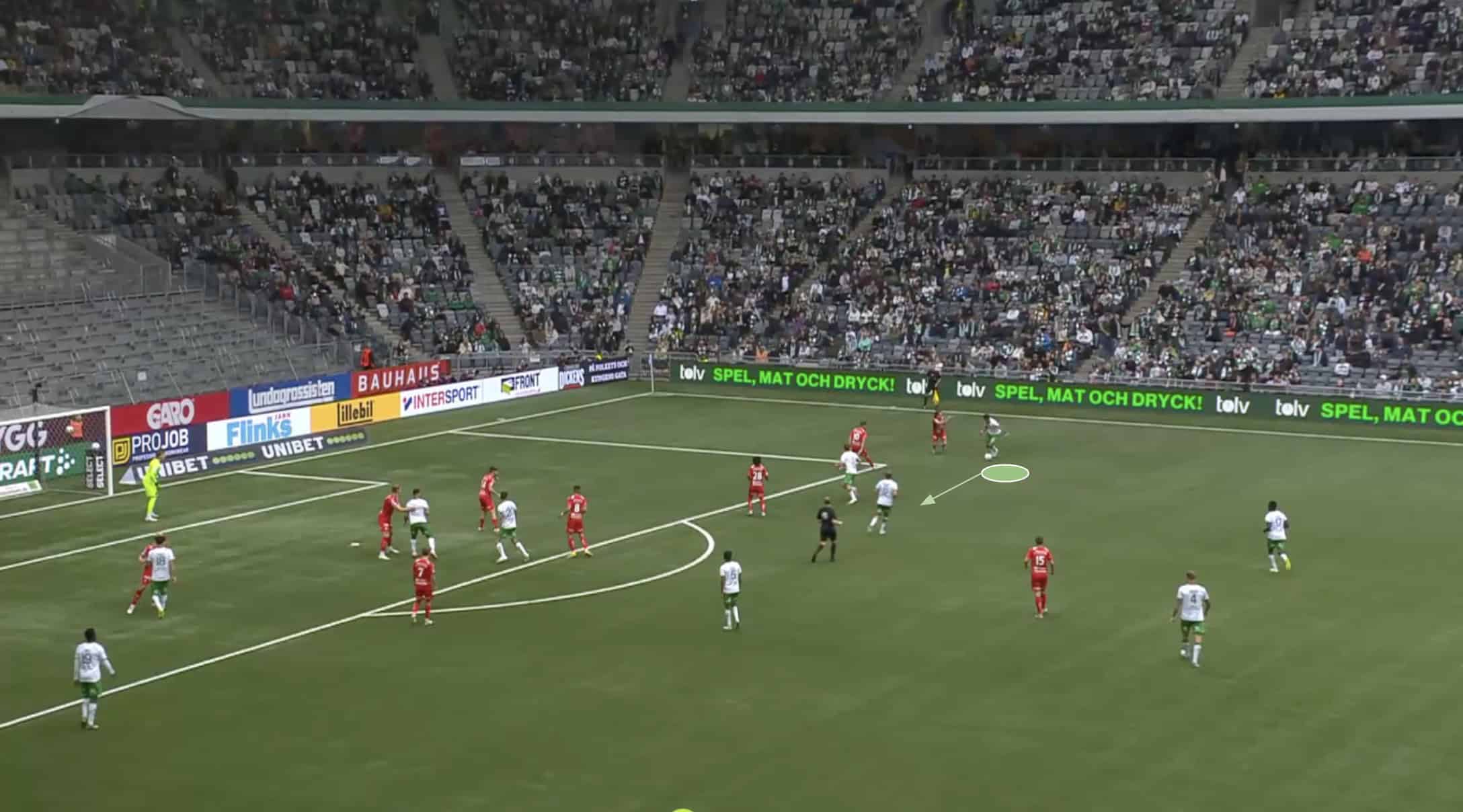
Once enough space has opened inside the full-back, Madjed quickly changes direction and charges into the space that’s opened up inside the full-back in the right half-space area.
His pace, balance, agility and ball control make it very difficult for the defender to stick with him.
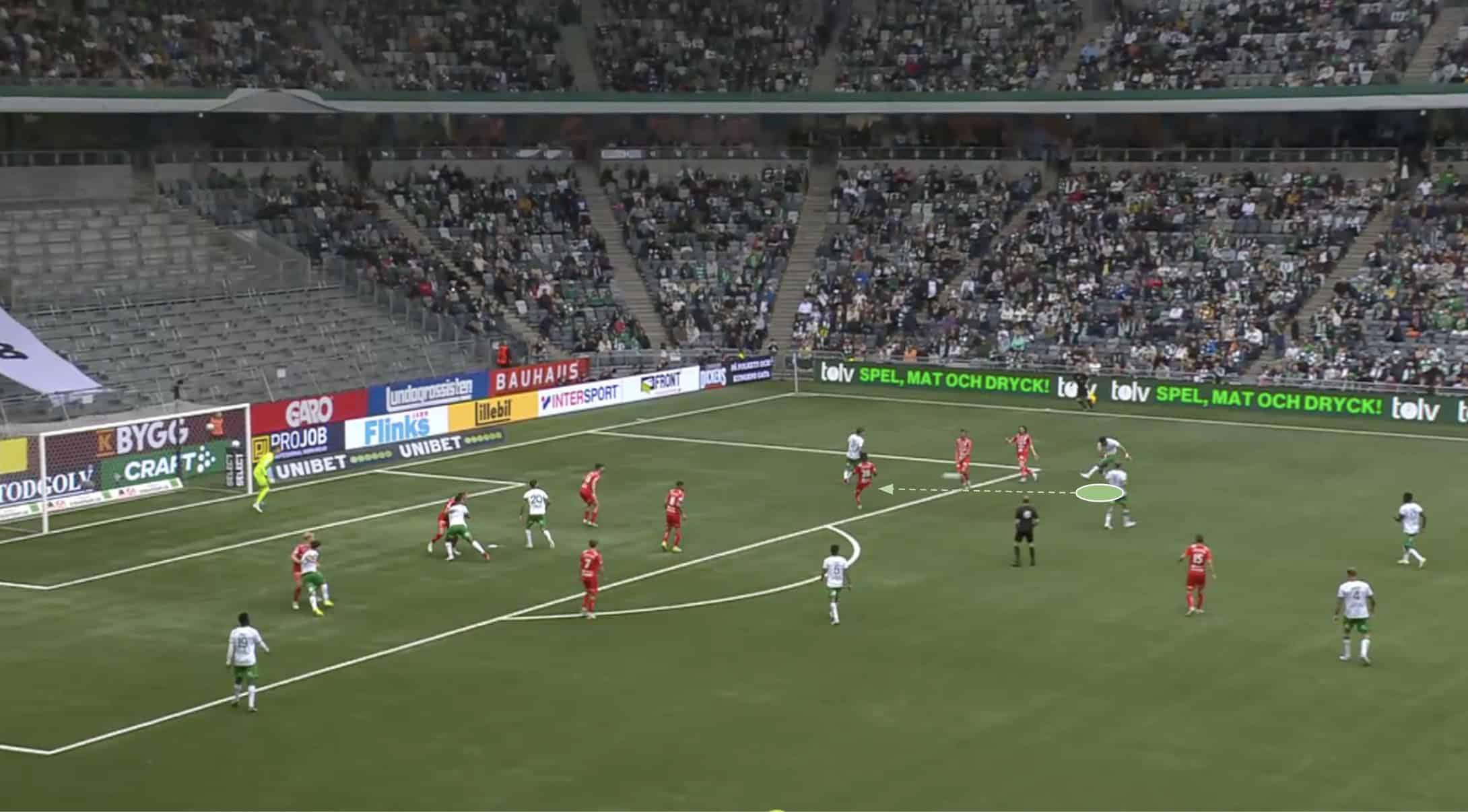
In the end, Madjed unleashes a shot with his stronger left foot from the edge of the box.
The winger’s shot is fast and powerful, as is typical of Madjed’s shot-taking abilities.
He tests the ‘keeper here, hitting the target and forcing a save out of his opponent.
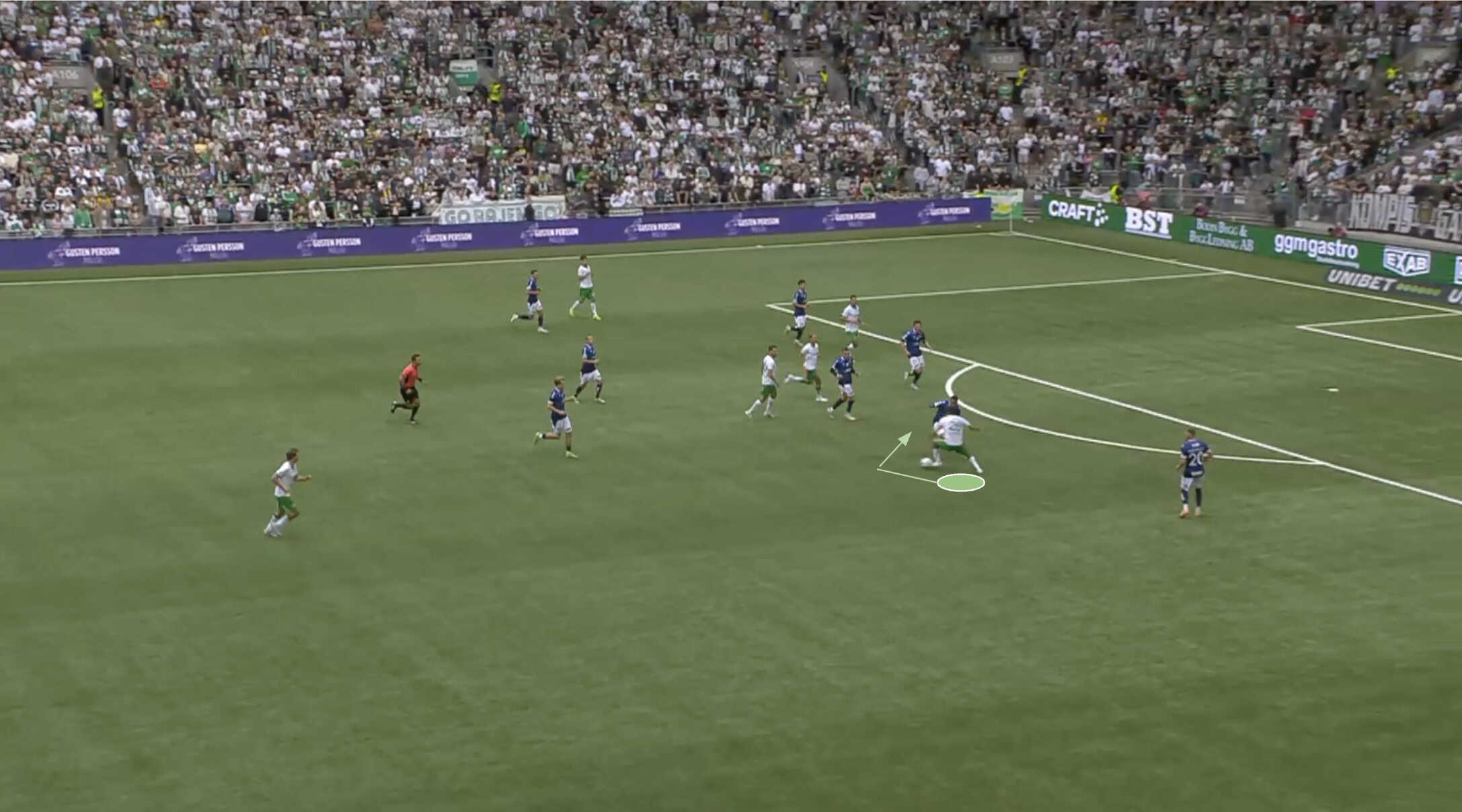
Madjed’s agility and ball control are second to none in Allsvenskan and leagues of a similar level.
Here, we see the winger reacting to some intense pressure by swiftly shifting the ball around the onrushing defender, creating an opening for one of his signature long shots.
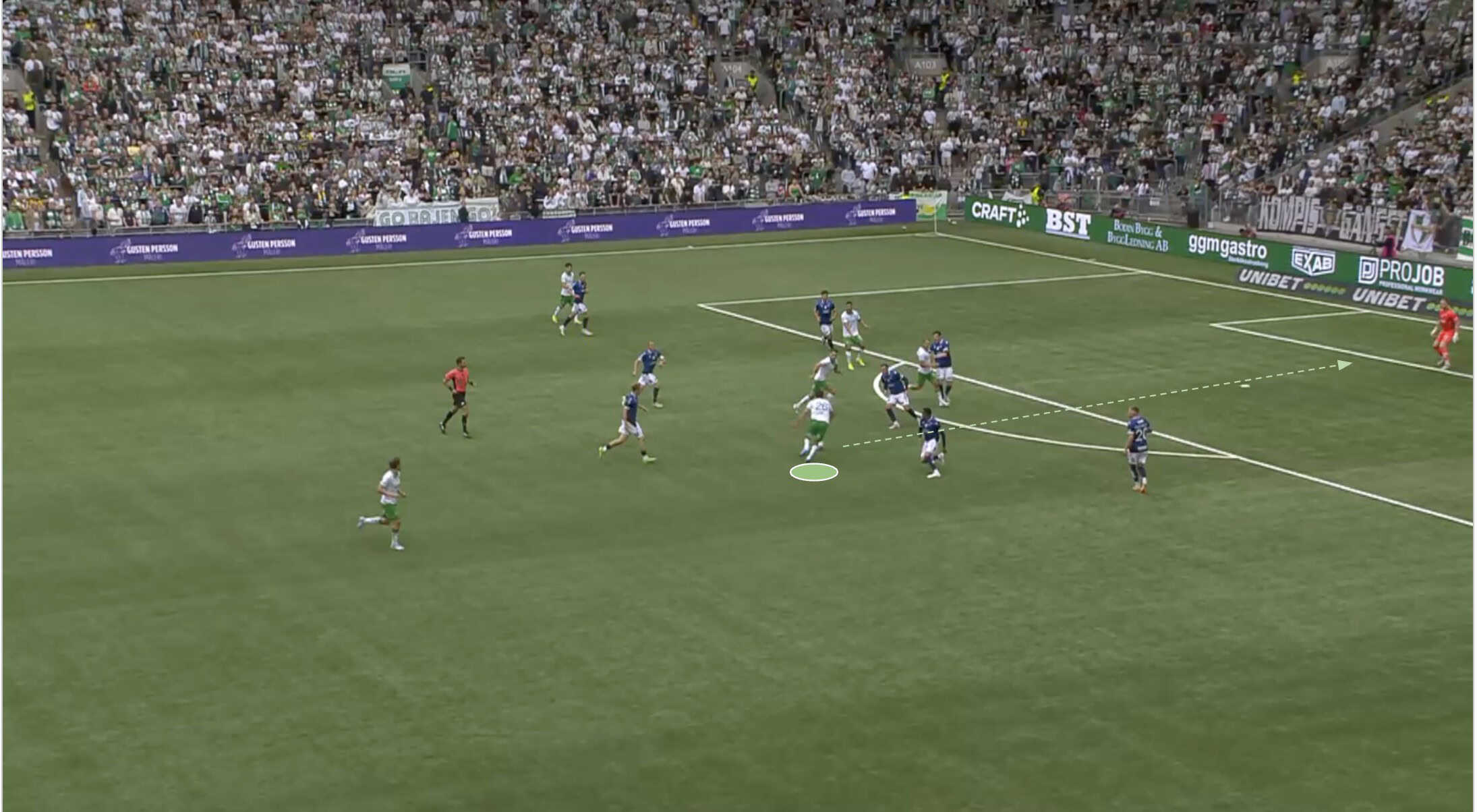
Madjed is the type of attacker who does well with little time to think.
Once the space to shoot opens up here, he gets his head up and quickly unleashes a curving shot towards the far corner of the net, which pings off the crossbar.
Conclusion
To conclude our analysis, we like the look of Max Fenger and Montader Madjed the most out of the current crop of young Allsvenskan forwards.
The €1.8m-rated striker, according to Transfermarkt, is a poacher with the ability to have a strong impact for a side that creates a lot of chances at EFL Championship level, in our view.
He’s got excellent finishing ability and off-the-ball movement to help his side create chances for himself to convert.
Fenger is not a creator or a dribbler; he doesn’t get heavily involved in possession, nor is he an imposing physical presence.
He is an Ole Gunnar Solskjær-style poacher with a bit of fight about him.
He is better off his right foot but capable of finishing with both feet and, importantly, his head.
Montader Madjed is, in our view, the most exciting attacking talent currently playing in Sweden’s top-flight.
He has outstanding pace and dribbling ability, as well as a thundering long shot.
The 20-year-old left-footed right winger, currently valued at €2.5m by Transfermarkt, could end up in one of Europe’s top five leagues in the future.
A move to Belgium or the Netherlands could provide an interesting stepping stone to that future.
