
Marcus Rashford’s loan to Barcelona in the summer of 2025 represents more than just a high-profile transfer; it is, in many ways, a final attempt to reignite a career that once promised world-class heights.
After struggling for rhythm and consistency during the latter stages of his Manchester United tenure, followed by a short, stop-start stint at Aston Villa, Rashford now finds himself in a new environment.
This Barcelona side is youthful, tactically ambitious, and undergoing a period of strategic renewal under Hansi Flick, a manager with a track record of extracting the best from dynamic attackers in fluid systems.
In this data analysis report, we assess whether Rashford’s profile still meets the demands of elite-level football and, more specifically, how his 2024/2025 performances might translate into Flick’s evolving system.
To ensure fairness in comparison and remove bias created by differences in playing time or role, we rely on per-90-minute averages rather than raw totals.
This allows us to evaluate output and efficiency on an equal footing, especially given that Rashford played just over 2,500 minutes across all competitions for both Manchester United and Aston Villa last season, the equivalent of fewer than 28 full matches.
We’ll use a combination of advanced statistical indicators, including shot data, creative metrics, progressive actions, and defensive contributions, to build a comprehensive picture of Rashford’s overall performance.
Furthermore, we will benchmark his output against Barcelona’s current front line using dimensionality reduction techniques such as Principal Component Analysis (PCA) and other positional comparison tools, all of which will be explained clearly in the sections that follow.
The goal is to move beyond reputation or instinct and use the numbers to understand whether Rashford truly has a place in this exciting Barcelona rebuild.
Attacking Output & Tactical Implications: Analysing Marcus Rashford 2024/2025 Offensive Profile
In the 2024/2025 season, Marcus Rashford accumulated 2,516 minutes in all competitions, spread across appearances for Manchester United and a loan spell at Aston Villa.
Attacking Metrics For Marcus Rashford During The 2024/2025 Season

Over that span, he registered 11 goals and seven assists, equating to 0.39 goals and 0.25 assists per 90 minutes, a moderate attacking return that places him closer to a supporting forward profile than a primary goalscorer.
His shot output was relatively consistent. He took 68 shots overall (2.44 per 90), with 44.1% hitting the target.
While not among the elite finishers, this accuracy suggests a decent level of shot selection and composure, especially when considered alongside an expected goals (xG) total of 9.3.
This total aligns reasonably with his actual goal tally, indicating he neither over- nor underperformed significantly in finishing.
Rashford also contributed creatively, providing 37 shot assists and delivering 70 crosses at a 35.7% accuracy rate.
His crossing output suggests he can operate effectively from wide areas, particularly in transition or when isolating full-backs.
The dribbling metrics further support this role.
He attempted 134 dribbles with a 47.8% success rate, highlighting his tendency to engage defenders and beat them in one-on-one situations.
However, while serviceable, this dribbling success rate does not reflect elite explosiveness or unpredictability.
In terms of overall offensive involvement, Rashford engaged in 231 offensive duels, achieving a modest success rate of 35.1%, which indicates a willingness to take on defenders but with limited end product in tight situations.
His 109 touches inside the opposition penalty area and 88 progressive runs show active movement and a desire to drive play forward.
However, his 12 offsides hint at occasional lapses in timing or over-eagerness to exploit space.
Overall, Rashford’s attacking profile suggests a dynamic wide forward who blends direct running with moments of composure, attributes potentially well-suited to Flick’s fluid, interchanging frontline.
Defensive Contribution – Assessing Marcus Rashford Off-The-Ball Impact In 2024/2025
While Marcus Rashford’s primary responsibilities lie in the attacking third, his defensive metrics from the 2024/2025 season across spells at Manchester United and Aston Villa reveal important insights into his off-the-ball work rate and tactical discipline.
Defensive Metrics For Marcus Rashford During The 2024/2025 Season
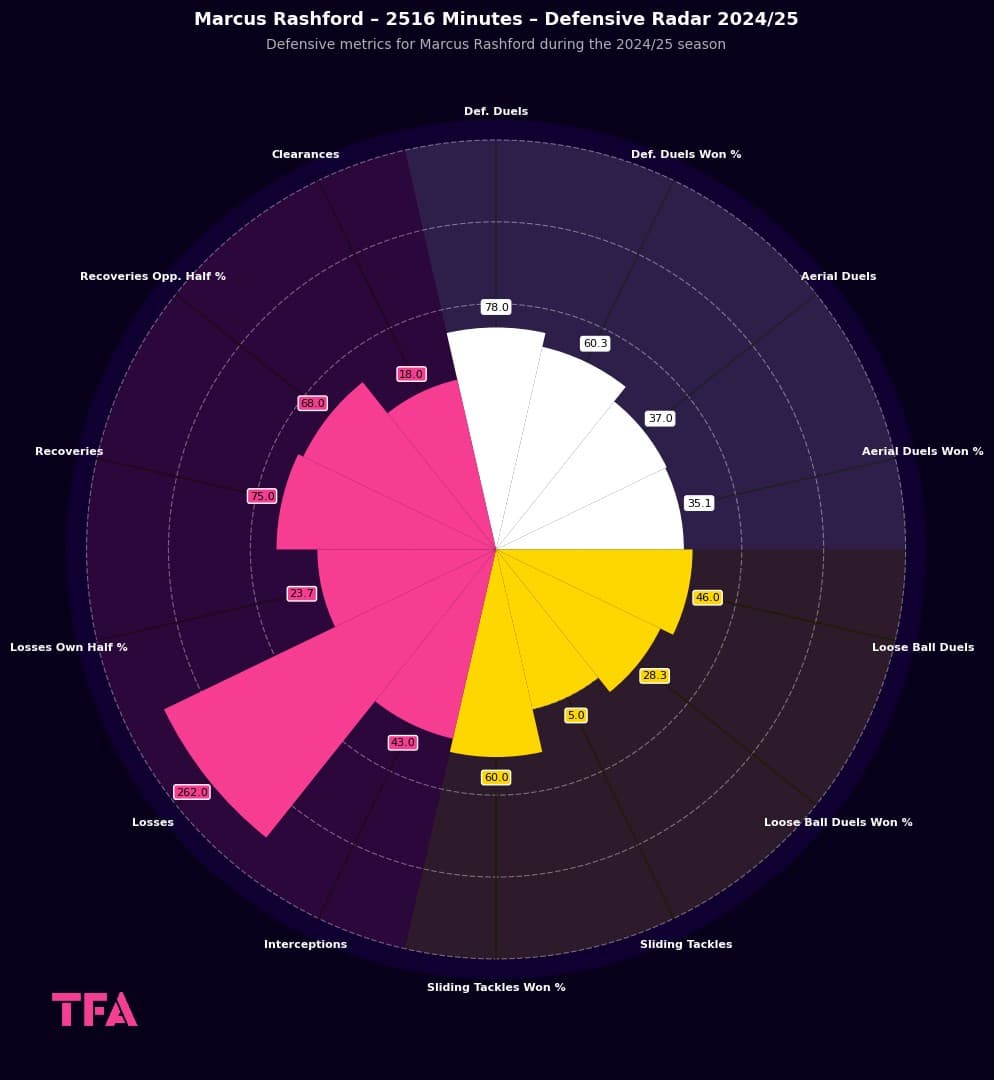
Across 2516 minutes, the equivalent of just under 28 full matches, Rashford engaged in 78 defensive duels, winning 60.3% of them.
This win rate is relatively solid for a wide forward, suggesting a willingness to contest possession and apply pressure when required, even if the volume of duels isn’t particularly high.
In aerial duels, he won just 35.1% of his 37 attempts, a figure that highlights one of his limitations, especially when tasked with defending long balls or switching play under pressure.
Similarly, his record in loose ball duels (28.3% success from 46 duels) indicates a reduced impact in chaotic or transitional moments, perhaps reflecting a focus on positioning over physical engagements.
Rashford attempted just five sliding tackles, three of which were successful.
This low output reflects both his role and a conservative defensive approach, which favours shape retention over high-risk interventions.
However, his 43 interceptions are notable, revealing intelligent reading of play, particularly when cutting out passes or stepping into passing lanes in wide areas.
He made 75 recoveries in total, with a strong 68% of those coming in the opposition half, a key tactical indicator of his role in the press and his positioning high up the pitch under both Erik ten Hag and Unai Emery.
The 262 losses, 23.7% of which occurred in his own half, show room for improvement in ball retention under pressure.
Ultimately, Rashford’s defensive contributions suggest a supportive rather than proactive role, one that suits a system where pressing is collective rather than individual.
Marcus Rashford Passing Diversity – A Tactical Layer Beyond The Final Action
While Marcus Rashford is often associated with direct runs and explosive finishes, his passing variety from the 2024/2025 campaign reveals a far more nuanced contribution to overall play.
Passing & Progression Metrics For Marcus Rashford During The 2024/2025 Season
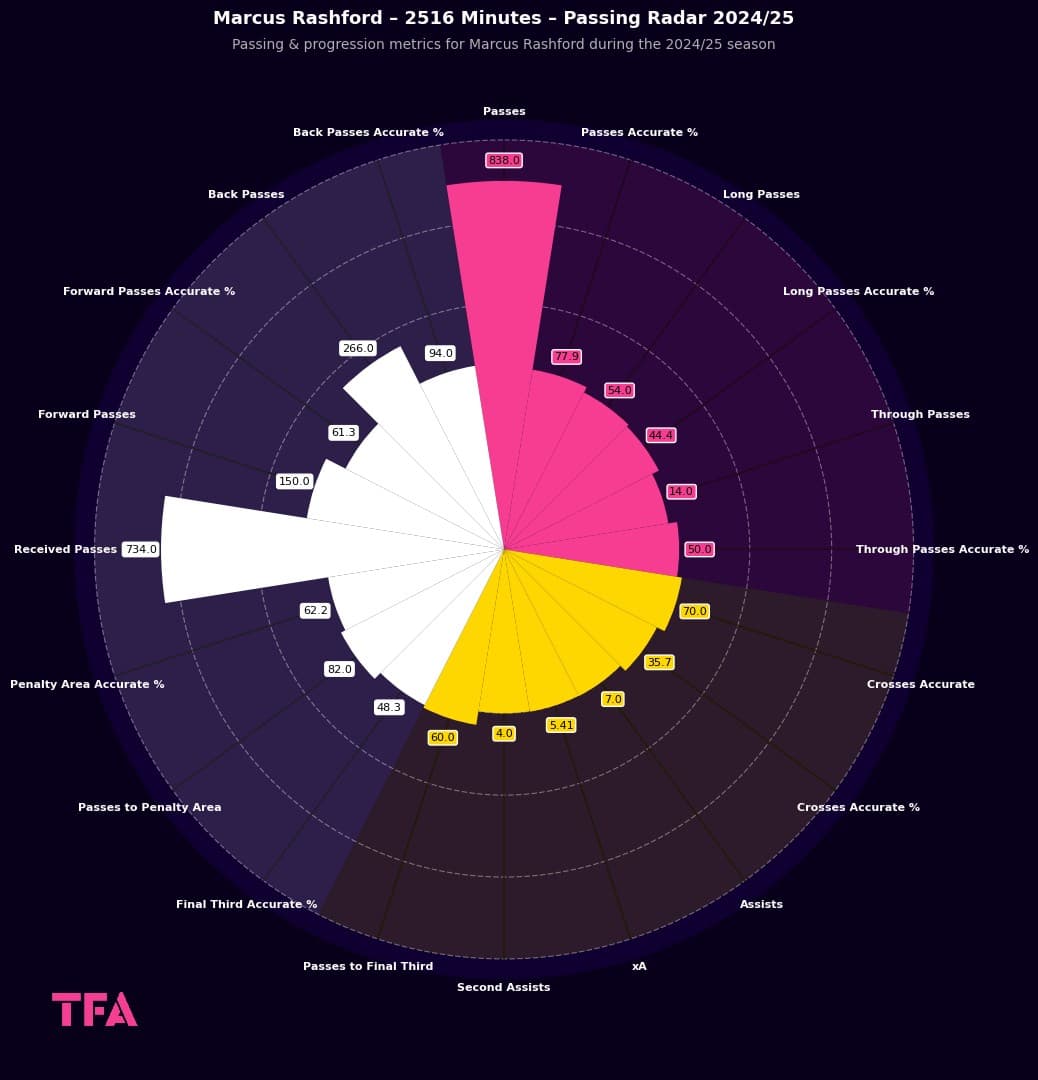
Across 2516 minutes, Rashford attempted 838 passes, maintaining an accuracy rate of 77.9%, a figure that, while not elite for a wide forward, speaks to a decent level of technical execution within high-risk zones.
Perhaps most interesting is his willingness to attempt different types of passes that directly influence attacking momentum.
Rashford registered 54 long passes, 44.4% of which found their target.
Though not exceptionally accurate, the intent to switch play or bypass midfield pressure is evident.
His 14 through passes, half of which were completed, suggest he’s more than just a finisher; he’s capable of threading incisive balls that unlock defensive lines.
His crossing, however, was more erratic.
Out of 70 attempted, only 35.7% reached a teammate, indicative of either rushed decisions or poor support positioning in the box.
Nonetheless, these deliveries contributed to seven assists and an expected assists (xA) total of 5.41, aligning his creative output with underlying chance quality.
Furthermore, Rashford contributed four secondary assists, a signal of his involvement in pre-assist build-up phases.
Progression-wise, Rashford recorded 60 passes into the final third (48.3% accuracy) and 82 into the penalty area with an improved 62.2% success rate, a notable pattern that indicates a stronger connection when closer to the goal.
His 150 forward passes, completed at 61.3% accuracy, contrast with his 266 backwards passes, completed at an impressive 94%, showcasing both attacking intent and control under pressure.
In sum, Rashford’s passing game in 2024/2025 added layered value beyond simple goal threat, offering verticality, transitional contribution, and involvement in multi-phase attacking sequences that could align well with Flick’s positional play at Barcelona.
Assessing Marcus Rashford Fit In Hansi Flick Attacking System With Barcelona Front Three
To evaluate whether Marcus Rashford could be a tactical fit within Hansi Flick’s attacking system at Barcelona, we first need to understand the visual analysis method used.
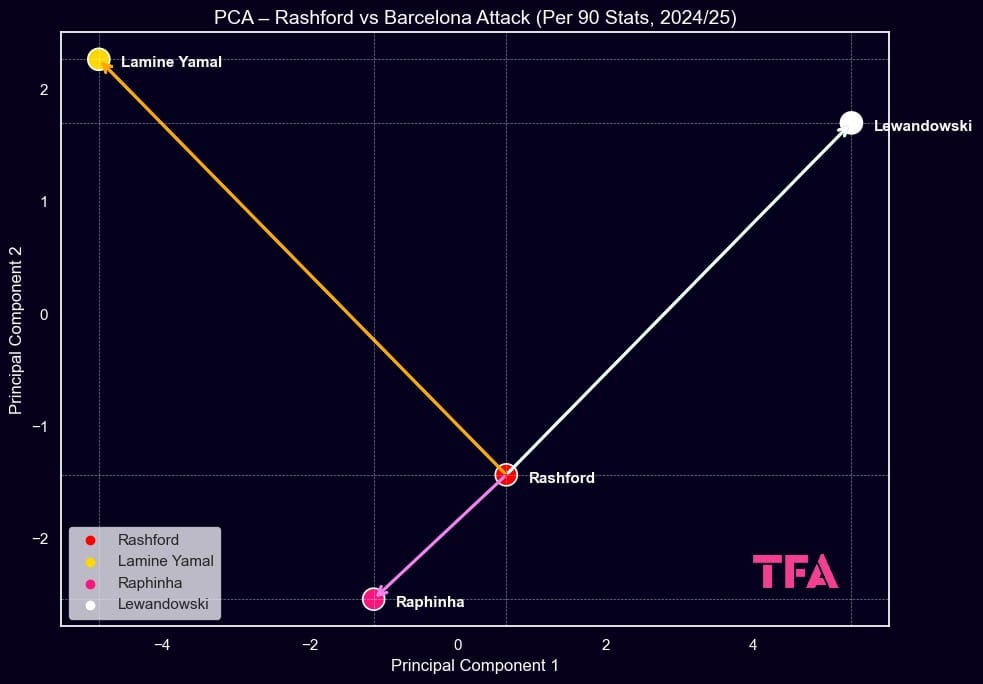
The approach is based on Principal Component Analysis (PCA), a statistical technique that reduces complex performance data into just two dimensions, Principal Component 1 (PC1) and Principal Component 2 (PC2).
These components capture the directions of greatest variation across a dataset of players: PC1 reflects the most significant difference in playing styles, while PC2 captures the second most significant, at a right angle to PC1.
In simpler terms, every player becomes a single dot on a two-dimensional plot, and their location reflects their performance profile in relation to others.
To ensure fairness, all stats were converted to a “per 90 minutes” basis, so a player who played 27 matches can be compared fairly with one who played 57.
The data was then standardised to remove any scale bias (goals shouldn’t outweigh passing simply due to larger numbers).
PCA reduced the dataset to a simplified space, allowing for the visual comparison of each player’s style.
Rashford’s proximity—or lack thereof—to Barcelona’s existing forwards on the plot offers an early signal: Is he stylistically aligned with the system, or will he require adaptation?
To determine whether Marcus Rashford will likely thrive in Hansi Flick’s attacking system at Barcelona, a data-driven comparison with the current front three, Lamine Yamal, Raphinha and Lewandowski, offers compelling insights.
Barcelona Forwards Vs Rashford – Per 90 Stats Comparison
Standardising performance by 90 minutes played, we observe that Rashford averages 0.39 goals per 90, which is closest to Lamine Yamal (0.31), though far behind Lewandowski’s prolific 0.9.
In terms of assists per 90, Rashford records 0.25, a figure comparable to Raphinha’s 0.37 but notably short of Yamal’s 0.41, suggesting a moderate creative impact.
His shot volume is 2.44 per 90, again similar to Lewandowski‘s (3.07), but his shots-on-target percentage (44.1%) is surpassed only by the Polish striker’s (47.9%), indicating efficient shooting.
Rashford’s expected goals (xG) per 90 is 0.34, considerably lower than Lewandowski’s (0.84) and Raphinha’s (0.42), but closely aligned with Yamal’s 0.37, reflecting a secondary scoring role rather than a primary one.
In terms of passing, Rashford averages 30.04 passes per 90 at a 77.9% success rate, mirroring Yamal and Raphinha’s profiles, though he offers less volume than both.
He delivers 2.55 crosses per 90 at 35.7% accuracy, on par with the others in crossing precision.
His dribbling output, 4.8 dribbles per 90 with 47.8% success, mirrors Raphinha’s closely (4.5 dribbles, 45.7%), reinforcing his likeness to a right-footed wide forward rather than an explosive one-on-one winger like Yamal.
On the defensive side, Rashford’s 1.33 interceptions and 2.68 recoveries in the opposition half per 90 are most in line with Lewandowski’s numbers, revealing a lower defensive involvement than the wingers.
Overall, Rashford statistically mirrors aspects of all three but appears closest in output and profile to Raphinha.
This suggests he could feasibly slot into Flick’s system as an inverted left winger, offering a blend of directness and goal threat without disrupting the current structure.
Marcus Rashford Output From The Left Wing – Space, Structure, & Subtle Decline
When operating on the left flank, his most natural and frequently used position, Marcus Rashford clocked 1186 minutes during the 2024/2025 season, the most he registered in any single role.
Performance Metrics For Marcus Rashford When Playing As A Left Winger
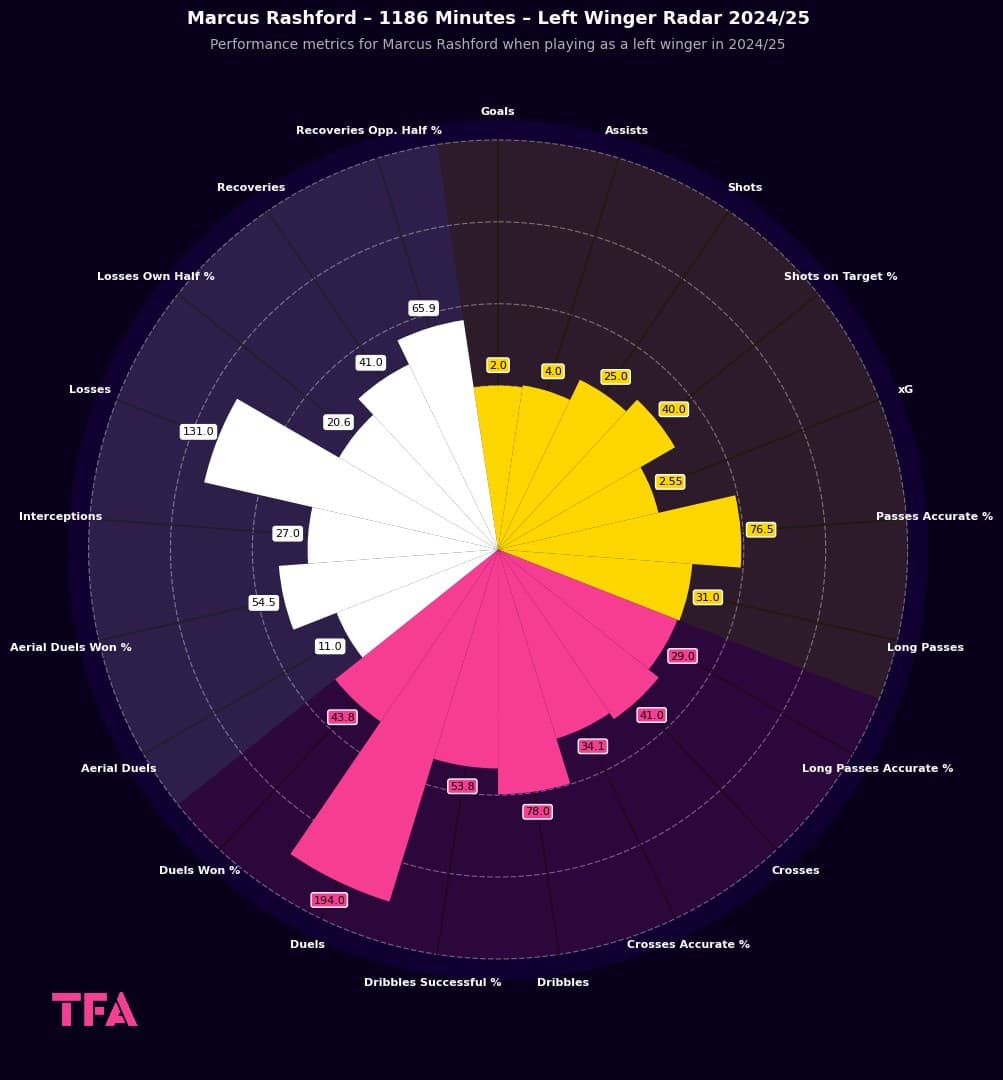
Yet intriguingly, this extended spell did not translate into a heightened end product.
Despite enjoying the structural freedom associated with hugging the touchline, Rashford managed just two goals and four assists across this period.
His xG from the left wing stood at a modest 2.55, and his shot accuracy hovered at 40% from 25 attempts, indicators that, while involved, his finishing was somewhat below par.
His passing efficiency on the wing also reflected a balanced but unspectacular contribution.
With 438 passes attempted at a 76.5% success rate, Rashford often found teammates but rarely broke lines.
His crossing frequency (41) and accuracy (34.1%) were solid, yet not exceptional, hinting at a role more about recycling play than carving open defences.
His dribbling success rate, at 53.8% from 78 attempts, suggests a willingness to take on defenders, although the success rate leans closer to the industry average rather than the elite.
The data tells a more subdued story defensively.
His duel success rate was 43.8%, and he recovered possession 41 times in the opposition half, which shows sporadic pressing effort but limited defensive consistency.
His 131 total losses, 27 of which were in his own half, raise questions about his ball security when deeper or under pressure.
Overall, Rashford’s numbers on the left wing suggest a player who contributes across phases but does not dominate them.
While his positioning offers width and tactical stretch, the final output does not quite match the volume of involvement, something Barcelona’s setup under Flick will need to fine-tune if he’s to thrive in that channel.
Marcus Rashford Central Striker Role – Ruthless Finishing With Tactical Trade-Offs
When deployed as a central striker during the 2024/2025 campaign, Marcus Rashford displayed a level of efficiency in front of goal that sharply contrasted with his wider role.
Performance Metrics For Marcus Rashford When Playing As A Forward
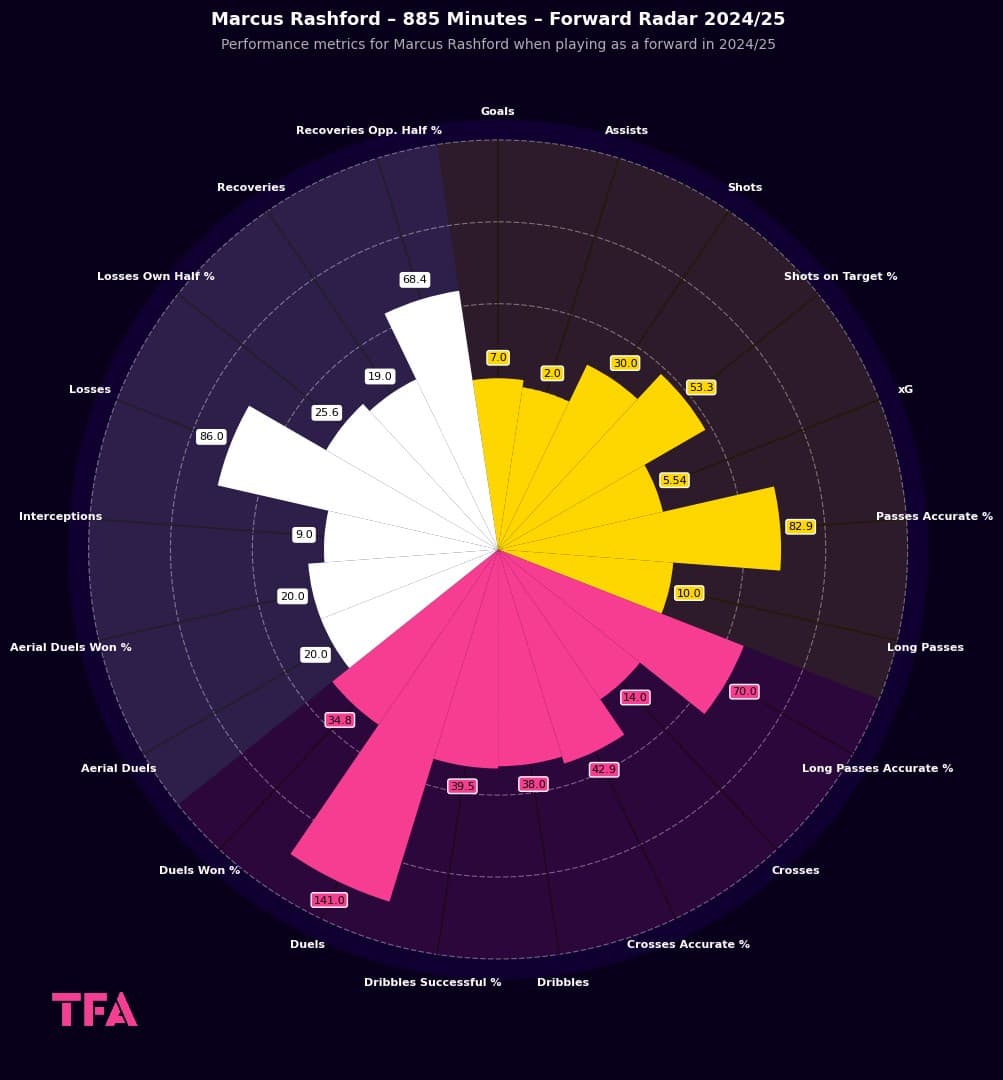
Across 885 minutes played as a number nine, Rashford scored seven goals and contributed two assists, translating to a goal involvement every 98 minutes, a far more potent return than when operating from the left wing.
His expected goals (xG) tally of 5.54 in this role aligns closely with his actual output, suggesting a clinical edge rather than overperformance.
Furthermore, with 30 shots and a shots-on-target rate of 53.3%, Rashford consistently tested opposition goalkeepers from central areas.
His involvement in build-up play was more restrained, though accurate.
He completed 252 passes at a strong 82.9% accuracy, including an impressive 70% success rate on long passes, indicating smart link-up play when dropping deep or switching the play.
However, his crossing (14 attempts, 42.9% accuracy) and dribbling (38 attempts, 39.5% success) figures suggest a more conservative approach in duels, focusing on positioning and movement rather than taking on defenders.
Defensively and in duels, Rashford showed limitations.
He engaged in 141 duels, achieving a 34.8% win rate, and won only 20% of his aerial battles.
This lack of physical dominance in central areas could hinder his effectiveness against more robust defensive lines.
His defensive contributions included just nine interceptions, and he lost possession 86 times, including 20 in his own half, metrics that underline the risk involved when he’s pressed high up the pitch.
Ultimately, Rashford’s stint as a striker underlines a trade-off: a sharper goal threat but reduced physical presence and defensive security.
Barcelona will need to weigh this profile carefully if they consider him a long-term option through the middle.
Conclusion
Marcus Rashford’s arrival at Barça is a pivotal point in his career and the club’s development.
For the player, it offers a chance to re-establish himself among Europe’s elite following a period of inconsistency and positional ambiguity.
For Barcelona, it’s a calculated gamble on a player whose numbers hint at potential, but whose output requires careful optimisation within Hansi Flick’s fluid and system-oriented setup.
The data from Rashford’s 2024/2025 season paints the picture of a player whose value lies in tactical flexibility.
As a striker, he demonstrated ruthless efficiency in front of goal, delivering a goal or assist nearly every game, while offering intelligent link-up play and decent ball circulation under pressure.
However, this came with trade-offs in terms of physical duels and off-the-ball involvement, limiting his effectiveness in more combative encounters.
On the left wing, his output dropped, despite a higher number of minutes.
While he provided width, pressing triggers, and moments of verticality, the end product was inconsistent, hinting at a player more comfortable attacking space than unlocking deep blocks.
His passing and crossing variety suggest an understanding of positional play, but the creative returns did not always match the volume of involvement.
Statistically, Rashford’s profile aligns most closely with Raphinha’s among Barcelona’s current attackers, suggesting a potential role as an inverted left winger who provides directness without disrupting the existing front line’s dynamics.
However, for him to truly thrive, Flick must tailor his responsibilities to amplify his strengths, sharp movement, transitional threat, and intelligent passing, while protecting against his defensive limitations and fluctuating influence in settled play.
In short, Rashford’s success at Barcelona will depend not just on his raw ability but also on whether he can evolve tactically within a demanding, fluid system and whether the club can unlock consistency from a talent still seeking its final form.
