
Since 1. FC Köln sealed their promotion back to the German top flight by winning the 2. Bundesliga title in May, they’ve been preparing themselves for the challenge of being among the elite again and stocking their squad with new signings.
One of those signings was Icelandic midfielder Ísak Bergmann Jóhannesson, who was one of the most offensively productive players in the second tier last term for Fortuna Düsseldorf.
With 17 goal contributions (11 goals and six assists), he nearly doubled his production of nine from the previous campaign and is living up to the promise he showed in his early days at Nörrkoping in Sweden a few years back.
At €5.5m, FC Köln are getting a fine young midfielder for a very cost-effective price, and one who is ready to step up on the big stage after a couple of solid years in the division below.
This player analysis and scout report will highlight Jóhannesson’s progression in 2024/2025, his strengths and areas of improvement, and how he could potentially fit into his new side going into his first crack at a top-five league this year.
Who Is Ísak Bergmann Jóhannesson?
Isak Bergmann Johannesson is a 22-year-old central midfielder who is predominantly left-footed, who stands at 6’0″(184 cm) and most recently weighed 158 lbs (72 kg).
Born in Sutton Coldfield, England, he has represented Iceland internationally since the U-15 level.
Since making his debut as a 17-year-old in 2020, he has amassed 35 caps for the nation at the senior level.
Although earlier in his career he was utilised in a number of different roles, including playing out wide on the right or just behind a striker, Jóhannesson has settled into playing predominantly as a central midfielder during his time in Germany thus far.
Although he still retains his versatility, which he showed early in his teenage years, finding his spot in central midfield has helped him mature into the player he is today, who has earned this transfer.
While his role has slightly altered depending on the system that his team laid out with different defensive schemes and midfield set-ups, he has largely been an #8 who receives freedom to push forward into attacking areas both on the ball to support the offence and off the ball to press higher to help win it back.
In addition to showing where he operates on the field, the radar map below from the 2024/2025 season can also offer an idea of his contributions to Düsseldorf in different data metrics before we expand on them further.
Ísak Bergmann Jóhannesson Radar Map 2024/2025
 It’s very evident right away from looking at this data visual that one area Jóhannesson excelled in among other midfielders at his level was his passing, ranking in the 88th percentile or higher in passes per 90, accurate passing percentage, and received passes per 90.
Another metric he performed very well in was his defensive duels winning percentage, which hovered around the 88th percentile.
He also ranked pretty well in the 67th percentile when it came to his aerial duels won (albeit from a smaller sample size given the low number of aerial duels per 90) and his goal contributions per 90, the latter not being so surprising as not many posted the numbers he did in the league last term.
However, he did rank relatively low in other metrics, such as defensive positioning and dribbling, which we’ll touch on more later.
But for now, let’s look at some of those areas Jóhannesson has proven to be strong in.
Ísak Bergmann Jóhannesson Strengths
Given that he is an attack-minded player playing in the centre of midfield, and his possession metrics look as strong as they did, it makes sense to start with highlighting his passing traits and abilities.
Jóhannesson averaged 41.53 passes per game last season with an accuracy of 84.1%, with 11.18 of those being forward passes on average.
For example, this ball below is against Kaiserslautern at home.
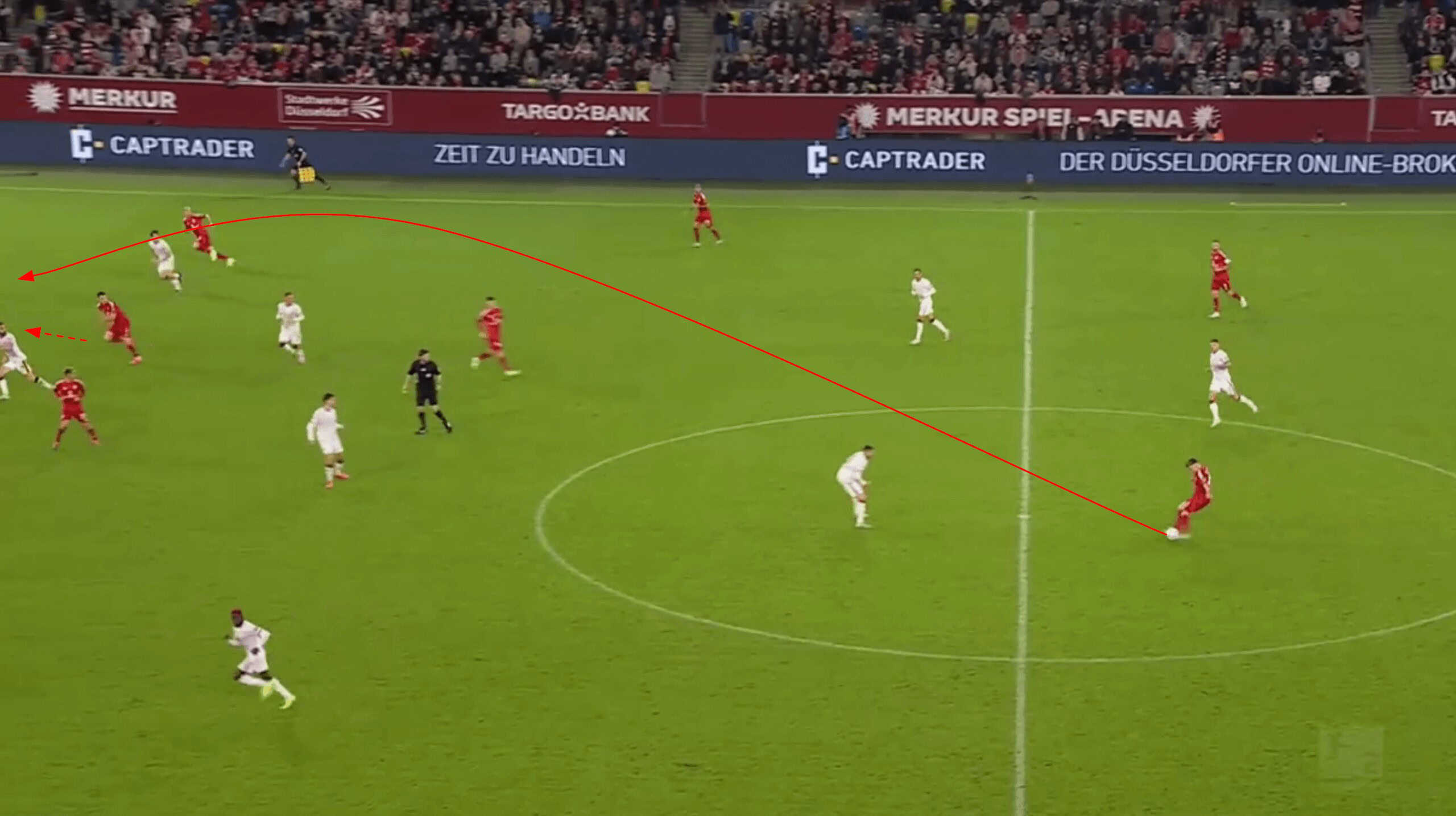 Jóhannesson dropped deep in the closing stages of the game and picked this ball out over the top of the defence to Felix Klaus, who made the run into the box and finished it first time.
Although this was in a situation of desperation, with Düsseldorf trailing by two and in stoppage time, it still highlights the range of Jóhannesson’s passing and ability to pick a player out, even from inside his own midfield, sending a ball into the final third.
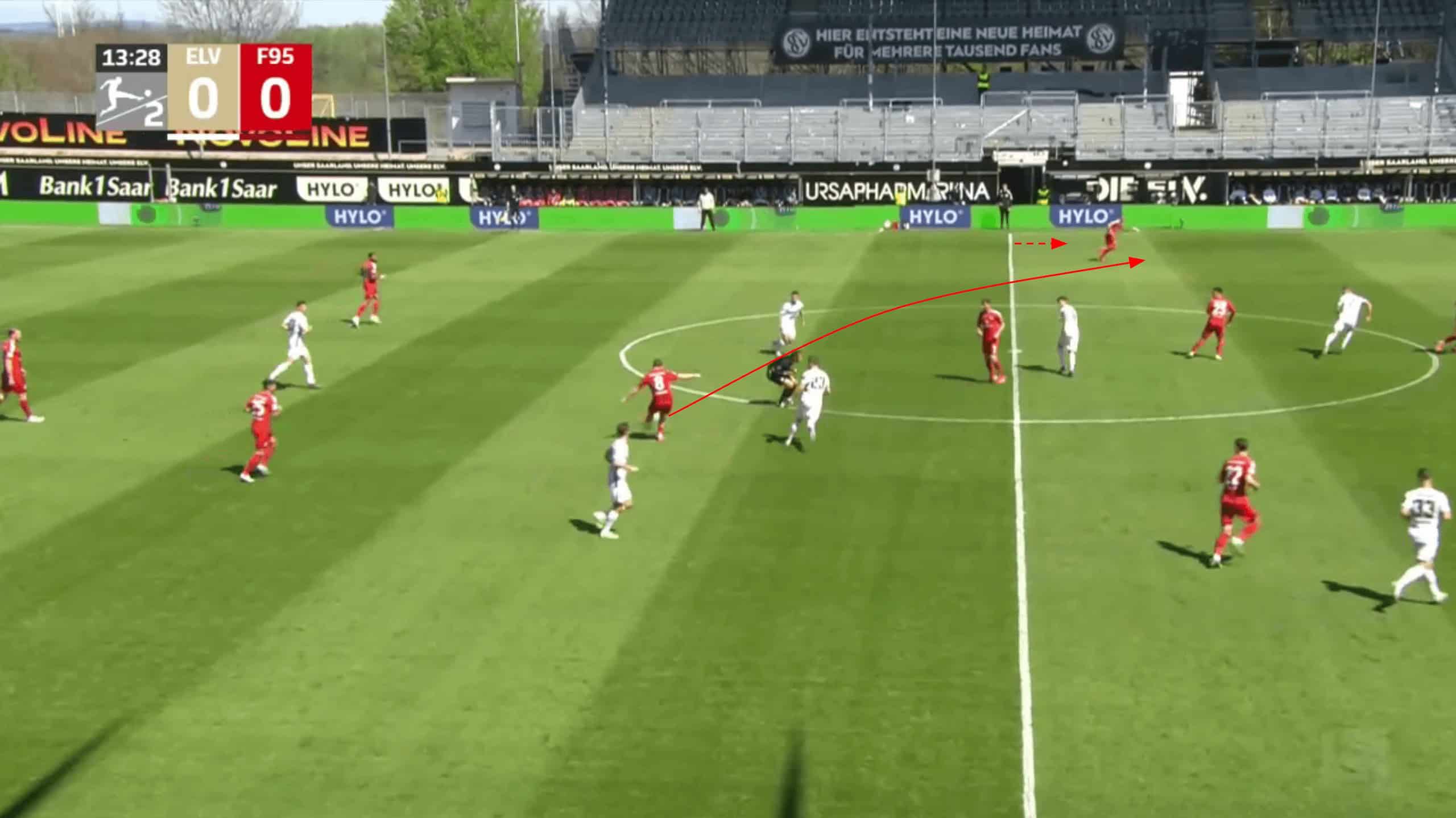 He’s also comfortable switching the ball from one side to the other, particularly cutting in from the right onto his left and playing it towards the overlapping full-back or winger, as in the above example against Elversberg.
Just as important as his passing accuracy is his timing and awareness of when and where to play the ball.
He’s refined this aspect of his game as he’s grown consistently by playing predominantly in central midfield throughout his time in Germany.
With the right movement from frontrunners into spaces, even small ones, Jóhannesson has the ability in his locker to add a new creative dimension to the Köln midfield.
He also delivers well in open play and dead-ball situations, which is another strength of his that his new club could find useful.
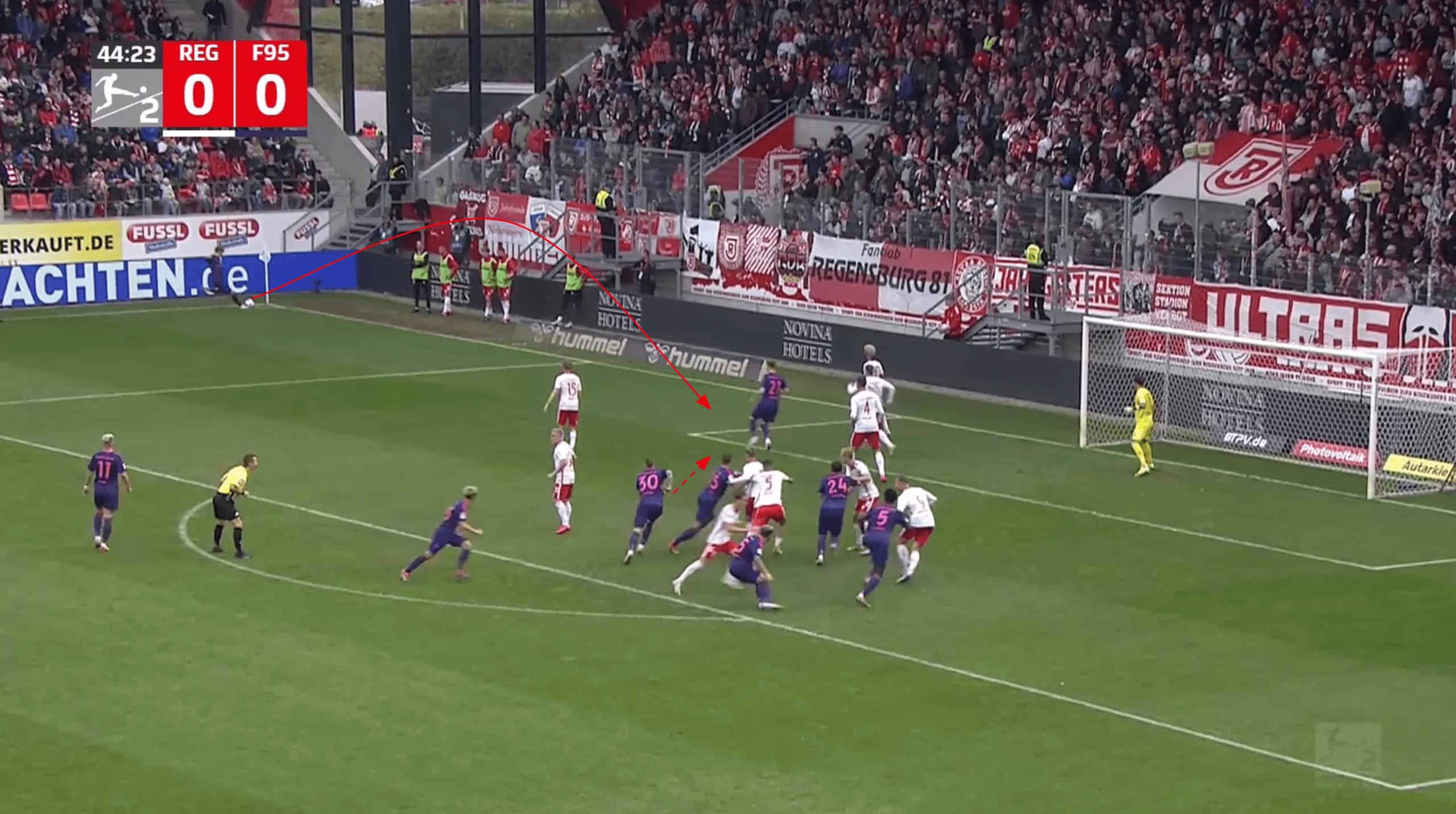 Jóhannesson registered a few assists last season, two of which came from set-pieces.
Firstly, above we can see an inswinging corner kick being delivered into the box from the left-hand side against Jahn Regensburg away.
The ball that Jóhannesson put into the box got up and down quickly before settling into the path of his teammate, who made a run towards the edge of the six-yard box.
There, he met the ball and put it into the back of the net.
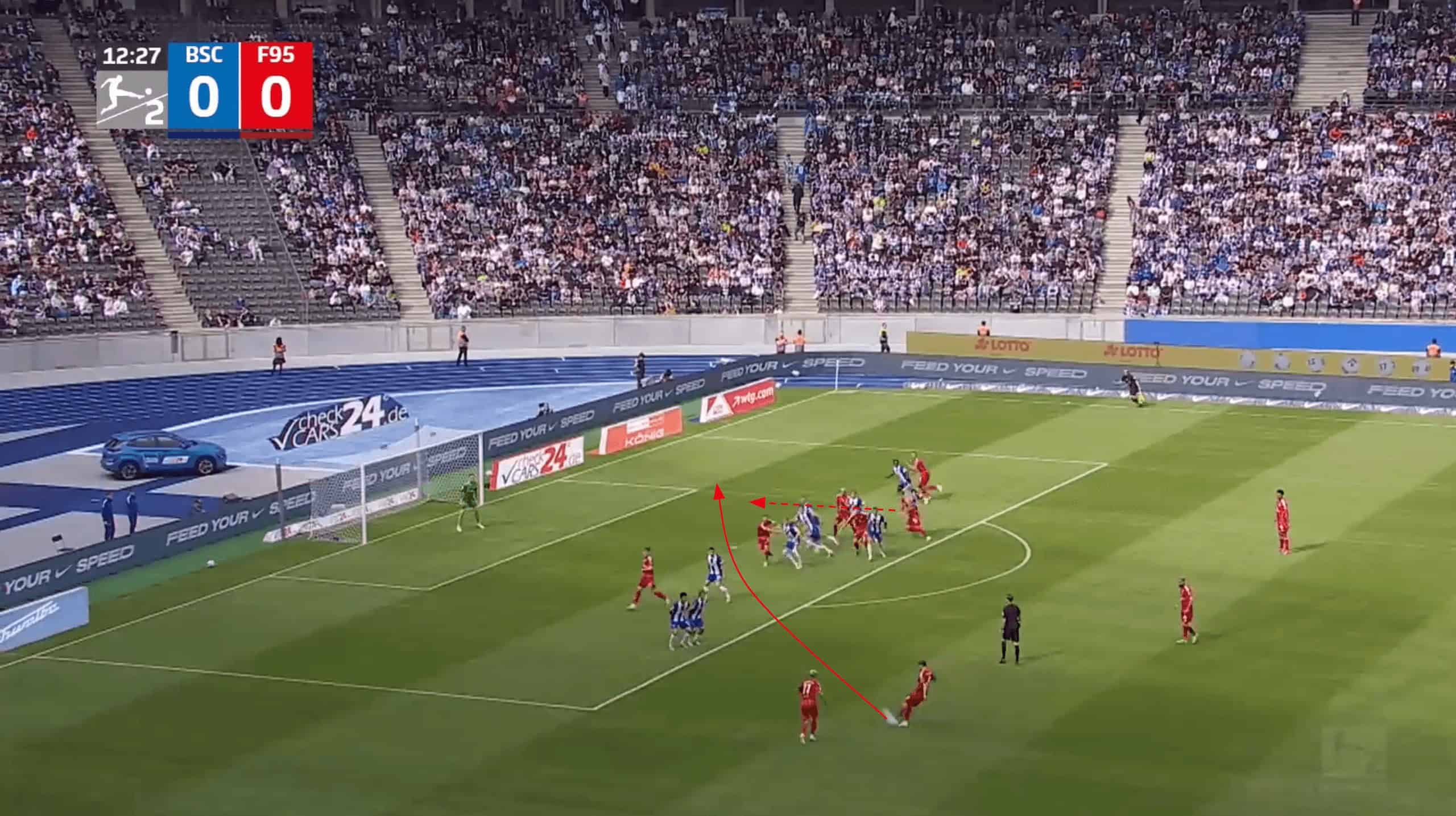 Similar case here, but from an indirect free-kick scenario away at Hertha Berlin.
He produces a curved ball that’s played towards the back post.
Again, it meets a late runner and ends in a goal for his side from the edge of the six-yard box.
Just as in open play, his passing ability and variety in his method of playing the ball can make it difficult for the opposition to deal with, which makes them hard to defend against and a great tool for his team to have in their offensive arsenal.
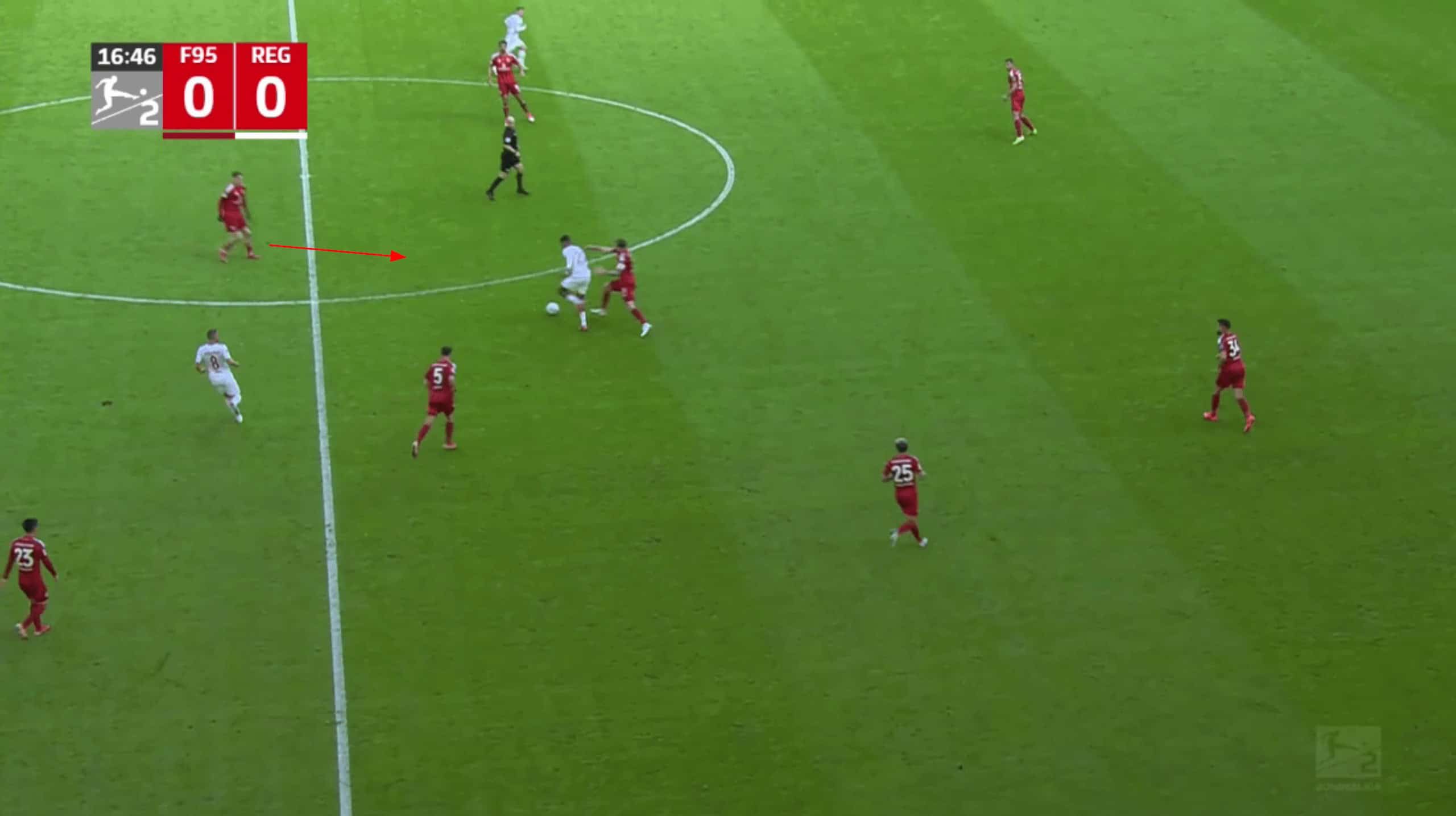 Another aspect of his game that impressed him statistically was his defensive duels won per 90, where he averaged 67% out of 5.37 such duels per game.
Although his starting position defensively could use work (more on that later), his ability to recover the ball for his team when needed was beneficial to Düsseldorf on several occasions last season.
Like in the example above against Regensburg at home, he begins by standing in the centre circle and collecting information on what’s going on in front of him.
A teammate is attempting to win the ball off their attacker.
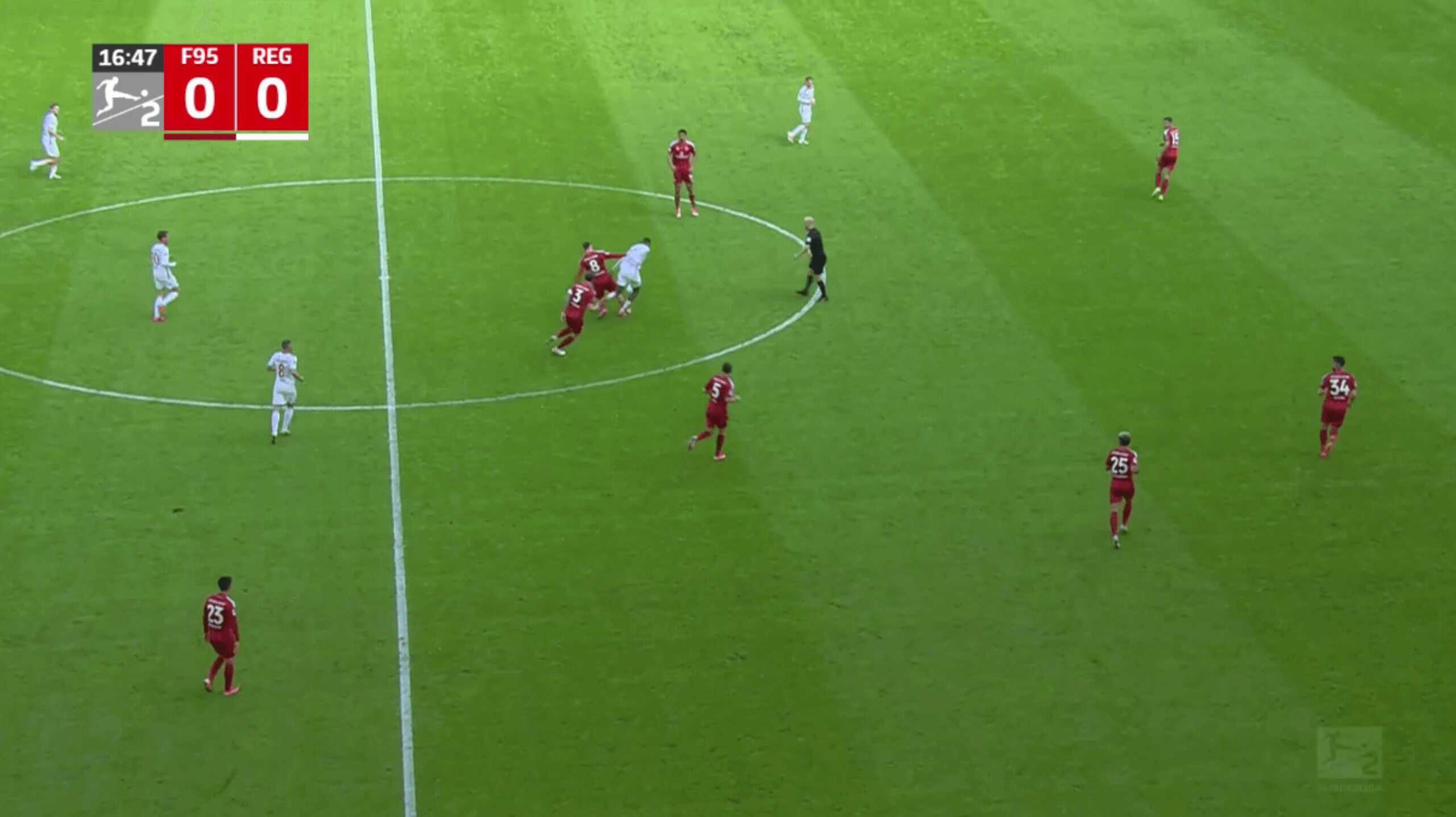 As the attacker is able to create space and distance from the initial challenge, Jóhannesson eventually comes deeper to attempt to win the ball back himself.
He manages to reclaim possession for his team by getting his foot in between the attacker’s legs and winning the ball cleanly, without committing a foul.
A clever piece of defensive play that he was able to analyse before acting and performing, something he has gotten better at doing as part of his responsibilities in midfield.
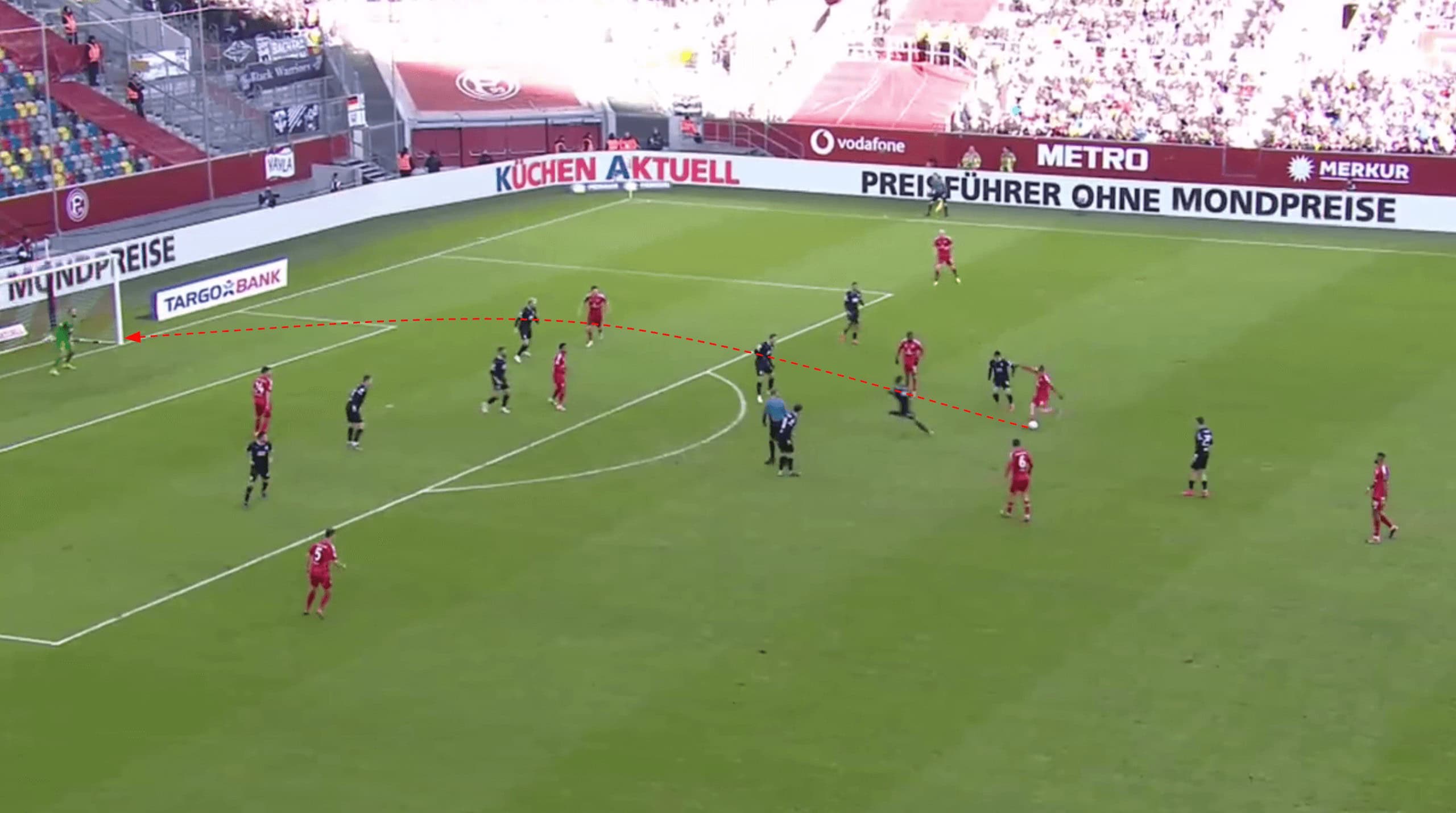 As someone who scored 11 times from midfield throughout the 2024/2025 campaign, it would not be easy to go through an analysis of Jóhannesson’s capabilities without mentioning his goalscoring prowess coming from deep.
Just as impressive as his number is the number of ways he can pop up and score a goal.
Take, for instance, this long-range strike above from the home match against Ulm.
The play initially began with Jóhannesson switching to the right flank with a short pass.
He then continued his run slowly and kept up with the play as his side advanced into the final third.
With Ulm players dropping deeper and moving across to try to get closer to the ball, Jóhannesson was free and unmarked in the middle about 30 yards from goal, before receiving a pass back from a winger who cut inside.
He then controlled the ball, took a second touch to get in front of it, and unleashed a well-placed shot that had speed, power, and accuracy into the bottom corner.
Although he doesn’t often produce such shots, this play proved that he can put his foot through the ball from a distance if the chance arises.
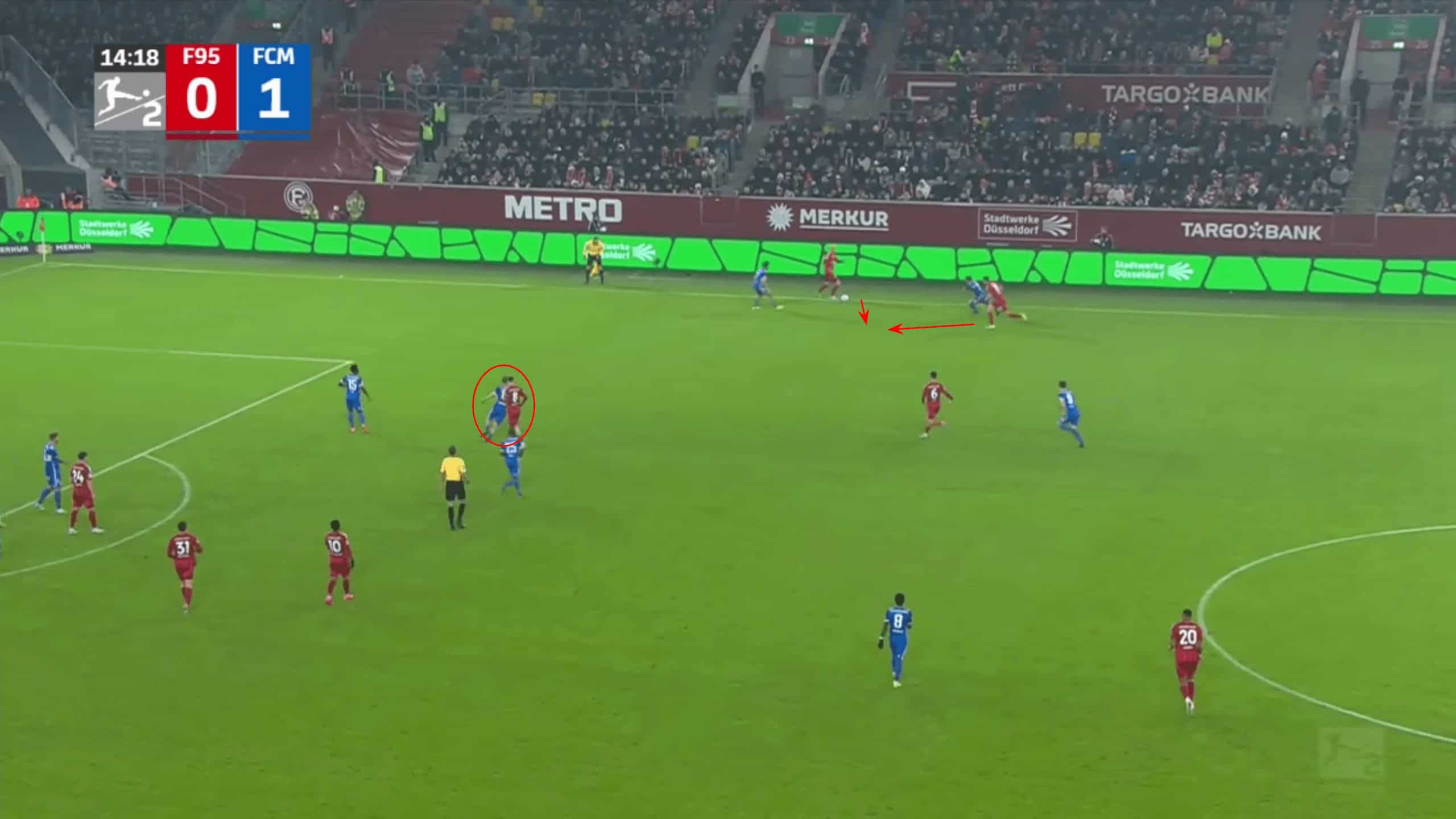 This goal against Magdeburg highlights a different type of goal that Jóhannesson is capable of.
It showcases his intelligent off-the-ball movement more than his striking ability.
With the ball out wide on the right flank, he can be spotted centrally outside of the penalty area with a marker tight to him, closing down the space for a potential pass infield towards him.
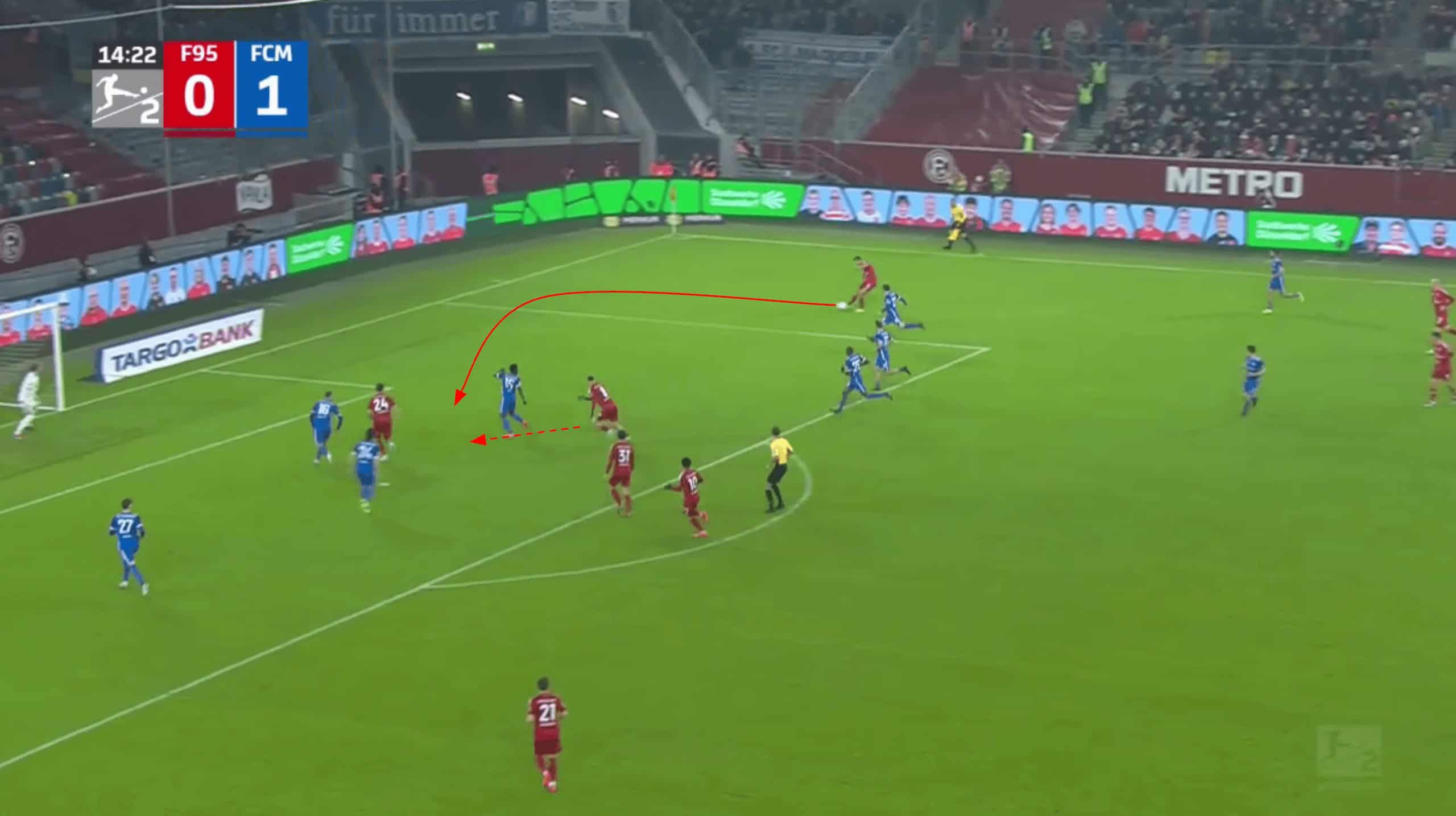 Following an overlapping run from the right center-back, who receives the pass on the run and moves into the attacking third and getting in position to cross the ball into the box, Jóhannesson is now found inside the penalty area and making a run off the blind side of the defender and moving towards the penalty spot to attack the eventual ball.
His movement was well-timed and spot on.
The ball was played exactly where he anticipated, and all he had to do was guide the header across the goalkeeper to score.
So, whether it’s about using his head or feet to score, Jóhannesson’s intelligence, timing, and instincts in the final third are a big component in the success he’s found at that end of the pitch over the last year.
And Köln will be looking to benefit from some of that in 2025/2026 by putting their new signing in similar positions to continue his goalscoring ventures.
Ísak Bergmann Jóhannesson Areas Of Improvement
Of course, like any other player who’s ever played the sport, Jóhannesson could also work on and sharpen his game.
In this section, we’ll pick one offensive and one defensive note that he can improve.
Offensively, he may possess a variety of tools within his passing, shooting, set-piece delivery, and off-the-ball movement, which have all already been highlighted.
But one thing he isn’t really strong at is his dribbling.
As we saw in his radar map, he ranks very low among other midfielders in his tier when it comes to dribbles per 90 minutes, averaging just 1.28 attempts per game.
Although he possesses a decent amount of pace for someone in his position, what sets him back when it comes to dribbling may be a two-fold issue—both physical and psychological.
The psychological factor could be a lack of self-confidence to attempt to beat his man more often, hence his aforementioned low averages.
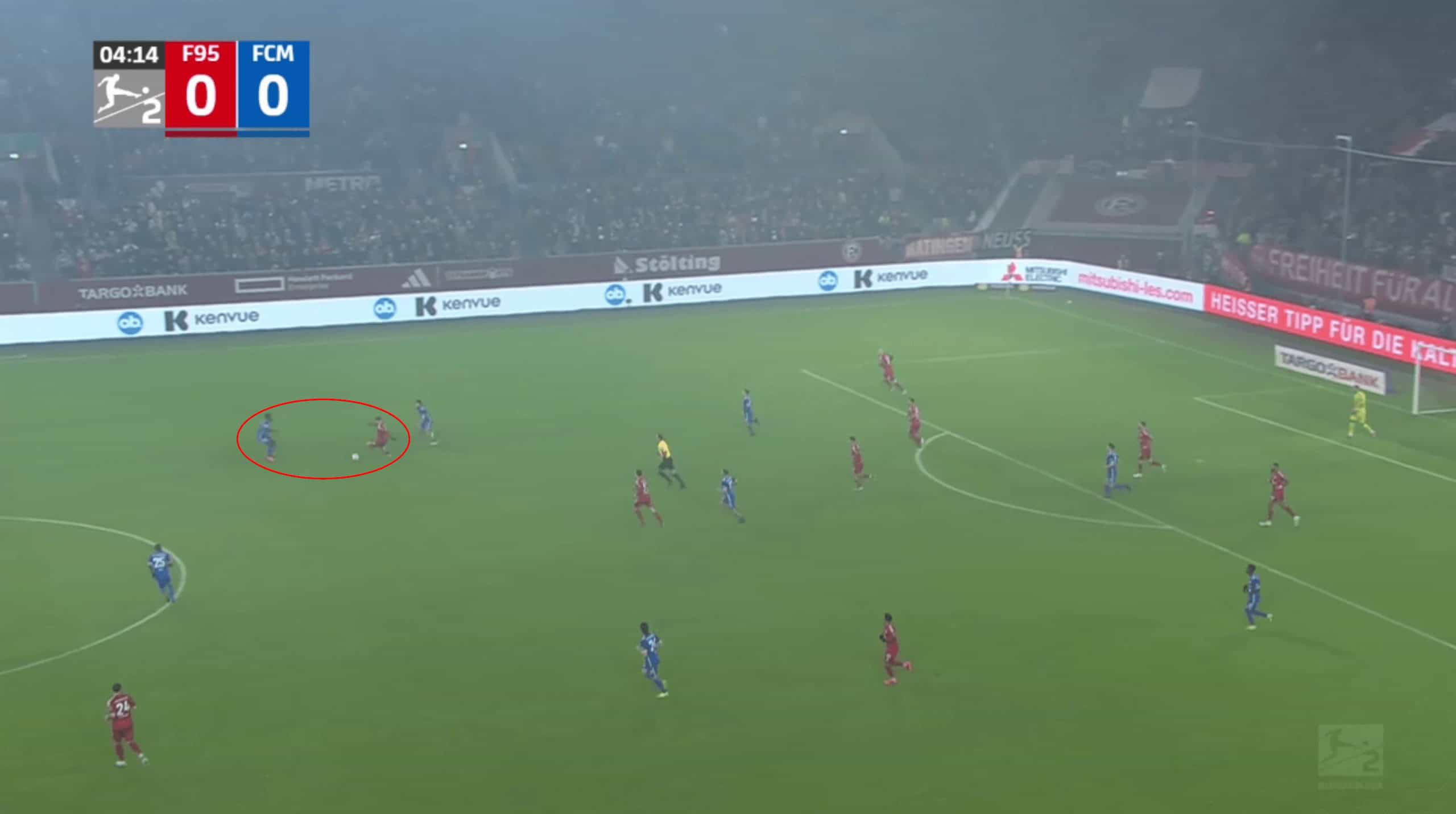 The physical factor could be that he may not have developed enough to ride challenges or beat others in a physical duel, which could, in turn, affect his confidence, especially when dribbling.
Take the example above against Magdeburg at home, for instance, where Jóhannesson is able to take the ball down and get it under control. He then has an opportunity to go 1v1 against the defender in front and initiate a counter-attack for his side.
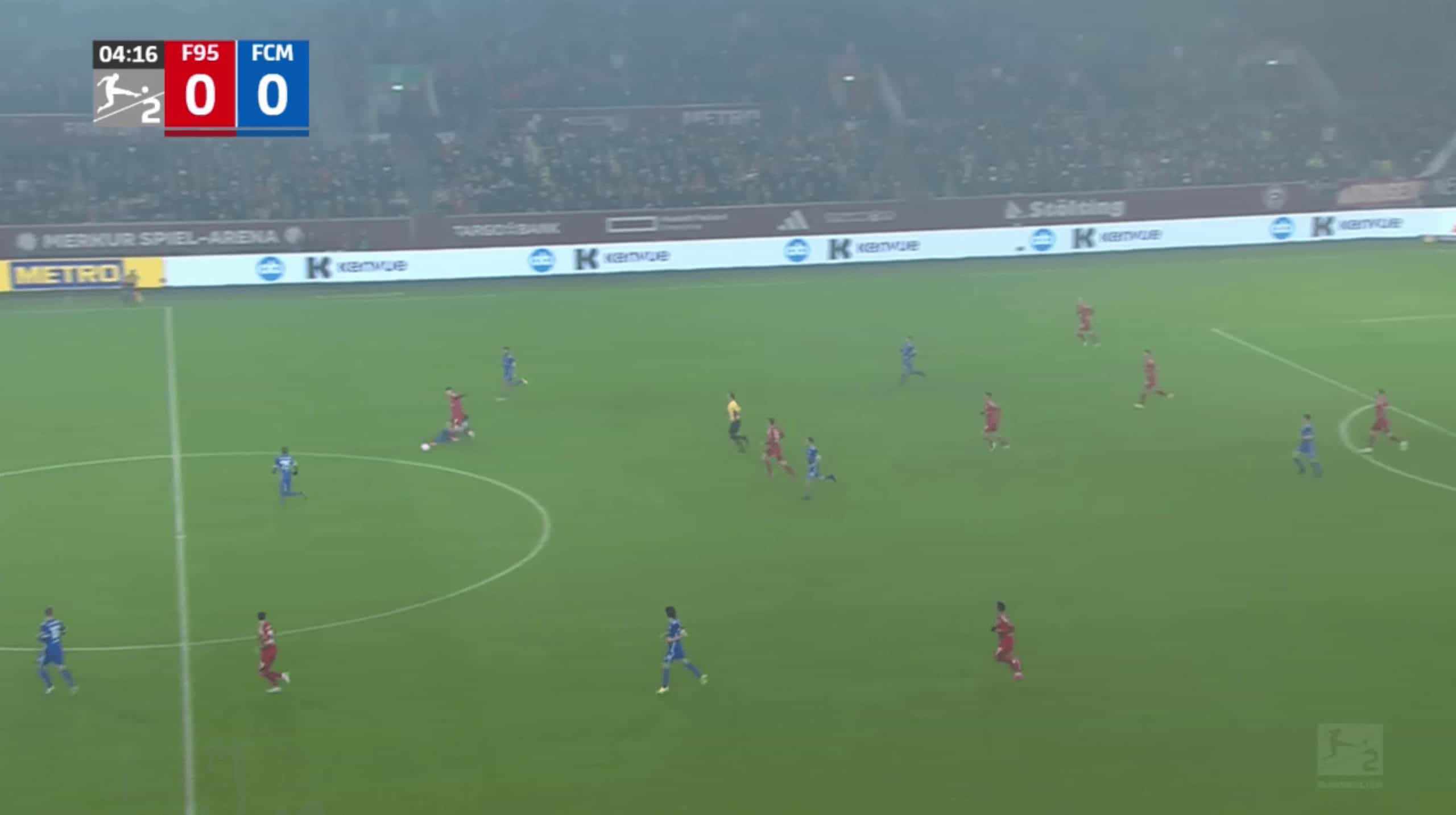 He did try to take that opportunity on, but he wasn’t able to fend off the defender when he tried to come inside of him.
He saw the ball nicked off him, and possession was squandered to the opposition.
Both the physical and psychological factors mentioned were on display here, as Jóhannesson wasn’t strong enough to win the duel and never really seemed confident enough to attempt to dribble.
If he could learn to deal with those factors better, he could become a more complete package offensively.
The way he plays the game currently, he lacks little else in an attacking sense.
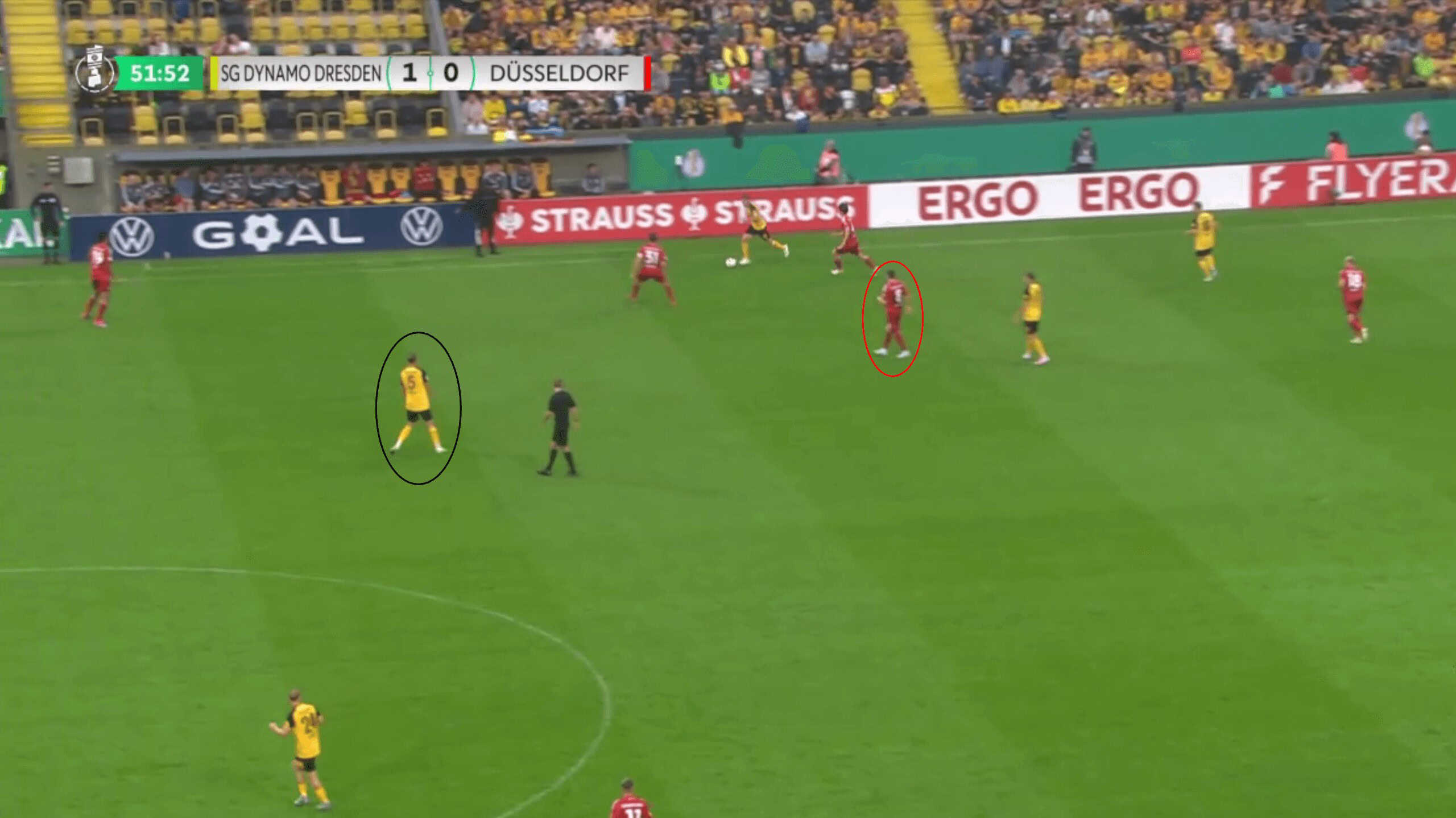 The defensive point we’ll highlight is his positioning, awareness of potential danger, and spotting it before it happens.
A great example of this can be seen above from early on last season against Dynamo Dresden away.
Jóhannesson can be seen circled in red, standing pretty much in the middle of nowhere.
He isn’t really making an attempt to press higher up the pitch.
Meanwhile, a Dresden player is all alone in the middle, circled in black, ready to receive the ball with tons of space around him and turn towards the Düsseldorf goal unopposed.
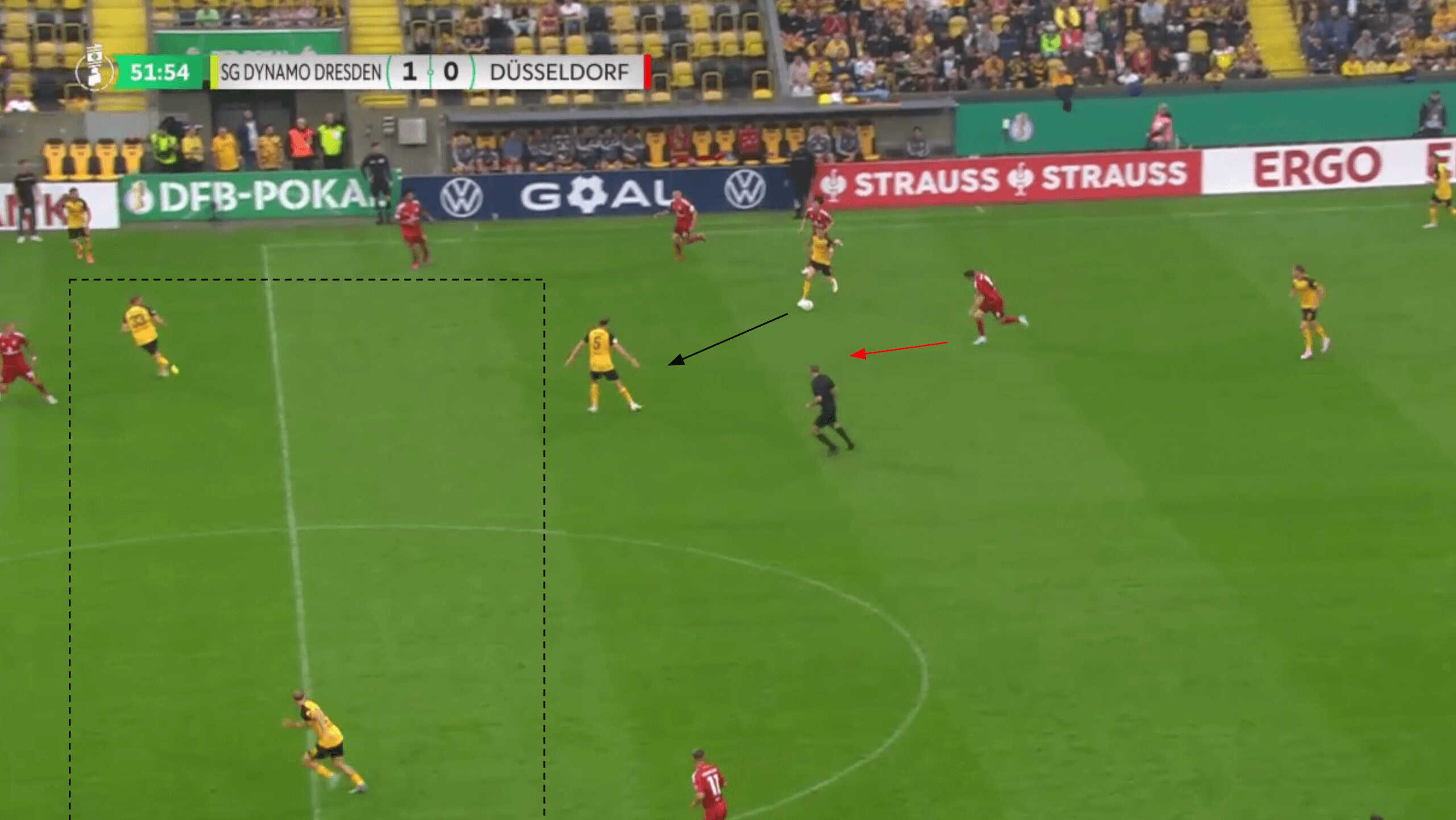 Eventually, the ball gets played to him, and we can see here that Jóhannesson realises that he is out of position and has to put in extra effort to get back into play and reposition himself to support the defence.
Had he spotted the open man early and decided to drop off and get closer to him, instead of pushing up and not really doing anything of note, this situation could have been averted.
Although his attempts to push up and join the press have had successful moments throughout the season, there have also been occasions like this where more defensive awareness would have been better and helped his team more if he had dropped deeper to support the backline.
And given that Köln are likely to see less of the ball against higher-quality opposition than in the 2. Bundesliga, he’ll have to improve on this more urgently going into the new season.
Potential Fit At 1. FC Köln
Despite earning promotion to the Bundesliga, Köln underwent a tumultuous period towards the end of the season when their potential Bundesliga status was in question.
In May, they were under two different managers.
Although they eventually got over the line, they’ve gone in a different direction, going into the top flight with 44-year-old Lukas Kwasniok, who was brought in after four years at Paderborn as their new head coach.
During his time at Paderborn, Kwasniok most often set his team out in a 3-4-2-1 or 3-4-3 shape, and that’s the system he’s gone with so far, early on in pre-season at his new club.
FC Köln Tactics 2025/2026 Pre-Season
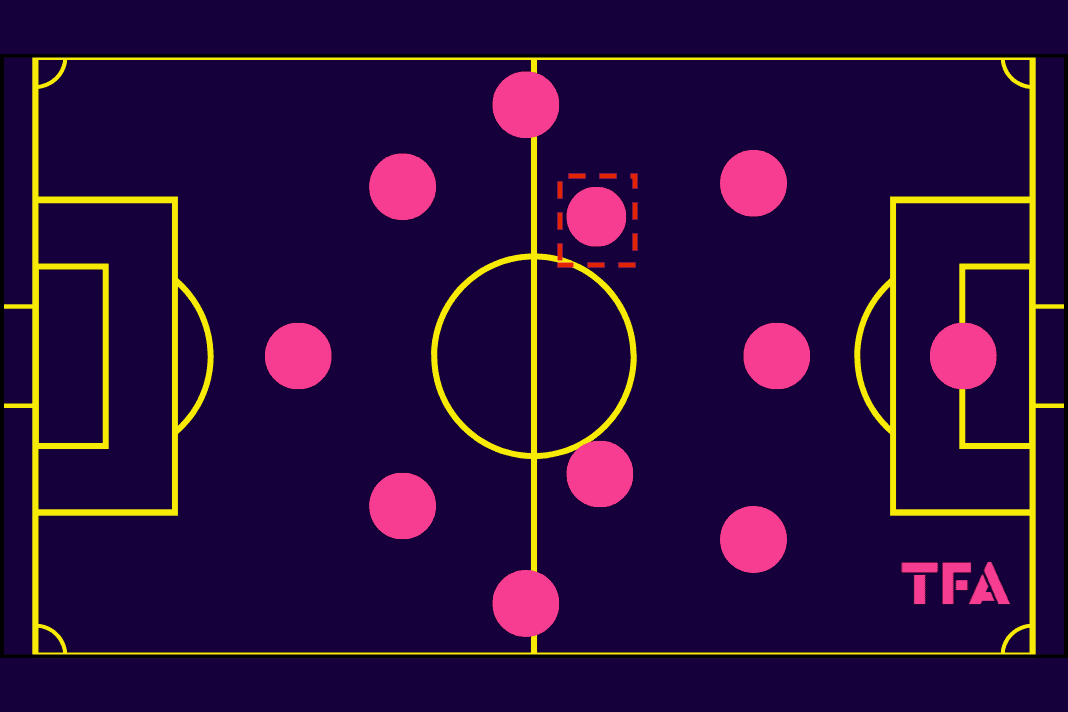 In their opening pre-season fixture against amateur side Bergisch Gladbach, Jóhannesson operated as a right-sided central midfielder (as pictured above) within this structure, similar to his role at Düsseldorf but in a double-pivot rather than a trio in midfield.
The 3-4-2-1 is one of several tactical schemes that Köln utilised last season, along with 4-4-2 and 4-2-3-1.
While Jóhannesson has played in a double pivot on many occasions himself and has displayed his versatility and tactical understanding in the past, given that he will play in this area of the pitch the most, he will have a greater responsibility on the defensive side.
And given what we’ve mentioned about his defending, which can be improved, especially with the step up in competition now, it is something he will have to work on to be a success with Effzeh, especially as, at the other end, he’s already flourishing from an offensive standpoint at a young age.
Conclusion
Based on what he showed last term in the 2. Bundesliga, Ísak Bergmann Jóhannesson will be a player to keep an eye on this year in the German top flight.
With a well-rounded attacking profile that incorporates a solid passing range and accuracy, dangerous set-piece deliveries, and goals provided from midfield, he has all the tools it takes to shine and succeed in the Bundesliga.
Having been considered one of Iceland’s top prospects for a few years now, he’ll finally get the chance to display his talents on the big stage.
At 22 years old, his best days are still very much in front of him.
