
Fortuna Düsseldorf have had a relatively strong start to the season with 10 points from the opening five games. From set pieces, Düsseldorf have been able to score twice in the league whilst also creating numerous clear-cut chances inside the six-yard box, where inconsistent finishing is the only reason they have not managed to score from set plays at the rate of a goal a game. PSV Eindhoven academy graduate Jordy de Wijs, who has also played in the EFL Championship and EFL League One for QPR and Hull City, has scored both set play goals, and his strong heading ability has allowed Düsseldorf to make the most of set plays whenever he meets the ball.
In this tactical analysis, we will look into the tactics behind Fortuna Düsseldorf’s offensive set plays, with an in-depth analysis of how their main corner routine has been used. This set-piece analysis will examine why this routine has instantly led to success and how it could be improved, following some opposition team’s recent successes at dealing with them.
Intent from Corners
Fortuna Düsseldorf have only used one routine consistently during the season’s opening month. It involves using a deep starting position for the attackers, with outswinging deliveries aimed just outside the six-yard box. The deep post of the attacking group is intended to bring the defenders further away from their goal in order to increase the amount of space between the two different defending units (zonal and man-marking).
Stretching the space between the defensive units gives them problems from all directions, where the zonal defenders have to be concerned about the space beside them and the ball coming in. In contrast, usually, a zonal marker should only be held responsible for the area they are situated in.

This routine favours outswinging crosses, where players can attack the ball as it travels directly against them. The deeper position means the headed efforts will likely take place from a further distance, where attacking the ball allows them to get more power on the shots.
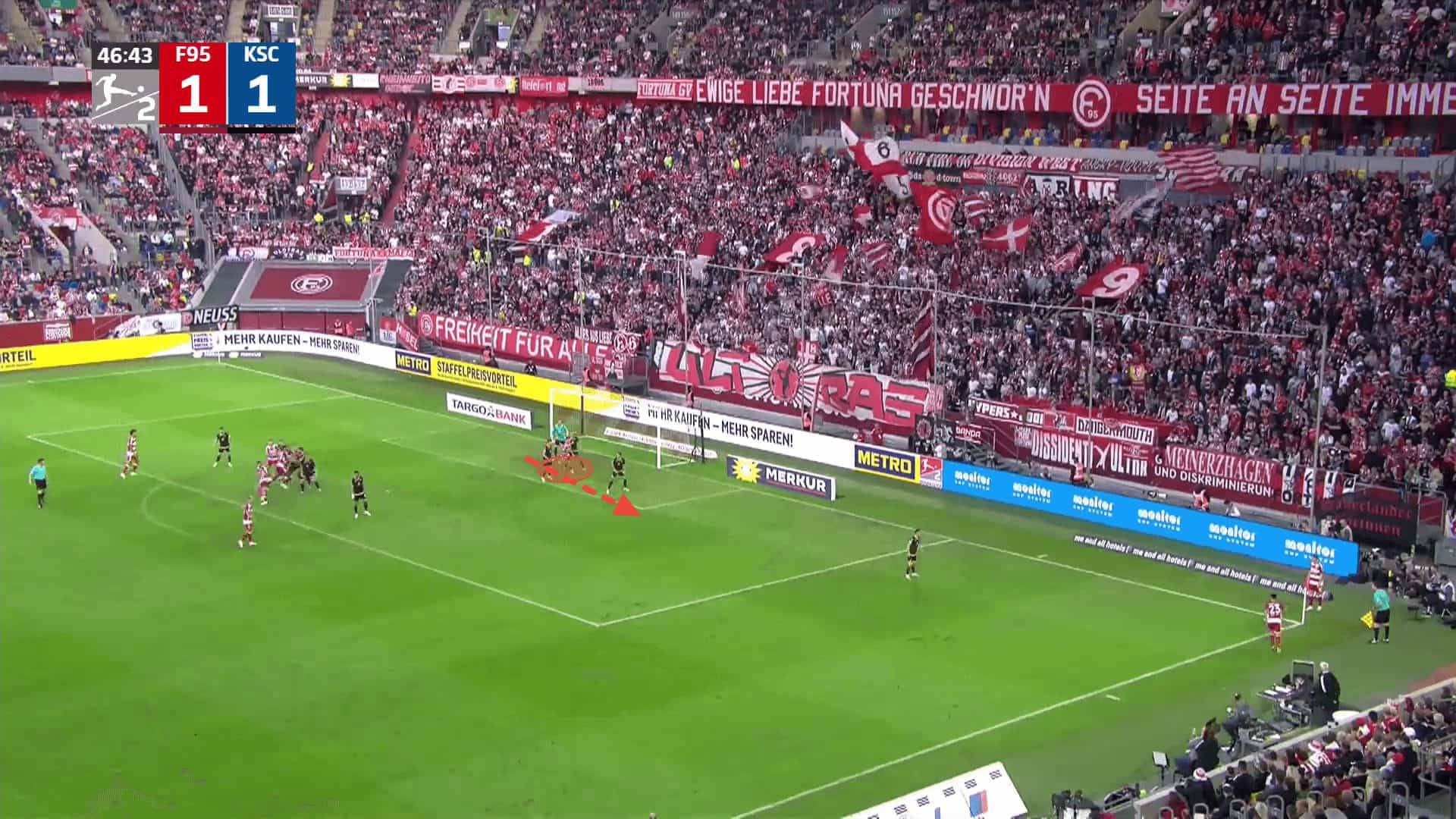
During these corners, the attacking player who starts inside the six-yard box attacks the front side of the six-yard box for two main reasons. Firstly, moving away from the six-yard box makes him act as a decoy runner, dragging a defender away from a target area. Secondly, moving ahead of any zonal defender gives Fortuna Düsseldorf a second chance if the corner is under hit, where the player can flick the ball into the path of the attacking unit to keep the attack alive.
The use of Blind Side Screens
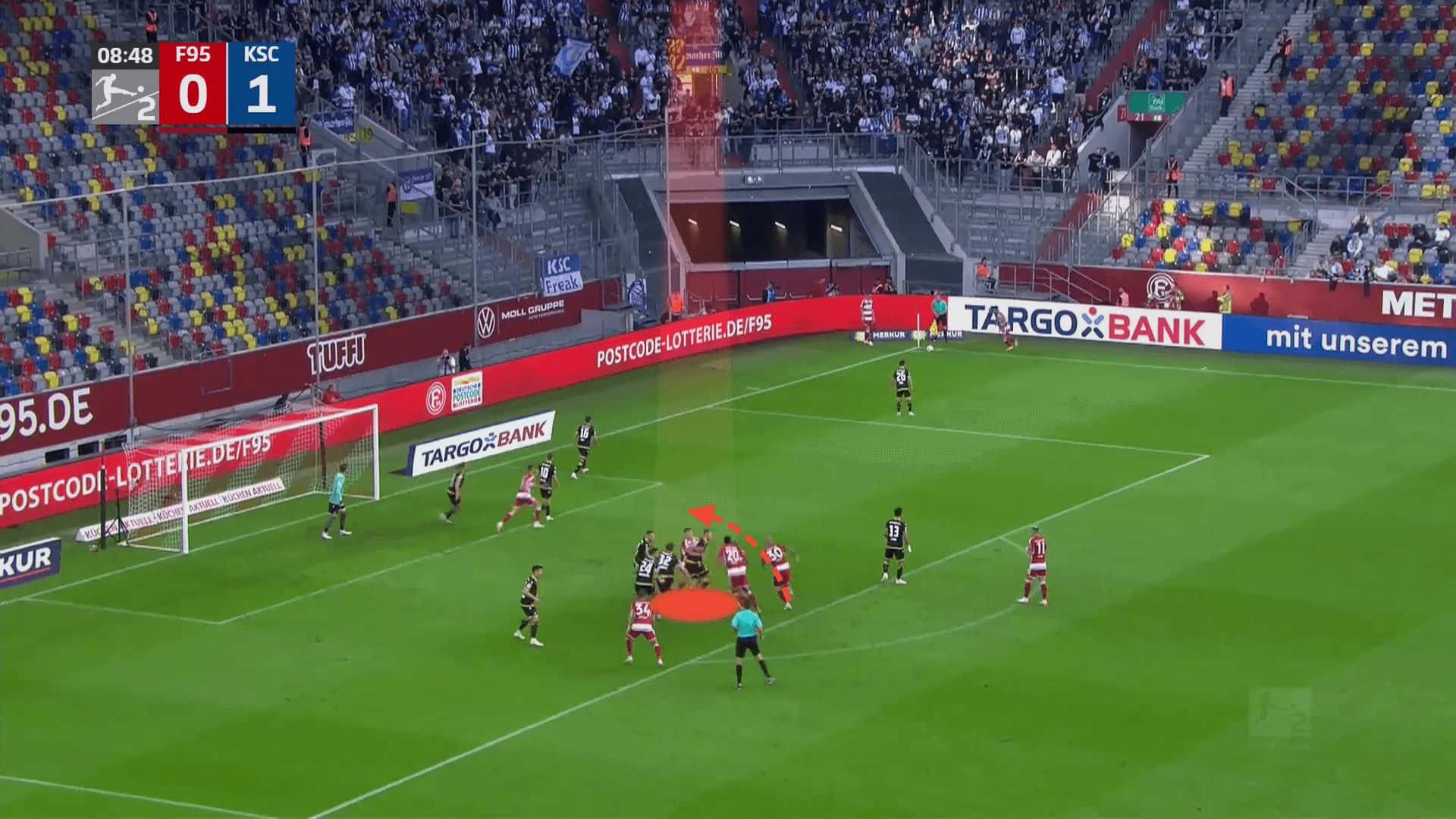
The primary cause of Fortuna Düsseldorf’s success is through the use of a blind side screen. In each attacking corner, the deep unit involves five attackers. Of these five, there is always one player who inserts himself between the defending man-markers, turning his back to the goal with no intention of attacking the ball.
As seen in the example below, the attacker providing the screen positions himself like a defender would, as his intention is the same as the defender: to disrupt a player’s path when attempting to attack the ball.
The player providing the screen starts in close contact with many defenders, where he can instantly perform a screen as soon as he sees his teammates starting their runs into the box. Being able to create so close to the target (man marker) means that the screen is more likely to be effective, as the defender has no time to evade it.
Furthermore, a screen from the defender’s blind side further reduces the chance of the defender bypassing it, while having the screen provider facing his target helps increase his chance of accurately judging the path of that defender’s movement so that he can position himself in the right place to intercept the run and prevent the defender from tracking his marker.
Fortuna Düsseldorf’s repetition of this routine has helped them perfect each player’s movements and timing, as well as increased the players’ intelligence to be aware of different situations. As seen below, the target area by the six-yard box is open, and an attacker has managed to find a clear, direct path into it.
With a screen being set up for him, giving him an easy opportunity to arrive in the target area for an unopposed header on goal, there is no need for the other attackers to attack that open space. Rather than attacking that area and bringing a defender who could potentially clear the ball, #9 Vincent Vermeij holds his run and changes direction.
He realised that he wouldn’t be the player to break free, as his marker wasn’t screened, and rather than disrupting the target area, he chose to attack the goal directly to give himself the chance of getting onto the end of a potential rebound or second ball.
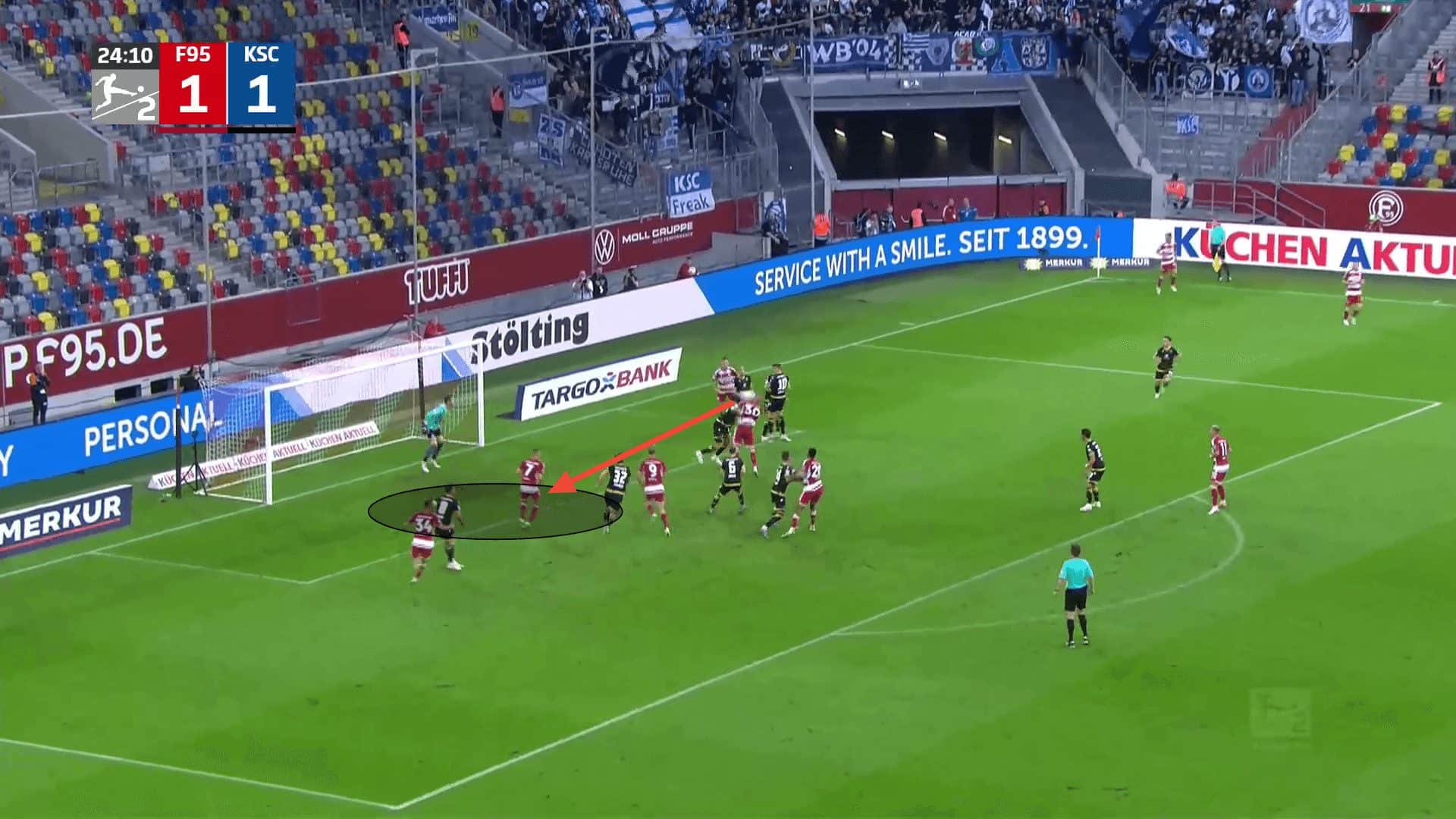
Another way in which Fortuna Düsseldorf’s players have become more aware is through being quicker to react to changes inside the box. As the screen is being attempted in the image below, the attacker who provides that screen is shifted out of the way by his marker.
His screen is made less effective due to his marker being aware and disabling the screen. However, due to the quick nature of the corners, the player understands that the slight screen is potentially enough to give the target attacker the separation he needs to attack the ball.
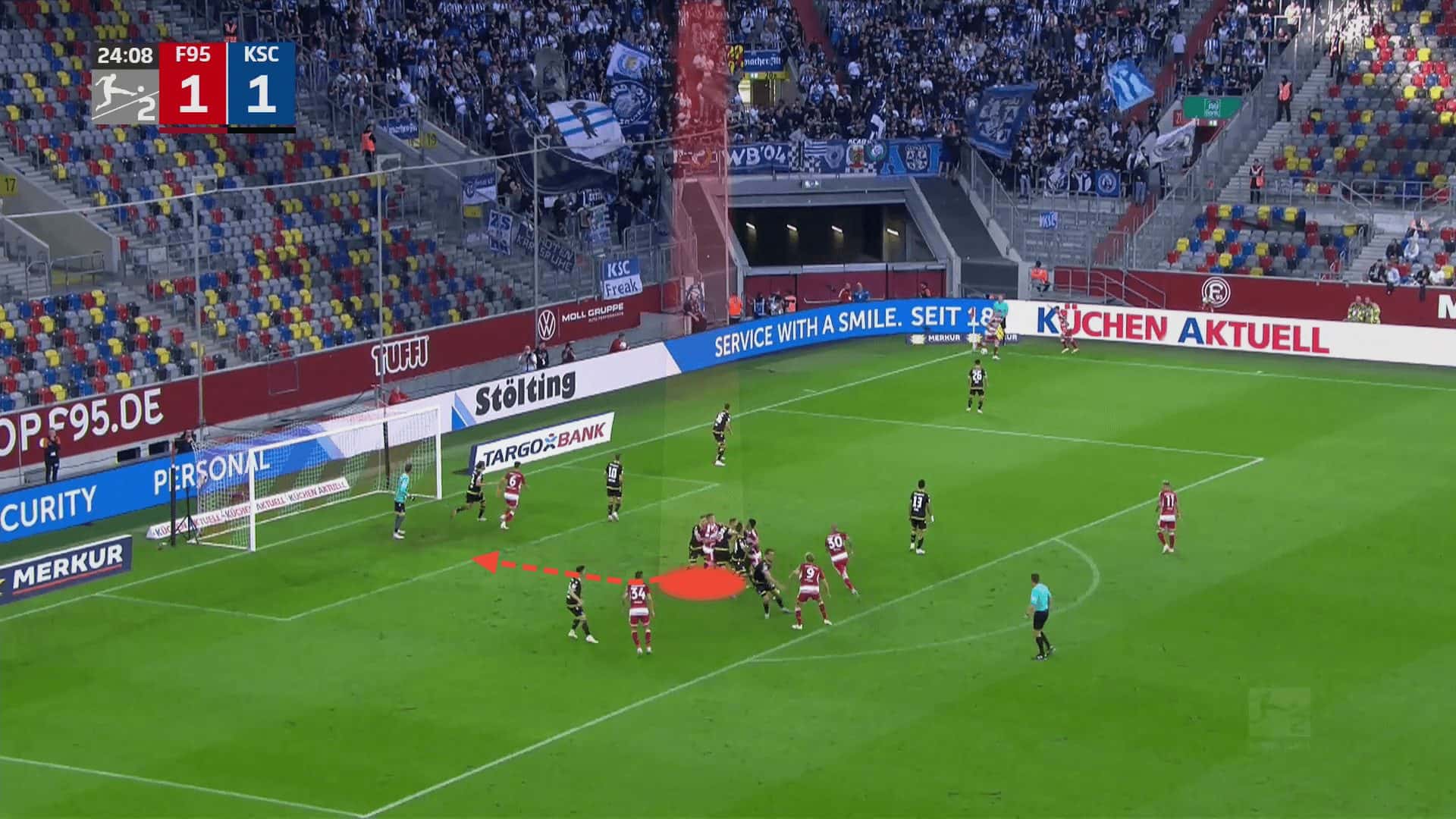
Therefore, rather than stopping, the player providing the screen, #7 Christos Tzolis, immediately turns to attack the six-yard box for the opportunity to react to second balls. Tzolis, through the repetitive nature of these corners, knows that the ball will arrive inside the six-yard box following the first contact, so rather than letting his marker get too tight following the initial contact, he quickly evades his marker to be an option for the second ball still.
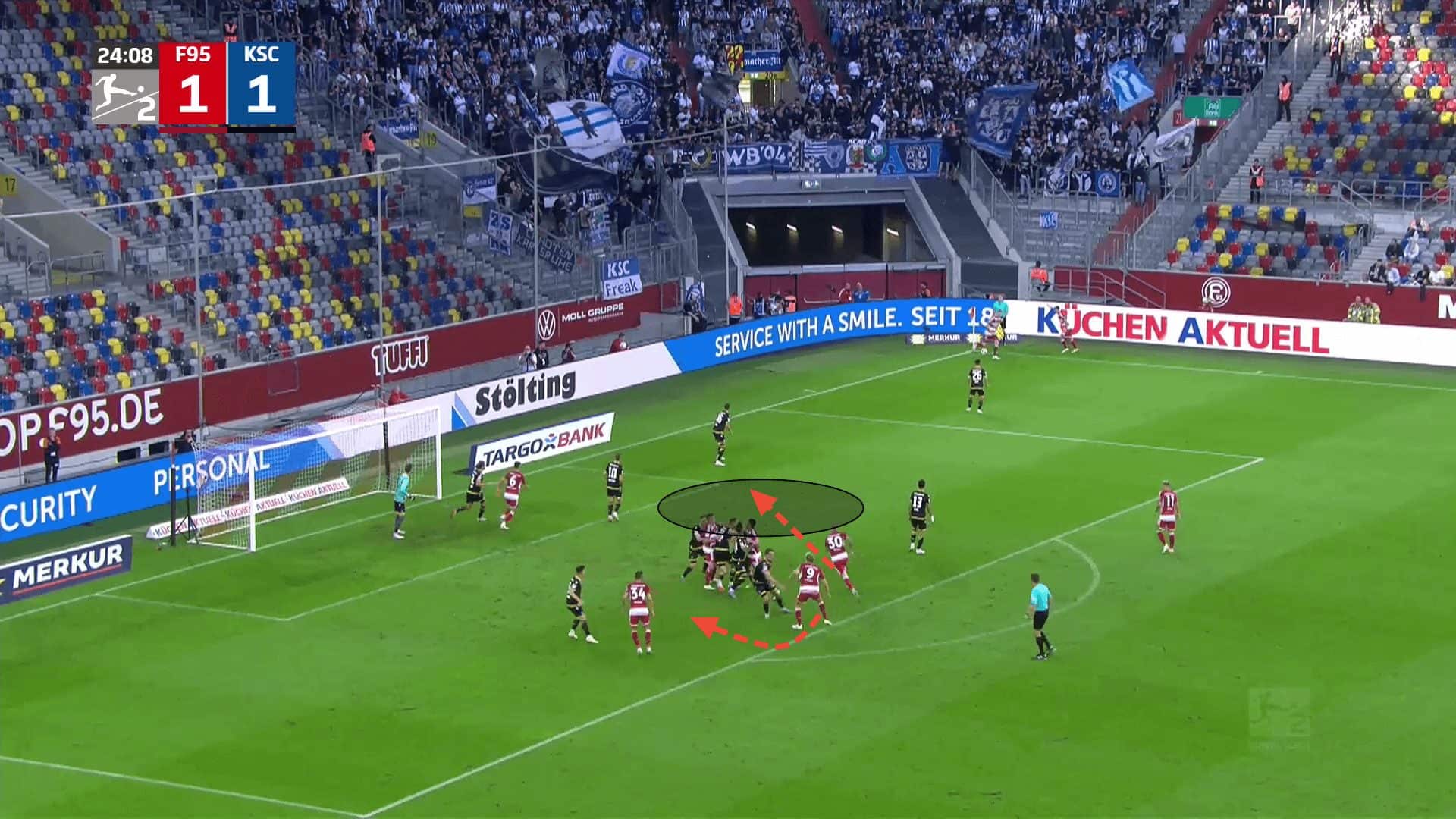
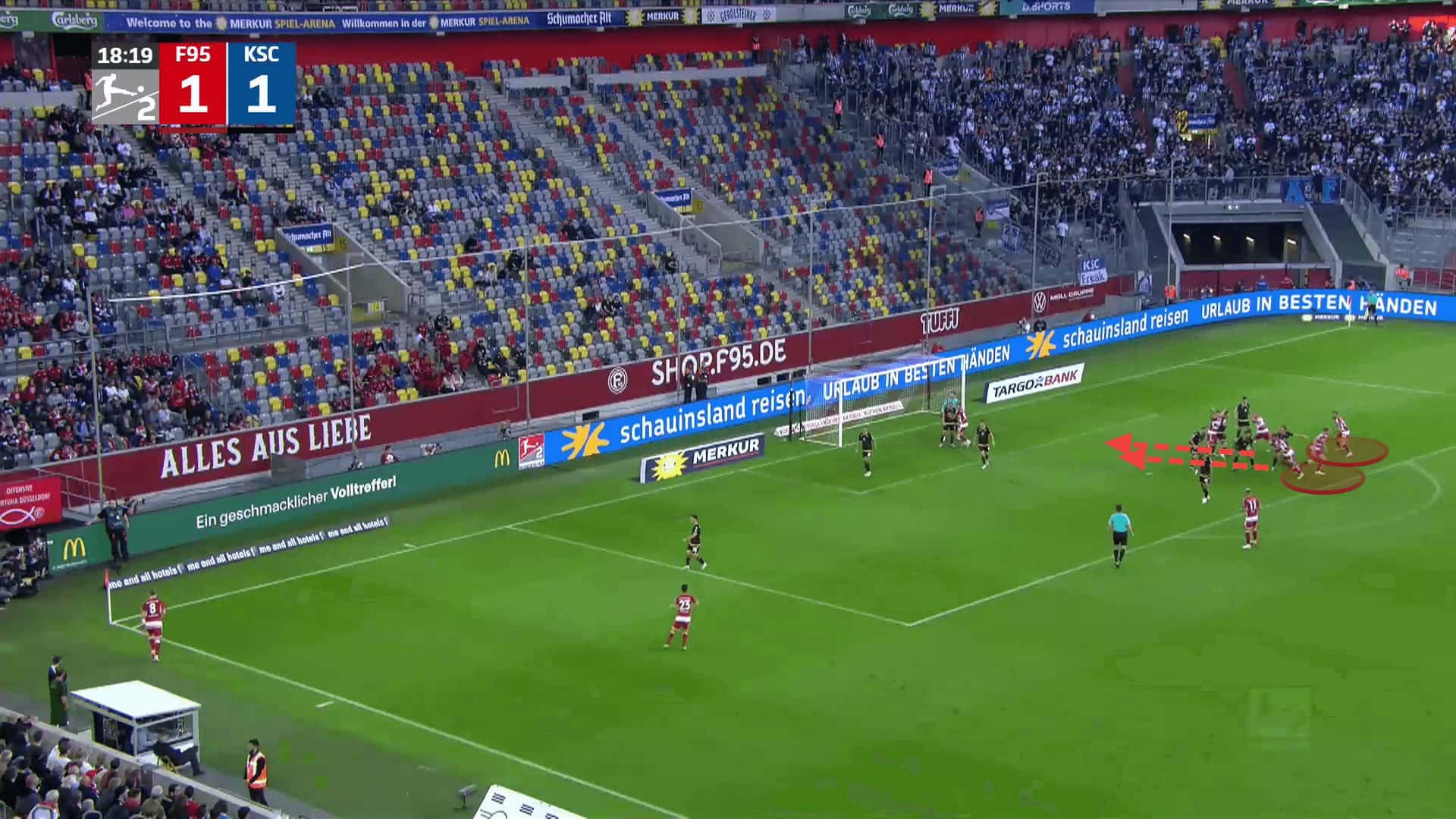
One slight variation that Düsseldorf have been using this season, to have more players with a chance of having the separation to attack the ball, has been through the staggered timings of when they’ve made the runs towards the six-yard box. As seen below, the two attackers closer to the goal make their runs towards the six-yard box, whilst the two deeper players initially move away from the goal.
Using opposite movements helps to increase the distance between each defender, stretching the defensive unit apart. As the defensive unit becomes less compact, each attacker has more space to evade their marker and gain the separation to attack the ball.
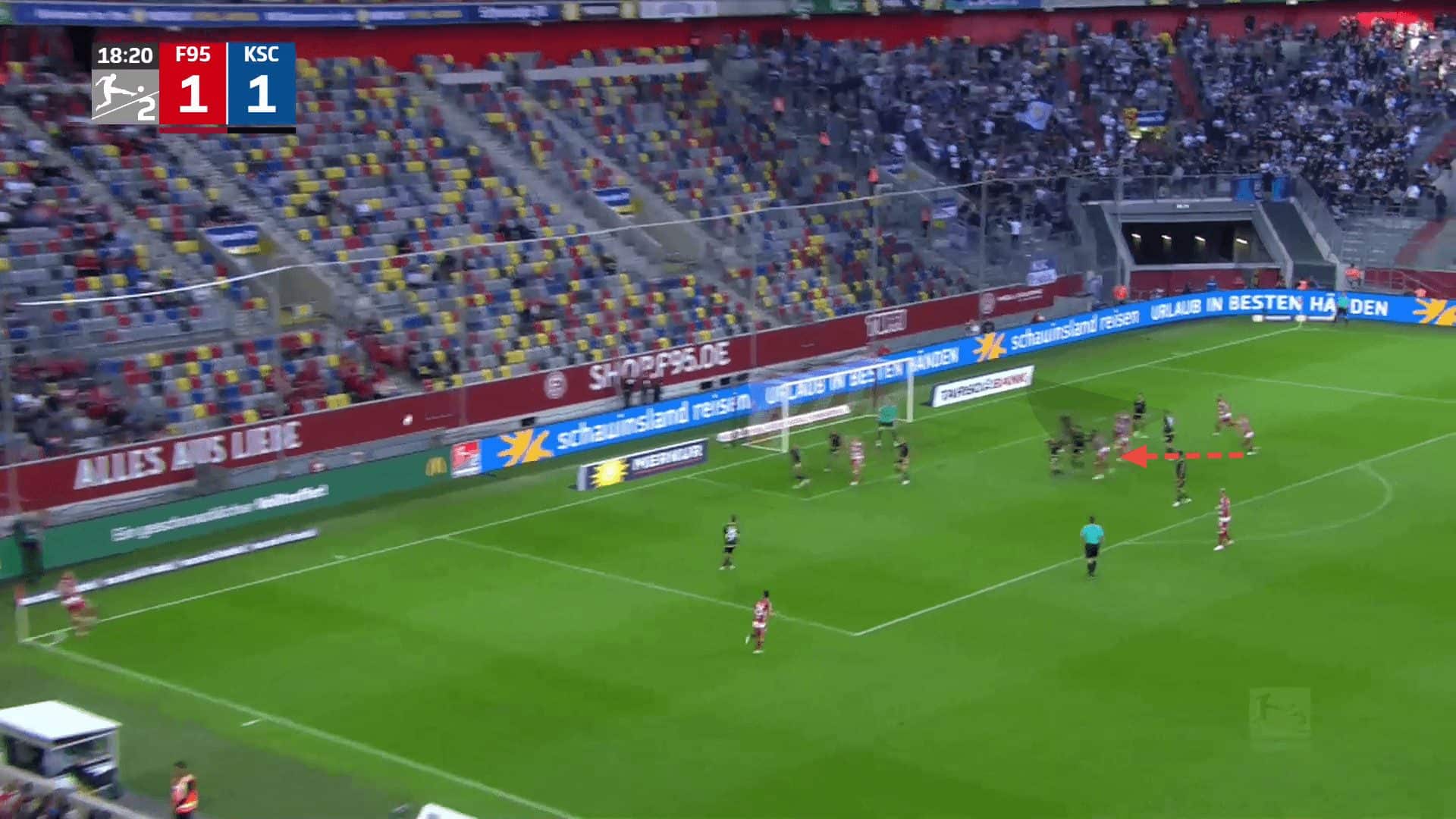
Furthermore, with the staggered timings of runs into the six-yard box, opposition defenders become more confused in regard to who to mark. The deeper attackers who move away from the goal do not intend to attack the ball, meaning defenders assume they don’t have to stay as tight.
However, as soon as their backs are turned, the attackers from deep can attack the ball, with their markers unaware of the pending danger. Rather than only one attacker having the space to shoot the ball freely, two or three players now have the time and space to attack the ball with intent, increasing the likelihood of making the first contact with the original cross.
What could be improved?
While Düsseldorf have been largely successful and threatening from corners in the opening weeks, there are some slight issues, which means they can be defended against and neutralised relatively simply.
Firstly, with the outswinging corners and deep positioning of the attackers, there is no threat immediately inside the six-yard box. As a result, the goalkeepers can step out far off their line and attempt to claim any crosses. The example below shows that the goalkeeper can step out halfway across the six-yard box while the ball has only just been delivered.
The defending side can manipulate the positions of their zonal markers in a way so that the ball has to be crossed toward the middle/back side of the six-yard box, which gives the goalkeeper plenty of time to react to and judge the flight of the ball, whilst the goalkeeper always has the advantage during an aerial duel.
Düsseldorf could counter this by adding an extra body into the penalty area or reassigning one of the current attacker’s roles, where one player’s role would be to mark the goalkeeper in order to prevent him from being able to step off of their line.
With Düsseldorf’s routine being so predictable, opposing teams can easily prepare for them to counter their preferred method.
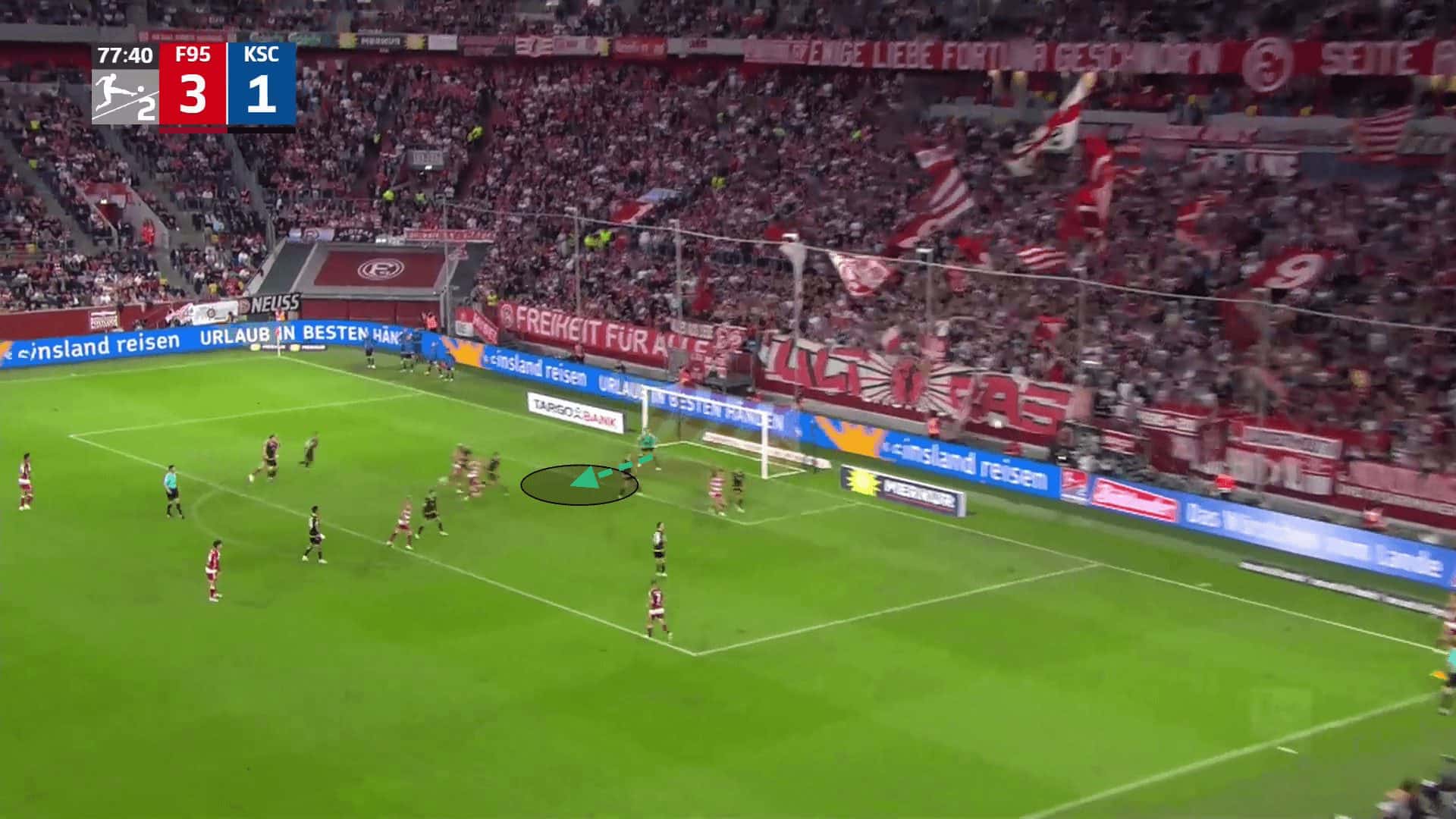
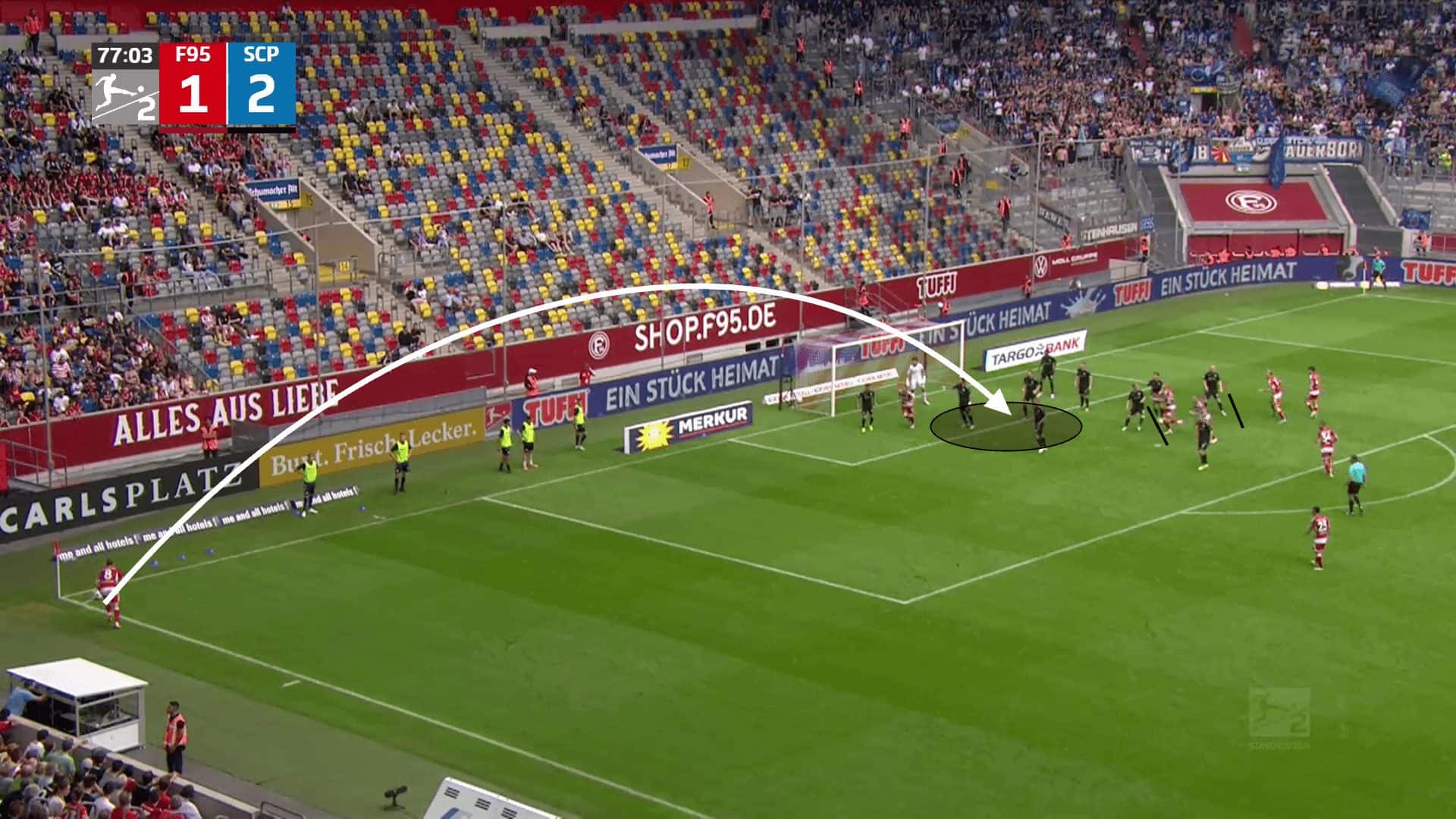
As seen in the example below, SC Paderborn knows what to expect and can easily defend against that routine. Paderborn reduces the space between the man markers and zonal defenders by giving each attacker space in their deeper position.
The target area is at the six-yard line, where zonal markers are waiting. Still, in order to prevent attackers from having the momentum advantage in the aerial duel, the man markers position themselves just in front of the target area to disrupt every attacker from being able to reach the six-yard box with a running start.
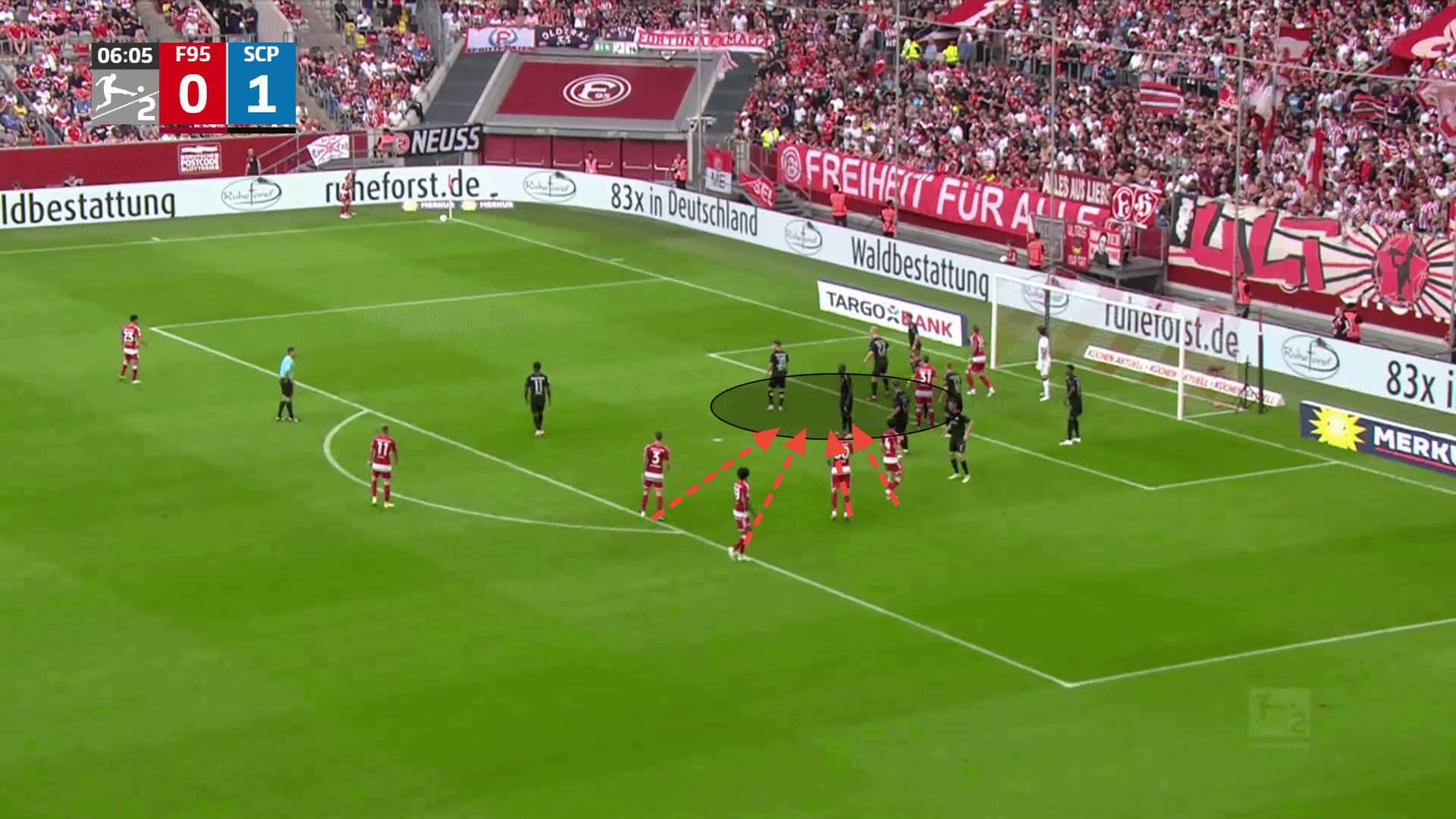
By the time any attacker potentially reaches the target area, they would have already had to run through the heavy traffic inside the penalty area, where the zonal defender and Düsseldorf attacker would both have a static starting position before engaging in the aerial duel, where the attacker doesn’t have any advantages.
Summary
This tactical analysis has detailed how Fortuna Düsseldorf have been able to emerge as one of the deadliest sides in the 2. Bundesliga from set plays.
However, after repetitively utilising one routine, they have become slightly predictable and easy to prepare against. Moving forward, Fortuna Düsseldorf need to add more variety to their set pieces, whether that comes through slightly varying the targets (both players and areas), changing the locations and number of screens for each corner, or using short corner routines. Fortuna Düsseldorf have only struggled from set plays against sides, which pack their penalty area with all 11 players.
It is understandably harder to find space in a more packed area, so Fortuna Düsseldorf could counter this through short corner routines where players will be definitely open, where they can entice pressure on those players outside the box, drawing defenders away from the penalty area and finding space inside of it.
