
Total Football Analysis
Once.Sport
  • Football Analysis
    • Data Analysis
    • Formations
      • 2-2-4 Formation
      • 2-3-5 Formation
      • 3-1-4-2 Formation
      • 3-2-2-3 Formation
      • 3-2-4-1 Formation
      • 3-1-6 Formation
      • 3-3-4 Formation
      • 3-4-1-2 Formation
      • 3-4-2-1 Formation
      • 3-4-3 Formation
      • 3-5-1-1 Formation
      • 3-5-2 Formation
      • 4-1-4-1 Formation
      • 4-2-2-2 Formation
      • 4-2-3-1 Formation
      • 4-2-4 Formation
      • 4-3-1-2 Formation
      • 4-3-3 Formation
      • 4-4-2 Formation
      • 4-5-1 Formation
      • 5-3-2 Formation
      • 5-4-1 Formation
      • 6-3-1 Formation
    • Head Coach Analysis
    • Match Analysis
    • Player Analysis
    • Recruitment Analysis
    • Set Piece Analysis
    • Tactical Theory
    • Tactical Preview
    • Team Analysis
    • Training Analysis
    • Tactical Analysis
    • Scouting Report
  • Competition
    • ALL Competitions
    • English Premier League
    • Champions League
    • La Liga
    • Bundesliga
    • Serie A
    • Ligue 1
    • Eredivisie
    • EFL Championship
    • FIFA World Cup 2022
    • WEURO 2022
    • Women’s Super League
    • NWSL
    • Belgian First Division A
    • A-League
    • Liga Profesional de Argentina
    • Austrian Bundesliga
    • Campeonato Brasileiro Série A
    • DFB Pokal
    • 1. HNL
    • Danish Superliga
    • EFL League One
    • EFL League Two
    • FA Cup
    • EFL Cup
    • Indian Super League
    • K-League
    • J1 League
    • Liga MX
    • Copa América 2021
    • Copa del Rey
    • MLS
    • Eliteserien
    • Euro 2020
    • Primeira Liga
    • Scottish Premiership
    • Allsvenskan
    • Europa League
    • UEFA Nations League
    • Liga AUF Uruguaya
  • Coaches
    • All Coaches
    • Alfred Schreuder
    • Ange Postecoglou
    • Antonio Conte
    • Arne Slot
    • Bo Svensson
    • Brendan Rodgers
    • Bruno Lage
    • Carlo Ancelotti
    • Christophe Galtier
    • Claude Puel
    • Claudio Ranieri
    • David Moyes
    • Dean Smith
    • Diego Simeone
    • Domenico Tedesco
    • Frank Lampard
    • Eddie Howe
    • Edin Terzić
    • Emma Hayes
    • Erik ten Hag
    • Ernesto Valverde
    • Gennaro Gattuso
    • Gerardo Seoane
    • Gian Piero Gasperini
    • Giovanni van Bronckhorst
    • Graham Potter
    • Igor Tudor
    • Imanol Alguacil
    • Jesse Marsch
    • Jonas Eidevall
    • Jorge Sampaoli
    • José Bordalás
    • José Mourinho
    • Julen Lopetegui
    • Julian Nagelsmann
    • Julien Stéphan
    • Jürgen Klopp
    • Luciano Spalletti
    • Lucien Favre
    • Manuel Pellegrini
    • Marcelo Bielsa
    • Marco Rose
    • Marco Silva
    • Massimiliano Allegri
    • Mauricio Pochettino
    • Maurizio Sarri
    • Mikel Arteta
    • Niko Kovač
    • Nuno Espírito Santo
    • Oliver Glasner
    • Patrick Vieira
    • Paulo Fonseca
    • Pep Guardiola
    • Peter Bosz
    • Rafa Benítez
    • Ralf Rangnick
    • Ralph Hasenhüttl
    • Roger Schmidt
    • Roy Hodgson
    • Sean Dyche
    • Sérgio Conceição
    • Simone Inzaghi
    • Sonia Bompastor
    • Stefano Pioli
    • Steffen Baumgart
    • Steven Gerrard
    • Thiago Motta
    • Thomas Frank
    • Thomas Tuchel
    • Unai Emery
    • Vincenzo Italiano
    • Xavi
  • Teams
    • ALL Teams
    • AC Milan
    • Ajax Amsterdam
    • Arsenal
    • AS Monaco FC
    • Atalanta
    • Atlético Madrid
    • FC Barcelona
    • FC Bayern Munich
    • Borussia Dortmund
    • Celtic FC
    • Chelsea FC
    • Everton F.C.
    • Inter Milan
    • Juventus F.C.
    • Leeds United F.C.
    • Liverpool FC
    • Manchester City
    • Manchester United FC
    • Paris Saint-Germain
    • Rangers FC
    • RB Leipzig
    • Real Madrid CF
    • Tottenham Hotspur
    • West Ham United
  • Players
    • ALL Players
    • Alisson Becker
    • Bukayo Saka
    • Erling Haaland
    • Harry Kane
    • Jack Grealish
    • John Stones
    • Julián Alvarez
    • Kalvin Phillips
    • Kevin De Bruyne
    • Kyle Walker
    • Kylian Mbappé
    • Lamine Yamal
    • Lionel Messi
    • Luis Díaz
    • Mohamed Salah
    • Phil Foden
    • Virgil Van Dijk
  • Contact
  • Write For TFA
No Result
View All Result
No Result
View All Result
Total Football Analysis
No Result
View All Result
Home Match Analysis

Flamengo Vs Racing Club [1–0] – Copa Libertadores 2025: Full-Backs Shine As Filipe Luís Tactics Edge Tight Semi-Final First Leg – Tactical Analysis

Juan Lauz by Juan Lauz
October 25, 2025
in Match Analysis, 1-4-3-2-1 Formation, 4-4-2 Formation, 5-3-2 Formation, Analysis, Clube de Regatas do Flamengo, Copa Libertadores, Filipe Luís, Giorgian de Arrascaeta, Gustavo Costas, Jorge Carrascal, Racing Club, Tactical Analysis
0
CR Flamengo Vs Racing Club 2025

A Copa night, in every sense of the word, opened the semi-finals of the Copa Libertadores.

The Maracanã witnessed the first leg of the semifinal between Filipe Luís’s Flamengo and Gustavo Costas’s Racing Club, two teams with very different paradigms and playing approaches, further contrasted by the context and the stage itself.

Although the final score (1–0) might suggest a tight contest, the match was intense, attractive, and rich in tactics.

The home side, led by an inspired Jorge Carrascal, sought to impose their dominance through possession and initiative.

At the same time, Racing opted for a compact, disciplined mid-to-low block that, at times, frustrated the Brazilians’ offensive attempts.

With Pedro isolated as the central reference, it was the attacking midfielders and full-backs who made the difference for Flamengo in attack.

In contrast, the Argentine side, still unable to find a midfielder capable of adding fluency to their circulation (a role once filled by Juan Fernando Quintero), relied on collective resistance and tactical order.

Costas has built a hard-working, selfless team that came close to taking a more favourable result back to Avellaneda.

In this tactical analysis, we’ll analyse in detail some of the key aspects that defined the match: Flamengo’s constant search through their full-backs, and Racing’s solid mid-block that conditioned much of the game’s flow.

Racing’s Chameleonic Plan

It would not be easy for the Argentines to withstand the creative surge of the Brazilians.

To compensate, Gustavo Costas designed a chameleonic team, capable of defending with either five or four players in the backline, depending on the situation.

It’s not the first time Santiago Sosa, a classic holding midfielder, drops between the centre-backs to act as the last man, follow fixations, or cover depth.

Adding to that versatility was the relentless effort of the wide midfielders.

Both Tomás Conechny and Santiago Solari worked tirelessly to counter Flamengo’s width and depth, which were provided by their full-backs, a key element of their attacking scheme.

Thus, Racing alternated between 4-4-2 and 5-3-2 in their mid-block, adjusting depending on whether an inside midfielder or a wide player dropped back.

The plan was clear: prevent inside turns, maintain density in central areas, and push forward collectively with numerical equality, or even superiority, against Flamengo’s first attacking line.

The coordinated pressing jumps mirrored the team’s lateral shifts, while cover movements ensured stability against runs in behind.

Everything revolved around a single principle: to conquer the interior zones and deny the spaces where Flamengo’s talent usually flows.

Racing Timing & Jumps

Despite the defeat, Racing can feel satisfied with both their plan and execution.

Flamengo struggled immensely to break through the two defensive walls set up by the Argentines during static attacks.

Beyond the result, the consistency of effort, tactical discipline, and collective involvement were remarkable.

The level of individual vigilance, coordination, and pressing timing was elite, preventing players like Giorgian De Arrascaeta or Jorge Carrascal from finding comfort between the lines or in the half-spaces.

Even when the match demanded extra physical effort on top of tactical intelligence, Racing responded immediately.

Man-oriented pursuits were constant: wingers tracking opposing full-backs, and their own full-backs marking inwards on the rival wingers.

Flamengo’s positional rotations could have caused an imbalance in delicate areas, the so-called “undefendable spaces” (half-spaces).

However, Racing’s defensive involvement in long pursuits and cross-coverings neutralized much of that threat.

The final score may leave a bitter taste, but Racing’s tactical execution reflected meticulous preparation and a collective commitment worthy of a continental semifinal.

Flamengo Attracting From The Outside

Racing’s entire defensive design was aimed at protecting the inner corridors.

The main priority was to deny space to De Arrascaeta and Jorginho, preventing them from receiving between the lines or floating through the block.

That part of the plan worked: the mid-block was solid, compact, and difficult to break.

However, the other side of the balance, the full-backs, fell short.

Racing controlled the centre well, but structurally, and by priority, neither Conechny nor Solari tracked Guillermo Varela (right) or Alex Sandro (left) deep into their own half.

Superioridad con lateral ancho Flamengo

The Brazilian full-backs, comfortable in high and wide positions, frequently carried the ball forward, gaining meters and freeing the inner lanes that Racing tried to protect.

https://totalfootballanalysis.com/wp-content/uploads/2025/10/Profundidad-de-lateral-Flamengo.mp4

When Racing’s midfielders were forced to jump outward to close those lanes, a domino effect was triggered: interior disorganisation, larger gaps between lines, and greater freedom for Flamengo’s creative players.

Through these dynamics, Filipe Luís’s team managed to manipulate the block from the outside, forming dynamic, fluid attacking structures that triangulated and climbed back in.
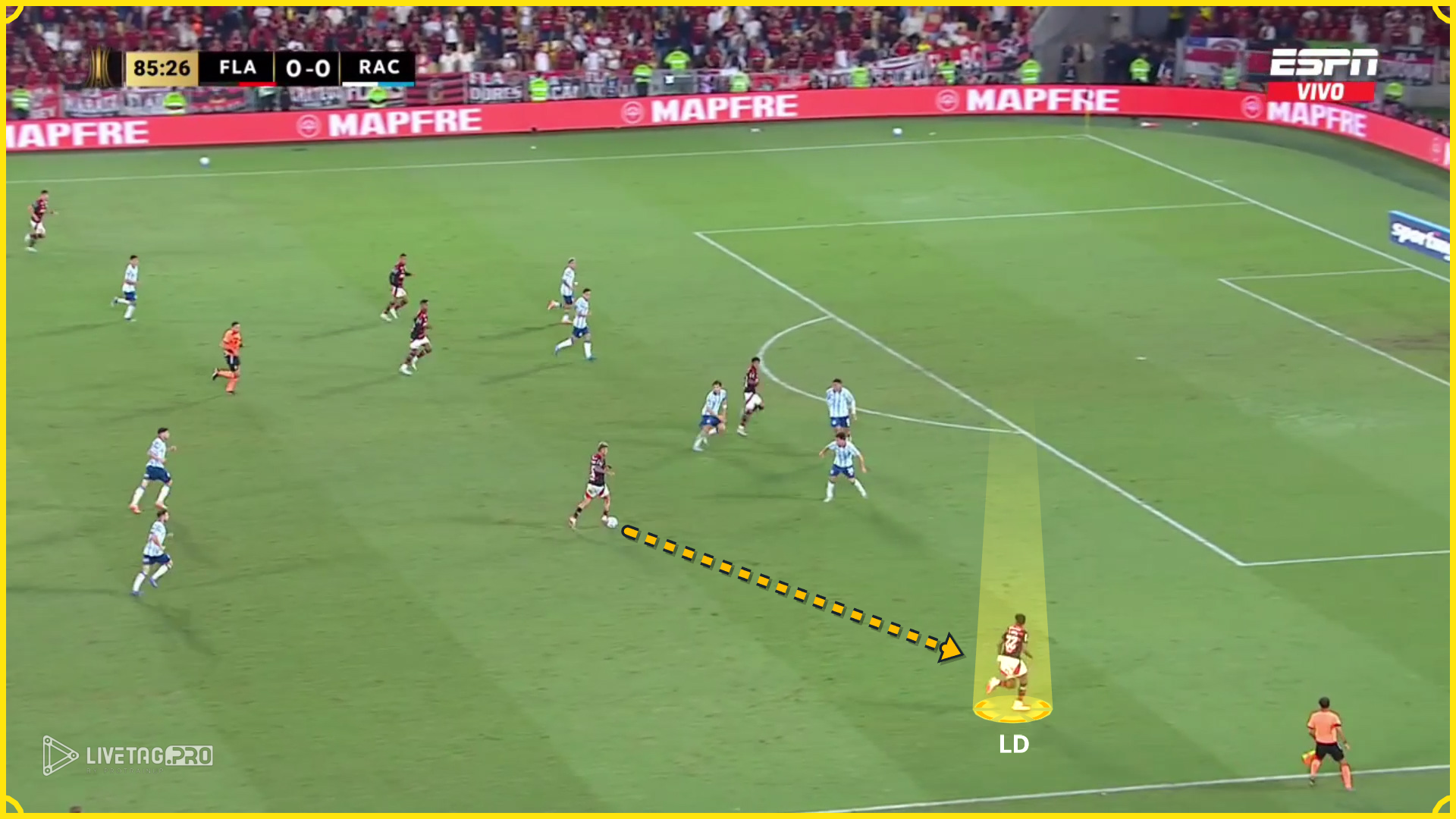
Superioridad con lateral ancho II Flamengo

At several moments, the link between De Arrascaeta and Carrascal, built through those “stairs to the sky”, allowed Flamengo to turn width into depth and finish attacks facing goal.

Flamengo Manipulating The Rival Block

Filipe Luís’s work as Flamengo’s coach has been outstanding so far.

His understanding of positional play, enriched by functional nuances that empower his most talented players, has shaped a team with a clear and expansive identity.

Against Racing, Flamengo delivered yet another masterclass in manipulating the opponent’s pressing phases: short but intense ones.

Filipe Luís designed a precise plan: to guide Racing’s pressure toward the wing, where the Argentine block condensed, and then to find the free man outside that dense area, exploiting numerical superiority in the half-spaces.

https://totalfootballanalysis.com/wp-content/uploads/2025/10/Construccion-4-2-_-Flamengo.mp4

Once again, the full-backs proved decisive.

Facing the rival wingers’ pressing jumps, they managed to receive behind the press, executing diagonal runs that broke lines and advanced the team.

Through these synchronised collective mechanisms, Flamengo created small but systematic advantages, consolidating their growth as a unit and reaffirming their coach’s tactical imprint: intelligent football, flexible, and with total spatial control.

Conclusion

The clash at the Maracanã left a clear impression: Flamengo and Racing embodied two distinct ways of competing at the top level of South American football.

The Brazilian side, faithful to Filipe Luís’s vision, displayed a mature command of positional play, combining patient circulation, manipulation of pressure, and an acute reading of space.

Their full-backs, constantly projected and aware of diagonal runs behind the wingers, were vital in stretching the rival block and activating free men in width.

Flamengo gave rhythm and continuity to every offensive phase through them, maintaining a sustained presence in the opponent’s half.

Meanwhile, Racing showed a competitive, disciplined side, with a defensive plan built on closing inner corridors and denying between-the-lines passes to players like De Arrascaeta or Carrascal.

Costas’s mid-block worked for long stretches, but the lack of response to Flamengo’s width and full-back progressions eventually opened cracks in what had been a solid structure.

In sum, the 1–0 leaves the tie wide open, but it also reveals a clear tactical contrast: Flamengo’s pursuit of control and spatial superiority versus Racing’s structured and sacrificial resistance.

Tags: Copa LibertadoresCopa Libertadores TacticsFilipe Luís FlamengoFlamengo AnalysisFlamengo Copa LibertadoresFlamengo TacticsFlamengo Vs Racing ClubFootball AnalysisFootball TacticsGustavo CostasGustavo Costas Racing ClubGustavo Costas Style Of PlayGustavo Costas TacticsRacing ClubRacing Club AnalysisRacing Club TacticsTactical Analysis
Previous Post

Real Madrid Vs Juventus [1–0] Champions League 2025/2026: Igor Tudor Defensive Resilience & Xabi Alonso Attacking Inefficiency – Tactical Analysis

Next Post

Julián Alvarez Scout Report At Atlético Madrid 2025/2026: From Haaland Backup At Man City To Diego Simeone Star – Player Analysis

Next Post
Julian Alvarez At Atlético Madrid 20252026

Julián Alvarez Scout Report At Atlético Madrid 2025/2026: From Haaland Backup At Man City To Diego Simeone Star – Player Analysis

  • About Total Football Analysis
  • Contact Total Football Analysis
  • Write For Total Football Analysis
  • Advertise
  • Privacy Policy
  • Cancellation / Refund Policy
  • Resources
  • Terms Of Service

© 2026 Total Football Analysis

No Result
View All Result
  • Football Analysis
    • Data Analysis
    • Formations
      • 2-2-4 Formation
      • 2-3-5 Formation
      • 3-1-4-2 Formation
      • 3-2-2-3 Formation
      • 3-2-4-1 Formation
      • 3-1-6 Formation
      • 3-3-4 Formation
      • 3-4-1-2 Formation
      • 3-4-2-1 Formation
      • 3-4-3 Formation
      • 3-5-1-1 Formation
      • 3-5-2 Formation
      • 4-1-4-1 Formation
      • 4-2-2-2 Formation
      • 4-2-3-1 Formation
      • 4-2-4 Formation
      • 4-3-1-2 Formation
      • 4-3-3 Formation
      • 4-4-2 Formation
      • 4-5-1 Formation
      • 5-3-2 Formation
      • 5-4-1 Formation
      • 6-3-1 Formation
    • Head Coach Analysis
    • Match Analysis
    • Player Analysis
    • Recruitment Analysis
    • Set Piece Analysis
    • Tactical Theory
    • Tactical Preview
    • Team Analysis
    • Training Analysis
    • Tactical Analysis
    • Scouting Report
  • Competition
    • ALL Competitions
    • English Premier League
    • Champions League
    • La Liga
    • Bundesliga
    • Serie A
    • Ligue 1
    • Eredivisie
    • EFL Championship
    • FIFA World Cup 2022
    • WEURO 2022
    • Women’s Super League
    • NWSL
    • Belgian First Division A
    • A-League
    • Liga Profesional de Argentina
    • Austrian Bundesliga
    • Campeonato Brasileiro Série A
    • DFB Pokal
    • 1. HNL
    • Danish Superliga
    • EFL League One
    • EFL League Two
    • FA Cup
    • EFL Cup
    • Indian Super League
    • K-League
    • J1 League
    • Liga MX
    • Copa América 2021
    • Copa del Rey
    • MLS
    • Eliteserien
    • Euro 2020
    • Primeira Liga
    • Scottish Premiership
    • Allsvenskan
    • Europa League
    • UEFA Nations League
    • Liga AUF Uruguaya
  • Coaches
    • All Coaches
    • Alfred Schreuder
    • Ange Postecoglou
    • Antonio Conte
    • Arne Slot
    • Bo Svensson
    • Brendan Rodgers
    • Bruno Lage
    • Carlo Ancelotti
    • Christophe Galtier
    • Claude Puel
    • Claudio Ranieri
    • David Moyes
    • Dean Smith
    • Diego Simeone
    • Domenico Tedesco
    • Frank Lampard
    • Eddie Howe
    • Edin Terzić
    • Emma Hayes
    • Erik ten Hag
    • Ernesto Valverde
    • Gennaro Gattuso
    • Gerardo Seoane
    • Gian Piero Gasperini
    • Giovanni van Bronckhorst
    • Graham Potter
    • Igor Tudor
    • Imanol Alguacil
    • Jesse Marsch
    • Jonas Eidevall
    • Jorge Sampaoli
    • José Bordalás
    • José Mourinho
    • Julen Lopetegui
    • Julian Nagelsmann
    • Julien Stéphan
    • Jürgen Klopp
    • Luciano Spalletti
    • Lucien Favre
    • Manuel Pellegrini
    • Marcelo Bielsa
    • Marco Rose
    • Marco Silva
    • Massimiliano Allegri
    • Mauricio Pochettino
    • Maurizio Sarri
    • Mikel Arteta
    • Niko Kovač
    • Nuno Espírito Santo
    • Oliver Glasner
    • Patrick Vieira
    • Paulo Fonseca
    • Pep Guardiola
    • Peter Bosz
    • Rafa Benítez
    • Ralf Rangnick
    • Ralph Hasenhüttl
    • Roger Schmidt
    • Roy Hodgson
    • Sean Dyche
    • Sérgio Conceição
    • Simone Inzaghi
    • Sonia Bompastor
    • Stefano Pioli
    • Steffen Baumgart
    • Steven Gerrard
    • Thiago Motta
    • Thomas Frank
    • Thomas Tuchel
    • Unai Emery
    • Vincenzo Italiano
    • Xavi
  • Teams
    • ALL Teams
    • AC Milan
    • Ajax Amsterdam
    • Arsenal
    • AS Monaco FC
    • Atalanta
    • Atlético Madrid
    • FC Barcelona
    • FC Bayern Munich
    • Borussia Dortmund
    • Celtic FC
    • Chelsea FC
    • Everton F.C.
    • Inter Milan
    • Juventus F.C.
    • Leeds United F.C.
    • Liverpool FC
    • Manchester City
    • Manchester United FC
    • Paris Saint-Germain
    • Rangers FC
    • RB Leipzig
    • Real Madrid CF
    • Tottenham Hotspur
    • West Ham United
  • Players
    • ALL Players
    • Alisson Becker
    • Bukayo Saka
    • Erling Haaland
    • Harry Kane
    • Jack Grealish
    • John Stones
    • Julián Alvarez
    • Kalvin Phillips
    • Kevin De Bruyne
    • Kyle Walker
    • Kylian Mbappé
    • Lamine Yamal
    • Lionel Messi
    • Luis Díaz
    • Mohamed Salah
    • Phil Foden
    • Virgil Van Dijk
  • Contact
  • Write For TFA
  • Login

© 2026 Total Football Analysis