
Recently, Eduardo Camavinga has shown under Carlo Ancelotti his ability to play dynamically in multiple positions.
The promising young Frenchman, who arrived in Madrid in the summer, seems to be about to shine at Los Blancos.
Ancelotti has lately attempted to generate more fluidity and dynamism in his team through the energetic 20-year-old midfielder.
He is known for versatility, tempo control, and tactical awareness, which makes him an exciting player to watch.
The Italian coach has given a definitive answer after being quizzed on Camavinga’s future: “We will not let Camavinga leave, he’s untouchable like Modric and Kroos.”
This tactical analysis, in the form of a team scout report, delves into the nuances of Camavinga’s stats, and how he fits in Ancelotti’s tactics as a defensive midfielder or even a fullback with Real Madrid.
A fluidity Generator
Firstly, Camavinga has played extensively as an active number ‘6’ in a 4-3-3 or as part of a double-pivot in a 3-4-3 or a 4-2-3-1, or being straightly a number ‘8’, generating momentum in the midfield with his agility.
He forces transitions and advances the play more than being the usual version of a box-to-box player.
Recently, Ancelotti decided to increase his reliance on him, either in the middle or to as the left-back during Ferland Mendy’s absence.
Camavinga’s presence alongside Luka Modric and Toni Kroos strongly supports dynamic control through the system, which allows individuality to glow more than sticking to a strict style of play.
Thus, usually, they continuously move, creating spaces and attacking them dynamically instead of occupying these spaces pre-determinedly.
He usually operates the holding midfielder role in a dynamic way.
Unlike Casemiro, he can drop down the field to build up if the opposition decides to press high.
His flexibility and agility allow him to be a moment ahead of the opponent, and he can turn quickly in a fraction of a second.
Below, against Barcelona, while Luka Modric and Toni Kroos dynamically occupy the fullback zones, Camavinga recognises the generated space well and moves to it to receive the ball.

Then, using his pressing resistance and decisive close control, he turns and changes his body orientation, smoothly switching the ball to the weak side.

Up the pitch, Camavinga effectively functions under the same principles of floating and decentralising, using his passing ability and explosive dribbling in tight spaces.
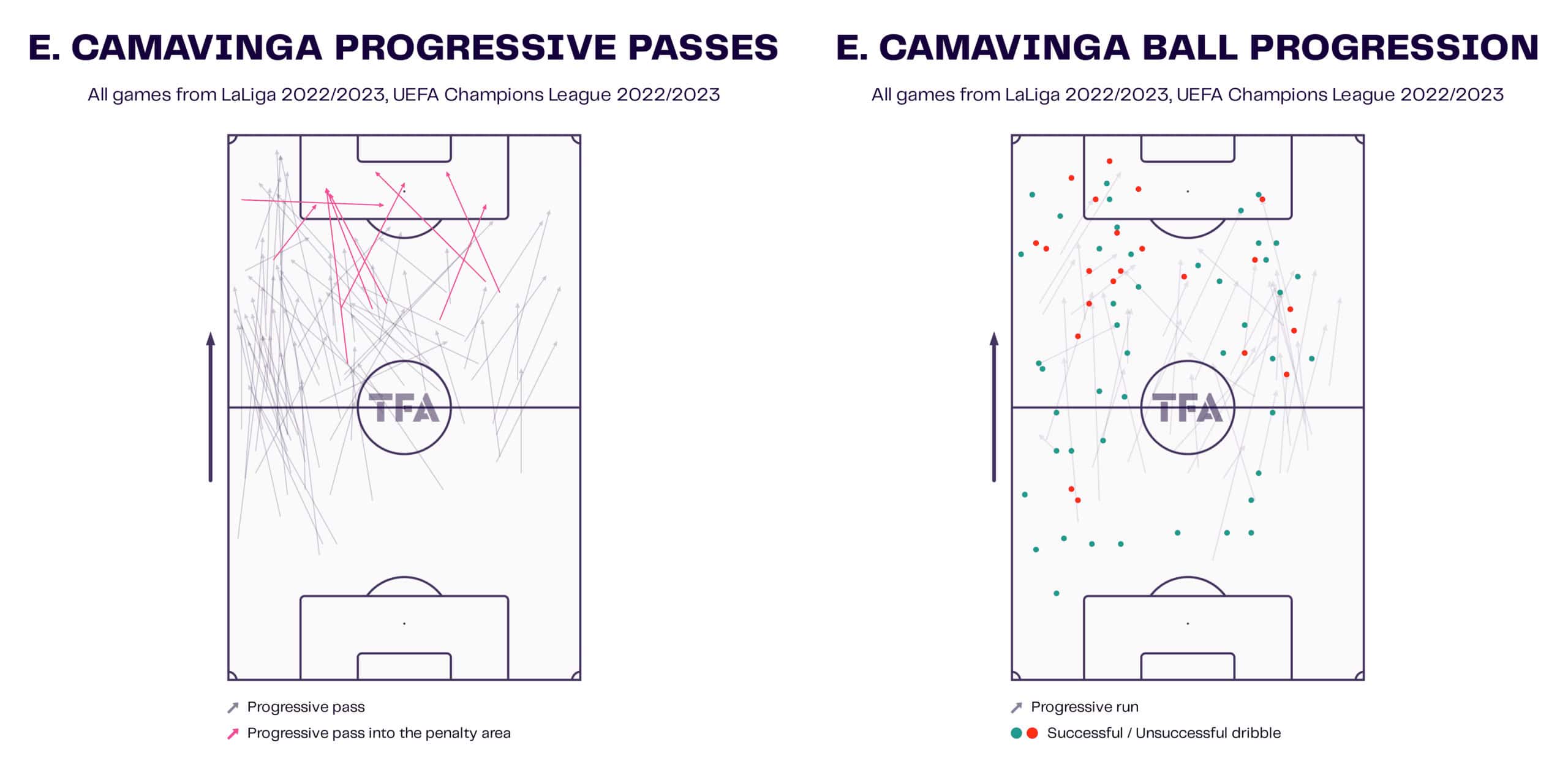
He is not the traditional version of a holding midfielder but more like a tireless workhorse and fearless ball carrier, hitting 6.68 progressive passes per 90 and 2.64 progressive carries per 90.
Real Madrid keep the intention of dynamicity, attempting to control the space.
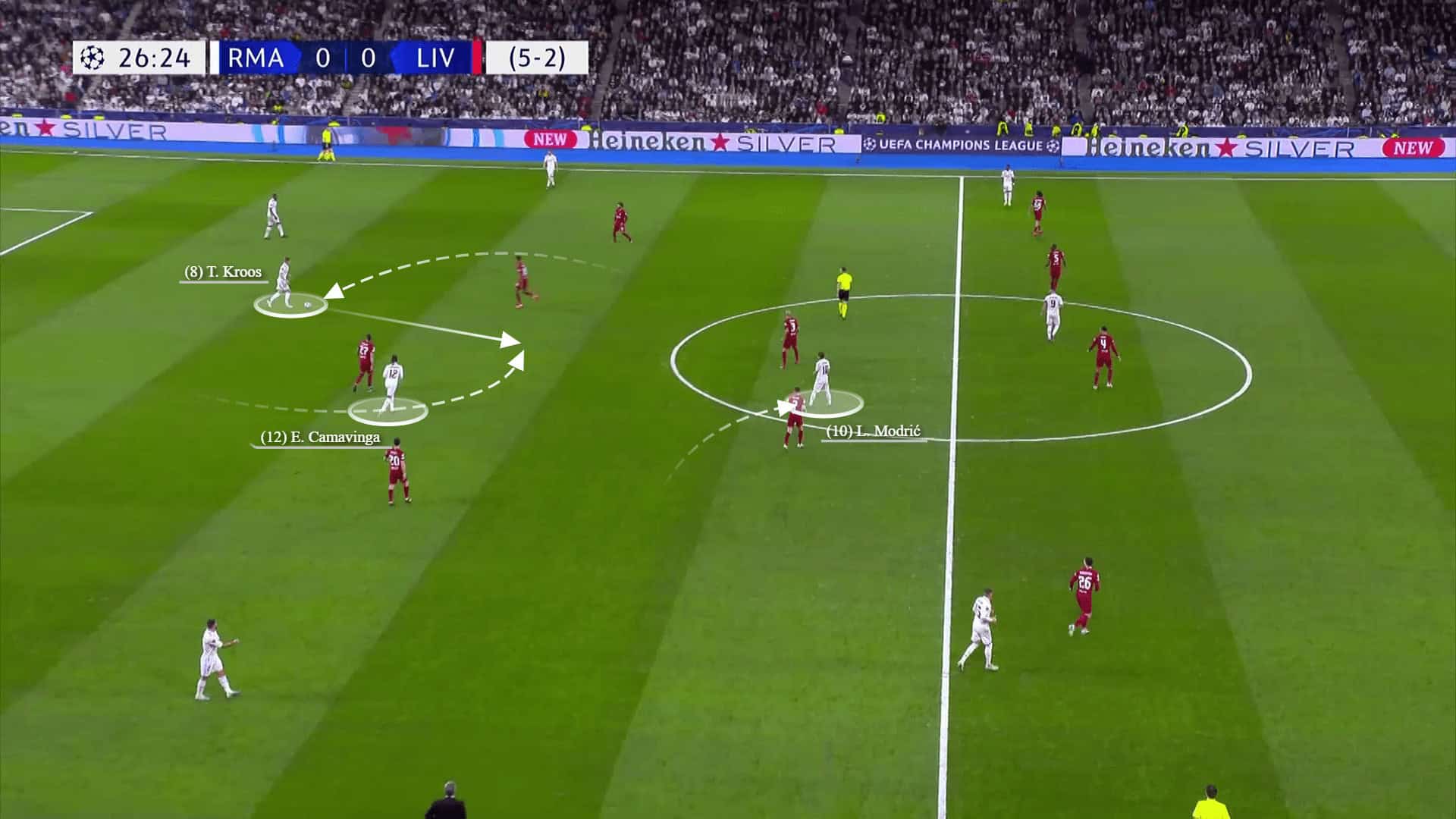
Below, during the game against Liverpool, Kroos left his position and dropped to build from a deeper area.
Meanwhile, Camavinga and Modric were moving.
He discovers the space behind the Reds’ first line of pressure and receives the ball there.
Their dynamics forced Liverpool to withdraw into a mid-block.
For the first goal during the same match, Camavinga demonstrated his proactivity and spatial awareness by playing a progressive breaker pass to Karim Benzema in the gap between Van Dijk and Konaté —it’s unusual that a holding midfielder plays a risky pass like this.

Furthermore, defensively, Camavinga is benefiting from his body moves and reading the play to intercept or tackle to counter the play.
The high-energy midfielder registers 3.09 tackles per 90.
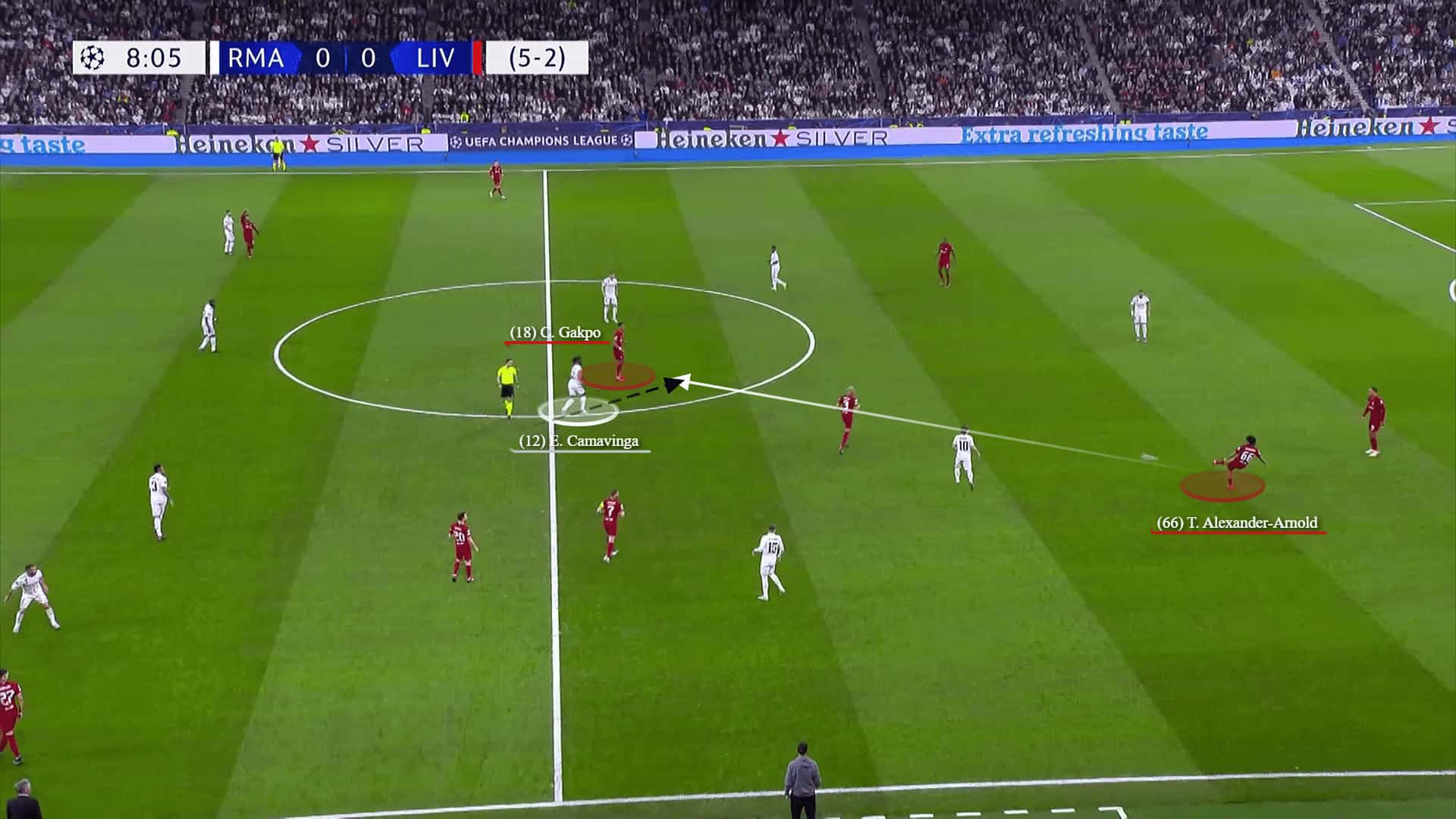
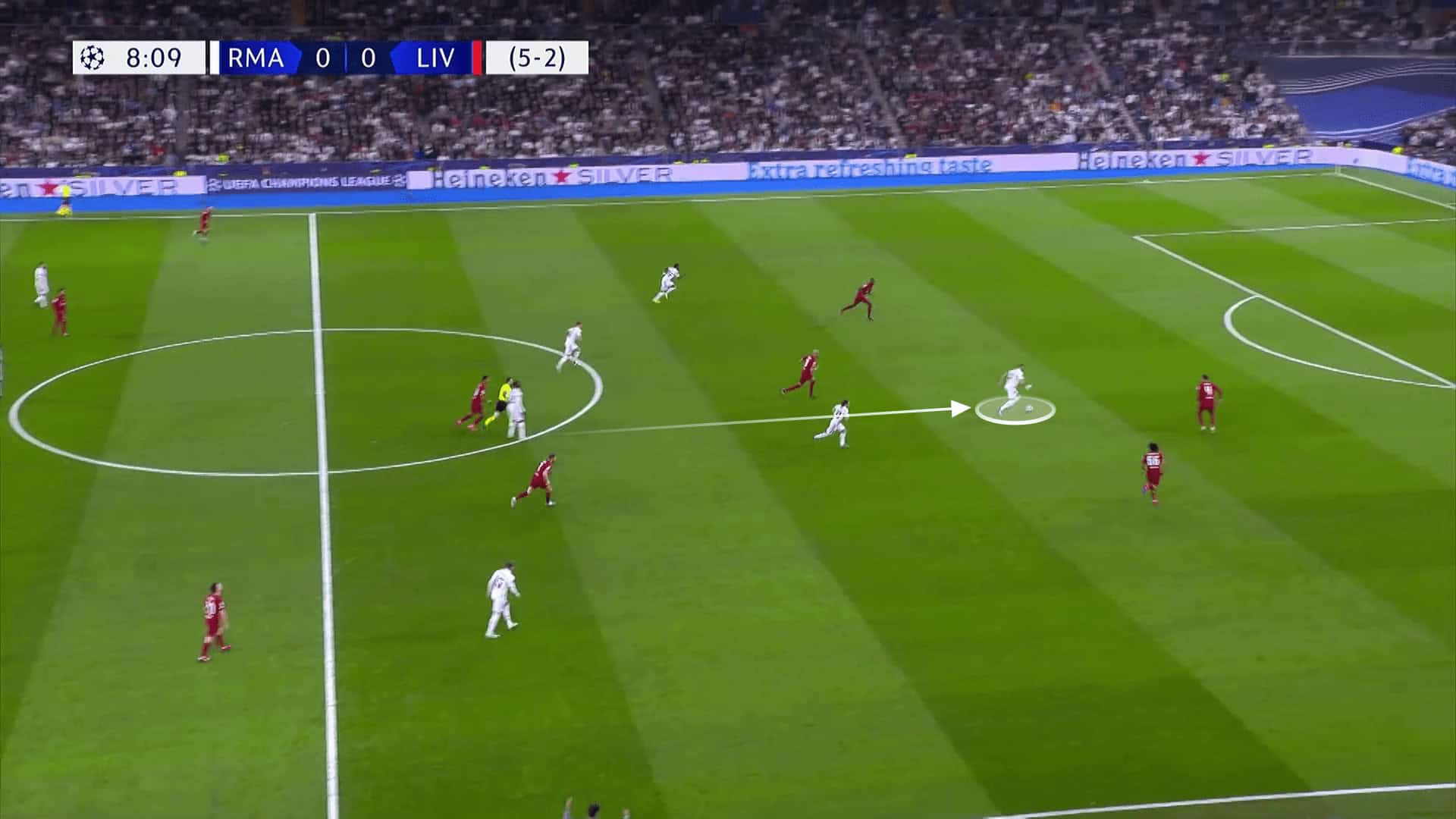
In the image below, he reads Trent Alexander-Arnold’s potential pass to Gakpo, succeeds in regaining the ball, and then puts the team into a dangerous counterattack.
Yet, his tendency to make risky and difficult passes maximises ball-loss chances, which often result in a loss of possession and possibly turnovers.
Furthermore, Camavinga has been caught out of position at times, which has allowed the opposition to exploit gaps in the midfield—both are considered to be his main issues as a number 6.
Perhaps soon, after the era of Modric (37), Kroos (33), and Ancelotti leaves, a modern coach will arrive and implement a positional approach in which Camavinga alongside Aurélien Tchouaméni in a double-pivot would be a good idea suitable for his technicality.
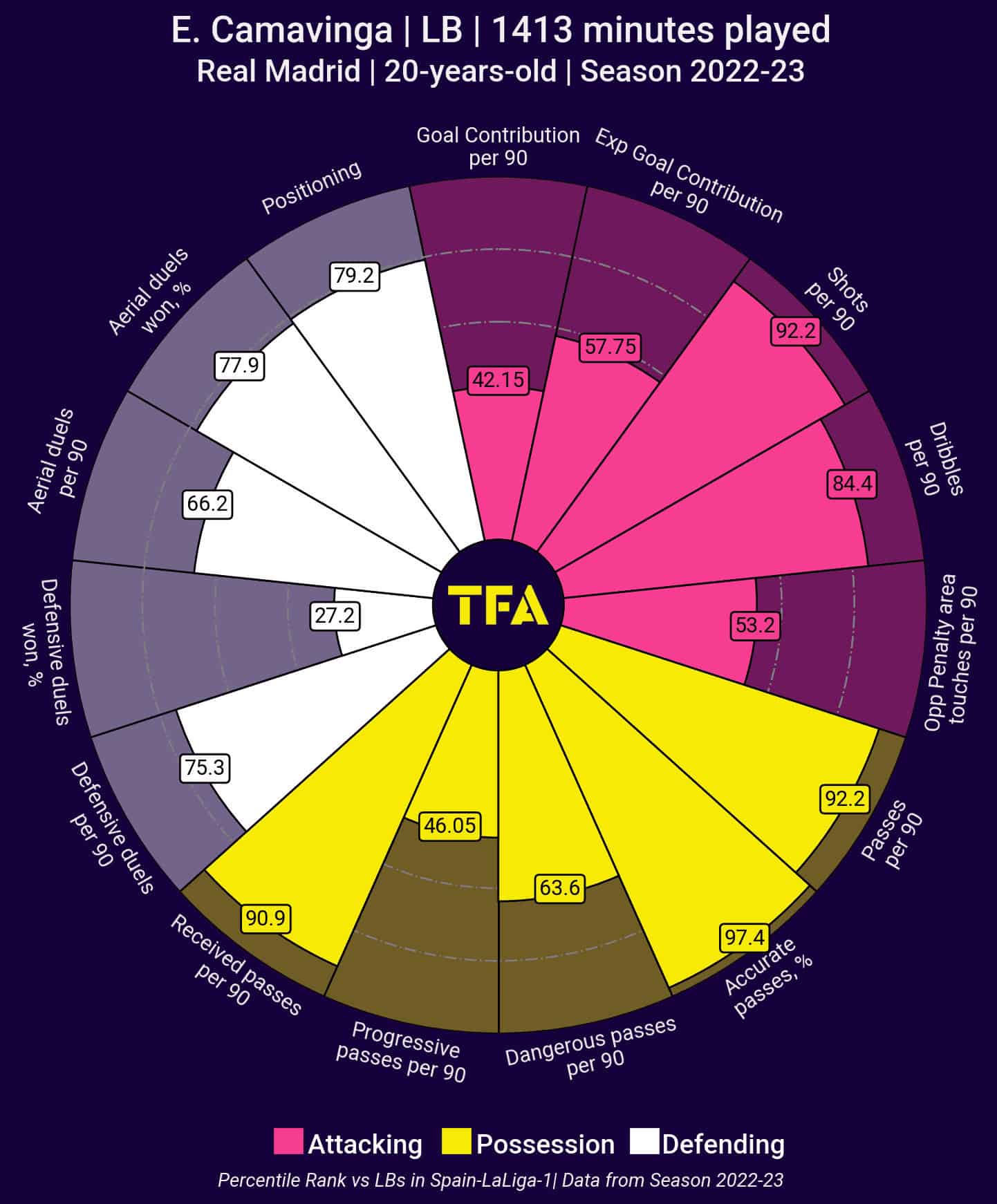
Before engaging his latest role as a left-back, let’s look more at his technicality with data.
Unstoppable soloist
FBref has recorded 1.58 successful take-ons per 90 over the last 365 days with a 95% percentage.
Meanwhile, the average is 0.78 which means Camavinga is an excellent tight-space dribbler and barely loses 1v1 situations because of his quick first touch to change the direction of his body or the ball, keeping the ball close to his feet under pressure.
With decent first touches and quick turns in tight spaces, he is also amazing at reading the pitch and directing the play, completing 90.1% pass completion per game.
Meanwhile, Napoli’s bright Stanislav Lobotka hits the highest by 93.6%, and the average among the midfielders is 81.9%.
Camavinga’s vision is demonstrated in the below graphic, hitting 6.68 progressive passes per 90, as already stated.
Advancing on the pitch, Camavinga is completing 3.43 shot-creating actions with an 85% success rate.
Despite his accuracy, Camavinga is not a killer in the final third.
While the shot average among the midfielders, as per FBref, is 1.09 per 90, Camavinga hits 0.94 shots and 0.08 assists.
Defensively, he implements the same speedy body moves and willingness to tackle, with 3.09 tackles per game and a 93% tackle percentage.
In contrast, his interceptions are lower than the average 0.87, with a 31% success rate.
Camavinga As a fullback
Anyway, Camavinga also has shown his versatility to play as a left-back for France and Real Madrid.
Deschamps and Ancelotti occasionally use him there in case of absences.
Defensively, he isn’t the usual fullback profile.
Keeping the same problems of positioning, covering, and tracking wingers inside, playing as a left-back requires defensive positional awareness.
On the ball, the vibrant engine Camavinga doesn’t seem to hug the line and overlap to deliver crosses yet underlaps or inverts to the central zones to involve more and isolate Vinícius Jr out wide in 1v1 situations.
In positional systems, as a left-back, Camavinga may be used in an inverted role, such as Oleksandr Zinchenko with Manchester City and Arsenal, having specific functions in the various phases of the play.
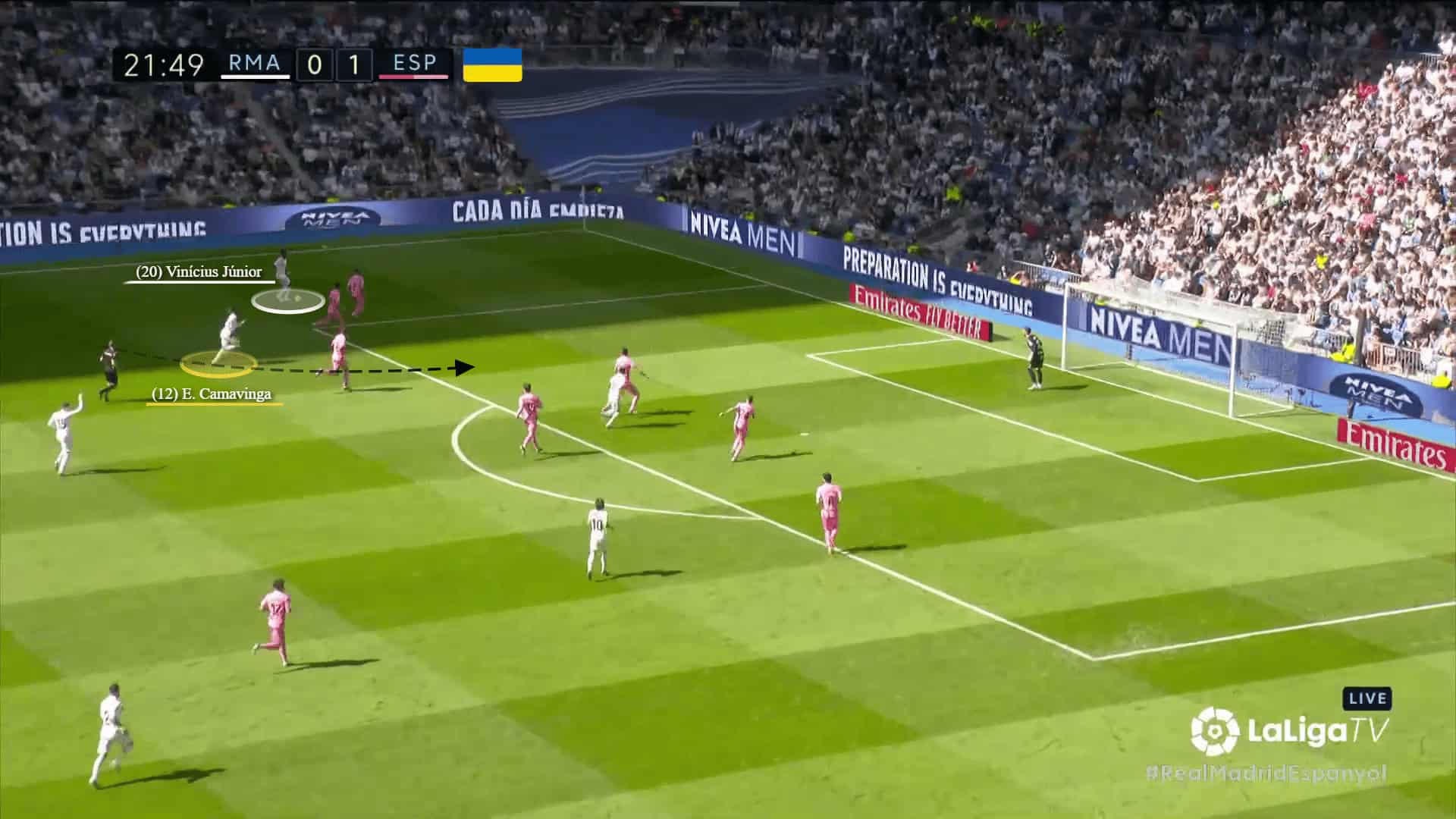
Below, against Espanyol, after isolating Vinícius Jr in a situation he loves, he got stuck in a 2v1 position.
Camavinga decides to underlap to manipulate which pulls two players away and opens the space inside for the Brazilian to come inside.
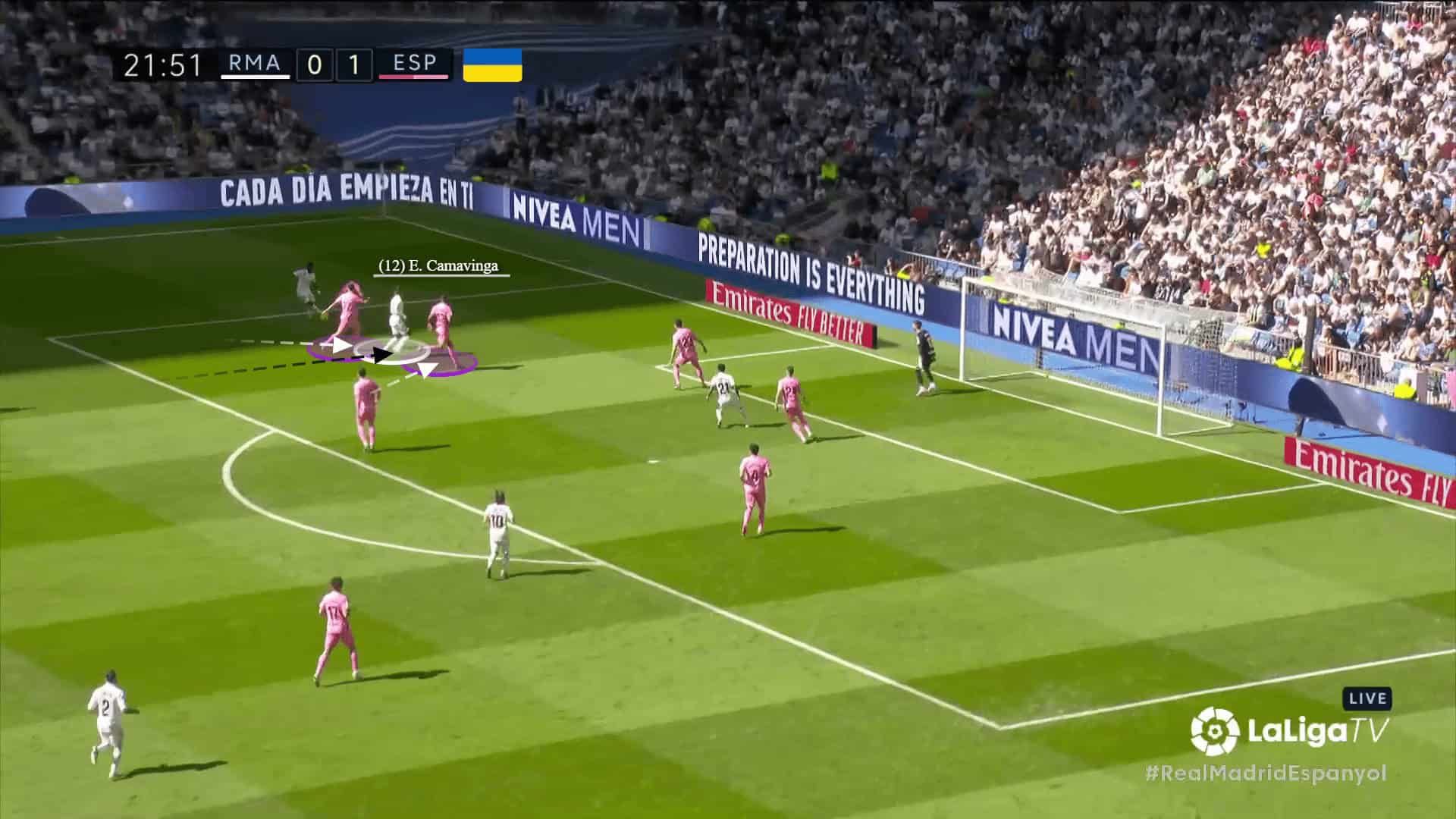
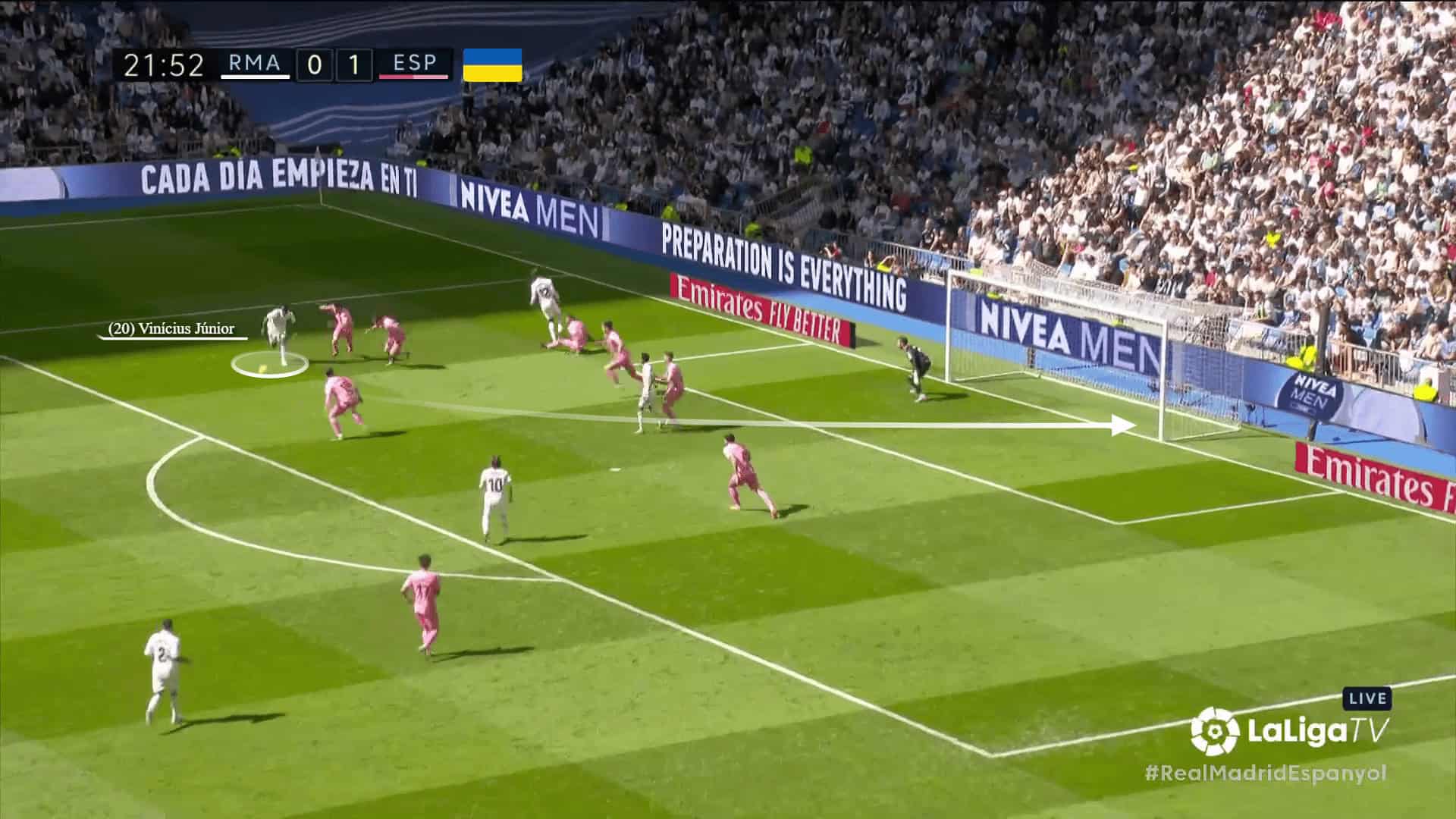
This then enables Vini Jr to cut inside and equalise with a curved shot.
In the image below, during the Club World Cup final against Al-Hilal, Camavinga moves inside, dragging Marega inside and opening the passing lane to Vinícius.
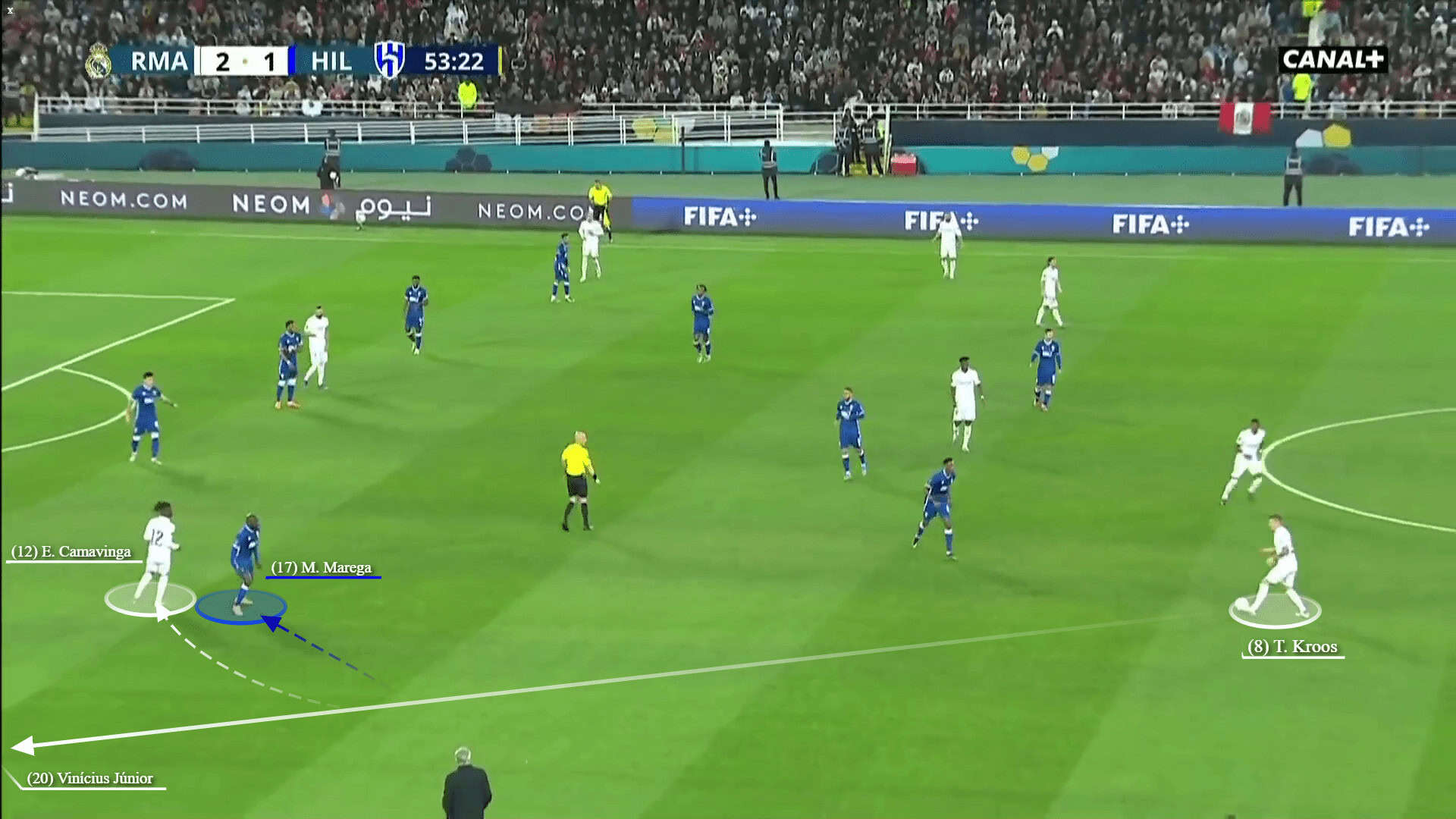
Camavinga involves well into a one-two combination which puts Vini later in 1v1 vs the fullback.
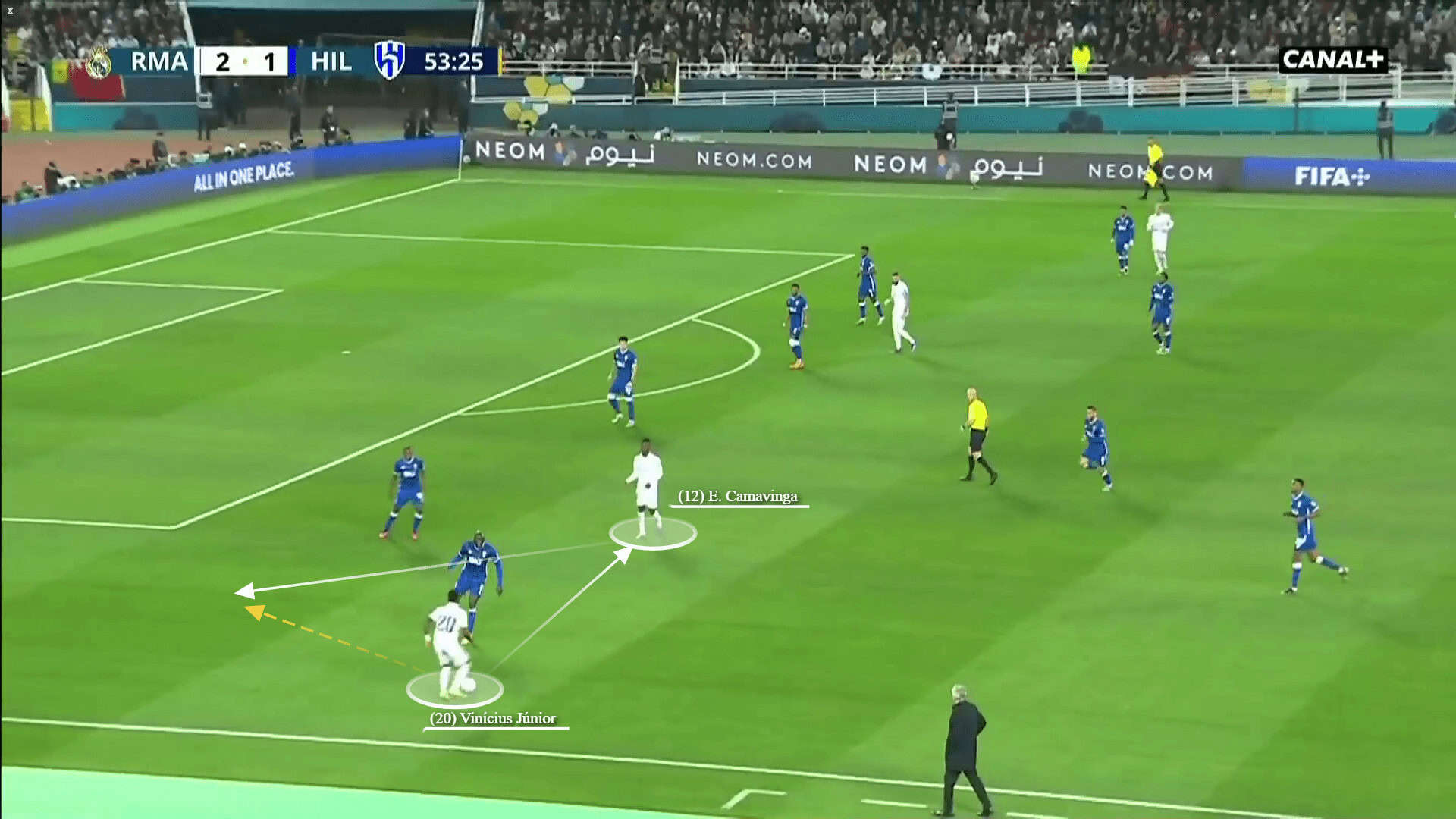
— and then he delivers a decent cross by the outside of his foot to Benzema who scores after recognising the space nicely.
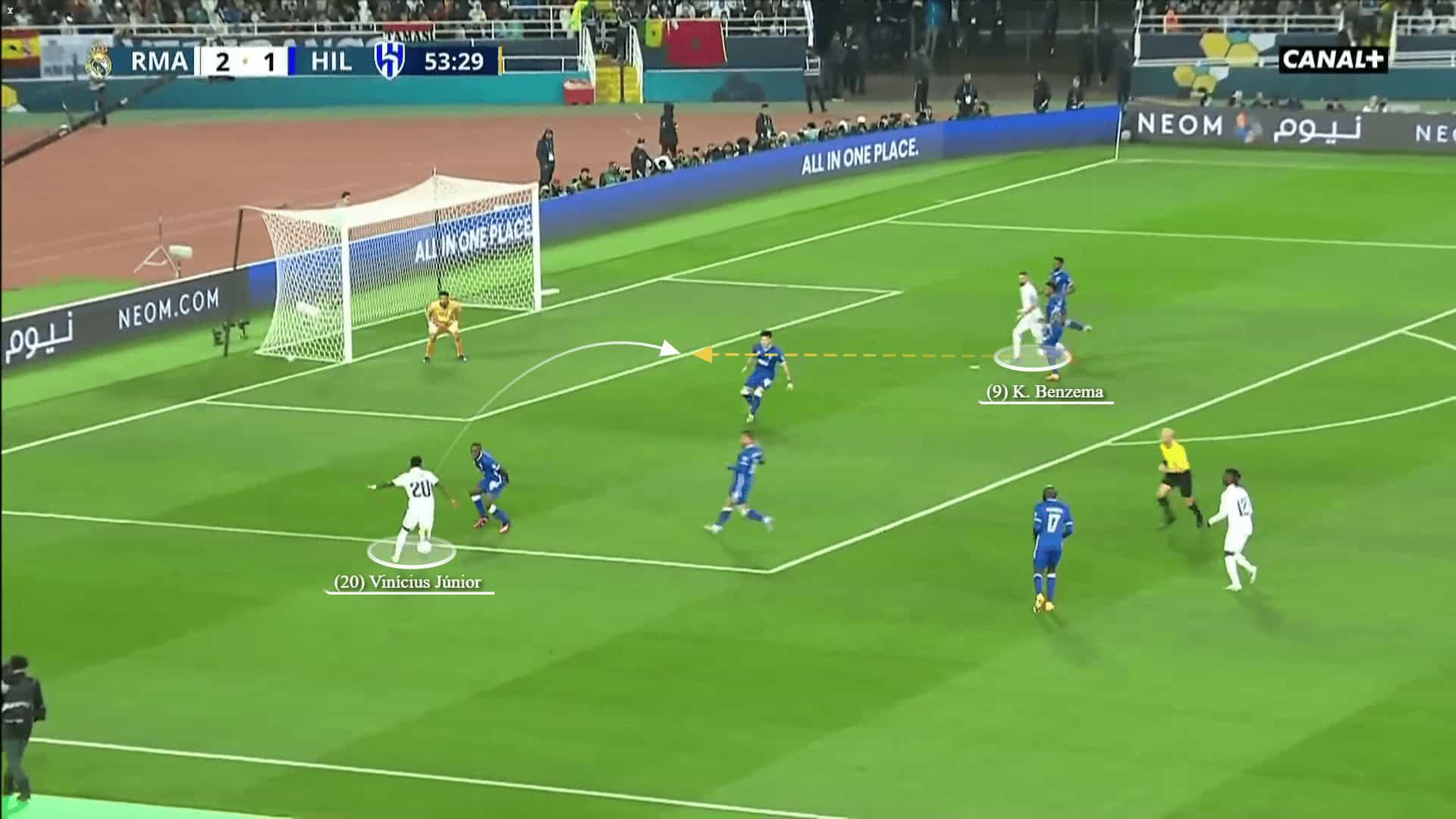
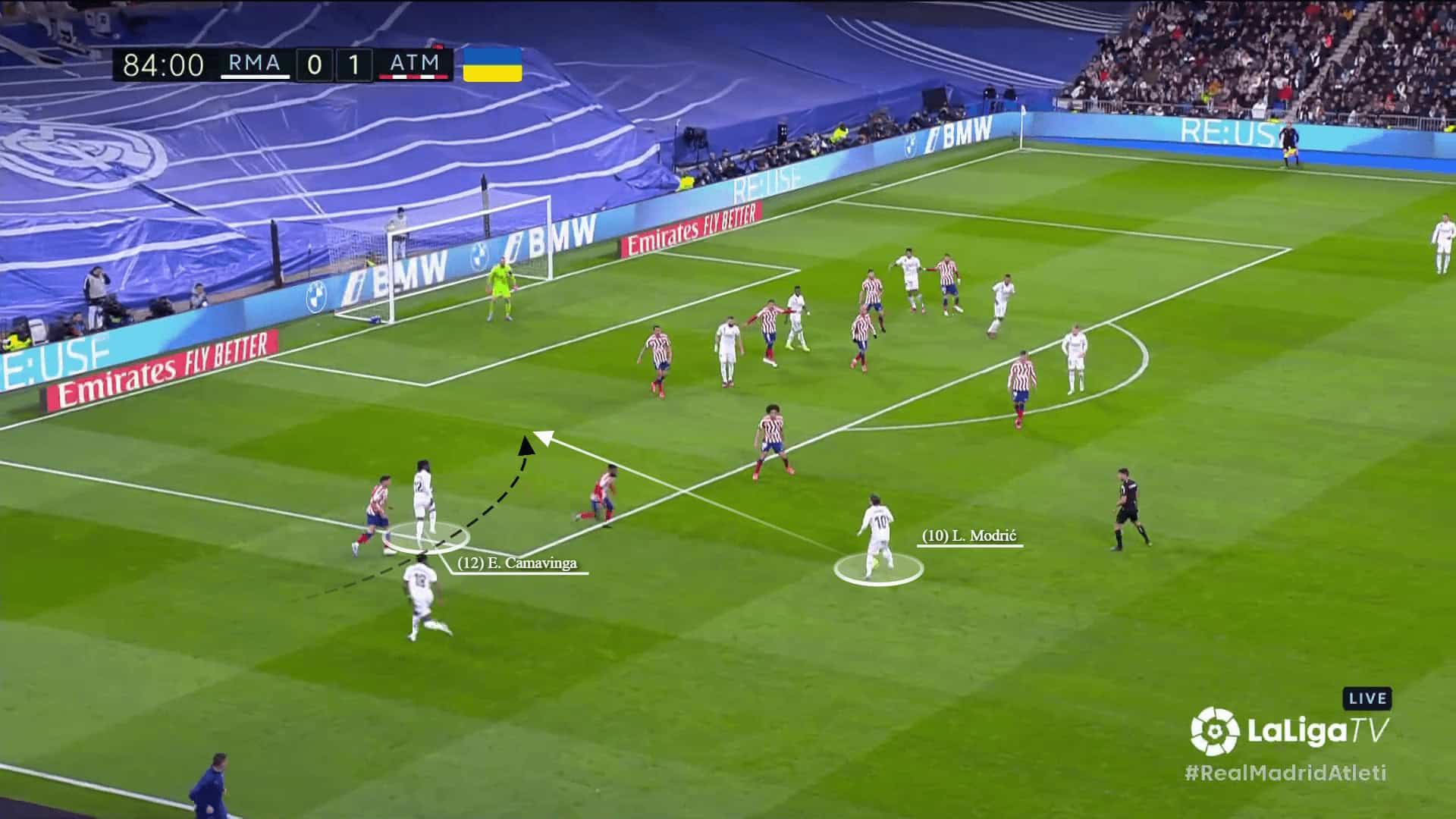
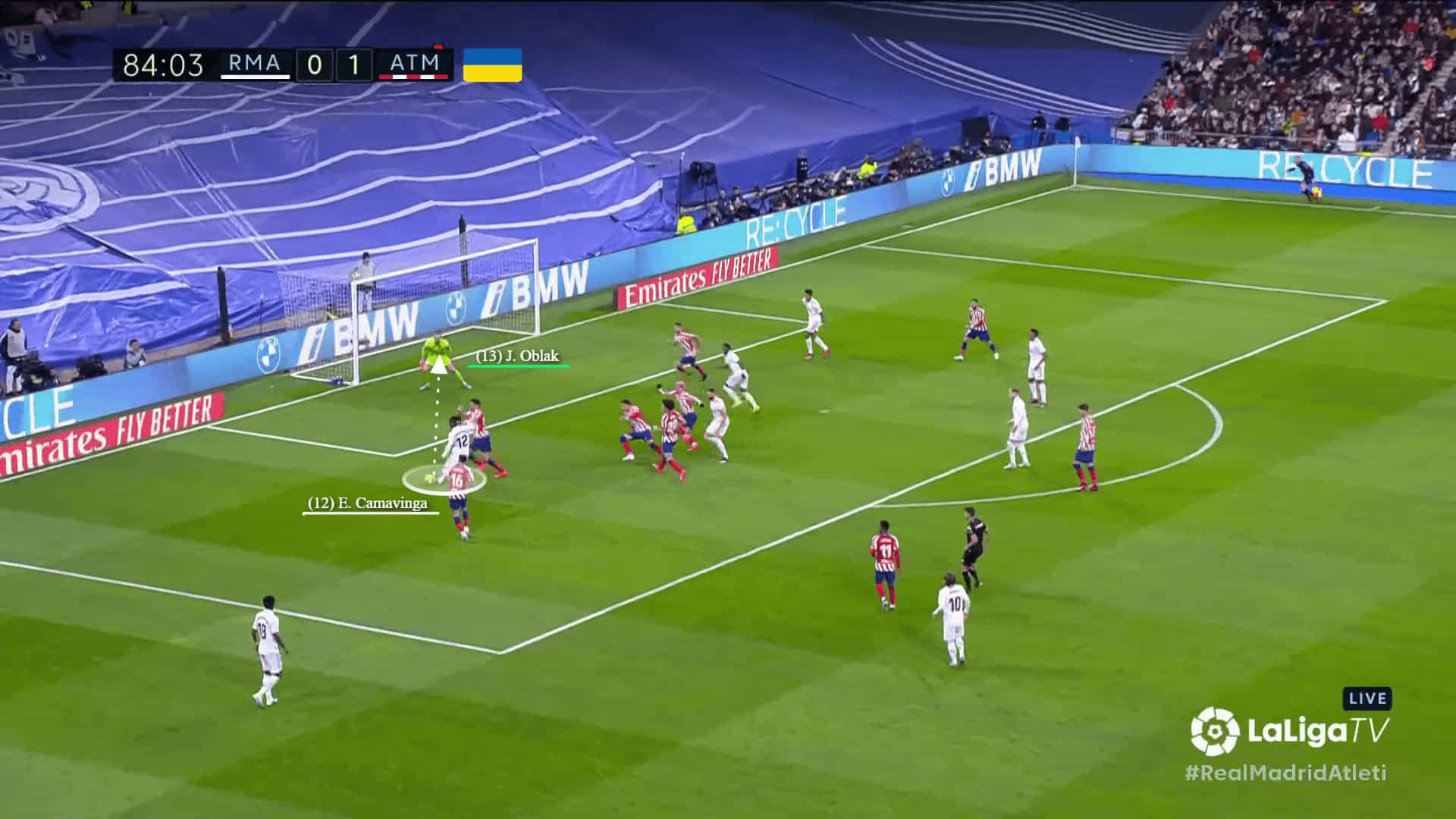
His off-ball movements and offensive positional awareness are also illustrated in the next image against Atletico Madrid.
While they are stuck in a 3v3 situation, Camavinga passes the ball to Modric.
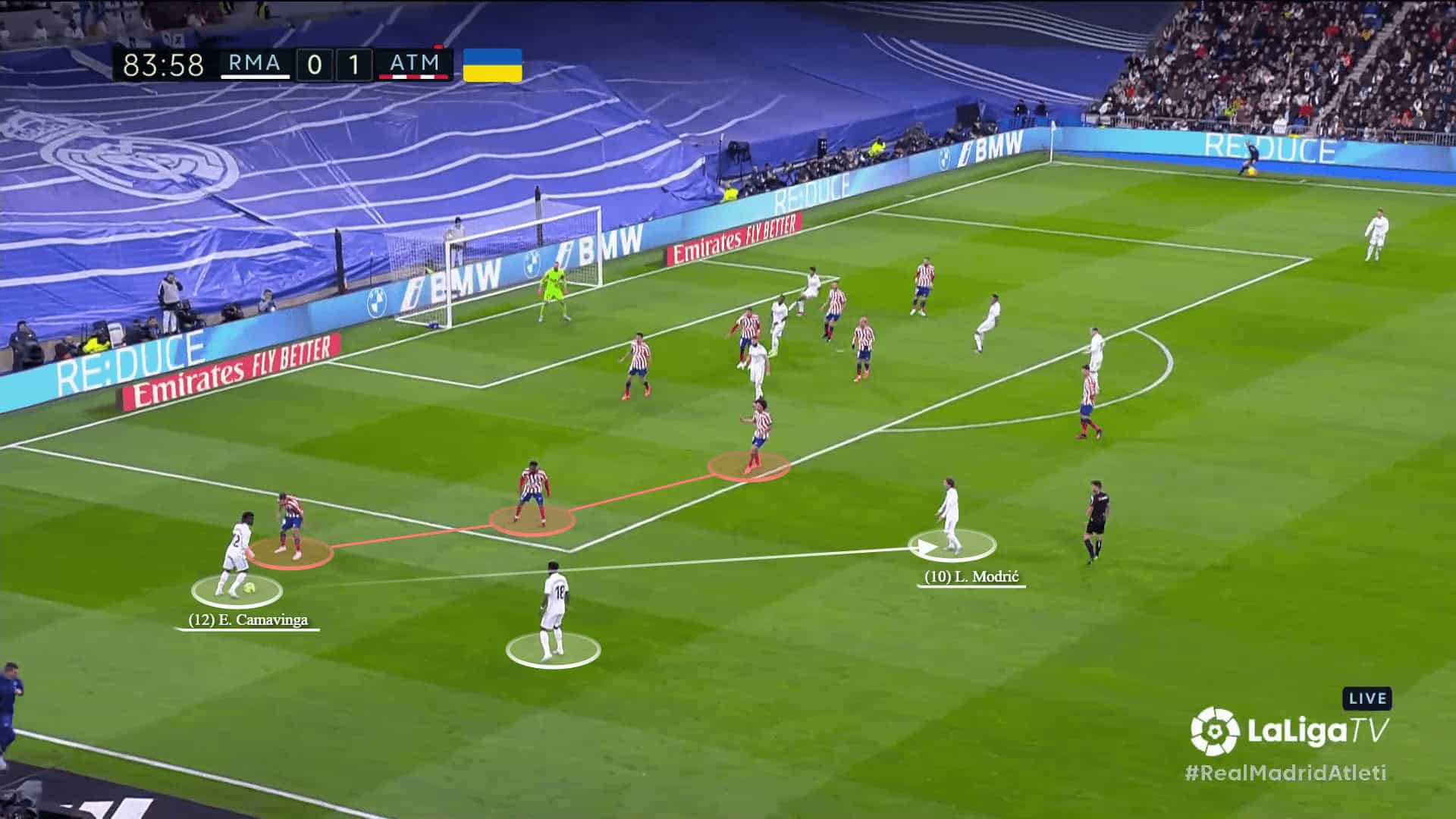
Then, he moves inside to the space behind the defenders waiting for the through pass from the Croatian.
After receiving the ball there, he launched a direct shot in the middle and Oblak brightly pushed it away.
Conclusion
This tactical analysis of Real Madrid’s Eduardo Camavinga showed how Carlo Ancelotti has used him in the central and fullback positions.
Eduardo Camavinga’s versatility and technical abilities make him a valuable asset in Real Madrid at present.
He has shown his ability to play dynamically in multiple positions, generating momentum in the midfield and even playing as a fullback when needed.
Eduardo Camavinga has already proven himself to be a true perseverance story.
Born in an Angolan refugee camp to Congolese parents, he came to France soon after his birth.
He got French citizenship in 2019 and made his debut for France Under-21.
Now he’s playing for the European champion.
He’s achieved a lot and surely has a great future ahead of himself with the 14-time European champions.
