
There are few players as synonymous with Real Madrid as Raúl.
The Madrid native signed for Los Blancos youth academy, known as La Fábrica, in 1992 and went on to make over 500 appearances for the first team, becoming club captain in the process.
Raúl’s time at the iconic club was trophy-laden, to say the least, with six La Liga titles and three Champions League titles plus a whole host of individual awards during the ‘Galacticos’ era.
Raúl departed Real Madrid in 2010 to join Schalke, before moving to Al Sadd and then on to the New York Cosmos to conclude his playing career.
Since his playing career ended, Raúl has transitioned into management, taking over as the head coach of Real Madrid’s Under-19 team in 2018.
The following year, he was promoted to take charge of Real Madrid Castilla (referred to as Castilla throughout), who play their football in the third tier of Spain.
Currently, the team are riding high on an 18-game unbeaten run, which finds them atop the 2022–23 Primera Federación table.
Reports suggest that Raùl recently turned down the opportunity to manage Leeds United following Jesse Marsch’s departure.
Presumably, the Real Madrid legend has his eye on the top job, with persistent rumours suggesting Carlo Ancelotti will retire at the end of his current contract.
This is a great time to dissect Raùl tactics.
This tactical analysis will showcase the tactical style he has developed during the current season at Castilla.
This analysis aims to explain Raùl’s preferred tactics, as well as how he has cultivated an effective tactical methodology through adaptability and flexibility.
Raúl Preferred Formations

Raùl’s primary formation is a 3-5-2, as he has used this 46% of the time during the current season.
This is a popular and versatile formation that many successful teams utilise.
Like any tactical formation, it has its own strengths and weaknesses that can impact the team’s overall performance.
This formation allows for a great deal of flexibility, particularly in midfield.
The three centre-backs provide defensive cover, while the five midfielders can play in a variety of roles, from attacking wingers/wing-backs to holding midfielders.
With two strikers and attacking midfielders pushing forward, the team can create a lot of scoring opportunities.
Particularly from the wing-backs pushing high up the pitch, acting as wingers to generate a vast amount of width, which is incredibly difficult for an opponent to defend against.
However, the 3-5-2 formation can be vulnerable to counterattacks, particularly if the wing-backs push too far forward.
If the opposition can quickly transition from defence to attack, they can exploit the spaces left behind the wing-backs.
To execute this formation successfully, players need to be able to defend and attack effectively while covering a lot of ground during the course of a game.
Short passes and diamonds in central areas
When building out from the back, Raúl asks his team to engage in swift vertical passes that often involve one of the forwards dropping deeper to receive the ball while a midfielder and wingback make a run into the attacking third.
Castilla average 53% possession per 90 meaning they often enjoy slightly more of the ball than their opponent.
When in possession, they look to play out from the back quickly, which very often enables them to create gaps in the opponent’s defence.
To do this, they utilise vertical passes in the central areas before eventually spreading the ball out wide.
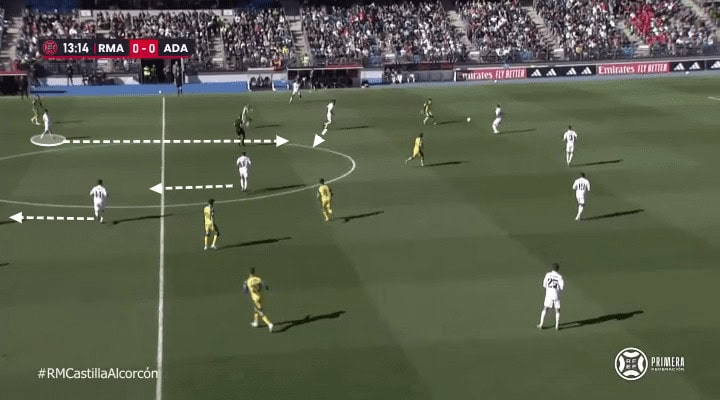
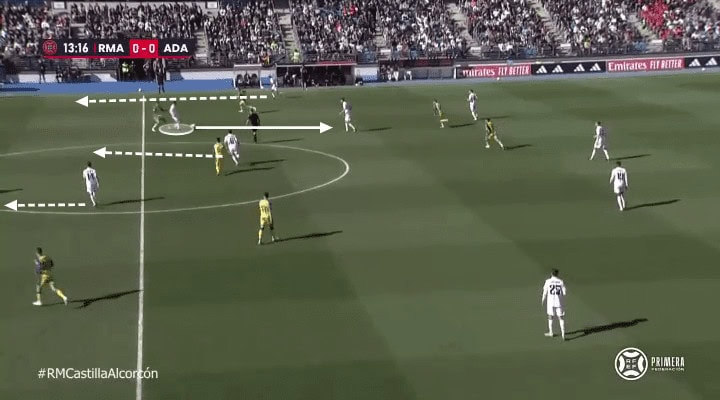
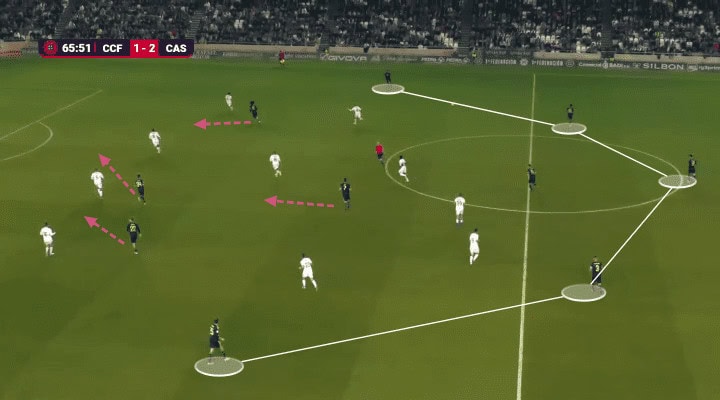
In the images below, Castilla have possession and are looking to build out from the back.
To create space for teammates to exploit, the right-sided striker (most often Sergio Arribas) will adopt the role of a ‘10’ and drop deeper to receive the ball, often bringing the opponent’s player with him, thereby creating space.
With these short and quick vertical passes, there is less time for the opposition to intercept or recover the ball, reducing the risk of turnovers and allowing Castilla to maintain possession and move into dangerous areas.
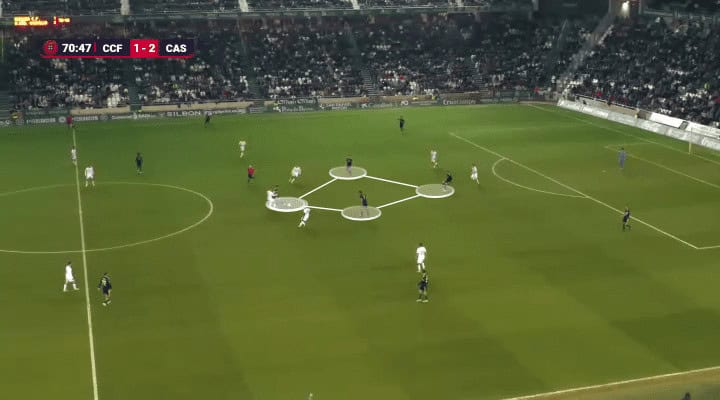
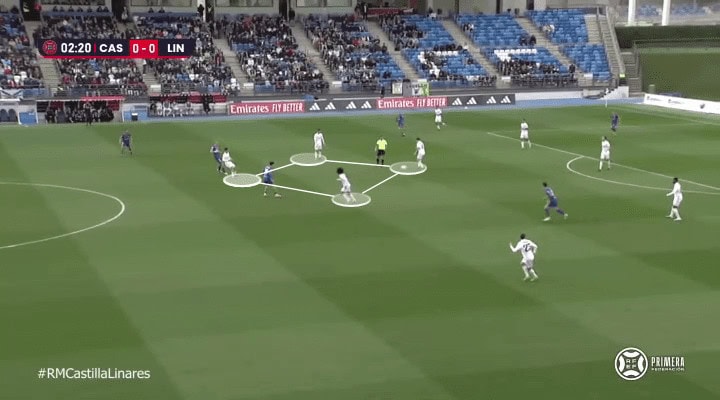
Another element of Raúl’s tactical set-up is the use of diamond passing shapes in the midfield area.
As depicted below, the right-sided striker has dropped back to form a diamond with the midfielders.
This compact passing shape enables short, swift passes to occur, which as we have already established, is something the manager wants from his team.
The compactness also increases the likelihood of retaining possession in central areas.
This is an important component of Raùl’s tactics, as the wing backs are expected to provide an attacking outlet; therefore, retention of the ball in central areas is required in order to limit the opportunity of a counterattack from the opposition.
The compact nature of this shape is also incredibly useful in another key aspect of Raúl’s tactics, creating space in the wide areas, which will be highlighted further in this analysis.
This strategy can be especially effective against teams that play a high-pressing style, as it allows the team to quickly move the ball through tight spaces and exploit gaps in the opposition’s defensive shape.
By keeping the ball close and limiting the distance between players, the team can quickly move the ball up the field and create scoring opportunities.
Short passing options enable Castilla to bypass an opposition press quickly and effectively, allowing them to transition smoothly into the attacking phase.
Utilising the wide areas
As mentioned above, Raúl likes his team to use short passes whilst playing out from the back in central areas.
However, when they are looking to transition into the attacking phase of play, the ball is usually swept out wide to one of the wing-backs (most often Vinicius Tobias on the right and Rafel Obrador on the left).
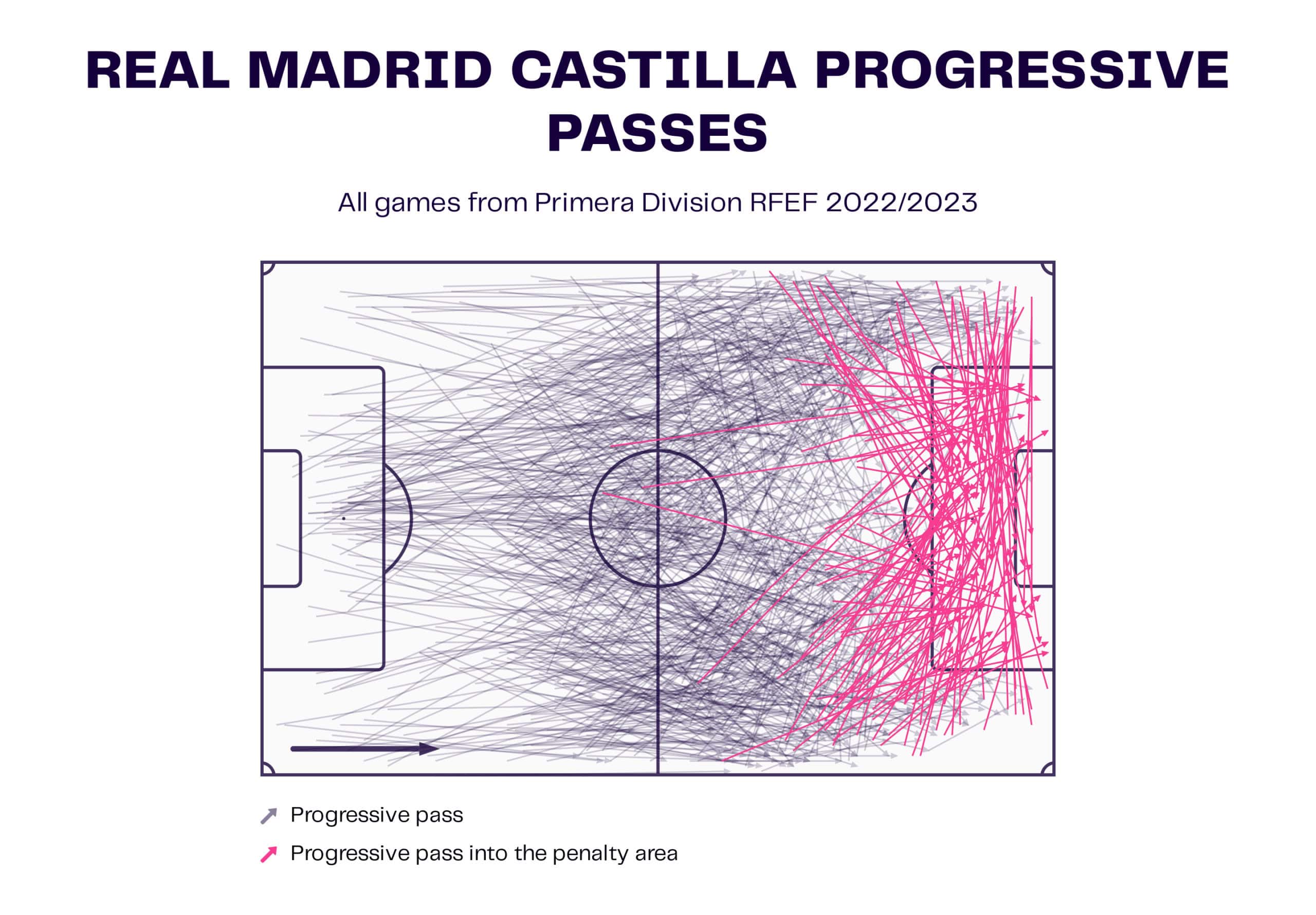
The data viz below demonstrates where Castilla’s progressive passes occur on the pitch.
The majority of progressive passes from the defensive areas are to the midfield, where the viz indicates the players look to pass to a wide player.
Castilla average 443.29 passes per 90 with an accuracy rating of 85% meaning they are reliable in possession.
Raúl’s team average 73.25 progressive passes per 90 with an accuracy rating of 73.5%.
As the viz also indicates, most of the progressive passes into the penalty area were from the wide areas.
This clearly showcases Raúl’s desire to see his team attack in the wide areas.
When a team exploits the wide areas, it can draw the opposition’s defenders out of position, creating spaces for other attackers to utilise in the central areas of the pitch.
This can create opportunities for through balls or quick passes to get behind the defence.
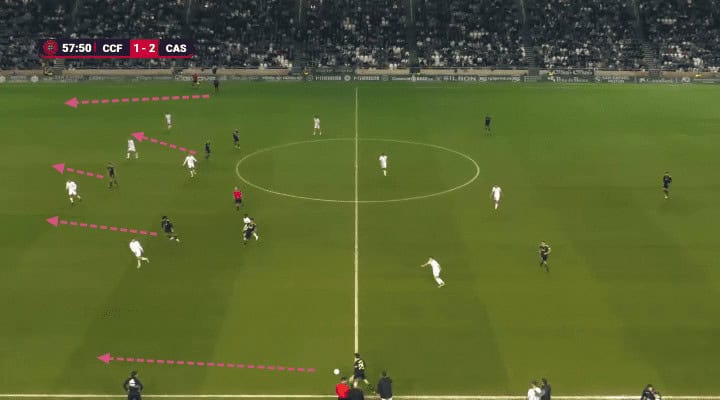
Raùl asks his wing-backs to stay as wide as possible when building an attack, as shown in the images below.
So, with the wing-backs following their instructions, what occurs next is that the two central midfielders will push forward to link up with the two strikers, creating a four-man attack in the central area.
This creates a problem for opponents.
If they are playing a back four, then it means all four defenders are occupied by Castilla attackers.
This creates an advantage for the wing-backs, who are often happy to go 1v1 with the opponent’s wide attackers or midfielders who have tracked back, as they are less likely to be defensively minded.
Therefore, it presents a set of conditions that are optimal for Castilla to succeed.
Additionally, the Castilla defensive line will, on occasion, push up into the opposition’s half, as depicted below.
This pins the opposition back into their own half, meaning that, should Castilla cede possession, they are in a prime position to engage in a counter-press in order to regain the ball.

With an average of 4.24 passes per possession, Raúl’s tactics enable individuals to showcase their ability on the ball, facilitating a smooth transition into the attacking phase.
Given that many players in the Castilla team have graduated from La Fábrica, they are technically gifted, and therefore, it makes sense for Raúl to utilise their individual skills to benefit the team.

The visualisation above shows that much of Castilla’s ball progression occurs in the wide areas, which, of course, is key to this tactic.
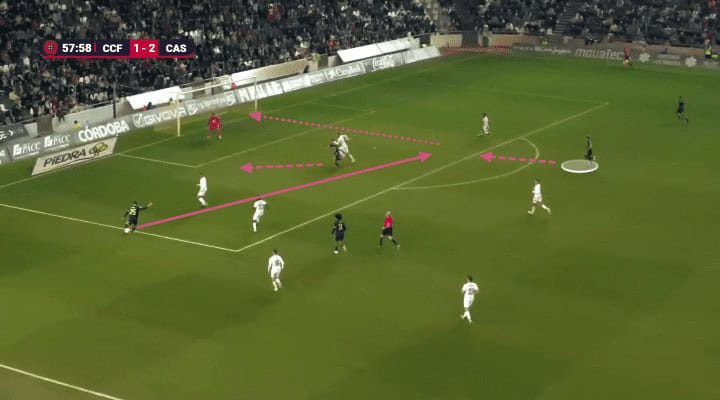
The images below show this ball progression in action.
Rafel Obrador has received the ball and is in a vast amount of space on the left wing as the opposition defence is preoccupied with the two Castilla strikers and central midfielders.
Obrador is able to advance down the left side unopposed and reach the penalty area, where he can play a pass across to one of the midfielders who is arriving on the edge of the area.
As a result, said midfielder is presented with a shooting opportunity.
Castilla average 7.83 crosses from the penalty area per 90 and so utilising the width of the pitch often proves to be to their advantage in games.
Raúl High pressing
Under Raúl’s direction, Castilla look to press their opponents high up the pitch in order to force errors and turnover possession.
The data viz below demonstrates that so far during the current campaign, they have completed 218 high regains, which is a regaining of possession within the final third.
They have completed 317 counter-pressing recoveries, which is another key element of Raúl’s tactical style.
He places great responsibility on his players to win the ball back as quickly as possible.
90 of those ball recoveries have been classed as dangerous, meaning they led to a shot within 20 seconds.

Castilla primarily looks to regain possession of the ball high up the pitch, as this often puts them in a good position to create scoring chances, as the opposing team is caught off guard.
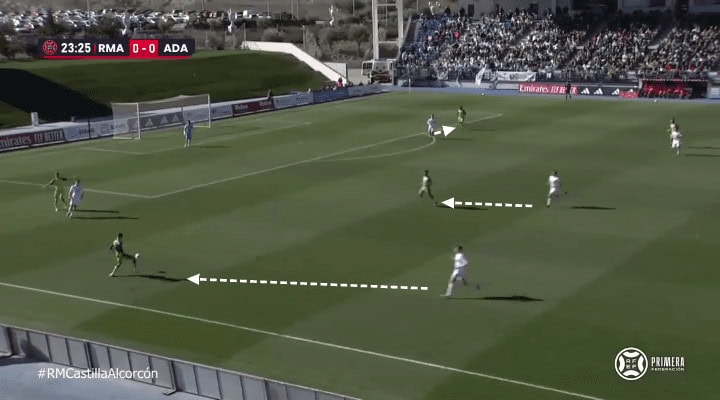
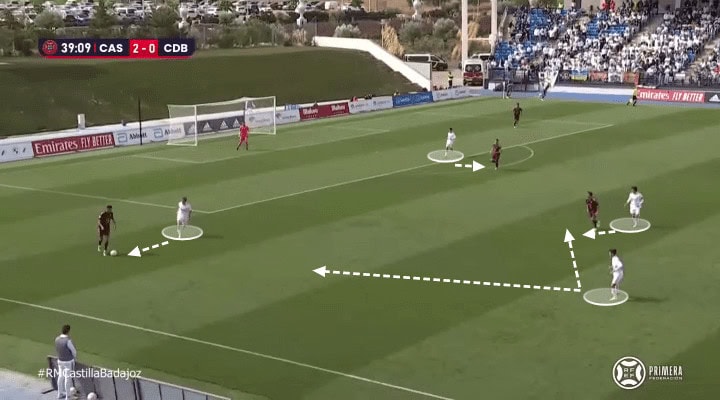
The images below show how they begin to press before the opposition have an opportunity to initiate any sort of attack.
As the opposition are looking to build an attack from the back, Castilla immediately look to cut off the passing lanes.
In the first image below, the goalkeeper was forced to play a pass to the fullback, but a Castilla player is already closing him down, whilst teammates are in positions to ensure no other obvious passes are available.
This increases the likelihood of the opponent playing a long pass, which can be intercepted, and Raúl’s side can then look to attack.
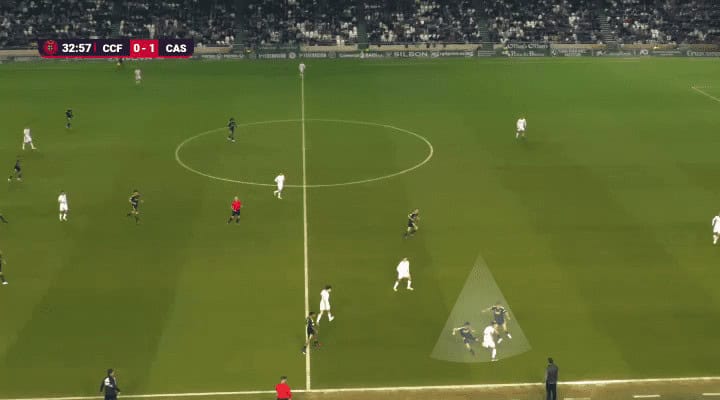
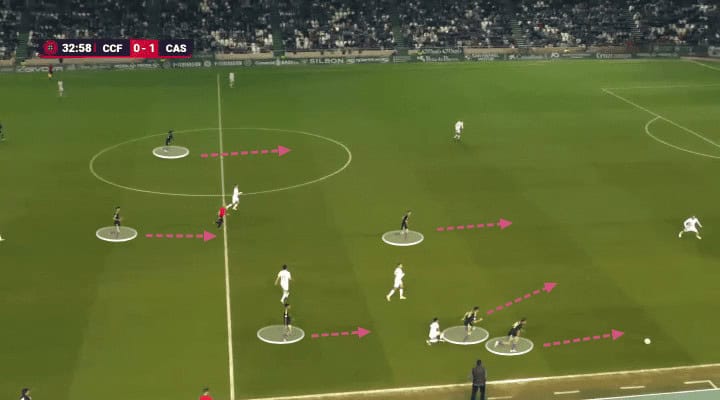
When possession has been lost in the attacking third or midfield, the Castilla team swiftly engage in a counter-press.
This is a way of reducing the risk of conceding goals.
By winning the ball back high up the pitch, they can deny the opposition time to organise their attacking play; therefore, the number of dangerous chances they can create is limited.
In the images below, the ball has been lost, and two players are ready to counter-press.
This is also a way of maintaining the momentum of the game in their favour, by keeping the pressure on the opposition and preventing them from settling into a rhythm of their own.
Low block defending when necessary
As much as Raúl’s Castilla team look to press high, they are very flexible in the defensive phase.
If the opposition is able to play through the lines and enter the Castilla defensive third, they will often look to fall back into a compact block of five defenders (the two wing backs and three central defenders).
The viz below indicates where Castilla’s defensive actions take place on the pitch.
They average 41.79 interceptions per 90 minutes, which indicates that the players are able to read the game well and use effective body positioning to intercept the ball rather than being forced into a tackle.

The image below shows Castilla falling into their low block of five defenders.
This affords them defensive stability.
They are able to maintain their shape whilst ensuring the play remains in front of them, so the opponent’s scoring opportunities are more limited.
This means that whilst the opposition may be able to carve out a potential scoring chance, there are more defensive players there to provide a block or limit the player’s window of opportunity to release a shot.
This means that the scoring opportunities they do concede are lower percentage chances, and so the opposition is less likely to find the back of the net.
This approach is proving to be successful for Raúl as his team concede an average of 0.92 goals per 90 (less than one goal per game) and have kept eight clean sheets so far this season.
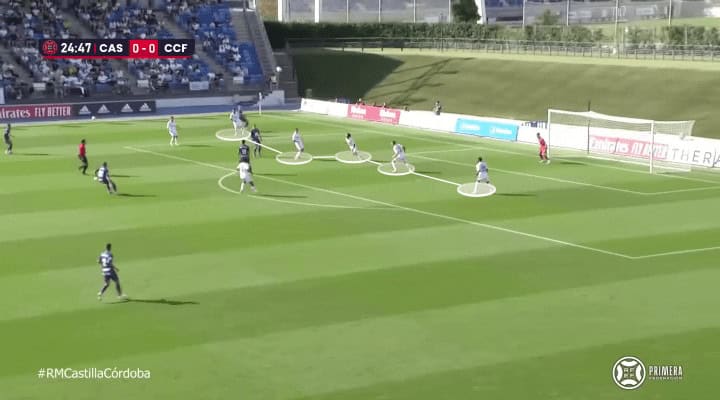
However, playing in this way does lead to some issues, mostly as a result of the compact nature of the low block.
In the image below, the right wing-back (Vinicius Tobias) has tucked in, as he is supposed to, to form said compact block.
This leaves the wide area unattended as there is no attacking winger to cover due to the 3-5-2 formation.
Therefore, as highlighted, the opposition is presented with an opportunity to exploit this space.
The holding midfielder is in his position as expected.
The two central midfielders, though, are incredibly narrow, which is what allows the opposition to exploit the space unchallenged.
This presents a worrying way in which opponents can look to beat this Castilla team.
By surrendering the space in the wide areas, Raúl is solely reliant on his defender’s abilities to clear their lines from inside their own penalty area.
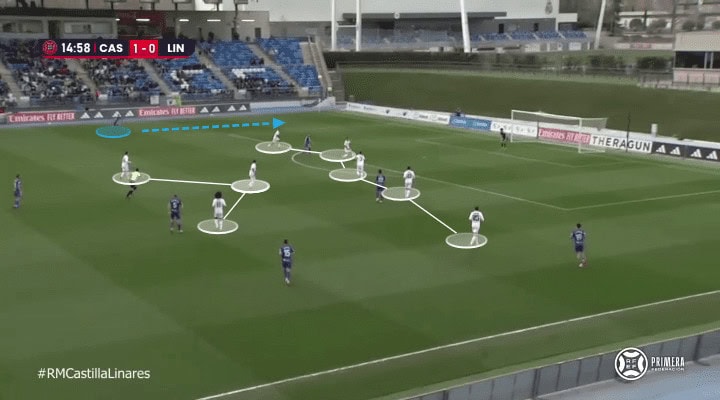
There are occasions where this flexible approach can lead to wrong decisions being made on the pitch.
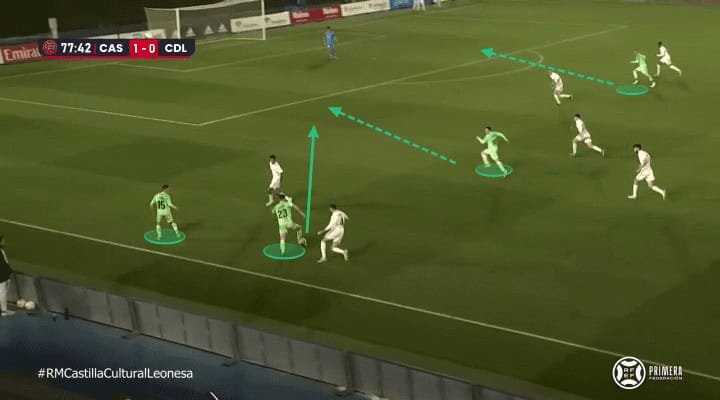
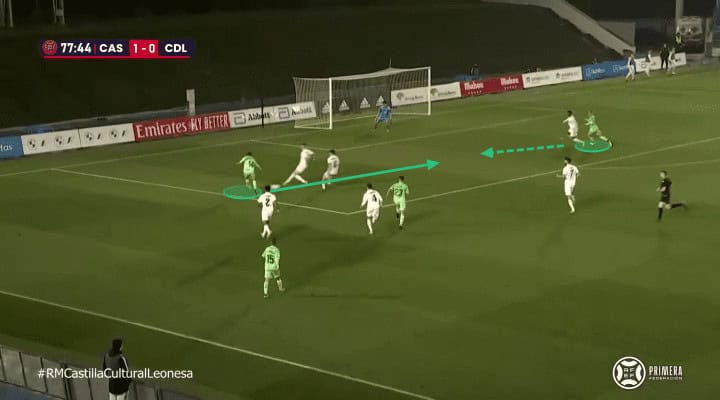
The sequence of images below is a prime example of this.
Castilla are in their defensive block of five.
When the ball is played into the opposition striker, the right-sided centre-back steps out of the defensive block to man-mark his opponent.
This leaves a vast amount of space behind him, which the central defender does not cover, nor does the holding midfielder.
This means that the opposition’s #14 can easily make a run into this space.
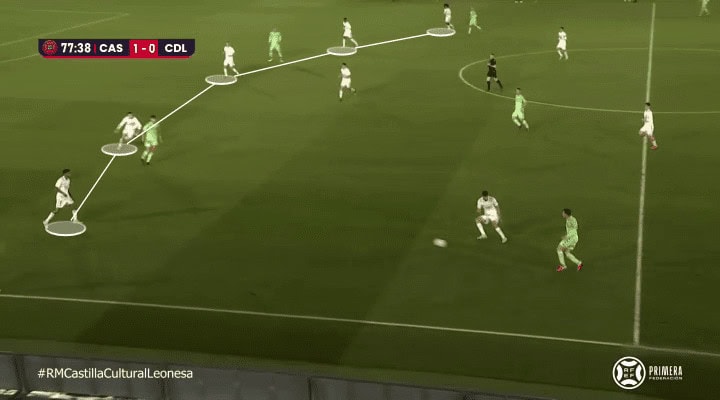
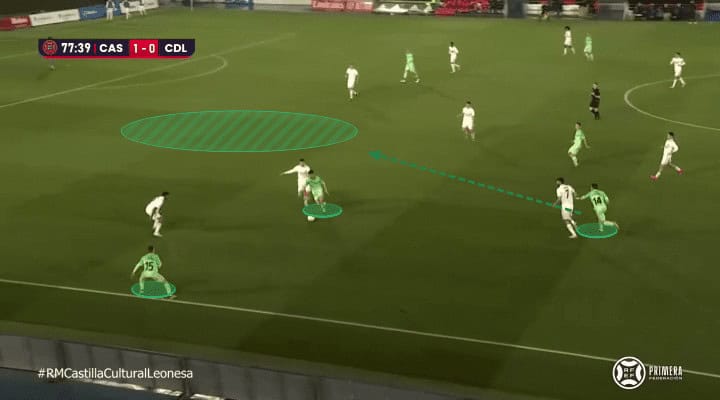
The striker is able to roll his man and then play in his teammate (#14), who has made the run forward.
As the defensive block has lost its shape, a cross can be played to the striker who is able to run across his man and get a shot at goal.
This shows how poor decision-making can cause a host of problems for the defence in this tactical set-up.
Conclusion
Overall, this analysis has shown that Raúl’s tactics at Castilla are based on flexibility and adaptability.
His methodology aspires to be everything: high pressing, low block defending, combined with short passes in central areas to exploit the wide spaces.
His system can be incredibly difficult to defend against, which is why Castilla are enjoying such a stellar campaign.
In order to effectively carry out Raúl’s desired tactical style, his players have to be intuitive, disciplined and incredibly organised.
One lapse in concentration or one poor decision can prove costly, gifting opponents a goalscoring opportunity.
For the most part, his players have shown great confidence in his methods and have been willing to put in the hard work that this tactical style requires.
Whether Raúl will be in the frame for the Real Madrid job should Carlo Ancelotti leave the post remains to be seen.
For now, though, the club legend is forging his own path in management and creating his own tactical style.
