
Following the 2022 FIFA World Cup in Qatar, Roberto Martinez called time on his tenure with the Belgian national team, after Les Diables rouges were eliminated at the round of sixteen stage.
This marked the beginning of the search for a new manager to lead Belgium into what is likely a new generation, with the so-called “golden generation” all nearing the end of their international careers.
After a somewhat protracted search, the Belgian FA decided on 37-year-old former Schalke, Spartak Moscow, and RB Leipzig boss Domenico Tedesco.
The Italian-born German was an intriguing choice by the Belgian FA.
This tactical analysis piece examines what Belgians can expect from their new national team manager.
His first match in charge is on Friday, March 24th, against Sweden in UEFA Euro 2024 qualifying.
Domenico Tedesco Preferred formations and style of play
During his most recent spell in charge of RB Leipzig in the Bundesliga, Tedesco opted to set his side up in a very aggressive 3-4-1-2 system, with this likely being the system he will employ during his first two Euro qualifying matches against Sweden and Germany.
The German manager likes his sides to be on the front foot, looking to be a very attack-minded side.
Tedesco also looks for his sides to hold the majority of possession, with his Red Bull Leipzig side averaging over 56% of the ball.
The underlying numbers show his philosophy of being an attack-minded coach when looking closer at the attacking statistics during his recent spell in Leipzig.
His Leipzig side created 1.52 xG per 90 minutes and averaged 9.05 shots per 90 minutes.
Tedesco’s teams also like to play vertically whenever possible. His Leipzig side had the second-most progressive passes in the Bundesliga last season, with 2,876, trailing only Bayern Munich.
A look at Tedesco’s more in-depth attacking style of play will be profiled later in this tactical analysis.
Still, in general, Belgian fans should look to see a side that will likely be more proactive going forward than they were in the past, which is good considering the attacking talent that Tedesco called up in this first window in charge.
Domenico Tedesco Build up play
The first thing we will look at is the build-up style that Domenico Tedesco’s style of play is looking to implement on his side.
As mentioned, the German manager preferred a 3-4-1-2 formation, which he would likely keep, at least for the first two Euro qualifiers.
As he likes to hold the majority of possession, Tedesco wants his sides to build out from the back with the goalkeeper, but in a certain way, with his back three system.

The image above shows an example of Leipzig‘s typical shape during the build-up phase of play under Domenico Tedesco.
Leipzig would look to create multiple passing options to escape the pressure from an opposition’s high press or just more easily bypass opposition lines of pressure.
To counter this without necessarily playing long, try creating multiple passing options on the second line to break or bypass the opposition press, which Tedesco implemented to great success with the Bundesliga side.
The first thing to notice is the shape of the back three.
Leipzig’s two wide centre-backs, Mohamed Simakan and Joško Gvardiol, stay wider, with goalkeeper Péter Gulácsi splitting the two.
The central centre-back, Willi Orban, pushes higher, forcing the opposition forwards to not press too high knowing the ball could be played to Orban to turn and drive into the space in midfield, bypassing the press.
However, knowing that passing to Orban is a risky option, with the defender acting more like a decoy to bait the forwards into dropping off slightly, midfielder Kevin Kampl drops into a wing-back position, with him being a clear option for Gvardiol to pass to.
The other option is to play a cross-field ball to Lukas Klostermann on the far side or attempt to play Orban centrally.
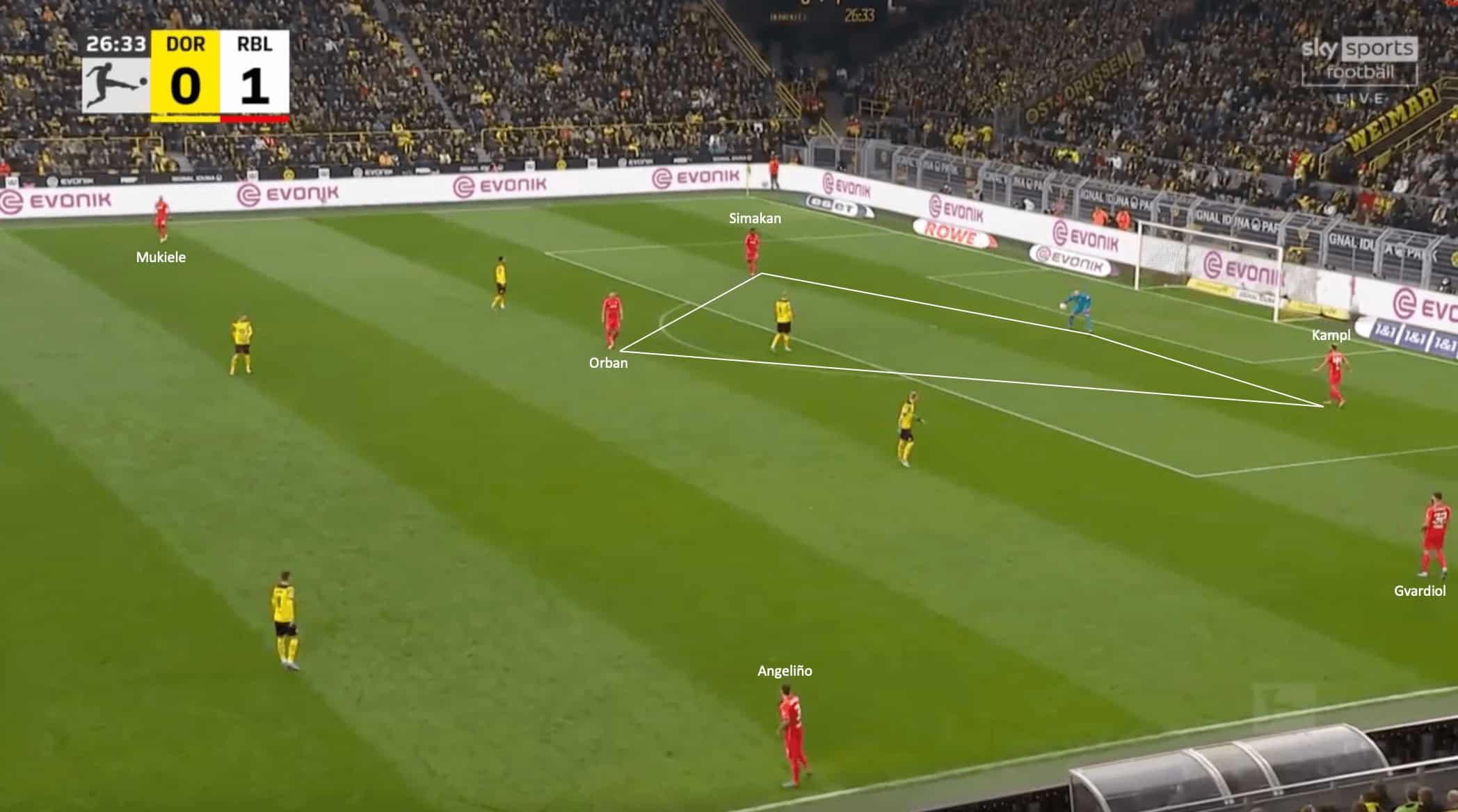
The image above shows another example of this shape utilised by Domenico Tedesco during the build-up phase.
The same almost diamond shape is present, with Willi Orban pushed up to prevent the Borussia Dortmund forwards from pressing too high and leaving Orban as a free option.
As mentioned previously, this allows the Leipzig players time in possession to play vertically, as an opposition high press would free the pass to Orban and break the opposition press with a single pass.
The difference here is that Kevin Kampl has dropped into the right centre-back position, with Gvardiol pushing well wide.
It is also interesting to note that both wing-backs, current PSG players Nordi Mukiele and Angeliño, are hugging the touchline while not being very advanced.
This gives RB Leipzig a 6v5 numerical advantage in the defensive third of the pitch while also allowing them to play the ball vertically to advanced positions.
This goes back to Tedesco’s philosophy of wanting to play a quick-flowing, attacking brand of football, rather than consistently playing laterally or backwards.
As this phase develops, the ball is rolled to Kampl, who plays it wide to Gvardiol in this wide position.
With Angeliño occupying the player closest to him, it allows Gvardiol to play directly to the forward, bypassing the first two Dortmund lines and allowing Leipzig to continue progressing play in a more favourable position.

A final example of Tedesco’s style of build-up is shown above.
Once again, the diamond shape is prevalent, with Orban pushed high.
Both wing-backs are again positioned wide, with Kampl being the X-factor in this example.
The Slovenian international drops all the way to position himself between the goalkeeper and Gvardiol, which allows the Croatian international the time and space to receive the ball and play forward.
In the image, the ball is played to Gvardiol, but as the play progresses, Gulácsi again retains possession.
Kampl drops into the penalty box, which attracts the attention of the furthest advanced Hoffenheim forward.
This allows the Croatian to receive the ball and have time to scan for forward options.
This continuous off-the-ball movement keeps opposing pressing shapes questioning, allowing Tedesco’s sides to create more than one option in advanced possession and advance the ball vertically.
Domenico Tedesco Attacking style of play
Tedesco is very much an attack-minded manager, and Leipzig’s attacking statistics during his time in charge indicate this.
Last season, Leipzig finished with the second-most touches inside the penalty area (763) as well as the second-most touches in the penalty areas per 90 minutes (21.17).
What is rather interesting is Tedesco’s Leipzig side’s success rate when it came to crosses in the final third. Their 38.2% successful cross rate was the fourth-highest in the Bundesliga last season.
This is also considering that they were middle of the pack in the Bundesliga when it came to attempted crosses last season.
One of Tedesco’s attacking principles is overloading the wide areas during the attacking phases.
Many of his attacking tactics are based on positional play and short passing distances, with players frequently interchanging positions and finding space between the opposing lines.
The manager also usually likes one of his outside centre-backs to push forward and join in attacking phases, with Joško Gvardiol normally doing this for him in Saxony.
This ability to create overloads in the wide channels allowed his side to have numerical advantages from an attacking perspective, enabling accurate crosses into the box, as well as numerous touches inside the penalty area, and creating countless goal-scoring chances.
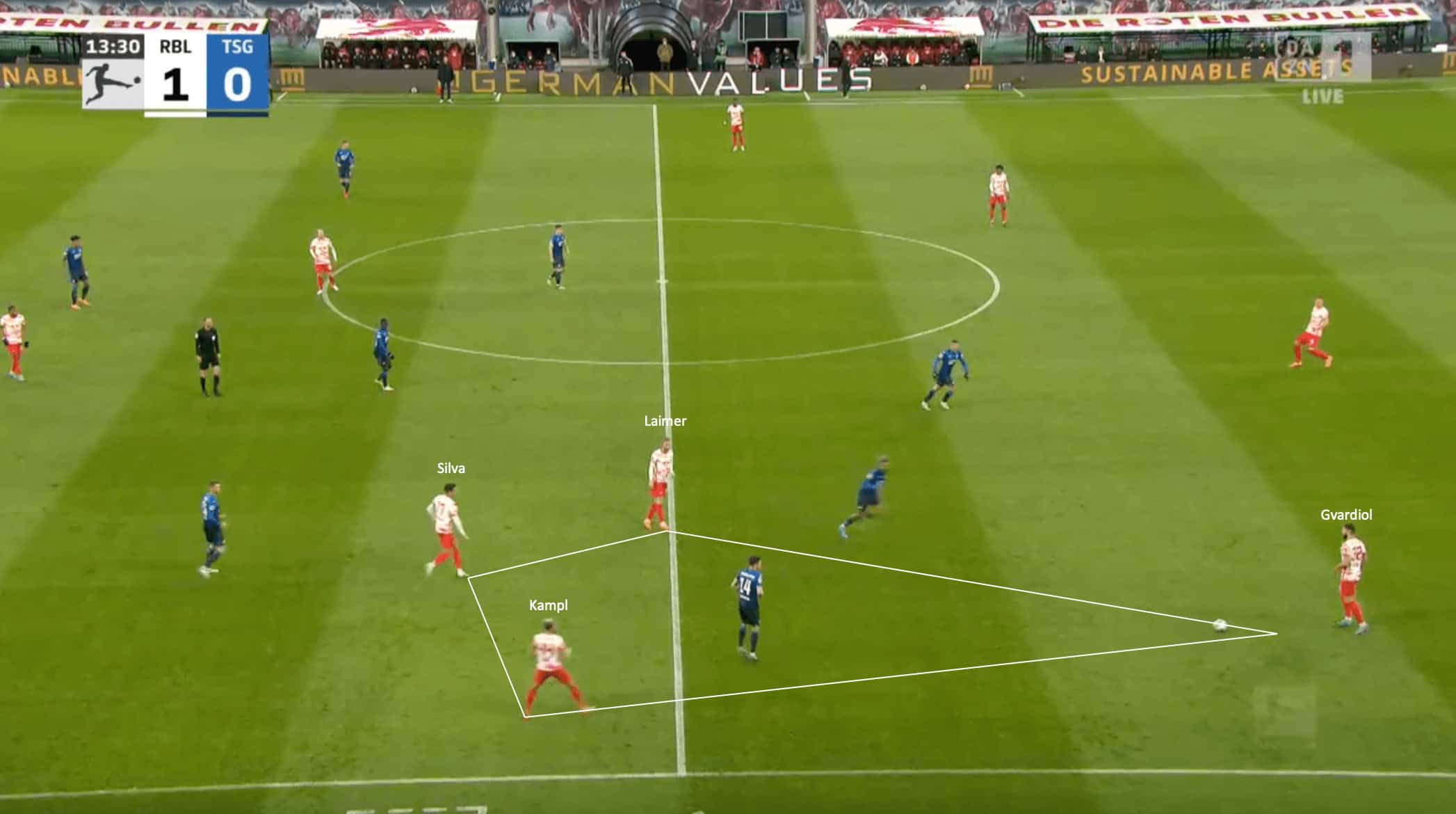
The image above illustrates an example of these attacking principles from Tedesco in action.
In this attacking phase of Leipzig’s match against Hoffenheim, Tedesco’s side has overloaded the wide channel, making it either a 4v2 or 4v3 against the defenders.
Like the build-up phase, they again create a diamond shape, with striker Andre Silva dropping between the lines into this half space.
As mentioned, the German manager wants his sides to minimise distance during these attacking phases of play. This allows short passing distances and, as a result, less room for error when progressing the ball.
The positional movement is also worth noting here.
With the wingback advanced and wide, he can pin the Hoffenheim defenders back, allowing Kampl to move into this wide position to help facilitate the overload.
While Leipzig are dispossessed in the end, with the number of players around the ball, they are able to quickly counter-press and eliminate any potential transition move from the opposition.
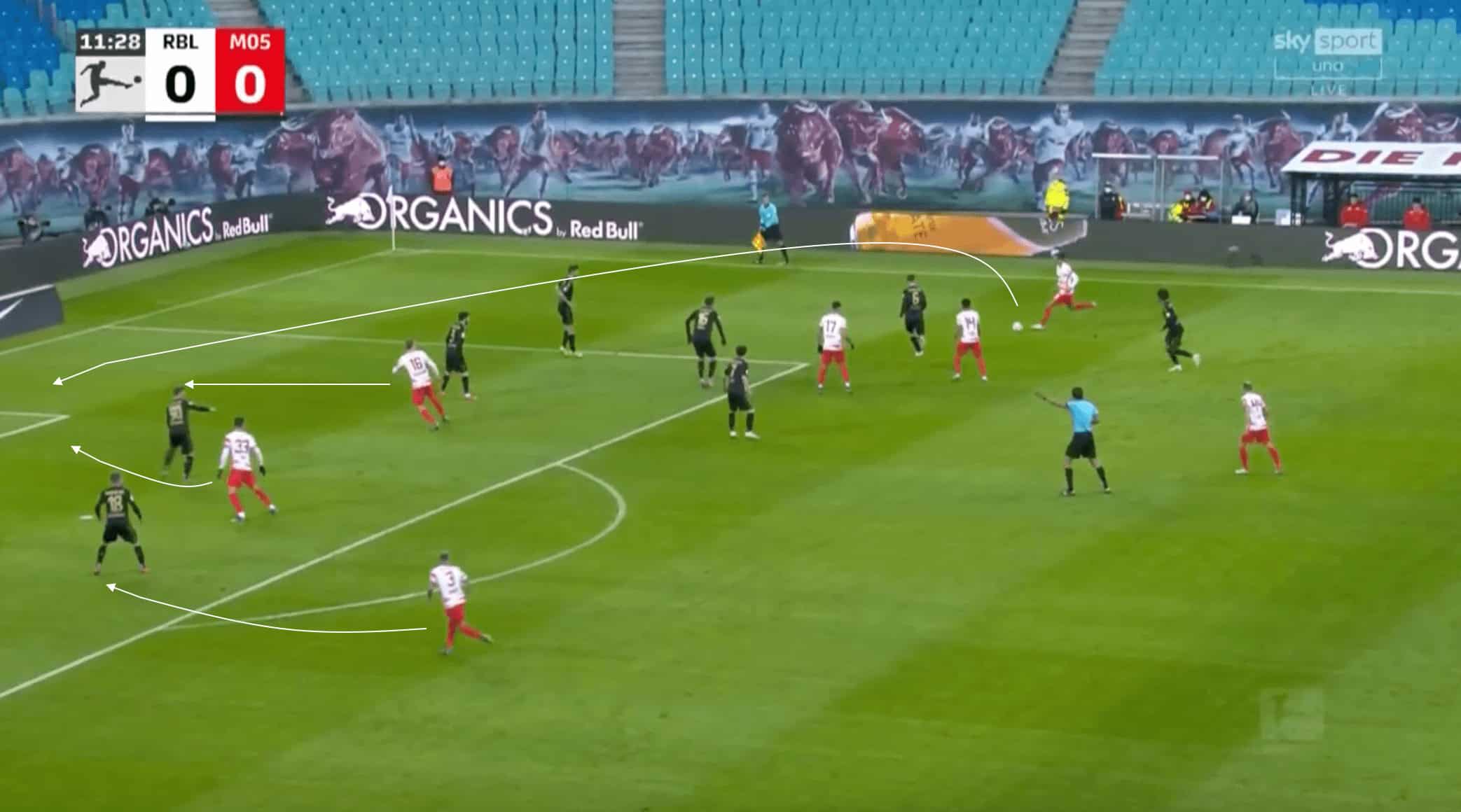
The image above shows a typical example of the types of runs that the Leipzig attackers made into the box last season when crosses were sent in from the wide areas.
Their layering of runs into the penalty box made the German side so successful with crossing accuracy under Tedesco.
The example above is a very good illustration of this from a match against Mainz.
As the ball is played in from the wide channel, the three advanced Leipzig players in the penalty box layer their runs, allowing them multiple opportunities to create a chance.
In this example, Lukas Klostermann is making the near post run, with Andre Silva behind him making the run centrally.
Klostermann makes his run early, which attracts the attention of the defender behind him.
Silva follows suit, with the ball able to find his head.
His ensuing shot is sent just wide of the post.
It is also worth mentioning Angeliño at the back post, who holds off on his run just inside the penalty area.
The stopping of his run allows him a better angle to potentially receive a second ball, as opposed to him running too deep and the ball going out of play on the near side.
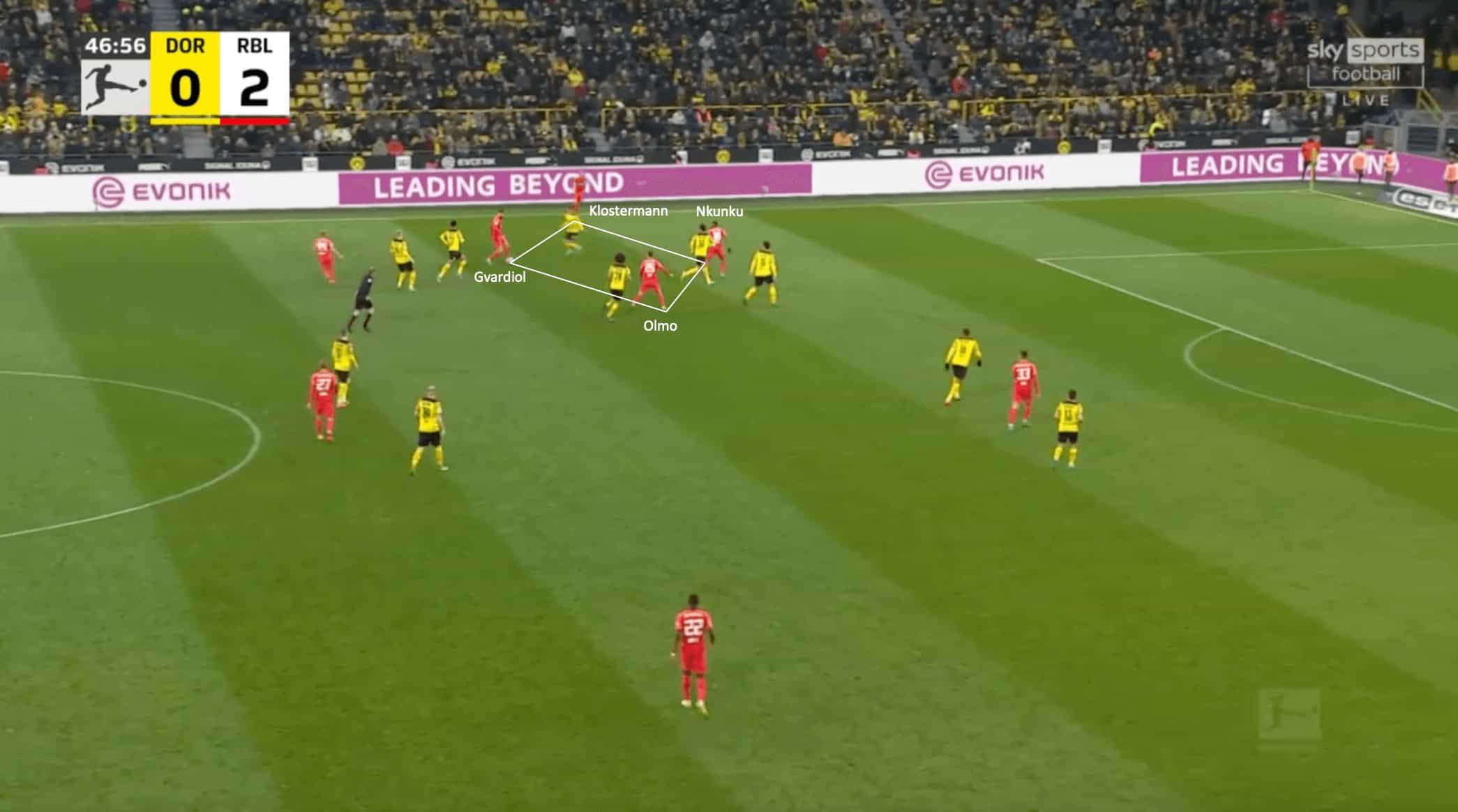
The image above again shows the impact of the centre-backs in Domenico Tedesco’s attacking phases, creating overloads in the wide channels.
Against Dortmund, Gvardiol again progresses into an advanced area with the ball at his feet to create an overload.
While nothing results from this specific attacking phase, it still shows the outside centre-backs’ impact from an attacking aspect in Tedesco’s attacking principles.
This would be unsurprising to see with Belgium, along with the ability for runners to consistently make contact when entering the box on crosses, due to the creation of layers in their runs and movements.
Domenico Tedesco Defensive style of play
From a defensive standpoint, Tedesco prefers to implement a counter-pressing style when possession is lost; however, if they are forced to drop back into a defensive shape, it typically becomes a 5-3-2.

The data visualisation graphic above shows the average height of Leipzig’s defensive line during Tedesco’s tenure in charge.
As it illustrates, the average height of the defensive line was just inside their 18-yard box, but they also maintained a high defensive line at times.
This 5-3-2 shape would occasionally shift to a 5-2-1-2, with Dani Olmo staying a bit further advanced in the defensive phases of play.
Also, at times, that shape would look like a 5-1-3-1, but it could potentially look like a back four as well, with one of the wing-backs tucking inside into midfield.
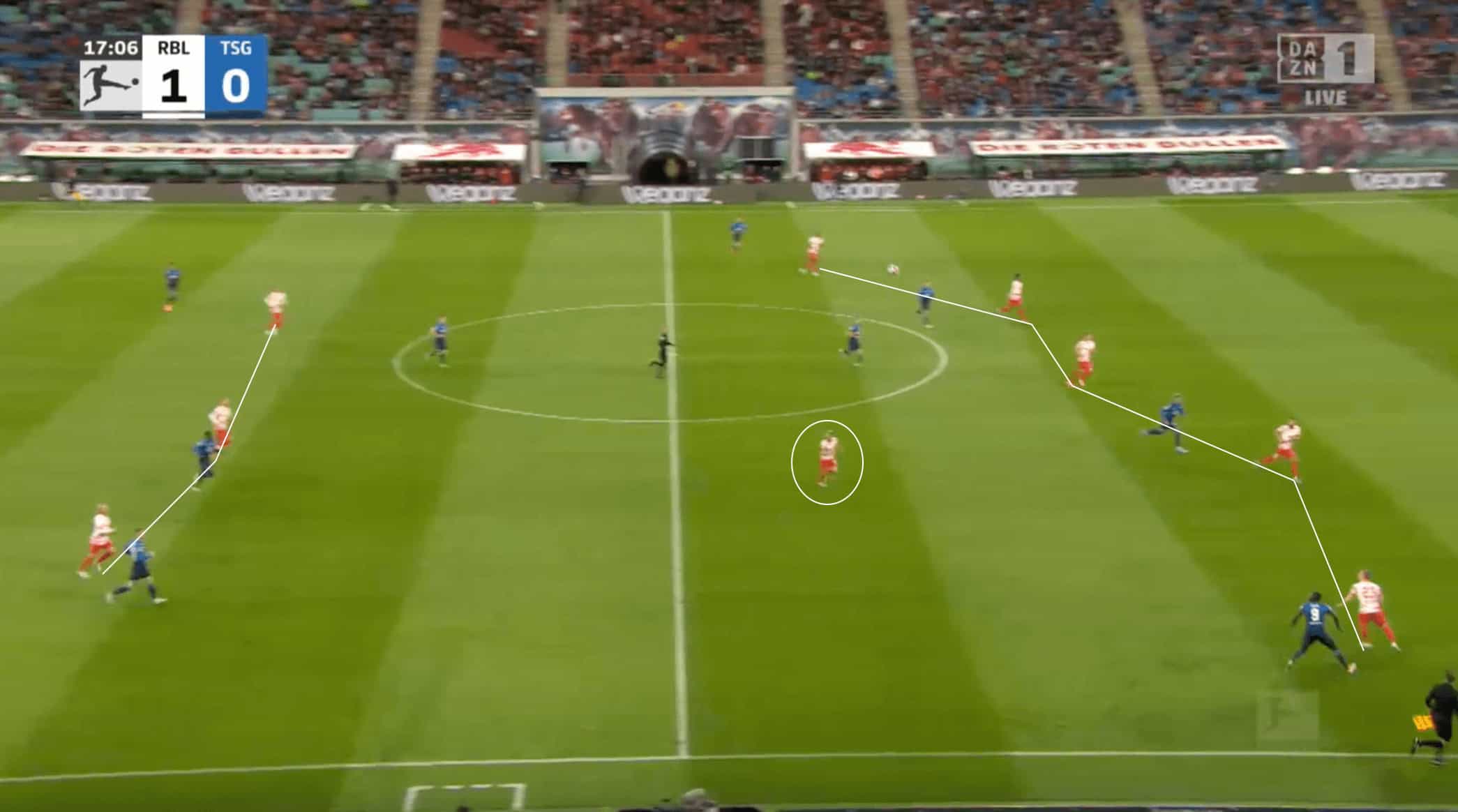
The image above shows an example of the defensive shape that Domenico Tedesco’s Leipzig had at times during his spell in charge.
The Italian-born German manager is not known for his rock-solid defences, and his sides are prone to conceding goals at the back.
The example above from the match against Hoffenheim shows Leipzig in a 5-1-3-1 defensive shape, one of the shapes they would opt for defensively.
In this phase of play, the opposition opted to play long from their goalkeeper, with the right-wing back winning the ball over the Hoffenheim wide attacker.
Kevin Kampl’s positioning in this defensive phase is crucial to Leipzig winning second balls and regaining possession as a result.
In this system, the Slovenian midfielder is offered a free-roaming role, which allows him to move wherever he needs to be to find himself in an advantageous position to win the second ball.
This is what happens here: the second ball falls to Kampl, allowing him to recover possession for Leipzig and start a transitional attacking moment.
In Tedesco’s first Belgian squad, it would be unsurprising to see someone like Everton’s Amadou Onana operate in a similar position to the one Kampl did for the German in Saxony, with Tedesco likely looking to find another Kampl-esque player for this system with Belgium.
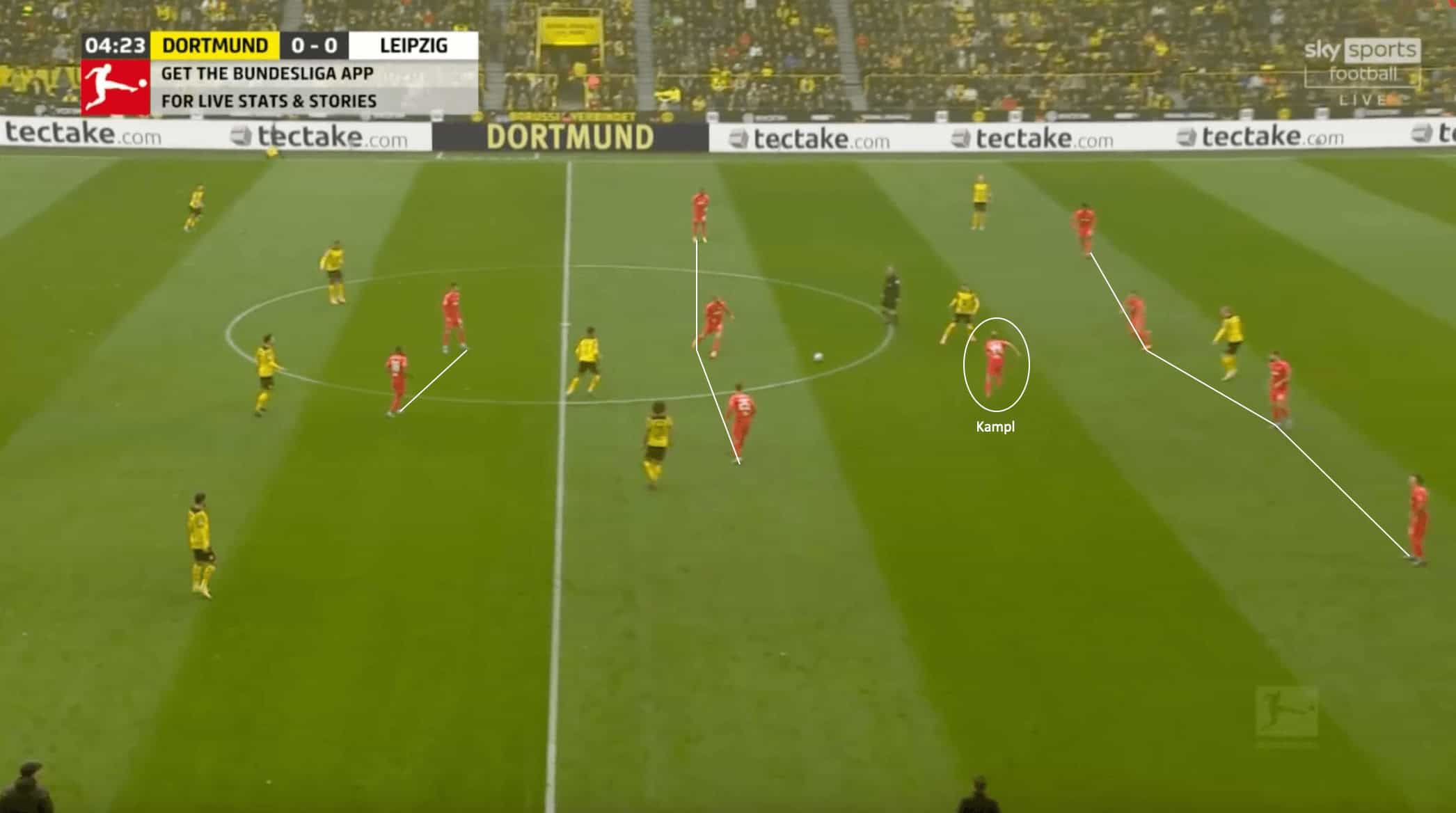
The image above shows another example of Tedesco’s Leipzig side’s defensive shape, this time a 4-1-3-2.
While the formation has changed, one thing has remained constant: Kevin Kampl‘s single-pivot positioning.
The midfielder was a massive cog in Tedesco’s defensive system at the club, and it would be unsurprising if another midfield player became a key player like Kampl.
As mentioned, this player would likely be Amadou Onana, with Kevin de Bruyne and Charles de Ketelaere playing in more advanced midfield positions.
This phase of play shown above is again impacted by the Slovenian, who is able to close down the Dortmund player receiving possession, along with the centre-back who steps out of the defensive line.
All in all, Domenico Tedesco’s defensive style revolves around covering space.
The German manager is not one to sit in a defensive shell when his side is not in possession.
The role of a single-pivot midfielder was also crucial on Leipzig’s defensive side, so these tactical trends would likely transfer to the Belgian national team.
Domenico Tedesco pressing
Another constant with Domenico Tedesco’s style of play is his emphasis on pressing the opposition.
High pressing is commonplace in German football, with Tedesco not being an exception.
Tedesco’s system needs attacking players who will constantly harass defenders when they possess the ball, looking to regain possession in advanced areas to create chances.

The data visualisation graphic above shows the number of high regains, counter-pressing recoveries, and dangerous recoveries that RB Leipzig experienced during Domenico Tedesco’s tenure in charge.
These numbers ranked near the top of the Bundesliga in these categories, with Leipzig consistently looking to pressure opposition defenders when they were in possession.
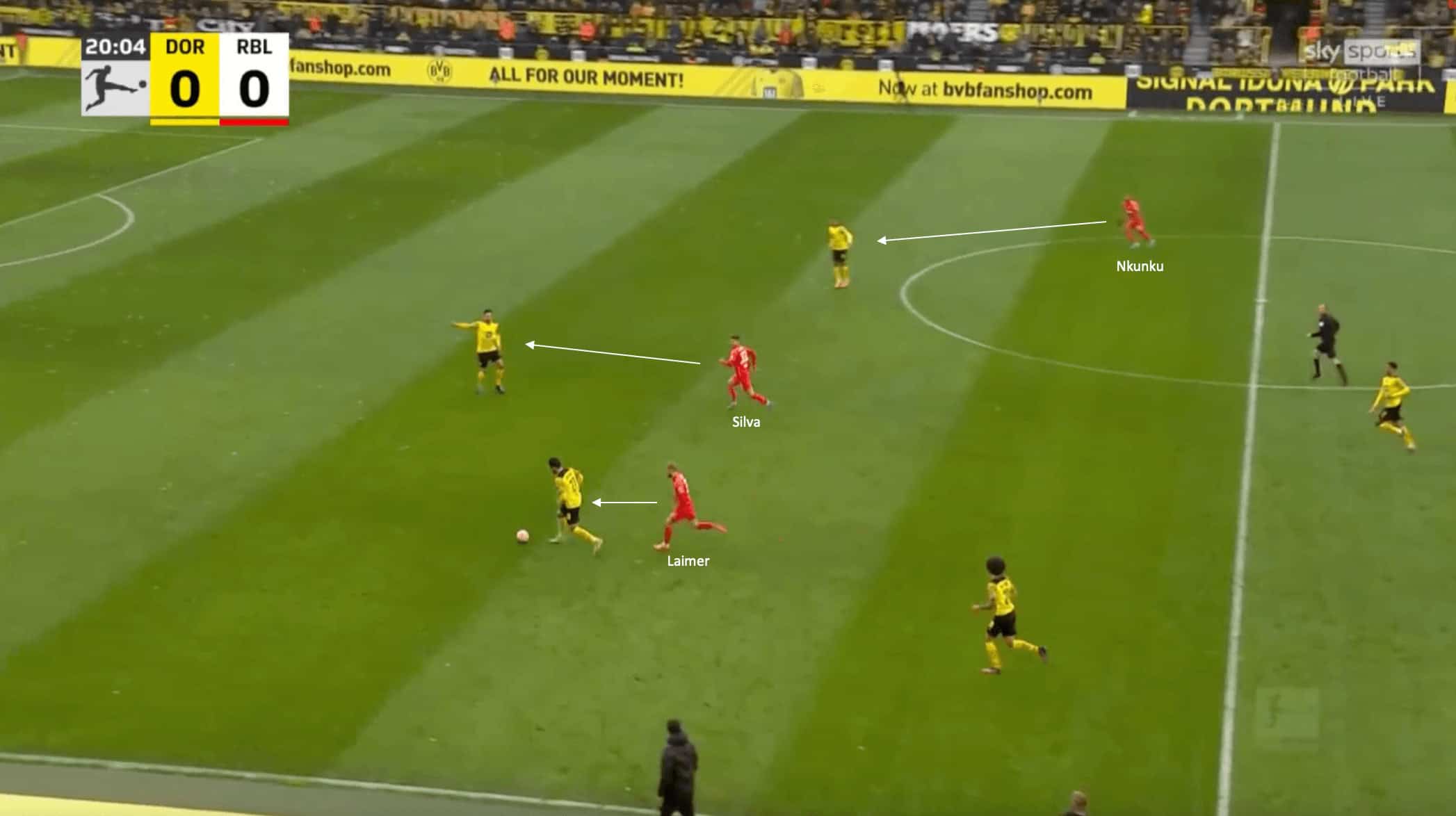
The image above shows an example of the type of pressing triggers that allow Tedesco’s sides to engage the opposition defenders when they are in possession.
In the phase of play above against Borussia Dortmund, the Dortmund fullback receives the ball from a more advanced position and turns with his back to the attack.
This triggers the Leipzig press, with Konrad Laimer getting advanced from his usual defensive midfield position to press the fullback.
Silva and Nkunku join him, with the two forwards closing down the space between them and the defenders to prevent a pass from going to them.
The only option is for the fullback to try and pass back to the goalkeeper, but he is unable to, as Laimer presses him quickly enough to dispose of him.
This pressing situation and turnover in an advanced area led to a goal for Leipzig.
The Saxony side was able to quickly play behind the Dortmund defence, and the ball eventually found its way back to Laimer, who was able to convert from close range.
This example illustrates how Tedesco prefers his sides to press strategically, with them waiting for pressing triggers rather than consistently trying to press high and becoming exposed defensively.
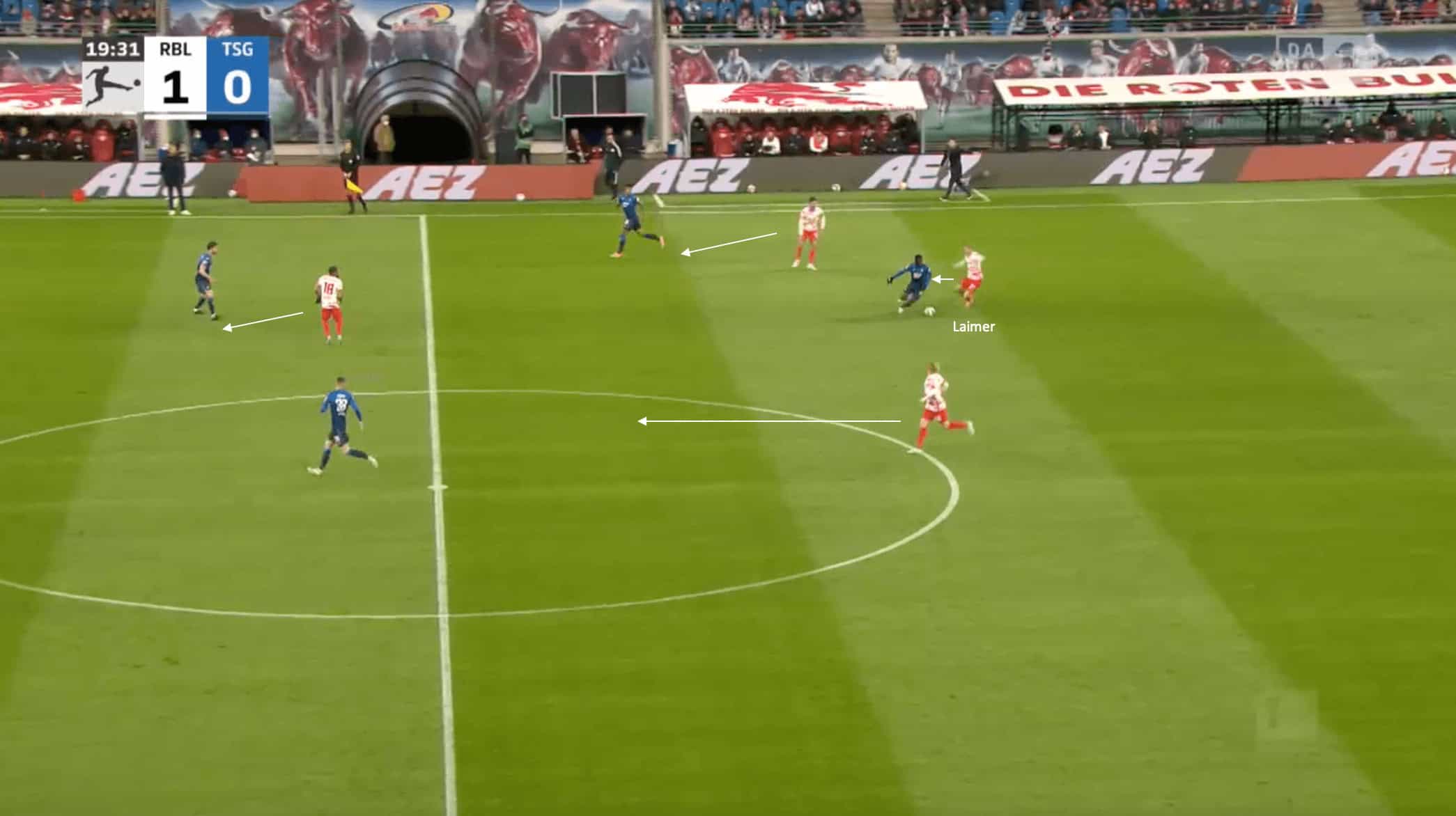
The image above shows another example of a Leipzig counter-press that leads to a goal for the German side.
Like the first example, the Hoffenheim player receives possession and turns away from the pressure, looking to play the ball backwards.
However, Emil Forsberg’s run at the bottom prevents the pass from being played, as it is too risky to be played into this space.
Instead, the forward decides to try and turn with the ball at his feet, but once again, Konrad Laimer is there to dispossess him.
This results in a quick transitional move by Leipzig, with the ball eventually finding the on-rushing Marcel Halstenberg at left wing-back, who is able to coolly slot home.
As this section has shown, Domenico Tedesco’s Belgian side will likely have pressing elements, but they will be based on specific triggers instead of an all-out, anything-goes pressing system.
Another trend throughout this tactical analysis is that Domenico Tedesco relies heavily on his central midfield players for his style of play in all facets of the game.
Therefore, the central players of his Belgium squad will be key to his success.
Conclusion
Some considered Domenico Tedesco’s appointment to lead the next generation of Belgian talent coming through the country rather fascinating.
However, as this tactical analysis has shown, it could be a very good fit for the way Belgian fans want their national team to play.
They don’t have long to wait, as Tedesco’s first match in charge, against Sweden in Euro 2024 qualifying, kicks off this Friday, before hosting Germany a few days later.
This being Tedesco’s first foray into international management, it will be interesting to watch how his side performs throughout the qualifiers and how he transitions to the international game.
