
This is a difficult season for RB Leipzig, which lost head coach Julian Nagelsmann and had key players leave during the summer.
Fresh faces such as Jesse Marsch from RB Salzburg and Achim Beierlorzer returning from Mainz 05 joined the team, as did new players André Silva, Joško Gvardiol, Mohamed Simakan, and Benjamin Henrichs.
However, things did not go according to plan.
They never looked like a side that could challenge for second place in the Bundesliga, and they were knocked out very early in the UEFA Champions League group after losing to Manchester City and PSG.
Therefore, the higher-level authority of Leipzig decided to react by parting ways with Marsch.
Soon, they appointed Domenico Tedesco as the new head coach and handed him a contract until June 2023.
In Tedesco’s first three games, he obtained 1W1D1L, which was not particularly impressive, but interesting tactics were behind it.
Compared to Marsch, who did not constrain his approach by formations, Tedesco was relatively consistent on a 3-5-2 formation, which also achieved good performance under Marsch.
This tactical analysis gives an early look at how Tedesco would transmit his philosophy and ideas into the team based on the first three games before the winter break.
3-2 or 3-1?
According to media reports, some said the players were not comfortable with Marsch’s very vertical approach.
In the offensive organization, they lost some of the positional dynamics, rotations, and rhythm that were demonstrated under Nagelsmann.
Tedesco added a structure to the team to give Leipzig more control in the match, compared to Marsch’s rather direct approach, which led to more transitions in the final third.

In the first two games, Tedesco played his team in a 3-4-1-2, which means there were two 6s in the second line.
Against Armenia Bielefeld, he opted for a more aggressive approach by playing a 3-1 shape in the construction phases, pushing Tyler Adams to higher spaces with Dominik Szoboszlai.
Both were tactically important as they provided solutions for encountering different opposition shapes and thus created progressive methods for advancing the attack.
We give a big picture of the positions of players in the first image.
Interpret this as a 3-2-1-4 as the wing-backs could be high, depending on what Tedesco was expecting.
Sometimes, Angeliño provided the offensive height on the left side, pinning the opposition wide defender, and rarely dropped back to help.
Then, Leipzig vacated the left-sided spaces in the central third to organize the attack.
Intriguingly, as suggested by Kevin Kampl and Adams’ positioning above, the 6s might not be disciplined to stay centrally.
Instead, one of the 6s could, usually Kampl, would operate wider and Leipzig were flexible to shift between a 3-1 and a 3-2 shape.
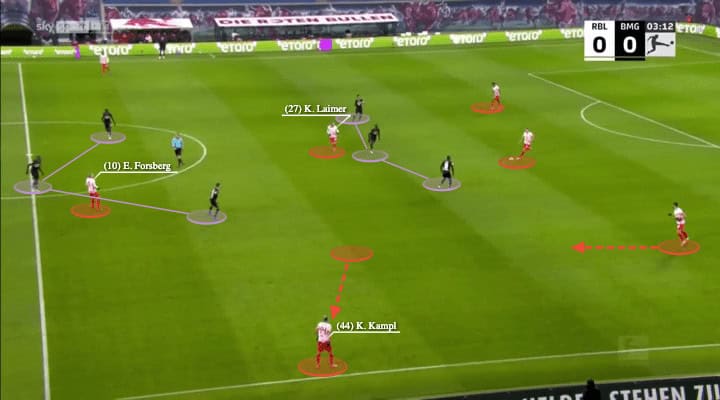
Tedesco wanted his back three to invite the opposition’s first line to the centre, which would then open other spaces on the pitch for attack.
In the above situation, Borussia Mönchengladbach initially played with a 4-diamond-2, but it became a narrow 4-1-2-3 when they matched the back three.
It was a 4v3 numerical advantage, as Konrad Laimer operated behind the first line, pulling the striker down to give Willi Orbán spaces to pass.
The 10 of Leipzig’s 3-4-1-2 or 3-3-2-2 had an important role in manipulating the second line.
With his off-ball movements behind the opposition midfielders, he should drag that midfielder down to open spaces for his teammates.
So, in this instance, the Mönchengladbach wide midfielder was late to press Kampl as Emil Forsberg appeared in the left half-spaces.
He must be covered before jumping out to press Kampl, or else Leipzig could go vertically in the half-spaces.
Note that it was also a 2v1 overload on Jonas Hofmann if the first pass broke the first line.
This numerical superiority was another concept we would explore in the next example.
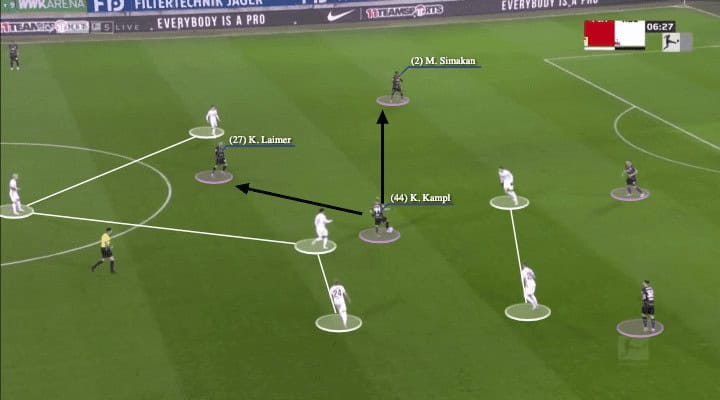
Leipzig wanted to have the 2v1 overload on the weaker side, and use that “+1” advantage to move the ball forward.
Let’s see how they did that against Augsburg’s 4-4-2.
The opposition was forced to change into a 4-1-3-2 as Forsberg was behind the second line.
When that happened, the linkage between the two opposition midfielders was cut, and they could not cover each other.
Therefore, it was a great advantage when Kampl received in the centre.
Firstly, Simakan freed himself because of the 3v2 advantage in the first line, two Augsburg strikers were unable to cover three centre-backs.
As Laimer was around to help, it became a 2v1 overload on the right side against the opposition left-winger.
The free player became obvious to search for, and Leipzig could play out from the back.

In the first two games, the Leipzig wing-backs stayed quite high to push the last line down, extending the block vertically and creating more spaces for the players in the construction phases.
Particularly, they liked to go out from the left side as Gvardiol was a very talented progressor, who had good passing skills and the physical strength to carry the ball forward.
In this example against Augsburg, who adapted into an asymmetrical 4-4-2 or a 4-3-3 shape, Gvardiol demonstrated his ability to bring the ball forward.
It was still a 3-2 structure in the middle, as Laimer and Kampl fixed the opposition midfielders in the centre.
This was important as now the Croatian defender had a 1v1 versus the opposition right-winger. Gvardiol had enough quality to beat the opponent.
He should go to the white spaces created by the position of Leipzig 6s.
Another prerequisite to create this circumstance was the 3v2 in the first line, which was explained above with the use of three centre-backs.
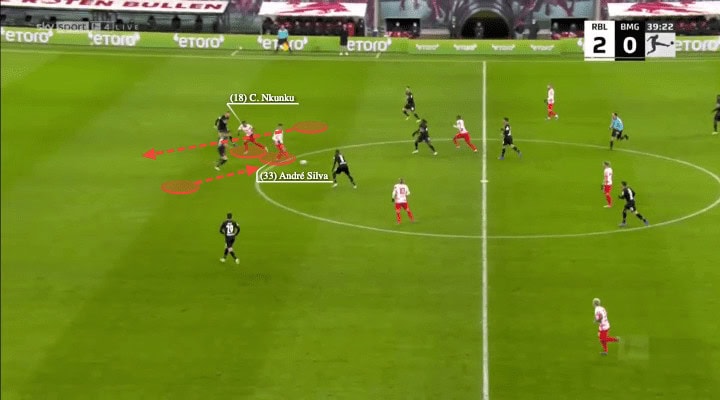
Apart from the 3-2 or 3-1 structure, Leipzig also improved the coordination of two strikers.
Under Marsch, they also frequently searched for the attacking depths with Silva’s runs, but even in a two-striker system, the front line lacked chemistry, and they could not maximize the threat of this approach (we explained their difficulties in this analysis).
Tedesco just added little elements to allow his strikers to create a better dynamic in the attack.
In the second phase, Silva now showed up behind the opposition’s second line more to receive the ball at feet, but this was never an individual movement.
Two strikers versus two centre-backs was a 2v2 situation, which could result in isolations and separations.
When Silva dropped, his partner, mostly Christopher Nkunku, must be facing the opposition goal and made a run behind.
This reversed movement between the two strikers would pose a question to the centre-backs: To follow which guy? They must decide as the Leipzig strikers were going in a reversed direction, and they must also be aware of Nkunku’s pace and 1v1 ability.
In addition, the 10s of Leipzig played an important role in manipulating midfield positions in a 3-1-2-4 or 3-3-2-2.
If they had a 3-1 structure in deeper spaces, such as in this situation against Arminia Bielefeld’s 4-2-3-1, the Leipzig 3-1 dragged the front four high to open spaces between the opposition 3-1 and 2.
Also, they were playing with deeper wing-backs to stretch the 3 of the 4-2-3-1 so they could break the line in the left half-space to connect Silva.
Again, you can see Nkunku’s body angle and behaviours, which are the coordination explained in the previous example.
In that positional structure, the most important thing was to use the two high 10s to stretch the opposition midfielders so Silva had space to turn.
Look at Szoboszlai and Adams’ above, their positionings served this well.
High pressing & blocks
Regardless of the coach’s choice, one thing about Leipzig’s football was inarguable: pressing.
Against the ball has been the core identity of this club since Ralf Rangnick implemented the style, and his successors, including Ralph Hasenhüttl, Nagelsmann, and Marsch, all valued this aspect of the game.
Therefore, even though Tedesco’s Schalke 04 only ranked 7th in terms of PPDA in 2017/18 and 10th in 2018/19, his Leipzig must be more proactive without the ball, and we saw some interesting pressing in these games.
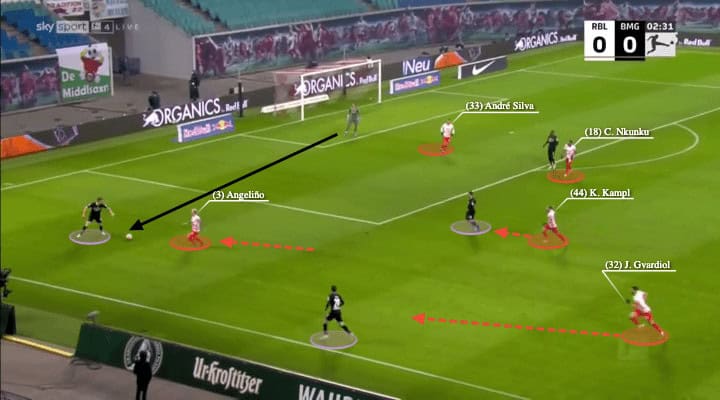
Both Marsch and Tedesco pressed high with a 3-5-2, using lateral passes, backward passes, and passes to the outside defender as triggers, but Tedesco’s approach was better, and they constrained the build-up of Mönchengladbach to a large extent.
The difference was the compactness.
Under Marsch, Leipzig’s block was loose, as the far-side player did not move into the centre enough to stay compact. That’s why the opponents had more time and space to look for a passing option and get out.
Also, the players were not close enough, they could not support and cover each other.
Comparatively, Tedesco’s Leipzig pressed in a different shape to make the shape more compact.
As shown in the above image, you could interpret the first line as a 1-1 instead of two strikers staying in the same horizontal chain.
Silva was usually the man higher while Nkunku should cover the 6 under his shadow.
Intriguingly, the wingbacks, mostly Angeliño, went very high to press the centre-back. This was a bold approach as it would leave the wide Mönchengladbach defender unmarked.
However, the situation was also well-planned, as Tedesco instructed the wide centre-back to join the press high, with the rest of the backline shifting.
Also, Leipzig’s 6s could come up and close the opponent’s 8s in the high press.
They kept a man around every short option of the centre-back, and more importantly, the block was compact as they were only defending on one flank.
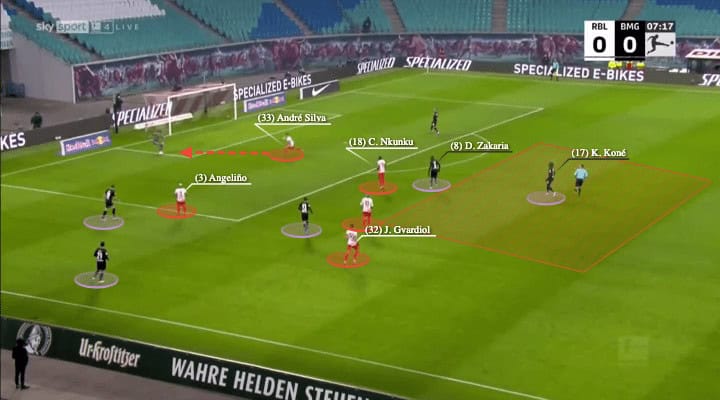
The above image was another instance of the Leipzig high press.
Silva was usually the player who went all the way to press the goalkeeper.
This was an important tactical concept of Tedesco since his Schalke 04 tenure.
Instead of being merely high in a block, he wanted his players to close down the opposition’s paths by coming from a specific direction.
For example, Silva went from Yan Sommer’s left side to force him go right, where Leipzig had players waiting for the pass.
The next step of Leipzig’s pressing was to close the red spaces.
They would need better control of spacing and aerial performance to deal with longer passes of the opponents.
There were many ways to solve the problem, such as applying the press to force a lower-quality out-ball or developing players’ consciousness, agility, physicality, and timing to turn and close that space when the opponents chipped the ball forward.
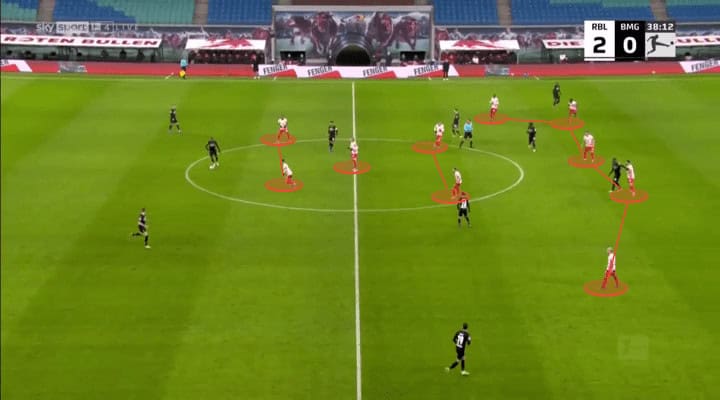
In a midblock, Leipzig spent many efforts to defend the centre with their 5-2-1-2 or 5-1-2-2 shape.
For example, in this situation against Mönchengladbach, you could see the wingbacks were very narrow or even closed the half-spaces; they added numbers centrally.
The midfield positionings were pivotal, too, as they were defending spaces, which means they should not orient themselves towards an opposition.
Even the Mönchengladbach 8s were stretching them in the half-spaces.
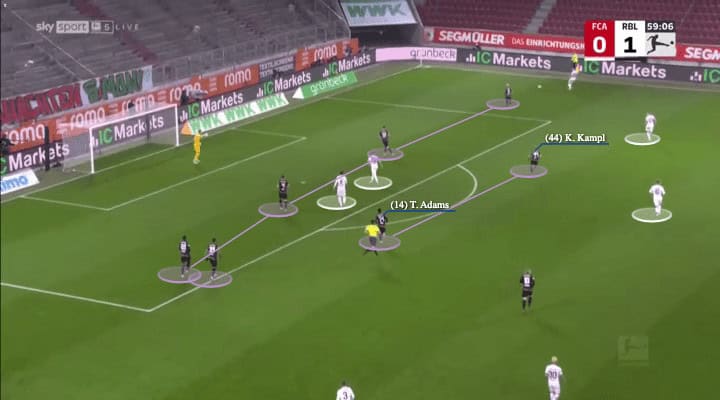
Structurally, the 5-2-1-2 might be a small concern when the opposition dragged away the 6s.
Since they tended to keep a 1-2 shape or at least two strikers in the rest offence, the protection of spaces in front of the last line was not enough.
Here, they conceded a long shot at the edge of the box as Kampl and Adams were apart; it was a 1v2 on the right side.
Conclusion
This was not a completed Tedesco team, as he only had limited time after his appointment.
Hopefully, the winter break gave time to rest, and injured players such as Forsberg and Yussuf Poulsen could return soon to provide competitions.
The squad was very young, and sometimes they were not mentally strong enough, being fragile.
The more experienced players, such as Silva, Lukas Klostermann, and Forsberg, should take responsibility for leading the squad and helping the young players.
If the consistent level was there, they could still challenge the UEFA Europa League and the top four in the Bundesliga.
We will also see more from Tedesco in 2022!
