
Union Berlin come into this season off the back of a very successful campaign, where they finished 5th in the Bundesliga, missing out on qualification to the UEFA Champions League by finishing one point behind RB Leipzig. Berlin had the third-best defensive record in the league, conceding only 44 goals. Still, their inability to be more efficient in front of goal meant they ultimately had to settle for the UEFA Europa League.
This tactical analysis will take the form of a scout report that explains the tactics behind Union Berlin’s strong start to the season, both in attack and defence. This analysis will show how Union Berlin has outplayed their opponents, the reasons behind it, and what we can expect from Urs Fischer‘s men by the end of the season.
Union Berlin Lineups And Formations
Union Berlin have lined up in a 3-5-2 for almost every game this season, with their match against Bayern Munich the exception, when they played a more cautious 5-4-1. The Bundesliga leaders have played in a very direct manner, averaging 42% possession, which leaves them 17th in the league in that regard. In this style, both strikers are tasked with running down the channels and serving as outlets for the team. The midfield line is very compact, which allows them to run onto loose balls knocked down from long balls. The two wing-backs stretch the opposition and are responsible for being the creative sparks in the team.
The team shown below is the one that started against Wolfsburg, with Baumgartl making his debut whilst the others had all been regulars this season.

Urs Fischer Build-Up And Direct Progression
In the build-up phase, Union Berlin have been one of the most direct teams in the league. Rather than playing through the press, Berlin looks to bypass it by going long to their two strikers, with Jordan Pefok being the main target as a 6-foot-2″ focal point. Union Berlin have the 5th least valuable squad in the league, so it’s not overly surprising that they try to hide the lack of technical ability required to play in tight spaces, by playing the ball over the press.
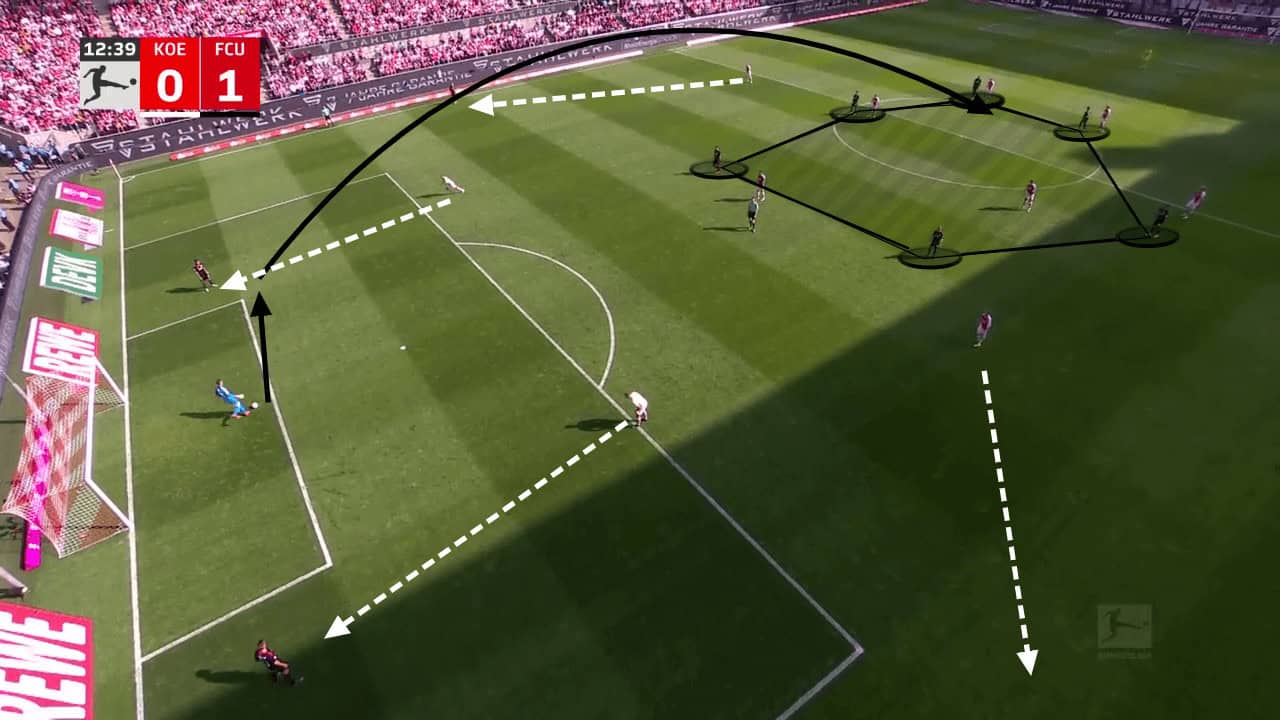
While Berlin does go long from goal kicks, they have at times made a short pass before going long, luring opposition players and opening up space for players further up. The image below highlights Berlin’s desire to go long and have lots of players ready to win second balls from the flick-on. This is a risky tactic, as the back line is very open; if Union doesn’t win the aerial duel, they could be instantly vulnerable to a counterattack.
The pass map below, from Ronnow, the goalkeeper, shows a preference to go long on goal kicks most of the time. You can see the clear instruction from the boss: aim for the forward players. This map only shows completed passes, too. There have been many more that were unsuccessful.
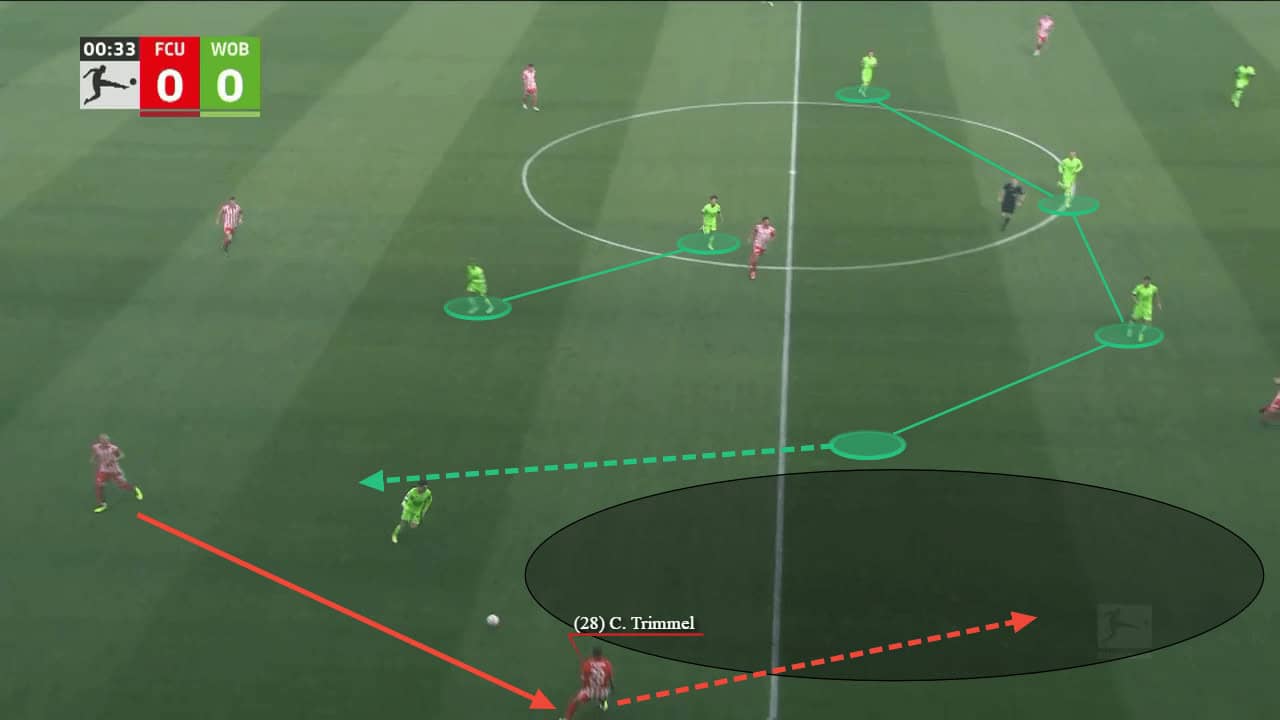
When Union Berlin manage to gain possession of the ball in settled play, their central defenders have managed to successfully retain the ball and allow Berlin to get some control of the game. Berlin’s back three has been extremely effective against teams that defend with a front two. A 3v2 means that there is always a spare player, who has time to either pick out a pass or drive into the open space ahead of him.
In this case below, Baumgartl was pressured to prevent him from carrying the ball up the pitch, which opened up space for Trimmel, who had lots of space to receive the ball and carry the ball towards the opposition box.
Below is the pass map from the recent match against Wolfsburg. Both the map and the links clearly show the number of passes the back three make to each other, compared to any other player on the pitch. Knoche is responsible for moving the ball from side to side, shifting the defensive block, and finding the spare man on either side. This shows that Berlin can be comfortable on the ball, though under intense pressure, their central defenders do not seem as composed.
When the opposition press is more intense, the Union Berlin back line have to be capable of playing the ball with excellent quality over long distances. In settled play, Berlin have often used a 3-1-6 formation, where both central midfielders and wing backs push up to the last line, whilst the holding midfielder stays to help with the build-up. This system is perfect for Berlin’s direct style, as the defence always has the option to go longer, and four players in close proximity can challenge for the second ball should the ball be played centrally.
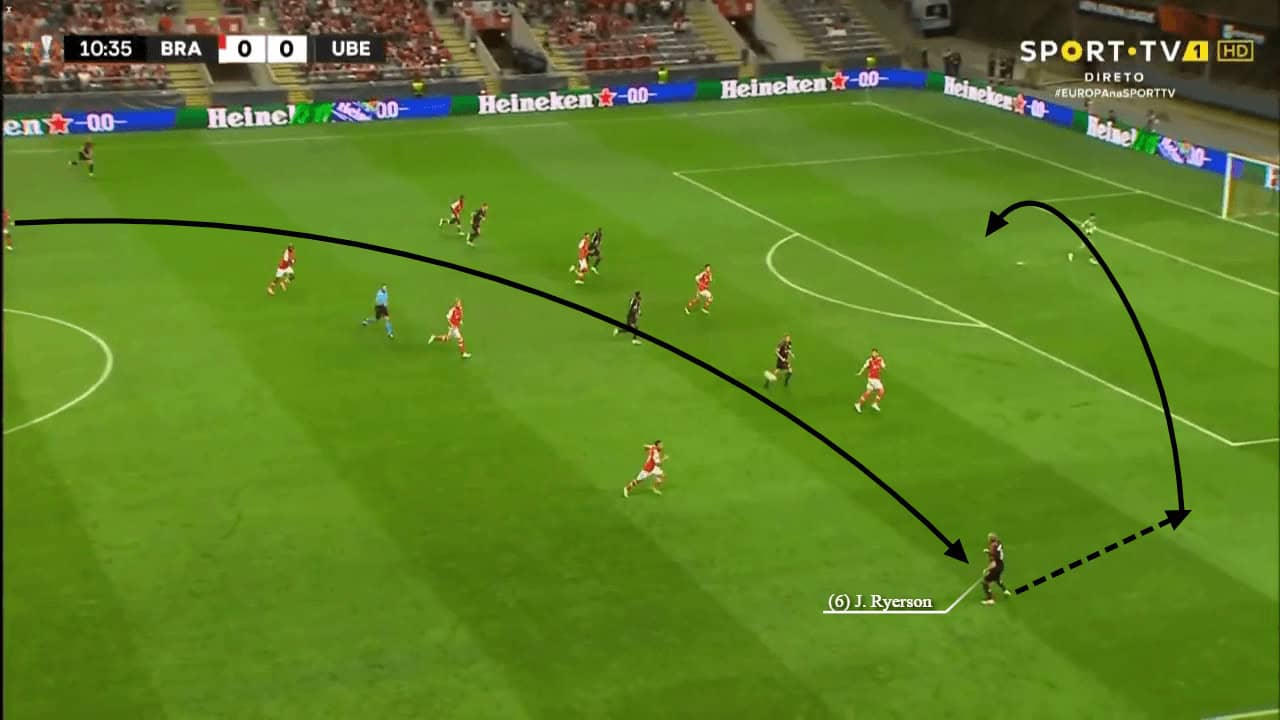
In the image below, Diogo Leite plays a good lofted pass to the wing-back, whose cross is blocked. Ryerson will be disappointed, as there was a 4v4 in the box if the cross had been a little better. The diagonal pass instantly takes three Braga players out of the game while simultaneously giving Union Berlin a dangerous chance.
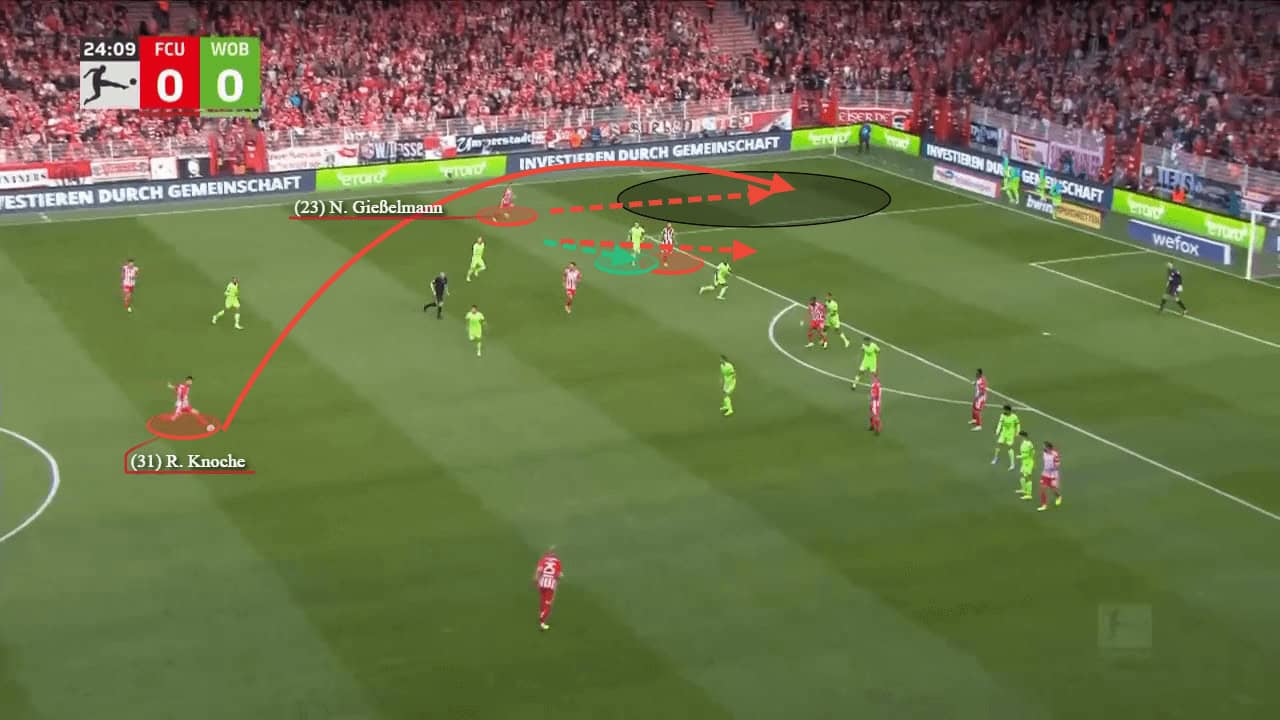
Below, we can see another example of Union Berlin’s central defender opting to go long to their wing-backs rather than attempting to play the ball between the lines. Usually, long balls are more likely to be difficult than short passes, so there is a chance that this move isn’t always going to come off; however, when it does, Union Berlin always has a large number of bodies waiting in the box.
To add to this, Urs Fischer has also instructed his offensive midfielders to constantly make off-ball runs, creating space for the wing-backs and allowing his midfielders to get into better scoring opportunities at the same time. The run from the LCM allows Giesselmann to have lots of space on the left flank to control the ball and pick out a cross.
Effectiveness In The Final Third
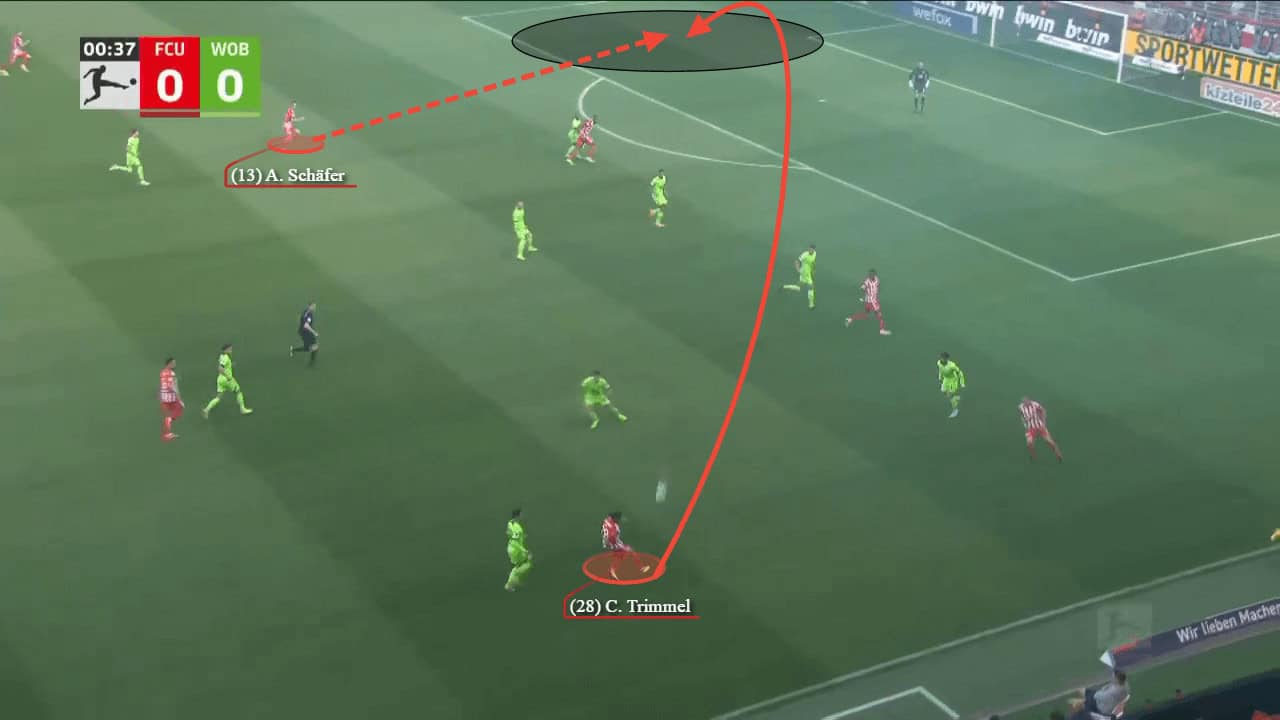
A big part of Union Berlin’s success in front of goal, and the reason for 15 goals in 7 games, is the sublime crosses that their wing-back can regularly pick out. Berlin boast the best crossing accuracy in the Bundesliga, with a 45.4% success rate. These crosses, especially deep ones like the one shown below, create dangerous opportunities from areas that don’t seem threatening.
We can see Trimmel making an early cross from a very deep position towards the back post. This cross floats perfectly into Schafer’s path, who directs his volley goalwards. In this scenario, Berlin purposefully underload the side the ball is on in order to have more players attacking the box and an overload on the opposite side of the pitch.
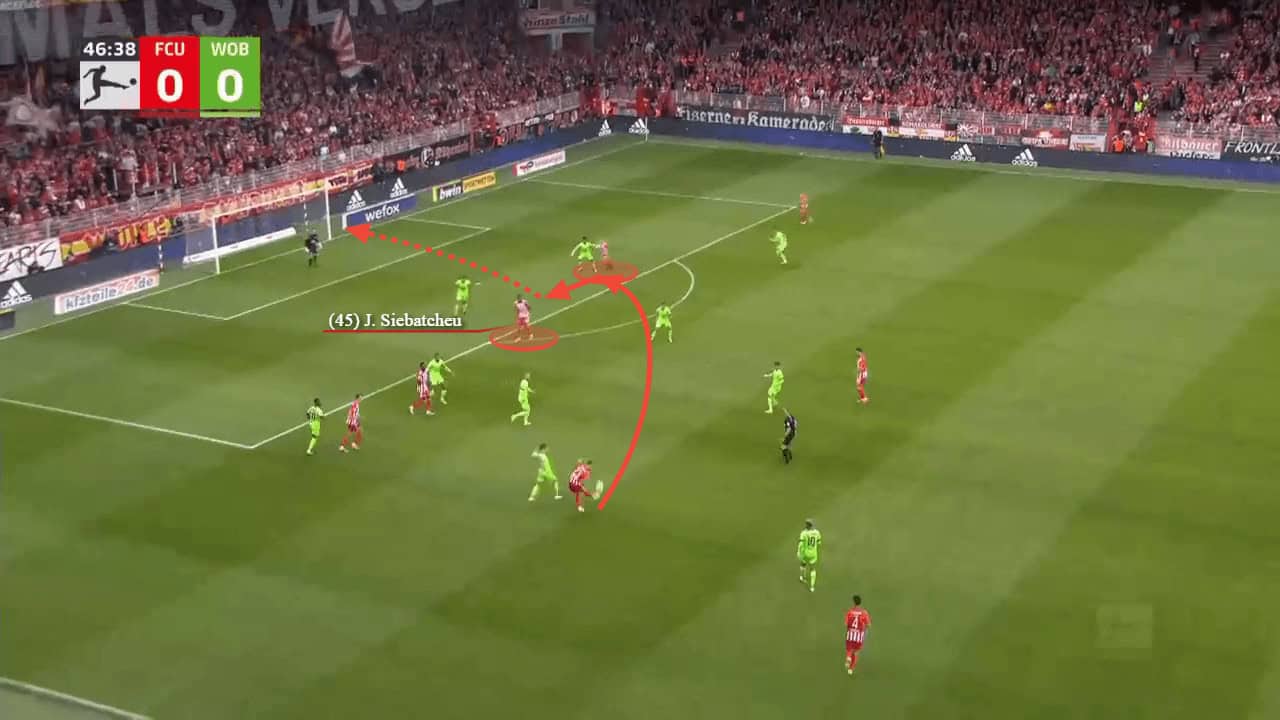
Union Berlin have also been unpredictable due to their ability to switch up the ways they get the balls into the box. Rather than starting out wide, Giesselmann cuts inside onto his right foot and plays a pass into the box. The central channel has gaps, as the Wolfsburg players were ready to run down the channel to prevent the cross.
Playing the ball centrally means that there are more options than if you had the ball in a wide area. Schafer receives the delivery and can lay it off to Jordan, who misplaces his shot wide of the post. The in-swinging delivery from deep also makes it difficult for the defender to get ahead of Schafer and intercept the ball as he would have to run the risk of going straight through the back of Schafer, and giving away a penalty.
One more factor that has made Union Berlin so dangerous is their threat in transition, given the pace and power of their front line. Playing in a 3-5-2 means the two front players are right up the pitch, closer to the goal and to each other when the ball is won back.
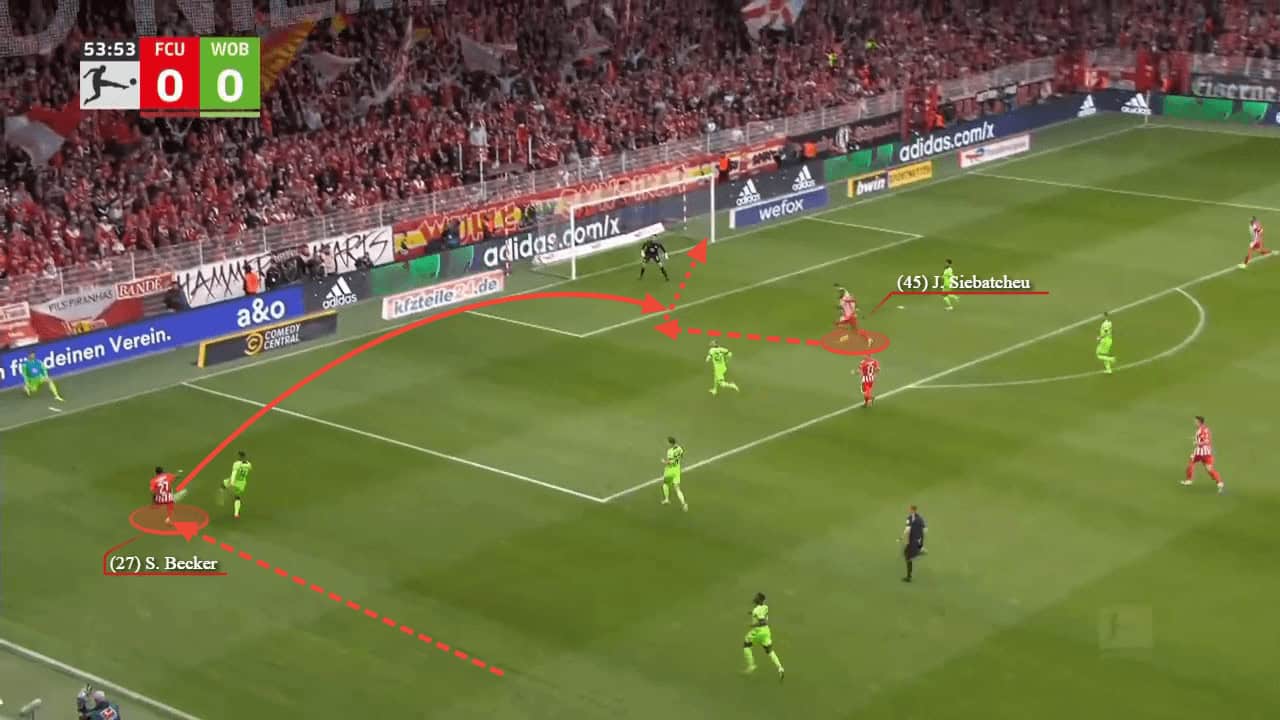
The image below illustrates how high up the pitch the front pair is, meaning they are ready to run off the last defender’s shoulder. In this scenario, Jordan Pefok (Siebatcheu) waits in the pocket of space whilst Becker makes a run in behind.
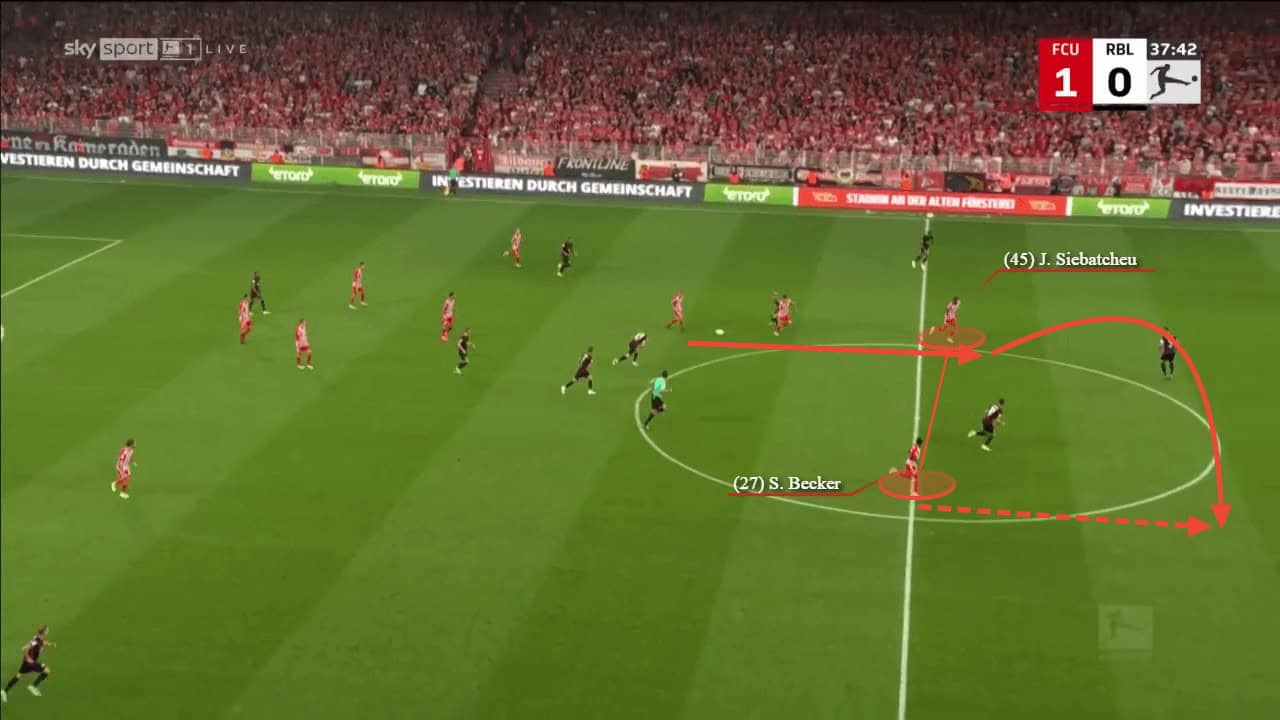
The next frame shows how just two passes after winning the ball back have already led to a very dangerous situation. Becker uses his quick feet to unbalance the defender one way, before cutting inside onto his left foot and curling in an effort into the top left corner to double the lead against RB Leipzig.
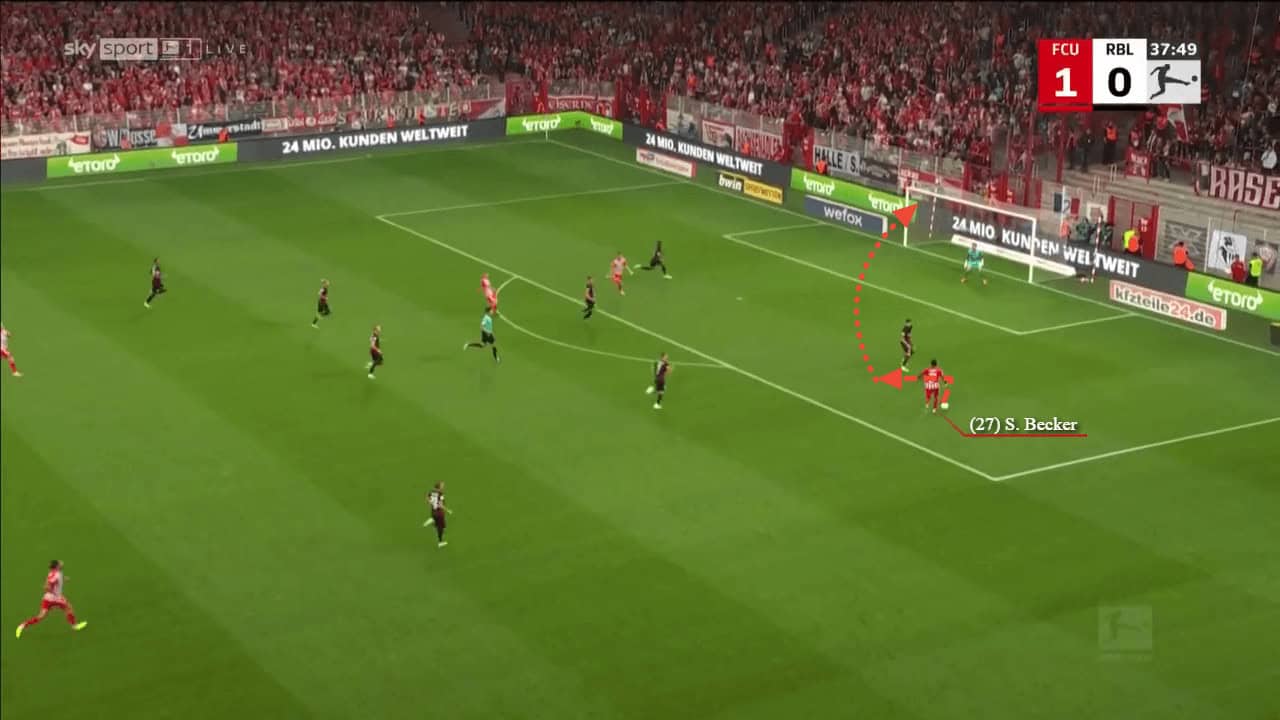
Sheraldo Becker has been a massive reason why Berlin have managed to score so many goals on the counter. The 27-year-old has 10 goal contributions and has single-handedly caused problems on the counter for most teams he’s played against.
In the image below, we can see him in a very dangerous crossing position, one he has reached thanks to his excellent dribbling and off-the-ball runs during the offensive transition. Becker has also been a creative spark for the club, with this delightful whipped cross for Jordan Pefok to head into the bottom corner with ease.
Sheraldo Becker has consistently been scoring difficult chance after chance. Not only is there pressure when leading a counterattack and having defenders chasing after you, but it is also something that isn’t easy for a player who has never been the goalscoring outlet for his team. Nevertheless, Becker has risen to the challenge, and the xG map below shows just how efficient he has been.
Pressing From Dead Ball Scenarios
A big part of why Berlin has been so tough to beat is that they try to press the opposition when the ball is not yet in settled play. In these scenarios, each Union Berlin player has the time to match up to their opponent and force the goalkeeper to launch the ball long. Berlin’s central defenders are more than happy to challenge for aerial duels and win the majority of them.
Impenetrable Mid-Block
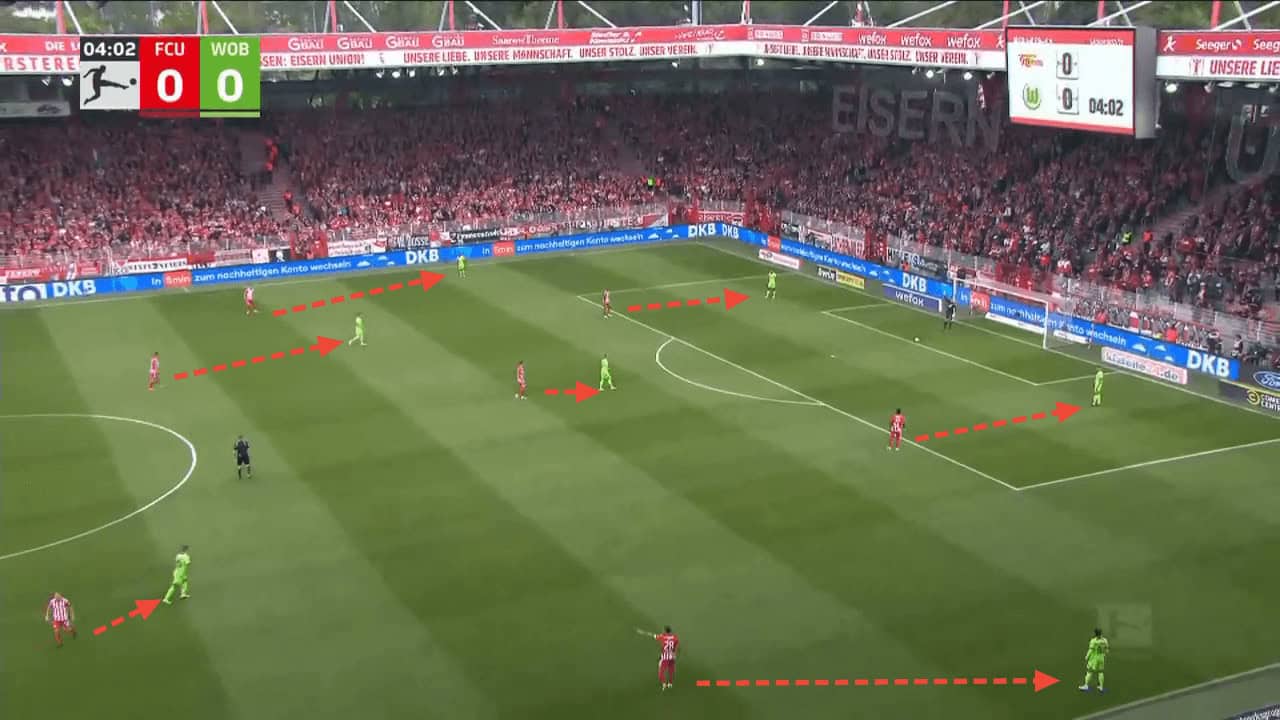
Union Berlin currently have the best defensive record in the league, having only conceded 4 in 7 games. This is the key reason why they are currently top of the league, and Urs Fischer has done an excellent job at making Berlin tough to play against. He has utilised a 5-3-2 mid-block, one that is compact in the centre, forcing opponents to play down the flanks. The vertical distance between the lines is also minimal, ensuring that no player can receive the ball in the pockets.
Union Berlin are happy to let the opposition team’s central defenders keep the ball, and their pressing triggers are the opposition’s full-backs. When the full-back receives the ball, the wide CM applies pressure, forcing him to rush the play. The two strikers shuffle over, cutting out any central option and forcing the player to pass it wide. In these situations, Fischer has encouraged his defensive players to be very aggressive and stick tight to their men, preventing them from turning on the ball.
Berlin does leave space behind as a result. Still, it doesn’t matter, as the tight marking ensures that the Wolfsburg player is either dispossessed or forced to pass backwards, giving the Berlin backline time to return to their original positions.
This excellent defensive structure has meant that they have allowed less than 1.0 xG per game, even after facing Leipzig and Bayern Munich. Teams can’t find gaps, so even though Berlin may only average 42% possession per game, they control the space in which the game is played.

Conclusion
This tactical analysis has displayed exactly why Union Berlin have been so strong in the first part of the season. Urs Fischer’s tactical solutions have made Union Berlin extremely tough to play against, and increased performance in front of goal has allowed them to soar to the top of the Bundesliga table. If the front line can keep up the scoring run they are on, they can match last season’s achievements and maybe finish a spot higher, but that will be a difficult task given the other teams competing for the same places.
Union Berlin have been unsuccessful at the start of the Europa League campaign, although it seems as if the league is the priority for the head coach. If they turn their attention to the cup tournament, they may be in with a small cup run, though it’s unlikely they’ll get near the trophy, given the strength of some of the other teams.
