
Christoph Baumgartner has emerged as one of RB Leipzig’s top performers during the 2025/2026 Bundesliga season.
With 14 goal involvements in just 16 games in all competitions, the attacking midfielder has showcased his quality in the final third.
After Xavi Simons left for Tottenham Hotspur this season, the Austrian has picked up the mantle and has become the creative outlet for Ole Werner’s side.
Baumgartner has also expressed his intention to stay at the club, ready to shape an important era; the groundwork has already begun, with Leipzig in second place behind Bayern Munich.
Through this Christoph Baumgartner scout report, we aim to examine Christoph Baumgartner’s style of play and determine how he can contribute to his side’s potential success.
Christoph Baumgartner Style Of Play In Attack
In this section, we will talk about the attacking side of Baumgartner’s play.
Christoph Baumgartner Progressive Passing & Dribbling
The Austrian has 3.54 progressive passes per 90 minutes this season, thus far.
Being responsible for the majority of his side’s creative actions, Baumgartner is frequently involved in playing line-breaking passes from the midfield third and from within the attacking third.
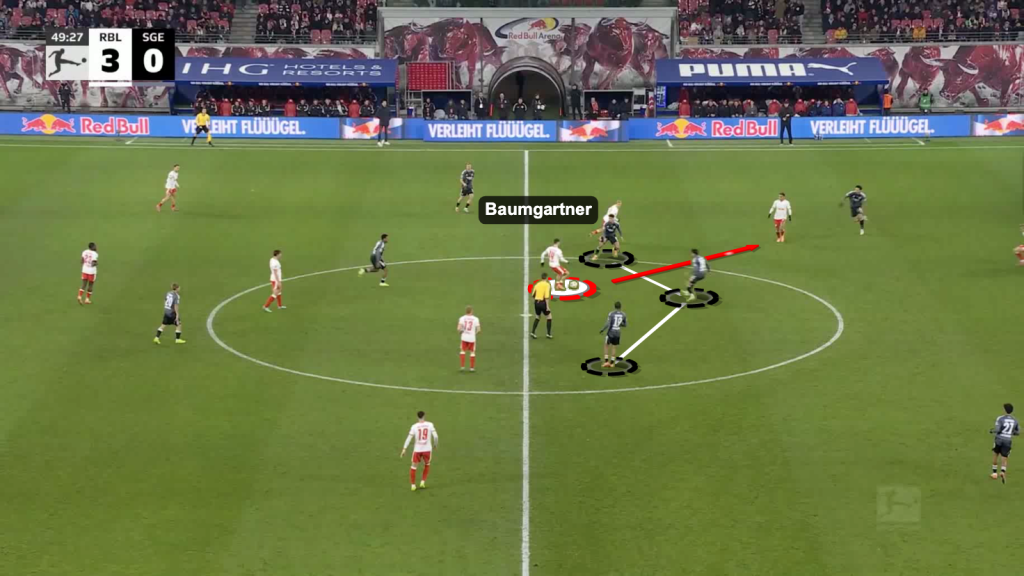
Baumgartner breaks his opponent’s line of midfield with a penetrative pass.
This takes multiple opponents out of the game, giving his side an advantage in attack.
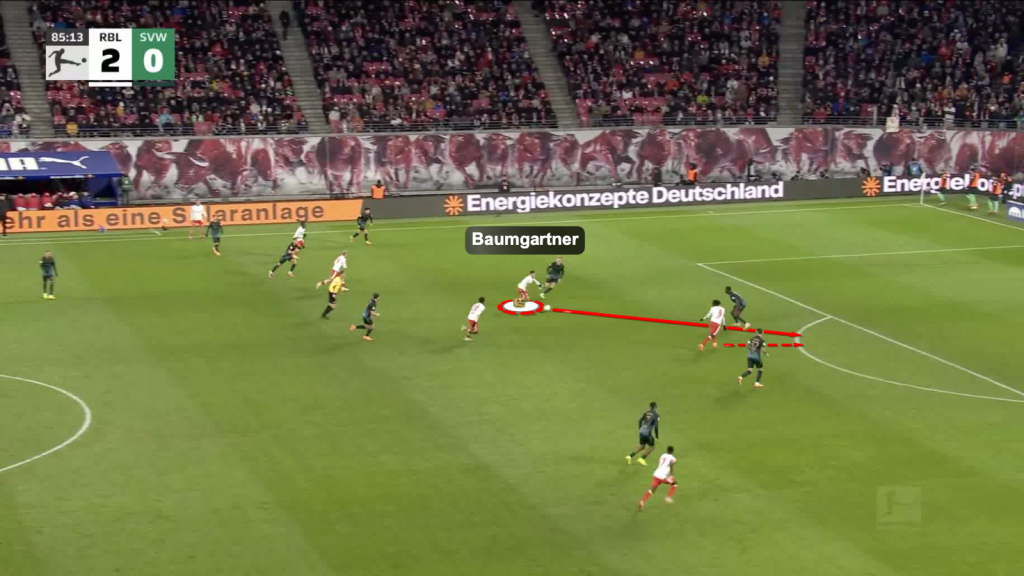
The Austrian makes a final pass into the attacking third.
With a well-timed run from his teammate, Leipzig are through on goal.
The Austrian is adept at playing killer passes in-behind. It is aptly showcased by his assist against Eintracht Frankfurt.
The striker (Conrad Harder) drops to set to Baumgartner; as Harder starts making the run in-behind, the Austrian plays a chipped through ball right into the striker’s path.
Harder meets it with a header to clip it over the goalkeeper.
Baumgartner has also made 1.56 progressive carries per 90.
Although not the usual suspect for aggressive ball-carrying with his limited pace, the Leipzig attacker contributes to the cause during transition moments.
In situations where his side has enough space to exploit, Baumgartner carries the ball into space, drawing nearby defenders before he can offload and move into a good attacking position himself.
In this video, he picks the ball up in his own defensive third and carries it all the way through the mid-third, helping his teammate make a final third entry.
Christoph Baumgartner Actions Between The Lines
Christoph Baumgartner contributes significantly to his side between the lines.
Playing as an attacking midfielder, he is less involved in build-up play, but rather higher up the pitch, where he occupies pockets of space between the lines.
He has recorded 3.85 progressive receives per 90 so far this season.
The areas he received these passes in range from the central channel (between the lines) to half-spaces and wide areas.
Although the Austrian thrives in tight spaces, he occasionally drifts wide to increase numbers in the wide channel.
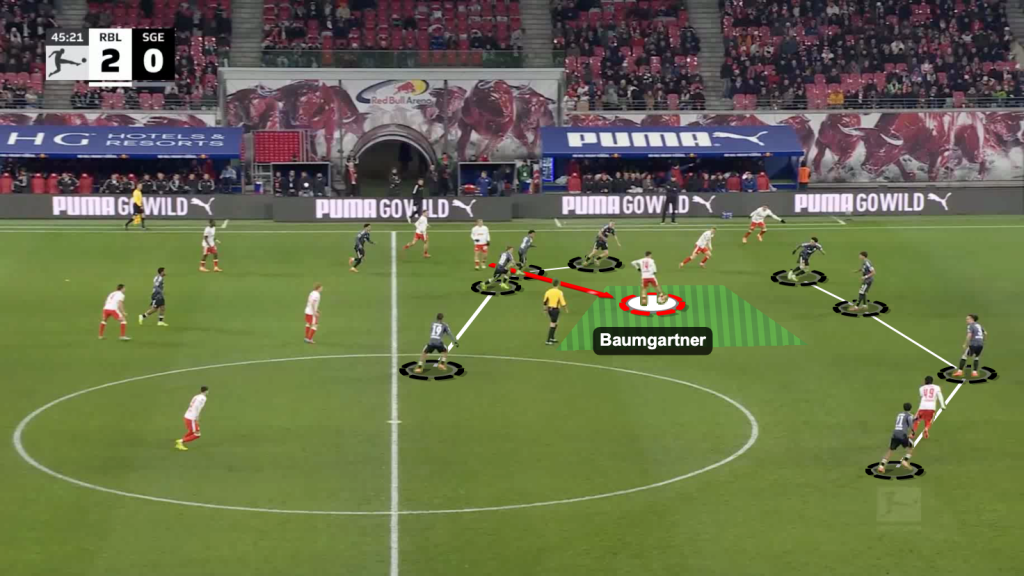
Christoph Baumgartner receives between the midfield and defence lines.
He positions himself well for these situations with an open body shape.
This allows him to play vertically when the option is available.
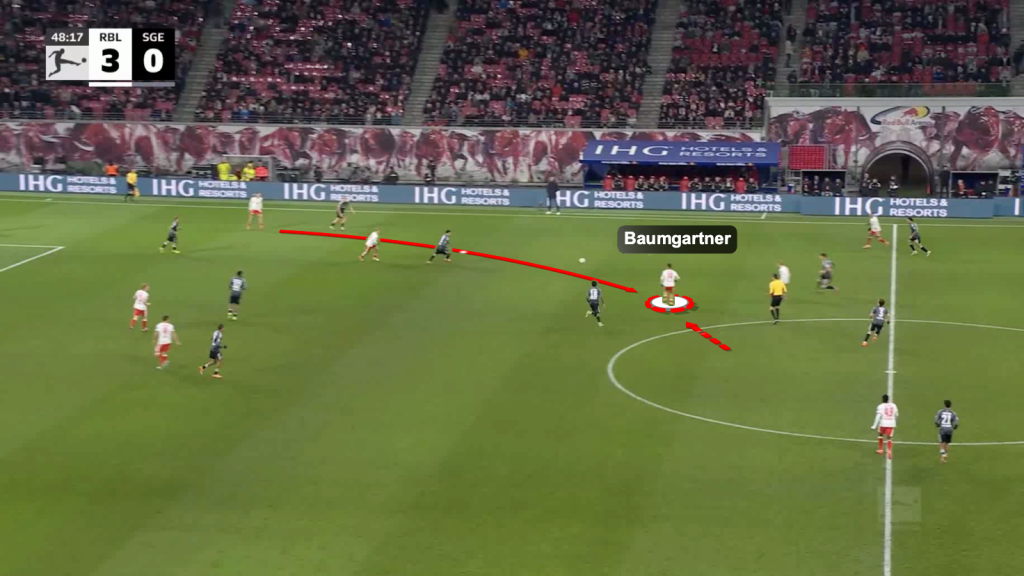
Although not very common, the Austrian does drop deep to offer support when bypassing the opponent’s first line of press.
He is clever enough to notice the disconnect between the opposition’s lines of pressure.
Dropping at the right time, he receives a line-breaking pass from his left-back (David Raum).
He has showcased similar activity in the half-space, especially in the attacking third.
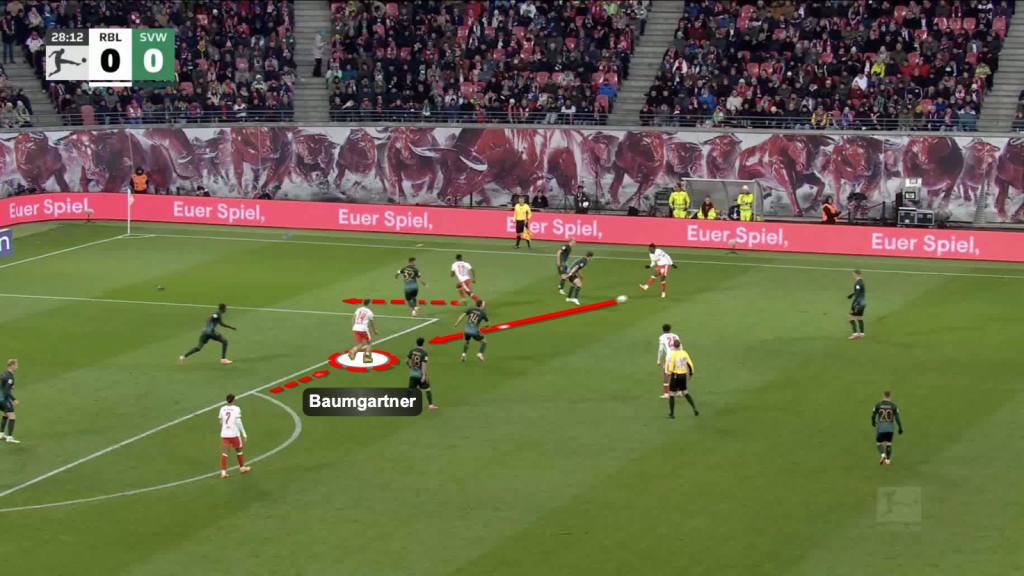
The winger moves away from the ball, dragging a defender with him.
This opens space for Christoph Baumgartner to step in and receive.
An attacking midfielder like him receiving the ball in such pockets of space tends to open up more space in the attacking third with enough movement from the surrounding players.
Moving in to support at the right time is essential for Baumgartner to have access to space for a moment longer.
Another notable action from Baumgartner, between the lines, is his ability to create combination plays.
He is frequently orchestrating one-twos and third-man combinations.
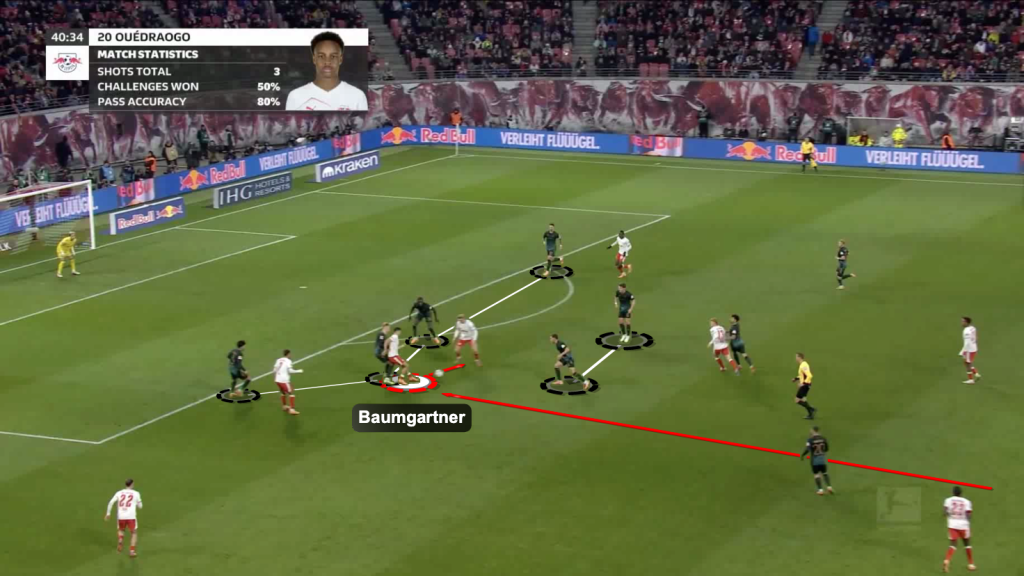
Third-man combination engineered by Baumgartner.
The Austrian receives a vertical pass between the lines in the attacking third.
With immediate pressure on his back, he lays it off to a teammate in the same pocket of space.
Creating these layoffs is an effective way of holding on to possession in tight areas after receiving a vertical pass.
It is particularly challenging because receiving with back to goal in front of the opposition back line invites them to jump and stick a tackle in.
In these scenarios, playing on one-touch helps ward off pressure.
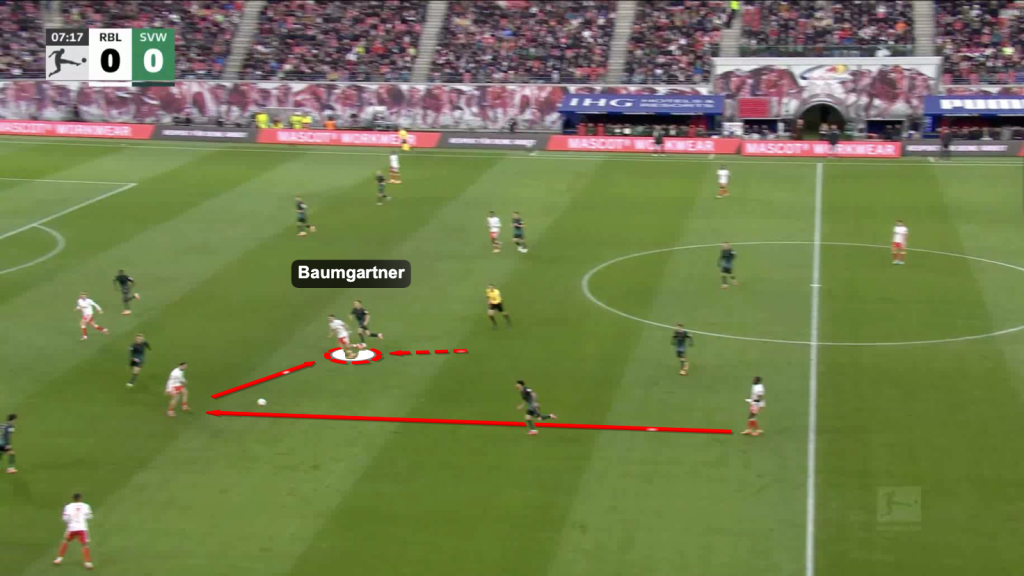
Similar to cushioning the vertical pass to a teammate in the vicinity, running onto a layoff is crucial, as it relieves the initial receiver of pressure.
Baumgartner gets into both situations regularly.
Instead of receiving from his centre-back directly with back to goal and immediate pressure on his back, he decides to move into space to receive a third-man pass facing the goal.
This allows him to play vertically with more frequency.
Baumgartner’s clever decision-making allows him to create the most out of the service he gets.
Let us look at his assist against Augsburg.
Leipzig start a nifty one-touch move in the central channel with angled passes to penetrate the opposition and finally find the finish.
Assan Ouédraogo finds Baumgartner in zone-14; the Austrian sets it back to him for a first-time finish.
The point of interest is the detail behind the final exchange.
Initially, Baumgartner has space on his blind side; however, once the pass from Ouédraogo comes, the opponent defender immediately closes him down.
The attacking midfielder, being aware of this, plays a set pass at a slightly different angle.
This opens enough space for an unopposed touch and shot.
Baumgartner’s winner against Hamburger SV showcases his ability to find combination plays in the tightest of spaces.
Upon receiving a vertical pass inside the opponent’s structure, Christoph Baumgartner realises the blind side pressure.
In an adept display of awareness, he finds his teammate (Rômulo) to play a one-two with.
Beating the initial pressure with the link-up and another opponent being dragged by Rômulo opens enough space for the Austrian to take a touch into space before applying the finishing touch.
Clever link-up play is rewarded the most when the opponent applies uncoordinated blind side pressure. However, realising the situation before the ball arrives is crucial.
Had Baumgartner failed to release the ball on one touch, the attacking move would have collapsed.
Christoph Baumgartner Box Positioning & Arrival
Apart from contributing to link-up play and vertical passes, Baumgartner can also help his team by getting on the end of attacking moves.
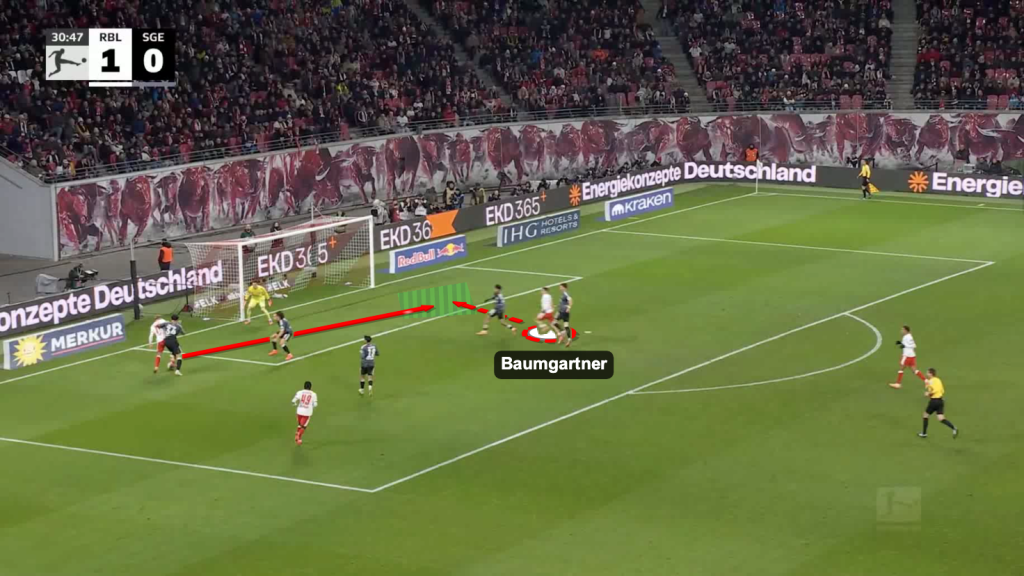
His goal against Frankfurt substantiates the point.
Leipzig release their striker (Harder) in an attacking transition moment.
The Dane waits long enough for Baumgartner to crash the back-post to meet his low cross for a tap-in.
The goal, although it looks straightforward, is an apt showcase of the Austrian’s off-the-ball movement.
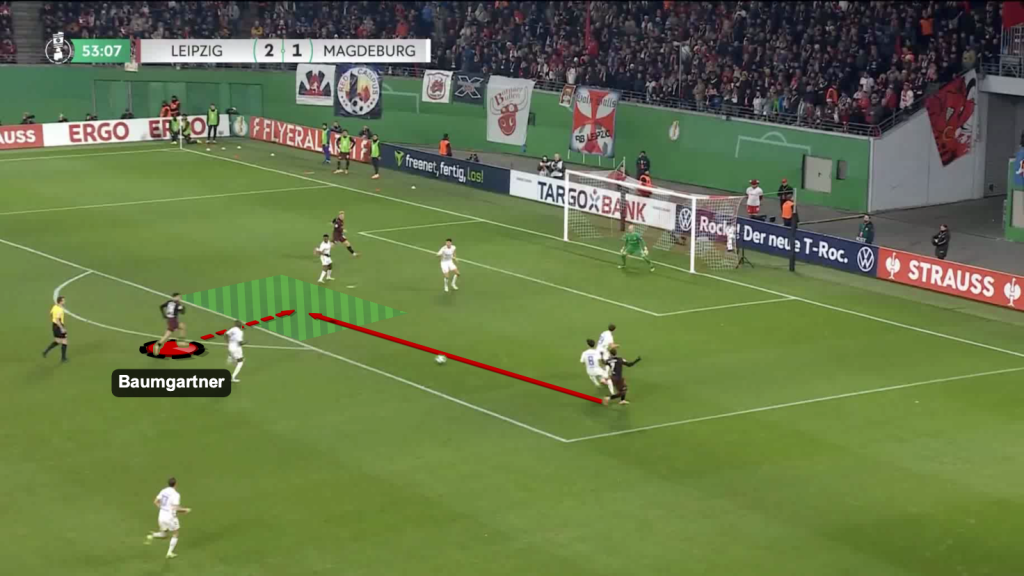
In another example of box arrival, we look at a goal from the DFB Pokal game against 1. FC Magdeburg.
Antonio Nusa is released on a counterattack.
Upon making the box entry from the right side, he plays a square pass into Baumgartner’s path.
After receiving the ball just inside the penalty area, the Austrian slots it into the net with ease.
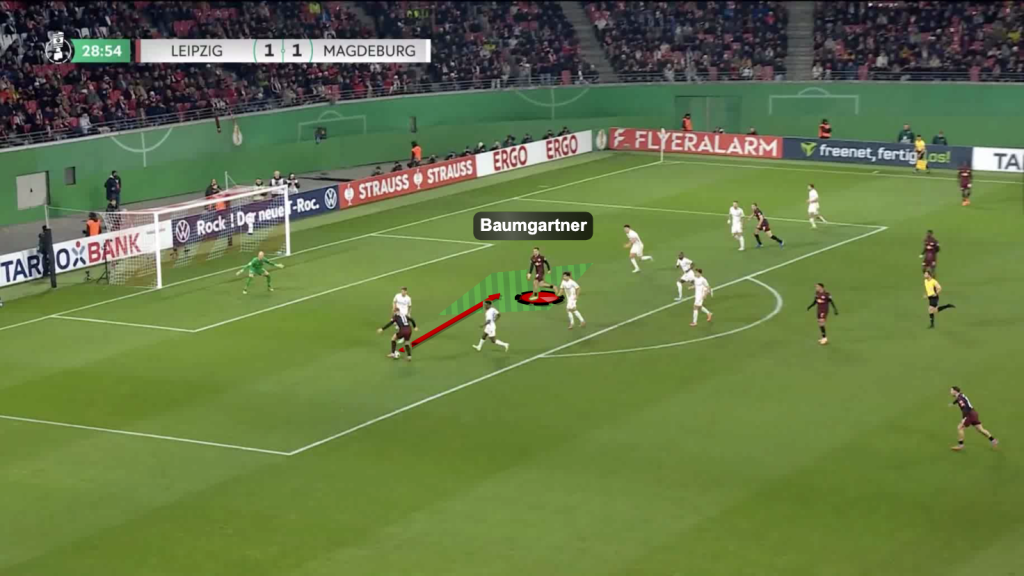
Another goal from the same game shows the opposition’s defensive structure is out of shape.
Baumgartner capitalises as he receives right in front of the goal for a comfortable finish.
His presence in the penalty area is not limited to finishing on the ground.
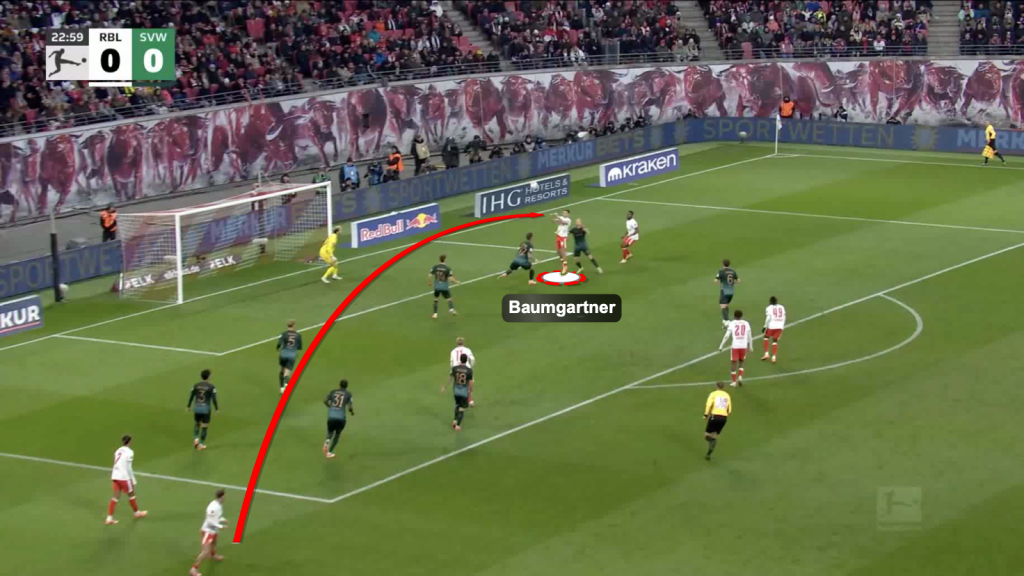
Baumgartner gets his head to a cross from Raum.
He has won 42.9% of his aerial duels this season, which is a modest number.
However, it is an avenue he can explore every once in a while.
His headed goal against Hamburger SV can serve as motivation to bag even more.
Baumgartner can also drift wide to disrupt the opponent’s defensive structure.
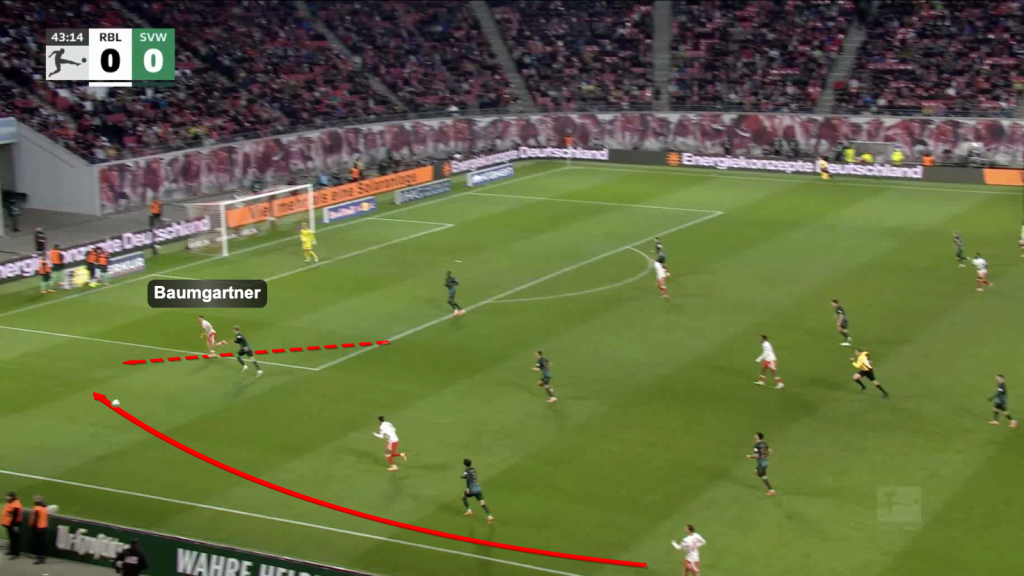
In a situation where no central passing lanes were open, the Austrian made an underlapping run into the wide channel.
This does not give Leipzig immediate penetration; however, it gives them an opportunity to attack depth.
Christoph Baumgartner Style Of Play In Defence
In this section, we will talk about the defensive side of Christoph Baumgartner’s play.
Group Defensive Actions
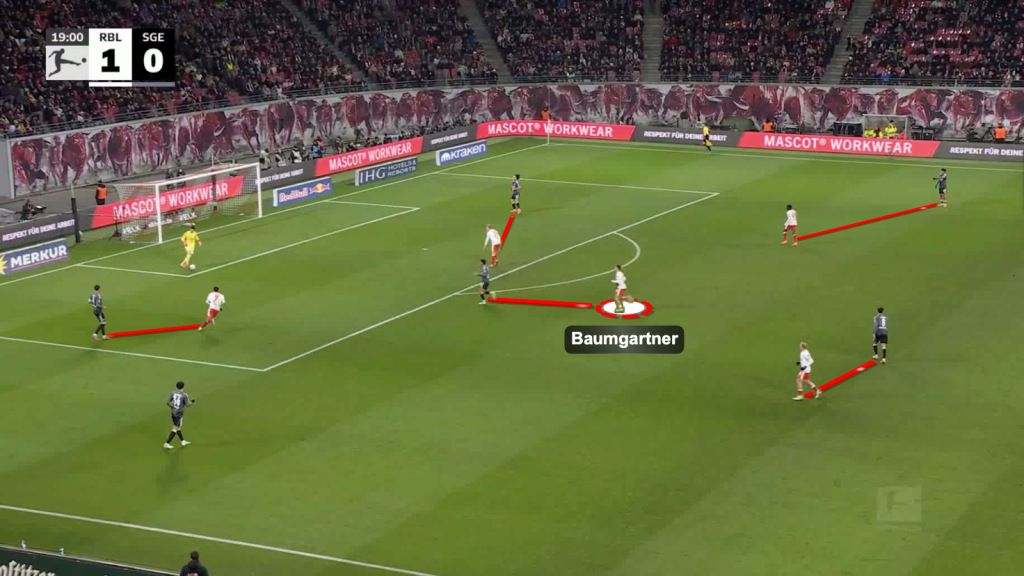
Whenever his side presses high, Baumgartner joins in to position himself and cut passing lanes into midfield.
As his striker anticipates a pass from the goalkeeper to the centre-back, the Austrian sticks closer to the pivot, cutting off vertical options.
His tendency to cover for his striker’s press translates in the mid-third as well.
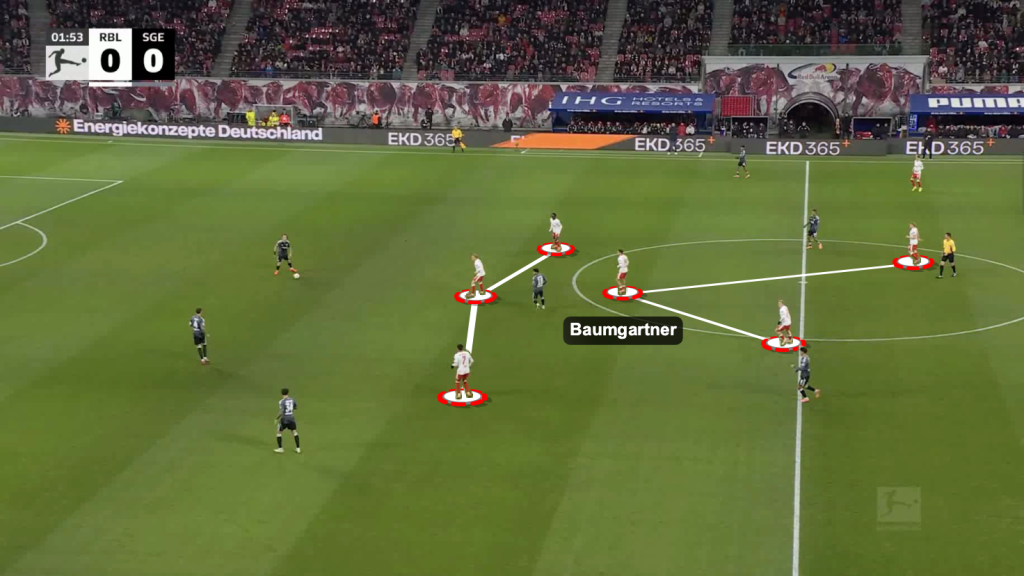
Baumgartner sits on top of the midfield triangle and right behind the striker.
Meanwhile, the front three maintain a compact shape.
Together, they force the opponent to play around them rather than through them.
Christoph Baumgartner Individual Defensive Actions
Christoph Baumgartner has 0.73 interceptions per 90 this season.
Although not a high figure, he succeeds in his defensive actions with a good starting position to engage his direct opponent.
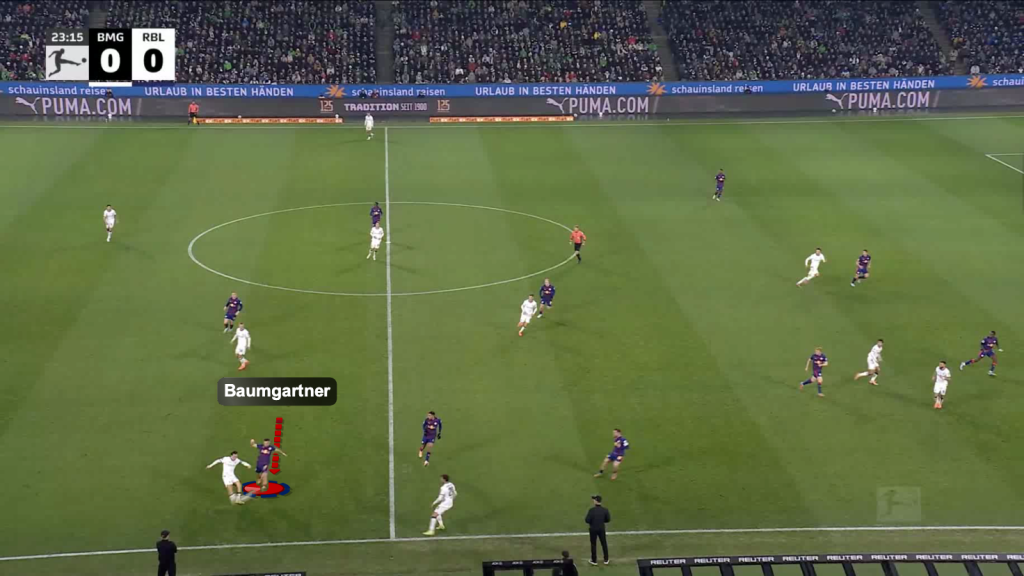 Here, he presses his opponent in the wide area, forcing a long ball to be blocked.
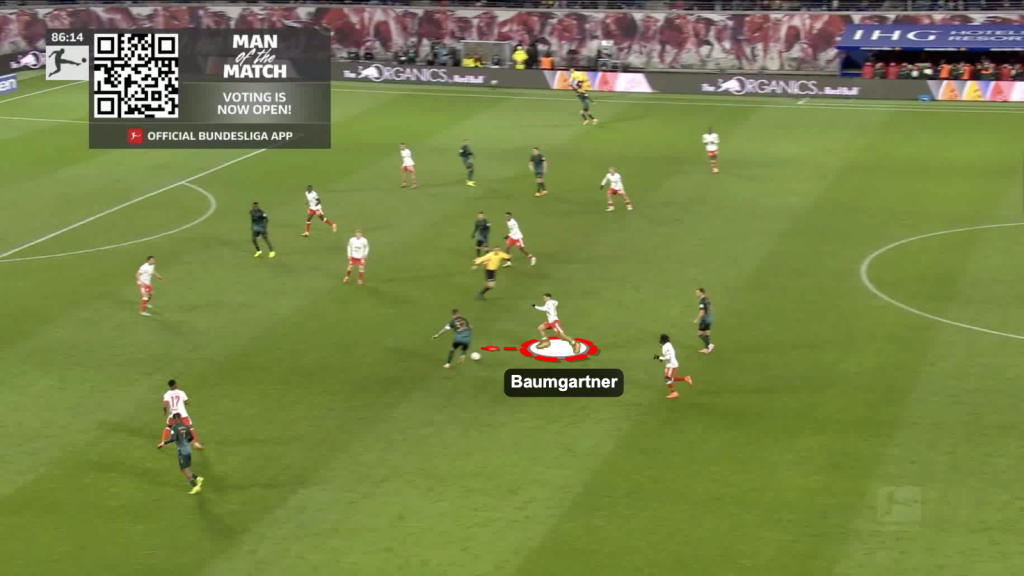
While the rest of his team is in their defensive shape, Baumgartner makes sure to cut out backward options in this situation.
As the ball-carrier has no forward options, he attempts to recycle.
This is when the Austrian steps in to make the interception.
Conclusion
Christoph Baumgartner is an intelligent attacking midfielder who can play progressive passes, receive progressive passes, and perform combination play in tight spaces high up the pitch.
He has proven to be RB Leipzig’s creative hub ever since Xavi Simons departed.
His attacking prowess is not limited to just creating chances, but also extends to getting on the end of attacking moves and finishing them.
It is fairly represented by his 10 goals in all competitions this season.
Defensively, he is not the most ruthless.
However, he makes sure to contribute by staying in structure and maintaining his positioning while pressing.
He also makes interceptions by engaging with his direct opponent at the right time and by having a good starting position.
