
When Sandro Wagner was appointed as manager of FC Augsburg this summer, expectations rose very quickly.
It looked like a perfect match.
For the club, it was the opportunity to finally shake off its image as the ‘Plain Jane’ of the Bundesliga.
Augsburg have played the same season on repeat for the past 10 years.
They started their seasons off somewhat decently, fell into a hole through the winter, got stuck in the relegation battle, but managed to fight their way out of relegation and finished between 12th and 15th in nine out of 10 seasons.
Sandro Wagner was their ticket out of there.
The former Bayern Munich striker has always had a very bright personality, even when he was a player and was perceived as arrogant, yet unique by the media.
After his playing career was over, Wagner quickly became a fan favourite as a pundit, thanks to his honest and straightforward approach to discussing the game and what happens behind the scenes.
At the same time, Wagner was starting out his coaching career by obtaining the licences required.
He never kept his goals a secret; he wanted to become a Bundesliga manager and was deeply invested in becoming a good coach.
After getting SpVgg Unterhaching promoted to the 3. Liga in his first season as a head coach, Wagner became an assistant coach for Julian Nagelsmann at the German national team, being part of the rejuvenating staff for the 2024 European Championships.
Now, after nine games of the Bundesliga season, the tenure of Wagner seems to already be close to over in Augsburg.
In this Augsburg tactical analysis, we will examine the tactics and ideas Sandro Wagner brought to FC Augsburg, why they are not working, and point out possible solutions to their problems.
No Clear Structure In The Block
Just looking at the table, it becomes rather obvious in which area FC Augsburg have struggled the most so far this season.
With 21 goals conceded in just nine games, Sandro Wagner is currently managing the team with the most goals against in the Bundesliga this term.
Obviously, their 0-6 defeat against RB Leipzig a couple of games ago was a massive contributor to that fact, but they still conceded those goals.
It’s not just the goals they conceded; they also allow the second-most expected goals and non-penalty expected goals, showing that it is not just a fluke, but a huge problem for the young coach.

Examining their defensive approach, we will review their game against Borussia Dortmund, where they attempted to play a more defensive style than in their previous couple of games.
Wagner is a young coach with a very clear idea about how football should be played.
To start the season, he attempted to implement an aggressive and fast style of play with his team.
However, he is now adjusting to what actually happens on the field of play.
Throughout the season, Wagner kept his 3-4-2-1 formation, dropping back his two wing-backs and a midfielder against the ball, forming a 5-3-2 shape while defending.
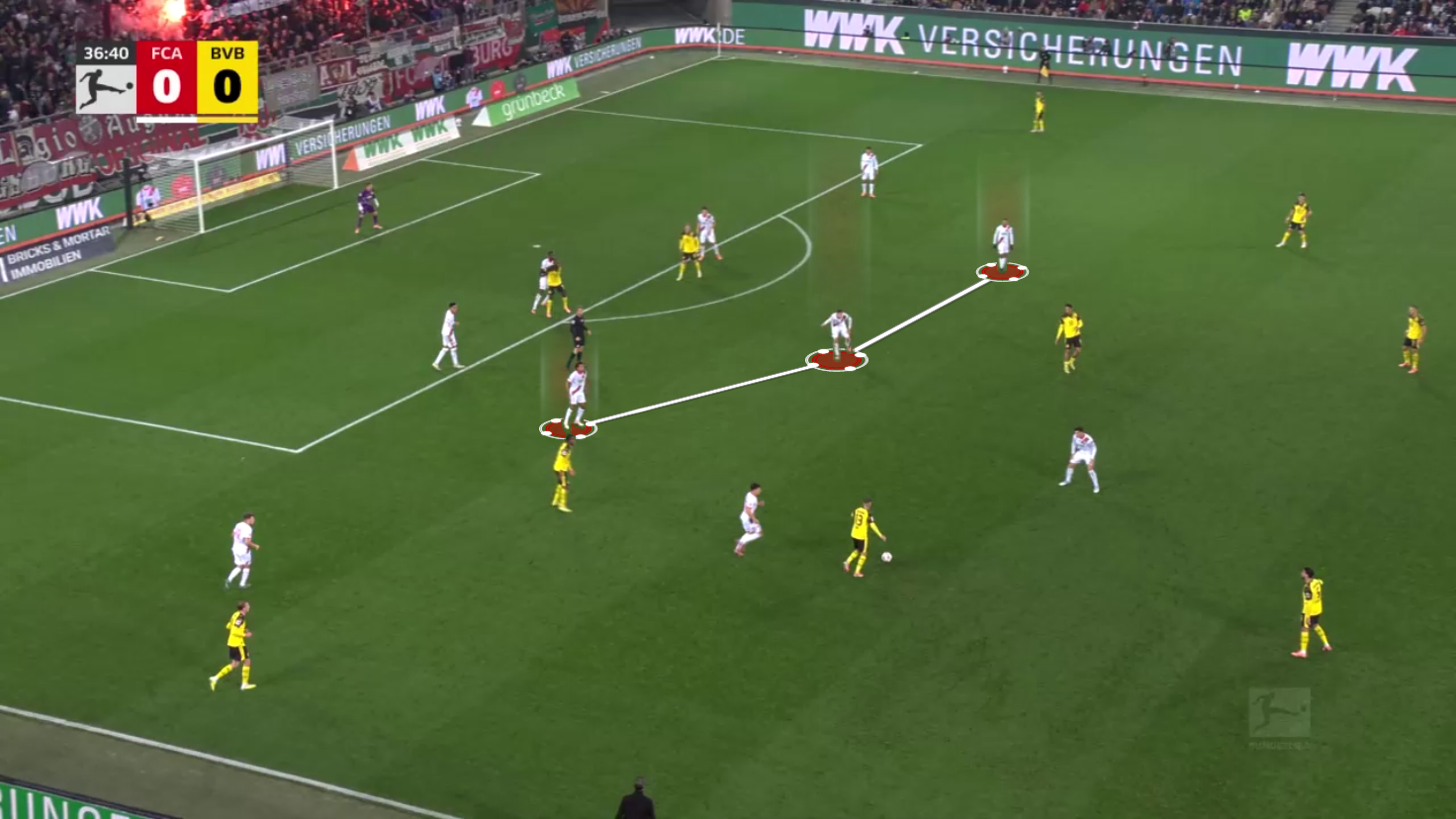
Against Dortmund, they now completely avoided going into their high press; they dropped back into a midfield press or even into their own half, trying to close the space and prevent Dortmund from creating opportunities.
However, we can already see one of the problems in the picture: half of the line defends forward, trying to minimise the space, while the left half of the backline drops back to defend against the long ball behind them.
These situations occur far too frequently for Augsburg, and Wagner needs to quickly get his players on the same page.
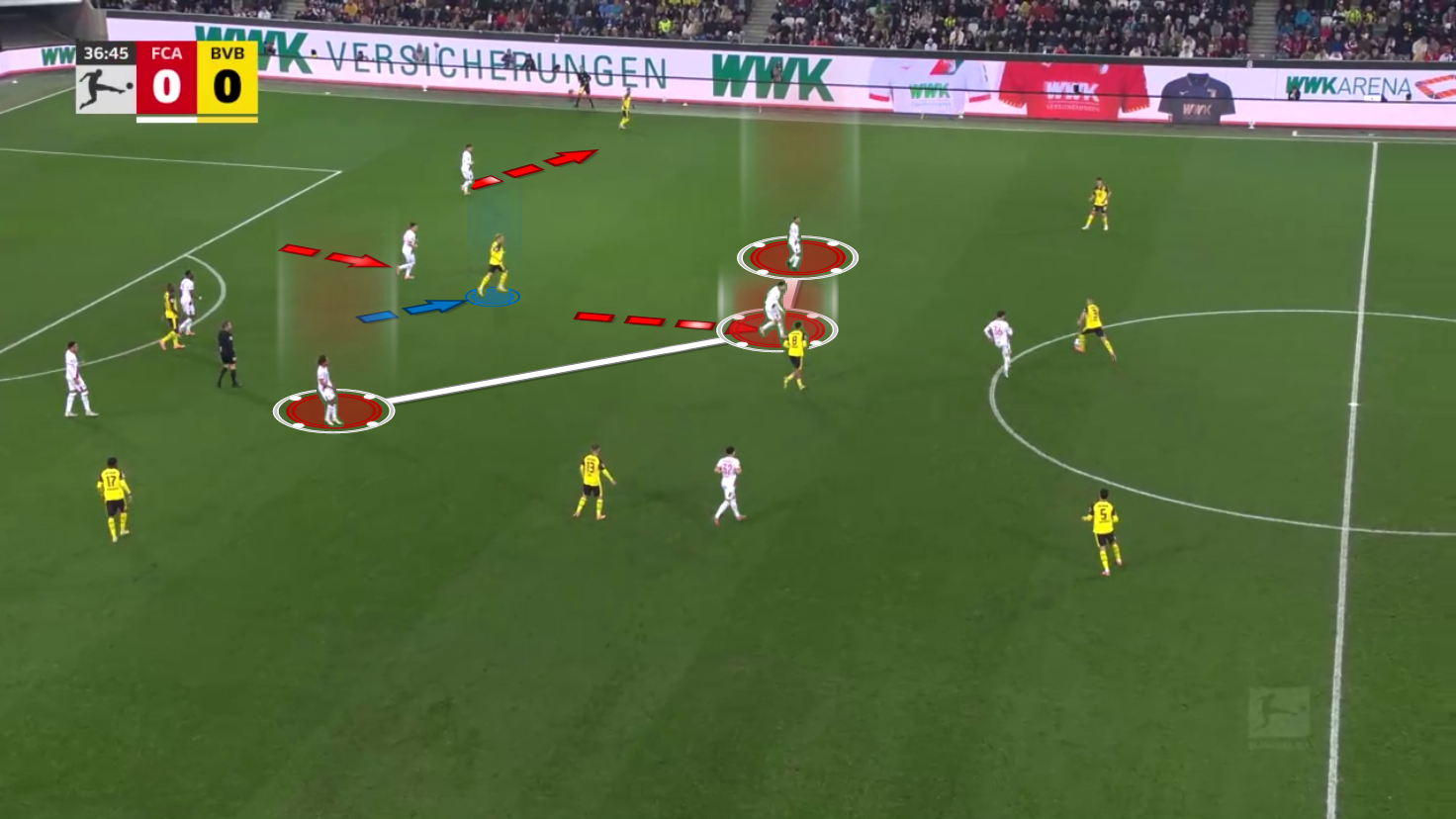
Examining the situation a bit later in the first half of the game, we can see more problems for Augsburg and Wagner.
They once again dropped one of the attacking midfielders back into midfield to close off the centre of play for Borussia Dortmund.
However, they once again struggle to be on the same page about what they want to do here.
The attacking midfielder is pressing forward onto the Dortmund midfielder, and the central midfielder is trying to pounce forward, pushing out of the deep block; however, the defenders are not doing the same.
This leads to a wide open space right in front of the backline for Wagner’s team, and this makes it way harder for them to defend, because they neither get a grasp on Dortmund with their press, nor do they have problems condensing the space.
Looking at the three midfielders now, after Dortmund switched play to the other side through their centre-backs, they are now playing at completely different heights.
The central midfielder is now pushing forward, effectively moving into the attacking line, while the far-sided midfielder is dropping back, almost playing in the backline.
Dortmund instantly punished this by dropping their attacking midfielder into the space right behind the central midfielder, forcing their centre-back to step up into midfield and completely blow up their block.
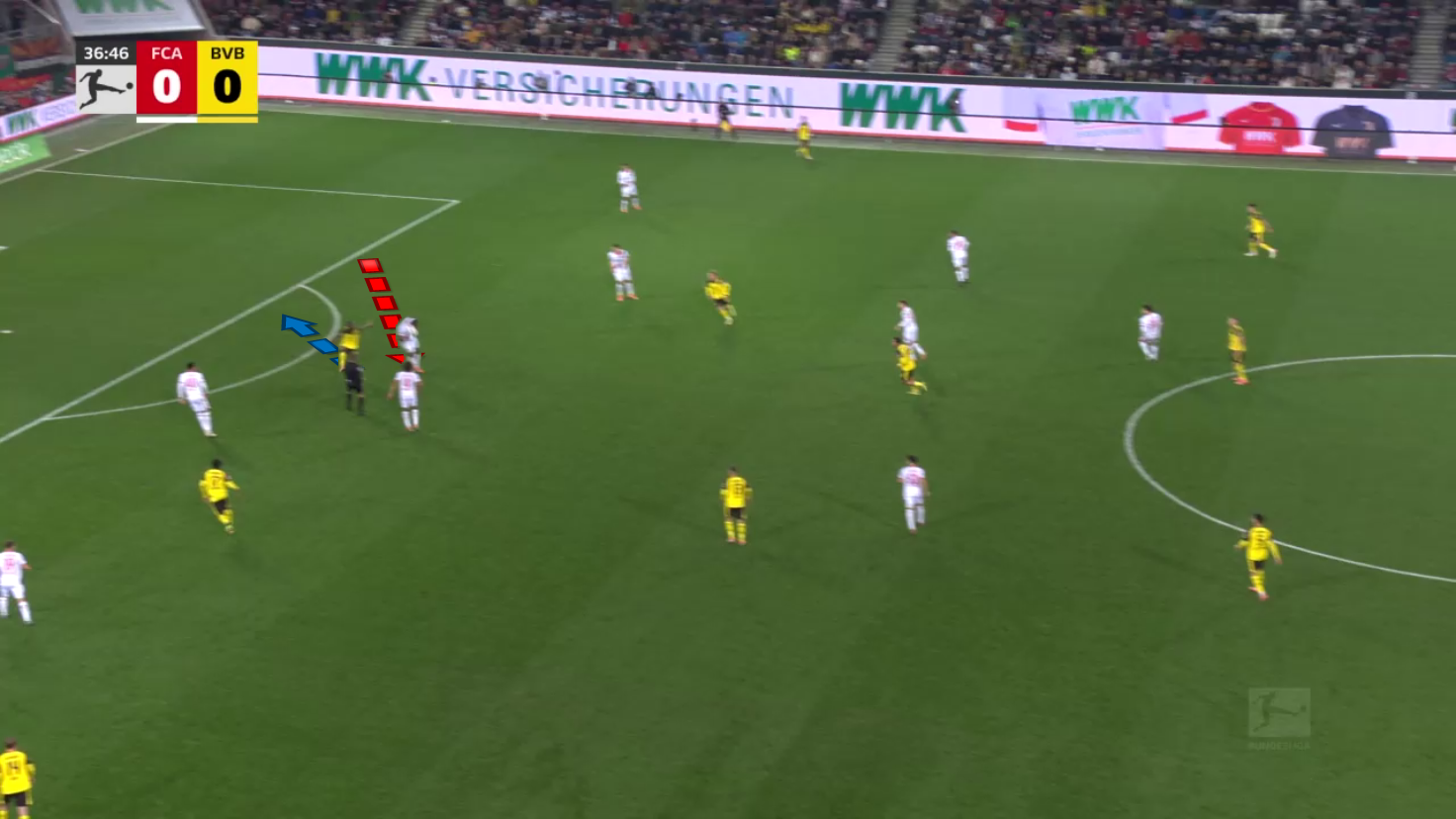
Dortmund now chip the ball forward in the direction of their target man, forcing Augsburg into a bad duel right at the edge of their box.
To add insult to injury, they now even get a bit of bad luck.
Chrislain Matsima heads the ball away, but hits his midfielder in the chest; the ball takes a bounce towards Serhou Guirassy, who then takes the opportunity to score the game-winning goal for Dortmund, as there was no Augsburg player left in the block to cover for Matsima.
Surely, they want to solve their problems against the ball. In that case, Wagner needs to establish clear principles on when to step up, when to fall back, and when to press, because the way Augsburg defends at the moment makes it rather obvious that each player makes individual decisions.
They are not acting as a collective at all.
Building Through The Wings
While their defence is already very bad, their attack is not much better.
Sandro Wagner’s men are creating the least amount of expected goals and the second-to-last amount of non-penalty expected goals, which is very concerning for them.
His players were overperforming in terms of finishing off their rare opportunities to start the season, especially in their season opener against SC Freiburg, but Augsburg went scoreless over the last three games they played.
Their problems start in the build-up phase already.
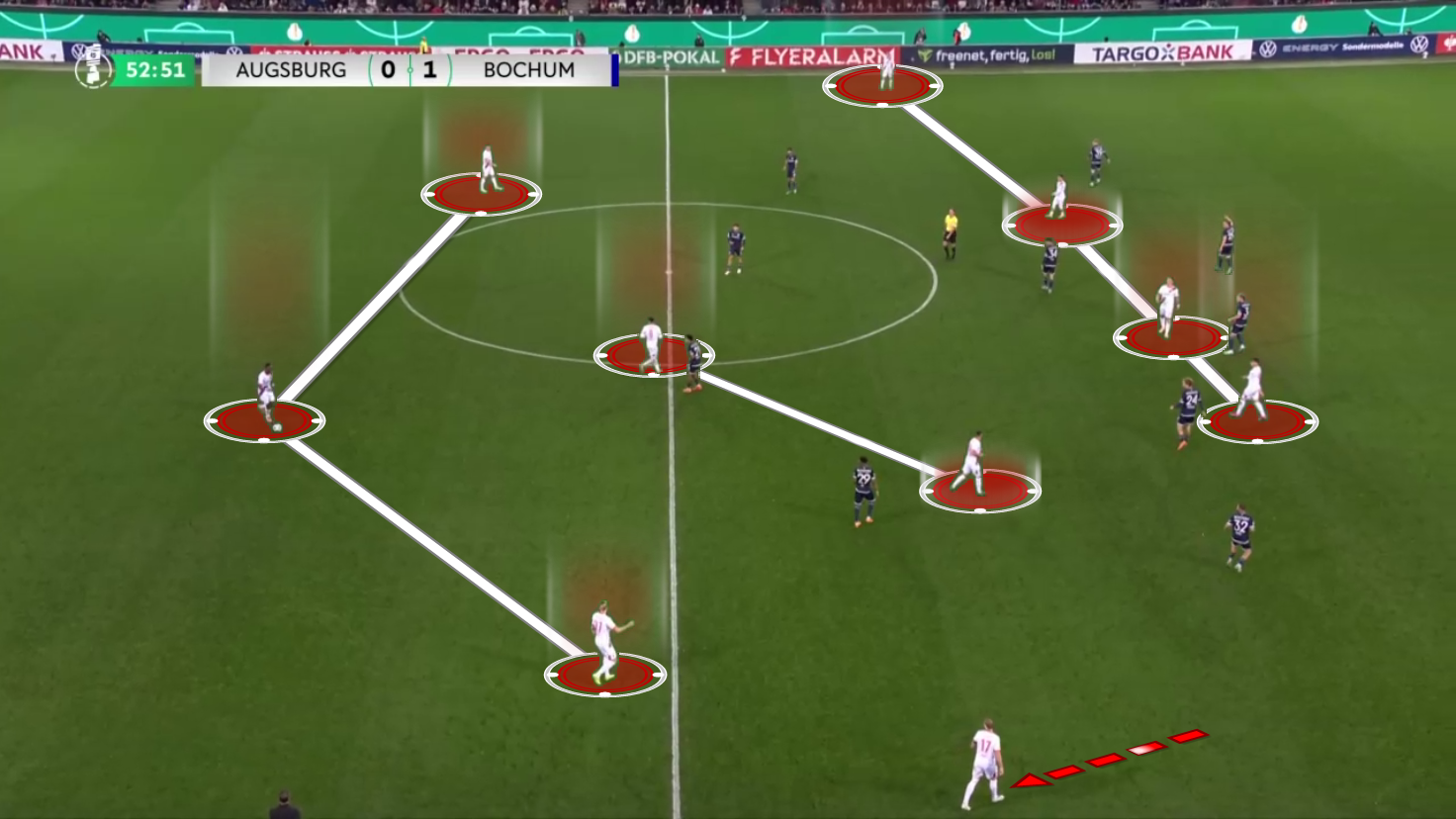
Wagner pushes his wing-backs up high on the pitch and forms the typical 3-2-5 shape that most coaches of his generation use in possession.
He took that from Julian Nagelsmann and his time with the national team.
The two outside centre-backs are positioned very wide, and the same applies to the two wing-backs, who try to stretch out the block of their opponents.
Looking at the picture above, we see the game against VfL Bochum in the DFB-Pokal, where they were facing a second-division club and were obviously forced to have the majority of possession.
They trigger their play in possession by the same pattern of play at pretty much all times.
One of the midfielders drops back to become a holding midfielder, while the other midfielder pushes high up the field.
Then, they drop the near-sided wing-back back towards the centre-back, trying to draw the opponent’s full-back out of his position.
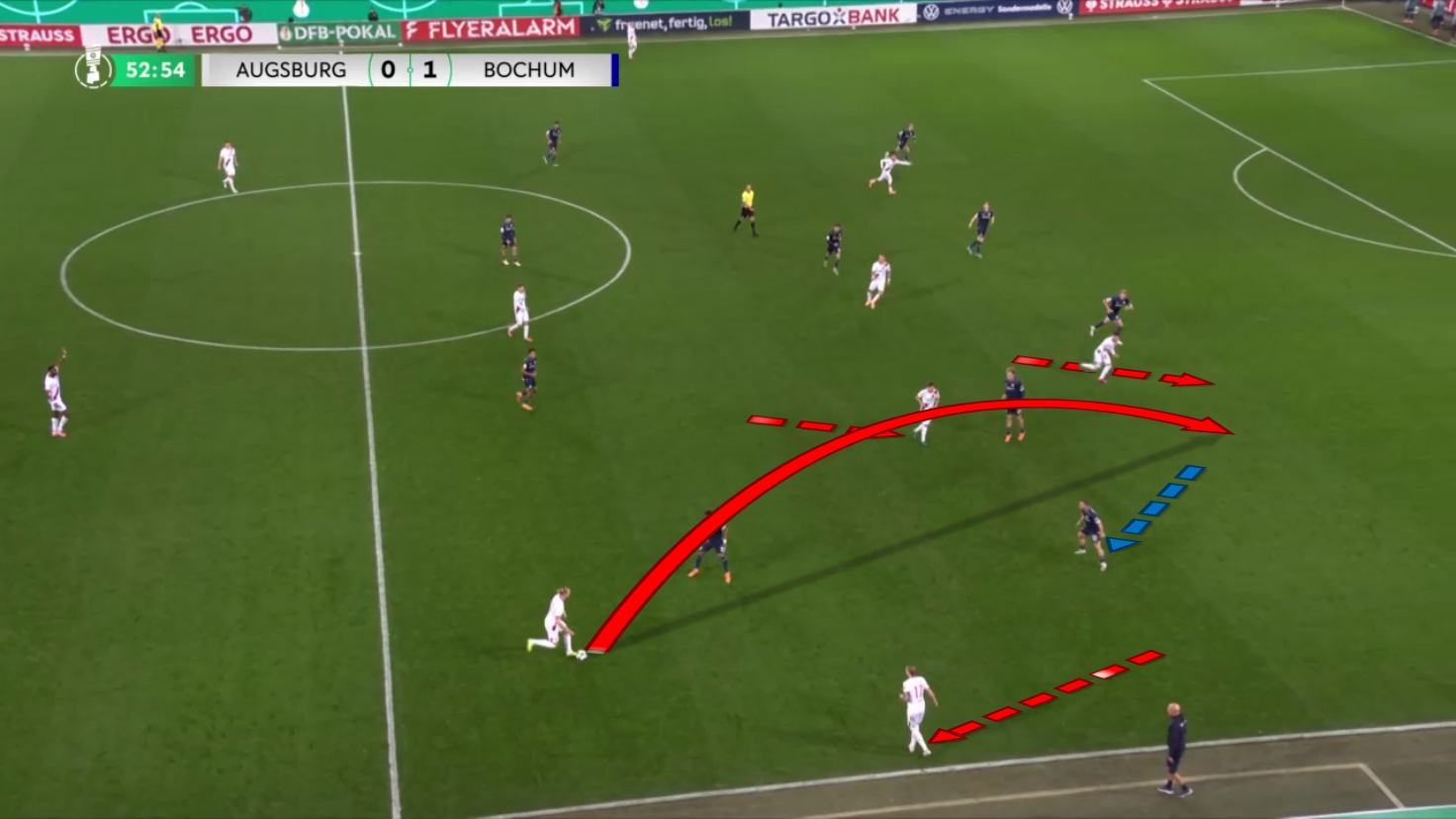
In this situation, it allows the near-sided attacking midfielder to make a diagonal run in the space behind the full-back, enabling Marius Wolf to chip the ball right into his path.
There are still multiple problems with their positional play in this situation, the timing is off and the midfielder moves to the near side way too late, not forming a triangle and therefore taking away the only option to pass it towards the centre of the field.
They, in theory, could play it into a triangle with the centre-back, wing-back, and the attacking midfielder making the run, but they rarely try to do so; they need to find solutions through the big triangle on the wings more often.
Another possible solution would be to pass to the centre to their false nine.
Wagner has not played with a more traditional striker in most games, and with the central midfielder making a run to the near side, the channel for a diagonal pass to the false nine is often open; they could really use that option more often.
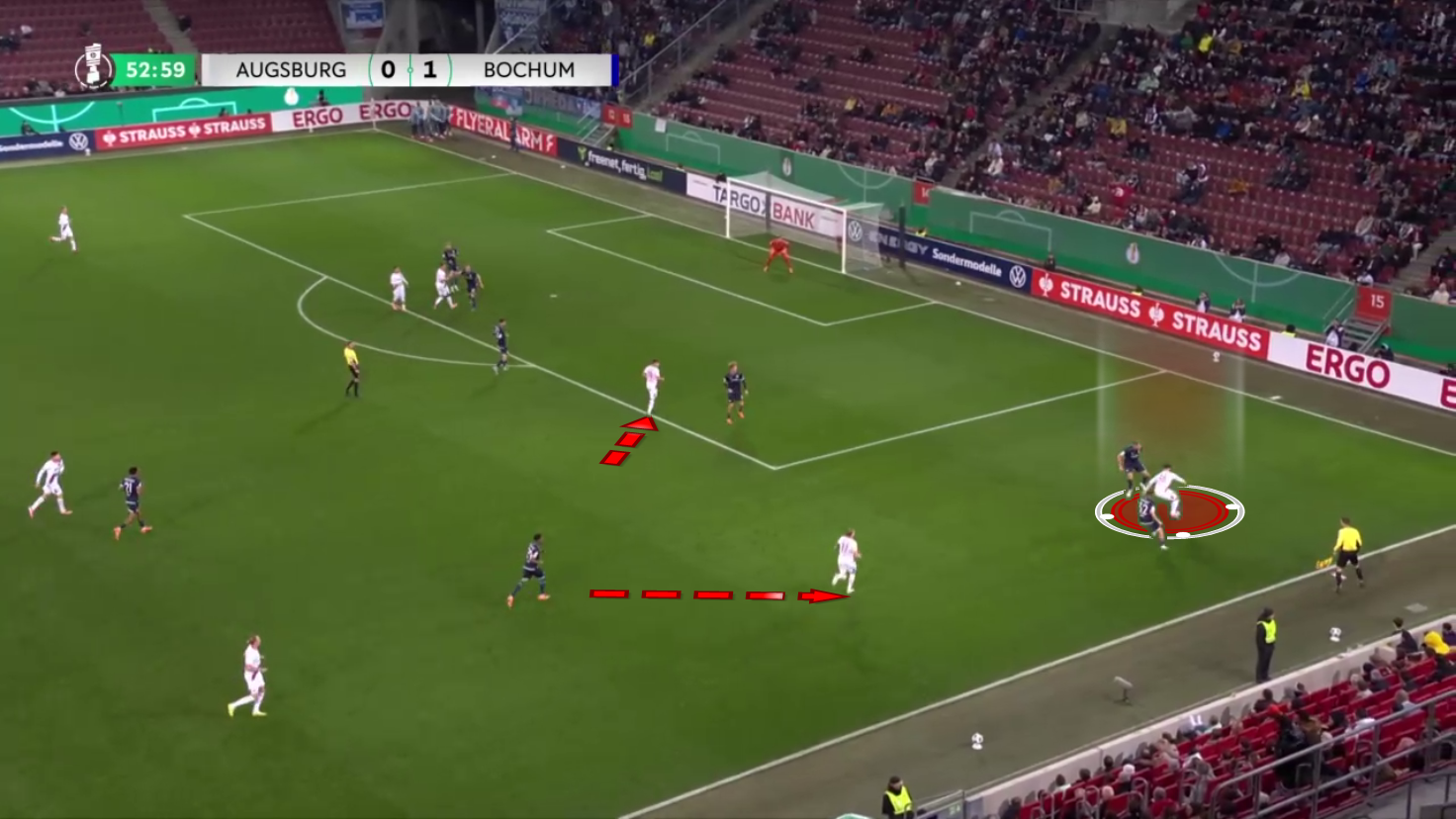
Their execution of the idea is also very poor, and it’s hindering their progress in the final third.
Instead of playing a chipped ball into the path of his attacking midfielder, Wolf plays the long ball on the ground towards the corner, forcing the run to cover more distance and be directed away from the goal, which completely undermines the dynamic they created in the attack.
Now, the Augsburg player finds himself cornered with his back turned towards the goal, getting doubled on the wing, and ultimately loses the ball.
I don’t really like the idea Wagner already has, but if they want to play like that, they need to execute more quickly and straightforwardly; otherwise, they won’t be able to create any form of danger.
Problems With Executing Ideas & Progressing Attacks
There are ideas that I really like; however, Sandro Wagner is unable to get his men onto the pitch consistently.
There are some really good patterns of play to be found in their games when they build through their wings, but they rarely get into the positions they need to take advantage of their positional play.
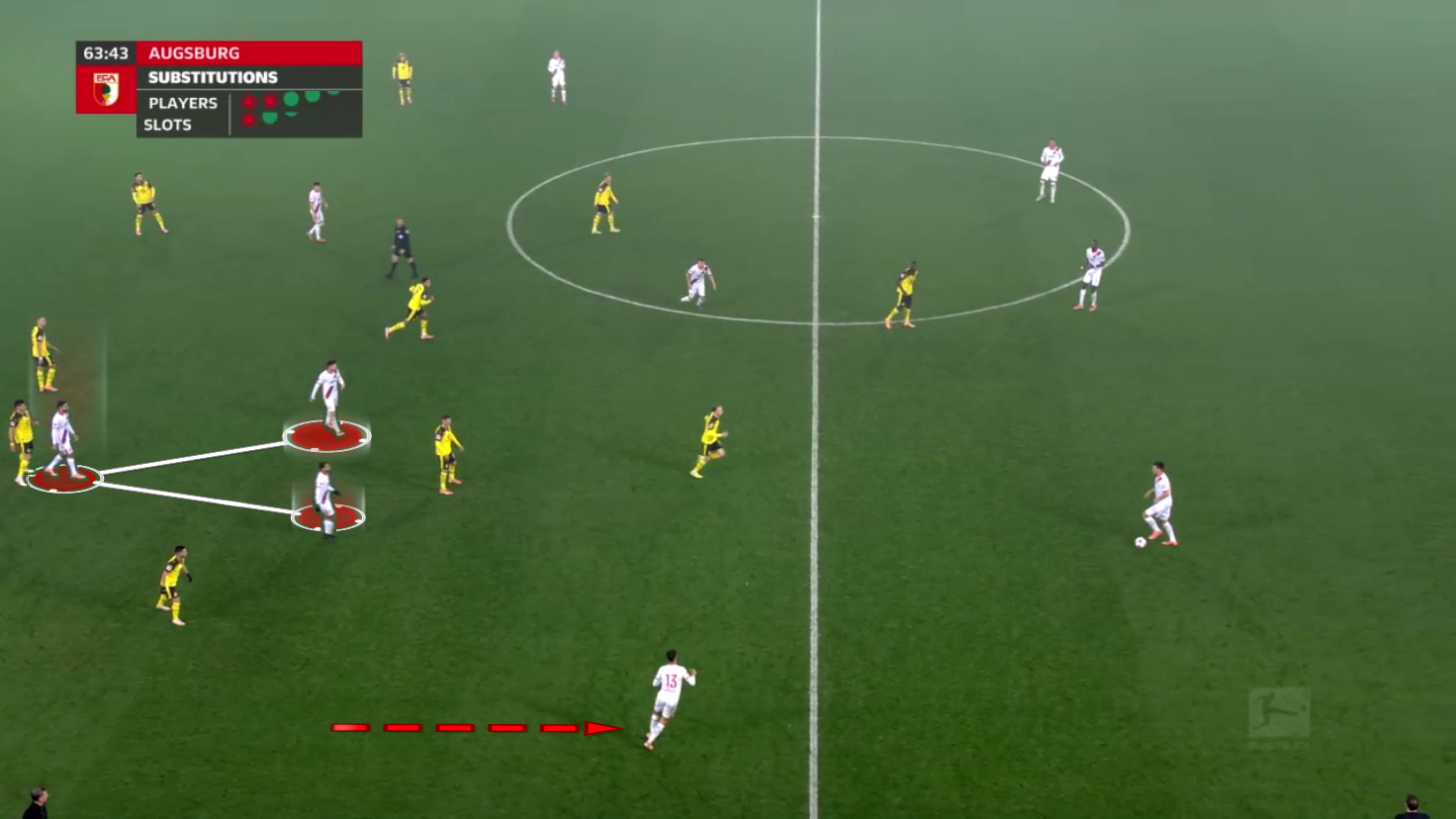
One of the most interesting things they do is their triangles in the near-sided half-space when they start their build-up.
As we can see in the picture above, they kept their centre-backs in a much narrower formation against Dortmund compared to their game in the DFB-Pokal, which allowed them to open up more space for their wingbacks near the sideline.
Now, the striker, central midfielder, and attacking midfielder form a very narrow triangle in the near-sided half-space and overload the midfield.
Still, the first step is dropping back their wing-back to receive the ball, but this time he has enough time to actually receive the ball and take a first touch in the direction of the goal.
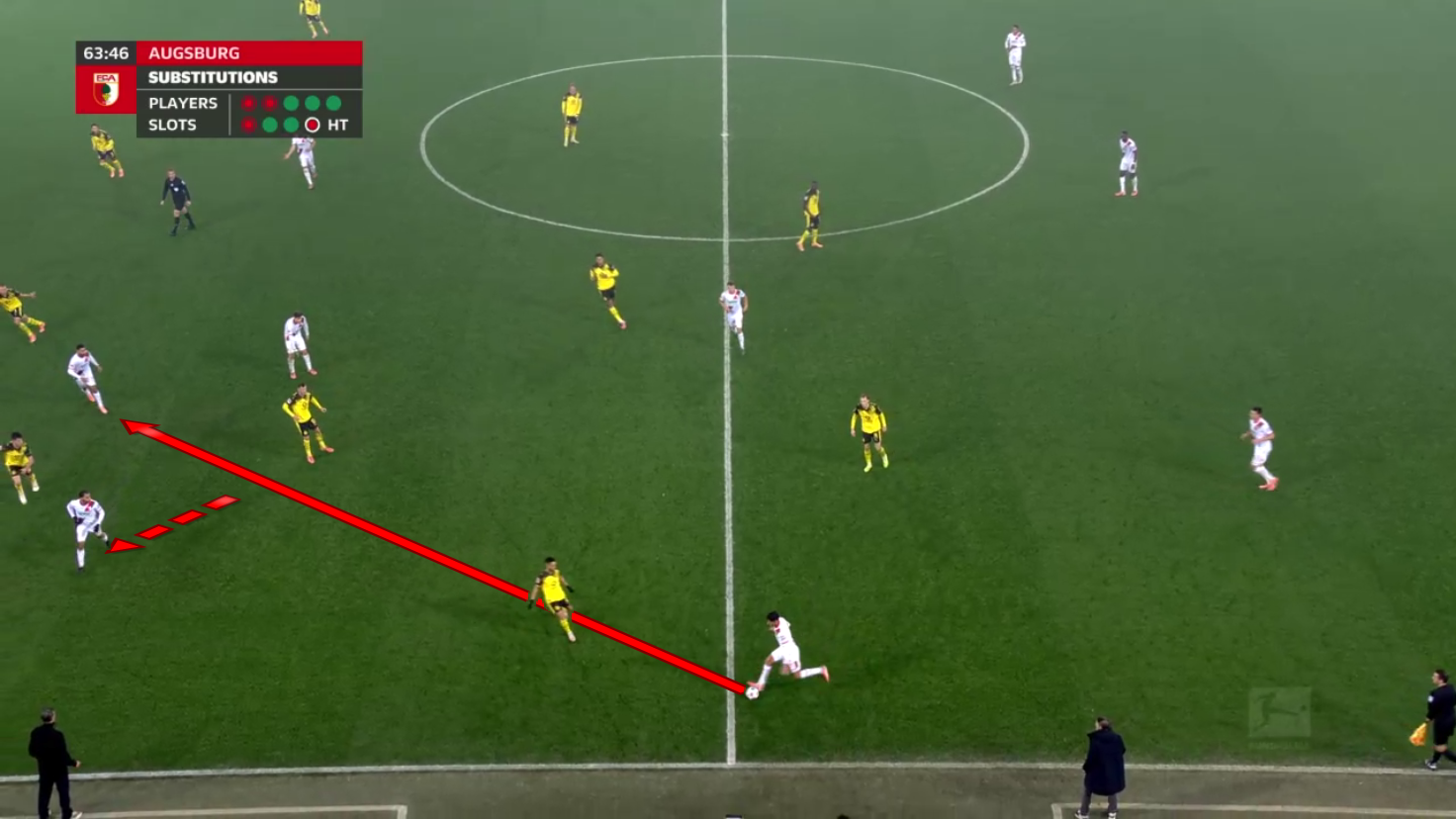
They break out of the triangle now, with attacking midfielder Alexis Claude-Maurice making a run towards the wing, taking another defender out of the centre of the field, and faking their standard pass down the sideline.
Instead, their striker now moves horizontally out of the coverage shadow of the last remaining Dortmund midfielder, who is assigned to cover two Augsburg attackers now.
This opens up the diagonal pass forward towards the striker from the full-back, which cuts through the defence and transitions their attack from build-up towards the final third.
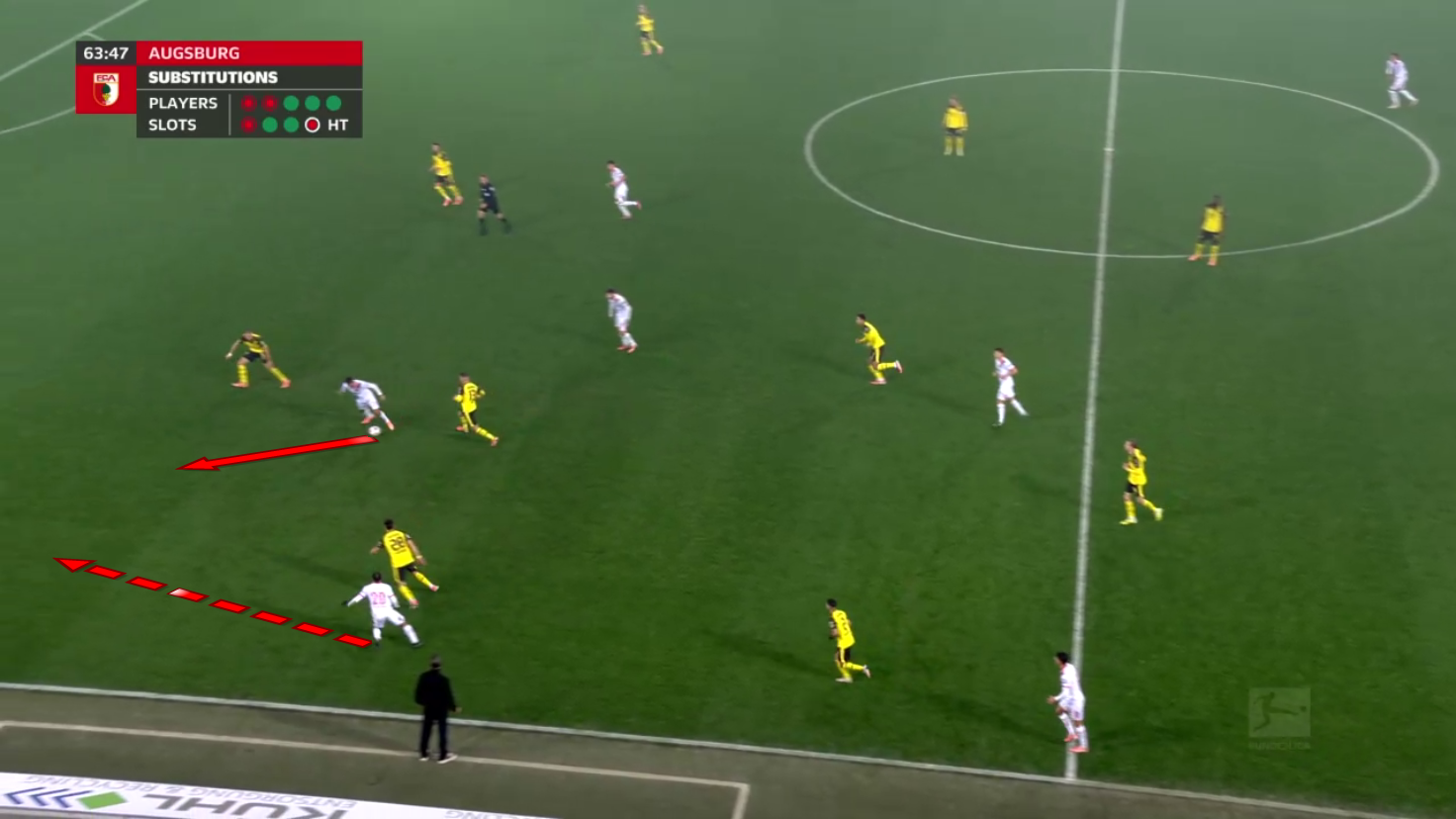
There, the problems start again.
Wagner’s men are now in the final third, but they lack ideas to transition into the attacking phase at all times.
Here, the hold-up play is very good, but from then on out, there are just no options to progress the ball further.
Out of the triangle, the two other players, especially Claude-Maurice on the wing, should continue his run directed towards the goal.
Still, he just stands and makes the run way too late, while the central midfielder is not even attempting to offer assistance.
This leads to the attack being over just a couple of seconds later.
If they just showed some intensity off the ball and made those runs, it would allow them for deep-deep-combinations, but instead, they just get stuck in the middle third way too often.
Conclusion
In the end, Sandro Wagner’s FC Augsburg are just not a good team right now, and with the way he talks about his team in interviews, it doesn’t really look like the young coach is close to figuring out the answer to their problems.
When defending, the team needs to start being on the same page instead of being a collection of individual players making individual decisions if they want to become more successful against the ball.
With the ball, they need to establish their good patterns on a more consistent basis, and they must execute better and with more purpose; otherwise, their attacking struggles will persist.
Overall, I’d say that Augsburg doesn’t really need to do the right things right now, but rather do things the right way, meaning that they need to show more intensity and believe in all their actions instead of overcomplicating things.
I genuinely believe that Sandro Wagner will be a good coach at some point in time, and I think he has great leadership qualities, so I hope he will get at least time to try to figure out a way out of this mess, but in this business, I highly doubt that Augsburg will grant him this time.
