
Under manager Manolo González, Espanyol entered the 2025/2026 season with a renewed focus on tactical structure and discipline, aiming to improve after just missing out on European competition last year.
While their average possession this season (around 40.5%) doesn’t place them among La Liga’s most ball-dominant sides, it reflects a philosophy of purposeful control.
González’s strategy prioritises a stable build-up from the back, smart positioning, and choosing the right moments to advance the ball up the field.
This Espanyol tactical analysis will examine how Espanyol build attacks from deep, focusing on their organisation, how they bypass defensive pressure, and the specific positional tactics they use to move the ball effectively into the midfield.
Espanyol Build-Up & Progression
Under Manolo González tactics, Espanyol’s build-up play focuses on structured, controlled progression rather than holding onto the ball for long periods.
The main objective is to cleanly break through the opponent’s initial line of pressure while maintaining a balanced formation that provides defensive coverage.
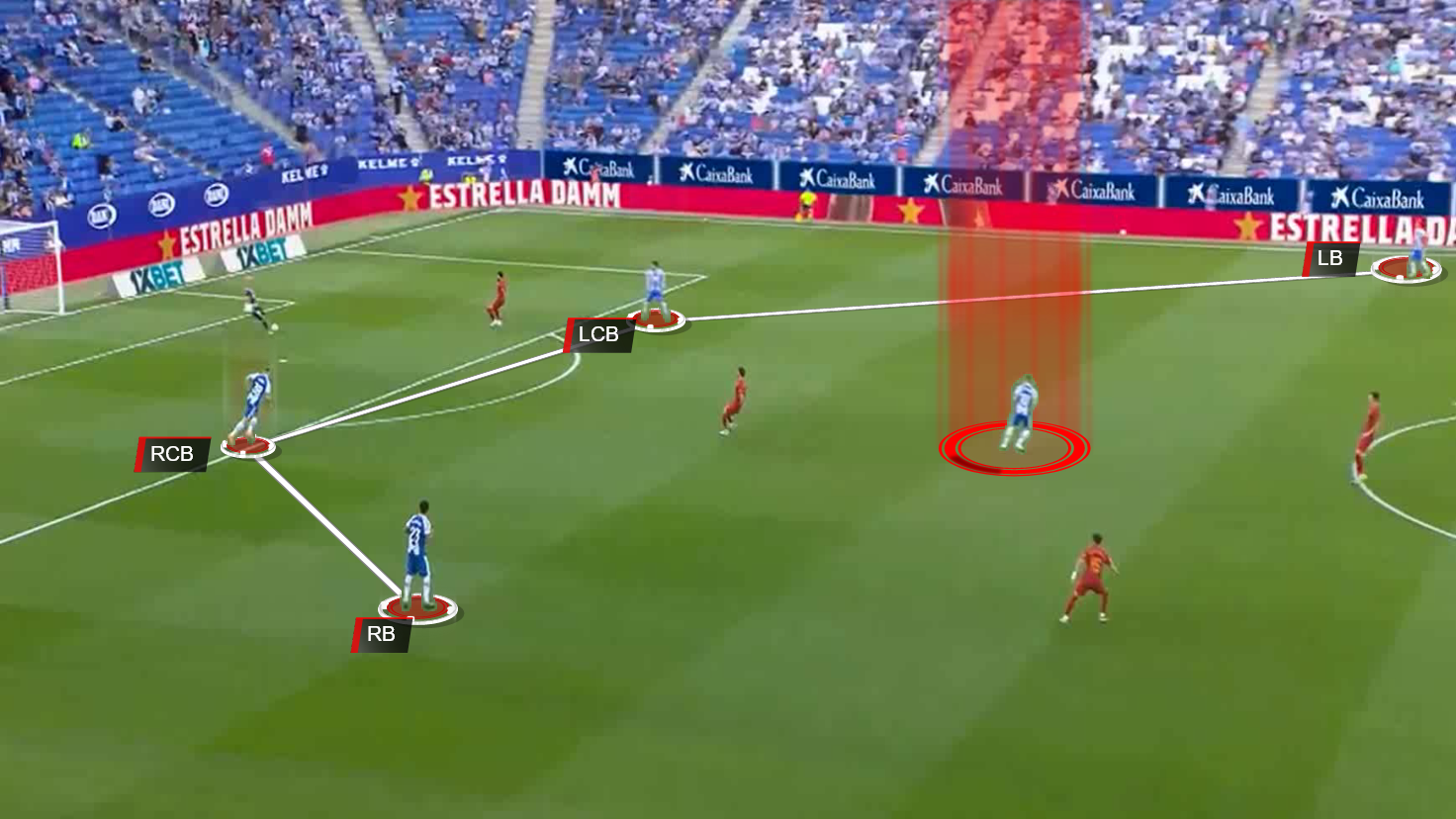
In their initial build-up phase, Espanyol’s 4-2-3-1 formation transitions into a 3-2-4-1 when they have the ball.
This change occurs when one of the central midfielders, often Eduardo Expósito, drops back to join the two centre-backs, Leandro Cabrera and Clemens Riedel, and the goalkeeper.
Alternatively, the right-back may tuck in with the centre-backs.
This creates a back three, giving them a 3-on-2 advantage against the opposition’s forwards and allowing for safer, more effective ball circulation from the back.
The underlying objective in this phase is not speed or creativity but positional clarity and risk reduction: By securing passing lanes and controlling tempo, Espanyol minimizes the chances of losing the ball in dangerous zones and builds a stable platform for further advancement.

In matches like the draw against Valencia this season, Espanyol’s build-up structure was clear from the start.
When Valencia pressed with a 4-4-2 formation, right-back Omar El Hilali dropped alongside the two centre-backs.
This created a back three, giving goalkeeper Marko Dmitrović three short passing options to bypass Valencia’s first line of pressure.
Meanwhile, the two central midfielders, including Expósito, positioned themselves higher up the pitch to provide vertical passing options once Espanyol successfully broke the press.
 Once their foundational structure is set, Espanyol use an asymmetrical formation with their wide players to intelligently move the ball forward.
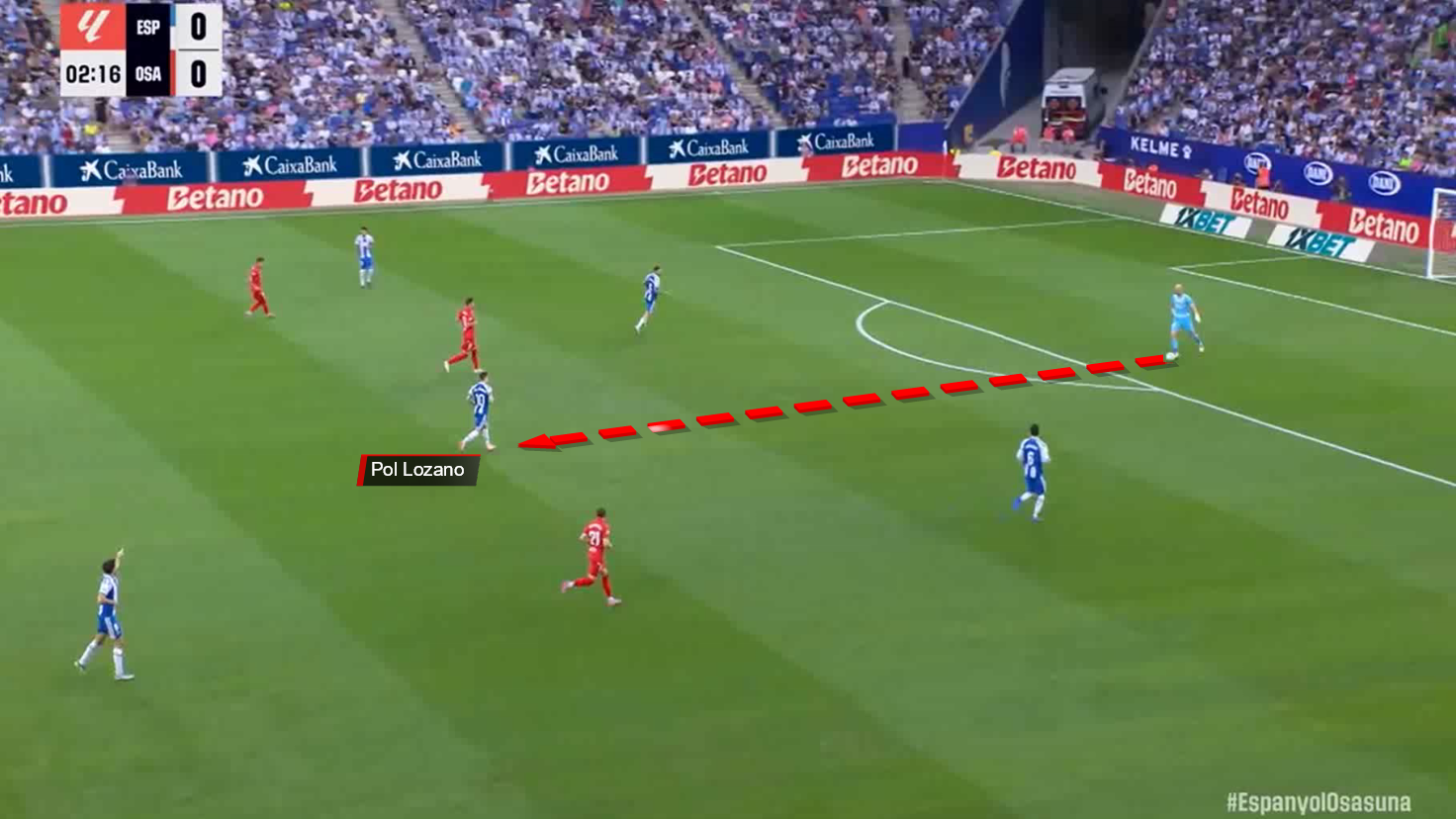
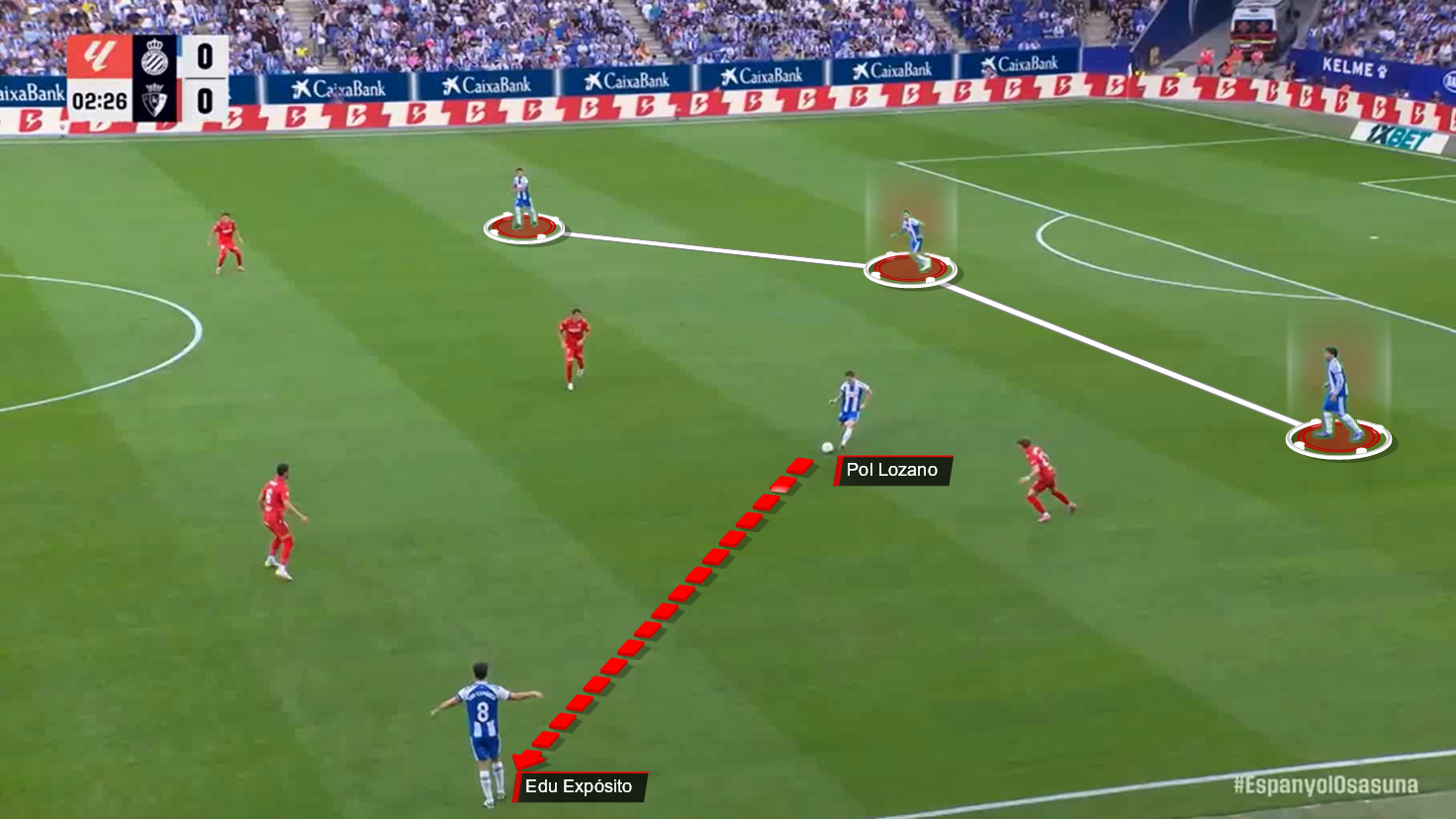
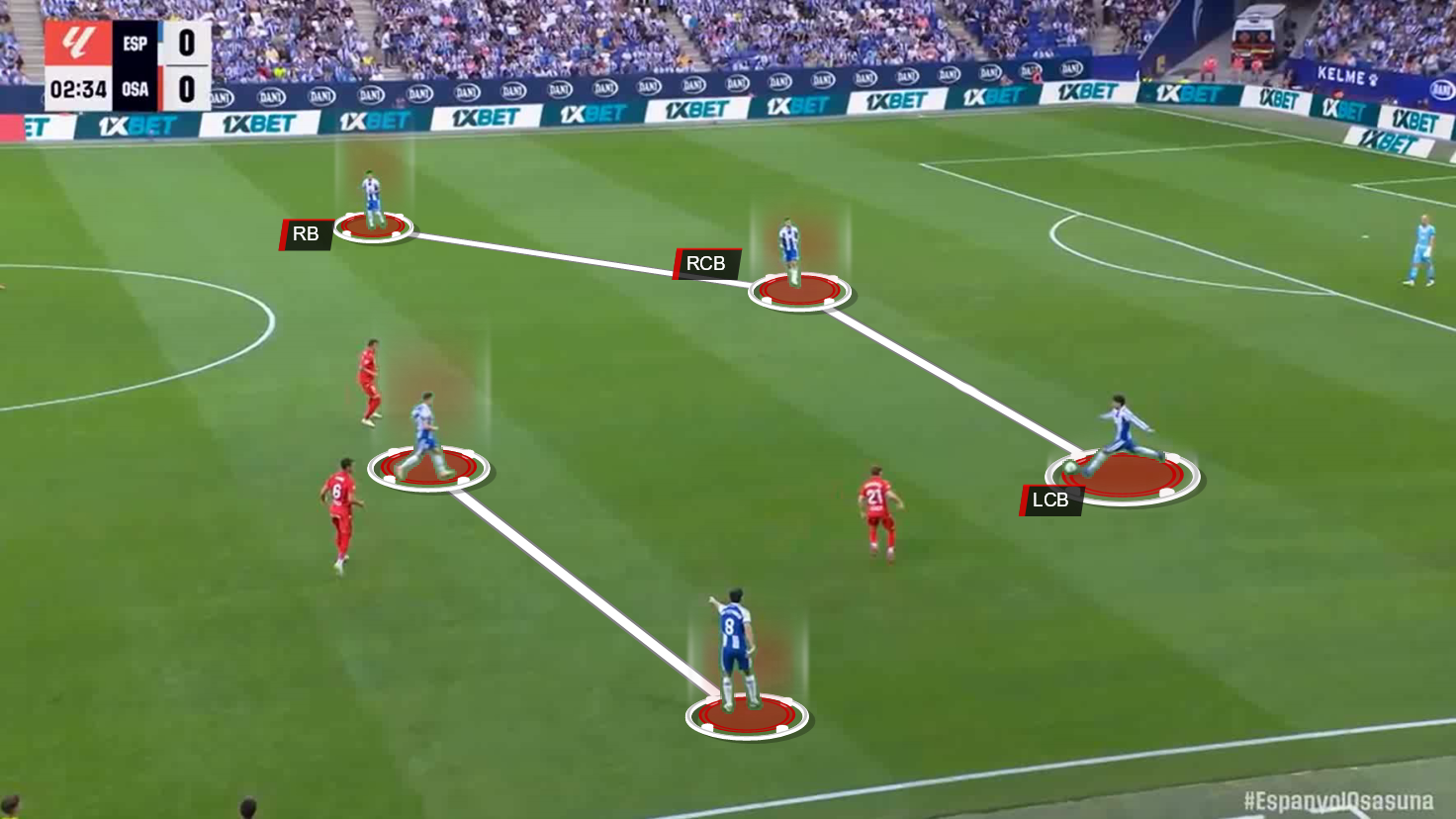
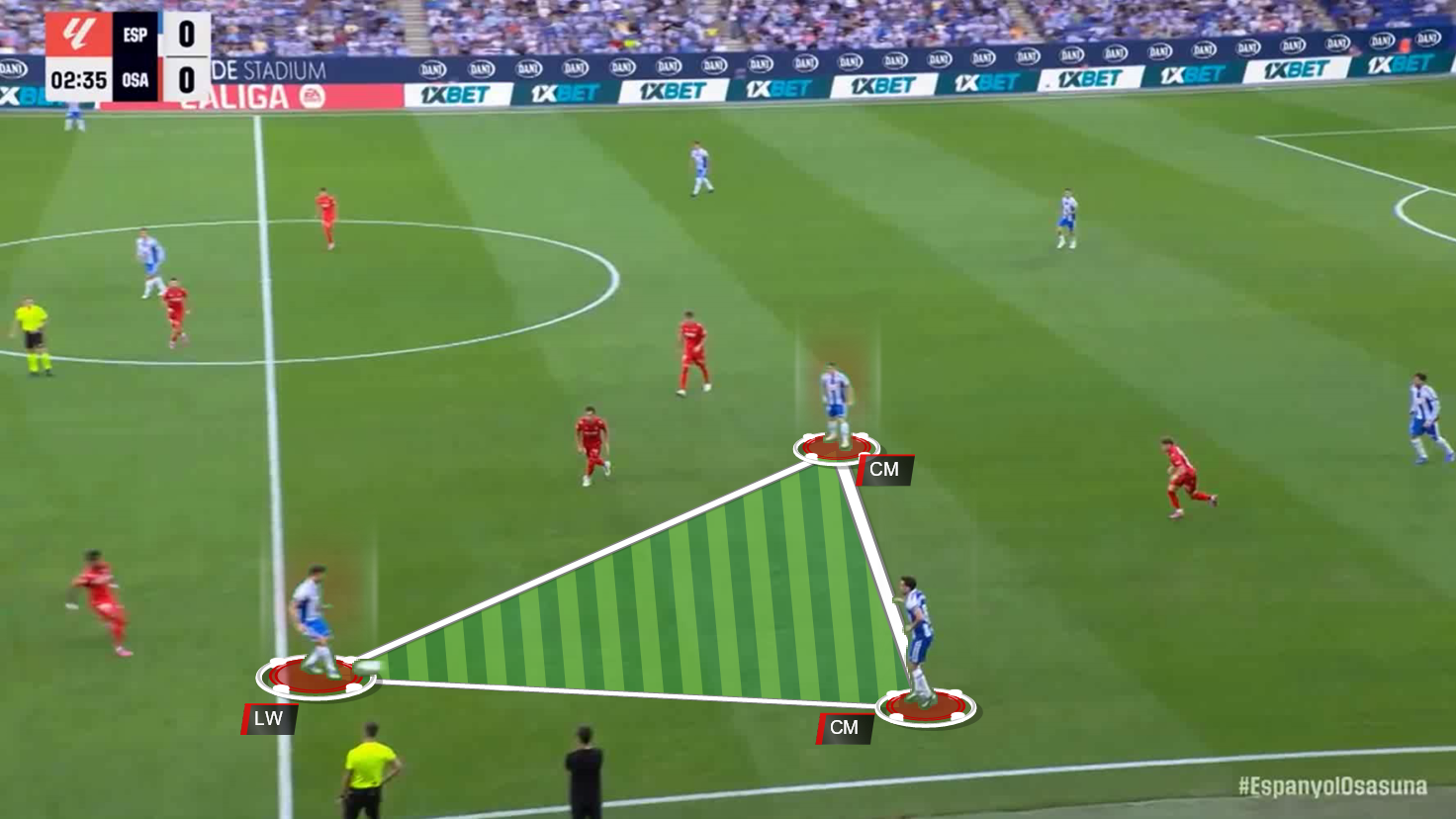
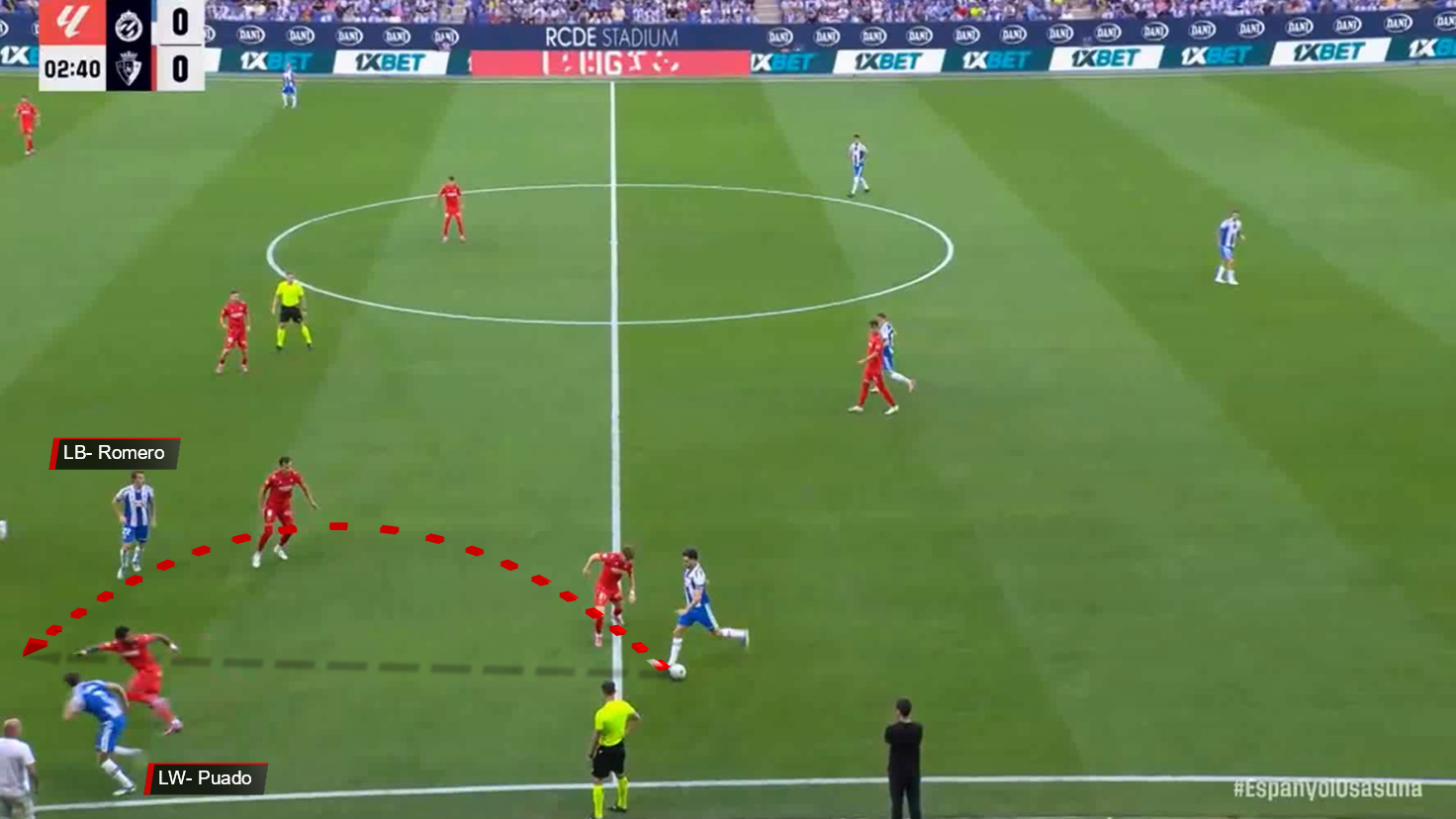 For instance, on one side, the full-back, like Omar El Hilali, will often move into a more central position, supporting the pivot and centre-backs in the build-up zone, while on the opposite side, the full-back pushes higher and wider.
This creates a dual effect: first, the narrow side enhances options for safe circulation, and second, the wide side provides an outlet for diagonal switching and vertical progression.
When their opponents block the centre of the field, Espanyol avoid forcing the ball through crowded spaces.
Instead, they use their full-backs and wingers on the sides to attack, as here versus Real Madrid.
This strategy allows them to stretch the opposing team horizontally and vertically, creating a dynamic and controlled build-up.
Once the team has spread out across the field, Espanyol focuses on moving the ball forward in a controlled manner.
Rather than relying on frantic dribbling or players constantly running out of position, they patiently wait for the ideal time and space to open up.
This forward movement is typically achieved either through a diagonal pass from the centre to a full-back who has moved up the field, or by an attacking midfielder making a third-man run to receive the ball.
This sequence usually starts when a central defensive midfielder or a centre-back intentionally draws pressure from the opposing team.
Once the opponent commits, the player passes the ball to the opposite side of the field or into the wide-open space along the sideline.
As soon as the ball reaches that wide area, the entire team adjusts its formation to prepare for an attack into the final third of the field.
Against Real Sociedad, Espanyol showcased their structural flexibility, shifting into a 3-2-4-1 in possession to stretch the pitch and create width during the build-up phase.
Throughout this phase, Espanyol maintain a rest-defence triangle behind the ball: the tucked-in full-back, the pivot, and the far centre-back or the opposite full-back stay compact to protect against counterattacks.
This shows that progression and defensive cover are built in tandem, not as afterthoughts.
Ultimately, Espanyol’s build-up strategy isn’t about holding onto the ball for extended periods, but rather about being effective with it.
While their average possession might be lower than that of the top teams in the league, their decision-making on when and how to move the ball forward truly counts.
The team’s structure ensures they seldom lose control.
By using wide passes and quick vertical attacks, they make sure that entering the final third is from more advantageous positions.
This focus on positional security before attempting to progress the ball reflects the identity their coach, González, has instilled in the squad: systematic, pragmatic, and well-drilled.
Essentially, Espanyol’s build-up phase is the bedrock of their entire tactical approach: it keeps them secure in defence, balanced in midfield, and always prepared to either launch an attack or defend against a counterattack.
Final Third & Chance Creation
After successfully moving the ball up the field and into the final third, Espanyol, under Manolo González tactics, changes their offensive strategy.
Instead of focusing on keeping the ball for long periods or playing at a fast pace, they concentrate on three key areas: efficiently using the space they’ve created, being dangerous from set-piece situations (like corners and free kicks), and creating numerical advantages in specific areas of the pitch through structured overloads.
To get into the final third, Espanyol often moves the ball into the wide channels and the half-spaces.
Their full-backs push high up the field while wingers or central midfielders drift into the half-spaces.
The strategy is designed to stretch the opponent’s defence horizontally, creating space in the middle of the field for a pass into the penalty area.
Once they are in the attacking third, a typical play involves the full-back receiving the ball high and wide.
As this happens, a winger moves from the outside towards the centre, and a midfielder makes a forward run to penetrate the defence.
This is followed by a pass or cross into the penalty box.
The main goal is to create better shooting chances or to force the defenders to move, which can open up exploitable gaps in their formation.
Under Manolo González, Espanyol’s attacks are defined by precise, well-timed movements, not by the sheer number of plays they run.
Once they have possession in the final third and have established a wide formation, the team focuses on making calculated runs in behind the opponent’s defence to exploit the space created.
Their formation often shifts to a 3-2-4-1 or a 4-2-3-1, allowing them to strategically control key areas and create multiple avenues to get the ball into the penalty box.
The main striker typically makes the primary run, attacking the space between the opposing centre-backs after the ball has been moved out wide.
At the same time, a second striker, such as Pere Milla, will position himself in the space next to the main striker, serving as another dangerous option and occupying the defence.
Meanwhile, a third wave of attackers often arrives late.
This can be a centre-back or a defensive midfielder who moves forward into the penalty box to capitalise on second chances or rebounds.
The delivery of the ball is intentionally timed.
Instead of sending in a constant stream of crosses, Espanyol’s players wait for the perfect moment.
They hold off until the opponent’s defensive line shifts sideways or a defender commits to a challenge.
At that instant, they trigger the pass or cross into the space behind the defence for a runner to attack.
A key strength of Espanyol’s attack is its effectiveness in set-piece and second-phase situations.
While their approach may not be flashy, the team follows clear, rehearsed routines.
For corners and wide free-kicks, they often aim for near-post flick-ons or target tall defenders making runs to the far post.
Another common tactic is to create knock-downs for onrushing players to attack.
A crucial part of Espanyol’s attack is their performance on set-pieces and what happens immediately after.
Though not always spectacular, their routines are well-defined.
During corners and wide free kicks, they practice plays such as flicking the ball into the near post or having tall defenders make runs to the far post.
They also work on creating knockdowns for other players to run onto and shoot from.
Espanyol Out-of-Possession & Pressing Phase
When Espanyol give up possession, they don’t simply fall back into a passive defensive shape.
Instead, under coach González, the team quickly organizes into a compact formation in the middle of the field.
From there, they use specific triggers to apply immediate pressure, which they refer to as counterpressing.
They aim to disrupt the opponent’s rhythm before they can build up speed for an attack.
Upon losing the ball, the team’s formation tightens into a 4-1-4-1 or a 4-5-1, depending on the opposition.
The central defensive midfielder moves from side to side to connect the midfield and defensive lines, while the full-backs move inward, effectively creating a five-player defensive line.
Espanyol’s defensive strategy is to force their opponents into wide areas or into situations where they can’t make a dangerous pass.
They do this by using specific, pre-planned moments to start pressing.
These “triggers” include an opponent taking a bad touch, passing the ball backward to a defender, or moving the ball to one of their full-backs.
When one of these triggers occurs, two or three Espanyol players, usually a winger and a central midfielder, will immediately sprint to apply pressure.
Their goal is either to win the ball back directly or to disrupt the opponent’s flow and prevent them from building a coherent attack.
When they win the ball back, the team transitions rapidly from defence to attack.
The full-backs immediately push wide, the central defensive midfielder moves higher up the pitch, and a forward or attacking midfielder runs into the space that has just been created.
Transition Phase
When Espanyol recover possession, the first priority is a quick but structured forward move.
The deep-lying pivot (often Edu Expósito) or one of the centre-backs (such as Leandro Cabrera) instantly looks to play the ball into the forward-facing midfielder or winger, especially Javi Puado or Roberto Fernández, who stretch the opposition by running into the half-space or channel.
The full-backs, specifically Omar El Hilali on the right and Carlos Romero on the left, are key to the attack.
They push high up the pitch to offer width and additional options.
The primary goal is to launch a rapid counterattack, ideally within seconds of regaining possession, to capitalise on the opponent’s momentary disarray.
This dual approach, combining a structured defense with the quick exploitation of turnovers, enables Espanyol to stay compact and protect their defensive shape while still generating forward momentum, all without sacrificing control of the game.
Espanyol’s out-of-possession structure under Manolo González reflects a controlled and disciplined approach.
The team stays compact, protecting central spaces and forcing play wide, with pressing triggers coordinated between the winger and midfield line.
This organised shape makes them hard to break through and provides stability across matches.
While brief lapses appear during second-ball moments, Espanyol’s collective balance and quick reorganisation remain key strengths in their defensive identity.
Upon losing possession, Espanyol’s immediate response is a high-intensity press from the three closest players (usually the winger, the attacking midfielder, and a central midfielder) to disrupt the opponent’s momentum.
Simultaneously, the remaining players rapidly reorganize into a tight defensive block, forming either a 4-4-2 or a 4-1-4-1 formation.
During this transition, Expósito shifts laterally to screen the area directly ahead of the backline.
The full-backs quickly retreat, while the wide midfielders tuck in to safeguard the vulnerable channels.
The main aim in this phase is not to win the ball immediately at all costs but to delay, channel, and recover, allowing the block to reset and minimise exposure to fast counters.
Conclusion
Manolo González’s Espanyol tácticas have crafted a clear collective identity built more on structure, balance, and calculated risk than on pure possession or aggression.
Their build-up play reflects patience and positional awareness, progressing through well-timed movements rather than long spells of circulation.
In the final third, their emphasis on targeted runs and controlled service provides efficiency over volume, while transitions, both attacking and defensive, display an understanding of space and compactness.
Although Espanyol may not dominate games through the ball, their organisation without it, combined with sharp execution in key moments, makes them a side capable of competing effectively in La Liga.
Under tácticas de Manolo González, the foundations of a tactically disciplined and adaptable team continue to strengthen, one whose evolution will depend on turning this structure into consistent attacking productivity.
