
Antoine Griezmann has been both lucky and unlucky in his career.
He’s won the World Cup, been on the Ballon d’Or podium, and lifted the UEFA Europa League trophy.
But there are still a few things missing from his cabinet.
He could have had another World Cup to his name, league titles that he has never won, and he lost both the UEFA Champions League final and the European Championship final.
Despite these setbacks, Griezmann has still achieved a great deal and remains one of the best players of his generation.
He is Atlético Madrid’s all-time top scorer and continues to play a crucial role for the club.
Since retiring from the French national team, he has devoted himself entirely to club football.
Atlético Madrid had a strong start to the season, reaching the Copa del Rey semi-finals, topping La Liga at one point, and advancing to the UCL knockout stages.
However, as has often been the case with Atlético, they started strong but were unable to maintain their momentum.
The season is ending without silverware, despite being in contention for multiple trophies.
In this scout report, we’ll examine Antoine Griezmann’s role at the club, how vital he is, and how he’s adapting to the younger players around him as he grows older under Diego Simeone.
Antoine Griezmann Position Changes Over Time
Early in his career, Antoine Griezmann position was that of a hybrid attacking role, mainly as a second striker, but with the technical ability and intelligence to also operate as a number 10.
This versatility made him highly effective, allowing Atlético Madrid to utilise him either as a striker behind a forward, as a striker himself, or in a dual-striker setup.
Over the years, he thrived in that role.
As he aged, Griezmann began to evolve.
His move to Barcelona was widely considered a failure, largely because he wasn’t used correctly, often playing out wide or in spaces already occupied by Lionel Messi.
However, upon returning to Atlético Madrid, he began adapting once again, taking on a new role that was more suited to his maturity and intelligence.
Now, he often plays as a free-roaming number 8, dropping deep to help in build-up, pressing high, and still joining attacks like a second striker when needed.
Both Didier Deschamps and Simeone recognised his ability to play in this modern midfield role, and both have shaped their systems to include him there.
At FC Barcelona, he even registered more tackles than most defenders, showing his two-way capability.
While he could easily thrive in a box-to-box role, we’re going to focus specifically on his role as an attacking 8 this season at Atlético Madrid, especially given the club’s new attacking talent.
Antoine Greizmann Radar Map

Given his technical ability and elite reading of the game, it’s no surprise that Griezmann ranks at the top in possession-based metrics.
He sits in the 98th percentile for received passes per 90, and he ranks in the 94th percentile for dangerous passes per 90, and again in the 98th percentile for total passes per 90.
This data highlights just how deeply involved Griezmann is in the team’s progression and final third play.
He’s not just the end product, but also key in build-up and staying connected from midfield to attack.
You can see that Griezmann’s attacking metrics aren’t as dominant as they once were; he could rank a bit higher there.
His role in the final third has been reduced compared to his peak years from 2016 to 2019, when his attacking numbers were elite.
Now, the focus has shifted; what stands out more are other aspects of his game.
Notably, he ranks in the 74th percentile for aerial duels won and 74th percentile for defensive duels won, which highlights his involvement on both ends of the pitch.
He’s not just pushing the team forward in possession; he’s also doing the dirty work when needed.
Antoine Griezmann Heat Map
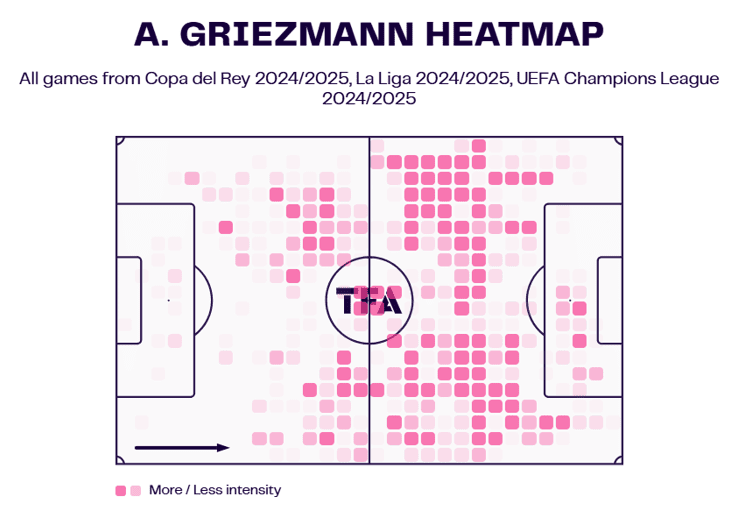
Take a look at his heatmap from this season; the left and right sides of that number 8 area are full of heat.
But you can also see some heat in the number 9 area, where he drifts to play in that second striker role.
You can even look at the number 6 area and see heat there.
From his heatmap, we can see he drifts from left to right in the number 8 role.
You see him making those runs forward, but also dropping back to defend and help build up when needed—a complete midfielder and key player for Atlético Madrid.
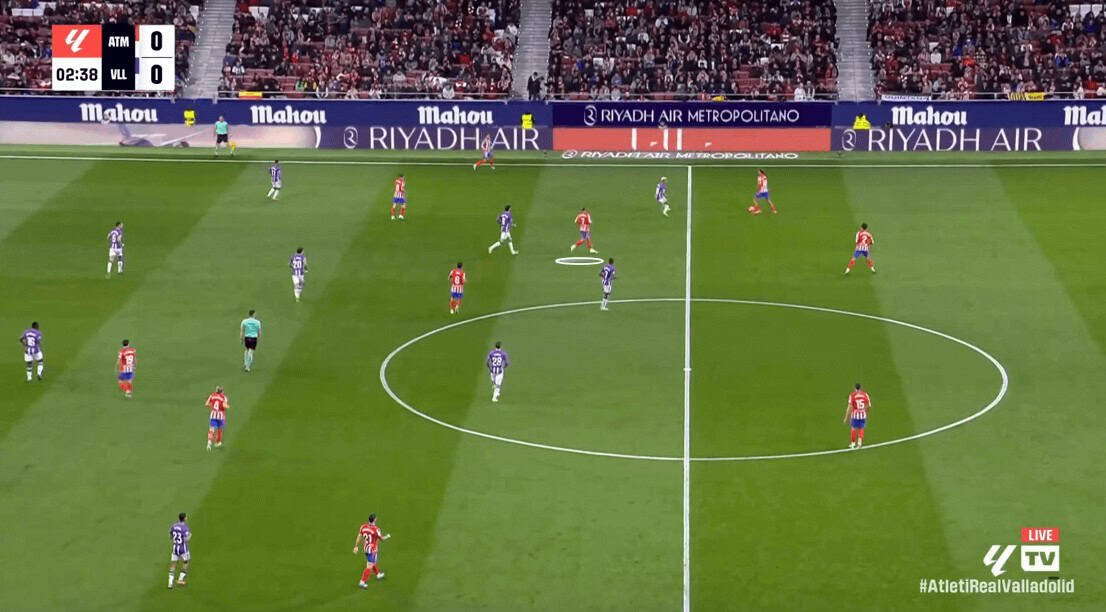
You can see how he comes deep to try to help build up when they are facing a very defensive block.
As shown in the image, they are attempting to break down a highly defensive 4-4-2 formation.
They need an extra spark to play in between the lines and break that second defensive line.
He likes to come into these areas to help, where we saw some heat in that number 6 area.
It’s more so to be a deep-lying playmaker to break the lines.
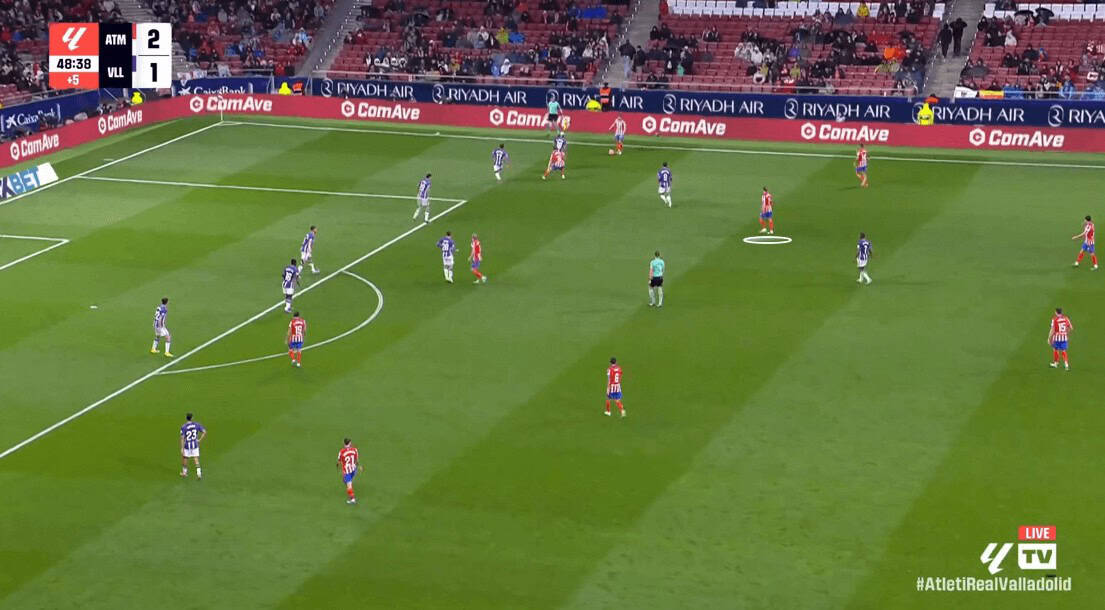
This photo is more interesting to see how much his role has truly changed at Atlético Madrid.
Old Griezmann would be much higher and central, even near the box next to Julián Álvarez.
Now, he’s playing that supporting role in midfield.
Antoine Griezmann Goal Contributions
In the 2024/25 season, Antoine Griezmann has 16 goals and seven assists across all competitions.
- LaLiga: 8 goals / 5 Assists
- UCL: 6 goals / 2 Assists
- Copa del Rey: 2 goals
Compared to his peak attacking seasons—2015/16 (32 Goals/Assists), 2017/18 (29 Goals/Assists), and 2022/23 (31 Goals/Assists), this season’s numbers are slightly below his best output.
However, his evolving role as a deeper, more creative midfielder means his influence extends beyond just goal contributions, making his current performances still highly impactful.
Antoine Griezmann Shot Map
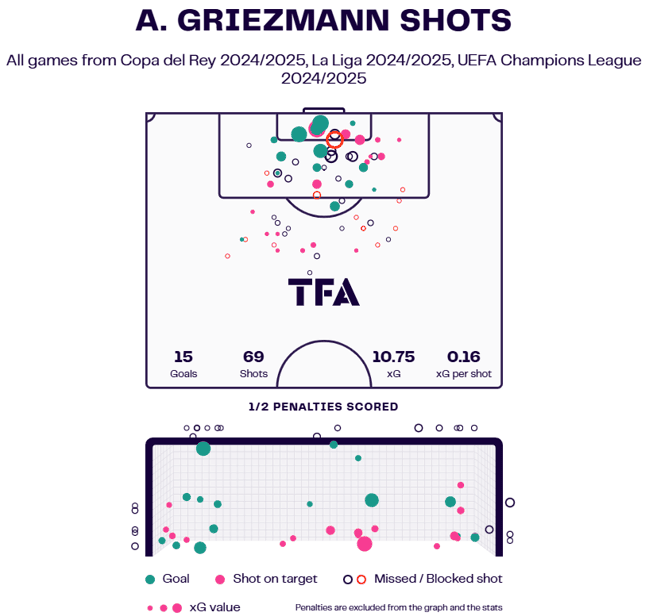
15 goals from 10.75 xG is a testament to his ability to finish his best chances when facing the net, showcasing his clinical nature.
Antoine Griezmann Assist Map
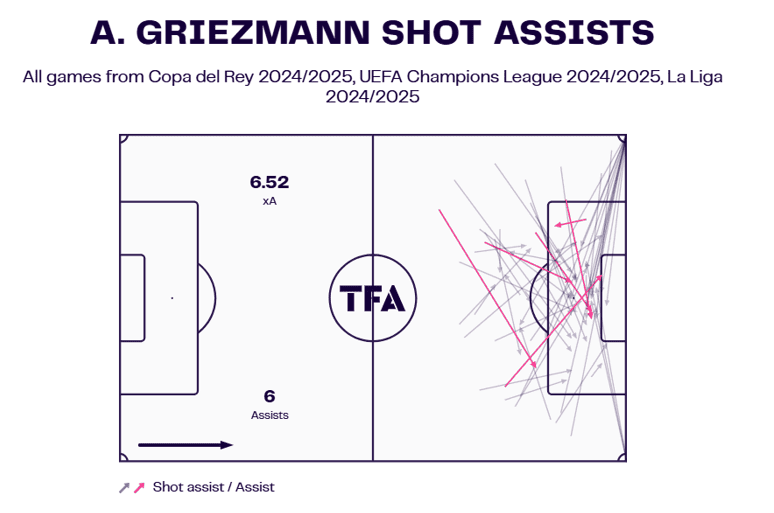
Six assists from 6.52 xA also show that his teammates are clinical when he gives them the opportunity.
Antoine Griezmann Playmaking Role
Antoine Griezmann Assist pic.twitter.com/mVcC2VpP8I
— Footie Clips (@FootieClips) April 20, 2025
He’s no longer in the central area when giving assists anymore; he’s playing a similar role to Kevin De Bruyne.
He takes the wing side of a midfielder and likes to put in crosses to try and make things happen as a playmaker from that angle.
The best part about his game here is that he’s capable of playing both wings.
In the example above, we see a cross from the left-hand side of his number 8 role.
Antoine Griezmann Assist pic.twitter.com/3gB1IXRqkx
— Footie Clips (@FootieClips) April 20, 2025
Now, in the video above, we see him do the same thing from the right-hand side, showing he doesn’t have a necessary preference but can do it from both angles.
Antoine Griezmann Defensive Role
We all know Diego Simeone’s philosophy on defence, which involves having every man behind the ball to defend.
Griezmann, who has an active work rate, plays on both ends of the pitch.
So, let’s take a look at how he helps in the press as well, defensively, when he has to come back from his number 8 role.
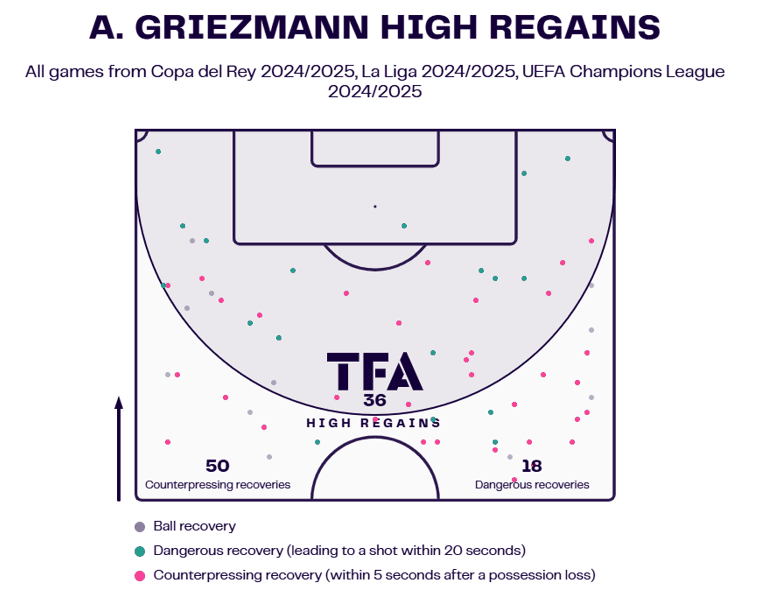
Eight dangerous regains and 50 counterpressing regains from someone who is mostly seen as an attacker or attacking 8 is very good.
He’s getting active in dropping back, winning challenges, and recovering the ball for his team.
This is a role he has adapted to over the past few years as he has grown older.
If we looked at 2016–2018, these numbers would not be the same.
Antoine Griezmann Aerial Duel pic.twitter.com/o45Sk9jJW7
— Footie Clips (@FootieClips) April 20, 2025
Something people may not know is that his aerial ability is very good, and he enjoys contesting aerial duels, often winning many of them.
Whether it’s winning the ball off a goal kick like in the video above, an aerial duel to get a header at goal, or a defensive aerial duel to win back possession, he contests for all of them.
And he lurks around to recover the ball when needed.
Like above, when he wins the aerial duel, he’s still lurking around to see if he can go into another duel, but he picks the ball back up and tries to play forward again with possession.
You will often see him analyzing the play before making the first move; he’s not jumping in right away without thinking.
He’s waiting for the right opportunity to pounce and enter the challenge to try to recover the ball.
Above is a great example.
Antoine Griezmann Slide Tackle pic.twitter.com/IZod1lxmBH
— Footie Clips (@FootieClips) April 20, 2025
Slide tackling is an enjoyment for Griezmann.
In another life, he must be a centre-back.
He’s aggressive in duels, not only does he tackle in defensive scenarios, but he likes to slide in to win the ball back even in the final third zone, just to make the recovery in a dangerous area.
A fearless player who likes to put a leg in, what more can you ask for from a number 8?
Conclusion
Antoine Griezmann is more than an 8.
For Atlético Madrid, he’s the heart of the entire team, coming to help in the first phases of play, being in the final third to help attack and score goals, being a playmaker on the wings, and putting in a tackle on both ends of the pitch.
There isn’t a more complete 8 in the world than him.
You could have had Modrić up there a few years ago, but now, there isn’t a better number 8 to have on your team.
With age, he’ll lose the speed and stamina he once had, but for now, he’s doing just fine.
Hopefully, with some key signings at Atlético Madrid, they can have a strong run for the entire season, rather than starting well and losing momentum later on.
But one thing is for sure: Griezmann is the heart of this team.
