
This tactical analysis of Brighton vs Bournemouth in the Premier League 2025/2026 examines a clash of contrasting game models at the Amex Stadium.
Fabian Hürzeler’s Brighton dominated possession and territory for large periods, while Andoni Iraola‘s side combined aggressive first-half pressing with a deep second-half low block in an attempt to protect the lead.
Brighton entered the match looking to extend their strong start to the new year and push towards the European qualification places, using a fluid 4-2-3-1 structure built on high full-backs, sustained counterpressing, and constant occupation of the final third.
Bournemouth, meanwhile, were forced into tactical adaptation following Antoine Semenyo’s departure to Manchester City, prioritising direct play, transitional speed, and defensive compactness.
This approach resulted in a superior xG output of 2.07.
The match ultimately became a test of structural dominance versus defensive resistance, with Bournemouth’s low block repelling sustained pressure until Brighton’s bench interventions altered the rhythm of the game.
Late changes, increased central overloads, and aggressive second-ball occupation culminated in a dramatic stoppage-time equaliser from Charalampos Kostoulas, underlining the growing importance of squad depth and in-game management under Fabian Hürzeler.
Lineups & Formations: Fabian Hürzeler Fluid Build-Up Vs Andoni Iraola Low Block
Fabian Hürzeler maintained his fluid 4-2-3-1 structure, which frequently morphed into a 2-4-4 in possession, emphasising high full-backs and a creative central presence between the lines.
Andoni Iraola, meanwhile, deployed a more traditional 4-2-3-1, prioritising rapid transitions in the first half before retreating into a compact and resolute low block after taking the lead.
Brighton & Hove Albion (4-2-3-1 / 2-4-4 In Possession)
Brighton goalkeeper Bart Verbruggen was active in build-up phases and comfortable sweeping behind Brighton’s high defensive line, although his aggressive approach was scrutinised following the VAR-awarded penalty.
Jan Paul van Hecke and Jack Hinshelwood anchored the defensive line, with Hinshelwood continuing his adaptation from right-back into a more central role during build-up.
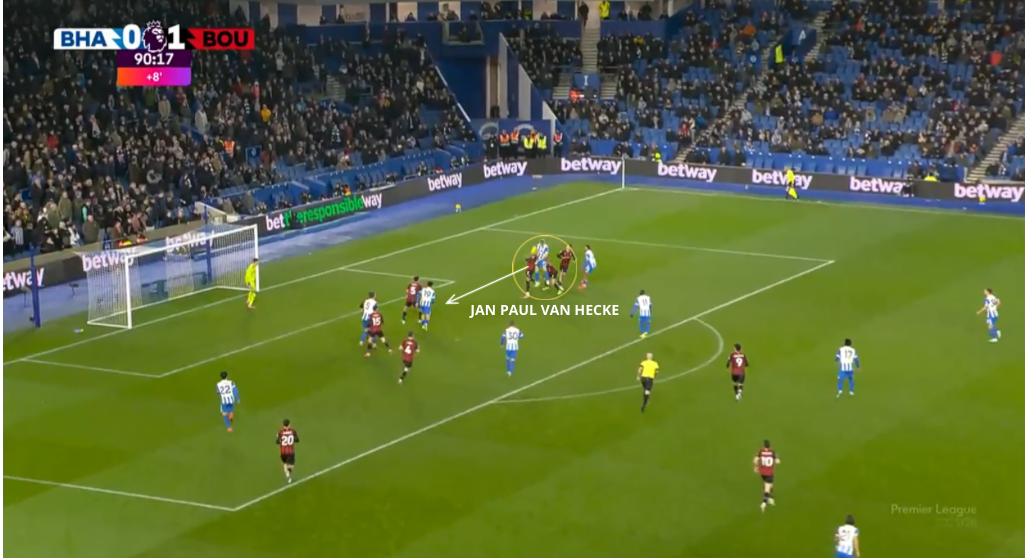
Van Hecke was particularly influential, later providing the assist for the equaliser.
Ferdi Kadıoğlu operated aggressively from left-back, advancing high and wide to create overloads and functioning almost as an auxiliary winger in sustained attacks.
Pascal Groß provided control and structure from central midfield, dictating tempo and circulation.
Diego Gómez was deployed as the central attacking midfielder, supported by Brajan Gruda on the right and Kaoru Mitoma on the left, with Mitoma marking his 100th Premier League appearance.
Danny Welbeck led the line as Brighton’s primary reference point, tasked with occupying Bournemouth’s centre-backs and facilitating combinations before the second-half tactical adjustments.

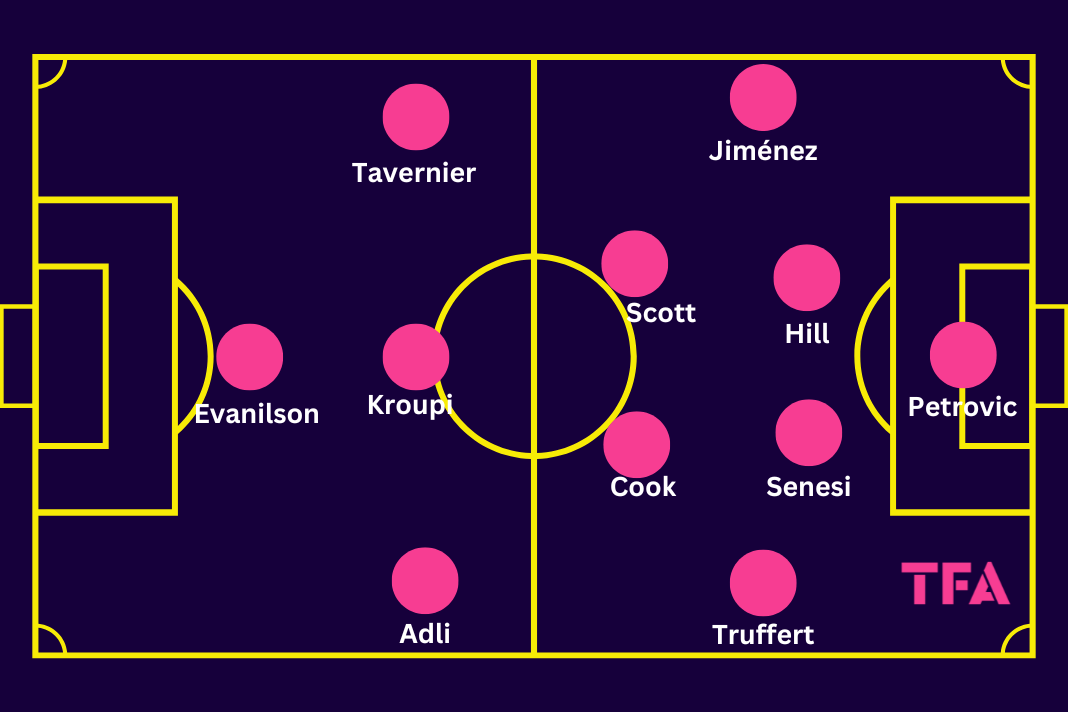
Bournemouth (4-2-3-1)
Bournemouth’s goalkeeper was Djordje Petrović, who produced a strong performance, making several important saves to deny Brighton’s wide attackers during sustained periods of pressure.
Alex Jiménez started at right-back and was tasked with limiting Mitoma’s influence, largely succeeding in isolating the winger in 1-v-1 situations.
Adrien Truffert operated on the left, while James Hill provided aerial security in central defence, with his long throws offering Bournemouth an additional attacking outlet.
A disciplined double pivot focused on protecting the backline and enabling direct progression.
Eli Junior Kroupi operated as the number 10 behind Evanilson, while Marcus Tavernier and Amine Adli provided width and verticality, particularly targeting the space behind Brighton’s high line.
Evanilson acted as the first trigger of Bournemouth’s press and remained a constant transitional threat, coming close to scoring after striking the woodwork in the first half.
Bournemouth High-Intensity Pressing & First-Half Control
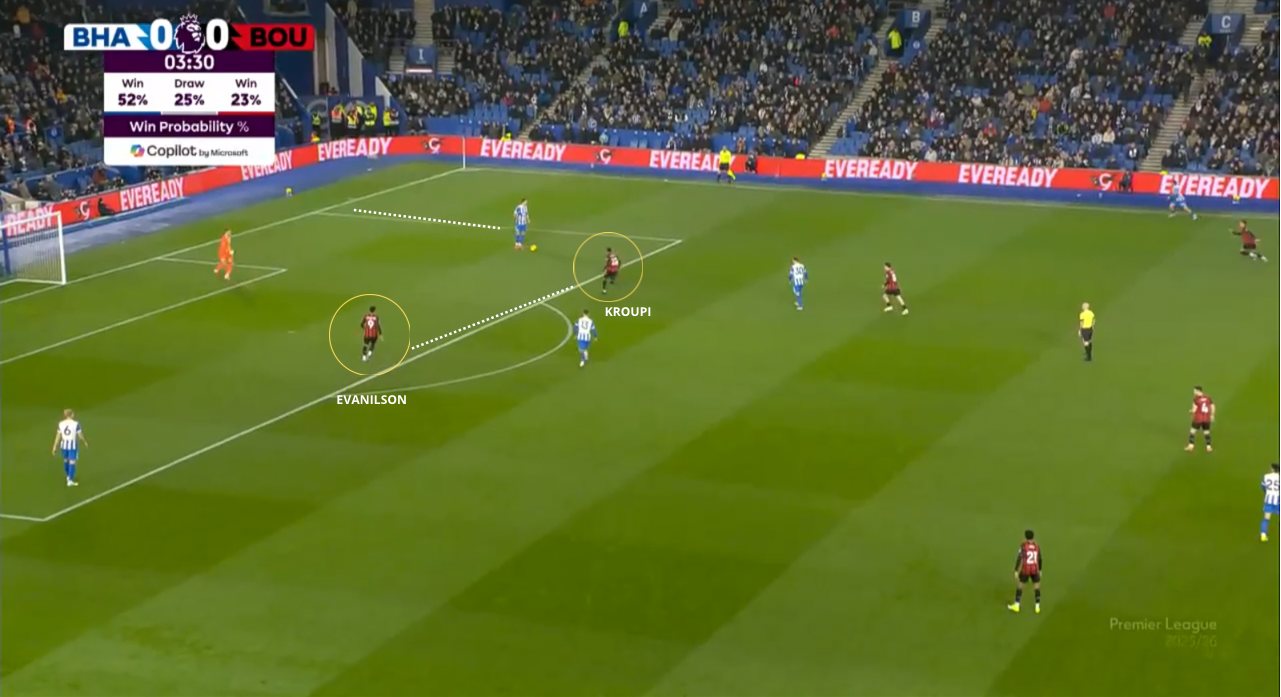
The match began with Brighton showing early intent, but after the first 15 minutes, Bournemouth seized control through speed, precision, and aggressive pressing.
Iraola’s side consistently exploited Brighton’s high defensive line, using 50 long passes to bypass midfield pressure and force the home side into repeated recovery runs towards their own goal.
Bournemouth’s effectiveness without the ball was reflected in their 10 recoveries in the final third, which significantly disrupted Brighton’s build-up structure and limited their ability to progress centrally.
This pressing success allowed Bournemouth to dictate the tempo of the first half despite having less overall possession.
The decisive moment arrived when Amine Adli beat Bart Verbruggen to a cross and went down inside the area.
Initially booked for simulation, the decision was overturned following a VAR review, allowing Marcus Tavernier to convert the penalty and give Bournemouth the lead.
Their first-half dominance was nearly rewarded further when Evanilson struck the post, contributing to Bournemouth’s superior Expected Goals (xG) total of 2.07, compared to Brighton’s 1.27.
Bournemouth Tactical Adjustments & Second-Half Low Block
As the match entered the second half, Andoni Iraola made a clear tactical adjustment to protect the 1-0 lead.
After a first half built on speed and precision in transition, Bournemouth’s physical output began to decline, prompting a deliberate retreat into a compact low block.
The attacking trio of Amine Adli, Marcus Tavernier, and Junior Kroupi, who had been crucial in stretching Brighton’s high defensive line, showed visible signs of fatigue around the hour mark.
With limited offensive reinforcements available following Antoine Semenyo’s departure, Iraola prioritised defensive stability over counterattacking threat.
The introductions of Bafodé Diakité, Adam Smith, and Ryan Christie reshaped Bournemouth into a rigid defensive structure, which registered 53 interceptions as they sought to repel sustained pressure.
This defensive block prioritised central compactness, forcing Brighton to circulate the ball horizontally and reducing access into the penalty area.
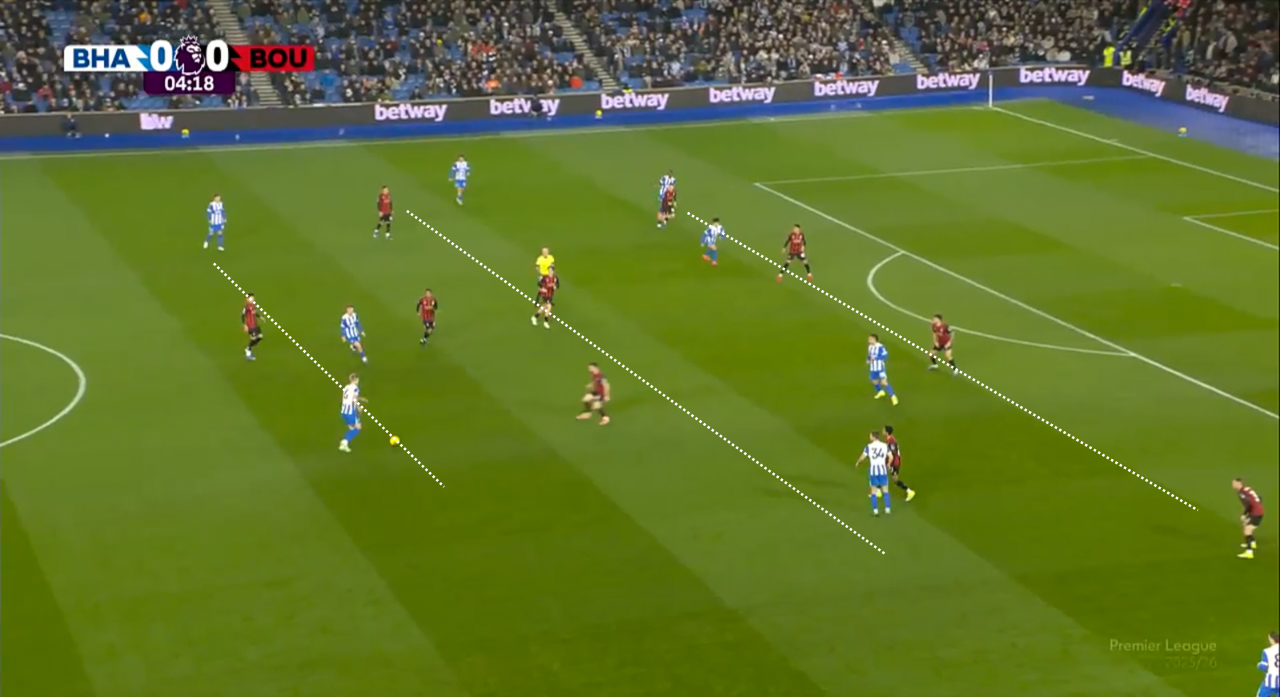
While this approach initially neutralised Brighton’s second-half pressure, it significantly reduced Bournemouth’s ability to relieve pressure through possession.
They managed just 28 passes into the final third, compared to Brighton’s 69, and became increasingly pinned inside their own half.
Bournemouth also suffered 55 ball losses in their defensive third, as Brighton’s aggressive counterpress produced 49 quick recoveries after a loss.
This sustained territorial dominance ultimately invited the late onslaught that led to Bournemouth’s concession.
Brighton Solutions Vs Bournemouth Low Block
Fabian Hürzeler’s response to Bournemouth’s deep defensive structure highlighted the importance of squad depth and in-game management.
With Brighton dominating possession but failing to generate sufficient penetration, Hürzeler introduced a decisive triple substitution in the 66th minute, aiming to increase physical intensity and attacking variety.
The impact was immediate, as Brighton finished the match with 70 progressive passes (67% accuracy) and 55 touches in the opponent’s penalty area, repeatedly forcing Bournemouth’s low block to adjust.
Midfield Stability & Counterpressing
The introduction of Carlos Baleba proved transformative.
Returning from international duty, Baleba added physicality and ball-winning capacity in central areas, overwhelming Bournemouth’s increasingly fatigued midfield.
His ability to regain possession under pressure was a key factor behind Brighton’s 49 quick recoveries after loss, allowing sustained attacks without compromising the high defensive line.
Wide Dynamism & Dribbling Threat
The return of Yankuba Minteh restored verticality and directness on the flanks.
Brighton completed 30 dribbles (56% success), with eight in high-risk zones at an impressive 87% success rate.
Minteh’s direct running forced Adrien Truffert into deeper defensive positions and contributed to 21 crosses, creating space for late arrivals into the box.
Central Link & Final-Third Access
In the ‘number 10’ role, Georginio Rutter replaced Diego Gómez and provided improved connectivity between midfield and attack.
Brighton subsequently completed 69 passes into the final third (75% accuracy), an improvement that was crucial in breaking down Bournemouth’s central compactness.
The decisive moment arrived with the 77th-minute introduction of Charalampos Kostoulas.
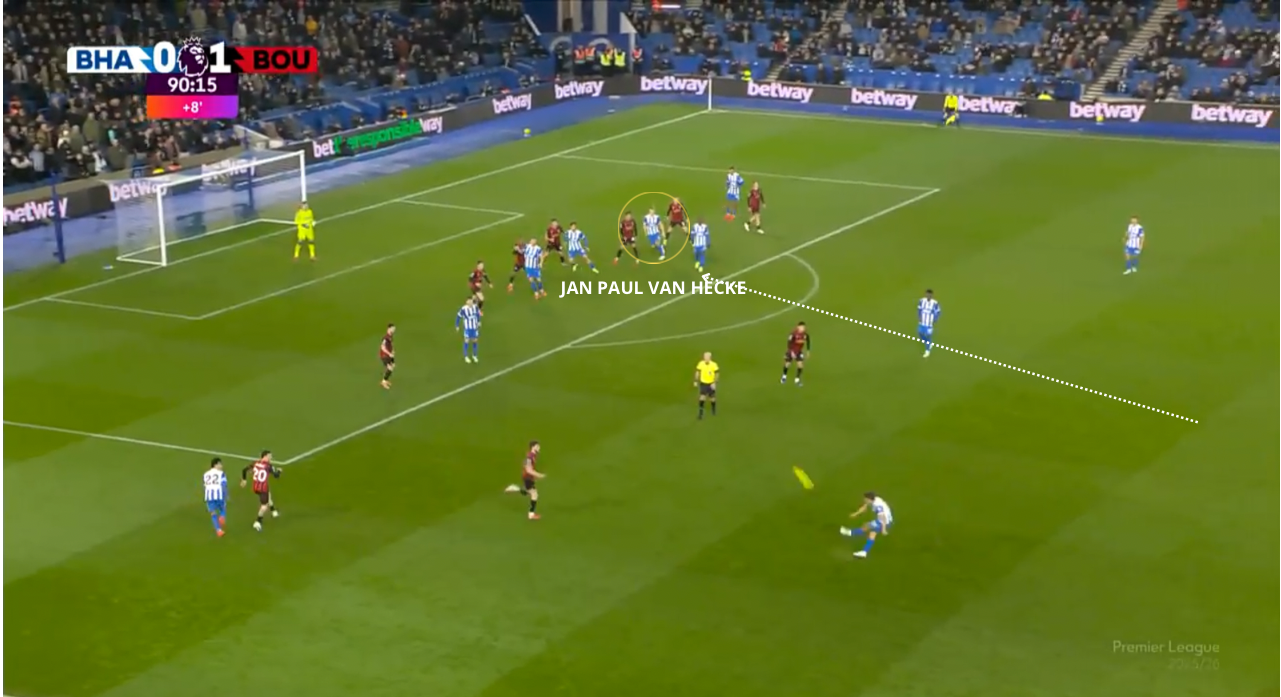
The young forward offered a physical and relational reference point, particularly for Jan Paul van Hecke’s forward passes and knock-downs.
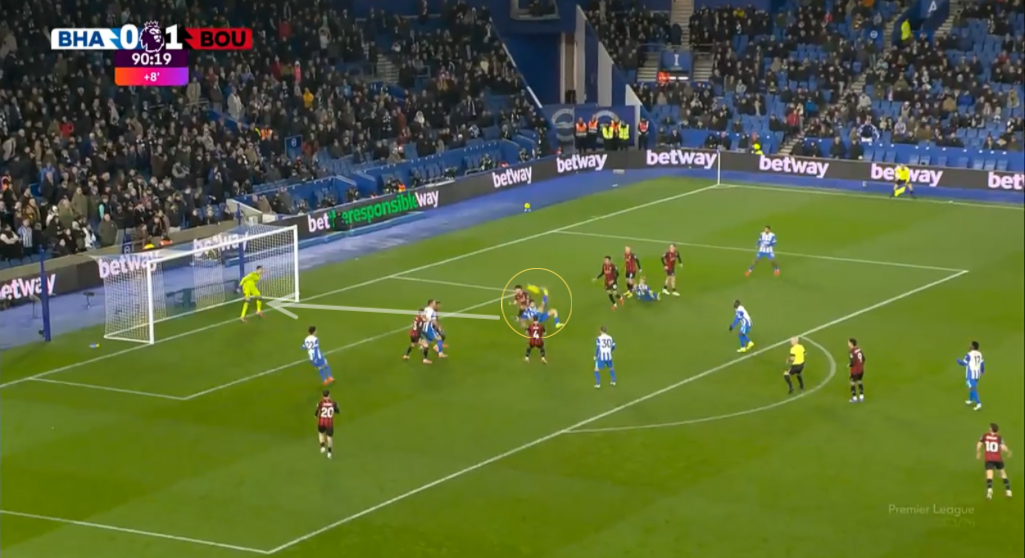
Brighton ended the match with 17 total shots, and Kostoulas’s acrobatic 91st-minute equaliser underlined the effectiveness of Brighton’s bench.
The goal was Brighton’s ninth scored by a substitute this season, reinforcing their status as one of the Premier League’s most effective teams at influencing matches late on.
Charalampos Kostoulas Impact
The decisive breakthrough arrived with the introduction of Charalampos Kostoulas in the 77th minute.
The teenage forward provided a physical and relational reference point, enabling Brighton to sustain pressure through second-ball dominance and direct link play.
His 91st-minute equaliser, finished acrobatically following a knock-down from Jan Paul van Hecke, was the clearest expression of Brighton’s territorial control and marked their ninth goal scored by a substitute this Premier League season.
Conclusion
This 1-1 draw at the Amex Stadium ultimately reflected a clash between Brighton’s structural dominance and Bournemouth’s defensive resistance.
Andoni Iraola’s side executed their plan effectively for long periods, combining first-half pressing with a compact second-half low block to limit Brighton’s access to central zones.
However, their increasing passivity and lack of counterattacking options left them vulnerable to sustained late pressure.
The match underlined the growing importance of squad depth and in-game management in the Premier League.
While Bournemouth were constrained by limited attacking options following Antoine Semenyo’s departure, Fabian Hürzeler’s substitutions systematically altered the physical and tactical balance of the game.
Brighton’s late equaliser was not the product of fortune, but the consequence of territorial dominance, aggressive counterpressing, and second-ball control.
Charalampos Kostoulas’s decisive contribution ultimately preserved a point that keeps Brighton firmly in the European qualification conversation, while highlighting the fine margins that define defensive survival without offensive relief.