
Despite currently enjoying an eight-point lead at the top of the Bundesliga, putting them on the path to a record-extending 34th German championship, Bayern Munich were unable to break their Bayer Leverkusen hoodoo on the domestic scene from last season in their direct battles.
With both league fixtures for the 2024/25 campaign already played, as well as a DFB-Pokal Round of 16 tie where Leverkusen posted the sole win in between them in Germany this season, Bayern were 0-for-3 against the reigning champions when the full-time whistle went in last month’s scoreless draw at the BayArena.
While that result was of greater benefit to Bayern than it was to Leverkusen, given the league situation, it did extend the Bavarians’ run of six games without a win against their rivals.
Their last success against them had come in September 2022, just before Xabi Alonso’s arrival as their manager the following month.
So when the UEFA Champions League knockout stage draw pitted both sides against each other once again, it offered another opportunity for Bayern to put things right and re-establish themselves as the top dogs in Germany again, not only by the standings but also in head-to-head competition.
And prevail they did, as Bayern walked out with a 3-0 win on Wednesday night to put themselves in a commanding position ahead of the return leg next week, courtesy of a brace from Harry Kane either side of Jamal Musiala’s goal.
In this tactical analysis, we’ll take a look at some of the keys behind Bayern’s victory, which gave Vincent Kompany his first taste of success against Xabi Alonso as manager, at the fourth time of asking this season.
Bayern Munich Vs Bayer Leverkusen Lineups & Formations
Bayern Munich, as they so often do under the Belgian manager, set out in a 4-2-3-1 scheme with Konrad Laimer, Dayot Upamecano, Kim Min-Jae, and Alphonso Davies, preferred to Raphael Guerreiro presumably due to the threat of Jeremie Frimpong’s pace on that side, forming their back four in front of Manuel Neuer.
Leon Goretzka partnered Joshua Kimmich in the center of midfield with Jamal Musiala occupying the attacking midfield role, Michael Olise and Kingsley Coman on either side of him and Harry Kane up front.
For Alonso’s Leverkusen, it was a similar approach to the league meeting between the two sides last month.
The team played a 4-4-2 double false-nine formation, with Florian Wirtz and Amine Adli leading the attack.
Top scorer Patrick Schick was benched once again.
Frimpong and Alex Grimaldo were on the wings, with Exequiel Palacios and Granit Xhaka in the middle of the park in midfield.
At the same time, Nordi Mukiele and Piero Hincapié flanked the central defensive duo of Jonathan Tah and Mario Hermoso.
Finally, Matěj Kovář was in between the sticks ahead of first-choice Lukas Hradecky.
There were no real surprises in Bayern’s selection.
For Leverkusen, it was the third consecutive meeting between the sides in which they lined up without an actual center-forward.
This was much criticised last month as they failed to convert their many chances into goals in a crucial match in the Bundesliga title race.
In the end, this approach didn’t work out this time either, but it had to do with much more than missed chances.
Let’s look at a few of the keys that led to Bayern’s victory and how they neutralized Leverkusen offensively while exposing them defensively.
Bayern Munich Positional Rotations
There were two ways Bayern were able to move their pieces effectively to wherever they needed them — both in attack and in defense.
First, let’s look at how that looked on the defensive side.
It’s no secret that Leverkusen bases much of their offensive work on their two standout wide players, Frimpong and Grimaldo. Bayern was prepared to deal well with this situation for this game, particularly with the Dutchman.
Besides opting to go with Alphonso Davies at left back, who can better match Frimpong’s pace in 1v1 situations than Raphael Guerreiro, Kingsley Coman played a key role on the defensive side, which helped them negate Leverkusen’s wide men on the right early on in the game.
 The above is an example of how Coman was used in this game.
He drops deeper here to help Davies in support against any potential 2v1 situation, with Frimpong and Nordi Mukiele coming from behind.
While this helped Bayern suss out the visitors’ advances on that flank, Coman’s presence in the defensive half was also useful when regaining possession.
He could then carry the ball forward or release it quickly so that his team could attack quickly through the other side in transitions.
While Coman carried out these defensive duties mainly on the left, there were times when it was Harry Kane or Jamal Musiala instead.
Coman stayed higher to get on the end of any long passes from deep, which we’ll touch on later.
The other player that Bayern clearly had a plan to defend was the obvious star man Wirtz, who loves to drop in between the lines and find pockets of space to receive the ball in before carrying it towards the opposing goal.
Bayern dealt with this potential danger by rotating Kimmich and Leon Goretzka over, who would move up and join the press when the possession was in Leverkusen’s hands and cover the spaces that Wirtz and company like to roam into.
 In the sequence above, Goretzka is the one pushing up in this situation to block any passing lanes alongside the front four.
At the same time, Kimmich drops quite deep to become almost another center-back while keeping a close eye on Wirtz’s movement.
Kimmich steps up after Wirtz gets away and finds space, where he receives the pass from Tah.
In the end, it’s Olise who comes in from his position to win the ball off instead and regain possession for Bayern.
Bayern repeatedly snuffed out any real danger before it arrived and managed to keep Wirtz, Frimpong, and the rest of the Leverkusen team at bay.
They never really allowed them to get on the ball and dictate proceedings at any point throughout the whole 90 minutes.
The front six’s roles and efforts in terms of defensive positioning and decision-making were spot on, helping alleviate the pressure on their defensive line, which has had its shaky moments throughout the campaign thus far.
Again, on the ball, positional rotations and clever movements helped them stretch Leverkusen and draw them in before picking them off.
One noticeable pattern was how their midfield trio of Kimmich, Goretzka, and Musiala often dropped deeper into the half-spaces between the center-backs and full-backs.
This allowed Konrad Laimer and Davies to push up and support Olise and Coman in attack, helping them create numerical superiority on the flanks, particularly in transitional phases.
 Here’s one such example close to the end of the half, where we can see a few things.
First, Kimmich moves towards Kim Min-Jae who is on the ball, while his midfield partner Goretzka goes out wide to the right-back position.
This allows Laimer to push up into a higher position on the field in the right half-space while Davies does the same on the opposite side.
Kim moves wider to cover on the left, while Kimmich drops in between the centerbacks to help facilitate play.
These rotations afforded Bayern greater access to the half-spaces going forward and supported Olise and Coman.
This would leave space in the middle for Kane and Musiala to move into, as Leverkusen would be expected to shift from side to side to better defend the overloaded flanks.
This makes it a nightmare for the away side to defend against threats coming from all angles from a relentless Bayern team.
Bayern Munich Early & Frequent Switches To Wide Players
All of the above laid the foundation for what Bayern really tried to achieve on the ball whenever they had it—finding their wide players as quickly as possible and creating 1v1 situations against the Leverkusen full-backs.
To do this, they required quicker ball circulation from those responsible in the early build-up phase, whether it be through quick ground passes or early, long diagonal balls switching from one side to another.
They opted to go with the latter on many occasions, not to break Leverkusen’s press but by design to catch them off guard defensively before they were settled in the shape they wanted to have when out of possession.
 They already managed to find success in doing so within the first ten minutes of the game when Kane picked his head up early and noticed the run of Olise, who had Hincapié isolated and Leverkusen not set in their defensive shape, just what Bayern would have wanted.
They ended up exploiting this situation to devastating effect.
Olise managed to deliver a cross off his weaker right side, which was met by a bullet Kane header for the opening goal.
And from then on, Bayern never looked back.
While they had isolated situations like these where they were able to find space in the wider areas quickly and efficiently, there was one player in particular they tried to play these sort of balls through by design.
Joshua Kimmich was the main player they went to to accomplish this, even if others were able to contribute at times.
Understandably so, given the range of passing and ability to pick players out that Kimmich has compared to the others in the side, and something Leverkusen struggled to deal with from the first minute.
 Here’s one situation just a few minutes after the first goal: a Leverkusen goal-kick eventually ends up at Kimmich’s feet, and he wastes no time in immediately launching the ball forward onto the run of Coman, who notices the space behind Leverkusen’s back three, who are holding a very high line here from the initial goal-kick.
The ball didn’t end up reaching him, but it wasn’t the only time in the game that he made this sort of run with Kimmich looking to pick him out from deep.
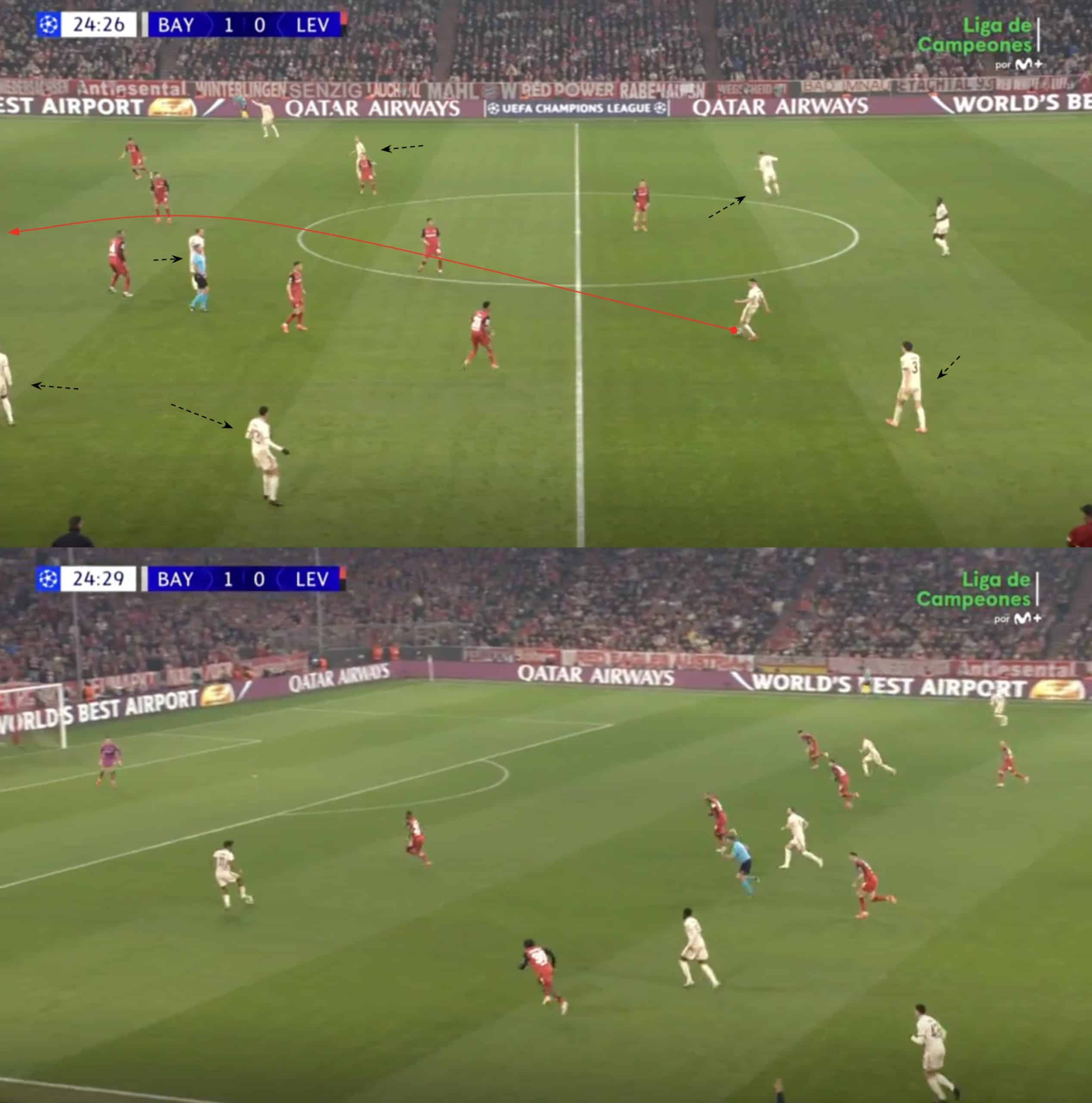 He did so again here a few minutes later, although in this situation, Leverkusen did not have as many bodies pushed forward as in the earlier example.
Here, we can also spot the previous point about Bayern’s positional rotations.
Goretzka and Kim again moved wider to cover so Laimer and Davies could push up, while Kane and Musiala found pockets of space between the lines.
While Leverkusen’s shape here doesn’t look too bad with the ball still in Bayern’s half, Kimmich’s ability to pick out an early long pass to Coman making the run towards the box in behind their defense catches them off guard.
It presents another dangerous opening for the home side.
Olise and Coman were the main targets of Bayern’s offense’s early switches and diagonal passes.
While Olise opted to stay wider to find himself in 1v1 situations against a defender, Coman often made runs in behind or through the middle, taking up the space usually occupied by a center-forward when Kane would drop off and attract a defender while moving into midfield.
Bayern had many different variations at their disposal, which they utilized throughout the game to unsettle Leverkusen defensively.
The key was to do it early, often, and successfully.
Conclusion
Leverkusen’s defensive mistakes and an early dismissal for Mukiele may have helped.
Still, nothing should be taken away from Bayern Munich, who finally earned their first win against Alonso’s side after failing to do so in the previous six outings.
It was a comfortable night for the record German champions, one which puts them in the driver’s seat to reach the Champions League quarterfinals for a fifth consecutive season.
It’s also a result that could significantly impact any faint hopes of Leverkusen’s domestic challenge to Bayern this year, with Alonso’s formula finally figured out by his opposite number, Kompany.
While there is still a second leg to turn things around, it’s an arduous task for Leverkusen now, and Bayern will look to finish the job and move on to keeping themselves in the hunt for two major trophies going into the final stretch of the season.
