
The opening three gameweeks of the Premier League delivered some fascinating fixtures, one of which took place at St. James’ Park as Newcastle United hosted Liverpool in one of the highlights of the season so far.
The reigning champions secured a hard-fought victory in the dying moments.
However, the home side also produced a strong performance.
Newcastle’s impact was not limited to open play.
The Magpies excelled in set-pieces, scoring both of their goals from such situations to stage a comeback before Liverpool’s late strike secured them the win.
From the Reds‘ perspective, this raises serious concerns regarding their set-piece defence.
What’s more, the goals did not come from corners, usually the most threatening type of set-piece, but rather from a throw-in and an indirect free-kick.
This game, therefore, provides an opportunity to examine Liverpool’s defensive structure in these specific phases.
So instead of looking at this game in isolation, let’s dive deeper and search to determine where the Reds’ weaknesses lie and how Newcastle managed to exploit them, not in terms of the final game result but specifically in the set-piece battle.
To gain a clearer picture, we can look back at last season to better understand how Liverpool tactics defend throw-ins and indirect free-kicks under Arne Slot.
Let’s start with throw-ins.
Liverpool Throw-In Defence Tactics 2024/2025
 Liverpool defend throw-ins in a 4-3-3 formation, though their defensive shape can vary depending on the opponent and the players on the pitch.
We will call the full-back on the throw-in side, the near full-back, while the opposite one is the far full-back.
Among the centre-backs, the defender nearest to the throw-in is the near centre-back, and the other becomes the far centre-back.
Three midfielders form the second line of defence ahead of these four, while the final line is composed of three forwards.
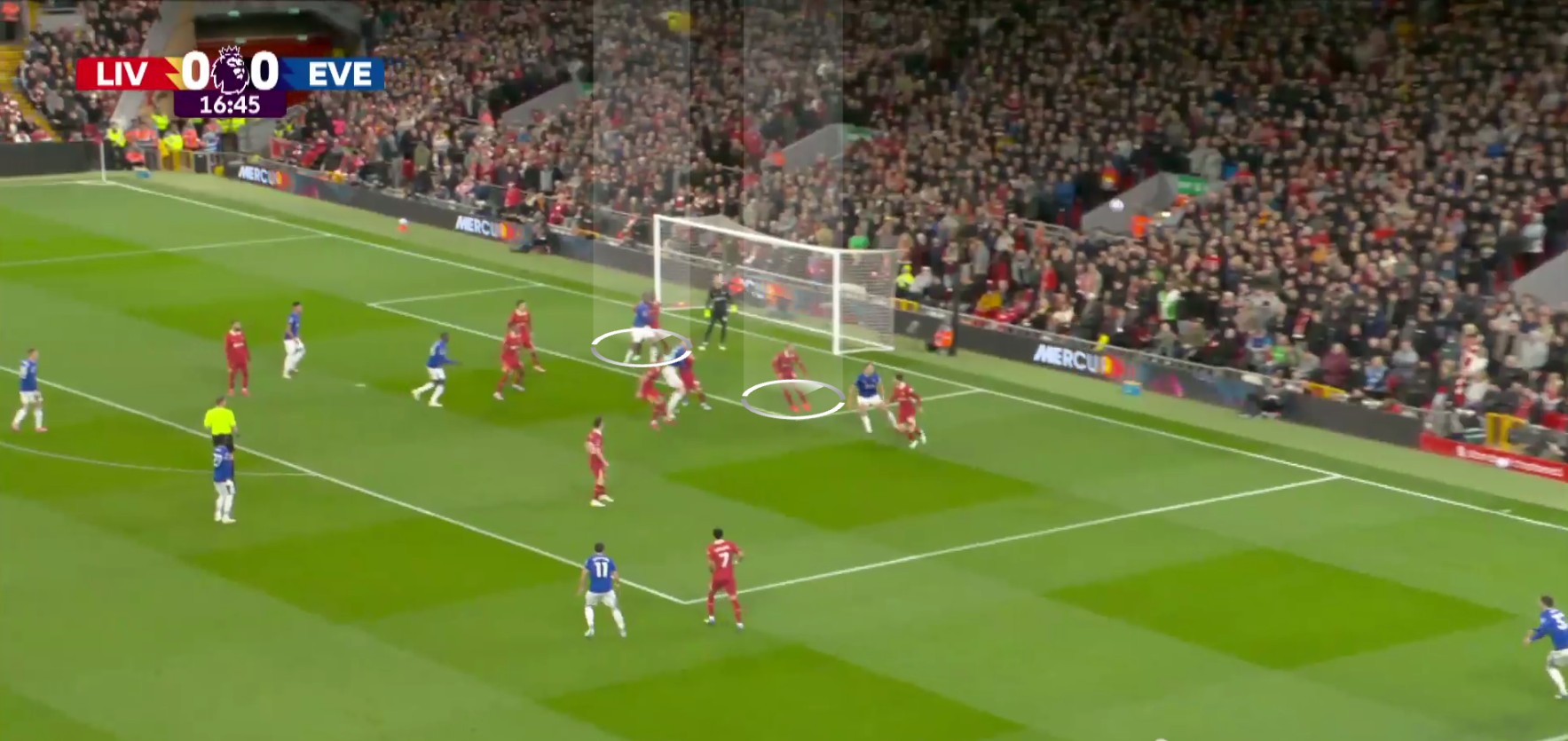 Everton attack the box with five players: three in the six-yard box, and two around the penalty spot.
They have three players at the edge of the box, and one at the back.
Liverpool’s main objective is to ensure that the near centre-back, in this case Virgil van Dijk, remains free, allowing him to attack the ball cleanly without direct pressure from an opponent.
To make this possible, the responsibility of marking the opposition’s centre-forward is handed to the far centre-back, here, Ibrahima Konaté, who tightly man-marks the centre-forward inside the six-yard box.
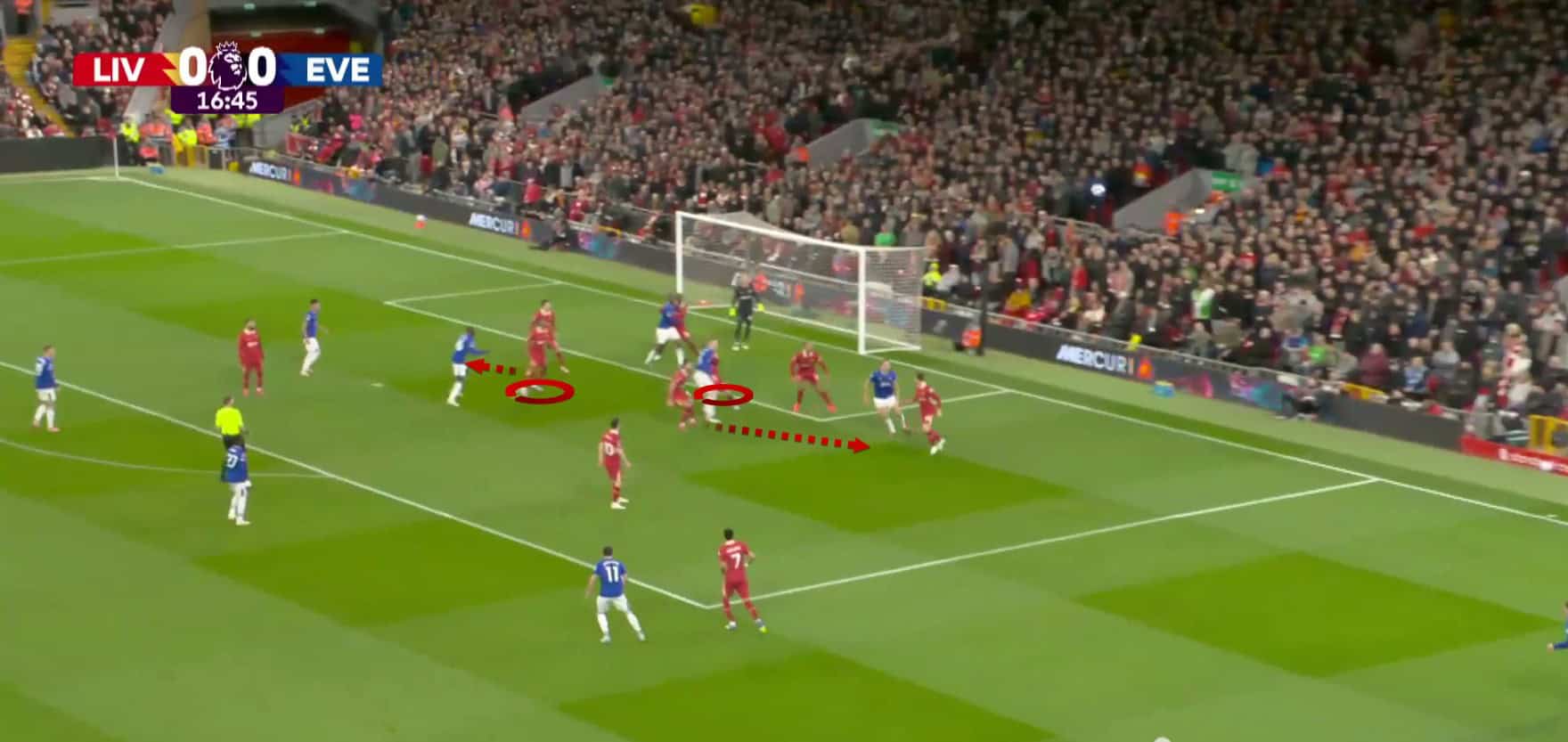 To keep the near centre-back free, Liverpool assign some of the midfielders to track runners who attempt to exploit the near-post space between the centre-back and the full-back.
In this instance, the right-sided eight, Dominik Szoboszlai, should have been with James Tarkowski, but we can see clearly that the six, Alexis Mac Allister, marks Jake O’Brien to prevent him from challenging Virgil van Dijk.
Meanwhile, the other eight, Ryan Gravenberch, positions himself zonally in front of the first line, with the flexibility to either pick up an opponent entering his zone or provide additional support to the initial defensive line.
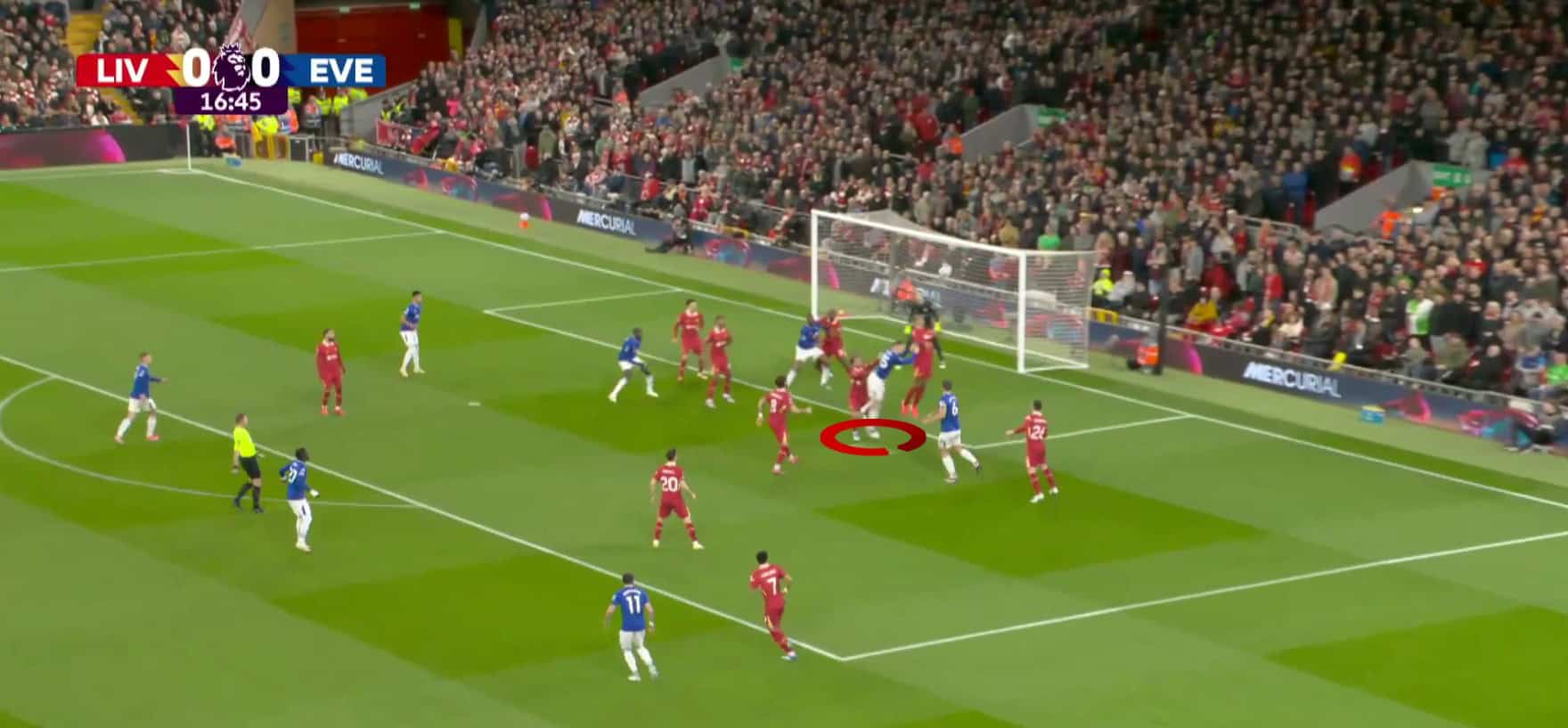 Mac Allister did not fully prevent Jake O’Brien’s movement, allowing him to push Van Dijk off balance and prevent him from winning the header.
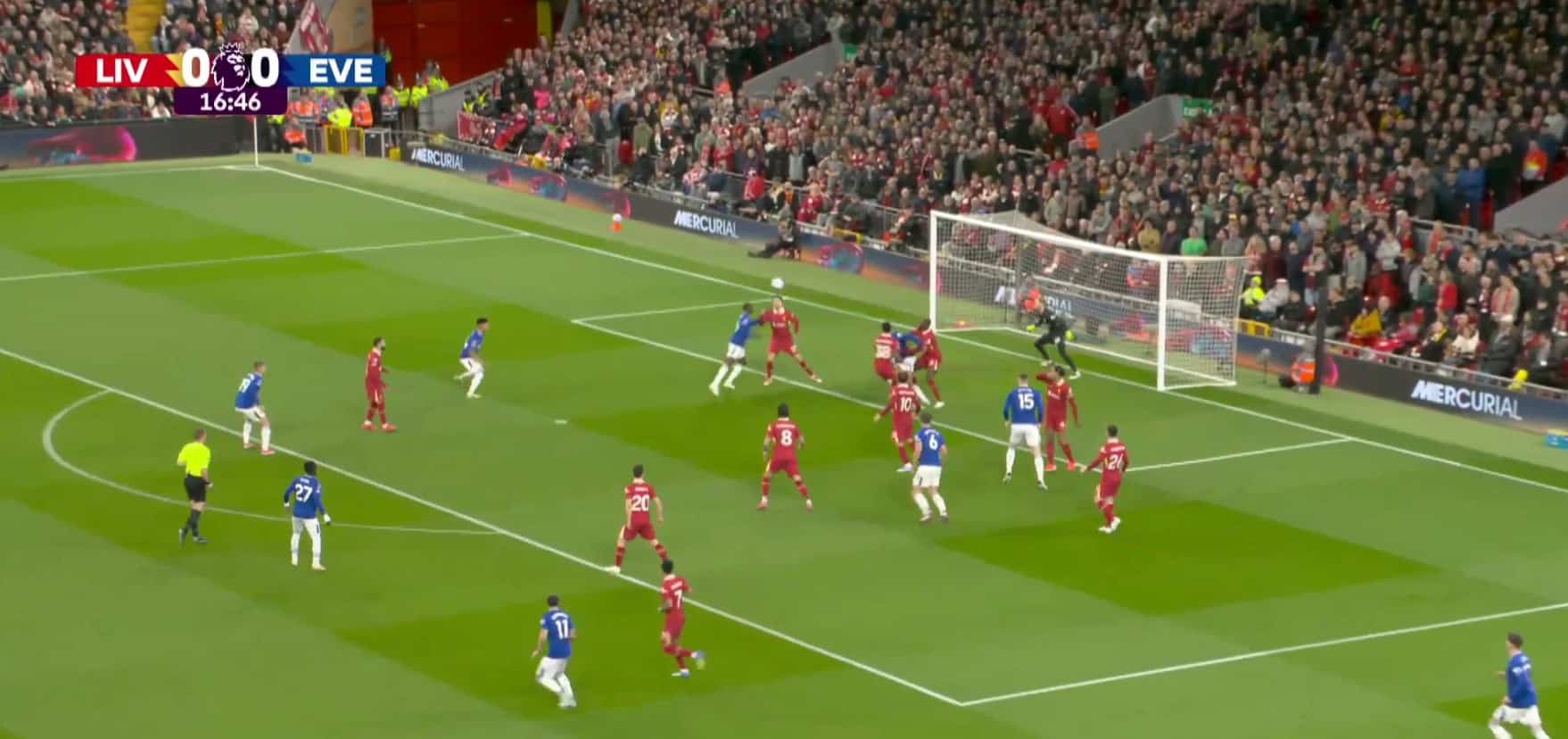 The far full-back in this situation is Curtis Jones, who is not particularly strong in aerial duels.
Sometimes, he remains away from opponents outside his immediate area by being positioned zonally inside the six-yard box.
Furthermore, as he was static while waiting for the ball, the rebound travelled over him and fell to Carlos Alcaraz.
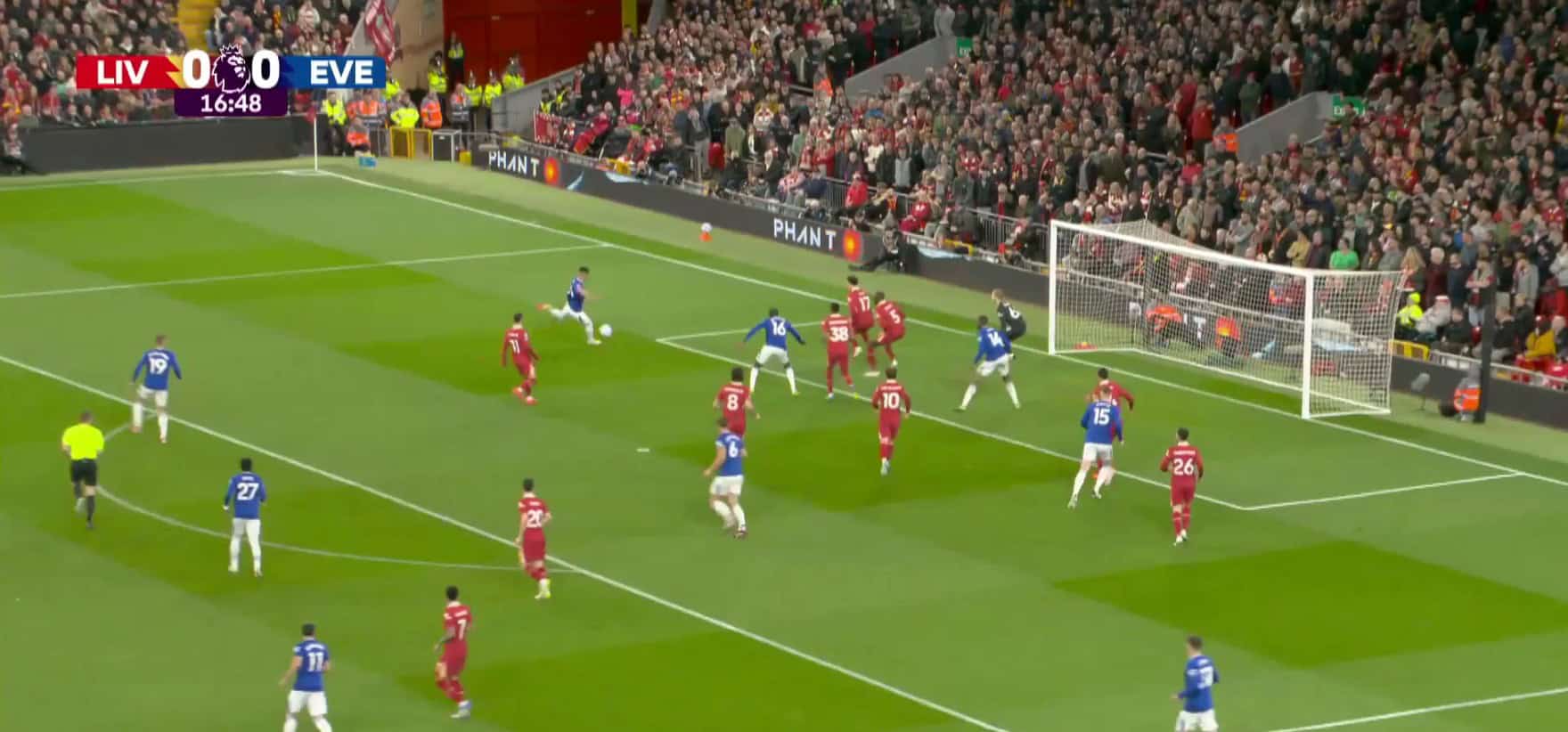
Alcaraz now had a clear opportunity to create a dangerous chance.
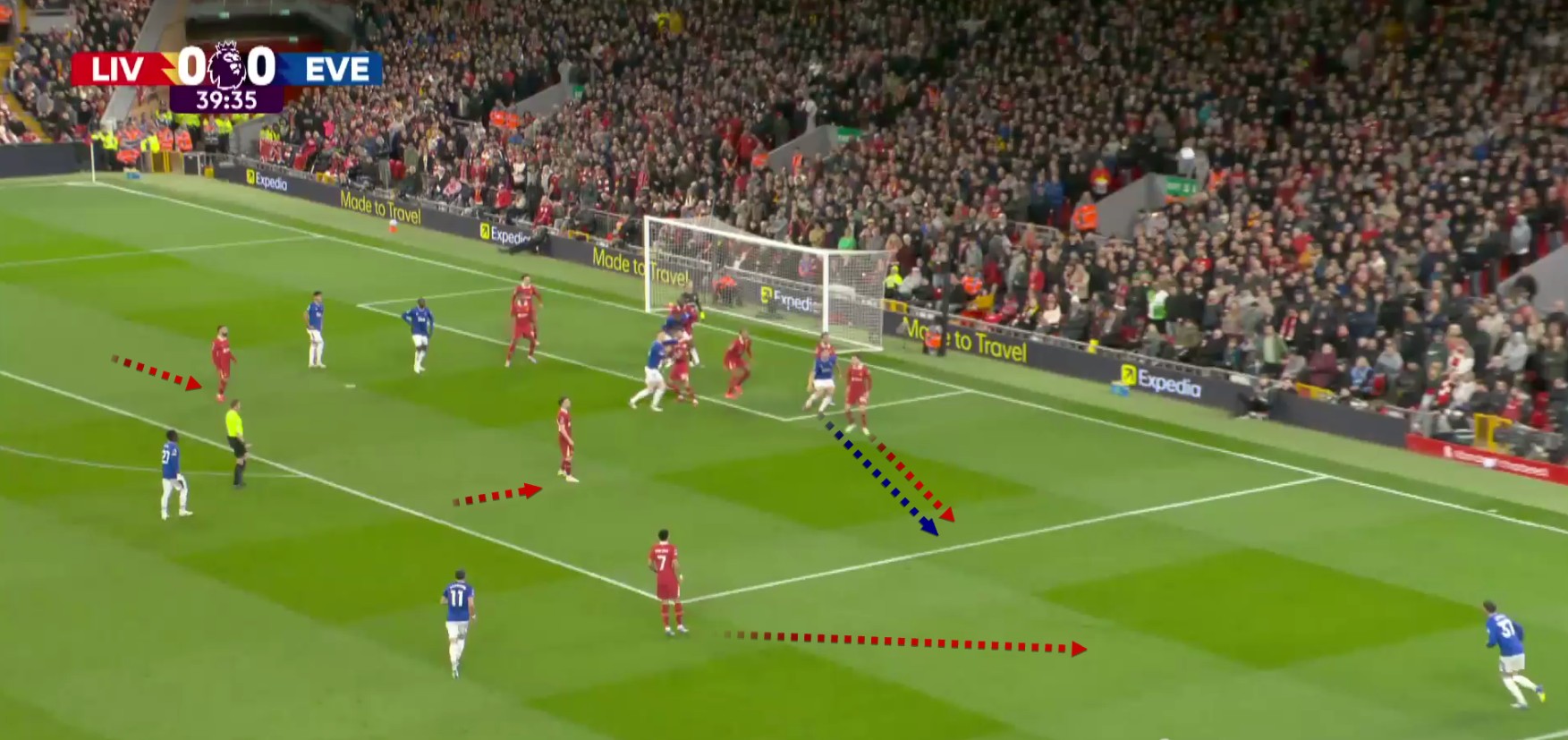 On the left side, Liverpool position Andrew Robertson as the near full-back, holding his place to deal with any late runners.
With this position, Robertson is ready to defend if the opposition tries to play a short throw-in at the last moment.
If the ball is cleared back towards the taker, Luis Díaz, as the left winger, presses immediately to deny the taker the time and space to deliver a cross.
Meanwhile, Mohamed Salah positions himself on the edge of the box to challenge for the second ball, while Diogo Jota holds a more central position inside the box to do the same.
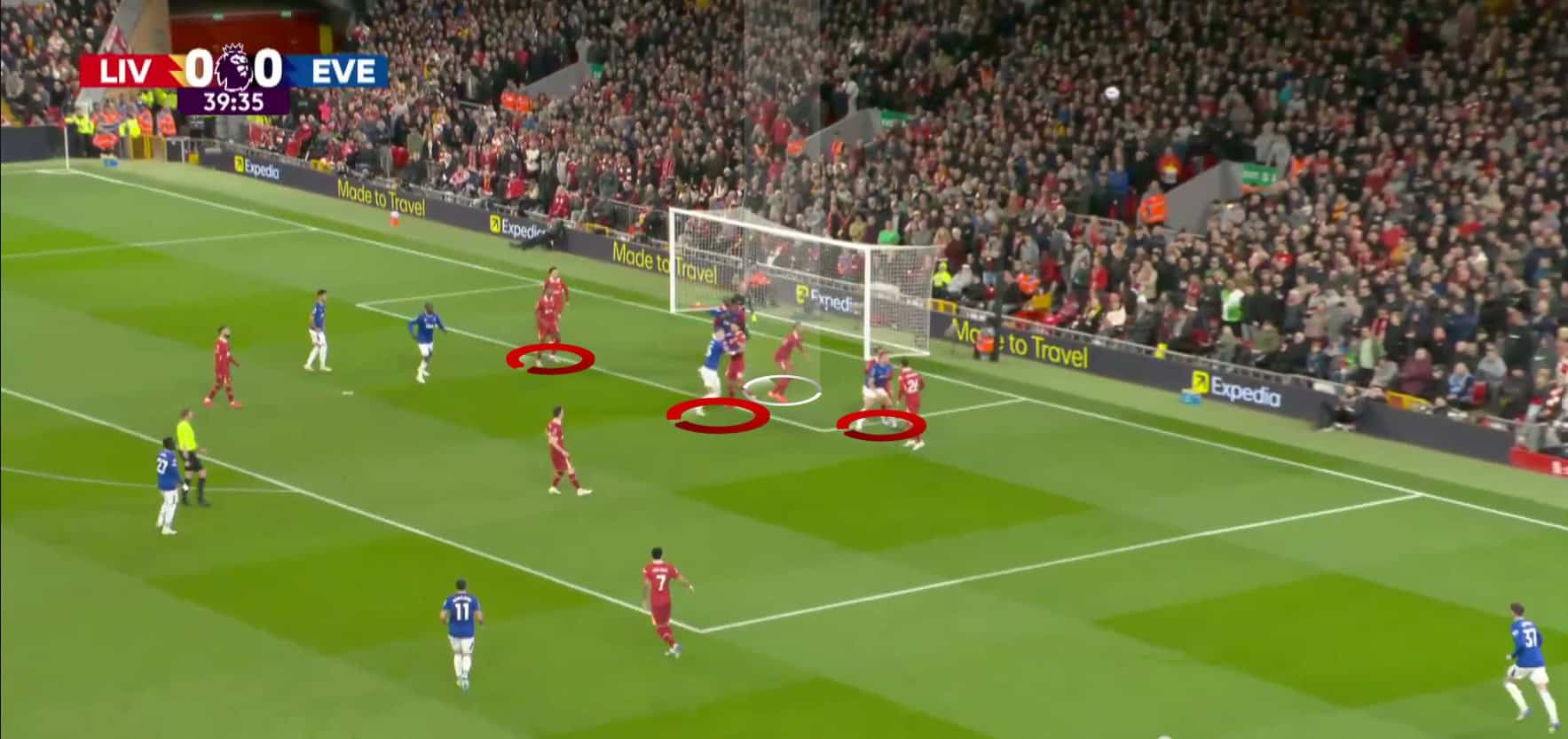
Once again, Liverpool maintains the same near-post structure, with Szoboszlai marking Tarkowski from the start of the throw-in.
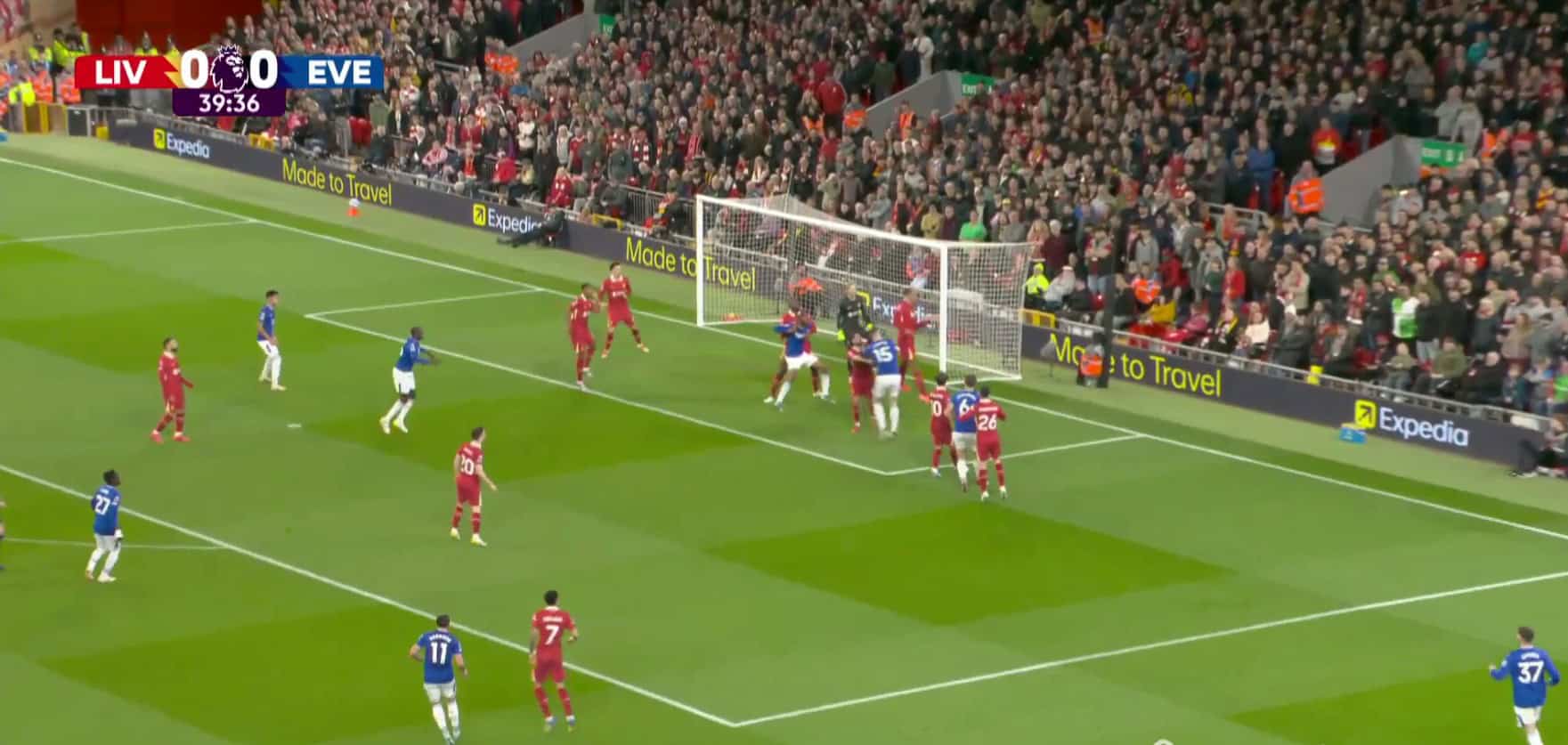
This time, Van Dijk finds a clear path to attack the header without obstruction.
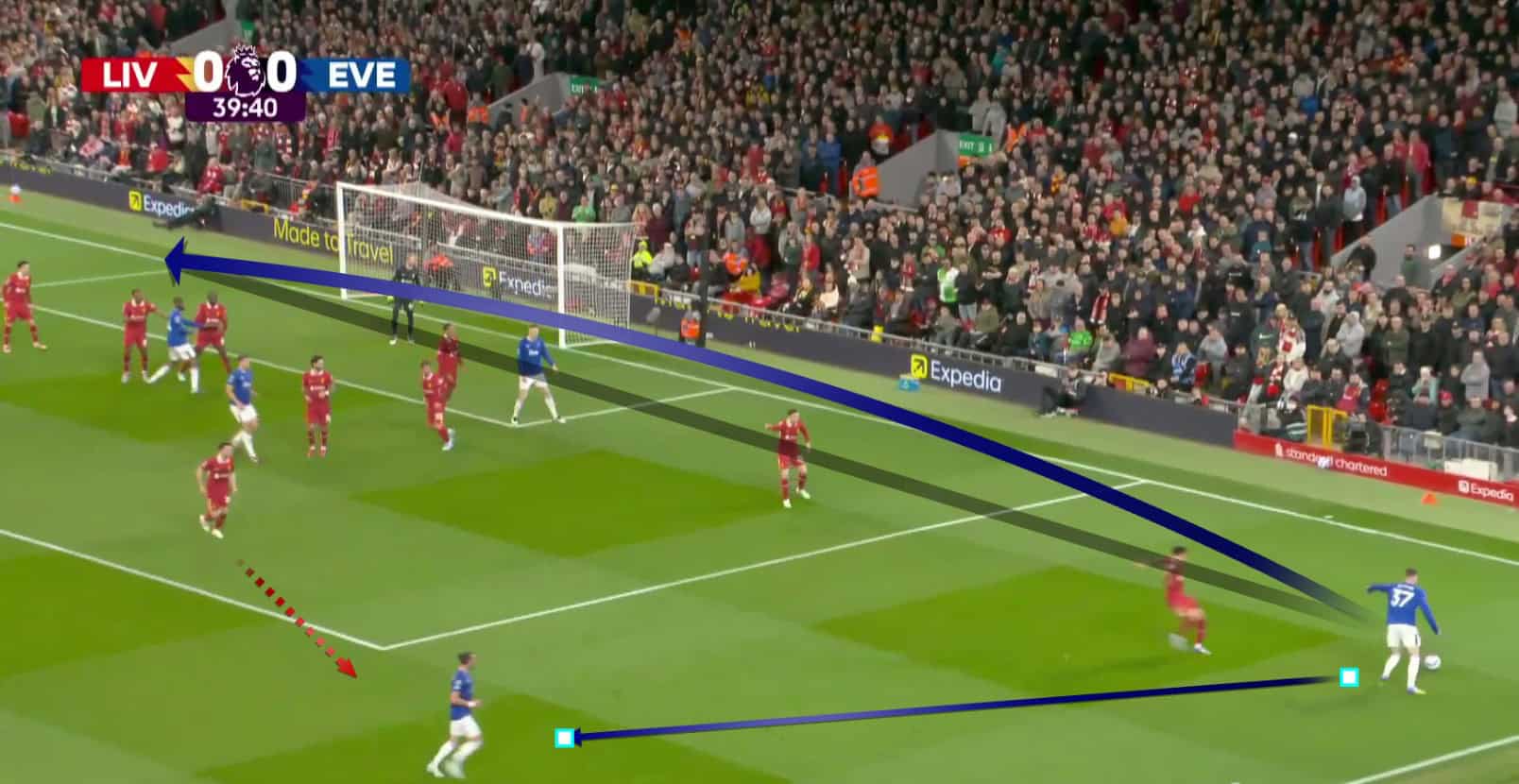
The problem happens when the clearance falls to the throw-in taker.
In this case, Díaz must press him, but he has to run a long distance, which can allow the taker enough time to deliver a cross.
Moreover, if Díaz fails to cut the passing lane to the supporting player behind, the taker can play the pass instead, and the receiver will also have the opportunity to cross.
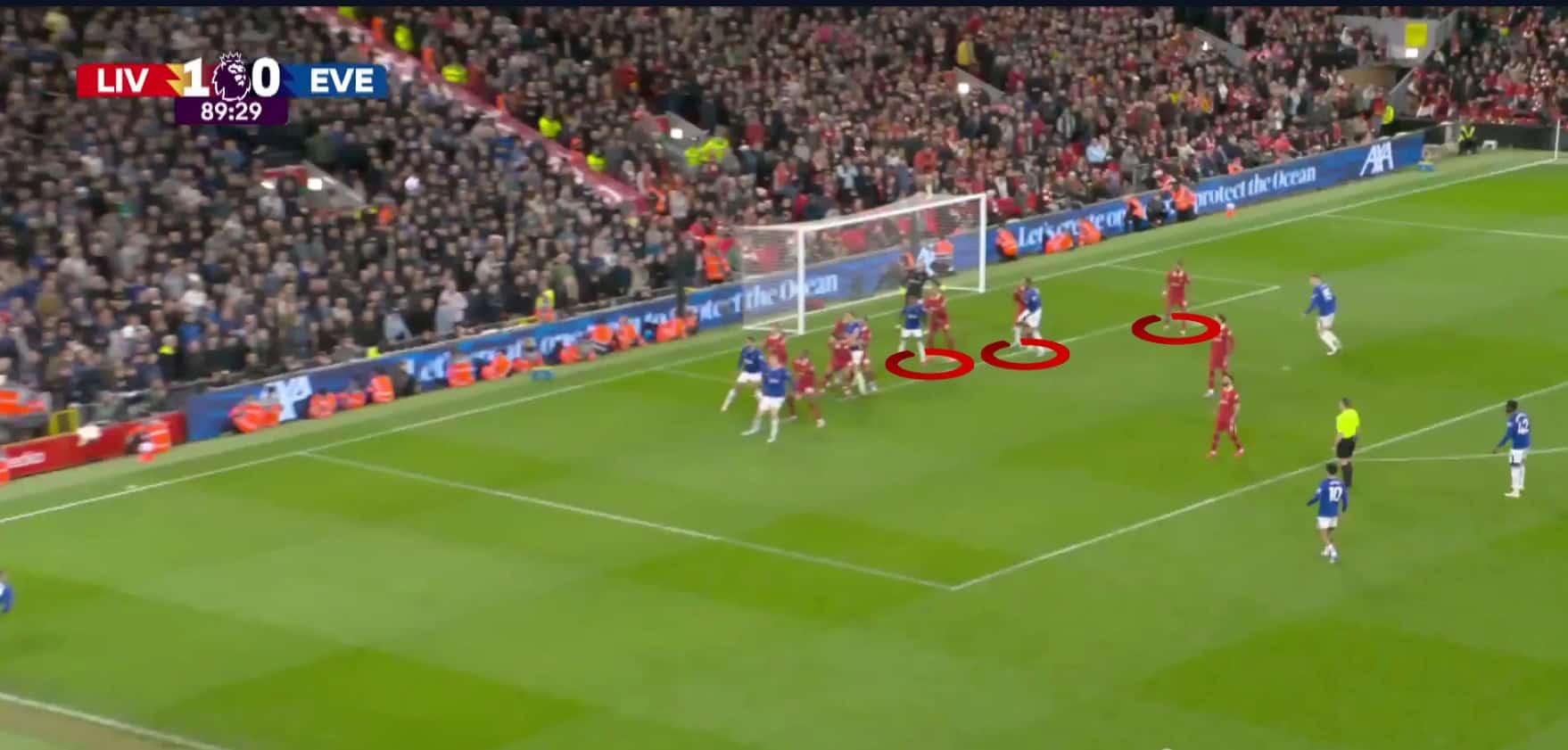 Unlike the earlier examples with Salah as the far winger, when the throw-in is on Liverpool’s right side, Cody Gakpo moves from the edge of the box to get closer to the far-side opponent.
This adjustment is crucial, especially when the far full-back must drop to cover an attacker entering the six-yard box.
It prevents the far centre-back, who is responsible for the centre-forward, from being exposed in a 2-v-1 situation and leaving an opponent in a dangerous position directly in front of the goal.
Another difference in this instance is that Everton commit six players to attack Liverpool’s first line instead of five.
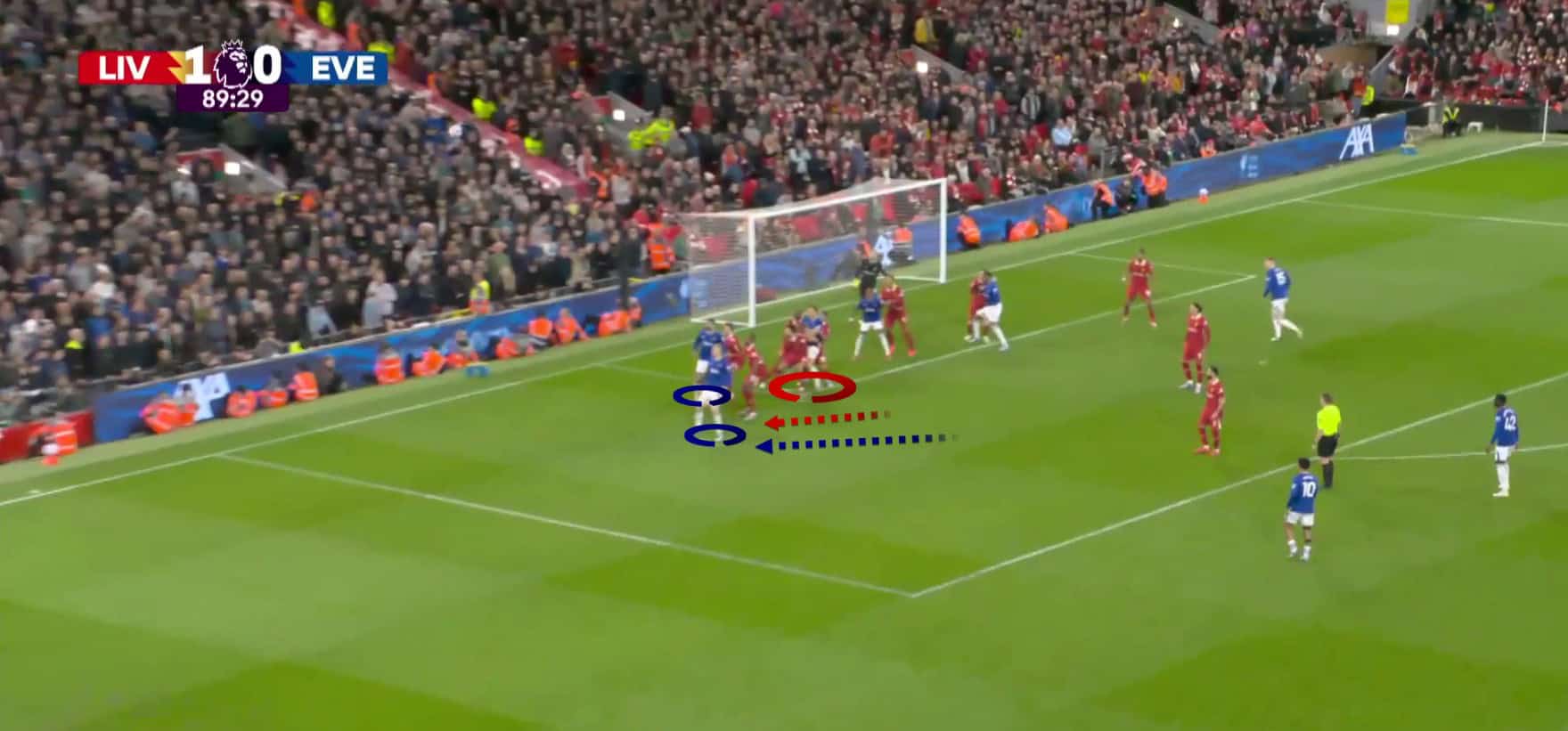 Two key details stand out in this situation.
First, Szoboszlai leaves his direct opponent when that player shifts towards the near full-back, Jones.
Instead, Szoboszlai doubles up with Mac Allister to cover the same man.
Second, Gravenberch tracks the additional Everton player positioned at the near post.
This movement means that the first two players occupying the near-post zone are now both from Everton.
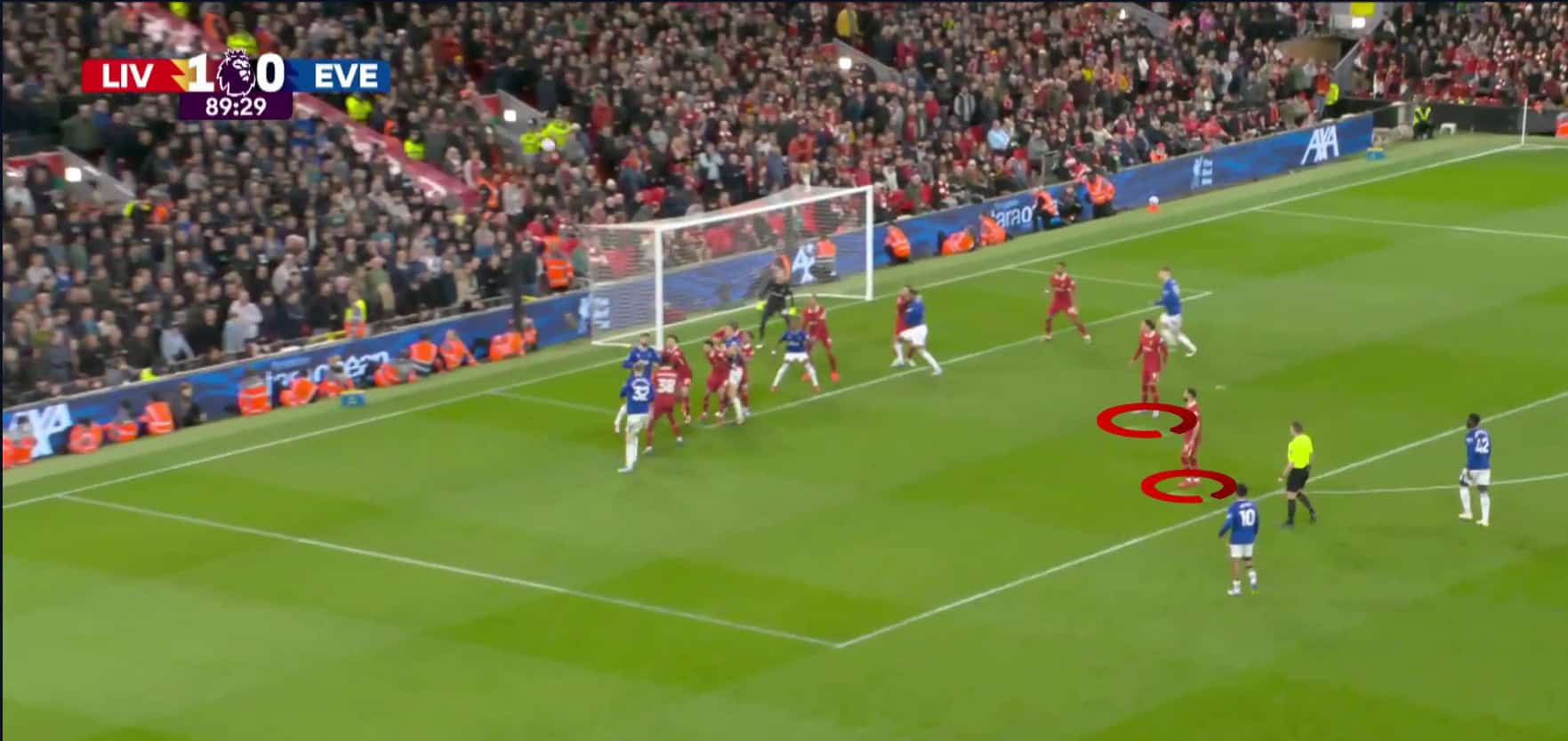 Another important detail when the throw-in is taken on Liverpool’s right side, where Salah operates, is that he is not tasked with pressing the taker if the clearance falls to him.
Instead, Salah holds his position on the edge of the box, staying close to the centre-forward.
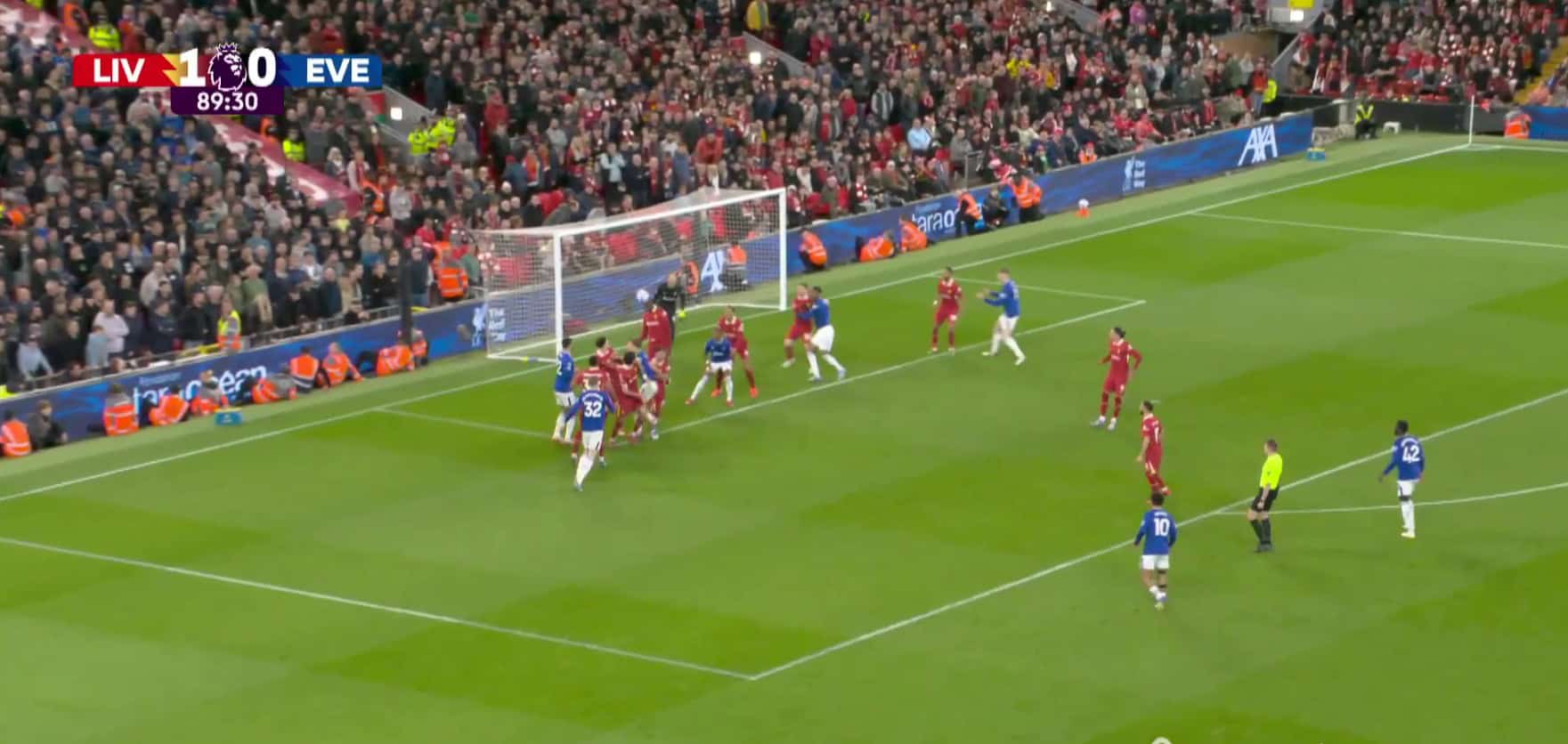 Liverpool use the same approach here, keeping the near centre-back free.
This allows Konaté to step in and make the clearance.
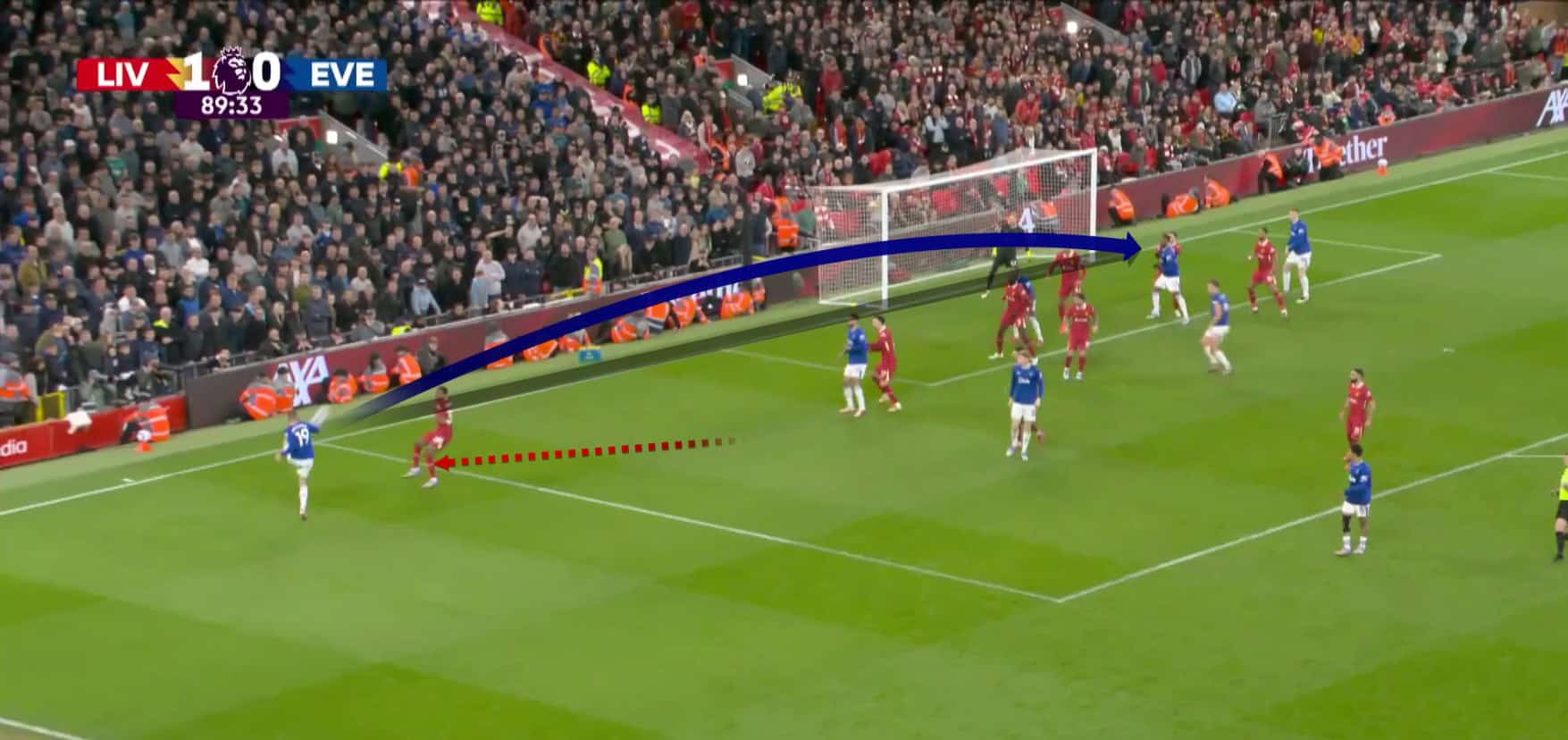 The issue arises when the clearance falls to the taker.
Since Salah holds his position on the edge of the box, the near full-back should close him down.
In this instance, Gravenberch is closer than Jones and takes responsibility for pressuring.
However, the gap between the taker and Liverpool’s nearest presser can be too large, giving the opponent time to recover the second ball and deliver a cross into the box.
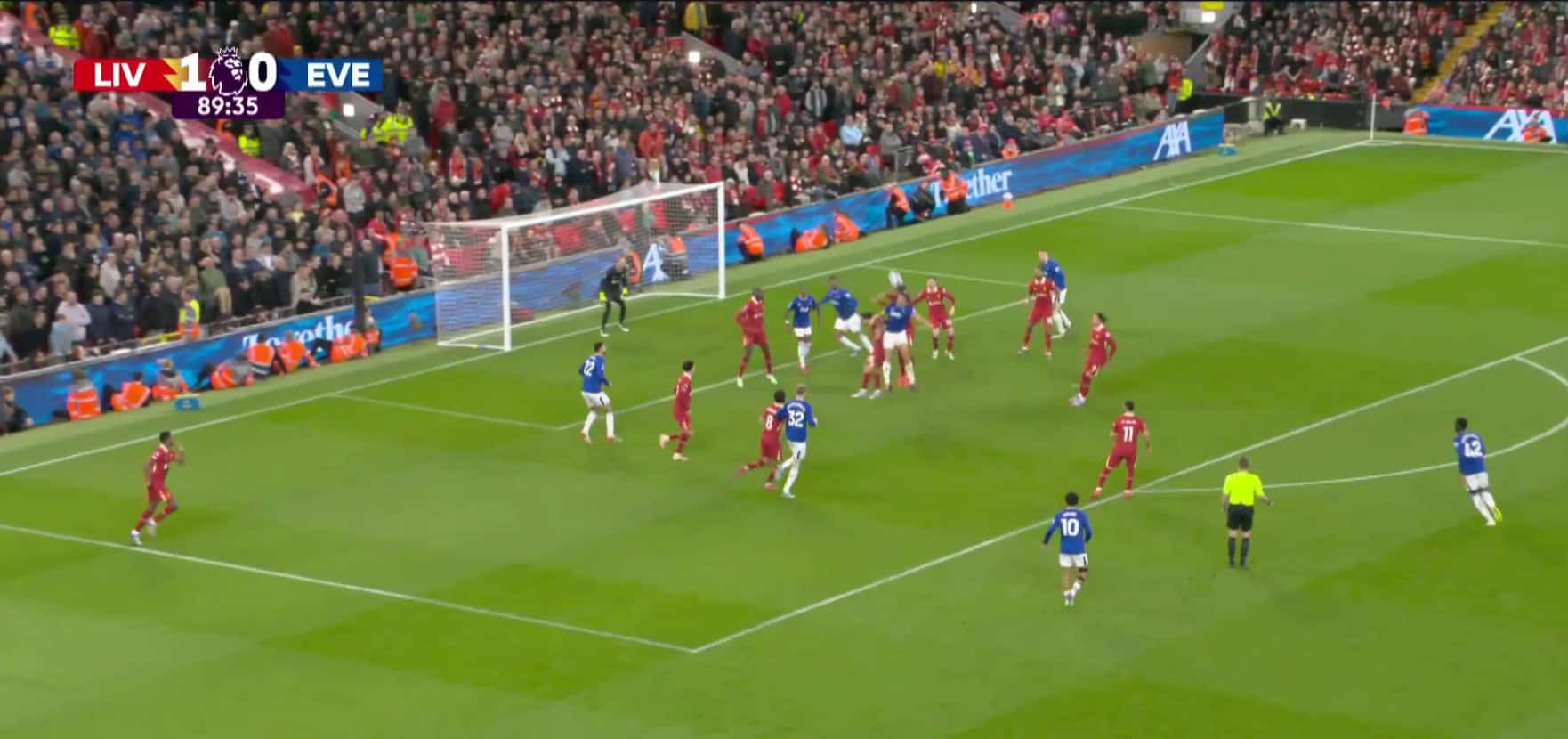 That is exactly what happens, with the cross aimed at one of the Premier League’s most dominant aerial duel winners from last season, James Tarkowski.
Yet he is unable to win this challenge, as he is up against Virgil van Dijk, another of the league’s strongest aerial duel competitors.
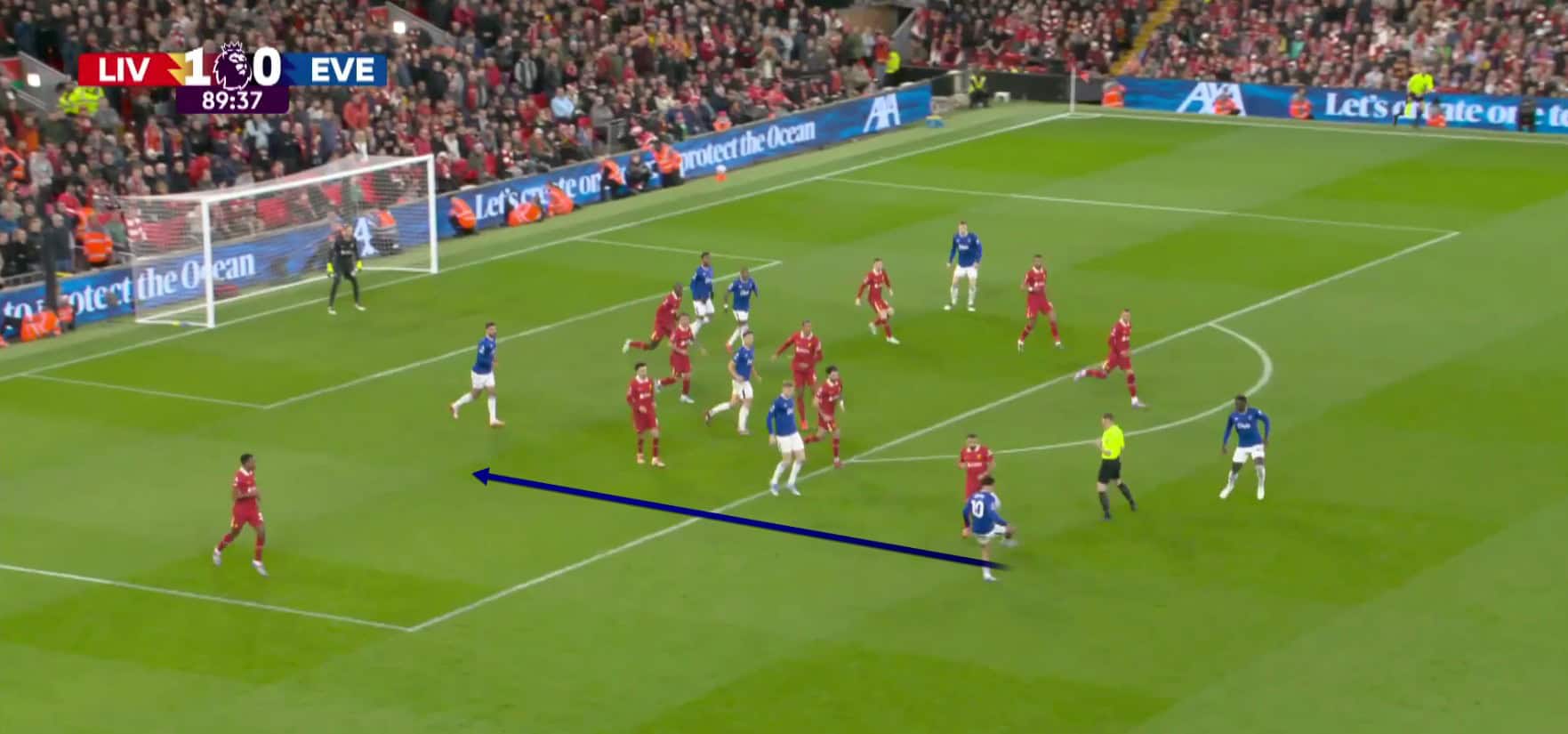 Even so, Van Dijk cannot clear the ball with distance, leaving Liverpool’s defensive situation far from secure.
The second ball then falls to an Everton player, who immediately plays a pass.
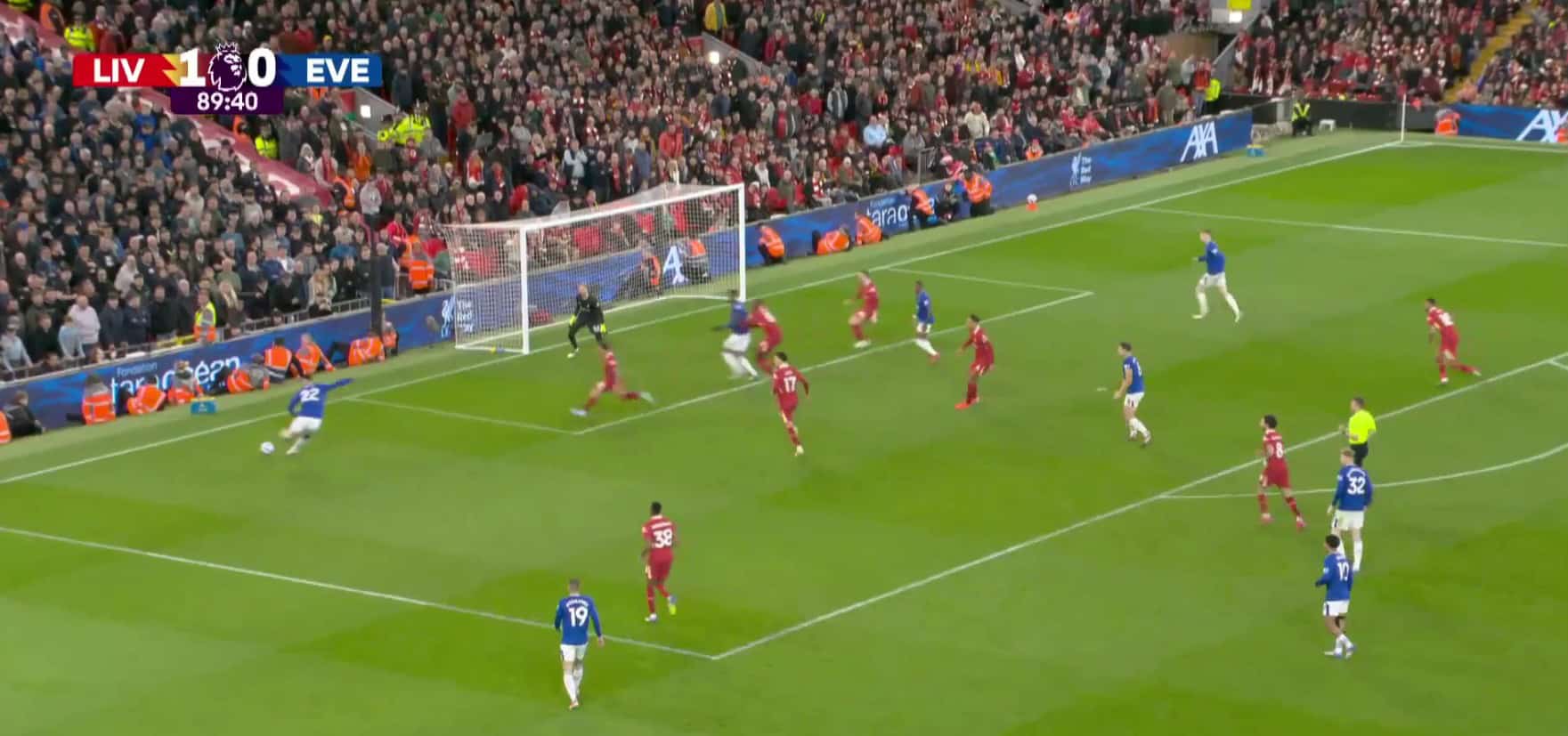 This sequence revives Everton’s attack and places Liverpool in an extremely dangerous situation.
Liverpool Defensive Approach In 2025/2026
In the Premier League season 2025/2026 opening match against Bournemouth, Liverpool defended long throw-ins with a consistent structure and method.
In this game, we can see Jeremie Frimpong as the near full-back, and Konaté as the near centre-back, remaining free to challenge aerial duels.
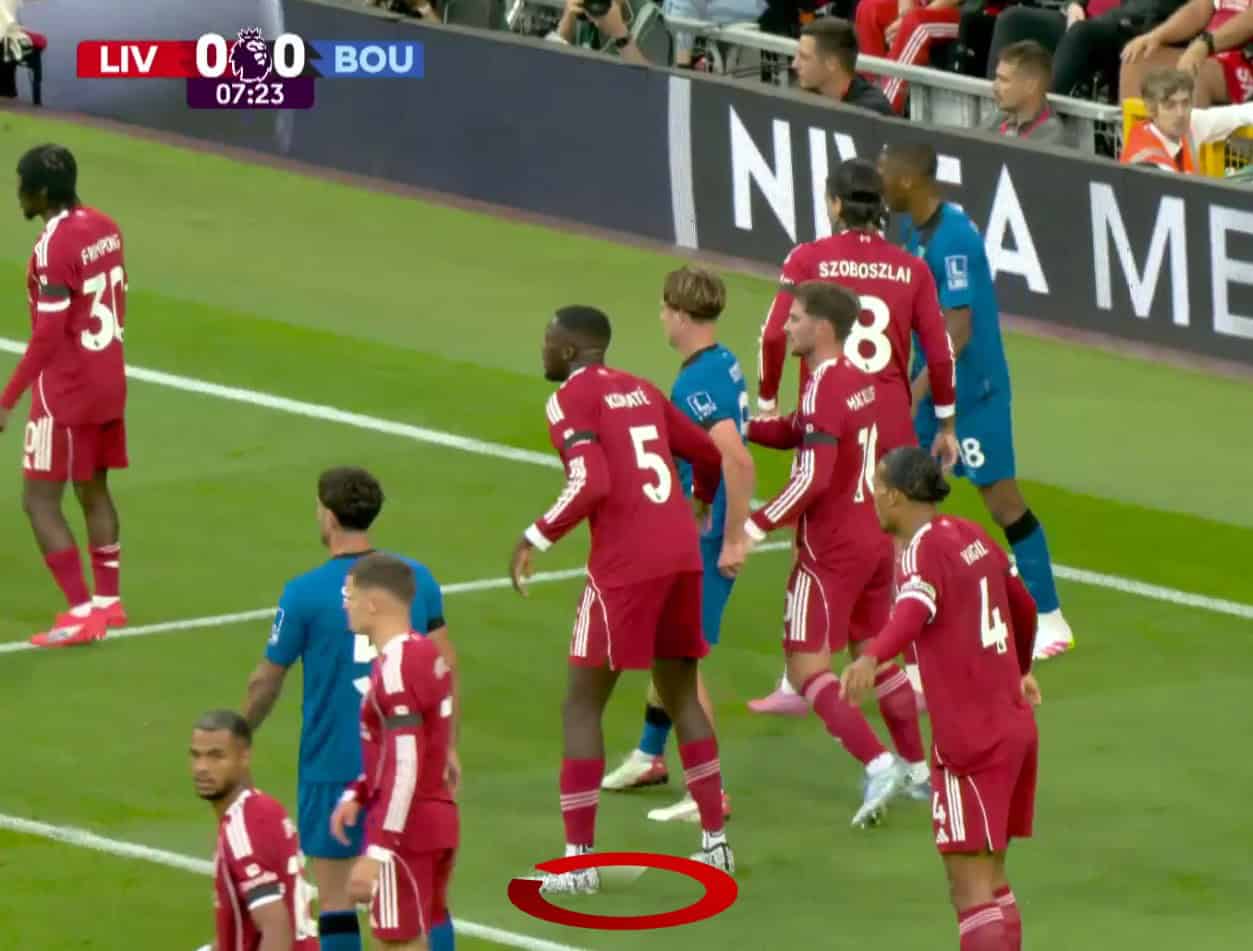
Van Dijk is the far centre-back, and Milos Kerkez operates as the far full-back.
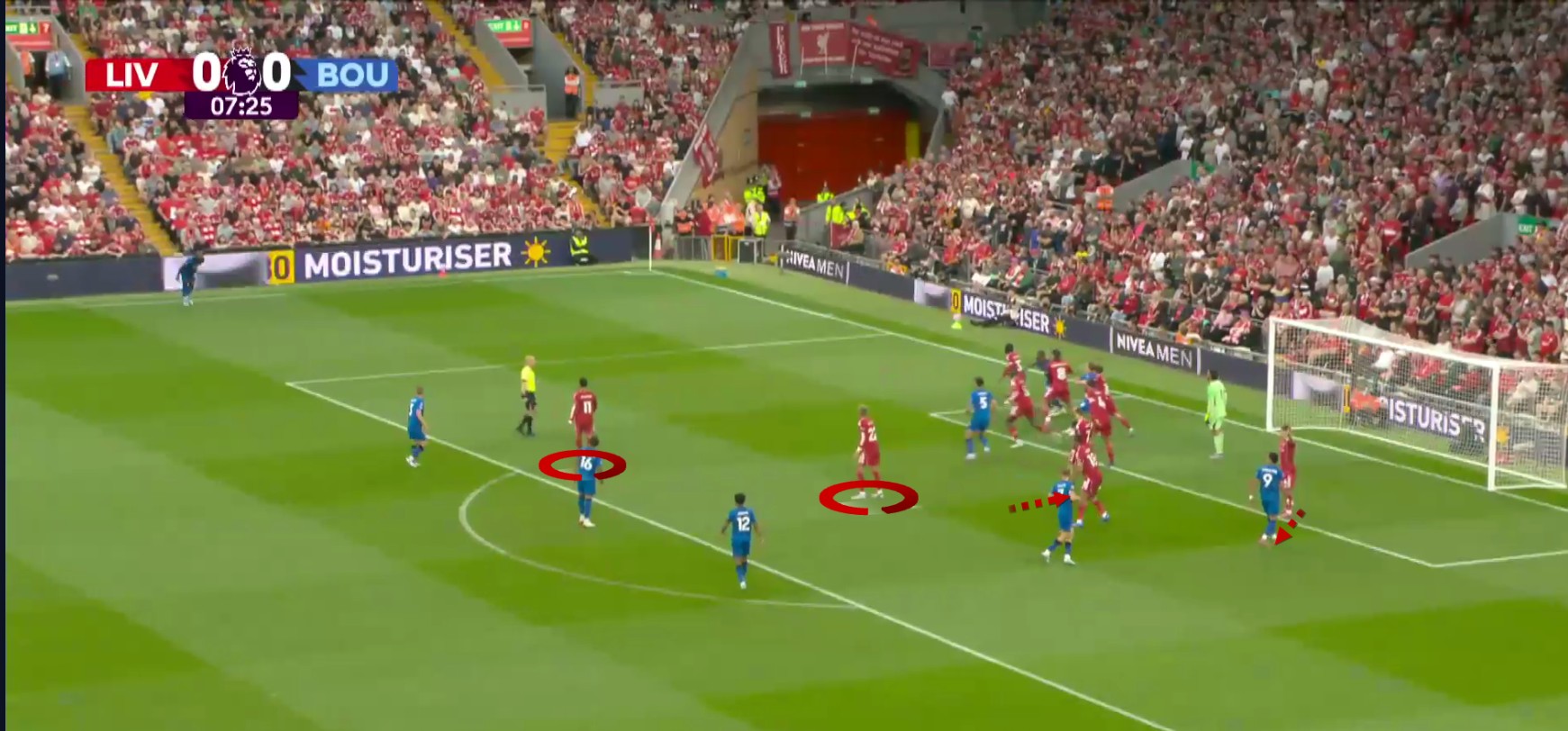 With the throw-in on Liverpool’s right side, Salah positions himself at the edge of the box alongside centre-forward Hugo Ekitike, while Gakpo drops deeper towards the first line to track David Brooks.
At the same time, Kerkez is ready to mark Evanilson.
Bournemouth attack inside the box with a 4-1 structure.
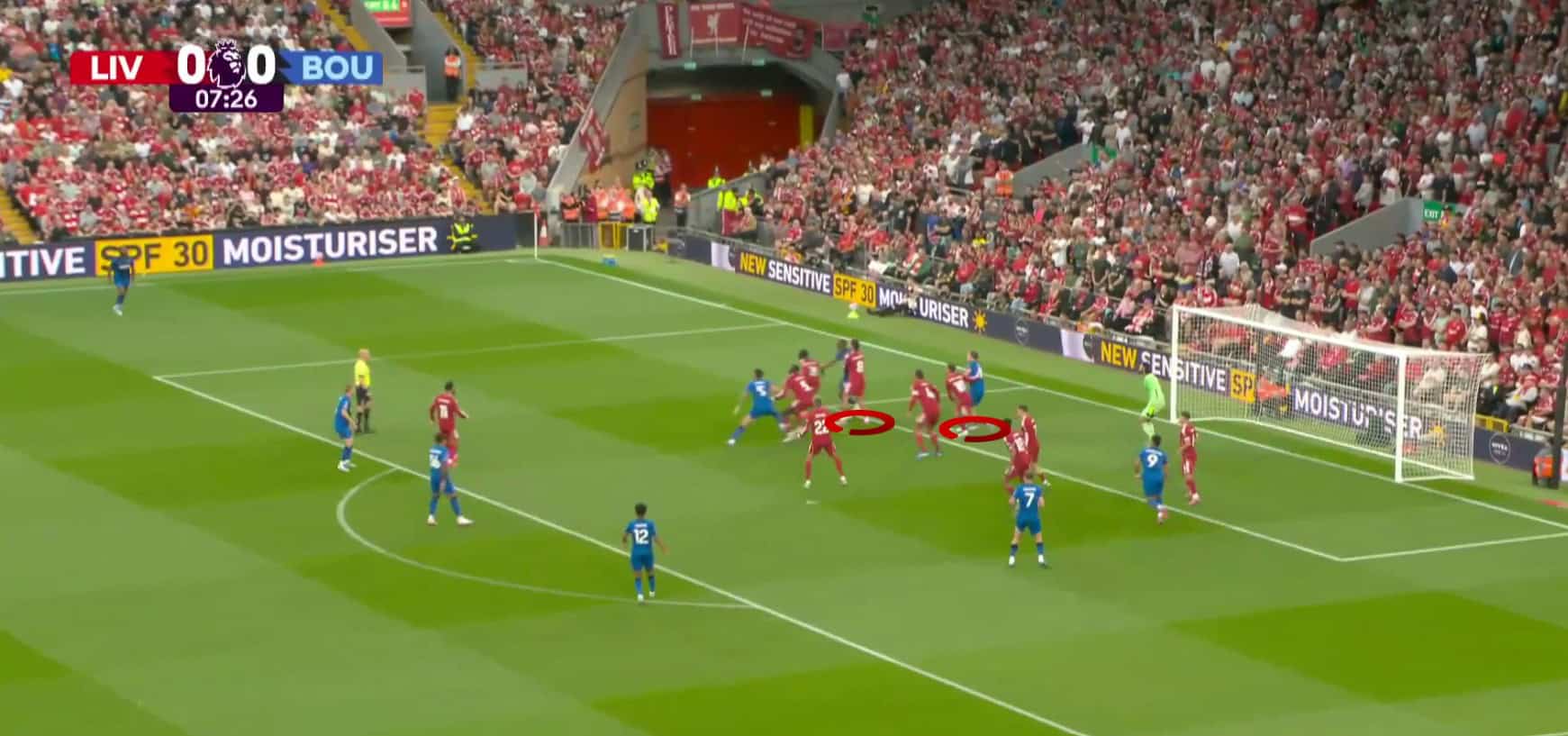 Szoboszlai and Mac Allister maintain their responsibilities of tightly marking opponents near the post.
This man-marking scheme ensures Konaté can remain free to challenge aerial balls.
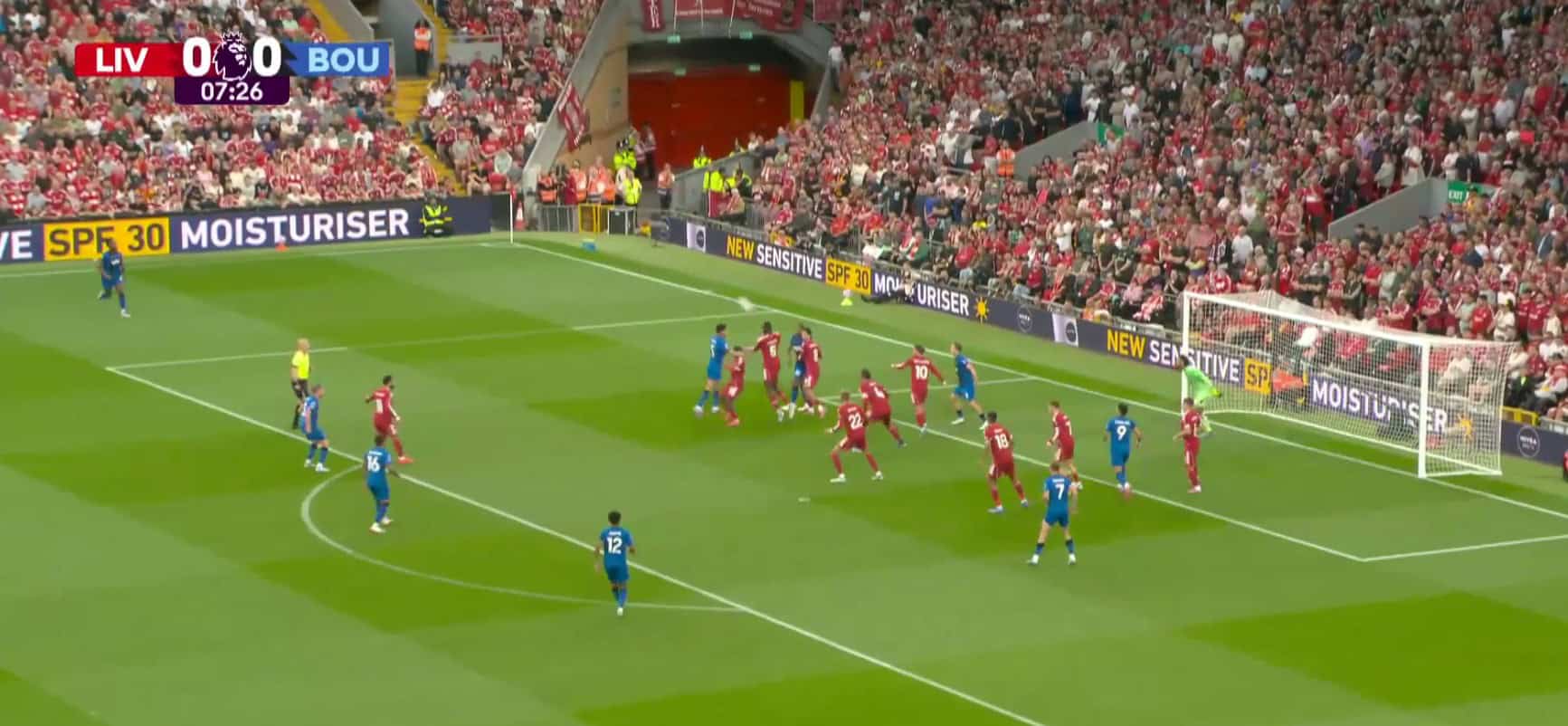 Konaté successfully wins the aerial duel and clears the ball.
The key question then becomes: where does he direct the clearance?
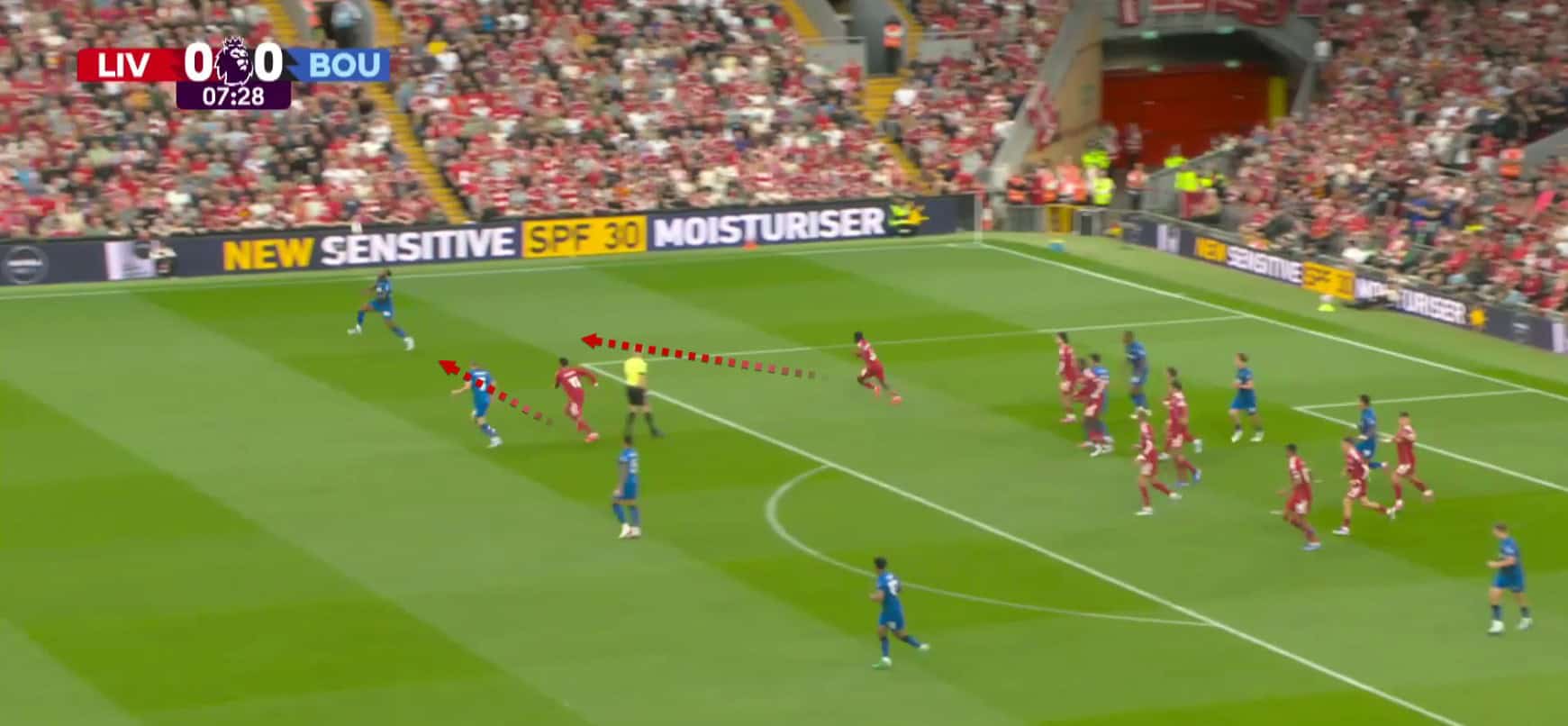 Konaté’s clearance travels back towards the throw-in side, Liverpool’s right flank.
This creates an immediate responsibility for Frimpong, who has to sprint across to press the taker and prevent a cross, as this is not Salah’s role.
Although the distance appears significant, Liverpool benefits because the clearance falls behind Antoine Semenyo, which encourages Salah to press aggressively and support Frimpong.
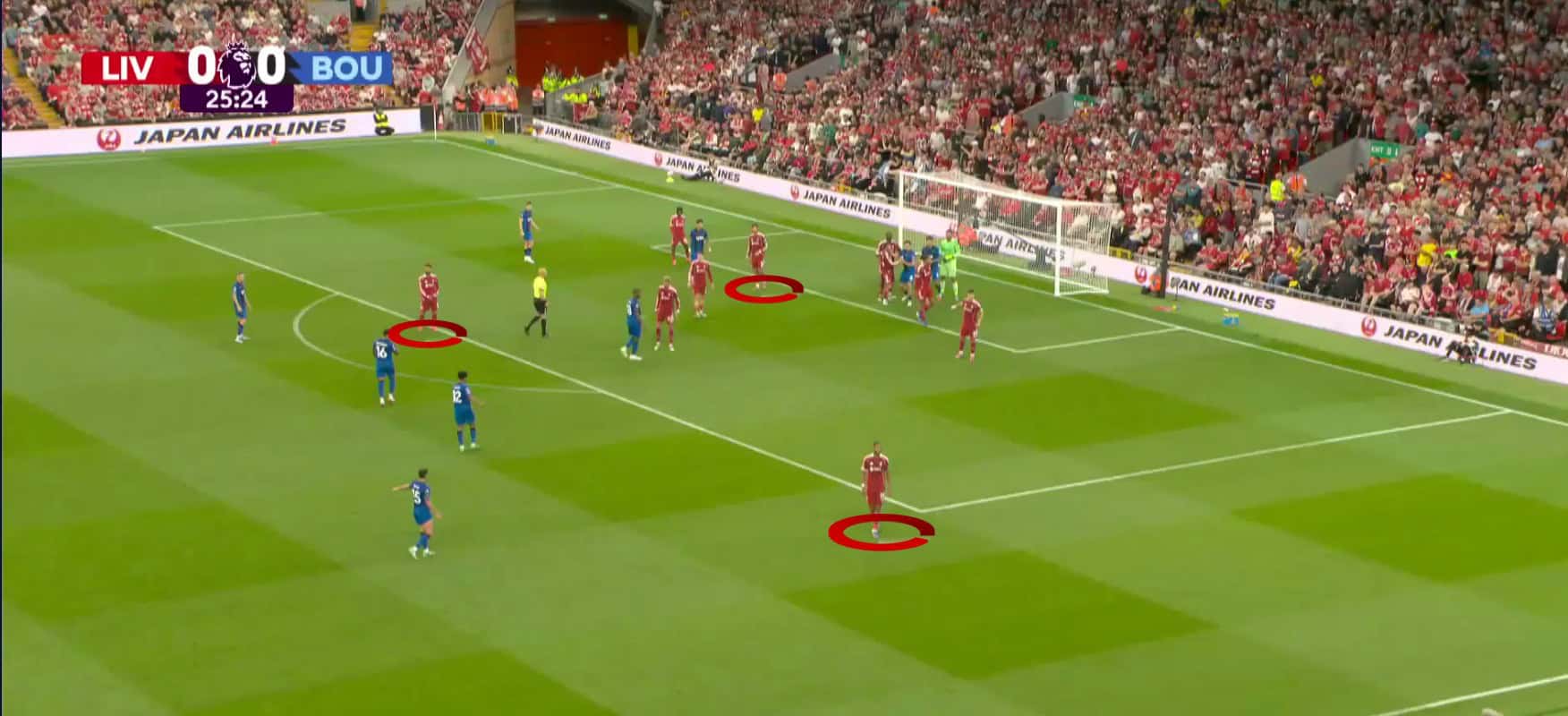 Once again, Liverpool face a long throw-in from the left.
On this occasion, Gakpo positions himself on the edge of the box, prepared to press the taker if he collects the second ball.
Salah, however, also holds a spot on the edge of the box and does not drop to support the first line.
As a result, Szoboszlai has to cover that role, especially since Konaté and Frimpong are already occupied with their direct markers.
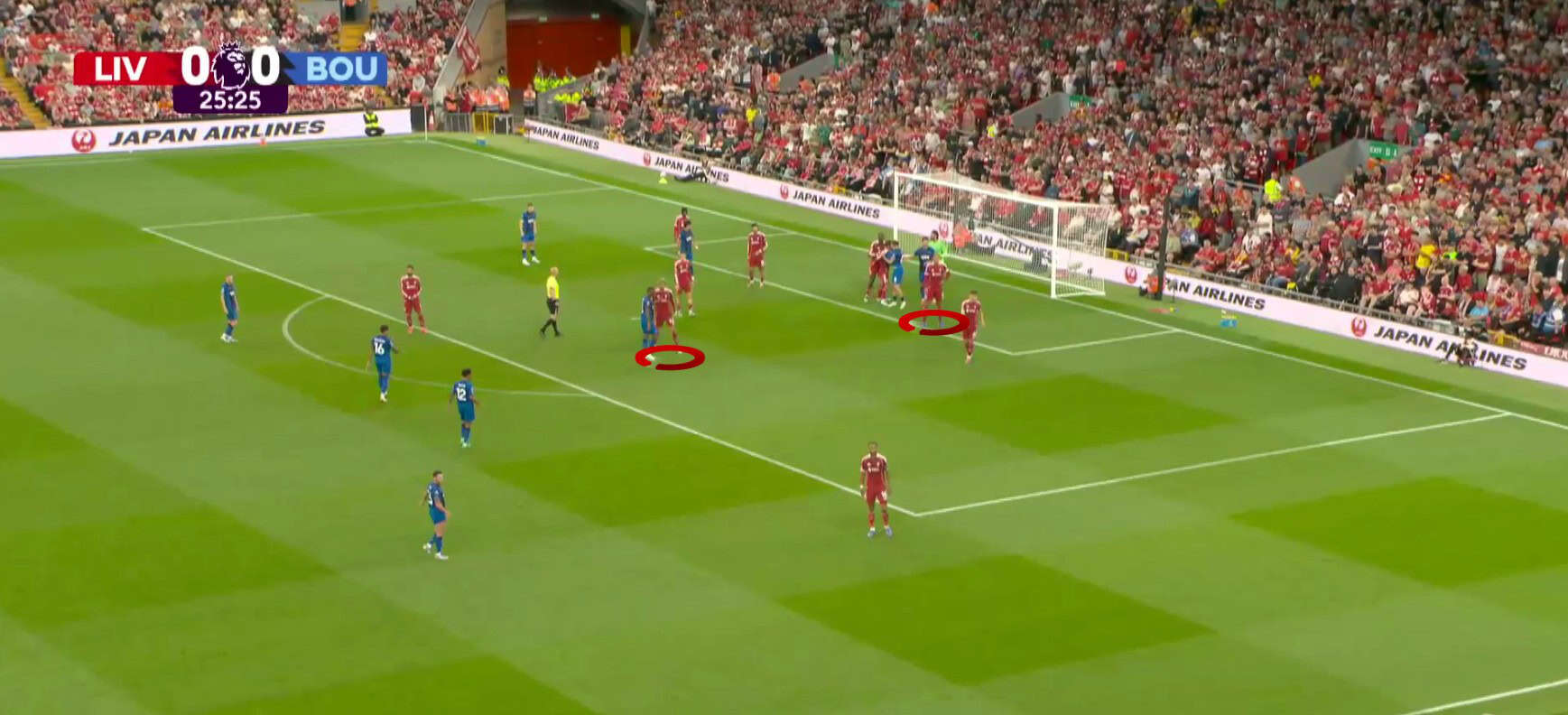 This setup leaves Mac Allister as the only player responsible for marking opponents who drift between the near full-back and centre-back.
To avoid leaving that zone unprotected, Liverpool assigns an additional player to cover any free runner.
Since Florian Wirtz is not particularly strong in aerial duels, Ekitike is tasked with that duty, enabling Van Dijk to remain free.
Meanwhile, Wirtz drops into a zonal position in the second line.
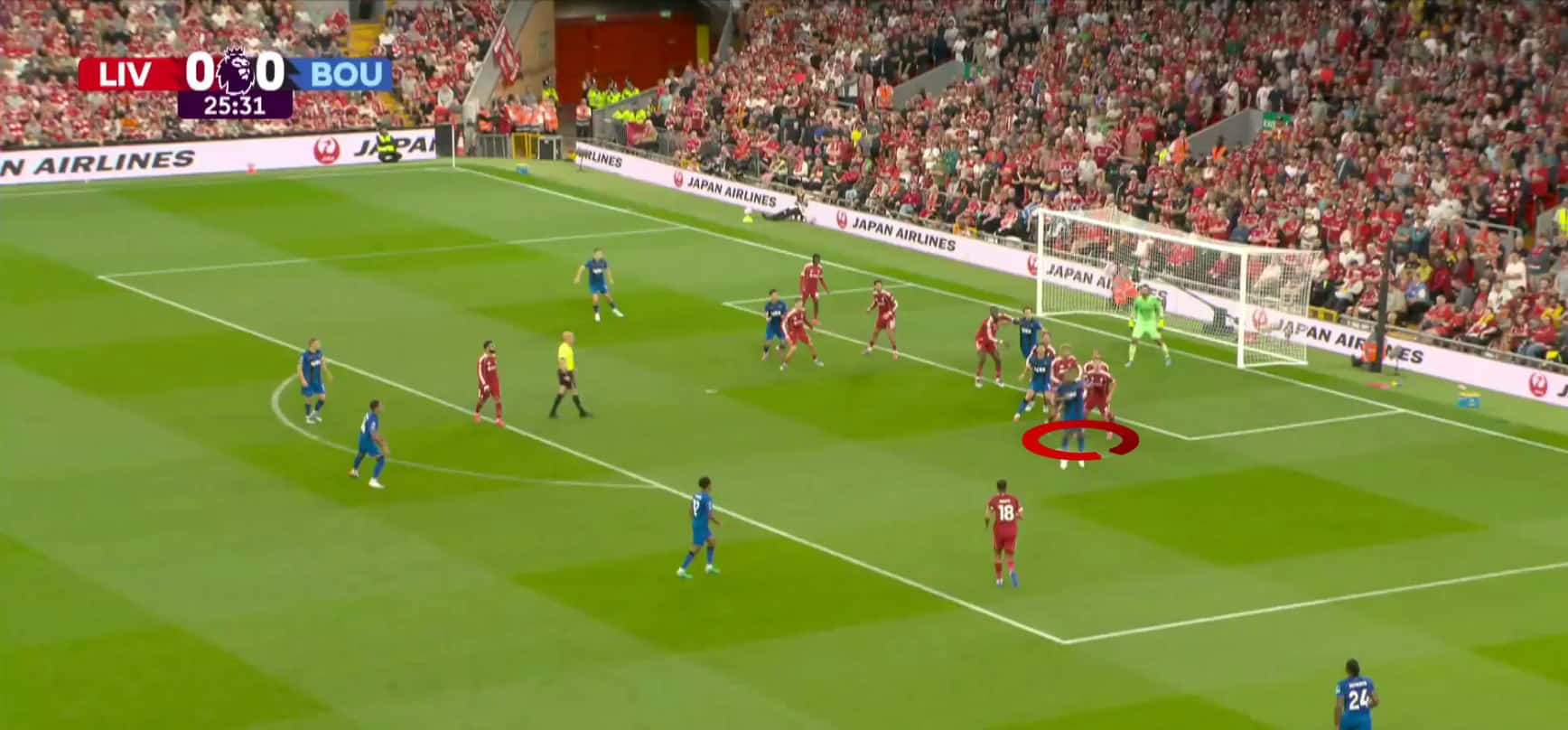 Ekitike tracks back into the near post position and is the one who clears the delivery.
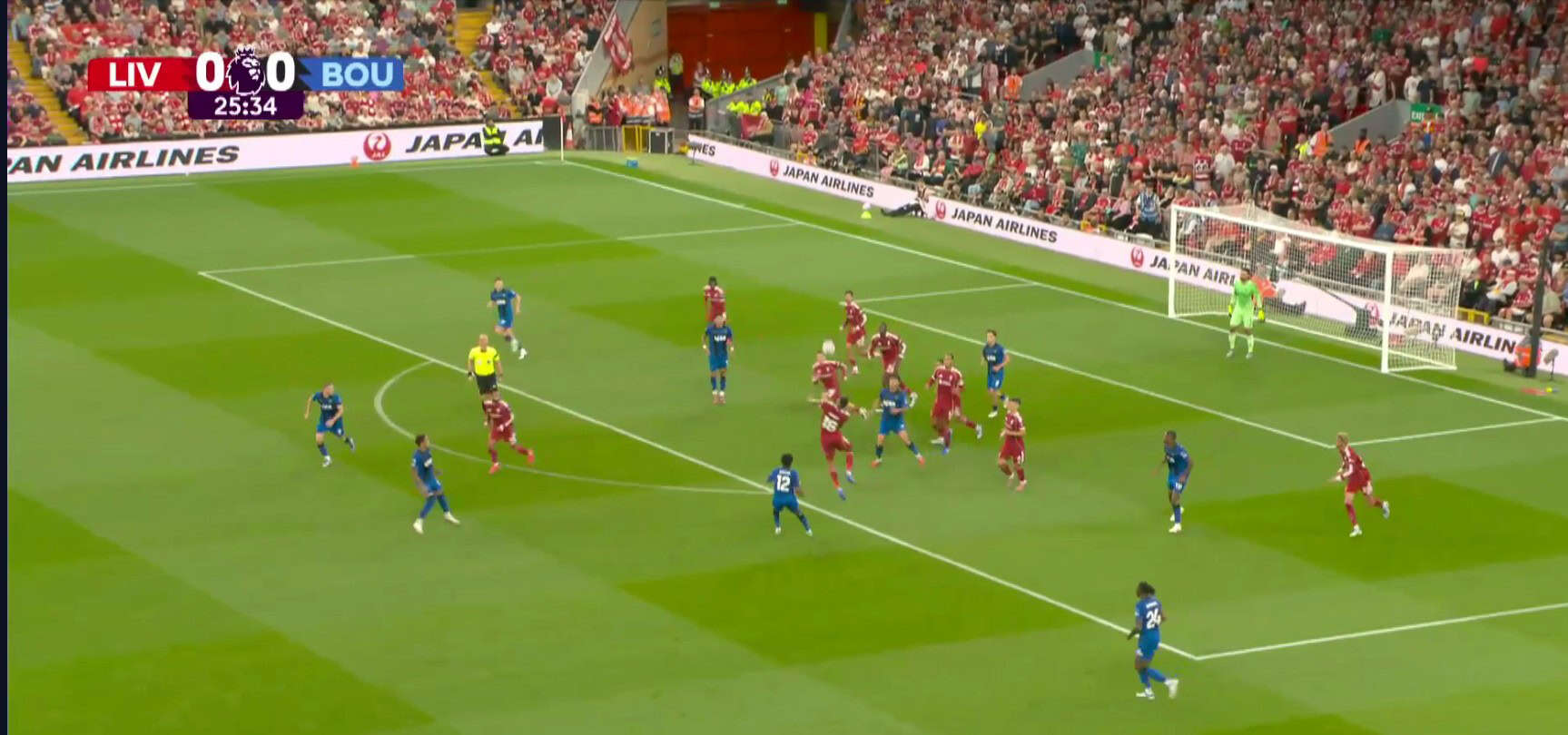 The clearance, however, is not decisive, and Gakpo has to do it again to clear the ball further.
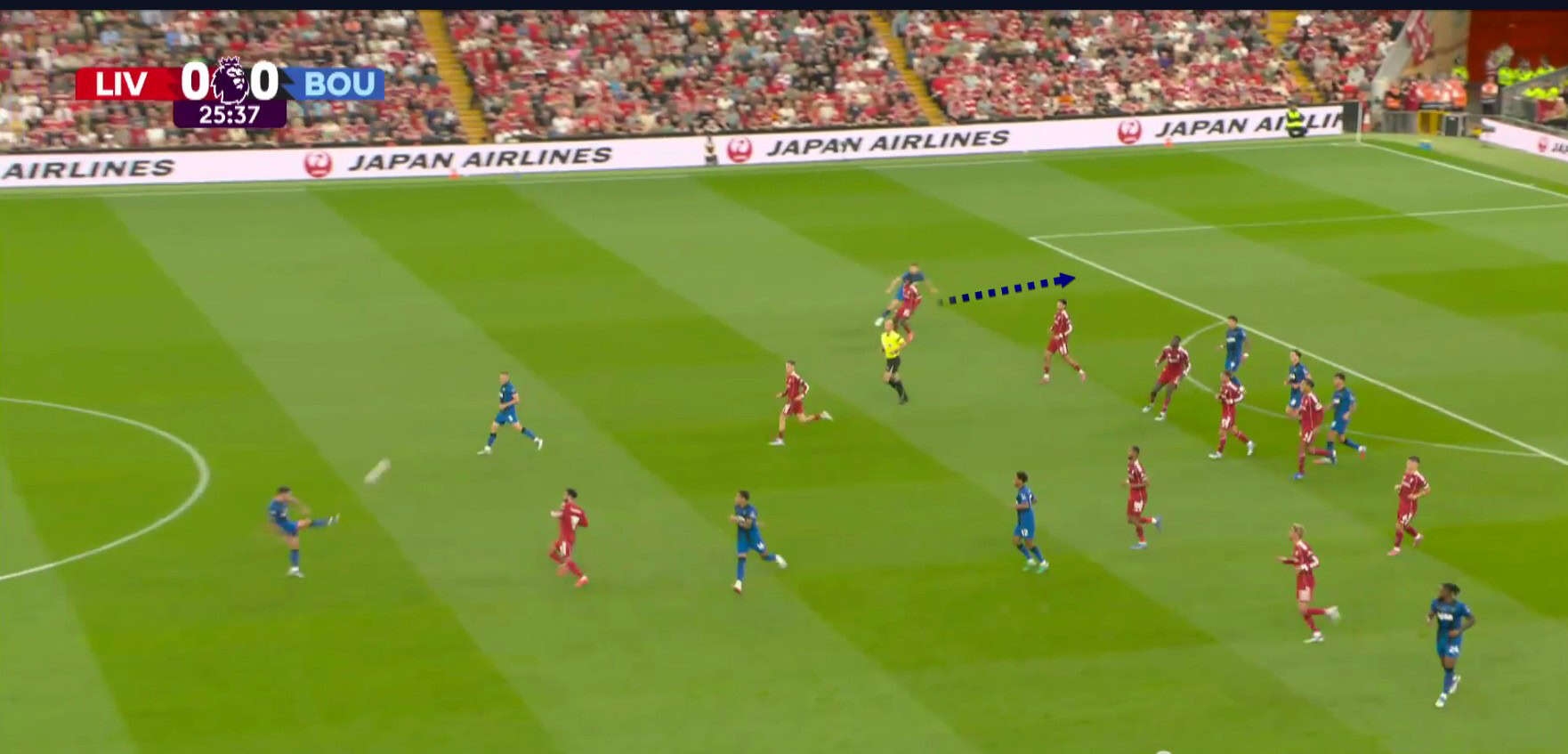
Even then, Bournemouth regain possession of the second ball and immediately attempts to exploit the space behind Liverpool’s defensive line.
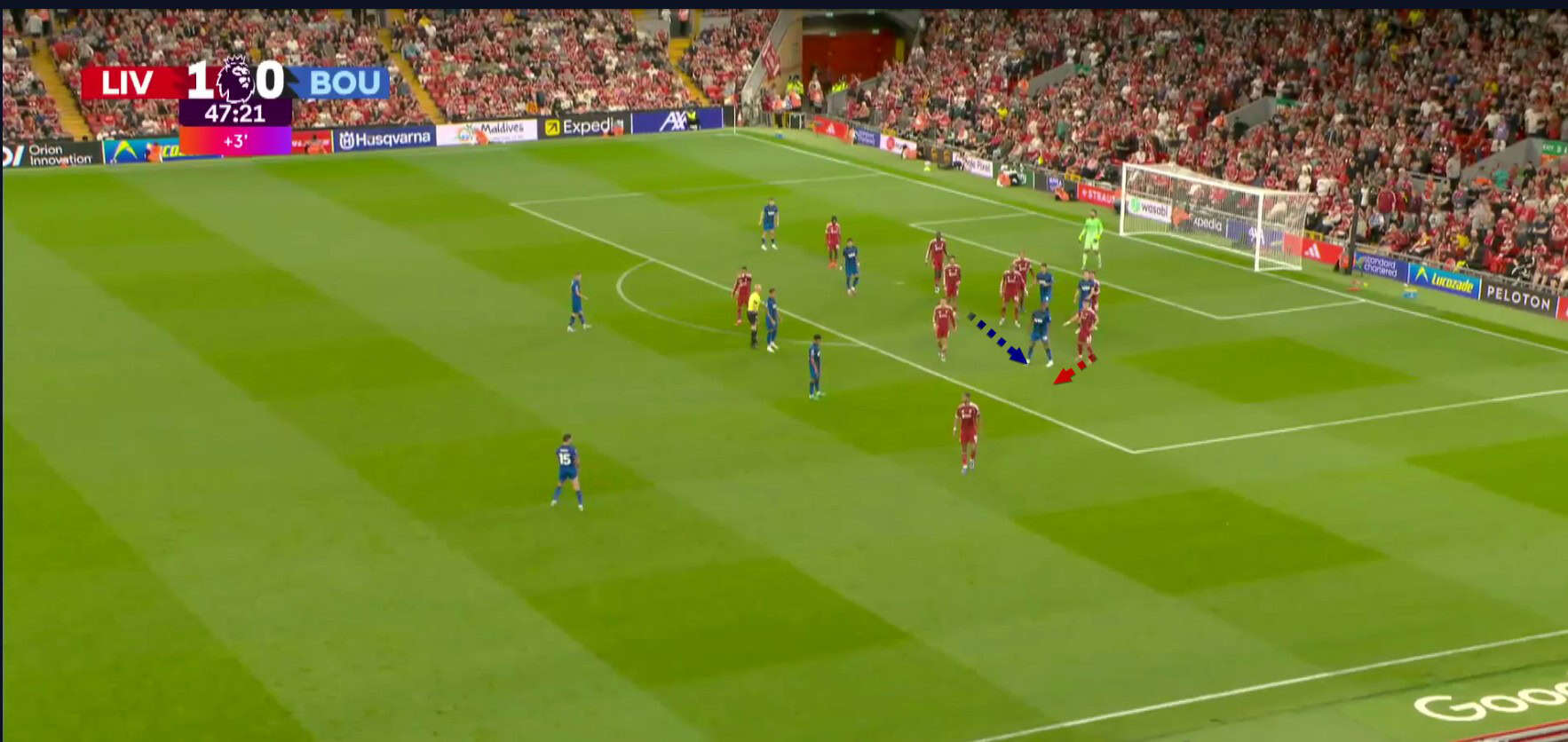 Against Everton, Liverpool allowed the opponent who moved in front of the near full-back to remain unmarked, not tracking his run.
The same situation occurs here, with Bafodé Diakité left free when he moves ahead of Kerkez.
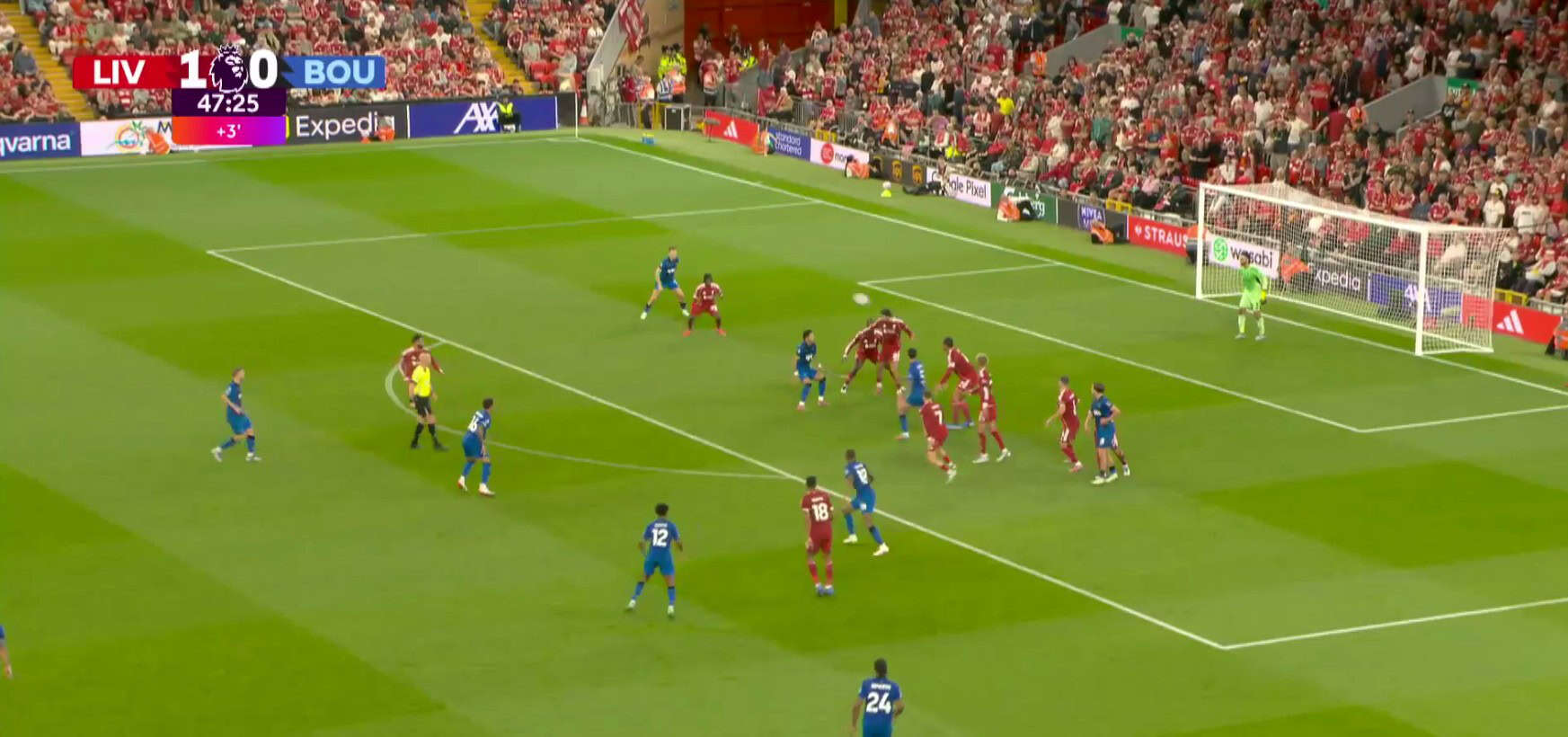 However, Diakité fails to win the first contact, and Szoboszlai steps in to clear the ball to the opposite side.
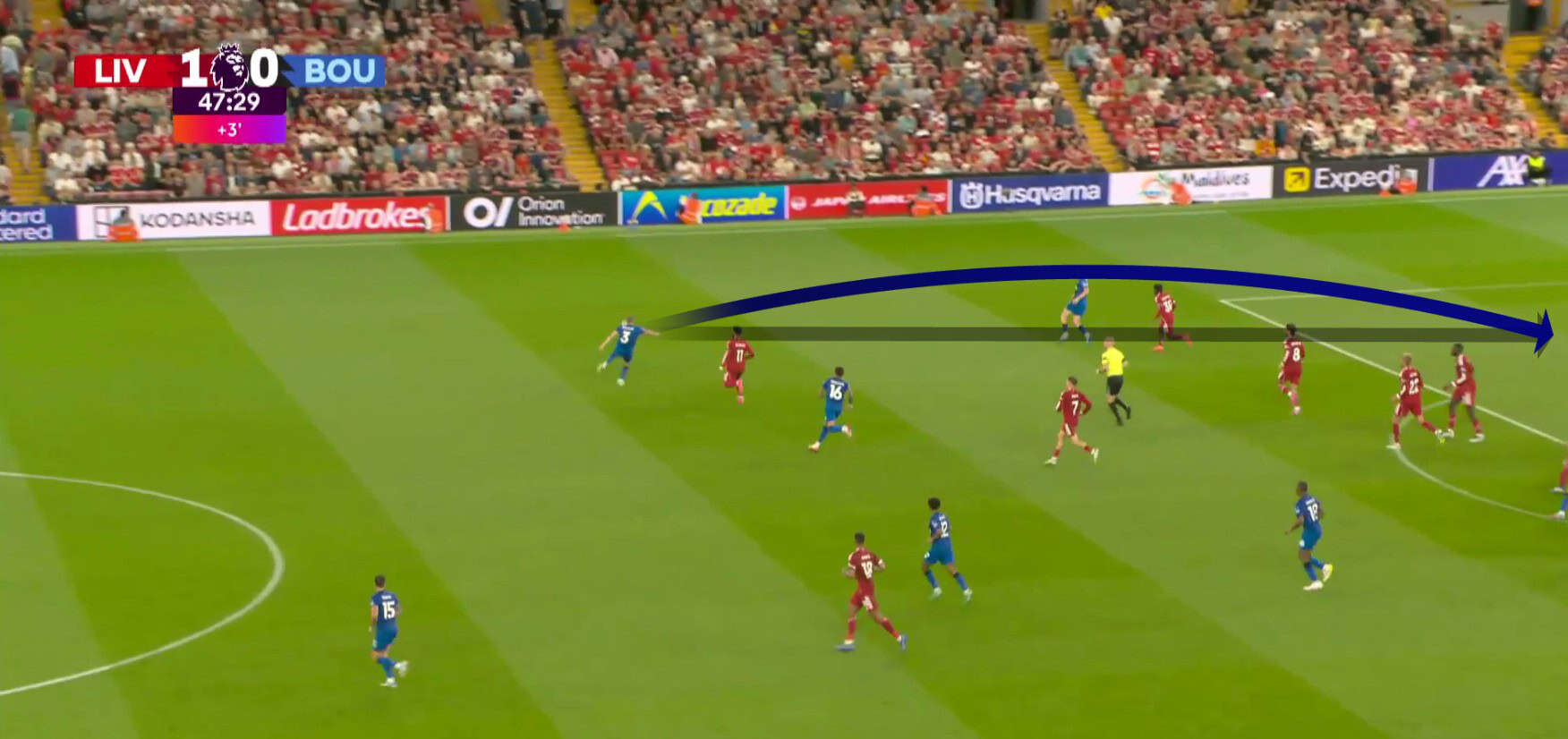 Again, once Bournemouth recover the second ball, they immediately look to exploit the space behind Liverpool’s defensive line.
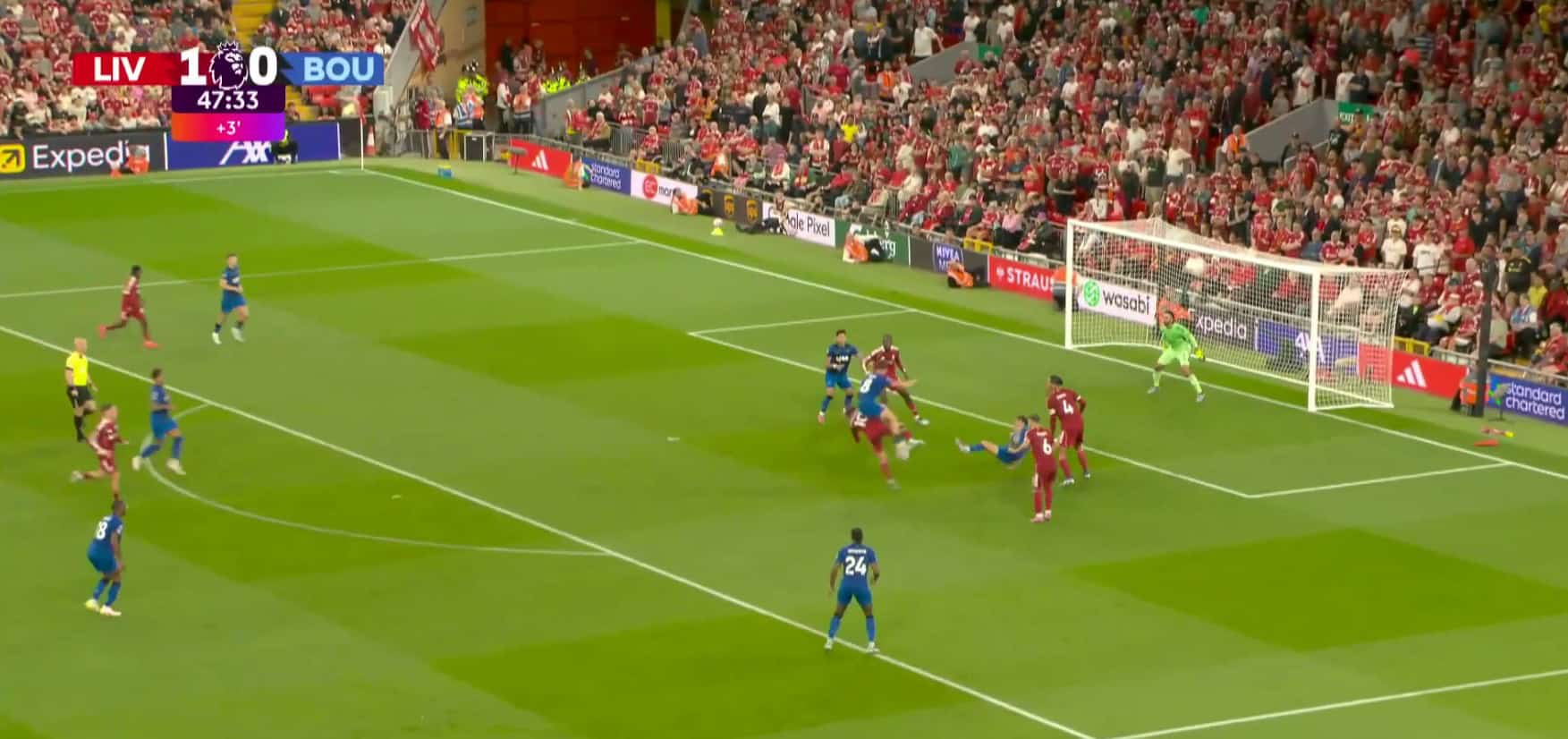 This sequence almost results in a dangerous chance for the opposition.
Newcastle United Exploit Liverpool’s Defensive Flaws
In the match against Newcastle, the Magpies had an idea against Liverpool’s defensive approach in throw-ins.
The idea was to put an additional player at the near post.
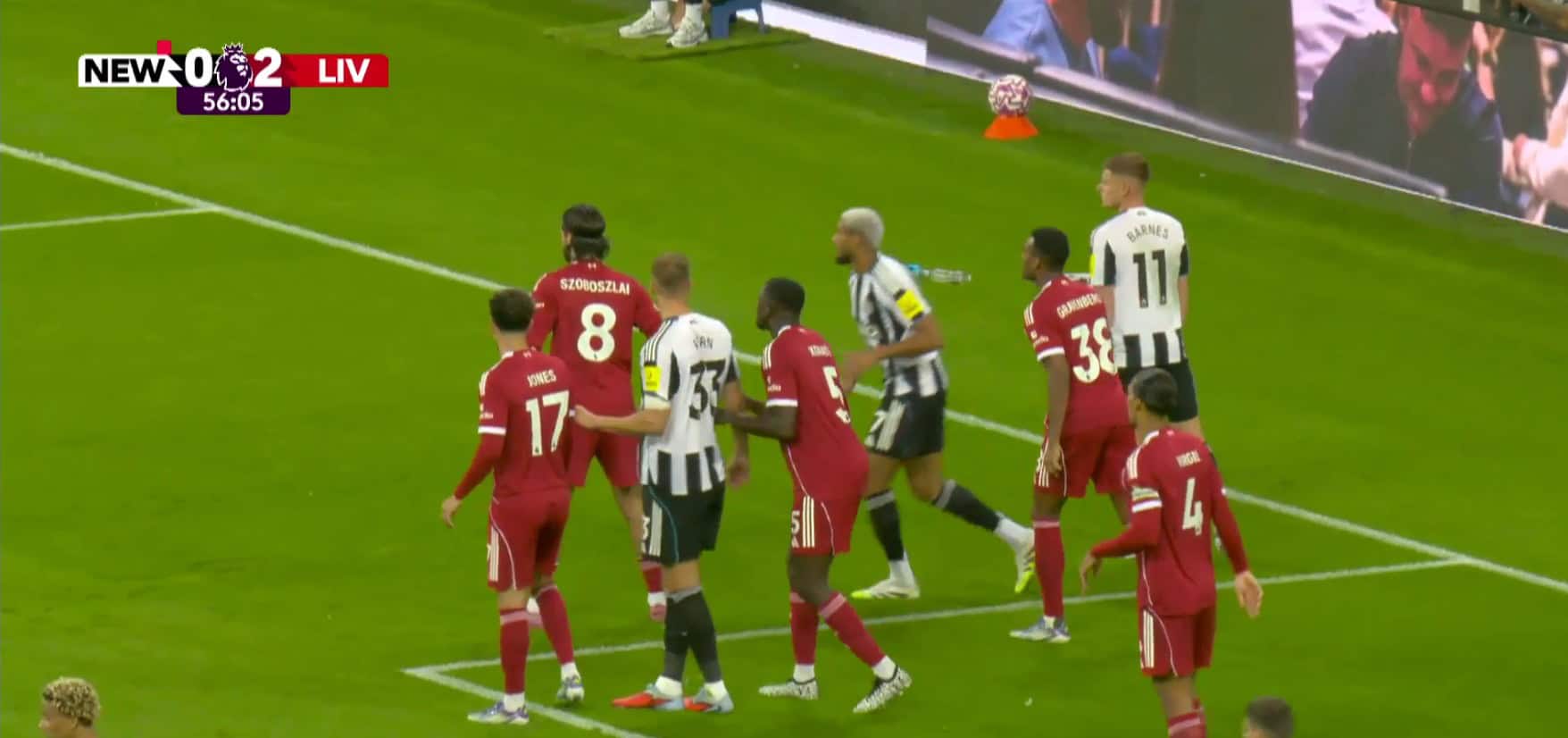
Harvey Barnes positions himself alongside the usual threats in this area, Dan Burn and Joelinton.
While Szoboszlai and Jones mark Burn and Joelinton tightly, Barnes is unmarked and free.
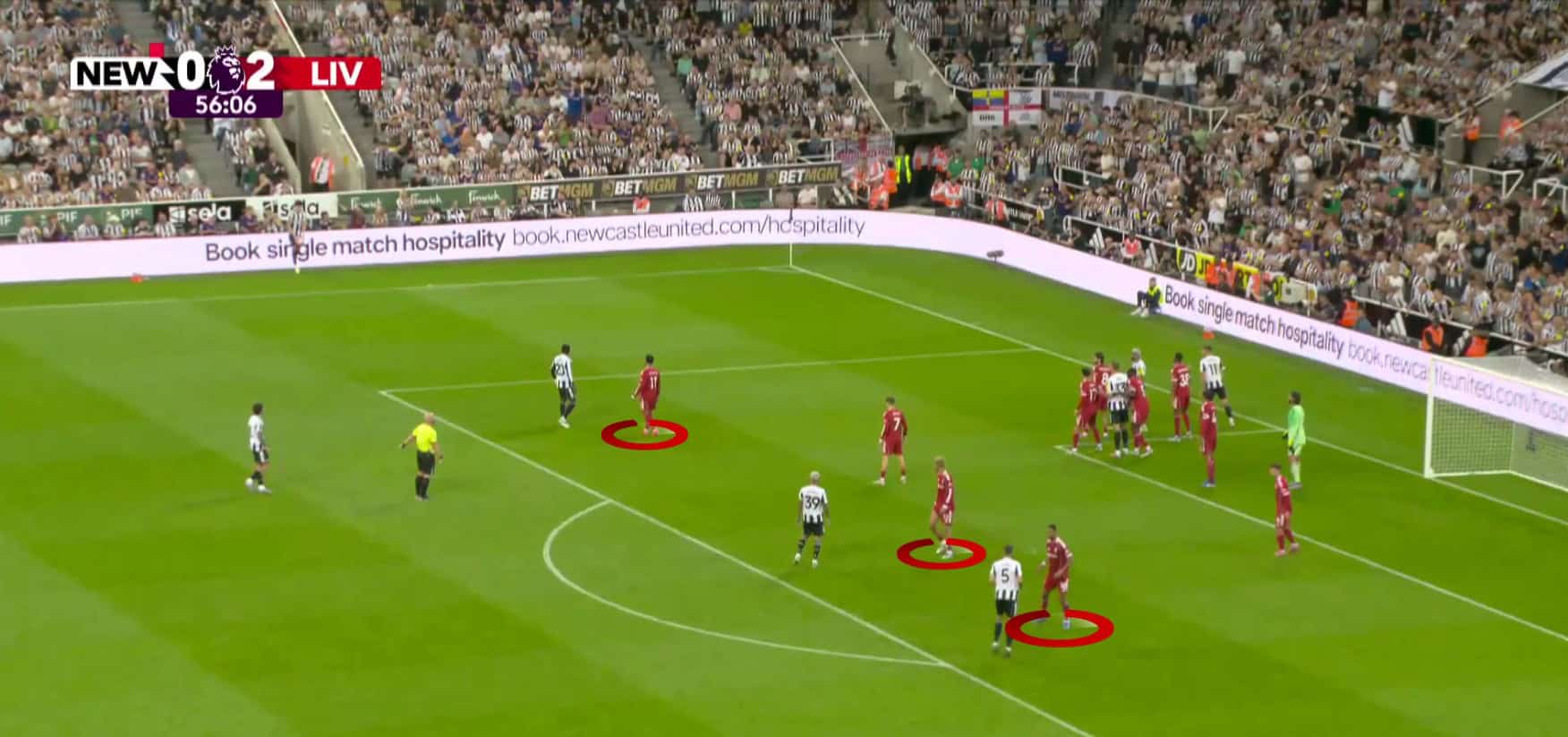 Newcastle’s throw-in shape became clear: three players align with Liverpool’s first defensive line, and three more on the edge of the box.
Anthony Elanga takes the near-post spot, Bruno Guimarães holds the central edge position, and Fabian Schär starts on the far side.
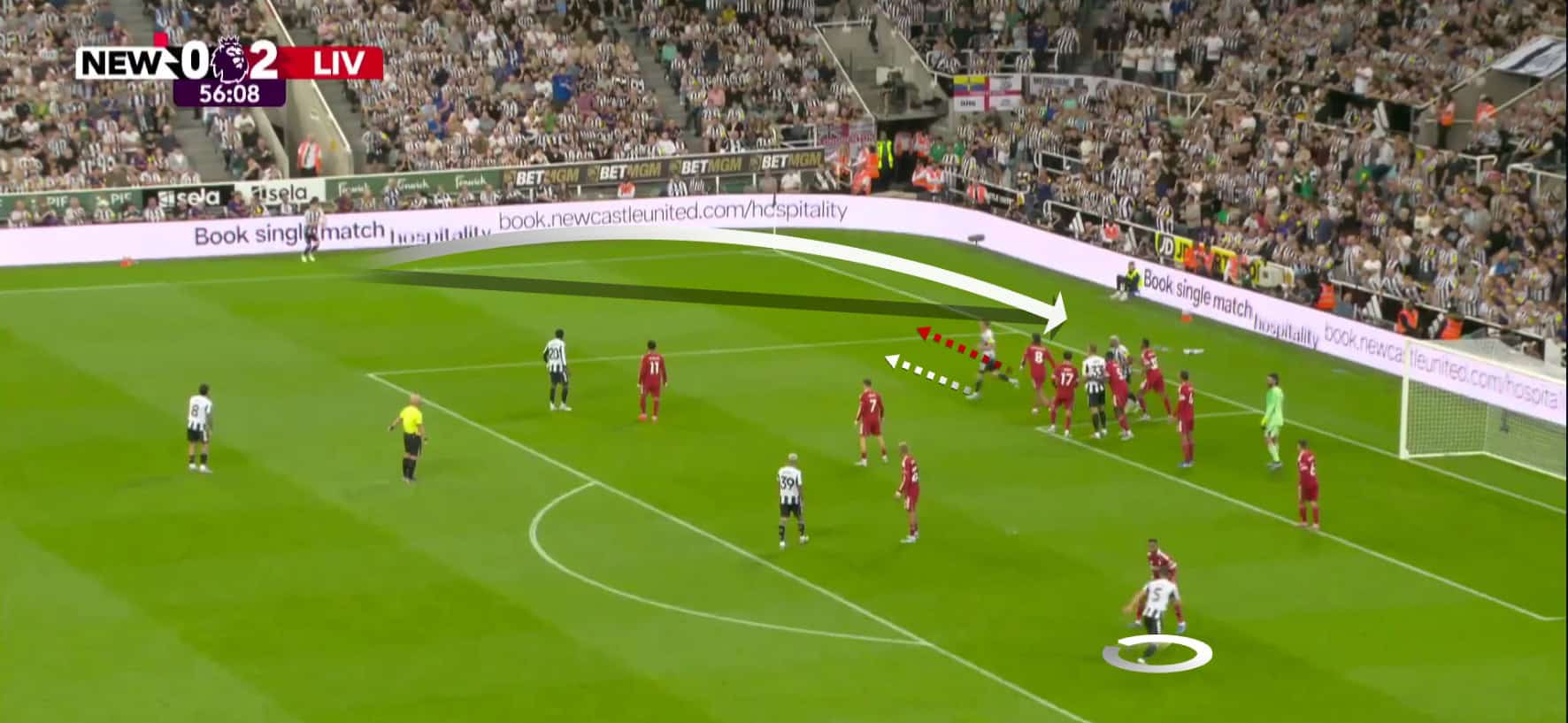 Barnes runs toward the touchline, drawing Szoboszlai, the near full-back, with him.
This opens a passing lane by removing Liverpool’s first defender in the line.
Meanwhile, on the far side, Schär begins from the edge of the box.
This positioning gave him an advantage over Gakpo, who usually tracks the far runner, and Liverpool’s static defensive line.
Starting deeper also provides Schär with space to escape Gakpo’s marking.
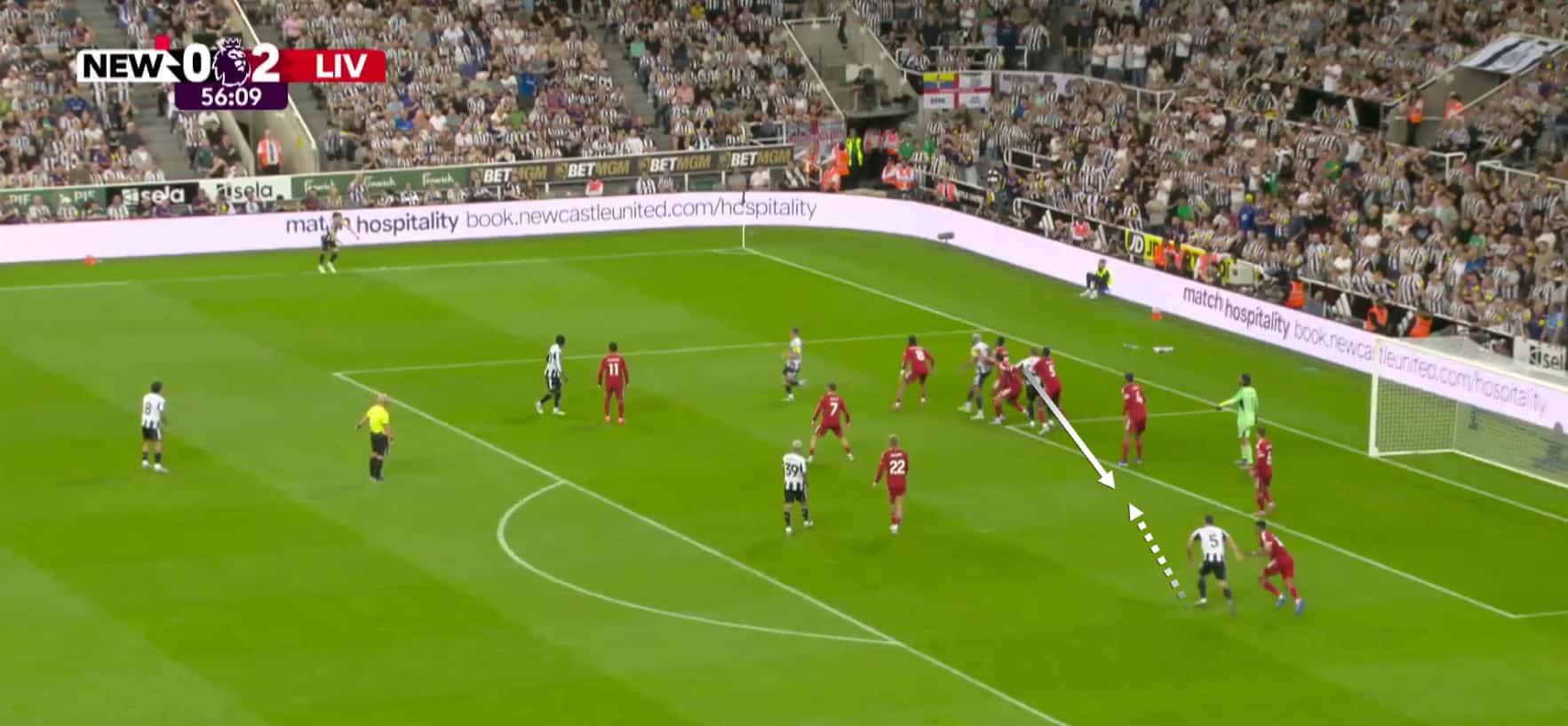 Also, when Schär manages to escape Gakpo, he arrives in the targeted zone with momentum.
The dynamic mismatch favours him, as he was sprinting while Liverpool’s zonal defenders were more static.
This gives Schär a greater chance of capitalising on a flick-on from a teammate at the near post.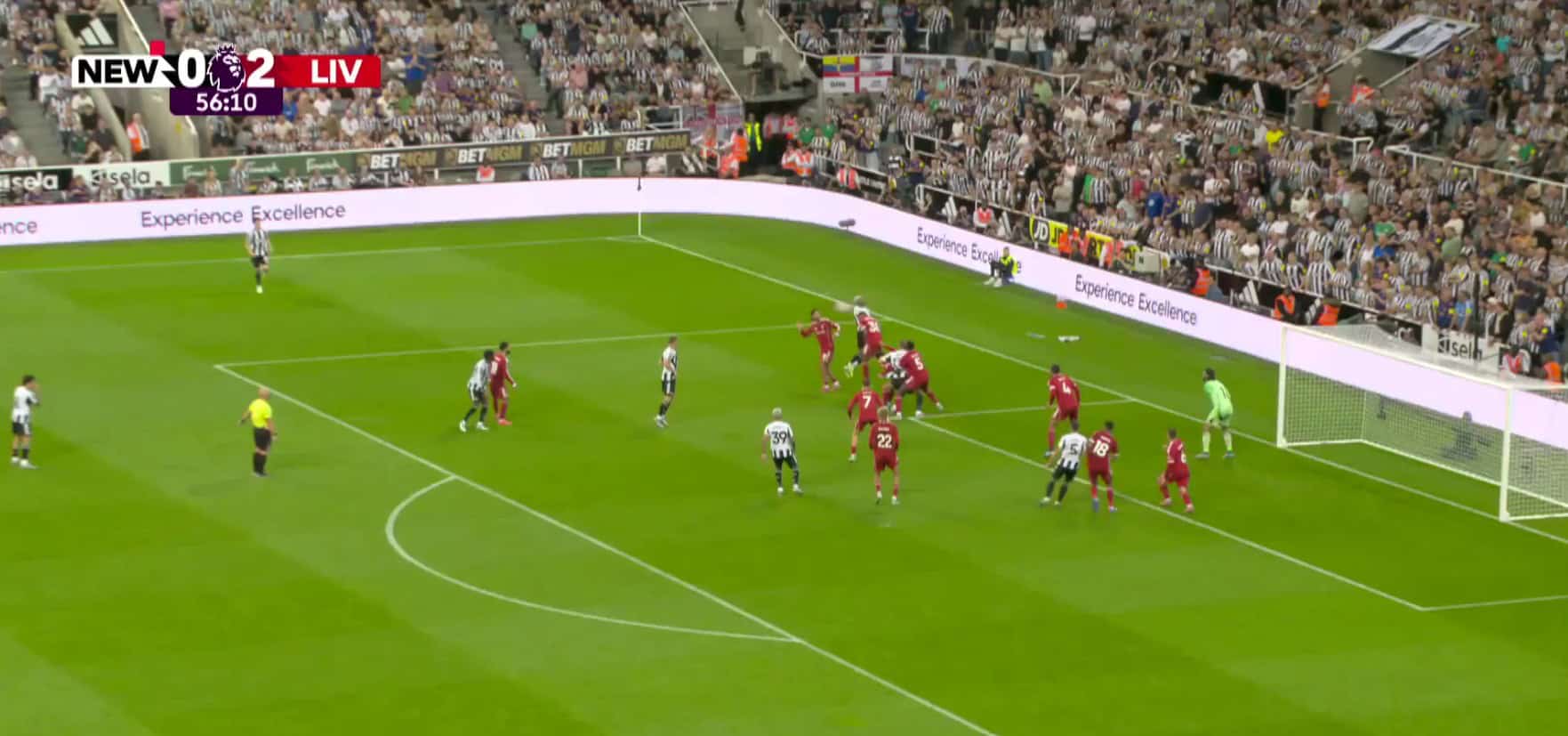 At the near post, Newcastle successfully opens the passing lane, but Joelinton is unable to win the first contact.
Instead, Gravenberch steps in and clears the ball.
The question then becomes, again: where does the clearance go?
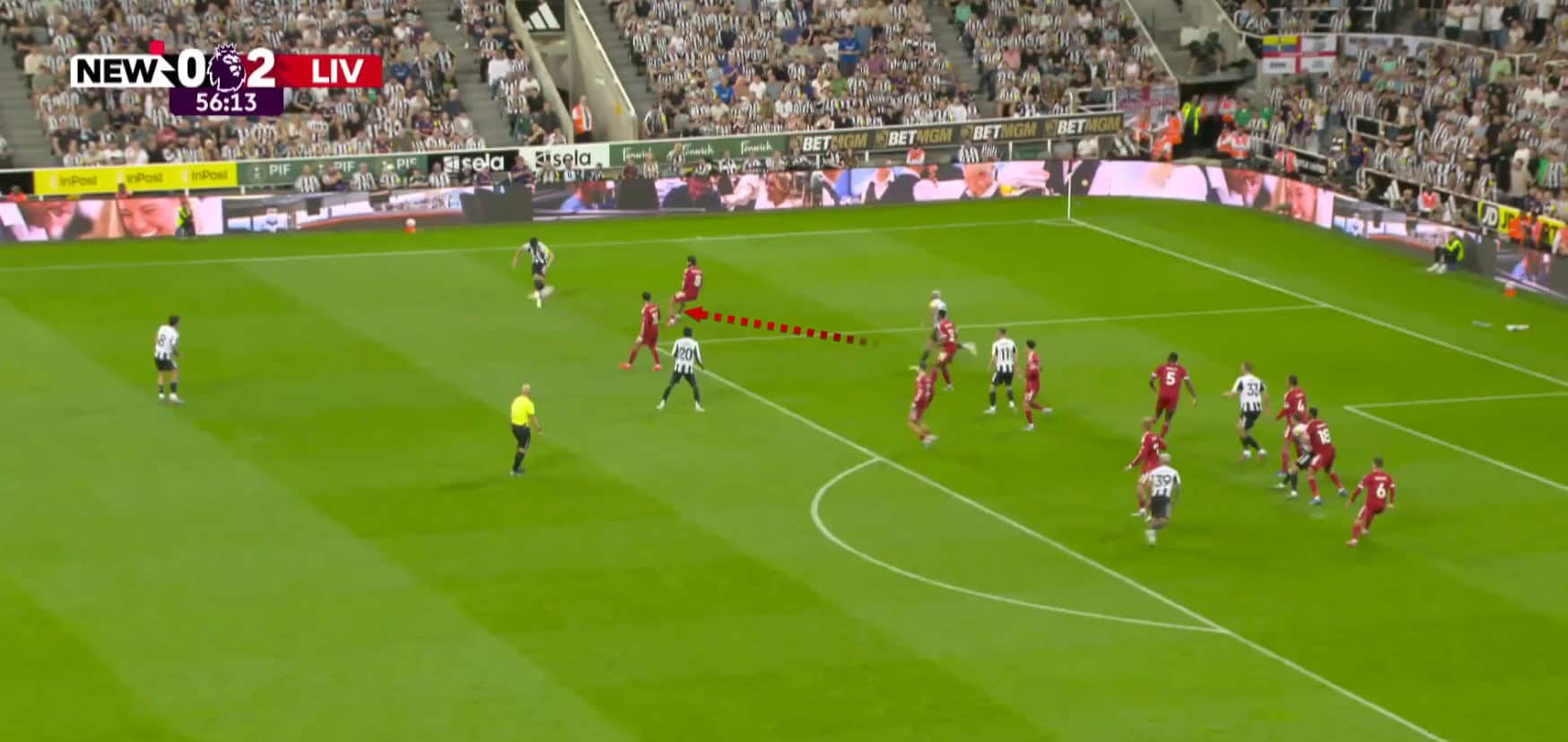 Gravenberch’s clearance goes toward Liverpool’s right side.
As we now know, in this setup, Salah does not press the throw-in taker, Livramento, especially when Elanga takes his attention.
This left Szoboszlai to sprint across and close Livramento.
However, the distance is too large, and with the ball already at Livramento’s feet, Szoboszlai cannot prevent the cross.
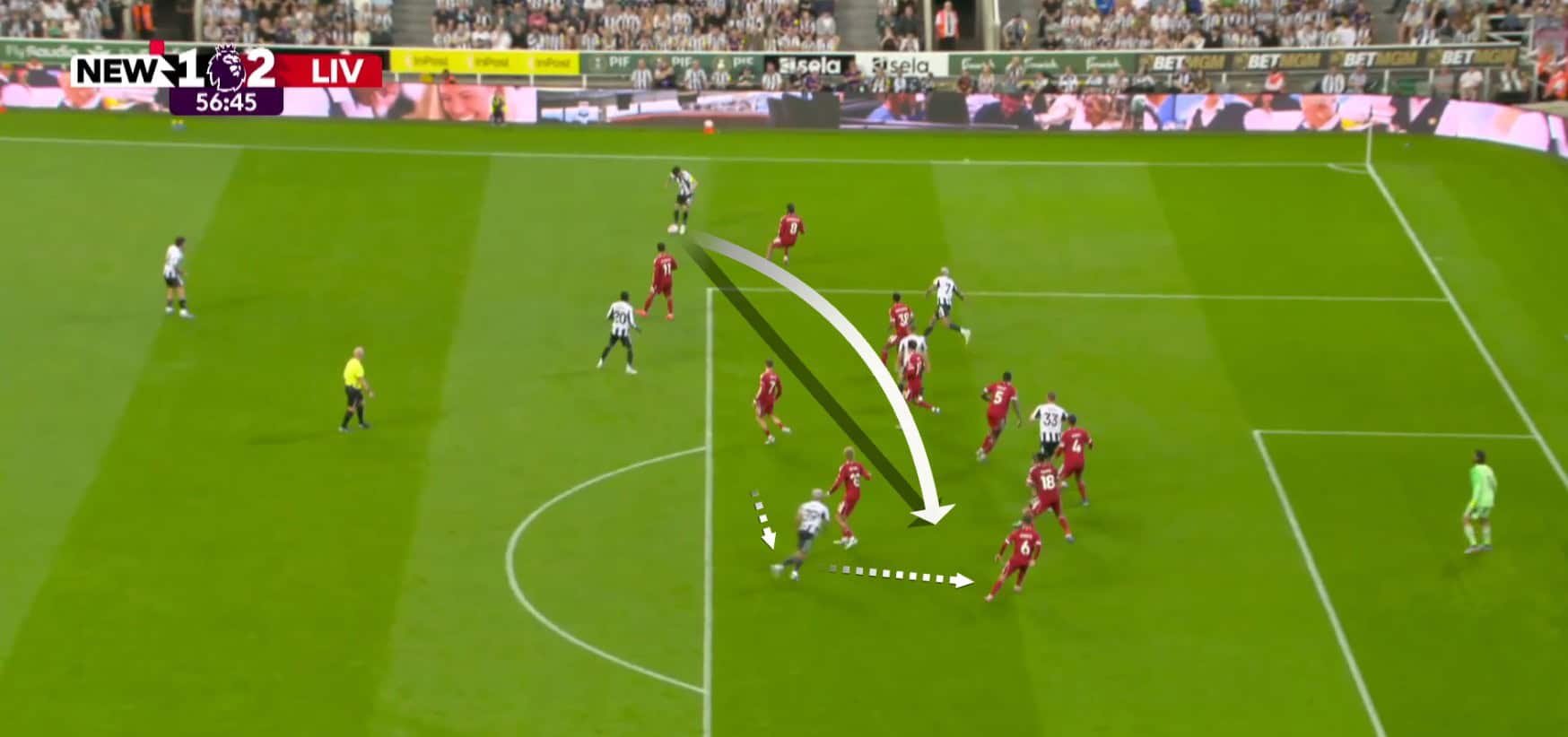 As the cross is delivered, Guimarães anticipates the second phase.
He shifts his position toward the far post and timed his run to meet Livramento’s delivery.
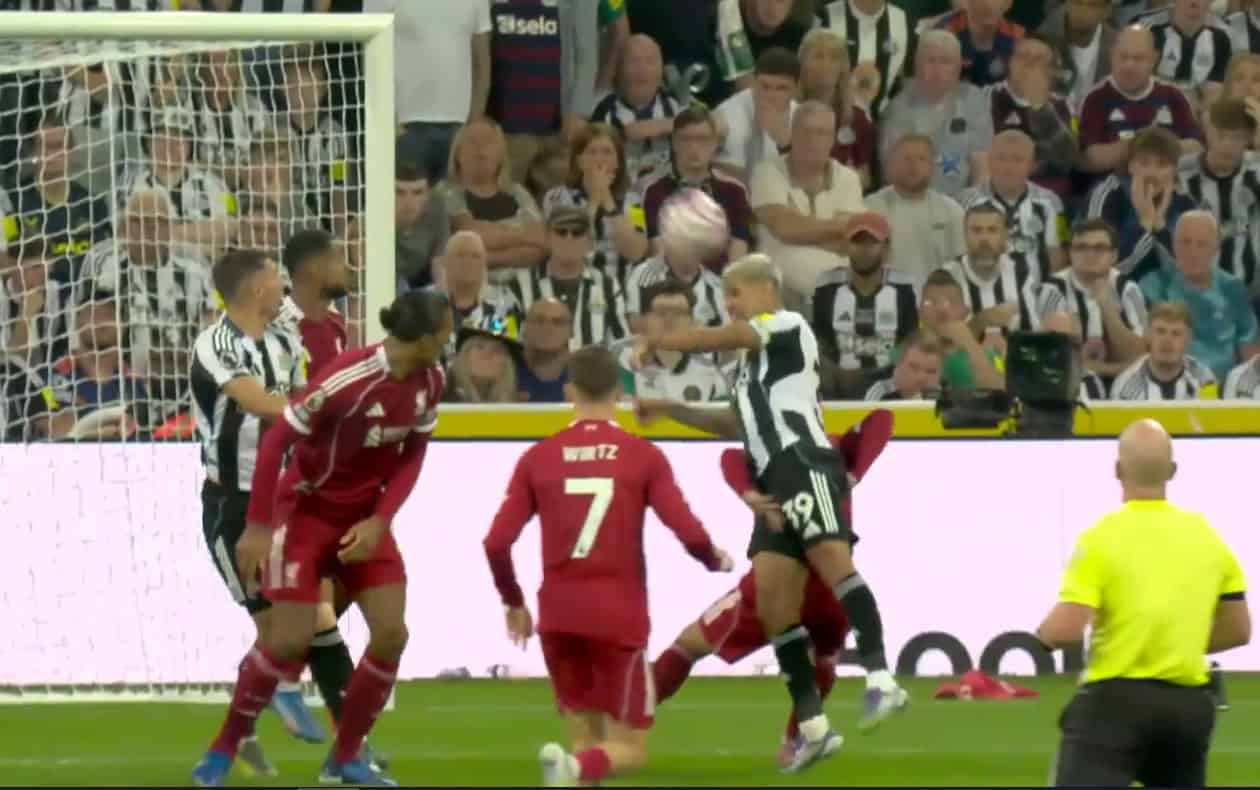 Kerkez attempts to disrupt Guimarães’ balance with this body contact technique, but it fails.
Guimarães maintains control and converts the chance, scoring Newcastle’s opening goal.
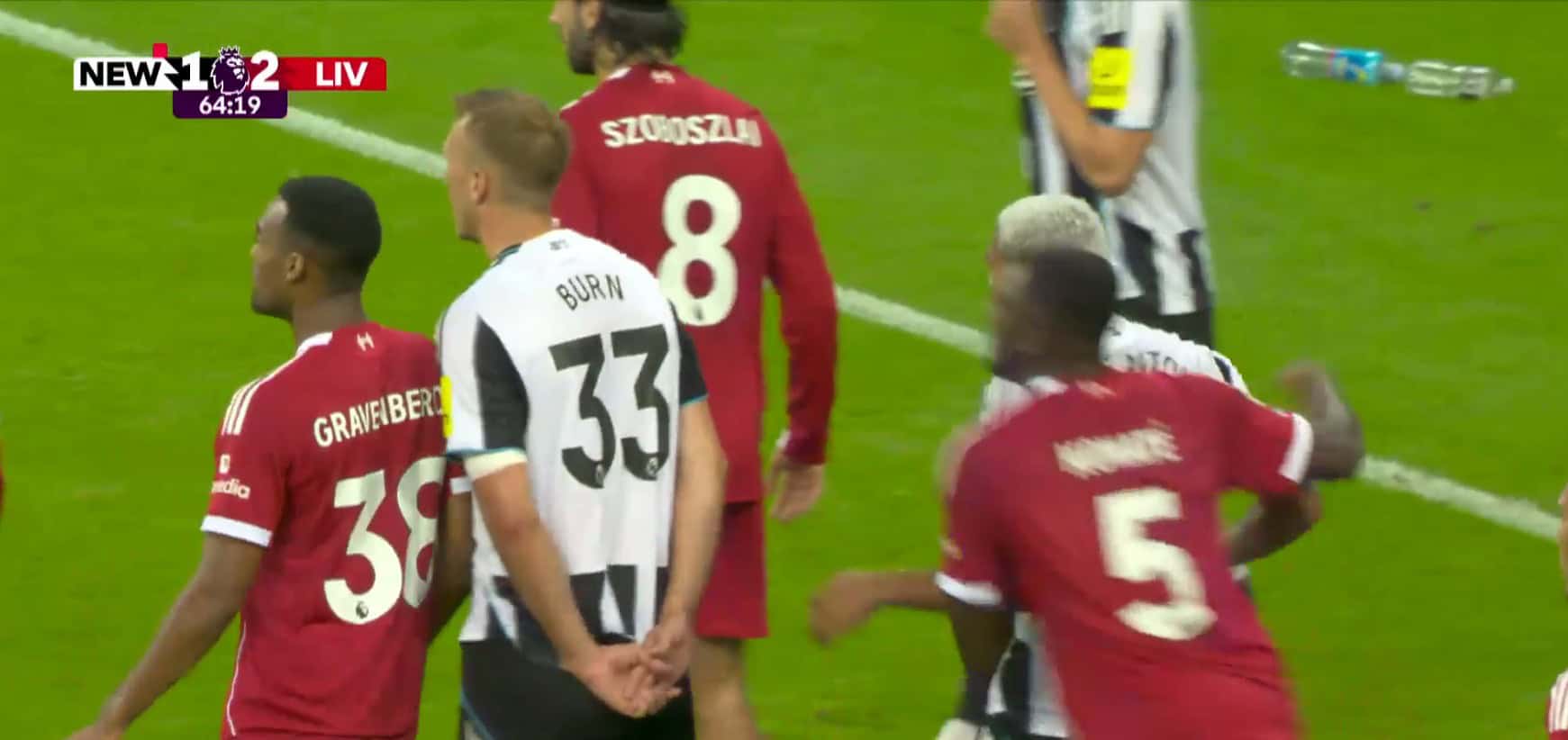 Although they scored from the second phase of their initial idea, Newcastle adjusted one detail: Burn is now positioned to deal with Gravenberch.
At the same time, Joelinton focuses on preventing Konaté from staying free by blocking him.
Here, Konaté reads the situation and tries to escape Joelinton’s marking, since Liverpool’s method is to keep him available as the near centre-back.
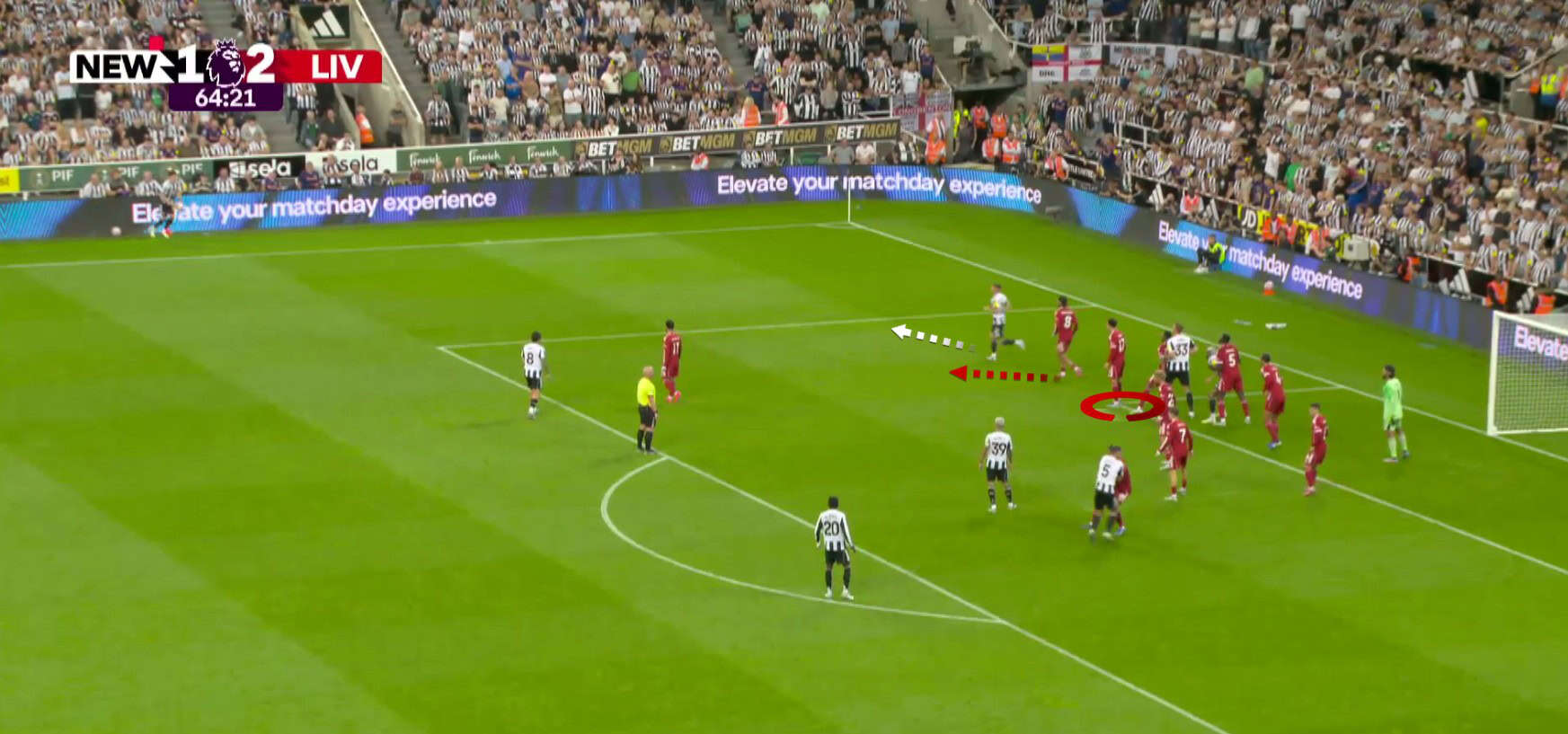 Reacting to Barnes’ run, Liverpool shifts by positioning Jones behind Szoboszlai, allowing him to cover when Szoboszlai follows Barnes.
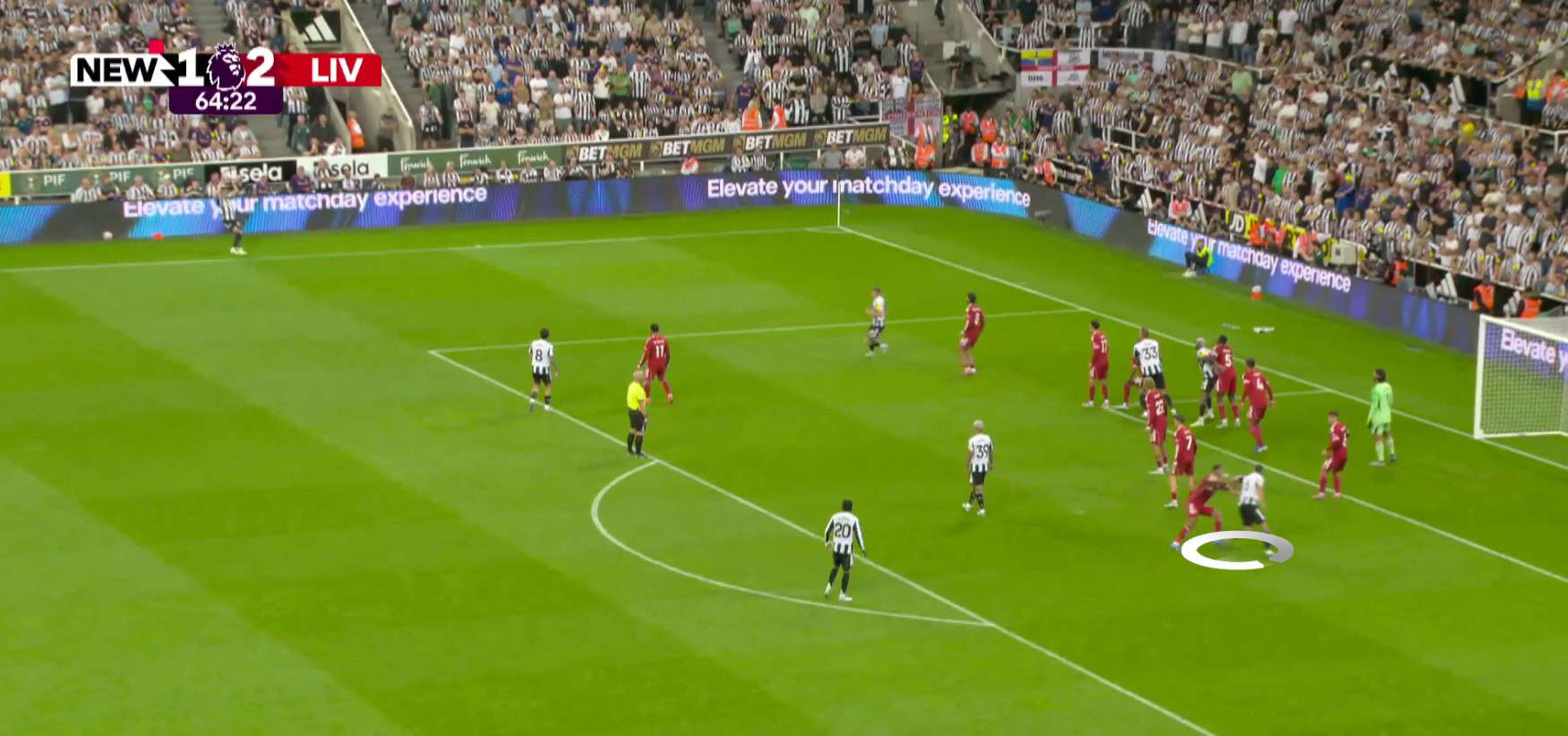 Schär repeats his assigned role in the sequence.
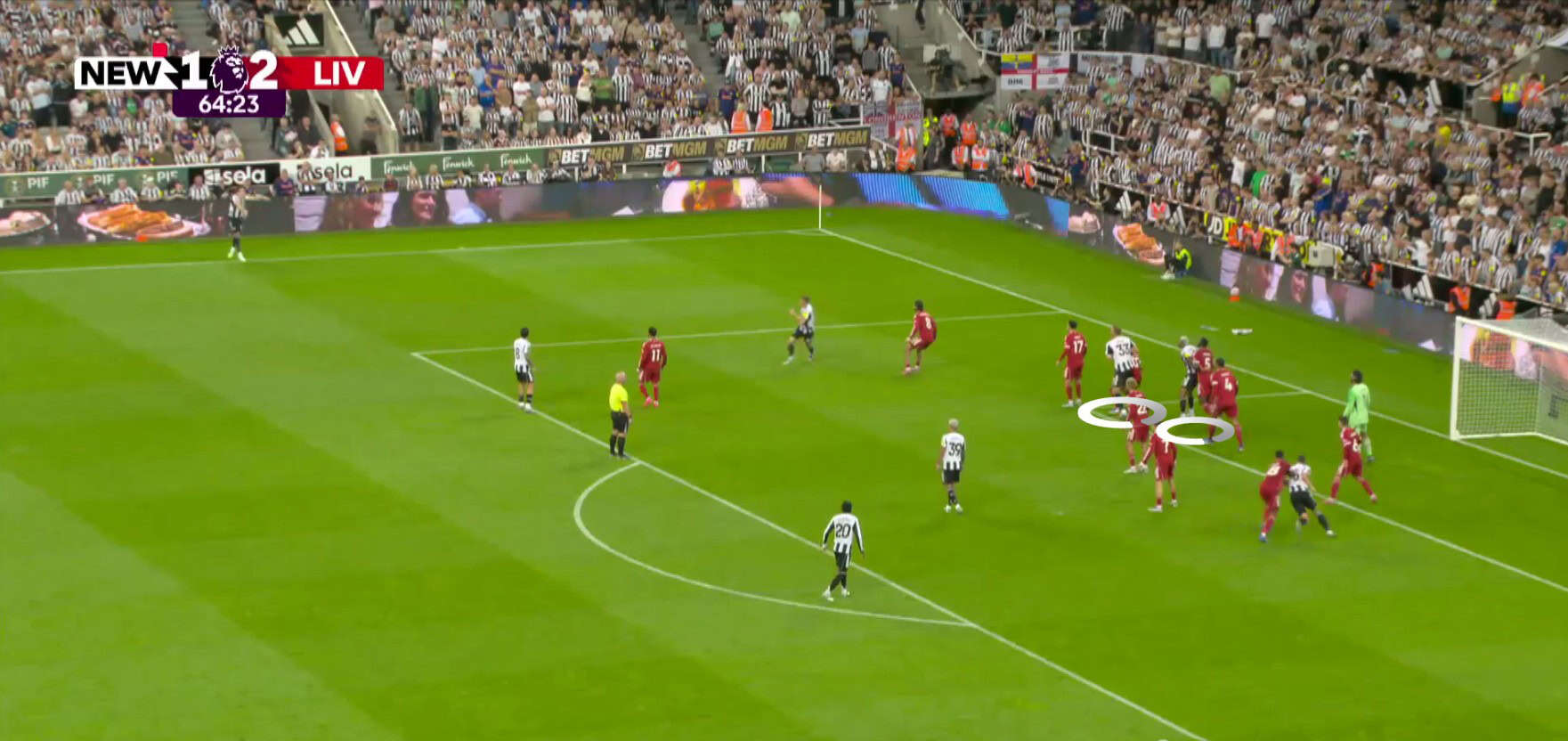 Here, Joelinton blocks Konaté to ease Burn’s task of winning the first contact against Gravenberch.
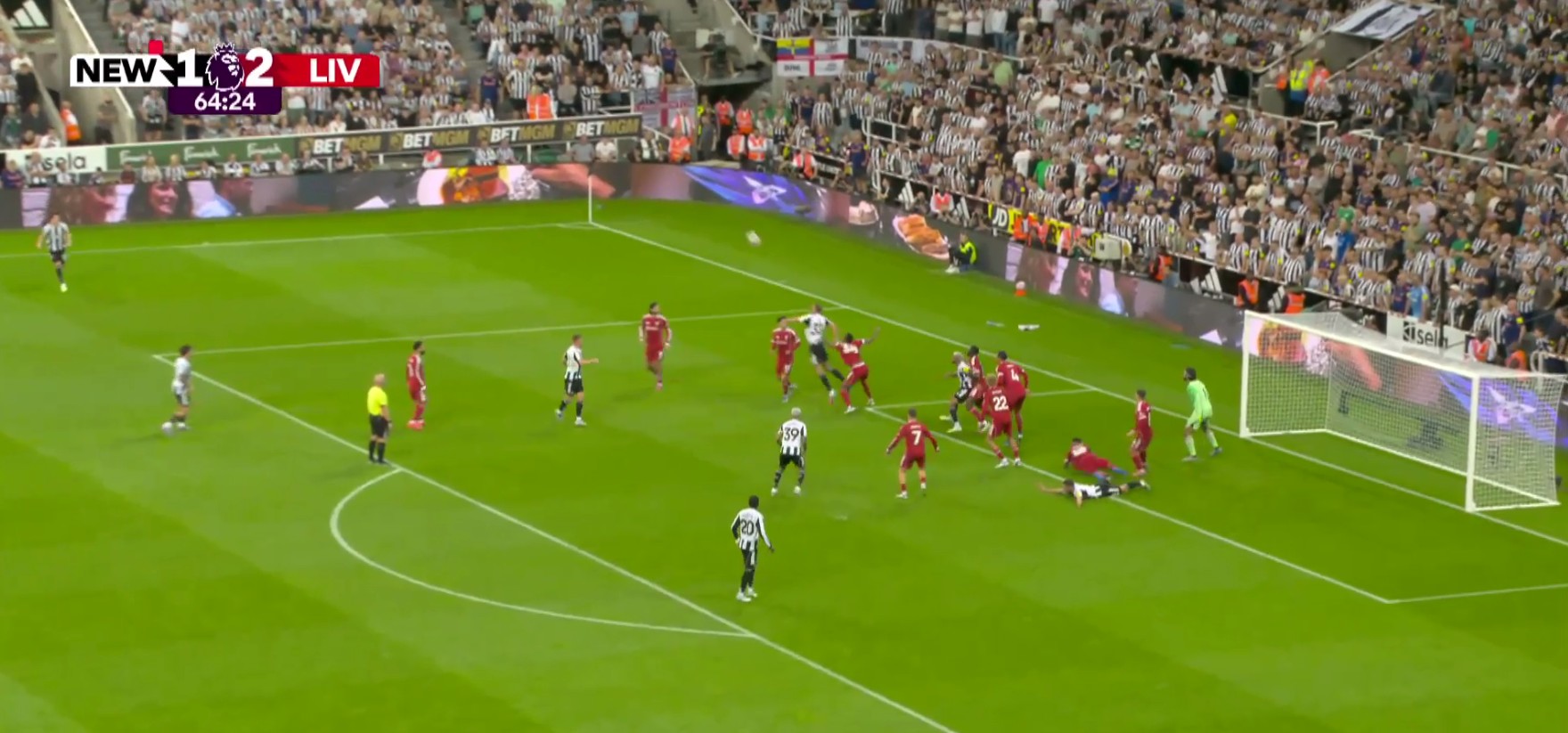 However, Livramento’s long throw is delivered too high, leaving Burn unable to challenge for it.
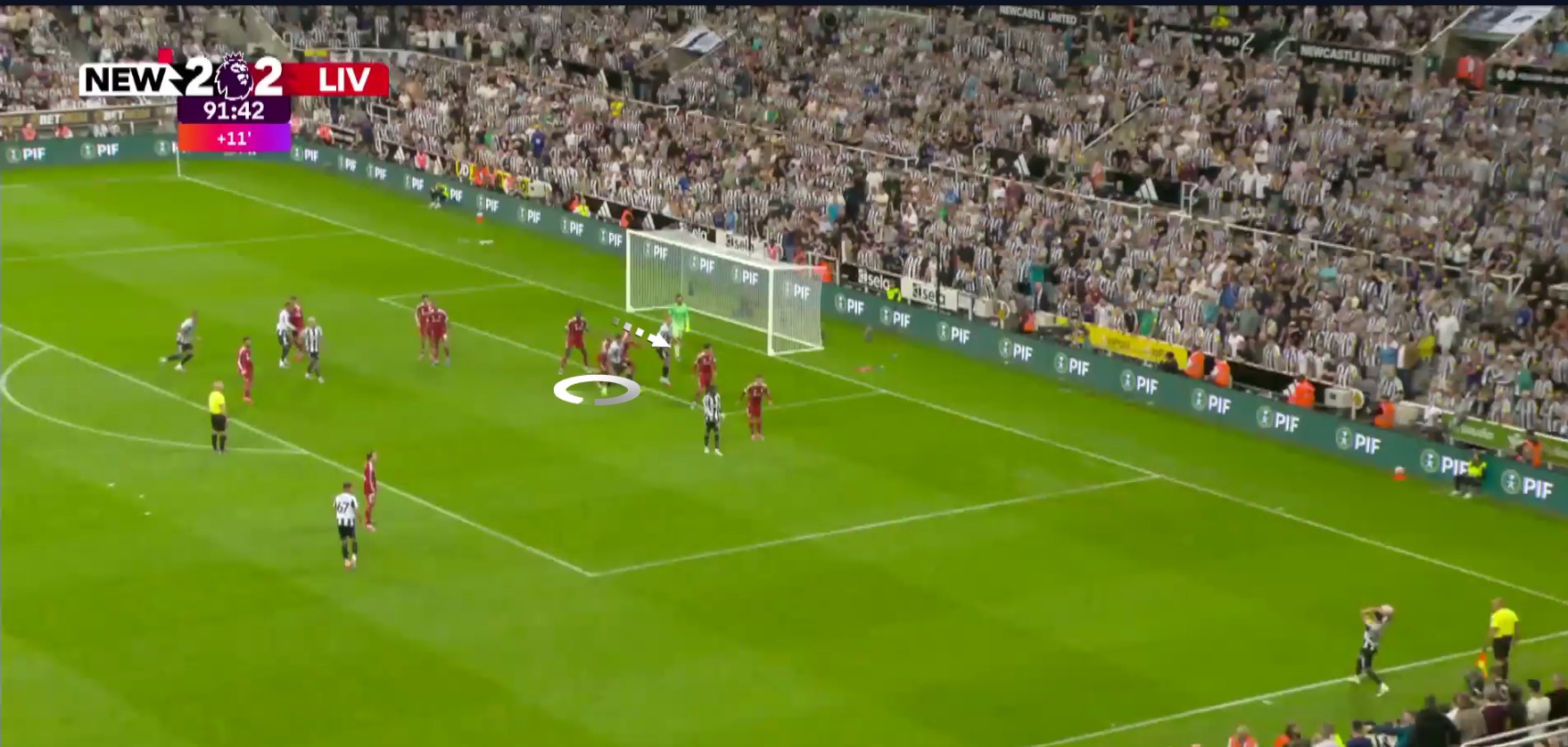 We see the same idea from the opposite side, with William Osula replicating Joelinton’s role to keep Burn free, and blocks Van Dijk as shown below.
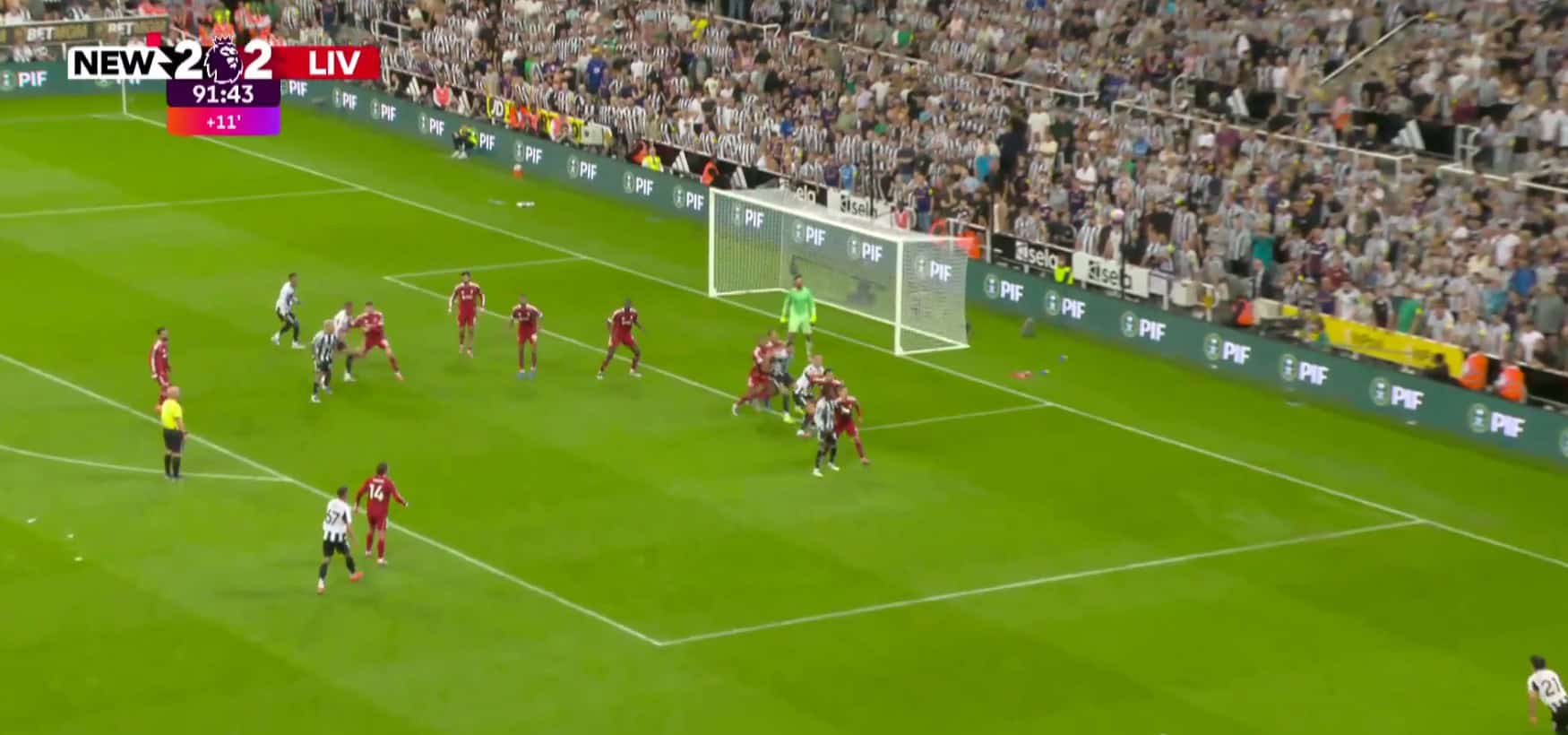
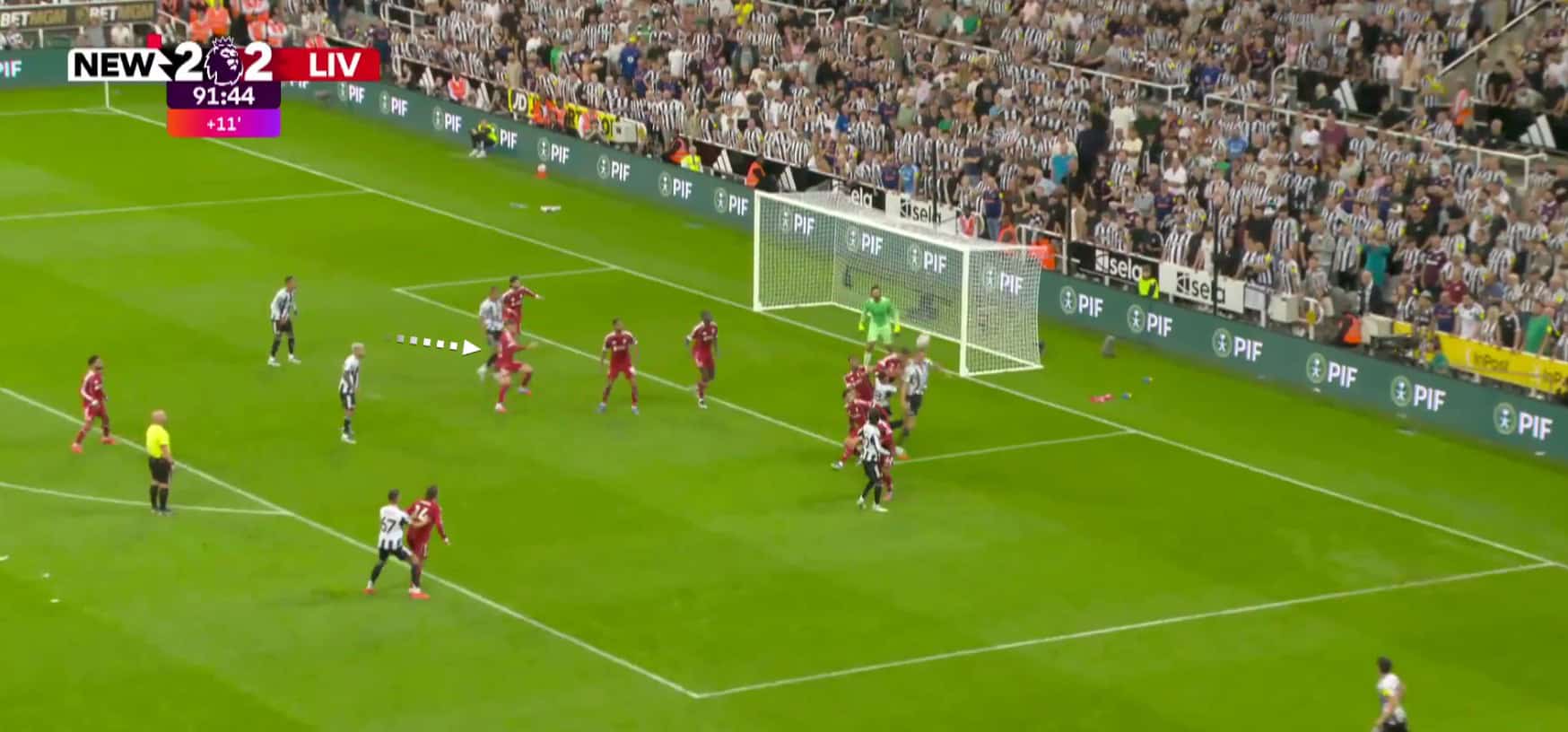
This time, Burn wins the first contact and flicks the ball on towards Malick Thiaw, who makes a run between Liverpool’s defenders.
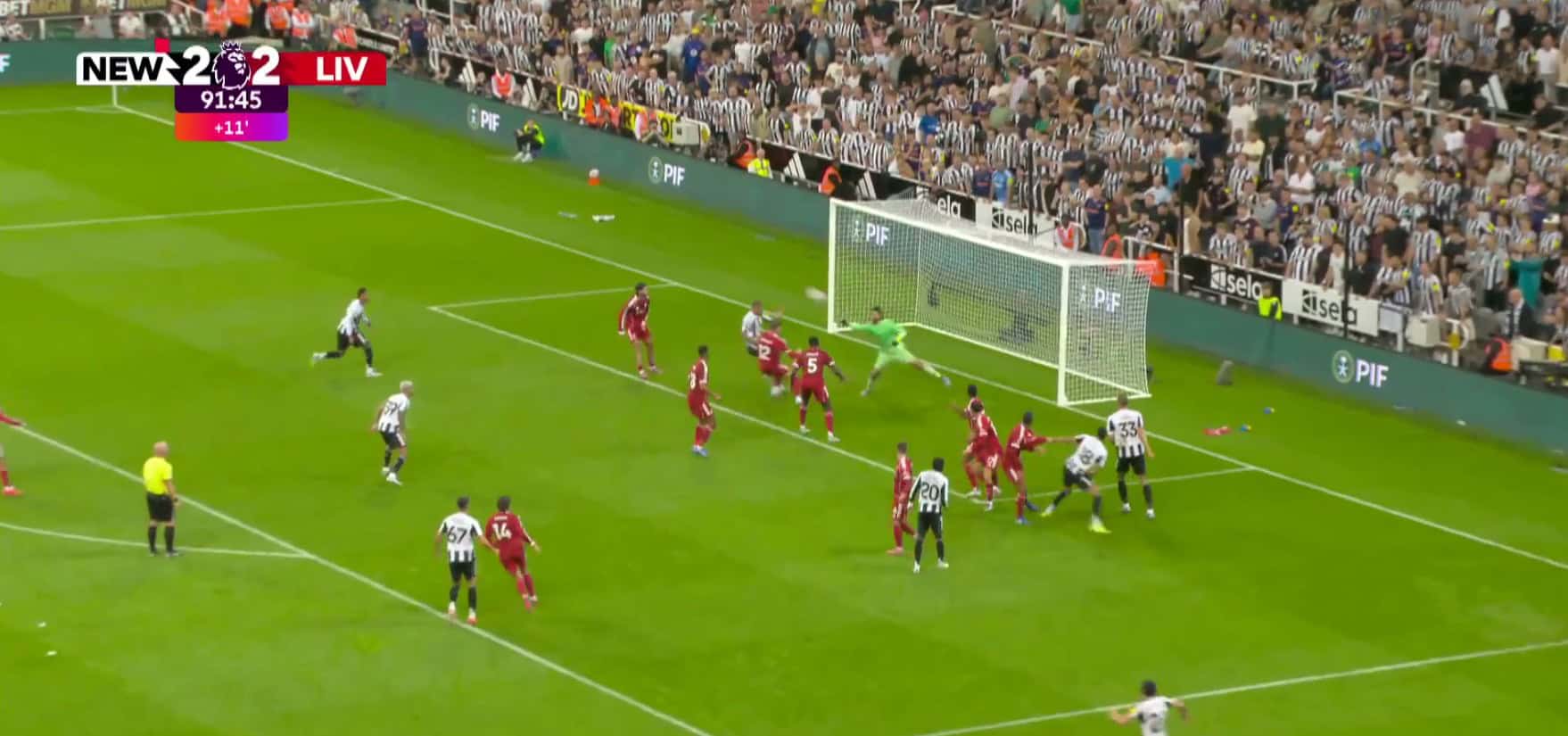 Alisson Becker punches the ball away at the last moment to prevent Liverpool from conceding a third goal and to keep the result until they score the winner.
Liverpool Free-Kick Defence Tactics
The challenges for Liverpool weren’t only throw-ins; free-kicks also caused problems.
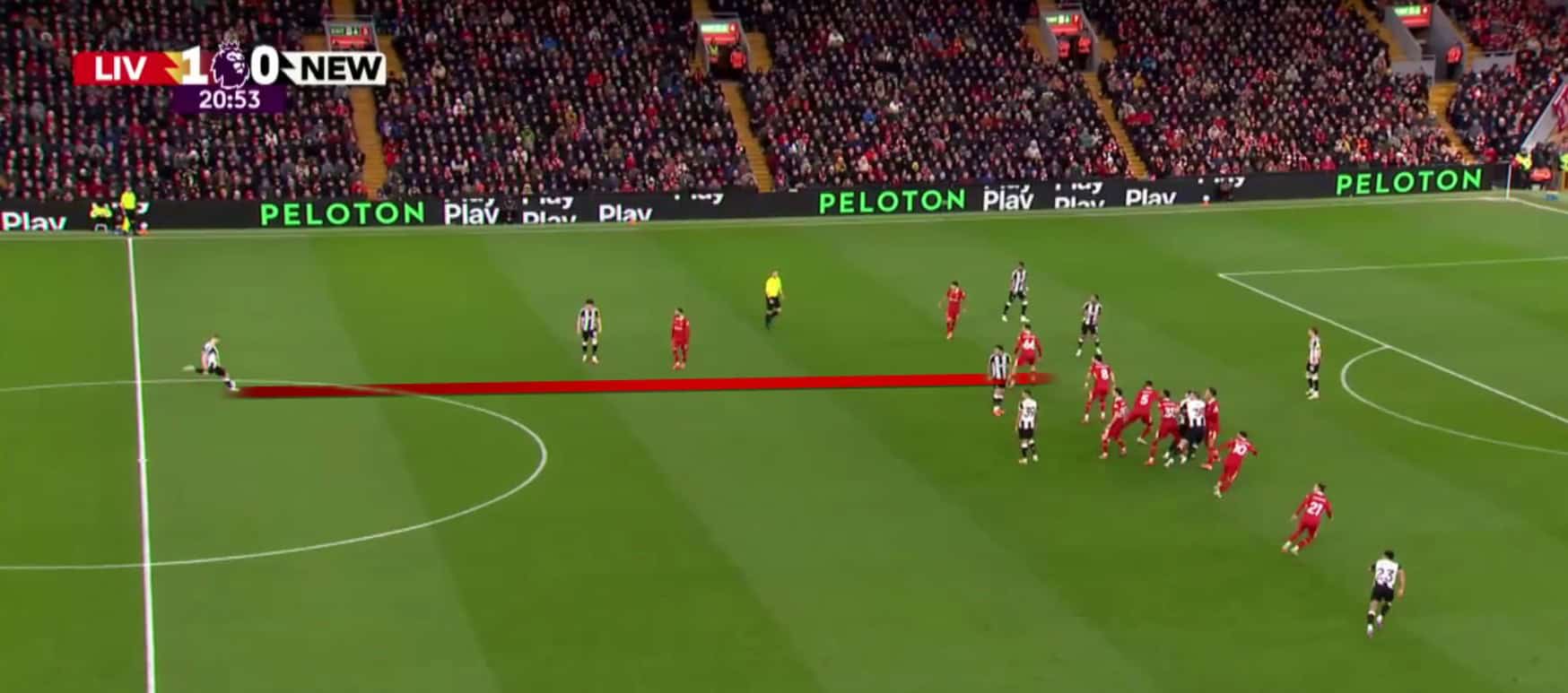 To give context, here’s an example from last season: Liverpool defend far free-kicks with a high line and a late drop.
This forces Newcastle players to delay their runs to stay onside, making it harder to reach the ball.
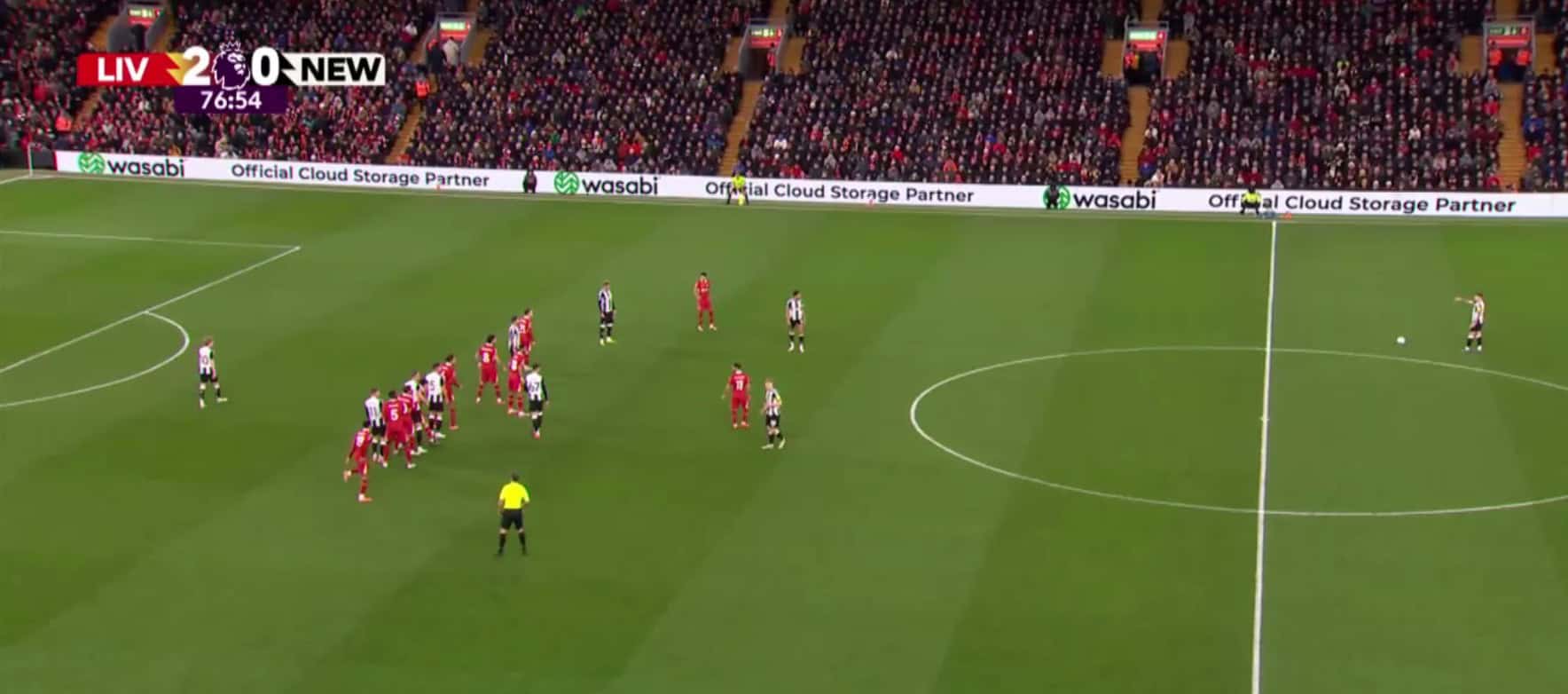 While this approach keeps Newcastle’s threat away from goal, it also leaves a large space behind the defensive line, which becomes dangerous if the opposition times their runs correctly.
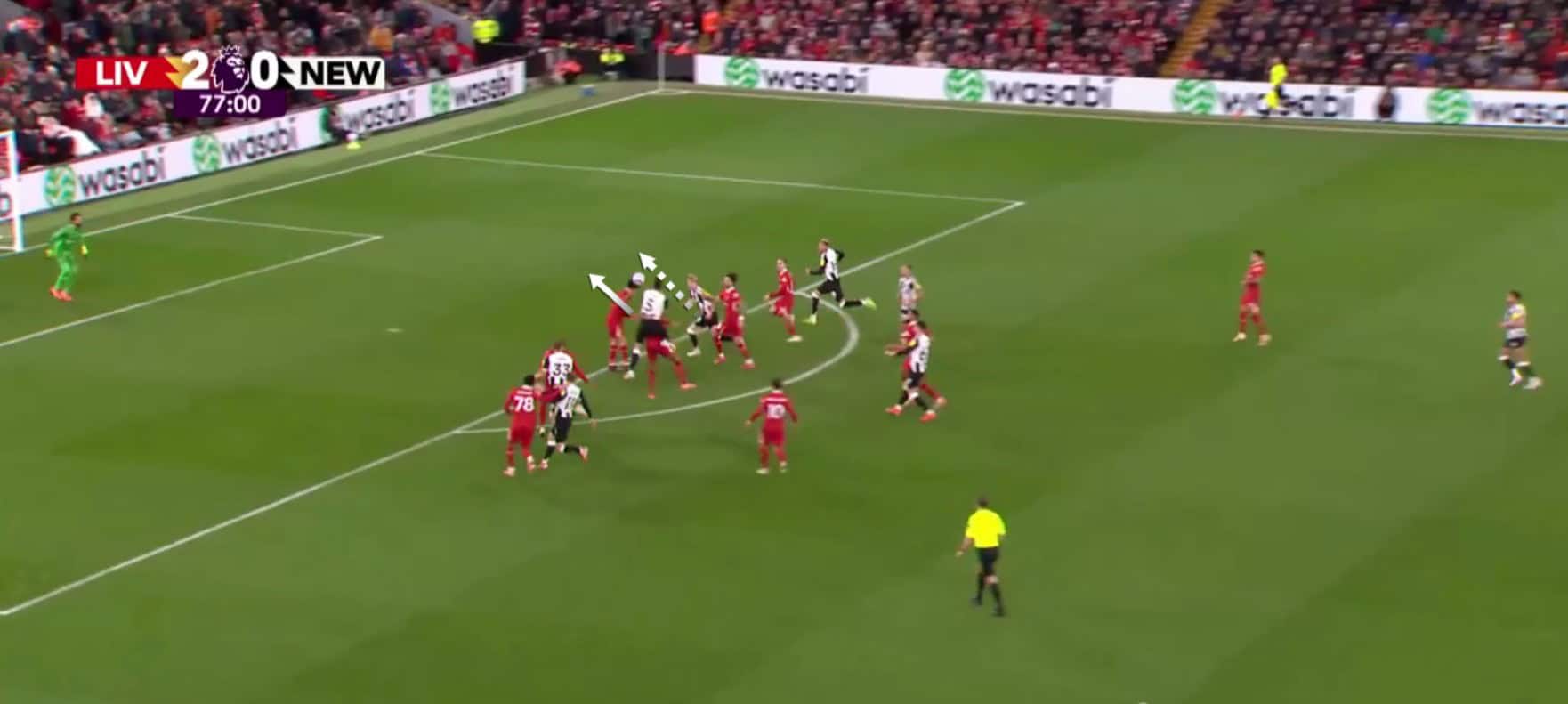 One of Newcastle’s ways of attacking this space is to win the first contact and play it to a runner moving forward.
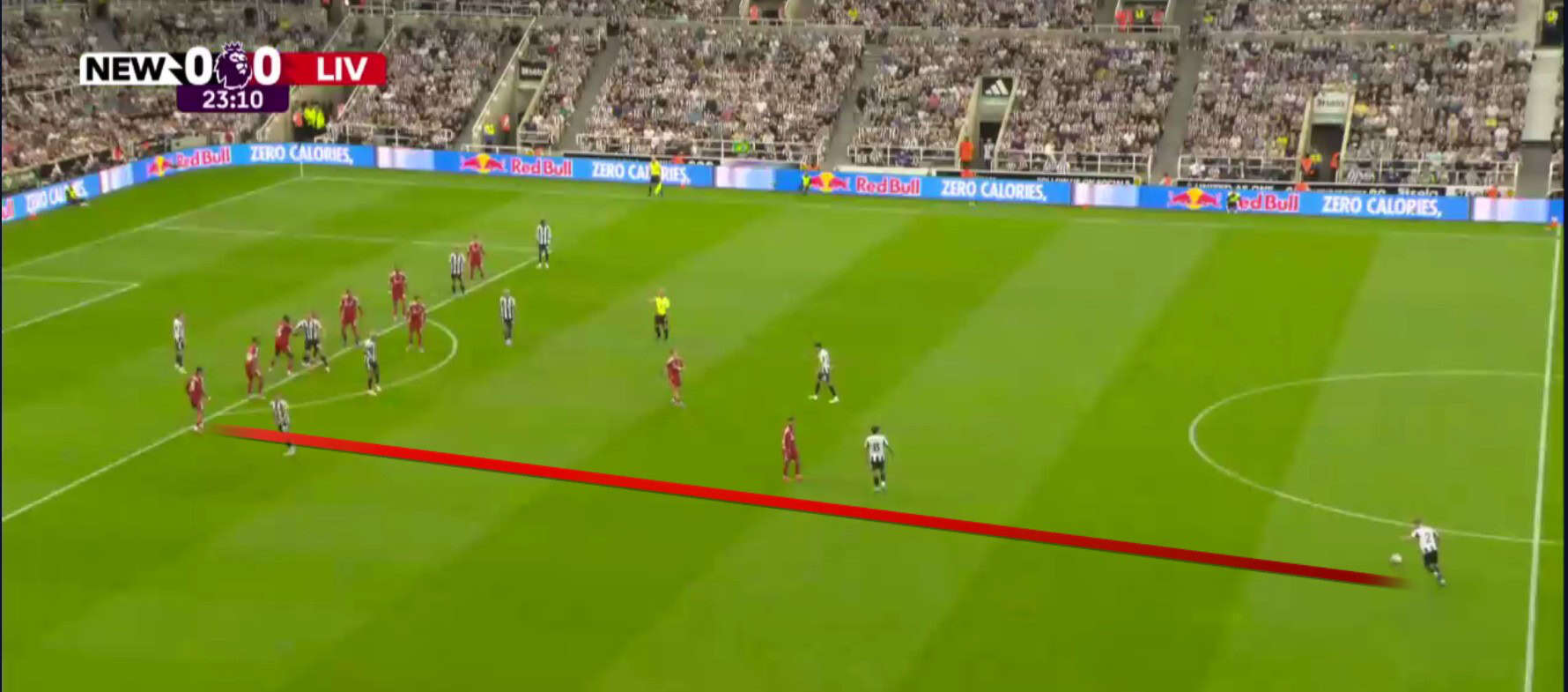 With their aerial strength, Liverpool aim to control Newcastle by reducing the space behind the defensive line.
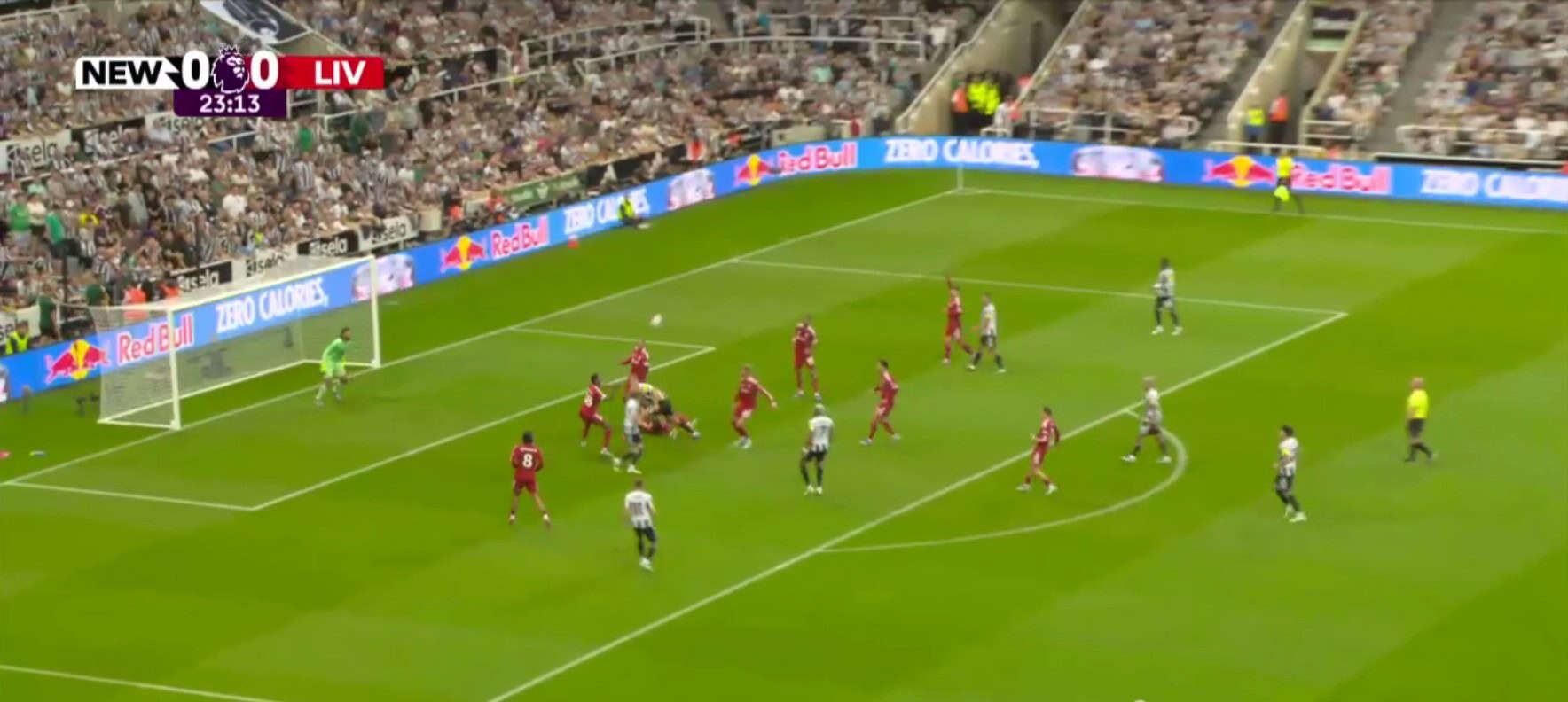 This adjustment denies room for runners behind and prevents any opponent from winning the ball behind the defensive line, which can lead to a 1-v-1 with Alisson.
It also puts defenders in a stronger position, with sight of both ball and opponent.
A high line rarely offers this.
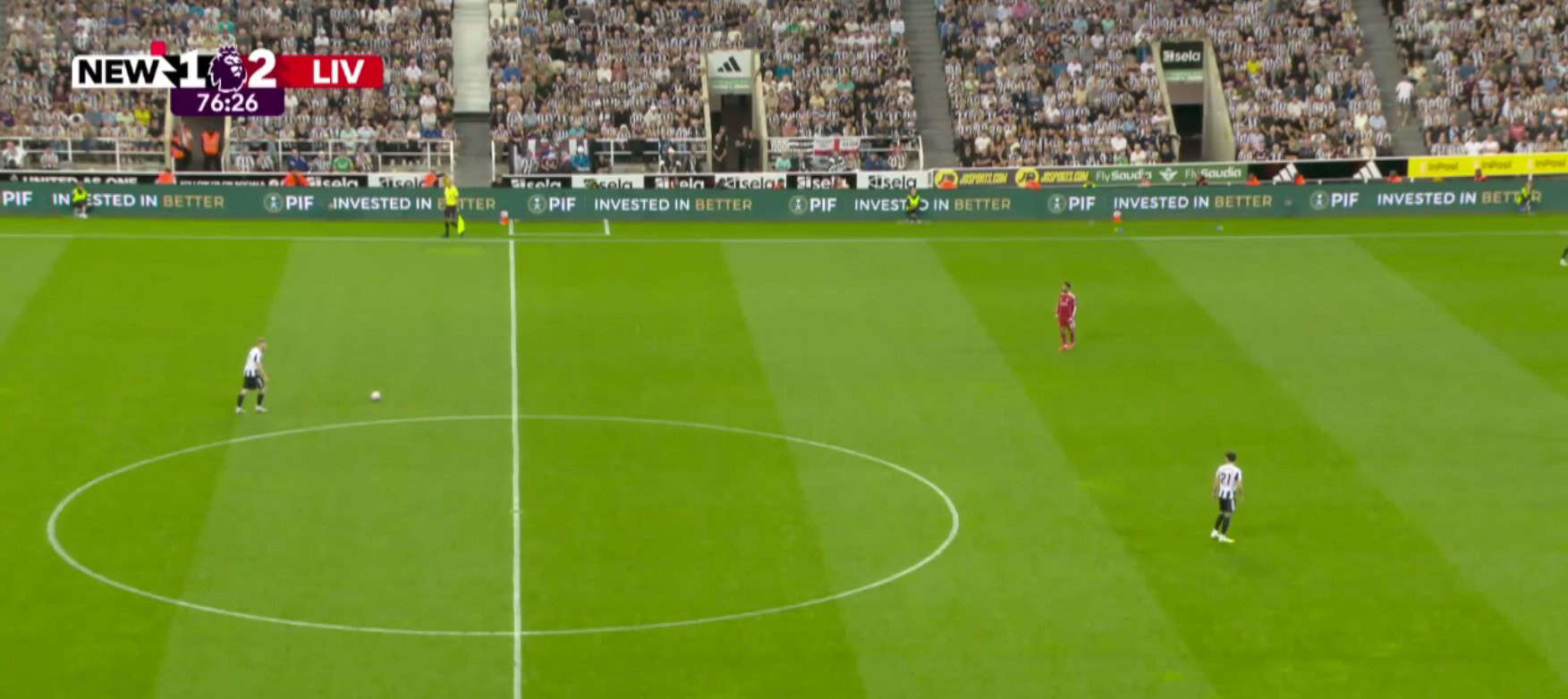 Liverpool continue using a deep line against far free-kicks.
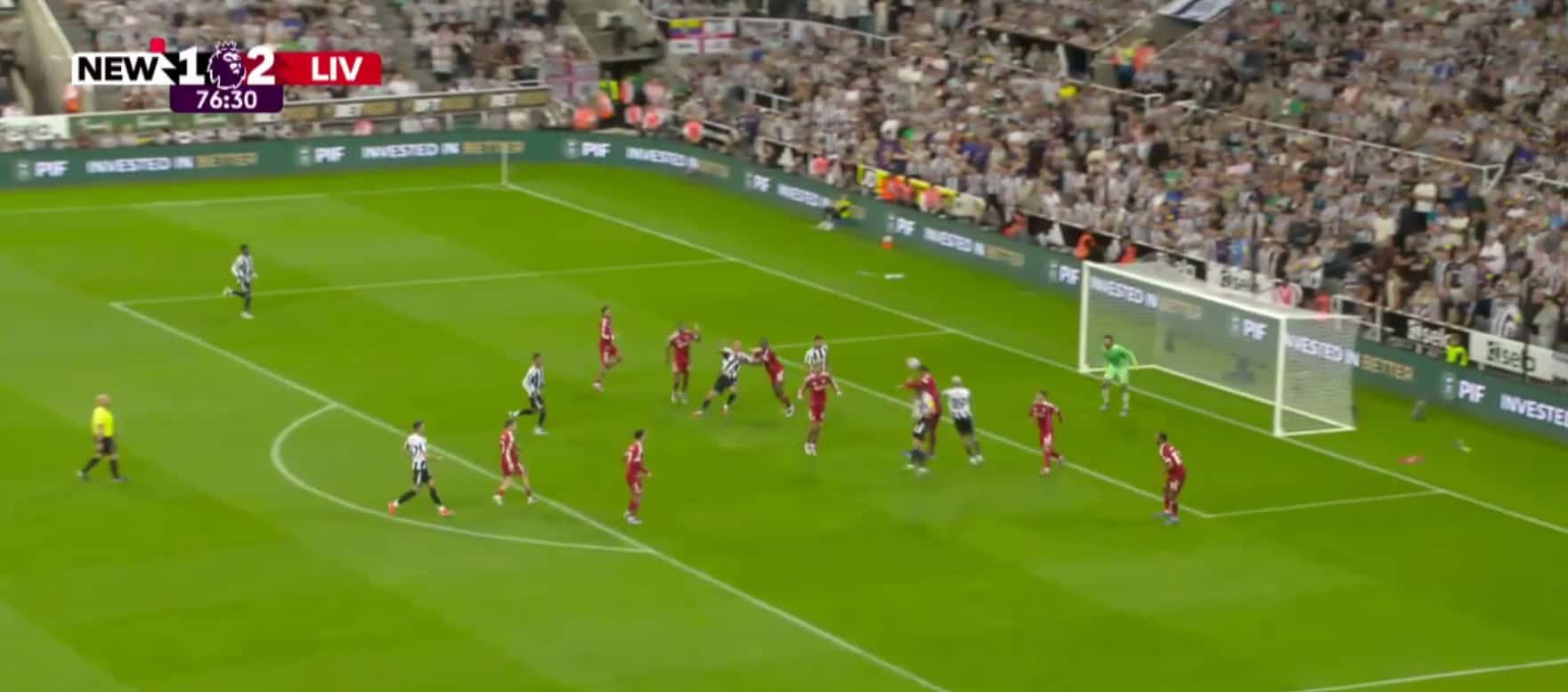 Here, Van Dijk is well-positioned to rise between two Newcastle players, win the aerial duel, and clear.
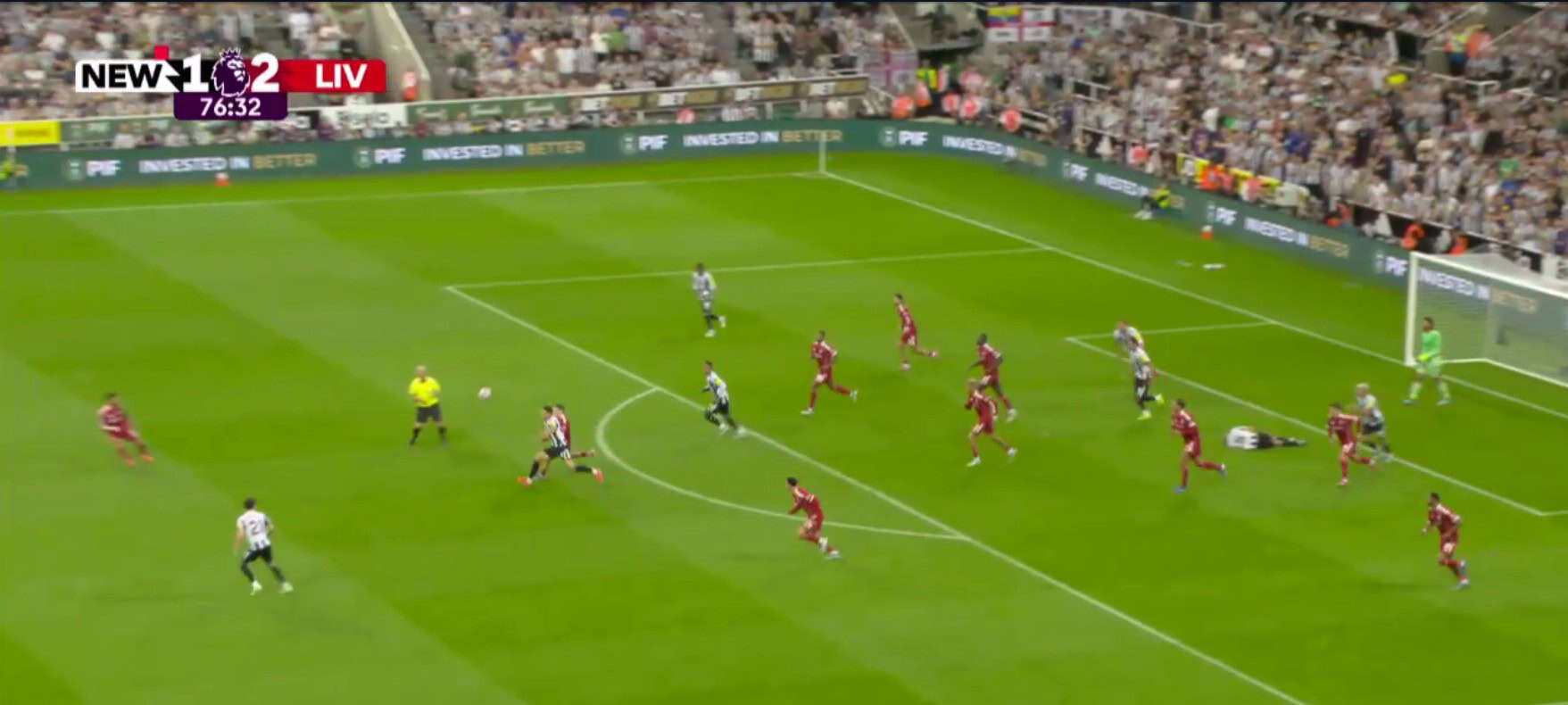 One of the disadvantages of this system is losing the second ball close to the goal.
As seen here, if Liverpool concedes the second ball at the edge of the box, it would force them into a low block.
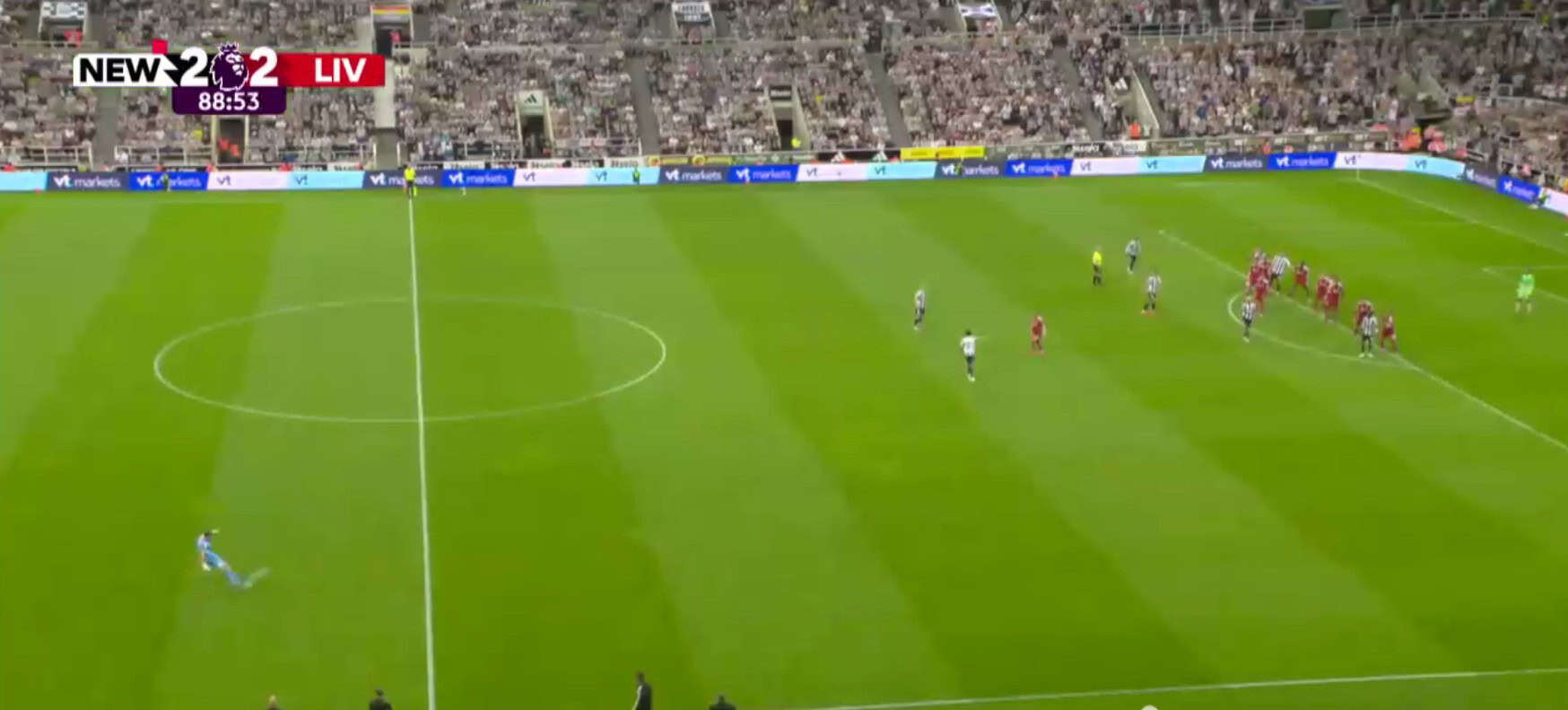
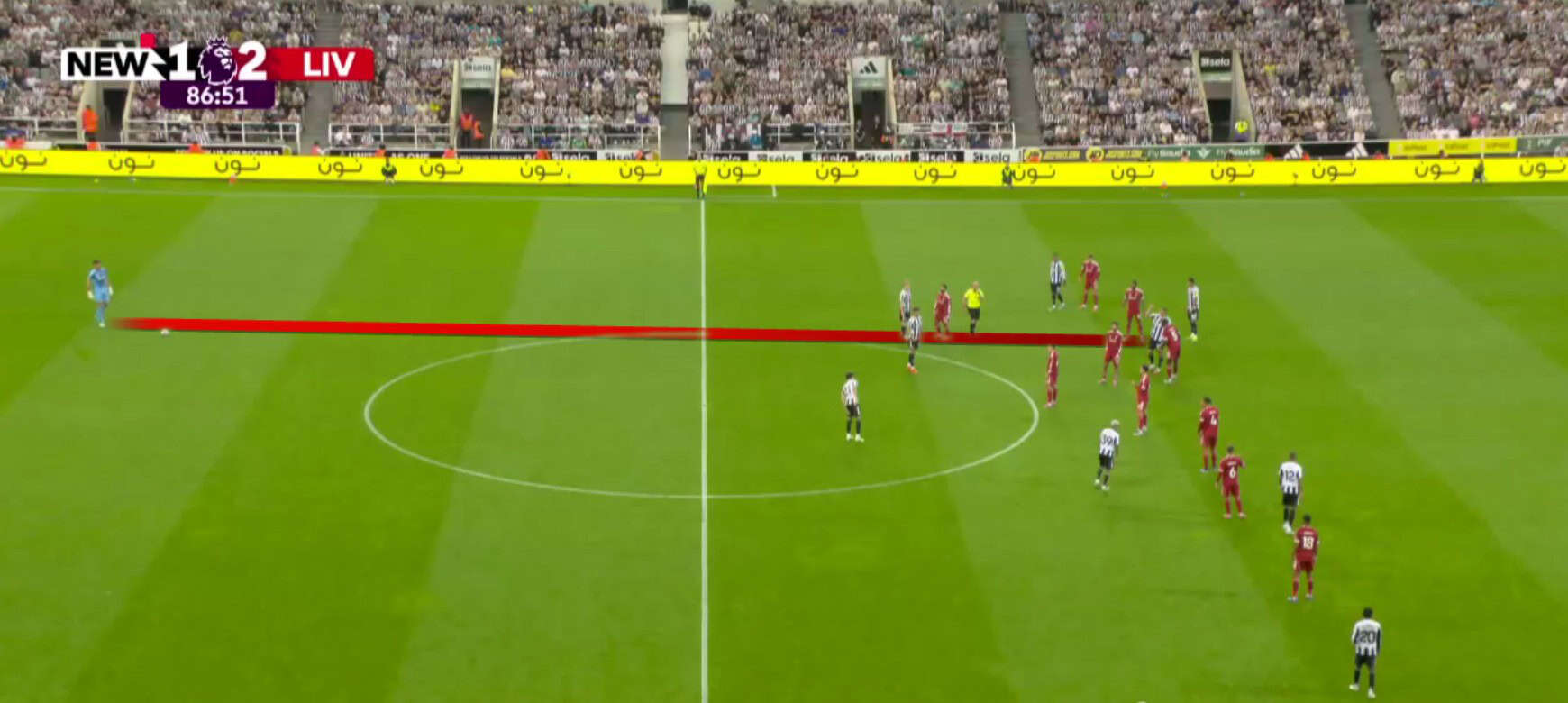 When they are [2-1], Liverpool switches to a high line against far free-kicks to push Newcastle away from goal.
This forces opponents’ runs to be perfectly timed to stay onside and moves second balls further up the pitch, if the opposition plays in front of the line.
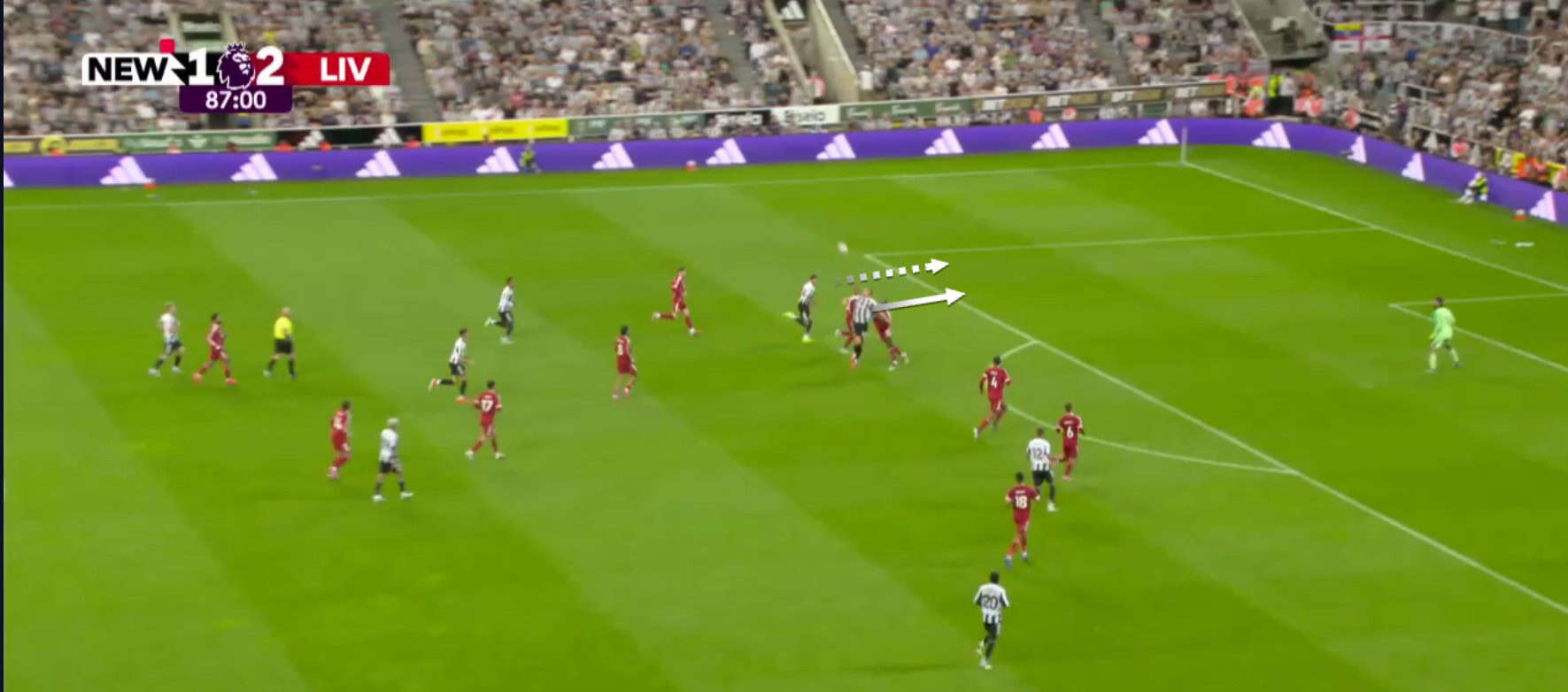 Unluckily, the first time Liverpool changes their free-kick setup, the danger they try to avoid appears.
Dan Burn stays onside, wins the first contact, and flicks it on to Osula, who runs behind the line.
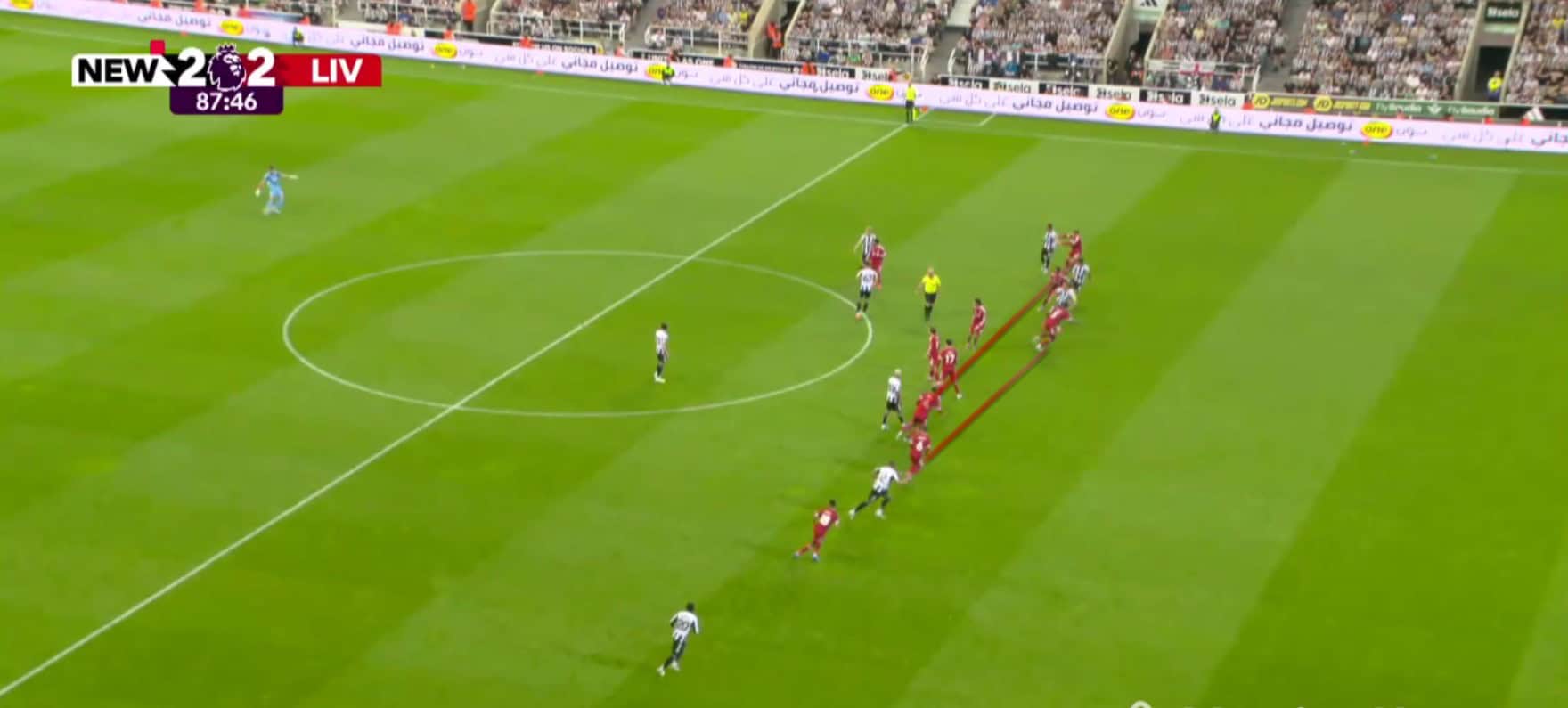 Burn stayed onside not only by timing his run with Liverpool’s drop but also because Liverpool’s defensive line failed to drop as a unit, leaving multiple lines and breaking the offside trap.
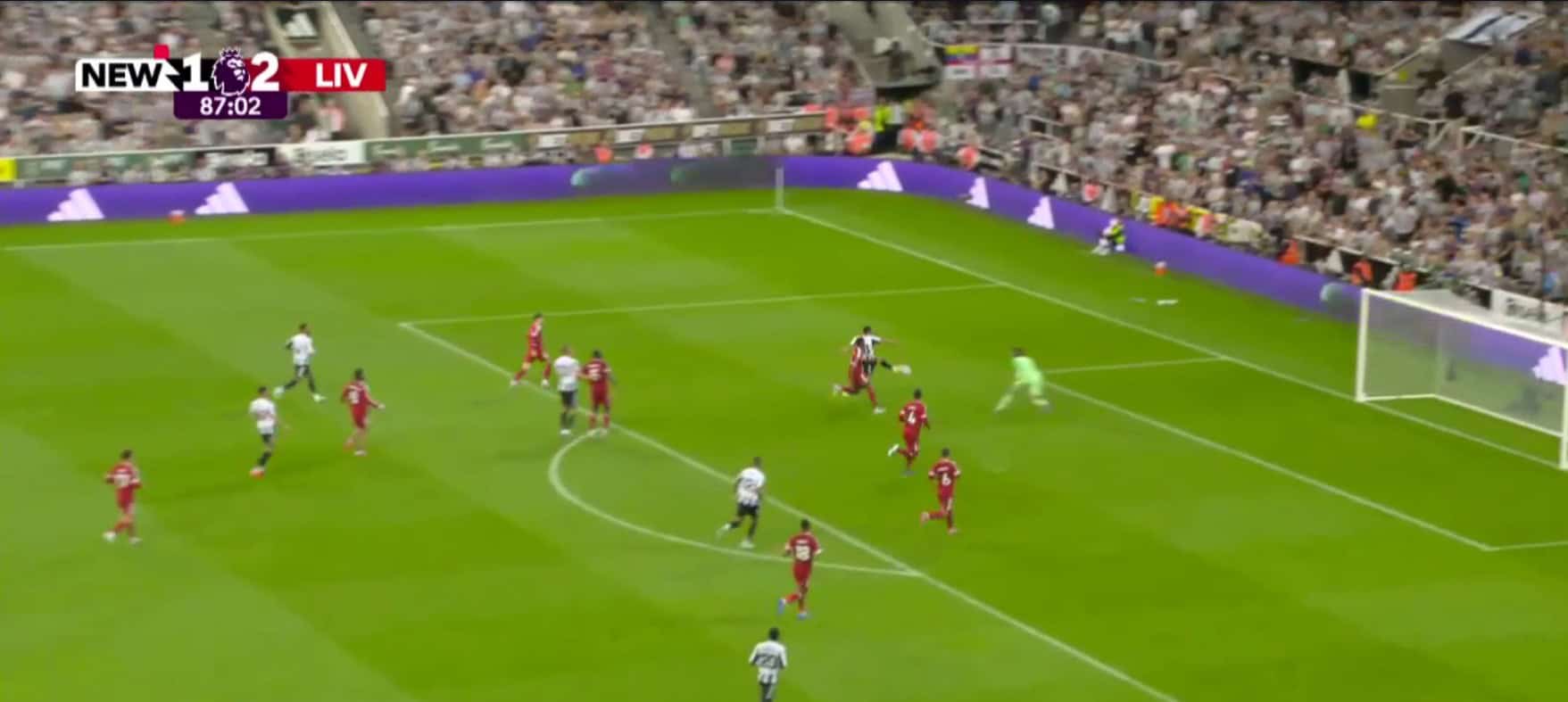 That sequence left Osula 1-v-1 with Alisson, costing Liverpool the equaliser.
 After conceding, Liverpool reverted to defending far free-kicks with a deep line until full-time.
Although we didn’t speak about corners, it’s fair to say that Newcastle truly brought out their strongest weapons against Liverpool in this match when it came to set-pieces.
They were well-prepared, with a clear plan built around individuals who perfectly suited the strategy.
It is hardly surprising that the main Newcastle threats in this narrative are also their best aerial duel specialists.
Dan Burn, who won 146 of 221 aerial duels last season, Joelinton, who won 59 of 105, and Fabian Schär, who won 56 of 127, were the key figures leading this aerial dominance.
All of this put them just a few steps away from getting out of the game with one point at least.
Conclusion
Since the pre-season and the start of this season, 2025/2026, some noticeable trends have been introduced in set pieces, particularly with throw-ins and free-kicks.
While Newcastle frequently utilised the long throw-in, it had not been a common feature across most Premier League clubs in recent years.
Similarly, Liverpool have started to experiment with a deep zonal line, another concept not often seen before.
The question now is whether these tactical innovations will develop into common set-piece trends across the league.
